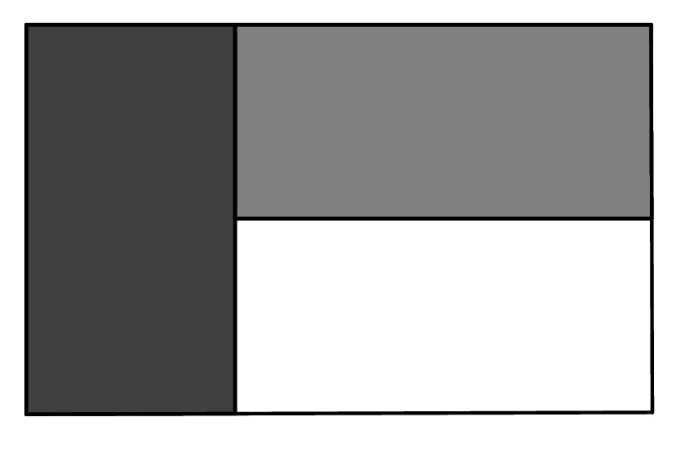
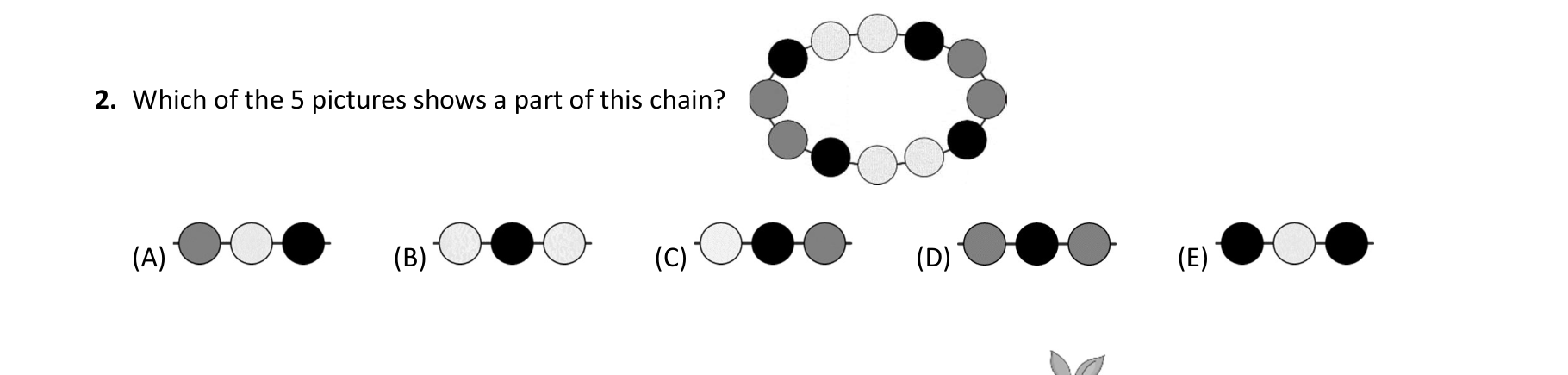
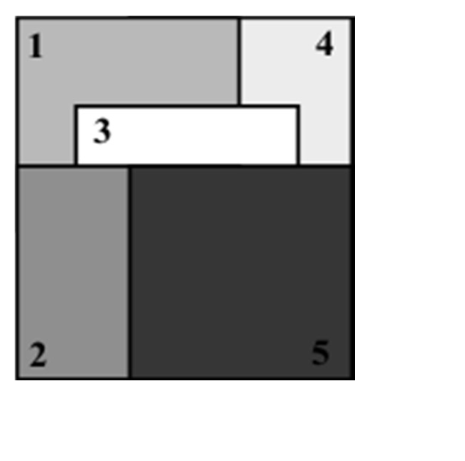
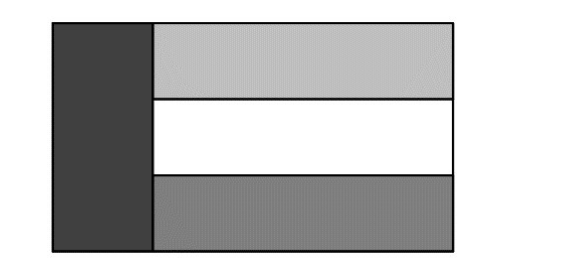
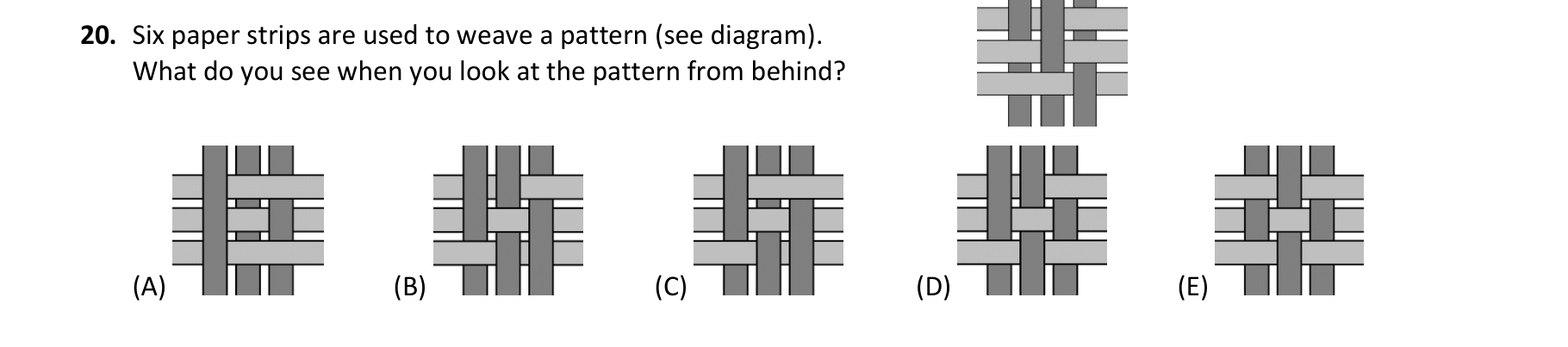
The flag of Kangoraland is a rectangle split into three equal rectangles, as shown. What is the ratio of the side lengths of the white rectangle?
Show answer
Answer: A — 1 : 2
Show hints
Hint 1 of 2
The three rectangles are congruent — the tall dark one is just one of them stood on end.
Still stuck? Show hint 2 →
Hint 2 of 2
Give the small rectangle sides 1 and 2 and check that one upright plus two stacked sideways tile the flag.
Show solution
Approach: the three congruent rectangles are one upright beside two stacked sideways
Let each of the three equal rectangles have short side 1 and long side r.
The dark rectangle stands upright (width 1, height r); the grey and white rectangles lie sideways (width r, height 1) and are stacked, so together they are r wide and 2 tall.
For the flag to be a rectangle, the upright height must equal the stacked height: r = 2.
So each rectangle is 1 by 2, and the white rectangle's sides are in ratio (A) 1 : 2.
A model railway goes round in circles at a constant speed and needs exactly 1 minute and 11 seconds for one circuit. How long does it need for six circuits?
Show answer
Answer: B — 7 minutes 6 seconds
Show hints
Hint 1 of 2
One circuit takes 71 seconds; what do six take?
Still stuck? Show hint 2 →
Hint 2 of 2
Multiply 71 s by 6, then convert back to minutes and seconds.
Show solution
Approach: convert to seconds, multiply, convert back
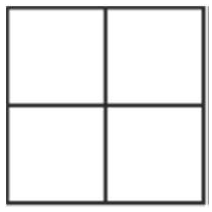
The numbers 1, 2, 3 and 4 are placed in different cells of the 2×2 table shown. Then the sum of the numbers in each row and in each column is found. Two of these sums are 4 and 5. What are the two remaining sums?
Show answer
Answer: E — 5 and 6
Show hints
Hint 1 of 2
The four entries 1,2,3,4 add to 10, so the two row sums add to 10 and the two column sums add to 10.
Still stuck? Show hint 2 →
Hint 2 of 2
If one given sum is a row and the other a column, find each partner from the total 10.
Show solution
Approach: use that all four numbers total 10
The numbers 1+2+3+4 = 10.
The two row sums add to 10; the two column sums also add to 10.
Given sums 4 and 5: the partner of a 4-sum is 6, and the partner of a 5-sum is 5.
So the two remaining sums are 5 and 6 — answer (E).
In a nursery group there are 14 girls and 12 boys. Half of the group go for a walk. What is the minimum number of girls that have to be amongst that group?
Show answer
Answer: E — 1
Show hints
Hint 1 of 3
First find how many children go for the walk: it is half of the whole group.
Still stuck? Show hint 2 →
Hint 2 of 3
To make girls as few as possible, imagine sending all the boys first.
Still stuck? Show hint 3 →
Hint 3 of 3
Once the boys are used up, see how many walking spots are still empty.
Show solution
Approach: fill the walking group with boys first
There are 14 + 12 = 26 children, so half of them, 13, go for the walk.
We want as few girls as possible, so picture sending boys first: there are only 12 boys, and they fill 12 of the 13 spots.
That leaves 13 − 12 = 1 spot, which must go to a girl, so the smallest number of girls is 1 (E).
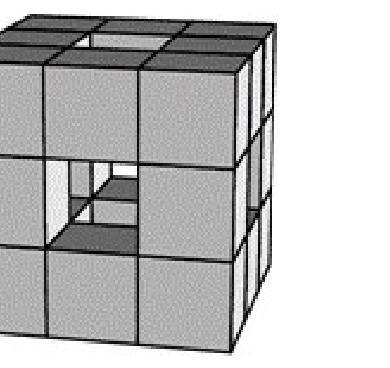
A 3 × 3 × 3 cube is made up of small 1 × 1 × 1 cubes. Then the middle cubes from front to back, from top to bottom and from right to left are removed (see diagram). How many 1 × 1 × 1 cubes remain?
Show answer
Answer: C — 20
Show hints
Hint 1 of 2
Start from all 27 small cubes and figure out exactly which ones get drilled away.
Still stuck? Show hint 2 →
Hint 2 of 2
The three tunnels all pass through the very middle, so the centre cube is removed only once.
Show solution
Approach: count removed cubes, watch the shared centre
A 3×3×3 block has 27 unit cubes.
Each of the three tunnels (front-back, top-bottom, left-right) removes the 3 cubes down its middle line.
All three lines share the single centre cube, so together they remove the centre plus 6 face-centre cubes = 7 cubes.
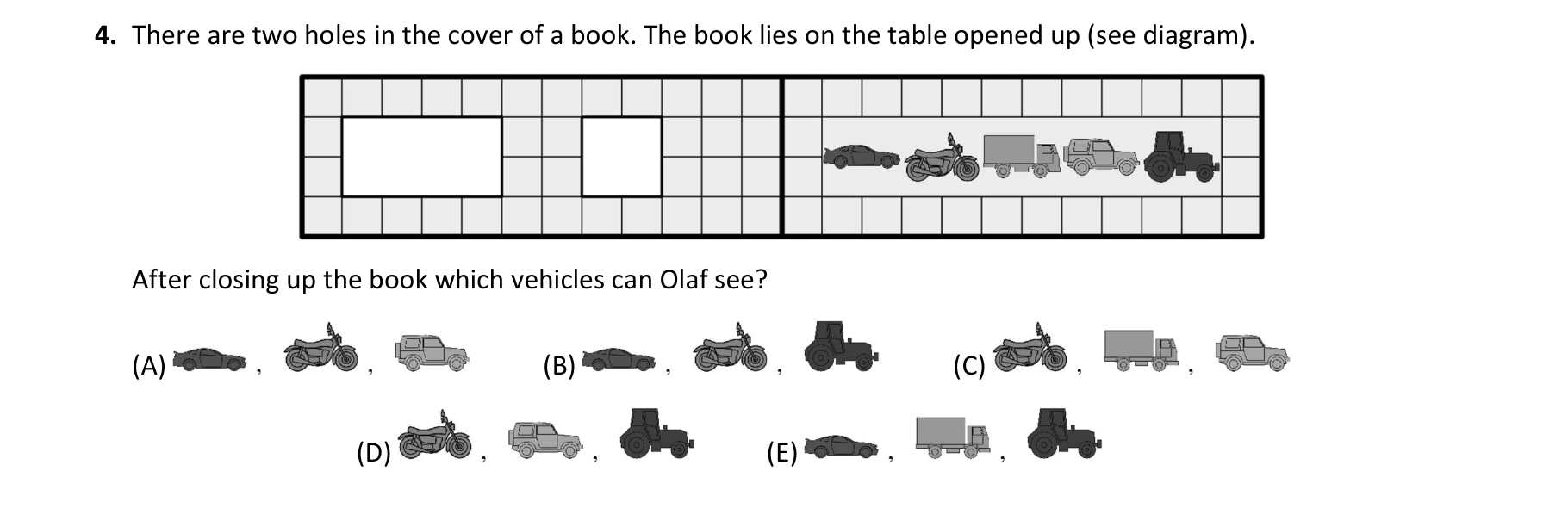
There are two holes in the cover of a book. The book lies on the table opened up (see diagram). After closing up the book, which vehicles can Olaf see through the two holes?
Show answer
Answer: D
Show hints
Hint 1 of 2
When the cover folds over, the holes line up above the page on the right.
Still stuck? Show hint 2 →
Hint 2 of 2
The folded cover flips left-to-right, so the vehicles appear in mirror order through the two windows.
Show solution
Approach: fold the cover and look through the holes
Folding the cover onto the page flips it like a mirror.
The two holes then sit over two groups of vehicles, but in reversed left-right order.
Matching the windows to the line of vehicles gives the set in option D.
There are 12 children in front of a zoo. Susi is the 7th from the front and Kim is the 2nd from the back. How many children are there between Susi and Kim?
Show answer
Answer: B — 3
Show hints
Hint 1 of 2
Find Susi's and Kim's spots in the line first, counting from the same end.
Still stuck? Show hint 2 →
Hint 2 of 2
Once you know both positions, count only the children strictly in between them.
Show solution
Approach: place both children by position, then count the gap
Counting from the front, Susi is in spot 7.
Kim is 2nd from the back of 12, so Kim is in spot 11.
The children between them sit in spots 8, 9 and 10.
Five equally big square pieces of card are placed on a table on top of each other, making the picture shown. The cards are collected up from top to bottom. In which order are they collected?
Show answer
Answer: E — 5-2-3-1-4
Show hints
Hint 1 of 2
The card on top is the one whose whole shape is fully visible, none of it hidden.
Still stuck? Show hint 2 →
Hint 2 of 2
Pick up the fully-showing card first, then the next one that becomes fully visible, and so on.
Show solution
Approach: peel cards top-down, taking the fully-visible one each time
The card that is completely visible (nothing covering it) is on top, so it comes off first.
Remove it, then find the next card that is now fully uncovered, and take that one.
Repeating this gives the order of collection from top to bottom.
A park has five entrances. Monika wants to enter the park through one entrance and leave through another entrance. How many ways are there in which she can enter and leave the park?
Show answer
Answer: B — 20
Show hints
Hint 1 of 2
She enters by one entrance and leaves by a different one.
Still stuck? Show hint 2 →
Hint 2 of 2
Count ordered pairs of distinct entrances: 5 choices then 4.
Five friends bake gingerbread and then meet up for a tasting. Each one gives one of his gingerbreads to each of the other four people. Then everyone eats all of the gingerbread they were given. After that the number of gingerbreads has halved. How many gingerbreads did the five friends have to start with?
Show answer
Answer: D — 40
Show hints
Hint 1 of 2
Work out how many gingerbreads are eaten in total.
Still stuck? Show hint 2 →
Hint 2 of 2
The amount eaten equals half the starting number.
Show solution
Approach: total eaten = half the start
Each of the 5 friends hands one gingerbread to each of the other 4, so 5 × 4 = 20 gingerbreads are given away and eaten.
After eating, the count has halved, so the 20 eaten are exactly half of the start.
Therefore they began with 2 × 20 = 40 gingerbreads.
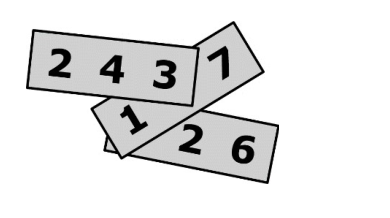
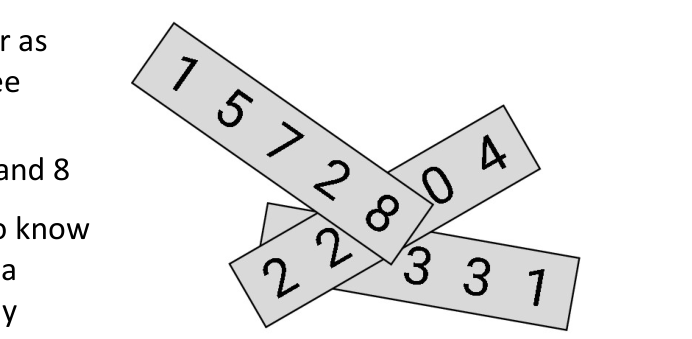
Three four-digit numbers are written on three separate pieces of paper, as shown. The sum of the three numbers is 11126. Three of the digits in the picture are hidden (covered by the overlapping papers). Which are the three hidden digits?
Show answer
Answer: B — 1, 5 and 7
Show hints
Hint 1 of 2
The three four-digit numbers add to 11126; line them up by place value and use the visible digits.
Still stuck? Show hint 2 →
Hint 2 of 2
Work column by column from the units, tracking carries, to pin down the three covered digits.
Show solution
Approach: add the three numbers by columns using the total 11126
Stack the three four-digit numbers as a column addition equal to 11126.
Going column by column from the units and carrying as needed, the visible digits force each hidden position in turn.
Completing the reconstruction gives the three hidden digits as 1, 5 and 7.
In an enclosure there is a group of kangaroos. If you add up the ages of all the kangaroos you get 36 years. In two years all the kangaroos together will be 60 years old. How many kangaroos are in the enclosure?
Show answer
Answer: A — 12
Show hints
Hint 1 of 3
In two years every single kangaroo gets exactly 2 years older.
Still stuck? Show hint 2 →
Hint 2 of 3
So the whole total grows by 2 for each kangaroo there is.
Still stuck? Show hint 3 →
Hint 3 of 3
The total grew from 36 to 60; ask how many 2s fit into that growth.
Show solution
Approach: the total gains 2 years per kangaroo
In two years the combined age goes from 36 to 60, so it grows by 60 − 36 = 24 years.
Each kangaroo is responsible for 2 of those extra years, so there must be 24 ÷ 2 = 12 kangaroos.
There are two kinds of camels: bactrian camels that have 2 humps, and dromedaries that have 1 hump. Exactly 10 camels live in a certain zoo. Together they have 14 humps. How many bactrian camels are there in this zoo?
Show answer
Answer: D — 4
Show hints
Hint 1 of 2
If all 10 camels had just 1 hump, how many humps would that be?
Still stuck? Show hint 2 →
Hint 2 of 2
Every bactrian camel adds one extra hump beyond that; the extra humps tell you the count.
Show solution
Approach: start from all one-hump and add the extra humps
If all 10 camels had 1 hump each, that would be 10 humps.
There are 14 humps, so there are 4 extra humps.
Each bactrian camel has one extra hump, so there are 4 bactrian camels.
The individual masses (in kg) of three kangaroos are three different integers. Together they weigh 97 kg. What is the maximum weight the lightest of the three can have?
Show answer
Answer: C — 31
Show hints
Hint 1 of 2
To make the lightest as big as possible, keep the three weights as close together as you can.
Still stuck? Show hint 2 →
Hint 2 of 2
Try three near-equal integers summing to 97 and adjust.
Show solution
Approach: push the three values close together
Let the weights be a < b < c with a + b + c = 97.
The lightest is largest when the three are nearly equal: 31, 32, 34 = 97.
Lothar finishes a race ahead of Manfred. Victor finishes after Jan, Manfred finishes ahead of Jan, and Eddy finishes ahead of Victor. Which of the five finishes the race last?
Show answer
Answer: A — Victor
Show hints
Hint 1 of 2
Write each clue as 'X before Y' and chain them.
Still stuck? Show hint 2 →
Hint 2 of 2
The last finisher is the one nobody finishes behind.
Show solution
Approach: order the chain of finishing positions
Lothar before Manfred, Manfred before Jan, and Jan before Victor give the order L, M, J, V.
Eddy finishes before Victor, so Eddy is also ahead of Victor.
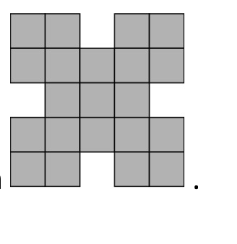
Laura wants to colour in exactly one 2 × 2 square (a block of four little squares) somewhere in the figure shown. How many ways are there for her to do that?
Show answer
Answer: D — 8
Show hints
Hint 1 of 3
Every 2×2 block is pinned down by just one cell: the one in its top-left corner.
Still stuck? Show hint 2 →
Hint 2 of 3
Slide the block around and mark each spot where all four of its little squares stay inside the shape.
Still stuck? Show hint 3 →
Hint 3 of 3
Count those marked spots carefully so you do not double-count or miss one.
Show solution
Approach: count valid top-left corners for a 2×2 square
Each placement of the 2×2 square is decided by which cell is its upper-left corner, provided all four cells lie inside the figure.
Going through the shape cell by cell, there are exactly eight spots where a full 2×2 square fits.
Julia reads a book whose pages are all numbered. The digit 0 appears five times and the digit 8 appears six times. What is the page number of the last page?
Show answer
Answer: B — 58
Show hints
Hint 1 of 2
Count how many 0s and 8s appear as you number pages 1, 2, 3, and so on.
Still stuck? Show hint 2 →
Hint 2 of 2
Stop at the page where the 0-count and 8-count first match the clue.
Show solution
Approach: tally the digits up to each candidate
Counting digits from page 1: the digit 0 first reaches five copies and the digit 8 first reaches six copies at the same point.
Tallying shows that happens exactly at page 58 (zeros in 10,20,30,40,50; eights in 8,18,28,38,48,58).
On each of three separate pieces of paper there is a three-digit number. The papers overlap so that one digit on each of two of them is hidden (see picture). The sum of the three numbers is 826. What is the sum of the two hidden digits?
Show answer
Answer: C — 9
Show hints
Hint 1 of 3
Line the three numbers up by ones, tens and hundreds, just like in column addition.
Still stuck? Show hint 2 →
Hint 2 of 3
Add only the digits you can actually see in each column, and call the two covered ones blanks.
Still stuck? Show hint 3 →
Hint 3 of 3
Compare your visible total with 826 to see what the two blanks together must make up.
Show solution
Approach: reconstruct from the column sums
Stack the three numbers in columns and add only the digits you can see, leaving the two hidden ones as blanks.
The visible digits already account for most of 826; the gap left over is what the two covered digits must supply together.
Working through the ones, tens and hundreds columns, the two hidden digits must add up to 9 (C).
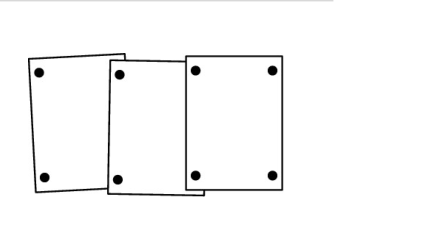
Linda fixes 3 photos on a pin board next to each other. She uses 8 pins to do so (see picture). Peter wants to fix 7 photos in the same way. How many pins does he need for that?
Show answer
Answer: B — 16
Show hints
Hint 1 of 2
Look at the picture: the first photo needs 4 pins (its 4 corners), but each new photo touches the one before it.
Still stuck? Show hint 2 →
Hint 2 of 2
Because neighbours share their pins, every photo after the first adds the same small number of pins.
Show solution
Approach: see the repeating add-on for each photo
The top row of pins has one more pin than the number of photos, and so does the bottom row.
For 3 photos that is 4 pins on top and 4 pins on the bottom, which makes 8 pins — this matches the picture.
For 7 photos it is 8 pins on top and 8 pins on the bottom.
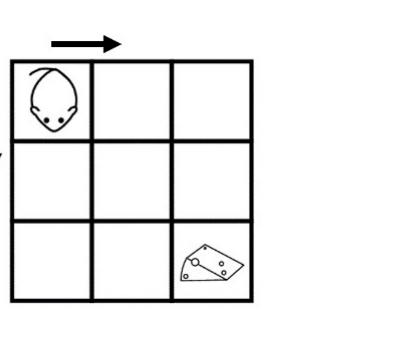
The picture shows a mouse and a piece of cheese. The mouse is only allowed to move to the neighbouring fields in the direction of the arrows. How many paths are there from the mouse to the cheese?
Show answer
Answer: E — 6
Show hints
Hint 1 of 2
The arrows only let the mouse go forward toward the cheese, never back.
Still stuck? Show hint 2 →
Hint 2 of 2
Trace one path with your finger, then carefully find every different way without repeating one.
Show solution
Approach: trace every allowed path one at a time and count them
Put your finger on the mouse and follow the arrows toward the cheese.
Each time you reach a spot with two arrows, you can pick a different way to go.
Carefully trace each different route all the way to the cheese without repeating one.
Counting all the different routes gives 6, so the answer is E.
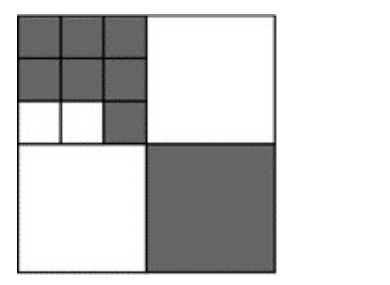
A big square is divided up into smaller squares of different sizes, as shown. Some of the smaller squares are shaded grey. Which fraction of the big square is shaded grey?
Show answer
Answer: D — 49
Show hints
Hint 1 of 2
Pick a unit so the smallest cells are 1 by 1 and the whole square is a whole number of them.
Still stuck? Show hint 2 →
Hint 2 of 2
Count grey units and divide by the total units.
Show solution
Approach: count equal area units
Let the big square be 6×6 = 36 small units.
The fully grey square in the lower-right quarter covers 9 units, and the grey cells in the small 3×3 block cover another 7 units.
Grey total = 9 + 7 = 16 units, so the fraction is 16/36 = 4/9.
The six smallest odd natural numbers are written on the sides of a die. Toni rolls the die three times and adds the numbers. Which sum will Toni not be able to make?
Show answer
Answer: E — 35
Show hints
Hint 1 of 3
The six smallest odd numbers are 1, 3, 5, 7, 9, 11, so those are the faces.
Still stuck? Show hint 2 →
Hint 2 of 3
Adding three odd numbers always gives an odd result, and there is a biggest total you can ever reach.
Still stuck? Show hint 3 →
Hint 3 of 3
Find that biggest possible total and check each answer against it.
Show solution
Approach: bound the achievable totals
The faces are the odd numbers 1, 3, 5, 7, 9, 11, and the biggest total you can roll is 11 + 11 + 11 = 33.
Three odd numbers always add to an odd number, and every odd value from 3 up to 33 can be reached.
35 is larger than the biggest possible total of 33, so it can never be made: 35 (E).
Andreas shares some apples equally among six baskets. Boris shares the same number of apples equally among five baskets. Boris notices that each of his baskets has two more apples than each of Andreas's baskets. How many apples did Andreas share out?
Show answer
Answer: A — 60
Show hints
Hint 1 of 2
Let the total number of apples be one unknown and write each person's per-basket amount.
Still stuck? Show hint 2 →
Hint 2 of 2
Boris's basket has 2 more than Andreas's basket.
Show solution
Approach: set up one equation in the total
Let the total be x apples. Andreas puts x/6 in each basket, Boris puts x/5 in each.
Every day the three kangaroos Alex, Bob and Carl go for a walk. If Alex does not wear a hat, then Bob wears a hat. If Bob does not wear a hat, then Carl wears a hat. Today Carl does not wear a hat. Which kangaroos can we be sure are wearing a hat today?
Show answer
Answer: E — only Bob
Show hints
Hint 1 of 2
Carl wears no hat. Use the rule 'if Bob has no hat then Carl wears one' in reverse.
Still stuck? Show hint 2 →
Hint 2 of 2
Since Carl has no hat, Bob must have one; then check whether Alex is forced.
Show solution
Approach: contrapositive reasoning from Carl
Rule: if Bob has no hat, Carl wears one. Carl has no hat, so Bob must have a hat.
Rule: if Alex has no hat, Bob wears one — already satisfied, so Alex is not forced either way.
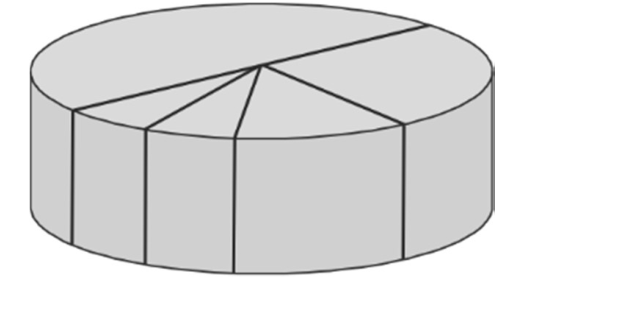
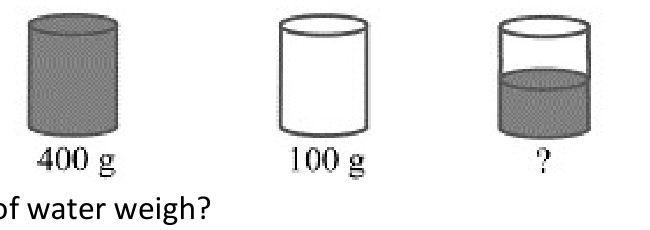
Mother halves the birthday cake. One half she then halves again. Of that she again halves one of the smaller pieces. Of these smaller pieces she once more halves one of them (see diagram). One of the two smallest pieces weighs 100 g. How much does the entire cake weigh?
Show answer
Answer: D — 1600 g
Show hints
Hint 1 of 2
Each halving makes a piece half as big; the smallest piece is a fraction of the whole cake.
Still stuck? Show hint 2 →
Hint 2 of 2
Halving four times gives a sixteenth, so the 100 g piece is 1/16 of the cake.
Show solution
Approach: track the fraction of the whole
Halving the cake repeatedly gives pieces of 1/2, 1/4, 1/8, and finally 1/16.
The smallest piece is 1/16 of the cake and weighs 100 g.
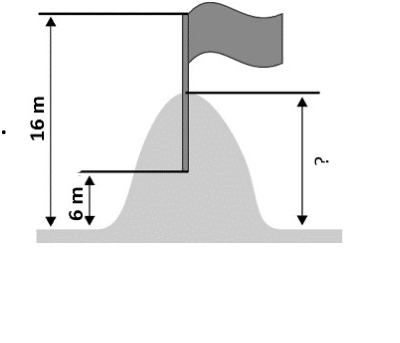
The giants Tim and Tom build a sandcastle and decorate it with a flag. They push half the flagpole into the highest point of the sandcastle. The highest point of the flagpole is now 16 m above the floor, and the lowest is 6 m (see diagram). How high is the sandcastle?
Show answer
Answer: A — 11 m
Show hints
Hint 1 of 2
Find the whole length of the flagpole from its top and bottom heights.
Still stuck? Show hint 2 →
Hint 2 of 2
Half the pole is buried, so the sand reaches halfway up the pole; that halfway height is the castle.
Show solution
Approach: find pole length, then take the midpoint where the sand reaches
The pole's top is 16 m up and its bottom is 6 m up, so the pole is 16 − 6 = 10 m long.
Half the pole (5 m) is buried in the castle, starting from its bottom at 6 m.
So the sand reaches up to 6 + 5 = 11 m, which is the top of the castle.
Three five-digit numbers are written onto three separate pieces of paper, as shown. Three of the digits in the picture are hidden. The sum of the three numbers is 57263. Which are the hidden digits?
Show answer
Answer: B — 1, 2 and 9
Show hints
Hint 1 of 2
The three five-digit numbers add to 57263; match digits column by column.
Still stuck? Show hint 2 →
Hint 2 of 2
Work through the addition with carries to pin down each hidden digit.
Show solution
Approach: column addition with the known total
Line up the three five-digit numbers so their sum is 57263.
Filling the columns with the right carries forces the three covered digits.
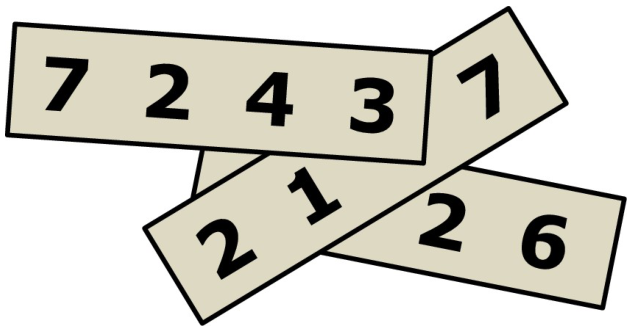
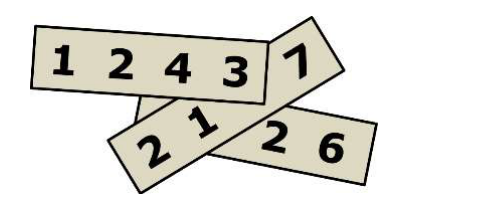
Three four-digit numbers are written on three separate strips of paper, as shown. The sum of the three numbers is 10126. Three of the digits in the picture are hidden. Which are the hidden digits?
Show answer
Answer: A — 5, 6 and 7
Show hints
Hint 1 of 3
You don't need to find each number — just the total of the three hidden digits.
Still stuck? Show hint 2 →
Hint 2 of 3
The digit sum of a number leaves the same remainder on division by 9 as the number itself, so the digits of all three numbers together must match 10126 in that test.
Still stuck? Show hint 3 →
Hint 3 of 3
Add the nine visible digits, see what the three hidden ones must add to, then pick the option with that sum.
Show solution
Approach: use the divisible-by-9 (digit-sum) check instead of reconstructing the numbers
A number and its digit sum leave the same remainder when divided by 9, so the sum of all twelve digits leaves the same remainder as 10126 does.
10126 has digit sum 1+0+1+2+6 = 10, which leaves remainder 1; the nine visible digits add to 1+2+4+3+7+2+1+2+6 = 28, which also leaves remainder 1.
So the three hidden digits must add to a multiple of 9; among the choices only 5+6+7 = 18 works.
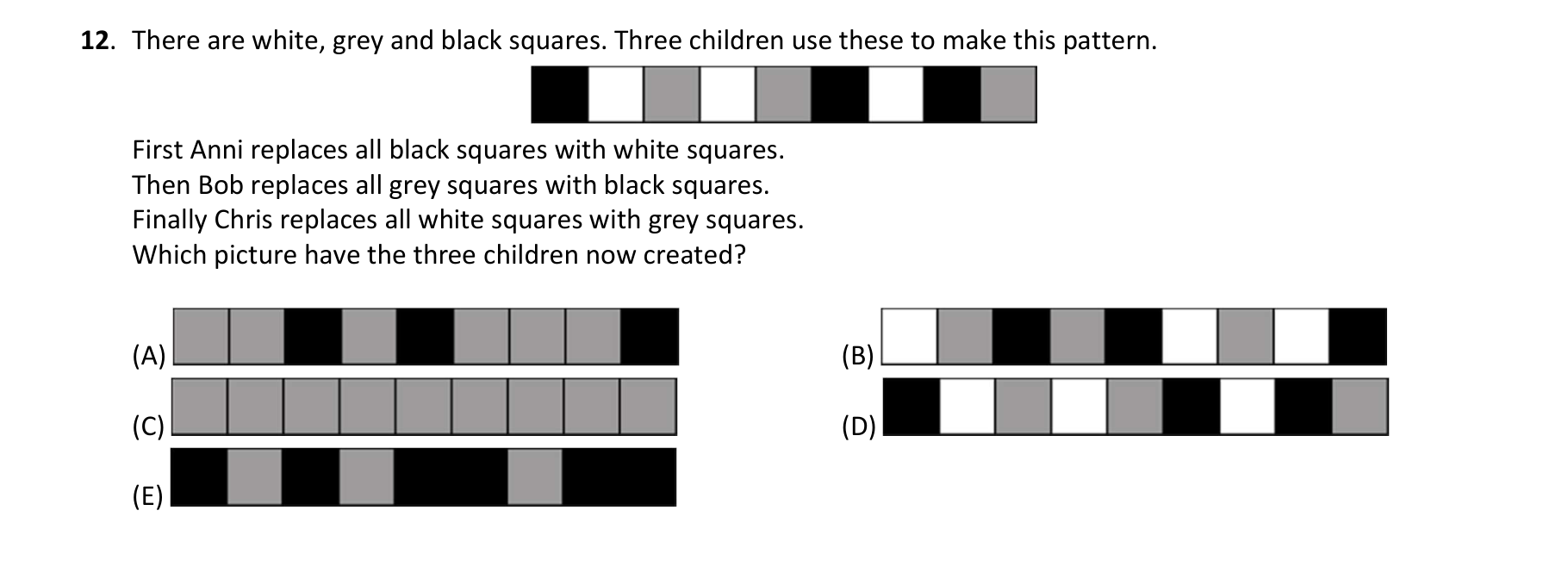
There are white, grey and black squares. Three children use these to make this pattern. First Anni replaces all black squares with white squares. Then Bob replaces all grey squares with black squares. Finally Chris replaces all white squares with grey squares. Which picture have the three children now created?
Show answer
Answer: A
Show hints
Hint 1 of 2
Do the three colour changes one at a time, in the order Anni, then Bob, then Chris.
Still stuck? Show hint 2 →
Hint 2 of 2
Follow just one square of each starting colour all the way through to see what it turns into.
Show solution
Approach: follow each starting colour through the three changes in order
A black square turns white (Anni), then that white turns grey (Chris), so black ends grey.
A grey square turns black (Bob) and stays black, so grey ends black.
A white square is only changed by Chris, turning grey, so white ends grey.
Recolouring every square this way gives the picture in option A.
Anna, Bella, Claire, Dora, Erika and Frieda meet at a party. Each pair who know each other shake hands exactly once. Anna shakes hands only once, Bella twice, Claire three times, Dora four times and Erika five times. How many people does Frieda shake hands with?
Show answer
Answer: C — 3
Show hints
Hint 1 of 2
Erika shook hands 5 times, so she shook everyone — including Anna, whose single handshake is therefore with Erika.
Still stuck? Show hint 2 →
Hint 2 of 2
Peel the people off one at a time (Erika, then Dora, …) to see who is left for Frieda.
Show solution
Approach: deduce each person's partners step by step
Erika (5) shook everyone; Anna (1) then only shook Erika.
Dora (4) shook everyone but Anna: Erika, Bella, Claire, Frieda — giving Bella her 2nd handshake.
Claire (3) shook Erika, Dora and Frieda, so Frieda's partners are Erika, Dora, Claire: 3 people.
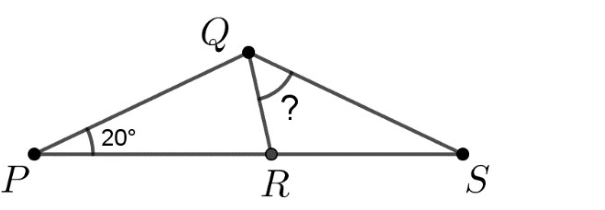
The following is known about triangle PSQ: angle QPS = 20°. The triangle PSQ has been split into two smaller triangles by the line QR, as shown. It is known that PQ = PR = QS. How big is the angle RQS?
Show answer
Answer: B — 60°
Show hints
Hint 1 of 2
PQ = PR makes one isosceles triangle; use its base angles.
Still stuck? Show hint 2 →
Hint 2 of 2
Then chase angles into triangle QRS where QS = PR.
Show solution
Approach: isosceles angle chase
In triangle PQR, PQ = PR and the apex angle at P is 20°, so the base angles are each (180−20)/2 = 80°.
Angle QRS is the supplement of 80° along line PS, namely 100°.
With QS = PR the remaining triangle forces angle RQS = 60°.
This school year the number of boys in my class increased by 20% compared with last year, and the number of girls decreased by 20%. There is now one more person in the class than before. Which of the following could be the current number of students in my class?
Show answer
Answer: B — 26
Show hints
Hint 1 of 2
A change of 20% gives a whole number only if the count is a multiple of 5, so last year's boys and girls were each multiples of 5.
Still stuck? Show hint 2 →
Hint 2 of 2
Write boys = 5b and girls = 5g; the net headcount change of +1 pins down b − g.
Show solution
Approach: boys and girls were each multiples of 5 last year
Let last year's boys = 5b and girls = 5g, so the 20% changes give whole numbers.
New count = 6b + 4g, old count = 5b + 5g; the increase is b − g = 1, so b = g + 1.
New total = 6(g+1) + 4g = 10g + 6, which for g = 2 gives 26.
In a witch’s garden there are 30 animals: dogs, cats and mice. The witch changes 6 dogs into 6 cats and then 5 cats into 5 mice. Now there is an equal number of dogs, cats and mice. How many cats were there to start with?
Show answer
Answer: C — 9
Show hints
Hint 1 of 3
At the end the three kinds are equal, and 30 splits into three equal piles.
Still stuck? Show hint 2 →
Hint 2 of 3
Follow only the cats: first they go up, then they go down.
Still stuck? Show hint 3 →
Hint 3 of 3
Work the cat count backwards from its final value to its start.
Show solution
Approach: work backward from 10 cats
At the end the three kinds are equal, so each is 30 ÷ 3 = 10; in particular there are 10 cats at the end.
Cats gained 6 (the dogs that became cats) and then lost 5 (the cats that became mice), a net change of 6 − 5 = +1.
So the cats started 1 fewer than they ended: 10 − 1 = 9 cats (C).
Sara has 16 blue marbles. She can swap her marbles in the following way: for 3 blue marbles she gets 1 red marble, and for 2 red marbles she gets 5 green marbles. What is the maximum number of green marbles she can get?
Show answer
Answer: B — 10
Show hints
Hint 1 of 2
First turn as many blue marbles as possible into red ones, then trade reds for greens.
Still stuck? Show hint 2 →
Hint 2 of 2
Watch the leftovers: trades only happen in fixed bundles (3 blue, 2 red).
Show solution
Approach: trade in bundles and track leftovers
16 blue ÷ 3 gives 5 red marbles (1 blue left over).
5 red ÷ 2 gives 2 trades = 10 green marbles (1 red left over).
Together the three squirrels Anni, Asia and Elli have 10 nuts. Each one has a different number of nuts, but at least 2 nuts. Anni has the least number of nuts. Asia has the most nuts. How many nuts does Elli have?
Show answer
Answer: C — 3
Show hints
Hint 1 of 2
Anni has the fewest and each squirrel has at least 2, so start Anni as low as allowed.
Still stuck? Show hint 2 →
Hint 2 of 2
Try the smallest possible numbers that are all different and add to 10, then read Elli's amount.
Show solution
Approach: use the smallest distinct amounts that sum to 10
All three numbers are different, each at least 2, and they add to 10.
Anni has the fewest, so try Anni = 2; then Elli and Asia must add to 8 with Asia largest.
The only way is Elli = 3 and Asia = 5 (all different, Asia most).
The vertices of a square ABCD are labelled anti-clockwise. A and C are the vertices of an equilateral triangle AEC, whose vertices are also labelled anti-clockwise. How big is the angle CBE?
Show answer
Answer: C — 135°
Show hints
Hint 1 of 2
Place the square on coordinates and find the equilateral triangle's apex E on the correct (anticlockwise) side.
Still stuck? Show hint 2 →
Hint 2 of 2
Measure angle CBE from the coordinates.
Show solution
Approach: coordinates and angle measurement
Take A(0,0), B(1,0), C(1,1), D(0,1). The anticlockwise triangle AEC puts E outside the square beyond AC.
Triangle BCE is isosceles, and the apex angle at B works out to 135°.
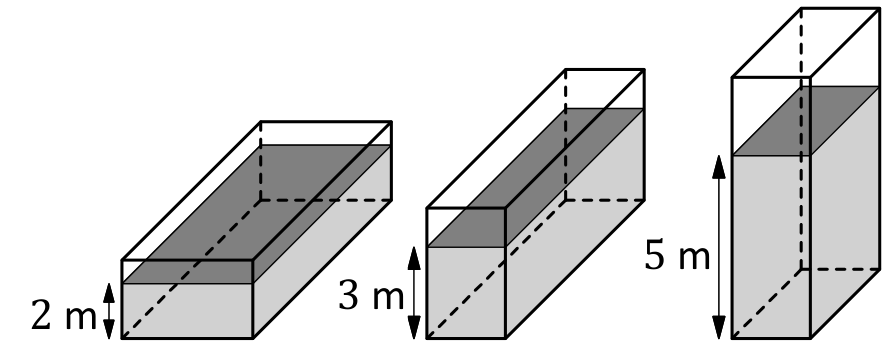
A cuboid-shaped container that is not completely filled holds 120 m³ of water. Depending on which face the container stands on, the depth of the water is 2 m, 3 m or 5 m (drawings not to scale). What is the volume of the container?
Show answer
Answer: E — 240 m³
Show hints
Hint 1 of 2
The same 120 m³ gives depth 2, 3 or 5 on three different bottom faces, so each face area is 120 divided by that depth.
Still stuck? Show hint 2 →
Hint 2 of 2
From the three face areas 60, 40 and 24, the cuboid's volume is the square root of their product.
Show solution
Approach: the water volume is the same in every orientation
The 120 m³ of water sits with depth 2, 3 or 5 m on three different faces.
Each bottom face area = 120 ÷ depth, giving 60, 40 and 24 m² — the three face areas of the cuboid.
If the edges are x, y, z then the faces are xy, xz, yz, so \((xyz)^2 = 60\cdot 40\cdot 24 = 57600\) and the volume is \(xyz = 240\).
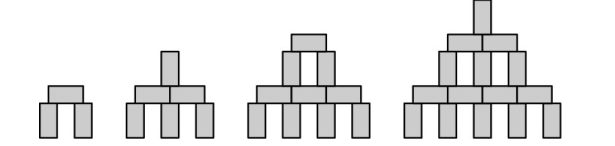
Maxi builds towers made up of little 1 cm × 1 cm × 2 cm building blocks, as shown in the picture. He continues to build his towers in the same way. Finally he uses 28 building blocks for one tower. What is the height of this tower?
Show answer
Answer: C — 11 cm
Show hints
Hint 1 of 3
Write down how many blocks each tower in the picture uses, in order.
Still stuck? Show hint 2 →
Hint 2 of 3
Each new tower adds one more block than the jump before, so the counts grow 3, 6, 10, 15, ...
Still stuck? Show hint 3 →
Hint 3 of 3
Keep extending until you reach 28 blocks, then read that tower's height from how it is built.
Show solution
Approach: extend the block-count pattern
Count the blocks in the picture's towers: 3, then 6, then 10, then 15. Each step adds one more block than the step before (+3, +4, +5, ...).
Keep going: 15 + 6 = 21, then 21 + 7 = 28, so the 28-block tower is the next one in the staircase pattern.
Building that tower in the same way, it rises to a height of 11 cm (C).
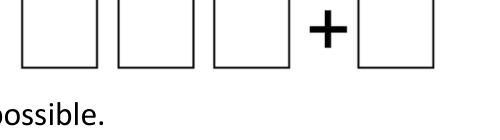
Steven wants to write each of the digits 2, 0, 1 and 9 into the boxes of this addition (a three-digit number plus a single-digit number). He wants to obtain the biggest result possible. Which digit does he have to use for the single-digit number?
Show answer
Answer: A — either 0 or 1
Show hints
Hint 1 of 2
The biggest sum comes from putting the largest digit, 9, in the hundreds place of the three-digit number.
Still stuck? Show hint 2 →
Hint 2 of 2
The single digit and the units of the three-digit number both count once, so swapping them does not change the total.
Show solution
Approach: maximise by place value
Put 9 in the hundreds place; the sum becomes 900 + (tens, units, single from 2,1,0).
Put 2 in the tens place to add the most: 920 + (remaining 1 and 0).
The leftover 1 and 0 fill the units and the single-digit number, each adding the same amount.
So the single digit can be either 0 or 1: answer A.
The numbers a, b, c and d are pairwise different integers between 1 and 10 (1 and 10 included). What is the smallest possible value of the expression ab + cd ?
Show answer
Answer: C — 1445
Show hints
Hint 1 of 2
To make a/b + c/d small, use small numerators and large denominators.
Still stuck? Show hint 2 →
Hint 2 of 2
Try numerators 1 and 2 with denominators 9 and 10, paired to minimise the sum.
Show solution
Approach: minimise by smart pairing
Use the small numerators 1, 2 and large denominators 9, 10.
Pairing 1/9 + 2/10 = 1/9 + 1/5 = 14/45.
No other choice of distinct 1–10 values beats it, so the minimum is 14/45.
Anna, Bella, Claire, Dora and Erika meet at a party. Each pair who know each other shake hands exactly once. Anna shakes hands once, Bella twice, Claire three times and Dora four times. How many people does Erika shake hands with?
Show answer
Answer: B — 2
Show hints
Hint 1 of 2
Start from Dora, who shook hands four times, so she met everyone else.
Still stuck? Show hint 2 →
Hint 2 of 2
Peel off who Anna, Bella and Claire could have shaken to find Erika's count.
Show solution
Approach: reason from the largest handshake count down
Dora shook 4 times, so she shook hands with all of Anna, Bella, Claire and Erika.
Anna shook only once, so Anna's single handshake was with Dora.
Claire shook three times: with Dora plus two others, which must be Bella and Erika; Bella's two are Dora and Claire.
So Erika shook hands with Dora and Claire: 2 people.
Michael invents a new operation \(\diamond\) for real numbers, defined by \(x \diamond y = y - x\). Which of the following statements is definitely true if numbers \(a\), \(b\) and \(c\) satisfy \((a \diamond b) \diamond c = a \diamond (b \diamond c)\)?
Show answer
Answer: D — \(a = 0\)
Show hints
Hint 1 of 2
Carefully apply \(x \diamond y = y - x\) to each side of the equation.
Still stuck? Show hint 2 →
Hint 2 of 2
Both sides become a simple expression in \(a\), \(b\), \(c\); the difference shows which variable is forced.
Show solution
Approach: expand both sides of the condition
With \(x \diamond y = y - x\), the left side is \((a \diamond b) \diamond c = c - (b - a) = c - b + a\).
The right side is \(a \diamond (b \diamond c) = (c - b) - a = c - b - a\).
Setting them equal gives \(c - b + a = c - b - a\), so \(2a = 0\), i.e. \(a = 0\).
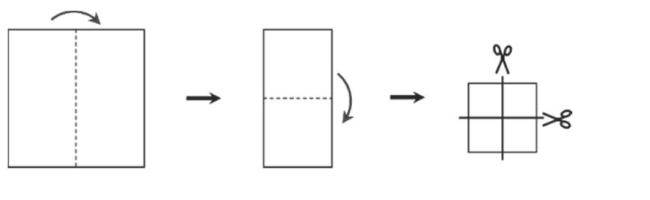
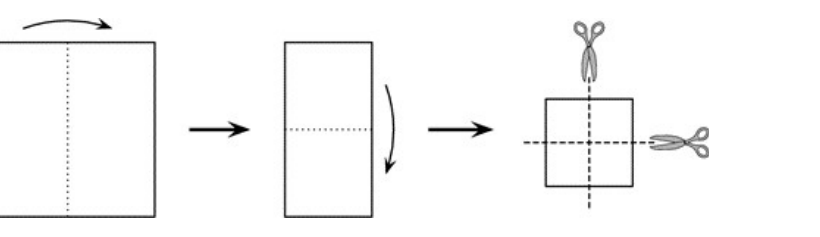
Bridget folds a square piece of paper in half, then in half again, and then cuts it along the two lines shown in the picture. How many pieces of paper does she get?
Show answer
Answer: C — 9
Show hints
Hint 1 of 3
Folding the square in half twice stacks it into four layers.
Still stuck? Show hint 2 →
Hint 2 of 3
One snip through four layers makes four cuts at once, so imagine the cut lines reflected when you unfold.
Still stuck? Show hint 3 →
Hint 3 of 3
Draw the unfolded square with all the cut lines and count the separate pieces.
Show solution
Approach: track the cuts through the folded layers, then unfold
Folding the square twice stacks it into four layers.
The two cuts slice through all the layers; unfolding turns each cut into a full line across the paper.
Counting the regions those lines make gives 9 separate pieces (C).
The flag of Kanguria is a rectangle whose side lengths are in the ratio 3 : 5. The flag is split into four rectangles of equal area, as shown. In which ratio are the side lengths of the white rectangle?
Show answer
Answer: E — 4 : 15
Show hints
Hint 1 of 2
The flag splits into four equal-area rectangles: one tall left strip plus three stacked bars on the right.
Still stuck? Show hint 2 →
Hint 2 of 2
Use the 3:5 side ratio to size the white bar, then take its own width-to-height ratio.
Show solution
Approach: size the pieces from equal areas
Take the flag 5 wide by 3 tall; each of the four equal pieces has area 15/4.
The left strip is 5/4 × 3; the three right bars are each 15/4 wide by 1 tall.
The white bar is 1 by 15/4, side ratio 1 : 15/4 = 4 : 15.
Jane plays basketball. Of her first 20 throws, 55% are successful. After five more throws her success rate rises to 56%. How many of her last five throws were successful?
Show answer
Answer: C — 3
Show hints
Hint 1 of 2
Turn each percentage into an actual number of successful throws.
Still stuck? Show hint 2 →
Hint 2 of 2
Subtract to find how many of the last five went in.
Show solution
Approach: convert percents to counts and subtract
Of the first 20 throws, 55% = 11 were successful.
After 25 throws the rate is 56%, so 0.56 × 25 = 14 successful in total.
The last five contributed 14 − 11 = 3 successful throws.
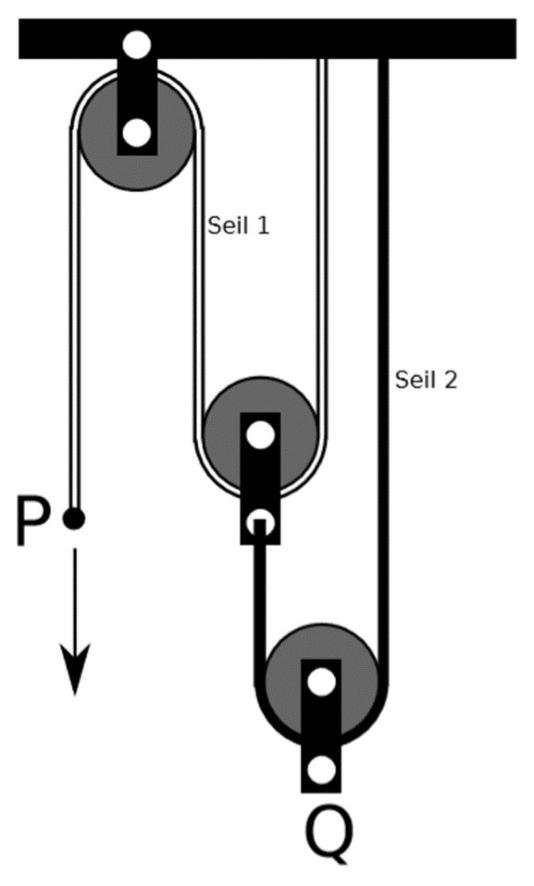
The system shown consists of three pulleys connected to each other by two ropes. The end P of one rope is pulled down by 24 cm. By how many centimetres does point Q move upwards?
Show answer
Answer: D — 6
Show hints
Hint 1 of 2
With movable pulleys the total rope length is conserved; the 24 cm pulled at P is shared among the rope segments that support each pulley.
Still stuck? Show hint 2 →
Hint 2 of 2
Follow each rope over its pulleys and see how the displacement is divided down to point Q.
Show solution
Approach: conserve rope length across the pulley system
Pulling P down by 24 cm feeds slack into the connected ropes.
Each movable pulley halves the displacement passed on, and the two ropes combine the reductions before reaching Q.
Following the displacement through the system, Q rises by 6 cm.
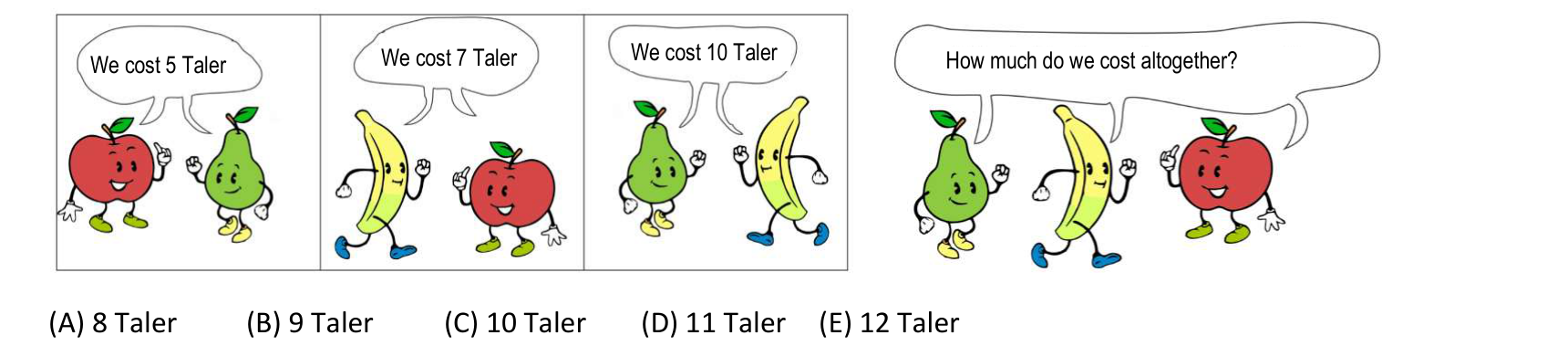
The pictures show how much 2 pieces of fruit cost altogether. The first three show pairs costing 5, 7 and 10 Taler. How much do the three fruits in the last picture cost altogether?
Show answer
Answer: D — 11 Taler
Show hints
Hint 1 of 2
Add the three given pair-prices together; each fruit then appears exactly twice.
Still stuck? Show hint 2 →
Hint 2 of 2
The last picture shows all three fruits, whose total is half of that combined sum.
Show solution
Approach: add the pairs, then halve
The three given totals are 5, 7 and 10 Taler.
Adding them gives 22, which counts each fruit twice.
All three fruits together cost 22 ÷ 2 = 11 Taler (D).
A 3 × 2 rectangle can be covered in two ways by two of the L-shaped figures, as shown. In how many ways can the diagram on the right be covered by these L-shaped figures?
Show answer
Answer: B — 2
Show hints
Hint 1 of 2
The two L-pieces must pair up the way they did in the 3 × 2 box.
Still stuck? Show hint 2 →
Hint 2 of 2
Find a corner cell that only one piece can reach, and let that placement force the rest.
Show solution
Approach: let a forced corner pin down the whole covering
Look at a corner cell of the figure: only one orientation of an L-piece can cover it while staying inside.
Once that corner piece is placed, the cells it leaves can be completed by the remaining pieces in just two consistent ways.
Kathi folds a square piece of paper twice and then cuts it along the two lines shown in the picture. The resulting pieces of paper are then unfolded where possible. How many of the pieces are squares?
Show answer
Answer: C — 5
Show hints
Hint 1 of 2
Fold mentally, mark the two cuts, then unfold and see which pieces are squares.
Still stuck? Show hint 2 →
Hint 2 of 2
Each cut, once unfolded, becomes several cuts because of the layers.
Show solution
Approach: unfold the cuts and identify square pieces
Folding the square twice stacks four layers; the two cuts pass through all layers.
Unfolding turns those cuts into a symmetric set of cut lines across the whole sheet.
Tracing the resulting pieces, exactly 5 of them are squares.
A positive integer \(n\) is called good if its biggest factor (apart from \(n\) itself) is equal to \(n - 6\). How many good positive integers are there?
Show answer
Answer: C — 3
Show hints
Hint 1 of 2
The biggest factor of \(n\) other than \(n\) is \(n\) divided by its smallest prime factor \(p\).
Still stuck? Show hint 2 →
Hint 2 of 2
Set \(n/p = n - 6\) and solve \(n = 6p/(p-1)\), then see which primes \(p\) make \(n\) a whole number.
Show solution
Approach: the largest proper factor is \(n\) over its smallest prime factor
The largest proper factor of \(n\) is \(n/p\), where \(p\) is the smallest prime factor of \(n\).
Require \(n/p = n - 6\), i.e. \(n(p-1) = 6p\), so \(n = \dfrac{6p}{p-1}\).
\(p = 2\) gives \(n = 12\), \(p = 3\) gives \(n = 9\), \(p = 7\) gives \(n = 7\) (and these each check out); no other prime makes \(n\) whole.
So there are exactly 3 good integers — answer (C).
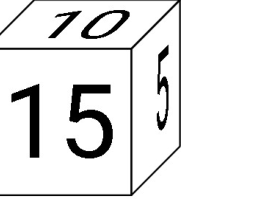
A natural number greater than 0 is written on each side of the die shown (the three visible faces show 10, 15 and 5). All products of opposite numbers are equal. What is the smallest possible sum of all 6 numbers?
Show answer
Answer: C — 41
Show hints
Hint 1 of 3
Every pair of opposite faces multiplies to the same number; call it k.
Still stuck? Show hint 2 →
Hint 2 of 3
Then each hidden face is k divided by the face across from it, so k must divide 10, 15 and 5 evenly.
Still stuck? Show hint 3 →
Hint 3 of 3
Pick the smallest such k to make the hidden faces as small as possible, then add all six.
Show solution
Approach: choose smallest common product k
The three shown faces 10, 15, 5 each have an opposite face, and all three opposite products equal some k.
Each opposite is k÷10, k÷15, k÷5, so k must be a multiple of 10, 15 and 5 — smallest is k = 30.
Then the opposites are 3, 2, 6, and the six faces sum to 10+15+5+3+2+6 = 41 (C).
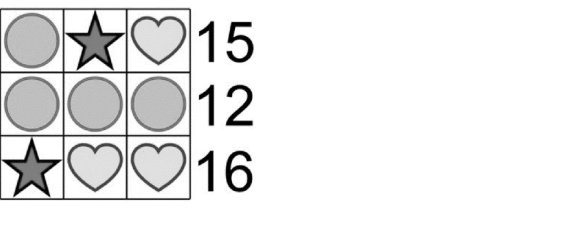
Each shape represents exactly one digit. The sum of the digits in each row is stated on the right hand-side of each row. Which digit does the star stand for?
Show answer
Answer: E — 6
Show hints
Hint 1 of 2
A row of three identical circles tells you one circle's value right away.
Still stuck? Show hint 2 →
Hint 2 of 2
Substitute the circle into the other rows to peel out the star and heart.
Show solution
Approach: solve the shape values one at a time
Row of three circles: 3×circle = 12, so circle = 4.
Top row: circle + star + heart = 15, so star + heart = 11.
Bottom row: star + heart + heart = 16, so subtracting gives heart = 5 and star = 6.
A triathlon consists of three disciplines: swimming, running and cycling. The cycle route is three quarters of the entire distance, the running route is one fifth of the entire distance and the swimming route is 2 km long. How long is the whole distance of the triathlon, in km?
Show answer
Answer: D — 40
Show hints
Hint 1 of 2
The swim is the part of the whole left after the cycle and run fractions.
Still stuck? Show hint 2 →
Hint 2 of 2
Find 1 − 3/4 − 1/5 of the distance; that fraction equals 2 km.
Show solution
Approach: the leftover fraction is the swim
Cycle + run = 3/4 + 1/5 = 19/20 of the distance.
So the swim is 1/20 of the distance, and that equals 2 km.
Michaela has 24 animals: dogs, cows, cats and kangaroos. One eighth of the animals are dogs. Three quarters of the animals are not cows, and two thirds are not cats. How many kangaroos does Michaela have?
Show answer
Answer: D — 7
Show hints
Hint 1 of 2
Convert each fraction into an actual number of animals out of 24.
Still stuck? Show hint 2 →
Hint 2 of 2
'Not cows' and 'not cats' tell you the cow and cat counts indirectly.
Show solution
Approach: find each animal count, then subtract
Dogs: 24/8 = 3.
Three quarters are not cows, so cows are one quarter: 24/4 = 6.
Two thirds are not cats, so cats are one third: 24/3 = 8.
There are five balls in a box: four contain chocolate, and one contains a boiled sweet. Johann and Maria take turns drawing a ball from the box without replacing it. Whoever draws the boiled sweet wins. Johann starts. What is the probability that Maria wins?
Show answer
Answer: A — \(\dfrac{2}{5}\)
Show hints
Hint 1 of 2
The single boiled sweet is equally likely to be the 1st, 2nd, 3rd, 4th or 5th ball drawn.
Still stuck? Show hint 2 →
Hint 2 of 2
Maria draws on turns 2 and 4, so count her winning positions out of five.
Show solution
Approach: the sweet is equally likely in each draw position
By symmetry the boiled sweet is equally likely to be the 1st, 2nd, 3rd, 4th or 5th ball drawn, each with probability \(\frac{1}{5}\).
Johann draws on turns 1, 3 and 5; Maria draws on turns 2 and 4.
Maria wins in exactly 2 of the 5 positions, so her probability is \(\frac{2}{5}\).
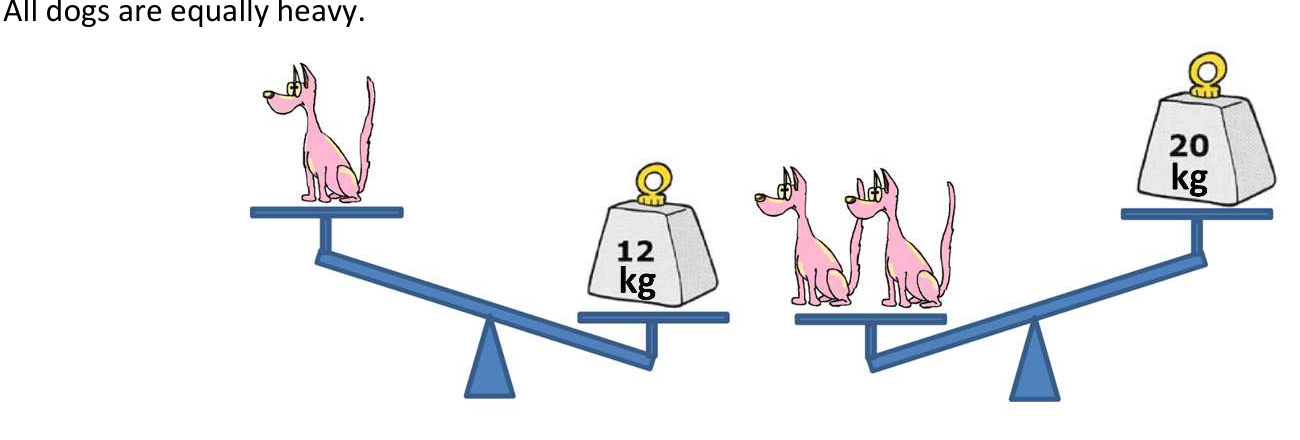
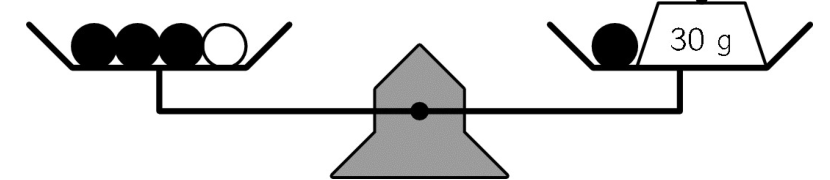
4 equally heavy black pearls, 1 white pearl and a piece of iron weighing 30 g are placed on a beam balance, as shown in the diagram, and the balance is level. How heavy are 6 black pearls and 3 white pearls altogether?
Show answer
Answer: E — 90 g
Show hints
Hint 1 of 3
A level balance means the two sides weigh exactly the same; read off what equals what.
Still stuck? Show hint 2 →
Hint 2 of 3
From the picture, the pearls left over on one side just balance the 30 g of iron.
Still stuck? Show hint 3 →
Hint 3 of 3
Notice that 6 black and 3 white is simply three copies of that balanced group of pearls.
Show solution
Approach: scale the balance equation
Reading the balanced scale, 2 black pearls and 1 white pearl together weigh the same as the 30 g iron, so 2 black + 1 white = 30 g.
We want 6 black + 3 white, which is exactly three copies of that group: 3 × (2 black + 1 white).
So 6 black and 3 white pearls weigh 3 × 30 g = 90 g (E).
Anna uses 32 small grey squares to frame a 7 cm by 7 cm big picture. How many small grey squares does she have to use to frame a 10 cm by 10 cm big picture?
Show answer
Answer: C — 44
Show hints
Hint 1 of 2
The grey squares make a ring one square thick all the way around the picture.
Still stuck? Show hint 2 →
Hint 2 of 2
Picture the four sides of the ring, and be careful not to count the four corner squares twice.
Show solution
Approach: count the four sides of the grey ring
Around the 7×7 picture, each side of the grey ring is 9 squares long (the 7 picture squares plus one corner at each end), and 4 sides of 9 with the 4 corners counted once give 32 — matching the picture.
Around the 10×10 picture, each side of the ring is 12 squares long.
Four sides of 12 is 48, but the 4 corners were each counted twice, so take 4 away: 48 − 4 = 44.
A 1-litre bottle of syrup is still half full. The syrup is to be diluted in the ratio 1 : 7 to make juice. Which fraction of the syrup should be used to obtain 2 litres of juice?
Show answer
Answer: B — 12
Show hints
Hint 1 of 2
Syrup : water = 1 : 7 means juice is 1/8 syrup.
Still stuck? Show hint 2 →
Hint 2 of 2
2 litres of juice needs 1/4 litre of syrup — compare to the 1/2 litre you have.
Show solution
Approach: find syrup needed, compare to amount on hand
Juice is 1 part syrup to 7 water, so 1/8 of the juice is syrup.
2 litres of juice need 2 × (1/8) = 1/4 litre of syrup.
You hold 1/2 litre, so you use (1/4)/(1/2) = 1/2 of the syrup.
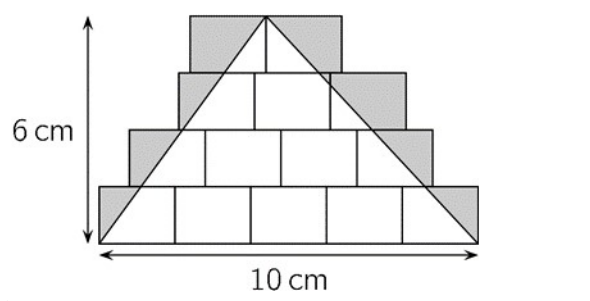
Mia draws some congruent rectangles and one triangle. She then shades grey the parts of the rectangles that lie outside the triangle (see diagram). How big is the resulting grey area?
Show answer
Answer: B — 12 cm²
Show hints
Hint 1 of 2
Compare the grey parts sticking out with the empty parts of the triangle the rectangles miss.
Still stuck? Show hint 2 →
Hint 2 of 2
By symmetry those two kinds of regions have equal total area.
Show solution
Approach: pair grey overflow with the triangle's uncovered gaps
The triangle has area ½ × 10 × 6 = 30 cm².
By the left-right symmetry of the staircase, each grey piece outside the triangle matches an equal empty piece of the triangle not covered by a rectangle.
Working through the matching, the grey total comes out to 12 cm².
Robert makes 5 statements, exactly one of which is wrong:
(A) My son Basil has 3 sisters. (B) My daughter Ann has 2 brothers. (C) My daughter Ann has 2 sisters. (D) My son Basil has 2 brothers. (E) I have 5 children.
Which statement is wrong?
Show answer
Answer: D — Statement D
Show hints
Hint 1 of 3
Try to find how many sons and daughters Robert has so that four of the five statements come out true.
Still stuck? Show hint 2 →
Hint 2 of 3
Remember a boy counts his brothers as the other boys, and his sisters as all the girls.
Still stuck? Show hint 3 →
Hint 3 of 3
Once you fix the numbers of boys and girls, check which single statement is then forced to be false.
Show solution
Approach: find the family that fits four statements
Statement A says Basil has 3 sisters (so 3 girls) and B says Ann has 2 brothers (so 2 boys); that makes 2 boys and 3 girls, which agrees with C (Ann's 2 sisters) and E (5 children).
Check D: Basil's brothers are the other boys, and with 2 boys he has only 1 brother, not 2, so statement D is false.
All the others fit the 2-boy, 3-girl family, so the single wrong one is statement D (D).
The pages of a book are numbered with 1, 2, 3, 4, 5 and so on. The digit 5 appears exactly 16 times. What is the maximum number of pages the book can have?
Show answer
Answer: B — 64
Show hints
Hint 1 of 2
Count where the digit 5 shows up as you list page numbers 1, 2, 3, ...
Still stuck? Show hint 2 →
Hint 2 of 2
The block 50-59 alone contributes ten 5s (the tens digit); add those to the single 5s like 5, 15, 25, ...
Show solution
Approach: count occurrences of the digit 5
Up to 49 the 5s appear at 5, 15, 25, 35, 45: five of them.
The block 50-59 has a 5 in every tens digit: ten more, plus the extra units-5 in 55, reaching the 16th by page 59.
Pages 60-64 add no new 5s, but page 65 would add a 17th.
So the most pages with exactly sixteen 5s is 64 (B).
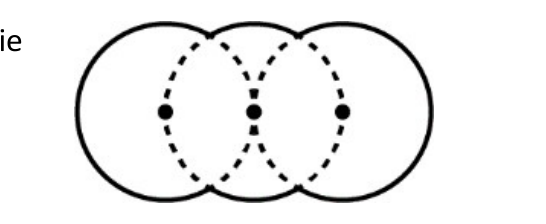
The diagram consists of three circles of equal radius R. The centres of those circles lie on a common straight line, where the middle circle passes through the centres of the other two circles (see diagram). How big is the perimeter of the figure?
Show answer
Answer: A — \(\dfrac{10\pi R}{3}\)
Show hints
Hint 1 of 3
Adjacent centres are a distance R apart, so neighbouring circles meet at 60° points.
Still stuck? Show hint 2 →
Hint 2 of 3
Add up the arc of each circle that lies on the outside of the figure.
Still stuck? Show hint 3 →
Hint 3 of 3
Two equal circles with centres R apart overlap in a 120° lens; work out each circle's exposed arc.
Show solution
Approach: add the exposed arcs of the three circles
Neighbouring circles (centres R apart) cross at points 60° above and below the centre line.
Adding the outside arcs of all three circles totals 600° of arc, i.e. 5/3 of a full circle.
Julius has two cylinder-shaped candles of different heights and diameters. The first candle burns down in 6 hours, the second in 8 hours. They both burn down evenly. He lights both candles at the same time, and after three hours they are both equally tall. What was the ratio of their original heights?
Show answer
Answer: C — 5 : 4
Show hints
Hint 1 of 2
After 3 hours each candle has burned a fraction of its own height.
Still stuck? Show hint 2 →
Hint 2 of 2
Set the two leftover heights equal and compare the originals.
Show solution
Approach: equal leftover heights give the ratio
In 3 hours the 6-hour candle burns half its height, leaving 1/2; the 8-hour candle burns 3/8, leaving 5/8.
Benjamin writes a number into the first circle. He then carries out the calculations shown along the arrows and each time writes the result in the next circle. How many of the six numbers are divisible by 3?
Show answer
Answer: B — 2
Show hints
Hint 1 of 3
The starting number is unknown, so try a few different starting numbers and watch which results land on multiples of 3.
Still stuck? Show hint 2 →
Hint 2 of 3
Among any three numbers in a row, exactly one is a multiple of 3.
Still stuck? Show hint 3 →
Hint 3 of 3
Check whether the count of multiples of 3 stays the same no matter where you start.
Show solution
Approach: try a couple of starting numbers and spot the steady pattern
Pick an easy start and follow the arrows; then pick a different start and do it again, each time circling the results that are multiples of 3.
Both times you find exactly two multiples of 3: one comes from the first three numbers (one of any three numbers in a row is always a multiple of 3), and one comes from the step that multiplies by 3.
The last two results are always 2 more, and double of that, so they are never multiples of 3, leaving exactly 2 divisible by 3 (B).
Why it is always exactly 2 (algebra)If the start is n, the six numbers are n, n+1, n+2, 3(n+2), 3(n+2)+2, and 6(n+2)+4. Exactly one of n, n+1, n+2 is divisible by 3, 3(n+2) always is, and the last two leave remainders 2 and 1, so the count is always 2.
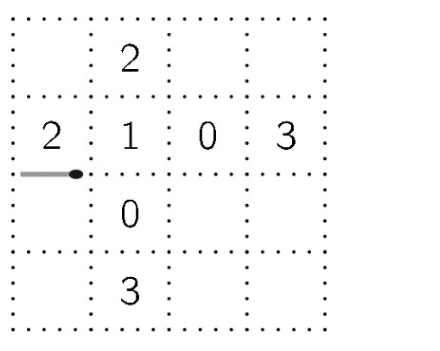
Anna places matches along the dotted lines to make a path. She has placed the first match as shown in the diagram. The path is built so that in the end it leads back to the left end of the first match. The numbers in the small squares tell how many sides of that square have a match on them. What is the smallest number of matches she can use?
Show answer
Answer: C — 16
Show hints
Hint 1 of 2
The numbers say exactly how many sides of each small square carry a match.
Still stuck? Show hint 2 →
Hint 2 of 2
Build one closed loop that meets all those counts using as few matches as possible.
Show solution
Approach: build the cheapest closed loop fitting the side-counts
Each labelled square must have exactly the stated number of its four sides covered by matches.
The matches form one closed path returning to the start, which constrains how edges join up.
The smallest such loop satisfying every count uses 16 matches.
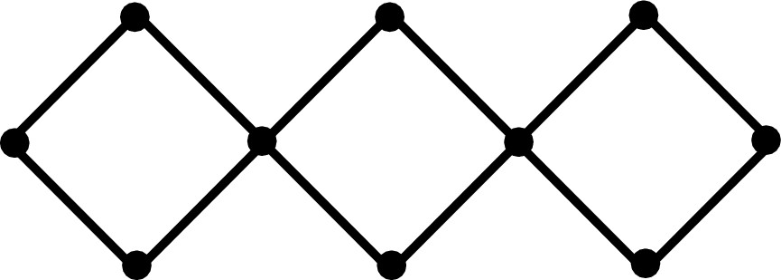
The intersection points of the network of bars shown are labelled with the numbers 1 to 10. The sum \(S\) of the four numbers at the vertices of each square is the same for all three squares. What is the minimum possible value of \(S\)?
Show answer
Answer: C — 20
Show hints
Hint 1 of 2
Two of the ten points are shared between neighbouring squares, so they each count in two of the square sums.
Still stuck? Show hint 2 →
Hint 2 of 2
Adding all three square sums gives \(3S = 55 + (\text{the two shared vertices})\); minimise \(S\) by choosing those two values well.
Show solution
Approach: minimise the common square sum using the shared vertices
The labels 1 to 10 add to 55. Summing the three equal square sums counts the two shared (middle) vertices twice, so \(3S = 55 + (\text{sum of the two shared vertices})\).
We need that total divisible by 3; since \(55 \equiv 1 \pmod 3\), the two shared vertices must sum to \(2 \pmod 3\).
The smallest such sum of two distinct labels is \(1 + 4 = 5\) (or \(2 + 3\)), giving \(3S = 60\), so \(S = 20\), and the remaining labels can be placed to make it work.
Emil takes selfies with his 8 cousins. Each one of the 8 cousins appears in two or three of the pictures. There are exactly 5 cousins in each picture. How many selfies does Emil take?
Show answer
Answer: B — 4
Show hints
Hint 1 of 3
Count the total number of 'cousin appearances' — every face that shows up in every photo.
Still stuck? Show hint 2 →
Hint 2 of 3
Since each cousin appears 2 or 3 times, this total must be between 2×8 and 3×8.
Still stuck? Show hint 3 →
Hint 3 of 3
Each photo shows exactly 5 cousins, so the number of photos times 5 equals that total.
Show solution
Approach: count total appearances, then divide by 5
Each of the 8 cousins shows up 2 or 3 times, so the total number of cousin-appearances is between 2×8 = 16 and 3×8 = 24.
Each photo holds exactly 5 cousins, so the number of photos times 5 must land between 16 and 24 — only 5 × 4 = 20 works.
So there are 4 photos (20 appearances split as four cousins thrice and four cousins twice): Emil takes 4 selfies (B).
Logic & Word Problemssum-constraintcomplementary-counting
There live exactly 15 animals on a farm: cows, cats and kangaroos. We know that exactly 10 animals are not cows and exactly 8 animals are not cats. How many kangaroos live on the farm?
Show answer
Answer: B — 3
Show hints
Hint 1 of 2
'Not cows' counts cats and kangaroos; 'not cats' counts cows and kangaroos.
Still stuck? Show hint 2 →
Hint 2 of 2
Find the cows and cats first, then subtract from 15 to get the kangaroos.
If one of the digits of a two-digit number is deleted, the result in both cases is a factor of the original number. How many two-digit numbers have this property?
Show answer
Answer: C — 14
Show hints
Hint 1 of 3
Deleting a digit leaves a single digit; the original must be divisible by each remaining digit.
Still stuck? Show hint 2 →
Hint 2 of 3
Require the number to be divisible by both its tens digit and its units digit.
Still stuck? Show hint 3 →
Hint 3 of 3
Every multiple of 11 works, plus a few others — count them all.
Show solution
Approach: test divisibility by each single digit
For a number with tens t and units u, both u and t must divide it (u ≠ 0).
Through 10–99 the ones that pass are 11, 12, 15, 22, 24, 33, 36, 44, 48, 55, 66, 77, 88, 99.
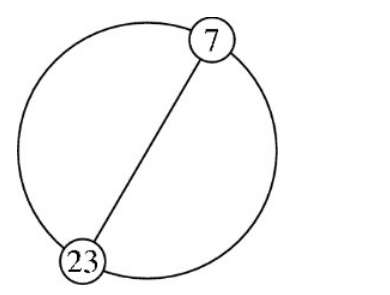
n buttons are placed evenly around a circle. The buttons are labelled clockwise in order with the numbers 1 to n. The button numbered 7 is exactly opposite the button numbered 23. How big is n?
Show answer
Answer: B — 32
Show hints
Hint 1 of 2
Two buttons are exactly opposite when they are half the circle apart.
Still stuck? Show hint 2 →
Hint 2 of 2
The gap between button 7 and button 23 is therefore n/2.
Show solution
Approach: opposite means a half-circle apart
If buttons 7 and 23 are exactly opposite, they are n/2 positions apart.
Let \(a\) be the sum of all positive factors of 1024 and \(b\) be the product of all positive factors of 1024. (Note that 1 and 1024 are also factors of 1024.) Then which statement holds?
Show answer
Answer: B — \((a+1)^{5} = b\)
Show hints
Hint 1 of 2
\(1024 = 2^{10}\) has eleven factors: \(2^{0}\) through \(2^{10}\).
Still stuck? Show hint 2 →
Hint 2 of 2
Their product is 2 raised to \(0 + 1 + \cdots + 10\); compare it with a power of the sum \(a\).
Show solution
Approach: use that \(1024 = 2^{10}\) has 11 factors
The factors of \(1024 = 2^{10}\) are \(2^{0}, \ldots, 2^{10}\), so their product is \(b = 2^{0+1+\cdots+10} = 2^{55}\).
The sum of all factors is \(a = 1 + 2 + \cdots + 1024 = 2^{11} - 1 = 2047\), so \(a + 1 = 2^{11}\).
60 apples and 60 pears in total are shared out among several boxes. There should be the same number of apples in each box, but no two boxes should contain the same number of pears. Each box contains both fruits. What is the maximum number of boxes that can be filled in this way?
Show answer
Answer: D — 10
Show hints
Hint 1 of 3
Equal apples per box means the number of boxes divides 60.
Still stuck? Show hint 2 →
Hint 2 of 3
Distinct positive pear counts summing to 60 need at least 1+2+…+k; combine both limits.
Still stuck? Show hint 3 →
Hint 3 of 3
Find the largest k with 60 divisible by k and 1+2+…+k ≤ 60.
Show solution
Approach: combine the apple and pear constraints
With k boxes, k must divide 60 (equal apples) and 1+2+…+k ≤ 60 (distinct pear counts).
1+…+10 = 55 ≤ 60 and 10 divides 60, so k = 10 works.
k = 12 fails (1+…+12 = 78 > 60), so the maximum is 10 boxes.
Leo spends all his money buying 50 bottles of juice for 1 Euro each, then sells them on for a higher price. After selling 40 bottles, each for the same price, he has 10 Euros more than he started with. He then sells the remaining bottles for the same price. How much money does Leo have now?
Show answer
Answer: B — 75 Euros
Show hints
Hint 1 of 2
First find the selling price from the 'after 40 sold' clue.
Still stuck? Show hint 2 →
Hint 2 of 2
Then total the income from all 50 bottles he sells.
Show solution
Approach: find the price, then total the sales
Leo spends 50 Euros buying 50 bottles. After selling 40 at price p he holds 40p, which is 10 more than his original 50, so 40p = 60 and p = 1.5 Euros.
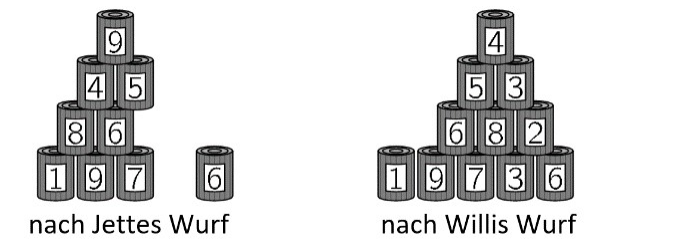
Jette and Willi throw balls at two identically built pyramids, each made up of 15 tins (each tin is worth the number written on it). The pictures show each pyramid after Jette's throw and after Willi's throw. Jette hits 6 tins and gets 25 points. Willi hits 4 tins. How many points does Willi get?
Show answer
Answer: D — 26
Show hints
Hint 1 of 3
Both pyramids are built the same, so each one holds the same total number of points.
Still stuck? Show hint 2 →
Hint 2 of 3
Use Jette's picture: the tins left standing plus the 25 she knocked down give the whole pyramid's total.
Still stuck? Show hint 3 →
Hint 3 of 3
For Willi, that same total minus the tins still standing in his picture is his score.
Show solution
Approach: find the grand total, then subtract what's left
After Jette's throw the standing tins add up to 55, and the 6 she knocked down scored 25, so the whole pyramid totals 55 + 25 = 80.
After Willi's throw the standing tins add up to 54.
One of the 5 children Alex, Bartek, Cora, Dani and Emil has eaten a cake. Alex says: “I did not eat a cake.” Bartek says: “I ate a cake.” Cora says: “Emil has not eaten a cake.” Dani says: “I did not eat a cake.” Emil says: “Alex has eaten a cake.” One of the children lies. Which child has eaten a cake?
Show answer
Answer: B — Bartek
Show hints
Hint 1 of 2
Exactly one statement is false; test who the eater could be and count the lies.
Still stuck? Show hint 2 →
Hint 2 of 2
Suppose Bartek is the eater and check whether only one child ends up lying.
Show solution
Approach: test the eater so that exactly one lies
Assume Bartek ate the cake.
Then Alex, Cora and Dani all speak truthfully, and Bartek's 'I ate' is true.
Only Emil's 'Alex ate' is false — exactly one liar, as required.
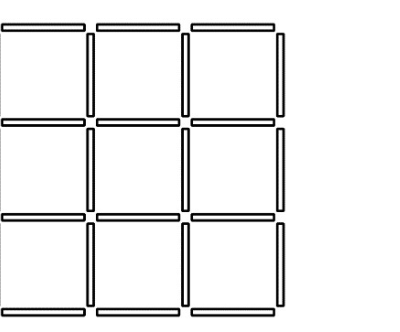
Natascha has some blue, red, yellow and green sticks, each 1 cm long. She wants to make a 3 × 3 grid, as shown, so that the four sides of every 1 × 1 square in the grid are all different colours. What is the smallest number of green sticks she can use?
Show answer
Answer: C — 5
Show hints
Hint 1 of 2
Each of the nine unit squares must use four different colours on its four sides.
Still stuck? Show hint 2 →
Hint 2 of 2
Push to use as few green sticks as possible while still colouring every square legally.
Show solution
Approach: minimise one colour under the per-square constraint
Every 1×1 square needs its four sides in four different colours, so each square uses green on at most one side.
Sticks are shared between neighbouring squares, so one green stick can serve two squares at once.
Arranging the green sticks to cover all nine squares needs a minimum of 5 green sticks.
To find the value of \(\dfrac{a+b}{c}\) (where \(a\), \(b\) and \(c\) are positive integers), Sara types \(a + b \div c =\) into a calculator and gets 11. Then she types \(b + a \div c =\) and is surprised to get 14. She realises the calculator follows the order of operations, doing division before addition. What is the actual value of \(\dfrac{a+b}{c}\)?
Show answer
Answer: E — 5
Show hints
Hint 1 of 2
The calculator computes \(a + \dfrac{b}{c} = 11\) and \(b + \dfrac{a}{c} = 14\).
Still stuck? Show hint 2 →
Hint 2 of 2
Subtracting and adding the two equations lets you pin down \(c\) and then \(a + b\).
Show solution
Approach: set up the two order-of-operations equations
The two calculator results give \(a + \dfrac{b}{c} = 11\) and \(b + \dfrac{a}{c} = 14\).
Subtracting: \((a - b)\left(1 - \dfrac{1}{c}\right) = -3\), so \((a-b)(c-1) = -3c\); the only positive-integer fit is \(c = 4\) with \(a - b = -4\).
With \(c = 4\), the first equation gives \(a + \dfrac{b}{4} = 11\), and together with \(a - b = -4\) we get \(a = 8\), \(b = 12\), so \(a + b = 20\).
The actual value is \(\dfrac{a+b}{c} = \dfrac{20}{4} = 5\) — answer (E).
Linus builds a 4 × 4 × 4 cube made up of 32 white and 32 black 1 × 1 × 1 cubes. He arranges the small cubes so that the surface of the big cube shows as much white as possible. Which fraction of the surface is white?
Show answer
Answer: A — 34
Show hints
Hint 1 of 3
First count the whole surface: the big cube has 6 faces, each split into 16 little squares.
Still stuck? Show hint 2 →
Hint 2 of 3
To show the most white, place white cubes where they expose the most faces — corner cubes show 3, edge cubes show 2.
Still stuck? Show hint 3 →
Hint 3 of 3
Count how many white faces those favorable spots give you, then compare with the total.
Show solution
Approach: place white cubes to expose the most faces
The surface has 6 × 16 = 96 unit faces. Corner cubes (8) show 3 faces each, edge cubes (24) show 2 each.
Filling the 8 corners and 24 edges with white uses all 32 white cubes and exposes 8×3 + 24×2 = 72 white faces.
So the white fraction of the surface is 72⁄96 = 3⁄4 (A).
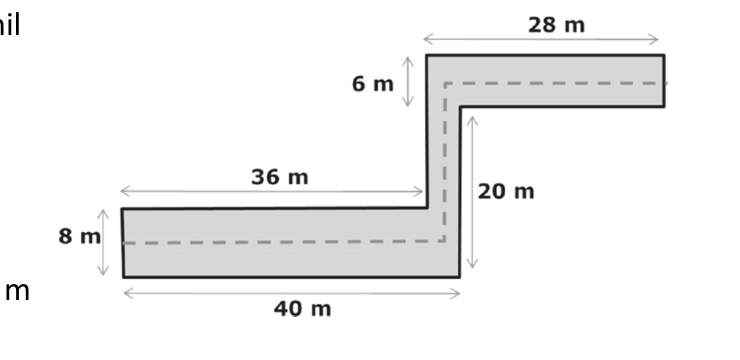
From above, the corridor of a school looks like in the diagram. A cat walks along the dotted line drawn in the middle of the room. How many meters does the cat walk?
Show answer
Answer: E — 83 m
Show hints
Hint 1 of 2
The cat follows the dashed centre line, so use the middle of each corridor section, not the outer walls.
Still stuck? Show hint 2 →
Hint 2 of 2
Break the path into the three straight middle-line pieces and add their lengths.
Show solution
Approach: add the centre-line segments
The corridor has three arms; the cat's dashed path runs along the middle of each.
Bottom arm: the vertical part is 40 − 36 = 4 m wide, so its middle sits 2 m in from the right wall; the centre line runs 36 + 2 = 38 m across.
Vertical arm: it is 20 m up to the start of the top arm, which is 6 m tall, so the centre line climbs to the middle of the top arm; together this part of the path is 19 m.
Top arm: from the middle of the vertical arm out to the far end is 26 m.
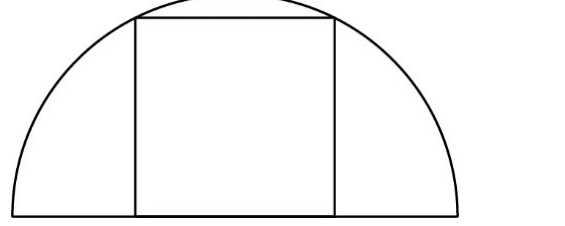
Two vertices of a square lie on a semi-circle, as shown, while the other two lie on its diameter. The radius of the circle is 1 cm. How big is the area of the square?
Show answer
Answer: A — 45 cm2
Show hints
Hint 1 of 2
Put the centre of the diameter at the origin; the square sits symmetrically on it.
Still stuck? Show hint 2 →
Hint 2 of 2
If the side is s, the top corners (±s/2, s) lie on the radius-1 circle.
Show solution
Approach: put a corner on the circle and solve
By symmetry the base runs from (−s/2, 0) to (s/2, 0) with top corners (±s/2, s).
These lie on the circle: (s/2)² + s² = 1, so (5/4)s² = 1.
Two points are marked on a circular disc that rotates about its centre. The outer point is 3 cm further away from the centre than the inner point, and it moves 2.5 times as fast as the inner point. How big is the distance between the outer point and the centre of the circular disc?
Show answer
Answer: E — 5 cm
Show hints
Hint 1 of 2
On a spinning disc, speed is proportional to distance from the centre.
Still stuck? Show hint 2 →
Hint 2 of 2
If the outer radius is r and the inner is r − 3, then r/(r − 3) = 2.5.
Show solution
Approach: speed proportional to radius
Speed ∝ radius, so (outer radius)/(inner radius) = 2.5.
With inner = r − 3 and outer = r: r = 2.5(r − 3) ⇒ 1.5r = 7.5 ⇒ inner = 2.
Elisabeth has 60 pralines. On Monday she eats 110 of them. Of the ones left she eats 19 on Tuesday, then on Wednesday 18 of those left from the day before, on Thursday 17 of those left, and so on, until she eats one half of the pralines left over from the day before. How many pralines has she still got afterwards?
Show answer
Answer: E — 6
Show hints
Hint 1 of 2
Each day she removes a unit fraction of what is currently left.
Still stuck? Show hint 2 →
Hint 2 of 2
Track the running total day by day until the 'eat one half' step.
Four different straight lines pass through the origin of the coordinate system. They intersect the parabola \(y = x^{2} - 2\) at eight points. What could the product of the \(x\)-coordinates of these eight points be?
Show answer
Answer: A — only 16
Show hints
Hint 1 of 2
A line \(y = mx\) through the origin meets \(y = x^{2} - 2\) where \(x^{2} - mx - 2 = 0\); by Vieta the two \(x\)-roots multiply to \(-2\).
Still stuck? Show hint 2 →
Hint 2 of 2
Each of the four lines contributes a root-product of \(-2\), so just multiply across the four lines.
Show solution
Approach: use Vieta on each line–parabola intersection
A line \(y = mx\) meets \(y = x^{2} - 2\) where \(x^{2} - mx - 2 = 0\), whose two roots multiply to \(-2\) (the constant term).
The four lines give four such pairs, each with root-product \(-2\).
So the product of all eight \(x\)-coordinates is \((-2)^{4} = 16\), no matter which four lines are chosen.
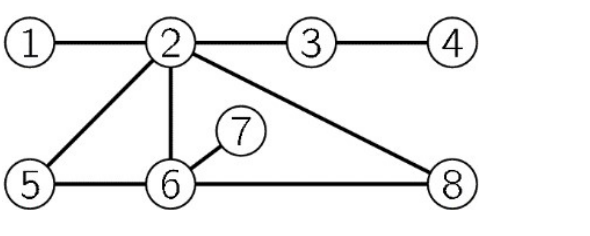
Peter colours each of the eight circles either red, yellow or blue. Two circles that are directly joined by a line are not allowed to be the same colour. Which two circles must Peter definitely colour the same?
Show answer
Answer: A — 5 and 8
Show hints
Hint 1 of 2
With only three colours, look for two circles forced into the same colour by their shared neighbours.
Still stuck? Show hint 2 →
Hint 2 of 2
Find two circles that are both adjacent to the same two differently-coloured circles.
Show solution
Approach: forced colour from a 3-colouring constraint
Each circle differs in colour from every circle it is joined to.
Two circles each connected to the same pair of other circles (which take the two remaining colours) are forced to share the one leftover colour.
Tracing the connections, circles 5 and 8 are forced to be the same colour.
Ria and Flora compare their savings and find that they are in the ratio 5 : 3. Then Ria buys a tablet for 160 €. The ratio of their savings now changes to 3 : 5. How much money did Ria have before she bought the tablet?
Show answer
Answer: C — 250 €
Show hints
Hint 1 of 2
Write both savings using the 5 : 3 ratio with one unknown.
Still stuck? Show hint 2 →
Hint 2 of 2
Subtract 160 from Ria's and set the new ratio to 3 : 5.
Show solution
Approach: set the changed ratio equal to 3 : 5
Let savings be 5x (Ria) and 3x (Flora).
After Ria spends 160: (5x − 160) : 3x = 3 : 5, so 5(5x − 160) = 9x.
That gives 25x − 800 = 9x, 16x = 800, x = 50, so Ria had 5x = 250 Euros.
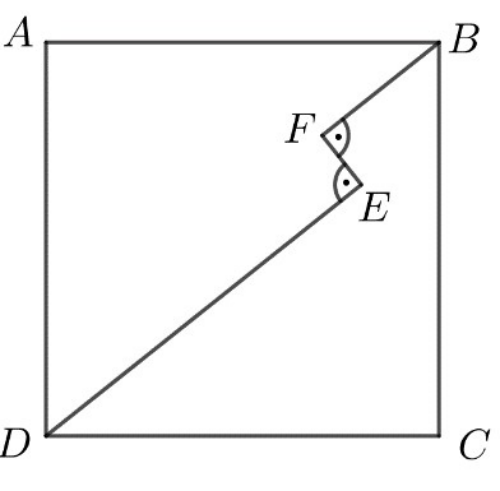
A path \(DEFB\) with \(DE \perp EF\) and \(EF \perp FB\) lies inside the square \(ABCD\), as shown. We know that \(DE = 5\), \(EF = 1\) and \(FB = 2\). What is the side length of the square?
Show answer
Answer: E — another value
Show hints
Hint 1 of 2
Since \(DE \perp EF\) and \(EF \perp FB\), the legs \(DE\) and \(FB\) are parallel; put \(D\) and \(B\) at opposite corners and use coordinates.
Still stuck? Show hint 2 →
Hint 2 of 2
Add the path vectors \(D\to E\to F\to B\) and force the result to land on the opposite corner \((s,s)\).
Show solution
Approach: add the path vectors and land on the opposite corner
Put \(D = (0,0)\) and \(B = (s,s)\). Let \(DE\) point along \((\cos\theta, \sin\theta)\); then \(EF\) along \((-\sin\theta, \cos\theta)\) and \(FB\) along \((\cos\theta, \sin\theta)\) again.
Logic & Word Problemscareful-countingspatial-reasoning
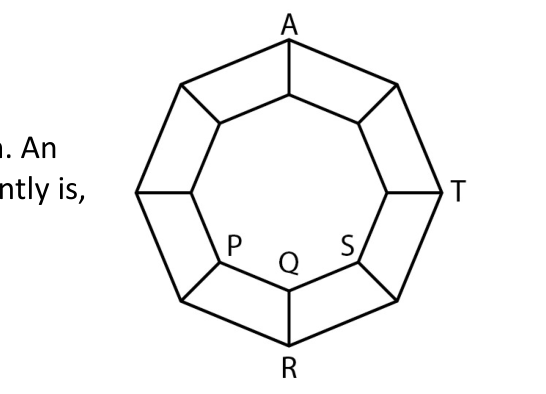
A graph consists of 16 points and several connecting lines, as shown in the diagram. An ant is at point A. With every move the ant can move from the point where it currently is, along one of the connecting lines, to an adjacent point. At which of the points P, Q, R, S and T can the ant be after 2019 moves?
Show answer
Answer: B — only at P, R, S or T, not at Q
Show hints
Hint 1 of 3
Two-colour the 16 points so every line joins different colours.
Still stuck? Show hint 2 →
Hint 2 of 3
After an odd number of moves the ant must sit on the colour opposite to A's.
Still stuck? Show hint 3 →
Hint 3 of 3
2019 is odd, so the ant ends on the opposite colour class from its start.
Show solution
Approach: bipartite two-colouring and parity
The graph is bipartite: colour the points so each edge joins the two colours.
A starts on one colour; after 2019 (odd) moves it must be on the other colour.
Of P, Q, R, S, T only Q shares A's colour, so the ant can be at P, R, S or T but not at Q.
Teams of three take part in a chess tournament. Each player plays against every player from every other team exactly once. For organisational reasons no more than 250 games may be played. What is the greatest number of three-player teams that can take part?
Show answer
Answer: E — 7
Show hints
Hint 1 of 2
Each game is between two players on different teams; count games as pairs of teams times players.
Still stuck? Show hint 2 →
Hint 2 of 2
Find the largest team count keeping games at most 250.
Show solution
Approach: count cross-team games and bound by 250
With n teams of 3, each pair of teams plays 3 × 3 = 9 games, so total games = 9 × n(n−1)/2.
For n = 7 that is 9 × 21 = 189 (allowed); for n = 8 it is 9 × 28 = 252 (too many).
The sequence \(a_1, a_2, a_3, \ldots\) starts with \(a_1 = 49\). To find \(a_{n+1}\) for \(n \ge 1\), you add 1 to the digit sum of \(a_n\) and square the result. For example, \(a_2 = (4 + 9 + 1)^{2} = 196\). Find \(a_{2019}\).
Show answer
Answer: C — 64
Show hints
Hint 1 of 2
Compute terms in order — \(a_1 = 49\), \(a_2 = 196\), \(a_3 = 289\), \(a_4 = 400\), \(a_5 = 25\), … — and watch for a repeating cycle.
Still stuck? Show hint 2 →
Hint 2 of 2
Once the sequence cycles, locate term 2019 by its position within the cycle.
Show solution
Approach: iterate until the sequence settles into a cycle
The numbers a, b and c are three-digit numbers, and in each number the first digit is equal to the last one. Furthermore \(b = 2a + 1\) and \(c = 2b + 1\). How many possible values are there for the number a?
Show answer
Answer: C — 2
Show hints
Hint 1 of 2
“First digit equals last” means each of a, b, c is a 3-digit number of the form x?x.
Still stuck? Show hint 2 →
Hint 2 of 2
Use b = 2a + 1 and c = 2b + 1 and test which starting a keep all three in that form.
Show solution
Approach: chase the doubling chain through 3-digit ‘x?x’ numbers
a, b, c each read x?x (first digit = last). With b = 2a + 1 and c = 2b + 1, only a few a work.
a = 181 gives b = 363, c = 727; a = 191 gives b = 383, c = 767 — both valid.
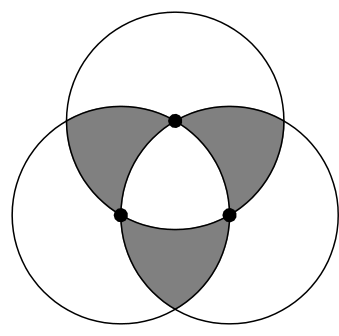
Three circles of radius 2 are drawn so that each time, one of the intersection points of two circles is the centre of the third circle. What is the area of the grey region?
Show answer
Answer: D — \(2\pi\)
Show hints
Hint 1 of 2
Each centre lies on the other two circles, so the three centres form an equilateral triangle of side \(r = 2\) and every pairwise overlap is the same lens shape.
Still stuck? Show hint 2 →
Hint 2 of 2
Set the full circle area \(4\pi\) against how many times each overlapping lens is being counted in the shaded picture.
Show solution
Approach: exploit the threefold symmetry: the answer is a clean multiple of the lens overlaps
Because each centre sits on the other two circles, the three centres form an equilateral triangle of side equal to the radius \(r = 2\), so the whole figure has perfect threefold symmetry.
Each circle has area \(\pi r^2 = 4\pi\), and the three identical pairwise overlap lenses meet symmetrically at the common region in the middle.
The shaded region is exactly two of these equal lens-overlaps' worth of area, which the symmetry forces to be the clean value \(2\pi\).
What is the minimum number of elements of the set \(\{10, 20, 30, 40, 50, 60, 70, 80, 90\}\) that have to be removed so that the product of the remaining elements is a square number?
Show answer
Answer: B — 2
Show hints
Hint 1 of 3
A product is a square exactly when every prime appears an even number of times.
Still stuck? Show hint 2 →
Hint 2 of 3
Only one element, 70, carries the prime 7, so 70 must go — then check what its removal does to the other primes.
Still stuck? Show hint 3 →
Hint 3 of 3
Removing 70 throws the counts of 2 and 5 off, so a second element is needed to fix them.
Show solution
Approach: make every prime exponent even
In the full product \(2^{16}\cdot 3^{4}\cdot 5^{10}\cdot 7^{1}\) the only odd exponent is the lone 7, which comes solely from 70.
So 70 must be removed; but 70 = \(2\cdot 5\cdot 7\), and dropping it turns the exponents of 2 and 5 odd.
Removing one more element that supplies an odd 2 and an odd 5 (for example 40 = \(2^{3}\cdot 5\)) makes everything even, so the minimum is 2.
A train has 18 carriages. There are 700 passengers on the train. In every five successive carriages there are exactly 199 passengers in total. How many passengers are in the two middle carriages of the train altogether?
Show answer
Answer: D — 96
Show hints
Hint 1 of 2
Every five consecutive carriages hold the same total, which forces a repeating pattern.
Still stuck? Show hint 2 →
Hint 2 of 2
Carriage counts repeat with period 5, so carriage i equals carriage i+5.
Show solution
Approach: use the period-5 pattern from equal 5-sums
Since each window of 5 carriages sums to 199, sliding by one shows carriage i and carriage i+5 carry the same number.
So the 18 carriages repeat with period 5; carriages 1-15 give 3 × 199 = 597, leaving carriages 16,17,18 to total 700 − 597 = 103.
Those equal carriages 1,2,3, so carriages 4+5 = 199 − 103 = 96; the two middle carriages 9,10 equal carriages 4,5, giving 96.
Logic & Word Problemssum-constraintcaseworkmagic-square
Numbers are placed in the square grid shown so that each of 1, 2, 3, 4 and 5 appears exactly once in every row and in every column. In addition, the sum of all the numbers in each of the three black-bordered sections must be the same. Which number must be written in the top right cell?
Show answer
Answer: C — 3
Show hints
Hint 1 of 2
It is a 5×5 Latin square (1–5 once per row and column) split into three black-bordered regions of equal sum.
Still stuck? Show hint 2 →
Hint 2 of 2
All 25 cells sum to 75, so each region sums to 25; combine that with the given 2 and the row/column rules to force the top-right cell.
Show solution
Approach: use the equal region sums of 25 with the Latin-square rules
Each row contains 1–5 and sums to 15, so the whole grid sums to 75.
The three black-bordered regions have equal sums, so each region sums to \(75 \div 3 = 25\).
Tracking the cells in each region together with the placed 2 and the once-per-row/column constraint forces the entries step by step.