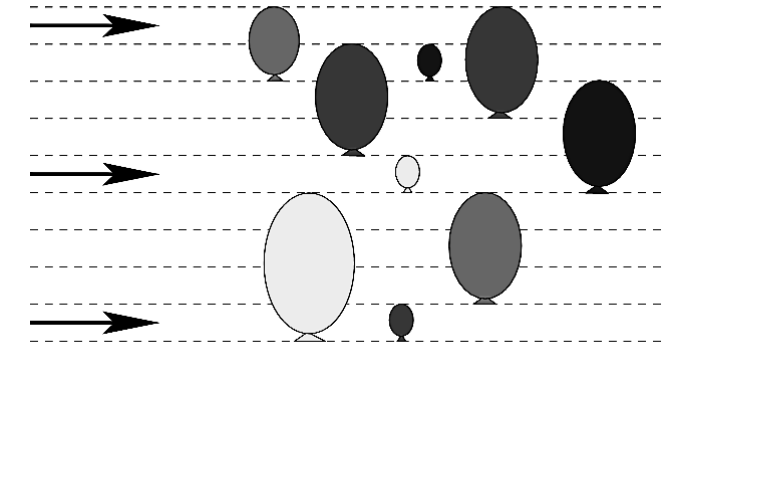
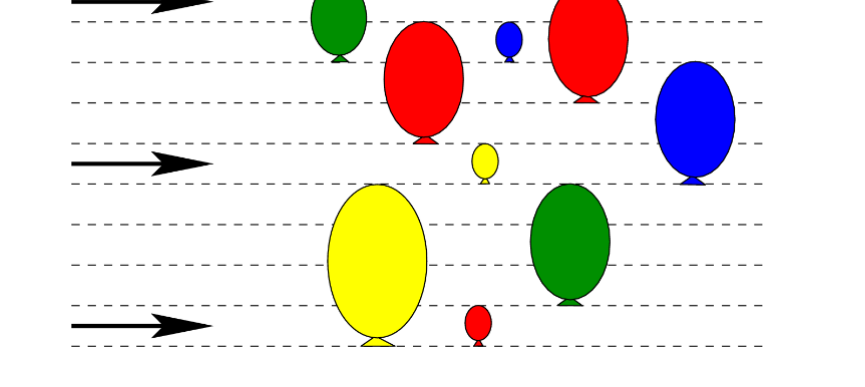
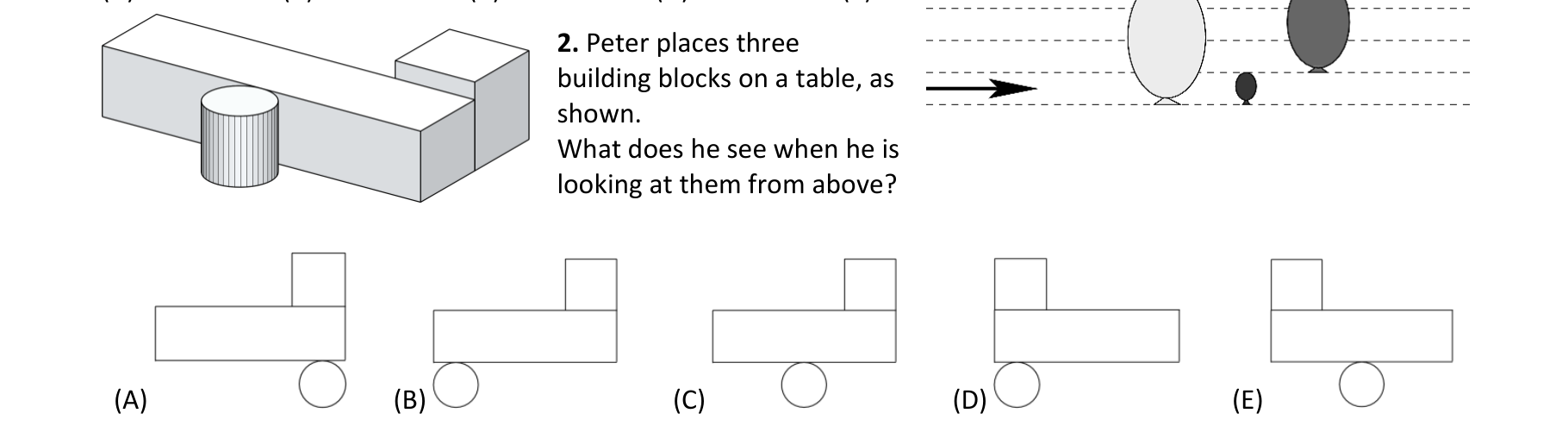
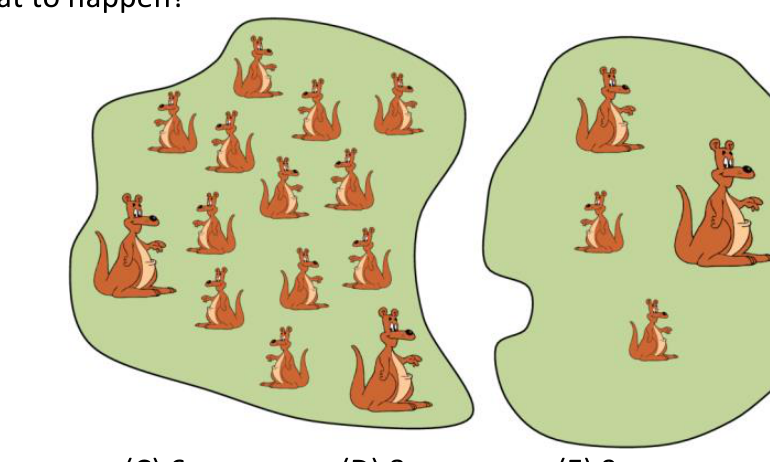
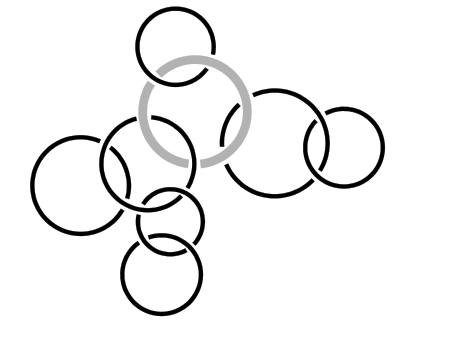
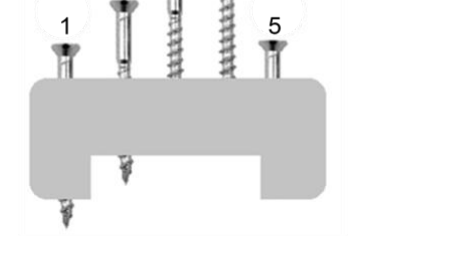
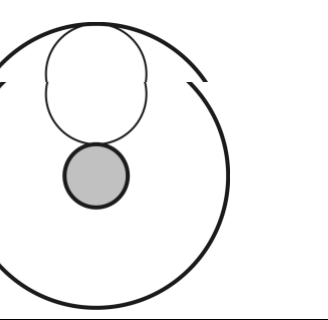
As seen in the diagram, three darts are thrown at nine fixed balloons. If a balloon is hit it bursts and the dart keeps going in the same direction it had before. How many balloons will not be hit by a dart?
Show answer
Answer: B — 3
Show hints
Hint 1 of 2
Follow each dart's straight line of travel and mark every balloon it passes through, since a burst balloon lets the dart keep going.
Still stuck? Show hint 2 →
Hint 2 of 2
Count the balloons that lie on no dart's path - those are the ones never hit.
Show solution
Approach: trace each dart's straight path and count the balloons it misses
Each dart flies in a straight line; whenever it meets a balloon, that balloon bursts and the dart continues the same way, so one dart can hit several balloons in its row.
Trace all three dart lines and shade every balloon that sits on one of those lines.
The balloons left unshaded are the ones no dart reaches.
In the diagram, 3 darts are flying towards 9 fixed balloons. If a dart hits a balloon, the balloon bursts and the dart keeps going in the same direction. How many balloons are hit by the darts?
Show answer
Answer: E — 6
Show hints
Hint 1 of 2
A dart does not stop at the first balloon — it keeps flying the same way and can pop more.
Still stuck? Show hint 2 →
Hint 2 of 2
Put your finger on each dart and slide it straight ahead, marking every balloon it touches.
Show solution
Approach: slide a finger along each dart's straight line and mark every balloon it touches
Place a finger on a dart and slide it straight in the way it is pointing; mark each balloon the line passes through.
Do this for all three darts — some darts line up with two balloons in a row, so they pop both.
Counting all the marked balloons gives 6, answer E.
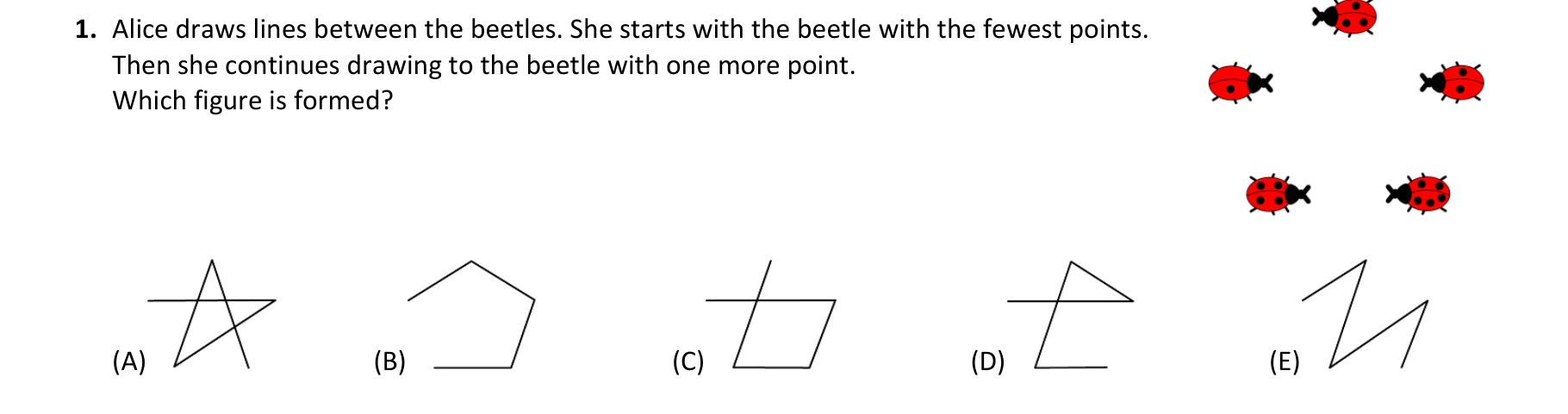
Alice draws lines between the beetles. She starts with the beetle that has the fewest dots. Then she keeps drawing on to the beetle with one more dot. Which figure is formed?
Show answer
Answer: D
Show hints
Hint 1 of 3
First find the beetle with the fewest dots — that is where the pencil starts.
Still stuck? Show hint 2 →
Hint 2 of 3
Go beetle to beetle in dot order: 1 dot, then 2 dots, then 3 dots, and so on.
Still stuck? Show hint 3 →
Hint 3 of 3
The line you draw between them, in that order, makes one of the five shapes.
Show solution
Approach: connect the beetles in dot order and see the shape
Count the dots on each beetle and put them in order: the fewest-dot beetle is first, then one more, then one more.
Draw the line from the 1st beetle to the 2nd, then to the 3rd, and on to the last — always to the beetle with just one more dot.
Following the beetles in that dot order draws the open shape in option D (not a closed star or pentagon).
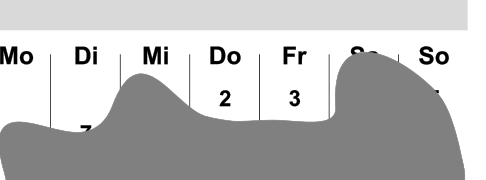
The diagram shows the calendar page of a certain month, but ink has run across parts of the page. Which day of the week does the 27th of that month fall on? (The weekday columns read Mon, Tue, Wed, Thu, Fri, Sat, Sun.)
Show answer
Answer: A — Monday
Show hints
Hint 1 of 2
Read the two visible dates to figure out which weekday column the month starts in.
Still stuck? Show hint 2 →
Hint 2 of 2
Once you know the weekday of the 1st, count forward 26 days using remainders mod 7.
Show solution
Approach: anchor the calendar, then step the weekday forward by a multiple of 7
The clear cells show Thursday is the 2nd and Friday the 3rd, so the 1st falls on Wednesday.
The 1st, 8th, 15th and 22nd are all Wednesdays.
From the 22nd, five more days (23,24,25,26,27) land on Monday.
If the letters of the word MAMA are written one underneath another, the word has a vertical axis of symmetry. For which of these words is that also true?
Show answer
Answer: E — TOTO
Show hints
Hint 1 of 2
Stack the letters of a word in a column and imagine a mirror line running straight down.
Still stuck? Show hint 2 →
Hint 2 of 2
Every single letter must look the same in that vertical mirror — check each letter of each word.
Show solution
Approach: test each letter for a vertical mirror line
A word has a vertical axis of symmetry only if every letter does (A, M, T, O, U, V, W, …).
ADAM has D, BAUM has B, BOOT has B, LOGO has L and G — none of these are vertically symmetric.
In TOTO every letter (T, O, T, O) is symmetric about a vertical line, so the answer is TOTO.
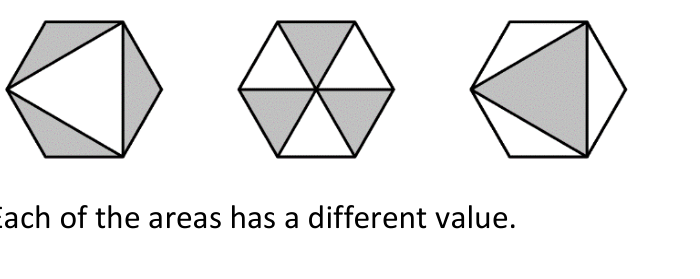
If you hit the target board you score points. The number of points depends on which of the three areas you hit. Diana throws two darts, three times, at the target board. On the first attempt she scores 14 points and on the second 16 points. How many points does she score on the third attempt?
Show answer
Answer: B — 18
Show hints
Hint 1 of 2
Two darts land in the ringed areas, so each total is a sum of two of the ring values.
Still stuck? Show hint 2 →
Hint 2 of 2
Use the 14 and 16 totals to pin down the ring values, then find the largest two-ring total for the third throw.
Show solution
Approach: find the ring point-values from the given totals, then read off the third
Each throw is two darts, so a score is the sum of two ring values.
The first total 14 and the second total 16 force the ring values (the rings are worth more as you go inward).
The two darts in the third picture both land in the highest-value ring.
In a triangle one side has length 5 and another side has length 2. The length of the third side is an odd whole number. What is the length of the third side?
Show answer
Answer: C — 5
Show hints
Hint 1 of 2
The third side must be longer than the difference of the other two and shorter than their sum.
Still stuck? Show hint 2 →
Hint 2 of 2
It has to be more than 5 − 2 = 3 and less than 5 + 2 = 7.
Show solution
Approach: triangle inequality
The third side must be greater than 5 − 2 = 3 and less than 5 + 2 = 7.
A triangle ABC has side lengths 6 cm, 10 cm and 11 cm. An equilateral triangle XYZ has the same perimeter as triangle ABC. What is the side length of triangle XYZ?
Show answer
Answer: B — 9 cm
Show hints
Hint 1 of 2
Equal perimeters means the two triangles have the same total side length.
Still stuck? Show hint 2 →
Hint 2 of 2
Find the perimeter of ABC, then split it into three equal sides.
Show solution
Approach: match perimeters, then divide by 3
Perimeter of ABC = 6 + 10 + 11 = 27 cm.
The equilateral triangle has the same perimeter, so each side = 27 : 3 = 9 cm.
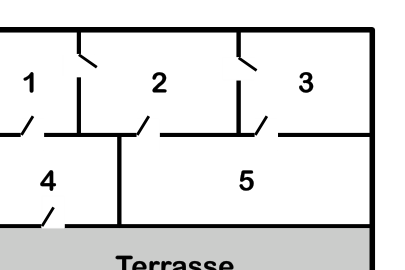
The diagram shows the floor plan of Renate's house. Renate enters from the terrace and walks through every door of the house exactly once. Which room does she end up in?
Show answer
Answer: B — 2
Show hints
Hint 1 of 2
Think of each door as an edge and each room as a dot; walking every door once is an Euler trail.
Still stuck? Show hint 2 →
Hint 2 of 2
An Euler trail ends at the other odd-degree room when it starts at an odd-degree one.
Show solution
Approach: model the floor plan as a graph and trace the Euler trail from the terrace
Treat rooms (and the outside terrace) as vertices and doors as edges.
Passing through every door exactly once is an Euler trail, which must start and finish at the two rooms with an odd number of doors.
Starting from the terrace, the trail is forced and ends in room 2.
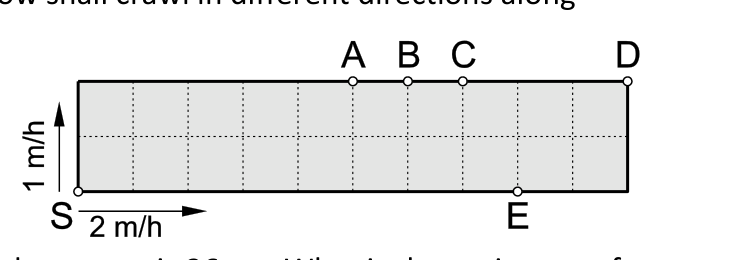
A garden is split into equally sized square-shaped lots. A fast snail and a slow snail crawl in different directions along the outside edge of the garden. Both start at the corner S. The slow snail crawls 1 m in one hour and the fast one crawls 2 m in one hour. At which marked point will the two snails meet for the first time?
Show answer
Answer: B — B
Show hints
Hint 1 of 2
The two snails together cover the whole boundary before they meet, so add their speeds.
Still stuck? Show hint 2 →
Hint 2 of 2
Find how far the faster snail has gone when their combined distance equals the perimeter, then step that far around from S.
Show solution
Approach: combined speed reaches the perimeter; locate the meeting point
Going opposite ways around the edge, the snails meet when the distances they have walked add up to the full perimeter.
Their combined speed is 1 + 2 = 3 m per hour, so the fast snail covers two-thirds of the boundary and the slow one a third.
Marking off the fast snail's two-thirds of the boundary from S lands exactly at point B.
Leonie has one stamp for each of the digits 0, 1, 2, 3, 4, 5, 6, 7, 8, 9. She uses them to stamp the date of the kangaroo competition (see picture). How many of the stamps does Leonie use?
Show answer
Answer: B — 6
Show hints
Hint 1 of 2
Write out the whole date as it is stamped: 15 03 2018.
Still stuck? Show hint 2 →
Hint 2 of 2
She has only one stamp of each digit, so a digit that shows up twice still uses just one stamp — count the different digits.
Show solution
Approach: write the date and circle the different digits, counting each kind once
The date is stamped as 1 5 0 3 2 0 1 8.
Cross out repeats: the 0 and the 1 each appear twice, but she only owns one stamp of each.
The different digits are 0, 1, 2, 3, 5, 8 — that is 6 stamps, answer B.
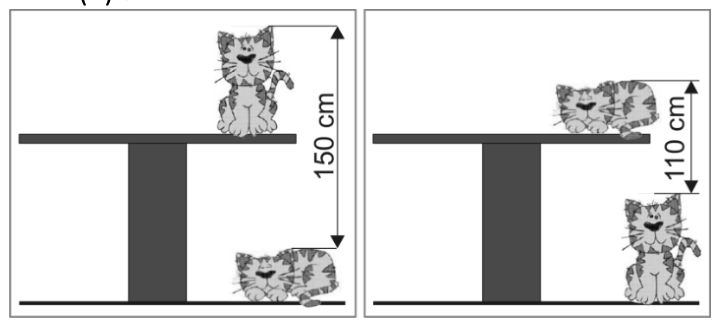
The distance from the top of the cat sitting on the table to the top of the cat sleeping on the floor is 150 cm. The distance from the top of the cat sleeping on the table to the top of the cat sitting on the floor is 110 cm. How high is the table?
Show answer
Answer: C — 130 cm
Show hints
Hint 1 of 2
Add the two given distances and see what each cat contributes.
Still stuck? Show hint 2 →
Hint 2 of 2
Each measurement is one sitting-cat height plus the table minus one sleeping-cat height; adding them cancels the cats.
Show solution
Approach: add the two measurements so the cat heights cancel
Let the table height be t, a sitting cat add s above its base and a sleeping cat add p.
First distance: t + s − p = 150. Second distance: t + p − s = 110.
Adding the two equations: 2t = 260, so t = 130 cm.
Thor has seven stones and a hammer. With his hammer he hits a stone and it breaks into five small stones. He does that a few times. Which of these numbers could be the number of stones he ends up with?
Show answer
Answer: D — 23
Show hints
Hint 1 of 2
Each hammer blow replaces one stone with five, so the count changes by a fixed amount.
Still stuck? Show hint 2 →
Hint 2 of 2
Track the total as a starting value plus a multiple of that step.
Show solution
Approach: find the invariant: each hit adds a constant number of stones
Breaking one stone into five removes 1 and adds 5, a net gain of +4 stones per hit.
Starting at 7, after k hits the total is 7+4k: 11, 15, 19, 23, ...
Among the options only 23 has the form 7+4k (k=4).
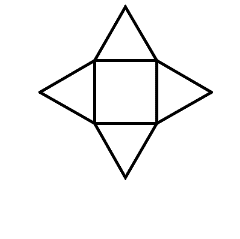
A star is made of a square and four triangles. All the sides of the triangles are equally long. The perimeter of the square is 36 cm. What is the perimeter of the star?
Show answer
Answer: E — 72 cm
Show hints
Hint 1 of 2
First get the side of the square from its perimeter.
Still stuck? Show hint 2 →
Hint 2 of 2
The star's outline is made only of the slanted triangle sides - the square's edges are hidden inside - so count how many of those equal sides form the border.
Show solution
Approach: find the equal side length, then count the edges on the star's outline
The square has perimeter 36 cm, so each side is 9 cm.
All the triangle sides equal that side, namely 9 cm.
The star's boundary is the two outer sides of each of the four triangles: 4 x 2 = 8 sides.
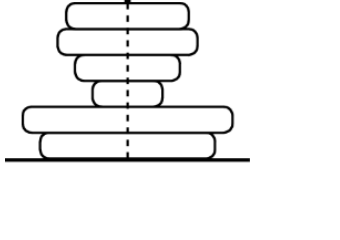
The diagram shows an object made up of 12 small cubes glued together. The object is dipped into paint so that its entire outside is coloured. How many of the small cubes will have exactly four faces coloured?
Show answer
Answer: A — 8
Show hints
Hint 1 of 2
A small cube ends up with exactly 4 painted faces only when exactly 2 of its faces are glued to neighbours.
Still stuck? Show hint 2 →
Hint 2 of 2
So count the cubes that touch exactly two other cubes.
Show solution
Approach: a cube shows 4 painted faces exactly when it is glued to neighbours on 2 faces
When dipped, a small cube is painted on every face that is on the outside, so it has 4 painted faces precisely when 2 of its faces are hidden (glued to neighbours).
Each cube glued on exactly two faces is one with two neighbours; cubes with one neighbour show 5 painted faces and cubes with three neighbours show 3.
Going through the 12 cubes of the shape, exactly 8 of them touch two neighbours.
A big spot of ink covers most of a calendar page for a certain month. On which day of the week does the 25th of that month fall? (In the calendar the weekday columns are labelled Mo, Di, Mi, Do, Fr, Sa, So — Monday through Sunday.)
Show answer
Answer: D — Saturday
Show hints
Hint 1 of 2
Use the few dates you can still read at the edges of the blot to lock down the weekday pattern.
Still stuck? Show hint 2 →
Hint 2 of 2
Dates a week apart fall on the same weekday; step by sevens from a known date to reach the 25th.
Show solution
Approach: anchor on a visible date and jump in steps of 7
A calendar repeats weekdays every 7 days, so the 25th shares a weekday with the 18th, 11th, and 4th.
Reading a date that the ink did not cover fixes that column's weekday.
Lucy folds a piece of paper exactly in half and then cuts out a figure (see picture). Then she unfolds the paper again. Which of the five pictures can she see?
Show answer
Answer: D
Show hints
Hint 1 of 2
Whatever is cut on the folded side gets copied onto the other side when the paper opens.
Still stuck? Show hint 2 →
Hint 2 of 2
So the opened picture must look the same on both sides of the fold line, like a butterfly.
Show solution
Approach: open the fold by copying the cut shape to a matching shape on the other side of the crease
When the folded paper is cut and then opened, the cut shape appears twice — once on each side of the fold line.
The two sides are mirror copies that touch along the crease, like a butterfly's wings.
Only picture D has that matching mirror shape, so the answer is D.
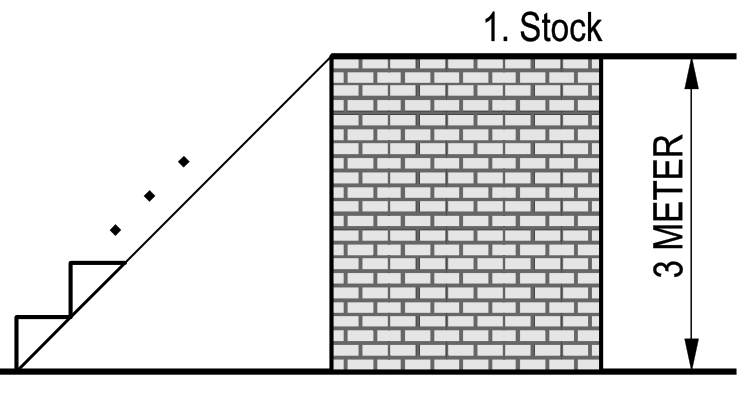
Bernd produces steps for a staircase which are 15 cm high and 15 cm deep (see diagram). The staircase should reach from the ground floor to the first floor, which is 3 m higher. How many steps does Bernd have to produce?
Show answer
Answer: D — 20
Show hints
Hint 1 of 2
Every step adds the same height. How much total height must the steps cover?
Still stuck? Show hint 2 →
Hint 2 of 2
Turn 3 m into centimetres, then see how many 15 cm steps fit.
Show solution
Approach: divide the total rise by the height of one step
The staircase must rise 3 m = 300 cm.
Each step is 15 cm high, so the number of steps is 300 : 15 = 20.
The following two statements are true: some aliens are green and all others are purple; green aliens live on Mars only. Which one of the following logical conclusions can be made?
Show answer
Answer: E — There are no green aliens on Venus.
Show hints
Hint 1 of 2
List exactly what the two true statements force and what they do not.
Still stuck? Show hint 2 →
Hint 2 of 2
Check each option against 'green aliens live on Mars only'.
Show solution
Approach: test each conclusion against the given facts
Green aliens live on Mars only, so no green alien can be on Venus.
The colour split (some green, the rest purple) does not force all aliens onto Mars, nor pin purple aliens to Venus.
Only the statement 'there are no green aliens on Venus' must be true.
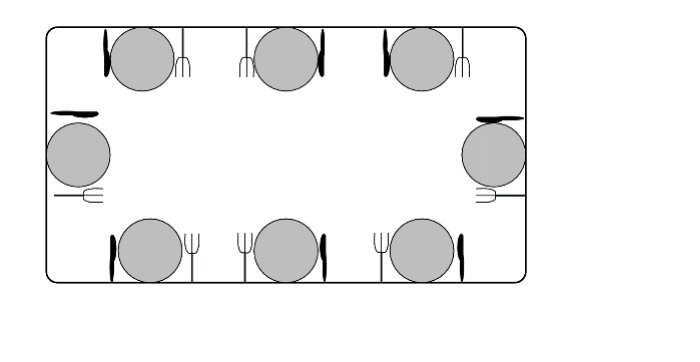
Mike sets the table for 8 people: the fork has to lie to the left and the knife to the right of the plate. For how many people is the cutlery set correctly?
Show answer
Answer: A — 5
Show hints
Hint 1 of 2
Sit in each chair in turn; the setting is right only if the fork is on your left hand and the knife on your right hand.
Still stuck? Show hint 2 →
Hint 2 of 2
Remember that someone sitting on the far side of the table faces you, so their left and right are flipped from yours.
Show solution
Approach: stand in each person's place and check fork-on-left, knife-on-right from their seat
Picture yourself sitting in each of the 8 chairs, facing the plate.
From that seat the fork must be by your left hand and the knife by your right hand — tick the places that match.
Exactly five places pass the test, so the cutlery is set correctly for 5 people, answer A.
Maria wants to share 42 apples, 60 peaches and 90 cherries fairly. She puts them into baskets that each hold the same number of apples, the same number of peaches and the same number of cherries, and gives one basket to each friend. At most, how many baskets can she fill?
Show answer
Answer: B — 6
Show hints
Hint 1 of 2
The number of baskets must divide each of 42, 60 and 90 exactly.
Still stuck? Show hint 2 →
Hint 2 of 2
Find the greatest common divisor of 42, 60 and 90.
Show solution
Approach: greatest common divisor
Each fruit count must split evenly among the baskets, so the number of baskets divides 42, 60 and 90.
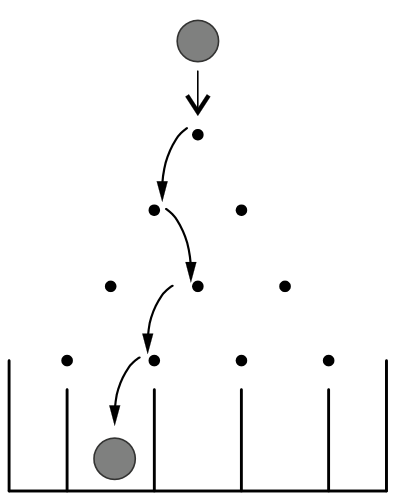
In a game of luck, a ball rolls downwards towards hammered nails and is diverted either to the right or the left by the nail immediately below it. One possible path is shown in the diagram. How many different ways are there for the ball to reach the second compartment from the left?
Show answer
Answer: C — 4
Show hints
Hint 1 of 2
Count how many rows of nails the ball passes before landing.
Still stuck? Show hint 2 →
Hint 2 of 2
The number of paths into each slot follows the same pattern as the rows of Pascal's triangle (1, then 1–1, then 1–2–1, …).
Show solution
Approach: count left/right choices like Pascal's triangle
The ball passes 4 rows of nails, choosing left or right each time, and lands in one of 5 compartments.
The number of ways to reach the compartments from left to right is 1, 4, 6, 4, 1.
The second compartment from the left has 4 different paths.
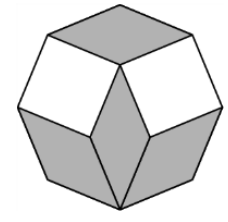
Four identical rhombuses (diamonds) and two squares are fitted together to form a regular octagon, as shown. How big are the obtuse interior angles of the rhombuses?
Show answer
Answer: A — \(135^\circ\)
Show hints
Hint 1 of 2
The four rhombuses and two squares tile a regular octagon, whose interior angle is known.
Still stuck? Show hint 2 →
Hint 2 of 2
Relate the rhombus obtuse angle to the octagon's corner angle.
Show solution
Approach: use the octagon's interior angle
A regular octagon has interior angles of 135°.
Each octagon vertex coincides with the obtuse corner of a rhombus, so that obtuse angle equals the octagon's interior angle.
Hence the obtuse interior angle of each rhombus is 135°.
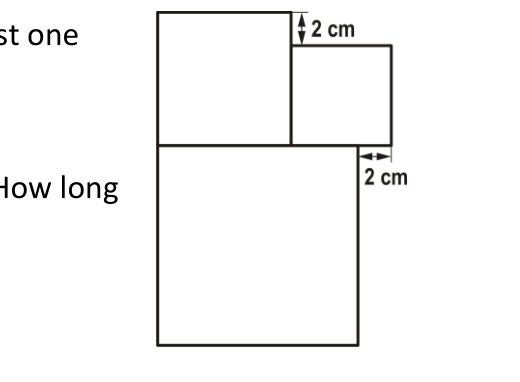
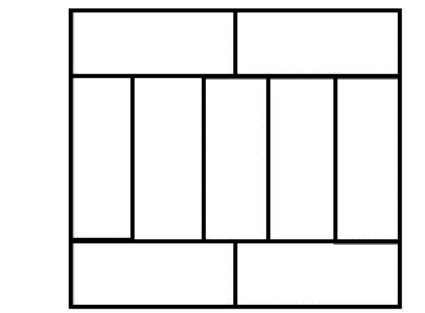
A large rectangle is made up of 9 equally big rectangles. The longer side of each small rectangle is 10 cm long. What is the perimeter of the large rectangle?
Show answer
Answer: C — 76 cm
Show hints
Hint 1 of 2
Let the small rectangle be 10 (long) by w (short), and write the big rectangle's sides using the layout.
Still stuck? Show hint 2 →
Hint 2 of 2
The middle band of standing rectangles fixes the width; the top and bottom rows fix the short side w.
Show solution
Approach: set up the dimensions from the 2+5+2 layout
Five standing rectangles side by side make the width: 5 short sides. Two lying rectangles also span that width, so 2 · 10 = 5w, giving w = 4 cm.
The big rectangle is 5w = 20 cm wide and (4 + 10 + 4) = 18 cm tall.
There are 65 balls in a box, 8 of which are white and the rest black. Up to 5 balls can be taken out of the box in one draw, and no balls may be put back. What is the minimum number of draws needed to be certain that at least one white ball is drawn?
Show answer
Answer: B — 12
Show hints
Hint 1 of 2
Imagine the unluckiest possible sequence of draws that keeps avoiding white balls.
Still stuck? Show hint 2 →
Hint 2 of 2
How many draws of up to 5 can be all black before white is forced?
Show solution
Approach: worst-case (pigeonhole) reasoning on the 57 black balls
There are 57 black balls; in the worst case you keep pulling black.
Eleven draws of 5 remove only 55 balls, so black balls might still remain; a twelfth draw can no longer be all black (at most 2 black left) and must include a white.
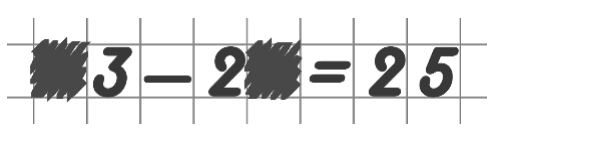
Alice subtracts one two-digit number from another two-digit number. Afterwards she paints over two of the digits in the calculation, so it now reads ?3 − 2? = 25 (each ? hides a digit). What is the sum of the two painted-over digits?
Show answer
Answer: D — 13
Show hints
Hint 1 of 2
Write the two numbers with their hidden digits as unknowns and line up the subtraction.
Still stuck? Show hint 2 →
Hint 2 of 2
Turn the painted-over subtraction into a place-value equation; only one pair of digits makes it work.
Show solution
Approach: rebuild the subtraction one place value at a time
The calculation is ?3 − 2? = 25, so the answer 25 sits just above 20.
For the difference to be 25, the first number must be in the 50s: try 53.
Then 53 − 2? = 25 forces 2? = 28, so the hidden digits are 5 and 8.
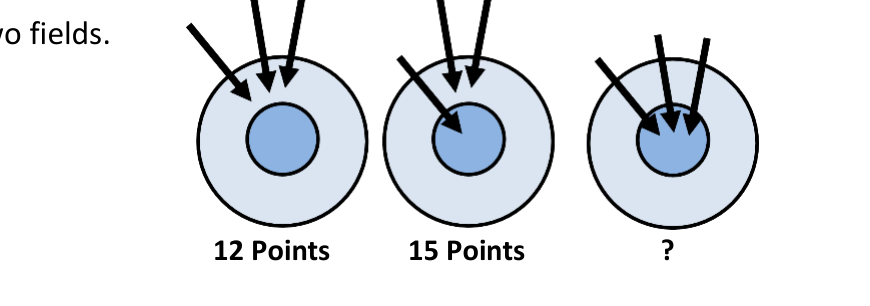
Diana shoots 3 darts, three times, at a target board with two fields. The first time she scores 12 points, the second time 15. The number of points depends on which field she hits. How many points does she score the third time?
Show answer
Answer: D — 21
Show hints
Hint 1 of 2
There are only two prizes: a dart in the small middle circle is worth one amount, a dart in the big ring is worth another.
Still stuck? Show hint 2 →
Hint 2 of 2
In the first picture all three darts are in the ring; in the second one dart has moved into the middle — see how much the score jumped.
Show solution
Approach: read each picture to find the ring value and the middle value, then score the third throw
First picture: all 3 darts are in the big ring and score 12, so each ring dart is worth 12 ÷ 3 = 4.
Second picture: one dart moved into the middle and the score went from 12 up to 15, so the middle is worth 4 + 3 = 7.
Third picture: all 3 darts are in the middle, so the score is 7 + 7 + 7 = 21, answer D.
Charles cuts one rope into 3 pieces that are all the same length. He ties 1 knot in the first piece, 2 knots in the next, and 3 knots in the last. Then he lays the three pieces down in any order. Which picture does he see?
Show answer
Answer: B
Show hints
Hint 1 of 3
Two things must be true in the right picture — about how many knots AND about the rope lengths.
Still stuck? Show hint 2 →
Hint 2 of 3
Count knots: the three pieces should show 1 knot, 2 knots, and 3 knots — one of each.
Still stuck? Show hint 3 →
Hint 3 of 3
Don't forget the pieces were cut to be the SAME length, so all three ropes must look equally long.
Show solution
Approach: check both the knot counts and that the three ropes are equal length
The three pieces must show one rope with 1 knot, one with 2 knots, and one with 3 knots.
But the pieces were cut to be the same length, so all three ropes must also be equally long.
Only option B has both: ropes of 1, 2 and 3 knots that are all the same length.
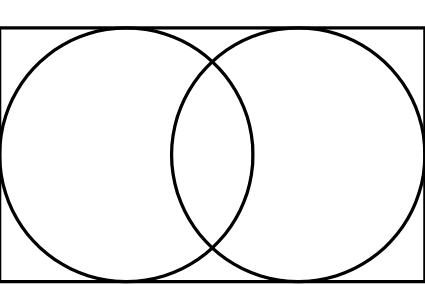
Two circles are inscribed in an 11 cm long and 7 cm wide rectangle so that they each touch three sides of the rectangle. How big is the distance between the centres of the two circles?
Show answer
Answer: D — 4 cm
Show hints
Hint 1 of 2
Each circle touches three sides, so its size is fixed by the short side of the rectangle.
Still stuck? Show hint 2 →
Hint 2 of 2
Find each centre's distance from the left and right ends; subtract.
Show solution
Approach: locate the two centres and subtract
Touching three sides means each circle has diameter 7 cm (the width), so radius 3.5 cm.
The left centre sits 3.5 cm from the left edge; the right centre sits 3.5 cm from the right edge of the 11 cm length.
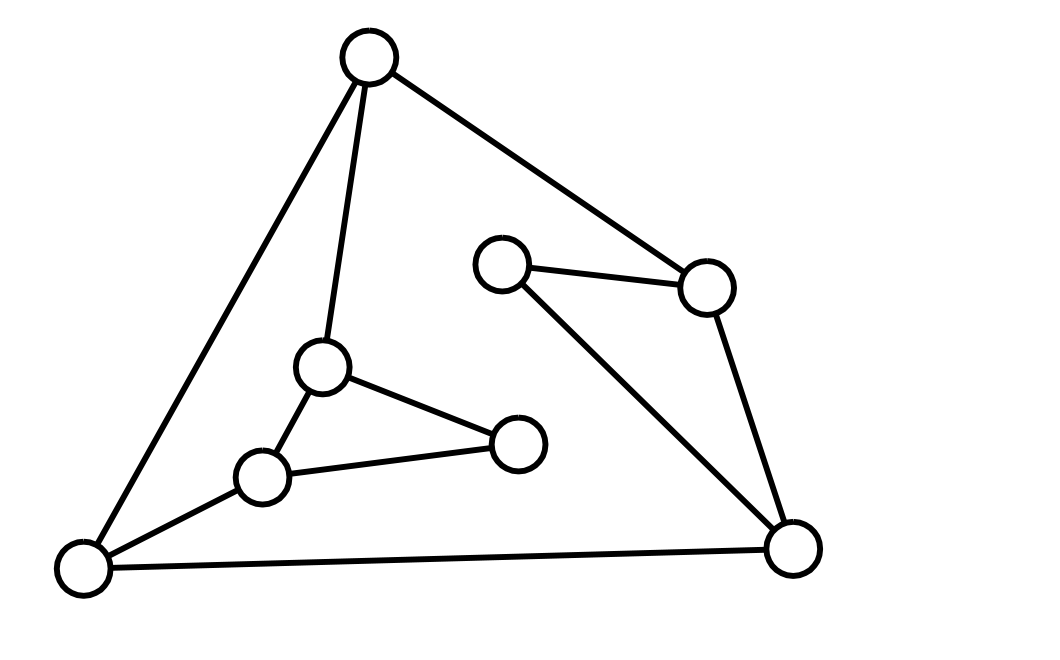
In the diagram the circles are light bulbs, joined by lines to some other light bulbs. At the start every bulb is switched off. If you touch a bulb, then that bulb and all the bulbs directly joined to it switch on. What is the smallest number of bulbs you have to touch in order to switch on all the bulbs?
Show answer
Answer: A — 2
Show hints
Hint 1 of 2
Touching one bulb lights it and every bulb directly joined to it, so look for a bulb connected to many others.
Still stuck? Show hint 2 →
Hint 2 of 2
Find the fewest bulbs whose neighbourhoods together cover all of them - two well-placed touches are enough here.
Show solution
Approach: dominating set - cover all bulbs with fewest touches
Touching a bulb switches on that bulb and all bulbs joined to it by an edge.
Look for bulbs whose connections together reach every bulb in the picture.
Two suitably chosen bulbs cover the whole network, and one is not enough.
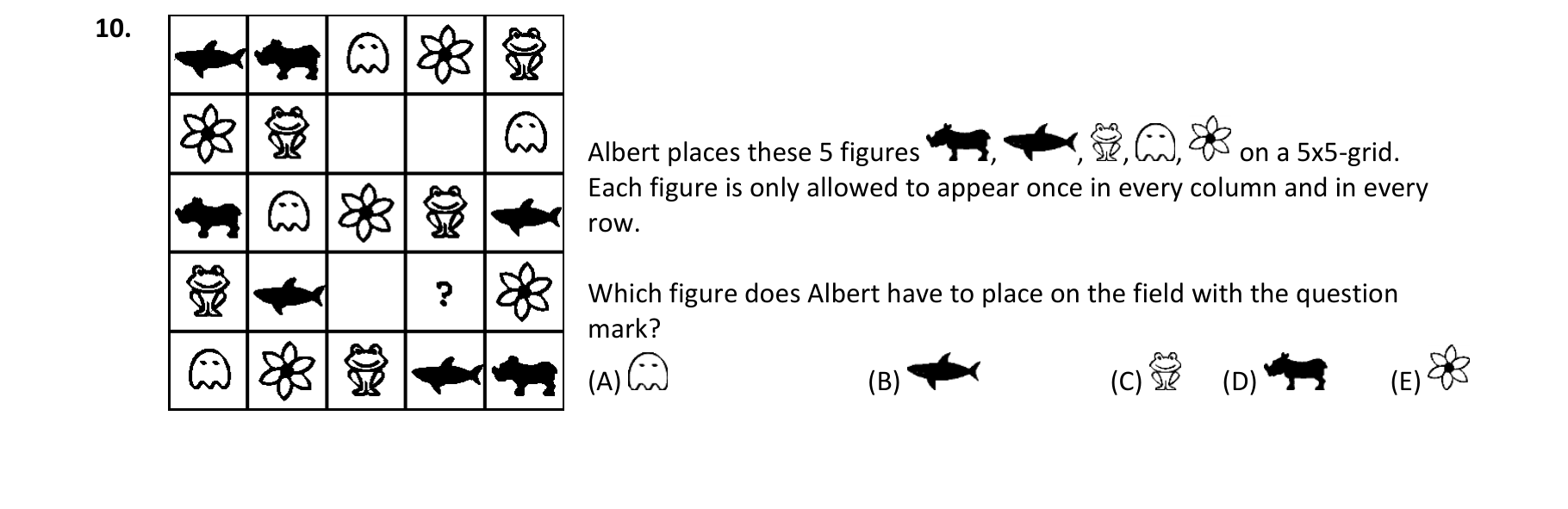
Albert places these 5 figures on a 5×5 grid. Each figure is only allowed to appear once in every column and once in every row. Which figure does Albert have to place on the field with the question mark?
Show answer
Answer: A
Show hints
Hint 1 of 2
Each of the five figures shows up exactly once in every row and exactly once in every column.
Still stuck? Show hint 2 →
Hint 2 of 2
Look along the question mark's row and down its column, and cross out every figure you already see there.
Show solution
Approach: cross out every figure already in the marked cell's row and column; one figure is left
Because no figure repeats in a row or a column, the missing one must be a figure not yet in that row or column.
Read across the marked cell's row and down its column and cross off each figure that already appears.
Exactly one figure is never crossed off, and that is the one that belongs in the question-mark cell, answer A.
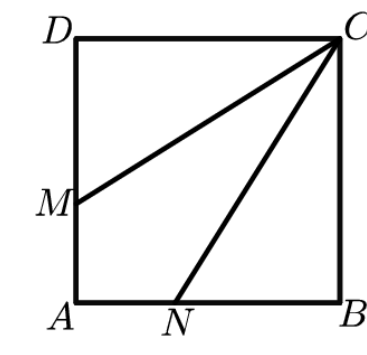
The square ABCD has side length 3 cm. The points M and N, which lie on the sides AD and AB respectively, are joined to the corner C. That way the square is split into three parts of equal area. How long is the line segment DM?
Show answer
Answer: D — 2 cm
Show hints
Hint 1 of 2
Each of the three pieces has area equal to one third of the square.
Still stuck? Show hint 2 →
Hint 2 of 2
Triangle DMC has base DM and height DC = 3; set its area equal to a third of the square.
Show solution
Approach: use the equal-area condition on triangle DMC
The square has area 9 cm², so each part has area 3 cm².
Triangle DMC has area ½ · DM · DC = ½ · DM · 3 = 3, so DM = 2 cm.
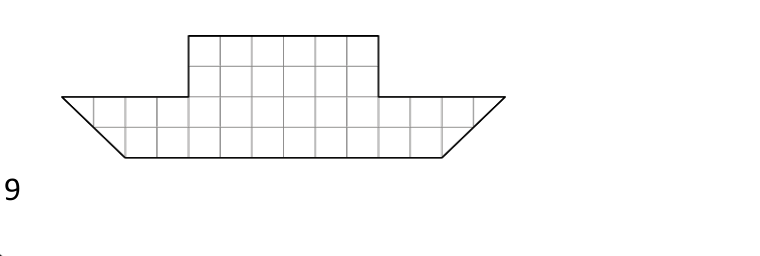
Tom wants to completely cover his paper boat using the two shapes shown (a small square and a trapezoid). What is the smallest number of shapes he needs?
Show answer
Answer: B — 6
Show hints
Hint 1 of 2
You want to fill the whole boat with no gaps, so try to use the bigger shape as often as it fits.
Still stuck? Show hint 2 →
Hint 2 of 2
Cover the wide bottom of the boat with the big pieces first, then patch the corners with the small ones.
Show solution
Approach: fill the boat using the big piece wherever it fits, then patch the rest, counting pieces
Start by laying the bigger shape across the parts of the boat where it fits exactly.
Fill the leftover corners and edges with the smaller shape so there are no gaps.
The fewest shapes that cover the whole boat is 6, answer B.
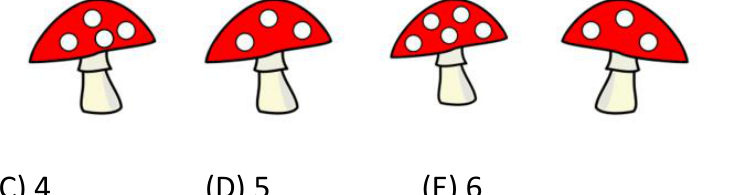
The number of spots on each fly agaric (toadstool) shows how many dwarfs fit under it. We can see one side of each toadstool; the other side has the same number of spots. When it rains, 36 dwarfs try to hide under the toadstools. How many dwarfs get wet?
Show answer
Answer: E — 6
Show hints
Hint 1 of 3
The back of each mushroom has the same spots as the front, so each mushroom really has double what you see.
Still stuck? Show hint 2 →
Hint 2 of 3
Work out how many dwarfs fit under all the mushrooms together.
Still stuck? Show hint 3 →
Hint 3 of 3
If there are more dwarfs than spaces, the leftover dwarfs are the ones who get wet.
Show solution
Approach: double the spots you can see, total them, then find the leftover dwarfs
The spots you can see are 4, 3, 5 and 3, which is 15 spots on the fronts. Each mushroom's back matches its front, so double it: there are really 30 spots in all.
So 30 dwarfs can hide under the mushrooms.
But 36 dwarfs come to hide, and 36 − 30 = 6 dwarfs have no space, so 6 get wet.
The entrances of two student halls are 250 m apart on a straight street. The first hall has 100 students and the second has 150 students. Where should a bus stop be built so that the total of all the students' walking distances is as small as possible?
Show answer
Answer: D — directly in front of the second hall
Show hints
Hint 1 of 2
Putting the stop nearer one hall trades short walks for the bigger group against longer walks for the smaller group.
Still stuck? Show hint 2 →
Hint 2 of 2
Place it where the larger group walks zero distance.
Show solution
Approach: put the stop where the larger group walks nothing
For any stop between the halls, moving it a metre toward the second hall saves 150 students a metre but costs only 100 students a metre.
So the total distance keeps shrinking as the stop moves toward the second hall.
The best place is directly in front of the second hall (the larger group).
Martina multiplies two two-digit numbers and then paints over some of the digits, leaving \(?\,3 \times 2\,? = 3\,?\,2\). How big is the sum of the three digits that Martina has painted over?
Show answer
Answer: B — 6
Show hints
Hint 1 of 2
The units digit of the product comes only from the units digits of the two factors.
Still stuck? Show hint 2 →
Hint 2 of 2
Find the hidden units digit first, then the product is forced, revealing the other hidden digits.
Show solution
Approach: pin down digits using the units digit and size
The numbers are (10a+3) and (20+b), product 3?2. For the product to end in 2, 3b must end in 2, so b = 4 and the second number is 24.
Then (10a+3) · 24 lies between 300 and 392; a = 1 gives 13 · 24 = 312, which fits 3?2.
The painted digits are 1, 4 and 1, whose sum is 6.
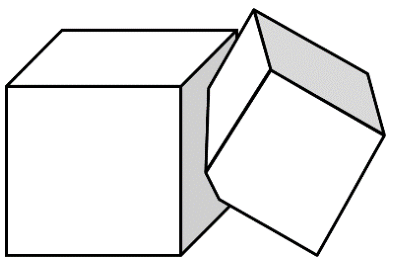
Two cubes with volumes V and W intersect each other as shown. 90% of the volume of the cube with volume V does not belong to both cubes, and 85% of the volume of the cube with volume W does not belong to both cubes. What is the relationship between the volumes of the two cubes?
Show answer
Answer: B — \(V = \tfrac{3}{2}\,W\)
Show hints
Hint 1 of 2
The shared (overlap) part is what each percentage leaves out.
Still stuck? Show hint 2 →
Hint 2 of 2
Set the two expressions for the common volume equal.
Show solution
Approach: equate the two descriptions of the overlap volume
90% of V is outside the overlap, so the overlap is 0.1V.
85% of W is outside the overlap, so the overlap is 0.15W.
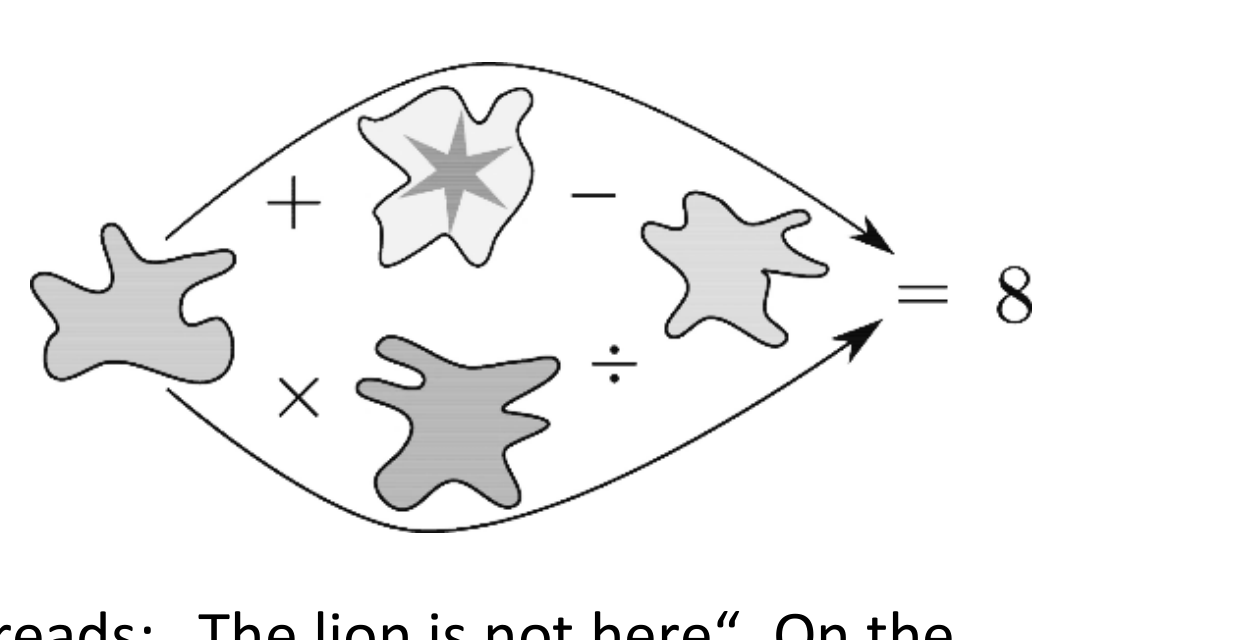
The four smudges hide four of the numbers 1, 2, 3, 4, 5. The calculations along the two arrows are both correct. Which number is hidden behind the smudge with the star?
Show answer
Answer: E — 5
Show hints
Hint 1 of 2
Each smudge hides one of 1, 2, 3, 4, 5; test which assignment makes both arrow-chains land on 8.
Still stuck? Show hint 2 →
Hint 2 of 2
Work the multiply/divide arrow first, since those choices are tight, then check the add/subtract arrow.
Show solution
Approach: try the few possibilities so both chains give 8
The four smudges hide four of the numbers 1, 2, 3, 4, 5, and each arrow's calculation must equal 8.
Only one way to place the numbers makes both the + / - path and the x / div path come out to 8.
You make two-digit numbers using the digits 2, 0, 1 and 8. Each number must be bigger than 10 and smaller than 25, and made of two different digits. How many different numbers do you get?
Show answer
Answer: A — 4
Show hints
Hint 1 of 3
The number is between 10 and 25, so it must start with a 1 or a 2 — try each.
Still stuck? Show hint 2 →
Hint 2 of 3
For a number starting with 1, the other digit comes from 2, 0, 8 (a 1 would repeat).
Still stuck? Show hint 3 →
Hint 3 of 3
Write out every number you can make, then cross off any below 11 or 25 and up, and any with two equal digits.
Show solution
Approach: list every allowed number and count them
The number is bigger than 10 and smaller than 25, so it starts with 1 or 2.
Starting with 1, the other digit (from 2, 0, 8) gives 12, 10, 18 — but 10 is not bigger than 10, so keep 12 and 18.
Starting with 2, staying under 25, gives 20 and 21. All together: 12, 18, 20, 21, which is 4 numbers.
105 numbers are written in a row: 1, 2, 2, 3, 3, 3, 4, 4, 4, 4, 5, 5, 5, 5, 5, … where each number n is written exactly n times. How many of those numbers are divisible by 3?
Show answer
Answer: D — 30
Show hints
Hint 1 of 2
1 + 2 + 3 + … + 14 = 105, so the row runs from 1 up to 14.
Still stuck? Show hint 2 →
Hint 2 of 2
Only the multiples of 3 (namely 3, 6, 9, 12) count, and each appears as many times as its value.
Show solution
Approach: sum the counts of the multiples of 3 up to 14
Since 1 + 2 + … + 14 = 105, the numbers used run from 1 to 14.
The multiples of 3 in that range are 3, 6, 9 and 12, each written that many times.
A rectangle is split into 40 equally big squares. The rectangle has more than one row of squares. Andreas colours in all the squares of the middle row. How many squares did he not colour in?
Show answer
Answer: C — 32
Show hints
Hint 1 of 2
There must be a single middle row, so the number of rows is odd.
Still stuck? Show hint 2 →
Hint 2 of 2
Find odd factors of 40 to get the rows, then the columns give the size of the middle row.
Show solution
Approach: factor 40 into odd rows times columns
A single middle row needs an odd number of rows; the only odd factor of 40 (with more than one row) is 5, so the grid is 5 rows by 8 columns.
The middle row has 8 squares, so the uncoloured squares number 40 − 8 = 32.
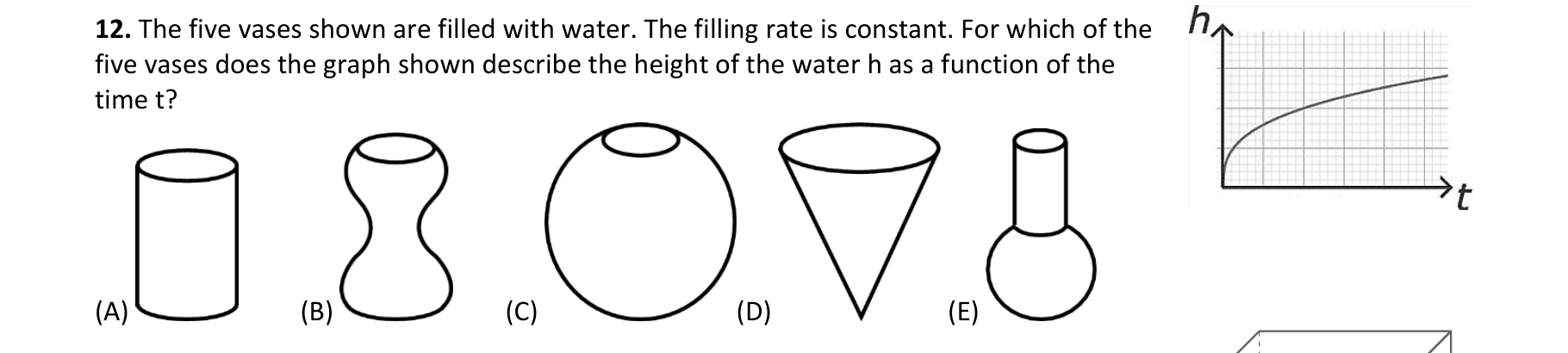
The five vases shown are filled with water at a constant rate. For which of the five vases does the graph shown describe the height of the water \(h\) as a function of the time \(t\)?
Show answer
Answer: D
Show hints
Hint 1 of 2
A constant fill rate means height rises fast where the vase is narrow and slowly where it is wide.
Still stuck? Show hint 2 →
Hint 2 of 2
Read the graph's changing slope and match it to a width profile.
Show solution
Approach: match the slope of h(t) to the cross-section width at each height
The graph rises steeply at first, then flattens — the level climbs quickly low down and slowly higher up.
Quick early rise means a narrow bottom; slowing rise means it widens going up.
The cone standing on its point (narrow below, wide above) gives exactly this.
A lion hides in one of three rooms. The note on room 1 reads “The lion is not here.” The note on room 2 reads “The lion is here.” The note on room 3 reads “2 + 3 = 5.” Exactly one of the three notes is true. In which room is the lion?
Show answer
Answer: A — Room 1
Show hints
Hint 1 of 2
Notice the note on door 3 (2 + 3 = 5) is simply a true statement on its own.
Still stuck? Show hint 2 →
Hint 2 of 2
Since exactly one note is true, that forces the other two to be false; read off where the lion must be.
Show solution
Approach: use the always-true note to fix the count
The note on room 3 says 2 + 3 = 5, which is true by itself.
Exactly one note is true, so room 3's note is the true one and the other two are false.
'The lion is not here' on room 1 being false means the lion IS in room 1; 'the lion is here' on room 2 being false agrees.
Felix the rabbit has 20 carrots. Every day he eats 2 of them. He has eaten the 12th carrot on a Wednesday. On which day of the week did he start eating the carrots?
Show answer
Answer: E — Friday
Show hints
Hint 1 of 2
Carrots come in pairs each day: day 1 is carrots 1 and 2, day 2 is carrots 3 and 4, and so on.
Still stuck? Show hint 2 →
Hint 2 of 2
Find which day number holds the 12th carrot, then hop backwards on the calendar to day 1.
Show solution
Approach: pair the carrots into days to reach day 6, then count back on the days of the week
Two carrots each day means: day 1 = carrots 1,2; day 2 = 3,4; day 3 = 5,6; day 4 = 7,8; day 5 = 9,10; day 6 = 11,12.
So the 12th carrot is eaten on day 6, which is the Wednesday given.
Count back 5 days from Wednesday: Tue, Mon, Sun, Sat, Friday — that is day 1, answer E.
Alice has 3 white, 2 black and 2 grey pieces of paper. First she cuts every piece of paper that is not black into two pieces. Then she cuts in half every piece of paper that is not white. How many pieces of paper does she have in the end?
Show answer
Answer: D — 18
Show hints
Hint 1 of 3
Keep three little piles in your head — white, black, and grey — and watch each pile change.
Still stuck? Show hint 2 →
Hint 2 of 3
Cutting a piece into two means that pile gets twice as many pieces.
Still stuck? Show hint 3 →
Hint 3 of 3
Do step 1 on the not-black piles, then step 2 on the not-white piles, then add the three piles up.
Show solution
Approach: watch each colour pile through the two cuts, then add
Start with 3 white, 2 black, 2 grey.
Step 1 cuts every not-black piece in two: white 3 becomes 6, grey 2 becomes 4, and the 2 black stay the same — that is 6 + 2 + 4 = 12 pieces.
Step 2 cuts every not-white piece in two: black 2 becomes 4, grey 4 becomes 8, and the 6 white stay the same — so 6 + 4 + 8 = 18 pieces.
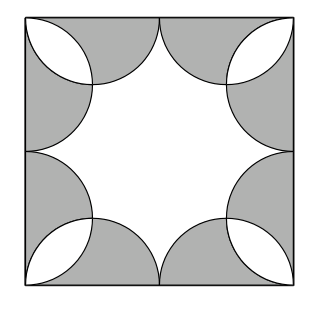
Eight congruent semicircles are drawn inside a square with side length 4. How big is the area of the white part?
Show answer
Answer: B — 8
Show hints
Hint 1 of 2
Find the radius of the semicircles from how they sit along the sides.
Still stuck? Show hint 2 →
Hint 2 of 2
Pair up the grey and white pieces so the curved parts cancel.
Show solution
Approach: match curved pieces so the area is exactly half the square
Two semicircles fit along each side of length 4, so each has diameter 2 and radius 1.
By symmetry the eight semicircles split the square into equal grey and white regions: each curved bite removed from the grey is matched by an equal curved bite added to the white.
So the white area is exactly half of the square: \(\tfrac12\times 16 = \) 8.
Philipp wants to know how much his book weighs, correct to half a gram. However, his scale only shows weights correct to 10 g, so he weighs several identical books all together. What is the minimum number of identical books he has to put on the scale to reach his aim?
Show answer
Answer: D — 20
Show hints
Hint 1 of 3
Reading to the nearest 10 g means the true total is off by at most 5 g.
Still stuck? Show hint 2 →
Hint 2 of 3
To know one book to the nearest half-gram, the per-book error must be small enough to round correctly — under a quarter of a gram.
Still stuck? Show hint 3 →
Hint 3 of 3
Share that 5 g total error among n books and make 5/n small enough.
Show solution
Approach: bound the per-book error so it rounds to the nearest half-gram
A reading correct to 10 g can be off by up to 5 g from the true total.
Dividing by n books, one book's value is off by up to 5/n g; to pin it to the nearest half-gram the error must stay below 0.25 g, so 5/n ≤ 0.25.
The two girls Eva and Olga and the three boys Adam, Isaac, and Urban play together with a ball. When a girl has the ball she throws it either to the other girl or to a boy. Every boy throws the ball only to another boy, but never back to the boy it just came from. The first throw is made by Eva to Adam. Who makes the 5th throw?
Show answer
Answer: A — Adam
Show hints
Hint 1 of 2
After Eva throws to Adam, the ball stays among the three boys, and a boy never throws back to whoever just threw to him.
Still stuck? Show hint 2 →
Hint 2 of 2
Track who holds the ball before each throw; the no-return rule on three boys forces the 5th thrower.
Show solution
Approach: trace the holder, using the no-immediate-return rule
Throw 1 is Eva to Adam, so Adam makes throw 2.
From then on the ball moves only among the three boys, each time to a boy other than the one who just passed it.
On a triangle of three boys this no-return rule sends the ball Adam -> (a boy) -> (the third boy) -> back to Adam.
A rose bush has 8 flowers, with butterflies and dragonflies sitting on them. At most one insect sits on each flower, and more than half of the flowers are taken. The number of butterflies is twice the number of dragonflies. How many butterflies are sitting on the flowers?
Show answer
Answer: C — 4
Show hints
Hint 1 of 2
Twice as many butterflies as dragonflies means the insects come in little teams of 3: two butterflies with one dragonfly.
Still stuck? Show hint 2 →
Hint 2 of 2
More than half of the 8 flowers are taken, so more than 4 insects are sitting, but no more than 8.
Show solution
Approach: group the insects into teams of two butterflies plus one dragonfly and count whole teams
Since there are twice as many butterflies as dragonflies, picture them in teams of 3: two butterflies and one dragonfly each.
More than half of the 8 flowers are filled, so the number of insects is more than 4 but at most 8 — one team is only 3 (too few) and three teams would be 9 (too many).
So there are exactly two teams: 6 insects, which is 4 butterflies and 2 dragonflies, giving 4 butterflies, answer C.
On one day there are 40 train trips, each from one of the towns M, N, O, P, Q to exactly one other of those towns. There are 10 trips either from or to M, 10 either from or to N, 10 either from or to O, and 10 either from or to P. How many trips are there either from or to Q?
Show answer
Answer: E — 40
Show hints
Hint 1 of 2
Each trip touches exactly two towns, so summing “trips touching each town” counts every trip twice.
Still stuck? Show hint 2 →
Hint 2 of 2
The five town-counts must add up to 2 × 40 = 80.
Show solution
Approach: each trip is counted at both of its towns
Every trip has two endpoints, so adding the counts for all five towns gives \(2\times 40 = 80\).
A lion hides in one of three rooms. The note on room 1 reads “The lion is here.” The note on room 2 reads “The lion is not here.” The note on room 3 reads “\(2 + 3 = 2 \times 3\).” Exactly one of the three notes is true. Which room is the lion in?
Show answer
Answer: C — Room 3
Show hints
Hint 1 of 2
The note on room 3 says 2 + 3 = 2 × 3, i.e. 5 = 6 — is that ever true?
Still stuck? Show hint 2 →
Hint 2 of 2
Since that note is false, exactly one of the other two notes must be true; test each room.
Show solution
Approach: use that exactly one note is true
Room 3's note (5 = 6) is false, so the single true note is on room 1 or room 2.
If the lion were in room 1 both notes 1 and 2 would be true; if in room 2 neither would be true.
If the lion is in room 3, only note 2 ('not here') is true — exactly one. So the lion is in Room 3.
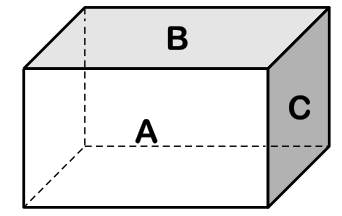
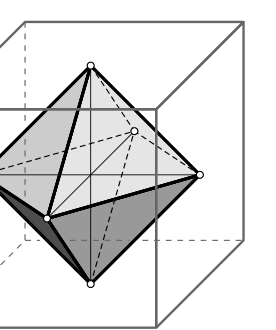
An octahedron is inscribed in a cube with side length 1; the vertices of the octahedron are the midpoints of the faces of the cube. How big is the volume of the octahedron?
Show answer
Answer: D — \(\tfrac{1}{6}\)
Show hints
Hint 1 of 2
The octahedron's vertices are the centres of the cube's six faces.
Still stuck? Show hint 2 →
Hint 2 of 2
Split the octahedron into two square pyramids.
Show solution
Approach: octahedron from face centres of a unit cube
The six face centres of a unit cube form a regular octahedron made of two square pyramids.
Each pyramid has base area 1/2 (the square joining four face centres) and height 1/2.
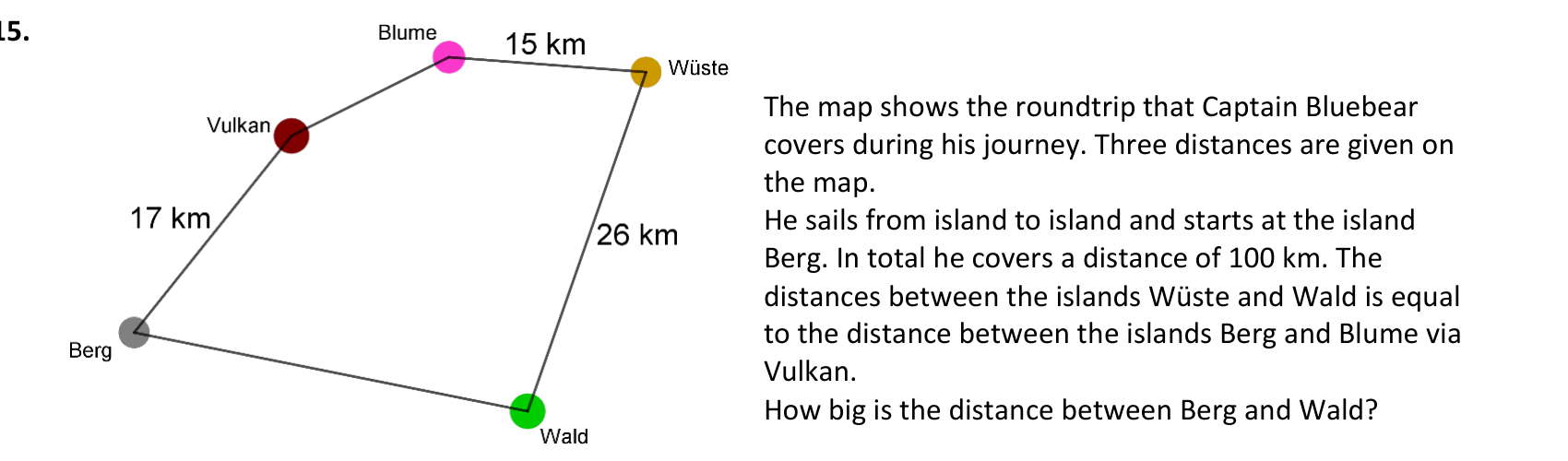
The map shows the round trip that Captain Bluebear sails. Three distances are given. He sails from island to island starting at Berg, and altogether he covers 100 km. The distance between Wüste and Wald equals the distance from Berg to Blume going past Vulkan. How big is the distance between Berg and Wald?
Show answer
Answer: D — 33 km
Show hints
Hint 1 of 2
Three legs are given (17, 15, 26) and the whole loop is 100 km.
Still stuck? Show hint 2 →
Hint 2 of 2
Use the clue that Wüste–Wald equals Berg–Blume via Vulkan to fill the missing leg, then subtract.
Show solution
Approach: find the unknown legs from the 100 km loop and the equal-distance clue
The trip Berg–Vulkan–Blume–Wüste–Wald–Berg totals 100 km.
The road from Anna's house to Mary's house is 16 km long. The road from Mary's house to John's house is 20 km long. The road from the crossing to Mary's house is 9 km long. How long is the road from Anna's house to John's house?
Show answer
Answer: E — 18 km
Show hints
Hint 1 of 3
Notice the two roads cross in the middle — that crossing is on the way from Anna to John.
Still stuck? Show hint 2 →
Hint 2 of 3
Both long roads (Anna-to-Mary and John-to-Mary) include the same 9 km piece up to Mary.
Still stuck? Show hint 3 →
Hint 3 of 3
Take that 9 km off each road to find Anna-to-crossing and John-to-crossing, then add them.
Show solution
Approach: break each road at the crossing, then add the two near pieces
Anna's road to Mary is 16 km, but the last 9 km is from the crossing to Mary, so Anna to the crossing is 16 − 9 = 7 km.
John's road to Mary is 20 km, and again 9 km of it is from the crossing to Mary, so John to the crossing is 20 − 9 = 11 km.
Anna to John goes through the crossing: 7 + 11 = 18 km.
At a humanistic university you can study languages, history or philosophy. Some students study exactly one language (nobody studies several at once). Among those language students, 35% study English. Among all students of the university, 13% study a language other than English. What percentage of all students study a language?
Show answer
Answer: B — 20 %
Show hints
Hint 1 of 2
If 35% of language students study English, then 65% study a non-English language.
Still stuck? Show hint 2 →
Hint 2 of 2
That 65% of the language group equals 13% of all students.
Show solution
Approach: the non-English language students link the two percentages
Among language students, 35% study English, so 65% study another language.
Those non-English language students are 13% of all students, so 65% of the language group = 13% of everyone.
Thus the language group is \(13\% \div 0.65 = \) 20% of all students.
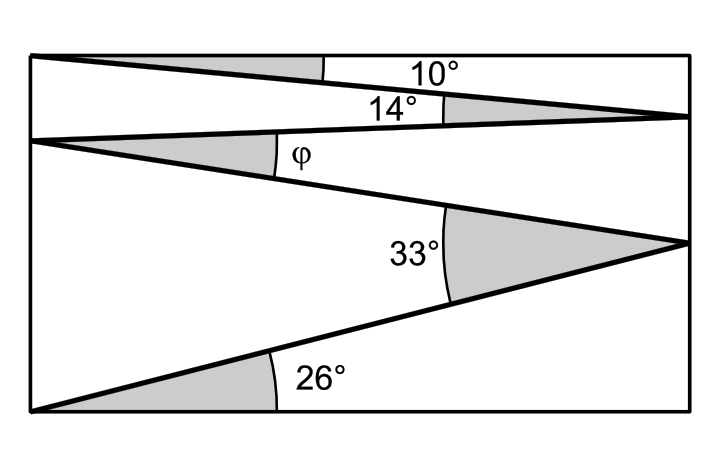
Valentin draws a zig-zag line inside a rectangle as shown in the diagram. For that he uses the angles 10°, 14°, 33° and 26°. How big is the angle \(\varphi\)?
Show answer
Answer: A — 11°
Show hints
Hint 1 of 2
The zig-zag bounces between the two parallel long sides of the rectangle.
Still stuck? Show hint 2 →
Hint 2 of 2
Going along the path, the slope angles add and subtract; combine the four given angles to get φ.
Show solution
Approach: add and subtract the alternating zig-zag angles
For a zig-zag between two parallel lines, the marked angles alternate in sign as the path turns.
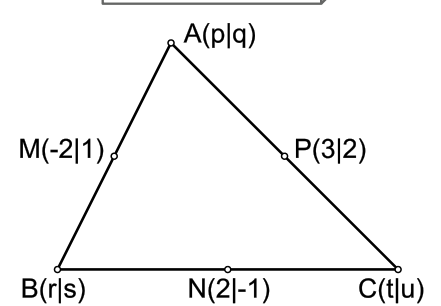
The vertices of a triangle have the coordinates \(A(p \mid q)\), \(B(r \mid s)\) and \(C(t \mid u)\), as shown. The midpoints of the sides of the triangle are the points \(M(-2 \mid 1)\), \(N(2 \mid -1)\) and \(P(3 \mid 2)\). Determine the value of the expression \(p + q + r + s + t + u\).
Show answer
Answer: D — \(5\)
Show hints
Hint 1 of 2
The sum of the triangle's vertices relates simply to the sum of the side midpoints.
Still stuck? Show hint 2 →
Hint 2 of 2
Each midpoint is the average of two vertices.
Show solution
Approach: sum the midpoints to get the sum of the vertices
Adding the three midpoints: (A+B)/2 + (B+C)/2 + (C+A)/2 = A+B+C.
So the sum of all vertex coordinates equals the sum of all midpoint coordinates.
From the list 1, 2, 3, 4, 5, 6, 7, Monika chooses 3 different numbers whose sum is 8. From the same list Daniel chooses 3 different numbers whose sum is 7. How many of the numbers were chosen by both Monika and Daniel?
Show answer
Answer: C — 2
Show hints
Hint 1 of 2
List the sets of three different numbers from 1-7 that sum to 7, then those that sum to 8.
Still stuck? Show hint 2 →
Hint 2 of 2
Daniel's sum 7 has only one possible set; compare it with each of Monika's options.
Show solution
Approach: enumerate the possible triples and compare
Three different numbers from 1-7 summing to 7 can only be {1, 2, 4}, so that is Daniel's set.
Summing to 8 gives Monika either {1, 2, 5} or {1, 3, 4}.
Comparing {1, 2, 4} with {1, 2, 5} shares {1, 2}; with {1, 3, 4} shares {1, 4}.
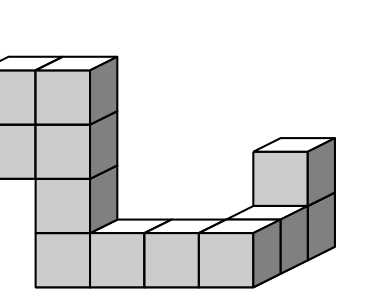
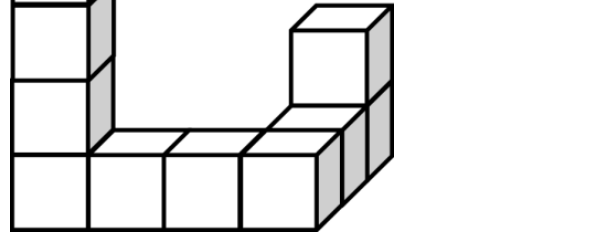
Tobias glues 10 cubes together to form the object shown. He paints all of it, even the bottom. How many of the cubes then have exactly 4 faces coloured?
Show answer
Answer: C — 8
Show hints
Hint 1 of 3
Every cube has 6 faces; the bottom is painted too, so a face stays unpainted only where it is glued to a neighbour cube.
Still stuck? Show hint 2 →
Hint 2 of 3
A cube shows exactly 4 painted faces when exactly 2 of its faces are glued to neighbours.
Still stuck? Show hint 3 →
Hint 3 of 3
The whole object is one long bent line of cubes, so most cubes touch a neighbour on each end.
Show solution
Approach: the cubes form one long bent chain; count how many touch a neighbour on exactly two sides
All 6 faces of a cube get painted except the ones glued to a neighbour, so a cube shows 4 painted faces exactly when 2 faces are glued.
The 10 cubes are joined into one long bending line (up the left arm, across the bottom, up the right side), so each cube in the middle of the line is glued to a neighbour on two sides, even the corner cubes where the line turns.
Only the two cubes at the very ends of the line are glued on just one side, so they show 5 painted faces; the other 10 − 2 = 8 cubes each show exactly 4 painted faces, answer C.
Peter wants to buy a book but has no money. His father and his two brothers help. His father gives him half as much as his two brothers give jointly. His older brother gives a third of what the other two give him. The youngest brother gives 10 €. How expensive is the book?
Show answer
Answer: A — 24 €
Show hints
Hint 1 of 2
Write the total as father + older brother + youngest brother and use each clue as a fraction of the total.
Still stuck? Show hint 2 →
Hint 2 of 2
Father is one third of the whole; the older brother is one quarter of the whole.
Show solution
Approach: express each gift as a fraction of the total
Father gives half of what the brothers give, so father is \(\tfrac13\) of the total cost.
The older brother gives a third of what the other two give, so he is \(\tfrac14\) of the total.
The youngest brother's 10 € is the remaining \(1-\tfrac13-\tfrac14 = \tfrac{5}{12}\) of the total.
Alice writes down three prime numbers that are all less than 100. She only uses the digits 1, 2, 3, 4 and 5, and she uses each digit exactly once. Which of the following prime numbers did she definitely write down?
Show answer
Answer: D — 41
Show hints
Hint 1 of 2
Five digits split as a 1-digit prime and two 2-digit primes; even digits can't end a prime.
Still stuck? Show hint 2 →
Hint 2 of 2
Place 2 and 4 as tens-digits, then find the forced prime common to every valid arrangement.
Show solution
Approach: place the even digits and find what is forced
Using digits 1,2,3,4,5 once, the even digits 2 and 4 can only be tens-digits (a prime can't end in an even digit).
Working through the options gives sets like {5, 23, 41} and {2, 41, 53}.
The prime that appears in every valid set is 41, so she definitely wrote it.
Before the football game Real Madrid vs. Manchester United, five predictions were made:
(i) The game will not end in a draw. (ii) Real Madrid will score at least one goal. (iii) Real Madrid will not lose. (iv) Real Madrid will win. (v) Exactly three goals will be scored in total.
It turns out that exactly three of these predictions come true. How many goals did Real Madrid score?
Show answer
Answer: B — 1
Show hints
Hint 1 of 2
Notice that 'Real Madrid will win' would make several other predictions true at once.
Still stuck? Show hint 2 →
Hint 2 of 2
Since exactly three are true, decide which statements must be false.
Show solution
Approach: logical elimination with the 'exactly three true' constraint
If 'Real Madrid wins' were true, then 'not a draw', 'scores at least 1', and 'does not lose' would all be true too — four true. So 'wins' is false.
A draw makes too few statements true, so Real Madrid loses.
Then 'not a draw', 'scores at least one goal', and 'exactly 3 goals total' are the three true ones, with 'wins' and 'does not lose' false.
A loss such as 1–2 (total 3) fits — Real Madrid scored 1 goal.
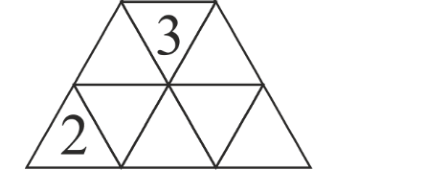
Emily wants to write a number in each empty small triangle. The sum of the numbers in any two triangles that share a side should always be the same. Two of the numbers are already given. What is the sum of all the numbers in the figure?
Show answer
Answer: C — 21
Show hints
Hint 1 of 2
Equal sums on shared sides force neighbouring triangles to repeat values in a pattern.
Still stuck? Show hint 2 →
Hint 2 of 2
Use the two given numbers to fill the pattern, then add every triangle's number.
Show solution
Approach: propagate the equal-sum rule from the given numbers
Two triangles sharing a side must give the same total with each neighbour, which forces a repeating pattern of values across the figure.
Starting from the given 2 and 3, fill every small triangle by that rule.
Adding all the resulting numbers gives a total of 21.
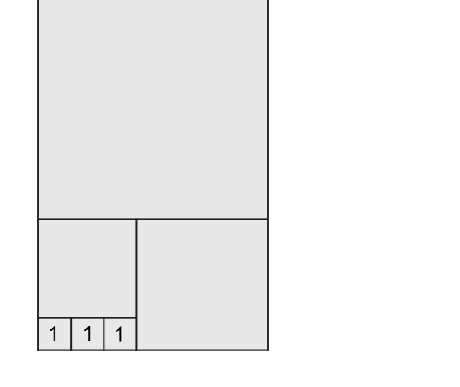
The big rectangle is made up of several squares of different sizes. Each of the three smallest squares has area 1. What is the area of the big rectangle?
Show answer
Answer: C — 77
Show hints
Hint 1 of 3
Each tiny square has area 1, so its side is just 1 little step — use that step as your ruler for everything else.
Still stuck? Show hint 2 →
Hint 2 of 3
The three tiny squares sit in a row, so the square resting on top of them is 3 steps wide, and you can keep measuring the bigger squares the same way.
Still stuck? Show hint 3 →
Hint 3 of 3
Once you know how many steps wide and how many steps tall the whole rectangle is, multiply those two numbers.
Show solution
Approach: use the side of a tiny square as a measuring step, find each bigger square's side, then multiply the rectangle's width by its height
Each smallest square has area 1, so its side is 1 step long; the three of them in a row make the bottom-left part 3 steps wide.
The square sitting on top of those three is 3 steps on each side, and together with the row of tiny squares the left part is 3 + 1 = 4 steps tall; the square next to it is 4 steps on each side, so the bottom strip is 3 + 4 = 7 steps wide.
The big square on top is as wide as the whole strip, 7 steps, so the rectangle is 7 steps wide and 4 + 7 = 11 steps tall, giving an area of 7 × 11 = 77, answer C.
How many three-digit numbers have the property that the two-digit number obtained by deleting the middle digit is exactly one ninth of the original number?
Show answer
Answer: D — 4
Show hints
Hint 1 of 2
Write the number as \(100a+10b+c\); deleting the middle digit gives \(10a+c\).
Still stuck? Show hint 2 →
Hint 2 of 2
The condition \(100a+10b+c = 9(10a+c)\) simplifies to a relation between the digits.
Show solution
Approach: set up the place-value equation and count solutions
Let the number be \(100a+10b+c\); deleting the middle digit gives \(10a+c\).
The condition \(100a+10b+c = 9(10a+c)\) becomes \(10a+10b = 8c\), i.e. \(5(a+b)=4c\).
So \(c\) is a multiple of 5, and \(c\neq 0\) forces \(c=5\), giving \(a+b=4\).
A hotel in the Caribbean correctly advertises with the slogan “350 days of sun in the year!” How many days does Mr. Happy have to spend in the hotel in a 365-day year to be guaranteed two consecutive days of sunshine to enjoy?
Show answer
Answer: D — 32
Show hints
Hint 1 of 2
There are 365 − 350 = 15 cloudy days to break up the sunny ones.
Still stuck? Show hint 2 →
Hint 2 of 2
Worst case, each cloudy day separates single sunny days; find the longest stay that could still avoid two sunny days in a row.
Show solution
Approach: worst-case spacing (pigeonhole)
With 15 cloudy days you can separate sunny days into at most 16 single sunny days, giving 15 + 16 = 31 days with no two sunny days adjacent.
So 31 days might not be enough, but on the very next day two sunny days must touch.
He must stay 32 days to be guaranteed two consecutive sunny days.
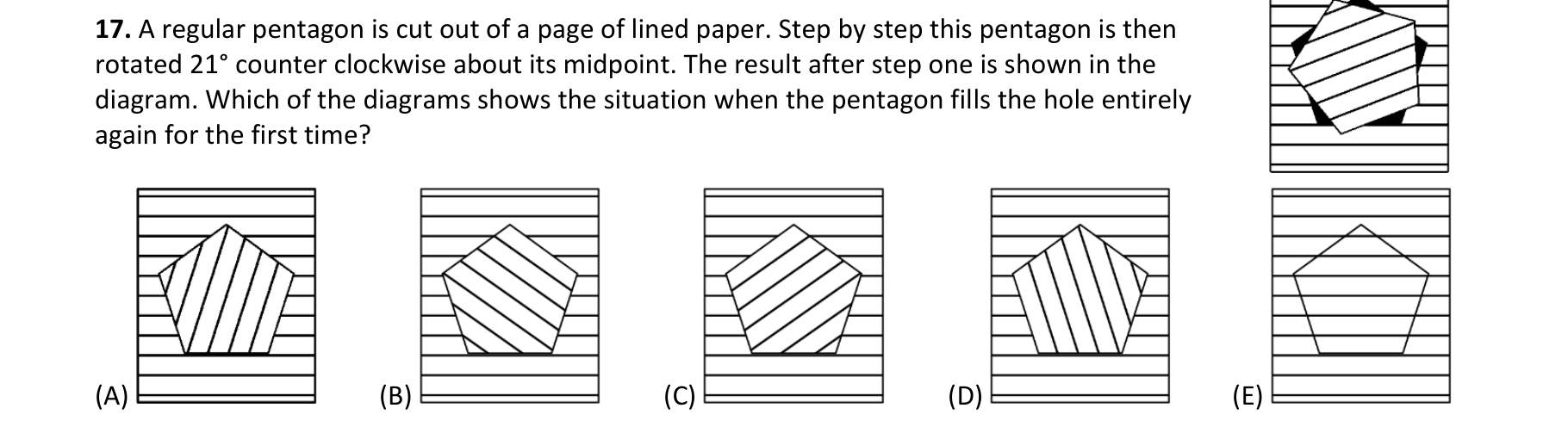
A regular pentagon is cut out of a page of lined paper. Step by step the pentagon is then rotated 21° counter-clockwise about its midpoint. The result after step one is shown in the diagram. Which of the diagrams shows the situation when the pentagon fills the hole entirely again for the first time?
Show answer
Answer: B
Show hints
Hint 1 of 3
The pentagon outline refits its hole only when the total turn is a whole multiple of its rotational-symmetry angle.
Still stuck? Show hint 2 →
Hint 2 of 3
Find the smallest number of 21° steps that is a whole multiple of 72°, then see how far the drawn lines have turned.
Still stuck? Show hint 3 →
Hint 3 of 3
The lines printed on the pentagon turn by the full accumulated angle, reduced modulo 360°.
Show solution
Approach: rotational symmetry: the hole is refilled when the total rotation is a multiple of 72°
A regular pentagon looks the same after a turn of 72°, so its outline fits the hole when the accumulated rotation is a multiple of 72°.
Stepping 21° at a time first lands on a multiple of 72° after 24 steps, since 24·21° = 504° = 7·72°.
The outline is back in place, but the lines printed across it have turned 504° ≡ 144°, so they are no longer horizontal — they appear tilted.
The diagram with the outline refit and the lines at that tilt is option (B).
Instead of digits, Hannes uses the letters A, B, C, and D in a calculation. Different letters stand for different digits, and the addition ABC + CBA = DDDD is correct (each group of letters is a number written with those digits in order). Which digit does the letter B stand for?
Show answer
Answer: A — 0
Show hints
Hint 1 of 2
Add ABC and CBA column by column and notice the symmetry of the outer digits.
Still stuck? Show hint 2 →
Hint 2 of 2
The sum 101(A + C) + 20B must equal a four-digit repdigit DDDD; only D = 1 fits, which pins B.
Show solution
Approach: add by place value and match to a repdigit
To slay a dragon, Mathias has to cut off all of its heads. As soon as he has cut off 3 heads, one new head grows back right away. After Mathias has cut off 13 heads, the dragon is dead. How many heads did the dragon have at the start?
Show answer
Answer: B — 9
Show hints
Hint 1 of 2
A new head grows after every 3rd cut, so cuts at 3, 6, 9, 12 each add one back.
Still stuck? Show hint 2 →
Hint 2 of 2
Net heads removed = cuts minus regrowths.
Show solution
Approach: count regrowths during the 13 cuts and subtract
Cutting 13 heads triggers a regrowth after cuts 3, 6, 9 and 12 — that is 4 new heads.
For the dragon to end with no heads, start = 13 − 4.
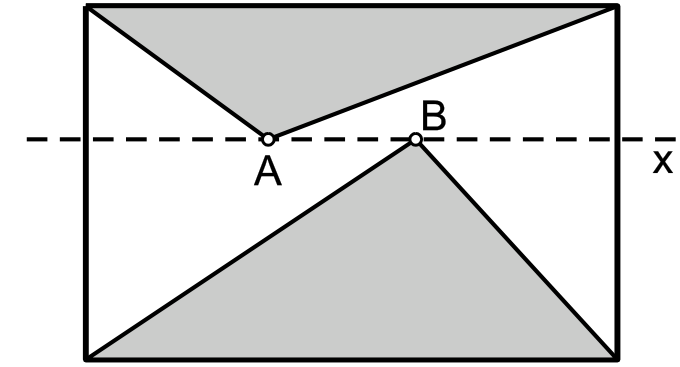
The diagram shows a rectangle and a straight line x, which is parallel to one of the sides of the rectangle. There are two points A and B on x inside the rectangle. The sum of the areas of the two triangles shaded in grey is 10 cm². How big is the area of the rectangle?
Show answer
Answer: B — 20 cm²
Show hints
Hint 1 of 2
Each grey triangle has the full width of the rectangle as its base and its apex on line x.
Still stuck? Show hint 2 →
Hint 2 of 2
Together the two triangles' heights add up to the height of the rectangle.
Show solution
Approach: add the two triangle areas using a common base
Both triangles share the rectangle's width as base; one reaches up to the top side, the other down to the bottom side.
Their heights sum to the rectangle's height, so together they cover ½ of the rectangle.
Since that half is 10 cm², the rectangle is 20 cm².
The rooms in Kanga’s house are numbered. Eva enters through the main entrance. She must walk through the rooms so that each room she enters has a higher number than the previous one. Through which door does Eva leave the house?
Show answer
Answer: D — D
Show hints
Hint 1 of 3
Start at the entrance and only ever step into a room whose number is bigger than the room you are leaving — never into a smaller or equal one.
Still stuck? Show hint 2 →
Hint 2 of 3
From each room, look at the rooms next to it and walk to one with a higher number; this forces your route step by step.
Still stuck? Show hint 3 →
Hint 3 of 3
Keep climbing to higher numbers until you reach the bottom wall, and see which door A–E you come out of.
Show solution
Approach: walk from the entrance always stepping into the next room only if its number is larger, which pins down a single route to the exit
From the main entrance Eva can step into a neighbouring room only when its number is larger than the one she is in, so at every step she has just the higher-numbered neighbour to choose.
Following that climbing-numbers rule, she is funnelled along one route down through the house, since any move to an equal or smaller number is blocked.
That single increasing path brings her to the bottom row and out through door D, answer D.
Jakob writes one of the natural numbers 1 to 9 into each cell of a 3×3 table. Then he works out the sum of the numbers in each row and in each column. Five of his results are 12, 13, 15, 16 and 17. What is the sixth sum?
Show answer
Answer: A — 17
Show hints
Hint 1 of 2
Add up all nine numbers 1 to 9.
Still stuck? Show hint 2 →
Hint 2 of 2
The three row sums total that, and so do the three column sums; use the grand total of all six sums.
Show solution
Approach: use that rows and columns each total 45
The numbers 1 to 9 add to 45, so the three row sums total 45 and the three column sums total 45 — all six sums total 90.
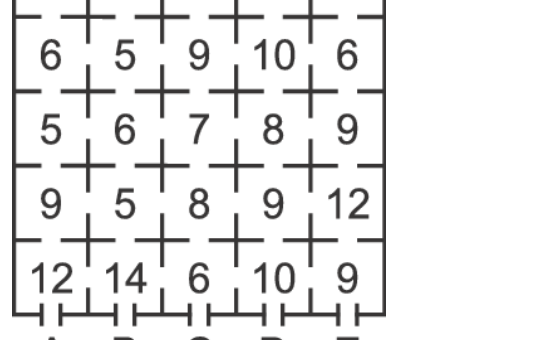
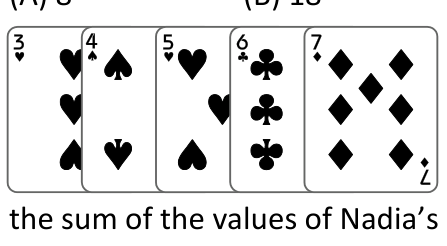
Three of the cards shown will be dealt to Nadia, the rest to Riny. Nadia multiplies the three values of her cards and Riny multiplies the two values of his cards. It turns out that the sum of those two products is a prime number. Determine the sum of the values of Nadia's cards.
Show answer
Answer: B — 13
Show hints
Hint 1 of 2
For the sum of the two products to be an odd prime, one product must be even and the other odd.
Still stuck? Show hint 2 →
Hint 2 of 2
Riny's two-card product is odd only if both his cards are odd — try the odd pairs from 3,5,7.
Show solution
Approach: use parity, then test the few odd pairs for Riny
The card values are 3,4,5,6,7. A prime above 2 is odd, so one product is even, one odd.
Riny's two-card product is odd only when both his cards are odd; the odd values are 3,5,7.
Trying Riny = {5,7}: product 35, Nadia = {3,4,6}, product 72, and 72+35 = 107, which is prime.
The symbols (an eye, a sun, an atom, a comb, and a fish) each stand for one of the digits 1, 2, 3, 4 or 5, all different. It is known that: atom + atom = fish, sun + sun = atom, and sun + fish = comb. Which symbol stands for the digit 3?
Show answer
Answer: A
Show hints
Hint 1 of 3
Each picture-symbol is a different digit from 1 to 5; start with the equation where the same symbol is added to itself.
Still stuck? Show hint 2 →
Hint 2 of 3
If a symbol doubled gives another symbol, that doubled symbol must be an even number, which narrows things down fast.
Still stuck? Show hint 3 →
Hint 3 of 3
Once you know four of the symbols, the leftover digit must belong to the fifth symbol.
Show solution
Approach: use the doubling equations to chain the symbols up to the digit 5, then the leftover digit names the eye
From sun + sun = atom, the atom is double the sun; from atom + atom = fish, the fish is double the atom — so sun, atom and fish are 1, 2 and 4 (sun = 1, atom = 2, fish = 4), since doubling has to stay inside 1–5.
From sun + fish = comb, the comb is 1 + 4 = 5, so the comb is 5.
The digits 1, 2, 4 and 5 are now used up, so the only one left, 3, must be the remaining symbol, the eye — answer A.
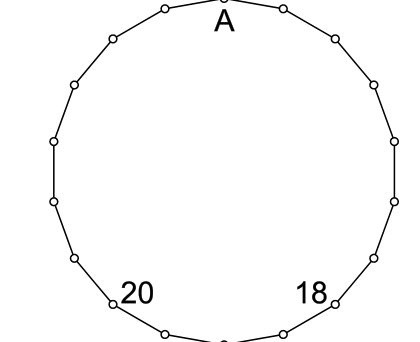
In a regular 2018-sided polygon the vertices are numbered 1 to 2018 in order. Two diagonals are drawn: one joins vertices 18 and 1018, the other joins vertices 1018 and 2000. How many vertices do the three resulting polygons have?
Show answer
Answer: A — 38, 983, 1001
Show hints
Hint 1 of 2
The two diagonals share vertex 1018, cutting the polygon into three pieces.
Still stuck? Show hint 2 →
Hint 2 of 2
Count the vertices on each piece inclusively (shared endpoints belong to both adjoining pieces).
Show solution
Approach: count the vertices on each arc inclusively
Diagonal 18–1018 bounds the arc 18, 19, …, 1018: that is \(1018-18+1 = 1001\) vertices.
Diagonal 1018–2000 bounds the arc 1018, …, 2000: that is \(2000-1018+1 = 983\) vertices.
The third piece runs 2000, …, 2018, 1, …, 18 together with vertex 1018: \(19 + 18 + 1 = 38\) vertices.
So the three polygons have 38, 983, 1001 vertices.
11 points are marked from left to right on a straight line, and their distances are recorded. The sum of the distances from the first point to every other point is 2018. The sum of all distances from the second point to every other point, including the first point, is 2000. What is the distance between the first and the second point?
Show answer
Answer: B — 2
Show hints
Hint 1 of 2
Compare the two distance-sums term by term, lining up the same far points.
Still stuck? Show hint 2 →
Hint 2 of 2
Every far point (from the 3rd on) contributes the gap between point 1 and point 2 to the difference.
Show solution
Approach: subtract the two sums to isolate the first gap
From point 2's sum, the distance to point 1 is the gap d; the distances to points 3..11 are each shorter by d than from point 1.
So the sums differ by 9d (nine points beyond the second): 2018 − 2000 = 9d.
Three different digits A, B, and C are chosen. Then the biggest possible six-digit number is built in which the digit A appears 3 times, the digit B 2 times, and the digit C 1 time. Which arrangement is definitely not possible for this number?
Show answer
Answer: D — AAABCB
Show hints
Hint 1 of 2
The biggest number puts its six digits in order from largest on the left to smallest on the right, so reading left to right the digits never go back up.
Still stuck? Show hint 2 →
Hint 2 of 2
Watch the two copies of B: if any other letter sits between them, that letter would have to be no bigger than B and no smaller than B at the same time, forcing it to equal B - which is not allowed.
Show solution
Approach: the biggest number lists its digits from largest to smallest, so equal digits must be together
To make the number as big as possible you write its six digits from largest to smallest, so going left to right the digits never increase.
Then the two B's must sit side by side: any letter caught between them would have to be no bigger than B (to its left) yet no smaller than B (to its right), so it would equal B - impossible, since the digits are all different.
In AAABCB the C sits between the two B's, which can never happen.
Every other option keeps the two B's together, so the impossible one is AAABCB.
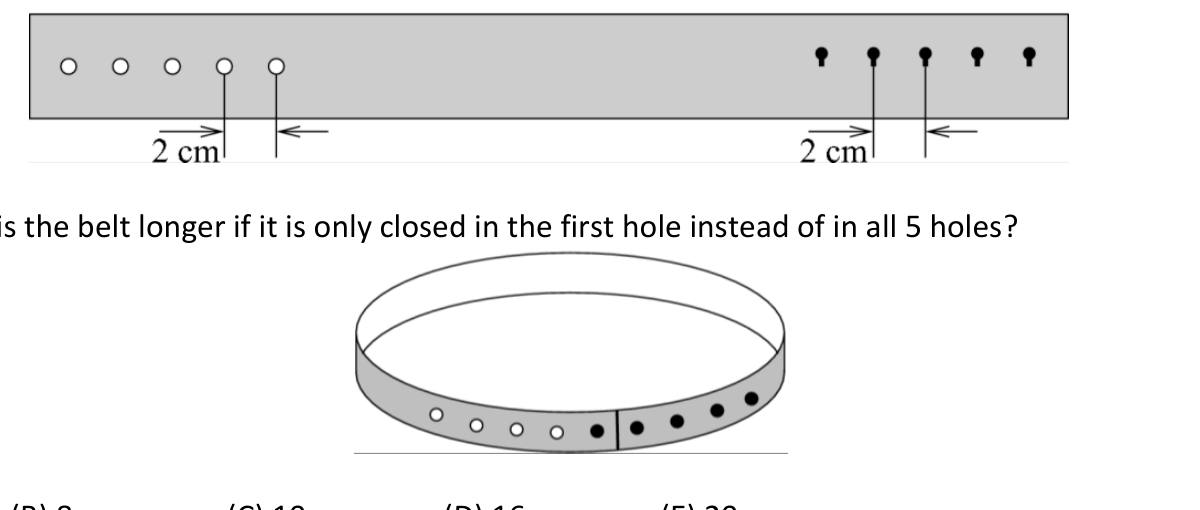
A belt can be closed in 5 different holes (see picture). How many cm longer is the belt if it is closed in the first hole instead of in the fifth (last) hole?
Show answer
Answer: B — 8 cm
Show hints
Hint 1 of 2
The holes are spaced 2 cm apart; using the first hole leaves more belt than using the fifth.
Still stuck? Show hint 2 →
Hint 2 of 2
The extra length is the distance from the first hole to the fifth.
Show solution
Approach: measure the gap between the first and last hole
The five holes are 2 cm apart, so the first and fifth holes are 4 × 2 = 8 cm apart.
Closing in the first hole instead of the fifth leaves that extra 8 cm of belt.
Some whole numbers are written on a board, among them the number 2018. The sum of all of them is 2018, and the product of all of them is also 2018. Which of the following could be how many numbers are on the board?
Show answer
Answer: B — 2017
Show hints
Hint 1 of 2
The product is already 2018 from that one number, so every other number must be \(\pm 1\).
Still stuck? Show hint 2 →
Hint 2 of 2
The sum is already 2018, so the extra \(+1\)'s and \(-1\)'s must cancel; that forces an exact count.
Show solution
Approach: every other number is +1 or -1, then match the sum and product constraints
The list already contains 2018, whose value equals both the required sum and the required product, so every other number must be a \(+1\) or a \(-1\) (these don't change a product and are the only integers that can).
For the product to stay \(+2018\), the number of \(-1\)'s must be even; for the sum to stay 2018, the \(+1\)'s and \(-1\)'s must cancel, so there are equally many of each, say \(k\) of each.
Then the board holds \(1 + k + k = 2k+1\) numbers, which is always odd, so among the options only 2017 is possible (take \(k = 1008\)).
At an election for student representatives there are three candidates. 130 students have voted, and the candidate with the most votes wins. Currently Samuel has 24 votes, Kevin 29 and Alfred 37. How many of the votes not yet counted does Alfred need to get in order to definitely win the election?
Show answer
Answer: E — 17
Show hints
Hint 1 of 2
Count how many votes are still uncounted, then imagine them all going to Alfred's nearest rival.
Still stuck? Show hint 2 →
Hint 2 of 2
Alfred must stay ahead even in that worst case.
Show solution
Approach: worst-case: rival gets all the rest
Counted so far: 24 + 29 + 37 = 90, so 130 − 90 = 40 votes remain.
If Alfred gets x of them, Kevin could get the other 40 − x, reaching 29 + 40 − x = 69 − x.
Alfred wins for sure when 37 + x > 69 − x, i.e. x > 16, so he needs 17 of the remaining votes.
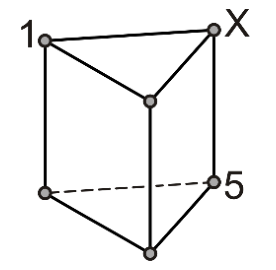
The faces of the prism shown are made up of two triangles and three squares. The six vertices are labelled using the numbers 1 to 6. The sum of the four numbers around each square is always the same. The numbers 1 and 5 are given in the diagram. Which number is written at vertex X?
Show answer
Answer: A — 2
Show hints
Hint 1 of 3
Add up all six labels, and use that each vertex sits on exactly two of the three square faces.
Still stuck? Show hint 2 →
Hint 2 of 3
That forces each pair of vertices joined by a vertical edge to add to the same total.
Still stuck? Show hint 3 →
Hint 3 of 3
Find that common edge-sum, then look at the edge through vertex 5.
Show solution
Approach: double counting forces each vertical edge of the prism to have the same vertex-sum
The labels 1–6 total 21. Each vertex lies on exactly two of the three square faces, so the three equal square sums total 2·21 = 42, giving each square sum 14.
Each square face is built from two vertical edges, and comparing the three faces shows the two endpoints of every vertical edge must add to the same value; with total 21 over three edges that value is 21/3 = 7.
So the vertical edges pair the numbers as (1,6), (2,5), (3,4); in the picture X sits directly above 5 on one vertical edge, so X + 5 = 7.
The sum of Kathi's age and her mother's age is 36. The sum of her mother's age and her grandmother's age is 81. How old was Kathi's grandmother when Kathi was born?
Show answer
Answer: C — 45
Show hints
Hint 1 of 2
Subtract the two given sums to compare the grandmother's age with Kathi's directly.
Still stuck? Show hint 2 →
Hint 2 of 2
The gap between grandmother and Kathi is exactly her age when Kathi was born.
Show solution
Approach: subtract the two equations to get the age gap
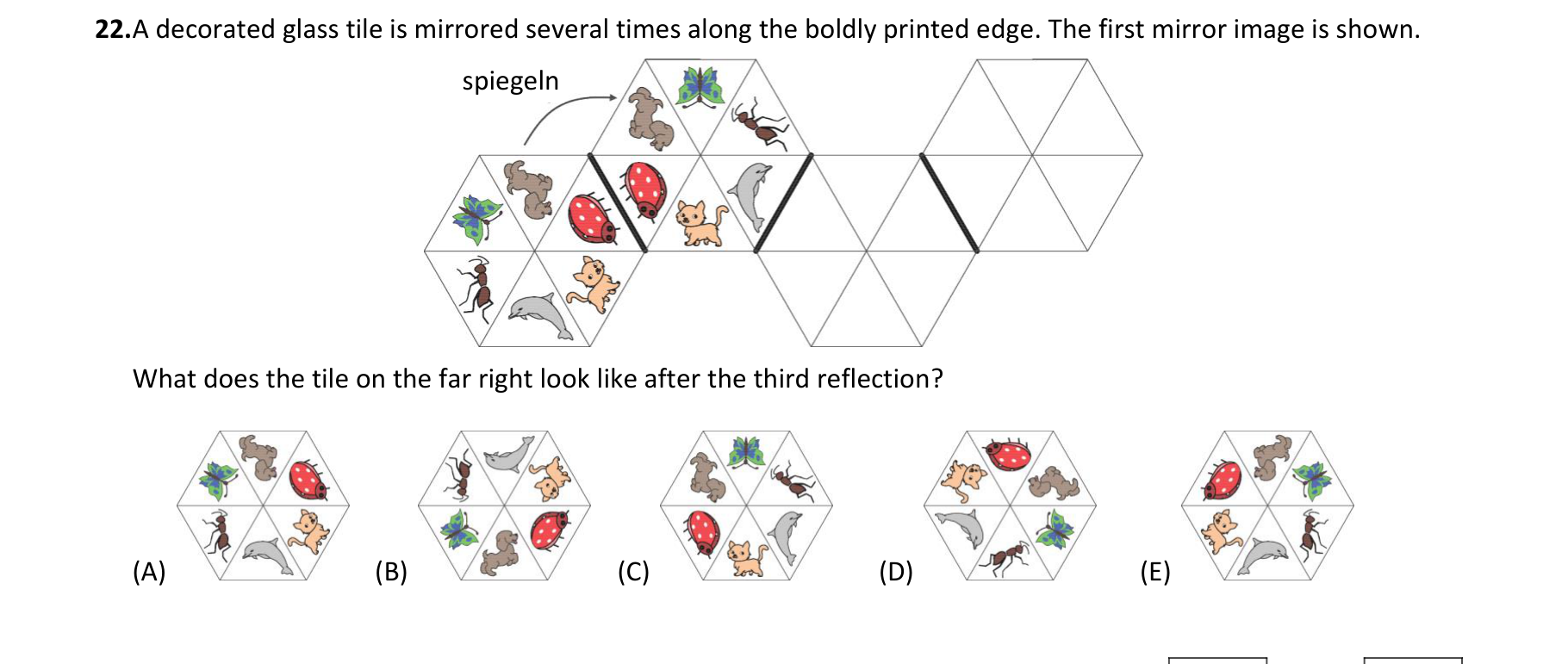
A decorated glass tile is mirrored several times along the boldly printed edge. The first mirror image is shown. What does the tile on the far right look like after the third reflection?
Show answer
Answer: B
Show hints
Hint 1 of 3
Picture the tile as a stamp pressed over and over: each mirror across the next bold edge flips it left-to-right, like turning the page of a book.
Still stuck? Show hint 2 →
Hint 2 of 3
Think about whether the tile faces the same way or the flipped way after 1 flip, after 2 flips, after 3 flips.
Still stuck? Show hint 3 →
Hint 3 of 3
One flip and three flips leave it mirror-flipped; two flips bring it back to looking like the original.
Show solution
Approach: track that each flip mirrors the tile, so an odd number of flips gives a mirror image of the start
Each reflection across a bold edge flips the tile left-to-right, so after one flip the picture is the mirror image of the original.
A second flip turns it back to the original look, and a third flip makes it the mirror image again — so after three flips the tile is the mirror image of the starting tile.
The picture that is the left-right mirror of the original tile is B, the answer.
Four positive numbers are given. Take three of them, find their mean, then add the fourth number. This can be done in four ways, giving the results 17, 21, 23 and 29. Which is the biggest of the four numbers?
Show answer
Answer: C — 21
Show hints
Hint 1 of 2
Each result is “mean of three” plus the one left out; adding the four results relates them to the total.
Still stuck? Show hint 2 →
Hint 2 of 2
The largest result corresponds to leaving out (adding back) the largest number.
Show solution
Approach: add all four results to find the total, then back out each number
Let the total of the four numbers be T. Each result is \(\frac{T-x}{3}+x = \frac{T+2x}{3}\), where x is the added number.
Summing the four results: \(\frac{4T + 2T}{3} = 2T\), and \(17+21+23+29 = 90\), so \(2T = 90\), giving \(T = 45\).
The biggest result 29 comes from the biggest x: \(\frac{45+2x}{3}=29\Rightarrow x = 21\).
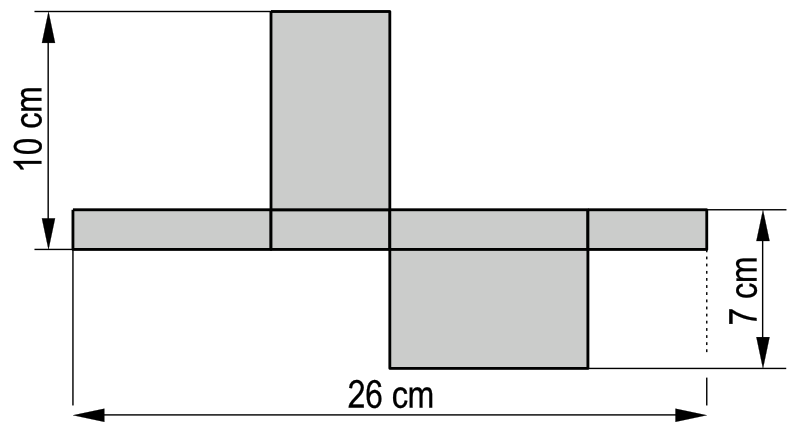
The diagram shows the net of a box consisting only of rectangles. How big is the volume of the box?
Show answer
Answer: C — 80 cm³
Show hints
Hint 1 of 2
Fold the net up in your head into a closed box and find its three edge lengths.
Still stuck? Show hint 2 →
Hint 2 of 2
The band of four faces wraps around the box, so its height is one edge and its total length is twice the sum of the other two edges; a tab gives the remaining edge.
Show solution
Approach: read the box edges from the folded net
The horizontal strip of four faces wraps around the box; its height (7 cm) is one edge, and the tab sticking out adds 10 − 7 = 3 cm for another edge.
Folding the net up gives a rectangular box, and multiplying its three edge lengths gives the volume.
By the official key the volume is 80 cm³ (the marked lengths in this image crop did not cleanly reproduce 80, so the key letter C is kept).
Nick wants to split the numbers 2, 3, 4, 5, 6, 7, 8, 9, 10 into some groups so that the sum of the numbers in each group is the same. What is the biggest number of groups he can make this way?
Show answer
Answer: B — 3
Show hints
Hint 1 of 2
Add 2 through 10 first; each group's sum must divide that total evenly.
Still stuck? Show hint 2 →
Hint 2 of 2
The number 10 must sit in some group, so every group sum is at least 10 - that caps how many groups you can have.
Show solution
Approach: use the total and the largest element to bound the groups
The numbers 2 + 3 + ... + 10 add to 54.
Equal groups means each group's sum divides 54, and since 10 sits in one group every group sum is at least 10.
The only divisor of 54 that is at least 10 and gives more than two groups is 18, which makes 54 / 18 = 3 groups (e.g. {10,8}, {9,7,2}, {6,5,4,3}).
Lea should write the numbers 1 to 7 in the fields of the figure, one number per field. Two consecutive numbers may not be in adjacent fields. Two fields are adjacent if they share an edge or a corner. Which numbers can she write in the field with the question mark?
Show answer
Answer: E — the numbers 1 or 7
Show hints
Hint 1 of 3
Remember that two fields count as touching if they share an edge OR even just a corner, and numbers that come right after each other (like 4 and 5) may not touch.
Still stuck? Show hint 2 →
Hint 2 of 3
Count how many other fields the question-mark field touches — it touches almost all of them, with only one field not touching it.
Still stuck? Show hint 3 →
Hint 3 of 3
Think about how many close-by partners each number has: 1 and 7 have just one each, but the numbers in the middle have two.
Show solution
Approach: count the neighbours of the marked field and see which numbers have few enough consecutive partners
The marked field touches 5 of the other 6 fields; only one field does not touch it.
So a number placed there can have at most one of its consecutive partners (one less and one more) kept away from it.
A number from 2 to 6 has two partners, but there is only one safe spot for them, so those numbers cannot go there.
Only 1 (whose only partner is 2) and 7 (whose only partner is 6) work, so the answer is the numbers 1 or 7.
The points \(A_0, A_1, A_2, \ldots\) all lie on a straight line. It is given that \(A_0A_1 = 1\) and that \(A_n\) is the midpoint of segment \(A_{n+1}A_{n+2}\) for every non-negative index n. How long is the segment \(A_0A_{11}\)?
Show answer
Answer: E — 683
Show hints
Hint 1 of 2
The midpoint rule rearranges to \(A_{n+2} = 2A_n - A_{n+1}\), so the signed step doubles and flips sign each time.
Still stuck? Show hint 2 →
Hint 2 of 2
Track the signed steps \(d_n = A_{n+1}-A_n\); they follow \(d_{n+1} = -2d_n\).
Show solution
Approach: find the recurrence for the directed steps, then sum
Since \(A_n\) is the midpoint of \(A_{n+1}A_{n+2}\), the signed steps satisfy \(d_{n+1} = -2d_n\) with \(d_0 = 1\), so \(d_n = (-2)^n\).
Rita wants to write a number into every square of the diagram shown. Every number should be equal to the sum of the two numbers from the adjacent squares. Squares are adjacent if they share one edge. Two numbers are already given. Which number is she going to write into the square marked with x?
Show answer
Answer: B — 7
Show hints
Hint 1 of 2
Each square equals the sum of its two neighbours, so going around: next = current − previous.
Still stuck? Show hint 2 →
Hint 2 of 2
That rule repeats every 6 squares; find x by stepping around the ring.
Show solution
Approach: use the period-6 'each equals sum of neighbours' rule
If each square is the sum of its two neighbours, then next = this − previous, a pattern that repeats every six squares.
Starting 10, ?, … and forcing the far corner to be 3 fixes the ring as 10, 7, −3, −10, −7, 3, repeating.
Stepping around to the square marked x lands on the value 7.
The figure shown consists of one square part and eight rectangular parts. Each part is 8 cm wide. Peter rearranges all the parts to form one long rectangle that is 8 cm wide. How long is this rectangle?
Show answer
Answer: D — 200 cm
Show hints
Hint 1 of 2
Every piece is 8 cm wide, so when laid end to end the new rectangle stays 8 cm wide; only total area matters.
Still stuck? Show hint 2 →
Hint 2 of 2
Find the total area of the original figure, then divide by 8 to get the length.
Show solution
Approach: conserve area: length = total area / width
All nine parts have width 8 cm, so reassembling them into one 8 cm-wide rectangle keeps the same total area.
The original figure is a square whose area equals the sum of all the parts.
Dividing that total area by the 8 cm width gives a length of 200 cm.
Each of the four balls weighs either 10, 20, 30 or 40 grams. The two balances are shown. Which ball weighs 30 grams?
Show answer
Answer: C — C
Show hints
Hint 1 of 3
The four weights 10, 20, 30, 40 add up to 100 grams altogether — keep that total handy.
Still stuck? Show hint 2 →
Hint 2 of 3
The second scale is level, so the two balls on one side weigh exactly as much as the single ball C on the other side.
Still stuck? Show hint 3 →
Hint 3 of 3
Try out which single weight can be split into two of the other weights, and check it against the tilted first scale.
Show solution
Approach: use the level scale to say C equals two other balls added, then test which weight that can be
The second scale balances, so B and D together weigh the same as C alone — that means C is made by adding two of the other weights.
Among 10, 20, 30 and 40, the only weight that is the sum of two of the others is 30 = 10 + 20, so C must be 30 grams (with B and D being 10 and 20, leaving A as 40).
Check the first scale: A and B together (40 + 20 = 60) are heavier than C and D (30 + 10 = 40), and that side does tip down, so everything fits — the 30 gram ball is C.
Two concentric circles with radii 1 and 9 form an annulus. n non-overlapping circles are drawn inside this annulus, each touching both circles of the annulus. (The diagram shows an example for n = 1.) What is the biggest possible value of n?
Show answer
Answer: C — 3
Show hints
Hint 1 of 2
Each inscribed circle has radius 4, with its centre 5 from the common centre.
Still stuck? Show hint 2 →
Hint 2 of 2
Compare the angle each circle takes up at the centre with the full 360°.
Show solution
Approach: fit equal circles around the ring by their central angles
A circle touching both the radius-1 and radius-9 circles has radius \(\tfrac{9-1}{2}=4\), and its centre lies on the circle of radius \(1+4 = 5\).
Two such neighbouring circles just touch when the half-angle \(\theta\) at the centre satisfies \(\sin\theta = \tfrac{4}{5}\), so each circle takes up about \(106^\circ\).
Three circles use about \(318^\circ < 360^\circ\) (they fit), but four would need about \(424^\circ\) (too much).
Simon runs along the edge round a 50 m long rectangular swimming pool, while at the same time Jan swims lengths in the pool. Simon runs three times as fast as Jan swims. While Jan swims 6 lengths, Simon manages 5 rounds around the pool. How wide is the swimming pool?
Show answer
Answer: B — 40 m
Show hints
Hint 1 of 2
In the same time, compare how far each travels using the 3-to-1 speed ratio.
Still stuck? Show hint 2 →
Hint 2 of 2
Find the pool's perimeter, then solve for the unknown width from 2(length + width).
Show solution
Approach: equal time, speed ratio gives the perimeter
Jan swims 6 lengths = 6 · 50 = 300 m; in the same time Simon (3 times as fast) covers 900 m in 5 rounds.
A function \(f\) fulfils the property \(f(x + y) = f(x) \cdot f(y)\) for all whole numbers \(x\) and \(y\). Furthermore \(f(1) = \tfrac{1}{2}\). Determine the value of the expression \(f(0) + f(1) + f(2) + f(3)\).
Show answer
Answer: D — \(\tfrac{15}{8}\)
Show hints
Hint 1 of 2
Plug in x = y = 0 to pin down f(0).
Still stuck? Show hint 2 →
Hint 2 of 2
Build f(2) and f(3) by repeatedly using f(a+b) = f(a)f(b).
Show solution
Approach: exploit the multiplicative functional equation
Setting x = y = 0 gives f(0) = f(0)², so f(0) = 1.
A number is written at every vertex of the 18-sided shape so that each number equals the sum of the numbers at its two neighbouring vertices. Two of the numbers are given (see picture). Which number is written at vertex A?
Show answer
Answer: D — 38
Show hints
Hint 1 of 2
The rule “each = sum of its two neighbours” makes the sequence of vertex values repeat with period 6.
Still stuck? Show hint 2 →
Hint 2 of 2
Write a few terms: the pattern is \(x,\ y,\ y-x,\ -x,\ -y,\ x-y\) and then it repeats.
Show solution
Approach: use the period-6 pattern forced by the neighbour rule
If a vertex equals the sum of its neighbours, going around gives the repeating block \(x,\,y,\,y-x,\,-x,\,-y,\,x-y\) (period 6).
Over the 18 vertices this block repeats exactly three times.
Placing the two given values (20 and 18) at their vertices and following the period-6 pattern forces vertex A to 38.
Lisa’s aviation club designs a flag with a flying “dove” on a 4×6 grid. The area of the “dove” is 192 cm². The perimeter of the “dove” is made up of straight lines and circular arcs. What measurements does the flag have?
Show answer
Answer: D — 24 cm x 16 cm
Show hints
Hint 1 of 2
By the design's symmetry the dove covers exactly half of the whole grid.
Still stuck? Show hint 2 →
Hint 2 of 2
Find the total grid area, then the area of one of the 4×6 cells to get the cell side.
Show solution
Approach: dove = half the grid, then size one cell
The dove's curved and straight pieces fit so it fills exactly half the grid, so the grid area is 2 · 192 = 384 cm².
The grid has 4 · 6 = 24 equal cells, so each cell is 384 : 24 = 16 cm², i.e. 4 cm by 4 cm.
The flag therefore measures 6 · 4 by 4 · 4 = 24 cm × 16 cm.
A quadratic function of the form \(f(x) = x^2 + px + q\) intersects the x-axis and the y-axis in three different points. The circle through these three points intersects the graph of \(f\) in a fourth point. What are the coordinates of this fourth point of intersection?
Show answer
Answer: C — \((-p \mid q)\)
Show hints
Hint 1 of 2
The four intersection x-values of circle and parabola are the roots of one quartic.
Still stuck? Show hint 2 →
Hint 2 of 2
Use the sum of those roots; three of them you already know.
Show solution
Approach: sum of roots of the circle-parabola quartic
Substituting y = x²+px+q into the circle equation gives a quartic in x whose four roots sum to −2p.
Three known intersection x-values are the two parabola roots (summing to −p) and 0.
So the fourth x-value is −2p −(−p) = −p, and y = f(−p) = q.
Diana draws a rectangle made of squares on grid paper and colours some squares black. In every white square she writes the number of black squares next to it (sharing an edge). The diagram shows an example. She now does the same with a rectangle made of 2018 squares. What is the biggest possible sum of all the numbers in the white squares?
Show answer
Answer: D — 3025
Show hints
Hint 1 of 2
The total written down is just the number of shared edges that have a black square on one side and a white square on the other.
Still stuck? Show hint 2 →
Hint 2 of 2
Since \(2018 = 2\times 1009\), the rectangle is either \(1\times 2018\) or \(2\times 1009\); compare which shape allows more black–white edges.
Show solution
Approach: the sum equals the count of black–white shared edges; maximise that
Each number in a white square counts its black neighbours, so adding them all gives exactly the number of edges that separate a black square from a white square.
Because \(2018 = 2\times 1009\), the rectangle is \(1\times 2018\) or \(2\times 1009\); colouring whole columns black/white alternately so that no two same-colour columns touch makes nearly every internal edge a black–white edge.
For the \(2\times 1009\) strip this alternating pattern gives \(3\times 1009 - 2 = 3025\) such edges (the \(1\times 2018\) strip gives only \(2017\)), so the largest total is 3025.
The points N, M and L lie on the sides of an equilateral triangle ABC so that NM ⊥ BC, ML ⊥ AB and LN ⊥ AC. The area of triangle ABC is 36 cm². What is the area of triangle LMN?
Show answer
Answer: B — 12 cm²
Show hints
Hint 1 of 2
The three right-angle conditions place L, M, N symmetrically on the three sides.
Still stuck? Show hint 2 →
Hint 2 of 2
Inner triangle LMN turns out to be a fixed fraction of triangle ABC.
Show solution
Approach: exploit the symmetric perpendicular-foot construction
The conditions NM ⊥ BC, ML ⊥ AB and LN ⊥ AC place L, M, N symmetrically, so triangle LMN is equilateral and centred in ABC.
For this construction the inner triangle has exactly one third of the area of ABC.
On an idealised rectangular billiard table with side lengths 3 m and 2 m, a point-shaped ball is pushed away from point M on the long side AB. It is reflected exactly once on each of the other sides, as shown. At what distance from vertex A will the ball hit side AB again if \(BM = 1.2\) m and \(BN = 0.8\) m?
Show answer
Answer: E — \(1.8\) m
Show hints
Hint 1 of 2
Reflect the path by 'unfolding' the table so the bounces become a straight line.
Still stuck? Show hint 2 →
Hint 2 of 2
The launch direction is fixed by M and the first bounce point N.
Show solution
Approach: unfold the reflections into a straight-line path
Place A=(0,0), B=(3,0); then M=(1.8,0) (BM=1.2) and the first hit N=(3,0.8) on the short side (BN=0.8), giving direction slope 0.8/1.2 = 2/3.
Following equal-angle reflections off the right, top and left sides, the unfolded straight path brings the ball back to the long side AB.
Seven little dice were removed from a 3 × 3 × 3 die, as shown in the diagram. The remaining (completely symmetrical) figure is cut along a plane through the centre and perpendicular to one of the four space diagonals. What does the cross-section look like?
Show answer
Answer: A
Show hints
Hint 1 of 2
Looking straight down a space diagonal of a cube, the outline you see is a regular hexagon.
Still stuck? Show hint 2 →
Hint 2 of 2
Track which little cubes were removed and where their gaps fall on that hexagonal cross-section.
Show solution
Approach: take the cross-section perpendicular to a space diagonal
Viewed along a space diagonal, the cube's cross-section through the centre is a regular hexagon.
Removing the seven little cubes (the centre and the six face-centres) leaves gaps that, on this cross-section, form a six-pointed star.
So the cross-section looks like option A (the star inside the hexagon).
Anna, Bettina and Claudia go shopping. Bettina spends 85% less than Claudia. Anna spends 60% more than Claudia. Together they spend 55 €. How much money does Anna spend?
Show answer
Answer: E — 32 €
Show hints
Hint 1 of 2
Write everyone's spending as a multiple of Claudia's amount.
Still stuck? Show hint 2 →
Hint 2 of 2
Add those multiples, set the total to 55 €, then find Anna's share.
Show solution
Approach: express all spendings via Claudia and total
Bettina spends 0.15 of Claudia's amount and Anna spends 1.6 of it.
Each number of the set {1, 2, 3, 4, 5, 6} is written into exactly one cell of a 2 × 3 table. In how many ways can this be done so that the sum of the numbers in every column and every row is divisible by 3?
Show answer
Answer: D — 48
Show hints
Hint 1 of 2
Group the numbers by remainder mod 3: {3,6} give 0, {1,4} give 1, {2,5} give 2.
Still stuck? Show hint 2 →
Hint 2 of 2
Decide the remainder pattern of the table first, then count how to place the actual numbers.
Show solution
Approach: work modulo 3 on the remainder pattern, then fill in
By remainder mod 3 the numbers are two 0's (3,6), two 1's (1,4) and two 2's (2,5).
Each row of three and each column of two must sum to a multiple of 3; find the valid remainder patterns.
For each valid pattern, the two numbers in each remainder class can be swapped, and counting all arrangements gives 48.
Viola practices long-jumping. On average she has jumped 3.80 m so far. On her next jump she reaches 3.99 m and thus her mean increases to 3.81 m. How far does she have to jump on her next attempt in order to increase her mean to 3.82 m?
Show answer
Answer: C — 4.01 m
Show hints
Hint 1 of 2
First use the jump from 3.80 to 3.81 average to find how many jumps she had.
Still stuck? Show hint 2 →
Hint 2 of 2
Then work out the new total she needs for a 3.82 average and subtract.
Show solution
Approach: find the count of jumps, then the required total
If the mean rises from 3.80 to 3.81 after a 3.99 m jump, then 3.80n + 3.99 = 3.81(n+1), giving n = 18 (now 19 jumps, total 72.39 m).
For a mean of 3.82 over 20 jumps the total must be 76.40 m.
ABCDEF is a regular hexagon, as shown. G is the midpoint of AB. H and I are the intersections of the line segments GD and GE respectively with the line segment FC. How big is the ratio of the areas of triangle GIF and trapezium IHDE?
Show answer
Answer: A — \(\tfrac{1}{2}\)
Show hints
Hint 1 of 2
Set coordinates for the regular hexagon and find H, I as intersections on FC.
Still stuck? Show hint 2 →
Hint 2 of 2
Compare the two areas directly.
Show solution
Approach: coordinate geometry on the regular hexagon
Place the hexagon with F and C on a horizontal diagonal and G at the midpoint of the top side AB.
Lines GD and GE cross FC at H and I, symmetric about the centre.
Computing areas, triangle GIF is exactly half of trapezium IHDE.
Ed builds a big cube from several identical small white dice and colours some of the big cube's faces red. His sister Nicole drops it and it breaks back into the small dice. 45 of them have no red face. How many faces of the big cube did Ed colour red?
Show answer
Answer: C — 4
Show hints
Hint 1 of 2
A small die stays all-white only if it touches none of the coloured big-cube faces.
Still stuck? Show hint 2 →
Hint 2 of 2
Find a cube size where exactly 45 small dice can avoid the coloured faces.
Show solution
Approach: count the small dice that avoid every coloured face
Take the big cube as \(5\times5\times5\) (125 small dice) and colour the 4 side faces, leaving the top and bottom uncoloured.
The dice touching no red face are the inner \(3\times3\) of each of the 5 layers: \(3\times 3\times 5 = 45\), exactly as stated.
In the isosceles triangle ABC (with base AC) the points K and L are added on the sides AB and BC respectively so that AK = KL = LB and KB = AC. How big is the angle ∠ABC?
Show answer
Answer: C — 36°
Show hints
Hint 1 of 2
Mark the equal segments and chase the base angles of the isosceles triangles that appear.
Still stuck? Show hint 2 →
Hint 2 of 2
Set the angle at A found two different ways equal to each other and solve for angle ABC.
Show solution
Approach: angle-chase the equal segments
Let ∠ABC = β. From AK = KL = LB the angle at A inside that chain is β/2, so ∠LAC = (90° − β/2) − β/2 = 90° − β.
Since KB = AC and B, L, C are in line, LC = AC, making triangle ALC isosceles with ∠LAC = 45° + β/4.
In a class there are 40% more girls than boys. The probability that a student representative team of two students randomly selected from this class is made up of exactly one girl and one boy is exactly \(\tfrac{1}{2}\). How many children are there in this class?
Show answer
Answer: C — 36
Show hints
Hint 1 of 2
Let the number of boys be b; girls are 1.4b, and 1.4b must be a whole number.
Still stuck? Show hint 2 →
Hint 2 of 2
Write the probability of one girl + one boy and set it to 1/2.
Show solution
Approach: set up the mixed-pair probability and solve
Let boys = b and girls = 1.4b, so the class has 2.4b children.
Set P(one girl and one boy) = (girls·boys)/C(total,2) equal to 1/2 and look for a whole-number class.
A class of 36 (15 boys and 21 girls) gives 15·21 / C(36,2) = 315/630 = 1/2.
Two chords AB and AC are drawn in a circle with diameter AD. \(\angle BAC = 60^\circ\), \(AB = 24\) cm, point E lies on AC with \(EC = 3\) cm, and BE is perpendicular to AC. How long is the chord BD?
Show answer
Answer: D — \(2\sqrt{3}\) cm
Show hints
Hint 1 of 2
Drop into right triangle ABE to get the two legs \(AE\) and \(BE\) from the \(60^\circ\) angle.
Still stuck? Show hint 2 →
Hint 2 of 2
AD is a diameter, so \(\angle ABD = 90^\circ\); also the inscribed angle \(\angle ADB\) equals \(\angle ACB\) because both stand on arc \(AB\).
Show solution
Approach: find angle ACB from the right triangle, then use the right angle at B in triangle ABD
In right triangle BEC (right angle at E): \(BE = 24\sin 60^\circ = 12\sqrt3\) and \(EC = 3\), so \(\tan(\angle ACB) = \dfrac{BE}{EC} = \dfrac{12\sqrt3}{3} = 4\sqrt3\).
Because AD is a diameter, \(\angle ABD = 90^\circ\); and \(\angle ADB = \angle ACB\) since both inscribed angles stand on the same arc \(AB\).
In right triangle ABD then \(BD = \dfrac{AB}{\tan(\angle ADB)} = \dfrac{24}{4\sqrt3} = \dfrac{6}{\sqrt3} = 2\sqrt3\).
In a game of dominoes the tiles always have to be placed so that the touching halves of two adjacent domino tiles show the same number of dots. Paul has six domino tiles in front of him (see diagram). In several steps he tries to arrange them in a correct order. In each step he is allowed either to swap any two domino tiles or to turn one domino tile 180° around. What is the minimum number of steps he needs to arrange the domino tiles correctly?
Show answer
Answer: C — 3
Show hints
Hint 1 of 2
Treat each domino value as a connection and look for a chain that uses all six with matching ends.
Still stuck? Show hint 2 →
Hint 2 of 2
Count the fewest swaps and 180° turns needed to turn the given row into such a chain.
Show solution
Approach: find a matching chain, count the moves to reach it
The six dominoes are 4-6, 3-1, 4-2, 3-4, 6-1, 2-6; one valid chain is 4-6, 6-1, 1-3, 3-4, 4-2, 2-6.
Starting from the given order, this is reachable by turning one tile and swapping tiles — three moves in total.
No arrangement is reachable in fewer, so the minimum is 3.
Archimedes has calculated \(15!\) and the result is on the board, but two of the digits—the second and the tenth—cannot be read: \(1\,?\,0\,7\,6\,7\,4\,3\,6\,?\,0\,0\,0\). What are the two missing digits? (Remark: \(15! = 15 \cdot 14 \cdot 13 \cdots 2 \cdot 1\).)
Show answer
Answer: E — 3 and 8
Show hints
Hint 1 of 2
15! is divisible by 9 and by 11, which constrain the hidden digits through digit tests.
Still stuck? Show hint 2 →
Hint 2 of 2
Use the rule for 9 (digit sum) and the alternating rule for 11.
Show solution
Approach: apply divisibility tests for 9 and 11 to recover the hidden digits
Write 15! as 1 a 0 7 6 7 4 3 6 b 0 0 0 with hidden 2nd digit a and 10th digit b.
Divisibility by 9: the digit sum 34+a+b must be a multiple of 9, forcing a+b = 11.
Divisibility by 11: the alternating digit sum forces b−a = 5.
Solving gives a = 3, b = 8 — the missing digits are 3 and 8.