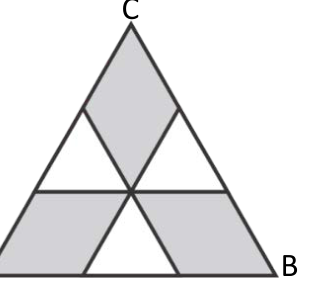
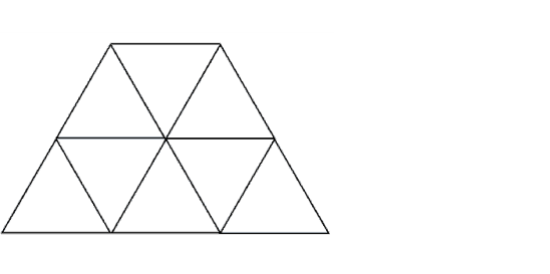
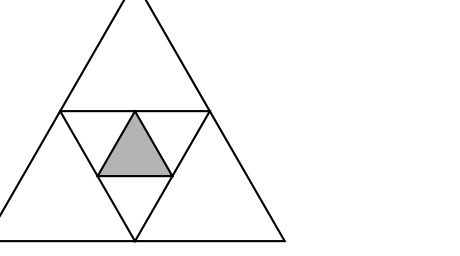
Triangle ABC is equilateral and has area 9. The dividing lines are parallel to the sides and split each side into three equal lengths. What is the area of the grey shaded part of the triangle?
Show answer
Answer: D — 6
Show hints
Hint 1 of 2
The dividing lines split the equilateral triangle into nine little congruent triangles.
Still stuck? Show hint 2 →
Hint 2 of 2
Each little triangle has the same area, so just count how many of the nine are shaded.
Show solution
Approach: count congruent unit triangles
Parallel lines cutting each side into three equal parts split the big triangle into 9 small congruent triangles.
Since the whole area is 9, each small triangle has area 1.
Counting the grey small triangles gives 6 of them.
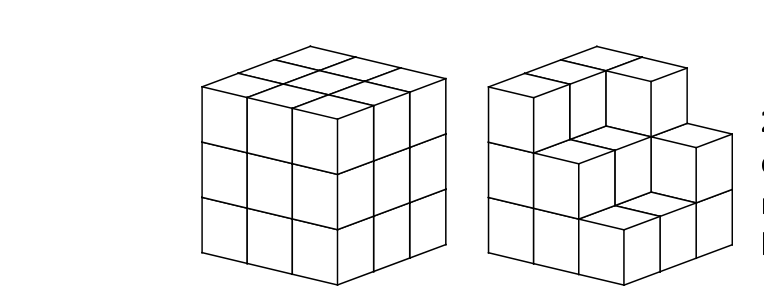
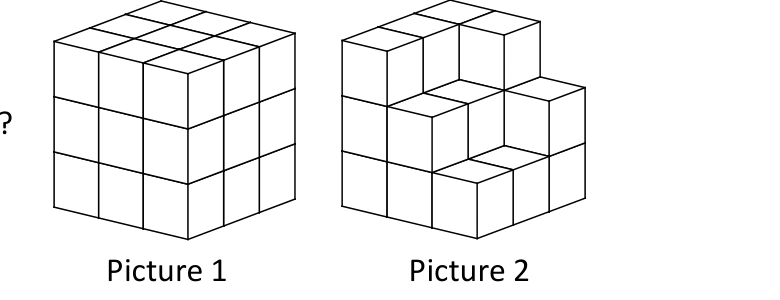
Nathalie wants to build a large cube out of small cubes (the complete cube is shown on the left). How many small cubes are missing from the shape on the right so that it would form the large cube?
Show answer
Answer: C — 7
Show hints
Hint 1 of 3
A full \(3\times3\times3\) cube is built from 27 little cubes.
Still stuck? Show hint 2 →
Hint 2 of 3
Count the little cubes already in the picture on the right, then see how many are still needed.
Still stuck? Show hint 3 →
Hint 3 of 3
Missing cubes = 27 minus the ones you counted.
Show solution
Approach: count present cubes and subtract from a full cube
The finished big cube is 3 cubes wide, 3 tall and 3 deep, so it needs \(3\times3\times3 = 27\) small cubes.
Counting the cubes in the picture on the right gives 20.
So the number still missing is \(27 - 20 = 7\), which is choice C.
Maria has six equally big square pieces of plain paper. On each piece of paper she draws one of the figures shown below. How many of these figures have the same perimeter as the plain piece of paper itself?
Show answer
Answer: C — 4
Show hints
Hint 1 of 2
A shaded shape has the same perimeter as the whole square only if every cut is balanced by an equal bit of border added.
Still stuck? Show hint 2 →
Hint 2 of 2
Cutting a notch out of an edge keeps the perimeter the same; count the figures that do not add extra sticking-out edges.
Show solution
Approach: compare each figure's boundary length to the plain square
The plain square has perimeter equal to four side-lengths.
A shape keeps that same perimeter when its drawn lines only re-trace existing border length without adding extra exposed edges.
Checking the six figures, exactly 4 of them match the square's perimeter.
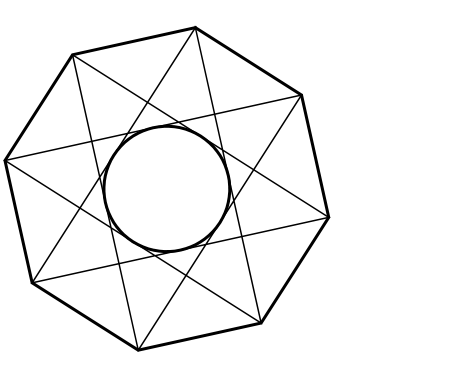
The regular octagon shown has sides of length 10. A circle touches all of the octagon's long diagonals (the inscribed star). What is the radius of this circle?
Show answer
Answer: C — 5
Show hints
Hint 1 of 2
The inscribed star is made of the long diagonals; the circle just touches each of them.
Still stuck? Show hint 2 →
Hint 2 of 2
The radius is the distance from the octagon's centre to those diagonals — find it from the side length.
Show solution
Approach: distance from centre to the long diagonals
Set up the regular octagon with side 10; its diagonals form the inscribed star that the circle touches.
By symmetry every such diagonal sits the same distance from the centre, and that distance is the circle's radius.
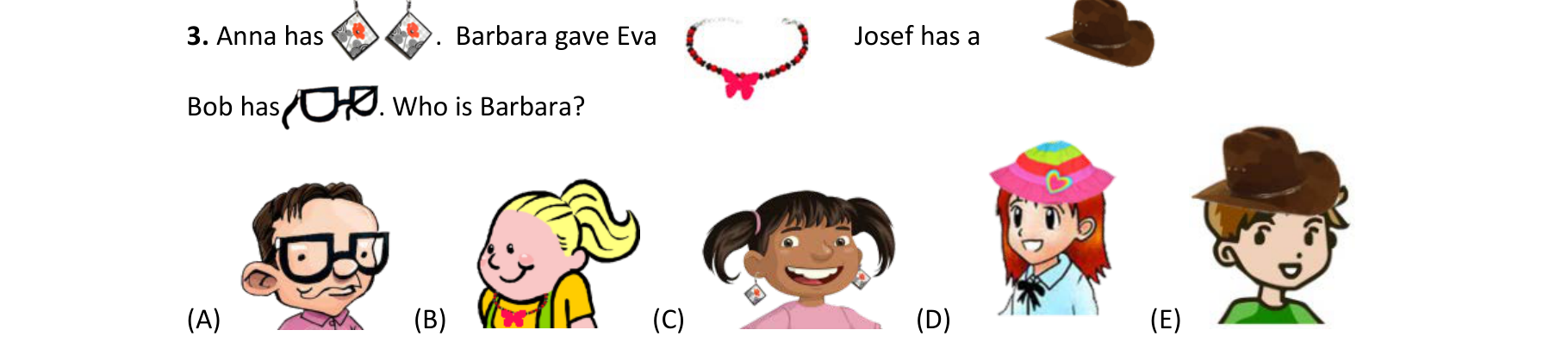
The clues describe what each child has or does (shown in the picture). Anna has one thing, Barbara gave Eva something, Josef has something, and Bob has something. Using the clues, which picture (A–E) shows Barbara?
Show answer
Answer: D
Show hints
Hint 1 of 3
Read the clues and cross off any picture that the clue gives to someone who is NOT Barbara.
Still stuck? Show hint 2 →
Hint 2 of 3
The clue about Barbara is the giving clue: she is the one who gave Eva her thing.
Still stuck? Show hint 3 →
Hint 3 of 3
Whoever is left after you label Anna, Josef and Bob, and who fits the giving clue, is Barbara.
Show solution
Approach: label the children you know, then the leftover picture matching the giving clue is Barbara
First label the pictures the clues hand directly to Anna, Josef and Bob.
The remaining clue says Barbara gave Eva her item, which points to one specific picture.
A market has a special corn-on-the-cob offer: each cob costs 20 cent, and every 6th cob is free. Mrs. Maisl buys four pieces of corn-on-the-cob for each of the four members of her family and gets the discount offered. How much does she end up paying?
Show answer
Answer: C — 2.80 €
Show hints
Hint 1 of 2
First find the total number of cobs bought.
Still stuck? Show hint 2 →
Hint 2 of 2
Use the every-6th-cob-free rule to subtract the free cobs before multiplying by the price.
Show solution
Approach: count cobs, apply the free-cob discount
She buys 4 cobs for each of 4 people: 4 × 4 = 16 cobs.
Every 6th cob is free, so cobs number 6 and 12 are free — 2 free cobs.
She pays for 16 − 2 = 14 cobs at 20 cent each: 14 × 20 = 280 cent.
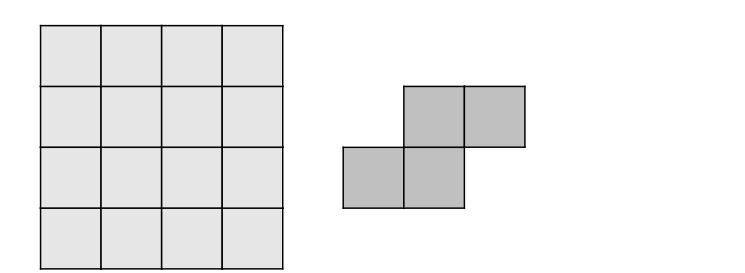
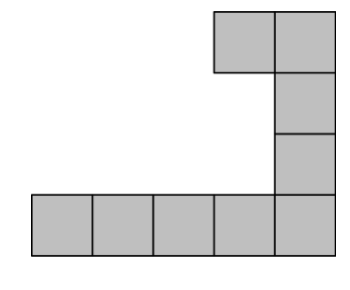
Melanie has a square piece of paper with a 4×4 grid drawn on it. She cuts along the gridlines, cutting out several shapes that each look like the one pictured or its mirror image. How many squares are left over if she cuts out as many shapes as possible?
Show answer
Answer: C — 4
Show hints
Hint 1 of 2
The shape is a 4-square piece; the grid holds 16 squares in total.
Still stuck? Show hint 2 →
Hint 2 of 2
Try to fit as many copies (or mirror images) as you can without overlap, then count the leftovers.
Show solution
Approach: tile and count leftovers
The 4×4 grid has 16 unit squares; each cut-out piece uses 4 of them.
These S/Z-shaped pieces cannot fill the 4×4 square completely.
The best packing fits 3 pieces (12 squares), leaving 4 squares uncovered.
Five children are talking about the number 325. Andreas: “It is a three-digit number.” Boris: “All the digits are different.” Sara: “The digit sum is 10.” Gerda: “The units digit is 5.” Daniela: “All the digits are odd.” Who has made a mistake?
Show answer
Answer: E — Daniela
Show hints
Hint 1 of 2
Check each child's statement against the actual number 325.
Still stuck? Show hint 2 →
Hint 2 of 2
One statement is simply false — look at whether every digit is really odd.
Show solution
Approach: test each claim about 325
325 is a three-digit number (Andreas correct), its digits 3, 2, 5 are all different (Boris correct).
3+2+5 = 10 (Sara correct) and the units digit is 5 (Gerda correct).
But 2 is even, so 'all the digits are odd' is wrong — that is Daniela.
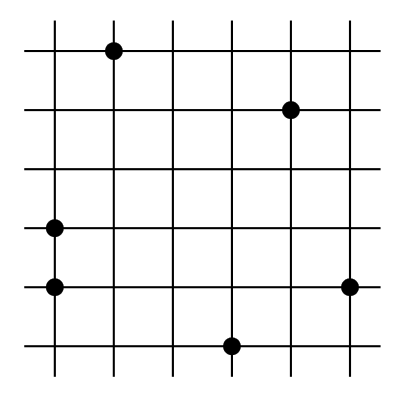
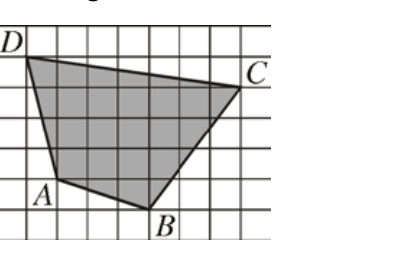
On a square grid made up of unit squares, six points are marked as shown. Three of them form a triangle with the least area. How big is this smallest area?
Show answer
Answer: A — \(\frac{1}{2}\)
Show hints
Hint 1 of 2
The smallest possible triangle area on a unit grid is very small — look for three points that are nearly in a line.
Still stuck? Show hint 2 →
Hint 2 of 2
A triangle with base 1 and height 1 already has area 1/2; check whether any triple beats that, or whether 1/2 is the minimum here.
Show solution
Approach: find the three marked points giving the least area
On a unit grid, the smallest triangle from lattice points has area 1/2 (base 1, height 1).
Among the six marked points, a triple forms exactly such a minimal triangle.
The year 2013 is made up of four consecutive digits 0, 1, 2, 3 (in some order). How many years before 2013 was the most recent year also made up of four consecutive digits?
Show answer
Answer: C — 581
Show hints
Hint 1 of 2
You need the most recent earlier year whose four digits are four consecutive integers in some order.
Still stuck? Show hint 2 →
Hint 2 of 2
Try the digit sets {1,2,3,4} and {0,1,2,3} and find the largest valid year below 2013.
Show solution
Approach: search digit-consecutive years just below 2013
A year of four consecutive digits uses a set like {0,1,2,3}, {1,2,3,4}, etc.
Below 2013, the largest such year comes from {1,2,3,4}: arranging them as 1432.
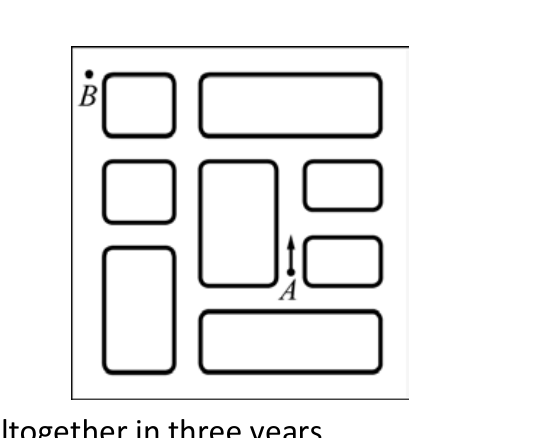
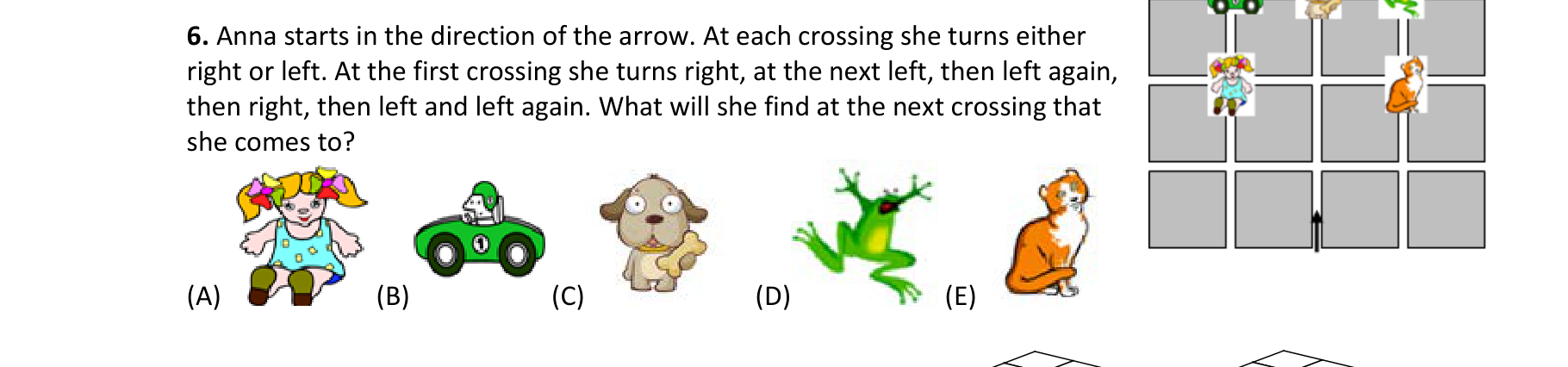
Anna starts walking in the direction of the arrow. At each crossing she turns either right or left. She turns right, then left, then left again, then right, then left, then left again. What will she find at the next crossing she reaches?
Show answer
Answer: A
Show hints
Hint 1 of 3
Put your finger on the start and point it the way the arrow points.
Still stuck? Show hint 2 →
Hint 2 of 3
Make the turns one at a time in order: right, left, left, right, left, left.
Still stuck? Show hint 3 →
Hint 3 of 3
After the last turn, look at the very next crossing to see which pictured item is there.
Show solution
Approach: walk the path one turn at a time and read off the item at the final crossing
Start at the arrow and trace the path, turning right, left, left, right, left, then left.
Keep your finger moving along the streets so you do not skip a crossing.
The item waiting at the next crossing is the one shown in option A.
Counting & ProbabilityLogic & Word Problemscasework
A sack contains marbles in five different colours: 2 red, 3 blue, 10 white, 4 green and 3 black. You take marbles out of the bag without looking and without putting any back. What is the smallest number of marbles you must remove to be sure of having two of the same colour?
Show answer
Answer: E — 6
Show hints
Hint 1 of 2
Think about the worst luck possible while still avoiding a matching pair.
Still stuck? Show hint 2 →
Hint 2 of 2
This is a pigeonhole question: one of each colour first, then one more forces a repeat.
Show solution
Approach: pigeonhole / worst case
There are 5 different colours, and every colour has at least two marbles.
The worst case is drawing one marble of each colour: 5 marbles, all different.
The very next marble (the 6th) must repeat a colour.
Nathalie wanted to build a large cube out of lots of small cubes, just like in Picture 1. How many cubes are missing from Picture 2 that would be needed to build the large cube?
Show answer
Answer: C — 7
Show hints
Hint 1 of 3
A full big cube like Picture 1 is 3 cubes wide, 3 deep and 3 tall, so it needs 27 small cubes.
Still stuck? Show hint 2 →
Hint 2 of 3
Count how many small cubes are really in Picture 2, layer by layer.
Still stuck? Show hint 3 →
Hint 3 of 3
The missing number is 27 take away the cubes you counted in Picture 2.
Show solution
Approach: subtract the cubes present from a full cube
A complete large cube is 3 × 3 × 3 = 27 small cubes.
Counting the cubes in picture 2 layer by layer gives 20 cubes.
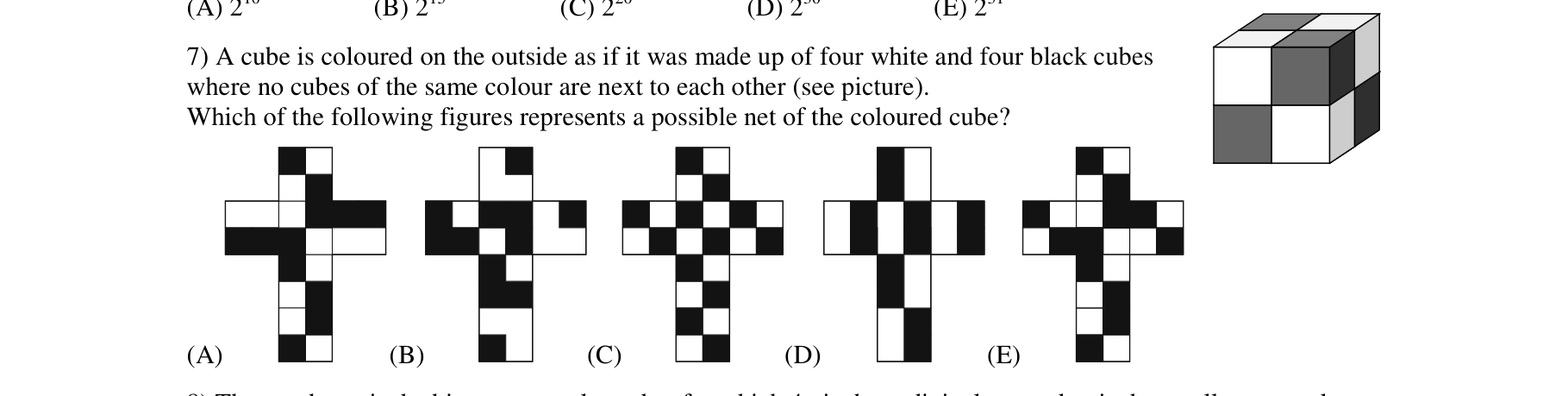
A cube is coloured on the outside as if it were made up of four white and four black small cubes, with no two cubes of the same colour next to each other (see picture). Which of the following figures could be a net of the coloured cube?
Show answer
Answer: E
Show hints
Hint 1 of 2
Track which faces end up opposite each other when the net folds into the cube.
Still stuck? Show hint 2 →
Hint 2 of 2
Each face is split into a checkerboard; only one net folds so that no two same-coloured small cubes touch.
Show solution
Approach: fold each net mentally and check the colouring rule
The cube is coloured so that small cubes of the same colour never sit next to each other.
Folding each candidate net, only one keeps that colouring consistent along every shared edge.
Alex lights a candle every 10 minutes. Each candle burns for 40 minutes before going out. How many candles are burning 55 minutes after he lit the first candle?
Show answer
Answer: C — 4
Show hints
Hint 1 of 2
List when each candle is lit and how long it stays burning.
Still stuck? Show hint 2 →
Hint 2 of 2
At minute 55, check which lit candles have not yet burned out.
Show solution
Approach: track burning intervals
Candles are lit at minutes 0, 10, 20, 30, 40, 50, each burning for 40 minutes.
At minute 55: the ones lit at 0 and 10 have gone out (out by 40 and 50).
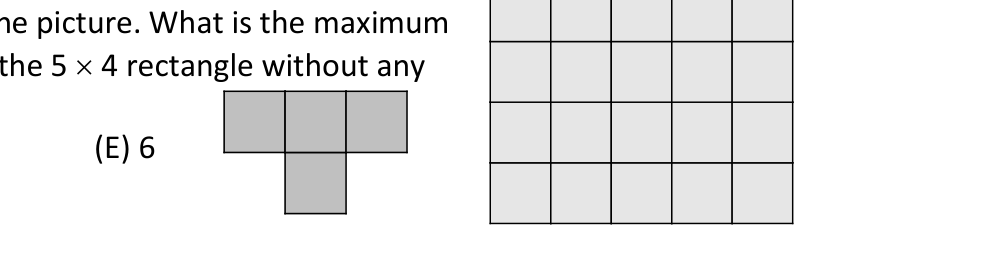
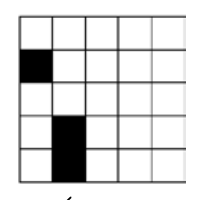
Anne has several grey tiles shaped like the one in the picture. What is the greatest number of these tiles she can place on the 5 × 4 rectangle without any overlaps?
Show answer
Answer: C — 4
Show hints
Hint 1 of 3
First count how many squares the board has and how many each tile covers.
Still stuck? Show hint 2 →
Hint 2 of 3
Area says at most 5 tiles could fit, but try actually drawing them in.
Still stuck? Show hint 3 →
Hint 3 of 3
The bumpy T-shape always leaves a few squares stranded, so you can't reach 5.
Show solution
Approach: bound by area, then test placement
The board has \(5 \times 4 = 20\) squares and each grey tile covers 4 squares, so at most \(20 \div 4 = 5\) tiles could fit.
But when you slot the T-shaped tiles in, they keep leaving small gaps, so 5 is impossible.
You can fit 4 tiles with no overlap (covering 16 squares), so the most is 4, choice C.
The number n is the biggest natural number for which \(4n\) is three digits long, and m is the smallest natural number for which \(4m\) is three digits long. What value does \(4n - 4m\) have?
Show answer
Answer: C — 896
Show hints
Hint 1 of 2
A three-digit multiple of 4 ranges from 100 to 999; find the largest and smallest n that land in that range.
Each of six lone heroes has captured some wanted people. In total they captured 20 wanted people: the first hero caught one, the second two, the third three. The fourth hero caught more than any other hero. What is the smallest number the fourth hero could have caught so that this is possible?
Show answer
Answer: B — 6
Show hints
Hint 1 of 2
The first three heroes account for 1+2+3 = 6, leaving the rest of the 20.
Still stuck? Show hint 2 →
Hint 2 of 2
Make the fifth and sixth heroes as large as possible while staying below the fourth.
Show solution
Approach: minimise the largest under a sum constraint
The number 36 has a special property: 36 can be divided by its units digit with no remainder (36 is divisible by 6). The number 38 does not have this property. How many numbers between 20 and 30 have the same property as 36?
Show answer
Answer: C — 4
Show hints
Hint 1 of 3
Check each number from 21 up to 29 one at a time.
Still stuck? Show hint 2 →
Hint 2 of 3
For each one, share it into groups the size of its last digit and see if there is any leftover.
Still stuck? Show hint 3 →
Hint 3 of 3
Count only the numbers that split evenly with nothing left over.
Show solution
Approach: check divisibility by the units digit
Go through 21 to 29 and divide each by its last digit: \(21\div1\), \(22\div2\), \(24\div4\) and \(25\div5\) all come out even with no leftover.
The rest (23, 26, 27, 28, 29) each leave a leftover.
So 4 numbers have the property, which is choice C.
Tom and Laura stand directly opposite each other around a circular well. At the same moment they both begin to run clockwise around the well. Tom's speed is \(\frac{9}{8}\) of Laura's speed. How many full laps of the well will Laura run before Tom catches up with her for the first time?
Show answer
Answer: A — 4
Show hints
Hint 1 of 2
They start half a lap apart; Tom must close that gap running only a little faster.
Still stuck? Show hint 2 →
Hint 2 of 2
Work with the speed difference and how long it takes to make up half a lap.
Show solution
Approach: relative speed to close the gap
Starting opposite means Tom is half a lap behind Laura.
Tom gains on Laura at rate (9/8 − 1) = 1/8 of Laura's speed.
To make up 1/2 lap at 1/8-lap-per-Laura-lap, Laura must run (1/2)÷(1/8) = 4 laps.
Maria drew the figures below on square sheets of paper (each shape is shaded on its own square sheet). How many of these figures have the same perimeter as the square sheet of paper itself?
Show answer
Answer: C — 4
Show hints
Hint 1 of 3
The plain square sheet has a border equal to its 4 sides.
Still stuck? Show hint 2 →
Hint 2 of 3
Trace each shape's edge and watch what a notch does: a step in must be matched by a step back out.
Still stuck? Show hint 3 →
Hint 3 of 3
A bump or dent that goes in and comes straight back keeps the border length the same.
Show solution
Approach: compare each outline's perimeter to the square
Trace the border of each figure and compare it to the square's 4-side border.
Most of the cut shapes have notches where every step inward is balanced by an equal step outward, so their border stays the same as the square's; one shape gains extra edge.
Counting the matching ones gives 4 figures, which is choice C.
Vera’s mum has made sandwiches, each using two slices of bread. There are 24 slices in a pack. How many sandwiches can she make with two whole packs and one half pack of bread?
Show answer
Answer: D — 30
Show hints
Hint 1 of 3
First work out the total number of bread slices Vera's mum has.
Still stuck? Show hint 2 →
Hint 2 of 3
A half pack has half of 24 slices, which is 12 slices.
Still stuck? Show hint 3 →
Hint 3 of 3
Each sandwich eats 2 slices, so split the total into pairs to count the sandwiches.
Show solution
Approach: count slices, then divide by 2
Two whole packs and one half pack give 24 + 24 + 12 = 60 slices.
Each sandwich uses 2 slices, so 60 ÷ 2 = 30 sandwiches.
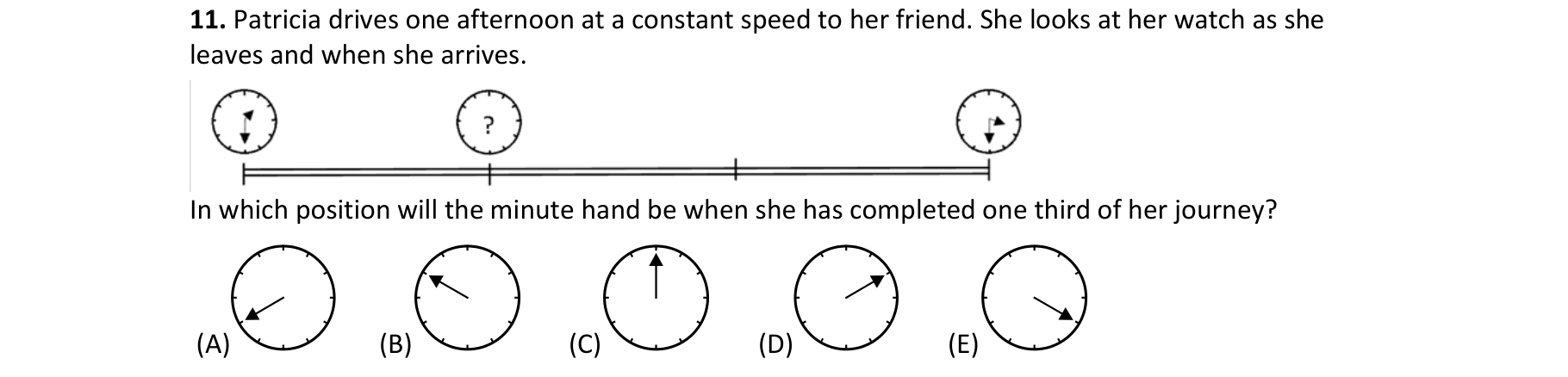
Patricia drives one afternoon at a steady speed to her friend. She looks at her watch when she leaves and again when she arrives (both clocks are shown). Where will the minute hand be when she has completed one third of her journey?
Show answer
Answer: D
Show hints
Hint 1 of 3
The two clocks show the start time and the finish time of the whole drive.
Still stuck? Show hint 2 →
Hint 2 of 3
Find how far the minute hand swings between those two clocks, then take one third of that swing.
Still stuck? Show hint 3 →
Hint 3 of 3
Mark the one-third point and match it to the pictured clock faces.
Show solution
Approach: take one‑third of the way between start and finish
From the leaving clock to the arriving clock, the minute hand sweeps through a fixed amount.
Since the speed is constant, one third of the journey means the hand has swept one third of that amount.
Marking the one-third point of the swing matches the clock in choice D.
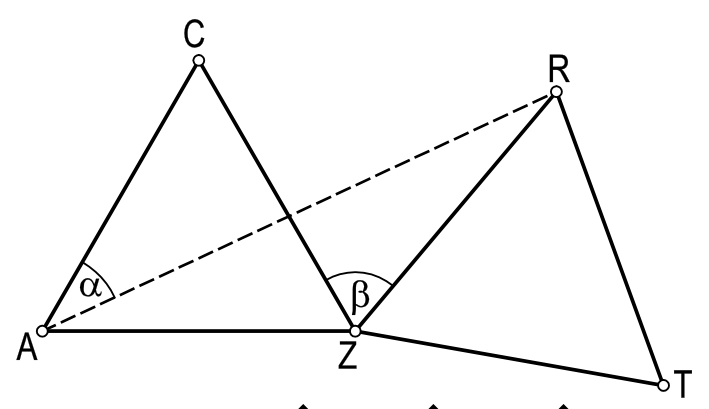
Triangle RZT is generated by rotating the equilateral triangle AZC about point Z. Angle \(\beta = \angle CZR = 70^\circ\). Determine angle \(\alpha = \angle CAR\).
Show answer
Answer: D — \(35^\circ\)
Show hints
Hint 1 of 2
A rotation about Z keeps lengths, so ZC = ZR and triangle CZR is isosceles.
Still stuck? Show hint 2 →
Hint 2 of 2
Find the base angle of that isosceles triangle, then relate it to angle CAR.
Show solution
Approach: use the rotation to build an isosceles triangle
Rotating equilateral triangle AZC about Z sends C to R, so ZC = ZR.
Triangle CZR is isosceles with apex angle β = 70°, so its base angles are (180° − 70°) / 2 = 55°.
Combining the 60° angle of the equilateral triangle at A with this geometry gives α = 35°.
Anne plays “sink the ship” with a friend on a 5×5 grid. She has already drawn in a 1×1 ship and a 2×2 ship (see picture). She must also draw a rectangular 3×1 ship. Ships may be neither directly nor diagonally adjacent to one another. How many possible positions are there for the 3×1 ship?
Show answer
Answer: E — 8
Show hints
Hint 1 of 3
Shade every cell that touches an existing ship, even at a corner, as off-limits.
Still stuck? Show hint 2 →
Hint 2 of 3
On the cells that remain, count the straight runs of three (across and down) where the new ship fits.
Still stuck? Show hint 3 →
Hint 3 of 3
Each free column tall enough holds several vertical placements, so check the open columns carefully.
Show solution
Approach: block the buffer cells, then count straight runs of three free cells
Each existing ship needs a one-cell gap on every side (including diagonals), so shade those buffer cells as forbidden.
After shading, the two right-hand columns stay completely open from top to bottom, plus the top two rows have a free stretch of three cells.
Each open length-5 column holds 3 vertical placements (rows 1-3, 2-4, 3-5), giving 3 + 3 = 6 vertical positions.
The two open top rows each hold one horizontal 3-in-a-row, adding 2 more, for 6 + 2 = 8.
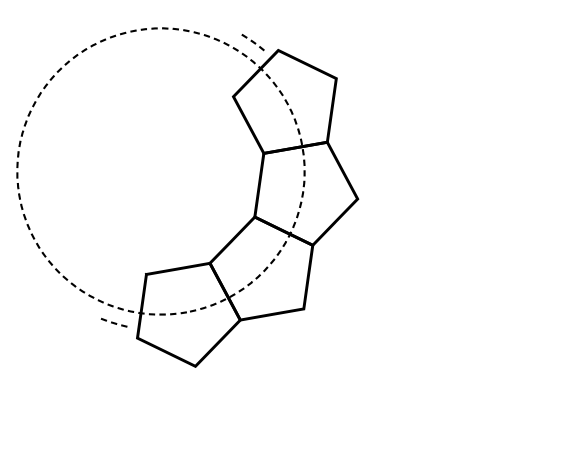
Ralf has many equally big plastic plates, each a regular pentagon. He glues them together edge to edge to form a complete ring (see picture). Out of how many plates is the ring made?
Show answer
Answer: C — 10
Show hints
Hint 1 of 2
Each pentagon turns the ring by a fixed angle as you go around.
Still stuck? Show hint 2 →
Hint 2 of 2
The ring closes after the turning adds up to a full 360° (going around twice for pentagons).
Show solution
Approach: turning angle around the ring
Gluing regular pentagons edge to edge bends the chain by 36° at each joint.
To come back to the start the bends must total 360°, needing 10 plates.
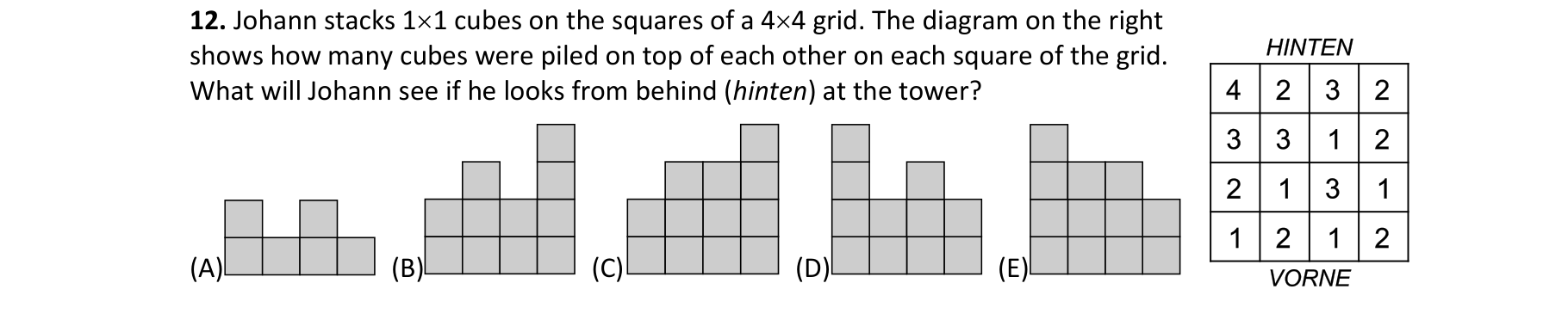
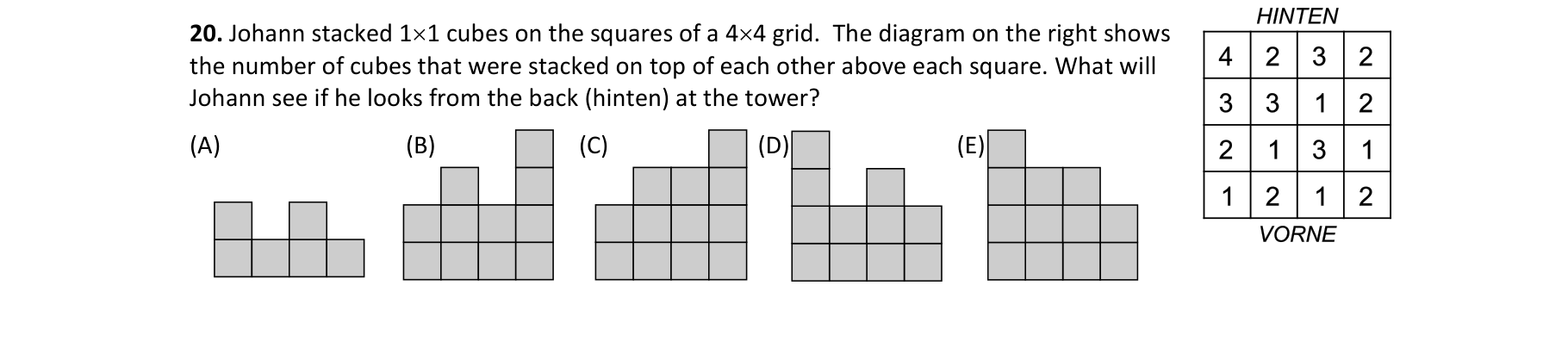
Johann stacks \(1\times1\) cubes on the squares of a \(4\times4\) grid. The diagram shows how many cubes are piled on each square. What will Johann see if he looks at the tower from behind?
Show answer
Answer: C
Show hints
Hint 1 of 3
Looking from the back flips left and right compared with the front.
Still stuck? Show hint 2 →
Hint 2 of 3
For each line of squares, only the tallest stack shows up in the side view.
Still stuck? Show hint 3 →
Hint 3 of 3
Read off the tallest stack in each row, then flip the row left-to-right for the back view.
Show solution
Approach: read the height grid from the back view
The grid tells how tall each stack is; from behind you see the same stacks but with left and right swapped.
For each line going across, the tallest stack is the one that shows in the outline.
Reading the tallest stacks and flipping left-to-right gives the shape in choice C.
Pinocchio’s nose is 9 cm long. Each time he lies, his nose grows by 6 cm. Each time he tells the truth, it shrinks by 2 cm. He tells three lies and twice tells the truth. How long is Pinocchio’s nose now?
Show answer
Answer: D — 23 cm
Show hints
Hint 1 of 3
Each lie adds 6 cm to the nose; each truth takes 2 cm away.
Still stuck? Show hint 2 →
Hint 2 of 3
There are three lies and two truths, so work out the total growing and the total shrinking.
Still stuck? Show hint 3 →
Hint 3 of 3
Start at 9 cm, add all the growing, then take away all the shrinking.
Show solution
Approach: add the lies, subtract the truths
Three lies add 3 × 6 = 18 cm; two truths take off 2 × 2 = 4 cm.
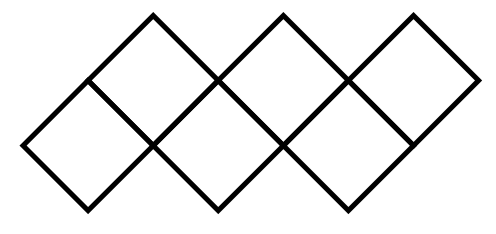
The figure shown is made up of six unit squares; its perimeter is 14 cm. Squares are added to this figure in the same zigzag way (alternating bottom-right and top-right) until it is made up of 2013 unit squares. How big is the perimeter of the newly created figure?
Show answer
Answer: B — 4028
Show hints
Hint 1 of 2
Find a simple rule linking the number of squares to the perimeter using the given case (6 squares, 14 cm).
Still stuck? Show hint 2 →
Hint 2 of 2
Each square added to the zigzag adds the same fixed amount to the perimeter.
Show solution
Approach: find the linear perimeter rule, then plug in 2013
For the staircase of unit squares, the perimeter follows P = 2n + 2 (check: n = 6 gives 2 · 6 + 2 = 14).
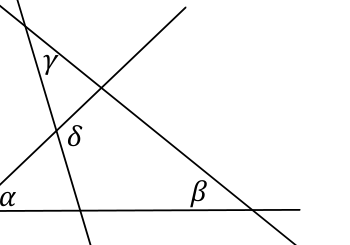
In the diagram, α = 55°, β = 40° and γ = 35°. How big is δ?
Show answer
Answer: E — 130°
Show hints
Hint 1 of 3
An exterior angle of a triangle equals the sum of the two interior angles it is not next to.
Still stuck? Show hint 2 →
Hint 2 of 3
Apply that idea twice, stepping up through the two stacked triangles toward δ.
Still stuck? Show hint 3 →
Hint 3 of 3
Watch how each step folds one more of the given angles into the running total.
Show solution
Approach: exterior-angle theorem, applied twice up the figure
On the bottom line, the lower triangle has base angles α and β, so the angle at its top vertex (the exterior angle on the far side) collects α + β = 55° + 40° = 95°.
That 95° angle and the angle γ = 35° are the two remote interior angles of the small triangle that has δ as its exterior angle.
By the exterior-angle theorem, δ = 95° + 35° = 130°.
36 children each voted once for one of five students in their class. The winner received 12 votes and the student placed last received just 4 votes. If every student received a different number of votes, how many votes did the second-placed student receive?
Show answer
Answer: B — 8 or 9
Show hints
Hint 1 of 3
The five vote counts are all different and add up to 36, with 12 on top and 4 at the bottom.
Still stuck? Show hint 2 →
Hint 2 of 3
Subtract the known 12 and 4 to find what the middle three must total.
Still stuck? Show hint 3 →
Hint 3 of 3
The second-place student has the biggest of those three middle counts, so test which biggest values can work.
Show solution
Approach: pin the middle three to sum 20 with distinct values
The top has 12 and the bottom has 4, so the other three students share \(36 - 12 - 4 = 20\) votes.
Those three are all different and each is strictly between 4 and 12, and the second-place count is the largest of the three.
If second place got 9, the others could be 5 and 6 (\(9+6+5=20\)); if second got 8, the others could be 5 and 7 (\(8+7+5=20\)); but 10 forces the other two to sum 10 with distinct values above 4, which is impossible.
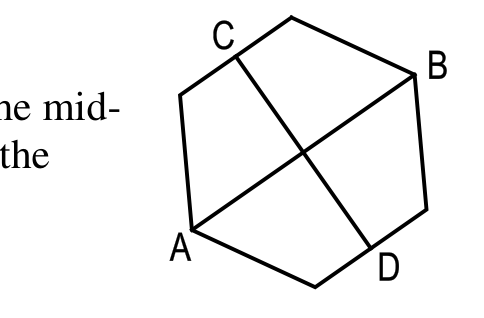
A and B are opposite vertices of a regular six-sided shape, and the points C and D are the midpoints of two opposite sides. The area of the regular six-sided shape is 60. Determine the product of the lengths of the segments AB and CD.
Show answer
Answer: D — 80
Show hints
Hint 1 of 2
Write AB (the long diagonal) and CD (the gap between opposite sides) in terms of the hexagon's side.
Still stuck? Show hint 2 →
Hint 2 of 2
Both the area and the product AB·CD are multiples of side²; take their ratio.
Show solution
Approach: express AB, CD, and area via the side length
For side s: the long diagonal AB = 2s, and the distance between opposite sides CD = s√3.
So AB · CD = 2√3 · s², while the area is (3√3 / 2) s² = 60.
A round carpet colours every tile it touches, so the grey region must be a single rounded, bulging blob.
Still stuck? Show hint 2 →
Hint 2 of 3
A disk has two axes of symmetry, so the set of tiles it touches must look the same when flipped left-right and top-bottom.
Still stuck? Show hint 3 →
Hint 3 of 3
Check each picture for that mirror symmetry and for any one-tile 'bump' a smooth circle could not reach.
Show solution
Approach: use the symmetry a disk's grey set must have
The tiles a disk touches always form one solid, convex-looking blob that is symmetric about both the horizontal and the vertical line through the disk's centre.
Patterns (A)–(D) each have that double mirror symmetry, so a suitably placed circle can produce them.
Pattern (E) has an off-centre tile that breaks the symmetry — no single circle can touch exactly those tiles, so the impossible one is E.
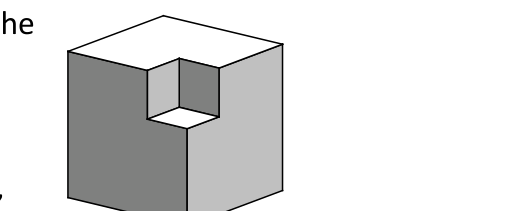
A 1 × 1 × 1 cube is cut out of each corner of a 3 × 3 × 3 cube. The picture shows the result after the first corner cube has been removed. How many faces does the final shape have?
Show answer
Answer: D — 30
Show hints
Hint 1 of 3
Begin with the 6 big faces the cube starts with.
Still stuck? Show hint 2 →
Hint 2 of 3
Look at the one notch in the picture: it scoops out a little corner and reveals 3 new small square walls.
Still stuck? Show hint 3 →
Hint 3 of 3
There are 8 corners, so add up all the new little faces and the original 6.
Show solution
Approach: count original faces plus faces added per corner
Even after the corners are scooped out, each of the 6 big outer faces is still one face (just with bites taken out of it), so that is 6 faces.
Each corner cut opens up 3 new little square faces inside the notch, and there are 8 corners: \(8 \times 3 = 24\) new faces.
A class has written a test. If every boy had obtained 3 more points, the class average would be 1.2 points higher than it is now. What percentage of the children in this class are girls?
Show answer
Answer: D — 60%
Show hints
Hint 1 of 2
Giving every boy 3 more points adds 3 × (number of boys) to the class total.
Still stuck? Show hint 2 →
Hint 2 of 2
That extra total, spread over all children, is the 1.2-point rise — set up the equation for the fraction of boys.
Show solution
Approach: relate the total point increase to the average increase
If there are b boys among c children, adding 3 to each boy adds 3b points total.
The average rises by 3b / c = 1.2, so b / c = 0.4 — 40% are boys.
Consider the following statement about a function \(f : \mathbb{Z} \to \mathbb{Z}\) defined for all integers x: “For every even x, \(f(x)\) is even.” What is the negation of this statement?
Show answer
Answer: D — There is a number x for which \(f(x)\) is odd.
Show hints
Hint 1 of 2
Negating 'for every …' turns it into 'there exists … that fails'.
Still stuck? Show hint 2 →
Hint 2 of 2
The failure is: an x where f(x) is odd.
Show solution
Approach: negate a universal statement
The claim is 'for every even x, f(x) is even.'
Its negation asserts the existence of some x for which f(x) is odd.
At the London 2012 Olympic Games the USA won the most medals: 46 gold, 29 silver and 29 bronze. China was second with 38 gold, 27 silver and 23 bronze. How many more medals did the USA win than China?
Show answer
Answer: C — 16
Show hints
Hint 1 of 3
Add up all of the USA's medals, then add up all of China's medals.
Still stuck? Show hint 2 →
Hint 2 of 3
The lighter way is to compare gold to gold, silver to silver, and bronze to bronze.
Still stuck? Show hint 3 →
Hint 3 of 3
Find each of those three differences and add the three differences together.
Show solution
Approach: compare each colour separately so the numbers stay small
Gold: the USA had 46 and China had 38, that is 8 more gold.
Silver: 29 against 27 is 2 more, and bronze: 29 against 23 is 6 more.
Adding the three extras, 8 + 2 + 6 = 16 more medals, which is answer C.
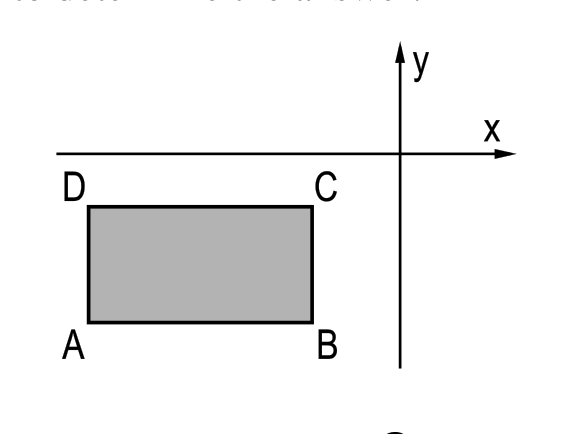
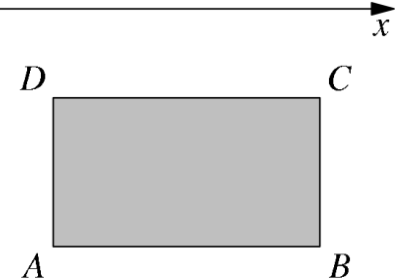
The sides of rectangle ABCD are parallel to the coordinate axes. The rectangle lies below the x-axis and to the right of the y-axis, as shown. For each of the points A, B, C, D the quotient (y-coordinate) : (x-coordinate) is calculated. For which point will you obtain the smallest quotient?
Show answer
Answer: D — D
Show hints
Hint 1 of 2
For every corner the quotient is (negative y) over (negative x), so it is positive; you want the smallest positive value.
Still stuck? Show hint 2 →
Hint 2 of 2
Smallest quotient = smallest |y| paired with largest |x| — find that corner.
Show solution
Approach: compare y/x at each corner
In the diagram the rectangle has both coordinates negative, so each quotient y : x is positive.
The smallest quotient comes from the corner closest to the x-axis (smallest |y|) and farthest from the y-axis (largest |x|).
In the last hockey game there were lots of goals. In the first half 6 goals were scored in total and the visiting team was leading. In the second half the home team scored another three goals and won the match. How many goals did the home team score in total?
Show answer
Answer: C — 5
Show hints
Hint 1 of 3
In the first half the two teams together scored 6, and the visitors were ahead.
Still stuck? Show hint 2 →
Hint 2 of 3
List the first-half scores where visitors lead: 6-0, 5-1 or 4-2.
Still stuck? Show hint 3 →
Hint 3 of 3
Then add the home team's 3 second-half goals and see which case lets them win.
Show solution
Approach: test first‑half splits that let home win
First half the goals add to 6 with visitors ahead, so the splits are visitors 6 home 0, visitors 5 home 1, or visitors 4 home 2.
The home team then scores 3 more; to win they need their total above the visitors' 6, 5, or 4.
Only 4-2 works: home ends with \(2 + 3 = 5\) against 4, a win, so the home team scored 5 in total, choice C.
30 children took part in a sports competition, playing football and handball. 15 took part in football and 20 took part in handball. How many children took part in both sports?
Show answer
Answer: E — 5
Show hints
Hint 1 of 3
If you add the football players and the handball players, the children who played both get counted twice.
Still stuck? Show hint 2 →
Hint 2 of 3
Add 15 and 20 and compare that total to the real number of children, 30.
Still stuck? Show hint 3 →
Hint 3 of 3
The extra amount above 30 is exactly the children who were counted twice.
Show solution
Approach: the double-counted children are the ones who played both
Add the football players and handball players: 15 + 20 = 35.
But there are only 30 children, so 35 is 5 too many.
Those extra 5 are the children counted in both lists, so 5 played both, which is answer E.
We consider rectangles that have one side of length 5.0 cm. Among them, some can be cut into a square and a rectangle, one of which has an area of 4.0 cm². How many such rectangles are there?
Show answer
Answer: D — 4
Show hints
Hint 1 of 2
Call the unknown side w; cutting off a square leaves a smaller rectangle.
Still stuck? Show hint 2 →
Hint 2 of 2
Set the square's area or the leftover's area equal to 4 and solve.
Show solution
Approach: case out which piece has area 4
A 5×w rectangle cut into a square plus a rectangle: solve w²=4, (5−w)w=4, or 5(w−5)=4.
These give w = 2, 1, 4, and 5.8 — four valid rectangles.
The number 35 has a special property: it can be divided exactly by its units digit, because \(35 \div 5 = 7\). The number 38 does not have this property. How many numbers bigger than 21 but smaller than 30 have this property?
Show answer
Answer: B — 3
Show hints
Hint 1 of 3
Bigger than 21 and smaller than 30 means the numbers 22, 23, 24, 25, 26, 27, 28, 29.
Still stuck? Show hint 2 →
Hint 2 of 3
For each one, can you split it into equal groups of its last digit with none left over?
Still stuck? Show hint 3 →
Hint 3 of 3
Count how many of the eight numbers pass that test.
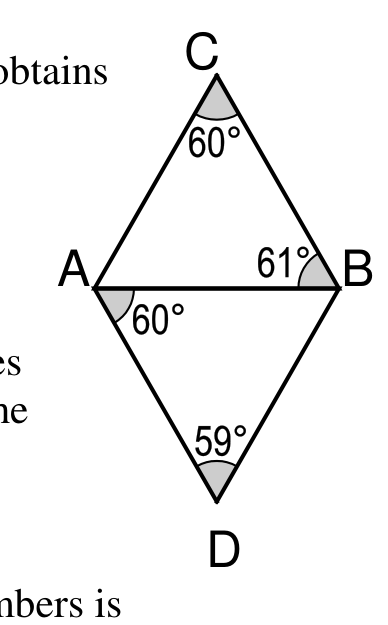
Tarzan wanted to draw a rhombus made up of two equilateral triangles, but he drew the line segments inaccurately. When Jane checked the four marked angles, she saw that they are not all equal (see diagram). Which of the five line segments in this diagram is the longest?
Show answer
Answer: A — AD
Show hints
Hint 1 of 2
In any triangle, the longest side lies opposite the largest angle.
Still stuck? Show hint 2 →
Hint 2 of 2
Compare the marked angles across both triangles to see which single segment is the longest of all five.
Show solution
Approach: use longest-side-opposite-largest-angle across the figure
The figure is two near-equilateral triangles whose marked angles are slightly unequal.
In each triangle the longest side is opposite its biggest angle; comparing the labelled angles across the whole figure singles out one segment as longest overall.
Number TheoryCounting & Probabilitycareful-countingplace-value
All four-digit positive numbers that use the same digits as 2013 were written on a blackboard in ascending order. Find the largest possible difference between two numbers that are next to each other on the blackboard.
Show answer
Answer: A — 702
Show hints
Hint 1 of 2
List the four-digit numbers using the digits 2, 0, 1, 3 each once (no leading 0), in order.
Still stuck? Show hint 2 →
Hint 2 of 2
The biggest jump happens where the leading digit changes.
Show solution
Approach: order the arrangements, find the largest jump
Using digits 2,0,1,3 (no leading zero) gives numbers starting with 1, 2, or 3.
The largest number starting with 2 is 2310; the smallest starting with 3 is 3012.
Their difference 3012 − 2310 = 702 is the largest gap between consecutive numbers.
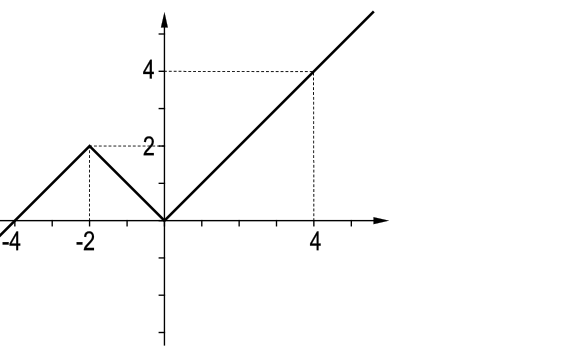
Peter drew the graph of a function \(f : \mathbb{R} \to \mathbb{R}\) consisting of two rays and a line segment, as shown. How many solutions does the equation \(f(f(f(x))) = 0\) have?
Show answer
Answer: A — 4
Show hints
Hint 1 of 2
First find every input that f sends to 0, then work outward one layer at a time.
Still stuck? Show hint 2 →
Hint 2 of 2
Track preimages: solve f = 0, then f = those values, then again.
Show solution
Approach: count preimages layer by layer
f(x)=0 at x = 0 and x = −4.
Pulling back once more, f(x) ∈ {0,−4} adds x = −8; pulling back again adds x = −12.
The solution set is {0,−4,−8,−12}: 4 solutions, A.
Five consecutive positive integers have the following property: the sum of three of the numbers is as big as the sum of the other two. How many sets of 5 such numbers are there?
Show answer
Answer: C — 2
Show hints
Hint 1 of 2
Let the five numbers be n, n+1, n+2, n+3, n+4 and write the three-equal-two condition as an equation.
Still stuck? Show hint 2 →
Hint 2 of 2
The three chosen must total half of all five, which is only possible for small n.
Show solution
Approach: split the five and require equal halves
The five numbers total 5n + 10; splitting into a 3-group equal to a 2-group needs each half to be (5n + 10) / 2.
Testing small starts: {2,3,4,5,6} works (2 + 3 + 5 = 4 + 6 = 10) and {4,5,6,7,8} works (4 + 5 + 6 = 7 + 8 = 15).
For larger n the two largest can no longer balance the three smallest, so there are exactly 2 such sets.
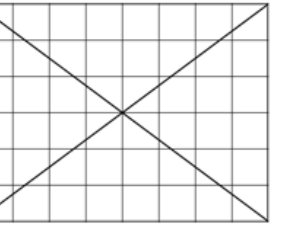
In the 8×6 grid pictured, there are 24 squares that are not cut by either of the two diagonals. Now we draw the two diagonals on a 10×6 grid. How many squares of this grid will not be cut by either diagonal?
Show answer
Answer: E — 32
Show hints
Hint 1 of 2
A diagonal of an m×n grid passes through m + n − gcd(m,n) unit squares.
Still stuck? Show hint 2 →
Hint 2 of 2
Subtract the squares both diagonals touch from the total to get the uncut ones.
Show solution
Approach: count squares a diagonal crosses
One diagonal of a 10×6 grid crosses 10 + 6 − gcd(10,6) = 14 squares.
Both diagonals meet at the centre lattice point and share no cut square, so together they cut 14 + 14 = 28.
The grid has 60 squares, so 60 − 28 = 32 are uncut.
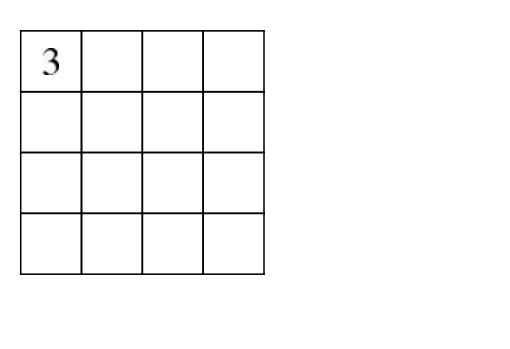
Numbers are written in the 4 × 4 grid so that any two numbers in squares sharing an edge differ by 1. The number 3 is already given, and the number 9 is used somewhere in the grid. How many different numbers are used once the grid is completely filled in?
Show answer
Answer: D — 7
Show hints
Hint 1 of 3
Touching squares differ by exactly 1, so as you step across the grid the number only goes up or down by 1 each time.
Still stuck? Show hint 2 →
Hint 2 of 3
To get from a 3 to a 9 you must pass through every value in between.
Still stuck? Show hint 3 →
Hint 3 of 3
List the numbers you are forced to step through from 3 up to 9 and count them.
Show solution
Approach: track the range of values forced by the rules
Moving from one square to a touching square changes the number by just 1, so to climb from 3 up to 9 you must step through 4, 5, 6, 7 and 8 along the way.
That forces all of 3, 4, 5, 6, 7, 8, 9 to appear in the grid.
So 7 different numbers are used, which is choice D.
Andi, Betti, Clara and Dani were born in the same year. Their birthdays are on 20 February, 12 April, 12 May and 25 May, but not necessarily in that order. Betti and Andi were born in the same month. Andi and Clara were born on the same day, in different months. Who is the oldest?
Show answer
Answer: D — Dani
Show hints
Hint 1 of 2
'Same month' must be the month that has two of the dates.
Still stuck? Show hint 2 →
Hint 2 of 2
'Same day, different months' must use the day number that appears twice.
Show solution
Approach: match the pairs of dates by the clues
Betti and Andi share a month, and only May has two dates (12 May, 25 May).
Andi and Clara share a day in different months, and only the 12th repeats (12 April, 12 May), so Andi = 12 May, Clara = 12 April; then Betti = 25 May.
Dani gets the leftover 20 February, the earliest date, so Dani is the oldest.
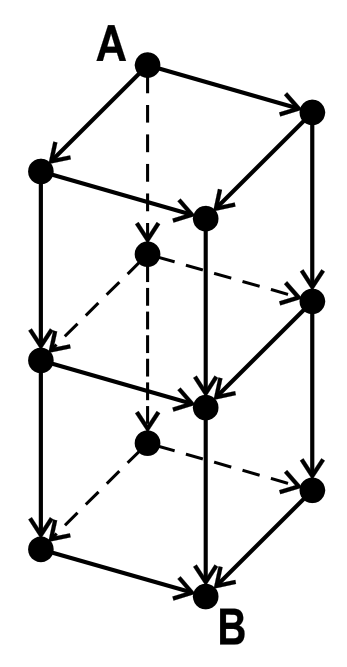
How many different ways are there in the diagram shown to get from point A to point B, if you are only allowed to move in the directions indicated by the arrows?
Show answer
Answer: D — 12
Show hints
Hint 1 of 2
Count paths by labelling each junction with how many ways reach it from A.
Still stuck? Show hint 2 →
Hint 2 of 2
Only the indicated arrow directions are allowed, so every move goes forward toward B.
Show solution
Approach: count directed paths by accumulating at each node
Label each junction with the number of allowed paths reaching it from A, starting with 1 at A.
Add incoming counts along the arrow directions, junction by junction, down to B.
Andi, Berti, Christa, Doris and Edi were born on these days: 20.02.2000, 12.03.2000, 20.03.2000, 12.04.2000 and 23.04.2000 (in some order). Andi and Edi have their birthday in the same month. Berti and Christa also share a birthday month. Andi and Christa were born on the same day of different months. Doris and Edi were also born on the same day of different months. Which of these children is the youngest?
Show answer
Answer: B — Berti
Show hints
Hint 1 of 2
Match the four clues to the five dates; same-month and same-day pairs are very restrictive.
Still stuck? Show hint 2 →
Hint 2 of 2
Once everyone has a date, the youngest is simply the latest one.
Show solution
Approach: deduce the date assignment
Same-month pairs force Andi&Edi into one of the doubled months and Berti&Christa into the other.
Same-day clues then fix Andi = 12.03, Christa = 12.04, Edi = 20.03, Doris = 20.02, Berti = 23.04.
A box holds 900 cards numbered from 100 to 999, every number appearing once. Franz picks some cards and works out the digit sum on each. What is the minimum number of cards he must pick to be sure of having at least three with the same digit sum?
Show answer
Answer: C — 53
Show hints
Hint 1 of 2
First find how many different digit-sums the numbers 100–999 can have.
Still stuck? Show hint 2 →
Hint 2 of 2
Watch the extreme sums — some occur for only one card.
Show solution
Approach: pigeonhole with limited boxes
Digit sums run 1 to 27, but sum 1 (100) and sum 27 (999) each occur only once.
Worst case: 2 cards from each of the 25 sums 2–26 plus the two lone cards = 52 with no triple.
The 53rd card forces a third of some sum, so the minimum is 53 = C.
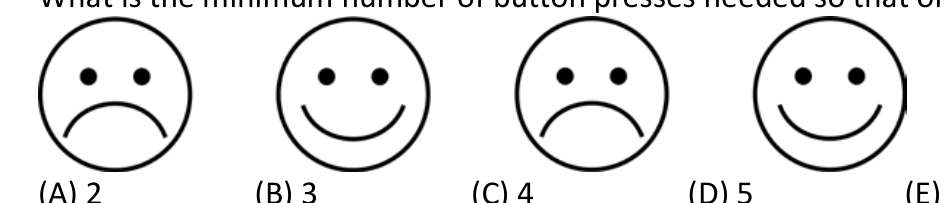
Two buttons showing smiling faces and two showing sad faces are in a row, as shown. Pressing a button changes its face and also the faces of its neighbours. What is the least number of button presses needed so that only smiling faces are showing?
Show answer
Answer: B — 3
Show hints
Hint 1 of 3
Pressing a button flips that face and the faces right next to it (sad becomes happy and happy becomes sad).
Still stuck? Show hint 2 →
Hint 2 of 3
Try pressing one button and watch which faces change, then plan the next press from the new picture.
Still stuck? Show hint 3 →
Hint 3 of 3
Check whether 1 or 2 presses can ever work before settling on a small number.
Show solution
Approach: try short sequences and watch the faces flip
Each press flips the button you push and its direct neighbours.
One or two presses always leave at least one sad face showing, so they are not enough.
Pressing the right three buttons in turn flips all the sad faces happy, so the fewest presses is 3, choice B.
If I join the midpoints of the sides of the large triangle in the picture, a small triangle is formed. If I join the midpoints of the sides of this small triangle, a tiny triangle is formed. How many of these tiny triangles can fit into the largest triangle at the same time?
Show answer
Answer: D — 16
Show hints
Hint 1 of 3
When you join the midpoints of a triangle, it splits into 4 equal little triangles just like it.
Still stuck? Show hint 2 →
Hint 2 of 3
So the big triangle holds 4 small triangles, and each small triangle holds 4 tiny ones.
Still stuck? Show hint 3 →
Hint 3 of 3
Count the tiny ones: 4 small triangles, each made of 4 tiny ones.
Show solution
Approach: each midpoint-join splits a triangle into 4 copies, so do it twice
Joining the midpoints cuts the big triangle into 4 equal small triangles.
Doing it again cuts each of those small triangles into 4 tiny ones.
That is 4 groups of 4 tiny triangles, so 4 × 4 = 16 fit in the big triangle, which is answer D.
Given a six-digit number whose digit sum is even and whose digit product is odd. Which of the following statements is true for this number?
Show answer
Answer: E — None of the statements (A)–(D) are correct.
Show hints
Hint 1 of 2
A product of digits is odd only when every single digit is odd.
Still stuck? Show hint 2 →
Hint 2 of 2
With all six digits odd, check each statement — and remember there are only five odd digits to choose from.
Show solution
Approach: deduce all digits are odd, then test each claim
An odd digit product forces all six digits to be odd (any even digit would make the product even).
Six odd digits sum to an even number, matching the condition — so such numbers exist (e.g. 111111).
Now: (A) zero even digits, false; (C) six odd digits is an even count, false; (D) only five distinct odd digits exist, so six different is impossible, false.
Starting from three numbers, the ‘addition machine’ makes three new ones by adding each pair together. For example, from {3, 4, 6} it makes {10, 9, 7}, and running it again gives {16, 17, 19}. We feed in the three numbers {20, 1, 3} and run the machine 2013 times. What is the biggest possible difference between two of the three resulting numbers?
Show answer
Answer: D — 19
Show hints
Hint 1 of 3
Don't follow the numbers themselves; watch the gaps between them.
Still stuck? Show hint 2 →
Hint 2 of 3
Work out the gaps in the example before and after one run of the machine and notice they are the same three gaps.
Still stuck? Show hint 3 →
Hint 3 of 3
If the gaps never change, the biggest gap at the end is the biggest gap you start with.
Show solution
Approach: watch the gaps between the numbers, not the numbers
Check the example: \(\{3,4,6\}\) has gaps 1, 2, 3, and after the machine \(\{7,9,10\}\) has gaps 2, 1, 3 — the very same three gaps, just shuffled.
So the three gaps between the numbers never change, no matter how many times you run the machine.
Starting from \(\{20,1,3\}\) the biggest gap is \(20 - 1 = 19\), and it is still 19 after 2013 runs, which is choice D.
Chrissi wants to sell 10 glass marbles that each have a different weight. Their weights are 1, 2, 3, 4, 5, 6, 7, 8, 9 and 10 dag. They are to be packed into bags, two marbles at a time, so that each bag has the same weight. Which two marbles will be put into the same bag?
Show answer
Answer: C — 3 and 8
Show hints
Hint 1 of 3
Ten marbles two at a time make 5 bags, and all five bags weigh the same.
Still stuck? Show hint 2 →
Hint 2 of 3
Add all the weights 1 + 2 + ... + 10 = 55, then share that equally among 5 bags.
Still stuck? Show hint 3 →
Hint 3 of 3
Each bag must weigh 11, so find the marble that pairs with 3 to make 11.
Show solution
Approach: equal-sum pairing
The total weight is 1+2+···+10 = 55, and 5 bags means each weighs 11 dag.
Pairs making 11: (1,10), (2,9), (3,8), (4,7), (5,6).
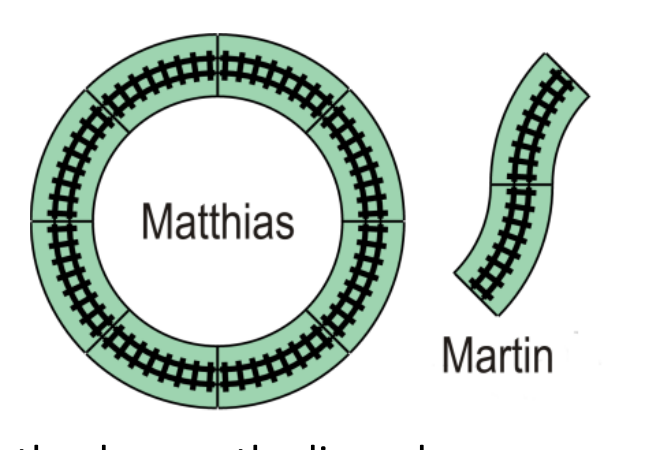
A model train set has only identical curved track pieces. Matthias uses 8 of them to make a closed circle (picture on the left). Martin starts his track with the 2 pieces shown on the right. He also wants a closed track using as few pieces as possible. How many pieces will his track use?
Show answer
Answer: B — 12
Show hints
Hint 1 of 3
Eight identical pieces close a full circle, so each piece bends the track by \(360^\circ \div 8 = 45^\circ\).
Still stuck? Show hint 2 →
Hint 2 of 3
To come back to the start, all the bends together must add up to one full turn, \(360^\circ\).
Still stuck? Show hint 3 →
Hint 3 of 3
Martin's two starting pieces curve opposite ways and cancel, so count how many more pieces are needed to still make a full turn.
Show solution
Approach: use the fixed bend angle to close a loop
Each curved piece turns the track \(45^\circ\), because 8 of them make a full circle (\(8 \times 45^\circ = 360^\circ\)).
To form a closed track the bends must add up to a full turn of \(360^\circ\), but Martin's two opening pieces curve in opposite directions and cancel out.
Working out the smallest loop that still turns a full \(360^\circ\) starting from that S-shape needs 12 pieces in all, which is choice B.
Baris has a few dominoes, shown in the picture. He wants to lay them in a line following the rules of dominoes: two dominoes can be placed next to each other only if the touching squares have the same number of dots. What is the greatest number of these dominoes that he can lay in a single line?
Show answer
Answer: C — 5
Show hints
Hint 1 of 3
Two dominoes may touch only when the halves that meet show the same number of dots.
Still stuck? Show hint 2 →
Hint 2 of 3
Treat it like a chain: the right end of one domino must equal the left end of the next.
Still stuck? Show hint 3 →
Hint 3 of 3
Try building the longest single chain you can, joining matching ends, and you may flip a domino around.
Show solution
Approach: build the longest chain where touching halves match
Pick a starting domino, then add a domino whose end matches its end.
Keep linking matching ends, flipping a domino around when that helps the numbers meet.
The longest single line you can make uses 5 dominoes, which is answer C.
The number 2013 is made up of the four consecutive digits 0, 1, 2, 3. How many years before the year 2013 was the date last made up of four consecutive digits?
Show answer
Answer: C — 581
Show hints
Hint 1 of 2
Search backward from 2013 for a year whose four digits are four consecutive values in some order.
Still stuck? Show hint 2 →
Hint 2 of 2
Try the digit-set {1,2,3,4} arranged to make the largest year below 2013.
Show solution
Approach: search backward for four-consecutive-digit years
Just below 2013, the most recent year using four consecutive digits is 1432 (digits 1, 2, 3, 4).
The sides of rectangle ABCD are parallel to the coordinate axes. The rectangle lies below the x-axis and to the right of the y-axis, as shown. The coordinates of A, B, C, D are all whole numbers. For each point we work out (y-coordinate) ÷ (x-coordinate). Which point gives the smallest value?
Show answer
Answer: A — A
Show hints
Hint 1 of 2
All x-coordinates are positive and all y-coordinates are negative, so y/x is always negative.
Still stuck? Show hint 2 →
Hint 2 of 2
To make a negative value smallest, you want the most-negative y over the smallest x.
Show solution
Approach: compare y/x at the four corners
Each point has x > 0 and y < 0, so every y/x is negative.
The smallest (most negative) value comes from the largest |y| with the smallest x.
Corner A is the lowest-left point: smallest x together with the most negative y.
2013 people live on an island; some are truth-tellers (who always tell the truth) and the rest are liars (who always lie). Each day one person says ‘When I have left the island, the number of truth-tellers will equal the number of liars,’ and then leaves. After 2013 days no one is left on the island. How many liars were living there to begin with?
Show answer
Answer: B — 1006
Show hints
Hint 1 of 3
Remember the rule: whatever a truth-teller says is really true, and whatever a liar says is really false.
Still stuck? Show hint 2 →
Hint 2 of 3
Look at the very first speaker: after he leaves there are 2012 people, and an even number can split into two equal halves.
Still stuck? Show hint 3 →
Hint 3 of 3
Decide whether that first speaker must be a truth-teller or a liar, and what that forces about the rest.
Show solution
Approach: reason about the first speaker, then balance the counts
After the first person leaves, 2012 remain. The claim 'truth-tellers equal liars' would mean \(1006 = 1006\), which is possible, so the first speaker can be a truth-teller telling the truth.
That makes the remaining 1006 truth-tellers and 1006 liars, and the very first speaker an extra truth-teller, giving \(1006 + 1 = 1007\) truth-tellers at the start.
The rest are liars: \(2013 - 1007 = 1006\) liars to begin with, which is choice B.
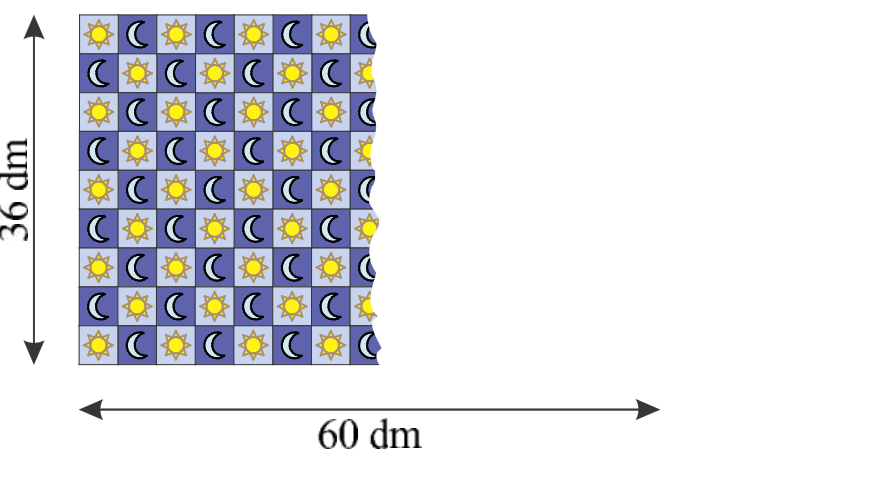
Peter has bought a rug that is 36 dm wide and 60 dm long. The rug is covered in squares that each contain either a sun or a moon, as shown in the picture. There are exactly nine squares along the width of the rug. The full length of the rug cannot be seen. How many moons would you see if you could see the entire rug?
Show answer
Answer: B — 67
Show hints
Hint 1 of 3
If 9 squares fit across the 36 dm width, work out how wide one square is.
Still stuck? Show hint 2 →
Hint 2 of 3
Use that square size to find how many squares fit along the 60 dm length.
Still stuck? Show hint 3 →
Hint 3 of 3
Multiply rows by columns for the total squares, then the sun/moon pattern splits them almost in half.
Show solution
Approach: find the grid size, then count one colour
36 dm ÷ 9 = 4 dm per square, so the length 60 dm holds 60 ÷ 4 = 15 squares.
The rug is 9 × 15 = 135 squares in a checkerboard of suns and moons.
The moons fall on the smaller of the two colour groups, giving 67 moons.
We are looking at rectangles where one side has length 5.0 cm. Among them are some that can be cut into a square and a rectangle, one of which has an area of 4.0 cm². How many such rectangles are there?
Show answer
Answer: D — 4
Show hints
Hint 1 of 2
Cutting a 5-by-L rectangle once gives a square (side = the shorter dimension) plus a leftover rectangle.
Still stuck? Show hint 2 →
Hint 2 of 2
Set either the square's area or the leftover's area to 4 and solve in each case.
Show solution
Approach: case-split on which piece has area 4
If the side of length 5 is the short one: square is 5 × 5, and leftover 5 × (L − 5) = 4 gives L = 5.8.
If the side of length 5 is the long one: square L × L gives L² = 4 so L = 2; or leftover L · (5 − L) = 4 gives L = 1 and L = 4.
40 boys and 28 girls hold hands in a big circle. Exactly 18 boys give their right hand to a girl. How many boys give their left hand to a girl?
Show answer
Answer: A — 18
Show hints
Hint 1 of 3
Each boy-and-girl neighbour pair is one boy's hand joined to one girl's hand.
Still stuck? Show hint 2 →
Hint 2 of 3
Walk around the circle one way and mark every spot where a boy is followed by a girl, and every spot where a girl is followed by a boy.
Still stuck? Show hint 3 →
Hint 3 of 3
Since the circle closes up, those two kinds of spots must come in equal numbers.
Show solution
Approach: match boy→girl and girl→boy spots around the circle
Walk around the circle one way. Every place where a boy is followed by a girl is a boy giving that hand to a girl; every place a girl is followed by a boy is a girl giving her hand to a boy.
Going around a loop, the number of boy→girl spots equals the number of girl→boy spots, because the two kinds must alternate.
So just as many boys give their left hand to a girl as give their right hand to a girl: 18.
Beatrice has several grey tiles that all look exactly like the one pictured. At least how many of these tiles does she need in order to make a complete square?
Show answer
Answer: B — 4
Show hints
Hint 1 of 3
Try fitting copies of the tile together so they make a big square with no gaps and no overlaps.
Still stuck? Show hint 2 →
Hint 2 of 3
Turn and rotate the copies so their stair-step edges lock into each other.
Still stuck? Show hint 3 →
Hint 3 of 3
Start small: see whether 2 or 3 copies can ever make a square before trying 4.
Show solution
Approach: rotate copies of the tile so they lock into a square, using as few as possible
Slide and rotate copies of the tile so their jagged edges fit together with no gaps.
Two or three copies cannot close up into a full square, but four copies do fit together into one.
So the fewest she needs is 4 tiles, which is answer B.
“Sum change” is a procedure in which, for a set of three numbers, each number is replaced by the sum of the other two. So for instance {3, 4, 6} becomes {10, 9, 7}, and this again becomes {16, 17, 19}. Let the starting set be {1, 2, 3}. How many such sum changes are necessary until the number 2013 appears in the set?
Show answer
Answer: E — 2013 never comes up.
Show hints
Hint 1 of 2
Run the sum-change a few times and watch what kind of set you always get.
Still stuck? Show hint 2 →
Hint 2 of 2
The three numbers stay clustered around a single fast-growing value — check whether 2013 is ever that value.
Show solution
Approach: iterate and spot the pattern
Starting from {1,2,3}, the sets become {3,4,5}, {7,8,9}, {15,16,17}, {31,32,33}, ... — always three consecutive integers centred near a power of 2.
The centre values run 4, 8, 16, 32, 64, 128, 256, 512, 1024, 2048 — jumping from {1023,1024,1025} straight to {2047,2048,2049}.
Those triples skip right over 2013, so 2013 never appears.
Number TheoryAlgebra & Patternsplace-valuedigit-sum
Robert chose a five-digit positive number. He removed one of its digits, leaving a four-digit number. The sum of this four-digit number and the original five-digit number is 52713. What is the digit sum of the original five-digit number?
Show answer
Answer: C — 23
Show hints
Hint 1 of 2
The five-digit number plus the four-digit number is 52713; estimate the five-digit number's size.
Still stuck? Show hint 2 →
Hint 2 of 2
Removing a digit relates the two numbers through place value — set up and solve.
Show solution
Approach: place-value relation between N and the trimmed number
Let N be the five-digit number and M the four-digit number; N + M = 52713.
Since M is N with one digit removed, N is a little under 52713, around 47921.
Solving gives N = 47921 (and M = 4792), whose digits sum to 4+7+9+2+1 = 23.
Let Q be the number of square numbers among the natural numbers from 1 to \(2013^{6}\), and K the number of cube numbers among the natural numbers from 1 to \(2013^{6}\). Which of the following holds true?
Show answer
Answer: A — \(Q = 2013\times K\)
Show hints
Hint 1 of 2
The count of perfect squares up to a number is the square root of that number (rounded down); the count of cubes is the cube root.
Still stuck? Show hint 2 →
Hint 2 of 2
Take the square root and cube root of 2013⁶ exactly.
Counting & ProbabilityLogic & Word Problemscaseworkcareful-counting
A gardener wants to plant a row of 20 trees (lindens and oaks) in a park. There must never be exactly three trees between any two oak trees. What is the greatest number of the 20 trees that could be oaks?
Show answer
Answer: C — 12
Show hints
Hint 1 of 2
‘Exactly three trees between two oaks’ means two oaks four positions apart — that is forbidden.
Still stuck? Show hint 2 →
Hint 2 of 2
Split the 20 spots into groups that are 4 apart and pick as many as possible from each.
Let \(f : \mathbb{N} \to \mathbb{N}\) be defined by \(f(n) = \frac{n}{2}\) for even n and \(f(n) = \frac{n-1}{2}\) for odd n. For a positive integer k, let \(f^{k}(n)\) mean applying f a total of k times. How many solutions does the equation \(f^{2013}(n) = 1\) have?
Show answer
Answer: D — \(2^{2013}\)
Show hints
Hint 1 of 2
For both even and odd n, the map is just the integer halving floor(n/2).
Still stuck? Show hint 2 →
Hint 2 of 2
Applying it k times gives floor(n / 2^k).
Show solution
Approach: iterate the halving map
f(n) = floor(n/2) for every n, so f^2013(n) = floor(n / 2^2013).
Using the numbers 1, 2, 3, …, 22, eleven fractions \(\frac{a}{b}\) are formed where each number is used exactly once. What is the maximum number of these fractions that can have whole-number values?
Show answer
Answer: B — 10
Show hints
Hint 1 of 2
A fraction is a whole number when the numerator is a multiple of the denominator; pair the numbers 1–22 to make as many such pairs as possible.
Still stuck? Show hint 2 →
Hint 2 of 2
Big primes like 13, 17, 19 are hard to use as denominators — one pair is forced to be non-integer.
Show solution
Approach: pair numbers so one divides the other, maximising integer pairs
A fraction \(\frac{a}{b}\) is a whole number when \(b\) divides \(a\), so pair each number with one it divides into.
The large primes 13, 17 and 19 have no other multiple in 1–22, so each can only sit on top of 1 to give an integer — but there is just one number 1, so at least two of them are forced into a non-integer fraction.
Matching the rest greedily (e.g. \(\frac{22}{11}, \frac{20}{10}, \frac{18}{9}, \dots\)) lets 10 fractions come out whole while one stays non-integer.
Algebra & PatternsLogic & Word Problemssubstitutionwork-backward
In the finishing order of a cross-country race there are twice as many runners behind Alex as there are ahead of Daniel, and 1.5 times as many behind Daniel as ahead of Alex. Alex finished in 21st place. How many runners finished the race?
Show answer
Answer: B — 41
Show hints
Hint 1 of 2
Alex is 21st, so 20 runners finished before him; turn each clue into a count.
Still stuck? Show hint 2 →
Hint 2 of 2
Write the total as one unknown and use the two ratio clues to solve.
Show solution
Approach: set up counts around the two runners
Before Alex there are 20 runners, so behind Daniel = 1.5 × 20 = 30.
Let T be the total; behind Alex = T − 21 and before Daniel = T − 31.
Behind Alex = 2 × (before Daniel): T − 21 = 2(T − 31).
Several straight lines are drawn in the plane. Line a intersects exactly three other lines, and line b intersects exactly four other lines. Line c intersects exactly n other lines with \(n \ne 3, 4\). How many lines were drawn?
Show answer
Answer: C — 6
Show hints
Hint 1 of 2
A line misses only the lines parallel to it; group lines by direction.
Still stuck? Show hint 2 →
Hint 2 of 2
Each intersection count tells you the size of that line's parallel class.
Show solution
Approach: parallel classes
If there are N lines, a line in a class of size s meets N−s others.
Line a: N−s_a = 3; line b: N−s_b = 4; line c needs a third class with n≠3,4.
Classes of sizes 3,2,1 give N = 6 and c meets 5 lines, so C.
Any three vertices of a regular 13-sided shape are joined up to form a triangle. How many of these triangles contain the circumcentre of the 13-sided shape?
Show answer
Answer: C — 91
Show hints
Hint 1 of 2
A triangle inscribed in a circle contains the centre exactly when none of its three arcs is a half-circle or more.
Still stuck? Show hint 2 →
Hint 2 of 2
It is easier to count the triangles that miss the centre, then subtract from the total C(13,3).
Show solution
Approach: complementary counting of centre-missing triangles
Total triangles: C(13,3) = 286.
A triangle misses the centre when all three vertices lie within a half-circle; counting these and subtracting leaves the ones containing the centre.
A sequence of numbers begins 1, −1, −1, 1, −1. Each new number is the product of the two numbers before it (for example, the sixth number is the product of the fourth and fifth). What is the sum of the first 2013 numbers?
Show answer
Answer: B — −671
Show hints
Hint 1 of 2
Compute a few more terms; the sequence soon repeats.
Still stuck? Show hint 2 →
Hint 2 of 2
Find the repeating block and its sum, then count how many blocks fit in 2013 terms.
Show solution
Approach: find the period and sum blocks
The terms run 1, −1, −1, 1, −1, −1, 1, −1, −1, … — the block (1, −1, −1) repeats.
A car starts at point A and drives on a straight road at 50 km/h. Every hour after that, another car leaves point A with a speed 1 km/h faster than the one before. The last car leaves A 50 hours after the first car and drives at 100 km/h. What is the speed of the car that is leading 100 hours after the start of the first car?
Show answer
Answer: C — 75 km/h
Show hints
Hint 1 of 2
The car leaving at hour k has speed 50 + k and, by 100 hours, has driven for 100 − k hours.
Still stuck? Show hint 2 →
Hint 2 of 2
Maximise the distance (50 + k)(100 − k) over k from 0 to 50.
Show solution
Approach: maximise distance travelled at t = 100
The car leaving at hour k (speed 50 + k) has travelled (50 + k)(100 − k) by t = 100.
This product is largest at k = 25, giving 75 × 75 = 5625.
Logic & Word ProblemsCounting & Probabilitywork-backwardcasework
Dad made 6 pancakes one after another and numbered them 1 to 6 in the order he made them. Sometimes while he worked his children ran into the kitchen and ate the hottest pancakes. In which of the following orders could the pancakes not have been eaten?
Show answer
Answer: D — 456231
Show hints
Hint 1 of 2
Children always grab the hottest available pancake — the most recently made uneaten one.
Still stuck? Show hint 2 →
Hint 2 of 2
That makes the eating order a stack (last in, first out); test each option for a stack violation.
Show solution
Approach: valid stack pop order
The hottest pancake is the most recently made one not yet eaten, so eating works like popping a stack.
An eating order is possible only if it is a valid stack-pop sequence of 1,2,3,4,5,6.
Order 456231 fails: eating 4, 5, 6 first means 1, 2, 3 are still stacked with 3 on top, so the next pancake eaten must be 3, not 2.
On an island live only Truthtellers (who always tell the truth) and Liars (who never tell the truth). I met two inhabitants and asked the taller one whether they were both Truthtellers. From his answer I could not tell which group they belonged to. So I asked the shorter one whether the taller one is a Truthteller. After his answer, I knew the type of both. Which statement is correct?
Show answer
Answer: D — The taller one was a Liar and the shorter one a Truthteller.
Show hints
Hint 1 of 2
Decode the first answer: when is 'are you both truthtellers?' ambiguous to the asker?
Still stuck? Show hint 2 →
Hint 2 of 2
Then see which second answer (about the taller) lets you pin both types down.
Show solution
Approach: rule out by what stays ambiguous
A 'no' to the first question would reveal taller=truthteller, smaller=liar, so the answer was an ambiguous 'yes'.
Asking the smaller about the taller resolves it only if that answer was 'no'.
'No' means the taller is a Liar and the smaller a Truthteller: D.
100 trees (oaks and birches) are standing in a row. The number of trees between any two oaks is never equal to 5. What is the maximum number of the 100 trees that can be oaks?
Show answer
Answer: B — 52
Show hints
Hint 1 of 2
Two oaks may not be 6 positions apart (that is 5 trees between them); link positions whose numbers differ by 6.
Still stuck? Show hint 2 →
Hint 2 of 2
Split positions 1–100 by their remainder mod 6 into chains, then pick the most from each chain with no two neighbours.
Show solution
Approach: independent set on residue-mod-6 chains
Positions that differ by 6 cannot both be oaks; grouping 1–100 by remainder mod 6 gives six chains.
Each chain is a row where no two adjacent positions may both be oaks, so pick about half of each: the ceiling of (chain length) / 2.
Summing over the six chains gives a maximum of 52 oaks.
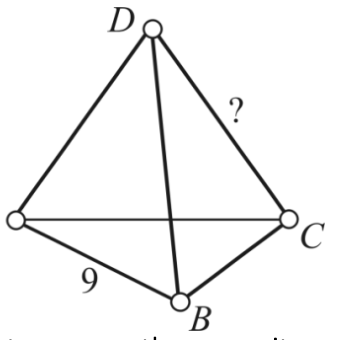
Each of the 4 vertices and 6 edges of a tetrahedron is labelled with one of the numbers 1, 2, 3, 4, 5, 6, 7, 8, 9, 11 (the number 10 is left out), each used exactly once. The number on each edge is the sum of the numbers on the two vertices it connects. The edge AB has the number 9. With which number is the edge CD labelled?
Show answer
Answer: B — 5
Show hints
Hint 1 of 2
Add up all ten labels, and note each vertex value is counted in three edges.
Still stuck? Show hint 2 →
Hint 2 of 2
Find the vertex-sum first; opposite edges (like AB and CD) split that sum.
Show solution
Approach: total counts each vertex three times
The ten labels 1..9 and 11 sum to 56.
Edges sum to 3×(vertex sum) since each vertex sits on 3 edges, so vertex sum + 3×(vertex sum) = 4×(vertex sum) = 56, giving vertex sum 14.
Edges AB and CD together use all four vertices, so (A+B) + (C+D) = 14.
A positive integer N is smaller than the sum of its three biggest proper factors (N itself is not a proper factor of N). Which of the following statements is true?
Show answer
Answer: B — All such numbers N are divisible by 6.
Show hints
Hint 1 of 2
The biggest proper factors of N are N/2, N/3, N/4, ... — write the sum of the top three this way.
Still stuck? Show hint 2 →
Hint 2 of 2
For that sum to exceed N, the small divisors 2 and 3 must both divide N.
Show solution
Approach: express the largest proper factors as N over its smallest divisors
The three biggest proper factors are N divided by its three smallest divisors (other than 1).
Their sum can exceed N only when both 2 and 3 divide N (for example N/2 + N/3 + N/4 = 13N/12 > N).
Counting & ProbabilityLogic & Word Problemscareful-countingcasework
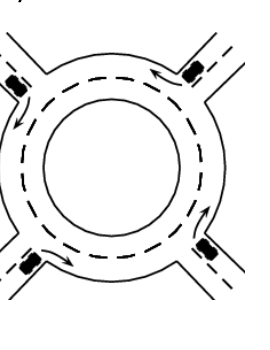
Four cars drive into a roundabout at the same moment, each from a different direction (see diagram). No car drives all the way around the roundabout, and no two cars leave by the same exit. In how many different ways can the cars exit the roundabout?
Show answer
Answer: A — 9
Show hints
Hint 1 of 2
No car exits where it entered (that would be a full loop), and all four exits are different.
Still stuck? Show hint 2 →
Hint 2 of 2
That is exactly a permutation of four things with no item in its own place.
Show solution
Approach: count derangements of 4
Each car must leave by a different exit, and not its own entrance — a permutation with no fixed point.
Five cars enter a roundabout at the same time, one at each of the five entrances. Each car drives less than a full loop and exactly one car leaves at each of the five exits. In how many different ways can the cars leave the roundabout?
Show answer
Answer: B — 44
Show hints
Hint 1 of 2
Each car must leave at a different exit and cannot ride a full lap back to its own entry.
Still stuck? Show hint 2 →
Hint 2 of 2
So no car exits at its own entrance — count arrangements with no fixed point.
Show solution
Approach: count derangements of 5
Label exits by the cars' entry points; a valid assignment sends each car to a different exit, never its own.