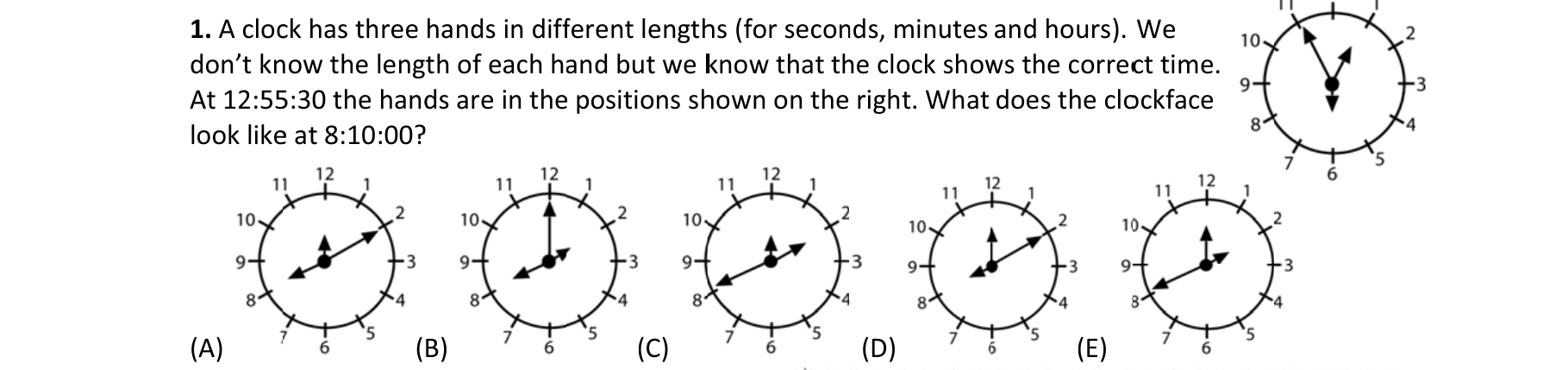
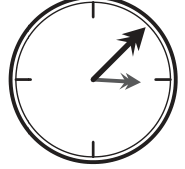
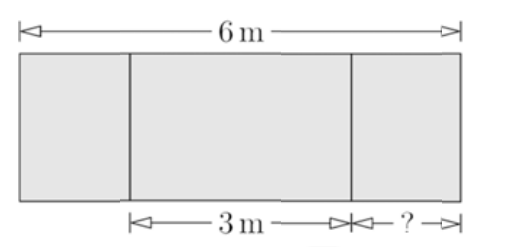
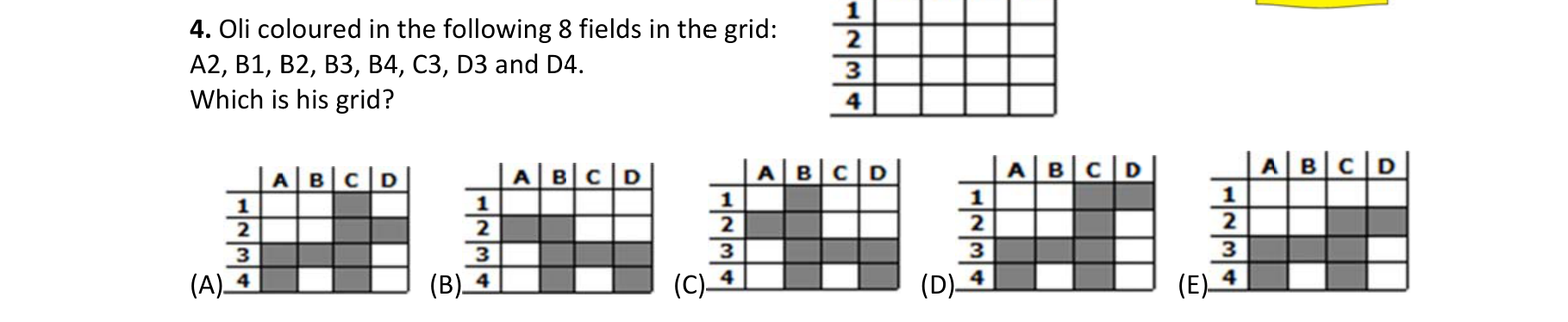
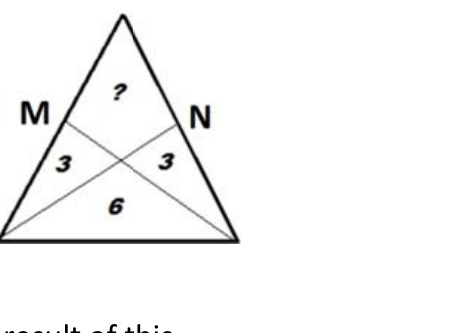
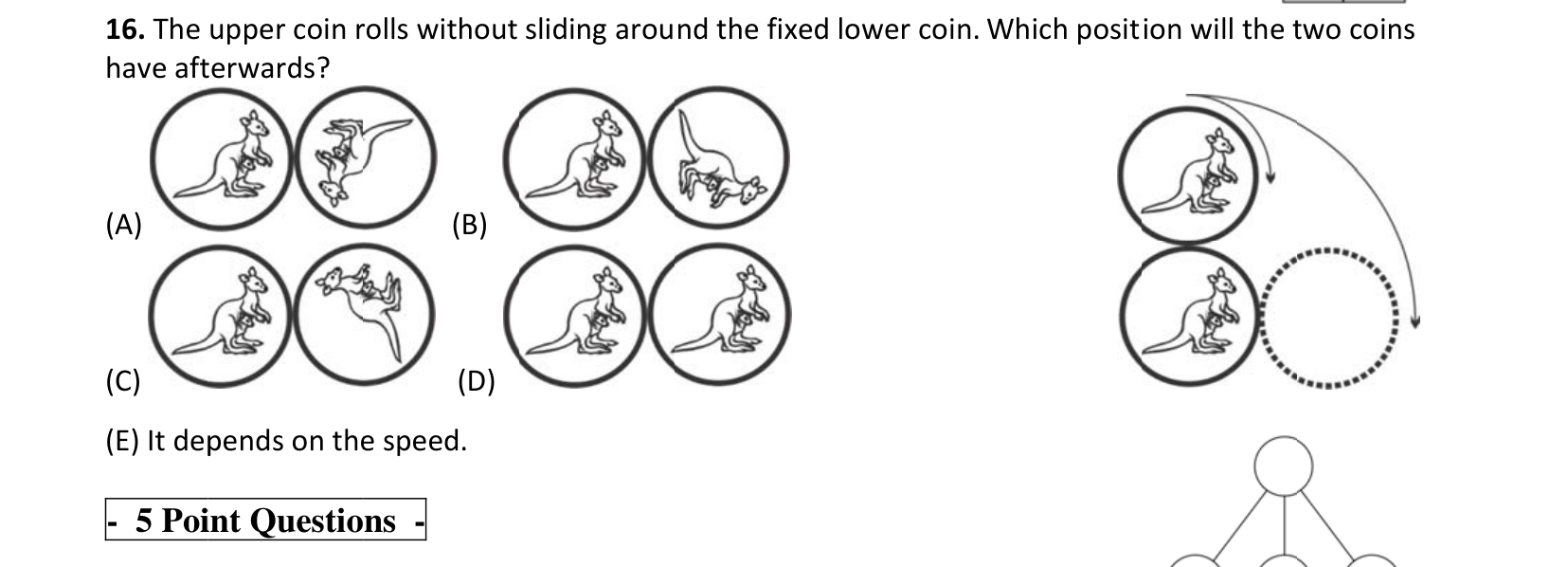
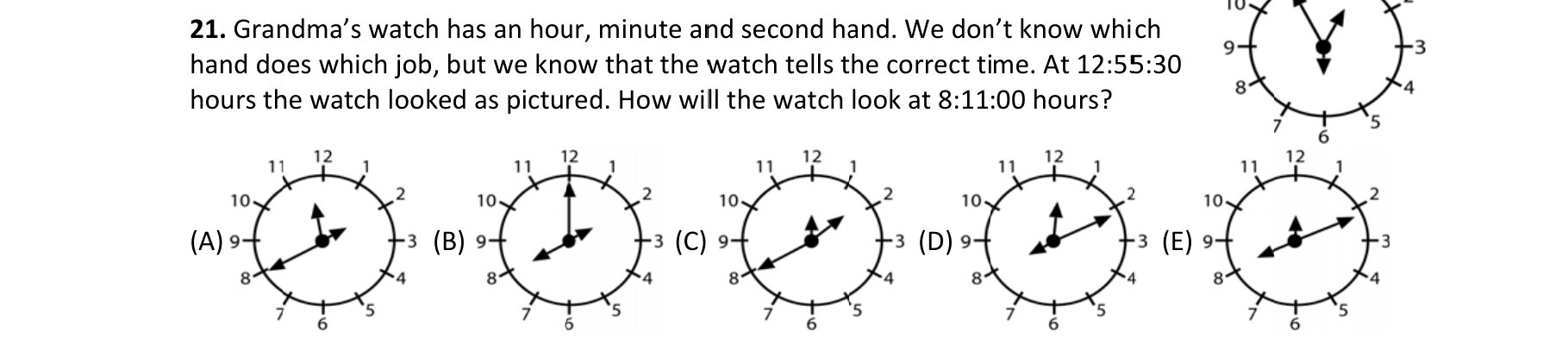
A clock has three hands of different lengths (for seconds, minutes and hours). We don't know the length of each hand, but we know the clock shows the correct time. At 12:55:30 the hands are in the positions shown on the right. What does the clockface look like at 8:10:00?
Show answer
Answer: A
Show hints
Hint 1 of 2
At 8:10:00 the second hand points straight to 12, while the minute hand has barely moved off the top.
Still stuck? Show hint 2 →
Hint 2 of 2
Decide where each of the three hands sits at 8:10:00, then find the picture that shows all three at once.
Show solution
Approach: place each clock hand at 8:10:00 and match the figure
At 8:10:00 the seconds hand is at 0, so it points exactly at 12.
The minute hand sits at 10 minutes, pointing to the 2.
The hour hand is a little past the 8.
Only choice A shows those three directions together.
Barbara wrote “KAENGURUWETTBEWERB” on the blackboard. She used the same colour for equal letters and a different colour for different letters. How many different colours did she use?
Show answer
Answer: D — 10
Show hints
Hint 1 of 2
Same letter means same colour, so count how many different letters appear.
Still stuck? Show hint 2 →
Hint 2 of 2
List the distinct letters in KAENGURUWETTBEWERB and count them.
Show solution
Approach: count distinct letters
Each distinct letter needs its own colour; repeated letters reuse a colour.
The distinct letters are K, A, E, N, G, U, R, W, T, B.
Barbara wrote the word MATHEMATIC on a piece of paper. She used the same colour for letters that are the same, and a different colour for letters that are different. How many different colours did she use?
Show answer
Answer: A — 7
Show hints
Hint 1 of 2
Write out the letters of MATHEMATIC and circle the ones that repeat.
Still stuck? Show hint 2 →
Hint 2 of 2
Count how many different letters appear, not how many letters there are.
Show solution
Approach: count the distinct letters
MATHEMATIC uses the letters M, A, T, H, E, M, A, T, I, C.
The repeats are the second M, the second A and the second T.
The different letters are M, A, T, H, E, I, C — that is 7.
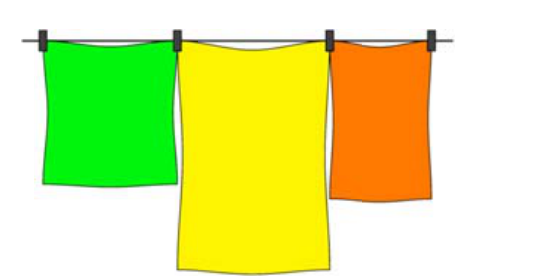
Father hangs towels on the washing line as shown in the picture. For three towels he uses 4 clothes pegs. How many clothes pegs would he use for 5 towels?
Show answer
Answer: C — 6
Show hints
Hint 1 of 2
Draw the towels in a row and mark a peg wherever two towels meet or a row ends.
Still stuck? Show hint 2 →
Hint 2 of 2
Each new towel adds just one extra peg, because neighbours share a peg.
Show solution
Approach: spot the 'one more peg than towels' pattern
Three towels in a row need a peg at each end and one between each pair: 3 towels → 4 pegs.
A wristwatch was laid on a table in such a way that the minute hand pointed northeast. How many minutes must pass before the minute hand is pointing northwest for the first time?
Show answer
Answer: A — 45
Show hints
Hint 1 of 2
The minute hand turns clockwise; mark NE and NW on a compass.
Still stuck? Show hint 2 →
Hint 2 of 2
Going clockwise from NE all the way round to NW is three quarters of a turn.
Show solution
Approach: turn the compass directions into a fraction of a full hour
Northeast and northwest are 90° apart, but the minute hand turns clockwise, so it must swing the long way: NE → SE → SW → NW.
That is 270°, which is three quarters of a full 360° turn.
A full turn of the minute hand takes 60 minutes, so three quarters takes 45 minutes.
A wristwatch lies on the table with its face upwards. The minute hand points towards north-east. How many minutes have to pass for the minute hand to point towards north-west for the first time?
Show answer
Answer: A — 45
Show hints
Hint 1 of 2
A minute hand sweeps the whole clock face in 60 minutes.
Still stuck? Show hint 2 →
Hint 2 of 2
Going clockwise, how much of a full turn takes you from north-east round to north-west?
Show solution
Approach: fraction of a full turn
The minute hand turns clockwise, a full circle (360°) in 60 minutes.
From north-east, turning clockwise, it reaches south, then west, then north-west: that is 270° of the turn.
270° is three-quarters of 360°, so it takes three-quarters of 60 minutes = 45 minutes.
Eva has a pair of scissors and five letters made from cardboard. She cuts up each letter with a single straight cut so that as many pieces as possible are obtained. For which letter does she obtain the most pieces?
Show answer
Answer: E
Show hints
Hint 1 of 2
One straight cut makes more pieces when it crosses the letter's outline more times.
Still stuck? Show hint 2 →
Hint 2 of 2
Picture a single line drawn across each letter and count how many separate parts it leaves.
Show solution
Approach: count crossings of a single line
A single straight cut splits a shape into one more piece for each time the cut crosses the shape.
A wiggly outline like the letter S can be crossed by one straight line in the most places.
Cutting M with one straight line through all four of its strokes leaves the most pieces of the five letters.
The positive whole numbers are being coloured in order, in red, blue and green, i.e. 1 red, 2 blue, 3 green, 4 red, 5 blue, 6 green, and so on. Which colour could the sum of a red number and a blue number be?
Show answer
Answer: C — green only
Show hints
Hint 1 of 2
Red, blue, green repeat every three numbers — look at remainders when dividing by 3.
Still stuck? Show hint 2 →
Hint 2 of 2
Add a 'red' remainder to a 'blue' remainder and see which colour the total lands on.
Show solution
Approach: track the colour by remainder mod 3
Red numbers leave remainder 1, blue leave remainder 2, green leave remainder 0 when divided by 3.
A red plus a blue gives remainder 1+2 = 3, i.e. remainder 0.
Remainder 0 is exactly the green colour, so the sum is always green only.
A dragon has 5 heads. Each time someone chops off one head, 5 new heads grow back. If 6 heads are chopped off one after the other, how many heads does the dragon end up with?
Show answer
Answer: C — 29
Show hints
Hint 1 of 2
Each chop removes one head but adds five, so track the net change.
Still stuck? Show hint 2 →
Hint 2 of 2
What is the net change in the number of heads per chop?
Show solution
Approach: net change per step
Each chop removes 1 head and grows 5, a net gain of 4 heads.
In a list of five numbers the first number is 2 and the last one is 12. The product of the first three numbers is 30, of the middle three 90 and of the last three 360. What is the middle number in that list?
Show answer
Answer: C — 5
Show hints
Hint 1 of 2
The first three multiply to 30 and the first number is 2, so you know the product of numbers 2 and 3.
Still stuck? Show hint 2 →
Hint 2 of 2
Use the last-three product and the known last number to pin down number 4, then chain back.
Show solution
Approach: peel products from both ends
Label the list \(a,b,c,d,e\) with \(a=2\) and \(e=12\). Since \(abc=30\), we get \(bc = 15\).
From \(bcd=90\): \(d = \frac{90}{bc} = \frac{90}{15} = 6\); and \(cde=360\) gives \(cd = \frac{360}{12} = 30\).
Then \(c = \frac{cd}{d} = \frac{30}{6} = 5\), so the middle number is \(5\), choice C.
The number 3 should be added to the number 6. This amount is then doubled, and the result is increased by 1. Which of the following sums fits this description?
Show answer
Answer: D — \((6 + 3) \times 2 + 1\)
Show hints
Hint 1 of 2
Translate the words step by step into an expression.
Still stuck? Show hint 2 →
Hint 2 of 2
'This amount is then doubled' means multiply the whole sum (6+3) by 2 first.
Show solution
Approach: translate words to an expression
'Add 3 to 6' gives (6 + 3).
'This amount is doubled' gives (6 + 3) x 2.
'the result increased by 1' gives (6 + 3) x 2 + 1, which is choice D.
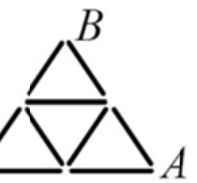
Each of the nine paths in a park is 100 m long. Anna wants to walk from A to B without using the same path twice. How long is the longest path she can choose?
Show answer
Answer: C — 700 m
Show hints
Hint 1 of 3
Try to walk along as many paths as you can without repeating one.
Still stuck? Show hint 2 →
Hint 2 of 3
Count how many paths meet at each junction — a route can pass straight through a junction only if an even number of paths meet there.
Still stuck? Show hint 3 →
Hint 3 of 3
Anna's start A and finish B are different corners, so she can't end where she began — check whether using all paths is even possible.
Show solution
Approach: count odd junctions (Euler trail)
Each junction needs paths to enter and leave in pairs; only the start and the finish are allowed to have an odd number of paths meeting them.
In this triforce network every one of the six junctions has an even number of paths (the three corners have 2 each, the three midpoints have 4 each), so a single route cannot start at corner A and end at the different corner B while using all 9 paths.
Leaving out the side that joins A to B (its two 100 m pieces) makes A and B the only odd junctions, and then all 7 remaining paths can be walked in one go.
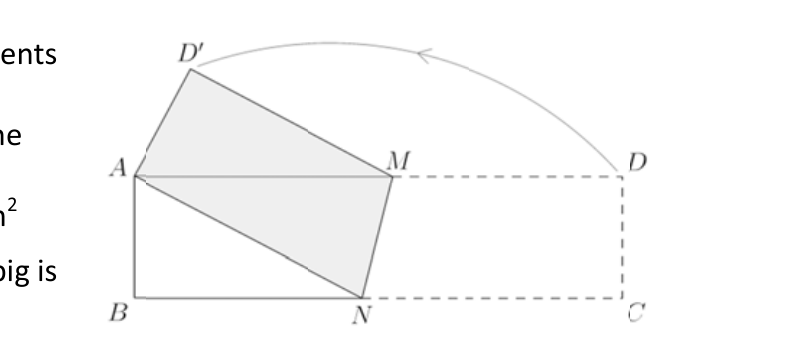
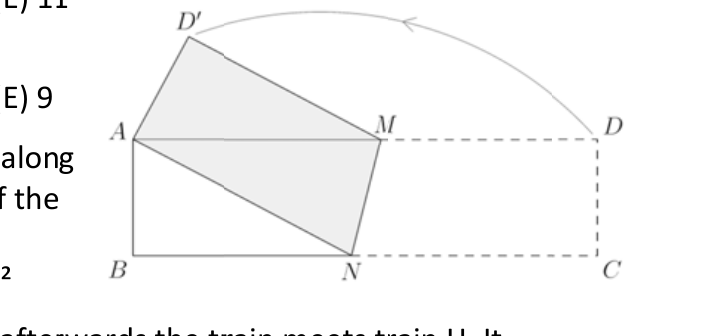
A rectangular piece of paper ABCD with the measurements 4 cm × 16 cm is folded along the line MN so that point C coincides with point A as shown. How big is the area of the quadrilateral ANMD′?
Show answer
Answer: C — 32 cm²
Show hints
Hint 1 of 2
The fold sends C onto A, so the crease MN reflects one part of the paper exactly onto the other.
Still stuck? Show hint 2 →
Hint 2 of 2
The quadrilateral ANMD' is the mirror image of region MNCD, so it has the same area.
Show solution
Approach: folding preserves area; find the reflected region
Folding along MN reflects corner C onto A, mapping region MNCD onto quadrilateral ANMD'.
Placing B=(0,0), C=(16,0), the equal-distance conditions give N=(7.5,0) on BC and M=(8.5,4) on AD.
Region MNCD is a trapezoid with parallel sides 7.5 and 8.5 and height 4, area (7.5+8.5)/2·4 = 32.
In the school for animals there are 3 cats, 2 ducks, 2 sheep and some dogs. The teacher counted the legs of all the animals and got 44. How many dogs go to the school?
Show answer
Answer: B — 5
Show hints
Hint 1 of 2
Count the legs you already know from the cats, ducks and sheep.
Still stuck? Show hint 2 →
Hint 2 of 2
Subtract those legs from 44, then see how many 4-legged dogs are left.
Show solution
Approach: account for known legs, then divide
Cats: 3 x 4 = 12 legs. Sheep: 2 x 4 = 8 legs. Ducks: 2 x 2 = 4 legs.
Known legs = 12 + 8 + 4 = 24.
Dog legs = 44 - 24 = 20, and each dog has 4 legs, so 20 / 4 = 5 dogs.
On the 24th of February 2012 Grandfather's chicks hatched. There are 29 days in February in 2012. How old are the chicks today, on the 15th of March 2012?
Show answer
Answer: D — 20 days
Show hints
Hint 1 of 2
Count the days from 24 February up to 15 March, using that February has 29 days.
Still stuck? Show hint 2 →
Hint 2 of 2
Find how many days from the 24th to the end of February, then add the March days.
ABC is a right-angled triangle with shorter sides 6 cm and 8 cm. K, L, M are the midpoints of the sides of triangle ABC. What is the perimeter of triangle KLM?
Show answer
Answer: B — 12 cm
Show hints
Hint 1 of 2
First find the third side of the 6–8 right triangle.
Still stuck? Show hint 2 →
Hint 2 of 2
The triangle joining the midpoints has sides exactly half of the original.
Show solution
Approach: medial triangle has half the perimeter
The right triangle has legs 6 and 8, so its hypotenuse is 10 and its perimeter is 24.
Joining the midpoints of the sides makes the medial triangle, whose sides are half as long.
So its perimeter is half of 24, which is 12 cm (B).
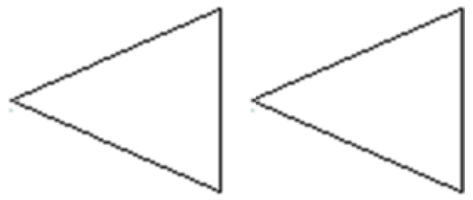
One vertex of the triangle on the left is connected to one vertex of the triangle on the right using a straight line so that no connecting line segment dissects either of the two triangles into two parts. In how many ways is this possible?
Show answer
Answer: D — 4
Show hints
Hint 1 of 2
Try joining each corner of the left triangle to each corner of the right triangle.
Still stuck? Show hint 2 →
Hint 2 of 2
Keep only the joins whose straight segment stays outside both triangles.
Show solution
Approach: test each vertex pairing
There are 3 × 3 = 9 ways to pick one corner from each triangle and join them with a straight segment.
A join is allowed only when the segment does not pass through the inside of either triangle.
Checking the pairings, exactly 4 of the connecting segments avoid both triangles' interiors.
The last row in an aeroplane is row 25. There is no row 13, and row 15 has only 4 seats. Every other row has 6 seats. How many passenger seats are there on this aeroplane?
Show answer
Answer: C — 142
Show hints
Hint 1 of 2
First count how many rows actually exist (watch out for the missing row 13).
Still stuck? Show hint 2 →
Hint 2 of 2
Most rows have 6 seats; only row 15 is different, so adjust for it.
Show solution
Approach: count rows, then adjust the odd one out
Rows are numbered 1 to 25 but row 13 is missing, so there are 24 rows.
If every row had 6 seats that would be 24 x 6 = 144.
Row 15 has only 4 instead of 6, which is 2 fewer, so 144 - 2 = 142 seats.
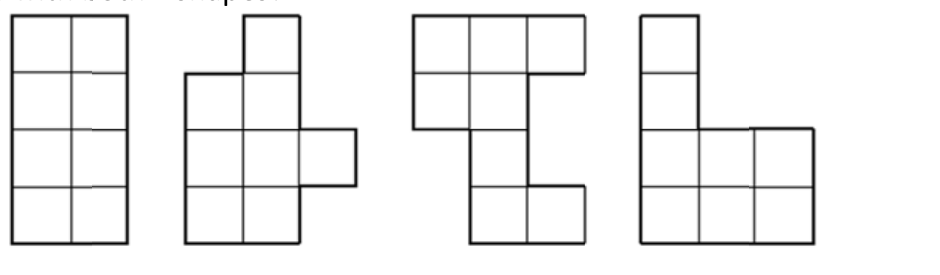
Werner folds a piece of paper once in the middle as shown. With a pair of scissors he makes two straight cuts into the folded paper, then unfolds it again. Which of the following shapes is not possible for the piece of paper to show afterwards?
Show answer
Answer: D
Show hints
Hint 1 of 3
After unfolding, the cut-out pattern must be mirror-symmetric about the fold line.
Still stuck? Show hint 2 →
Hint 2 of 3
Each straight cut on the doubled paper unfolds into a symmetric pair, so two cuts can make only a limited number of corners.
Still stuck? Show hint 3 →
Hint 3 of 3
Count how many separate notches or corners each shape needs and compare it to what just two straight cuts can produce.
Show solution
Approach: count the cuts each shape needs
Folding once makes two layers, so each straight cut goes through both layers and unfolds into a pair of cuts that are mirror images across the fold.
Two straight cuts can therefore create at most two such symmetric features — enough to make the single notch of A, the central hole of B, the trimmed corners of C, and the symmetric notch of E.
Shape D has several separate zig-zag notches, more than two straight cuts can produce, so it is the one that is not possible.
In addition to the weight of the basket, a single balloon can lift 80 kg. Two balloons can lift 180 kg in addition to the weight of the basket. How heavy is the basket?
Show answer
Answer: E — 20 kg
Show hints
Hint 1 of 2
Adding a second balloon adds another 80 kg of lift; compare the two situations.
Still stuck? Show hint 2 →
Hint 2 of 2
Find the basket weight by seeing how the totals jump from one balloon to two.
Show solution
Approach: compare one balloon vs two balloons
Let the basket weigh b and one balloon's own lift be L. One balloon: L - b = 80.
Two balloons: 2L - b = 180. Subtracting the first from the second gives L = 100.
Then b = L - 80 = 100 - 80 = 20 kg. Check: 2(100) - 20 = 180.
Alice and Bob send each other secret messages. To put their messages into code they use the following system: First each letter is given a number in order: A = 1, B = 2, C = 3, … Z = 26. Then the letter number is doubled and 9 is added. Bob received a message which began 19 – 37 – 48 – 19 – … Which of the following messages had Alice sent to Bob?
Show answer
Answer: E — Alice has made a mistake
Show hints
Hint 1 of 2
Undo the rule: from a received number, subtract 9 then halve to get the letter number.
Still stuck? Show hint 2 →
Hint 2 of 2
Check whether every received number actually gives a whole letter number.
Show solution
Approach: invert the encoding and test for validity
The rule sends a letter number n to 2n + 9, so to decode you compute (received − 9) / 2.
19 → 5 = E and 37 → 14 = N, but 48 → (48 − 9)/2 = 19.5, which is not a whole number.
Since 48 cannot come from any letter, the message could not have been encoded correctly.
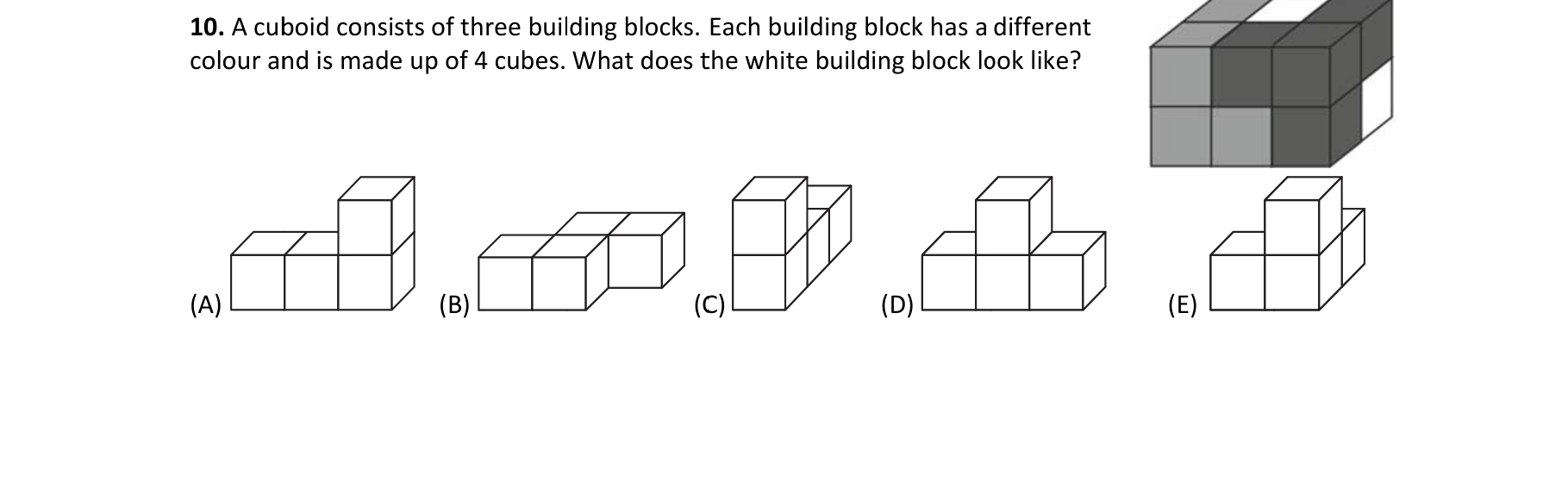
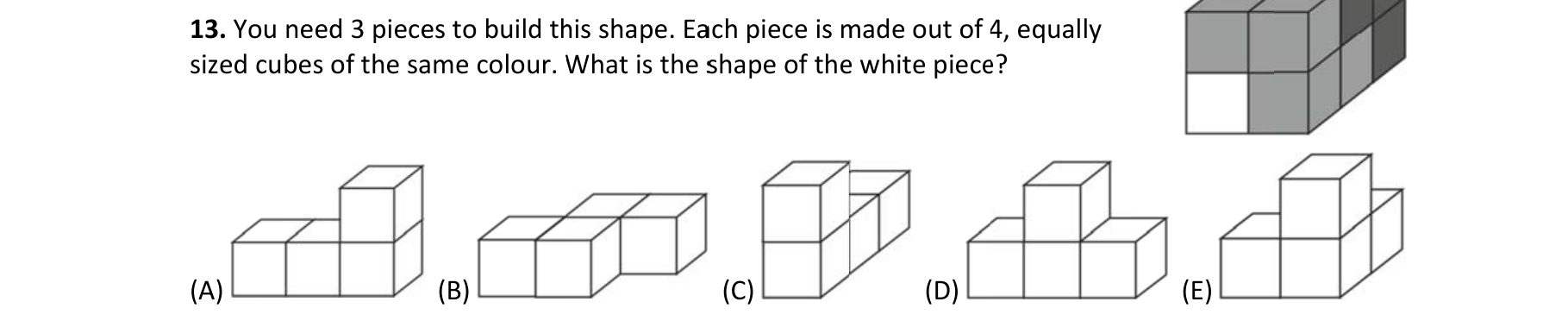
A cuboid is built from three building blocks. Each building block has a different colour and is made up of 4 cubes. What does the white building block look like?
Show answer
Answer: D
Show hints
Hint 1 of 3
The cuboid is 2 × 2 × 3 (12 cubes), split into three blocks of 4 cubes each.
Still stuck? Show hint 2 →
Hint 2 of 3
Find every white cube — two are visible (one on the top, one on the right face); the other two are hidden inside.
Still stuck? Show hint 3 →
Hint 3 of 3
Once you know all four white positions, picture how those four cubes connect into one solid block.
Show solution
Approach: locate the white cubes and read their shape
The full cuboid holds 12 unit cubes shared by three blocks of 4 cubes each, so the grey and dark-grey blocks fill 8 cubes and the white block fills the remaining 4.
Tracking the white cubes through the picture, three of them lie in a row along the bottom and the fourth sits on top of the middle of that row.
The age of Quintus is a two-digit power of five and the age of Sekundus is a two-digit power of two. If one adds the digits of their ages the total obtained is an odd number. How big is the product of the digits of their ages?
Show answer
Answer: A — 240
Show hints
Hint 1 of 2
A two-digit power of 5 is forced; list the two-digit powers of 2.
Still stuck? Show hint 2 →
Hint 2 of 2
Use the 'sum of all digits is odd' clue to pick the right power of 2, then multiply the four digits.
Show solution
Approach: pin the ages from the power and parity clues
The only two-digit power of 5 is \(25\) (digits 2 and 5, summing to 7).
Two-digit powers of 2 are \(16, 32, 64\), with digit sums \(7, 5, 10\).
Adding each to 7 gives \(14, 12, 17\) — only \(64\) makes the total odd (\(17\)).
So the four digits are \(2,5,6,4\) and their product is \(2\cdot5\cdot6\cdot4 = 240\), choice A.
Grandmother gave Vivian and Mike some apples and pears. In total they had 25 pieces of fruit. On the way home Vivian ate 1 apple and 3 pears, and Mike ate 3 apples and 2 pears. At home they noticed that there were exactly the same number of apples and pears left in the basket. How many pears had Grandmother given them?
Show answer
Answer: B — 13
Show hints
Hint 1 of 2
Work out how many apples and pears were eaten in total.
Still stuck? Show hint 2 →
Hint 2 of 2
After eating, the basket has equal apples and pears; build back up to the pears given.
Show solution
Approach: track what was eaten, then use the equal-leftover clue
Eaten: Vivian 1 apple + 3 pears, Mike 3 apples + 2 pears, so 4 apples and 5 pears eaten (9 pieces).
Left in the basket: 25 - 9 = 16 pieces, split equally, so 8 apples and 8 pears.
Total pears = pears left + pears eaten = 8 + 5 = 13.
Grandmother baked 20 ginger biscuits for her grandchildren. She decorated them with raisins and nuts. First she decorated 15 with raisins, and then 15 with nuts. No biscuit was left plain. How many biscuits were decorated with both raisins and nuts?
Show answer
Answer: E — 10
Show hints
Hint 1 of 2
Adding the raisin biscuits and the nut biscuits double-counts the ones with both.
Still stuck? Show hint 2 →
Hint 2 of 2
The overlap is (15 + 15) - 20.
Show solution
Approach: overlap of two groups
15 biscuits got raisins and 15 got nuts, a total of 15 + 15 = 30 'decorations'.
But there are only 20 biscuits and none was left plain, so the extra 30 - 20 = 10 decorations come from biscuits counted twice.
In four of the following calculations you can swap the number 8 with another positive number without changing the answer to the sum. For which calculation does it not work?
Show answer
Answer: D — \(8 - (8 \div 8) + 8\)
Show hints
Hint 1 of 2
Try replacing every 8 by the same other number and see if the value changes.
Still stuck? Show hint 2 →
Hint 2 of 2
Four expressions simplify so the number cancels out; one does not.
Show solution
Approach: replace 8 by a variable and see which value depends on it
Replace each 8 by the same number x and simplify each expression.
(8+8−8)÷8 becomes x÷x = 1; 8+(8÷8)−8 becomes 1; 8÷(8+8+8) becomes 1/3; 8×(8÷8)÷8 becomes 1 — all independent of x.
But 8−(8÷8)+8 becomes 2x−1, which changes when x changes.
From the digits 1, 2, 3, 4, 5, 6, 7, 8 we form two four-digit numbers so that every digit is used exactly once and the sum of the two numbers is as small as possible. What is the value of this sum?
Show answer
Answer: C — 3825
Show hints
Hint 1 of 2
The two thousands-digits matter most for the size of the sum.
Still stuck? Show hint 2 →
Hint 2 of 2
Put the smallest available digits in the highest place values of both numbers.
Show solution
Approach: smallest digits in the biggest places
To make the sum small, give the two thousands places the smallest digits (1 and 2), the hundreds places 3 and 4, the tens 5 and 6, the units 7 and 8.
In the school for animals there are 3 cats, 2 ducks, 2 sheep and some dogs. The teacher counted the legs of all the animals and got 44. How many dogs go to the school?
Show answer
Answer: B — 5
Show hints
Hint 1 of 2
Count the legs of the cats, ducks and sheep first.
Still stuck? Show hint 2 →
Hint 2 of 2
Subtract those legs from 44, then divide what is left by 4 for the dogs.
Show solution
Approach: subtract known legs, then divide
3 cats have 12 legs, 2 ducks have 4 legs, 2 sheep have 8 legs: 12 + 4 + 8 = 24 legs.
The dogs account for 44 - 24 = 20 legs.
Each dog has 4 legs, so there are 20 / 4 = 5 dogs.
When Adam stands on a table and Mike on the floor, Adam is 80 cm taller than Mike. When Mike stands on the table and Adam on the floor, Mike is one metre taller than Adam. How high is the table?
Show answer
Answer: C — 90 cm
Show hints
Hint 1 of 2
Write the two situations as equations using Adam's height, Mike's height, and the table.
Still stuck? Show hint 2 →
Hint 2 of 2
Add the two equations — the heights cancel and leave twice the table height.
Show solution
Approach: set up two equations and add them
With Adam on the table: (Adam + table) − Mike = 80.
With Mike on the table: (Mike + table) − Adam = 100.
Add the two equations: the heights cancel, giving 2 × table = 180, so the table is 90 cm (C).
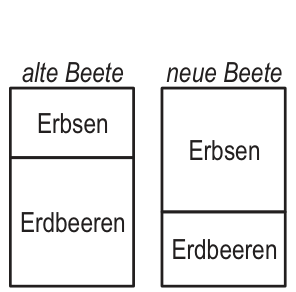
Ms. Green plants peas (“Erbsen”) and strawberries (“Erdbeeren”) only in her garden. This year she has changed her pea-bed into a square-shaped bed by increasing one side by 3 m. By doing this her strawberry-bed became 15 m² smaller. What area did the pea-bed have before? (In the picture, “alte Beete” means the old beds and “neue Beete” the new beds.)
Show answer
Answer: C — 10 m²
Show hints
Hint 1 of 2
Increasing one side by 3 m turned the rectangular pea-bed into a square.
Still stuck? Show hint 2 →
Hint 2 of 2
The 15 m² taken from the strawberries is the strip that was added — use it to find the square's side.
Show solution
Approach: set up the added strip
Let the square pea-bed have side s; before, the pea-bed was (s−3) by s, since one side grew by 3.
The added strip has area 3 × s and equals the 15 m² lost by the strawberries, so 3s = 15, giving s = 5.
The original pea-bed area was (s−3) × s = 2 × 5 = 10 m².
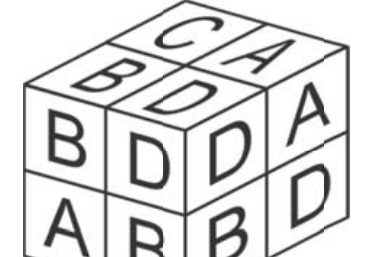
Lisa built a large cube out of 8 smaller ones. The small cubes have the same letter on each of their faces (A, B, C or D). Two cubes with a common face always have a different letter on them. Which letter is on the cube that cannot be seen in the picture?
Show answer
Answer: B — B
Show hints
Hint 1 of 3
There are 8 little cubes but only 4 letters, and every cube touches three neighbours that must all differ from it.
Still stuck? Show hint 2 →
Hint 2 of 3
Two cubes can share a letter only if they do NOT touch, i.e. they sit at opposite ends of a long diagonal through the centre.
Still stuck? Show hint 3 →
Hint 3 of 3
The hidden cube is the corner diagonally opposite a visible one, so it copies that cube's letter.
Show solution
Approach: opposite corners share a letter
Each small cube touches 3 others (one in each direction), and touching cubes must differ, so a cube and its 3 neighbours use up all 4 letters A, B, C, D.
That means a letter can repeat only on two cubes that never touch, namely the two ends of a diagonal running through the centre of the big cube.
So each of the 4 space-diagonals carries one repeated letter, pairing every cube with the corner diagonally across from it.
The unseen back corner is diagonally opposite a visible corner, and matching their letter gives the hidden one: B.
Barbara wants to complete the grid shown on the right by inserting three numbers into the empty spaces. The sum of the first three numbers should be 100, the sum of the middle three numbers 200 and the sum of the last three numbers 300. Which is the middle number in this grid?
10
130
Show answer
Answer: B — 60
Show hints
Hint 1 of 2
Write the five numbers as 10, then three unknowns, then 130.
Still stuck? Show hint 2 →
Hint 2 of 2
Use the overlapping sums of three to peel off one number at a time.
Show solution
Approach: overlapping sums
Call the row 10, a, b, c, 130 with 10+a+b = 100, a+b+c = 200, b+c+130 = 300.
From 10+a+b=100: a+b = 90. From b+c+130=300: b+c = 170.
Then a+b+c = 200 gives c = 200−90 = 110, and b = 170−110 = 60.
A travel agency organises four different trips for a certain group. Each trip has a participation rate of 80%. What is the minimum percentage of the group which has taken part in all four roundtrips?
Show answer
Answer: D — 20 %
Show hints
Hint 1 of 2
Count who could MISS a trip rather than who takes it.
Still stuck? Show hint 2 →
Hint 2 of 2
Spread the 20% who skip each trip over different people to make the all-four group as small as possible.
Show solution
Approach: bound the overlap using the missers
Each trip is skipped by 20% of the group.
Across four trips at most 4×20% = 80% skip at least one trip.
So at least 100% − 80% = 20% took part in all four.
The natural numbers are to be painted: 1 is red, 2 is blue, 3 is green, 4 is red, 5 is blue, 6 is green, and so on. Which colour(s) can the sum of a red number and a blue number have?
Show answer
Answer: A — green only
Show hints
Hint 1 of 2
The colours repeat every three numbers: red, blue, green, red, blue, green...
Still stuck? Show hint 2 →
Hint 2 of 2
Think about the remainders when red and blue numbers are divided by 3, then add them.
Show solution
Approach: use remainders mod 3
Red numbers are 1, 4, 7, ... (remainder 1 when divided by 3); blue are 2, 5, 8, ... (remainder 2).
A red plus a blue number has remainder 1 + 2 = 3, that is remainder 0 (a multiple of 3).
Multiples of 3 (3, 6, 9, ...) are exactly the green numbers, so the sum is always green only.
15 tables were set for a party. 5 plates were laid on 6 of the tables. 3 plates were laid on the rest of the tables. How many plates were needed in total?
Show answer
Answer: C — 57
Show hints
Hint 1 of 2
Find how many tables get 3 plates after 6 tables get 5 plates.
Still stuck? Show hint 2 →
Hint 2 of 2
Work out each group's plates and add them.
Show solution
Approach: split into two groups of tables
6 tables get 5 plates each: 6 x 5 = 30 plates.
The other 15 - 6 = 9 tables get 3 plates each: 9 x 3 = 27 plates.
Tom and Mary play a game with a coin. When the coin shows heads, Mary wins and Tom must give her two sweets. When the coin shows tails Tom wins and Mary must give him three sweets. After 30 throws of the coin they each have the same number of sweets as they had at the start of the game. How often has Tom won?
Show answer
Answer: B — 12
Show hints
Hint 1 of 2
Let h be heads and t tails; the totals must end where they started.
Still stuck? Show hint 2 →
Hint 2 of 2
Tom's net change is −2 per head and +3 per tail, and it must be zero.
Show solution
Approach: set net change to zero with a fixed number of throws
In 30 throws let h be heads (Mary wins, Tom loses 2) and t tails (Tom wins 3), with h + t = 30.
For the counts to return to the start, Tom's net is 0: −2h + 3t = 0, i.e. 2h = 3t.
Solving with h + t = 30 gives h = 18, t = 12, so Tom won (the tails) 12 times (B).
For a ski race consecutive starting numbers are handed out. One number was accidentally given out twice. The sum of all the numbers handed out is 857. Which number was given out twice?
Show answer
Answer: D — 37
Show hints
Hint 1 of 2
First add up 1+2+…+n and see which n lands just below 857.
Still stuck? Show hint 2 →
Hint 2 of 2
The leftover above that triangular number is the repeated starting number.
Show solution
Approach: match a triangular number, then read the extra
If the numbers run \(1\) to \(n\), their sum is \(\frac{n(n+1)}{2}\) and the repeated number adds a little extra.
\(1+\cdots+40 = 820\), and \(857 - 820 = 37\), which is a valid number between 1 and 40 (while \(1+\cdots+41 = 861\) is already too big).
A flea stands on the floor and wants to climb the 10 steps. Each time it can either jump 3 steps up or jump 4 steps down. What is the smallest number of jumps it must make?
Show answer
Answer: E — 8
Show hints
Hint 1 of 2
Each up-jump moves him 3 steps, so just adding up-jumps lands on 3, 6, 9, 12, ... — never exactly 10.
Still stuck? Show hint 2 →
Hint 2 of 2
To fix that miss, mix in a down-jump of 4 and count how many jumps that takes.
Show solution
Approach: skip-count the up-jumps, then patch with a down-jump
Only going up, the flea lands on 3, 6, 9, 12, 15, 18, ... — he hops right over 10 and never lands on it.
So he must overshoot and then drop down 4: from 12 a down-jump lands on 8, and from 18 a down-jump lands on 14, still not 10.
Try going higher: 6 up-jumps reach step 18, then 2 down-jumps of 4 take him 18 → 14 → 10, landing exactly on 10.
That is 6 + 2 = 8 jumps, and nothing shorter ever lands on 10, so the fewest jumps is 8.
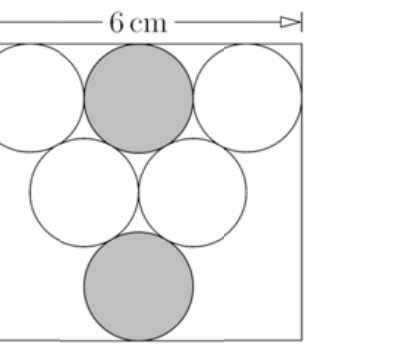
One of the two sides of a rectangle has length 6 cm. In the rectangle circles are drawn next to each other in such a way that their centres form an equilateral triangle. What is the shortest distance between the two grey circles (in cm)?
Show answer
Answer: C — \(2\sqrt{3} - 2\)
Show hints
Hint 1 of 2
Three equal circles span the 6 cm side, so each has diameter 2 and radius 1.
Still stuck? Show hint 2 →
Hint 2 of 2
Equal touching circles have centres 2 apart; stack the equilateral rows to find the two grey centres.
Show solution
Approach: locate the grey centres, then subtract the two radii
Three touching circles fill the 6 cm width, so each diameter is 2 and each radius is 1.
Centres of touching circles are 2 apart and form equilateral triangles, so going down two rows the centres drop by 2 × √3 = 2√3 vertically.
The two grey circles' centres are 2√3 apart; subtract the two radii (1 + 1 = 2) to get the gap.
Take four cards and on each one write one of the numbers 2, 5, 7, 12. On the back of each card write one of the following properties: “divisible by 7”, “prime number”, “odd”, “greater than 100” so that the number on the other side does not have this property. Every number and every property is used exactly once. Which number is on the card with the property “greater than 100”?
Show answer
Answer: C — 7
Show hints
Hint 1 of 3
The property written on a card must be FALSE for the number on that card.
Still stuck? Show hint 2 →
Hint 2 of 3
Pin down the forced pairings first: which number can sit with 'prime'?
Still stuck? Show hint 3 →
Hint 3 of 3
Match the most restrictive properties one at a time and see which number is left for 'greater than 100'.
Show solution
Approach: forced matching
Each card's stated property must be false for its own number; the numbers are 2, 5, 7, 12.
'Prime' must go on the only non-prime, 12; 'odd' must go on an even number, and with 12 used that leaves 2.
'Divisible by 7' must go on a non-multiple of 7, so not 7; only 5 remains for it, leaving 'greater than 100' for the last number 7.
In one class a test did not yield a very successful result because the average mark was exactly 4. The boys have done slightly better with an average mark of 3.6, while the girls have received an average mark of 4.2. Which of the following statements is correct?
Show answer
Answer: C — There are twice as many girls as boys.
Show hints
Hint 1 of 2
Write the total of all marks two ways: as 4×(everyone) and as boys' total plus girls' total.
Still stuck? Show hint 2 →
Hint 2 of 2
Set them equal and the ratio of boys to girls drops out.
Show solution
Approach: balance the weighted average
With \(b\) boys and \(g\) girls, the total of all marks is \(3.6b + 4.2g\) and also \(4(b+g)\).
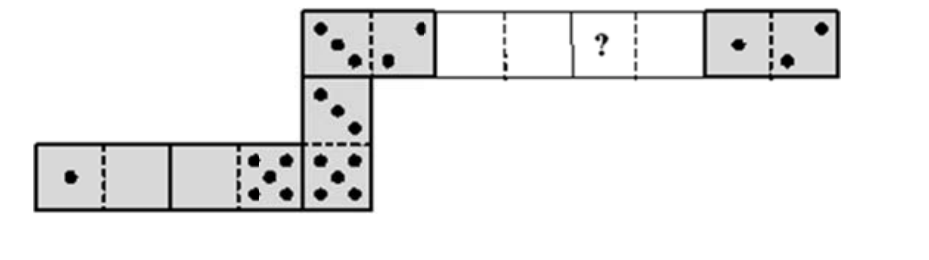
Frank laid out his dominoes as shown in the picture. (Dominoes that touch must always show the same number of points.) Before his brother George removed two dominoes, there were 33 points altogether. How many points is the question mark worth?
Show answer
Answer: C — 4
Show hints
Hint 1 of 2
Touching halves must match, so equal numbers run along where dominoes meet.
Still stuck? Show hint 2 →
Hint 2 of 2
Use that the whole chain held 33 points to pin down the hidden half.
Show solution
Approach: use matching ends and the total of 33
Where two dominoes touch the pips are equal, which fixes most of the hidden values along the chain.
Adding all the visible pips and using that the full set held 33 points leaves the question-mark half determined.
Carrying out that bookkeeping gives the missing value.
On each of the four walls in Billy's room hangs a correctly working clock, but each one runs either behind or ahead of the correct time. The first clock is incorrect by 2 minutes, the second by 3 minutes, the third by 4 minutes and the fourth by 5 minutes. Billy wants to know what time it is and sees the following times: 6 minutes to 3, 3 minutes to three, 2 minutes past three and 3 minutes past 3. What is the actual time?
Show answer
Answer: D — 2:59
Show hints
Hint 1 of 2
Write each shown time as minutes before/after 3:00, and the errors are 2, 3, 4, 5.
Still stuck? Show hint 2 →
Hint 2 of 2
Find one true time so the four gaps to the shown times are exactly 2, 3, 4, 5.
Show solution
Approach: match the shown times to the four error sizes
The shown times are 6 to 3, 3 to 3, 2 past 3, 3 past 3, i.e. −6, −3, +2, +3 minutes from 3:00.
Try the true time 2:59 (one minute before 3:00): the gaps become 5, 2, 3, 4 minutes.
Those are exactly the four errors 2, 3, 4 and 5, each used once, so the true time is 2:59 (D).
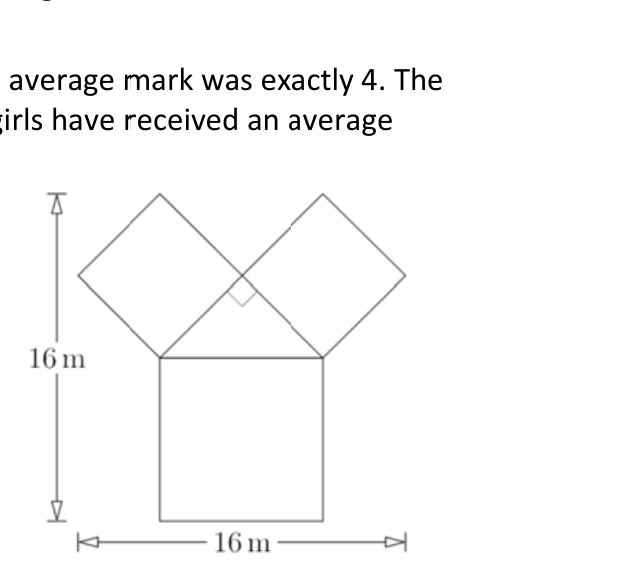
In the diagram we see a rose bed. White roses are growing in the squares that are equally big, red ones are in the big square and yellow ones in the right-angled triangle. The bed has width and height 16 m. How big is the area of the bed?
Show answer
Answer: C — 144 m²
Show hints
Hint 1 of 2
The triangle is an isosceles right triangle (its two leg-squares are equal), with the big red square sitting on its hypotenuse.
Still stuck? Show hint 2 →
Hint 2 of 2
Let the red square have side \(d\); then express the whole figure's width and height in terms of \(d\) and use that both equal 16.
Show solution
Approach: express everything through the hypotenuse-square side d
Let the red square (on the hypotenuse) have side \(d\). The right angle sits at the top apex, so the two equal legs have length \(\frac{d}{\sqrt{2}}\), and each white square has side \(\frac{d}{\sqrt{2}}\).
The two white squares fan out left and right, making the figure \(2d\) wide; stacked on the red square they reach height \(2d\). So \(2d = 16\), giving \(d = 8\).
Add the pieces: red square \(d^2 = 64\), two white squares \(2\cdot\frac{d^2}{2} = 64\), and the yellow triangle \(\frac{1}{2}\left(\frac{d}{\sqrt2}\right)^2 = \frac{d^2}{4} = 16\).
Total \(= 64 + 64 + 16 = 144\;\text{m}^2\), choice C.
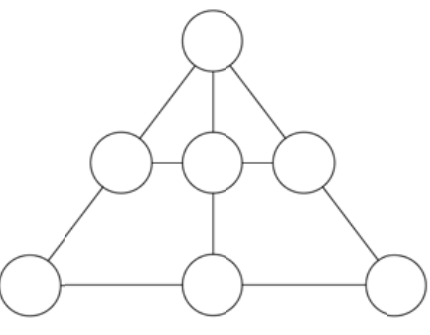
The numbers 1 to 7 should be written in the small circles so that the sum of the numbers along each line is the same. Which number should be written in the uppermost circle on the triangle?
Show answer
Answer: C — 4
Show hints
Hint 1 of 3
First add up all the numbers you must place: 1 + 2 + ... + 7.
Still stuck? Show hint 2 →
Hint 2 of 3
The three corner circles each sit on two lines, so they get counted twice when you add the three line-sums together.
Still stuck? Show hint 3 →
Hint 3 of 3
Try giving the lines the smallest equal sum that works, and see which number is forced into the top circle.
Show solution
Approach: balance the three equal line-sums
The seven numbers 1 to 7 add up to 28.
Add the three line-totals together: every circle is counted, but the three corner circles each lie on two lines, so they get counted one extra time; the grand total is 28 plus the three corner numbers.
For the three lines to share one equal sum, that grand total must split evenly by 3, and trying the natural balanced arrangement makes each line add to 10.
Filling that in, the only number that lands in the top circle is 4 (choice C).
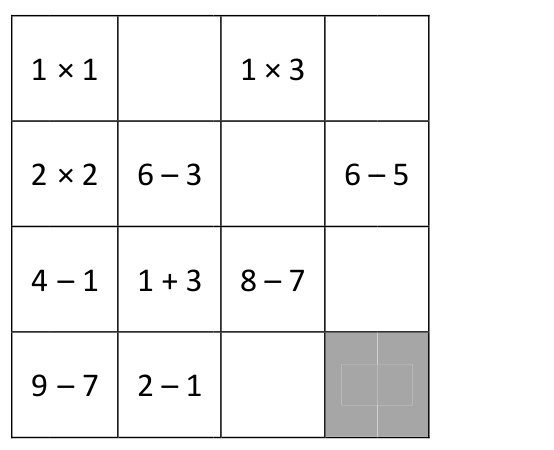
In an arithmetic-sudoku, the values 1, 2, 3, 4 each appear exactly once in every row and every column. (First work out the value written in each cell.) Which value belongs in the grey square?
Show answer
Answer: C — 3
Show hints
Hint 1 of 2
First work out the number in each cell from its little sum, then it is a 4-by-4 Latin square.
Still stuck? Show hint 2 →
Hint 2 of 2
Each row and column holds 1, 2, 3, 4 once; fill the forced cells until you reach the grey one.
Show solution
Approach: work out each little sum, then solve like a tiny sudoku
First do the small sums in the cells, for example \(6-3=3\), \(4-1=3\), \(1+3=4\), \(8-7=1\), \(9-7=2\), \(2-1=1\), so each cell becomes a single number.
Now it is a 4-by-4 puzzle where 1, 2, 3, and 4 each appear once in every row and once in every column.
Filling the rows and columns one forced cell at a time leaves only the number 3 able to go in the grey square.
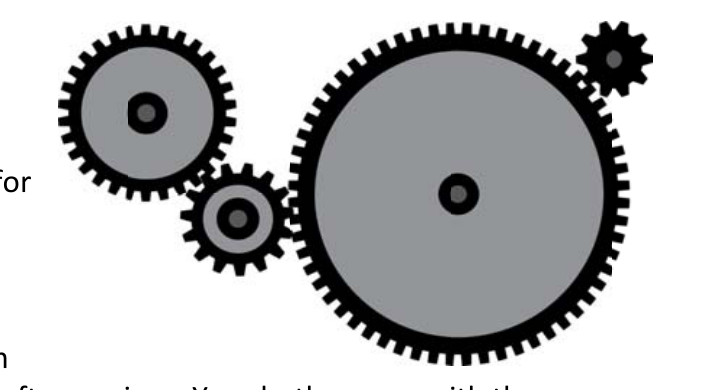
Four cogs are connected to each other as shown in the picture. The first has 30 teeth, the second 15, the third 60 and the fourth 10. How many turns will the last cog make for each full turn of the first cog?
Show answer
Answer: A — 3
Show hints
Hint 1 of 2
Connected gears pass the same number of teeth; the in-between gears do not change the first-to-last result.
Still stuck? Show hint 2 →
Hint 2 of 2
Compare only the first gear's teeth with the last gear's teeth.
Show solution
Approach: teeth passed are equal; compare first and last
One full turn of the first gear moves 30 teeth along the chain of gears.
Those same 30 teeth pass the last gear, which has only 10 teeth.
So the last gear turns 30 / 10 = 3 times (the middle gears do not matter).
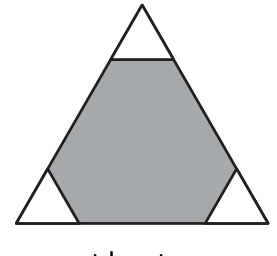
Three equally sized equilateral triangles are cut from the vertices of a large equilateral triangle of side length 6 cm. The three little triangles together have the same perimeter as the remaining grey hexagon. What is the side-length of one side of one small triangle?
Show answer
Answer: D — 1.5 cm
Show hints
Hint 1 of 2
Let the small triangle's side be x and write both perimeters in terms of x.
Still stuck? Show hint 2 →
Hint 2 of 2
The hexagon's six sides are the three cut edges and the three leftover pieces of the big sides.
Show solution
Approach: match the two perimeters
With small side x, the three little triangles have total perimeter 3 × 3x = 9x.
The hexagon's sides are three edges of length x plus three leftover pieces of length 6 − 2x, total 3x + 3(6−2x) = 18 − 3x.
Setting 9x = 18 − 3x gives 12x = 18, so x = 1.5 cm.
A square ABCD has side-length 2. E is the midpoint of AB and F the midpoint of AD. G is a point on the line CF with 3CG = 2GF. How big is the area of the triangle BEG?
Show answer
Answer: B — \(\tfrac{4}{5}\)
Show hints
Hint 1 of 2
Drop coordinates on the square so \(E\), \(F\) and \(C\) are easy points.
Still stuck? Show hint 2 →
Hint 2 of 2
Find \(G\) by splitting \(CF\) in the ratio \(CG:GF = 2:3\); then base \(BE\) lies on the x-axis so the area only needs \(G\)'s height.
Show solution
Approach: coordinates with base BE on the x-axis
Let \(A=(0,0)\), \(B=(2,0)\), \(C=(2,2)\), \(D=(0,2)\); then \(E=(1,0)\) and \(F=(0,1)\).
\(G\) divides \(CF\) with \(CG:GF = 2:3\), so \(G = C + \tfrac{2}{5}(F-C) = \left(\tfrac{6}{5}, \tfrac{8}{5}\right)\).
Base \(BE\) lies on the x-axis with length 1, and \(G\)'s height above it is \(\tfrac{8}{5}\), so the area is \(\tfrac12 \cdot 1 \cdot \tfrac{8}{5} = \tfrac{4}{5}\).
So the area of triangle \(BEG\) is \(\tfrac{4}{5}\), choice B.
A rectangular piece of paper is 108 mm long and 84 mm wide. After making a straight cut you have a square and a leftover piece. You do the same with the leftover piece and so on until the leftover piece itself is a square. What is the side length of the last square?
Show answer
Answer: E — 12 mm
Show hints
Hint 1 of 2
Each cut peels off the biggest square it can; track the leftover rectangle's sizes.
Still stuck? Show hint 2 →
Hint 2 of 2
This is the subtract-the-smaller-side process, and it ends at the greatest common divisor.
Gregory made two 3-digit numbers from the digits 1, 2, 3, 4, 5, 6. Each digit was used only once. Afterwards he added the two numbers together. What is the largest answer he could have got?
Show answer
Answer: D — 1173
Show hints
Hint 1 of 2
To make a sum large, put the biggest digits where they count the most.
Still stuck? Show hint 2 →
Hint 2 of 2
Give the two hundreds places the largest digits, then the tens, then the units.
Show solution
Approach: place the largest digits in the highest places
Use 6 and 5 in the hundreds places, 4 and 3 in the tens, 2 and 1 in the units.
The two numbers add to (600 + 500) + (40 + 30) + (2 + 1).
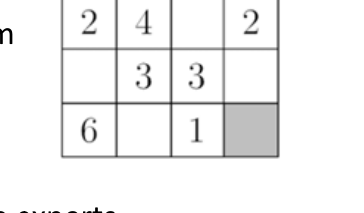
A number from 1 to 9 is to be written into each of the 12 fields of the table so that the sum of each column is the same. Also the sum of each row must be the same. A few numbers have already been written in. Which number should be written in the grey square?
Show answer
Answer: B — 4
Show hints
Hint 1 of 2
All three row sums are equal and all four column sums are equal; the whole grid holds the same total either way.
Still stuck? Show hint 2 →
Hint 2 of 2
Find one common total you can pin down from an almost-complete row or column, then chase the rest.
Show solution
Approach: find the common totals, then fill the forced entries
The grid is 3 rows by 4 columns; given are row 1: 2, 4, _, 2; row 2: _, 3, 3, _; row 3: 6, _, 1, grey. Three equal row sums and four equal column sums share the same grand total, so 3·(row sum) = 4·(column sum).
Column 2 is 4 + 3 + (row-3 entry); since every entry is 1–9, matching all column sums forces the common column sum to be 12 and the common row sum to be 16.
Now the bottom row must total 16: 6 + (row-3 col-2) + 1 + grey = 16; column 2 = 12 makes the row-3 col-2 entry 5, leaving 6 + 5 + 1 + grey = 16.
The lazy tomcat Garfield observes some mice stealing cheese. Each mouse carries away at least one piece of cheese but less than ten pieces. Each mouse steals a different amount of cheese pieces. No mouse steals exactly twice as many pieces as another mouse. What is the maximum number of mice Garfield can have observed?
Show answer
Answer: C — 6
Show hints
Hint 1 of 2
The amounts are different whole numbers from 1 to 9, and no amount may be exactly double another.
Still stuck? Show hint 2 →
Hint 2 of 2
Group the numbers into doubling chains and pick the most from each chain.
Show solution
Approach: avoid doubling pairs
Allowed amounts are distinct numbers 1–9 with no pair a and 2a.
The doubling chain 1–2–4–8 lets you keep at most 2 numbers; the chain 3–6 lets you keep 1; and 5, 7, 9 are free (3 numbers).
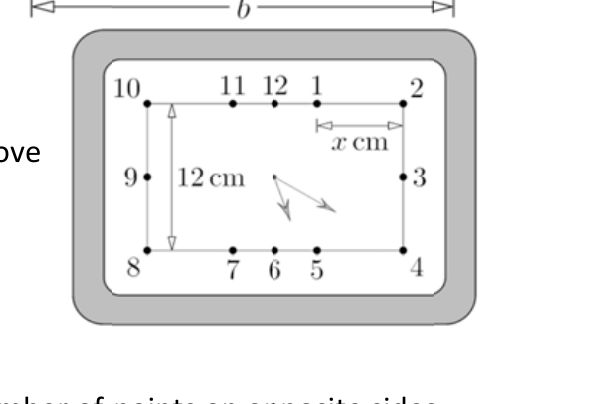
The clock shown has a rectangular clock face, the hands however move as usual in a constant circular pattern. How big is the distance x of the digits 1 and 2 (in cm), if the distance between the numbers 8 and 10 is given as 12 cm?
Show answer
Answer: C — \(4\sqrt{3}\)
Show hints
Hint 1 of 2
The numbers sit where rays \(30^\circ\) apart from the centre meet the rectangle; 8 and 10 are the two left corners, so their \(12\) cm gap is the rectangle's height.
Still stuck? Show hint 2 →
Hint 2 of 2
Put the centre at the origin and find where the rays toward 1 and 2 hit the frame.
Show solution
Approach: intersect the 30°-spaced clock rays with the rectangle
Numbers 8 and 10 are the bottom-left and top-left corners, so the left edge (the height) is \(12\) cm; place the centre at the origin with half-height \(6\).
The ray to 2 (\(60^\circ\) from straight up) hits the top-right corner \((W, 6)\): from direction \(\left(\tfrac{\sqrt3}{2}, \tfrac12\right)\), reaching \(y=6\) needs \(t=12\), so \(W = 6\sqrt3\) and corner 2 is at \((6\sqrt3, 6)\).
The ray to 1 (\(30^\circ\) from up) hits the top edge at \(x = 2\sqrt3\), so number 1 is at \((2\sqrt3, 6)\).
The gap is \(6\sqrt3 - 2\sqrt3 = 4\sqrt3\) cm, choice C.
Anna, Laura, Lisa and Katharina wanted to take a photo together. Anna and Katharina are best friends and wanted to stand next to each other. Lisa also wanted to stand next to Anna. In how many different ways can the photo be taken, if all their wishes are met?
Show answer
Answer: B — 4
Show hints
Hint 1 of 2
Anna must stand next to both Katharina and Lisa, so Anna is in the middle of those two.
Still stuck? Show hint 2 →
Hint 2 of 2
Treat Katharina-Anna-Lisa as one block and place Laura at either end.
Show solution
Approach: bundle the friends who must be adjacent
Anna is next to Katharina and next to Lisa, so the order around Anna is Katharina-Anna-Lisa (or its reverse): 2 ways.
This block of three can have Laura at the left end or the right end: 2 ways.
The runners Kann, Gu and Ru are favourites to win the marathon. Before the race three experts gave their predictions for the outcome of the race.
Expert 1: “Either Kann or Gu will win.” Expert 2: “If Gu is second Ru will win.” Expert 3: “If Gu is third Kan will not win.” Expert 4: “Either Gu or Ru will come second.”
After the race all four predictions were proven correct. In which order, did the three runners finish the race?
Show answer
Answer: D — Gu, Ru, Kan
Show hints
Hint 1 of 2
List the possible finishing orders and test each against all four statements.
Still stuck? Show hint 2 →
Hint 2 of 2
All four predictions are true at once, so eliminate any order that breaks even one.
Show solution
Approach: test each finishing order against all four statements
Try the finishing orders of the three runners; require all four experts correct at once.
The order Gu first, Ru second, Kan third works: Expert 1 (Kann or Gu wins) holds since Gu wins; Expert 4 (Gu or Ru second) holds since Ru is second; Experts 2 and 3 are 'if Gu is 2nd/3rd...' which never happen, so they hold automatically.
At an airport there is a “rolling pavement” which is 500 m long and transports people with a speed of 4 km/h. Anna and Peter step onto the rolling pavement at the same time. While Peter is standing still, Anna continues to walk with a speed of 6 km/h. How big is Anna’s head start on Peter when she leaves the rolling pavement after 500 m?
Show answer
Answer: E — 300 m
Show hints
Hint 1 of 2
Add Anna's walking speed to the belt's speed to get her ground speed.
Still stuck? Show hint 2 →
Hint 2 of 2
Find how long Anna takes for 500 m, then see how far Peter (moving with the belt) gets in that time.
Show solution
Approach: distance = speed × time
Anna's ground speed is 4 + 6 = 10 km/h; Peter just rides the belt at 4 km/h.
Anna covers 500 m = 0.5 km in 0.5 ÷ 10 = 0.05 h.
In 0.05 h Peter travels 4 × 0.05 = 0.2 km = 200 m, so Anna's lead is 500 − 200 = 300 m.
Renate wants to glue together a number of ordinary dice (whose number of points on opposite sides always adds up to 7) to form a “dicebar” as shown. Doing this she only wants to glue sides together with an equal number of points. She wants to make sure that the sum of all points on the non-glued sides equals 2012. How many dice does she have to glue together?
Show answer
Answer: E — It is impossible to obtain exactly 2012 points on the non-glued together sides.
Show hints
Hint 1 of 2
Glued faces show equal pips, and the two glued faces of an inner die are opposite, so they sum to 7.
Still stuck? Show hint 2 →
Hint 2 of 2
That forces the exposed total into a fixed form — work out its possible values and check whether 2012 can ever be hit.
Show solution
Approach: track the exposed pip total under the opposite-faces rule
Each die has \(21\) pips; a bar of \(n\) dice has \(n-1\) glued joints, each hiding \(2v\) pips for the equal glued value \(v\).
Each inner die's two glued faces are opposite, summing to 7, so consecutive joint values alternate \(v\) and \(7-v\) and adjacent joints sum to 7.
The exposed total is \(21n - 2(\text{joint sum})\): for even \(n-1\) this is \(7(2n+1)\), an odd multiple of 7 (and \(2012\) is not a multiple of 7); for odd \(n-1\) it is even and forces \(v = 7n - 999\), which has no valid \(n\) with \(1\le v\le 6\).
So no \(n\) gives exactly 2012, making it impossible, choice E.
Both the figures on the right were made out of the same 5 pieces. The rectangle has dimensions 5 cm × 10 cm. The other pieces are quarter circles with 2 different sized radii. What is the difference between the perimeters of the two figures?
Show answer
Answer: E — 20 cm
Show hints
Hint 1 of 2
Both shapes use the very same five pieces, so the curved (arc) parts of their outlines are identical.
Still stuck? Show hint 2 →
Hint 2 of 2
Only the straight rectangle edges show up differently, so compare just those.
Show solution
Approach: cancel the identical arcs, compare straight edges
Both figures are built from the very same five pieces, so the curved quarter-circle arcs contribute the same total length to each outline and simply cancel when we take the difference.
The only thing that can differ is how much of the rectangle's straight edges shows on the outside; in one figure a pair of the rectangle's 10 cm sides lies on the boundary while in the other they are tucked inside.
That swap of two 10 cm straight edges gives a perimeter difference of 2 x 10 = 20 cm (choice E).
Two sides of a quadrilateral have lengths 1 and 4. One of the diagonals has length 2 and splits the quadrilateral into two isosceles triangles. What is the perimeter of the quadrilateral?
Show answer
Answer: D — 11
Show hints
Hint 1 of 2
The diagonal of length 2 makes each of the two triangles isosceles.
Still stuck? Show hint 2 →
Hint 2 of 2
Pair the given sides 1 and 4 with the diagonal so each triangle's two equal sides work out.
Show solution
Approach: force each triangle to be isosceles using the diagonal
The diagonal of length 2 splits the quadrilateral into two isosceles triangles.
On the triangle holding the side 1, the only valid isosceles choice is sides 1, 2, 2; on the triangle holding the side 4 it is 4, 4, 2 (sides 2, 2, 4 would be degenerate).
So the four sides are 1, 2, 4, 4, giving perimeter 1 + 2 + 4 + 4 = 11 (D).
Initially the side length of a talking magic square is 8 cm. Every time it speaks the truth its sides each decrease by 2 cm. If it lies its perimeter doubles. It says four sentences, two of which are true and two are false, in which order is unknown. What is the biggest possible perimeter it can have after those four sentences?
Show answer
Answer: D — 112
Show hints
Hint 1 of 3
A true sentence shrinks each side by 2; a false one doubles the whole perimeter (so it doubles each side too).
Still stuck? Show hint 2 →
Hint 2 of 3
To make the perimeter biggest, decide the best order for the two lies and two truths.
Still stuck? Show hint 3 →
Hint 3 of 3
A subtraction of 2 hurts less when the side is small, so think about when to place the truths.
Show solution
Approach: order the operations to maximise
Start with side 8 (perimeter 32). A truth lowers the side by 2; a lie doubles the side (and so doubles the perimeter).
Doubling first makes each later −2 a smaller fraction lost, so do both lies first: 8 → 16 → 32, then both truths: 32 → 30 → 28.
The biggest side reachable is 28, giving perimeter 4 × 28 = 112, answer D.
Michael thought of a number. He multiplied this number by itself, added 1, multiplied the result by 10, added 3, and multiplied the total by 4. He arrived at 2012. Which number had Michael thought of to start with?
Show answer
Answer: D — 7
Show hints
Hint 1 of 2
Undo each step that led to 2012, working from the last operation back to the first.
Still stuck? Show hint 2 →
Hint 2 of 2
Divide by 4, subtract 3, divide by 10, subtract 1, then take the square root.
Show solution
Approach: reverse the operations
He finished at 2012; undo 'x4' to get 2012 / 4 = 503.
Undo '+3' to get 500, then undo 'x10' to get 50, then undo '+1' to get 49.
49 came from the number times itself, so the number is the square root: 7.
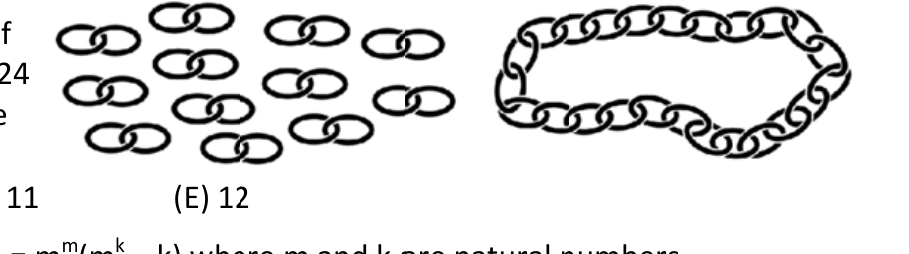
A goldsmith has 12 double-links of chain. Out of these he wants to make a single closed chain with 24 links. What is the minimum number of links that he must open (and close again)?
Show answer
Answer: A — 8
Show hints
Hint 1 of 2
Opening both links of one whole double-link frees two connectors.
Still stuck? Show hint 2 →
Hint 2 of 2
How many pieces must you sacrifice so the freed links join all the rest into one loop?
Show solution
Approach: sacrifice whole pieces to use their links as connectors
There are 12 double-links (pieces). Opening both links of one piece gives two open links that can join other pieces, while using up that whole piece.
If you open p whole pieces you get 2p connector links; the remaining 12 − p pieces need 12 − p joins to close into one loop.
Require 2p ≥ 12 − p, i.e. 3p ≥ 12, so p ≥ 4; opening 4 pieces means opening 2 × 4 = 8 links (A).
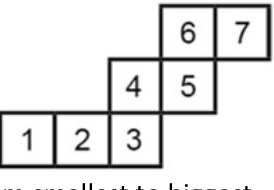
The diagram shows the 7 positions 1, 2, 3, 4, 5, 6, 7 of the bottom side of a die which is rolled around its edge in this order. Which two of these positions were taken up by the same face of the die?
Show answer
Answer: B — 1 and 6
Show hints
Hint 1 of 3
Track which face is on the bottom as the die tips from square to square.
Still stuck? Show hint 2 →
Hint 2 of 3
Each tip moves the bottom face to a neighbour; carefully follow it through the two turns in the staircase path.
Still stuck? Show hint 3 →
Hint 3 of 3
Label the starting bottom face and update it tip by tip until you see it land face-down again.
Show solution
Approach: track the bottom face along the path
Label the face touching the ground on square 1 and follow it as the die tips along the staircase path 1-2-3-4-5-6-7.
Updating the bottom face at each tip, the bottoms on the seven squares come out as positions 1, 3, 6, 2, 4, 1, 5 in terms of the original faces.
The same face is on the bottom on square 1 and again on square 6, so the answer is 1 and 6, B.
A rectangular piece of paper is 60 mm long and 36 mm wide. After making a straight cut you have a square and a leftover piece. You do the same with the leftover piece, and so on, until the leftover piece itself is a square. What is the side length of the last square?
Show answer
Answer: E — 12 mm
Show hints
Hint 1 of 2
Each cut slices off the biggest square that fits, leaving a smaller rectangle.
Still stuck? Show hint 2 →
Hint 2 of 2
Repeat the cutting on 60 by 36 and watch the leftover shrink to a square.
Show solution
Approach: repeatedly cut off the largest square
From 60 by 36, cut a 36 by 36 square, leaving 24 by 36.
From 24 by 36, cut a 24 by 24 square, leaving 24 by 12.
From 24 by 12, two 12 by 12 squares finish it, so the last square has side 12.
Stefan has 5 dice in different sizes. If he places them in order next to each other from smallest to biggest then the heights of two neighbouring dice each differ by 2 cm. The biggest die is as big as the tower built by the two smallest dice. How high is a tower made up of all 5 dice?
Show answer
Answer: E — 50 cm
Show hints
Hint 1 of 2
Write the five heights as an arithmetic list with common difference 2.
Still stuck? Show hint 2 →
Hint 2 of 2
Use 'biggest = two smallest stacked' to find the starting height.
Show solution
Approach: arithmetic sequence
Let the heights be a, a+2, a+4, a+6, a+8 (increasing by 2).
Biggest equals the two smallest stacked: a+8 = a + (a+2), so a = 6; heights are 6, 8, 10, 12, 14.
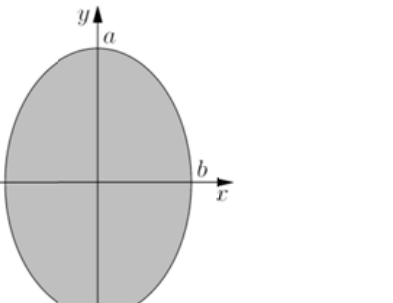
Let a > b. If the ellipse shown rotates about the x-axis an ellipsoid Ex with volume Vol(Ex) is obtained. If it rotates about the y-axis an ellipsoid Ey with volume Vol(Ey) is obtained. Which of the following statements is true?
Show answer
Answer: C — Ex ≠ Ey and Vol(Ex) > Vol(Ey)
Show hints
Hint 1 of 2
Read the figure: the ellipse is tall, with the larger semi-axis \(a\) along the \(y\)-axis and the smaller \(b\) along the \(x\)-axis.
Still stuck? Show hint 2 →
Hint 2 of 2
When you spin a shape about an axis, the volume grows with the square of the radius (the semi-axis perpendicular to the spin axis).
Show solution
Approach: compare the two solids of revolution
From the figure the ellipse has semi-axis \(a\) up the \(y\)-axis and \(b\) along the \(x\)-axis, with \(a > b\).
Spinning about the \(x\)-axis sweeps radius \(a\), giving a solid with semi-axes \((b,a,a)\) and volume \(\tfrac{4}{3}\pi a^2 b\); spinning about the \(y\)-axis sweeps radius \(b\), giving semi-axes \((b,b,a)\) and volume \(\tfrac{4}{3}\pi a b^2\). The two solids clearly differ.
Since \(a > b\), \(\tfrac{4}{3}\pi a^2 b > \tfrac{4}{3}\pi a b^2\), so \(\mathrm{Vol}(E_x) > \mathrm{Vol}(E_y)\).
Thus \(E_x \ne E_y\) and \(\mathrm{Vol}(E_x) > \mathrm{Vol}(E_y)\), choice C.
Logic & Word Problemscareful-countingsum-constraint
12 children were at a birthday party. The children were 6, 7, 8, 9, and 10 years old (every one of these ages was present). Four of them were 6 years old. There were more 8-year-olds than any other age group. What is the average age of the children?
Show answer
Answer: B — 7·5
Show hints
Hint 1 of 3
All five ages 6, 7, 8, 9 and 10 are present, so each of those groups has at least one child.
Still stuck? Show hint 2 →
Hint 2 of 3
The 8-year-olds must outnumber every other group, including the four 6-year-olds, so there are at least five 8-year-olds.
Still stuck? Show hint 3 →
Hint 3 of 3
Once the counts are pinned down, just add all twelve ages and divide by 12.
Show solution
Approach: pin down the counts from the clues, then average
Four children are 6, so the other eight share the ages 7, 8, 9 and 10, with at least one child at each age.
The 8-year-olds are the biggest group, so they must beat the four 6-year-olds: at least five children are 8.
Five 8s plus one each of 7, 9 and 10 already uses 5 + 3 = 8 children, so the only fit is exactly one 7, five 8s, one 9 and one 10.
The ages are four 6s, one 7, five 8s, one 9, one 10; their total is 24 + 7 + 40 + 9 + 10 = 90, and 90 / 12 = 7.5, choice B.
In football you get 3 points for a win, no points for a loss, and 1 point for a draw. A team has played 36 matches and has 80 points. What is the maximum number of matches the team could have lost?
Show answer
Answer: E — 8
Show hints
Hint 1 of 2
A loss is worth 0 points, so the more games lost, the fewer games are left to earn all 80 points.
Still stuck? Show hint 2 →
Hint 2 of 2
Wins are worth the most (3 each), so packing the points into wins leaves the most room for losses.
Show solution
Approach: earn the 80 points in as few games as possible, then the rest are losses
Losses give 0 points, so all 80 points must come from the wins and draws — and the fewer of those games, the more games are free to be losses.
Wins are worth 3 and draws only 1, so use mostly wins: 26 wins make 26 × 3 = 78 points, then 2 draws add 2 more for exactly 80.
That uses 26 + 2 = 28 games, leaving 36 − 28 = 8 games to lose.
So the most matches the team could have lost is 8.
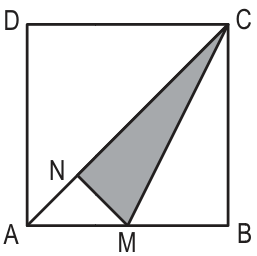
In a square ABCD, M is the midpoint of AB. MN is perpendicular to AC. Determine the ratio of the area of the grey triangle to the area of the square ABCD.
Show answer
Answer: D — 3 : 16
Show hints
Hint 1 of 2
Put the square on coordinates with side 2 and find N as the foot of the perpendicular from M to AC.
Still stuck? Show hint 2 →
Hint 2 of 2
Compute the grey triangle's area, then compare it to the square's area.
Show solution
Approach: coordinates and area
Take A(0,0), B(2,0), C(2,2), D(0,2); M(1,0) is the midpoint of AB and AC is the line y = x.
The foot of the perpendicular from M to AC is N(0.5, 0.5); the grey triangle has vertices M, N, C with area 3/4.
The square's area is 4, so the ratio is (3/4) : 4 = 3 : 16.
In a game with fractions I am allowed to carry out two operations, namely either increase the numerator by 8 or increase the denominator by 7 without simplifying during the game. Starting with the fraction 78 after n such operations I again obtain a fraction with equal value. What is the smallest value of n?
Show answer
Answer: D — 113
Show hints
Hint 1 of 2
Say you add 8 to the numerator \(p\) times and 7 to the denominator \(q\) times.
Still stuck? Show hint 2 →
Hint 2 of 2
Set the new fraction equal to \(\tfrac{7}{8}\) and clear fractions; you'll get a clean ratio between \(p\) and \(q\).
Show solution
Approach: set the new fraction equal and solve for the move counts
After \(p\) numerator-moves and \(q\) denominator-moves the fraction is \(\frac{7+8p}{8+7q}\).
Setting it equal to \(\tfrac{7}{8}\) gives \(8(7+8p) = 7(8+7q)\), which simplifies to \(64p = 49q\).
Since \(\gcd(64,49)=1\), the smallest whole solution is \(p = 49\), \(q = 64\), so \(n = p+q = 113\), choice D.
Tango is being danced in pairs, a man with a woman. No more than 50 people attend a dance evening. At a certain moment 34 of the men were dancing with 45 of the women. How many people were dancing at this moment?
Show answer
Answer: B — 24
Show hints
Hint 1 of 2
Dancing men and dancing women are equal in number (they pair up).
Still stuck? Show hint 2 →
Hint 2 of 2
Set (3/4) of the men equal to (4/5) of the women and use the at-most-50 limit.
Show solution
Approach: equal dancing partners
Pairs mean dancing men = dancing women: (3/4)M = (4/5)W, so 15M = 16W, giving M = 16k, W = 15k.
Total people 31k ≤ 50 forces k = 1, so M = 16, W = 15.
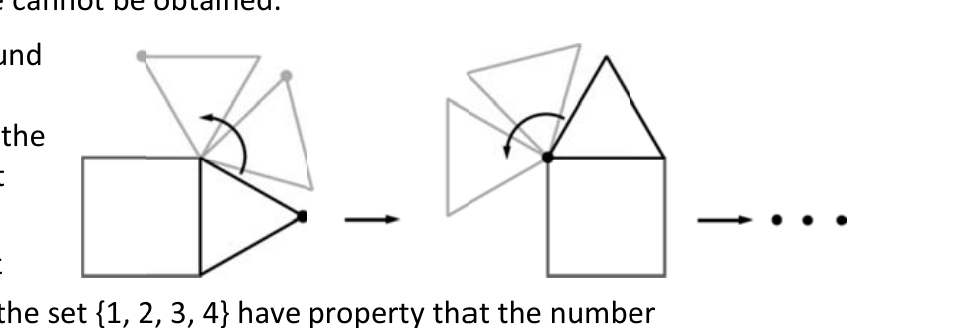
An equilateral triangle is being rolled around a unit square as shown. How long is the path that the point shown covers, if the point and the triangle are both back at the start for the first time?
Show answer
Answer: B — \(\tfrac{28}{3}\pi\)
Show hints
Hint 1 of 2
The triangle has the same side length (1) as the square, so each pivot turns it by the exterior angle \(120^\circ\), except at a square corner where an extra \(90^\circ\) is added.
Still stuck? Show hint 2 →
Hint 2 of 2
The marked point sweeps an arc of radius 1 each flip, unless the point itself is the pivot (then radius 0, no arc); add the arcs over one full return circuit.
Show solution
Approach: sum the arcs swept by the marked vertex over one full circuit
Each tumble pivots the triangle about a vertex; the marked point (another vertex, distance 1 away) sweeps a circular arc of radius 1 — and stays put whenever it is itself the pivot.
On a flat stretch each flip turns the triangle \(120^\circ = \tfrac{2\pi}{3}\); rounding a square corner adds an extra \(90^\circ\) to that turn.
Following the rolling until both the point and the triangle first return to their starting position, the swept arcs (each of radius 1) total an angle of \(\tfrac{28}{3}\pi\).
So the path length is \(\tfrac{28}{3}\pi\), choice B.
It takes 8 seconds for train G to pass by a milestone. Shortly afterwards the train meets train H. It takes 9 seconds for the trains to pass each other. Train H then takes 12 seconds to pass by the milestone. What can be deduced about the length of the trains?
Show answer
Answer: A — G is twice as long as H.
Show hints
Hint 1 of 2
Passing a milestone takes (own length)/(own speed); passing each other uses the combined length and speeds.
Still stuck? Show hint 2 →
Hint 2 of 2
Write the three timings and combine them to compare the lengths.
Show solution
Approach: translate each timing into length = speed × time and combine
Let G have length Lg, speed vg, so Lg = 8·vg; H has Lh = 12·vh.
The trains pass each other in 9 s: Lg + Lh = 9(vg + vh), i.e. 8vg + 12vh = 9vg + 9vh, giving vg = 3vh.
Then Lg = 8vg = 24vh and Lh = 12vh, so Lg = 2·Lh: train G is twice as long as H (A).
David wants to place the twelve numbers from 1 to 12 in a circle so that two adjacent numbers always differ by 2 or 3. Which numbers are therefore adjacent?
Show answer
Answer: D — 6 and 8
Show hints
Hint 1 of 2
List which numbers each value is allowed to sit next to (differ by 2 or 3).
Still stuck? Show hint 2 →
Hint 2 of 2
1 and 2 have very few options — those force several neighbours; build out from there.
Show solution
Approach: forced neighbours then complete the loop
Each number's neighbours must differ from it by 2 or 3, and each has exactly two neighbours in the circle.
1 can only touch 3 and 4; 2 can only touch 4 and 5; chaining these and continuing yields the loop 6–3–1–4–2–5–7–10–12–9–11–8 back to 6.
In that loop 8 sits next to 6, so 6 and 8 are adjacent.
The two diagonals \(\{x_1,x_3\}\) and \(\{x_2,x_4\}\) split \(\{1,2,3,4\}\) into a pair-sum product: \(5\cdot5\), \(4\cdot6\), or \(3\cdot7\) — only \(4\cdot6\) and \(3\cdot7\) are divisible by 3.
Each good split fills the two diagonals in \(2\times2\) orders, and either pair can be the odd-positioned one, giving \(8\) permutations per split.
Two good splits give \(2\times8 = 16\) permutations, choice D.
The shape pictured is made out of two squares with side lengths 4 cm and 5 cm respectively, a triangle with area 8 cm² and the grey parallelogram. What is the area of the parallelogram?
Show answer
Answer: B — 16 cm²
Show hints
Hint 1 of 2
The triangle's two sides are the sides of the squares (4 and 5); use its area to find the angle.
Still stuck? Show hint 2 →
Hint 2 of 2
The parallelogram has the same two side lengths but the supplementary angle.
Show solution
Approach: relate triangle and parallelogram through the shared angle's sine
The triangle has sides 4 and 5 (shared with the squares); its area ½·4·5·sinθ = 8 gives sinθ = 0.8.
The grey parallelogram has the same two sides 4 and 5 but the supplementary angle, whose sine is also 0.8.
Wanted are all three-digit numbers from 100 to 999 that have the following property: If you remove the first digit a square number remains and if you remove the last digit again a square number remains (e.g. 164 → (1)64 → 16(4)). How big is the sum of all numbers with this special property?
Show answer
Answer: D — 1993
Show hints
Hint 1 of 2
Both 'drop the first digit' and 'drop the last digit' must leave two-digit squares.
Still stuck? Show hint 2 →
Hint 2 of 2
The middle digit is shared — it is the units digit of one square and the tens digit of another.
Show solution
Approach: match shared middle digit
The two-digit squares are 16, 25, 36, 49, 64, 81. The number a b c needs both 10a+b and 10b+c to be in this list.
The shared digit b must be a units digit of one square and a tens digit of another, which works for b = 1, 4, 6, giving the numbers 816, 649, 164, 364.
After an especially intense lesson the graph of the function y = x² was still on the board as well as 2012 straight lines parallel to the straight line with the equation y = x, which each intersected the parabola in two points. How big is the sum of all x-coordinates of the intersections of the straight lines with the parabola?
Show answer
Answer: D — 2012
Show hints
Hint 1 of 2
Each line parallel to \(y = x\) has the form \(y = x + c\); intersect it with \(y = x^2\).
Still stuck? Show hint 2 →
Hint 2 of 2
The two \(x\)-values on one line are the roots of \(x^2 - x - c = 0\) — use the sum of roots, which is the same for every line.
Show solution
Approach: sum of roots per line, added over all lines
A line \(y = x + c\) meets \(y = x^2\) where \(x^2 - x - c = 0\), whose two roots sum to \(1\) (independent of \(c\)).
So each of the 2012 lines contributes \(1\) to the running total of \(x\)-coordinates.
The overall sum is \(2012 \cdot 1 = 2012\), choice D.
Of 5 lamps each one can be set to “ON” or “OFF”. Each time when the switch of one lamp is changed, not only does the status of that particular lamp change but also that of one other lamp chosen at random. If the same switch is changed several times not always the same other lamp changes. Initially all lamps are set to “OFF”. Then 10 switching operations are carried out. After that one can say that
Show answer
Answer: C — definitely not all lamps are switched to “ON”;
Show hints
Hint 1 of 2
Each switch flips its own lamp AND one other — so two lamps flip at once.
Still stuck? Show hint 2 →
Hint 2 of 2
Track the parity (even/odd) of how many lamps are ON.
Show solution
Approach: parity of the number of ON lamps
Every operation flips exactly two lamps, so the number of lamps that are ON changes by an even amount each time.
Starting from 0 (all OFF, even), the count of ON lamps stays even after any number of operations.
All five ON would be 5, an odd number, which is impossible — so we can definitely say not all lamps are switched to ON (C).
There are 30 chapters in a book. Each chapter has a different length, i.e. 1, 2, 3, …, 30 pages. Each chapter starts on a new page. The first chapter starts on page 1. At most how many chapters start on a page with an odd page number?
Show answer
Answer: E — 23
Show hints
Hint 1 of 2
A chapter keeps the next start's parity the same when its length is even, and flips it when odd.
Still stuck? Show hint 2 →
Hint 2 of 2
There are 15 even and 15 odd lengths — spend the even ones while you are on odd pages.
Show solution
Approach: track start-page parity
Chapter 1 starts on page 1 (odd). An even-length chapter keeps the next start odd; an odd-length chapter flips the parity.
Use all 15 even lengths first: starts of chapters 1 through 16 are all odd (16 odd starts). The remaining 14 odd-length chapters then alternate parity, adding 7 more odd starts.
Three corners of a die (not all on one face) have the coordinates P(3, 4, 1), Q(5, 2, 9) and R(1, 6, 5). What are the coordinates of the midpoint of the die?
Show answer
Answer: A — A(4, 3, 5)
Show hints
Hint 1 of 2
Compute the squared distances between \(P\), \(Q\), \(R\) and compare them.
Still stuck? Show hint 2 →
Hint 2 of 2
If two of the points turn out to be opposite corners (a space diagonal), the centre of the die is just their midpoint.
Show solution
Approach: identify the space diagonal, then take its midpoint
The squared distances are \(PR^2 = 24\), \(QR^2 = 48\), \(PQ^2 = 72\), in the ratio \(1 : 2 : 3\).
For a cube with edge\(^2 = 24\) these are an edge, a face diagonal and a space diagonal, so \(P\) and \(Q\) are opposite corners.
The centre is the midpoint of \(PQ\): \(\left(\tfrac{3+5}{2}, \tfrac{4+2}{2}, \tfrac{1+9}{2}\right) = (4,3,5)\), choice A.
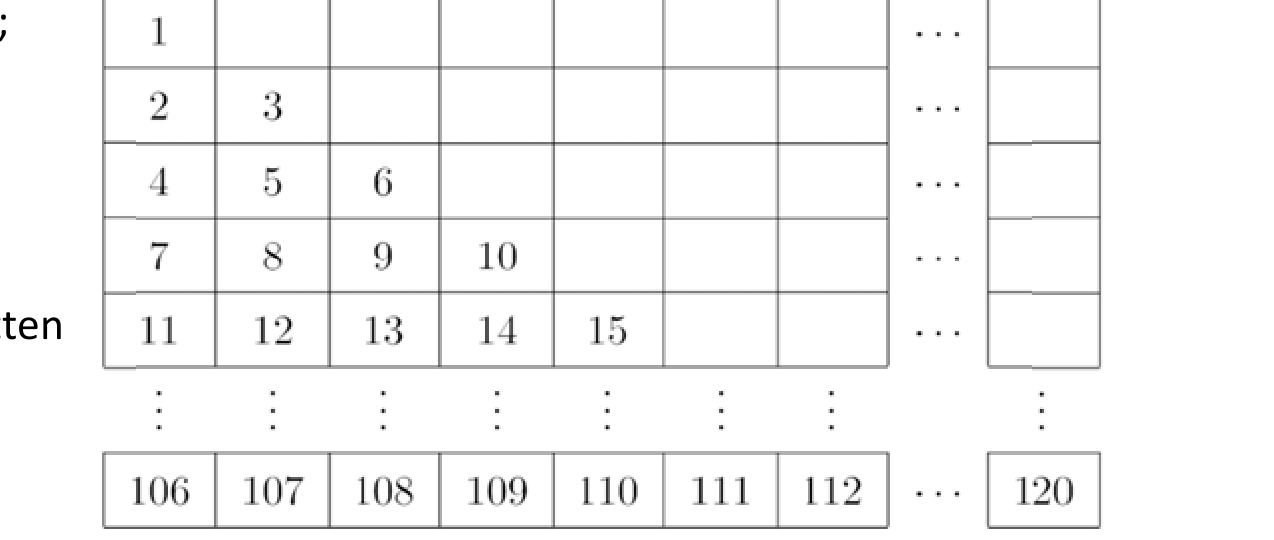
The natural numbers from 1 to 120 were written as shown into a table with 15 columns. In which column (counting from left) is the sum of the numbers the largest?
Show answer
Answer: B — 5
Show hints
Hint 1 of 3
The picture is a triangle: row 1 has one number, row 2 has two, … row 15 has fifteen (since 1 + 2 + … + 15 = 120).
Still stuck? Show hint 2 →
Hint 2 of 3
Column j is only filled from row j downward, so far-left columns have many small numbers and far-right columns have few large ones — the winner is somewhere in between.
Still stuck? Show hint 3 →
Hint 3 of 3
Compare a column's total to its right neighbour: moving right drops one small top entry but adds 1 to every entry below it.
Show solution
Approach: see the triangular fill, then balance 'fewer entries' against 'bigger entries'
Row n holds n numbers, ending at 1 + 2 + … + n; row 15 ends at 120, so it is a 15-row triangle and column j is filled only in rows j through 15.
Column 1 has fifteen entries but they are the smallest in each row; the far-right columns have only a few entries even though they are large — so the biggest total sits in the middle.
Adding up each column gives totals 575, 588, 598, 604, 605, 600, 588, … which peak at column 5.
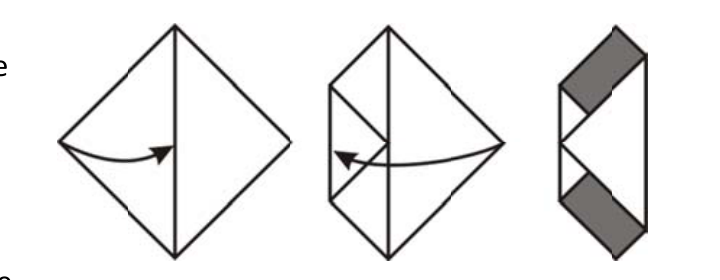
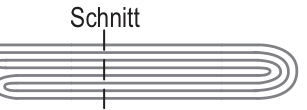
A piece of string is folded as shown in the diagram by folding it in the middle, then folding it in the middle again and finally folding it in the middle once more. Then this folded piece of string is cut so that several pieces emerge. Amongst the resulting pieces there are some with length 4 m and some with length 9 m. Which of the following lengths cannot be the total length of the original piece of string? (In the picture, “Schnitt” marks where the cut is made.)
Show answer
Answer: C — 72 m
Show hints
Hint 1 of 3
Folding in half three times stacks the string into eight equal layers before the single cut.
Still stuck? Show hint 2 →
Hint 2 of 3
Call the two parts the cut makes in one folded layer \(a\) and \(b\); then the whole string has length \(8(a+b)\).
Still stuck? Show hint 3 →
Hint 3 of 3
Work out the lengths of the pieces in terms of \(a\) and \(b\), then test each total to see whether both a 4 m and a 9 m piece can appear.
Show solution
Approach: lengths of the unfolded pieces
Three folds make 8 stacked layers, so the folded packet has length \(s=a+b\) where the cut lands distance \(a\) from the folded edge, and the whole string is \(8s=8(a+b)\).
Unfolding, the cut points split the string into pieces of just three lengths: \(a\) (the two ends), \(2a\), and \(2b\); so both a 4 m piece and a 9 m piece must appear among \(a,2a,2b\).
A total of 52, 68 or 88 m can be split this way with a 4 m and a 9 m piece, but for a total of 72 m we get \(s=9\), and then \(a,2a,2b\) can never give both 4 and 9 at once.
In the sequence 1, 1, 0, 1, −1, … the first two terms a1 and a2 are each 1. The third term is the difference of the previous two and a3 = a1 − a2 holds true. The fourth one is the sum of the previous two with a4 = a2 + a3, the fifth is the difference a5 = a3 − a4, a6 = a4 + a5, and so on, as well as the alternating difference and the sum. How big is the sum of the first 100 terms of this sequence?
Show answer
Answer: B — 3
Show hints
Hint 1 of 2
Just generate terms, alternately subtracting then adding the previous two, until the pattern repeats.
Still stuck? Show hint 2 →
Hint 2 of 2
Find the period and the sum over one full period, then handle the leftover terms.
Show solution
Approach: find the period, then sum 100 terms
Listing terms gives \(1,1,0,1,-1,0,-1,-1,0,-1,1,0\), after which \(a_{13}=1, a_{14}=1\) repeat the start, so the period is 12.
One full period sums to \(0\), so the first \(96 = 8\times12\) terms contribute \(0\).
The remaining four terms \(a_{97},\dots,a_{100}\) match \(a_1,\dots,a_4 = 1,1,0,1\), summing to \(3\), choice B.
Positive numbers were written in a 3 × 3 grid in such a way that the product of the numbers in each row and each column is exactly 1. The product of the four numbers in each 2 × 2 grid that can be found inside the 3 × 3 grid is 2. Which number is written in the centre of the 3 × 3 grid?
Show answer
Answer: A — 16
Show hints
Hint 1 of 3
Multiply all four 2×2 block products together — that is \(2^4 = 16\).
Still stuck? Show hint 2 →
Hint 2 of 3
Group the resulting factors by row and use that each row and each column multiplies to 1.
Still stuck? Show hint 3 →
Hint 3 of 3
Almost everything cancels, leaving just the centre value.
Show solution
Approach: multiply the four block products and cancel using the unit row/column products
Label the grid a, b, c / d, e, f / g, h, i with every row product and every column product equal to 1, and each of the four 2×2 block products equal to 2.
Multiplying the four block products gives \(2^4 = 16\) and, collecting factors, equals \(a b^2 c \cdot d^2 e^4 f^2 \cdot g h^2 i\).
Group by rows: \(abc = 1\) and \(def = 1\) and \(ghi = 1\), so this reduces to \(b \cdot e^2 \cdot h\); the middle column \(beh = 1\), leaving just \(e\).
Three lines dissect a big triangle into four triangles and three quadrilaterals. The sum of the perimeters of the three quadrilaterals is 25 cm. The sum of the perimeters of the four triangles is 20 cm. The perimeter of the big triangle is 19 cm. How big is the sum of the lengths of the three dissecting lines?
Show answer
Answer: C — 13 cm
Show hints
Hint 1 of 2
Add up the perimeters of all seven pieces and see what gets counted twice.
Still stuck? Show hint 2 →
Hint 2 of 2
Each interior cut-line is shared by two pieces, so it is counted twice in that total.
Show solution
Approach: double-counting the cut lines
Summing all seven small perimeters gives 20 + 25 = 45.
In that sum the big triangle's boundary (19) is counted once and every interior cut-line is counted twice.
So 45 = 19 + 2 × (total cut length), giving total cut length = (45 − 19)/2 = 13 cm.
Gerhard chooses two numbers a and b from the set {1, 2, 3, …, 26}. The product ab of these two numbers is equal to the sum of the remaining 24 numbers from this set. How big is |a − b|?
Show answer
Answer: E — 6
Show hints
Hint 1 of 2
Write 'product equals sum of the other 24' using the total \(1+2+\cdots+26 = 351\).
Still stuck? Show hint 2 →
Hint 2 of 2
Rearrange \(ab + a + b = 351\) into a product of two shifted factors (Simon's trick).
Show solution
Approach: turn the condition into a factoring of 352
The remaining 24 numbers total \(351 - a - b\), so the condition is \(ab = 351 - a - b\).
Add 1 to both sides: \(ab + a + b + 1 = 352\), i.e. \((a+1)(b+1) = 352\).
The only factor pair of \(352 = 16\cdot22\) with both numbers \(\le 27\) gives \(\{a,b\} = \{15,21\}\), so \(|a-b| = 6\), choice E.