A zebra crossing has alternating white and black stripes, each 50 cm wide. The first stripe is white and the last one is white. The zebra crossing in front of our school has 8 white stripes. How wide is the road?
Show answer
Answer: B — 7.5 m
Show hints
Hint 1 of 2
With the first and last stripe both white, the black stripes sit in the gaps between whites.
Still stuck? Show hint 2 →
Hint 2 of 2
Count how many stripes there are in total, then multiply by 50 cm.
Show solution
Approach: count stripes from the white count
With 8 white stripes and a black stripe in each gap between them, there are 7 black stripes.
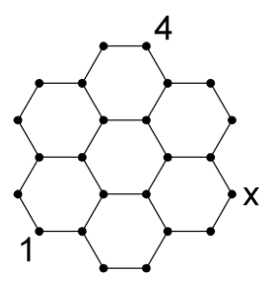
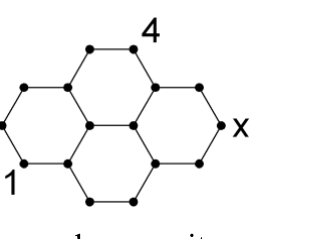
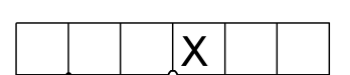
In the picture on the right a number is written next to each marked point. Along every side of the large hexagon, the numbers at the points must add up to the same total. Two numbers are already filled in. Which number belongs at the point marked x?
Show answer
Answer: A — 1
Show hints
Hint 1 of 2
Every side of the hexagon must reach the same total, and two corner numbers are already fixed.
Still stuck? Show hint 2 →
Hint 2 of 2
Lock the common side-total from a side whose numbers you know, then carry it around to the side that contains x.
Show solution
Approach: use the equal side-sums to chase the value around to x
Every side of the large hexagon must carry the same point-total, and the sides through the corners 4 and 1 let you pin that common total.
Following the constraint from corner to corner around the hexagon forces each remaining value in turn.
Three racers take part in a Formula-1 race: Michael, Fernando and Sebastian. At the start Michael leads, ahead of Fernando, who is ahead of Sebastian. During the race Michael and Fernando overtake each other 9 times, Fernando and Sebastian 10 times, and Michael and Sebastian 11 times. In what order do the three finish?
Show answer
Answer: B — Fernando, Sebastian, Michael
Show hints
Hint 1 of 2
Two racers swap order exactly once each time they overtake one another, so only the parity of each count matters.
Still stuck? Show hint 2 →
Hint 2 of 2
Odd number of swaps reverses a pair's order; even keeps it the same.
Show solution
Approach: track each pair's order by the parity of its overtakes
Start: Michael, Fernando, Sebastian.
Michael–Fernando: 9 swaps (odd) → Fernando now ahead of Michael.
Fernando–Sebastian: 10 (even) → Fernando stays ahead of Sebastian.
Michael–Sebastian: 11 (odd) → Sebastian now ahead of Michael.
So Fernando > Sebastian > Michael: order Fernando, Sebastian, Michael.
Given are the expressions \(S_1 = 2\times3 + 3\times4 + 4\times5\), \(S_2 = 2^2 + 3^2 + 4^2\), and \(S_3 = 1\times2 + 2\times3 + 3\times4\). Which one of the following statements is true?
A zebra crossing has alternating white and black stripes each 50 cm wide. The first stripe is white and the last one is white. The zebra crossing in front of our school has 8 white stripes. How wide is the road?
Show answer
Answer: B — 7.5 m
Show hints
Hint 1 of 2
If the crossing starts and ends with a white stripe, how many black stripes sit between the white ones?
Still stuck? Show hint 2 →
Hint 2 of 2
Count the total number of stripes first, then multiply by the 50 cm width.
Show solution
Approach: count all stripes, then multiply by width
The pattern is white, black, white, ... starting and ending white, with 8 white stripes.
Between/around 8 white stripes there are 7 black stripes, so 8+7=15 stripes total.
Each stripe is 50 cm = 0.5 m, so the road is 15×0.5 = 7.5 m wide.
In Crazytown the houses on the right-hand side of the street all have odd numbers. The Crazytowners don't use any numbers with the digit 3 in them. The first house on the right-hand side has the number 1. Which number does the fifteenth house on the right-hand side have?
Show answer
Answer: E — 47
Show hints
Hint 1 of 2
List the odd house numbers in order, but skip any that contain the digit 3.
Still stuck? Show hint 2 →
Hint 2 of 2
Count carefully until you reach the 15th allowed number.
Show solution
Approach: list allowed odd numbers and count to the 15th
Odd numbers with no digit 3, in order: 1, 5, 7, 9, 11, 15, 17, 19, 21, 25, 27, 29, 41, 45, 47.
(We skip 3, 13, 23, and 31–39 because they contain a 3.)
Simon awoke one and a half hours ago. In three and a half hours he will catch a train to go to his grandma. How long before his train leaves did he wake up?
Show answer
Answer: E — Five hours
Show hints
Hint 1 of 2
He woke up before now; the train leaves after now.
Still stuck? Show hint 2 →
Hint 2 of 2
Add the time since he woke to the time still left before the train.
Show solution
Approach: add the two time gaps
From waking to now is 1½ hours; from now to the train is 3½ hours.
So from waking to the train is 1½ + 3½ = 5 hours, answer E.
In the picture a number should be written next to each point. The sum of the numbers on the corners of each side of the hexagon should be equal. Two numbers have already been written. Which number should be in the place marked ‘x’?
Show answer
Answer: A — 1
Show hints
Hint 1 of 3
Every side of the big hexagon must have the same corner-sum, so use the two known numbers to find what that common sum is.
Still stuck? Show hint 2 →
Hint 2 of 3
Two sides share a corner; comparing two sides that share a corner forces the opposite corners to be equal.
Still stuck? Show hint 3 →
Hint 3 of 3
Chain equal-sum sides from the 4 and the 1 around to the point marked x.
Show solution
Approach: use that adjacent equal-sum sides force matching opposite corners
Each side of the outer hexagon holds the same total, so two sides meeting at one shared corner must have equal sums of their other corners.
Following that equality around the ring, a corner is forced to match the corner two steps away, propagating the known values.
Tracing from the 4 and the 1 to the marked point this way pins the value at x to 1.
My calculator has gone mad. If I want to multiply, it divides, and if I want to add, it subtracts. I type in \((12\times3)+(4\times2)=\). Which result will it give me?
Show answer
Answer: A — 2
Show hints
Hint 1 of 2
Replace every × with ÷ and every + with − before you compute.
Still stuck? Show hint 2 →
Hint 2 of 2
Evaluate (12÷3)−(4÷2).
Show solution
Approach: swap the operations as the broken calculator does
The calculator turns × into ÷ and + into −.
So (12×3)+(4×2) is actually carried out as (12÷3)−(4÷2).
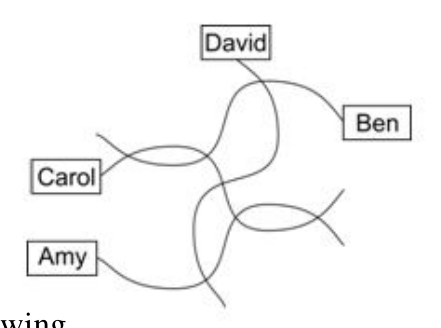
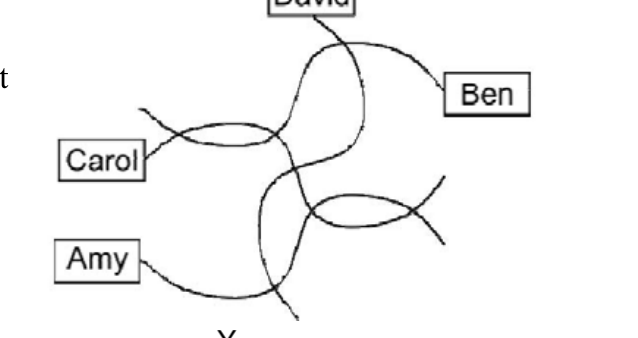
Jan cannot draw very accurately, but he tried to make a roadmap of his village. The relative positions of the houses and the street crossings are all correct, but although three of the roads are actually straight, Qurwik street is not. Who lives on Qurwik street?
Show answer
Answer: C — Carol
Show hints
Hint 1 of 2
Three of the four roads are straight; the one that bends is Qurwik street.
Still stuck? Show hint 2 →
Hint 2 of 2
Find the resident whose connecting road is the curved one, not a straight segment.
Show solution
Approach: identify the single curved road in the map
The crossings and house positions are correct, and only one road is drawn curved instead of straight.
That curved road is Qurwik street, and the house it serves belongs to Carol.
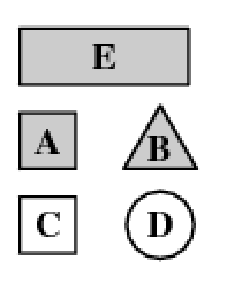
Maria describes one of these five shapes in the following way: “It is not a square. It is grey. It is either round or three‑sided.” Which shape did she describe?
Show answer
Answer: B — B
Show hints
Hint 1 of 2
Use each clue to cross shapes off the list.
Still stuck? Show hint 2 →
Hint 2 of 2
Keep only the shape that is not a square, is grey, and is round or three-sided.
Show solution
Approach: eliminate by each clue
“Not a square” removes the two squares (A and C).
“It is grey” removes the white circle (D); “round or three-sided” removes the grey rectangle (E).
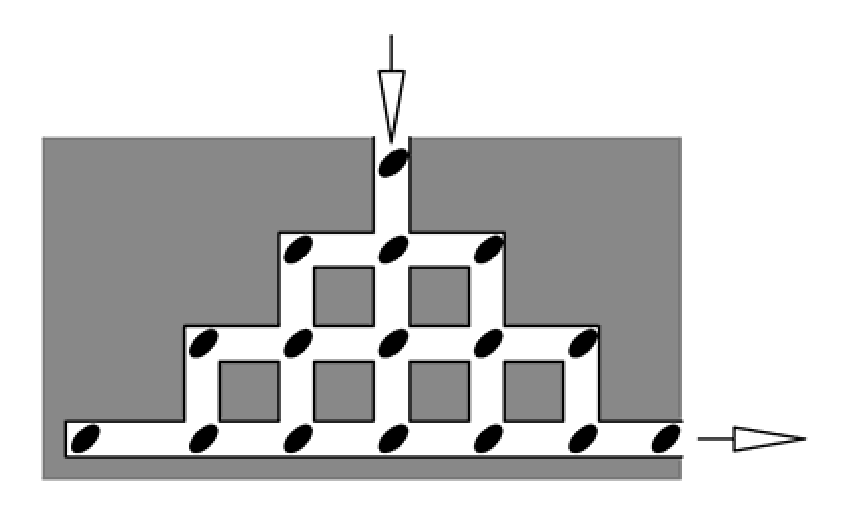
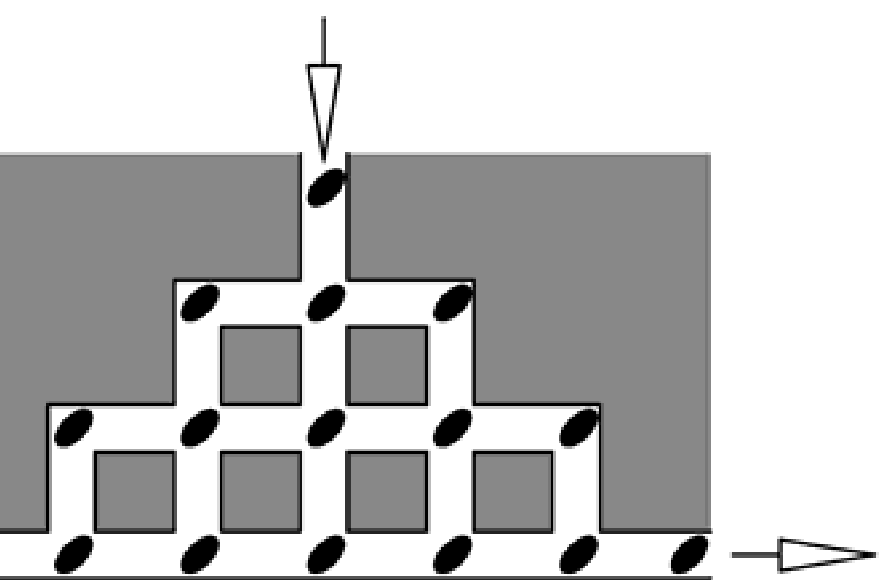
1000 litres of water is passed through the water system shown, into two identical tanks. At each junction the water separates into two equal amounts. How many litres of water end up in Tank Y?
Show answer
Answer: B — 750
Show hints
Hint 1 of 2
At every junction the water splits into two equal halves.
Still stuck? Show hint 2 →
Hint 2 of 2
Trace what fraction of the original 1000 litres ends up flowing into Tank Y.
Show solution
Approach: track the halving fractions along the paths to Y
The 1000 litres repeatedly splits in half at each junction.
Following the pipes, three quarters of the water is routed toward Tank Y and one quarter toward Tank X.
So Tank Y receives \(\frac{3}{4}\) of 1000 = 750 litres.
Lenka paid 1 Euro and 50 Cents for three scoops of ice cream. Miso paid 2 Euros and 40 Cents for two chocolate bars. How much did Igor pay for one scoop of ice cream and one chocolate bar?
Show answer
Answer: A — 1 € 70 c
Show hints
Hint 1 of 2
Find the price of one scoop and the price of one bar separately.
Still stuck? Show hint 2 →
Hint 2 of 2
Three scoops cost 1.50 €; two bars cost 2.40 €.
Show solution
Approach: unit prices, then add
One scoop: 1.50 € ÷ 3 = 0.50 €. One bar: 2.40 € ÷ 2 = 1.20 €.
One scoop + one bar = 0.50 + 1.20 = 1 € 70 c, answer A.
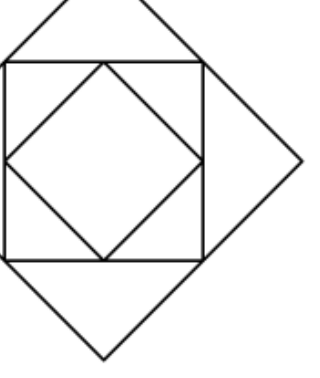
In the picture we can see three squares. The corners of the middle square are on the midpoints of the sides of the larger square, and the corners of the smaller square are on the midpoints of the sides of the middle square. The area of the small square is 6 cm². What is the area of the big square?
Show answer
Answer: A — 24 cm²
Show hints
Hint 1 of 2
A square drawn on the midpoints of another square has a fixed fraction of its area.
Still stuck? Show hint 2 →
Hint 2 of 2
Each step outward doubles the area, so apply that twice from the small square.
Show solution
Approach: each inner square has half the area of the next one out
Connecting the midpoints of a square makes a new square with half the area.
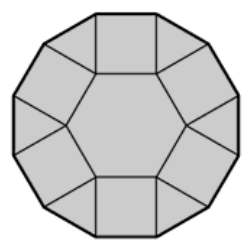
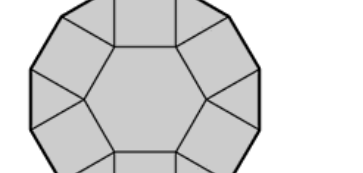
A regular hexagon of side-length 1, six squares and six equilateral triangles fit together as shown on the right. What is the perimeter of this tessellation?
Show answer
Answer: E — 12
Show hints
Hint 1 of 2
The whole tessellation has a 12-sided outline; every outer edge has length 1.
Still stuck? Show hint 2 →
Hint 2 of 2
Just count the outer edges — one per square and triangle around the rim.
Show solution
Approach: count unit edges on the outer boundary
Around the rim the squares and triangles each contribute outer edges of length 1.
The boundary is a regular 12-gon of unit edges, so the perimeter is 12.
The date 01-03-05 (1st March 2005) has three consecutive odd numbers. This is the first day in the 21st Century with this property. How many days with this property are there in total in the 21st Century?
Show answer
Answer: A — 5
Show hints
Hint 1 of 2
The date reads day-month-year as three numbers that are consecutive odd numbers.
Still stuck? Show hint 2 →
Hint 2 of 2
List consecutive-odd triples and check that the day and month stay valid.
Show solution
Approach: list consecutive odd triples that form a valid date
We need day, month, year to be three consecutive odd numbers, with day ≤ 31 and month ≤ 12.
The triples that work: (1,3,5), (3,5,7), (5,7,9), (7,9,11), (9,11,13).
The bell of a clocktower rings every full hour (8:00, 9:00, 10:00 etc.) and rings as many times as the number of hours. It also rings once on every half hour (8:30, 9:30, 10:30 etc.). How often will it ring between 7:55 and 10:45?
Show answer
Answer: D — 30 times
Show hints
Hint 1 of 2
List every full hour and every half hour strictly between 7:55 and 10:45.
Still stuck? Show hint 2 →
Hint 2 of 2
A full hour rings as many times as the hour number; each half hour rings once.
Show solution
Approach: count rings by occasion
Full hours in the window: 8:00 rings 8, 9:00 rings 9, 10:00 rings 10, total 27 rings.
Half hours 8:30, 9:30, 10:30 each ring once, adding 3.
The 17 houses in my street are numbered consecutively, on one side with the odd numbers 1, 3, 5,… and on the other side with the numbers 2, 4, 6,…. My house is the last one on the even side and has the number 12. Yours is the last one on the odd side. Which number does your house have?
Show answer
Answer: E — 21
Show hints
Hint 1 of 2
First figure out how many houses are on the even side, given the largest even number is 12.
Still stuck? Show hint 2 →
Hint 2 of 2
The rest are on the odd side; find the last (largest) odd number there.
Show solution
Approach: split the 17 houses across the two sides
My house is the last even number, 12, so the even side has 2,4,6,8,10,12 — that is 6 houses.
The other 17−6 = 11 houses are on the odd side.
The 11th odd number is 21, so your house is number 21.
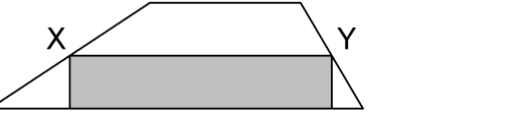
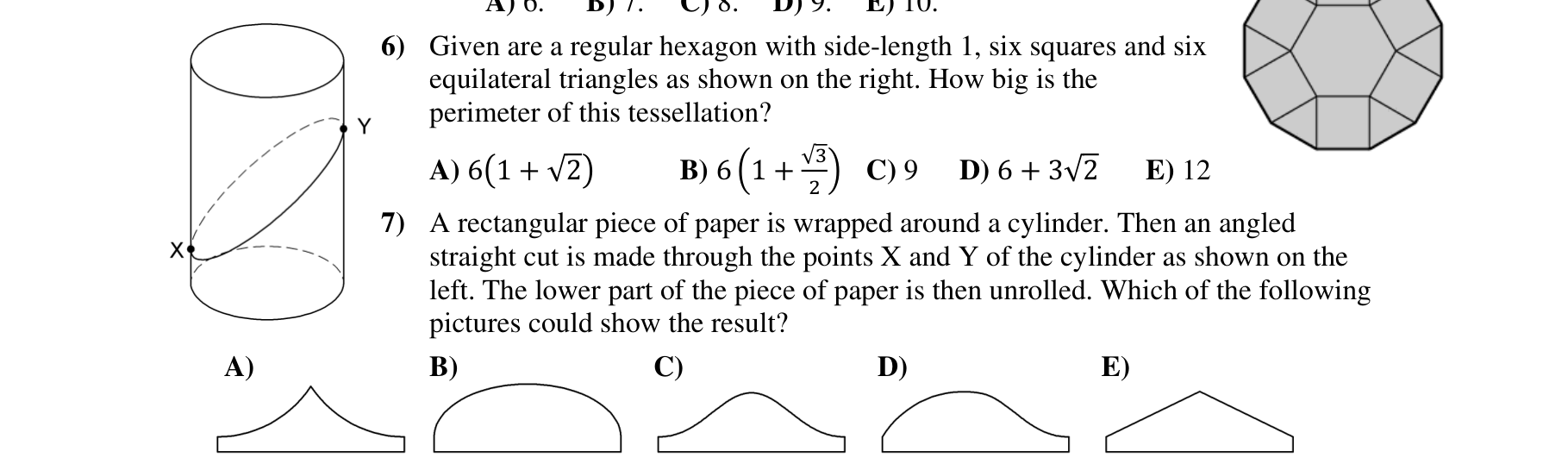
A rectangular piece of paper is wrapped around a cylinder. Then an angled straight cut is made through the points X and Y of the cylinder, as shown on the left. The lower part of the paper is then unrolled. Which of the following pictures could show the result?
Show answer
Answer: C
Show hints
Hint 1 of 2
A slanted plane cut across a cylinder, then unrolled, gives a smooth wave rather than a straight or circular top.
Still stuck? Show hint 2 →
Hint 2 of 2
The unrolled cut is one period of a sine curve.
Show solution
Approach: unrolling a slanted cylinder cut gives a sine curve
Wrapping height around the cylinder, a straight slanted cut becomes a sinusoid when the sheet is flattened.
The lower piece therefore has a single smooth sine-shaped upper edge.
Felix the Tomcat catches 12 fish in 3 days. On the second day he catches more than on the first. On the third day he catches more than on the second but less than on the first two days together. How many fish does he catch on day three?
Show answer
Answer: A — 5
Show hints
Hint 1 of 2
The three numbers add to 12 and increase, with day 3 less than the first two days combined.
Still stuck? Show hint 2 →
Hint 2 of 2
Try small increasing whole numbers that sum to 12 and check the day-3 condition.
Show solution
Approach: use the inequalities to pin the three day totals
Let the catches be d1 < d2 on days 1 and 2, with total 12.
Day 3 is more than day 2 but less than d1+d2.
Testing d1=3, d2=4 gives d3=5: indeed 5>4 and 5<7, and 3+4+5=12.
Given are a regular hexagon with side-length 1, six squares and six equilateral triangles arranged as shown. What is the perimeter of this tessellation?
Show answer
Answer: C — 12
Show hints
Hint 1 of 2
The squares and triangles all have side length 1, so every outer edge has length 1.
Still stuck? Show hint 2 →
Hint 2 of 2
Just count how many unit edges form the outer boundary of the whole tiling.
Show solution
Approach: count unit edges on the outer boundary
All pieces share the hexagon's side length 1, so each exposed edge is 1 unit long.
The outer boundary of the star-shaped tiling is a twelve-sided outline.
From all whole numbers between 100 and 1000 whose digits sum to 8, the smallest and the largest number are chosen. How big is the sum of those two numbers?
Show answer
Answer: B — 907
Show hints
Hint 1 of 2
To make the smallest number, keep the hundreds digit tiny; to make the largest, make it big.
Still stuck? Show hint 2 →
Hint 2 of 2
Find 107 and 800, then add them.
Show solution
Approach: find the smallest and largest 3-digit numbers with digit sum 8
Smallest such number puts weight at the end: 107 (1+0+7=8).
When Liza the cat is very lazy and sits around the whole day, she drinks 60 ml of milk. When she chases mice she drinks a third more milk. In the past two weeks, she has chased mice on every second day. How much milk has she drunk in the past two weeks?
Show answer
Answer: B — 980 ml
Show hints
Hint 1 of 2
First find how much she drinks on a chasing day (a third more than 60 ml).
Still stuck? Show hint 2 →
Hint 2 of 2
Over 14 days she chases on 7 days and is lazy on the other 7.
Show solution
Approach: combine the two kinds of days
A lazy day is 60 ml; a chasing day is a third more: 60 + 20 = 80 ml.
In two weeks (14 days) she chases on 7 days and is lazy on 7 days.
All the children in a class have at least one pet, and at most two pets. They write down how many pets they have together. Two children each have a dog and a fish. Three each have a cat and a dog. No child has two cats. Altogether they have eight cats, six dogs, and two fish. How many children are in the class?
Show answer
Answer: A — 11
Show hints
Hint 1 of 2
Sort the children by which pets they own, using the given groups first.
Still stuck? Show hint 2 →
Hint 2 of 2
Account for all 8 cats, 6 dogs and 2 fish without giving anyone two cats.
Show solution
Approach: tally each pet type
2 children have dog+fish (using both fish and 2 dogs); 3 children have cat+dog (using 3 cats and 3 dogs).
Dogs left: 6 − 5 = 1, so one child has just a dog. Cats left: 8 − 3 = 5, so five children have just a cat (no one has two cats).
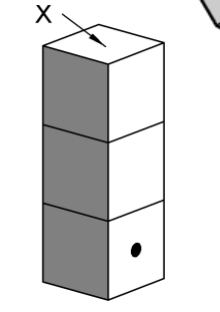
The picture shows three dice stacked on top of each other. The sum of the points on opposite sides of a die is 7, as usual. The sum of the points on the faces that touch each other is always 5. How many points are on the face marked X?
Show answer
Answer: E — 6
Show hints
Hint 1 of 3
Opposite faces of one die sum to 7, and the two faces where neighbouring dice touch sum to 5.
Still stuck? Show hint 2 →
Hint 2 of 3
Start from the visible front dot on the bottom die and step up the stack one face at a time.
Still stuck? Show hint 3 →
Hint 3 of 3
Use the two rules to relate each touching face to the one above it until you reach X.
Show solution
Approach: step the two face-sum rules up the stack to the top face X
Write the chain from the bottom die upward: opposite faces of a die sum to 7, and each pair of touching faces between two dice sums to 5.
Starting from the orientation fixed by the visible front 1, each touching pair forces the next face, and these alternating 7s and 5s carry the value up the column.
Following the chain to the very top face leaves X = 6, the only value keeping every die face between 1 and 6.
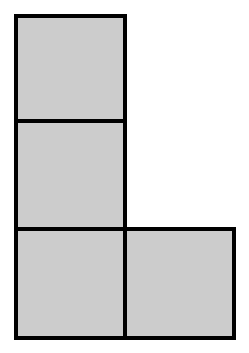
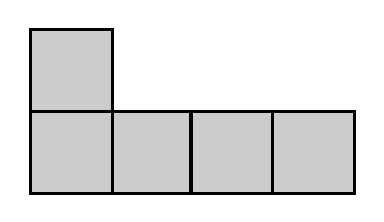
The picture shows an L-shaped object made up of four squares. We would like to add another equally big square so that the new object has a line of symmetry. How many ways are there to achieve this?
Show answer
Answer: C — 3
Show hints
Hint 1 of 2
A line of symmetry means one half is the mirror image of the other.
Still stuck? Show hint 2 →
Hint 2 of 2
Try adding the extra square in each open position and test for a mirror line.
Show solution
Approach: add a square so the figure gains a line of symmetry
The L of four squares can be completed in different ways by adding one equal square.
Check each spot where a new square can sit and see if the result has a mirror line.
Exactly 3 placements give a figure with a line of symmetry.
Max and Hugo roll a number of dice to decide who jumps first into the cold lake. If no six comes up, Max jumps; if exactly one six comes up, Hugo jumps; if several sixes come up, neither jumps. How many dice must they use so that the two boys are equally likely to have to jump in?
Show answer
Answer: B — 5
Show hints
Hint 1 of 2
Write the chance of 'no six' and the chance of 'exactly one six' with n dice, then set them equal.
Still stuck? Show hint 2 →
Hint 2 of 2
(5/6)n = n·(1/6)(5/6)n−1 collapses nicely.
Show solution
Approach: set the two probabilities equal and simplify
Fridolin the hamster runs through the maze in the picture. 16 pumpkin seeds are lying on the path. He is only allowed to cross each junction once. What is the maximum number of pumpkin seeds that he can collect?
Show answer
Answer: B — 13
Show hints
Hint 1 of 2
He may pass each junction only once, so he can't take every seed.
Still stuck? Show hint 2 →
Hint 2 of 2
Find the longest single path through the maze and count seeds along it.
Show solution
Approach: find the best non-repeating path
Fridolin must follow a path that uses each junction at most once.
Because some seeds sit on junctions he cannot revisit, he cannot collect all 16.
The best possible single path lets him pick up 13 of the pumpkin seeds.
Johannes has only 5 Cent coins and 10 Cent coins in his pocket. Altogether he has 13 coins. Which of the following amounts cannot be the total of his coins?
Show answer
Answer: B — 60 c
Show hints
Hint 1 of 2
With 13 coins, swapping a 5 c coin for a 10 c coin changes the total by a fixed step.
Still stuck? Show hint 2 →
Hint 2 of 2
Find the smallest and largest possible totals, and the step between reachable totals.
Show solution
Approach: range and step of the total
All 5 c gives 65 c; all 10 c gives 130 c; each 5→10 swap adds 5 c, so totals are 65, 70, 75, …, 130.
80, 70, 115 and 125 are all multiples of 5 in that range, but 60 c is below 65 c, so it cannot be the total, answer B.
In a certain month there were 5 Mondays, 5 Tuesdays and 5 Wednesdays. In the month before there were only 4 Sundays. What will be true in the next month?
Show answer
Answer: B — exactly 4 Saturdays
Show hints
Hint 1 of 2
Five Mondays, Tuesdays and Wednesdays force a 31-day month starting on a Monday.
Still stuck? Show hint 2 →
Hint 2 of 2
Use 'the previous month had only 4 Sundays' to identify the month, then look at the one after.
Show solution
Approach: pin down the month, then read off the next one
Five each of Mon/Tue/Wed means a 31-day month beginning on Monday (so it ends on a Wednesday).
The previous month ended on a Sunday with only 4 Sundays, which only fits a 28-day February — so this month is March.
Next is April (30 days) starting on Thursday: its Saturdays fall on the 3rd, 10th, 17th and 24th.
A rectangle is split into three smaller rectangles. One of them measures 7 by 11 and another measures 4 by 8. Determine the measurements of the third rectangle so that its area is as large as possible.
Show answer
Answer: D — 7 by 8
Show hints
Hint 1 of 2
Imagine one rectangle filling a full side, with the remaining strip split into two.
Still stuck? Show hint 2 →
Hint 2 of 2
Match shared side lengths: a strip 8 wide split into a 4-tall piece leaves a 7-tall piece.
Show solution
Approach: fit shared edges to size the third piece
Place 7×11 along the full height 11; the leftover column is 8 wide.
Splitting that column gives the 4×8 piece and a remaining 7×8 piece.
All the four-digit numbers with the same digits as 2011 (i.e. 0, 1, 1, 2) are written in a row in ascending order. What is the difference between the two numbers that are next to 2011 in this list?
Show answer
Answer: B — 891
Show hints
Hint 1 of 2
List all four-digit numbers using the digits 0, 1, 1, 2 in increasing order.
Still stuck? Show hint 2 →
Hint 2 of 2
Find 2011 in the list and look at its immediate neighbours.
Show solution
Approach: order the arrangements and subtract the neighbours
Using digits 0,1,1,2 (no leading zero), the ordered list is 1012, 1021, 1102, 1120, 1201, 1210, 2011, 2101, 2110.
The numbers just before and after 2011 are 1210 and 2101.
Three racers take part in a Formula-1 race: Michael, Fernando and Sebastian. From the start Michael is in the lead, in front of Fernando, who is in front of Sebastian. During the race Michael and Fernando overtake each other 9 times, Fernando and Sebastian 10 times, and Michael and Sebastian 11 times. In which order do the three finish the race?
Show answer
Answer: B — Fernando, Sebastian, Michael
Show hints
Hint 1 of 2
Each overtake of a pair flips that pair's relative order, so an odd count flips it and an even count restores it.
Still stuck? Show hint 2 →
Hint 2 of 2
Apply the odd/even rule to each of the three pairs to get the final order.
Show solution
Approach: use parity of each pair's overtakes
Start order M, F, S. Michael–Fernando swap 9 times (odd) → F ahead of M.
Fernando–Sebastian swap 10 times (even) → F stays ahead of S.
Michael–Sebastian swap 11 times (odd) → S ahead of M.
So F first, then S, then M: Fernando, Sebastian, Michael, choice (B).
Marie has 9 pearls which weigh, in order, 1 g, 2 g, 3 g, 4 g, 5 g, 6 g, 7 g, 8 g and 9 g. She makes four rings, each with two pearls. The pearls on those rings weigh, in order, 17 g, 13 g, 7 g and 5 g. How much does the pearl which has not been used weigh?
Show answer
Answer: C — 3 g
Show hints
Hint 1 of 2
You do not need to figure out the actual pairs — think about totals.
Still stuck? Show hint 2 →
Hint 2 of 2
Subtract the combined ring weight from the weight of all nine pearls.
Show solution
Approach: the unused pearl is the total minus the four ring sums
The pearls 1..9 weigh 1+2+...+9 = 45 g in total.
The four rings weigh 17+13+7+5 = 42 g and use 8 pearls.
Michael wants to write whole numbers into the empty cells of the 3×3 table on the right so that the numbers in every 2×2 square add up to 10. Four numbers are already filled in. Which of the following could be the sum of the remaining five numbers?
Show answer
Answer: E — None of these numbers is possible.
Show hints
Hint 1 of 3
Call the centre cell c and write each 2×2 sum-equals-10 condition in terms of c.
Still stuck? Show hint 2 →
Hint 2 of 3
Add the four border cells and the centre — the total comes out as 20 − 3c.
Still stuck? Show hint 3 →
Hint 3 of 3
Check whether any listed value has the form 20 − 3c for a whole number c.
Show solution
Approach: express the five unknowns through the centre value
With the centre = c, the four 2×2 conditions give the corners as 7−c, 5−c, 5−c, 3−c.
Their sum with c is (7−c)+(5−c)+c+(5−c)+(3−c) = 20 − 3c.
That is always 2 more than a multiple of 3, but 9, 10, 12, 13 are not.
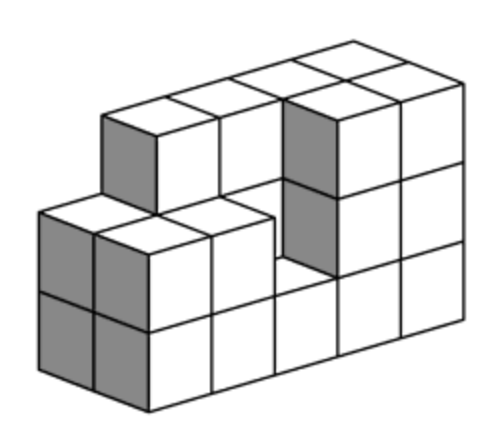
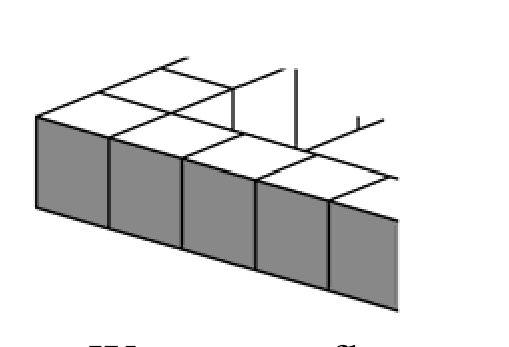
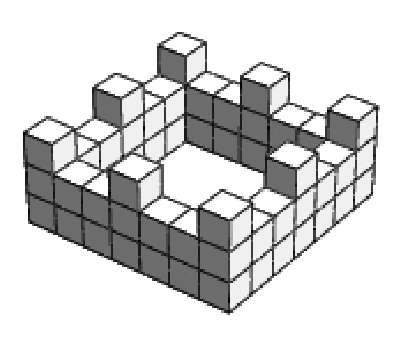
Nina made a wall around a square area, using 36 identical cubes. A section of the wall is shown in the picture. How many cubes will she now need to completely fill the square area?
Show answer
Answer: C — 64
Show hints
Hint 1 of 2
The 36 cubes form just the border of a square, one cube thick.
Still stuck? Show hint 2 →
Hint 2 of 2
Find the side of that square, then how many cubes fill the whole inside.
Show solution
Approach: the wall is the border; find the side, then fill the inside
The 36 cubes are just the outer ring of a square, one cube thick.
A square that has 10 cubes along each side uses 10 + 10 + 8 + 8 = 36 cubes around the edge (the corners are counted once), so each side is 10 cubes long.
The whole 10-by-10 area holds 10 × 10 = 100 cubes, and 36 are already the wall, so she still needs 100 − 36 = 64.
Shortcut with a formulaThe border of an \(n \times n\) square uses \(4n - 4\) cubes; \(4n - 4 = 36\) gives \(n = 10\), so the fill is \(100 - 36 = 64\).
Anna, Bob, Cleo, Dido, Eva, and Ferdl each roll a die. Each person rolls a different number. Anna’s number is twice as big as Bob’s. Anna’s number is three times as big as Cleo’s. Dido’s number is four times as big as Eva’s. Which number did Ferdl roll?
Show answer
Answer: D — 5
Show hints
Hint 1 of 2
Anna's number is both double and triple of someone's — what must it be?
Still stuck? Show hint 2 →
Hint 2 of 2
Once Anna is fixed, the other multiples force every name, leaving Ferdl's.
Show solution
Approach: pin down Anna first
Anna is 2×Bob and 3×Cleo, so Anna is divisible by 2 and 3 — on a die that means Anna = 6, Bob = 3, Cleo = 2.
Dido = 4×Eva forces Eva = 1, Dido = 4. The five used numbers are 6, 3, 2, 1, 4, so Ferdl rolled 5, answer D.
Fridolin the hamster runs through the maze shown. On the path there are 16 pumpkin seeds. He is only allowed to cross each junction once. What is the maximum number of pumpkin seeds that he can collect?
Show answer
Answer: B — 13
Show hints
Hint 1 of 2
He cannot revisit a junction, so some seed-bearing edges must be left out.
Still stuck? Show hint 2 →
Hint 2 of 2
Look for the route that misses as few seeds as possible while obeying the one-visit rule.
Show solution
Approach: trace a single path that crosses each junction once and grabs the most seeds
Seeds sit along the maze edges; he may pass each junction only once.
That restriction forces him to skip some edges, so he cannot scoop up all 16.
The best single legal route through the maze collects 13 seeds.
48 children are going on a ski trip. Six of them go with exactly one sibling, nine go with exactly two siblings, and four go with exactly three siblings. The remaining children go without any siblings. How many families are going on the trip?
Show answer
Answer: D — 36
Show hints
Hint 1 of 2
'Exactly one sibling' means a family of two; 'two siblings' a family of three, and so on.
Still stuck? Show hint 2 →
Hint 2 of 2
Turn each group of children into a count of families, then add the only-children.
Show solution
Approach: convert children-with-k-siblings into families
6 children with one sibling → 3 families of 2; 9 with two siblings → 3 families of 3; 4 with three siblings → 1 family of 4.
Children with siblings: 6+9+4 = 19, leaving 48−19 = 29 only-children → 29 families.
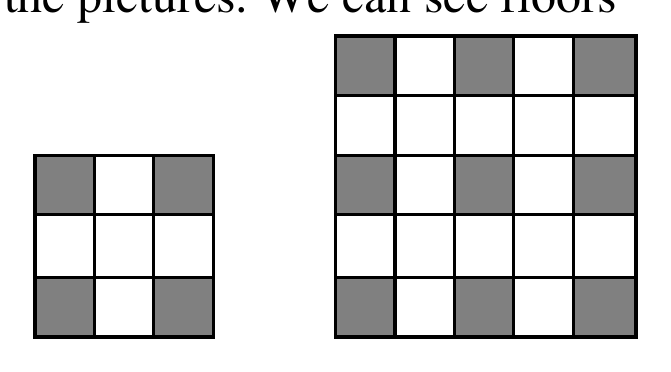
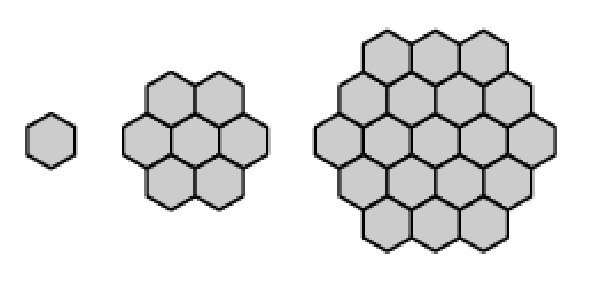
Black and white tiles can be laid on square floors as shown in the pictures. We can see floors with 4 black and 9 black tiles respectively. In each corner there is a black tile, and each black tile touches only white tiles. How many white tiles would there be on a floor that had 25 black tiles?
Show answer
Answer: D — 56
Show hints
Hint 1 of 2
Look at the small floors: 4 black tiles sit on a 3-by-3 floor, and 9 black tiles sit on a 5-by-5 floor.
Still stuck? Show hint 2 →
Hint 2 of 2
Spot the pattern in the floor sizes, then count the white tiles as total minus black.
Show solution
Approach: see how the floor grows with the black count, then subtract
Watch the pattern: 4 black tiles go on a 3-by-3 floor, and 9 black tiles go on a 5-by-5 floor — the side jumps by 2 each time.
Following the pattern, 25 black tiles go on a 9-by-9 floor, which is 9 × 9 = 81 tiles in all.
White tiles = 81 − 25 = 56.
Why the pattern worksWith \(n^2\) black tiles the floor is \((2n-1) \times (2n-1)\); for \(n = 5\) that is \(9 \times 9 = 81\), so white \(= 81 - 25 = 56\).
A quizshow has the following rules: each contestant begins with 10 points. They must answer 10 questions. For each correct answer they get a point and for each incorrect answer they lose a point. Mrs Blandorfer finished the show with 14 points. How many questions had she answered incorrectly?
Show answer
Answer: D — 3
Show hints
Hint 1 of 3
First imagine she got every single question right and see how many points that would give.
Still stuck? Show hint 2 →
Hint 2 of 3
Compare that perfect score with her real score of 14 points.
Still stuck? Show hint 3 →
Hint 3 of 3
Each wrong answer instead of a right one costs her 2 points: one she does not gain, plus one she loses.
Show solution
Approach: compare with a perfect score
If all 10 answers were right she would start with 10 and add 10, reaching 20 points.
She actually finished with 14, which is 20 − 14 = 6 points short of perfect.
Each wrong answer costs 2 points (she misses the +1 and also loses 1), so 6 ÷ 2 = 3 questions were wrong, answer D.
I have two cubes with side lengths a dm and a + 1 dm. The big cube is full of water and the little one is empty. I pour as much water as possible from the big one into the little one, and now 217 ℓ remain in the big cube. How many litres of water are now in the little one?
Show answer
Answer: B — 512 ℓ
Show hints
Hint 1 of 2
The leftover water equals the big cube's volume minus the small cube's volume.
Still stuck? Show hint 2 →
Hint 2 of 2
Set that difference equal to 217 (in litres = dm³) and solve for the side a.
Show solution
Approach: solve the cube-volume difference for a
1 dm³ = 1 litre, so the leftover is (a+1)³ − a³ = 217.
Expanding: 3a² + 3a + 1 = 217, so a² + a − 72 = 0, giving a = 8.
The small cube is now full, holding a³ = 8³ = 512 litres.
The list 17, 13, 5, 10, 14, 9, 12, 16 gives the points scored in a test. Which two scores can be removed without changing the average value of the list?
Show answer
Answer: E — 14 and 10
Show hints
Hint 1 of 2
First find the current average of the list.
Still stuck? Show hint 2 →
Hint 2 of 2
Two numbers can be dropped without changing the mean exactly when their sum is twice the mean.
Show solution
Approach: removing two numbers keeps the mean only if their sum equals 2×mean
The eight scores total 96, so the average is 96/8 = 12.
To keep the average 12 after removing two of them, the removed pair must sum to 2×12 = 24.
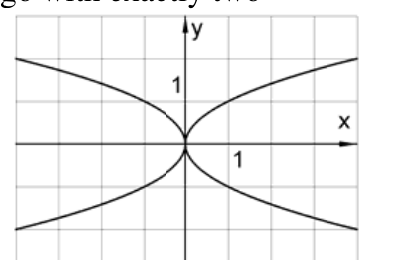
How many of the functions \(y=x^{2}\), \(y=-x^{2}\), \(y=+\sqrt{x}\), \(y=-\sqrt{x}\), \(y=+\sqrt{-x}\), \(y=-\sqrt{-x}\), \(y=+\sqrt{|x|}\), \(y=-\sqrt{|x|}\) have graphs that appear in the sketch on the right?
Show answer
Answer: D — 6
Show hints
Hint 1 of 2
Sort the eight functions into square-type parabolas and square-root-type curves.
Still stuck? Show hint 2 →
Hint 2 of 2
The sketch shows the sideways square-root branches, not the upward/downward parabolas.
Show solution
Approach: match the sketch to the square-root family of curves
The drawing shows curves that flatten near the axis like square roots, meeting at the origin.
Six of the listed functions (the √-type ones) reproduce exactly those branches; the two parabolas do not.
Paul wanted to multiply a whole number by 301, but forgot to include the zero and multiplied by 31 instead. His answer was 372. What should his answer have been?
Show answer
Answer: B — 3612
Show hints
Hint 1 of 2
Use the wrong answer to recover the original whole number.
Still stuck? Show hint 2 →
Hint 2 of 2
Then multiply that number by 301 as he intended.
Show solution
Approach: undo the wrong multiplication, then redo it right
He multiplied by 31 and got 372, so the number is 372 ÷ 31 = 12.
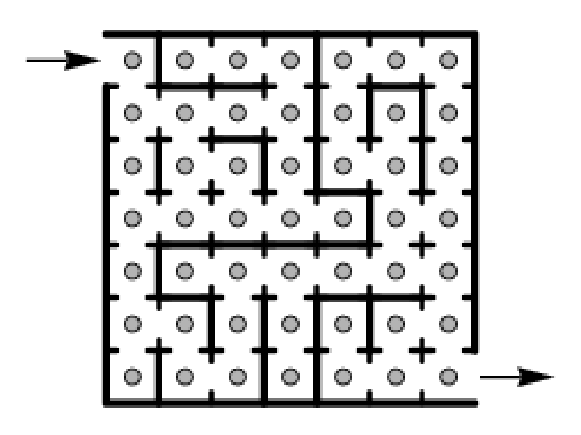
In each square of the maze there is a piece of cheese. Ronnie the mouse wants to enter and leave the maze as shown in the picture. He doesn’t want to visit a square more than once, but would like to eat as much cheese as possible. What is the maximum number of pieces of cheese that he can eat?
Show answer
Answer: C — 37
Show hints
Hint 1 of 2
Plan a single path from the entrance to the exit that never revisits a square.
Still stuck? Show hint 2 →
Hint 2 of 2
Try to weave through as many squares as the walls allow before leaving.
Show solution
Approach: trace the longest non-repeating path
Starting at the entrance, follow the corridors so the path never crosses itself.
The walls let the mouse snake through at most 37 of the squares before reaching the exit.
So the greatest number of cheese pieces he can eat is 37.
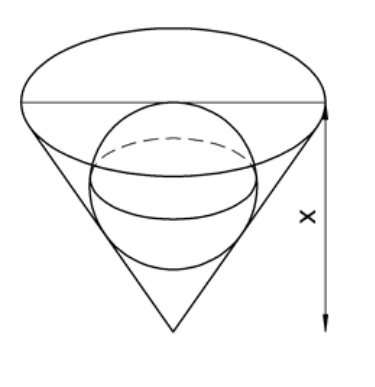
A marble of radius 15 is rolled into a cone-shaped hole. It fits in perfectly. From the side the cone looks like an equilateral triangle. How deep is the hole?
Show answer
Answer: C — 45
Show hints
Hint 1 of 2
From the side the cone is an equilateral triangle and the marble is its inscribed circle.
Still stuck? Show hint 2 →
Hint 2 of 2
For an equilateral triangle the inradius is one third of the height.
Show solution
Approach: use the equilateral triangle's inradius
Side-on, the marble is the circle inscribed in an equilateral triangle, with radius 15.
In an equilateral triangle the inradius equals one third of the height.
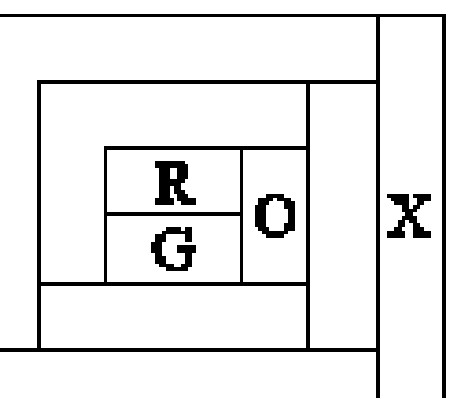
Each area in the picture should be coloured using one of the colours red (R), green (G), blue (B) or orange (O). Areas which touch must be different colours. Which colour is the area marked X?
Show answer
Answer: A — red
Show hints
Hint 1 of 2
Adjacent regions must use different colours, so colour the small inner regions first.
Still stuck? Show hint 2 →
Hint 2 of 2
Check which colours X is forced to avoid, then see which one is left for it.
Show solution
Approach: colour the regions in order so neighbours differ, then read off X
Fill the inner regions with the forced colours so touching areas differ (e.g. R, G, O as marked).
Region X borders the orange and the inner block but not the red region.
A consistent colouring lets X be red, so X is red.
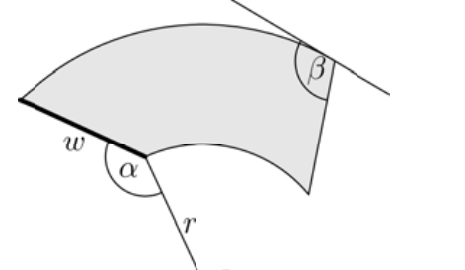
A car's rear window wiper is built so that the rod r and the wiper blade w are equally long and are joined at an angle α. The wiper turns about the centre of rotation O and wipes the area shown on the right. Find the angle β between the right edge of the cleaned area and the tangent to the curved upper edge.
Show answer
Answer: B — \(\pi-\frac{\alpha}{2}\)
Show hints
Hint 1 of 2
The blade tip traces a circle about O, and a tangent to that circle is perpendicular to the radius.
Still stuck? Show hint 2 →
Hint 2 of 2
Triangle O–joint–tip is isosceles (rod = blade), so its base angle is (π−α)/2.
Show solution
Approach: use the isosceles rod-blade triangle plus the tangent-radius right angle
Rod and blade are equal, so the triangle from O to the joint to the tip is isosceles with apex angle α; its base angle is (π−α)/2.
The tangent to the swept arc is perpendicular to the radius to the tip.
Adding the right angle to the base angle: β = π/2 + (π−α)/2 = π − α/2.
In a tournament FC Barcelona scored a total of three goals, and conceded one goal. In the tournament the team had won one game, lost one game and drawn one game. What was the score in the game that FC Barcelona won?
Show answer
Answer: B — 3:0
Show hints
Hint 1 of 2
The single goal they conceded must have come in the game they lost.
Still stuck? Show hint 2 →
Hint 2 of 2
That fixes the lost and drawn scores, leaving the goals for the win.
Show solution
Approach: place the one conceded goal, then balance the totals
They conceded only 1 goal all tournament, and a loss needs at least one conceded, so the loss was 0:1.
With no goals left to concede, the draw must be 0:0.
All 3 scored goals fall in the win, so the won game was 3:0.
During a party, two identical cakes were each cut into four identical pieces. Each of these pieces was then cut into three identical pieces. Each person at the party got a piece of cake, and there were three pieces left over. How many people were at the party?
Show answer
Answer: B — 21
Show hints
Hint 1 of 2
Work out how many small pieces the two cakes are cut into altogether.
Still stuck? Show hint 2 →
Hint 2 of 2
Each person ate one piece, and three pieces were left.
Show solution
Approach: count pieces, then subtract leftovers
Two cakes × 4 = 8 quarters, and each quarter × 3 = 24 small pieces in all.
Three pieces were left over, so the number of people = 24 − 3 = 21, answer B.
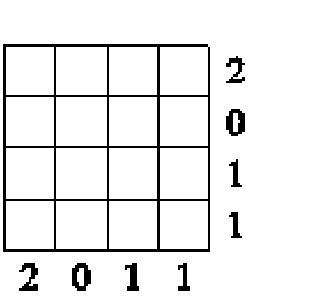
The cells of the 4×4 table shown should each be coloured either black or white. The numbers tell how many cells in each row and column should be black. In how many ways can the colouring be done?
Show answer
Answer: D — 5
Show hints
Hint 1 of 2
A row or column needing 0 black cells is entirely white, shrinking the puzzle.
Still stuck? Show hint 2 →
Hint 2 of 2
Count the black-cell placements left over for the smaller grid by cases on the row needing 2.
Show solution
Approach: remove the zero line, then enumerate the 3x3 core
The row and column needing 0 black cells are all white, leaving a 3×3 core with row sums 2,1,1 and column sums 2,1,1.
Place the two black cells of the '2' row, then fill the two '1' rows to meet the column totals.
The three cases for that pair of columns give 2 + 2 + 1 = 5 valid fillings.
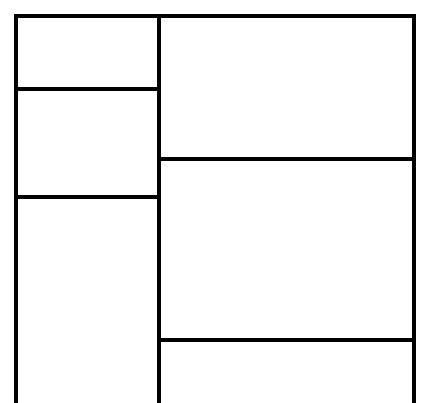
A square piece of paper is cut into six rectangular pieces as shown. The sum of the perimeters of the six pieces is 120 cm. How big is the area of the square?
Show answer
Answer: D — 144 cm²
Show hints
Hint 1 of 2
The six perimeters together include the outside edges plus the internal cut lines counted twice.
Still stuck? Show hint 2 →
Hint 2 of 2
Express that total in terms of the side length s, set it to 120, and solve.
Show solution
Approach: relate the total of the six perimeters to the square's side
When the square (side s) is cut into the six rectangles shown, the cut segments add length.
Adding up all six perimeters counts the square's outer edge plus twice every internal cut.
For this cut pattern that total equals 120 cm exactly when s = 12, so the area is 12² = 144 cm².
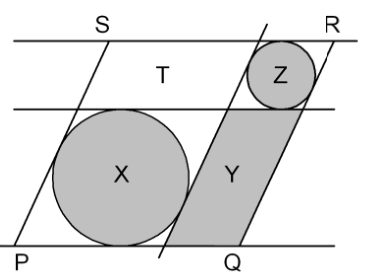
There are three horizontal lines and three parallel sloped lines. Both circles shown touch four of the lines. X, Y and Z are the areas of the grey regions, and D is the area of the parallelogram PQRS. At least how many of the areas X, Y, Z and D must you know in order to determine the area of the parallelogram T?
Show answer
Answer: A — 1
Show hints
Hint 1 of 2
The equally spaced parallel lines split PQRS into pieces with fixed area ratios.
Still stuck? Show hint 2 →
Hint 2 of 2
Because those ratios are fixed, one known area pins down all the rest, including T.
Show solution
Approach: exploit the fixed area ratios from equally spaced lines
The three-by-three set of parallel lines cuts the parallelogram into regions whose areas stay in fixed proportion.
Knowing any single one of X, Y, Z or D therefore determines every region, T included.
You are given the three corner points of a triangle and want to add a fourth point to make the four corners of a parallelogram. In how many places can the fourth point be placed?
Show answer
Answer: C — 3
Show hints
Hint 1 of 2
Draw the triangle, then try sliding the new point off each of the three corners in turn.
Still stuck? Show hint 2 →
Hint 2 of 2
Each corner of the triangle can be the one that sits opposite the new point — count those choices.
Show solution
Approach: let each triangle corner be the one opposite the new point
Draw the triangle with corners A, B, C; the fourth point joins them into a parallelogram.
Pick which corner is opposite the new point: if it is A you get one parallelogram, if B another, if C a third.
That gives three different spots for the fourth point, so the answer is 3.
Four friends Masha, Sasha, Dasha and Pasha are sitting on a bench. At first Masha swapped places with Dasha. Then Dasha swapped places with Pasha. After this the four friends are sitting from left to right in the order: Masha, Sasha, Dasha, Pasha. In what order, from left to right, were they sitting to begin with?
Show answer
Answer: C — Dasha, Sasha, Pasha, Masha
Show hints
Hint 1 of 2
Undo the swaps in reverse order, starting from the final seating.
Still stuck? Show hint 2 →
Hint 2 of 2
First undo the Dasha–Pasha swap, then the Masha–Dasha swap.
Show solution
Approach: reverse the swaps
Final order: Masha, Sasha, Dasha, Pasha. Undo the last swap (Dasha↔Pasha): Masha, Sasha, Pasha, Dasha.
Undo the first swap (Masha↔Dasha): the start was Dasha, Sasha, Pasha, Masha, answer C.
In a tournament FC Barcelona scored three goals and conceded one goal. The team won once, lost once and drew once in the tournament. What was the score in the game that FC Barcelona won?
Show answer
Answer: B — 3:0
Show hints
Hint 1 of 2
The team conceded only one goal in total — where could that single goal have gone?
Still stuck? Show hint 2 →
Hint 2 of 2
Pin down the loss and the draw first, then the won game score is forced.
Show solution
Approach: use the totals: 3 goals for, 1 against, over one win, one draw, one loss
Only 1 goal was conceded in all three games, so the loss was 0:1 and the draw must be 0:0.
That leaves all 3 scored goals for the win, with 0 conceded there.
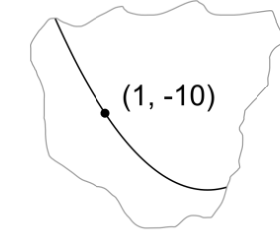
In the (x, y)-plane the coordinate axes are drawn as usual. The point A(1, −10), which lies on the parabola \(y=ax^{2}+bx+c\), was marked. Then the coordinate axes and most of the parabola were erased, leaving the sketch on the right. Which of the following statements could be false?
Show answer
Answer: E — \(c<0\)
Show hints
Hint 1 of 2
Use the point A(1, −10): substituting x = 1 gives a + b + c = −10.
Still stuck? Show hint 2 →
Hint 2 of 2
That fixes some statements as always true; look for the one that the picture does not force.
Show solution
Approach: substitute the known point and test each statement
A(1,−10) gives a+b+c = −10 < 0, so that statement is always true; the upward shape forces a > 0.
But c is the value at x = 0, which the trimmed picture does not pin down — it may be positive.
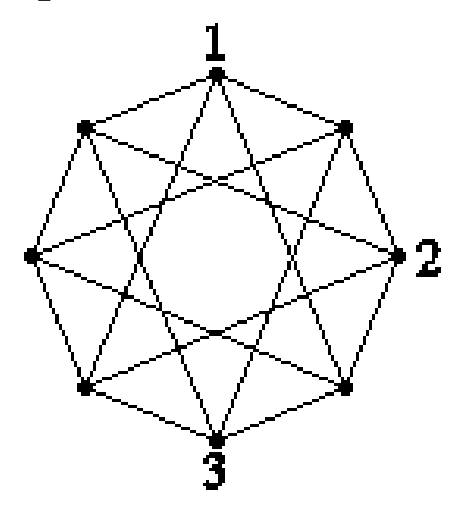
The 8 corners of the shape in the picture are to be labelled with the numbers 1, 2, 3 or 4, so that the numbers at the ends of each of the lines shown are different. How often does the number 4 appear on the shape?
Show answer
Answer: D — 4
Show hints
Hint 1 of 2
Endpoints of every drawn line must get different labels from {1,2,3,4}.
Still stuck? Show hint 2 →
Hint 2 of 2
This is a colouring; work out how many corners are forced to be 4.
Show solution
Approach: treat it as a proper labelling of the figure
Label the 8 corners with 1, 2, 3 or 4 so that any two corners joined by a line differ.
Working through the constraints of the drawn lines, the label 4 is forced onto exactly four corners.
Logic & Word Problemsclock-calendarcareful-counting
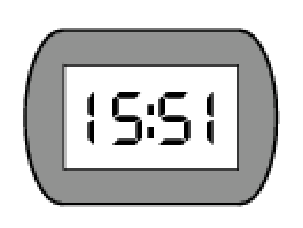
How often in a day does a digital clock display four identical digits? The picture shows a digital clock that is displaying exactly two different digits.
Show answer
Answer: C — 3 times
Show hints
Hint 1 of 2
A digital clock shows HH:MM on a 24-hour day — list when all four digits are equal.
Still stuck? Show hint 2 →
Hint 2 of 2
The hour can be at most 23, so check which single repeated digit even fits.
Show solution
Approach: check each repeated digit
All four digits the same means a time like dd:dd. The hour part dd must be a valid hour (00–23).
That allows 00:00, 11:11 and 22:22 only (33:33 etc. are not real times).
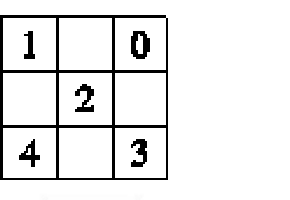
Nick wants to write whole numbers into the cells of the 3×3 table shown so that the sum of the numbers in each 2×2 sub-table is always 10. Five numbers have already been written. Determine the sum of the remaining four numbers.
Show answer
Answer: D — 12
Show hints
Hint 1 of 2
Each 2×2 block summing to 10 gives one equation among neighbouring cells.
Still stuck? Show hint 2 →
Hint 2 of 2
Add the right equations so the known centre and corners cancel, leaving the four unknown edge cells.
Show solution
Approach: combine the four 2x2 equations
Label the grid with corners 1, 0, 4, 3 and centre 2; the unknowns are the four edge-midpoints b, d, f, h.
Top blocks give b+d = 7 and b+f = 8; bottom blocks give d+h = 4 and f+h = 5.
The needed sum is b + d + f + h = (b+d) + (f+h) = 7 + 5 = 12.
So the four remaining numbers total 12, choice (D).
Louise draws a line DE of length 2 cm. How many ways are there for her to add a point F so that a right-angled triangle DEF with area 1 cm² can be formed?
Show answer
Answer: C — 6
Show hints
Hint 1 of 2
Area 1 with base 2 forces the distance from F to line DE to be 1.
Still stuck? Show hint 2 →
Hint 2 of 2
Consider separately where the right angle is: at D, at E, or at F.
Show solution
Approach: place the right angle at D, at E, or at F
With base DE = 2 and area 1, the height must be 1.
Right angle at D: F is 1 cm from D perpendicular to DE — 2 positions (each side); same at E gives 2 more.
Right angle at F: F lies on the circle with diameter DE, and height 1 is reached at exactly 2 points.
The sides AB, BC, CD, DE, EF and FA of a hexagon all touch the same circle. The sides AB, BC, CD, DE and EF, in this order, measure 4, 5, 6, 7 and 8. How long is side FA?
Show answer
Answer: D — 6
Show hints
Hint 1 of 2
For a polygon whose sides all touch one circle, the two tangent lengths from each vertex are equal.
Still stuck? Show hint 2 →
Hint 2 of 2
That makes the alternating sums of side lengths equal.
Show solution
Approach: equal alternating sums in a tangential polygon
In a tangential hexagon, AB + CD + EF = BC + DE + FA.
Jan cannot draw very accurately, but he tried to produce a road map of his village. The relative positions of the houses and the street crossings are all correct, but three of the roads are actually straight and only the Qurwikroad is not. Who lives on the Qurwikroad?
Show answer
Answer: C — Carol
Show hints
Hint 1 of 3
The house positions and crossings are drawn correctly, so a road is really straight only if its two ends could be joined by a straight line in the picture without crossing another road.
Still stuck? Show hint 2 →
Hint 2 of 3
Three of the four roads can be straightened that way; the Qurwikroad is the one that cannot.
Still stuck? Show hint 3 →
Hint 3 of 3
Check each house's road to see which one is forced to stay curved.
Show solution
Approach: find the one road that cannot be a straight line given the fixed positions
Since the positions of houses and crossings are accurate, a road is genuinely straight exactly when its drawn endpoints can be connected by a straight segment consistent with the other crossings.
Three of the four roads pass that test, so they are the straight ones.
The remaining road, the one whose endpoints cannot be joined straight without conflicting with the layout, runs to Carol's house.
What is the smallest possible positive whole-number value of the expression \(\dfrac{K\cdot A\cdot N\cdot G\cdot A\cdot R\cdot O\cdot O}{G\cdot A\cdot M\cdot E}\) if different letters stand for different digits, none equal to 0, and equal letters stand for equal digits?
Show answer
Answer: B — 2
Show hints
Hint 1 of 2
Cancel the letters common to top and bottom, leaving K·A·N·R·O·O over M·E.
Still stuck? Show hint 2 →
Hint 2 of 2
Make the denominator's two digits divide the numerator while keeping the quotient as small as possible.
Show solution
Approach: cancel, then choose digits to minimise the integer quotient
After cancelling one A and one G, the value is (K·A·N·R·O²)/(M·E) with eight distinct nonzero digits.
Choosing O = 1 and letting M·E absorb the rest, e.g. K,A,N,R = 2,3,4,6 and M,E = 8,9, gives 2·3·4·6/(8·9) = 2.
No assignment gives a positive value below 2, so the minimum is 2.
10 children are at a judo club. Their teacher has 80 sweets. If he gives each girl the same amount of sweets, there are three sweets left over. How many boys are at the club?
Show answer
Answer: C — 3
Show hints
Hint 1 of 2
Take away the 3 leftover sweets; the rest split evenly among the girls.
Still stuck? Show hint 2 →
Hint 2 of 2
The number of girls must divide that leftover-free amount exactly, and be fewer than 10.
Show solution
Approach: share the leftover-free sweets evenly among the girls
After 3 are left over, 80 − 3 = 77 sweets are shared equally among the girls.
77 splits evenly only into 7 groups of 11 (or 11 groups of 7), and only 7 girls fits a club of 10, so there are 7 girls.
You can place together the cards pictured to make different three‑digit numbers, for instance 989 or 986. How many different three‑digit numbers can you make with these cards?
Show answer
Answer: E — 12
Show hints
Hint 1 of 3
Two of the cards are the kind that show a 6 one way and a 9 when you turn them upside down; the 8 looks the same either way.
Still stuck? Show hint 2 →
Hint 2 of 3
First decide which of the three spots the 8 sits in, then fill the other two spots.
Still stuck? Show hint 3 →
Hint 3 of 3
For each place the 8 can go, the two leftover spots can each be a 6 or a 9.
Show solution
Approach: place the 8, then fill the other two spots with 6 or 9
There are three cards: two flip-cards that each show a 6 or a 9, and one 8-card that looks the same whichever way up it is.
Pick where the 8 goes: it can be the first, middle, or last digit — that is 3 choices.
For each of those, the two remaining spots can each be a 6 or a 9, giving 4 numbers per choice: for example with 8 in front you get 866, 869, 896, 899.
So the count is 3 groups of 4, which is 3 × 4 = 12 different numbers, answer E.
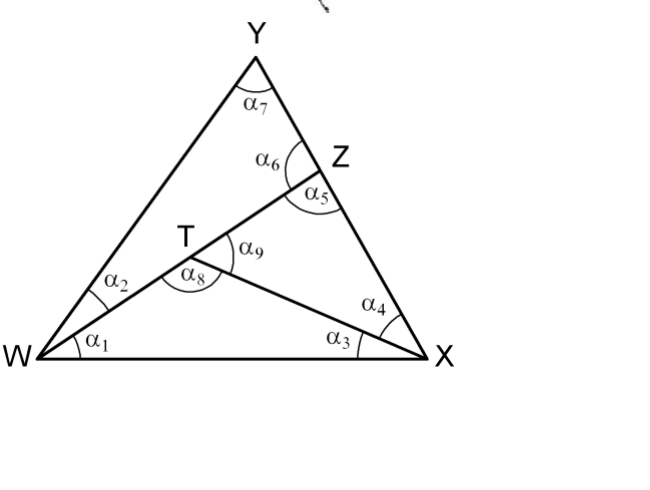
In the triangle WXY, point Z lies on XY and point T lies on WZ, as shown. Connecting T with X creates a figure with nine interior angles. Of those 9 angles, what is the smallest possible number that could all be different sizes from one another?
Show answer
Answer: B — 3
Show hints
Hint 1 of 3
The drawing makes three small triangles, and each one's angles must add to 180°.
Still stuck? Show hint 2 →
Hint 2 of 3
Ask how FEW distinct sizes the nine angles could take while still obeying every triangle's angle sum and the straight-line angles at T and Z.
Still stuck? Show hint 3 →
Hint 3 of 3
Try to force as many angles equal as possible and see what minimum number of different sizes survives.
Show solution
Approach: minimise the number of distinct angle sizes under the triangle-sum constraints
Segment TX cuts the figure into three triangles, and the marked angles also satisfy straight-angle relations along line WZ at T and along XY at Z.
If we try to make all nine angles equal, the 180° sums clash, so they cannot all match; with care we can still force them down to just a few values.
Choosing the shape cleverly collapses the nine angles into exactly three distinct sizes, and no arrangement does better.
So the smallest possible number of different sizes is 3, choice (B).
The brothers Gerhard and Günther pass on information about the members of their chess club. Gerhard says: “All members of our club are male, with five exceptions.” Günther says: “In every group of six members there are at least four female members.” How many members does the chess club have?
Show answer
Answer: B — 7
Show hints
Hint 1 of 2
'Five exceptions' means exactly five female members.
Still stuck? Show hint 2 →
Hint 2 of 2
If every group of six must hold at least four females, no group of six can contain three males — so there are at most two males.
Show solution
Approach: bound the males, then make the group-of-six condition meaningful
There are exactly 5 female members. Any six members must include ≥4 females, so at most 2 males.
For the 'every group of six' statement to be about more than the whole club, there must be more than six members.
A cat had 7 kittens. The kittens had the colours white, black, ginger, black-white, ginger-white, ginger-black, and ginger-black-white. In how many ways can you choose 4 cats so that each time two of them have a colour in common?
Show answer
Answer: C — 4
Show hints
Hint 1 of 2
Each kitten is a set of colours; every chosen pair must share a colour.
Still stuck? Show hint 2 →
Hint 2 of 2
Look for groups of four whose colour-sets pairwise overlap.
Show solution
Approach: count pairwise-intersecting families of four
List the colour-sets; any two chosen kittens must share at least one colour.
Three families work by sharing one fixed colour (all whites, all blacks, or all gingers — four kittens each).
A fourth family is the three two-colour kittens plus the all-three kitten, which also pairwise overlap.
That makes 4 valid ways to choose the four kittens.
Simon has a glass cube with side length 1 dm. He sticks several equally big black squares on it, as shown, so that all faces look the same. How many cm² were covered over?
Show answer
Answer: C — 225
Show hints
Hint 1 of 2
The cube has edge 10 cm, so its total surface area is 6 × 10².
Still stuck? Show hint 2 →
Hint 2 of 2
Find what fraction of each identical face the black squares cover, then take that share of the surface.
Show solution
Approach: take the covered fraction of the total surface
A 1 dm cube has edge 10 cm, so its surface area is 6 × 10² = 600 cm².
The pattern is identical on every face, so the same fraction of each 100 cm² face is black.
That fraction works out to ⅜ of each face, and ⅜ of 600 = 225 cm².
A drum contains a number of balls, each marked with a different positive whole number. On 30 of the balls the numbers are divisible by 6, on 20 balls the numbers are divisible by 7, and on 10 balls the numbers are divisible by 42. What is the minimum number of balls in the drum?
Show answer
Answer: B — 40
Show hints
Hint 1 of 2
Balls labelled with a multiple of 42 are counted in both the 'divisible by 6' and 'divisible by 7' groups.
Still stuck? Show hint 2 →
Hint 2 of 2
Use inclusion–exclusion on the 6- and 7-divisible counts.
Show solution
Approach: inclusion–exclusion on overlapping divisibility groups
Multiples of 42 are exactly the numbers divisible by both 6 and 7, and there are 10 of them.
The five-digit number \(\overline{abcde}\) is called interesting if all of its digits are different and a = b + c + d + e holds true. How many interesting numbers are there?
Show answer
Answer: C — 168
Show hints
Hint 1 of 2
The leading digit a must equal the sum of four distinct digits, so a is at least 6.
Still stuck? Show hint 2 →
Hint 2 of 2
For each value of a from 6 to 9, list the digit-sets, then multiply by the arrangements of the last four digits.
Show solution
Approach: case on the leading digit, then count arrangements
Since a = b+c+d+e with four distinct digits, the smallest possible sum is 0+1+2+3 = 6, so a is 6, 7, 8 or 9.
The sets summing to a (none equal to a) number 1, 1, 2, 3 for a = 6, 7, 8, 9: seven sets in all.
Each set's four digits can be arranged 4! = 24 ways after the fixed leading a.
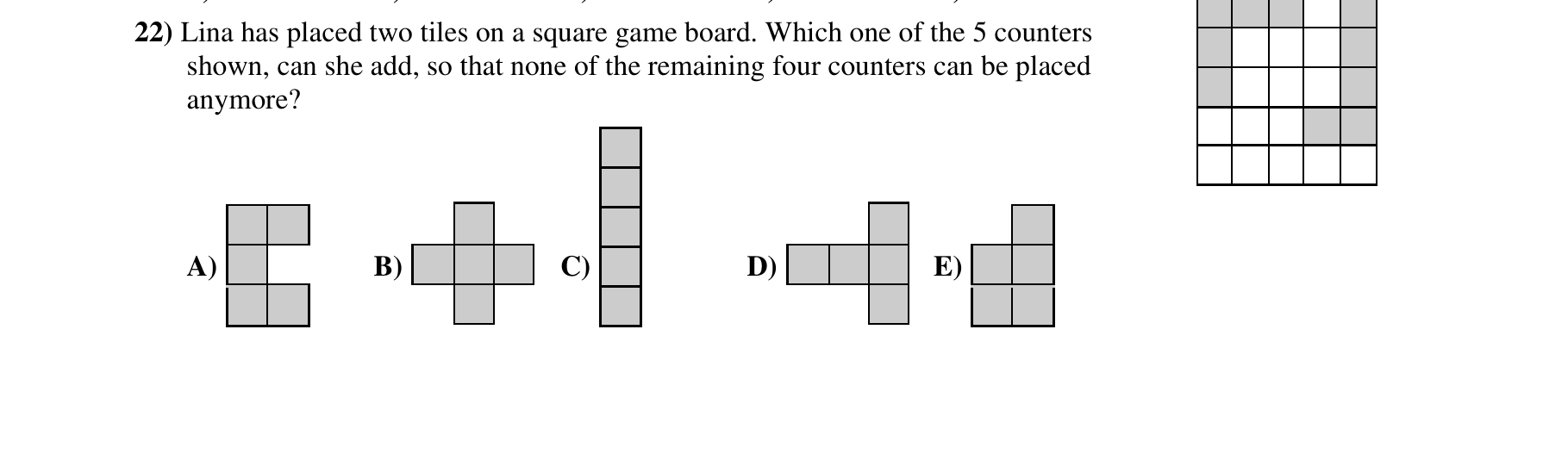
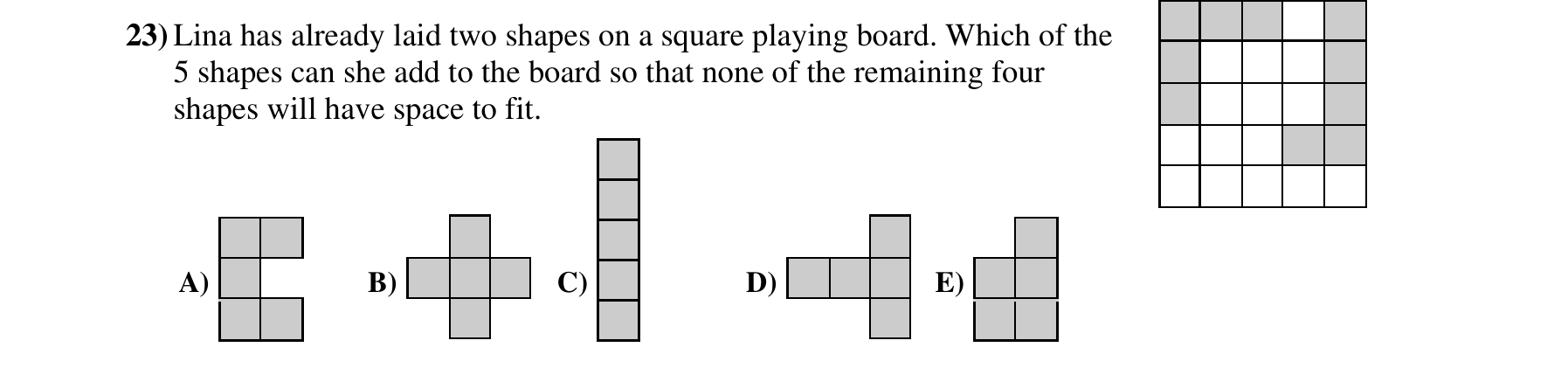
Lina has placed two tiles on a square game board. Which one of the 5 counters shown (A–E) can she add, so that none of the remaining four counters can be placed anymore?
Show answer
Answer: D
Show hints
Hint 1 of 2
A good blocking piece should break up the empty area into spaces too small for the others.
Still stuck? Show hint 2 →
Hint 2 of 2
Place each option and ask: can any other counter still be added?
Show solution
Approach: find the counter that blocks every spot for the remaining four
Two tiles are already placed; adding one more counter should leave no room for any of the other shapes.
Test each candidate counter and check whether the empty cells can still hold any remaining piece.
Only counter D fills the board so that none of the other four counters fit anymore.
Consider the two arithmetic sequences 5, 20, 35, … and 35, 61, 87, …. How many different arithmetic sequences of positive whole numbers have both of these as subsequences?
Show answer
Answer: C — 5
Show hints
Hint 1 of 2
For an arithmetic sequence to contain another as a subsequence, its common difference must divide the other's difference.
Still stuck? Show hint 2 →
Hint 2 of 2
Here the difference must divide both 15 and 26, whose gcd is 1.
Show solution
Approach: the super-sequence's step must divide both 15 and 26
To contain the step-15 sequence its difference d divides 15; to contain the step-26 sequence d divides 26.
Since gcd(15, 26) = 1, d = 1, so the super-sequence runs through consecutive integers.
Starting at any of 1, 2, 3, 4, 5 (it must reach 5) gives 5 such sequences.
(Note: the official key also accepts 'infinite' under a looser reading of the question.)
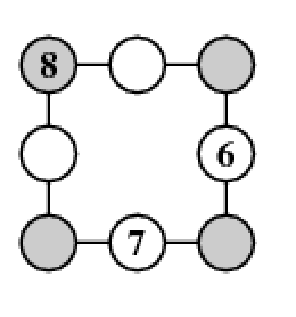
Johannes wrote the numbers 6, 7 and 8 in the circles as shown. He wants to write the numbers 1, 2, 3, 4 and 5 in the remaining circles so that the sum of the numbers along each side of the square is 13. What will be the sum of the numbers in the grey circles?
Show answer
Answer: E — 16
Show hints
Hint 1 of 3
The grey circles are the four corners, and the white circles are the four middles.
Still stuck? Show hint 2 →
Hint 2 of 3
Add up the four sides together: each corner sits on two sides, so it gets counted twice, while each middle is counted once.
Still stuck? Show hint 3 →
Hint 3 of 3
You also know all eight numbers (the corners plus the middles) are 1 to 8.
Show solution
Approach: add all four sides at once
Add the four side-totals together: 13 + 13 + 13 + 13 = 52. In that big sum each corner is counted twice (it touches two sides) and each middle is counted once.
All eight numbers 1, 2, 3, 4, 5, 6, 7, 8 add up to 36, so the corners and middles together make 36.
Take the 52 away from the 36 idea: 52 is one extra copy of every corner above the full 36, so the grey corners add to 52 − 36 = 16, answer E.
Each one of the three birds Isaak, Max and Oskar has its own nest. Isaak says: “I am more than twice as far away from Max as I am from Oskar.” Max says: “I am more than twice as far away from Oskar as I am from Isaak.” Oskar says: “I am more than twice as far away from Max as I am from Isaak.” At least two of them speak the truth. Who is lying?
Show answer
Answer: B — Max
Show hints
Hint 1 of 2
The statements form a cycle, so they cannot all be true at once.
Still stuck? Show hint 2 →
Hint 2 of 2
Try making each bird the single liar and see which case lets the other two be truthful.
Show solution
Approach: test which single liar makes at least two statements consistent
The three 'more than twice as far' claims cannot all hold together for any placement of nests.
Assume each bird in turn is the liar and check whether the other two statements can both be true.
Only if Max is lying can Isaak's and Oskar's statements both hold, so Max is lying.
The sequence of functions \(f_{1}(x),\,f_{2}(x),\,\ldots\) satisfies \(f_{1}(x)=x\) and \(f_{n+1}(x)=\dfrac{1}{1-f_{n}(x)}\). Determine the value of \(f_{2011}(2011)\).
Show answer
Answer: A — 2011
Show hints
Hint 1 of 2
Compute f₂, f₃, f₄ and watch for a repeat.
Still stuck? Show hint 2 →
Hint 2 of 2
The map cycles with period 3, so reduce 2011 modulo 3.
Show solution
Approach: detect the period-3 cycle
f₁(x)=x, f₂=1/(1−x), f₃=(x−1)/x, and f₄=x again — period 3.
Numbers are to be built using only the digits 1, 2, 3, 4 and 5 in such a way that each digit is only used once in each number. How many of these numbers will have the following property: the first digit is divisible by 1, the first 2 digits make a number divisible by 2, the first 3 digits make a number divisible by 3, the first 4 digits make a number divisible by 4, and all 5 digits make a number divisible by 5?
Show answer
Answer: A — It's not possible
Show hints
Hint 1 of 2
Each prefix has a divisibility rule: the 5th digit forces a 5 at the end, the even positions force even digits.
Still stuck? Show hint 2 →
Hint 2 of 2
Check whether the first-four-digits-divisible-by-4 rule can still be met.
Show solution
Approach: apply the prefix rules and hit a contradiction
The 5-digit number must end in 5 (divisible by 5 with no 0 available), and digits 2 and 4 must be even, so they are 2 and 4.
Divisibility of the first three digits by 3 forces digit 2 = 2, hence digit 4 = 4 and digits 1,3 are 1 and 3.
Then the first four digits end in '14' or '34', and neither is divisible by 4 — a contradiction.
Given is a regular tetrahedron ABCD whose face ABC lies on the plane \(\varepsilon\). The edge BC lies on the straight line s. Another tetrahedron BCDE shares one face with ABCD. Where does the straight line DE intersect the plane \(\varepsilon\)?
Show answer
Answer: C — Outside of ABC, not on the same side of s as A.
Show hints
Hint 1 of 3
Since ABCD is regular, A is itself an apex over face BCD, so E (the other regular tetrahedron's apex on BCD) is just A reflected across the plane BCD.
Still stuck? Show hint 2 →
Hint 2 of 3
Set simple coordinates with BC on the x-axis and A on the positive-y side, then find where line DE crosses z = 0.
Still stuck? Show hint 3 →
Hint 3 of 3
Check the y-sign of that crossing point to decide which side of s it lands on.
Show solution
Approach: reflect A across plane BCD to get E, then intersect line DE with the base plane
All edges of ABCD are equal, so A is an apex of face BCD; the second regular tetrahedron's apex E is therefore the mirror image of A in the plane BCD.
Placing B and C on line s with A on the positive-y side and D the apex above triangle ABC, reflecting A across plane BCD puts E below, with a negative y-coordinate.
Extending DE down to the base plane ε gives a point with negative y — outside triangle ABC and on the far side of s from A.
So DE meets ε outside ABC, not on A's side of s, choice (C).
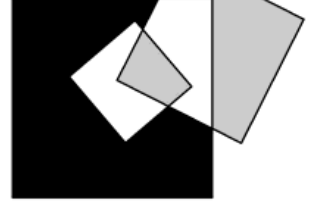
On the inside of a square with side length 7 cm another square is drawn with side length 3 cm. Then a third square with side length 5 cm is drawn so that it cuts the first two as shown in the picture. How big is the difference between the black area and the grey area?
Show answer
Answer: D — 15 cm²
Show hints
Hint 1 of 2
Set up the black area and the grey area and subtract; the overlap of the third square cancels.
Still stuck? Show hint 2 →
Hint 2 of 2
Work with the square areas 49, 9 and 25 and see how the shared region drops out.
Show solution
Approach: track which parts of each square count as black and as grey
The 7 cm square is black, the 3 cm square inside it is grey, and the 5 cm square overlays both.
Comparing the black region with the grey region, the overlapping pieces cancel out.
What remains is a difference of 15 cm² between the black and grey areas.
A box contains red and green balls. If two balls are drawn at random, the probability that they are the same colour is \(\tfrac{1}{2}\). Which of the following could be the total number of balls in the box?
Show answer
Answer: A — 81
Show hints
Hint 1 of 2
Set the chance of two same-colour equal to the chance of two different.
Still stuck? Show hint 2 →
Hint 2 of 2
The condition simplifies to (r − g)² = r + g, so the total must be a perfect square.
Show solution
Approach: reduce the probability condition to a perfect-square total
P(same) = 1/2 means C(r,2)+C(g,2) = rg, which simplifies to (r−g)² = r+g = n.
So the total n must be a perfect square.
Among the choices only 81 = 9² qualifies, so the total could be 81.
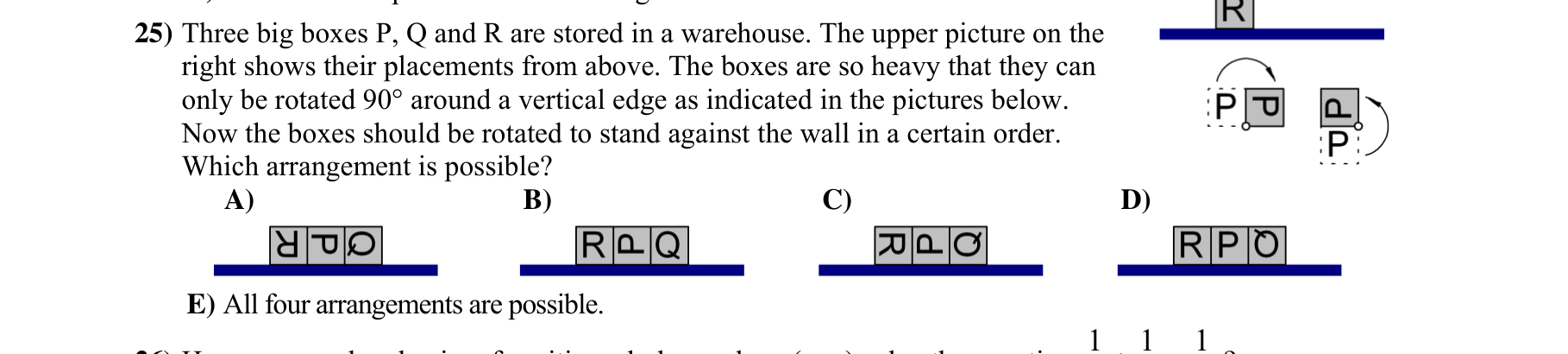
Three big boxes P, Q and R are stored in a warehouse. The upper picture on the right shows their placement seen from above. The boxes are so heavy that they can only be rotated 90° around a vertical edge, as indicated in the pictures below. Now the boxes should be rotated to stand against the wall in a certain order. Which arrangement is possible? (Choice E: all four arrangements are possible.)
Show answer
Answer: B
Show hints
Hint 1 of 3
Each allowed move is a 90° turn about a vertical edge, which both slides a box and rotates its top label a quarter turn.
Still stuck? Show hint 2 →
Hint 2 of 3
So a box's final orientation is tied to how far it travelled: track position and label-rotation together.
Still stuck? Show hint 3 →
Hint 3 of 3
Test each pictured line-up and reject any whose letters point the wrong way for the moves needed to reach it.
Show solution
Approach: couple each box's final position to its forced label orientation
Tipping a box 90° about a vertical edge moves it one step and turns its label a quarter turn, so position and orientation change together — they cannot be set independently.
Walking the boxes to the wall one move at a time, each box's letter must end pointing the way that number of quarter-turns dictates.
Comparing the four pictured line-ups, only one has every letter oriented consistently with the moves that put the boxes there.
Myshko shoots at a target board. He only hits the numbers 5, 8 and 10. In doing so he hits the numbers 8 and 10 equally often and scores a total of 99 points. For 25% of his shots he missed the target board completely. How often did he shoot at the target board?
Show answer
Answer: D — 20
Show hints
Hint 1 of 2
Call the equal counts of the 8s and 10s the same letter and write the score equation.
Still stuck? Show hint 2 →
Hint 2 of 2
Once you know how many shots hit, use 'missed 25%' to scale up to all shots.
Show solution
Approach: set hits of 8 and 10 equal, use the score, then the 25% miss rate
Let him hit 8 and 10 the same number of times, k each, and 5 some number m times.
Score: 5m + 8k + 10k = 5m + 18k = 99; trying k = 3 gives m = 9.
Hits = m + 2k = 15, and since 25% missed, hits are 75% of all shots, so total = 15/0.75 = 20.
An airline does not charge for luggage below a certain weight; for each additional kg there is a charge. Mr. and Mrs. Raiss had 60 kg of luggage and paid 3 €. Mr. Wander also had 60 kg of luggage but had to pay 10.50 €. How many kg of luggage per passenger were carried free?
Show answer
Answer: D — 25
Show hints
Hint 1 of 2
Mr. and Mrs. Raiss are two passengers; Mr. Wander is one — they share the same free allowance and rate.
Still stuck? Show hint 2 →
Hint 2 of 2
Set up the two charge equations and divide them to remove the rate.
Show solution
Approach: two charge equations, eliminate the per-kg rate by dividing
Let f be the free kg per passenger and c the rate. Raiss: c(60 − 2f) = 3; Wander: c(60 − f) = 10.5.
Dividing: (60 − f)/(60 − 2f) = 3.5, so 60 − f = 210 − 7f, giving 6f = 150.
In a convex quadrilateral ABCD with AB = AC, the following holds true: ∠BAD = 80°, ∠ABC = 75°, ∠ADC = 65°. How big is ∠BDC? (Note: in a convex quadrilateral all internal angles are less than 180°.)
Show answer
Answer: B — 15°
Show hints
Hint 1 of 2
Use AB = AC to get the base angles of triangle ABC, then the quadrilateral angle sum.
Still stuck? Show hint 2 →
Hint 2 of 2
Show AB = AD, find ∠ADB, and subtract it from ∠ADC.
Show solution
Approach: chase angles using AB = AC and the quadrilateral angle sum
AB = AC gives triangle ABC base angles 75°, so ∠BAC = 30° and ∠CAD = 50°.
The quadrilateral angles sum to 360°, forcing ∠BCD = 140°, hence ∠ACD = 65°, and triangle ACD gives AC = AD.
Then AB = AD too, so triangle ABD has base angles 50°, and ∠BDC = ∠ADC − ∠ADB = 65° − 50° = 15°.
For a positive whole number \(n \ge 2\), let \(\langle n\rangle\) denote the largest prime number less than or equal to n. How many positive whole numbers k satisfy the condition \(\langle k+1\rangle + \langle k+2\rangle = \langle 2k+3\rangle\)?
Show answer
Answer: B — 1
Show hints
Hint 1 of 2
Both sides are at most 2k+3, and the left side hits that maximum only when k+1 and k+2 are both prime.
Still stuck? Show hint 2 →
Hint 2 of 2
Test small k directly; the equality is very restrictive.
Show solution
Approach: bound both sides, then test small k
The left side is at most (k+1)+(k+2) = 2k+3, and the right side ⟨2k+3⟩ is at most 2k+3.
Equality forces a tight prime arrangement; checking k = 1 gives 2 + 3 = 5 = ⟨5⟩, which works.
For k = 2, 3, 4, ... the largest primes drop below the needed totals, so none work.
Seven years ago Eva’s age was a multiple of 8. In eight years it will be a multiple of 7. Eight years ago Raffi’s age was a multiple of 7. In seven years it will be a multiple of 8. Which of the following statements can be true?
Show answer
Answer: A — Raffi is two years older than Eva.
Show hints
Hint 1 of 2
Write each clue as 'age plus or minus something is a multiple of 7 or 8' and combine them.
Still stuck? Show hint 2 →
Hint 2 of 2
Compare the possible ages of Eva and Raffi to read off their age difference.
Show solution
Approach: find the smallest age each set of clues allows, then compare
Eva needs \(E-7\) a multiple of 8 and \(E+8\) a multiple of 7; the smallest realistic age that fits both is \(E=55\) (since \(48\) and \(63\) work).
Raffi needs \(R-8\) a multiple of 7 and \(R+7\) a multiple of 8; the smallest realistic age that fits both is \(R=57\) (since \(49\) and \(64\) work).
With \(E=55\) and \(R=57\), Raffi is exactly 2 years older than Eva, so statement A can be true.
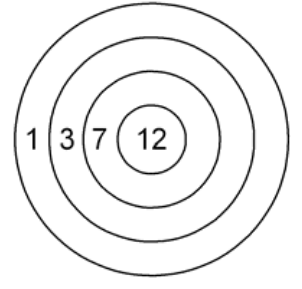
An archer tries his skill on the target shown on the right. With each of his three arrows he always hits the target. How many different total scores can he make with three arrows?
Show answer
Answer: C — 19
Show hints
Hint 1 of 2
Each arrow scores 1, 3, 7 or 12, and the three scores add up; repeats are allowed.
Still stuck? Show hint 2 →
Hint 2 of 2
List the possible totals for all triples and count the distinct values.
Show solution
Approach: enumerate distinct sums of three values from {1,3,7,12}
Any three arrows give a total a+b+c with each of a,b,c in {1, 3, 7, 12}.
Listing every combination yields totals 3,5,7,9,11,13,14,15,16,17,18,20,21,22,25,26,27,31,36.
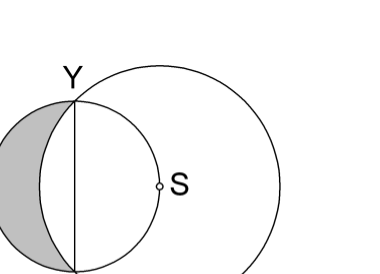
The two circles shown intersect each other at X and Y. Here XY is the diameter of the small circle. The centre S of the large circle (with radius r) lies on the small circle. How big is the area of the grey region?
Show answer
Answer: C — \(\dfrac{1}{2}r^2\)
Show hints
Hint 1 of 2
Since S lies on the small circle and XY is its diameter, angle XSY is a right angle.
Still stuck? Show hint 2 →
Hint 2 of 2
The grey lune's area equals the area of the right triangle XSY.
Show solution
Approach: use the lune = triangle identity
XY is the small circle's diameter and S lies on that circle, so angle XSY = 90°.
X and Y are on the large circle, so SX = SY = r, making XSY a right isosceles triangle of area ½r².
By the classic lune result, the grey crescent has the same area as triangle XSY.
Which is the smallest possible positive whole-number value of the expression K × A × N × G × A × R × O × OG × A × M × E if different letters stand for different digits not equal to 0, and the same letters stand for the same digits?
Show answer
Answer: B — 2
Show hints
Hint 1 of 2
First simplify by cancelling the letters that appear in both top and bottom.
Still stuck? Show hint 2 →
Hint 2 of 2
Then assign distinct digits so the remaining fraction is a small whole number.
Show solution
Approach: cancel repeated letters, then make the leftover product smallest
The expression is K·A·N·G·A·R·O·O divided by G·A·M·E; the G and one A cancel.
What is left is K·A·N·R·O·O / (M·E) with distinct nonzero digits.
Choosing digits so the bottom nearly matches the top makes the smallest whole-number value 2.
Let a, b and c be positive whole numbers for which \(a^{2}=2b^{3}=3c^{5}\). What is the smallest possible number of divisors of \(abc\), counting 1 and \(abc\) themselves?
Show answer
Answer: D — 77
Show hints
Hint 1 of 2
Write the common value as 2x3y and impose the square, cube and fifth-power conditions on the exponents.
Still stuck? Show hint 2 →
Hint 2 of 2
Each exponent must satisfy three modular conditions at once.
Show solution
Approach: force the exponents to meet all three power conditions
Let a² = 2b³ = 3c⁵ = 2x3y; then x,y even, x≡1 and y≡0 (mod 3), x≡0 and y≡1 (mod 5).
Smallest solution: x = 10, y = 6, giving abc = 2103⁶.
The figure on the left consists of two rectangles. Two side lengths are marked: 11 and 13. The figure is cut into three parts along the two lines drawn inside. These can be put together to make the triangle shown on the right. How long is the side marked x?
Show answer
Answer: B — 37
Show hints
Hint 1 of 2
Cutting and rearranging does not change total area — set rectangle area equal to triangle area.
Still stuck? Show hint 2 →
Hint 2 of 2
Use the marks 11 and 13 to find the area, then solve for the side x.
Show solution
Approach: the two rectangles' area equals the triangle's area
The three cut pieces from the two rectangles reassemble into the triangle, so the total area is preserved.
Using the marked lengths 11 and 13 to compute that area and matching it to the triangle gives the missing side.
Twenty different positive whole numbers are written into a 4×5 table. Any two numbers in cells that share a common side always have a common factor greater than 1. Determine the smallest possible value of n, where n is the largest number in the table.
Show answer
Answer: C — 26
Show hints
Hint 1 of 2
Neighbouring numbers must share a prime, so colour the grid like a checkerboard of two prime 'families'.
Still stuck? Show hint 2 →
Hint 2 of 2
Build the table from the smallest usable multiples of small primes to keep the maximum down.
Show solution
Approach: assign small-prime multiples to keep the largest entry minimal
Adjacent cells need a common factor, so arrange numbers from the smallest multiples of 2, 3, 5, … that still keep all 20 distinct.
Optimising the layout to minimise the biggest value gives a maximum of 26.
Determine all n (with \(1 \le n \le 8\)) for which one can mark several cells of a 5×5 table so that there are exactly n marked cells in every 3×3 sub-table.
Show answer
Answer: E — All numbers from 1 to 8 are possible.
Show hints
Hint 1 of 3
Sliding a 3×3 window one column right drops its left column and adds a new one, so equal counts force the dropped and added columns (over those three rows) to match.
Still stuck? Show hint 2 →
Hint 2 of 3
That balancing condition makes column-1 match column-4 and column-2 match column-5, suggesting a repeating pattern.
Still stuck? Show hint 3 →
Hint 3 of 3
Instead of asking which n are forbidden, just try to build one valid marking for each n from 1 to 8.
Show solution
Approach: build an explicit marking for every n from 1 to 8
Because overlapping windows force the marking to repeat (column 4 like column 1, column 5 like column 2, and likewise for rows), a marking is fixed by a small repeating block.
Choosing how many cells of that block are marked lets the common window-count be tuned up or down across the whole achievable range.
Carrying this out gives an explicit valid pattern for each target, so n = 1, 2, 3, 4, 5, 6, 7 and 8 are all attainable.
Logic & Word Problemswork-backwardcareful-counting
Mark plays a computer game on a 4×4 board. The cells each have a colour which is initially hidden. If he clicks on a cell it turns red or blue. He knows that there are exactly two blue cells and that they share one side. What is the smallest number of clicks with which he can definitely find the blue cells?
Show answer
Answer: B — 10
Show hints
Hint 1 of 2
Think of the two blue cells as a domino placed somewhere on the board.
Still stuck? Show hint 2 →
Hint 2 of 2
You need a clicking pattern that cannot miss the domino in any position — count the minimum needed.
Show solution
Approach: find the fewest clicks that always reveal the two adjacent blue cells
The two blue cells share an edge, so they form a domino somewhere in the 4×4 grid.
A clever set of clicks must hit at least one blue cell no matter where that domino lies, then confirm its partner.
The smallest number of clicks that guarantees finding both is 10.
A 3×3×3 die is built from 27 identical small dice. A plane perpendicular to one of the space diagonals of the big die passes through its midpoint. How many of the small dice does this plane cut?
Show answer
Answer: C — 19
Show hints
Hint 1 of 2
The plane through the centre, perpendicular to a space diagonal, cuts a hexagonal cross-section.
Still stuck? Show hint 2 →
Hint 2 of 2
A small cube is cut when the plane passes strictly between its nearest and farthest corner sums.
Show solution
Approach: count small cubes the central diagonal plane passes through
Place the plane as x+y+z = 4.5; a unit cube at (i,j,k) is cut when i+j+k < 4.5 < i+j+k+3.
Counting all 27 unit cubes, exactly 19 satisfy this.