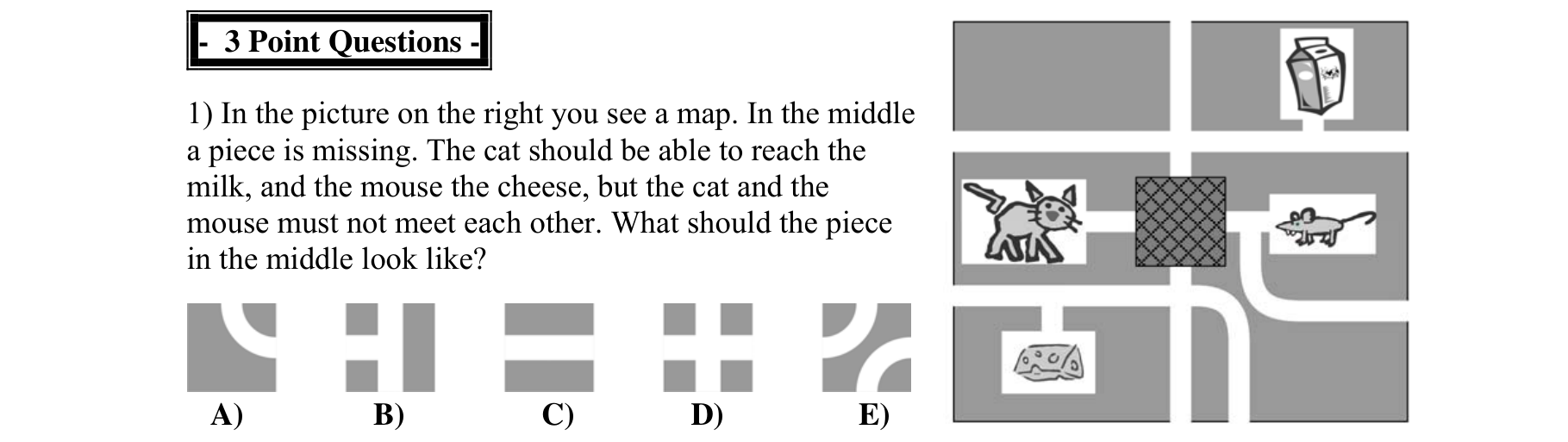
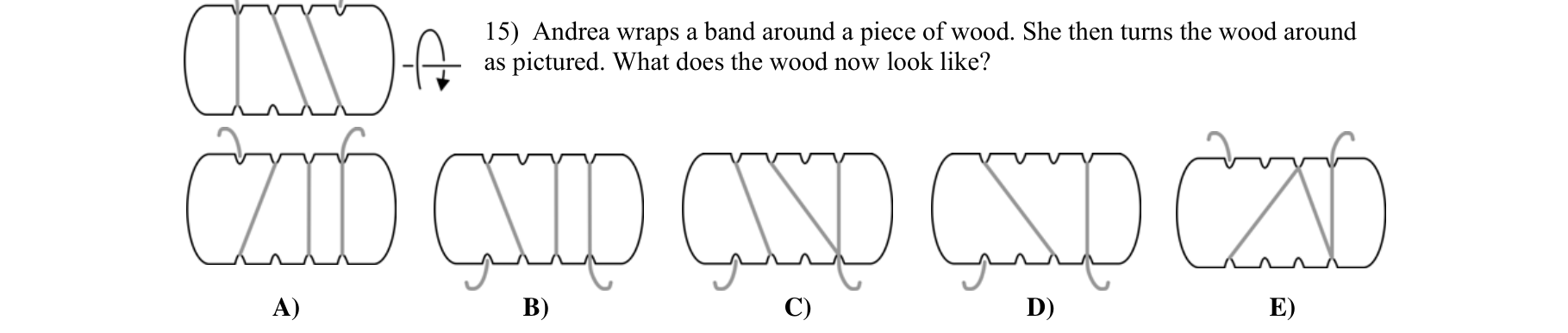
The road piece has to join the cat to the milk and the mouse to the cheese, yet keep those two routes from ever touching.
Still stuck? Show hint 2 →
Hint 2 of 2
Look at which sides of the missing square each road must enter and leave, then find the piece whose roads connect exactly those sides without crossing.
Show solution
Approach: match the road piece to the required connections
The cat must reach the milk, and the mouse the cheese, but the two animals' paths must stay separate.
So the missing piece needs two roads that link the correct opposite sides while never meeting in the middle.
Only the curved piece E carries the two routes past each other without letting them join.
Ivan gains 85% of the points in a test. Tibor gains 90% of the points in the same test, but only one point more than Ivan. What is the maximum number of points that can be gained in this test?
Show answer
Answer: D — 20
Show hints
Hint 1 of 2
The gap between 85% and 90% of the same total equals one point.
Still stuck? Show hint 2 →
Hint 2 of 2
Find what 5% of the total is worth.
Show solution
Approach: percent difference equals one point
Tibor scores 90% and Ivan 85% of the same total, so Tibor has 5% more.
That 5% is exactly 1 point, so 1% is worth 0.2 of a point.
The whole test is 100%, which is 100 times 0.2 = 20 points.
Kangi goes directly from the zoo (Zoo) to school (Schule) and counts the flowers along the way. Which of the following numbers can he not obtain this way?
Show answer
Answer: C — 11
Show hints
Hint 1 of 2
At each fork in the path Kangi can take either the top branch or the bottom branch.
Still stuck? Show hint 2 →
Hint 2 of 2
Write down every total he can make by mixing the branch choices, then see which listed number never appears.
Show solution
Approach: list the reachable totals
Each of the two loops offers two flower counts, and the middle stretch is always counted.
Combine a choice from the first loop with a choice from the second (plus the middle) to get the possible totals.
Listing them shows 9, 10, 12 and 13 are reachable but 11 is not.
The hollow spaces of two empty containers are cubic and have a base area of 1 dm² and 4 dm² respectively. The big container is to be filled with water, using the small one as a scoop. How many full scoops are necessary to fill the big cube?
Show answer
Answer: D — 8
Show hints
Hint 1 of 2
Both hollows are cubes, so a base area also fixes the height.
Still stuck? Show hint 2 →
Hint 2 of 2
Compare the two volumes, not the base areas.
Show solution
Approach: turn base areas into side lengths, then volumes
A cube with base 1 dm² has side 1 dm, so volume 1 dm³.
A cube with base 4 dm² has side 2 dm, so volume 2³ = 8 dm³.
Filling 8 dm³ one scoop (1 dm³) at a time needs 8 scoops.
A staircase has 21 steps. Nick and Mike count the steps, one from bottom to top and the other from top to bottom. They meet at one step, which Nick counts as the 10th. Which number does Mike give this same step?
Show answer
Answer: C — the 11th
Show hints
Hint 1 of 2
They both count the very same step, just starting from opposite ends.
Still stuck? Show hint 2 →
Hint 2 of 2
On a 21-step staircase, think about how many steps sit below the meeting step and how many sit above it.
Show solution
Approach: count the same step from the other end
The two boys meet on one shared step on a staircase of 21 steps.
Mike counts that step from the top: the steps above it plus the meeting step itself make up his count, which lands on the 11th.
So Mike calls the meeting step the 11th — the answer is C.
In a cafe the soup costs €4, the main course €9 and the dessert €5. The three courses ordered together cost €15. How many euros cheaper is this than ordering the same three courses separately?
Show answer
Answer: A — €3
Show hints
Hint 1 of 2
First add up the three separate prices.
Still stuck? Show hint 2 →
Hint 2 of 2
Then compare that total with the combined price of 15.
Show solution
Approach: compare separate total with bundle price
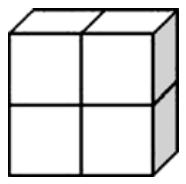
For transport, games are packed in several equally sized cube-shaped boxes. Every eight of these are packed into a bigger cubic box. How many of the small boxes are on the bottom level of the bigger box?
Show answer
Answer: D — 4
Show hints
Hint 1 of 2
A bigger cube made of eight equal cubes is a 2×2×2 stack.
Still stuck? Show hint 2 →
Hint 2 of 2
Just look at one floor of that 2×2×2 arrangement.
Show solution
Approach: picture the 2x2x2 cube
Eight equal cubes packed into a cube form a 2×2×2 block.
Each level (floor) is a 2×2 square of cubes = 4 boxes.
The managing director of a company claims “Every one of our employees is at least 25 years old.” It turns out, he is wrong. Which of the following statements is correct?
Show answer
Answer: D — One of the employees of the company is less than 25 years old.
Show hints
Hint 1 of 2
The boss's 'every employee is at least 25' is false.
Still stuck? Show hint 2 →
Hint 2 of 2
The exact opposite of 'all are at least 25' is just one counterexample.
Show solution
Approach: negate a universal statement
'Every employee is at least 25' being wrong means the claim fails for someone.
The negation of 'all ≥ 25' is 'at least one is below 25'.
Four friends each eat some ice cream. Mike eats more than Franz, Jaroslav eats more than Veit, and Jaroslav eats less than Franz. Put the friends in order by how much ice cream they ate, starting with the largest amount.
Show answer
Answer: C — Mike, Franz, Jaroslav, Veit
Show hints
Hint 1 of 2
Turn each clue into a simple "more than" comparison and chain them together.
Still stuck? Show hint 2 →
Hint 2 of 2
Jaroslav eats less than Franz but more than Veit, and Mike eats more than Franz.
Show solution
Approach: chain the inequalities into one order
Mike > Franz, Jaroslav > Veit, and Jaroslav < Franz.
Combine: Mike is biggest, then Franz, then Jaroslav, then Veit.
Largest first: Mike, Franz, Jaroslav, Veit — option C.
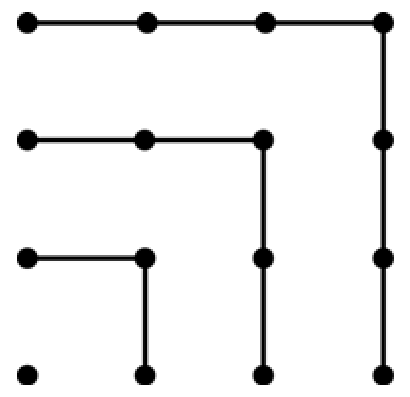
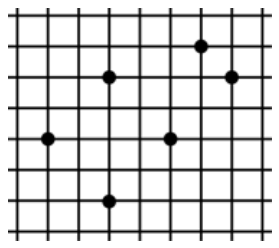
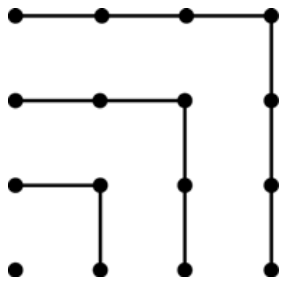
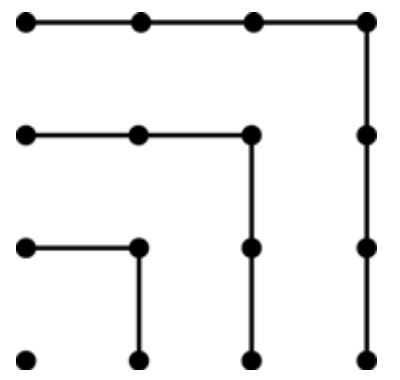
Six points are marked on a square grid as pictured. Which geometric figure cannot be drawn if only the marked points are allowed to be used as corner points of the figure?
Show answer
Answer: E — all figures are possible
Show hints
Hint 1 of 2
Look at where the six dots sit and try to actually build each named shape on them.
Still stuck? Show hint 2 →
Hint 2 of 2
Test the shapes one by one; if you can place all four, the answer is that all are possible.
Show solution
Approach: construct each shape on the marked points
Check each listed figure against the six marked points.
Each of the shapes can be formed using marked points as its corners.
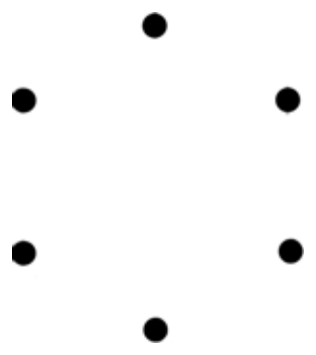
Martina draws the six corner points of a regular hexagon (see picture) and then connects some of them to obtain a geometric figure. Which of the following figures cannot be made?
Show answer
Answer: C — square
Show hints
Hint 1 of 2
Mark the six vertices of a regular hexagon and try to form each named shape.
Still stuck? Show hint 2 →
Hint 2 of 2
A square needs four points with equal sides and right angles — check whether any four hexagon vertices give that.
Show solution
Approach: try to realise each shape on hexagon vertices
A trapezium, a right-angled triangle, a kite and an obtuse triangle can all be formed from hexagon vertices.
But no four of the six regular-hexagon vertices form a square.
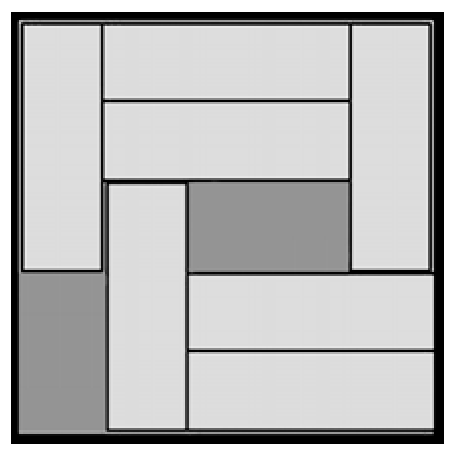
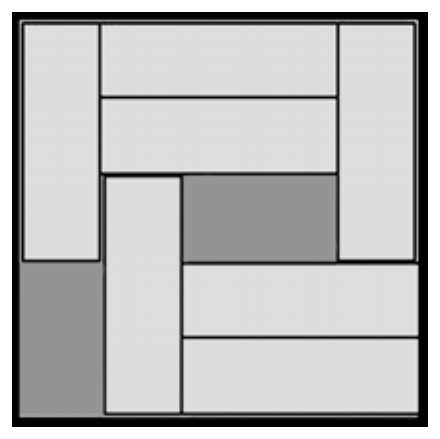
In the box are seven blocks. You want to rearrange the blocks so that another block can be placed in the box. What is the minimum number of blocks that have to be moved?
Show answer
Answer: B — 3
Show hints
Hint 1 of 2
You only need enough free space for one more block of the same kind.
Still stuck? Show hint 2 →
Hint 2 of 2
Try to clear the smallest set of blocks that opens up a gap big enough.
Show solution
Approach: find the fewest blocks to relocate to free a slot
Look for where an eighth block could fit and what currently blocks it.
Shifting the blocks around that spot, the minimum that must be moved is 3.
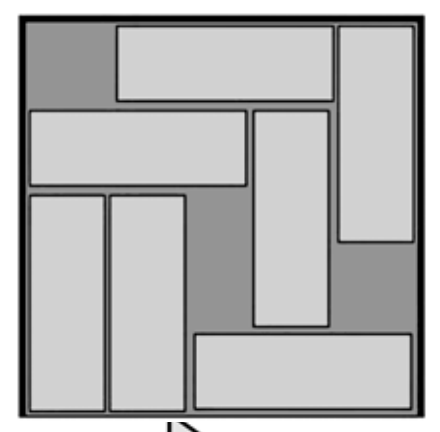
In the box there are seven blocks. By sliding the blocks around it is possible to make room so that one more block can be added. What is the least number of blocks that must be moved?
Show answer
Answer: B — 2
Show hints
Hint 1 of 2
Look at where the empty space is — it is split into pieces, not one block-sized hole yet.
Still stuck? Show hint 2 →
Hint 2 of 2
You only need to slide enough blocks to gather that empty space into one spot the new block fits.
Show solution
Approach: gather the empty space into one hole
There is exactly one block of empty space, but it is spread out, so a new block will not fit yet.
By sliding just two of the blocks, the scattered empty space lines up into a single block-shaped gap.
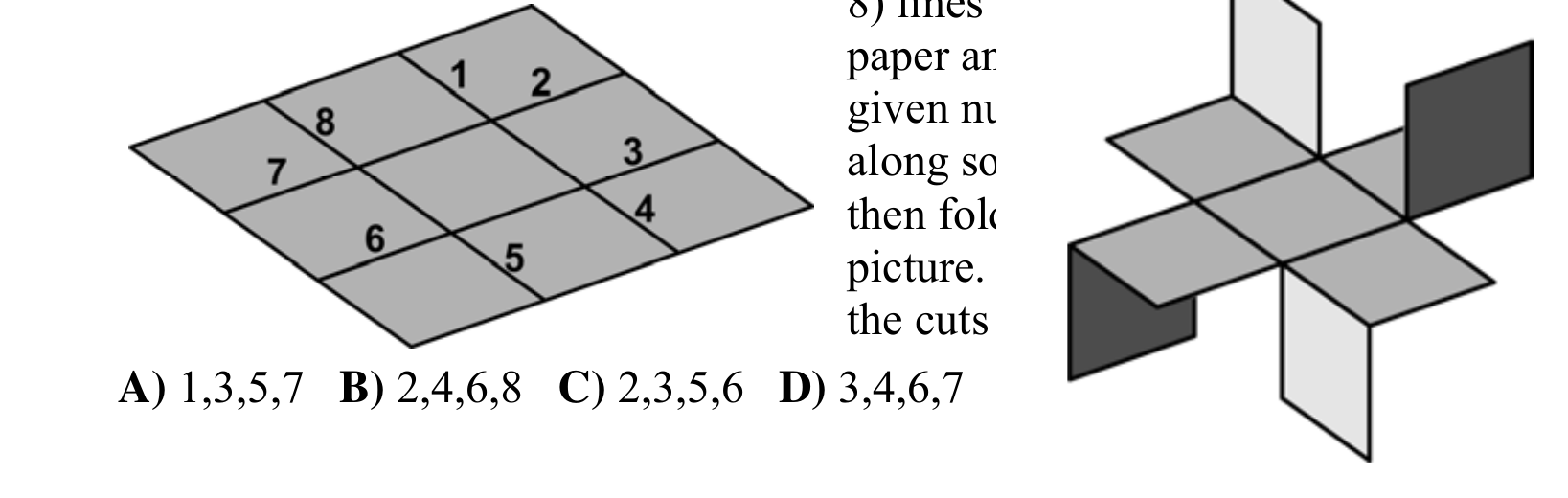
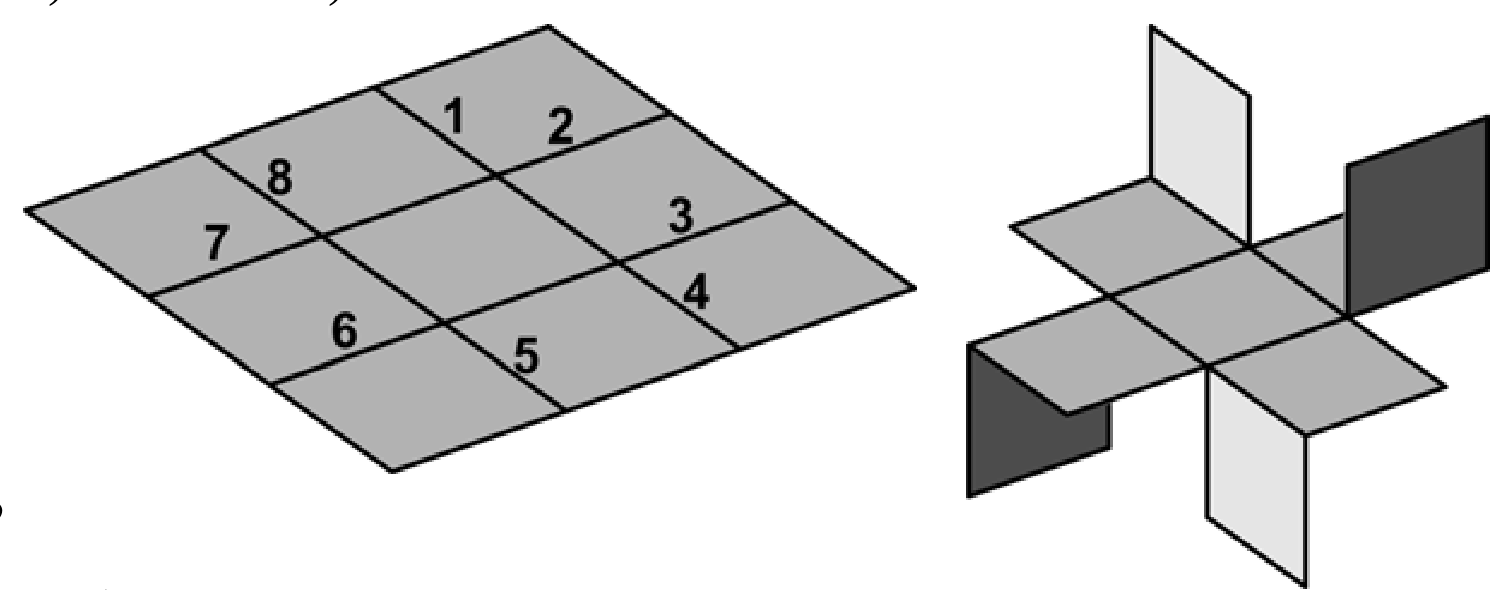
Lines are drawn on a piece of paper and some of the lines are numbered. The paper is cut along some of these lines and then folded into the shape shown. Along which lines were the cuts made?
Show answer
Answer: B — 2, 4, 6, 8
Show hints
Hint 1 of 2
A fold keeps the paper joined, but a cut lets a flap lift up and stand free.
Still stuck? Show hint 2 →
Hint 2 of 2
Match each free-standing flap in the folded picture back to its numbered line on the flat sheet.
Show solution
Approach: unfold the model in your head
On the flat sheet, a fold-line stays attached but a cut-line frees a flap to be raised.
Tracing the flaps that lift up in the folded picture back to the sheet, they sit on the even-numbered lines.
So the cuts were made along lines 2, 4, 6 and 8 (answer B).
Eva is a centipede with exactly 100 feet. Yesterday she bought 16 pairs of shoes and put them on right away. Even so, she still had 14 feet with no shoes. On how many feet was she already wearing shoes before she went shopping yesterday?
Show answer
Answer: C — 54
Show hints
Hint 1 of 2
Each pair of shoes covers 2 feet; first find how many feet have shoes now.
Still stuck? Show hint 2 →
Hint 2 of 2
Subtract the feet she put new shoes on today from the total now wearing shoes.
Show solution
Approach: count shod feet, then remove today's new shoes
She has 100 feet and 14 are bare, so 100 − 14 = 86 feet wear shoes now.
Today she put on 16 pairs = 32 shoes, covering 32 feet.
So before shopping she already wore shoes on 86 − 32 = 54 feet.
Brigitte goes on holiday to Verona and plans to cross all five of the famous old bridges over the Etsch (Adige) at least once. She starts at the train station and when she returns there she has crossed each of the five bridges but no others. During her walk she has crossed the river n times. What is a possible value for n?
Show answer
Answer: D — 6
Show hints
Hint 1 of 2
Each bridge she crosses takes her from one bank to the other, so think about which side she ends up on.
Still stuck? Show hint 2 →
Hint 2 of 2
Since she returns to the starting bank, the number of crossings must be even.
Show solution
Approach: parity of river crossings on a closed route
Every bridge she walks over flips her from one bank to the other, so the river crossing count must be even for her to come back to the station's bank.
That rules out the odd choices 3, 5 and 7, and 4 is too few to cover all five bridges.
Crossing the five bridges with one used twice gives 6 crossings, which works.
In a box are 50 counters: white ones, blue ones and red ones. There are eleven times as many white ones as blue ones. There are fewer red ones than white ones, but more red ones than blue ones. By how much is the number of red counters less than the number of white ones in the box?
Show answer
Answer: C — 19
Show hints
Hint 1 of 2
Let the number of blue ones be small and write white as eleven times that.
Still stuck? Show hint 2 →
Hint 2 of 2
Use the clues that red is between blue and white to pin everything down.
Show solution
Approach: set up with the blue count
If blue = b then white = 11b, and blue + white + red = 50 gives red = 50 - 12b.
With b = 3: white = 33, red = 14, and indeed blue(3) < red(14) < white(33).
In the box are seven blocks. It is possible to slide the blocks around so that another block can be added to the box. What is the minimum number of blocks that must be moved?
Show answer
Answer: B — 3
Show hints
Hint 1 of 2
You need to clear enough room for one more block of the empty shape.
Still stuck? Show hint 2 →
Hint 2 of 2
Find the fewest blocks to relocate so the free space lines up into one block-sized gap.
Show solution
Approach: rearrange to open one block-sized gap
The seven blocks leave scattered free space; an eighth block fits only after the gaps are merged.
Sliding 3 blocks is enough to gather the free area into one block-shaped opening, and fewer cannot.
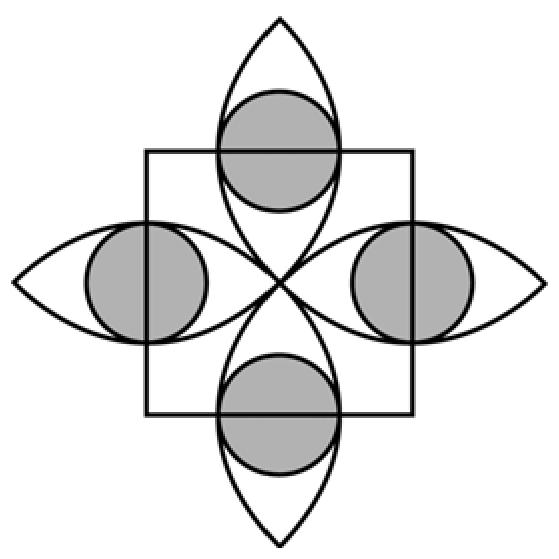
In the figure the square has side length 2. The semicircles pass through the midpoint of the square and have their centres on the corners of the square. The grey circles have their centres on the sides of the square and touch the semicircles. How big is the total area of the grey parts?
Show answer
Answer: A — \(4\cdot(3-2\sqrt{2})\cdot\pi\)
Show hints
Hint 1 of 2
Find the radius of a semicircle: its centre is a corner and it passes through the square's centre.
Still stuck? Show hint 2 →
Hint 2 of 2
A grey circle sits on a side and just touches a semicircle; relate their radii along that line.
Show solution
Approach: find both radii, then add four grey-circle areas
A semicircle is centred at a corner and reaches the square's centre, a distance √2, so its radius is √2.
A grey circle is centred at a side's midpoint, distance 1 from the nearest corner; touching the semicircle gives 1 + r = √2, so r = √2 − 1.
Matthias and Klara live in a tower block. Klara lives 12 floors above Matthias. One day Matthias climbs the stairs to visit Klara. When he is halfway there he is on the 8th floor. On which floor does Klara live?
Show answer
Answer: B — 14th
Show hints
Hint 1 of 2
Halfway up the climb, Matthias has gone up half of the 12 floors.
Still stuck? Show hint 2 →
Hint 2 of 2
Find Matthias's floor first, then add 12 for Klara.
Show solution
Approach: use the halfway floor to find the start
Half of the 12-floor climb is 6 floors, and that point is the 8th floor.
Grandma has baked a cake for her grandchildren. She does not know whether 3, 5, or all 6 grandchildren will come today. Into how many pieces does she have to cut the cake so that, no matter how many come, all the grandchildren present get the same amount of cake?
Show answer
Answer: E — 30
Show hints
Hint 1 of 2
The number of pieces must split evenly among 3, 5 or 6 children.
Still stuck? Show hint 2 →
Hint 2 of 2
So you need the smallest number divisible by all of 3, 5 and 6 — their least common multiple.
Show solution
Approach: least common multiple
The pieces must divide evenly by 3, by 5 and by 6.
LCM(3,5,6) = 30, so she cuts the cake into 30 pieces.
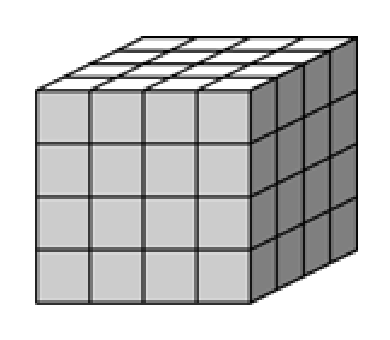
A large cube is made from 64 small cubes. The 5 visible faces of the large cube are green and the bottom face is red. How many of the small cubes have 3 green faces?
Show answer
Answer: A — 4
Show hints
Hint 1 of 2
A small cube shows 3 green faces only if it is a corner of the big cube with all three faces on green sides.
Still stuck? Show hint 2 →
Hint 2 of 2
The bottom face is red, so bottom corners can't have 3 green faces — only the top corners can.
Show solution
Approach: check which corner cubes touch three green faces
Only corner cubes can show three faces.
The four bottom corners each touch the red bottom, so they have at most 2 green faces.
The four top corners each touch the green top and two green sides — 3 green faces.
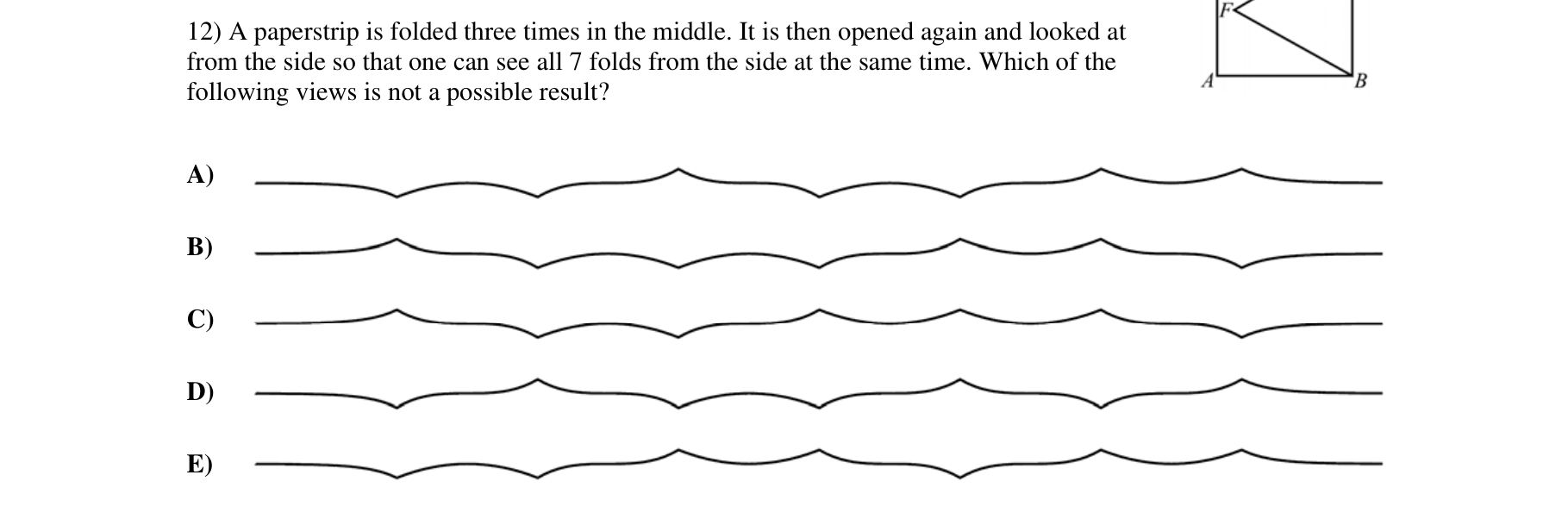
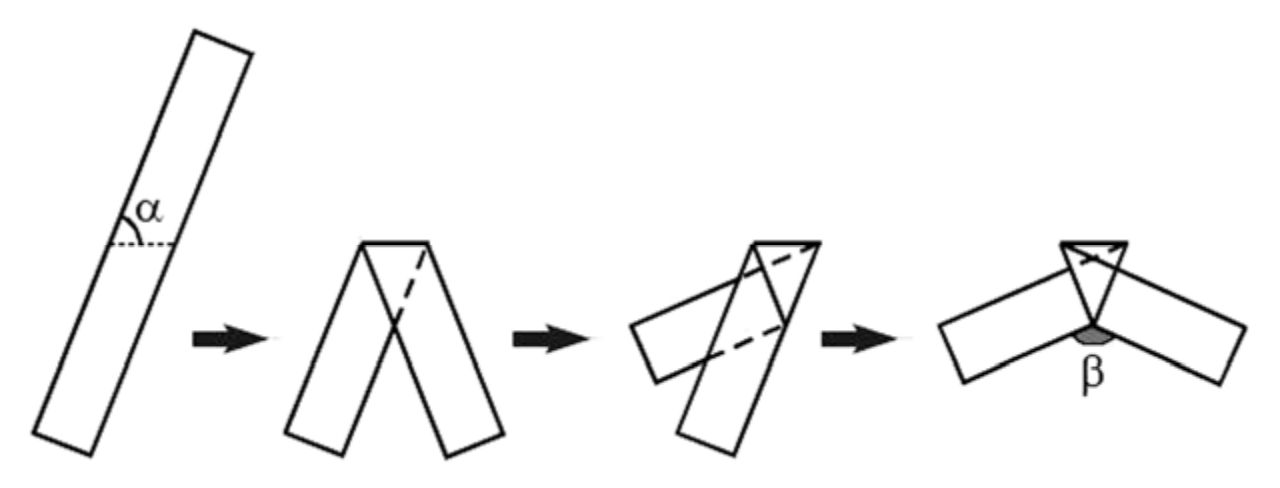
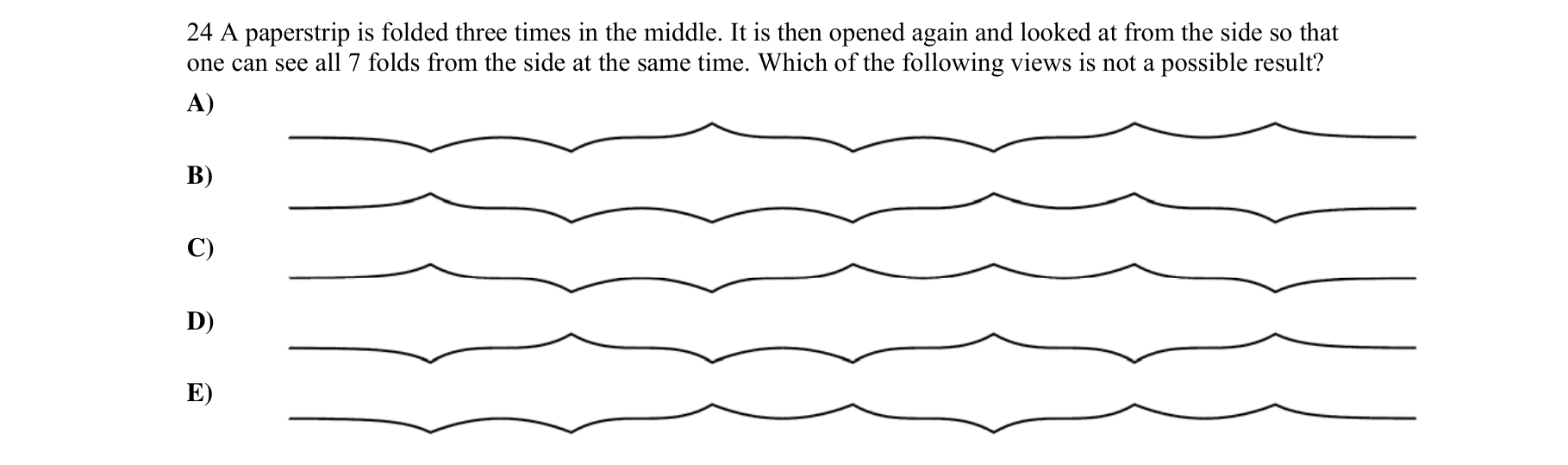
A paper strip is folded three times in the middle. It is then opened again and looked at from the side, so that one can see all 7 folds from the side at the same time. Which of the following views is not a possible result?
Show answer
Answer: D
Show hints
Hint 1 of 2
Folding a strip in the middle three times makes 7 creases when reopened.
Still stuck? Show hint 2 →
Hint 2 of 2
Look at the up/down pattern of creases; one of the pictures breaks the rule of what folding can make.
Show solution
Approach: check the crease (mountain/valley) pattern
Folding in the middle three times and reopening leaves seven creases, each either a peak (mountain) or a dip (valley).
Repeated centre-folding forces a fixed symmetric mountain/valley pattern, so most of the pictures match a real fold while one cannot occur.
The view that no sequence of centre folds can produce is D.
Benjamin chooses a number, divides it by 7, adds 7 to the result, and then multiplies that result by 7. He obtains the number 777. Which number did he start with?
Show answer
Answer: E — 728
Show hints
Hint 1 of 2
Run the story backwards, starting from the final answer 777.
Still stuck? Show hint 2 →
Hint 2 of 2
Each step undoes the one Benjamin did: undo a multiply with a divide, undo an add with a subtract.
Show solution
Approach: undo each step from the end
The last thing he did was \(\times 7\), so undo it: \(777 \div 7 = 111\).
Before that he added 7, so undo it: \(111 - 7 = 104\).
The first thing he did was \(\div 7\), so undo it: \(104 \times 7 = 728\) — the answer is E.
The numbers 1, 4, 7, 10 and 13 are to be written into the squares so that the sum of the three numbers in the horizontal row equals the sum of the three numbers in the vertical column. What is the largest possible value of these sums?
Show answer
Answer: E — 24
Show hints
Hint 1 of 2
The square in the middle belongs to both the row and the column, so it gets counted twice.
Still stuck? Show hint 2 →
Hint 2 of 2
Since the middle number is the one counted twice, putting the biggest number there makes both sums as large as possible.
Show solution
Approach: put the biggest number where it counts twice
Both the row and the column share the centre square, so the centre number adds into both sums.
Place the largest, 13, in the centre; the other four \(\{1, 4, 7, 10\}\) split into two equal pairs \(1 + 10 = 4 + 7 = 11\).
Each line is then \(11 + 13 = 24\), so the largest possible sum is 24 (answer E).
A ferry boat can carry, in one trip, either 10 cars or 6 lorries. Yesterday the boat crossed the river 5 times. It was always full and carried 42 vehicles in all. How many of these were cars?
Show answer
Answer: E — 30
Show hints
Hint 1 of 2
Each of the 5 full trips carries either 10 cars or 6 lorries.
Still stuck? Show hint 2 →
Hint 2 of 2
Start by pretending every trip was lorries, then see how far short of 42 you are.
Show solution
Approach: start from all-lorry trips and swap until the total is right
If all 5 trips were lorry trips, that would be 6 + 6 + 6 + 6 + 6 = 30 vehicles, which is 12 short of 42.
Changing one lorry trip (6) into a car trip (10) adds 4 vehicles, and 12 needs three such changes.
So 3 trips were car trips: 10 + 10 + 10 = 30 cars, choice E.
In order to sew together three short strips of cloth to get one long strip, Cathy needs 18 minutes. How much time does she need to sew together a really long piece consisting of six short strips?
Show answer
Answer: D — 45 minutes
Show hints
Hint 1 of 2
Joining strips needs one fewer seam than the number of strips.
Still stuck? Show hint 2 →
Hint 2 of 2
Find the time per seam from the three-strip case, then count seams for six strips.
Show solution
Approach: count seams, scale by time per seam
Three strips need 2 seams and take 18 min, so each seam takes 9 min.
To make a newspaper with 60 pages, you need 15 sheets stacked inside one another. In one such newspaper, page 7 is missing. Which other pages are also missing from this newspaper?
Show answer
Answer: E — 8, 53 and 54
Show hints
Hint 1 of 2
One loose sheet has four pages on it: two near the front of the paper and two near the back.
Still stuck? Show hint 2 →
Hint 2 of 2
On any sheet the front page number and the back page number always add up to \(60 + 1 = 61\).
Show solution
Approach: the four pages on one sheet add to 61 in pairs
On each sheet the page numbers pair up to total \(61\) (like \(1\) with \(60\), \(2\) with \(59\)).
The front of the missing sheet holds pages 7 and 8, so the back holds \(61 - 7 = 54\) and \(61 - 8 = 53\).
So pages 8, 53 and 54 are missing too — the answer is E.
Hans started a chain e-mail. He sent an e-mail to his friend Peter, who sent it on to 2 more people. Each person who gets the e-mail sends it on to 2 more people. After 3 rounds, 1 + 2 + 4 = 7 people have received the e-mail. How many people have received the e-mail after 5 rounds?
Show answer
Answer: C — 31
Show hints
Hint 1 of 2
Each round doubles the number of new people: 1, 2, 4, then 8, 16.
Still stuck? Show hint 2 →
Hint 2 of 2
Add up the new people from all five rounds.
Show solution
Approach: sum the doubling rounds
Each round the number of new people doubles: 1, 2, 4, then 8, then 16.
In a bag are blue, green and red balls (at least one ball of each colour). If we randomly take five balls out of the bag, we know: at least two balls are red and at least three are of the same colour. How many blue balls are in the bag?
Show answer
Answer: A — 1
Show hints
Hint 1 of 2
'We always know' means it must hold no matter which five balls come out.
Still stuck? Show hint 2 →
Hint 2 of 2
Work out the smallest set of balls that forces both guarantees.
Show solution
Approach: use the guarantees to pin down the counts
For any 5 balls to surely include at least two red, at most 3 balls can be non-red.
For any 5 to surely include three of one colour as well, the counts are forced to red = 3, plus one each of the others.
On the playground some children measure the length of the playground in strides. Anni takes 15 strides, Betty 17, Denis 12 and Ivo 14. Who has the longest stride?
Show answer
Answer: C — Denis
Show hints
Hint 1 of 2
They all cross the same length, so fewer strides means each stride is longer.
Still stuck? Show hint 2 →
Hint 2 of 2
Find who used the fewest strides.
Show solution
Approach: fewest strides means the longest stride
The playground length is fixed, so the longest stride belongs to whoever takes the fewest steps.
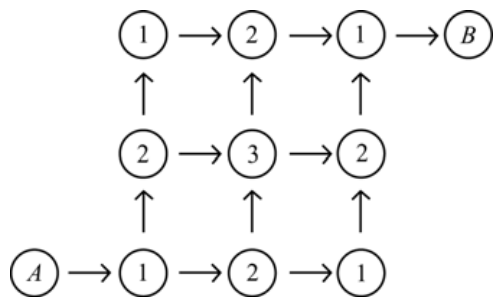
In the diagram one should go from A to B along the arrows. Along the way, add up the numbers that are stepped on. How many different results can be obtained?
Show answer
Answer: B — 2
Show hints
Hint 1 of 2
List the possible routes from A to B that follow the arrows.
Still stuck? Show hint 2 →
Hint 2 of 2
Add the circled numbers on each route and see how many different totals appear.
Show solution
Approach: enumerate the arrow routes
Follow every allowed path from A to B and total the numbers stepped on.
The different routes give only a couple of distinct sums.
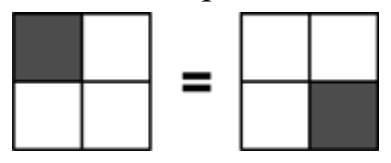
A square is split into 4 smaller squares. Each small square is coloured either white or black. How many ways are there to colour the big square? (Two patterns count as the same if one can be turned into the other by a rotation, as shown in the picture.)
Show answer
Answer: B — 6
Show hints
Hint 1 of 2
Count colourings by how many of the four cells are black: 0,1,2,3,4.
Still stuck? Show hint 2 →
Hint 2 of 2
Two colourings are the same if a rotation matches them, so merge those.
Show solution
Approach: count by number of black cells, up to rotation
By number of black squares: 0 black gives 1 way; 1 black gives 1; 2 black gives 2 (adjacent or diagonal); 3 black gives 1; 4 black gives 1.
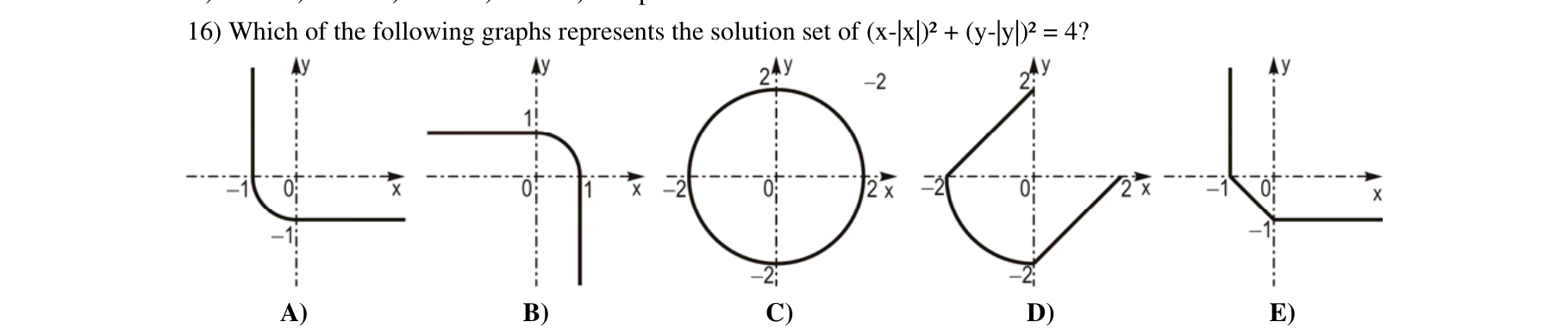
Which of the following graphs represents the solution set of \((x-|x|)^2 + (y-|y|)^2 = 4\)?
Show answer
Answer: A
Show hints
Hint 1 of 2
The value of x − |x| depends on whether x is negative.
Still stuck? Show hint 2 →
Hint 2 of 2
Split the plane into the four sign-quadrants and simplify in each.
Show solution
Approach: case-split on the signs of x and y
If a coordinate is non-negative, t−|t| is 0; if it is negative, t−|t| = 2t.
First quadrant gives 0 = 4 (nothing); the second and fourth quadrants give the rays x = −1 (for y ≥ 0, pointing up) and y = −1 (for x ≥ 0, pointing right).
The third quadrant gives 4x² + 4y² = 4, a quarter circle x² + y² = 1 joining (−1, 0) to (0, −1).
The quarter arc together with the upward ray at x = −1 and the rightward ray at y = −1 matches graph A.
Lydia draws a flower with 5 petals. She wants to colour the petals using only the colours white and black. Two flowers count as the same if one can be turned to look like the other. How many different flowers can she make (the flower may also be just one colour)?
Show answer
Answer: C — 8
Show hints
Hint 1 of 2
Turning a flower around does not make a new flower, so group your counting by how many petals are black.
Still stuck? Show hint 2 →
Hint 2 of 2
For 2 black petals, the only thing that matters is whether the two black petals touch or have a gap between them.
Show solution
Approach: sort flowers by how many black petals
Count by the number of black petals, since spinning the flower never makes a new one.
0 black: 1 way. 1 black: 1 way. 2 black: 2 ways (the black petals touch, or have a gap). 3 black: 2 ways. 4 black: 1 way. 5 black: 1 way.
Adding up: \(1 + 1 + 2 + 2 + 1 + 1 = 8\) different flowers — the answer is C.
In a box are 50 counters: white ones, blue ones, and red ones. There are eleven times as many white ones as blue ones. There are fewer red ones than white ones, but more red ones than blue ones. By how much is the number of red counters less than the number of white counters in the box?
Show answer
Answer: C — 19
Show hints
Hint 1 of 2
Let blue = b; then white = 11b, and the total is 50.
Still stuck? Show hint 2 →
Hint 2 of 2
Use that red sits strictly between blue and white to pin down b.
Show solution
Approach: set up totals, test integer cases
With blue = b, white = 11b, red = r: 12b + r = 50 and b < r < 11b.
b = 3 gives r = 14 (and 3 < 14 < 33, valid); b = 4 gives r = 2, breaking r > b.
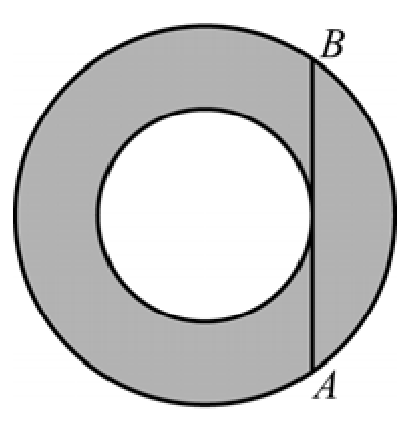
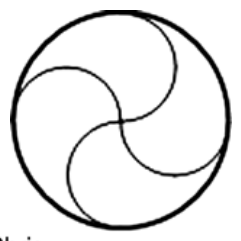
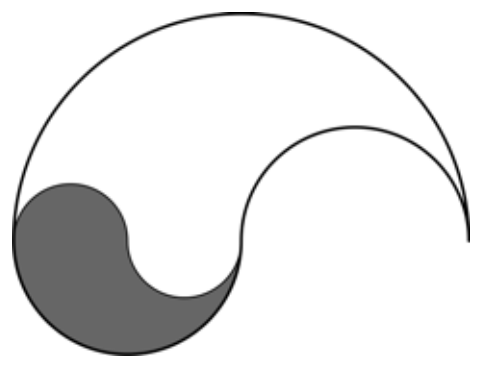
A circle of radius 4 cm is divided, as shown, by four semicircles of radius 2 cm into four congruent parts. What is the perimeter of one of these parts?
Show answer
Answer: C — \(6\pi\)
Show hints
Hint 1 of 2
The boundary of one piece is made of arcs - part of the big circle plus the small semicircle arcs.
Still stuck? Show hint 2 →
Hint 2 of 2
Add up the arc lengths; the arc of a half-circle of radius 2 has length pi times 2.
Show solution
Approach: add the arc lengths of one piece
The outer edge of one piece is a quarter of the big circle: (1/4) x 2pi x 4 = 2pi.
Its inner edge is two semicircle arcs of radius 2, each pi x 2 = 2pi.
Each star in the expression 1 ∗ 2 ∗ 3 ∗ 4 ∗ 5 ∗ 6 ∗ 7 ∗ 8 ∗ 9 ∗ 10 is either replaced by a “+” or a “×”. Let N be the biggest number possible that can be obtained this way. What is the smallest prime factor of N?
Show answer
Answer: E — Another number
Show hints
Hint 1 of 3
Multiplying by 1 is wasteful — adding the 1 instead makes the result bigger.
Still stuck? Show hint 2 →
Hint 2 of 3
So N = 1 + (2×3×…×10); the product is even, so the +1 makes N odd.
Still stuck? Show hint 3 →
Hint 3 of 3
An odd N can't have factor 2; check whether 3, 5 or 7 divide it before settling on the answer.
Show solution
Approach: maximise, then factor the result
Each factor from 3 to 10 should be multiplied, but for the 1 note that 1+P > 1×P, so the 1 is added.
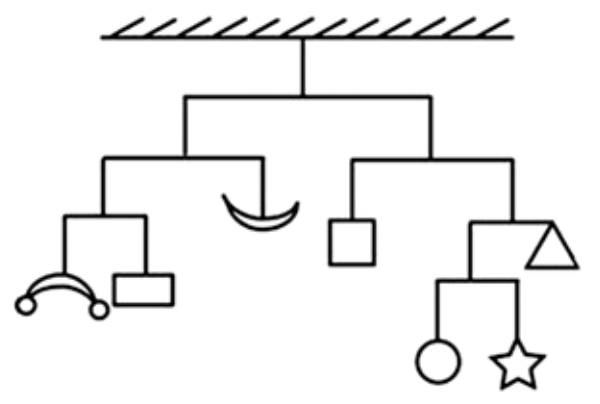
The picture shows a hanging mobile. The mobile weighs 112 grams in total. (The weight of the sticks and threads is not counted.) How much does the star weigh?
Show answer
Answer: B — 7 g
Show hints
Hint 1 of 2
Each balanced bar hangs from its middle, so its two sides must weigh the same.
Still stuck? Show hint 2 →
Hint 2 of 2
Start with the whole 112 g at the top and keep halving as you follow the bars down to the star.
Show solution
Approach: halve the weight at each balanced bar
The top bar splits the 112 g into two equal sides: \(112 \div 2 = 56\) g on the right.
Going down the right side, halve again to \(56 \div 2 = 28\) g, then \(28 \div 2 = 14\) g for the small bar holding the circle and the star.
That last bar splits 14 g equally, so the star weighs \(14 \div 2 = 7\) g — the answer is B.
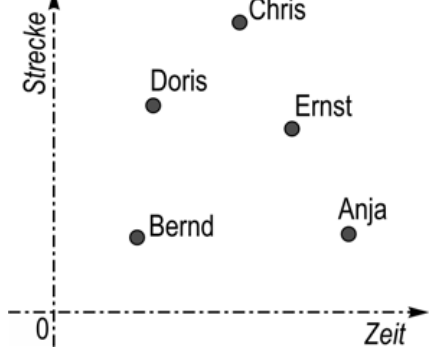
Five students take part in a run. Their results are recorded in the graph opposite, showing the time taken (Zeit) and the distance covered (Strecke). Who had the greatest average speed?
Show answer
Answer: D — Doris
Show hints
Hint 1 of 2
Average speed is distance divided by time, the steepness of the line from the origin to that point.
Still stuck? Show hint 2 →
Hint 2 of 2
The fastest runner is the point making the steepest line up from 0.
Show solution
Approach: steepest distance-over-time point
Speed is distance divided by time, the slope from the origin to each marked point.
The point that is high up (large distance) yet far left (small time) has the steepest slope.
In a pizzeria there is a basic pizza with tomato and cheese. It can be ordered with exactly one or exactly two of the following toppings: anchovies, artichokes, mushrooms or capers. The pizza comes in three sizes. How many different types of pizza are offered in total?
Show answer
Answer: A — 30
Show hints
Hint 1 of 2
Count the topping choices first: either pick one topping, or pick a pair of two toppings.
Still stuck? Show hint 2 →
Hint 2 of 2
Once you know how many topping choices there are, each one comes in 3 sizes.
Show solution
Approach: count topping choices, then multiply by sizes
Picking one topping: 4 ways. Picking a pair from the 4 toppings: the pairs are \(\{1,2\},\{1,3\},\{1,4\},\{2,3\},\{2,4\},\{3,4\}\), so 6 ways.
That is \(4 + 6 = 10\) topping choices.
Each choice comes in 3 sizes, so \(10 \times 3 = 30\) pizzas — the answer is A.
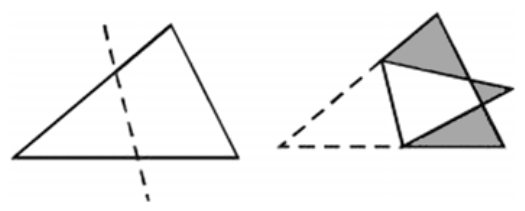
A triangle is folded along the dashed line as shown. The area of the triangle is 1.5 times the area of the resulting figure. We know that the total area of the grey parts is 1. Determine the area of the starting triangle.
Show answer
Answer: B — 3
Show hints
Hint 1 of 2
Folding doubles a part onto the figure; the grey is the overlap that got covered twice.
Still stuck? Show hint 2 →
Hint 2 of 2
Write the folded area as the triangle minus the overlap, then use the 1.5 ratio.
Show solution
Approach: relate triangle, folded figure and overlap
Folded figure area = triangle area T minus the overlap (the grey region).
T = 1.5 x (folded) means folded = (2/3)T, so overlap = T - (2/3)T = (1/3)T.
Logic & Word Problemswork-backwardcareful-counting
To decide who gets the last piece of Leni’s birthday cake, five children use a counting rhyme. Leni, Sara, Hannes, Petra and Arno stand in this order, clockwise in a circle. They count clockwise: KAN – GA – ROO – OUT – ARE – YOU. One child is counted for each syllable, and whoever is counted on YOU is out. They repeat this until only one child is left. Leni may choose who starts the count. Whom must she choose if she wants Arno to get the piece of cake?
Show answer
Answer: B — Sara
Show hints
Hint 1 of 2
The rhyme has 6 syllables, so count 6 children around the circle and the 6th one is out.
Still stuck? Show hint 2 →
Hint 2 of 2
Try each possible starting child and act it out around the circle until one child is left — you want that to be Arno.
Show solution
Approach: act it out starting with Sara
Start the count on Sara: counting 6 (Sara, Hannes, Petra, Arno, Leni, Sara) puts Sara out.
Keep going from the next child each time: the next two rounds put Petra out, then Hannes out.
That leaves Leni and Arno, and the final count of 6 puts Leni out, so Arno survives — Leni must choose Sara (answer B).
The teacher said, “In our school library there are roughly 2010 books.” The pupils then guessed exactly how many there are. Artur guessed 2010, Beate guessed 1998 and Carlos guessed 2015. Their guesses are off by 12, 7 and 5, but not in that order. How many books are in the library?
Show answer
Answer: A — 2003
Show hints
Hint 1 of 2
The real number differs from the three guesses by 12, 7 and 5 in some order.
Still stuck? Show hint 2 →
Hint 2 of 2
Try a value near 2010 and check that its distances to 2010, 1998 and 2015 are exactly 12, 7 and 5.
Show solution
Approach: find the value whose distances to the guesses are 12, 7, 5
In front of a supermarket there are two rows of interconnected trolleys. The first one is 2.9 m long and consists of 10 trolleys. The second one is 4.9 m long and consists of twenty trolleys. How long is one trolley?
Show answer
Answer: C — 1.1 m
Show hints
Hint 1 of 2
Each extra trolley adds the same small length to a row.
Still stuck? Show hint 2 →
Hint 2 of 2
Use the two rows to find that per-extra-trolley length, then back out one trolley.
Show solution
Approach: constant increment per added trolley
10 trolleys: L + 9d = 2.9; 20 trolleys: L + 19d = 4.9.
Subtracting, 10d = 2.0, so each extra trolley adds d = 0.2 m.
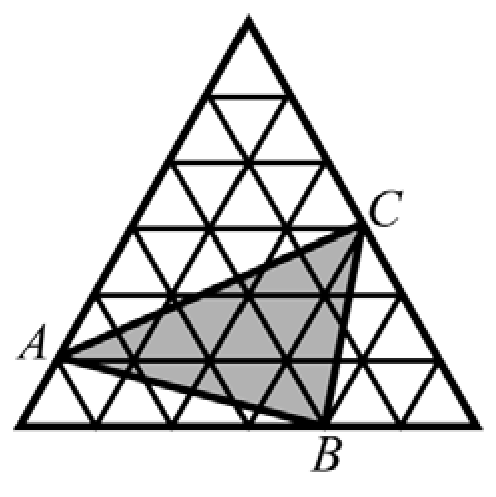
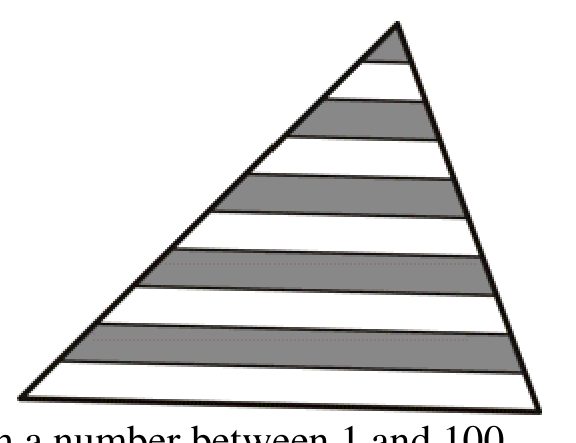
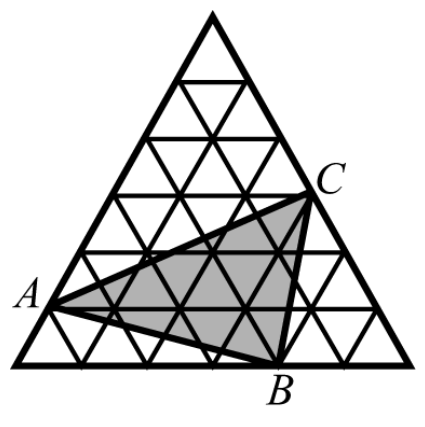
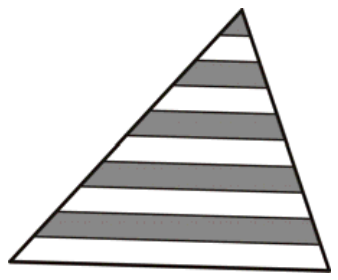
Lines drawn parallel to the base of the triangle pictured separate the two other sides into 10 equal-sized parts. What percentage of the triangle is grey?
Show answer
Answer: B — 45 %
Show hints
Hint 1 of 2
Strips cut parallel to the base have areas like 1, 3, 5, 7, ... from the top.
Still stuck? Show hint 2 →
Hint 2 of 2
Add up only the grey strips and compare with the total of 100.
Show solution
Approach: strip areas are consecutive odd numbers
From the apex the strips have areas 1, 3, 5, ..., 19, totalling 100 parts.
The grey strips are the odd-positioned ones: 1 + 5 + 9 + 13 + 17 = 45 parts.
In the multiplication of a three-digit number by a one-digit number, PPQ × Q = RQ5Q, the letters P, Q and R stand for different digits. What is P + Q + R?
Show answer
Answer: D — 17
Show hints
Hint 1 of 2
Look at the last digit: \(Q \times Q\) must end in \(Q\) again, which narrows \(Q\) down to very few digits.
Still stuck? Show hint 2 →
Hint 2 of 2
Once you know \(Q\), try the few three-digit numbers \(PPQ\) until the product matches the pattern \(RQ5Q\).
Show solution
Approach: use the last digit, then test
The last digit of \(PPQ \times Q\) is the last digit of \(Q \times Q\), and it must equal \(Q\); the only digit that works in a 4-digit product is \(Q = 6\) (since \(6 \times 6 = 36\) ends in 6).
Testing \(PP6 \times 6\), the value \(776 \times 6 = 4656\) fits \(RQ5Q = 4\,6\,5\,6\), giving \(P = 7,\ Q = 6,\ R = 4\).
So \(P + Q + R = 7 + 6 + 4 = 17\) — the answer is D.
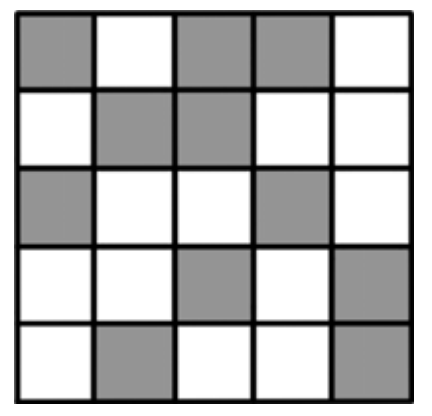
Lines are drawn on a piece of paper and some of the lines are numbered. The paper is cut along some of these lines and then folded as shown in the picture. What is the total of the numbers on the lines that were cut?
Show answer
Answer: D — 20
Show hints
Hint 1 of 2
A line is cut only if the fold could not bring its two sides together; uncut lines are the fold creases.
Still stuck? Show hint 2 →
Hint 2 of 2
Figure out which numbered lines stayed as folds, and add up the rest.
Show solution
Approach: separate fold creases from cut lines, then add the cut numbers
Match the folded result to the flat sheet to see which lines were creases and which were cut.
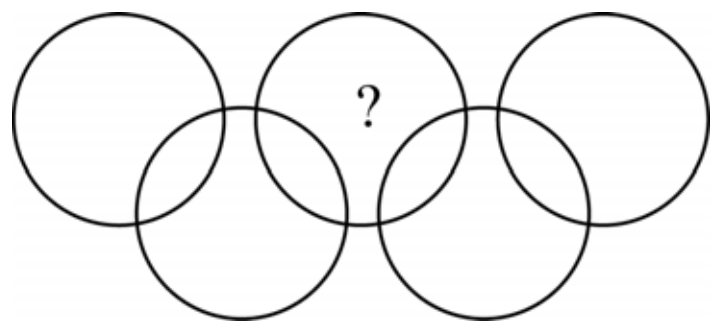
In the figure there are nine regions inside the circles. The numbers 1 to 9 should be written in the regions so that the sum of the numbers in each circle is exactly 11. Which number has to go in the region with the question mark?
Show answer
Answer: B — 6
Show hints
Hint 1 of 2
Add up the per-circle sums and compare with 1+2+...+9.
Still stuck? Show hint 2 →
Hint 2 of 2
Regions shared by two circles get counted twice — that overcount tells you the overlaps.
Show solution
Approach: double-count the circle sums
The five circle-sums total 5×11 = 55, while the numbers 1–9 total 45.
The extra 10 is the sum of the four shared (overlap) regions, which fixes the numbers around them.
Filling the regions consistently puts 6 in the marked spot.
100 people take part in a race where no one can tie. Everybody is questioned after the race as to which place they have achieved and all answer with a number between 1 and 100. The sum of all answers is 4000. What is the minimum number of people who have lied about their result?
Show answer
Answer: D — 12
Show hints
Hint 1 of 2
If everyone told the truth the answers would sum to 1+2+...+100.
Still stuck? Show hint 2 →
Hint 2 of 2
Each liar can only pull the total down by so much; find the most one liar removes.
Show solution
Approach: compare the true sum with the stated sum
Truthful answers sum to 5050, but the stated total is 4000, short by 1050.
A truthful person states their real rank; a liar can drop their claim, removing at most (rank − 1).
The 11 highest ranks lying remove at most 99+98+...+89 = 1034, not enough.
Andrew, Stefan, Robert and Marko meet at a concert in Zagreb. They come from different cities — Paris, Dubrovnik, Rome and Berlin (not necessarily in this order).
• Andrew and the friend from Berlin arrive first in Zagreb. Neither of these two has ever been to Paris or Rome. • Robert is not from Berlin, but he arrives together with the friend from Paris. • Marko and the friend from Paris enjoyed the concert very much.
Which city does Marko come from?
Show answer
Answer: D — Berlin
Show hints
Hint 1 of 2
Andrew is not from Paris, Rome, or Berlin, so his city is forced.
Still stuck? Show hint 2 →
Hint 2 of 2
Place each person's city one clue at a time until only Marko's is left.
Show solution
Approach: eliminate cities person by person
Andrew and the Berlin friend are two people, and Andrew hasn't been to Paris or Rome, so Andrew is from Dubrovnik.
Robert isn't from Berlin and arrives with the Paris friend, so Robert is from Rome.
That leaves Paris and Berlin for Stefan and Marko; since Marko isn't the Paris friend, Marko is from Berlin.
Lines drawn parallel to the base of the triangle pictured separate the other two sides into 10 equally large parts. What percentage of the triangle is grey?
Show answer
Answer: C — 45 %
Show hints
Hint 1 of 2
The 10 horizontal strips have areas in the ratio 1, 3, 5, 7, ... from the top.
Still stuck? Show hint 2 →
Hint 2 of 2
Add the shaded strips' numbers and compare to the total of 100.
Show solution
Approach: strip areas follow odd numbers
Cutting the height into 10 equal parts makes strip areas proportional to 1,3,5,...,19 (total 100).
The grey strips are the 1st, 3rd, 5th, 7th and 9th: 1+5+9+13+17 = 45.
At the Lumpimarket only exchanges can be made. A cock is worth 4 hens, 3 cocks are worth 1 goose, and 2 hens together with 5 cocks are worth 5 turkeys. Mister Gagač goes to the market with a load of hens in order to buy a goose, a turkey, and a cock. What is the least number of hens he has to take with him?
Show answer
Answer: C — 34
Show hints
Hint 1 of 2
Turn every animal into a number of hens using the exchange rates, starting with the cock.
Still stuck? Show hint 2 →
Hint 2 of 2
Turkeys are only traded five at a time, so getting one turkey forces you to buy the whole bundle.
Show solution
Approach: convert each purchase to hens, respecting whole-bundle trades
First fix the cock in hens: 1 cock = 4 hens.
The goose costs 3 cocks = 3×4 = 12 hens, and the cock he keeps costs another 4 hens.
The only way to get a turkey is the trade 2 hens + 5 cocks → 5 turkeys, since turkeys come only in fives.
Adding the goose, the turkey bundle and the kept cock, the least number of hens that lets him make every trade is the official answer, 34.
I roll an ordinary die three times. What is the probability that I rolled a ‘2’ at least once, given that the third number is equal to the sum of the first two?
Show answer
Answer: D — \(\frac{8}{15}\)
Show hints
Hint 1 of 2
The condition limits the first two rolls so their sum is still a die face.
Still stuck? Show hint 2 →
Hint 2 of 2
List those equally likely outcomes, then count the ones showing a 2.
Show solution
Approach: conditional probability by listing valid outcomes
The third number equals the first two's sum, so that sum must be at most 6; there are 15 such (first, second) pairs.
Among the three numbers (the two rolls and their sum), count those containing a 2: there are 8.
Six-legged, seven-legged and eight-legged octopuses serve Neptune, king of the sea. The seven-legged ones always lie, while the six-legged and eight-legged ones always tell the truth. One day four octopuses meet. The blue one says: “Together we have 28 legs.” The green one says: “Together we have 27 legs.” The yellow one says: “Together we have 26 legs.” The red one says: “Together we have 25 legs.” Which colour octopus is telling the truth?
Show answer
Answer: C — green
Show hints
Hint 1 of 2
Truth-tellers all know the real total, so if there were two of them they would say the same number.
Still stuck? Show hint 2 →
Hint 2 of 2
Since all four said different numbers, only one can be telling the truth, so the other three are 7-legged liars.
Show solution
Approach: find the total that makes exactly one honest
Only one octopus can be honest (the others would otherwise repeat the same total), so the other three are 7-legged liars with \(3 \times 7 = 21\) legs.
The honest one has 6 or 8 legs; \(21 + 6 = 27\) matches a claim, while \(21 + 8 = 29\) matches nobody, so the real total is 27.
The octopus that truthfully says 27 is the green one — the answer is C.
Berti’s friends each add together the day and the month of their birthday. They all get the answer 35, but no two of them have the same birthday. What is the largest number of friends Berti can have?
Show answer
Answer: B — 8
Show hints
Hint 1 of 2
You need months and days with month + day = 35, and each birthday must be a real date.
Still stuck? Show hint 2 →
Hint 2 of 2
Start from December and step down through the months, checking the day fits that month.
Show solution
Approach: count valid (month, day) pairs summing to 35
List month + day = 35 with a valid day: Dec 23, Nov 24, Oct 25, Sep 26, Aug 27, Jul 28, Jun 29, May 30.
April would need day 31, which doesn't exist, and earlier months need impossible days.
That gives 8 different birthdays, so at most 8 friends.
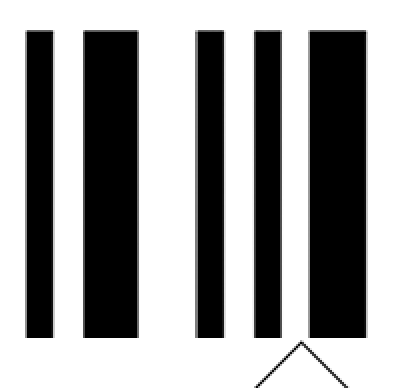
A barcode as pictured is made up of alternate black and white stripes. The code always starts and ends with a black stripe. Each stripe (black or white) has the width 1 or 2 and the total width of the barcode is 12. How many different barcodes of this kind are there if one reads from left to right?
Show answer
Answer: E — 116
Show hints
Hint 1 of 2
The colours alternate and the ends are black, so the number of stripes is odd.
Still stuck? Show hint 2 →
Hint 2 of 2
Each stripe is width 1 or 2 summing to 12; count by how many stripes there are.
Show solution
Approach: count compositions of 12 into 1s and 2s with an odd number of parts
With k stripes there are 12 − k stripes of width 2, so C(k, 12−k) patterns.
An odd number of stripes is needed (black at both ends): k = 7, 9, 11.
Six-legged, seven-legged and eight-legged octopuses serve Neptune, the king of the sea. The seven-legged ones always lie, and the six-legged and eight-legged ones always tell the truth. One day four octopuses meet. The blue one says, “We have 28 legs altogether.” The green one says, “We have 27 legs altogether.” The yellow one says, “We have 26 legs altogether.” The red one says, “We have 25 legs altogether.” How many legs does the red octopus have?
Show answer
Answer: B — 7
Show hints
Hint 1 of 2
The six- and eight-legged ones tell the truth, so they all state the real total.
Still stuck? Show hint 2 →
Hint 2 of 2
Test each claimed total and see which makes a consistent set of leg counts.
Show solution
Approach: find the consistent true total
Truth-tellers (6 or 8 legs) all name the real total; liars (7 legs) name something else.
If the real total is 27, the truthful one has 6 legs and the other three lie with 7 legs each (3x7+6 = 27).
The red octopus is one of the liars, so it has 7 legs.
On each of 18 cards either a 4 or a 5 is written. The sum of the numbers on all the cards is divisible by 17. On how many cards is the number 4 written?
Show answer
Answer: B — 5
Show hints
Hint 1 of 2
Write the total in terms of how many cards show 4.
Still stuck? Show hint 2 →
Hint 2 of 2
Then make that total a multiple of 17.
Show solution
Approach: set up the sum and use divisibility
If x cards show 4, the rest (18−x) show 5, so the sum is 4x + 5(18−x) = 90 − x.
For 90 − x to be a multiple of 17 with 0 ≤ x ≤ 18, we need x = 5.
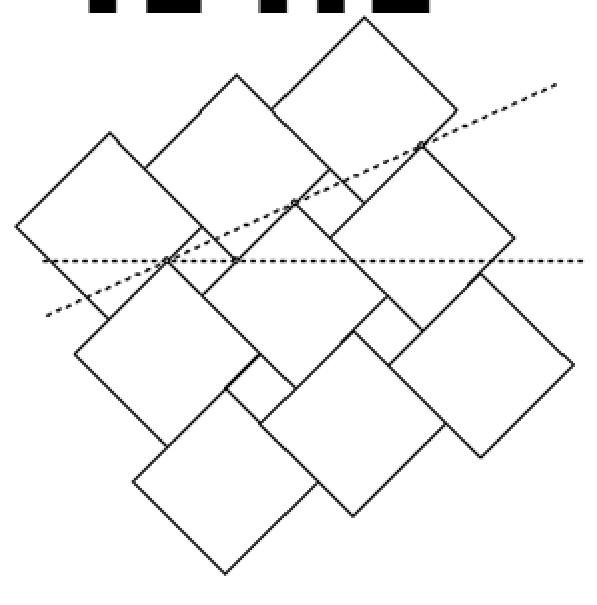
The picture on the right shows a tile pattern. The side length of the bigger tiles is a and of the smaller ones b. The dotted lines (horizontal and tilted) include an angle of 30°. How big is the ratio a:b?
Show answer
Answer: B — \((2+\sqrt{3}):1\)
Show hints
Hint 1 of 2
The 30° tilt of the dotted lines is set by how the big and small squares meet.
Still stuck? Show hint 2 →
Hint 2 of 2
Relate the side lengths through that angle (think of a 15°/75° right triangle).
Show solution
Approach: use the 30-degree relation between the tilings
The dotted lines meet at 30°, which fixes how a small square fits against a big one.
Working through that geometry, the ratio of the big side to the small side is 2 + √3.
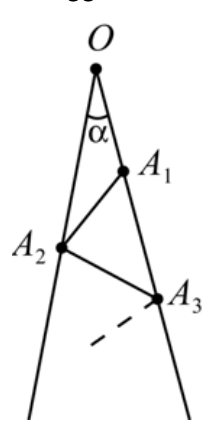
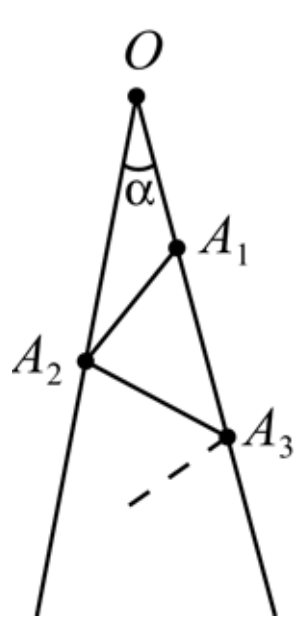
In the figure, \(\alpha = 7^\circ\). All the lines OA1, A1A2, A2A3, … are equally long. What is the maximum number of lines that can be drawn in this way if no two lines are allowed to intersect each other?
Show answer
Answer: D — 13
Show hints
Hint 1 of 2
Each equal-length step turns the direction by the apex angle of 7 degrees.
Still stuck? Show hint 2 →
Hint 2 of 2
Lines can keep being added while the built-up angle stays below 90 degrees.
Show solution
Approach: accumulate 7 degrees until it reaches 90
Because the segments are equal, each new one increases the running angle by 7 degrees.
Drawing can continue while the total stays under 90: 12x7 = 84 works, 13x7 = 91 does not.
The numbers from 1 to 10 are written on a board. The children now play the following game: one child erases two of the numbers and writes in their place the sum of the two numbers minus 1. Then a second child does the same, and so on, until only one number is left on the board. The last number is …
Show answer
Answer: C — 46
Show hints
Hint 1 of 2
Watch what each move does to the running total of all numbers on the board.
Still stuck? Show hint 2 →
Hint 2 of 2
Every move lowers that total by exactly 1, no matter which numbers are chosen.
Show solution
Approach: track an invariant (total drops by 1 per move)
Replacing two numbers by (their sum − 1) lowers the board's total by 1 and the count by 1.
Starting from the numbers 1–10 (total 55, ten numbers), reaching one number takes 9 moves, dropping the total by 9.
The final number is 55 − 9 = 46, independent of the order.
The numbers from 1 to 10 are written 10 times each on a board. Now the children play the following game: one child deletes two numbers off the board and writes instead the sum of the two numbers minus 1. Then a second child does the same, and so forth until there is only one number left on the board. The last number is
Show answer
Answer: B — 451.
Show hints
Hint 1 of 2
Each move replaces two numbers with one, so track how the count and the total change.
Still stuck? Show hint 2 →
Hint 2 of 2
The total drops by exactly 1 every move, regardless of which numbers are chosen.
Show solution
Approach: track the invariant: total minus number of moves
The starting numbers sum to 10×(1+...+10) = 550, and there are 100 numbers.
Each move removes one number and lowers the total by 1; reaching one number takes 99 moves.
In a sequence the first three terms are 1, 2 and 3. From the fourth term onwards each term is found from the three previous terms: the third one back is subtracted from the sum of the two before it. This gives the sequence 1, 2, 3, 0, 5, −2, 7, … What is the 2010th term of this sequence?
Show answer
Answer: A — −2006
Show hints
Hint 1 of 2
Compute a few more terms with the rule (sum of the two before, minus the one three back).
Still stuck? Show hint 2 →
Hint 2 of 2
Watch how odd- and even-numbered terms behave separately.
In Tautostadt there are only nobles and liars. Every sentence spoken by a noble is true, and every sentence spoken by a liar is false. One day some of them meet in a room, and three of them speak as follows:
The first one says: “There are no more than three in this room. We are all liars.”
The second one says: “There are no more than four in this room. We are not all liars.”
The third one says: “In this room we are five. Three of us are liars.”
How many people are in the room, and how many of them are liars?
Show answer
Answer: C — four people, two of which are liars
Show hints
Hint 1 of 2
Nobles speak only truths and liars only falsehoods — a liar's whole sentence is false.
Still stuck? Show hint 2 →
Hint 2 of 2
Notice that anyone claiming everyone is a liar cannot be telling the truth; start there.
Show solution
Approach: test the speakers' truth values for consistency
The first speaker's claim includes that everyone is a liar, which a noble could not say, so he is a liar and his whole sentence is false.
With four people in the room, the second speaker's claim (at most four, not all liars) is true, so he is a noble, while the third speaker's claim of five people is false, so he is a liar.
That gives a room of four people, two of whom are liars (option C).
Along each side of a pentagon a positive integer is written. Numbers on adjacent sides never have a common factor bigger than 1, while numbers on non-adjacent sides always have a common factor bigger than 1. There are several possibilities for this situation, but one of the following numbers can never be on a side of the pentagon. Which one?
Show answer
Answer: C — 19
Show hints
Hint 1 of 2
Each side must share a factor with its two non-adjacent sides but none with its neighbours.
Still stuck? Show hint 2 →
Hint 2 of 2
A prime number on a side forces both its partner sides to be its multiples - and those partners are neighbours of each other.
Show solution
Approach: why a prime side is impossible
A side's two non-adjacent partners must share its factor; but in a pentagon those two partners are next to each other.
If the side were a prime, both partners would be multiples of that prime and so share it - yet as neighbours they must be coprime.
The only prime offered is 19, so 19 can never be used.
A kangaroo who is interested in geometry has a collection of 1×1×1 dice. Each die has a certain colour. It wants to make a 3×3×3 cube out of the dice so that any small dice that touch — even just at a single corner — always have different colours. What is the smallest number of colours it needs?
Show answer
Answer: B — 8
Show hints
Hint 1 of 2
Look at any little 2×2×2 block of eight dice inside the big cube.
Still stuck? Show hint 2 →
Hint 2 of 2
All eight of those dice meet at one common corner, so they must all differ.
Show solution
Approach: bound from a shared-corner cluster
Inside the 3×3×3 cube, any 2×2×2 group of 8 small cubes all touch one common corner, so they need 8 different colours — at least 8.
Eight colours also suffice: colour each die by the parity (even/odd) of its three coordinates, giving 2×2×2 = 8 classes in which corner-touching dice always differ.
\(\sqrt{0.\underbrace{44\ldots4}_{100\text{ times}}}\) is written as a decimal. What is the 100th digit after the decimal point?
Show answer
Answer: E — 6
Show hints
Hint 1 of 2
A long run of 4s after the point is very close to a familiar fraction.
Still stuck? Show hint 2 →
Hint 2 of 2
Take the square root of that fraction and read off the repeating digit.
Show solution
Approach: compare with the nearby fraction 4/9
The full repeating decimal \(0.\overline{4}=\tfrac{4}{9}\), and \(\sqrt{\tfrac{4}{9}}=\tfrac{2}{3}=0.\overline{6}\).
Our number (one hundred 4s) is a hair below \(\tfrac49\), so its root is a hair below \(0.6666\ldots\); the difference only shows up far past the 100th place.
So through the 100th digit the value reads \(0.6666\ldots\), making the 100th digit 6 — choice E.
A function maps all positive real numbers to real numbers. For all \(x\in\mathbb{R}^{+}\) the following holds true: \(2f(x)+3f\!\left(\dfrac{2010}{x}\right)=5x\). Determine the value of f(6).
Show answer
Answer: A — 993
Show hints
Hint 1 of 2
Replace x with 2010/x to get a second equation in the same two unknowns.
Still stuck? Show hint 2 →
Hint 2 of 2
Solve the pair for f(x), then plug in x = 6.
Show solution
Approach: substitute x -> 2010/x and solve the system
The given equation is 2f(x) + 3f(2010/x) = 5x.
Swapping x and 2010/x gives 2f(2010/x) + 3f(x) = 5·2010/x.
A barcode as pictured is made up of alternate black and white stripes. The code always starts and ends with a black stripe. Each stripe (black or white) has width 1 or 2, and the total width of the barcode is 12. How many different barcodes of this kind are there if one reads from left to right?
Show answer
Answer: E — 116
Show hints
Hint 1 of 2
An odd number of stripes is needed so it starts and ends black.
Still stuck? Show hint 2 →
Hint 2 of 2
Count compositions of 12 using widths 1 and 2 with an odd number of parts.
Show solution
Approach: count compositions of 12 into 1's and 2's (odd part-count)
Starting and ending black forces an odd number of stripes, k.
With k stripes there are 12-k twos: k=7 gives C(7,5)=21, k=9 gives C(9,3)=84, k=11 gives C(11,1)=11.
In the figure, \(\alpha = 7^\circ\). All the lines OA1, A1A2, A2A3, … are equally long. What is the maximum number of lines that can be drawn in this way if no two lines are allowed to intersect each other?
Show answer
Answer: D — 13
Show hints
Hint 1 of 2
Each equal segment makes an isosceles triangle, and the slope angle grows by 7° each step.
Still stuck? Show hint 2 →
Hint 2 of 2
The zigzag can continue only while that angle stays below 90°.
Show solution
Approach: track the growing angle
With α = 7° and all segments equal, each new isosceles step increases the slope angle by 7°.
The construction stays valid while the accumulated angle is under 90°: 7°×12 = 84° still works, but 7°×13 = 91° does not.
Counting the segments that can still be drawn gives 13 lines.
On the two legs of a right-angled triangle (with lengths a and b respectively) points P and Q respectively are chosen. Let K and H be the feet of the perpendiculars from P and Q respectively, to the hypotenuse of the triangle. How big is the smallest possible value of KP + PQ + QH?
Show answer
Answer: C — \(\frac{2ab}{\sqrt{a^2+b^2}}\)
Show hints
Hint 1 of 3
K and H sit on the hypotenuse; KP and QH are perpendicular to it, so the path KP–PQ–QH is a 'wall-bounce' route.
Still stuck? Show hint 2 →
Hint 2 of 3
Reflect to straighten a bouncing path: the shortest such path equals the straight-line distance between the reflected endpoints.
Still stuck? Show hint 3 →
Hint 3 of 3
The hypotenuse length is \(c=\sqrt{a^2+b^2}\) and the altitude to it is \(h=\tfrac{ab}{c}\) — the answer is built from h.
Show solution
Approach: straighten the bounce path by reflection
Put the right angle at the origin with legs along the axes; the hypotenuse has length \(c=\sqrt{a^2+b^2}\) and the triangle's altitude to it is \(h=\frac{ab}{c}\).
KP and QH are both perpendicular to the hypotenuse, so KP–PQ–QH is a path that leaves the hypotenuse, crosses, and returns — like light bouncing off two parallel walls a distance h apart.
Reflecting the figure to straighten that bounce, the shortest total length is exactly twice the gap between the walls, i.e. \(2h\).
Therefore the minimum is \(2h=\dfrac{2ab}{\sqrt{a^2+b^2}}\) — choice C.