Casey went on a road trip that covered 100 miles, stopping only for a lunch break along the way. The trip took 3 hours in total and her average speed while driving was 40 miles per hour. In minutes, how long was the lunch break?
Show answer
Answer: B — 30 minutes.
Show hints
Hint 1 of 2
The 40 mph only describes the part where she's actually moving — the 3 hours also hides the lunch stop. Which piece can you compute directly?
Still stuck? Show hint 2 →
Hint 2 of 2
Time = distance ÷ speed gives the driving time only. Subtract that from the 3 total hours and what's left is the break.
Show solution
Approach: the 3 hours is driving + break; only driving obeys distance ÷ speed
The 40 mph is her speed while driving, so distance ÷ speed gives only the driving time, not the whole trip. Find that first: 100 ÷ 40 = 2.5 hours.
Whatever's left of the 3 total hours is the lunch break: 3 − 2.5 = 0.5 hour = 30 minutes.
Sanity check: 30 minutes of lunch is reasonable, and 2.5 h of driving at 40 mph really does cover 100 miles. The reusable idea: always separate ‘moving time’ from total time before using rate = distance ÷ time — the rate only describes the moving part.
A lake contains 250 trout, along with a variety of other fish. When a marine biologist catches and releases a sample of 180 fish from the lake, 30 are identified as trout. Assume the ratio of trout to the total number of fish is the same in both the sample and the lake. How many fish are there in the lake?
Show answer
Answer: B — 1500 fish.
Show hints
Hint 1 of 2
Think of the net of 180 fish as a shrunk-down copy of the whole lake — same recipe, smaller pot. So the trout fraction matches.
Still stuck? Show hint 2 →
Hint 2 of 2
Find the trout fraction in the sample (30 out of 180), then apply that same fraction to the 250 known trout to recover the whole.
Show solution
Approach: the trout fraction is the same in sample and lake
The sample is a tiny scale model of the lake: the trout fraction in your net should match the trout fraction in the whole lake. So find that one fraction and apply it.
In the sample, 30 of 180 are trout: 30 ÷ 180 = 16. That clean fraction is the heart of the problem — trout are 1 in every 6 fish.
So the 250 real trout are 16 of the whole lake, meaning the lake holds 250 × 6 = 1500 fish. This transfers to every ‘capture sample’ (or poll, or survey): part-of-sample = part-of-whole.
Another way — scale the whole sample up:
The lake has 250 trout but the sample only caught 30 — so the lake is 250 ÷ 30 = 253 times as ‘trout-rich’ as the sample.
Everything scales by that same factor, so total fish = 180 × 253 = 60 × 25 = 1500.
Luka is making lemonade to sell at a school fundraiser. His recipe requires 4 times as much water as sugar and twice as much sugar as lemon juice. He uses 3 cups of lemon juice. How many cups of water does he need?
Show answer
Answer: E — 24 cups.
Show hints
Hint 1 of 2
Lemon juice is the “smallest” ingredient and everything is measured against it. So instead of two separate steps, ask: how many times bigger is water than lemon juice?
Still stuck? Show hint 2 →
Hint 2 of 2
When one thing scales another which scales a third, the scale factors multiply. Water is 4× sugar and sugar is 2× lemon, so water is 4 × 2 = 8 times the lemon juice.
Show solution
Approach: multiply the scale factors into one jump
Chained scalings multiply: water is 4× sugar and sugar is 2× lemon, so water is 4 × 2 = 8 times the lemon juice — one jump instead of two.
With 3 cups of lemon juice, water = 8 × 3 = 24 cups.
You'll see this again as: any “A is k times B, B is m times C” chain collapses to “A is k·m times C.” Gear ratios and unit conversions work the same way.
Another way — one step at a time: lemon → sugar → water (MAA):
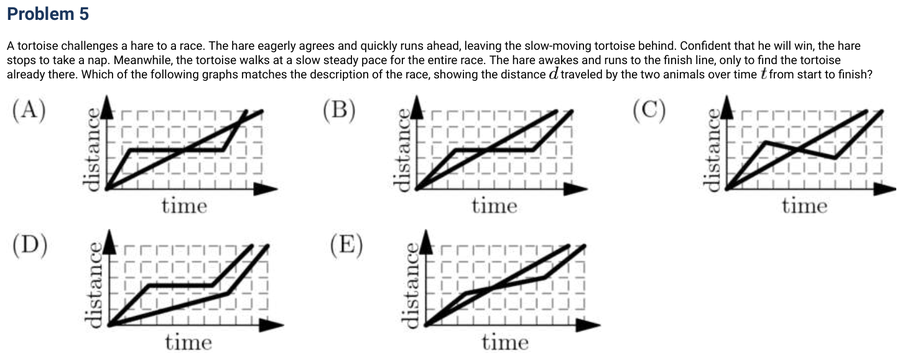
On a distance-vs-time graph, steepness is speed and a flat stretch means "not moving." Translate the story into two shapes, then find the graph that has both.
Still stuck? Show hint 2 →
Hint 2 of 2
Two clues must both show up: the hare's line has a flat middle (the nap), and the tortoise's line hits the finish height at an earlier time than the hare's. Use these to eliminate, not to eyeball.
Show solution
Approach: read slopes as speeds, then use two distinguishing features
Slope = speed. The hare runs (steep), naps (flat), then runs again (steep) — so the hare's curve is the one with a horizontal plateau in the middle.
The tortoise moves at one steady slow pace, a single straight gentle line. The crucial detail: "the tortoise was already there," so the tortoise's line reaches the top (finish distance) at a smaller time than the hare's.
Only graph (B) shows the napping plateau AND the tortoise finishing first.
Why this transfers: match graphs to stories by listing 2–3 testable features (a flat part, who reaches the top first, where lines cross) and eliminate — trying to read the whole picture at once is where mistakes sneak in.
An amusement park has a collection of scale models, with a ratio of 1 : 20, of buildings and other sights from around the country. The height of the United States Capitol is 289 feet. What is the height in feet of its replica at this park, rounded to the nearest whole number?
Show answer
Answer: A — 14 feet.
Show hints
Hint 1 of 2
A scale of 1 : 20 means "the model is the smaller one." The real building is the big side (20), the replica is the small side (1) — so which way does 289 go, up or down?
Still stuck? Show hint 2 →
Hint 2 of 2
The technique: a ratio 1 : k shrinks the real size by dividing by k. Map the bigger number to the bigger part of the ratio so you never flip it by accident.
Show solution
Approach: divide by the scale factor
The replica is the "1" side and the real Capitol is the "20" side, so the replica is 1/20 of 289 — smaller, which is the sanity check that we're dividing (a model should be tiny).
289 ÷ 20 = 14.45, which rounds to 14 feet.
You'll see it again: any scale-model or map problem is just multiply or divide by the scale factor — the only decision is which way, and matching big-to-big settles it.
When Cheenu was a boy he could run 15 miles in 3 hours and 30 minutes. As an old man he can now walk 10 miles in 4 hours. How many minutes longer does it take for him to travel a mile now compared to when he was a boy?
Show answer
Answer: B — 10 minutes longer.
Show hints
Hint 1 of 2
The question asks about ONE mile, but the two trips are different lengths — comparing the raw trip times would be unfair. Shrink each trip down to a per-mile rate so they're on equal footing.
Still stuck? Show hint 2 →
Hint 2 of 2
The unit that matches the question is minutes-per-mile: divide each trip's total minutes by its miles, then the answer is just the gap between the two paces.
Show solution
Approach: reduce each trip to minutes-per-mile, then subtract
Boy: 3 h 30 min = 210 minutes for 15 miles ⇒ 210 ÷ 15 = 14 minutes per mile.
Old man: 4 h = 240 minutes for 10 miles ⇒ 240 ÷ 10 = 24 minutes per mile.
He's slower now, so it takes 24 − 14 = 10 extra minutes per mile.
Sanity check: he covers fewer miles in more time as an old man, so the pace MUST be slower — a positive difference is expected, and 10 is small enough to be one mile's worth (not the whole trip).
You'll see this again as: any rate comparison — convert both to the SAME unit the question asks about (here, minutes per mile) before comparing; never compare totals of different sizes.
Jack and Jill are going swimming at a pool that is one mile from their house. They leave home simultaneously. Jill rides her bicycle to the pool at a constant speed of 10 miles per hour. Jack walks to the pool at a constant speed of 4 miles per hour. How many minutes before Jack does Jill arrive?
Show answer
Answer: D — 9 minutes.
Show hints
Hint 1 of 2
The distance is the same for both (1 mile), so don't compute any distance — the only thing that differs is how long each takes. Find both times, then subtract.
Still stuck? Show hint 2 →
Hint 2 of 2
Reading 'miles per hour' as 'miles per 60 minutes' turns time into a one-step division: minutes for one mile = 60 ÷ speed.
Show solution
Approach: same distance — just compare the two travel times
Both travel 1 mile, so all that matters is each person's time. At v mph one mile takes 60/v minutes (since 1 hour = 60 min).
Jill: 60/10 = 6 min. Jack: 60/4 = 15 min.
Jill arrives 15 − 6 = 9 minutes earlier.
Sanity check: Jack is slower, so he takes longer — the slower person's time should be the bigger number, and 15 > 6. ✓
Trey and his mom stopped at a railroad crossing to let a train pass. As the train began to pass, Trey counted 6 cars in the first 10 seconds. It took the train 2 minutes and 45 seconds to clear the crossing at a constant speed. Which of the following was the most likely number of cars in the train?
Show answer
Answer: C — About 100 cars.
Show hints
Hint 1 of 2
Constant speed means the cars-per-second rate never changes. So the whole train is just the early sample (6 cars in 10 s) scaled up to the full time. Find that one rate first.
Still stuck? Show hint 2 →
Hint 2 of 2
Turn the count into a rate (cars per second), then multiply by the total seconds. "Constant speed" is the green light to use a single proportion.
Show solution
Approach: scale the cars-per-second rate to the total time
Get everything in one unit: total time = 2 × 60 + 45 = 165 seconds.
The rate is 6 cars every 10 seconds = 0.6 cars/second, and it holds the whole time. So cars = 0.6 × 165 = 99.
The answer choices are round numbers, so 99 → 100 — "most likely" signals you to round to the nearest choice.
Sanity check: 165 s is about 16 ten-second chunks of 6 cars ≈ 16 × 6 ≈ 96, comfortably near 100.
Rachelle uses 3 pounds of meat to make 8 hamburgers for her family. How many pounds of meat does she need to make 24 hamburgers for a neighborhood picnic?
Show answer
Answer: E — 9 pounds.
Show hints
Hint 1 of 2
Don't reach for a formula — just compare the two orders. How many times bigger is 24 hamburgers than 8?
Still stuck? Show hint 2 →
Hint 2 of 2
This is scaling a recipe: if everything in the recipe grows by the same factor, the meat grows by that factor too.
Show solution
Approach: scale the recipe by the same factor
Notice 24 is exactly 3 batches of 8 (24 / 8 = 3) — she's making the same recipe 3 times over.
So everything triples, including the meat: 3 × 3 = 9 pounds.
Why this works & transfers: in any rate/recipe problem, scale both sides by the same factor — spotting the whole-number multiplier (here, ×3) beats setting up a cross-multiplication.
In the country of East Westmore, statisticians estimate there is a baby born every 8 hours and a death every day. To the nearest hundred, how many people are added to the population of East Westmore each year?
Show answer
Answer: B — About 700.
Show hints
Hint 1 of 2
Births and deaths are quoted on different clocks (every 8 hours vs. every day). Find a single day's net change first — then a year is just many copies of that day.
Still stuck? Show hint 2 →
Hint 2 of 2
This is find the per-day net, then scale: get one clean daily number, multiply by 365. Don't track births and deaths separately all the way out.
Show solution
Approach: net change per day, then scale to a year
Put both on a one-day clock: a birth every 8 hours means 24 / 8 = 3 births a day, against 1 death a day.
Net per day = 3 − 1 = 2 people. (Working with the net now means one multiplication later, not two.)
Over a year: 2 × 365 = 730, which rounds to 700.
Sanity check: ≈2 a day for a year should be in the high hundreds — 700 fits, 70 or 7000 would not.
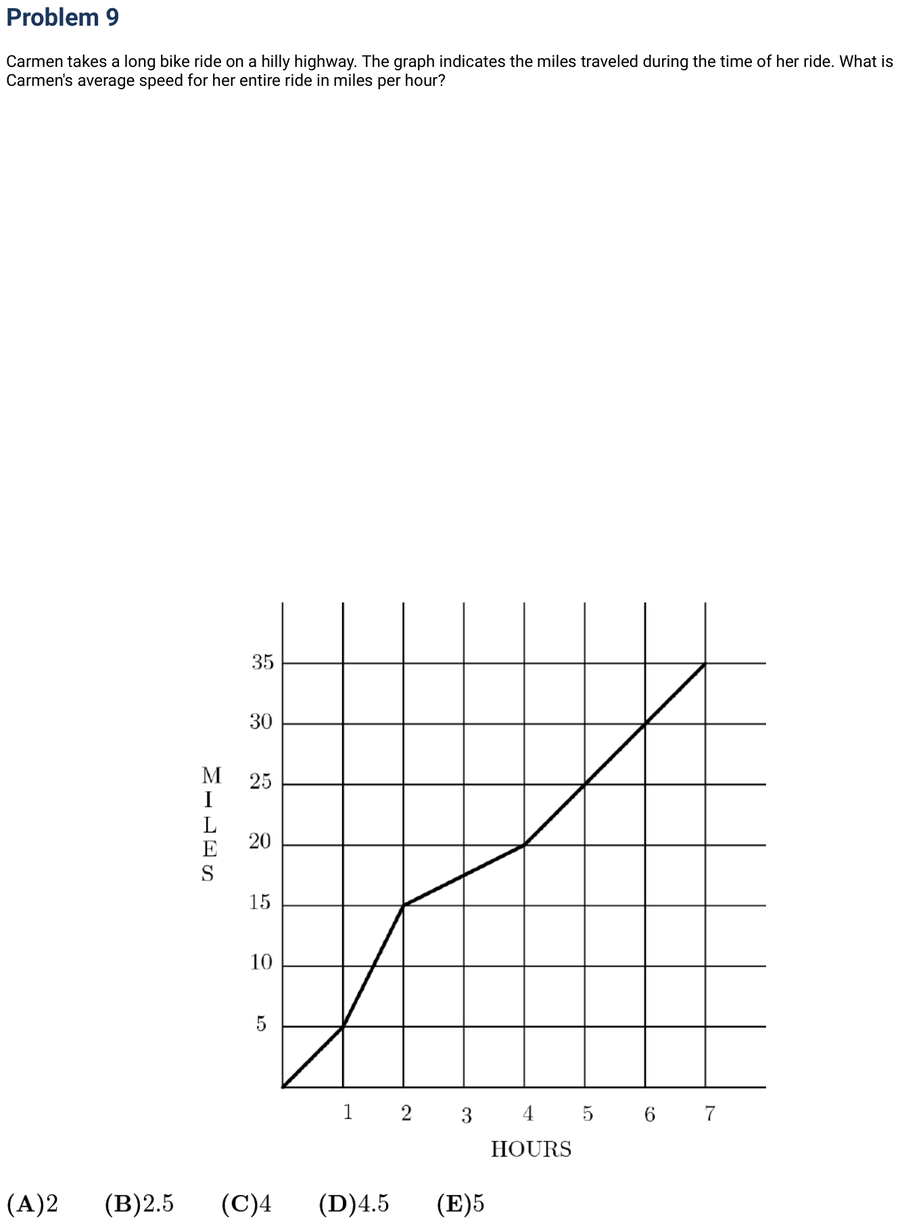
Carmen takes a long bike ride on a hilly highway. The graph indicates the miles traveled during the time of her ride. What is Carmen's average speed for her entire ride in miles per hour?
Show answer
Answer: E — 5 mph.
Show hints
Hint 1 of 2
Average speed doesn't care about the hills, the slow stretches, or the bends in the graph — only where the ride started and where it ended. Read just the final point.
Still stuck? Show hint 2 →
Hint 2 of 2
Average speed = total distance ÷ total time. The far-right end of the curve gives you both at once.
Show solution
Approach: average speed depends only on the endpoints
The curve ends at 35 miles after 7 hours — that's the whole ride: 35 miles in 7 hours.
Average speed = total distance ÷ total time = 35 ÷ 7 = 5 mph.
Why this transfers: "average speed" is always end-distance over end-time. The wiggly middle of a distance-time graph is a distraction — never average the steeper and flatter parts.
On average, for every 4 sports cars sold at the local dealership, 7 sedans are sold. The dealership predicts that it will sell 28 sports cars next month. How many sedans does it expect to sell?
Show answer
Answer: D — 49 sedans.
Show hints
Hint 1 of 2
Think of the cars in repeating BATCHES: every batch is 4 sports cars + 7 sedans. The whole question is just 'how many batches?'
Still stuck? Show hint 2 →
Hint 2 of 2
Find the scale factor (what turns 4 into 28), then apply that SAME factor to 7. This is what 'keeping a ratio' means.
Show solution
Approach: scale the ratio by a single factor
How many batches of 4 sports cars make 28? 28 ÷ 4 = 7 batches.
Each batch also has 7 sedans, so 7 batches give 7 × 7 = 49 sedans.
You'll see it again as: any 'A is to B' ratio scaled to a new amount — find the multiplier on one quantity, reuse it on the other. No cross-multiplying needed when the numbers divide nicely.
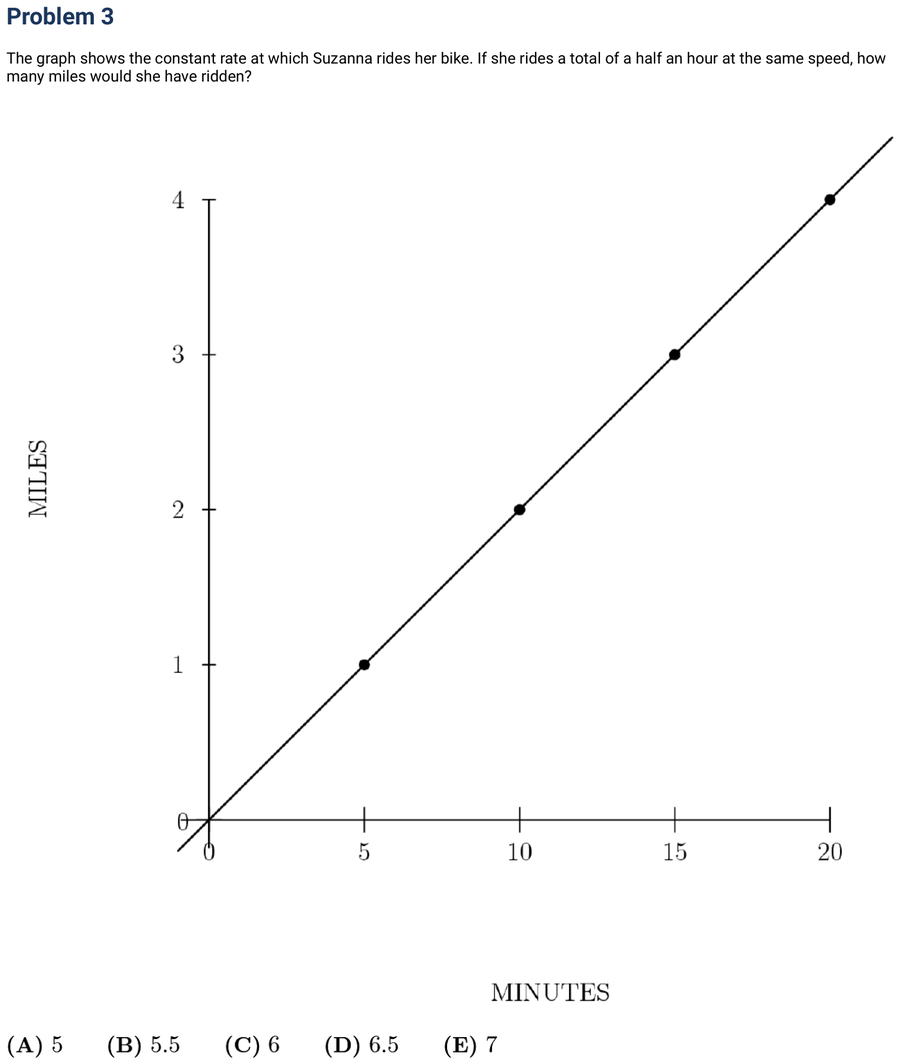
The graph shows the constant rate at which Suzanna rides her bike. If she rides a total of a half an hour at the same speed, how many miles would she have ridden?
Show answer
Answer: C — 6 miles.
Show hints
Hint 1 of 2
"Constant rate" is the key phrase: one dot on the graph fixes the speed forever, so you don't need the line to reach 30 minutes — you can just scale up.
Still stuck? Show hint 2 →
Hint 2 of 2
Read one easy point off the graph, turn it into a simple per-minute rate, then count how many of those time-chunks fit in 30 minutes.
Show solution
Approach: read one point, scale to the new time
Pick the cleanest point on the line: she goes 1 mile every 5 minutes.
Half an hour = 30 minutes, which is 30 ÷ 5 = 6 of those 5-minute chunks. So 6 × 1 = 6 miles.
Why this works: a straight line through the origin means distance and time grow in lockstep — one ratio (1 mile / 5 min) describes every point, so rescaling is all you ever need.
Another way — unit rate then multiply:
Speed = 1 mile / 5 min = 0.2 mi/min, which is 12 mph.
Steve's empty swimming pool will hold 24,000 gallons of water when full. It will be filled by 4 hoses, each of which supplies 2.5 gallons of water per minute. How many hours will it take to fill Steve's pool?
Show answer
Answer: A — 40 hours.
Show hints
Hint 1 of 2
Four hoses running at once act like one big hose — their rates simply ADD. The answer wants hours, so save yourself a conversion by building the combined rate in gallons-per-HOUR from the start.
Still stuck? Show hint 2 →
Hint 2 of 2
Once you have a single combined rate, time = total amount ÷ rate.
Show solution
Approach: combine rates, then divide total by rate
One hose: 2.5 gal/min. Working together, rates add: 4 × 2.5 = 10 gal/min. Since the answer is in hours, scale up now: 10 gal/min × 60 = 600 gal/hour.
Time = total ÷ rate = 24,000 ÷ 600 = 40 hours.
Why this transfers: whenever several workers/pipes/machines run simultaneously, add their individual rates into one combined rate — then it's a single division. Converting units BEFORE dividing (here min→hr) avoids a clumsy 2,400-minute intermediate.
Barney Schwinn notices that the odometer on his bicycle reads 1441, a palindrome, because it reads the same forward and backward. After riding 4 more hours that day and 6 the next, he notices that the odometer shows another palindrome, 1661. What was his average speed in miles per hour?
Show answer
Answer: E — 22 mph.
Show hints
Hint 1 of 2
"Palindrome" is just flavor — all you need is the two odometer readings and the total hours.
Still stuck? Show hint 2 →
Hint 2 of 2
Average speed always means total distance ÷ total time, no matter how the trip was split up.
Show solution
Approach: total distance ÷ total time
Distance is just how far the odometer moved: 1661 − 1441 = 220 miles. Don't be distracted by the palindrome story.
Total time is 4 + 6 = 10 hours, so average speed = 220 ÷ 10 = 22 mph.
Why this transfers: average speed is never the average of two speeds — it's always all the miles over all the hours.
Elisa swims laps in the pool. When she first started, she completed 10 laps in 25 minutes. Now she can finish 12 laps in 24 minutes. By how many minutes has she improved her lap time?
Show answer
Answer: A — 1/2 minute.
Show hints
Hint 1 of 2
The question asks about her lap time — how long ONE lap takes. So convert each situation to minutes-per-lap before comparing; don't compare 25 vs 24 directly.
Still stuck? Show hint 2 →
Hint 2 of 2
"Per one lap" means divide minutes by laps. The unit you want (min/lap) tells you which number goes on top.
Show solution
Approach: convert each to minutes per lap, then subtract
Lap time = total minutes ÷ number of laps. Before: 25 ÷ 10 = 2.5 min/lap. Now: 24 ÷ 12 = 2 min/lap.
She shaved off 2.5 − 2 = 1/2 minute per lap.
Why convert first: the two situations use different lap counts, so the totals (25 and 24) aren't comparable. Reducing both to the same per-unit measure makes them line up — this "put everything in the same units" move powers almost every rate problem.
Problems 14, 15 and 16 involve Mrs. Reed's English assignment. A Novel Assignment. The students in Mrs. Reed's English class are reading the same 760-page novel. Three friends, Alice, Bob and Chandra, are in the class. Alice reads a page in 20 seconds, Bob reads a page in 45 seconds and Chandra reads a page in 30 seconds. If Bob and Chandra both read the whole book, Bob will spend how many more seconds reading than Chandra?
Show answer
Answer: B — 11,400 seconds.
Show hints
Hint 1 of 2
You're asked for a DIFFERENCE, so don't compute two big times and subtract giants. Find how much longer Bob takes on a SINGLE page first.
Still stuck? Show hint 2 →
Hint 2 of 2
Factor before you multiply: 760·45 − 760·30 = 760·(45−30). Pulling out the common 760 turns two big multiplications into one small one.
Show solution
Approach: per-page gap, then scale up
On each page Bob is slower by 45 − 30 = 15 seconds.
Over all 760 pages that gap accumulates: 760 × 15 = 11,400 seconds.
Why this beats brute force: computing 760×45 = 34,200 and 760×30 = 22,800 and subtracting works, but factoring out the shared 760 first (the distributive property) skips the big numbers entirely. Difference questions love this — subtract the rates, then multiply once.
Joe had walked half way from home to school when he realized he was late. He ran the rest of the way to school. He ran 3 times as fast as he walked. Joe took 6 minutes to walk half way to school. How many minutes did it take Joe to get from home to school?
Show answer
Answer: D — 8 minutes.
Show hints
Hint 1 of 2
Both halves cover the same distance, so you can compare them directly — no need to know the actual distance or speed.
Still stuck? Show hint 2 →
Hint 2 of 2
For a fixed distance, speed and time are flip sides: triple the speed means a third of the time.
Show solution
Approach: same distance ⇒ time scales by 1/speed
The two halves are equal distances, so walking and running can be compared head-to-head. Walking the first half took 6 min.
Running is 3× as fast over the same distance, so it takes ⅓ the time: 6 ÷ 3 = 2 min.
Total: 6 + 2 = 8 min.
Why this transfers: over a fixed distance, time is inversely proportional to speed — double speed → half time, triple speed → third the time. No distance value needed. (The decimal traps 7.3, 7.7, 8.3 punish anyone who fumbles the 'a third' step.)
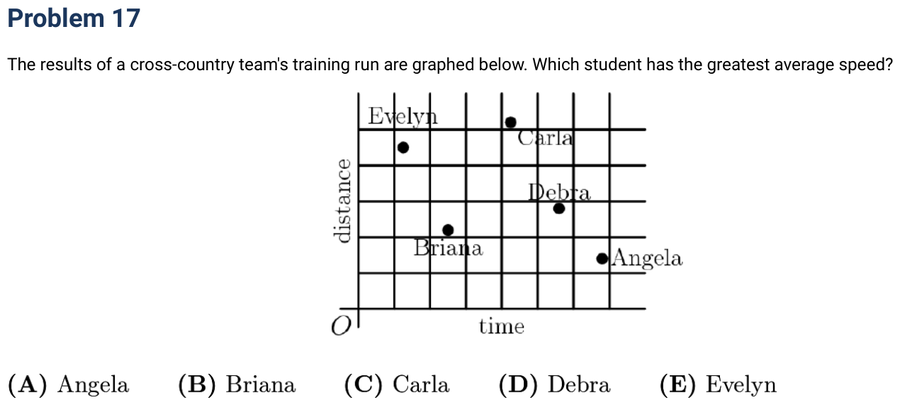
The results of a cross-country team's training run are graphed below. Which student has the greatest average speed?
Show answer
Answer: E — Evelyn.
Show hints
Hint 1 of 2
Speed = distance ÷ time. On a distance-vs-time graph, that ratio for each runner is the steepness of the line from the origin O out to their dot.
Still stuck? Show hint 2 →
Hint 2 of 2
You don't need numbers off the axes. Just eyeball which dot's line from O tilts up most steeply — high distance for little time.
Show solution
Approach: fastest = steepest line from the origin
Average speed is distance ÷ time, which is exactly the slope of the segment joining O to a runner's dot. Steeper line = more distance per unit time = faster.
Evelyn's dot sits high (large distance) and far left (small time), so her line from O is the steepest ⇒ Evelyn.
Watch the trap: Carla is the highest dot, but she took the most time, so she isn't fastest — 'farthest' is not 'fastest.' Only the slope from the origin tells you speed.
On a map, a 12-centimeter length represents 72 kilometers. How many kilometers does a 17-centimeter length represent?
Show answer
Answer: B — 102 km.
Show hints
Hint 1 of 2
Before reaching for 17, find what just one centimeter is worth. Once you know the value of a single unit, any length is just a multiplication away.
Still stuck? Show hint 2 →
Hint 2 of 2
This is the unit-rate idea: collapse any proportion to a 'per one' value, then scale. It beats cross-multiplying because the 'per one' number is reusable.
Show solution
Approach: unit rate (value of one cm)
Shrink the scale to one unit: 72 km spread over 12 cm means each cm is worth 72 ÷ 12 = 6 km. That single number is the whole problem.
Now any length scales instantly: 17 cm × 6 km/cm = 102 km.
Sanity check: 17 cm is a bit more than 12 cm, so the answer should be a bit more than 72 — and 102 is. You'll see this 'find the per-one value first' move in every map, recipe, and speed problem.
Twelve friends met for dinner at Oscar's Overstuffed Oyster House, and each ordered one meal. The portions were so large, there was enough food for 18 people. If they shared, how many meals should they have ordered to have just enough food for the 12 of them?
Show answer
Answer: A — 8 meals.
Show hints
Hint 1 of 2
The 12 friends are a distraction — the real fact is 'this much food'. How many people does a single meal actually feed?
Still stuck? Show hint 2 →
Hint 2 of 2
This is a capacity / unit-rate setup: turn the deal into 'people fed per meal', then ask how many meals reach your target. Same skill as 'miles per gallon' or 'words per minute'.
Show solution
Approach: people-fed-per-meal rate
Find what one meal is worth: 12 meals stretched to feed 18 people means each meal feeds 18 ÷ 12 = 1.5 people. That's the insight — the meals are 50% bigger than one person needs.
To feed exactly 12 people: 12 ÷ 1.5 = 8 meals.
Sanity check: meals feed more than one person each, so we should need fewer than 12 meals — and 8 < 12. Good.
Another way — ratio scaling:
Meals-to-people stays fixed at 12 : 18, which reduces to 2 : 3.
Scale the 'people' side down to 12: that's 12 / 3 = 4 groups, so meals = 2 × 4 = 8.
Casey's shop class is making a golf trophy. He has to paint 300 dimples on a golf ball. If it takes him 2 seconds to paint one dimple, how many minutes will he need to do his job?
Show answer
Answer: D — 10 minutes.
Show hints
Hint 1 of 2
The question asks for minutes, but everything is given in seconds — that's two jobs: find the time, then switch the unit.
Still stuck? Show hint 2 →
Hint 2 of 2
Total seconds = (seconds per dimple) × (dimples); minutes = seconds ÷ 60.
Watch the units the question wants. Here it asks for minutes, so an answer of 600 would be a trap — you'll see this trick again whenever a problem feeds you one unit and asks for another.
Another way — convert the rate first:
2 seconds per dimple means he paints 30 dimples per minute (60 ÷ 2).
300 dimples ÷ 30 per minute = 10 minutes — no big numbers needed.
On a dark and stormy night Snoopy suddenly saw a flash of lightning. Ten seconds later he heard the sound of thunder. The speed of sound is 1088 feet per second and one mile is 5280 feet. Estimate, to the nearest half-mile, how far Snoopy was from the flash of lightning.
Show answer
Answer: C — 2 miles.
Show hints
Hint 1 of 2
The words "estimate" and "to the nearest half-mile" are permission to round — don't chase exact decimals.
Still stuck? Show hint 2 →
Hint 2 of 2
Find the distance the sound covered (speed × time) in feet, then ask which whole number of miles it's nearest.
Show solution
Approach: distance in feet, then convert to miles
Sound travels distance = speed × time = 1088 × 10 = 10,880 feet during those 10 seconds.
Now compare to miles: 2 miles = 2 × 5280 = 10,560 feet, which is the closest landmark — so the distance is about 2 miles.
Worth keeping: sound covers roughly a mile every 5 seconds (≈5280 ÷ 1088). So "divide the delay by 5" gives miles — 10 seconds → ~2 miles, instantly.
Another way — the 5-seconds-per-mile rule:
Each mile of sound takes about 5280 ÷ 1088 ≈ 5 seconds.
A 10-second gap is two of those 5-second miles, so the lightning is about 2 miles away.
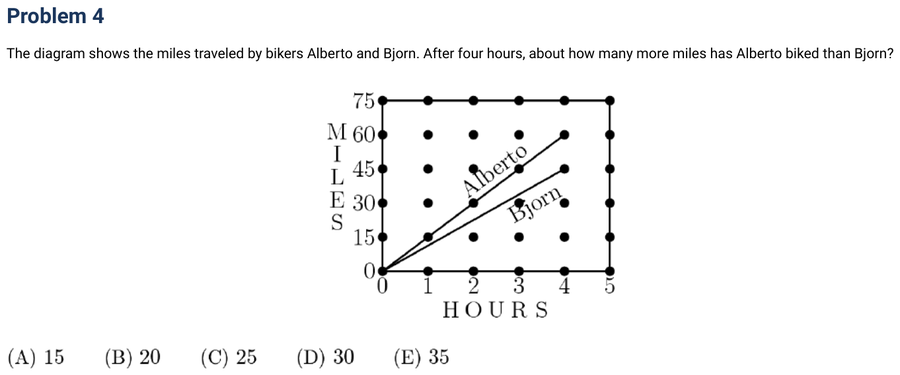
The word "more" means a gap, and a gap on a graph is a vertical distance. Go to Hours = 4 and look at how far apart the two lines sit there.
Still stuck? Show hint 2 →
Hint 2 of 2
Read each line's height at the 4-hour line, then subtract — you don't need the actual mileages anywhere else.
Show solution
Approach: the 'how much more' is the vertical gap at 4 hours
Slide up the vertical line at Hours = 4. Alberto's line is at about 60 miles, Bjorn's at about 45.
"How many more" is the gap between them: 60 − 45 = 15 miles.
Reading tip you'll reuse: a difference question on a graph is always a vertical gap at one chosen x-value — find that x, then measure straight up between the curves. Steeper line = faster rider, which is why Alberto pulls ahead.
A child's wading pool contains 200 gallons of water. If water evaporates at the rate of 0.5 gallons per day and no other water is added or removed, how many gallons of water will be in the pool after 30 days?
Show answer
Answer: C — 185 gallons.
Show hints
Hint 1 of 2
A steady rate over a stretch of time means total change = rate × time. Find the whole amount lost before touching the 200.
Still stuck? Show hint 2 →
Hint 2 of 2
Once you know the total lost, the pool just starts at 200 and gives that much back.
Show solution
Approach: rate × time gives the total loss, then subtract
Losing 0.5 gallon a day for 30 days is rate × time = 0.5 × 30 = 15 gallons gone.
Starting from 200, that leaves 200 − 15 = 185 gallons.
Trap check: the answer choices 198.5 and 199.85 are what you'd get if you forgot to multiply by all 30 days (subtracting only one day's loss, or mis-sliding the decimal). The phrase 'per day' for 30 days always means multiply first.
Given that 1 mile = 8 furlongs and 1 furlong = 40 rods, the number of rods in one mile is
Show answer
Answer: B — 320.
Show hints
Hint 1 of 2
The miles–rods jump is too big to do directly, but you have a stepping-stone (furlongs) that connects them — hop mile → furlong → rod.
Still stuck? Show hint 2 →
Hint 2 of 2
Each hop multiplies: stack the two conversion factors together. (Ignore the decoy numbers 660, 1760, 5280 — those are real mile facts but for feet/yards, not this puzzle's furlongs and rods.)
Show solution
Approach: chain the conversions
Bridge through furlongs: 1 mile is 8 furlongs, and each of those 8 furlongs is 40 rods.
So 1 mile = 8 × 40 = 320 rods.
Why multiply (not add): each furlong unpacks into 40 rods, and you have 8 furlongs, so it's 8 groups of 40 — that's multiplication. This 'chain the units' move handles any multi-step conversion.
In July 1861, 366 inches of rain fell in Cherrapunji, India. What was the average rainfall in inches per hour during that month?
Show answer
Answer: A — 366 ⁄ (31 × 24).
Show hints
Hint 1 of 2
You're asked for rain *per hour*, but the rain is given *per month*. What do you need to divide by to get from a month down to one hour?
Still stuck? Show hint 2 →
Hint 2 of 2
An average rate is always total amount ÷ total of the units you want — here, inches ÷ hours.
Show solution
Approach: average rate = total ÷ number of units
"Per hour" is the giveaway: an average rate is the total spread evenly over every hour, so it's total inches ÷ total hours. No real arithmetic needed — just assemble the right division.
How many hours in July? 31 days × 24 hours, so the answer is 366 ⁄ (31 × 24).
Sanity check on the wrong options: anything that *multiplies* by 31 or 24 makes the rain bigger, but spreading it out over more time must make the per-hour figure *smaller* — only choice A divides.
Miguel and his dog Luna start together at a park entrance. Miguel throws a ball straight ahead to a tree and keeps walking at a steady pace. Luna sprints to the ball and immediately brings it back to Miguel. Luna runs 5 times as fast as Miguel walks. What fraction of the entrance-to-tree distance does Miguel cover by the time Luna brings him the ball?
Show answer
Answer: D — 1/3.
Show hints
Hint 1 of 2
They run for the same amount of time, so forget the clock entirely — in equal time, distance is just proportional to speed. Luna covers 5 times as far as Miguel, whatever that distance turns out to be.
Still stuck? Show hint 2 →
Hint 2 of 2
Picture Luna's actual route: entrance → tree → back to wherever Miguel has walked to. Set that whole length equal to 5 times Miguel's short walk and solve.
Show solution
Approach: same time ⇒ Luna's path length = 5 × Miguel's
Because they move for the same time, the time cancels: Luna's total distance is simply 5 times Miguel's. So set their path lengths in a 5-to-1 ratio — no need for actual speeds or seconds.
Let the entrance-to-tree distance be 1 and Miguel's walk be d. Luna runs to the tree (1) and back to Miguel, who has moved up to d, so the return leg is 1 − d. Luna's path = 1 + (1 − d) = 2 − d.
Equal time means Luna's path = 5d: 5d = 2 − d ⇒ 6d = 2 ⇒ d = 1/3.
Why this transfers: when two movers share the same time window, drop the clock — their distances are in the ratio of their speeds, turning a rate problem into a one-line distance equation.
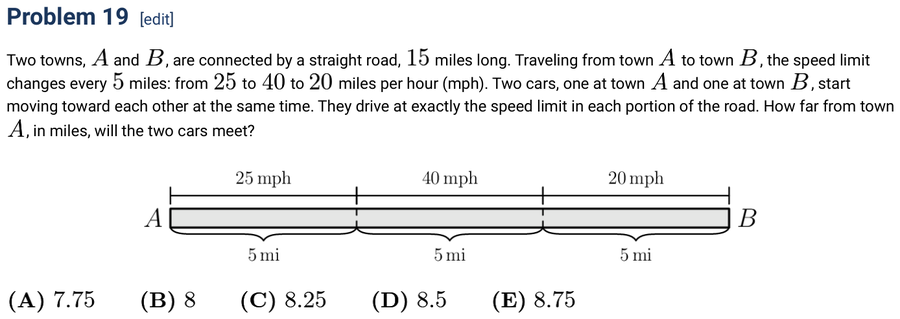
Guess where they meet first: the middle section, where both happen to drive 40 mph. There, equal speeds mean they close the gap evenly — all the trickiness is in how unevenly they reach the middle.
Still stuck? Show hint 2 →
Hint 2 of 2
Time A to the middle: 5/25 = 1/5 hr. Time B to the middle: 5/20 = 1/4 hr. So A enters the middle 1/20 hr early — turn that head start into miles, then split what's left.
Show solution
Approach: find each car's position when both are in the equal-speed middle section
Bet that they meet in the middle 40-mph section (then they go the same speed, so you only need positions). A covers its 5-mile left section in 5/25 = 1/5 hr; B covers its 5-mile right section in 5/20 = 1/4 hr. So A reaches the middle 1/4 − 1/5 = 1/20 hr before B.
In that 1/20-hr head start, A drives 40 × 1/20 = 2 miles into the middle. So when B finally enters, A is at mile 7, B at mile 10 — a 3-mile gap, both now at 40 mph.
Equal speeds split the gap evenly: each drives 1.5 more miles. A's meeting point is 7 + 1.5 = 8.5 miles from A.
Why this transfers: when speeds match over the stretch where they meet, the closing is symmetric — so isolate the asymmetry (the unequal times to arrive), convert it to a distance, then share the remainder equally.
Another way — track total time to the meeting instant:
They meet somewhere in the middle section at the same clock time t. Suppose A has gone a distance d into the middle and B has gone 5 − d into it (their middle distances fill the 5-mile section).
NASA's Perseverance Rover was launched on July 30, 2020. After traveling 292,526,838 miles, it landed on Mars in Jezero Crater about 6.5 months later. Which of the following is closest to the Rover's average interplanetary speed in miles per hour?
Show answer
Answer: C — About 60,000 mph.
Show hints
Hint 1 of 2
The answer choices jump by factors of 10, not by small amounts — that's permission to round wildly. Don't touch 292,526,838; call it 3 × 10⁸.
Still stuck? Show hint 2 →
Hint 2 of 2
Turn 6.5 months into hours through friendly rounding: ≈ 200 days ≈ 5000 hours. Then speed ≈ distance ÷ time.
Show solution
Approach: round to easy numbers, divide
First read the answer choices: they're spaced by powers of 10. That means precision is wasted — the game is to land in the right ballpark, so round everything to one digit.
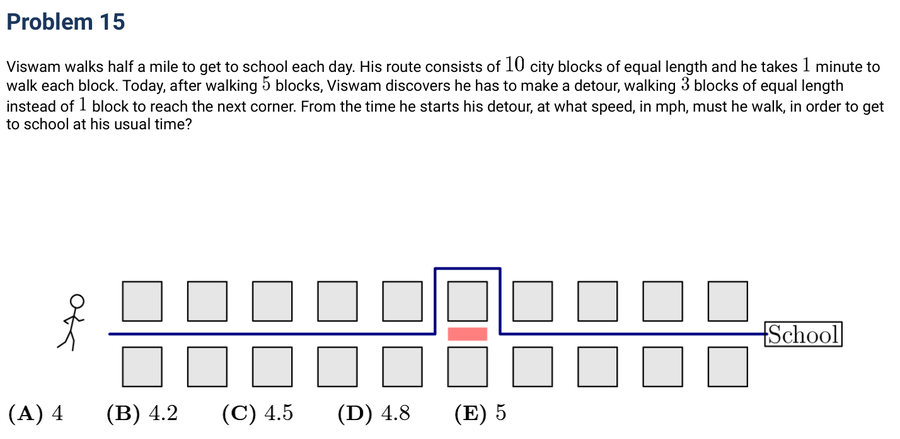
The deadline doesn't move — he still has the same 5 minutes left. What changed is only the distance: the detour swaps 1 block for 3, adding 2 extra blocks.
Still stuck? Show hint 2 →
Hint 2 of 2
So in the leftover 5 minutes he must now cover 7 blocks instead of 5. Turn both into mph-friendly units: each block is 0.05 mile, 5 minutes is 1/12 hour.
Show solution
Approach: convert blocks to miles, time to hours
The anchor is that his arrival time is unchanged — so his time budget for the rest of the walk is fixed, and only his distance grew. That's what forces a faster speed.
Usual walk: 10 blocks = 0.5 mile in 10 min, so each block is 0.05 mile and 5 blocks normally take 5 minutes. After the detour, the detour swaps 1 block for 3, so the remaining trip is 5 + 2 = 7 blocks = 0.35 mile.
He still has only 5 minutes = 1/12 hour. Speed = 0.35 ÷ (1/12) = 0.35 × 12 = 4.2 mph. This transfers: when a deadline is fixed and only the distance changes, hold time constant and let speed = new distance ÷ that fixed time.
Another way — scale up his old speed by the extra distance:
His normal pace covers those last 5 blocks in exactly the 5 minutes he has. The detour makes him cover 7 blocks in that same time — 7/5 as far.
So he must go 7/5 times his usual 3 mph: 3 × 7/5 = 21/5 = 4.2 mph.
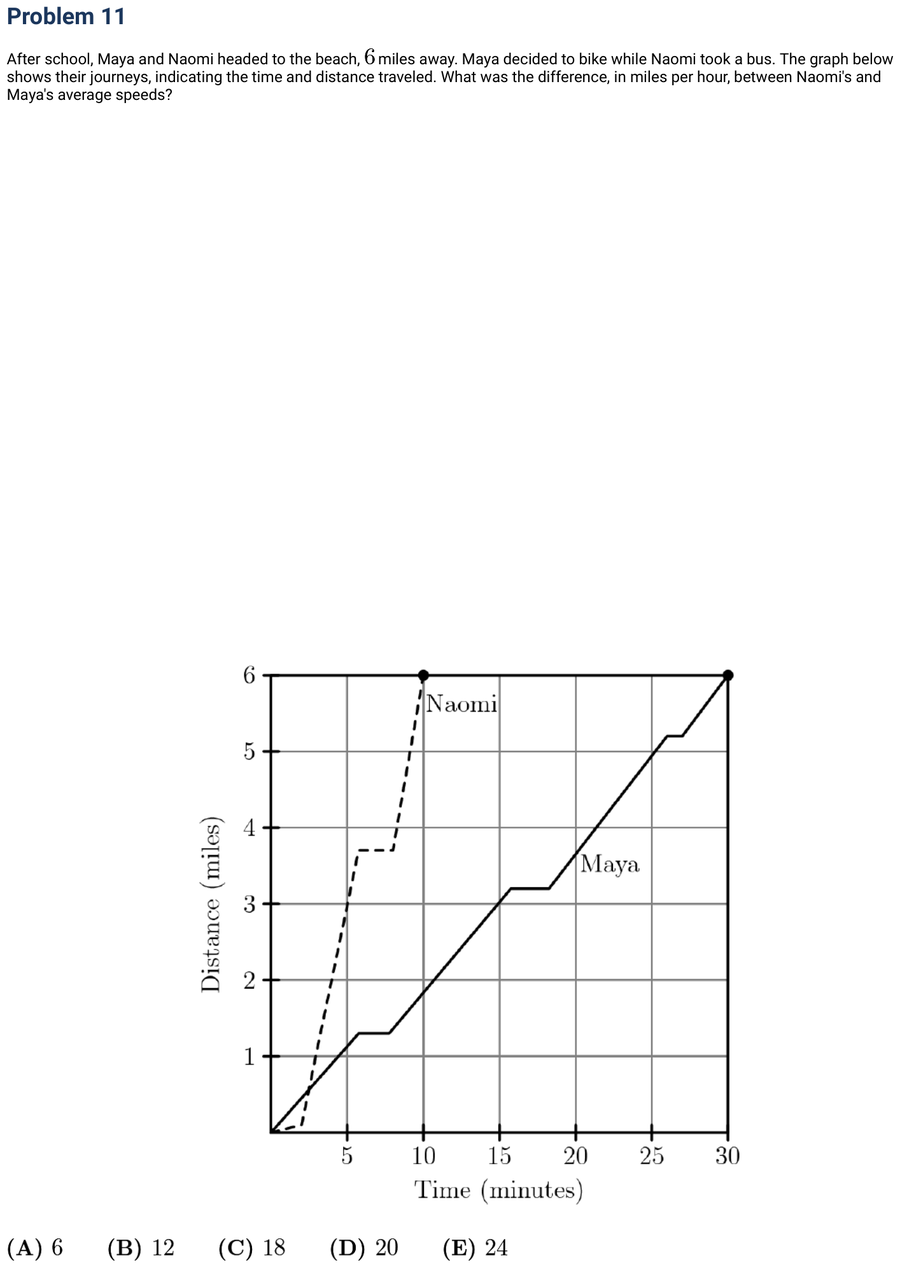
Average speed ignores every stop, wiggle, and flat spot in the graph — it only looks at the two endpoints. So all you need is each girl's finishing time at 6 miles.
Still stuck? Show hint 2 →
Hint 2 of 2
Read where each line hits 6 miles: Naomi at 10 min, Maya at 30 min. Convert each to miles per hour, then subtract.
Show solution
Approach: average speed depends only on start and finish
Average speed = total distance ÷ total time, so the bumps in the graph don't matter — only the endpoint times do. Read them off: Naomi hits 6 miles at 10 min, Maya at 30 min.
Naomi: 6 miles in 10 min = 16 hr → 6 ÷ 16 = 36 mph.
Maya: 6 miles in 30 min = 12 hr → 6 ÷ 12 = 12 mph.
Difference: 36 − 12 = 24 mph.
Why this transfers: on a distance–time graph, average speed is just the slope of the straight line from start to finish — the actual path's twists are irrelevant. Don't get baited into measuring individual segments.
Another way — same distance → compare the times:
Both travel the same 6 miles, so their speeds are in reverse ratio to their times: Naomi (10 min) is 3 times faster than Maya (30 min).
Maya is 12 mph, so Naomi is 36 mph, and the gap is 36 − 12 = 24 mph — no need to recompute from scratch.
Qiang drives 15 miles at an average speed of 30 miles per hour. How many additional miles will he have to drive at 55 miles per hour to average 50 miles per hour for the entire trip?
Show answer
Answer: D — 110 miles.
Show hints
Hint 1 of 2
Average speed is NOT the average of 30 and 55 — it's total distance ÷ total time. Time is the quantity you can actually add up across the two legs, so make time your handle.
Still stuck? Show hint 2 →
Hint 2 of 2
First leg takes 15÷30 = ½ hour. Let the extra distance be x (time x/55). Then set (total distance)÷(total time) = 50 and solve.
Show solution
Approach: total distance ÷ total time = 50
The first leg takes 15 ÷ 30 = ½ hour. Driving x more miles at 55 adds x/55 hours, so total distance = 15 + x and total time = ½ + x/55.
Average speed is the ratio: 15 + x½ + x/55 = 50, i.e. 15 + x = 25 + 10x/11.
Multiply through by 11: 165 + 11x = 275 + 10x ⇒ x = 110.
Why this transfers — and a sanity check: the answer 110 is far bigger than the 15-mile first leg because he must drive a long way at 55 to drag the average all the way up to 50 (just shy of 55). Never average speeds directly; only times and distances add.
Another way — fix the total time first:
Driving 15 miles at 30 used ½ hour. Suppose the second leg also takes t hours; then total distance = 50(½ + t) and the second leg covers 55t miles.
So 15 + 55t = 25 + 50t ⇒ 5t = 10 ⇒ t = 2 hours, and the extra distance is 55 × 2 = 110 miles.
The clock in Sri's car, which is not accurate, gains time at a constant rate. One day as he begins shopping he notes that his car clock and his watch (which is accurate) both say 12:00 noon. When he is done shopping, his watch says 12:30 and his car clock says 12:35. Later that day, Sri loses his watch. He looks at his car clock and it says 7:00. What is the actual time?
Show answer
Answer: B — 6:00.
Show hints
Hint 1 of 2
The first 30-minute shopping trip is a free calibration: it tells you that whenever the car clock ticks 35, only 30 real minutes have passed. The clock runs fast, so the true time is always less than what the car shows.
Still stuck? Show hint 2 →
Hint 2 of 2
The technique is a conversion factor: real time = car time × (30/35). Build the fraction so the fast clock's bigger number is on the bottom, guaranteeing you shrink it.
Show solution
Approach: convert car-time to actual via the rate
Calibrate from the shopping trip: 30 real minutes per 35 car minutes, so real = (30/35) × car = (6/7) × car.
The car shows 7:00, i.e. 420 minutes past noon. Real elapsed = 420 × 6/7 = 360 minutes = 6 hours.
Six real hours after noon is 6:00. Sanity check: the clock gains, so real time must be earlier than 7:00 — 6:00 is, while traps like 8:10 are not.
You'll see it again: any "broken clock running at a steady wrong rate" is a unit-conversion problem — find the real-per-fake ratio once, then scale.
Bella begins to walk from her house toward her friend Ella's house. At the same time, Ella begins to ride her bicycle toward Bella's house. They each maintain a constant speed, and Ella rides 5 times as fast as Bella walks. The distance between their houses is 2 miles, which is 10,560 feet, and Bella covers 2½ feet with each step. How many steps will Bella take by the time she meets Ella?
Show answer
Answer: A — 704 steps.
Show hints
Hint 1 of 2
They walk for the same amount of time until they meet, so the distances they cover split in the same ratio as their speeds — 1 to 5. Bella does the small share, Ella eats up the rest.
Still stuck? Show hint 2 →
Hint 2 of 2
The technique: for two movers closing a gap, "same time" means distance is shared in the speed ratio. Out of 1 + 5 = 6 equal parts, Bella covers 1 part — then convert her distance to steps.
Show solution
Approach: ratio of distances, then divide by step length
In the equal time before they meet, Bella and Ella cover distances in their speed ratio 1 : 5. Together those parts make up the whole 10,560 feet, so Bella covers 1 of 6 parts.
Bella's distance: 10,560 ÷ 6 = 1,760 feet.
Each step is 2.5 ft, so steps = 1,760 ÷ 2.5 = 704. (The fact that 10,560 = 2 miles is just there to confirm the feet conversion.)
You'll see it again: two objects meeting after starting at the same instant always divide the distance in their speed ratio — no need to find the meeting time at all.
Karl's car uses a gallon of gas every 35 miles, and his gas tank holds 14 gallons when it is full. One day, Karl started with a full tank of gas, drove 350 miles, bought 8 gallons of gas, and continued driving to his destination. When he arrived, his gas tank was half full. How many miles did Karl drive that day?
Show answer
Answer: A — 525 miles.
Show hints
Hint 1 of 2
The miles after the gas stop aren't given directly — but the GAS is. Stop chasing miles; instead bookkeep the tank's gallons at every stage, and the unknown miles fall out of the gallons burned.
Still stuck? Show hint 2 →
Hint 2 of 2
March the gauge forward: full → (drive 350) → (buy 8) → half-full at the end. The only mystery leg is the last one; the gallons burned there = (gallons after buying) − (gallons left), and gallons × 35 gives those miles.
Show solution
Approach: bookkeep gallons stage by stage; convert gallons burned to miles
Buy 8 gal → tank now holds 4 + 8 = 12 gal. He arrives half full = 7 gal, so the last leg burned 12 − 7 = 5 gal = 5 × 35 = 175 miles.
Total distance = 350 + 175 = 525 miles.
Why this transfers: in any "resource used up over a journey" problem (fuel, battery, money), track the level of the RESOURCE step by step — the hidden distance/time pops out of the amount consumed.
Annie and Bonnie are running laps around a 400-meter oval track. They started together, but Annie has pulled ahead because she runs 25% faster than Bonnie. How many laps will Annie have run when she first passes Bonnie?
Show answer
Answer: D — 5 laps.
Show hints
Hint 1 of 2
"First passes" on a loop track doesn't mean catching up — they started together, so Annie passes Bonnie when she's a WHOLE LAP ahead. The question is really about the GAP between them growing to 400 m, not their absolute positions.
Still stuck? Show hint 2 →
Hint 2 of 2
25% faster means speeds are in ratio 5 : 4, so Annie gains 1/4 of a lap on Bonnie for each lap Bonnie runs. Ask: how many of Bonnie's laps until that gain reaches one full lap?
Show solution
Approach: track the GAP: Annie gains a quarter-lap per Bonnie-lap until it's a full lap
Annie : Bonnie speeds = 125 : 100 = 5 : 4, so while Bonnie runs 1 lap, Annie runs 5/4 laps — Annie's lead grows by 1/4 lap each Bonnie-lap.
To pull a full lap ahead (the moment she "passes"), the lead must reach 1 lap: that takes 4 quarter-laps, i.e. Bonnie runs 4 laps.
In that same stretch of time Annie runs 5/4 × 4 = 5 laps.
Watch the trap: answer 4 is Bonnie's lap count, not Annie's — the question asks how far ANNIE has run. Track whose laps you're reporting.
Why this transfers: for two bodies moving the same direction, work with the RELATIVE speed (the gap's growth rate); "lapping" happens when the gap equals one full lap.
Homer began peeling a pile of 44 potatoes at the rate of 3 potatoes per minute. Four minutes later Christen joined him and peeled at the rate of 5 potatoes per minute. When they finished, how many potatoes had Christen peeled?
Show answer
Answer: A — 20.
Show hints
Hint 1 of 2
Christen's count depends on how LONG she works, so the real target is the shared time — peel away Homer's head start first.
Still stuck? Show hint 2 →
Hint 2 of 2
After the head start, the two work together at a combined rate; that combined rate tells you how long the rest takes.
Show solution
Approach: head start, then combined rate
Account for the head start: in 4 minutes alone Homer peels 3 × 4 = 12, leaving 44 − 12 = 32 potatoes.
Now they work side by side at 3 + 5 = 8 potatoes per minute, so finishing 32 takes 32 ÷ 8 = 4 minutes. (Combine rates by adding when people work at the same time.)
Christen worked all 4 of those minutes at 5 per minute: 5 × 4 = 20 potatoes. The key was finding the shared time first — counts follow once you know how long someone worked.
Another way — split the remaining work by rate share:
After the head start, 32 potatoes remain and the pair peels in a 3 : 5 ratio (Homer : Christen), 8 parts total.
Christen does 5/8 of the remaining 32 = 20 potatoes — no need to find the time at all.
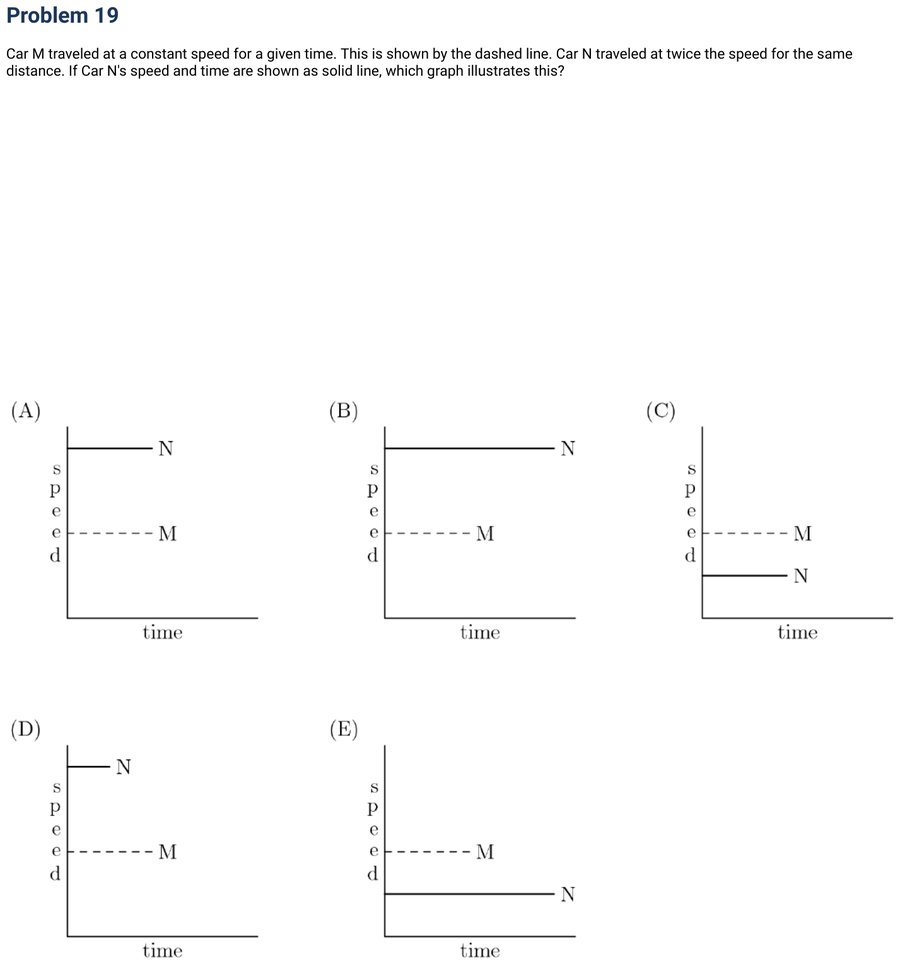
On a speed-vs-time graph, the distance traveled is the AREA of the rectangle under the line (speed × time). Both cars cover the same distance, so both rectangles have the same area.
Still stuck? Show hint 2 →
Hint 2 of 2
Double the height (speed) with the same area forces half the width (time) — so look for N's line drawn twice as high but half as long as M's.
Show solution
Approach: twice the speed over the same distance halves the time
Read the axes: speed is vertical, time horizontal, and a constant speed is a horizontal line. Distance = speed × time = the area under that line.
Car N is twice as fast, so its line sits at twice M's height. Same distance means same area, so doubling the height must halve the width — N's line runs only half as long in time.
The graph with N higher AND shorter than M is D. The takeaway: on speed-time graphs, area = distance, so trading height for width keeps distance fixed.
Nisos Isles. In 1998 the islands have 200 people, and the population triples every 25 years. The total area is 24,900 square miles, and the Queen requires at least 1.5 square miles per person. In about how many years from 1998 will the population reach the maximum the islands can support?
Show answer
Answer: C — About 100 years.
Show hints
Hint 1 of 2
Two stages here: first decide the target (the most people the land can hold), then count triplings to reach it. The cap comes from sharing the land: total area ÷ space-per-person.
Still stuck? Show hint 2 →
Hint 2 of 2
Once you have the cap, it's the same engine as before — divide by 200 to get the multiple, then count the ×3 steps (powers of 3) and turn them into years.
Show solution
Approach: compute the land's cap, then count triplings to reach it
Largest population the land allows = total area ÷ space each person needs = 24,900 ÷ 1.5 = 16,600 people.
That's 16,600 ÷ 200 = 83 times today's count. Walk up the powers of 3: 3, 9, 27, 81 — four triplings give 81, just shy of 83.
Four steps = 4 × 25 = 100 years after 1998.
Why this transfers: many word problems are a 'find the goal, then count steps to it' combo. Here the goal hides behind a sharing/division (area ÷ per-person), and the step-counting is the same powers-of-3 idea from the earlier parts.
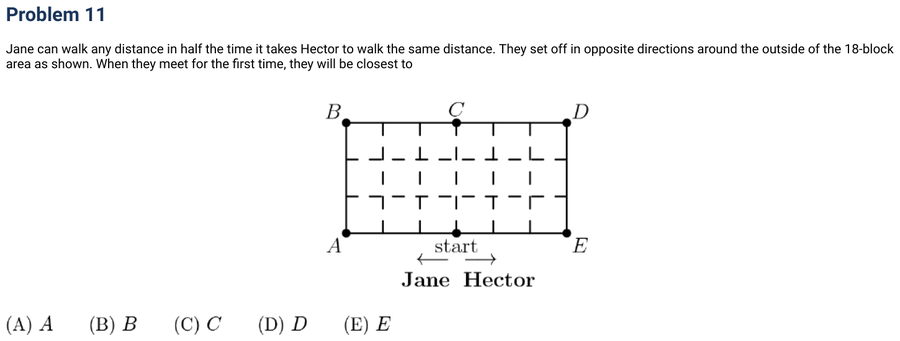
When two people start together and walk opposite ways around a loop, at the instant they meet their distances ADD UP to the whole loop. That one fact replaces any speed/time algebra.
Still stuck? Show hint 2 →
Hint 2 of 2
Speeds split the loop in the same ratio as the speeds. Jane is twice as fast, so of the 18 blocks she walks 2 parts and Hector 1 part — Hector walks just 13 of 18 = 6 blocks. Then trace those 6 blocks on the picture.
Show solution
Approach: their combined distance equals the loop; split it by the speed ratio
The key idea: going opposite ways around the rectangle, when they first meet their two distances together equal the full perimeter, 18 blocks. No need to find time or actual speed.
Speed ratio is 2 : 1 (Jane : Hector), so they split the 18 blocks the same way: Jane walks 12, Hector walks 6.
Trace Hector's 6 blocks from the start (bottom middle): 3 blocks right to corner E, then 3 blocks up the right side — landing exactly on corner D. (Jane's 12 blocks bring her to D too, confirming the meeting point.)
Why this transfers: for two travelers closing a loop or a gap, 'distances sum to the whole' plus 'distances split as the speed ratio' solves almost every meeting problem with no equations.
Students from three middle schools worked on a summer project. Seven students from Allen school worked for 3 days, four students from Balboa school worked for 5 days, and five students from Carver school worked for 9 days. The total amount paid for the students' work was $774. Assuming each student received the same amount for a day's work, how much did the students from Balboa school earn altogether?
Show answer
Answer: C — 180.00 dollars.
Show hints
Hint 1 of 2
Pay depends on BOTH how many students and how many days — so the real unit being paid for is one 'student-day' (one student working one day). Count those, not students.
Still stuck? Show hint 2 →
Hint 2 of 2
Add up all the student-days, find the dollars per student-day, then multiply by Balboa's share.
Show solution
Approach: invent the right unit (student-days), then find its rate
The insight: each student is paid the same per day, so money tracks 'student-days' — one student for one day. Seven students for 3 days is 21 student-days, and so on. Build everything from this unit.
The $774 paid for all 86, so each student-day is worth 774 ÷ 86 = $9. Balboa's 20 student-days earned 20 × $9 = $180.
Why this transfers: when a quantity depends on two factors multiplied together (people × time, machines × hours, workers × days), make the combined unit first — then it's a plain unit-rate problem.
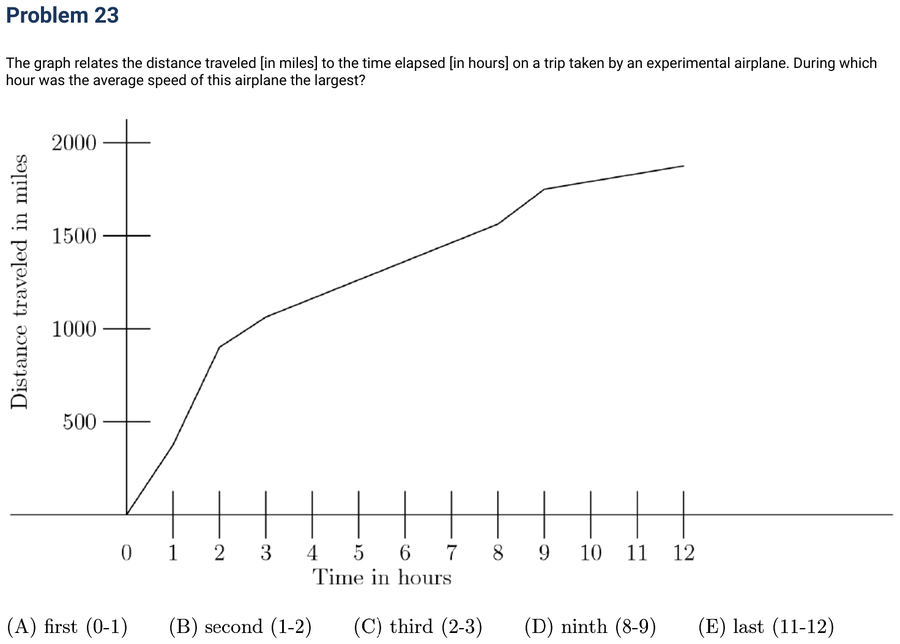
Speed = distance ÷ time, and every choice covers the same one hour. So 'fastest hour' just means 'the hour where the distance climbed the most' — you're comparing rises, not doing division.
Still stuck? Show hint 2 →
Hint 2 of 2
On a distance–time graph, the steeper the line over an hour, the faster the plane went that hour. Don't read exact numbers — just eyeball where the curve shoots up most sharply.
Show solution
Approach: steepest one-hour segment = fastest hour (read the slope by eye)
Average speed over an hour = (miles gained) ÷ (1 hour) = the miles gained that hour. Since every option is a 1-hour stretch, the fastest hour is simply the one with the biggest jump in distance — the steepest part of the graph.
Scan the curve: between hours 1 and 2 it leaps from about 400 to about 900 miles — roughly a 500-mile climb, clearly steeper than any other single hour (the later hours flatten out).
So the largest average speed is during the second hour (1-2).
*Worth keeping:* on a distance–time graph, steepness *is* speed — comparing slopes by eye beats computing every segment, and a flattening curve means slowing down.
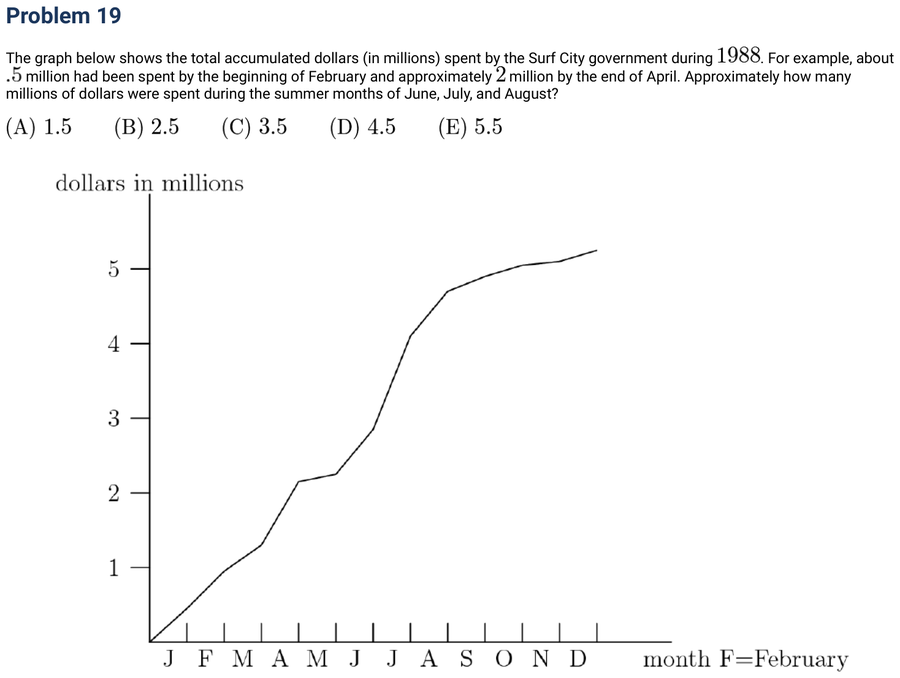
Read carefully: the graph shows TOTAL accumulated dollars, a running tally that only climbs. The height at any month is everything spent up to then — not the spending of that month alone.
Still stuck? Show hint 2 →
Hint 2 of 3
On a running-total graph, the spending during a stretch of time is how much the curve RISES across that stretch (end value minus start value), not the height itself.
Still stuck? Show hint 3 →
Hint 3 of 3
Summer is June, July, August — so it starts at the end of May and finishes at the end of August. Read the curve's height at both moments and subtract.
Show solution
Approach: rise of the running total across the window
The key is the word 'accumulated' — the curve is a running total that never goes down, so each month's height already includes all earlier months. To isolate the summer, take the rise of the curve from where summer begins to where it ends.
Summer = June + July + August, which spans from end-of-May to end-of-August. Read the curve: ≈ 2.2 million at end-of-May, ≈ 4.7 million at end-of-August.
Summer spending ≈ 4.7 − 2.2 = 2.5 million.
Trap to avoid: don't read 4.7 (the end-of-summer total) as the summer's spending — that would count the whole first half of the year too. On any cumulative graph, a period's amount is always a difference of two heights.
The average weight of 6 boys is 150 pounds and the average weight of 4 girls is 120 pounds. The average weight of the 10 children is
Show answer
Answer: C — 138 pounds.
Show hints
Hint 1 of 2
You can't just average 150 and 120 — there are more boys than girls, so the boys pull the combined average closer to their side. The only safe move is to go back to the raw totals.
Still stuck? Show hint 2 →
Hint 2 of 2
An average is always (total of everything) ÷ (how many things). Find the total weight of all 10 kids, then divide by 10.
Show solution
Approach: rebuild from total weight ÷ total count
Recover the totals each average came from: boys weigh 6 × 150 = 900, girls weigh 4 × 120 = 480. All 10 children together weigh 900 + 480 = 1380.
Average = 1380 ⁄ 10 = 138 pounds.
Trap to avoid: (150 + 120) ⁄ 2 = 135 (choice A) treats the groups as equal in size. Because the 6 boys outnumber the 4 girls, the real average sits *above* the midpoint 135 — and 138 leans toward the heavier, larger group, exactly as it should.
Why this transfers: to combine two averages, never average the averages. Undo each average into a sum, add the sums, and divide by the combined count — the group sizes do the weighting for you automatically.
At the beginning of a trip, the mileage odometer read 56,200 miles. The driver filled the gas tank with 6 gallons of gasoline. During the trip, the driver filled his tank again with 12 gallons of gasoline when the odometer read 56,560. At the end of the trip, the driver filled his tank again with 20 gallons of gasoline. The odometer read 57,060. To the nearest tenth, what was the car's average miles-per-gallon for the entire trip?
Show answer
Answer: D — 26.9.
Show hints
Hint 1 of 3
The numbers are designed to trip you up. MPG = miles ÷ gas *used*. The very first 6 gallons were poured in *before* any of the measured driving — so does that gas belong in 'gas used during the trip'?
Still stuck? Show hint 2 →
Hint 2 of 3
A refill replaces exactly the gas you just burned. So the gas used between the start and end odometer readings is the sum of the *later* fill-ups, not the first one.
Still stuck? Show hint 3 →
Hint 3 of 3
Miles = end odometer − start odometer; gas used = the two refills made during the trip.
Show solution
Approach: miles driven ÷ gas burned (the refills during the trip)
First the easy part: miles driven = 57,060 − 56,200 = 860 miles.
Now the trap. The opening 6 gallons just filled the tank at the start — that gas measures driving from *before* this trip, not during it. Every refill afterwards replaces exactly what was burned since, so the gas used over these 860 miles is 12 + 20 = 32 gallons.
MPG = 860 ÷ 32 = 26.875 ≈ 26.9.
Why exclude the first fill: 'miles per gallon' pairs the distance with the fuel that distance consumed. Including the initial top-off (giving 860⁄38 ≈ 22.6, choice B — the planted wrong answer) would mix in fuel for earlier miles. Match the gas to the miles it actually moved.
If you walk for 45 minutes at a rate of 4 mph and then run for 30 minutes at a rate of 10 mph, how many miles will you have gone at the end of one hour and 15 minutes?
Show answer
Answer: B — 8 miles.
Show hints
Hint 1 of 2
The speeds are in miles per HOUR, but the times are in minutes — those units must match before you multiply. Turn 45 minutes and 30 minutes into fractions of an hour first.
Still stuck? Show hint 2 →
Hint 2 of 2
Distance = rate × time, done separately for the walk and the run, then added. The total time (1 hour 15 min) is a distractor — you never use it directly; it's just the two legs combined.
Show solution
Approach: rate × time on each leg
Match the units: 45 min = 45⁄60 = 3⁄4 hour, and 30 min = 30⁄60 = 1⁄2 hour.
Walk leg: 4 mph × 3⁄4 hr = 3 miles. Run leg: 10 mph × 1⁄2 hr = 5 miles.
Total distance = 3 + 5 = 8 miles.
Spot the trap: the choice '480 miles' comes from multiplying speed by minutes (10 × 30 + …) without converting to hours. Always make the time unit match the speed's unit before multiplying.
The ratio of boys to girls in Mr. Brown's math class is 2 : 3. If there are 30 students in the class, how many more girls than boys are in the class?
Show answer
Answer: D — 6.
Show hints
Hint 1 of 2
Think of the ratio 2 : 3 as dividing the class into equal-size 'parts' — 2 parts of boys and 3 parts of girls. How many parts is that all together, and how big is each one?
Still stuck? Show hint 2 →
Hint 2 of 2
Add the ratio numbers to get the total parts (2 + 3 = 5), divide the class by that to size one part, then read off whatever the question asks. Here 'how many more girls' is just the part-difference (3 − 2 = 1 part).
Show solution
Approach: size of one part times the difference of parts
The ratio splits the class into 2 + 3 = 5 equal parts, so each part = 30 ⁄ 5 = 6 students.
Girls (3 parts) outnumber boys (2 parts) by exactly 1 part: extra girls = 1 × 6 = 6.
Spot the trap: '6' is the difference of parts (3 − 2 = 1 part), NOT the count of girls (which is 18) or 2 parts (which is 10, a tempting wrong answer). Always match the question to the right number of parts.
If your average score on your first six mathematics tests was 84 and your average score on your first seven mathematics tests was 85, then your score on the seventh test was
Show answer
Answer: D — 91.
Show hints
Hint 1 of 2
An average is a disguised total: average × count = sum. The seventh test is the only difference between the two groups, so it must be the gap between the two totals.
Still stuck? Show hint 2 →
Hint 2 of 2
Turn each average into a running total (7 × 85 and 6 × 84), then subtract — what's left over is the one extra test.
Show solution
Approach: difference of totals
Recover the sums: first 7 tests total 7 × 85 = 595; first 6 tests total 6 × 84 = 504.
The seventh test is the difference: 595 − 504 = 91.
Intuition: adding the 7th test pulled the average UP by 1 point across all 7 tests. So the 7th score had to be the old average 84 plus enough to lift all seven by 1 — that's 84 + 7 = 91. (Quick check: 84 + 7×1 = 91 ✓.)
In January 1980 the Mauna Loa Observatory recorded carbon dioxide CO2 levels of 338 ppm (parts per million). Over the years the average CO2 reading has increased by about 1.515 ppm each year. What is the expected CO2 level in ppm in January 2030? Round your answer to the nearest integer.
Show answer
Answer: B — 414 ppm.
Show hints
Hint 1 of 2
"Same amount every year" is the signal for one move: total rise = rate × number of years. Don't add year by year.
Still stuck? Show hint 2 →
Hint 2 of 2
Technique — linear growth: increase = (yearly rate) × (years elapsed), then add to the starting level. Count the years from 1980 to 2030 first.
Show solution
Approach: rate × time, then add to start
A constant yearly increase means the rise is just rate × time — no need to step through 50 separate years. Years elapsed: 2030 − 1980 = 50.
Total increase: 50 × 1.515 = 75.75 ≈ 76 ppm.
New level: 338 + 76 = 414. Sanity check: ~1.5 ppm/yr over 50 years is roughly 75, landing just above 338+75 = 413 — only 414 is in range, so estimation alone nails the choice.
When the World Wide Web first became popular in the 1990s, download speeds reached a maximum of about 56 kilobits per second. Approximately how many minutes would the download of a 4.2-megabyte song have taken at that speed? (Note that there are 8000 kilobits in a megabyte.)
Show answer
Answer: B — 10 minutes.
Show hints
Hint 1 of 2
The speed is in kilobits per second but the song is in megabytes — the units don't match. Fix that first; everything else is one division.
Still stuck? Show hint 2 →
Hint 2 of 2
Convert the song to kilobits (4.2 × 8000), then time = size ÷ speed, and finish by turning seconds into minutes.
Show solution
Approach: make the units match the speed, then divide
Insight: don't divide yet — the answer choices span 0.6 to 36000, so a units slip is the whole danger. The speed is in kilobits/sec, so put the song in kilobits too: 4.2 × 8000 = 33,600 kilobits.
Time = 33,600 ÷ 56 = 600 seconds = 10 minutes.
Lighter path: avoid the big division by reshaping the size as 56 × (something): 33,600 = 56 × 600, so it's 600 seconds straight off — then ÷60 for minutes.
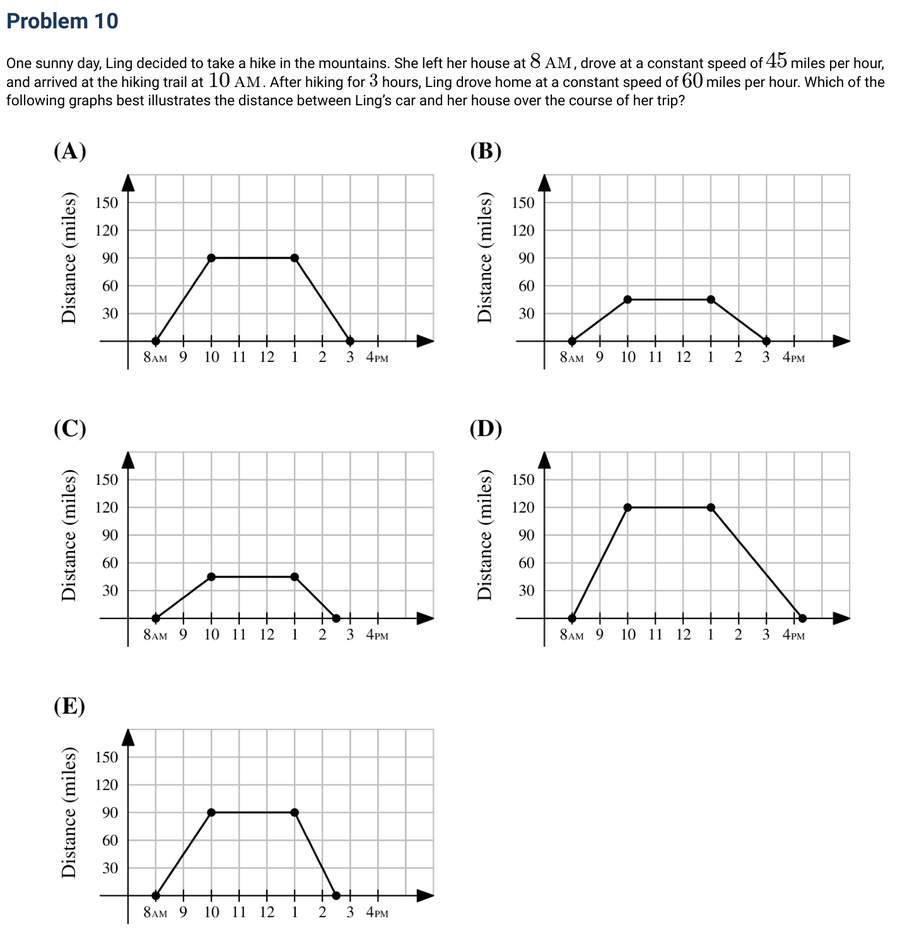
The trip has three phases — drive out, hike (not moving away), drive back. So the graph must go up, flat, then down. Match that shape first, then check the numbers.
Still stuck? Show hint 2 →
Hint 2 of 2
Out: 2 hr × 45 mph = 90 mi (the peak). Hiking is a flat stretch (distance from home unchanged). Return is faster (60 mph), so the down-slope is steeper than the up-slope.
Show solution
Approach: match the up-flat-down shape, then pin the peak and slopes
Insight: a graph problem is a matching problem — read the story as a shape before touching numbers. Drive out (rising), hike (flat, since her distance from home holds steady), drive back (falling): up → flat → down.
Peak height: 2 hr × 45 mph = 90 miles, reached at 10am — that alone rules out any graph not peaking at 90.
Slopes: the return is at 60 mph (faster than the 45 mph trip out), so the down-slope is steeper than the up-slope — 90 ÷ 60 = 1.5 hr home, arriving 2:30pm.
The up-flat-down graph peaking at 90 with a steeper descent is choice E.
You'll see this again: on distance-time graphs, steeper = faster, flat = stopped (or moving neither toward nor away). Reading slope as speed lets you eliminate most choices without arithmetic.
On a trip to the beach, Anh traveled 50 miles on the highway and 10 miles on a coastal access road. He drove three times as fast on the highway as on the coastal road. If Anh spent 30 minutes driving on the coastal road, how many minutes did his entire trip take?
Show answer
Answer: C — 80 minutes.
Show hints
Hint 1 of 2
The one fact you're handed (10 miles in 30 minutes) is secretly a speed. Pin that down and the highway speed comes free — it's just three times bigger.
Still stuck? Show hint 2 →
Hint 2 of 2
The technique: when given distance and time for one stretch, get a speed, then use that speed (or a scaled version) to find the missing time on the other stretch. Time = distance ÷ speed.
Show solution
Approach: find each leg's time separately
Coastal leg: 10 miles in 30 min, so his coastal speed is 1/3 mile per minute. Highway is 3× faster: 1 mile per minute.
Highway time: 50 miles ÷ 1 mile/min = 50 min.
Total trip: 30 + 50 = 80 minutes.
Another way — compare the legs directly (no speeds needed):
Going 3× faster on the highway means each highway mile takes 1/3 the time of a coastal mile. The highway is 5× longer (50 vs 10 miles) but 3× quicker per mile, so the highway takes 5/3 of the coastal time.
Coastal took 30 min, so highway takes (5/3)(30) = 50 min, and the total is 30 + 50 = 80 minutes — reached entirely by scaling the one known time.
George walks 1 mile to school. He leaves home at the same time each day, walks at a steady speed of 3 miles per hour, and arrives just as school begins. Today he was distracted by the pleasant weather and walked the first 12 mile at a speed of only 2 miles per hour. At how many miles per hour must George run the last 12 mile in order to arrive just as school begins today?
Show answer
Answer: B — 6 mph.
Show hints
Hint 1 of 2
Time is the fixed budget here, not speed. He must arrive at the usual moment, so his total travel time is locked at the normal value — figure that out first.
Still stuck? Show hint 2 →
Hint 2 of 2
Subtract the time the slow first half ate up; whatever's left is all he has to cover the last half-mile. Speed = distance ÷ that leftover time.
Show solution
Approach: time is the fixed budget — subtract what's spent
Normal trip: 1 mile at 3 mph takes 1/3 hr. That's the total time budget he must hit today.
Slow first half: (1/2 mile) ÷ (2 mph) = 1/4 hr used up.
Time left for the second half-mile: 1/3 − 1/4 = 4/12 − 3/12 = 1/12 hr.
Required speed = (1/2 mile) ÷ (1/12 hr) = 6 mph.
Why this transfers: in "arrive on time" problems, hold time constant and treat it as a budget. Don't average the speeds — dawdling on the first half costs disproportionately more time, which is why he must nearly triple his pace, not just speed up a little.
Ted's grandfather used his treadmill on 3 days this week. He went 2 miles each day. On Monday he jogged at a speed of 5 miles per hour. He walked at the rate of 3 miles per hour on Wednesday and at 4 miles per hour on Friday. If Grandfather had always walked at 4 miles per hour, he would have spent less time on the treadmill. How many minutes less?
Show answer
Answer: D — 4 minutes.
Show hints
Hint 1 of 2
Same 2 miles every day, so time is decided entirely by speed: time = distance ÷ rate. Slower = longer, faster = shorter. The "always 4 mph" plan is your benchmark.
Still stuck? Show hint 2 →
Hint 2 of 2
You don't even need all three days. Friday was already 4 mph (no change). Monday at 5 mph was faster than 4, so it would actually take more time at 4 — the real saving lives only where he went slower than 4.
Show solution
Approach: compare each real day to the 4-mph benchmark
Distance is fixed at 2 miles, so time = 2 ÷ rate. At 4 mph the benchmark is 2/4 hr = 30 min per day.
Friday was 4 mph — already on benchmark, 0 difference. Monday at 5 mph took 2/5 hr = 24 min, which is 6 min less than 30 (so "always 4" would cost +6 there).
Wednesday at 3 mph took 2/3 hr = 40 min, which is 10 min more than 30.
Net time saved by going all-4-mph = +6 (Mon) − 10 (Wed) + 0 (Fri)… flip sign for "less time": 10 − 6 = 4 minutes less.
Check the totals: actual 24 + 40 + 30 = 94 min; all-4 plan 3 × 30 = 90 min; 94 − 90 = 4. Same answer.
A number of students from Fibonacci Middle School are taking part in a community service project. The ratio of 8th-graders to 6th-graders is 5 : 3, and the ratio of 8th-graders to 7th-graders is 8 : 5. What is the smallest number of students that could be participating in the project?
Show answer
Answer: E — 89 students.
Show hints
Hint 1 of 2
The 8th-graders appear in both ratios — they're the shared hinge. In ratio 5:3 their count is a multiple of 5; in ratio 8:5 it's a multiple of 8. Make those two pictures agree first.
Still stuck? Show hint 2 →
Hint 2 of 2
To merge two ratios that share a quantity, force the shared term to a common value — the smallest is the LCM. Then every group count comes out whole.
Show solution
Approach: make the shared 8th-grader count an LCM
8th-graders link both ratios, so their count must be a multiple of 5 (from 5:3) and of 8 (from 8:5). Smallest such count = lcm(5, 8) = 40 — pick that to keep everyone whole.
6th-graders: 40 × 3/5 = 24 (from 5:3).
7th-graders: 40 × 5/8 = 25 (from 8:5).
Total = 40 + 24 + 25 = 89.
Why this transfers: any "chain" of ratios sharing a common term is stitched together by setting that term to the LCM — the same trick scales recipe ratios, gear ratios, and unit conversions.
As Emily is riding her bicycle on a long straight road, she spots Emerson skating in the same direction 1/2 mile in front of her. After she passes him, she can see him in her rear mirror until he is 1/2 mile behind her. Emily rides at a constant rate of 12 miles per hour, and Emerson skates at a constant rate of 8 miles per hour. For how many minutes can Emily see Emerson?
Show answer
Answer: D — 15 minutes.
Show hints
Hint 1 of 2
Don't track two moving people — track the gap between them. It starts at 1/2 mile (Emerson ahead) and ends at 1/2 mile (Emerson behind), a swing of 1 full mile.
Still stuck? Show hint 2 →
Hint 2 of 2
When two things move the same direction, sit in one rider's seat: from Emily's view Emerson drifts backward at the difference of the speeds, 12 − 8 = 4 mph. That's relative speed.
Show solution
Approach: watch the gap, using relative speed
From Emily's seat, Emerson slides backward at 12 − 8 = 4 mph — only the difference matters since they head the same way.
The gap she can ‘see across’ runs from 1/2 mile ahead to 1/2 mile behind, so 1 mile of relative drift.
Why this transfers: same direction → subtract speeds; opposite directions → add them. Reframing two movers as one gap turns chase/overtake problems into a single distance ÷ rate step.
Another way — track real positions and solve:
Let t be hours since Emily is alongside Emerson. Emily has gone 12t, Emerson 8t, so Emily leads by 4t miles.
Visibility starts at 4t = −1/2 (he's ahead) and ends at 4t = +1/2 (he's behind), a span of Δ(4t) = 1, i.e. t increases by 1/4 hour.
1/4 hour = 15 minutes — same answer, confirming the gap view.
Austin and Temple are 50 miles apart along Interstate 35. Bonnie drove from Austin to her daughter's house in Temple, averaging 60 miles per hour. Leaving the car with her daughter, Bonnie rode a bus back to Austin along the same route and averaged 40 miles per hour on the return trip. What was the average speed for the round trip, in miles per hour?
Show answer
Answer: B — 48 mph.
Show hints
Hint 1 of 2
The trap answer is 50 (just averaging 60 and 40). But she spends MORE time at the slow 40 mph, so the average leans below 50. Average speed is always total distance ÷ total time — never the average of the speeds.
Still stuck? Show hint 2 →
Hint 2 of 2
Since the distance each way is the same, the actual 50 miles cancels out — the answer depends only on the two speeds 60 and 40.
Show solution
Approach: total distance ÷ total time
Time there: 50/60 = 5/6 hr. Time back: 50/40 = 5/4 hr. Total time = 5/6 + 5/4 = 10/12 + 15/12 = 25/12 hr.
Sanity check: 48 is below the plain average of 50 — correct, because the slow leg eats more time.
You'll see it again: equal-distance round trips give the harmonic mean of the speeds, 2×60×40/(60+40) = 4800/100 = 48 — always below the ordinary average, and the actual distance never matters.
Another way — pick a convenient distance:
The distance cancels, so use the LCM of 60 and 40: pretend each leg is 120 miles.
Out: 120/60 = 2 hr. Back: 120/40 = 3 hr. Total 240 miles in 5 hr = 48 mph.
A recipe that makes 5 servings of hot chocolate requires 2 squares of chocolate, 1/4 cup sugar, 1 cup water and 4 cups milk. Jordan has 5 squares of chocolate, 2 cups of sugar, lots of water, and 7 cups of milk. If she maintains the same ratio of ingredients, what is the greatest number of servings of hot chocolate she can make?
Show answer
Answer: D — 8¾ servings.
Show hints
Hint 1 of 2
You can only make as much as your SCARCEST ingredient allows — like a chain breaking at its weakest link. Having extra of everything else doesn't help once one runs out.
Still stuck? Show hint 2 →
Hint 2 of 2
For each ingredient ask: how many full recipes does my supply cover? (supply ÷ amount-per-recipe). The smallest of those numbers is the limit; then turn recipes into servings.
The smallest is milk at 1.75 recipes — milk runs out first, so it caps everything.
Each recipe makes 5 servings: 1.75 × 5 = 35/4 = 8¾ servings.
Why this transfers: any "how much can I make / how many can I build" problem is a weakest-link question — compute the limit from each resource and take the minimum. Don't average them or use the most plentiful one.
Cassie leaves Escanaba at 8:30 AM heading for Marquette on her bike. She bikes at a uniform rate of 12 miles per hour. Brian leaves Marquette at 9:00 AM heading for Escanaba on his bike. He bikes at a uniform rate of 16 miles per hour. They both bike on the same 62-mile route between Escanaba and Marquette. At what time in the morning do they meet?
Show answer
Answer: D — 11:00 AM.
Show hints
Hint 1 of 2
Two riders heading toward each other close the gap between them at the SUM of their speeds — think of the empty road shrinking, not the riders moving. But first deal with the half-hour head start so you start both clocks together.
Still stuck? Show hint 2 →
Hint 2 of 2
Closing speed: when two things approach each other, add their speeds; the gap divided by that combined speed is the time to meet.
Show solution
Approach: settle the head start, then close the gap at combined speed
Cassie rides alone from 8:30 to 9:00, half an hour, covering ½ × 12 = 6 miles. So at 9:00 the gap between them is 62 − 6 = 56 miles.
From 9:00 they ride toward each other, closing the gap at 12 + 16 = 28 mph.
Time to close 56 miles: 56 ÷ 28 = 2 hours. They meet at 9:00 + 2:00 = 11:00 AM.
Why add the speeds: in one hour Cassie eats 12 miles of road and Brian eats 16, so 28 miles of gap vanish per hour regardless of where they are. This "combined speed" trick turns every meeting problem into one simple division — just remember to handle any head start first.
Chandra and Bob, who each have a copy of the book, decide that they can save time by "team reading" the novel. In this scheme, Chandra will read from page 1 to a certain page and Bob will read from the next page through page 760, finishing the book. When they are through they will tell each other about the part they read. What is the last page that Chandra should read so that she and Bob spend the same amount of time reading the novel?
Show answer
Answer: C — Page 456.
Show hints
Hint 1 of 2
"Same amount of time" is the hook. Write each reader's time as (pages they read) × (seconds per page) and set the two times equal.
Still stuck? Show hint 2 →
Hint 2 of 2
Equal time with different speeds means the faster reader covers MORE pages. The pages split in the same ratio as the speeds — here Chandra (30 s/page) to Bob (45 s/page).
Show solution
Approach: set the two reading times equal
Let Chandra read x pages; Bob reads the rest, 760 − x. Chandra's time is 30x seconds, Bob's is 45(760 − x).
Equal time: 30x = 45(760 − x). Expand and gather: 75x = 45 × 760, so x = 45 × 760 ÷ 75 = 456.
Chandra reads through page 456.
The shape to remember: since Chandra is faster (30 vs 45), she should read more pages — the page split is 45 : 30 = 3 : 2 in her favor, and 3/5 of 760 = 456. Equal-time splits always favor the faster worker, in proportion to the other's slowness.
Another way — split the pages by ratio, no equation:
Equal time means pages are shared in inverse proportion to the per-page times: Chandra : Bob = 45 : 30 = 3 : 2.
Chandra gets 3 parts out of 3 + 2 = 5: (3/5)(760) = 456 pages — same answer with pure ratio reasoning.
Before Chandra and Bob start reading, Alice says she would like to team read with them. If they divide the book into three sections so that each reads for the same length of time, how many seconds will each have to read?
Show answer
Answer: E — 7200 seconds.
Show hints
Hint 1 of 2
"Read for the same length of time" means in that one shared block of time, each person reads pages at their own speed. The fast reader simply gets through more pages.
Still stuck? Show hint 2 →
Hint 2 of 2
Pages read in equal time are in proportion to reading SPEED (pages per second), which is the inverse of seconds-per-page. Build the speed ratio first, split the 760 pages by it, then find one person's time.
Show solution
Approach: split pages by speed ratio, then read off the shared time
Speeds (pages/sec): Alice 1/20, Chandra 1/30, Bob 1/45. To clear fractions, scale by 180: 9 : 6 : 4. So in equal time Alice reads 9 parts, Chandra 6, Bob 4.
The parts total 9 + 6 + 4 = 19, and they cover all 760 pages, so each part is 760 ÷ 19 = 40 pages. Alice 360, Chandra 240, Bob 160.
Now find the shared time from any one reader — Bob: 160 pages × 45 sec/page = 7200 seconds. (Check: Alice 360 × 20 = 7200, Chandra 240 × 30 = 7200 — all match.)
The big idea: equal time ⇒ pages divide in proportion to speed. The fact that 760 ÷ 19 came out to a whole number (40) is the contest hinting you're on the intended path.
Art, Roger, Paul, and Trisha bake cookies that are all the same thickness, in the shapes shown below (dimensions in inches). Each friend uses the same amount of dough, and Art's batch makes exactly 12 cookies.
Art's cookies sell for 60 cents each. To bring in the same total from one batch, how much should one of Roger's cookies cost, in cents?
Show answer
Answer: C — 40 cents.
Show hints
Hint 1 of 2
Both bakers earn the same total from the same dough, so every square inch of cookie is worth the same money — a small cookie should cost proportionally less.
Still stuck? Show hint 2 →
Hint 2 of 2
Price per cookie scales with cookie area: take Roger's area ÷ Art's area, then apply that fraction to 60¢.
Show solution
Approach: price per cookie scales with cookie area
Same dough and same total revenue means the price is really being charged per square inch of cookie. So a cookie's price is proportional to its area — you can scale straight from area to price.
Roger's cookie is 8 in², Art's is 12 in²: Roger's is 8/12 = 2/3 the size.
So Roger charges 2/3 of Art's price: 60 × 2/3 = 40 cents.
You'll see this again: spotting the hidden constant rate (here, cents per in²) turns a multi-step count into one proportion.
Another way — count the cookies:
Art: 12 cookies at 60¢ = 720¢ per batch, using 12 × 12 = 144 in² of dough.
Answer: A — Graph A — the volume rises steadily, then stays constant once the bath overflows.
Show hints
Hint 1 of 2
Don't match numbers — match the *story shape*. The bath has two chapters: filling up, then full-and-overflowing. Picture each chapter's slope.
Still stuck? Show hint 2 →
Hint 2 of 2
While filling, the net gain (in minus out) is the *same* every minute, so the line is straight and rising. Once it overflows, what goes in spills out, so the amount inside stops changing — flat.
Show solution
Approach: net inflow until full, then constant
Read the graph from the story, not the arithmetic. Chapter 1: water arrives faster than it leaves, by a *constant* 20 − 18 = 2 mL each minute. A constant rate of change means a *straight line* tilting up.
Chapter 2: the bath is full and overflowing — every mL in is a mL out, so the volume inside holds steady: a *flat* line.
A straight rise that then levels off is graph A.
*The transferable skill:* turn a rate story into a graph by reading its *slopes*. Constant rate → straight segment; no change → flat segment; faster/slower → steeper/shallower. You never need exact values to pick the right shape.
Nisos Isles. In 1998 the islands have 200 people, and the population triples every 25 years. Estimate the population in the year 2050.
Show answer
Answer: D — About 2000.
Show hints
Hint 1 of 2
'Triples every 25 years' means the clock matters, not a formula. How many full 25-year steps fit between 1998 and 2050? Each step multiplies the people by 3.
Still stuck? Show hint 2 →
Hint 2 of 2
Two steps means multiply by 3, then by 3 again — don't add the steps, stack the triplings.
Show solution
Approach: count the 25-year steps, multiply by 3 for each
From 1998, the tripling moments land at 2023 (one step) and 2048 (two steps) — and 2048 is essentially 2050. So two full triplings have happened.
Each tripling is a ×3: 200 → 600 → 1800. (Growth multiplies, it doesn't add — that's the whole flavor of these problems.)
1800 is closest to 2000.
Why this transfers: for repeated-multiplying growth, count how many doubling/tripling periods have passed, then multiply that many times. Adding the periods instead of multiplying is the classic mistake.
Nisos Isles. In 1998 the islands have 200 people, and the population triples every 25 years. Estimate the year in which the population will be about 6000.
Show answer
Answer: B — About 2075.
Show hints
Hint 1 of 2
Flip the previous question around: instead of 'how big after N steps,' ask 'how many ×3 steps until 200 grows to 6000?' First find how many times bigger 6000 is than 200.
Still stuck? Show hint 2 →
Hint 2 of 2
Build up the powers of 3 (3, 9, 27, 81, …) and see which one lands near your target multiple — then turn that count of steps into years.
Show solution
Approach: find the growth factor, match it to a power of 3, convert steps to years
How many times the start is 6000? 6000 ÷ 200 = 30.
Now count triplings to reach about 30×: ×3, ×9, ×27 — three triplings give 27, close to 30. (A fourth would overshoot to 81.) So three 25-year steps.
Three steps = 3 × 25 = 75 years after 1998, landing on about 2075.
Why this transfers: to find WHEN growth reaches a target, divide target by start to get the multiple, then count how many ×3's (the powers of 3) reach it — the same skill as reading a logarithm, just by hand.
Julie is preparing a speech. It must last between one-half hour and three-quarters of an hour, and her ideal rate is 150 words per minute. If she speaks at that rate, which of the following word counts is an appropriate length?
Show answer
Answer: E — 5650 words.
Show hints
Hint 1 of 2
A 'between' problem becomes easy once you turn the two time limits into the language of the answer — word counts. Convert the fences, then see which choice sits inside.
Still stuck? Show hint 2 →
Hint 2 of 2
When a quantity must fall in a range, translate BOTH endpoints into the same units as the answers and look for the one trapped between them.
Show solution
Approach: convert the time fences to word counts, then trap the answer
Half an hour = 30 min, three-quarters = 45 min. At 150 words/min the speech must hold between 150 × 30 = 4500 and 150 × 45 = 6750 words.
Scan the choices for the one inside [4500, 6750]: 2250, 3000, 4200 are too low; 4350 is still under 4500; only 5650 fits.
Sanity check: 5650 ÷ 150 ≈ 37.7 minutes — comfortably between 30 and 45, confirming it.
You'll see it again: for 'which value is in the allowed range' questions, compute the two boundaries first; you rarely need to test every answer.
A fly and a jogger start 12 km apart. The jogger runs straight toward the fly's starting spot at 4 km per hour. Meanwhile the fly zooms back and forth at 6 km per hour: it flies to the jogger, turns around, flies back, turns around again, and keeps doing this. The fly keeps flying until the jogger reaches the fly's starting spot. How far does the fly travel in total?
Show answer
Answer: 18 km
Show hints
Hint 1 of 4
The fly's back-and-forth path looks scary, but you only need the TOTAL distance it flies. And distance = speed multiplied by time. So the real question is: how long is the fly in the air?
Still stuck? Show hint 2 →
Hint 2 of 4
Stop trying to follow the fly. Watch the jogger instead. The flying stops the exact moment the jogger finishes the 12 km. So all you need is the jogger's travel time.
Still stuck? Show hint 3 →
Hint 3 of 4
How long does the jogger take to go 12 km at 4 km per hour? Divide: 12 divided by 4.
Show solution
Approach: Find the time, not the path
The trap is adding up all the tiny back-and-forth flights. The clever move is to think about TIME, not the fly's messy path.
The fly stops flying when the jogger covers the 12 km. At 4 km/hr that takes \(\dfrac{12}{4}=3\) hours.
The fly was flying that entire 3 hours at 6 km/hr, so it covers \(6\times3=18\) km.
The fly travels 18 km. (Notice the puzzle has to tell us when the flying stops, or the answer wouldn't be clear — spotting that hidden assumption is part of careful problem solving.)
Arithmetic & OperationsLogic & Word ProblemsRatios, Rates & Proportionsidentifying-relevant-datavisual-representationlogical-reasoning
A worker bikes to work. The trip is 3 km and he usually rides at 15 km/h. One day, after going 1 km, he gets a flat tire, so he pushes his bike the rest of the way, arriving 20 minutes late. At work he fixed the tire and rode all the way home as usual. Over the whole round trip (there and back), how many more kilometers did he ride than he walked?
Show answer
Answer: 2 km more by bike
Show hints
Hint 1 of 4
Draw the trip as a straight line: home to work, then work back home. Mark the flat (1 km from home). Shade the parts he rode and the parts he walked.
Still stuck? Show hint 2 →
Hint 2 of 4
Going to work: he rode the first 1 km, then walked the last 2 km. Coming home: he rode all 3 km. Now compare total riding to total walking.
Still stuck? Show hint 3 →
Hint 3 of 4
The 2 km from the flat to work was walked once (going) and ridden once (coming home), so those cancel. What part of the route did he ride but never walk?
Show solution
Approach: Picture the round trip and cancel the matching segments
Picture the round trip: home —(ride 1 km)— flat —(walk 2 km)— work, then work —(ride 3 km)— home.
He rode 1 km going + 3 km coming = 4 km. He walked 2 km. So he rode \(4 - 2 = 2\) km more than he walked.
A neat way to see it: the 2 km from the flat to work was walked once and ridden once, so it cancels. Only the first 1 km was ridden both directions and never walked, counting twice (\(2 \times 1 = 2\) km).
So he rode 2 km more than he walked. (Notice everything except that 1 km — even the speed and lateness — is unnecessary for this question.)
Two hikers need to reach a village 12 km away as fast as possible. They walk at 4 km/h and ride a bike at 12 km/h, but they have only one bike, carrying one rider. Using the smartest plan, what is the shortest time (in hours) for BOTH of them to arrive?
Show answer
Answer: 2 hours (average speed 6 km/h)
Show hints
Hint 1 of 4
The two hikers are identical, so the fair, symmetric plan is to share the bike equally and have both arrive at the same moment.
Still stuck? Show hint 2 →
Hint 2 of 4
Hiker 1 rides, then leaves the bike on the road and walks the rest. Hiker 2 walks until he reaches the parked bike, then rides. Where should the bike be dropped so they tie?
Still stuck? Show hint 3 →
Hint 3 of 4
Drop the bike exactly at the halfway point, 6 km. Then each rides 6 km and walks 6 km. Compute the time for one hiker: \(\tfrac{\text{riding}}{12} + \tfrac{\text{walking}}{4}\).
Show solution
Approach: Symmetric bike-sharing: each rides half, walks half
Since both hikers have the same speeds, the smartest plan is symmetric: split the biking equally so they arrive together.
Hiker 1 rides the first 6 km, leaves the bike, and walks the last 6 km. Hiker 2 walks the first 6 km, finds the parked bike, and rides the last 6 km. Each rides 6 km and walks 6 km, so by symmetry they arrive together.
For either hiker: \(T = \tfrac{6}{12} + \tfrac{6}{4} = 0.5 + 1.5 = 2\) hours.
So both arrive in 2 hours. (Average speed \(= \tfrac{12}{2} = 6\) km/h, the harmonic mean of 4 and 12.)
Two trains are \(200\) miles apart on the same track, heading toward each other. One goes \(60\) mph, the other \(40\) mph. A fly starts on the front of the slower train and flies back and forth between the two trains at \(240\) mph, turning around instantly each time it reaches a train, until the trains crash and squash it. How far does the fly travel in total?
Show answer
Answer: 480 miles
Show hints
Hint 1 of 3
Adding up the fly's endless shrinking back-and-forth trips is a nightmare. Ask the key question: what single thing, times the fly's speed, gives its total distance?
Still stuck? Show hint 2 →
Hint 2 of 3
Distance = speed \(\times\) time, and the fly is flying the WHOLE time until the trains crash. So the real question is: how long until they crash?
Still stuck? Show hint 3 →
Hint 3 of 3
The two trains close the \(200\)-mile gap together at \(60 + 40 = 100\) mph. Find how long that takes, then multiply by the fly's \(240\) mph.
Show solution
Approach: Asking the key question — find the time, not the zig-zags
Don't add up the fly's zig-zags. Ask the key question: how long does the fly fly? Its distance is just speed times time, and it flies until the trains crash.
The trains approach each other at a combined speed of \(60 + 40 = 100\) mph. To close a \(200\)-mile gap at \(100\) mph takes time \(= \frac{200}{100} = 2\) hours.
The fly flies for those whole \(2\) hours at \(240\) mph: \(240 \times 2 = 480\) miles.
An American traveling in Italy wishes to exchange American dollars for Italian lire. If 3000 lire = $1.60, how much lire will the traveler receive for $1.00?
Show answer
Answer: D — 1875 lire.
Show hints
Hint 1 of 2
You're given lire for $1.60 but asked for lire per $1.00. Find the 'per one dollar' rate — that's the unit rate, and a unit rate makes every later question easy.
Still stuck? Show hint 2 →
Hint 2 of 2
To get the rate for exactly $1, divide the lire by the number of dollars: 3000 ÷ 1.60.
Show solution
Approach: find the unit rate (lire per single dollar)
The whole game is to find how many lire one dollar buys — the unit rate. Once you have 'per $1,' any dollar amount is just a multiply.
Sanity check: $1 is less than $1.60, so you should get fewer than 3000 lire — and 1875 < 3000. Good. (Choice 4875 is the trap of multiplying instead of dividing.)
Why this transfers: exchange rates, unit prices, and speeds all become trivial once you reduce them to 'per one' first.
Two children at a time can play pairball. For 90 minutes, with only two children playing at a time, five children take turns so that each one plays the same amount of time. The number of minutes each child plays is
Show answer
Answer: E — 36.
Show hints
Hint 1 of 2
Two kids are always playing, so the game produces TWO 'player-slots' every minute — count the total slot-time first, then hand it out fairly.
Still stuck? Show hint 2 →
Hint 2 of 2
Total playing-time available = 2 slots × 90 minutes. Share that pot equally among the 5 children.
Show solution
Approach: total child-minutes, shared equally
Each minute fills 2 playing spots, and the game runs 90 minutes, so there are 2 × 90 = 180 'child-minutes' of play to give out.
Five children split it evenly: 180 ÷ 5 = 36 minutes each.
The key move is counting total work in 'person-units' (here child-minutes) before dividing — the same trick behind 'if 3 painters take 4 hours, that's 12 painter-hours of work.' Reality check: 36 < 90, which makes sense since nobody plays the whole time.
A can of soup can feed 3 adults or 5 children. If there are 5 cans of soup and 15 children are fed, then how many adults would the remaining soup feed?
Show answer
Answer: B — 6 adults.
Show hints
Hint 1 of 2
The cans get spent in two jobs: first feeding the kids, then feeding adults with whatever's left. So figure out the kids' share of cans before anything else.
Still stuck? Show hint 2 →
Hint 2 of 2
A can is a fixed 'unit' here — one can feeds 5 children OR 3 adults. Convert children-to-cans, subtract, then convert leftover-cans-to-adults.
Show solution
Approach: spend cans on children first, convert the leftovers
Each can feeds 5 children, so 15 children eat exactly 15 ÷ 5 = 3 cans. That leaves 5 − 3 = 2 cans untouched.
Each leftover can feeds 3 adults, so 2 cans feed 2 × 3 = 6 adults.
Watch the trap: the can is the currency, not the person. Don't try to convert children straight into adults (a can isn't '5 children = 3 adults' once it's been opened) — count whole cans used, then refill the rest with adults.
To control her blood pressure, Jill's grandmother takes one half of a pill every other day. If one supply of medicine contains 60 pills, then the supply would last approximately
Show answer
Answer: D — 8 months.
Show hints
Hint 1 of 2
The pills last so long because of a double stretch: each dose is only half a pill, AND each dose covers two days. Both effects multiply the days, so handle them one at a time.
Still stuck? Show hint 2 →
Hint 2 of 2
Chain the units: pills → doses → days. Half-pill doses mean twice as many doses as pills; every-other-day means twice as many days as doses.
Show solution
Approach: convert pills → doses → days, step by step
Each dose is ½ a pill, so 60 pills make 60 ÷ ½ = 120 doses. (Dividing by a half doubles the count — half-size pieces means twice as many.)
Each dose covers 2 days ('every other day'), so 120 doses last 120 × 2 = 240 days. A year is 365 days and 240 ÷ 30 ≈ 8, so the supply lasts about 8 months.
Why this transfers: 'half a pill every other day' hides two doublings. Walking through one conversion at a time — and naming each unit — keeps you from accidentally cancelling them or doing only half the job.
The five tires of a car (four road tires and a full-sized spare) were rotated so that each tire was used the same number of miles during the first 30,000 miles the car traveled. For how many miles was each tire used?
Show answer
Answer: C — 24,000 miles.
Show hints
Hint 1 of 3
The car drives 30,000 miles, but how many tires are touching the road during ALL of that distance? That's the total amount of "tire wear" to share.
Still stuck? Show hint 2 →
Hint 2 of 3
Count total tire-miles (tires on the road × distance), then split that workload equally — this "total work ÷ sharers" idea is the heart of the problem.
Still stuck? Show hint 3 →
Hint 3 of 3
Five tires share the work, but only four are ever rolling at once — so the total work is 4 cars' worth of miles, not 5.
Show solution
Approach: total tire-miles of road work, shared equally among 5 tires
At every moment 4 tires are on the road, and the car covers 30,000 miles. So the total road work is 4 × 30,000 = 120,000 tire-miles of wear.
By the rotation, all 5 tires share that work equally: 120,000 ÷ 5 = 24,000 miles each.
Why this transfers: "everyone shares equally" problems all run the same way — add up the total work being done, then divide by the number of sharers. Here the work is 4-at-a-time even though there are 5 tires.
Sanity check: 24,000 is less than the 30,000 miles driven, which must be true — each tire rests for part of the trip while the spare takes a turn.
On a trip, a car traveled 80 miles in an hour and a half, then was stopped in traffic for 30 minutes, then traveled 100 miles during the next 2 hours. What was the car's average speed in miles per hour for the 4-hour trip?
Show answer
Answer: A — 45.
Show hints
Hint 1 of 3
Average speed is NOT the average of the speeds. It's about the whole journey: how far in total, over how long in total — and does the clock keep ticking while the car sits in traffic?
Still stuck? Show hint 2 →
Hint 2 of 3
Average speed = total distance ÷ total time. The total time must include every minute the trip took, even the stopped half-hour.
Still stuck? Show hint 3 →
Hint 3 of 3
Add the two driving distances; add all three time chunks (including the stop) for the bottom.
Show solution
Approach: total distance ÷ total elapsed time (stop included)
Total distance driven: 80 + 100 = 180 miles. Total time elapsed: 1.5 hr driving + 0.5 hr stopped + 2 hr driving = 4 hours — the stop still counts.
Average speed = 180 ÷ 4 = 45 mph.
Why this transfers: average speed always means ‘if you'd gone one steady speed the whole time, what would it be?’ — so it's total distance over total time, never the plain average of the leg-speeds.
Trap: the leg speeds are about 53 mph and 50 mph; averaging those to ~52 ignores the half-hour of zero. Including the stop drags the true average down to 45.
There are 2 boys for every 3 girls in Ms. Johnson's math class. If there are 30 students in her class, what percent of them are boys?
Show answer
Answer: C — 40%.
Show hints
Hint 1 of 3
A ratio of 2 boys to 3 girls means the class splits into 2 + 3 = 5 equal-size groups. Boys aren't 2 out of 3 — they're 2 out of how many?
Still stuck? Show hint 2 →
Hint 2 of 3
Turn a ratio into a fraction-of-the-whole by adding the parts: boys are 2 of the 5 total parts.
Still stuck? Show hint 3 →
Hint 3 of 3
You don't even need the 30: boys are 2/5 of the class, and 2/5 is already a percent in disguise.
Show solution
Approach: add the ratio parts, then take the fraction of the whole
The ratio 2 : 3 means 2 + 3 = 5 equal parts make up the class, and boys fill 2 of them — so boys are 2/5 of everyone.
2/5 = 40/100 = 40%. (Checking with the count: 30 ÷ 5 = 6 per part, boys = 2×6 = 12, and 12/30 = 40%.)
Trap to avoid: 60% is the boys-to-girls comparison (2 is 2/3 of 3) — but the question asks boys as a slice of the whole class, which is 2/5. Always ask 'fraction of WHAT?' before converting to a percent.
A stack of paper containing 500 sheets is 5 cm thick. Approximately how many sheets of this type of paper would there be in a stack 7.5 cm high?
Show answer
Answer: D — 750.
Show hints
Hint 1 of 2
Same paper means every sheet is the same thickness, so the number of sheets grows in lockstep with the height. 7.5 cm is one-and-a-half times 5 cm — what does that do to the sheet count?
Still stuck? Show hint 2 →
Hint 2 of 2
Find the 'unit rate' (sheets per single cm) and the rest is one multiplication. Unit rates turn any 'this much gives that much, so how much gives…?' question into a single step.
Show solution
Approach: scale up by the ratio of heights
500 sheets fill 5 cm, so the rate is 500 ⁄ 5 = 100 sheets per cm.
A 7.5 cm stack holds 100 × 7.5 = 750 sheets.
Sanity check: 7.5 cm is 1.5 × the 5 cm stack, so the count should be 1.5 × 500 = 750 — height and sheet count scale together because the paper is identical.
A bus takes 2 minutes to drive from one stop to the next, and waits 1 minute at each stop to let passengers board. Zia takes 5 minutes to walk from one bus stop to the next. As Zia reaches a bus stop, if the bus is at the previous stop or has already left the previous stop, then she will wait for the bus. Otherwise she will start walking toward the next stop. Suppose the bus and Zia start at the same time toward the library, with the bus 3 stops behind. After how many minutes will Zia board the bus?
Show answer
Answer: A — 17 minutes.
Show hints
Hint 1 of 2
Zia only makes a decision at the instants she reaches a stop — every 5 minutes. So you don't need a continuous chase; just check the situation at t = 5, 10, 15, … and see where the bus is each time.
Still stuck? Show hint 2 →
Hint 2 of 2
The bus's rhythm is 2 min driving + 1 min waiting = 3 min per stop. Track which stop each of them is at on Zia's 5-minute marks.
Show solution
Approach: only check the few moments Zia can act — her 5-minute arrivals
Insight: a step-by-step chase looks messy, but Zia only chooses to wait-or-walk when she arrives at a stop — at t = 5, 10, 15. Sampling just those moments (the bus runs on a tidy 3-min-per-stop cycle: 2 driving + 1 waiting) makes it a 3-line simulation. Number the stops from the bus's start (stop 0); at t = 0, Zia is at stop 3, bus at stop 0.
t = 5: Zia at stop 4. Bus took 5 min → finished stop 1 (arrived at 2 min, left at 3 min, arrived at stop 2 at 5 min). Bus is at stop 2 — not yet at the previous stop (3), so Zia walks on.
t = 10: Zia at stop 5. Bus: from t = 5 (at stop 2) waits 1 min (leaves at 6), drives 2 min to stop 3 (arrives at 8), waits till 9, drives to stop 4 (arrives at 11). So at t = 10, bus is mid-drive between stops 3 and 4 — not at the previous stop (4), so Zia walks on.
t = 15: Zia at stop 6. Bus: arrives at stop 4 at 11, waits till 12, drives to stop 5 (arrives 14, waits till 15). At t = 15, bus is at stop 5 — the previous stop. Zia waits.
Bus leaves stop 5 at t = 15 and drives 2 min to stop 6: arrives at t = 17.
You'll see this again: when one mover only acts at fixed intervals, you don't have to track time continuously — jump straight to those decision instants and read off the other mover's state. Discretizing turns a chase into a short table.
Miki has a dozen oranges of the same size and a dozen pears of the same size. Miki uses her juicer to extract 8 ounces of pear juice from 3 pears and 8 ounces of orange juice from 2 oranges. She makes a pear-orange juice blend from an equal number of pears and oranges. What percent of the blend is pear juice?
Show answer
Answer: B — 40%.
Show hints
Hint 1 of 2
The "dozen" is pure bait — she uses an *equal* number of each fruit, so however many that is divides out. All that matters is the juice from *one* pear versus *one* orange.
Still stuck? Show hint 2 →
Hint 2 of 2
Pears: 8 oz from 3, so 8/3 oz each. Oranges: 8 oz from 2, so 4 oz each. The blend's pear share is just one pear's juice over (one pear + one orange).
Show solution
Approach: compare juice per fruit
Since she blends *equal counts* of each fruit, the common count cancels — work per fruit. One pear yields 8/3 oz; one orange yields 8/2 = 4 oz.
Pear-to-orange juice is 8/3 : 4, and clearing the 3 gives 8 : 12 = 2 : 3.
Pear's share = 2 ÷ (2 + 3) = 2/5 = 40%.
*Worth keeping:* when two things are mixed in equal *counts*, the actual count is irrelevant — reduce to one of each and compare. Chasing the dozen (32 oz vs 48 oz) gives the same answer with bigger numbers.
Another way — scale up to the full dozen:
12 pears give 12 × 8/3 = 32 oz; 12 oranges give 12 × 4 = 48 oz.
Pear fraction = 32 ÷ (32 + 48) = 32/80 = 2/5 = 40% — same ratio, just unscaled.
In a far-off land three fish can be traded for two loaves of bread, and a loaf of bread can be traded for four bags of rice. How many bags of rice is one fish worth?
Show answer
Answer: D — 2⅔ bags.
Show hints
Hint 1 of 2
Bread is the middle-man currency. Pick one good to measure everything in — rice — and convert the bread in the fish trade into rice. Then the fish↔rice rate falls right out.
Still stuck? Show hint 2 →
Hint 2 of 2
Chain the rates so the middle unit (bread) cancels: fish→bread→rice. This is exactly how unit conversions work in science too.
Show solution
Approach: chain the trades through a common unit so bread cancels
Express the fish deal in rice. 3 fish = 2 loaves, and each loaf = 4 bags, so 2 loaves = 8 bags. Thus 3 fish = 8 bags of rice.
Divide to get one fish: 8 ÷ 3 = 2⅔ bags of rice.
The transferable move: when trades link A→B→C, convert through the shared item so it cancels — just like converting hours→minutes→seconds. (Sanity check: a fish is worth a bit more than half a loaf, and a loaf is 4 bags, so 2-and-a-bit bags per fish feels right.)
Another way — scale to whole pieces (avoid fractions of a fish):
To dodge thirds, work with 3 fish at once. 3 fish trade for 2 loaves, and 2 loaves = 8 bags of rice, so 3 fish ↔ 8 bags.
Reading the ratio 3 fish : 8 bags, one fish is 8/3 = 2⅔ bags.
Bundling to the smallest whole quantities (here 3 fish) keeps the arithmetic clean and only divides once at the very end.
Ratios, Rates & ProportionsLogic & Word Problemslogical-reasoningvisual-representationpattern-recognition
Anton and Ben start running toward each other from the two ends of a long straight path (Anton from end A, Ben from end B). Each runs at his own steady speed. They first meet 800 m from Ben's end. They keep going, reach the far ends, instantly turn around, and meet a second time 400 m from Anton's end. How long is the path (in meters)?
Show answer
Answer: 2000 m
Show hints
Hint 1 of 4
Don't track each runner separately at first — track the TOTAL distance the two of them run together.
Still stuck? Show hint 2 →
Hint 2 of 4
At the FIRST meeting, the two of them together have covered the path exactly once (their two pieces fill it).
Still stuck? Show hint 3 →
Hint 3 of 4
At the SECOND meeting, together they have covered the path exactly three times. (Draw it: each one went to the far end and partway back.)
Show solution
Approach: Combined distance triples between the two meetings
Because both run steadily, their distances grow in the same proportion. At the first meeting they have together run one full path length; at the second meeting they have together run three path lengths (each finishes the path and comes partway back).
So the combined distance tripled, and since both run steadily, each runner's own distance also triples.
Ben ran 800 m to the first meeting (it was 800 m from his end B), so by the second meeting Ben has run \(3 \times 800 = 2400\) m. The second meeting is 400 m from Anton's end A, meaning Ben ran the whole path and came back 400 m, so path \(= 2400 - 400 = 2000\) m.
The path is 2000 m long. (Check Anton: he ran \(2000 - 800 = 1200\) m to the first meeting, then \(3 \times 1200 = 3600\) m by the second, which is one path plus 1600 m back, leaving him \(2000 - 1600 = 400\) m from end A. It fits.)
Buses from Dallas to Houston leave every hour on the hour. Buses from Houston to Dallas leave every hour on the half hour. The trip from one city to the other takes 5 hours. Assuming the buses travel on the same highway, how many Dallas-bound buses does a Houston-bound bus pass on the highway (not in the station)?
Show answer
Answer: D — 10.
Show hints
Hint 1 of 3
You don't have to track positions or speeds. The only thing that lets two buses meet on the road is that they are on the road AT THE SAME TIME — so this is really a question about overlapping time windows, not motion.
Still stuck? Show hint 2 →
Hint 2 of 3
Pin down ONE Houston-bound bus and its 5-hour window. Then an oncoming bus is passed exactly when its own 5-hour window overlaps that one — so count the oncoming departure times whose trips overlap.
Still stuck? Show hint 3 →
Hint 3 of 3
An oncoming bus already on the road when yours starts still counts (you pass it later on), and one that starts before you finish counts too. So look both BACKWARD and forward from your window — don't just count buses that leave during your trip.
The freeing insight: two buses on the same highway pass each other if and only if they share the road at the same moment. Speeds and exact meeting points never matter — only whether their time-on-road windows overlap. So pick one bus and compare windows.
Pin your Houston-bound bus: say it leaves Dallas at 12:00 and (5-hour trip) arrives Houston at 17:00, so it owns the road-window 12:00–17:00.
A Dallas-bound bus that left Houston at time t owns the window (t, t+5). It overlaps yours when it hasn't already arrived (t + 5 > 12:00, i.e. t > 7:00) AND it has already left (t < 17:00). So the meeting condition is simply 7:00 < t < 17:00.
Houston buses leave on the half hour, so the departures in that range are 7:30, 8:30, 9:30, … , 16:30 — that's 10 buses (one every hour across a 10-hour span).
The trap this catches: only counting buses that leave during your own 12:00–17:00 trip gives 5 or 6 and misses the ones already underway when you start — that's why the overlap test must reach back to 7:00. Sanity check: the early 7:30 bus reaches Dallas at 12:30 (just after you set out, so you do pass it on the road), and the late 16:30 bus is still rolling when you arrive — both genuine highway meetings, not station ones.
Why this transfers: whenever you're asked 'how many of these cross paths,' translate each traveler into a time interval and count overlapping intervals — the geometry of who-is-where dissolves into simple interval arithmetic.
Another way — draw it as a distance–time picture:
Sketch time across the bottom and distance (Dallas at the bottom, Houston at the top) up the side. Your bus is one slanted line going up; every Dallas-bound bus is a slanted line going down, starting on the half hours.
Two lines crossing = a pass. Your line spans the 5-hour width, and a down-line crosses it exactly when it starts within 5 hours before you finish and ends within 5 hours after you begin — the same 7:00-to-17:00 window. Counting the crossing lines gives 10.
Maria buys computer disks at a price of 4 for $5 and sells them at a price of 3 for $5. How many computer disks must she sell in order to make a profit of $100?
Show answer
Answer: D — 240.
Show hints
Hint 1 of 2
Profit comes from the gap between what each disk costs her and what each disk earns her. Find that gap for *one* disk, then see how many disks pile up to $100.
Still stuck? Show hint 2 →
Hint 2 of 2
Cost per disk = $5⁄4; sale price per disk = $5⁄3. Profit per disk is the difference, $5⁄3 − $5⁄4.
Show solution
Approach: profit per disk, then scale to $100
Each disk costs 5⁄4 dollar and sells for 5⁄3 dollar, so the profit per disk is 5⁄3 − 5⁄4 = 20⁄12 − 15⁄12 = 5⁄12 dollar.
To pile up $100 of profit: 100 ÷ (5⁄12) = 100 × 12⁄5 = 240 disks.
Why this transfers: profit is always (money in) − (money out) per unit; once you know the profit on one item, any target total is just division by that per-item profit.
Another way — work in whole-disk batches (no fractions):
Pick a batch size that divides evenly both ways — 12 disks (since 12 is a multiple of 3 and 4). Buying 12 costs 3 groups of $5 = $15; selling 12 brings 4 groups of $5 = $20. So every 12 disks make $20 − $15 = $5 profit.
$100 ÷ $5 = 20 batches, and 20 × 12 = 240 disks — all whole numbers, no fractions needed.
King Middle School has 1200 students. Each pupil takes 5 classes a day. Each teacher teaches 4 classes. Each class has 30 students and 1 teacher. How many teachers are there at King Middle School?
Show answer
Answer: E — 50.
Show hints
Hint 1 of 2
You can't jump straight from students to teachers — but both connect to the same middle thing: CLASSES. Find the number of classes first, then convert classes to teachers.
Still stuck? Show hint 2 →
Hint 2 of 2
Count one quantity two different ways. The total 'student-seats' (a student sitting in a class) equals 1200 × 5 counted from the students' side, and also equals (number of classes) × 30 counted from the classes' side. Setting those equal unlocks the class count.
Show solution
Approach: count student-class slots two ways
Count total enrollments (one student in one class) two ways. From students: 1200 × 5 = 6000 seats. From classes: each class has 30 students, so (# classes) × 30 = 6000, giving 6000 ⁄ 30 = 200 classes.
Each teacher covers 4 classes, so teachers = 200 ⁄ 4 = 50.
Why this transfers: 'counting the same thing two ways' is a powerhouse — pick a quantity both groups touch (here, class enrollments), tally it from each side, and set them equal. It chains students → classes → teachers without ever needing a direct student-to-teacher link.