About this topic
Two cups of flour make six cookies. Six cups make… eighteen. You did not set up an equation. You felt the pattern: triple the flour, triple the cookies. That feeling is the whole lesson.
A ratio compares two amounts by division. Writing '2 : 3' (say 'two to three') tells you the shape of a comparison — for every 2 boys, 3 girls — not the actual count. A rate is a ratio with units: miles per hour, dollars per pound, dimples per second. A proportion says two ratios are equal, and chasing the missing piece of one is the most common move in contest rate problems.
Get this and you get a lot for free: a percent is a ratio out of 100, a map scale is a ratio, and the entire \(D = S \times T\) family is one rate wearing different costumes. Nine chapters: ratio parts, proportions and percents, the \(D = S \times T\) formula, average speed, unit conversion, relative speed, reading graphs, exponential growth, and work-rate.
Ratios — parts of a whole
Here is a recipe for trail mix: 2 scoops peanuts to 3 scoops raisins. Now picture three different bowls a friend made:
- 4 peanuts, 6 raisins
- 20 peanuts, 30 raisins
- 200 peanuts, 300 raisins
Different sizes — but bite for bite they taste identical. Each is the same 2 : 3 recipe, scaled up. A ratio doesn't pin down the counts. It pins down the flavor.
So how do you find the real counts? Think in parts. Each number in the ratio is a count of equal-sized parts. 2 : 3 means 5 parts in all.
RATIO PARTS
A ratio a : b has a + b total parts.
Total amount ÷ total parts = the size of one part.
Then each side's count = (its parts) × (one part).
Walkthrough. 30 students split 2 : 3, boys to girls.
- Total parts: 2 + 3 = 5.
- One part: 30 ÷ 5 = 6 students.
- Boys = 2 × 6 = 12. Girls = 3 × 6 = 18.
- Check: 12 + 18 = 30 ✓.
Three-way ratios work the same. A 1 : 2 : 3 split of 18 cookies has 6 parts, so one part = 3, and the three people get 3, 6, and 9.
The one-step shortcut: each side is a fraction OF THE WHOLE
Once you see the parts, you can skip computing 'one part' entirely. In 2 : 3, boys are 2 of the 5 parts — so boys are simply \(\tfrac{2}{5}\) of everyone, and girls are \(\tfrac{3}{5}\). Multiply that fraction by the total in one shot.
PART-TO-WHOLE
In a ratio a : b, the first side is a / (a + b) of the whole and the second is b / (a + b).
Each side's count = (its fraction) × (the total). One multiply, no 'find one part' detour.
So those 30 students: girls = \(\tfrac{3}{5} \times 30 = 18\) — done in a single step. A 1 : 4 rope of 10 ft has a long piece that is \(\tfrac{4}{5}\) of it = 8 ft. The 'one part' method and this fraction method are the same arithmetic; reach for whichever reads faster. The fraction form is also the bridge to percents in the next chapter — a percent is just that part-to-whole fraction forced onto 100.
Framing inspired by AoPS Prealgebra.
Go deeper: bar models, joining two ratios, and the difference shortcut
Bar models make the parts you can see
Draw each part as one equal bar — the same bars from the Algebra lesson. This is where they pay off.
Boys to girls is 3 : 5, and there are 12 more girls than boys. How many students in all?
Three equal bars for boys, five for girls. The girls have 2 extra bars — and those 2 bars are the 12 extra girls. So one bar = 12 ÷ 2 = 6. Total = 8 bars = 8 × 6 = 48.
Joining two ratios that share a quantity
Now a move that unlocks a whole class of #16-level problems. You're handed two separate ratios that overlap on one quantity, and asked about the two that don't touch. Say a paint mix gives blue : white = 2 : 3 and, separately, white : red = 4 : 5. What is blue : red?
You can't just line them up — the white is written as 3 in one ratio and 4 in the other, and those are supposed to be the same stuff. The fix: force the shared term to agree. Scale each ratio so the white matches. The smallest value both 3 and 4 divide into is their LCM, 12:
- blue : white = 2 : 3, multiply by 4 → 8 : 12.
- white : red = 4 : 5, multiply by 3 → 12 : 15.
Now both call the white 12, so they snap into one chain:
Reading off the two ends: blue : red = 8 : 15. The shared white was the hinge — once it agreed, the outer two locked into place.
Framing inspired by AoPS Prealgebra.
amc8-2013-16, answer E.)kangaroo-2013-kadett-03, answer A.)Named trick: the “extra parts carry the extra amount” move
When a problem gives you a difference between the two sides instead of a total, don't solve for one part the long way. The gap in counts sits on the gap in parts. In a a : b split, the difference between the sides is (b − a) parts — so one part = (given difference) ÷ (b − a), and everything else follows.
Quick example. Nuts to bolts is 7 : 4, and there are 33 more nuts than bolts. How many bolts? The gap is 7 − 4 = 3 parts, and that equals 33, so one part = 33 ÷ 3 = 11. Bolts = 4 parts = 4 × 11 = 44. (Check: nuts = 77, and 77 − 44 = 33 ✓.)
If a problem only asks for the difference between the two sides, don't compute both. The difference equals (difference in part counts) × (one part). For 3 : 5 with one part = 6, the gap is (5 − 3) × 6 = 12.
Luka is making lemonade to sell at a school fundraiser. His recipe requires 4 times as much water as sugar and twice as much sugar as lemon juice. He uses 3 cups of lemon juice. How many cups of water does he need?
Luka's lemonade uses 4 times as much water as sugar, and twice as much sugar as lemon juice. He uses 3 cups of lemon juice. How much water? (AMC 8 2020 #1.)
Step 1 — resist three variables. The temptation is to write \(s, w, \ell\) and grind. But ‘twice’ then ‘four times’ is just multiply-then-multiply. Chain the scalings instead.
Step 2 — collapse the chain. Water is 4× the sugar, and sugar is 2× the lemon — so water is 4 × 2 = 8× the lemon juice.
Step 3 — one multiplication. Water = 8 × 3 = 24 cups (choice E). One jump, not two: any ‘A is k times B, B is m times C’ chain collapses to ‘A is k·m times C’.
The temptation is to write \(s\), \(w\), \(\ell\) and grind. But 'twice' then 'four times' is multiply-then-multiply. Collapse the chain first; then it's one multiplication on a real number you were handed.
Add all parts to get the total parts. Total amount ÷ total parts = one part. Multiply each part count. For chained 'k times' descriptions, multiply the factors into one.
2009 · #2 On average, for every 4 sports cars sold at the local dealership, 7 sedans are sold. The dealership predicts that it will sell 28 sports...
On average, for every 4 sports cars sold at the local dealership, 7 sedans are sold. The dealership predicts that it will sell 28 sports cars next month. How many sedans does it expect to sell?
Show answer
Show hints
Still stuck? Show hint 2 →
Show solution
- How many batches of 4 sports cars make 28? 28 ÷ 4 = 7 batches.
- Each batch also has 7 sedans, so 7 batches give 7 × 7 = 49 sedans.
- You'll see it again as: any 'A is to B' ratio scaled to a new amount — find the multiplier on one quantity, reuse it on the other. No cross-multiplying needed when the numbers divide nicely.
- Set 4/7 = 28/x. Cross-multiply: 4x = 7 × 28 = 196.
- x = 49. (Slower here, but the go-to when the scale factor isn't a whole number.)
1989 · #9 There are 2 boys for every 3 girls in Ms. Johnson's math class. If there are 30 students in her class, what percent of them are boys?
There are 2 boys for every 3 girls in Ms. Johnson's math class. If there are 30 students in her class, what percent of them are boys?
Show answer
Show hints
Still stuck? Show hint 2 →
Still stuck? Show hint 3 →
Show solution
- The ratio 2 : 3 means 2 + 3 = 5 equal parts make up the class, and boys fill 2 of them — so boys are 2/5 of everyone.
- 2/5 = 40/100 = 40%. (Checking with the count: 30 ÷ 5 = 6 per part, boys = 2×6 = 12, and 12/30 = 40%.)
- Trap to avoid: 60% is the boys-to-girls comparison (2 is 2/3 of 3) — but the question asks boys as a slice of the whole class, which is 2/5. Always ask 'fraction of WHAT?' before converting to a percent.
2019 · #27 Ria and Flora compare their savings and find that they are in the ratio 5 : 3. Then Ria buys a tablet for 160 €. The ratio of their...
Ria and Flora compare their savings and find that they are in the ratio 5 : 3. Then Ria buys a tablet for 160 €. The ratio of their savings now changes to 3 : 5. How much money did Ria have before she bought the tablet?
Show answer
Show hints
Still stuck? Show hint 2 →
Show solution
- Let savings be 5x (Ria) and 3x (Flora).
- After Ria spends 160: (5x − 160) : 3x = 3 : 5, so 5(5x − 160) = 9x.
- That gives 25x − 800 = 9x, 16x = 800, x = 50, so Ria had 5x = 250 Euros.
Proportions & percents — same ratio over here as over there
Watch the pattern, then we'll name it. Each row keeps the same recipe; the cookie count just rides along:
| cups of flour | cookies | cookies ÷ cups |
|---|---|---|
| 2 | 6 | 3 |
| 4 | 12 | 3 |
| 6 | ? | 3 |
The right column never changes. That's what a proportion is: two fractions that must stay equal. The whole game is find the missing piece. Since cookies ÷ cups = 3, the missing count is 6 × 3 = 18.
The classic move is cross-multiplication. Picture an X drawn across two equal fractions: each diagonal gives a product, and the two products are equal.
Multiply along the diagonals:
4 × ? = 6 × 6 ⇒ ? = 36 ÷ 4 = 9 cookiesWhy is that allowed? Cross-multiplication isn't a magic trick — it's just clearing the denominators. Start from \(\tfrac{a}{b} = \tfrac{c}{d}\) and multiply both sides by \(b\) and by \(d\) (the same legal move on each side keeps it balanced). The \(b\) on the left cancels and the \(d\) on the right cancels, leaving \(a \cdot d = b \cdot c\). That's the whole proof: two fractions are equal exactly when their cross-products are. So you may always trade a proportion for one tidy equation with no fractions.
WHEN TO REACH FOR A PROPORTION
Any time the problem says 'at this rate' or 'in the same ratio':
- Recipes — double the flour, double the cookies.
- Map scales — 1 inch = 50 miles, so 4.2 inches = 210 miles.
- Scale models — a 1 : 20 replica is the real thing ÷ 20.
- Per-unit prices — 3 candies for $1, 9 candies for $3.
The trap: when MORE means LESS (inverse proportion)
Not every scaling story is a proportion. If 6 painters take 4 hours to paint a house, do 12 painters take 8 hours? No — more painters means faster, not slower.
| Type | What stays constant | Set up |
|---|---|---|
| Direct | RATIO (a/b) | a/b = c/d → cross-multiply |
| Inverse | PRODUCT (a·b) | a · b = c · d |
amc8-2009-02, answer D.)Percent is just a ratio out of 100
You already met this idea in the intro; here is the engine. A percent is a part-to-whole ratio where the whole is forced to 100. So 45% is the fraction \(\tfrac{45}{100}\), full stop. That single fact lets one comparison wear three outfits:
| ratio | fraction of whole | percent |
|---|---|---|
| girls : boys = 3 : 2 | girls are 3/5 | 60% girls |
All one statement. The ratio names the parts; the fraction picks 'out of the whole'; the percent rescales that whole to 100. To turn any fraction into a percent, push the bottom to 100 (a proportion): \(\tfrac{3}{16} = \tfrac{x}{100}\) cross-multiplies to \(16x = 300\), so \(x = 18.75\%\). Or divide and slide the decimal: \(3 \div 16 = 0.1875 = 18.75\%\).
Going the other way — a percent OF a number — turn the percent into a decimal and multiply: 15% of 80 is \(0.15 \times 80 = 12\). Or use number sense: 15% is 3 out of every 20, and 80 is four 20s, so it's 4 × 3 = 12. Friendly anchors to keep ready: 10% (move the decimal one spot), 25% (\(\div 4\)), 50% (\(\div 2\)).
ajhsme-1989-09, answer C.)Framing inspired by Competition Math for Middle School (AoPS).
Percent change — and the trap that −20% then +20% does NOT cancel
Percent change is always measured against the starting amount: \(\text{percent change} = \dfrac{\text{change}}{\text{original}}\). A price drops from $50 to $40? The change is $10, and \(\tfrac{10}{50} = 20\%\) off. Shortcut: you now pay \(\tfrac{40}{50} = 80\%\) of the old price, so you saved the other 20%.
Now the trap, and it is the most-tested percent idea on the whole contest. A $100 jacket is marked down 20%, then later marked up 20%. Back to $100? Your instinct screams yes. Resist it.
- Down 20%: \(100 \times 0.80 = 80\).
- Up 20%: \(80 \times 1.20 = 96\).
You land at $96, a 4% loss. The +20% was taken on the smaller $80, so it adds back fewer dollars than the −20% removed. Percents don't measure from the same place twice.
The clean way to chain percents is multipliers: 'down 20%' is \(\times 0.80\), 'up 20%' is \(\times 1.20\). String them: \(0.80 \times 1.20 = 0.96\), a net 4% drop — no matter the starting price. A raise of 10% four years running isn't +40%; it's \(1.1^4 \approx 1.464\), a 46.4% rise.
Each percent change is a multiplier. Chain them by multiplying; a drop and an equal-size rise never get you home.
Percent-change framing inspired by Competition Math for Middle School (AoPS).
Go deeper: the differences are proportional too, and stacked-discount multipliers
The differences are proportional too
Here is a move most kids never learn. If a/b = c/d, then the gaps follow the same ratio: (a−c)/(b−d) equals it as well. Subtract top-from-top and bottom-from-bottom, and the leftover keeps the recipe.
Why it helps: when a problem hands you a difference instead of a total, you can ride the difference straight to the answer. A 5ft pole casts an 8ft shadow at noon. A flagpole stands 15ft taller — how much longer is its shadow? Height-to-shadow is 5 : 8, and the extra 15ft of height carries an extra shadow in that same 5 : 8 ratio: 15 is 3× the 5, so the extra shadow is 3 × 8 = 24ft longer. You never needed either full height.
Framing inspired by Competition Math for Middle School (AoPS).
Named trick: successive-discount multipliers
Two coupons stacked — “25% off, then 20% off the reduced price” — never combine to 45% off. Turn each into a multiplier and multiply: ×0.75 then ×0.80 gives ×0.60, a single 40% off. (And the order doesn't matter: 0.75 × 0.80 = 0.80 × 0.75.)
Quick example. A $120 coat is 25% off, then a member takes another 20% off at the register. Final price? \(120 \times 0.75 \times 0.80 = 120 \times 0.60 = \) $72. (Adding the percents would wrongly give 45% off = $66 — too cheap.)
For 'more workers, less time' problems, set up a · b = c · d, not a / b = c / d. The direction of the relationship is the entire decision — ask yourself the 'double or halve' question before you write anything down.
It takes 6 painters 4 hours to paint a house. The crew grows to 9 painters. More painters, so set up a proportion: \(\tfrac{6}{4}=\tfrac{9}{x}\). Cross-multiply: \(6x=36\), so \(x=6\) hours.
Why it breaks: a proportion assumes that when one quantity goes up the other goes up too. But more painters means the job finishes sooner, not later — 9 painters can't take longer than 6 did. This is inverse, not direct.
The fix: For inverse pairs, the product stays fixed, not the ratio. The job is \(6\times 4 = 24\) painter-hours of work. With 9 painters: \(24\div 9 = 2\tfrac23\) hours. Always ask first: 'double one — does the other double (direct) or halve (inverse)?'
A stack of paper containing 500 sheets is 5 cm thick. Approximately how many sheets of this type of paper would there be in a stack 7.5 cm high?
500 sheets of paper stack 5 cm high. How many sheets in a 7.5 cm stack?
Per-unit path (lightest). 500 sheets ÷ 5 cm = 100 sheets per cm. Then 100 × 7.5 = 750 sheets (choice D).
Same answer as the proportion 500/5 = x/7.5, but you compute the rate once and finish with a single multiply.
Taller stack means more sheets — direct, so it's a true proportion. Reach for 'sheets per cm' first; the per-unit rate turns the whole thing into one multiplication.
Direct: a/b = c/d, cross-multiply (or find the per-unit rate). Inverse: a·b = c·d. Always ask 'double one — does the other double or halve?' first.
2018 · #1 An amusement park has a collection of scale models, with a ratio of 1 : 20, of buildings and other sights from around the country. The...
An amusement park has a collection of scale models, with a ratio of 1 : 20, of buildings and other sights from around the country. The height of the United States Capitol is 289 feet. What is the height in feet of its replica at this park, rounded to the nearest whole number?
Show answer
Show hints
Still stuck? Show hint 2 →
Show solution
- The replica is the "1" side and the real Capitol is the "20" side, so the replica is 1/20 of 289 — smaller, which is the sanity check that we're dividing (a model should be tiny).
- 289 ÷ 20 = 14.45, which rounds to 14 feet.
- You'll see it again: any scale-model or map problem is just multiply or divide by the scale factor — the only decision is which way, and matching big-to-big settles it.
1989 · #9 There are 2 boys for every 3 girls in Ms. Johnson's math class. If there are 30 students in her class, what percent of them are boys?
There are 2 boys for every 3 girls in Ms. Johnson's math class. If there are 30 students in her class, what percent of them are boys?
Show answer
Show hints
Still stuck? Show hint 2 →
Still stuck? Show hint 3 →
Show solution
- The ratio 2 : 3 means 2 + 3 = 5 equal parts make up the class, and boys fill 2 of them — so boys are 2/5 of everyone.
- 2/5 = 40/100 = 40%. (Checking with the count: 30 ÷ 5 = 6 per part, boys = 2×6 = 12, and 12/30 = 40%.)
- Trap to avoid: 60% is the boys-to-girls comparison (2 is 2/3 of 3) — but the question asks boys as a slice of the whole class, which is 2/5. Always ask 'fraction of WHAT?' before converting to a percent.
2009 · #9 A lift can carry either 12 adults or 20 children. What is the maximum number of children that could travel in the lift with 9 adults?
A lift can carry either 12 adults or 20 children. What is the maximum number of children that could travel in the lift with 9 adults?
Show answer
Show hints
Still stuck? Show hint 2 →
Show solution
- The full lift holds 12 adults, so 9 adults take up 9/12 = 3/4 of the capacity.
- The remaining 1/4 holds 1/4 x 20 = 5 children.
D = S × T — the master rate formula
Walk for 2 hours at 3 miles per hour. How far did you go? Six miles — you multiplied without thinking. Now you know one rate formula; the other two are the same fact rearranged.
DISTANCE–SPEED–TIME
Distance = Speed × Time
Speed = Distance ÷ Time Time = Distance ÷ Speed
One picture stores all three. Write D on top, S and T on the bottom of a triangle. Cover the letter you want — what's left is the formula.
Cover D → S × T. Cover S → D / T. Cover T → D / S.
Every time, name which two of (D, S, T) you were handed, then solve for the third.
Units bite here. If speed is in mph but time is in minutes, convert one. 30 minutes at 60 mph is \((\tfrac12 \text{ hr}) \times 60 = 30\) miles — not 1800.
For two-leg trips (walk then run, drive then bike), find each leg's distance separately and add. Do not average the speeds — chapter 4 shows why that fails.
Clock arithmetic — the easiest points kids throw away
The T in \(D = S \times T\) is often a clock time, and clocks are sneaky: they roll over at 60, not 100, and flip am/pm at 12. More test-takers miss a plain 'how long was the trip?' than miss the speed formula itself. Slow down here.
How long? A bus leaves at 11:36 am and arrives at 2:23 pm. Don't subtract like plain numbers — the minutes will betray you. Hop it in pieces:
- 11:36 → 12:00 is 24 min (60 − 36).
- 12:00 → 2:00 is 2 hr.
- 2:00 → 2:23 is 23 min.
- Total: 2 hr + 24 + 23 = 2 hr 47 min.
What time? A 2½-hour test starts at 9:47 am. Add whole hours first, then minutes: 9:47 + 2 hr = 11:47, then + 30 min → 12:17 pm. (47 + 30 = 77 rolled past 60, so an extra hour kicked in — that roll-over is exactly where points leak.)
Split the jump at every hour line and every 12 o'clock. Add hours, then minutes, and watch the roll-over at 60.
(Clock-arithmetic examples adapted from Problem Solving via the AMC, Australian Maths Trust.)
kangaroo-2011-benjamin-02, answer C.)A handy trick: a moving walkway just ADDS its speed to yours
An escalator, a travelator, or a river current is a floor that moves under you. While you walk on it, two speeds push you the same way at once, so your speed over the ground is simply your speed + the floor's speed. Stand still and you move at the floor's speed alone; walk against it and you subtract. After that it is plain \(D = S \times T\) with the combined speed — no new formula to learn.
Another worked example
A 60 m travelator slides forward at 1.2 m/s. Maria steps on and walks forward at 0.8 m/s. How many seconds does she save versus just standing and riding to the end?
- Standing: only the floor carries her, at 1.2 m/s, so time \(= 60 \div 1.2 = \textbf{50}\) s.
- Walking on it: the speeds add — \(1.2 + 0.8 = 2.0\) m/s, so time \(= 60 \div 2.0 = \textbf{30}\) s.
- Saved: \(50 - 30 = \textbf{20}\) seconds.
The trap is averaging the two speeds or the two times. Add the speeds first, then divide the distance once. (Adapted from Terry Chew Academy, Escalator & Staircase Problems and Speed.)
When time is in minutes and speed is in mph, convert time to hours by dividing by 60 before you do anything. Match the time unit to the speed unit and \(D = S \times T\) works straight off.
On a trip to the beach, Anh traveled 50 miles on the highway and 10 miles on a coastal access road. He drove three times as fast on the highway as on the coastal road. If Anh spent 30 minutes driving on the coastal road, how many minutes did his entire trip take?
Anh drove 50 miles on the highway and 10 miles on a coastal road, going three times as fast on the highway. He spent 30 minutes on the coastal road. How many minutes was the whole trip?
Two legs — handle them one at a time.
- Coastal: 10 miles in 30 minutes. That fixes the coastal speed and the coastal time (30 min, given).
- Highway speed is 3× the coastal speed. The highway is 50 miles = 5× the coastal 10 miles. Going 3× as fast over 5× the distance takes \(\tfrac{5}{3}\) of the coastal time: \(\tfrac{5}{3} \times 30 = 50\) minutes.
- Total: 30 + 50 = 80 minutes (choice C).
No speeds in mph needed — just the ratio of distances against the ratio of speeds.
You never have to name the coastal speed. Time = distance ÷ speed, so the time ratio is (distance ratio) ÷ (speed ratio) = 5 ÷ 3. Multiply the known 30 minutes by that. Light path beats grinding out mph.
Know which two of (D, S, T) you're given. Convert times to one unit (usually hours). For two-leg trips, do each leg separately, then add — never average the speeds.
2016 · #4 When Cheenu was a boy he could run 15 miles in 3 hours and 30 minutes. As an old man he can now walk 10 miles in 4 hours. How many...
When Cheenu was a boy he could run 15 miles in 3 hours and 30 minutes. As an old man he can now walk 10 miles in 4 hours. How many minutes longer does it take for him to travel a mile now compared to when he was a boy?
Show answer
Show hints
Still stuck? Show hint 2 →
Show solution
- Boy: 3 h 30 min = 210 minutes for 15 miles ⇒ 210 ÷ 15 = 14 minutes per mile.
- Old man: 4 h = 240 minutes for 10 miles ⇒ 240 ÷ 10 = 24 minutes per mile.
- He's slower now, so it takes 24 − 14 = 10 extra minutes per mile.
- Sanity check: he covers fewer miles in more time as an old man, so the pace MUST be slower — a positive difference is expected, and 10 is small enough to be one mile's worth (not the whole trip).
- You'll see this again as: any rate comparison — convert both to the SAME unit the question asks about (here, minutes per mile) before comparing; never compare totals of different sizes.
2014 · #17 George walks 1 mile to school. He leaves home at the same time each day, walks at a steady speed of 3 miles per hour, and arrives just...
George walks 1 mile to school. He leaves home at the same time each day, walks at a steady speed of 3 miles per hour, and arrives just as school begins. Today he was distracted by the pleasant weather and walked the first 12 mile at a speed of only 2 miles per hour. At how many miles per hour must George run the last 12 mile in order to arrive just as school begins today?
Show answer
Show hints
Still stuck? Show hint 2 →
Show solution
- Normal trip: 1 mile at 3 mph takes 1/3 hr. That's the total time budget he must hit today.
- Slow first half: (1/2 mile) ÷ (2 mph) = 1/4 hr used up.
- Time left for the second half-mile: 1/3 − 1/4 = 4/12 − 3/12 = 1/12 hr.
- Required speed = (1/2 mile) ÷ (1/12 hr) = 6 mph.
- Why this transfers: in "arrive on time" problems, hold time constant and treat it as a budget. Don't average the speeds — dawdling on the first half costs disproportionately more time, which is why he must nearly triple his pace, not just speed up a little.
2026 · #5 Casey went on a road trip that covered 100 miles, stopping only for a lunch break along the way. The trip took 3 hours in total and her...
Casey went on a road trip that covered 100 miles, stopping only for a lunch break along the way. The trip took 3 hours in total and her average speed while driving was 40 miles per hour. In minutes, how long was the lunch break?
Show answer
Show hints
Still stuck? Show hint 2 →
Show solution
- The 40 mph is her speed while driving, so distance ÷ speed gives only the driving time, not the whole trip. Find that first: 100 ÷ 40 = 2.5 hours.
- Whatever's left of the 3 total hours is the lunch break: 3 − 2.5 = 0.5 hour = 30 minutes.
- Sanity check: 30 minutes of lunch is reasonable, and 2.5 h of driving at 40 mph really does cover 100 miles. The reusable idea: always separate ‘moving time’ from total time before using rate = distance ÷ time — the rate only describes the moving part.
Ratios, proportions, D = ST
Three problems on parts-of-a-whole and the master rate formula.
2020 · #1 Luka is making lemonade to sell at a school fundraiser. His recipe requires 4 times as much water as sugar and twice as much sugar as...
Luka is making lemonade to sell at a school fundraiser. His recipe requires 4 times as much water as sugar and twice as much sugar as lemon juice. He uses 3 cups of lemon juice. How many cups of water does he need?
Show answer
Show hints
Still stuck? Show hint 2 →
Show solution
- Chained scalings multiply: water is 4× sugar and sugar is 2× lemon, so water is 4 × 2 = 8 times the lemon juice — one jump instead of two.
- With 3 cups of lemon juice, water = 8 × 3 = 24 cups.
- You'll see this again as: any “A is k times B, B is m times C” chain collapses to “A is k·m times C.” Gear ratios and unit conversions work the same way.
- Sugar is twice the lemon juice: 2 × 3 = 6 cups.
- Water is four times the sugar: 4 × 6 = 24 cups.
2023 · #5 A lake contains 250 trout, along with a variety of other fish. When a marine biologist catches and releases a sample of 180 fish from...
A lake contains 250 trout, along with a variety of other fish. When a marine biologist catches and releases a sample of 180 fish from the lake, 30 are identified as trout. Assume the ratio of trout to the total number of fish is the same in both the sample and the lake. How many fish are there in the lake?
Show answer
Show hints
Still stuck? Show hint 2 →
Show solution
- The sample is a tiny scale model of the lake: the trout fraction in your net should match the trout fraction in the whole lake. So find that one fraction and apply it.
- In the sample, 30 of 180 are trout: 30 ÷ 180 = 16. That clean fraction is the heart of the problem — trout are 1 in every 6 fish.
- So the 250 real trout are 16 of the whole lake, meaning the lake holds 250 × 6 = 1500 fish. This transfers to every ‘capture sample’ (or poll, or survey): part-of-sample = part-of-whole.
- The lake has 250 trout but the sample only caught 30 — so the lake is 250 ÷ 30 = 253 times as ‘trout-rich’ as the sample.
- Everything scales by that same factor, so total fish = 180 × 253 = 60 × 25 = 1500.
2002 · #24 Miki has a dozen oranges of the same size and a dozen pears of the same size. Miki uses her juicer to extract 8 ounces of pear juice...
Miki has a dozen oranges of the same size and a dozen pears of the same size. Miki uses her juicer to extract 8 ounces of pear juice from 3 pears and 8 ounces of orange juice from 2 oranges. She makes a pear-orange juice blend from an equal number of pears and oranges. What percent of the blend is pear juice?
Show answer
Show hints
Still stuck? Show hint 2 →
Show solution
- Since she blends *equal counts* of each fruit, the common count cancels — work per fruit. One pear yields 8/3 oz; one orange yields 8/2 = 4 oz.
- Pear-to-orange juice is 8/3 : 4, and clearing the 3 gives 8 : 12 = 2 : 3.
- Pear's share = 2 ÷ (2 + 3) = 2/5 = 40%.
- *Worth keeping:* when two things are mixed in equal *counts*, the actual count is irrelevant — reduce to one of each and compare. Chasing the dozen (32 oz vs 48 oz) gives the same answer with bigger numbers.
- 12 pears give 12 × 8/3 = 32 oz; 12 oranges give 12 × 4 = 48 oz.
- Pear fraction = 32 ÷ (32 + 48) = 32/80 = 2/5 = 40% — same ratio, just unscaled.
Average speed — never average the speeds
Drive 60 mph for an hour, then 30 mph for another hour. Average speed? 45 — equal times, so the plain average works. Now change one word: drive 60 miles at 60 mph, then 60 miles back at 30 mph. Same two speeds. The average is not 45. It's 40. Watch why.
AVERAGE SPEED — ONE FORMULA, ALWAYS
average speed = TOTAL distance ÷ TOTAL time
Never average two speeds directly unless you spent equal TIME at each.
Round-trip shortcut
For a round trip where each leg is the same distance at speeds a and b:
average = 2ab / (a + b)
(This is the harmonic mean.) For 60 and 30: 2·60·30 / 90 = 40 ✓.
| Two speeds | Simple avg (TRAP) | Harmonic mean (CORRECT) |
|---|---|---|
| 60 & 30 mph | 45 | 40 |
| 40 & 60 mph | 50 | 48 |
| 3 & 6 mph | 4.5 | 4 |
| 10 & 90 mph | 50 | 18 (slow really dominates!) |
Why is it \(2ab/(a+b)\)? Pick the distance and watch it fall out
The same ‘pick convenient numbers’ trick you just used proves the formula — no memorizing. Each leg of a round trip is the same distance, and the answer can’t depend on what that distance is. So choose the friendliest possible distance: let each leg be \(ab\) (the product of the two speeds). Watch the fractions vanish:
- Out at speed \(a\): time \(= ab \div a = b\) hours.
- Back at speed \(b\): time \(= ab \div b = a\) hours.
- Total distance \(= 2ab\); total time \(= a + b\).
- Average \(= \dfrac{2ab}{a+b}\) — the harmonic mean, forced, not memorized.
For 60 and 30: distance \(= 1800\) each leg, times \(30\) and \(60\) min… or just \(\tfrac{2 \cdot 60 \cdot 30}{90} = 40\) ✓. (Derivation adapted from Competition Math for Middle School, AoPS.)
Go deeper: pick your own numbers (the ‘convenient units’ trick)
Pick your own numbers — the 'convenient units' trick
When a problem gives only fractions and percents with no actual distance or time, your instinct is to write \(x\) and \(d\) and grind. There's a faster way: you pick a friendly number for the missing piece. An average-speed answer can't depend on how long the trip really was — so make it whatever is easiest.
The trip splits into thirds. A plane flies 800 km/h for the first third of its TIME and averages 700 km/h over the whole trip. How fast was the rest?
The trip is in thirds, so the friendliest total time is 3 hours (one tidy hour per third):
- Whole trip: 3 hr × 700 = 2100 km.
- First third: 1 hr × 800 = 800 km.
- Remaining 2 hr cover 2100 − 800 = 1300 km.
- Speed for the rest: 1300 ÷ 2 = 650 km/h.
No variable, no equation — the 3 turned every fraction into whole hours. Pick the total to match the denominators: thirds → use 3; quarters → use 4; 'half the way' → use 2.
When only the shape of a trip matters, not its real size, pick the size yourself — and pick it to kill the fractions.
(Convenient-units idea adapted from Problem Solving via the AMC, Australian Maths Trust.)
amc8-2009-14, answer B.)'Equal distance each leg' → the average is always less than the plain average (use total÷total, or the harmonic mean). 'Equal time each leg' → the plain average is correct.
Maya drives 30 miles to the lake at 60 mph, then drives the same 30 miles home at 20 mph. She went half the trip at 60 and half at 20, so her average speed is just the average of the two: \((60 + 20)\div 2 = 40\) mph.
Why it breaks: 'half the trip' means half the distance, not half the time — and the slow 20-mph leg eats far more clock time, so it should count for more, not the same.
The fix: Add the real time. Out: 30÷60 = ½ hr. Back: 30÷20 = 1½ hr. Total 60 miles in 2 hours = 30 mph, not 40. (Check with the harmonic mean: \(\tfrac{2\cdot 60\cdot 20}{80} = 30\).) The plain average is only right when the two legs take equal time.
Framing inspired by AoPS Prealgebra.
On a trip, a car traveled 80 miles in an hour and a half, then was stopped in traffic for 30 minutes, then traveled 100 miles during the next 2 hours. What was the car's average speed in miles per hour for the 4-hour trip?
A car goes 80 miles in 1.5 hours, sits in traffic for 0.5 hours, then drives 100 more miles in 2 hours. Average speed for the whole trip? (AJHSME 1992 #18.)
Step 1 — go straight to the definition. Different times and a stop, so don't average speeds — use total distance ÷ total time.
Step 2 — total distance. 80 + 100 = 180 miles.
Step 3 — total time, stop included. 1.5 + 0.5 + 2 = 4 hours. The 30-minute stop is time on the clock at speed 0 — it counts.
Step 4 — divide once. 180 ÷ 4 = 45 mph (choice A). Drop the stop and you'd wrongly get 180 ÷ 3.5 ≈ 51.
The setters parked that stop in the middle on purpose. Total distance over total elapsed time beats every trap at once: it refuses to average speeds and it refuses to ignore the standstill.
Average speed = total distance ÷ total time. Never average two speeds unless the times are equal. Equal-distance round trip: 2ab/(a+b).
2008 · #5 Barney Schwinn notices that the odometer on his bicycle reads 1441, a palindrome, because it reads the same forward and backward. After...
Barney Schwinn notices that the odometer on his bicycle reads 1441, a palindrome, because it reads the same forward and backward. After riding 4 more hours that day and 6 the next, he notices that the odometer shows another palindrome, 1661. What was his average speed in miles per hour?
Show answer
Show hints
Still stuck? Show hint 2 →
Show solution
- Distance is just how far the odometer moved: 1661 − 1441 = 220 miles. Don't be distracted by the palindrome story.
- Total time is 4 + 6 = 10 hours, so average speed = 220 ÷ 10 = 22 mph.
- Why this transfers: average speed is never the average of two speeds — it's always all the miles over all the hours.
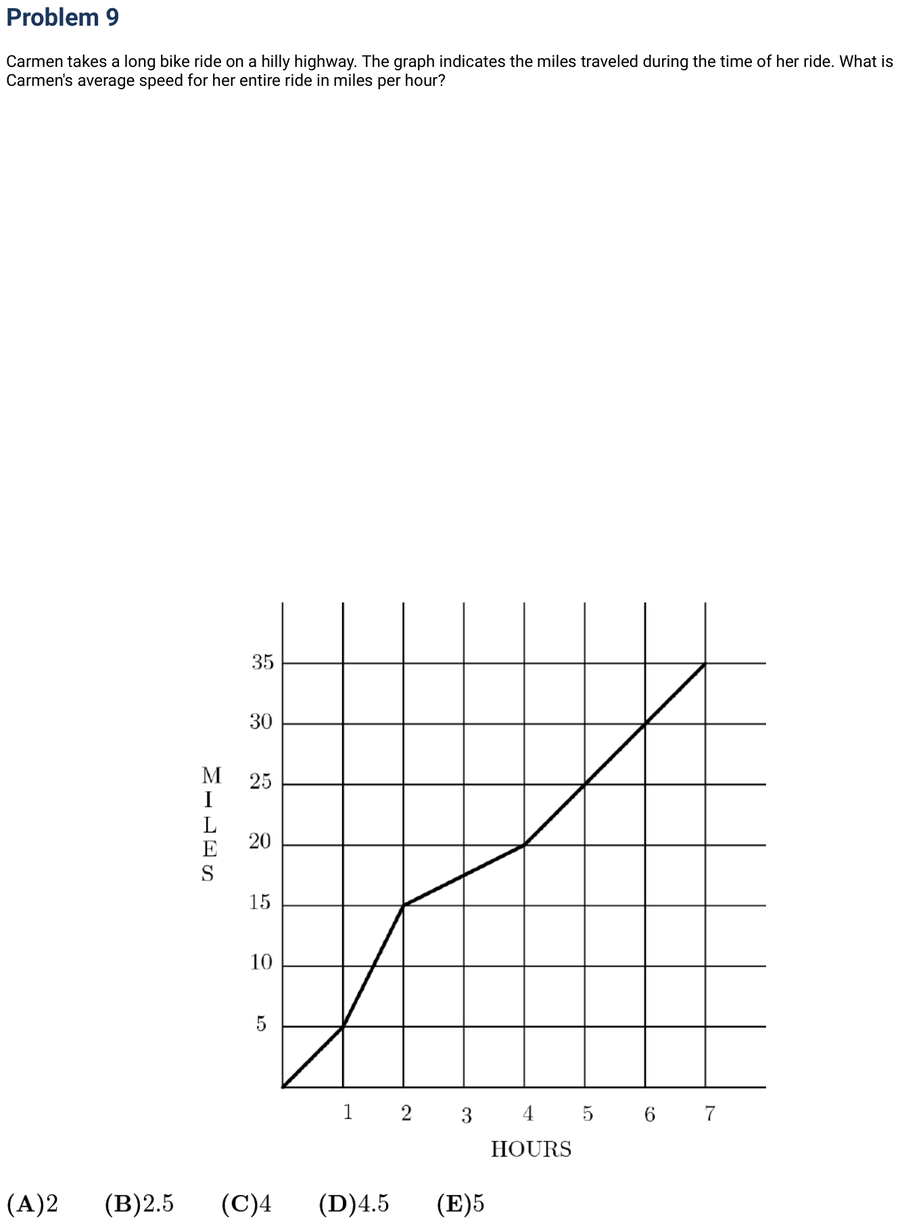
2011 · #9 Carmen takes a long bike ride on a hilly highway. The graph indicates the miles traveled during the time of her ride. What is Carmen's...
Carmen takes a long bike ride on a hilly highway. The graph indicates the miles traveled during the time of her ride. What is Carmen's average speed for her entire ride in miles per hour?
Show answer
Show hints
Still stuck? Show hint 2 →
Show solution
- The curve ends at 35 miles after 7 hours — that's the whole ride: 35 miles in 7 hours.
- Average speed = total distance ÷ total time = 35 ÷ 7 = 5 mph.
- Why this transfers: "average speed" is always end-distance over end-time. The wiggly middle of a distance-time graph is a distraction — never average the steeper and flatter parts.
2026 · #5 Casey went on a road trip that covered 100 miles, stopping only for a lunch break along the way. The trip took 3 hours in total and her...
Casey went on a road trip that covered 100 miles, stopping only for a lunch break along the way. The trip took 3 hours in total and her average speed while driving was 40 miles per hour. In minutes, how long was the lunch break?
Show answer
Show hints
Still stuck? Show hint 2 →
Show solution
- The 40 mph is her speed while driving, so distance ÷ speed gives only the driving time, not the whole trip. Find that first: 100 ÷ 40 = 2.5 hours.
- Whatever's left of the 3 total hours is the lunch break: 3 − 2.5 = 0.5 hour = 30 minutes.
- Sanity check: 30 minutes of lunch is reasonable, and 2.5 h of driving at 40 mph really does cover 100 miles. The reusable idea: always separate ‘moving time’ from total time before using rate = distance ÷ time — the rate only describes the moving part.
Unit conversion — multiply by 1
You already convert units in your head: 2 hours is 120 minutes — you multiplied by 60 because '1 hour = 60 minutes'. The grown-up version writes that '60' as a fraction equal to 1 and lets the units cancel like algebra. Once you trust the units, you never again guess whether to multiply or divide.
Multiply by a fraction whose top and bottom are the same quantity in different units (like 5280 ft / 1 mi). That fraction equals 1, so you change the look, not the value. This is the factor-label method: write the units, let them cancel, and the numbers fall out.
FACTOR-LABEL RECIPE
- Write the starting value with units (e.g.,
60 mi/hr). - Multiply by conversion fractions, each equal to 1 (e.g.,
5280 ft / 1 mi). - Put the unit you DON'T want in the OPPOSITE part of the fraction so it cancels.
- The unit you DO want should survive.
- Multiply the numerators, divide by the denominators — the surviving units are your answer's units.
Go deeper: conversion facts to know cold
Conversion facts to know cold
| From | To | Multiply by |
|---|---|---|
| 1 mile | feet | 5280 |
| 1 mile | yards | 1760 |
| 1 yard | feet | 3 |
| 1 foot | inches | 12 |
| 1 hour | minutes | 60 |
| 1 minute | seconds | 60 |
| 1 hour | seconds | 3600 |
| 1 mph | ft/s | ≈ 1.467 (so 60 mph = 88 ft/s) |
| 1 km | meters | 1000 |
| 1 lb | ounces | 16 |
kangaroo-2025-kadett-05, answer A.)Don't memorize 'when do I multiply by 60 vs. divide.' Write the conversion factors with units and let cancellation decide. The units are guardrails — trust them.
To control her blood pressure, Jill's grandmother takes one half of a pill every other day. If one supply of medicine contains 60 pills, then the supply would last approximately
Jill's grandmother takes ½ pill every other day. A bottle holds 60 pills. About how many months will it last?
Stack the conversions and let them cancel:
60 pills × (1 dose / ½ pill) × (2 days / 1 dose) × (1 month / 30 days)
- 60 × 2 × 2 = 240 days.
- 240 days × (1 month / 30 days) ≈ 8 months (choice D).
The units are the proof: started in 'pills', ended in 'months', everything between cancelled.
'Every other day' hides a conversion (1 dose ↔ 2 days). 'Half a pill per dose' hides another (1 dose ↔ ½ pill). Writing each as a fraction with units drags the hidden conversions into the open so cancellation can finish.
Multiply by 1 = (target unit) / (source unit). Units cancel like algebra; the number falls out. Wrong units = flip a fraction.
1994 · #5 Given that 1 mile = 8 furlongs and 1 furlong = 40 rods, the number of rods in one mile is
Given that 1 mile = 8 furlongs and 1 furlong = 40 rods, the number of rods in one mile is
Show answer
Show hints
Still stuck? Show hint 2 →
Show solution
- Bridge through furlongs: 1 mile is 8 furlongs, and each of those 8 furlongs is 40 rods.
- So 1 mile = 8 × 40 = 320 rods.
- Why multiply (not add): each furlong unpacks into 40 rods, and you have 8 furlongs, so it's 8 groups of 40 — that's multiplication. This 'chain the units' move handles any multi-step conversion.
2022 · #7 When the World Wide Web first became popular in the 1990s, download speeds reached a maximum of about 56 kilobits per second....
When the World Wide Web first became popular in the 1990s, download speeds reached a maximum of about 56 kilobits per second. Approximately how many minutes would the download of a 4.2-megabyte song have taken at that speed? (Note that there are 8000 kilobits in a megabyte.)
Show answer
Show hints
Still stuck? Show hint 2 →
Show solution
- Insight: don't divide yet — the answer choices span 0.6 to 36000, so a units slip is the whole danger. The speed is in kilobits/sec, so put the song in kilobits too: 4.2 × 8000 = 33,600 kilobits.
- Time = 33,600 ÷ 56 = 600 seconds = 10 minutes.
- Lighter path: avoid the big division by reshaping the size as 56 × (something): 33,600 = 56 × 600, so it's 600 seconds straight off — then ÷60 for minutes.
2019 · #2 Ten quarters of an hour correspond to how many hours?
Ten quarters of an hour correspond to how many hours?
Show answer
Show hints
Still stuck? Show hint 2 →
Show solution
- Ten quarter-hours are 10 × 15 = 150 minutes.
- 150 minutes ÷ 60 = 2.5 hours.
- So the answer is 2½ hours.
Relative speed — meet, chase, lap
Two cars head straight at each other on a 100-mile road, one at 40 mph and one at 60 mph. How long until they meet? You could track each car's position and solve. Or you could notice the only thing that matters: how fast the gap between them shrinks. That number is the closing speed, and it makes these problems collapse.
Case 1: heading TOWARD each other (speeds ADD)
Why add? Every mile the gap loses is shared: A eats 40 of it per hour, B eats 60, so the gap drops 100 miles each hour.
Case 2: same direction, faster behind (speeds SUBTRACT)
Why subtract? Bob moves at 8, but Alice keeps fleeing at 4, carrying 4 miles of progress away each hour. Bob only nets 4 mph of catching up.
RELATIVE-SPEED SUMMARY
| Situation | Closing speed | Time |
|---|---|---|
| Toward each other | v₁ + v₂ | gap ÷ (v₁ + v₂) |
| Same direction (faster behind) | vfast − vslow | gap ÷ (vfast − vslow) |
| Round track, same direction | vfast − vslow | track length ÷ that (next lap) |
| Round track, opposite direction | v₁ + v₂ | track length ÷ that (next meet) |
kangaroo-2017-kadett-28, answer E.)Go deeper: the train-passing trap, and same-distance races (speed ratio = distance ratio)
How many do you pass? (the train trap)
This one fools almost everyone. Trains leave City B for City A every hour on the hour; each trip takes 3 hours. You leave A at noon and reach B at 3:00. How many B-to-A trains do you pass on the way?
Your gut says 3 — the ones that leave while you travel (12, 1, 2). Wrong. You also pass trains already on the track when you started.
The 10:00 train from B is still rolling toward you at noon. So is the 11:00 train. You pass both, plus the 12, 1, and 2 o'clock trains. That's five: 10, 11, 12, 1, 2. (The 9:00 train reaches A as you leave and the 3:00 train reaches B as you arrive — you meet those at the stations, not on the road.)
Count every train on the route during your trip, not only the ones that leave during it.
(Train-passing problem adapted from Problem Solving via the AMC, Australian Maths Trust.)
A handy trick: same distance ⇒ the speed ratio flips into the time ratio
In a race everyone runs the same distance, so distance is held fixed, not time. When distance is fixed, faster means proportionally less time, so the ratio of times is the ratio of speeds turned upside down. The slick consequence: at the instant the winner finishes, every other runner's distance is in the same ratio as the speeds. If A's speed : B's speed \(= 5 : 4\), then when A has run 100 m, B has run \(\tfrac{4}{5}\) of that — 80 m — no time or equation needed.
Another worked example
In a 100 m race Aria beats Bea by 20 m, and in a separate 100 m race Bea beats Cleo by 25 m. All run at steady speeds. If Aria and Cleo race over 100 m, by how many metres does Aria win?
- Aria beats Bea by 20: when Aria runs 100, Bea runs 80, so \(A : B = 100 : 80 = 5 : 4\).
- Bea beats Cleo by 25: when Bea runs 100, Cleo runs 75, so \(B : C = 100 : 75 = 4 : 3\).
- Bea is the ‘4’ in both ratios, so the chain lines up directly: \(A : B : C = 5 : 4 : 3\).
- When Aria finishes 100 m, Cleo has run \(100 \times \tfrac{3}{5} = 60\) m.
So Aria beats Cleo by \(100 - 60 = \textbf{40}\) m — not \(20 + 25 = 45\), the tempting wrong add. The gaps don't add because each was measured against a different runner's full 100 m. (Adapted from Terry Chew Academy, Speed.)
Same direction → subtract speeds. Opposite directions → add. The real trap is not seeing that 'catching up' or 'meeting' is a relative-speed problem at all — the instant you spot a gap, find how fast it closes.
Two cars start 120 miles apart and drive toward each other, one at 50 mph and one at 70 mph. Their average speed is \((50+70)\div 2 = 60\) mph, so to cross the 120-mile gap takes \(120\div 60 = 2\) hours.
Why it breaks: the gap isn't being closed by one car going 60 mph — it's being closed by both cars at once, each eating into it. Averaging the speeds throws away one of the two cars and makes the gap close half as fast as it really does.
The fix: Track the gap, not the cars. Heading toward each other, the gap shrinks by 50 miles AND another 70 miles every hour — so it closes at 50 + 70 = 120 mph. Time to close 120 miles = 120÷120 = 1 hour. Add the speeds when they approach; subtract when one chases the other.
As Emily is riding her bicycle on a long straight road, she spots Emerson skating in the same direction 1/2 mile in front of her. After she passes him, she can see him in her rear mirror until he is 1/2 mile behind her. Emily rides at a constant rate of 12 miles per hour, and Emerson skates at a constant rate of 8 miles per hour. For how many minutes can Emily see Emerson?
Emily (12 mph) and Emerson (8 mph) ride the same direction. When Emily spots him he is ½ mile ahead; she loses him from her mirror when he is ½ mile behind. How long was he in view?
The gap swings from ½ mile ahead to ½ mile behind — a relative shift of 1 mile, not ½. (Picture Emily still and Emerson drifting backward past her: he must cover a full mile relative to her.)
- Closing speed = 12 − 8 = 4 mph.
- Time = 1 mile ÷ 4 mph = ¼ hour = 15 minutes (choice D).
The trap is reading '½ mile' once and treating it as a single ½-mile chase. It's two halves stitched together: ½ mile to catch up, ½ mile to pull away — both at the same 4 mph relative speed. So 1 mile ÷ 4 mph = 15 minutes, not 7.5.
Toward each other: speeds add. Same direction: speeds subtract. Time to meet/catch = gap ÷ relative speed.
2006 · #13 Cassie leaves Escanaba at 8:30 AM heading for Marquette on her bike. She bikes at a uniform rate of 12 miles per hour. Brian leaves...
Cassie leaves Escanaba at 8:30 AM heading for Marquette on her bike. She bikes at a uniform rate of 12 miles per hour. Brian leaves Marquette at 9:00 AM heading for Escanaba on his bike. He bikes at a uniform rate of 16 miles per hour. They both bike on the same 62-mile route between Escanaba and Marquette. At what time in the morning do they meet?
Show answer
Show hints
Still stuck? Show hint 2 →
Show solution
- Cassie rides alone from 8:30 to 9:00, half an hour, covering ½ × 12 = 6 miles. So at 9:00 the gap between them is 62 − 6 = 56 miles.
- From 9:00 they ride toward each other, closing the gap at 12 + 16 = 28 mph.
- Time to close 56 miles: 56 ÷ 28 = 2 hours. They meet at 9:00 + 2:00 = 11:00 AM.
- Why add the speeds: in one hour Cassie eats 12 miles of road and Brian eats 16, so 28 miles of gap vanish per hour regardless of where they are. This "combined speed" trick turns every meeting problem into one simple division — just remember to handle any head start first.
2024 · #29 Anne drives from point A to point B and then immediately back to A. Benni drives from point B to point A and then immediately back to B....
Anne drives from point A to point B and then immediately back to A. Benni drives from point B to point A and then immediately back to B. They drive on the same road, start at the same time, and both drive at constant speed. Anne’s speed is three times as high as Benni’s speed. They meet for the first time 15 minutes after they start. How long after the start will they meet for the second time?
Show answer
Show hints
Still stuck? Show hint 2 →
Show solution
- With speeds 3v and v meeting head-on after 15 min, the road length is 4v·15 = 60v.
- Anne reaches the far end at 20 min and turns back; Benni is still heading the same way.
- Anne then closes the 20v gap at relative speed 2v, taking 10 more min, so they meet at 30 min.
1995 · #25 Buses from Dallas to Houston leave every hour on the hour. Buses from Houston to Dallas leave every hour on the half hour. The trip from...
Buses from Dallas to Houston leave every hour on the hour. Buses from Houston to Dallas leave every hour on the half hour. The trip from one city to the other takes 5 hours. Assuming the buses travel on the same highway, how many Dallas-bound buses does a Houston-bound bus pass on the highway (not in the station)?
Show answer
Show hints
Still stuck? Show hint 2 →
Still stuck? Show hint 3 →
Show solution
- The freeing insight: two buses on the same highway pass each other if and only if they share the road at the same moment. Speeds and exact meeting points never matter — only whether their time-on-road windows overlap. So pick one bus and compare windows.
- Pin your Houston-bound bus: say it leaves Dallas at 12:00 and (5-hour trip) arrives Houston at 17:00, so it owns the road-window 12:00–17:00.
- A Dallas-bound bus that left Houston at time t owns the window (t, t+5). It overlaps yours when it hasn't already arrived (t + 5 > 12:00, i.e. t > 7:00) AND it has already left (t < 17:00). So the meeting condition is simply 7:00 < t < 17:00.
- Houston buses leave on the half hour, so the departures in that range are 7:30, 8:30, 9:30, … , 16:30 — that's 10 buses (one every hour across a 10-hour span).
- The trap this catches: only counting buses that leave during your own 12:00–17:00 trip gives 5 or 6 and misses the ones already underway when you start — that's why the overlap test must reach back to 7:00. Sanity check: the early 7:30 bus reaches Dallas at 12:30 (just after you set out, so you do pass it on the road), and the late 16:30 bus is still rolling when you arrive — both genuine highway meetings, not station ones.
- Why this transfers: whenever you're asked 'how many of these cross paths,' translate each traveler into a time interval and count overlapping intervals — the geometry of who-is-where dissolves into simple interval arithmetic.
- Sketch time across the bottom and distance (Dallas at the bottom, Houston at the top) up the side. Your bus is one slanted line going up; every Dallas-bound bus is a slanted line going down, starting on the half hours.
- Two lines crossing = a pass. Your line spans the 5-hour width, and a down-line crosses it exactly when it starts within 5 hours before you finish and ends within 5 hours after you begin — the same 7:00-to-17:00 window. Counting the crossing lines gives 10.
Speeds and conversions
Three problems on average speed, unit conversion, and relative speed.
2026 · #5 Casey went on a road trip that covered 100 miles, stopping only for a lunch break along the way. The trip took 3 hours in total and her...
Casey went on a road trip that covered 100 miles, stopping only for a lunch break along the way. The trip took 3 hours in total and her average speed while driving was 40 miles per hour. In minutes, how long was the lunch break?
Show answer
Show hints
Still stuck? Show hint 2 →
Show solution
- The 40 mph is her speed while driving, so distance ÷ speed gives only the driving time, not the whole trip. Find that first: 100 ÷ 40 = 2.5 hours.
- Whatever's left of the 3 total hours is the lunch break: 3 − 2.5 = 0.5 hour = 30 minutes.
- Sanity check: 30 minutes of lunch is reasonable, and 2.5 h of driving at 40 mph really does cover 100 miles. The reusable idea: always separate ‘moving time’ from total time before using rate = distance ÷ time — the rate only describes the moving part.
2014 · #17 George walks 1 mile to school. He leaves home at the same time each day, walks at a steady speed of 3 miles per hour, and arrives just...
George walks 1 mile to school. He leaves home at the same time each day, walks at a steady speed of 3 miles per hour, and arrives just as school begins. Today he was distracted by the pleasant weather and walked the first 12 mile at a speed of only 2 miles per hour. At how many miles per hour must George run the last 12 mile in order to arrive just as school begins today?
Show answer
Show hints
Still stuck? Show hint 2 →
Show solution
- Normal trip: 1 mile at 3 mph takes 1/3 hr. That's the total time budget he must hit today.
- Slow first half: (1/2 mile) ÷ (2 mph) = 1/4 hr used up.
- Time left for the second half-mile: 1/3 − 1/4 = 4/12 − 3/12 = 1/12 hr.
- Required speed = (1/2 mile) ÷ (1/12 hr) = 6 mph.
- Why this transfers: in "arrive on time" problems, hold time constant and treat it as a budget. Don't average the speeds — dawdling on the first half costs disproportionately more time, which is why he must nearly triple his pace, not just speed up a little.
2006 · #13 Cassie leaves Escanaba at 8:30 AM heading for Marquette on her bike. She bikes at a uniform rate of 12 miles per hour. Brian leaves...
Cassie leaves Escanaba at 8:30 AM heading for Marquette on her bike. She bikes at a uniform rate of 12 miles per hour. Brian leaves Marquette at 9:00 AM heading for Escanaba on his bike. He bikes at a uniform rate of 16 miles per hour. They both bike on the same 62-mile route between Escanaba and Marquette. At what time in the morning do they meet?
Show answer
Show hints
Still stuck? Show hint 2 →
Show solution
- Cassie rides alone from 8:30 to 9:00, half an hour, covering ½ × 12 = 6 miles. So at 9:00 the gap between them is 62 − 6 = 56 miles.
- From 9:00 they ride toward each other, closing the gap at 12 + 16 = 28 mph.
- Time to close 56 miles: 56 ÷ 28 = 2 hours. They meet at 9:00 + 2:00 = 11:00 AM.
- Why add the speeds: in one hour Cassie eats 12 miles of road and Brian eats 16, so 28 miles of gap vanish per hour regardless of where they are. This "combined speed" trick turns every meeting problem into one simple division — just remember to handle any head start first.
Reading rates from graphs
A graph is a rate problem with the numbers hidden in the lines. The skill is knowing what to read where. Before touching a graph, ask one question: does the height show a running total, or a single moment? The answer changes everything.
- Cumulative total (dollars spent vs. month, miles ridden vs. time): the slope is the rate; the difference of two heights is the amount over that stretch.
- Distance vs. time: slope = speed. Steeper means faster.
- Speed vs. time: the area underneath = distance covered.
- Pie chart: each slice's angle ÷ 360° = its fraction of the whole.
The cumulative-graph trap — read TWO heights, then subtract
Here is the question setters reach for most: a graph shows total dollars saved by the end of each month. 'How much was saved during summer (June, July, August)?' The wrong move is to read August's bar and call it the answer — but that bar already includes every month before June. On a running-total graph, a single height is everything-so-far, not the slice you want.
So you read the height at end-of-August, read the height at end-of-May, and subtract. The gap between those two heights is the summer total — the graph already added the three months for you.
Two lines that CROSS — that's a meeting
A distance-vs-time graph can hold two travelers at once, and where their lines cross is the instant they share the same spot: a meeting. This is chapter 6's relative speed, drawn instead of computed.
Put them on a straight path of length \(L\), both starting at once. One leaves the near end (height 0) and climbs; the other leaves the far end (height \(L\)) and descends. The steeper line is the faster walker. They meet at the one point where the lines touch — read its time across and its position up.
Worked example. A 12 km trail runs from town A (position 0) to town B (position 12). Pat leaves A at 3 km/h; Quinn leaves B at the same moment heading back at 1 km/h. When and where do they meet?
- Pat's line rises: position \(= 3t\). Quinn's line falls: position \(= 12 - 1t\).
- They cross when \(3t = 12 - t\), so \(4t = 12\) and \(t = extbf{3 h}\).
- Position at the crossing: \(3 imes 3 = extbf{9 km}\) from A. (Check Quinn: \(12 - 3 = 9\) ✓.)
Go deeper: it's the chapter-6 closing-speed equation in disguise
That \(4t = 12\) above is exactly chapter 6's closing speed. The 12 km gap shrinks at \(3 + 1 = 4\) km/h (they head toward each other, so speeds add), so they meet after \(12 \div 4 = 3\) hours — the same answer, no graph needed.
So the graph and the formula are two views of one fact: the vertical gap between the two lines is the distance still between the walkers, and it closes at the sum of the slopes. When that gap hits zero, the lines cross. Reading a meeting off a graph is just relative speed you can see.
Framing inspired by Competition Math for Middle School (AoPS).
Cumulative graph → your answer is a difference of two heights. Per-period bar chart → read or sum directly. Pie chart → (slice fraction) × total. Decide which kind you're looking at before you read a single number.
Carmen takes a long bike ride on a hilly highway. The graph indicates the miles traveled during the time of her ride. What is Carmen's average speed for her entire ride in miles per hour?
Carmen's bike ride is drawn as miles traveled vs. time. The question asks for her average speed over the whole ride.
Don't fuss over the hills and dips in the middle — average speed only needs the two endpoints.
- Read total distance at the end of the ride and the total time across.
- The line runs from the start to (the end time, the end distance); average speed is the overall slope = total miles ÷ total hours.
- That slope works out to 5 mph (choice E).
Every wiggle in between is a distraction. Average speed = (final height) ÷ (final time), full stop.
The graph tempts you to measure each segment's speed and average them — the chapter-4 trap in disguise. Average speed is total distance over total time, which on a distance-vs-time graph is the straight slope from first point to last.
Decide cumulative vs. per-period first. Cumulative answers are differences of heights; distance-vs-time slope is speed; speed-vs-time area is distance.
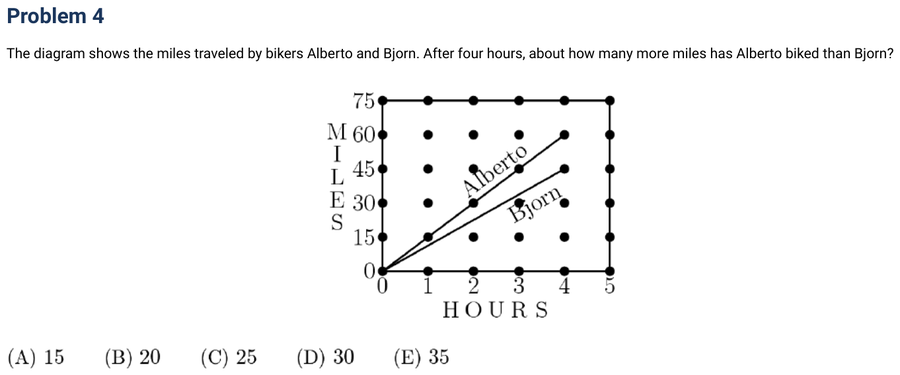
1999 · #4 (figure problem)
Show answer
Show hints
Still stuck? Show hint 2 →
Show solution
- Slide up the vertical line at Hours = 4. Alberto's line is at about 60 miles, Bjorn's at about 45.
- "How many more" is the gap between them: 60 − 45 = 15 miles.
- Reading tip you'll reuse: a difference question on a graph is always a vertical gap at one chosen x-value — find that x, then measure straight up between the curves. Steeper line = faster rider, which is why Alberto pulls ahead.
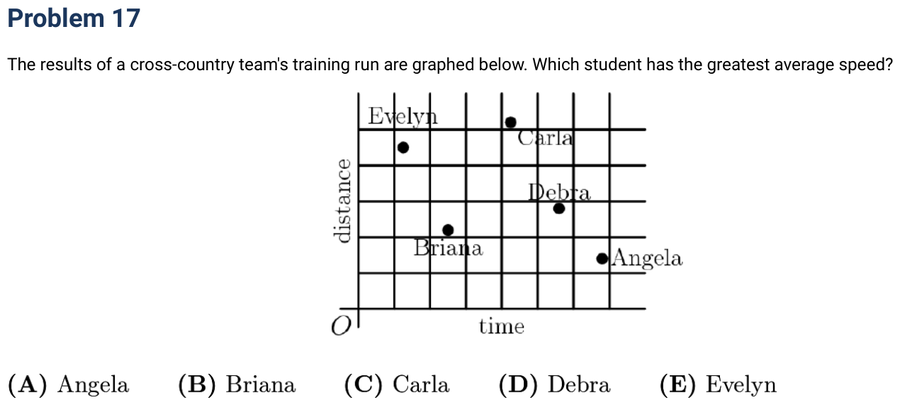
2005 · #17 The results of a cross-country team's training run are graphed below. Which student has the greatest average speed?
The results of a cross-country team's training run are graphed below. Which student has the greatest average speed?
Show answer
Show hints
Still stuck? Show hint 2 →
Show solution
- Average speed is distance ÷ time, which is exactly the slope of the segment joining O to a runner's dot. Steeper line = more distance per unit time = faster.
- Evelyn's dot sits high (large distance) and far left (small time), so her line from O is the steepest ⇒ Evelyn.
- Watch the trap: Carla is the highest dot, but she took the most time, so she isn't fastest — 'farthest' is not 'fastest.' Only the slope from the origin tells you speed.
Exponential growth — when a quantity multiplies each step
Fold a piece of paper in half, then again, then again. Three folds: 8 layers. Ten folds: over a thousand. The layer count doesn't add — it doubles every fold, and doubling sprints away from adding faster than your eyes expect. That's exponential growth, and contests love it.
Two ways a quantity can grow:
- Linear: the SAME amount is ADDED each step. (Save $5 every week.)
- Exponential: the value is MULTIPLIED by the same factor each step. (Bacteria double each hour; savings earn 10% a year.)
They start close, then exponential rockets up. Watch $1 over 10 steps:
Both start at $1. By step 10, linear sits at $11 (still hugging the axis); exponential has hit $1024. The gap is 93×.
EXPONENTIAL FORMULA
Start V₀, multiplier r per step, after n steps:
V(n) = V₀ × rn
r > 1 grows. 0 < r < 1 shrinks (0.9 = lose 10% each step).
The doubling-jar trap — work BACKWARD from full
The most famous doubling puzzle, and almost everyone trips. A bug culture doubles every minute. Dropped in a jar at 3:00, the jar is exactly full at 3:12. When was it half full?
Your instinct screams '3:06 — halfway through the time!' Resist it. Half the time is not half the amount when something doubles.
Run the tape backward. Forward it doubles each minute, so backward it halves each minute. Full at 3:12 means half that one minute earlier — half full at 3:11.
That second line is the real contest move: 'quarter full' is just two doublings short of full. You never needed a formula — you counted steps backward from the end.
When something doubles each step, the second-to-last step is already HALF done. Count backward from the finish, not forward from the start.
(Doubling-jar idea adapted from Problem Solving via the AMC, Australian Maths Trust.)
Go deeper: growth factors to recognize on sight
Growth factors to recognize on sight
| Phrase | Multiplier per step | 5 steps gives … |
|---|---|---|
| doubles each year | × 2 | × 32 |
| triples each year | × 3 | × 243 |
| grows 50% each year | × 1.5 | × 7.59 |
| grows 10% each year | × 1.1 | × 1.61 (not 1.5!) |
| shrinks 10% each year | × 0.9 | × 0.59 |
| half-life: halves each step | × 0.5 | × 0.03 (1/32) |
amc8-2024-10, answer B.)For 'doubles every N hours': start at 1 at hour 0, and after kN hours you have \(2^k\). Mind the off-by-one — at hour 0 it's 1, at hour N it's 2, at hour 2N it's 4. And before you multiply, double-check the word: 'adds the same each time' is linear, not exponential.
Nisos Isles. In 1998 the islands have 200 people, and the population triples every 25 years. Estimate the year in which the population will be about 6000.
In 1998 the Nisos Isles have 200 people, and the population triples every 25 years. About when will it reach 6000?
This 'when does it reach a target?' question is a count-the-multiplications problem — no logarithms.
- Target as a multiple of the start: 6000 ÷ 200 = 30×.
- Count triplings: ×3, ×9, ×27 — three triplings give 27, close to 30. (A fourth jumps to 81, way past.) So three 25-year steps.
- 3 × 25 = 75 years after 1998 → about 2075 (choice B).
Memorize the powers of 3 (3, 9, 27, 81) and you read this like a clock.
Don't solve \(200 \cdot 3^n \ge 6000\) with logs. Divide target by start to get '30 times', then count how many ×3 jumps clear it. That count, times the step length, is the time. Same skill as a logarithm — done by hand.
Exponential = ×r each step; after n steps it's V₀ × r^n. Don't confuse it with linear (adds a fixed amount). To find WHEN it reaches a target, divide target by start and count the multiplications.
1998 · #15 Nisos Isles. In 1998 the islands have 200 people, and the population triples every 25 years. Estimate the population in the year 2050.
Nisos Isles. In 1998 the islands have 200 people, and the population triples every 25 years. Estimate the population in the year 2050.
Show answer
Show hints
Still stuck? Show hint 2 →
Show solution
- From 1998, the tripling moments land at 2023 (one step) and 2048 (two steps) — and 2048 is essentially 2050. So two full triplings have happened.
- Each tripling is a ×3: 200 → 600 → 1800. (Growth multiplies, it doesn't add — that's the whole flavor of these problems.)
- 1800 is closest to 2000.
- Why this transfers: for repeated-multiplying growth, count how many doubling/tripling periods have passed, then multiply that many times. Adding the periods instead of multiplying is the classic mistake.
2024 · #10 In January 1980 the Mauna Loa Observatory recorded carbon dioxide CO2 levels of 338 ppm (parts per million). Over the years the average...
In January 1980 the Mauna Loa Observatory recorded carbon dioxide CO2 levels of 338 ppm (parts per million). Over the years the average CO2 reading has increased by about 1.515 ppm each year. What is the expected CO2 level in ppm in January 2030? Round your answer to the nearest integer.
Show answer
Show hints
Still stuck? Show hint 2 →
Show solution
- A constant yearly increase means the rise is just rate × time — no need to step through 50 separate years. Years elapsed: 2030 − 1980 = 50.
- Total increase: 50 × 1.515 = 75.75 ≈ 76 ppm.
- New level: 338 + 76 = 414. Sanity check: ~1.5 ppm/yr over 50 years is roughly 75, landing just above 338+75 = 413 — only 414 is in range, so estimation alone nails the choice.
Work-rate problems — when rates add
One hose fills a tank in 4 hours. A second fills the same tank in 6 hours. Both run at once — how long? Almost every kid's first guess is to average 4 and 6 to get 5. It's wrong, and it's wrong in a way worth feeling: two hoses pouring together should beat the faster hose alone (4 hours), so any answer above 4 can't be right. The fix is one idea: rates add; times don't.
RATES ADD; TIMES DON'T
If A finishes alone in t_a, A's rate is 1/t_a jobs per unit time. Same for B at 1/t_b. Together the rates add:
combined rate = 1/t_a + 1/t_b
Combined time is the reciprocal:
t = 1 / (1/t_a + 1/t_b) = (t_a · t_b) / (t_a + t_b)
Why rates add. 'Jobs per hour' behaves like a speed. Each worker pours their own fraction of the tank every hour, and fractions of the same tank add. The hours each worker would need on their own are not the thing that combines — the per-hour fractions are.
Together they fill 5/12 of the tank each hour, so the whole job takes 12/5 = 2.4 hours — under the 4 hours the faster hose needs alone. ✓
Worked walkthrough. Hose A: 4 hours. Hose B: 6 hours. Both at once.
- A's rate: 1/4 tank/hr. B's rate: 1/6 tank/hr.
- Combined: 1/4 + 1/6 = 3/12 + 2/12 = 5/12 tank/hr.
- Time: 1 ÷ (5/12) = 12/5 = 2.4 hours.
Identical workers shortcut. If k identical workers each take t alone, together they take t/k. (Their rates just multiply by k.)
Go deeper: one formula for many workers and many jobs — Work = Rate × Time × Agents
The ‘identical workers’ shortcut above hints at a bigger idea. When a problem juggles a changing number of workers AND a changing amount of work, stretch \(D = S \times T\) by one more factor — the number of agents doing the job:
WORK = RATE × TIME × AGENTS
W = r · t · n
where W = total work done, r = rate of one agent, t = time, n = how many identical agents. It is just \(D = S \times T\) with a crowd: each of the n agents contributes its own \(r \cdot t\).
The recipe is always the same two steps: find one agent’s rate from the situation you’re told, then plug it back in with the new numbers.
Worked example. 3 printers churn out 600 pages in 4 minutes. How long do 5 printers need to print 2000 pages?
- One printer’s rate: \(600 = r \times 4 \times 3\), so \(r = 600 \div 12 = \textbf{50}\) pages per minute per printer.
- Now solve for the new time: \(2000 = 50 \times t \times 5 = 250\,t\), so \(t = 2000 \div 250 = \textbf{8}\) minutes.
More printers and more pages, settled by one substitution — no juggling proportions in two directions at once.
The classic decoy: ‘more agents’ is not ‘more time’
The agents factor also kills a famous trap. 4 robots fold 4 shirts in 4 minutes. How long for 8 robots to fold 8 shirts? The number 8 begs you to answer ‘8 minutes’ — resist it. First find one robot’s rate: \(4 = r \times 4 \times 4\) gives \(r = \tfrac14\) shirt per minute, i.e. one robot folds one shirt in 4 minutes. With 8 robots and 8 shirts, hand each robot its own shirt — every robot finishes in 4 minutes, so the whole batch is done in 4 minutes, not 8. Doubling both the workers and the work leaves the time unchanged.
(The Work = Rate × Time × Agents identity and the ‘moles digging holes’ decoy are adapted from Competition Math for Middle School, AoPS.)
Go deeper: the LCM-units trick for three or more workers
A handy trick: make the job size the LCM — then every rate is a whole number
Fractions like \(\tfrac14 + \tfrac16\) are where work-rate slips happen. Skip them: the total ‘job’ can be any size, so pick the friendliest — the LCM of the alone-times. Call the job that many equal units (litres, bricks, tiles). Now each worker's rate is \(\text{units} \div \text{their time}\), a whole number. Add those whole numbers, then \(\text{time} = \text{total units} \div \text{combined rate}\). Same answer, no fraction arithmetic — and it scales painlessly to three or more workers.
Another worked example
Painting a fence alone takes Amir 4 hours, Bea 6 hours, and Cole 12 hours. Working together at their steady rates, how long do they take?
- Call the fence \(\operatorname{lcm}(4,6,12) = \textbf{12}\) equal units (say 12 panels).
- Rates in panels/hr: Amir \(12 \div 4 = 3\), Bea \(12 \div 6 = 2\), Cole \(12 \div 12 = 1\).
- Together: \(3 + 2 + 1 = \textbf{6}\) panels/hr.
- Time \(= 12 \div 6 = \textbf{2}\) hours.
Check against the reciprocal rule: \(\tfrac14 + \tfrac16 + \tfrac{1}{12} = \tfrac{3+2+1}{12} = \tfrac{6}{12} = \tfrac12\) job/hr, so 2 hours — matching, but the unit method never touched a fraction. And 2 hours is under Amir's solo 4, the sanity check we expect. (Adapted from Terry Chew Academy, Speed.)
For 'A alone takes a, B alone takes b, how long together?', memorize ab/(a+b) — the same harmonic-mean shape from chapter 4. For 3+ workers, add all the rates 1/a + 1/b + 1/c, then flip.
Trap reframe. 'A and B together take 3 hours, A alone takes 5; how long for B alone?' Set B's rate as the unknown: 1/5 + 1/x = 1/3, solve for x.
Tom paints a fence in 6 hours; Huck paints the same fence in 5 hours. Working together, they'll take the average of their times: \((6 + 5)\div 2 = 5.5\) hours.
Why it breaks: two people working together must finish faster than the quicker one alone — so any answer above 5 hours is impossible on its face. You can't average the times.
The fix: Rates add, times don't. Tom does \(\tfrac16\) of the fence per hour, Huck \(\tfrac15\); together \(\tfrac16+\tfrac15=\tfrac{11}{30}\) of the fence each hour. Flip it: \(1\div\tfrac{11}{30}=\tfrac{30}{11}\approx 2.7\) hours — under 5, as it must be.
Framing inspired by AoPS Prealgebra.
Steve's empty swimming pool will hold 24,000 gallons of water when full. It will be filled by 4 hoses, each of which supplies 2.5 gallons of water per minute. How many hours will it take to fill Steve's pool?
Steve's pool holds 24,000 gallons. Four hoses each pour 2.5 gallons/min. How many hours to fill it? (AMC 8 2009 #6.)
Step 1 — identical workers, so just add rates by multiplying. Combined rate = 4 × 2.5 = 10 gallons/min.
Step 2 — time in minutes. 24,000 ÷ 10 = 2400 minutes.
Step 3 — convert to hours. 2400 ÷ 60 = 40 hours (choice A). The general \(1/(1/t_a + 1/t_b + \ldots)\) collapses to t/k when all k rates match — which is exactly this.
Pin the unit down first. Hoses are gallons per minute; the question wants hours. Convert once, at the start or the end — doing it in one spot keeps the minutes and hours from tangling.
Rates add; times don't. Two workers (times a, b): combined time ab/(a+b). k identical workers (each time t): t/k. Sanity check: the combined time is always below the fastest worker alone.
2009 · #6 Steve's empty swimming pool will hold 24,000 gallons of water when full. It will be filled by 4 hoses, each of which supplies 2.5...
Steve's empty swimming pool will hold 24,000 gallons of water when full. It will be filled by 4 hoses, each of which supplies 2.5 gallons of water per minute. How many hours will it take to fill Steve's pool?
Show answer
Show hints
Still stuck? Show hint 2 →
Show solution
- One hose: 2.5 gal/min. Working together, rates add: 4 × 2.5 = 10 gal/min. Since the answer is in hours, scale up now: 10 gal/min × 60 = 600 gal/hour.
- Time = total ÷ rate = 24,000 ÷ 600 = 40 hours.
- Why this transfers: whenever several workers/pipes/machines run simultaneously, add their individual rates into one combined rate — then it's a single division. Converting units BEFORE dividing (here min→hr) avoids a clumsy 2,400-minute intermediate.
2010 · #14 In order to sew together three short strips of cloth to get one long strip, Cathy needs 18 minutes. How much time does she need to sew...
In order to sew together three short strips of cloth to get one long strip, Cathy needs 18 minutes. How much time does she need to sew together a really long piece consisting of six short strips?
Show answer
Show hints
Still stuck? Show hint 2 →
Show solution
- Three strips need 2 seams and take 18 min, so each seam takes 9 min.
- Six strips need 5 seams: 5×9 = 45 minutes.
1994 · #14 Two children at a time can play pairball. For 90 minutes, with only two children playing at a time, five children take turns so that...
Two children at a time can play pairball. For 90 minutes, with only two children playing at a time, five children take turns so that each one plays the same amount of time. The number of minutes each child plays is
Show answer
Show hints
Still stuck? Show hint 2 →
Show solution
- Each minute fills 2 playing spots, and the game runs 90 minutes, so there are 2 × 90 = 180 'child-minutes' of play to give out.
- Five children split it evenly: 180 ÷ 5 = 36 minutes each.
- The key move is counting total work in 'person-units' (here child-minutes) before dividing — the same trick behind 'if 3 painters take 4 hours, that's 12 painter-hours of work.' Reality check: 36 < 90, which makes sense since nobody plays the whole time.
Escalators & moving floors — count the steps
Chapter 3 had the easy half of this idea: a moving floor just adds its speed to yours. Contests ask the harder half — how many steps does the escalator itself have? The trick is to count steps two ways and notice they must agree.
While you ride an up-going escalator, two things lift you at once: the steps you walk up, and the steps the escalator carries up under you. Add them and you have climbed the whole staircase:
Worked example: the two-trip escalator
Macy walks up an up-going escalator at 1 step per second and reaches the top after taking 14 steps. Speeding up to 2 steps per second, she reaches the top in 20 steps. How many steps does the escalator have?
The hidden quantity is time. “14 steps at 1 step/s” means she rode for 14 seconds; “20 steps at 2 steps/s” means she rode for only 10 seconds. Let the escalator move \(e\) steps each second. Count the whole staircase from each trip:
- Trip 1: her 14 steps + the escalator’s \(14e\) steps (14 s of carrying) \(=\) total \(N\). So \(N = 14 + 14e\).
- Trip 2: her 20 steps + the escalator’s \(10e\) steps (only 10 s) \(=\) the same \(N\). So \(N = 20 + 10e\).
Both equal \(N\), so set them equal: \(14 + 14e = 20 + 10e\). Then \(4e = 6\), giving \(e = 1.5\) steps/s. Plug back: \(N = 14 + 14(1.5) = 14 + 21 = \textbf{35}\) steps. (Check the other trip: \(20 + 10(1.5) = 35\) ✓.)
(Escalator-step archetype adapted from Terry Chew Academy, Escalator & Staircase Problems.)
Same machine, three names: solve a current (or wind) from a system
An escalator, a river current, and a tailwind are the same story: a medium that adds when you go with it and subtracts when you go against it. If you are handed both the with-it speed and the against-it speed, you can recover both hidden numbers — your own speed and the medium’s — by adding and subtracting the two equations.
Example. A boat goes 30 km/h downstream and 18 km/h upstream. Find the boat’s still-water speed \(p\) and the current \(c\).
- Downstream the current helps: \(p + c = 30\).
- Upstream it fights: \(p - c = 18\).
- Add the two: \(2p = 48\), so \(p = \textbf{24}\) km/h.
- Subtract them: \(2c = 12\), so \(c = \textbf{6}\) km/h.
The ground speeds are just \(p \pm c\); their average is your own speed and their half-difference is the medium’s. Same algebra recovers a headwind from two flight times. (Adapted from Terry Chew Academy, Speed II, and Competition Math for Middle School, AoPS.)
For “two riders / two speeds, find the steps”: turn each trip into (your steps) + (escalator speed) × (your ride time) = total, where ride time = your steps ÷ your step-rate. Set the two totals equal to solve for the escalator’s speed, then read off the total.
Your steps + the escalator’s steps = the whole staircase, every trip. Ride time = (your steps) ÷ (your step-rate). For currents/winds: with-it = \(p+c\), against-it = \(p-c\); add to get \(2p\), subtract to get \(2c\).
Two meetings on a path — the “3×” rule
Two runners start at the same instant from the two ends of a straight path, each at a steady speed. They meet once, keep going to the far ends, instantly turn, and meet a second time. Questions about the path length sound like they need both speeds. They don’t — one clean idea cracks them with no speeds at all.
Track the combined distance the two of them cover, not each runner separately:
- At the first meeting, their two pieces just fill the path — together they have run 1 path length.
- Between meetings, each one finishes the path and comes partway back, adding two more full lengths. So at the second meeting, together they have run 3 path lengths.
Three times the combined distance means — because both run steadily — each runner has run 3× as far as at the first meeting. That single fact is the whole chapter.
Worked example: find the path length
Anton starts at end A, Ben starts at end B. They first meet 800 m from B. After turning at the ends they meet again 400 m from A. How long is the path?
- By the first meeting, Ben (from B) has run 800 m.
- By the second meeting the pair has covered 3 paths, so Ben has run \(3 \times 800 = \textbf{2400}\) m.
- Ben’s 2400 m is one full path to A, then back toward B. The second meeting is 400 m from A, so Ben came back 400 m: \(2400 = L + 400\).
- Therefore \(L = \textbf{2000}\) m.
Check. First meeting 800 from B means Anton ran \(2000 - 800 = 1200\), and \(800 + 1200 = 2000\) = one path ✓. Speeds are in ratio \(1200:800 = 3:2\), but we never needed the numbers — the 3× rule did it all.
Framing inspired by Competition Math for Middle School (AoPS).
Capstone: the fly between two trains — track the time, not the path
This is chapter 6’s mantra — track the gap, not the movers — in its purest form. Two trains are 120 km apart and head straight at each other, each at 30 km/h. A fly starts at one train and zips back and forth between them at 50 km/h until the trains meet. How far does the fly travel?
The zig-zags are a trap. You don’t need a single one of them. Ask the one question that matters: how long is the fly flying? The fly flies for exactly as long as it takes the trains to close their gap.
- Closing speed of the trains \(= 30 + 30 = 60\) km/h.
- Time to meet \(= 120 \div 60 = \textbf{2 hours}\).
- The fly flew for those 2 hours at 50 km/h: \(50 \times 2 = \textbf{100 km}\).
No infinite sum, no path-by-path bookkeeping — just the time the gap lasted. (Adapted from Competition Math for Middle School, AoPS.)
Linear back-and-forth, two meetings: combined distance is 1 path at the first meeting and 3 paths at the second. So multiply each runner’s first-meeting distance by 3, then place it on the path (out to the far end, then back). Speeds never appear.
First meeting: together = 1 path; each runner’s distance = its share. Second meeting: together = 3 paths; each runner has gone 3× its first-meeting distance. Lay that distance along the path (to the far end, then back) to find the spot.
Train length & the head-start chase
Two relative-speed phrasings show up on contests constantly and trip up kids who only know \(D = S \times T\) for a single point. Both yield to the same move: figure out exactly what distance is being covered, then subtract two situations to cancel what you don’t want.
A train has length — so the distance is bridge + train
When a train crosses a bridge, the front enters and the back must clear the far end. The train therefore travels (bridge length) + (its own length), not just the bridge. That hidden train length is the whole difficulty — and the way to kill it is to compare two bridges.
Worked example. A train crosses an 820 m bridge in 45 s and a 620 m bridge in 35 s, at the same steady speed. Find its speed and length.
Let the train’s length be \(\ell\) and speed be \(v\). Each crossing covers bridge + train:
- \(820 + \ell = 45v\)
- \(620 + \ell = 35v\)
Subtract the second from the first — the unknown \(\ell\) cancels: \(820 - 620 = (45 - 35)v\), i.e. \(200 = 10v\), so \(v = \textbf{20 m/s}\) (that’s 72 km/h). Then \(\ell = 45(20) - 820 = 900 - 820 = \textbf{80 m}\). (Check: \(620 + 80 = 700 = 35 \times 20\) ✓.)
(Train-length archetype adapted from Terry Chew Academy, Speed II.)
The head start in TIME — when does the chaser catch up?
The other workhorse: someone leaves later but faster, and you want the catch-up time. Convert the head start into a head-start distance, then close it at the relative speed (chapter 6).
Worked example. A tour bus leaves the depot at 8:00 am going 60 km/h. A car leaves the same depot at 9:00 am going 80 km/h, same road. When does the car catch the bus?
- By 9:00 the bus has a one-hour head start: \(60 \times 1 = \textbf{60 km}\) ahead.
- Same direction, so the gap closes at \(80 - 60 = \textbf{20 km/h}\).
- Time to close 60 km: \(60 \div 20 = \textbf{3 hours}\) after 9:00 → 12:00 noon.
Check. By noon the bus has gone \(60 \times 4 = 240\) km and the car \(80 \times 3 = 240\) km — same spot ✓.
(Catch-up archetype adapted from Competition Math for Middle School, AoPS.)
Train + bridge: distance = bridge + train length; two crossings at one speed subtract to cancel the train. Head start: distance gap = slower speed × lead time; catch-up time = gap ÷ (faster − slower).
A train past a point covers its own length; past a bridge it covers bridge + length. Subtract two crossings to get the speed, then back out the length. A time head start becomes a distance head start (slow speed × lead), closed at the speed difference.
Stretch test
Five harder rate problems combining D=ST with average-speed, relative motion, and trade-chains.
1999 · #22 In a far-off land three fish can be traded for two loaves of bread, and a loaf of bread can be traded for four bags of rice. How many...
In a far-off land three fish can be traded for two loaves of bread, and a loaf of bread can be traded for four bags of rice. How many bags of rice is one fish worth?
Show answer
Show hints
Still stuck? Show hint 2 →
Show solution
- Express the fish deal in rice. 3 fish = 2 loaves, and each loaf = 4 bags, so 2 loaves = 8 bags. Thus 3 fish = 8 bags of rice.
- Divide to get one fish: 8 ÷ 3 = 2⅔ bags of rice.
- The transferable move: when trades link A→B→C, convert through the shared item so it cancels — just like converting hours→minutes→seconds. (Sanity check: a fish is worth a bit more than half a loaf, and a loaf is 4 bags, so 2-and-a-bit bags per fish feels right.)
- To dodge thirds, work with 3 fish at once. 3 fish trade for 2 loaves, and 2 loaves = 8 bags of rice, so 3 fish ↔ 8 bags.
- Reading the ratio 3 fish : 8 bags, one fish is 8/3 = 2⅔ bags.
- Bundling to the smallest whole quantities (here 3 fish) keeps the arithmetic clean and only divides once at the very end.
2002 · #24 Miki has a dozen oranges of the same size and a dozen pears of the same size. Miki uses her juicer to extract 8 ounces of pear juice...
Miki has a dozen oranges of the same size and a dozen pears of the same size. Miki uses her juicer to extract 8 ounces of pear juice from 3 pears and 8 ounces of orange juice from 2 oranges. She makes a pear-orange juice blend from an equal number of pears and oranges. What percent of the blend is pear juice?
Show answer
Show hints
Still stuck? Show hint 2 →
Show solution
- Since she blends *equal counts* of each fruit, the common count cancels — work per fruit. One pear yields 8/3 oz; one orange yields 8/2 = 4 oz.
- Pear-to-orange juice is 8/3 : 4, and clearing the 3 gives 8 : 12 = 2 : 3.
- Pear's share = 2 ÷ (2 + 3) = 2/5 = 40%.
- *Worth keeping:* when two things are mixed in equal *counts*, the actual count is irrelevant — reduce to one of each and compare. Chasing the dozen (32 oz vs 48 oz) gives the same answer with bigger numbers.
- 12 pears give 12 × 8/3 = 32 oz; 12 oranges give 12 × 4 = 48 oz.
- Pear fraction = 32 ÷ (32 + 48) = 32/80 = 2/5 = 40% — same ratio, just unscaled.
2022 · #22 A bus takes 2 minutes to drive from one stop to the next, and waits 1 minute at each stop to let passengers board. Zia takes 5 minutes...
A bus takes 2 minutes to drive from one stop to the next, and waits 1 minute at each stop to let passengers board. Zia takes 5 minutes to walk from one bus stop to the next. As Zia reaches a bus stop, if the bus is at the previous stop or has already left the previous stop, then she will wait for the bus. Otherwise she will start walking toward the next stop. Suppose the bus and Zia start at the same time toward the library, with the bus 3 stops behind. After how many minutes will Zia board the bus?
Show answer
Show hints
Still stuck? Show hint 2 →
Show solution
- Insight: a step-by-step chase looks messy, but Zia only chooses to wait-or-walk when she arrives at a stop — at t = 5, 10, 15. Sampling just those moments (the bus runs on a tidy 3-min-per-stop cycle: 2 driving + 1 waiting) makes it a 3-line simulation. Number the stops from the bus's start (stop 0); at t = 0, Zia is at stop 3, bus at stop 0.
- t = 5: Zia at stop 4. Bus took 5 min → finished stop 1 (arrived at 2 min, left at 3 min, arrived at stop 2 at 5 min). Bus is at stop 2 — not yet at the previous stop (3), so Zia walks on.
- t = 10: Zia at stop 5. Bus: from t = 5 (at stop 2) waits 1 min (leaves at 6), drives 2 min to stop 3 (arrives at 8), waits till 9, drives to stop 4 (arrives at 11). So at t = 10, bus is mid-drive between stops 3 and 4 — not at the previous stop (4), so Zia walks on.
- t = 15: Zia at stop 6. Bus: arrives at stop 4 at 11, waits till 12, drives to stop 5 (arrives 14, waits till 15). At t = 15, bus is at stop 5 — the previous stop. Zia waits.
- Bus leaves stop 5 at t = 15 and drives 2 min to stop 6: arrives at t = 17.
- You'll see this again: when one mover only acts at fixed intervals, you don't have to track time continuously — jump straight to those decision instants and read off the other mover's state. Discretizing turns a chase into a short table.
2024 · #29 Anne drives from point A to point B and then immediately back to A. Benni drives from point B to point A and then immediately back to B....
Anne drives from point A to point B and then immediately back to A. Benni drives from point B to point A and then immediately back to B. They drive on the same road, start at the same time, and both drive at constant speed. Anne’s speed is three times as high as Benni’s speed. They meet for the first time 15 minutes after they start. How long after the start will they meet for the second time?
Show answer
Show hints
Still stuck? Show hint 2 →
Show solution
- With speeds 3v and v meeting head-on after 15 min, the road length is 4v·15 = 60v.
- Anne reaches the far end at 20 min and turns back; Benni is still heading the same way.
- Anne then closes the 20v gap at relative speed 2v, taking 10 more min, so they meet at 30 min.
2017 · #28 Two runners are training at the same time on a 720 m long, round running track. They run with constant speed in opposite directions. The...
Two runners are training at the same time on a 720 m long, round running track. They run with constant speed in opposite directions. The first runner needs four minutes for one lap, the second five minutes. How many metres does the second runner run between two consecutive meetings of the two runners?
Show answer
Show hints
Still stuck? Show hint 2 →
Show solution
- Speeds: 720/4 = 180 m/min and 720/5 = 144 m/min; closing speed = 180 + 144 = 324 m/min.
- They meet every 720 ÷ 324 minutes; in that time the second runner covers 144 × 720/324.
- That equals 320 m.
Stretch practice — beyond AMC 8
4 bonus problems on Ratios, Rates & Proportions. These are typed-answer (no multiple choice) and tilt harder — closer to early AMC 10. Try the ones that look fun.
Stretch · #2 A fly and a jogger start 12 km apart. The jogger runs straight toward the fly's starting spot at 4 km per hour. Meanwhile the fly zooms...
Show answer
Show hints
Still stuck? Show hint 2 →
Still stuck? Show hint 3 →
Show solution
- The trap is adding up all the tiny back-and-forth flights. The clever move is to think about TIME, not the fly's messy path.
- The fly stops flying when the jogger covers the 12 km. At 4 km/hr that takes \(\dfrac{12}{4}=3\) hours.
- The fly was flying that entire 3 hours at 6 km/hr, so it covers \(6\times3=18\) km.
- The fly travels 18 km. (Notice the puzzle has to tell us when the flying stops, or the answer wouldn't be clear — spotting that hidden assumption is part of careful problem solving.)
Stretch · #6 Two hikers need to reach a village 12 km away as fast as possible. They walk at 4 km/h and ride a bike at 12 km/h, but they have only...
Show answer
Show hints
Still stuck? Show hint 2 →
Still stuck? Show hint 3 →
Show solution
- Since both hikers have the same speeds, the smartest plan is symmetric: split the biking equally so they arrive together.
- Hiker 1 rides the first 6 km, leaves the bike, and walks the last 6 km. Hiker 2 walks the first 6 km, finds the parked bike, and rides the last 6 km. Each rides 6 km and walks 6 km, so by symmetry they arrive together.
- For either hiker: \(T = \tfrac{6}{12} + \tfrac{6}{4} = 0.5 + 1.5 = 2\) hours.
- So both arrive in 2 hours. (Average speed \(= \tfrac{12}{2} = 6\) km/h, the harmonic mean of 4 and 12.)
Stretch · #17 Two trains are \(200\) miles apart on the same track, heading toward each other. One goes \(60\) mph, the other \(40\) mph. A fly starts...
Show answer
Show hints
Still stuck? Show hint 2 →
Still stuck? Show hint 3 →
Show solution
- Don't add up the fly's zig-zags. Ask the key question: how long does the fly fly? Its distance is just speed times time, and it flies until the trains crash.
- The trains approach each other at a combined speed of \(60 + 40 = 100\) mph. To close a \(200\)-mile gap at \(100\) mph takes time \(= \frac{200}{100} = 2\) hours.
- The fly flies for those whole \(2\) hours at \(240\) mph: \(240 \times 2 = 480\) miles.
Stretch · #5 Anton and Ben start running toward each other from the two ends of a long straight path (Anton from end A, Ben from end B). Each runs at...
Show answer
Show hints
Still stuck? Show hint 2 →
Still stuck? Show hint 3 →
Show solution
- Because both run steadily, their distances grow in the same proportion. At the first meeting they have together run one full path length; at the second meeting they have together run three path lengths (each finishes the path and comes partway back).
- So the combined distance tripled, and since both run steadily, each runner's own distance also triples.
- Ben ran 800 m to the first meeting (it was 800 m from his end B), so by the second meeting Ben has run \(3 \times 800 = 2400\) m. The second meeting is 400 m from Anton's end A, meaning Ben ran the whole path and came back 400 m, so path \(= 2400 - 400 = 2000\) m.
- The path is 2000 m long. (Check Anton: he ran \(2000 - 800 = 1200\) m to the first meeting, then \(3 \times 1200 = 3600\) m by the second, which is one path plus 1600 m back, leaving him \(2000 - 1600 = 400\) m from end A. It fits.)
Rates quick-reference
FORMULAS / FACTS TO KNOW COLD
- D = S × T (and its two cousins). Same shape as Work = Rate × Time.
- Ratio parts:
a : bhasa + bparts; one part = total ÷ total parts. Each side is also a fraction of the whole:a/(a+b)andb/(a+b)— multiply by the total in one step. - Join two ratios on a shared term: scale each so the shared quantity becomes their LCM, then read the chain (blue:white 2:3 and white:red 4:5 → white = 12 → blue : red = 8 : 15).
- Average speed = total distance ÷ total time. NEVER the average of the speeds (unless the times are equal). This is the marquee trap.
- Factor-label conversion: multiply by fractions equal to 1 (
5280 ft / 1 mi); unwanted units cancel, the wanted unit survives. - 1 hour = 3600 seconds = 60 minutes.
- 1 mile = 5280 feet. 1 km = 1000 m. 1 yard = 3 feet. 1 foot = 12 inches.
- 1 mph ≈ 1.467 ft/s (so 60 mph = 88 ft/s).
- Equal-distance round trip avg speed:
2ab / (a+b)(harmonic mean). - Equal-time legs avg speed:
(a+b)/2(simple average). - Work-rates ADD; times don't. A alone a, B alone b → together
T = ab / (a+b); for 3+ workers add all rates1/a + 1/b + …and flip. k identical workers each taking t:t/k. - Same-direction closing speed: faster − slower.
- Opposite-direction closing speed: sum of speeds.
- Exponential growth: V(n) = V₀ · rn. Compound interest: V₀ · (1 + p/100)n.
- Percent = ratio out of 100. Percent of change = change ÷ original. Chain percent changes by MULTIPLYING multipliers (down 20% = ×0.80), never by adding.
- Spot the decoy — which number doesn’t matter? Rate problems love planting numbers you never use. Before computing, ask what you actually need. Mr. Mayer buses to work and walks home in 70 min total; walking both ways takes 110 min. So one walk = 55 min, one bus = 70 − 55 = 15 min, and busing both ways = 30 min — the ‘7:25 bus’ start time is a pure decoy. (AoPS.)
- Averaging speeds for equal-distance trips — THE marquee trap. The slow leg eats more time, so the average is pulled toward the slow speed. Always use total distance ÷ total time (60 & 30 mph round trip averages 40, not 45).
- Averaging speeds to close a gap. Two cars approaching each other close the gap at the SUM of their speeds, not the average — both eat into it at once.
- Lining up two ratios without matching the shared term. blue:white 2:3 and white:red 4:5 can't chain until you scale both so white agrees (=12).
- Forgetting to convert minutes to hours before applying D = S × T with mph. (Wrong final units = a flipped conversion fraction.)
- Inverse vs. direct proportion. 'More workers, less time' is inverse (product fixed); 'more time, more distance' is direct (ratio fixed).
- Averaging times for work-rate problems. Rates add, times don't — two helpers must finish FASTER than the quicker one alone.
- Cumulative vs. per-period graphs. Cumulative answers are differences of two heights; per-period answers are direct reads.
- Linear vs. exponential. 'Adds the same each year' is linear; 'multiplies each year' is exponential — a 10% raise four times compounds to 46.4%, not 40%.
- Doubling-jar 'halfway in time' error. If something doubles each step and is full at step 12, it was half full at step 11, not at the time-midpoint — count backward from the finish.
- Counting only the vehicles that depart during your trip. You also pass those already en route when you started (the train-passing trap).
- Dropping a stop or a head start from total time in an average-speed problem.
- Assuming −p% then +p% cancels. It never does: −20% then +20% lands at ×0.96, a 4% loss, because the rise is taken on a smaller amount.
- Reading 'percent of the whole' as 'percent of the other part'. A 2 : 3 split makes boys 2/5 (40%) of the class, not 2/3.
Drill these:
- 60 mph for 90 minutes = how many miles? (90)
- Faucet A fills a tub in 6 min, B in 12 min; together: 1/6 + 1/12 = 1/4 → 4 min.
- Mix 30% of 10 L with 70% of 20 L. Combined %? ((0.3·10 + 0.7·20) / 30 ≈ 56.7%)
- 4 painters take 9 hours; how long for 6? (Inverse: 4·9 = 36 painter-hours; ÷6 = 6 hours.)
- Round trip 60 mph and 30 mph (equal distance) average? (40 mph, via 2·60·30/90.)
Want to climb higher? — advanced rate ideas (#22–#25 territory)
- Pick convenient numbers. When only the shape of a trip is given (fractions, percents, no real distance/time), choose the total yourself to kill the denominators — thirds → use 3, quarters → use 4. The answer can't depend on the real size.
- Round-track repeated meetings. Opposite ways: they meet every
track ÷ (v₁ + v₂). Same way: the faster laps the slower everytrack ÷ (vfast − vslow). - Three-worker together-time (alone a, b, c):
T = 1 / (1/a + 1/b + 1/c). Same pattern, three terms. - Filling AND draining at once. Fill rate 1/a, drain rate 1/d give net rate
1/a − 1/d— the drain subtracts. - Mixture problems. Mixing x liters of A% with y liters of B% gives concentration
(xA + yB) / (x + y)— a weighted average. - Train passes a person vs. a station. Past a point: train travels its own length. Past a station: train length + station length. Time = length ÷ train speed.
- Continuous compound interest (rare here):
ertgrows faster than discrete (1+r)t for the same r, t.