Problem 22 · 2025 AMC 8
Hard
Number Theory
factorizationfactor-pairs
Show answer
Answer: D — 7 different coat counts.
Show hints
Hint 1 of 2
The annoying part is that the gap after the last coat has no coat closing it off, unlike the gaps between coats. Fix that asymmetry: imagine one phantom coat on a 36th hook, and now empty-then-coat repeats perfectly.
Still stuck? Show hint 2 →
Hint 2 of 2
With the phantom, 36 hooks split into d identical blocks of length b (each = some empties + one coat), so bd = 36 with b ≥ 2 and d ≥ 2. Counting the coat-arrangements becomes counting these factorizations.
Show solution
Approach: add a phantom coat to make a clean repeat, then count factor pairs
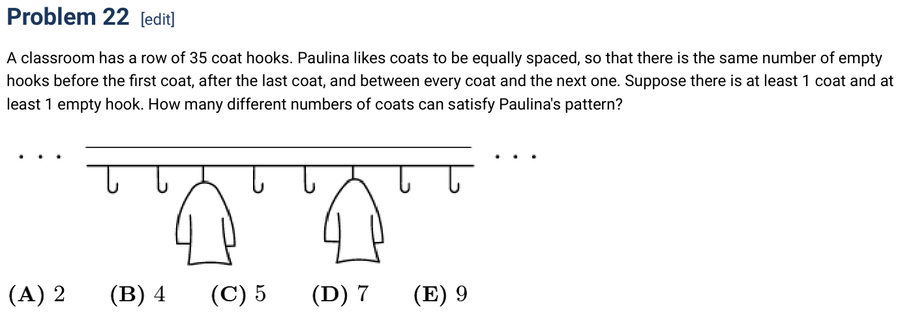
- The setup is fiddly because the trailing gap isn't followed by a coat the way the inner gaps are. Patch it: drop a phantom coat on a 36th hook. Now the whole row is a flawless repeat of (some empty hooks)+(one coat), each block of length b ≥ 2.
- If there are d such blocks, bd = 36, and the real coat count is d − 1 (we added one phantom). The constraints are b ≥ 2 (each block has ≥ 1 empty + 1 coat) and d ≥ 2 (≥ 1 real coat plus the phantom).
- So just count factorizations 36 = b × d with both factors ≥ 2. Since 36 = 22 × 32 has (2+1)(2+1) = 9 divisors, and we drop the two using a 1 (1×36, 36×1), the answer is 9 − 2 = 7.
- Why this transfers: when boundary items spoil a repeating pattern, add (or remove) a phantom to restore the symmetry — the awkward "ends differ from the middle" complication melts into a clean periodic count.
Mark:
· log in to save