Problem 12 · 2025 AMC 8
Medium
Geometry & Measurement
areaspatial-reasoning
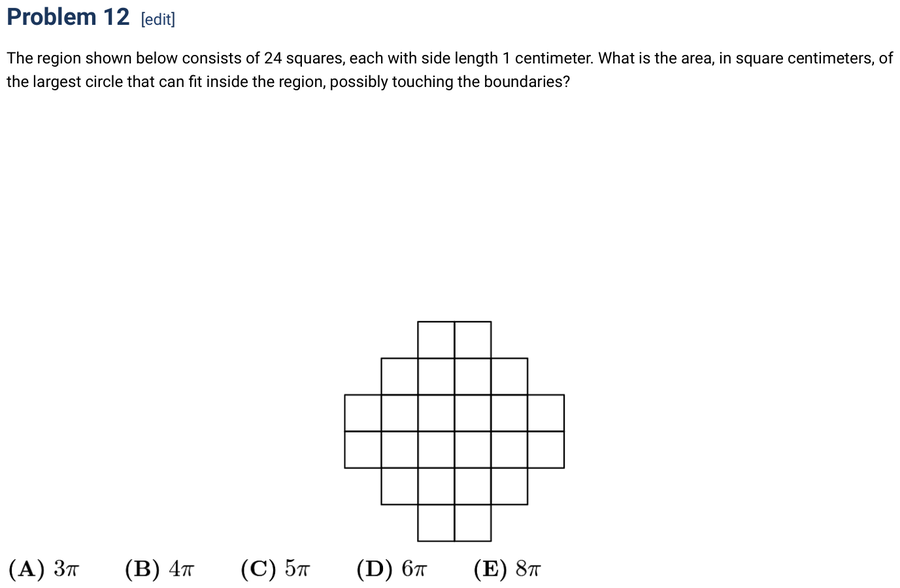
Show answer
Answer: C — 5π square centimeters.
Show hints
Hint 1 of 2
A circle's reach is capped by the closest bit of boundary. On this lumpy plus-shape, that closest bit isn't a flat edge — it's an inward corner where two arms meet.
Still stuck? Show hint 2 →
Hint 2 of 2
Center the circle in the middle (by symmetry). Find one nearest inward corner: it's 1 unit across and 2 units up from the center. The Pythagorean theorem gives the radius — then square it for the area.
Show solution
Approach: radius = distance to the closest point of the boundary
- Center the circle at the region's center (forced by symmetry). The biggest it can grow is limited by the nearest boundary point — and on this cross-shape those are the inward corners where the arms notch in, not the outer flat edges.
- One such corner sits 1 unit across and 2 units up from the center, so the radius is the hypotenuse: √(12 + 22) = √5.
- Area = π × (√5)2 = 5π.
- Why this transfers: the largest inscribed circle is always pinned by the closest point of the boundary — so on a non-convex shape, hunt the inward corners first. And notice you never needed √5 itself: squaring it for the area gives a clean 5.
Mark:
· log in to save