Problem 4 · 2023 AMC 8
Stretch
Number Theory
primesspiral-pattern
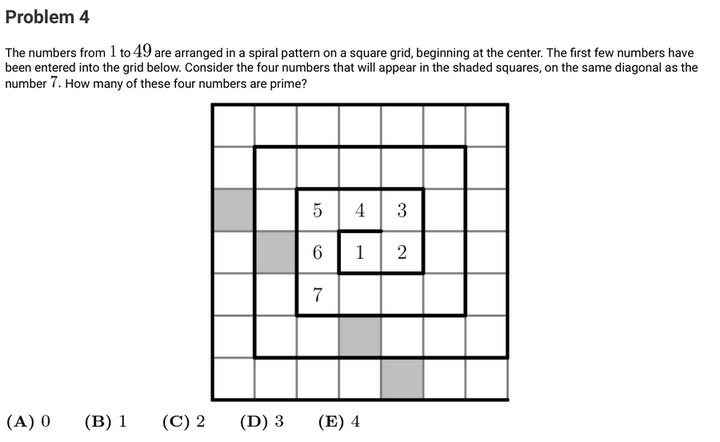
Show answer
Answer: D — Three of them are prime.
Show hints
Hint 1 of 2
The spiral is just scenery — the real question is simply which four numbers land on those squares. Find them, then the problem becomes ‘how many are prime?’
Still stuck? Show hint 2 →
Hint 2 of 2
To find the numbers without drawing the whole grid, use the perfect squares as landmarks: 9, 25, 49 sit at corners of their layers. Then test each shaded number for primeness (a quick digit-sum check catches multiples of 3).
Show solution
Approach: fill in the diagonal, then test each for primeness
- The clever move is to ignore the picture's prettiness and just ask: which four numbers land on those squares? Once you know them, the spiral has done its job and the question is pure prime-testing.
- Continuing the spiral outward, the diagonal through 7 carries the four shaded numbers 19, 23, 39, 47.
- Now test each for primeness. 39 jumps out: its digits add to 12 (a multiple of 3), so 39 = 3 × 13 is composite. The other three — 19, 23, 47 — are prime.
- So 3 of the four shaded numbers are prime. Worth keeping: the digit-sum test (digits add to a multiple of 3 ⇒ divisible by 3) is the fastest way to spot a non-prime here.
Another way — use perfect squares as landmarks (MAA):
- Without filling the whole grid: on an n×n spiral the number n2 sits in the upper-left (n even) or lower-right (n odd) corner. So 9 is at lower-right of the 3×3 block, 25 at lower-right of 5×5, 49 at lower-right of 7×7; 16 at upper-left of 4×4, 36 at upper-left of 6×6.
- Walking outward from those anchors locates the four shaded squares as 19, 23, 39, 47 — with 39 = 3 × 13 the only composite.
Mark:
· log in to save