Problem 10 · 2022 AMC 8
Easy
Ratios, Rates & Proportions
distance-speed-timegraph-reading
Show answer
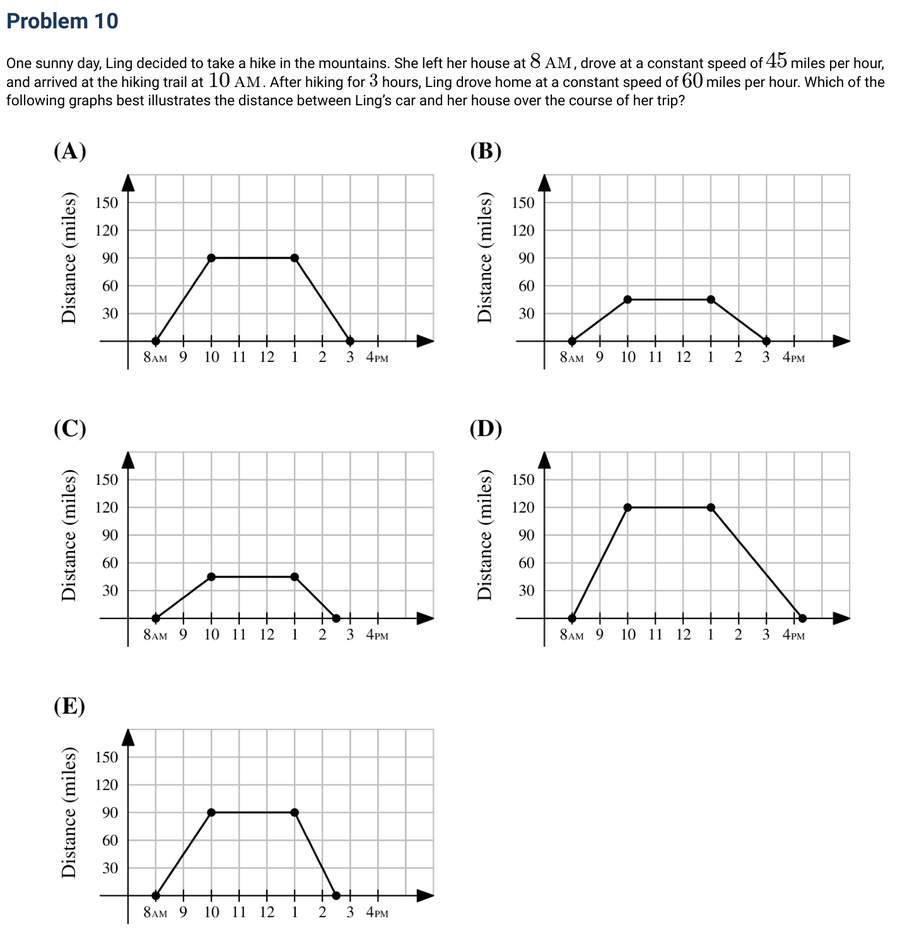
Answer: E — Graph (E).
Show hints
Hint 1 of 2
The trip has three phases — drive out, hike (not moving away), drive back. So the graph must go up, flat, then down. Match that shape first, then check the numbers.
Still stuck? Show hint 2 →
Hint 2 of 2
Out: 2 hr × 45 mph = 90 mi (the peak). Hiking is a flat stretch (distance from home unchanged). Return is faster (60 mph), so the down-slope is steeper than the up-slope.
Show solution
Approach: match the up-flat-down shape, then pin the peak and slopes
- Insight: a graph problem is a matching problem — read the story as a shape before touching numbers. Drive out (rising), hike (flat, since her distance from home holds steady), drive back (falling): up → flat → down.
- Peak height: 2 hr × 45 mph = 90 miles, reached at 10am — that alone rules out any graph not peaking at 90.
- Slopes: the return is at 60 mph (faster than the 45 mph trip out), so the down-slope is steeper than the up-slope — 90 ÷ 60 = 1.5 hr home, arriving 2:30pm.
- The up-flat-down graph peaking at 90 with a steeper descent is choice E.
- You'll see this again: on distance-time graphs, steeper = faster, flat = stopped (or moving neither toward nor away). Reading slope as speed lets you eliminate most choices without arithmetic.
Mark:
· log in to save