Problem 4 · 2020 AMC 8
Medium
Algebra & Patterns
arithmetic-sequencespiral-pattern
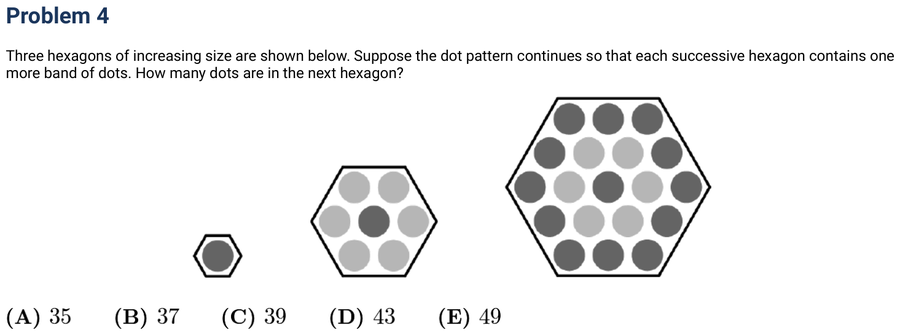
Three hexagons of increasing size are shown below. Suppose the dot pattern continues so that each successive hexagon contains one more band of dots. How many dots are in the next hexagon?
Show answer
Answer: B — 37 dots.
Show hints
Hint 1 of 2
Don't redraw the next hexagon — just figure out how many dots the new outer ring adds. A hexagon ring has 6 corners, so its count grows by 6 each time.
Still stuck? Show hint 2 →
Hint 2 of 2
The bands go 1, then 6, 12, 18, … (each adds 6 more than the last). You already have 1 + 6 + 12 = 19 in hexagon 3; add the next band of 18.
Show solution
Approach: count only the new ring; the rings grow by 6 each time
- A hexagon has 6 sides, so each new outer ring adds 6 more dots than the ring before it: the bands are 1, 6, 12, 18, … (a center dot, then rings stepping up by 6).
- Hexagon 3 already has 1 + 6 + 12 = 19 dots (matches the picture).
- The 4th hexagon just tacks on the next ring of 18: 19 + 18 = 37.
- You'll see this again as: “centered hexagonal” growth — when a shape grows by adding a border, count only the border. Its size usually climbs by a fixed step tied to the number of sides (hexagon → +6, square → +8, triangle → +3).
Another way — closed form for centered hexagonal numbers:
- Summing 1 + 6 + 12 + … + 6(n−1) gives 1 + 6·(1+2+…+(n−1)) = 1 + 3n(n−1).
- For the 4th hexagon, n = 4: 1 + 3·4·3 = 1 + 36 = 37 — a one-line check on the band-by-band count.
Mark:
· log in to save