Problem 23 · 1998 AJHSME
Stretch
Algebra & Patterns
find-the-pattern
Show answer
Answer: C — 7/16.
Show hints
Hint 1 of 2
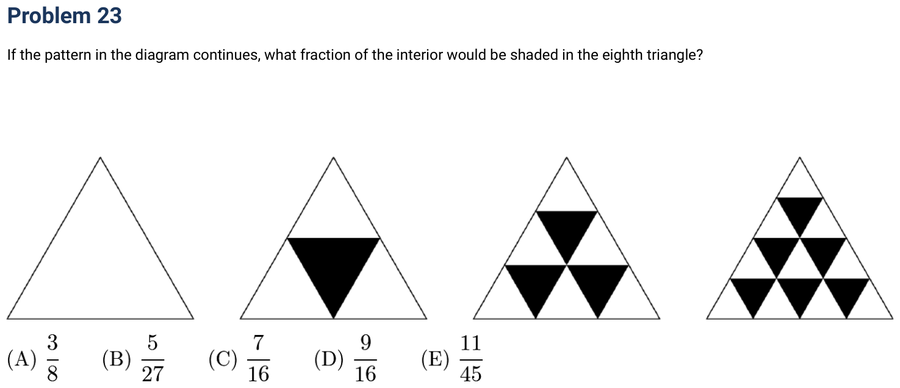
Don't try to draw the 8th figure. Make a tiny table of the first four and track two separate counts as they grow: how many little triangles total, and how many are shaded (the downward-pointing ones).
Still stuck? Show hint 2 →
Hint 2 of 2
Totals go 1, 4, 9, 16 — the perfect squares (n²). Shaded go 0, 1, 3, 6 — the triangular numbers (each adds one more than the last). Recognizing these named patterns lets you leap to the 8th figure without drawing.
Show solution
Approach: tabulate two patterns (squares and triangular numbers), jump to n = 8
- Total little triangles in figures 1–4: 1, 4, 9, 16 — these are the squares, so the nth figure has n². The 8th has 8² = 64.
- Shaded (downward) triangles: 0, 1, 3, 6 — the triangular numbers, each step adding the next whole number. By the 8th figure the shaded count is 1 + 2 + 3 + 4 + 5 + 6 + 7 = 28.
- Shaded fraction = 28/64 = 7/16.
- Why this transfers: 'what happens at the big nth step' problems are solved by naming the pattern in the small cases. Two of the most common are the squares (1,4,9,16…) and the triangular numbers (1,3,6,10…) — spot them and you can skip straight to any term.
Mark:
· log in to save