Problem 14 · 1996 AJHSME
Hard
Logic & Word Problems
caseworkconstraint
Show answer
Answer: B — 29.
Show hints
Hint 1 of 2
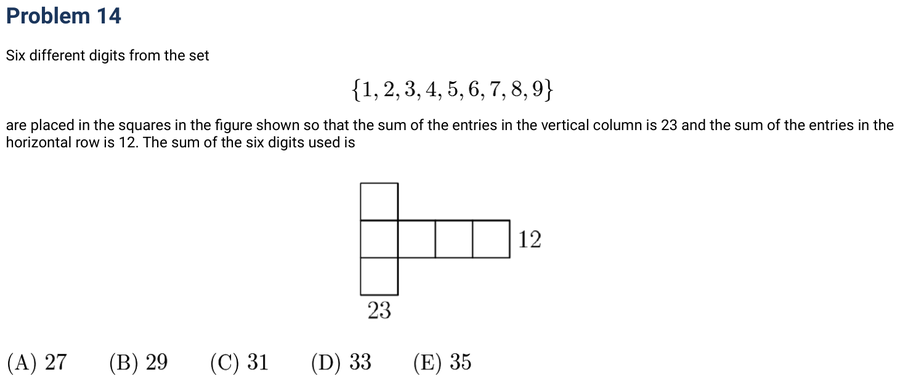
The column and the row overlap in exactly ONE square. If you just add 23 + 12, that corner square got counted twice. So the six digits sum to 23 + 12 − (the shared corner) — now you only need to find that one corner digit.
Still stuck? Show hint 2 →
Hint 2 of 2
Pin the corner by squeezing it from both sides. The 3-square column sums to 23, which is huge for distinct digits, so it must use the biggest ones. The 4-square row only sums to 12, so its other digits must be small. The corner has to satisfy both — try the possibilities.
Show solution
Approach: subtract the double-counted corner, then pin it
- The column and row share one square, so adding both sums counts that square twice: total of all six digits = 23 + 12 − (shared corner). Everything hinges on that one corner value.
- The column has 3 distinct digits summing to 23 — only {6, 8, 9} can do it (it's nearly the max 9+8+7=24). So the corner is 6, 8, or 9. The row's other 3 digits must then sum to 12 − corner: if the corner were 9 they'd need to sum to 3, and 8 → 4, both impossible for three distinct positive digits (smallest is 1+2+3=6). Only corner = 6 works, with the row finishing as 1, 2, 3.
- So the six digits are {9, 8} (column-only), 6 (corner), {1, 2, 3} (row-only), and their sum is 23 + 12 − 6 = 29.
- Why this transfers: whenever two overlapping groups are summed, the overlap is double-counted — subtract it once (the heart of inclusion-exclusion). And squeeze an unknown from two constraints at once instead of guessing.
Mark:
· log in to save