Problem 14 · 1993 AJHSME
Hard
Logic & Word Problems
latin-squarededuction
Show answer
Answer: C — 4.
Show hints
Hint 1 of 2
Like a mini-Sudoku: every row AND every column holds 1, 2, 3 once each. Don't guess — hunt for a cell whose value is forced because only one number is left for it.
Still stuck? Show hint 2 →
Hint 2 of 2
Chain the forcing. Once a cell is forced, it eliminates options elsewhere, which forces the next cell. Start where you already have two of the three numbers in a line.
Show solution
Approach: forced-cell deduction, one square at a time
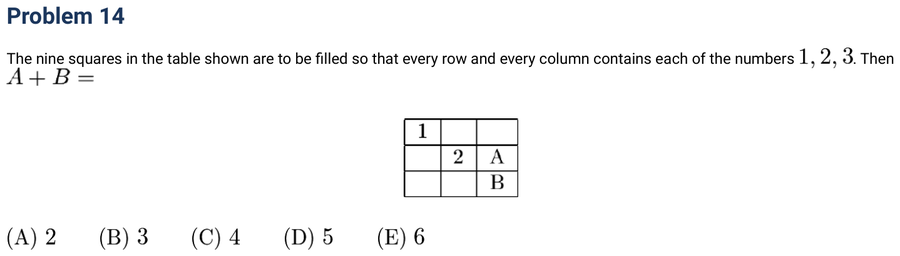
- Middle column already shows a 2. The top row has a 1, so the top-middle cell can't be 1; being in the column-with-2 it can't be 2 either — it's forced to 3. Then the top-right cell (top row, only 2 left) is 2.
- Now the right column has a 2 up top, so A (middle-right) is 1 or 3; but A's row already has the 2, and we'll see its column needs a 1: the middle row reads (left, 2, A), and the only spot left for 1 in that row makes A = 1. The right column then needs its last number, 3, for B at the bottom: B = 3.
- So A + B = 1 + 3 = 4.
- Why this transfers: Latin-square / Sudoku logic is never trial-and-error if you look for the cell with the fewest choices. Each forced fill shrinks the puzzle — keep chasing the most-constrained square and the grid solves itself.
Mark:
· log in to save