Problem 5 · 1996 AJHSME
Medium
Arithmetic & Operations
sign-analysisnumber-line
Show answer
Answer: A — P − Q.
Show hints
Hint 1 of 2
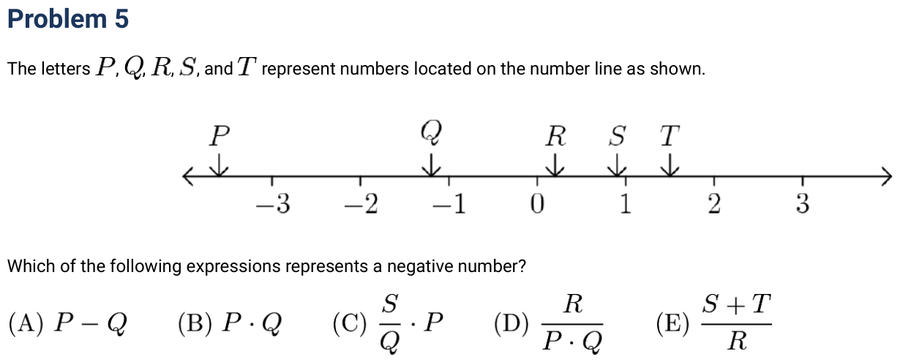
Forget the exact values — you only need each expression's SIGN. First read off the signs from the line: P and Q sit left of 0 (negative), while R, S, T sit right of 0 (positive).
Still stuck? Show hint 2 →
Hint 2 of 2
For multiplying and dividing, a result is negative only with an ODD number of negative pieces. For subtracting, P − Q is negative only if P is the smaller (more-left) number. Scan the five choices for the one that lands negative.
Show solution
Approach: track signs, not values
- Sort the signs from the line: P, Q are negative; R, S, T are positive. That's all the information we need.
- Now count negatives in each choice. (B) P·Q = (−)(−) is positive. (C) (S/Q)·P has two negatives (Q and P) → positive. (D) R/(P·Q): the bottom P·Q is positive, so the whole thing is positive. (E) (S+T)/R is all positives → positive.
- Only (A) P − Q is left, and it must be the negative one: P is farther left than Q, so subtracting the larger Q from the smaller P gives a negative (e.g. −2.7 − (−1.3) ≈ −1.4). Answer P − Q.
- Why this transfers: for 'which is positive/negative' questions, never compute — just count negative factors (odd = negative) and check direction on subtractions. Sign-tracking beats arithmetic every time.
Mark:
· log in to save