Problem 18 · 1993 AJHSME
Hard
Geometry & Measurement
area-decompositionmidpoint
Show answer
Answer: A — 320.
Show hints
Hint 1 of 2
The quadrilateral ABDF is a slanted, awkward shape — but it's just the full rectangle with two corner triangles snipped off. Find the easy whole, then subtract the easy corners.
Still stuck? Show hint 2 →
Hint 2 of 2
Both snipped corners are right triangles (the rectangle's own corners C and E). Each has one leg that's a full side and one leg that's a midpoint half-side — so area = ½·base·height.
Show solution
Approach: rectangle minus two corner right triangles
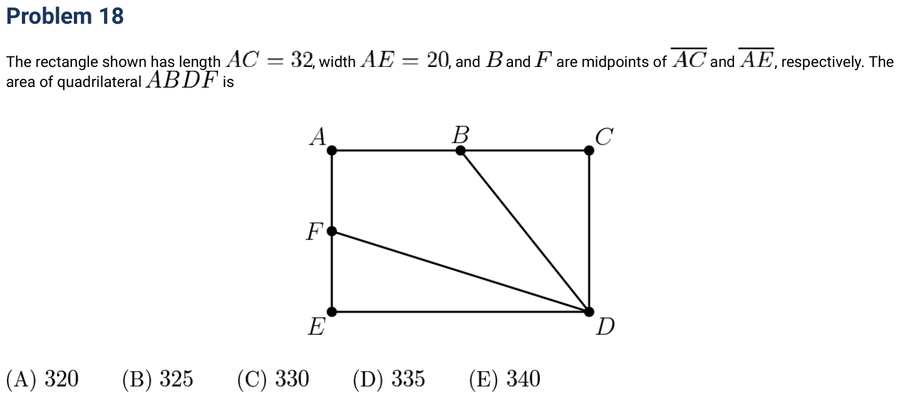
- Don't chase ABDF directly. Start from rectangle ACDE: area 32 × 20 = 640. ABDF is what's left after cutting the two triangles at corners C and D-side.
- △BCD sits at corner C: legs BC = 16 (half of the 32 top, since B is a midpoint) and CD = 20, so its area is ½·16·20 = 160. △FED sits at corner E: legs FE = 10 (half of the 20 side, F a midpoint) and ED = 32, area ½·10·32 = 160.
- ABDF = 640 − 160 − 160 = 320.
- Why this transfers: a tilted polygon inside a rectangle is almost always easiest as (rectangle) − (corner triangles). The midpoints just make each triangle's legs exactly a full side and a half side — clean numbers, no slanted lengths needed.
Another way — coordinates + shoelace:
- Place A(0,20), B(16,20), D(32,0), F(0,10). Shoelace gives ½|0·(20−10) + 16·(0−20) + 32·(10−20) + 0·(20−0)| = ½(320 + 320) = 320.
Mark:
· log in to save