Problem 9 · 1993 AJHSME
Hard
Algebra & Patterns
read-table
Show answer
Answer: D — 4.
Show hints
Hint 1 of 2
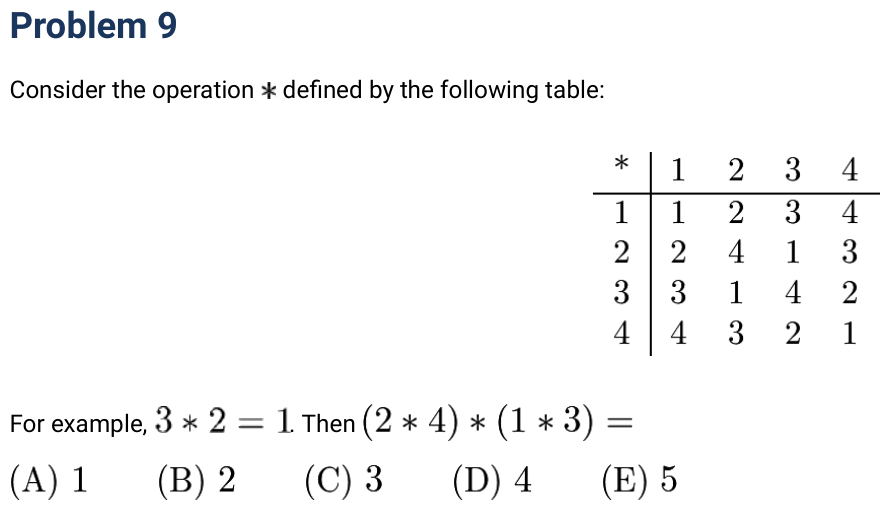
The ∗ table is just a lookup grid, like a multiplication table for a made-up operation: find the left number on the side, the right number on top, read where they meet. No rule to figure out — just look it up.
Still stuck? Show hint 2 →
Hint 2 of 2
Respect the parentheses. Evaluate each inner (a ∗ b) first to get two numbers, THEN star those two together — same as order of operations with ×.
Show solution
Approach: evaluate the parentheses by table lookup, then combine
- Inner first. For 2 ∗ 4, go to row 2, column 4: that cell is 3. For 1 ∗ 3, row 1 column 3: that's 3. (Row = left number, column = right number.)
- Now the expression is 3 ∗ 3. Row 3, column 3 reads 4. So (2 ∗ 4) ∗ (1 ∗ 3) = 4.
- Why this transfers: a 'defined operation' problem is never about discovering a formula — it's careful reading. Lock down which input is the row and which is the column, then it's pure lookup. Don't assume the table is symmetric; always read row then column.
Mark:
· log in to save