Problem 11 · 1990 AJHSME
Stretch
Number Theory
consecutiveopposite-pairs
Show answer
Answer: E — 81.
Show hints
Hint 1 of 2
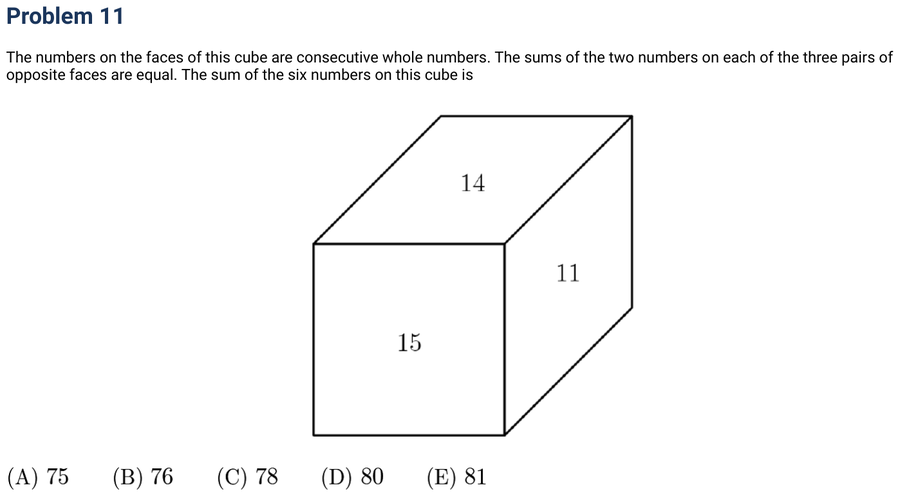
Six consecutive numbers, and you can see 11, 14, 15. Since they're consecutive, the whole set is squeezed into a tight window around those three — what six numbers in a row could contain all of 11, 14, and 15?
Still stuck? Show hint 2 →
Hint 2 of 2
The three opposite-pair sums are equal, so each pair sums to the same value — which means each pair is (smallest+largest), (2nd+2nd-largest), (middle two). That tells you the lowest and highest must add to the same total, pinning the set.
Show solution
Approach: consecutive + equal opposite-sums pins the exact six numbers
- Six consecutive whole numbers containing 11, 14, and 15 can only be 11, 12, 13, 14, 15, 16 (you must reach up to 15 and you can't start above 11). That alone fixes the set — the 'equal sums' is just the consistency check.
- Confirm it's consistent: pair them from the outside in — 11+16, 12+15, 13+14 — each sums to 27, so opposite faces can indeed match. Good.
- Now you don't even need the answer choices for arithmetic tricks — total = 11+12+13+14+15+16. Pair from the ends: three pairs of 27 = 81.
- *Worth keeping:* a run of consecutive numbers always pairs symmetrically (smallest+largest = 2nd+2nd-to-last = …), so their sum = (number of pairs) × (one pair sum) — far faster than adding one at a time.
Mark:
· log in to save