Problem 23 · 1986 AJHSME
Stretch
Geometry & Measurement
area-differencehalf-circles
Show answer
Answer: B — 1.
Show hints
Hint 1 of 3
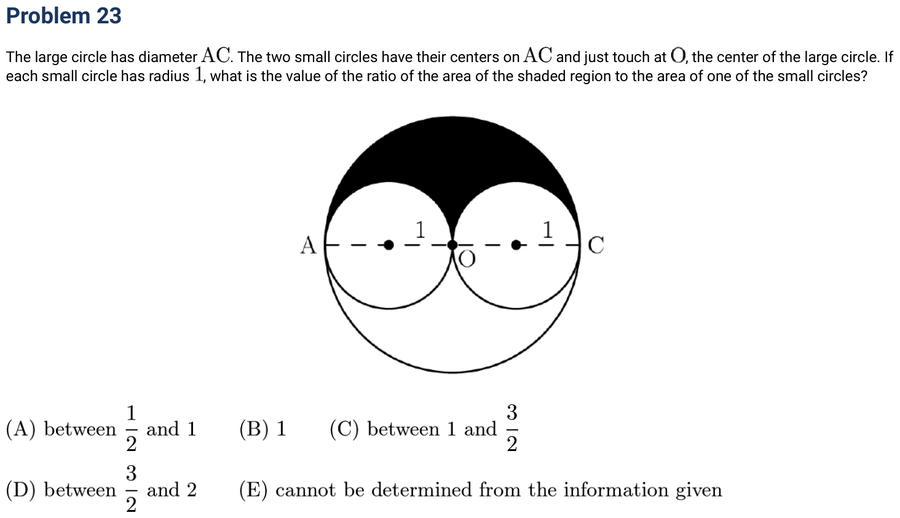
First nail down the sizes. Two small circles of radius 1 sit side by side along the diameter AC, so AC = 4, making the big circle's radius 2 — the big radius is double the small one.
Still stuck? Show hint 2 →
Hint 2 of 3
The shaded blob is the *top half* of the big circle with the *top halves* of the two small circles scooped out. Write shaded = (half the big disk) − (two half small disks) and let the π's do the work.
Still stuck? Show hint 3 →
Hint 3 of 3
Don't fear π — it will cancel when you form the final ratio, so the answer is a clean number.
Show solution
Approach: shaded = half big disk − two half small disks
- Sizes first: the two radius-1 circles span AC, so AC = 4 and the big radius is 2. Doubling the radius is the key — area grows with the *square* of the radius.
- The shaded region is the upper half of the big circle minus the upper halves of the two small circles: ½(π · 2²) − 2 · [½(π · 1²)] = 2π − π = π.
- The question asks for the ratio of this to *one* small circle (area π · 1² = π): π ⁄ π = 1. The π cancels, leaving a tidy whole number.
- Neat takeaway: even though the big circle has 4× the area of a small one, slicing everything in half and subtracting leaves the shaded piece exactly equal to a whole small circle — a reminder that 'radius doubles ⇒ area quadruples' drives these comparisons.
Mark:
· log in to save