Problem 21 · 1986 AJHSME
Stretch
Geometry & Measurement
net-of-topless-cube
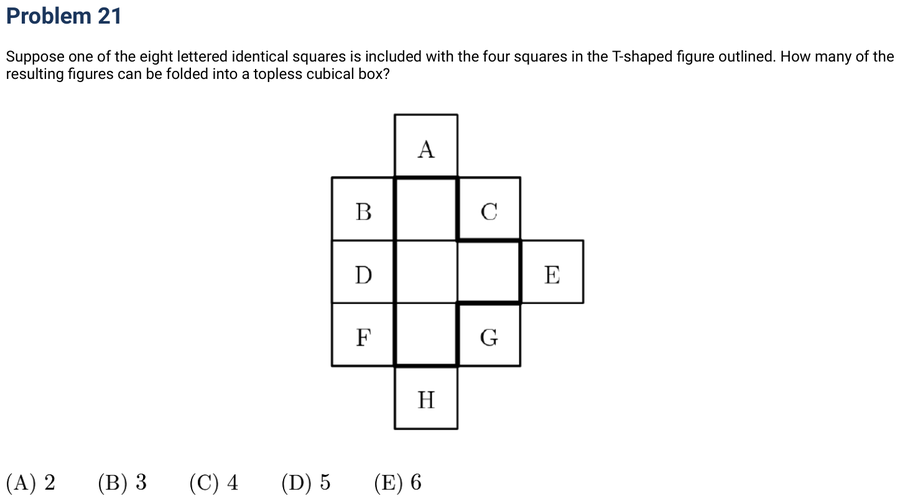
Show answer
Answer: E — 6.
Show hints
Hint 1 of 3
A box with no top is just 4 walls plus a floor — exactly 5 squares. The T already gives 4, so adding any one lettered square gives the right *count*; the real question is whether they fold without overlapping.
Still stuck? Show hint 2 →
Hint 2 of 3
Don't fold all eight in your head at once. Mentally fold the 4 squares of the T into an open box first, then for each lettered square just ask: does it land on an empty wall, or does it crash into a face that's already there?
Still stuck? Show hint 3 →
Hint 3 of 3
A choice fails only when, after folding, it would cover a spot another square already occupies (two faces on the same side).
Show solution
Approach: fold the T into an open box, then test each added square
- A topless cube needs 5 squares (4 sides + a bottom), and the T supplies 4, so every choice has the correct number — the only way to fail is an *overlap* when folded.
- Fold the T's four squares up into an open box, leaving one wall missing. Each lettered square either folds neatly into the one empty face or collides with a face that's already filled.
- Going through the eight positions, only two of them fold onto an already-used face; the other 6 complete a topless cubical box.
- Why count squares first: knowing a topless cube is exactly 5 faces tells you instantly that 'how many squares' is never the obstacle — the whole puzzle is purely about overlaps, so you only have to test for collisions.
Mark:
· log in to save