Problem 24 · 1985 AJHSME
Stretch
Algebra & Patterns
double-count-vertices
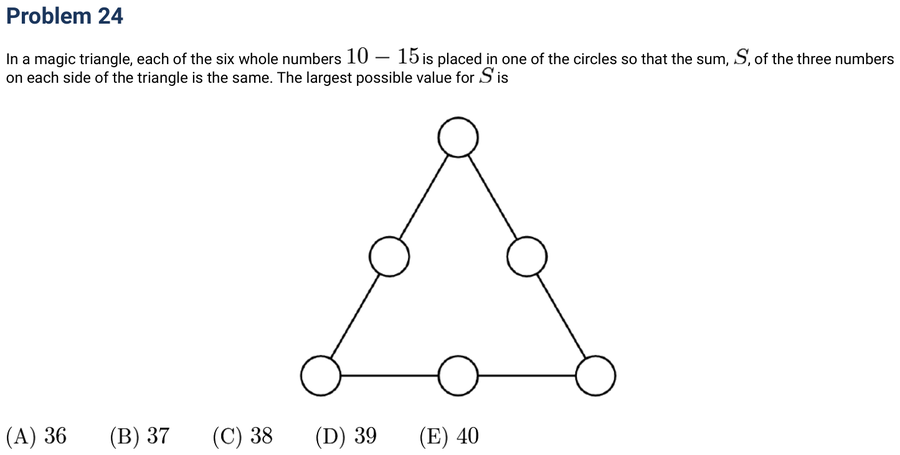
Show answer
Answer: D — 39.
Show hints
Hint 1 of 3
The three corner circles are each shared by TWO sides, while each middle circle belongs to just one side. So when you add up all three side-sums, the corners get counted twice and the middles once. That imbalance is the key — which numbers do you want in the doubly-counted corners?
Still stuck? Show hint 2 →
Hint 2 of 3
Add the three side-sums together: that total is (every number once) + (each corner one extra time) = 75 + (corner sum). To make S as big as possible, load the corners with the three largest numbers so the corner sum is largest.
Still stuck? Show hint 3 →
Hint 3 of 3
Once you decide the corners, double-check it's actually buildable: each side must hit the SAME S, so the leftover numbers have to land as the right middles.
Show solution
Approach: double-count the corner contributions
- All six numbers total 10 + 11 + ⋯ + 15 = 75. Adding the three side-sums counts each corner twice and each middle once, so 3S = 75 + (corner sum). Bigger corners → bigger S, so put the three largest at the corners: 13 + 14 + 15 = 42.
- Then 3S = 75 + 42 = 117, so S = 39.
- Confirm it's achievable: corner pairs sum to 27, 28, 29, and each side needs the middle to fill up to 39 — that's middles 12, 11, 10 (= the three leftover numbers, perfectly). So S = 39 really works.
- Why this transfers: in 'shared-vertex' sum puzzles, add ALL the line-sums first — the shared spots get over-counted, and steering the big (or small) values into the over-counted spots is how you maximize (or minimize) the common total.
Mark:
· log in to save