Casey went on a road trip that covered 100 miles, stopping only for a lunch break along the way. The trip took 3 hours in total and her average speed while driving was 40 miles per hour. In minutes, how long was the lunch break?
Show answer
Answer: B — 30 minutes.
Show hints
Hint 1 of 2
The 3 hours includes the break. Find the driving time first.
Still stuck? Show hint 2 →
Hint 2 of 2
Time = distance ÷ speed gives only the driving time. Whatever's left of the 3 hours is the break.
A lake contains 250 trout, along with a variety of other fish. When a marine biologist catches and releases a sample of 180 fish from the lake, 30 are identified as trout. Assume the ratio of trout to the total number of fish is the same in both the sample and the lake. How many fish are there in the lake?
Show answer
Answer: B — 1500 fish.
Show hints
Hint 1 of 2
The fraction of trout should be the same in the sample as in the whole lake.
Still stuck? Show hint 2 →
Hint 2 of 2
The fraction of the sample that is trout should equal the fraction of the whole lake that is trout. Set the two fractions equal.
Show solution
In the sample, 30 of 180 are trout: 30 ÷ 180 = 16.
So trout make up 16 of the whole lake too.
If 250 trout are 16 of the fish, the total is 250 × 6 = 1500.
Luka is making lemonade to sell at a school fundraiser. His recipe requires 4 times as much water as sugar and twice as much sugar as lemon juice. He uses 3 cups of lemon juice. How many cups of water does he need?
Show answer
Answer: E — 24 cups.
Show hints
Hint 1 of 2
Don't solve for sugar first — chain the two scalings into one trip from lemon juice to water.
Still stuck? Show hint 2 →
Hint 2 of 2
Water is 4 × sugar, sugar is 2 × lemon. So water is 4 × 2 = 8 times the lemon juice.
Show solution
Approach: chain the ratios
Water is 4 × sugar, and sugar is 2 × lemon juice, so water is 4 × 2 = 8 times the lemon juice.
With 3 cups of lemon juice, water = 8 × 3 = 24 cups.
Another way — step by step: lemon → sugar → water (MAA):
An amusement park has a collection of scale models, with a ratio of 1 : 20, of buildings and other sights from around the country. The height of the United States Capitol is 289 feet. What is the height in feet of its replica at this park, rounded to the nearest whole number?
Show answer
Answer: A — 14 feet.
Show hint
Hint 1
Scale 1:20 means the replica is 1/20 of the original. Divide.
When Cheenu was a boy he could run 15 miles in 3 hours and 30 minutes. As an old man he can now walk 10 miles in 4 hours. How many minutes longer does it take for him to travel a mile now compared to when he was a boy?
Show answer
Answer: B — 10 minutes longer.
Show hints
Hint 1 of 2
Convert each to minutes-per-mile, then subtract.
Still stuck? Show hint 2 →
Hint 2 of 2
Boy: 210 min / 15 mi = 14 min/mi. Old: 240 min / 10 mi = 24 min/mi.
Show solution
Approach: minutes per mile, then subtract
Boy: 3 h 30 min = 210 minutes for 15 miles ⇒ 14 min/mile.
Old: 4 h = 240 minutes for 10 miles ⇒ 24 min/mile.
Jack and Jill are going swimming at a pool that is one mile from their house. They leave home simultaneously. Jill rides her bicycle to the pool at a constant speed of 10 miles per hour. Jack walks to the pool at a constant speed of 4 miles per hour. How many minutes before Jack does Jill arrive?
Show answer
Answer: D — 9 minutes.
Show hint
Hint 1
Compute each one's minutes-per-mile (60 / speed) and subtract.
Trey and his mom stopped at a railroad crossing to let a train pass. As the train began to pass, Trey counted 6 cars in the first 10 seconds. It took the train 2 minutes and 45 seconds to clear the crossing at a constant speed. Which of the following was the most likely number of cars in the train?
Show answer
Answer: C — About 100 cars.
Show hint
Hint 1
Set up a proportion: 6 cars per 10 sec. Convert 2 min 45 sec to seconds.
Rachelle uses 3 pounds of meat to make 8 hamburgers for her family. How many pounds of meat does she need to make 24 hamburgers for a neighborhood picnic?
Show answer
Answer: E — 9 pounds.
Show hint
Hint 1
24 hamburgers is 3 times as many as 8, so the meat triples.
In the country of East Westmore, statisticians estimate there is a baby born every 8 hours and a death every day. To the nearest hundred, how many people are added to the population of East Westmore each year?
Show answer
Answer: B — About 700.
Show hint
Hint 1
Births per day = 24/8 = 3. Net growth per day = 3 − 1 = 2. Multiply by 365.
Show solution
Approach: net per day × 365
Births per day: 24/8 = 3. Net daily growth: 3 − 1 = 2.
On average, for every 4 sports cars sold at the local dealership, 7 sedans are sold. The dealership predicts that it will sell 28 sports cars next month. How many sedans does it expect to sell?
Steve's empty swimming pool will hold 24,000 gallons of water when full. It will be filled by 4 hoses, each of which supplies 2.5 gallons of water per minute. How many hours will it take to fill Steve's pool?
Barney Schwinn notices that the odometer on his bicycle reads 1441, a palindrome, because it reads the same forward and backward. After riding 4 more hours that day and 6 the next, he notices that the odometer shows another palindrome, 1661. What was his average speed in miles per hour?
Elisa swims laps in the pool. When she first started, she completed 10 laps in 25 minutes. Now she can finish 12 laps in 24 minutes. By how many minutes has she improved her lap time?
Problems 14, 15 and 16 involve Mrs. Reed's English assignment. A Novel Assignment. The students in Mrs. Reed's English class are reading the same 760-page novel. Three friends, Alice, Bob and Chandra, are in the class. Alice reads a page in 20 seconds, Bob reads a page in 45 seconds and Chandra reads a page in 30 seconds. If Bob and Chandra both read the whole book, Bob will spend how many more seconds reading than Chandra?
Show answer
Answer: B — 11,400 seconds.
Show hint
Hint 1
Difference per page: 45 − 30 = 15 sec. Multiply by 760.
Joe had walked half way from home to school when he realized he was late. He ran the rest of the way to school. He ran 3 times as fast as he walked. Joe took 6 minutes to walk half way to school. How many minutes did it take Joe to get from home to school?
Show answer
Answer: D — 8 minutes.
Show hint
Hint 1
Running 3x as fast takes 1/3 the time for the same distance.
Show solution
Approach: scale time by speed
Walking half: 6 min. Running the other half (3x speed): 6/3 = 2 min.
Twelve friends met for dinner at Oscar's Overstuffed Oyster House, and each ordered one meal. The portions were so large, there was enough food for 18 people. If they shared, how many meals should they have ordered to have just enough food for the 12 of them?
Show answer
Answer: A — 8 meals.
Show hint
Hint 1
12 meals = 18 people ⇒ 1 meal feeds 1.5. Solve m · 1.5 = 12.
Casey's shop class is making a golf trophy. He has to paint 300 dimples on a golf ball. If it takes him 2 seconds to paint one dimple, how many minutes will he need to do his job?
Show answer
Answer: D — 10 minutes.
Show hint
Hint 1
Find the total seconds first, then convert to minutes.
On a dark and stormy night Snoopy suddenly saw a flash of lightning. Ten seconds later he heard the sound of thunder. The speed of sound is 1088 feet per second and one mile is 5280 feet. Estimate, to the nearest half-mile, how far Snoopy was from the flash of lightning.
Show answer
Answer: C — 2 miles.
Show hints
Hint 1 of 2
Distance = speed × time gives the feet; then compare with a mile.
Still stuck? Show hint 2 →
Hint 2 of 2
Two miles is about 10,560 feet.
Show solution
Approach: distance in feet, then convert to miles
In 10 seconds the sound travels 10 × 1088 = 10,880 feet.
Since 2 miles is 2 × 5280 = 10,560 feet, the distance is closest to 2 miles.
A child's wading pool contains 200 gallons of water. If water evaporates at the rate of 0.5 gallons per day and no other water is added or removed, how many gallons of water will be in the pool after 30 days?
Show answer
Answer: C — 185 gallons.
Show hints
Hint 1 of 2
Find the total amount lost over the 30 days first.
Miguel and his dog Luna start together at a park entrance. Miguel throws a ball straight ahead to a tree and keeps walking at a steady pace. Luna sprints to the ball and immediately brings it back to Miguel. Luna runs 5 times as fast as Miguel walks. What fraction of the entrance-to-tree distance does Miguel cover by the time Luna brings him the ball?
Show answer
Answer: D — 1/3.
Show hints
Hint 1 of 2
In the same time, Luna covers 5 times the distance Miguel does.
Still stuck? Show hint 2 →
Hint 2 of 2
Luna's path is entrance → tree → Miguel; set its length to 5 times Miguel's walk.
Show solution
Approach: equal time means Luna's path is 5× Miguel's
Let the entrance-to-tree distance be 1 and Miguel's distance be d. Luna runs to the tree and back to Miguel: 1 + (1 − d) = 2 − d.
Since Luna covers 5 times Miguel's distance, 5d = 2 − d, so 6d = 2 and d = 1/3.
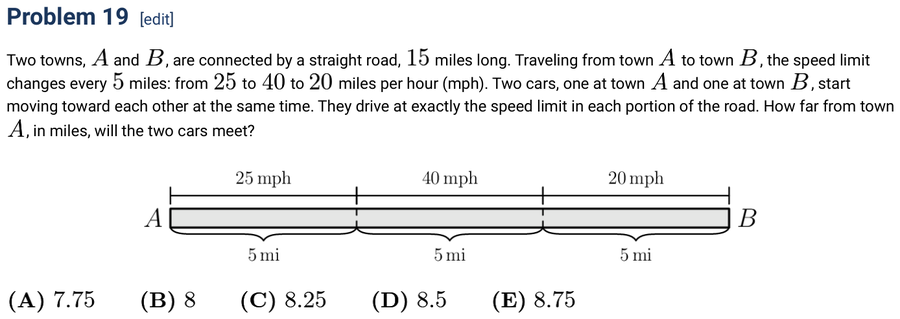
Once both cars are in the middle section, they're going the same speed — the asymmetry is in how they got there.
Still stuck? Show hint 2 →
Hint 2 of 2
Car A reaches the middle in 5/25 = 1/5 hr; car B in 5/20 = 1/4 hr. A has a 1/20-hr head start in the middle section — that's 2 miles.
Show solution
Approach: let the cars meet in the middle 40-mph section
Car A's left section is 5 miles at 25 mph → reaches the middle in 5/25 = 1/5 hr. Car B's right section is 5 miles at 20 mph → reaches the middle in 5/20 = 1/4 hr. A enters the middle 1/20 hr before B.
In that 1/20 hr, A travels 40 × 1/20 = 2 miles, so when B enters the middle, A is at mile 7, B at mile 10 — a 3-mile gap.
Both now go 40 mph, closing at 80 mph. They split the 3-mile gap equally: each covers 1.5 miles. A is at 7 + 1.5 = 8.5 miles from A.
NASA's Perseverance Rover was launched on July 30, 2020. After traveling 292,526,838 miles, it landed on Mars in Jezero Crater about 6.5 months later. Which of the following is closest to the Rover's average interplanetary speed in miles per hour?
Show answer
Answer: C — About 60,000 mph.
Show hints
Hint 1 of 2
The choices span orders of magnitude, so round generously. Distance ≈ 3 × 10⁸ miles.
Still stuck? Show hint 2 →
Hint 2 of 2
6.5 months ≈ 200 days ≈ 5000 hours. Then speed ≈ distance ÷ time.
Qiang drives 15 miles at an average speed of 30 miles per hour. How many additional miles will he have to drive at 55 miles per hour to average 50 miles per hour for the entire trip?
Show answer
Answer: D — 110 miles.
Show hints
Hint 1 of 2
Average speed = total distance / total time. Write that equation with x = additional miles.
Still stuck? Show hint 2 →
Hint 2 of 2
Time so far: 15/30 = 1/2 hr. Set (15 + x)/(1/2 + x/55) = 50.
Show solution
Approach: set total-distance / total-time = 50
Time so far: 15/30 = 1/2 hour. After x additional miles at 55 mph, the new total is (15 + x) miles and (1/2 + x/55) hours.
The clock in Sri's car, which is not accurate, gains time at a constant rate. One day as he begins shopping he notes that his car clock and his watch (which is accurate) both say 12:00 noon. When he is done shopping, his watch says 12:30 and his car clock says 12:35. Later that day, Sri loses his watch. He looks at his car clock and it says 7:00. What is the actual time?
Show answer
Answer: B — 6:00.
Show hints
Hint 1 of 2
30 real minutes correspond to 35 car-clock minutes. Ratio: actual / car = 30/35 = 6/7.
Still stuck? Show hint 2 →
Hint 2 of 2
Car clock shows 7 hours = 420 car-minutes past noon. Actual = 420 × 6/7.
Show solution
Approach: convert car-time to actual via the rate
30 real minutes = 35 car-clock minutes ⇒ actual = (6/7) × car-clock time.
Car shows 7:00, which is 420 car-minutes past noon. Actual = 420 × 6/7 = 360 minutes = 6 hours.
Bella begins to walk from her house toward her friend Ella's house. At the same time, Ella begins to ride her bicycle toward Bella's house. They each maintain a constant speed, and Ella rides 5 times as fast as Bella walks. The distance between their houses is 2 miles, which is 10,560 feet, and Bella covers 2½ feet with each step. How many steps will Bella take by the time she meets Ella?
Show answer
Answer: A — 704 steps.
Show hints
Hint 1 of 2
Bella : Ella speed ratio 1 : 5, so Bella covers 1/6 of the total 10,560 feet by the time they meet.
Still stuck? Show hint 2 →
Hint 2 of 2
Bella's distance = 1760 feet. Divide by 2.5 ft/step.
Show solution
Approach: ratio of distances, then divide by step length
Combined speed ratio Bella : Ella = 1 : 5, so Bella covers 1/6 of the 10,560-foot distance.
Karl's car uses a gallon of gas every 35 miles, and his gas tank holds 14 gallons when it is full. One day, Karl started with a full tank of gas, drove 350 miles, bought 8 gallons of gas, and continued driving to his destination. When he arrived, his gas tank was half full. How many miles did Karl drive that day?
Show answer
Answer: A — 525 miles.
Show hint
Hint 1
Track gallons. Start 14, drive 350 = use 10, left 4. Buy 8 → 12. End half full = 7. So extra used = 5 gallons = 175 miles.
Show solution
Approach: track gallons through the trip
Start: 14 gal. After 350 mi: used 350/35 = 10 gal, leaving 4.
Bought 8 gal → 12 gal in tank. Arrived half full (7 gal), so used 12 − 7 = 5 more gallons = 5 × 35 = 175 miles.
Annie and Bonnie are running laps around a 400-meter oval track. They started together, but Annie has pulled ahead because she runs 25% faster than Bonnie. How many laps will Annie have run when she first passes Bonnie?
Show answer
Answer: D — 5 laps.
Show hints
Hint 1 of 2
25% faster means speed ratio 5 : 4. Annie gains a quarter-lap on Bonnie per Bonnie-lap.
Still stuck? Show hint 2 →
Hint 2 of 2
To gain a full lap, Bonnie completes 4 laps; in that time Annie completes 5.
Show solution
Approach: speed ratio → lap gain per Bonnie lap
Speed ratio Annie : Bonnie = 5 : 4. So for every lap Bonnie runs, Annie runs 5/4 laps — a gain of 1/4 lap per Bonnie-lap.
To gain a full lap (and pass Bonnie), Bonnie must run 4 laps. In that time, Annie runs 5 laps.
Homer began peeling a pile of 44 potatoes at the rate of 3 potatoes per minute. Four minutes later Christen joined him and peeled at the rate of 5 potatoes per minute. When they finished, how many potatoes had Christen peeled?
Show answer
Answer: A — 20.
Show hints
Hint 1 of 2
First find how many potatoes are left when Christen starts.
Still stuck? Show hint 2 →
Hint 2 of 2
Then they peel together at a combined rate — find how long that takes.
Show solution
Approach: head start, then combined rate
In the first 4 minutes Homer peels 3 × 4 = 12, leaving 44 − 12 = 32 potatoes.
Together they peel 3 + 5 = 8 per minute, so the rest takes 32 ÷ 8 = 4 minutes.
In those 4 minutes Christen peels 5 × 4 = 20 potatoes.
Nisos Isles. In 1998 the islands have 200 people, and the population triples every 25 years. The total area is 24,900 square miles, and the Queen requires at least 1.5 square miles per person. In about how many years from 1998 will the population reach the maximum the islands can support?
Show answer
Answer: C — About 100 years.
Show hints
Hint 1 of 2
First find the largest population the land allows: area ÷ 1.5.
Still stuck? Show hint 2 →
Hint 2 of 2
Compare that to 200 and count how many triplings it takes.
Show solution
Approach: find the cap, then count triplings
The land supports 24,900 ÷ 1.5 = 16,600 people, about 83 times today's 200.
Since 3⁴ = 81 ≈ 83, that's four triplings, or 4 × 25 = 100 years.
Students from three middle schools worked on a summer project. Seven students from Allen school worked for 3 days, four students from Balboa school worked for 5 days, and five students from Carver school worked for 9 days. The total amount paid for the students' work was $774. Assuming each student received the same amount for a day's work, how much did the students from Balboa school earn altogether?
Show answer
Answer: C — 180.00 dollars.
Show hints
Hint 1 of 2
Count total student-days across all schools.
Still stuck? Show hint 2 →
Hint 2 of 2
Find the pay per student-day, then multiply by Balboa's student-days.
At the beginning of a trip, the mileage odometer read 56,200 miles. The driver filled the gas tank with 6 gallons of gasoline. During the trip, the driver filled his tank again with 12 gallons of gasoline when the odometer read 56,560. At the end of the trip, the driver filled his tank again with 20 gallons of gasoline. The odometer read 57,060. To the nearest tenth, what was the car's average miles-per-gallon for the entire trip?
Show answer
Answer: D — 26.9.
Show hints
Hint 1 of 2
The first 6-gallon fill-up only tops off the tank — gas used during the trip is what was refilled afterwards.
Still stuck? Show hint 2 →
Hint 2 of 2
Miles ÷ gallons used.
Show solution
Approach: miles ÷ (gas used to refill)
Miles driven = 57,060 − 56,200 = 860. Gas used (the two refills) = 12 + 20 = 32.
If you walk for 45 minutes at a rate of 4 mph and then run for 30 minutes at a rate of 10 mph, how many miles will you have gone at the end of one hour and 15 minutes?
Show answer
Answer: B — 8 miles.
Show hint
Hint 1
Convert each leg's minutes into a fraction of an hour, then multiply by the speed.
If your average score on your first six mathematics tests was 84 and your average score on your first seven mathematics tests was 85, then your score on the seventh test was
Show answer
Answer: D — 91.
Show hint
Hint 1
Convert each average to a sum, then subtract.
Show solution
Approach: difference of totals
Total of first 7 = 7 × 85 = 595. Total of first 6 = 6 × 84 = 504. Seventh test = 595 − 504.
In January 1980 the Mauna Loa Observatory recorded carbon dioxide CO2 levels of 338 ppm (parts per million). Over the years the average CO2 reading has increased by about 1.515 ppm each year. What is the expected CO2 level in ppm in January 2030? Round your answer to the nearest integer.
Show answer
Answer: B — 414 ppm.
Show hints
Hint 1 of 2
Constant per-year increase means total increase is linear in the years elapsed.
Still stuck? Show hint 2 →
Hint 2 of 2
Multiply the per-year rate by the number of years (50), then add to the 1980 starting value.
When the World Wide Web first became popular in the 1990s, download speeds reached a maximum of about 56 kilobits per second. Approximately how many minutes would the download of a 4.2-megabyte song have taken at that speed? (Note that there are 8000 kilobits in a megabyte.)
Show answer
Answer: B — 10 minutes.
Show hints
Hint 1 of 2
Convert the song to kilobits first (units of the speed), then time = size ÷ speed.
On a trip to the beach, Anh traveled 50 miles on the highway and 10 miles on a coastal access road. He drove three times as fast on the highway as on the coastal road. If Anh spent 30 minutes driving on the coastal road, how many minutes did his entire trip take?
Show answer
Answer: C — 80 minutes.
Show hints
Hint 1 of 2
Coastal speed = 10 mi / 30 min = 1/3 mile/minute. Highway is 3× faster = 1 mile/minute.
Still stuck? Show hint 2 →
Hint 2 of 2
Highway time = 50 miles ÷ 1 mile/min = 50 min. Add the 30 min coastal.
Show solution
Approach: find each leg's time separately
Coastal: 10 miles in 30 min ⇒ 1/3 mile per minute. Highway is 3× that: 1 mile/min.
George walks 1 mile to school. He leaves home at the same time each day, walks at a steady speed of 3 miles per hour, and arrives just as school begins. Today he was distracted by the pleasant weather and walked the first 12 mile at a speed of only 2 miles per hour. At how many miles per hour must George run the last 12 mile in order to arrive just as school begins today?
Show answer
Answer: B — 6 mph.
Show hint
Hint 1
Total time on a normal day = 1/3 hour. How much of that did the slow first half use? Whatever's left must cover the second half-mile.
Show solution
Approach: subtract used time from total time
Normal total time = 1 / 3 hr.
First half-mile at 2 mph took (1/2) / 2 = 1/4 hr.
Time remaining for the second half = 1/3 − 1/4 = 1/12 hr.
Ted's grandfather used his treadmill on 3 days this week. He went 2 miles each day. On Monday he jogged at a speed of 5 miles per hour. He walked at the rate of 3 miles per hour on Wednesday and at 4 miles per hour on Friday. If Grandfather had always walked at 4 miles per hour, he would have spent less time on the treadmill. How many minutes less?
Show answer
Answer: D — 4 minutes.
Show hint
Hint 1
Time for 2 miles at rate r is 2/r hours. Convert each to minutes and compare with the all-4-mph plan.
Show solution
Approach: sum the actual minutes vs the hypothetical minutes
Monday: (2/5) hr = 24 min. Wednesday: (2/3) hr = 40 min. Friday: (2/4) hr = 30 min. Total: 94 min.
A number of students from Fibonacci Middle School are taking part in a community service project. The ratio of 8th-graders to 6th-graders is 5 : 3, and the ratio of 8th-graders to 7th-graders is 8 : 5. What is the smallest number of students that could be participating in the project?
Show answer
Answer: E — 89 students.
Show hints
Hint 1 of 2
Both ratios link to the 8th-graders. The number of 8th-graders must be a multiple of 5 (first ratio) and 8 (second ratio).
Still stuck? Show hint 2 →
Hint 2 of 2
Smallest such number is lcm(5, 8) = 40.
Show solution
Approach: lcm of the 8th-grader counts
8th-graders divisible by both 5 and 8 ⇒ smallest is 40.
As Emily is riding her bicycle on a long straight road, she spots Emerson skating in the same direction 1/2 mile in front of her. After she passes him, she can see him in her rear mirror until he is 1/2 mile behind her. Emily rides at a constant rate of 12 miles per hour, and Emerson skates at a constant rate of 8 miles per hour. For how many minutes can Emily see Emerson?
Show answer
Answer: D — 15 minutes.
Show hint
Hint 1
Use the gap-closing speed: Emily − Emerson = 4 mph. She sees him while the gap shrinks from 1/2 ahead to 1/2 behind — a total relative shift of 1 mile.
Show solution
Approach: relative-speed reasoning
Relative speed: 12 − 8 = 4 mph.
Emily must cover 1 mile of relative displacement (from 1/2 ahead to 1/2 behind).
Austin and Temple are 50 miles apart along Interstate 35. Bonnie drove from Austin to her daughter's house in Temple, averaging 60 miles per hour. Leaving the car with her daughter, Bonnie rode a bus back to Austin along the same route and averaged 40 miles per hour on the return trip. What was the average speed for the round trip, in miles per hour?
Show answer
Answer: B — 48 mph.
Show hint
Hint 1
Average speed = total distance / total time. Don't just average the two speeds — equal distances at different speeds gives the harmonic mean.
Show solution
Approach: total distance / total time
Time out: 50/60 = 5/6 hr. Time back: 50/40 = 5/4 hr. Total time: 5/6 + 5/4 = 25/12 hr.
Total distance: 100. Average: 100 / (25/12) = 48 mph.
A recipe that makes 5 servings of hot chocolate requires 2 squares of chocolate, 1/4 cup sugar, 1 cup water and 4 cups milk. Jordan has 5 squares of chocolate, 2 cups of sugar, lots of water, and 7 cups of milk. If she maintains the same ratio of ingredients, what is the greatest number of servings of hot chocolate she can make?
Show answer
Answer: D — 8¾ servings.
Show hint
Hint 1
For each ingredient, compute how many recipes worth Jordan has, then multiply by 5 servings. The smallest result limits the answer.
Show solution
Approach: compute per-ingredient capacity, take the min
Chocolate: 5/2 recipes worth.
Sugar: 2 / (1/4) = 8 recipes.
Milk: 7/4 recipes.
Smallest is milk at 7/4. Servings: 5 · 7/4 = 35/4 = 8¾.
Cassie leaves Escanaba at 8:30 AM heading for Marquette on her bike. She bikes at a uniform rate of 12 miles per hour. Brian leaves Marquette at 9:00 AM heading for Escanaba on his bike. He bikes at a uniform rate of 16 miles per hour. They both bike on the same 62-mile route between Escanaba and Marquette. At what time in the morning do they meet?
Show answer
Answer: D — 11:00 AM.
Show hint
Hint 1
By 9:00, Cassie has covered 6 miles. Then 56 miles remain at combined speed 28 mph ⇒ 2 hours.
Show solution
Approach: head-start, then combined speed
By 9:00 AM Cassie has biked (1/2)(12) = 6 miles. Gap: 62 − 6 = 56 miles.
Chandra and Bob, who each have a copy of the book, decide that they can save time by "team reading" the novel. In this scheme, Chandra will read from page 1 to a certain page and Bob will read from the next page through page 760, finishing the book. When they are through they will tell each other about the part they read. What is the last page that Chandra should read so that she and Bob spend the same amount of time reading the novel?
Before Chandra and Bob start reading, Alice says she would like to team read with them. If they divide the book into three sections so that each reads for the same length of time, how many seconds will each have to read?
Show answer
Answer: E — 7200 seconds.
Show hints
Hint 1 of 2
Equal time means pages-per-reader are in inverse proportion to seconds-per-page (rates).
Still stuck? Show hint 2 →
Hint 2 of 2
Reading rates: Alice 1/20, Bob 1/45, Chandra 1/30. Ratio of pages = 1/20 : 1/45 : 1/30 = 9 : 4 : 6 (multiply by 180).
Show solution
Approach: page split, then time
Reading rates: 1/20, 1/45, 1/30 pages/sec for Alice, Bob, Chandra.
Pages each reads in equal time: ratio 9 : 4 : 6 (sum 19). Total 760 pages ⇒ Alice 360, Bob 160, Chandra 240.
Art, Roger, Paul, and Trisha bake cookies that are all the same thickness, in the shapes shown below (dimensions in inches). Each friend uses the same amount of dough, and Art's batch makes exactly 12 cookies.
Art's cookies sell for 60 cents each. To bring in the same total from one batch, how much should one of Roger's cookies cost, in cents?
Show answer
Answer: C — 40 cents.
Show hints
Hint 1 of 2
Same total money from one batch means each cookie's price scales with its size.
Still stuck? Show hint 2 →
Hint 2 of 2
Compare Roger's cookie area to Art's, then scale 60 cents by that ratio.
Show solution
Approach: price per cookie scales with cookie area
For a fixed batch and a fixed total price, each cookie's price is proportional to its area.
Roger's cookie is 8 in² and Art's is 12 in², a ratio of 8/12 = 2/3.
So Roger should charge 60 × 2/3 = 40 cents.
Another way — count the cookies:
Art: 12 cookies at 60¢ = 720¢ per batch, using 12 × 12 = 144 in² of dough.
Nisos Isles. In 1998 the islands have 200 people, and the population triples every 25 years. Estimate the year in which the population will be about 6000.
Show answer
Answer: B — About 2075.
Show hints
Hint 1 of 2
6000 is about 30 times the starting 200.
Still stuck? Show hint 2 →
Hint 2 of 2
Each tripling multiplies by 3 — how many triples reach about 30×?
Show solution
Approach: count triplings to reach ~30×
6000 ÷ 200 = 30, and three triplings give ×27 ≈ 30.
Three 25-year periods is 75 years after 1998, about 2075.
Julie is preparing a speech. It must last between one-half hour and three-quarters of an hour, and her ideal rate is 150 words per minute. If she speaks at that rate, which of the following word counts is an appropriate length?
Show answer
Answer: E — 5650 words.
Show hints
Hint 1 of 2
Turn each time limit into a word count at 150 words per minute.
Still stuck? Show hint 2 →
Hint 2 of 2
The answer must fall between those two counts.
Show solution
Approach: convert the time bounds to word counts
At 150 words per minute, 30 minutes is 4500 words and 45 minutes is 6750 words.
An American traveling in Italy wishes to exchange American dollars for Italian lire. If 3000 lire = $1.60, how much lire will the traveler receive for $1.00?
Two children at a time can play pairball. For 90 minutes, with only two children playing at a time, five children take turns so that each one plays the same amount of time. The number of minutes each child plays is
Show answer
Answer: E — 36.
Show hints
Hint 1 of 2
Two children play at once, so there are 2 × 90 child-minutes of play available.
Still stuck? Show hint 2 →
Hint 2 of 2
Share those equally among the five children.
Show solution
Approach: total child-minutes, shared equally
Two play at a time for 90 minutes: 2 × 90 = 180 child-minutes.
A can of soup can feed 3 adults or 5 children. If there are 5 cans of soup and 15 children are fed, then how many adults would the remaining soup feed?
Show answer
Answer: B — 6 adults.
Show hints
Hint 1 of 2
First find how many cans the 15 children use.
Still stuck? Show hint 2 →
Hint 2 of 2
The leftover cans each feed 3 adults.
Show solution
Approach: use cans for children, then convert the rest
15 children need 15 ÷ 5 = 3 cans, leaving 5 − 3 = 2 cans.
To control her blood pressure, Jill's grandmother takes one half of a pill every other day. If one supply of medicine contains 60 pills, then the supply would last approximately
Show answer
Answer: D — 8 months.
Show hints
Hint 1 of 2
How many doses are in 60 pills if each dose is half a pill?
Still stuck? Show hint 2 →
Hint 2 of 2
Each dose covers two days.
Show solution
Approach: doses, then days
60 pills ÷ ½ per dose = 120 doses, and each dose lasts 2 days, so 240 days.
The five tires of a car (four road tires and a full-sized spare) were rotated so that each tire was used the same number of miles during the first 30,000 miles the car traveled. For how many miles was each tire used?
Show answer
Answer: C — 24,000 miles.
Show hints
Hint 1 of 2
Only 4 tires are on the road at any moment, so count total tire-miles.
Still stuck? Show hint 2 →
Hint 2 of 2
Share those tire-miles equally among all 5 tires.
Show solution
Approach: total tire-miles shared over 5 tires
Four tires are used over 30,000 miles, for 4 × 30,000 = 120,000 tire-miles.
Split among 5 tires: 120,000 ÷ 5 = 24,000 miles each.
On a trip, a car traveled 80 miles in an hour and a half, then was stopped in traffic for 30 minutes, then traveled 100 miles during the next 2 hours. What was the car's average speed in miles per hour for the 4-hour trip?
Show answer
Answer: A — 45.
Show hints
Hint 1 of 2
Average speed is total distance divided by total time — include the stop.
Still stuck? Show hint 2 →
Hint 2 of 2
Add 80 + 100 miles over 1.5 + 0.5 + 2 hours.
Show solution
Approach: total distance over total time
Total distance is 80 + 100 = 180 miles over 1.5 + 0.5 + 2 = 4 hours.
A bus takes 2 minutes to drive from one stop to the next, and waits 1 minute at each stop to let passengers board. Zia takes 5 minutes to walk from one bus stop to the next. As Zia reaches a bus stop, if the bus is at the previous stop or has already left the previous stop, then she will wait for the bus. Otherwise she will start walking toward the next stop. Suppose the bus and Zia start at the same time toward the library, with the bus 3 stops behind. After how many minutes will Zia board the bus?
Show answer
Answer: A — 17 minutes.
Show hints
Hint 1 of 2
Zia only checks at multiples of 5 minutes (when she reaches a stop). At each check, see where the bus is and whether to wait.
Still stuck? Show hint 2 →
Hint 2 of 2
Bus cycle: 2 min driving + 1 min stopped = 3 min per stop. Track stop indexes at t = 0, 5, 10, 15.
Show solution
Approach: simulate at Zia's 5-minute checkpoints
Index stops by the bus's start (stop 0). At t = 0, Zia is at stop 3, bus at stop 0.
t = 5: Zia at stop 4. Bus took 5 min → finished stop 1 (arrived at 2 min, left at 3 min, arrived at stop 2 at 5 min). Bus is at stop 2 — not yet at the previous stop (3), so Zia walks on.
t = 10: Zia at stop 5. Bus: from t = 5 (at stop 2) waits 1 min (leaves at 6), drives 2 min to stop 3 (arrives at 8), waits till 9, drives to stop 4 (arrives at 11). So at t = 10, bus is mid-drive between stops 3 and 4 — not at the previous stop (4), so Zia walks on.
t = 15: Zia at stop 6. Bus: arrives at stop 4 at 11, waits till 12, drives to stop 5 (arrives 14, waits till 15). At t = 15, bus is at stop 5 — the previous stop. Zia waits.
Bus leaves stop 5 at t = 15 and drives 2 min to stop 6: arrives at t = 17.
Miki has a dozen oranges of the same size and a dozen pears of the same size. Miki uses her juicer to extract 8 ounces of pear juice from 3 pears and 8 ounces of orange juice from 2 oranges. She makes a pear-orange juice blend from an equal number of pears and oranges. What percent of the blend is pear juice?
Show answer
Answer: B — 40%.
Show hints
Hint 1 of 2
Work out how much juice one pear gives and how much one orange gives.
Still stuck? Show hint 2 →
Hint 2 of 2
With equal numbers of each fruit, just compare those per-fruit yields.
Show solution
Approach: compare juice per fruit
One pear gives 8/3 oz of juice; one orange gives 8/2 = 4 oz.
Equal numbers of each fruit make the pear-to-orange juice ratio 8/3 : 4 = 2 : 3.
Pear's share of the blend is 2 ÷ (2 + 3) = 2/5 = 40%.
In a far-off land three fish can be traded for two loaves of bread, and a loaf of bread can be traded for four bags of rice. How many bags of rice is one fish worth?
Show answer
Answer: D — 2⅔ bags.
Show hints
Hint 1 of 2
Convert bread into rice first, so everything is measured in rice.
Still stuck? Show hint 2 →
Hint 2 of 2
Then 3 fish equals that many bags — divide by 3.
Show solution
Approach: convert to a common good (rice), then divide
Since 1 loaf = 4 bags of rice, 2 loaves = 8 bags, and 3 fish trade for those 2 loaves.
So 3 fish = 8 bags, making one fish 8 ÷ 3 = 2⅔ bags of rice.
Buses from Dallas to Houston leave every hour on the hour. Buses from Houston to Dallas leave every hour on the half hour. The trip from one city to the other takes 5 hours. Assuming the buses travel on the same highway, how many Dallas-bound buses does a Houston-bound bus pass on the highway (not in the station)?
Show answer
Answer: D — 10.
Show hints
Hint 1 of 2
A Houston-bound bus is on the road for a 5-hour window; it passes any oncoming bus whose own road-window overlaps.
Still stuck? Show hint 2 →
Hint 2 of 2
Count the Dallas departure times whose 5-hour trips overlap that window on the highway.
Show solution
Approach: count oncoming buses with overlapping road time
Say the Houston-bound bus leaves Dallas at 12:00 and reaches Houston at 17:00 — so it's on the road during 12:00–17:00.
A Dallas-bound bus (leaving Houston on the half hour) is on the road for its own 5-hour window. To be passed on the highway, its window must overlap (12:00, 17:00) — its departure time t satisfies 7:00 < t < 17:00. The Houston departures in that window are 7:30, 8:30, …, 16:30 — 10 buses.
Maria buys computer disks at a price of 4 for $5 and sells them at a price of 3 for $5. How many computer disks must she sell in order to make a profit of $100?
Show answer
Answer: D — 240.
Show hints
Hint 1 of 2
Cost per disk = $5⁄4; sale price per disk = $5⁄3.
Still stuck? Show hint 2 →
Hint 2 of 2
Profit per disk = $5⁄3 − $5⁄4.
Show solution
Approach: profit per disk × number = total profit
Profit per disk = 5⁄3 − 5⁄4 = 20⁄12 − 15⁄12 = 5⁄12 dollar.
To make $100: 100 ÷ (5⁄12) = 100 × 12⁄5 = 240 disks.
King Middle School has 1200 students. Each pupil takes 5 classes a day. Each teacher teaches 4 classes. Each class has 30 students and 1 teacher. How many teachers are there at King Middle School?
Show answer
Answer: E — 50.
Show hints
Hint 1 of 2
Count student-class slots two ways.
Still stuck? Show hint 2 →
Hint 2 of 2
1200 students × 5 classes = total student-class slots; that also equals (# classes) × 30.
Show solution
Approach: count student-class slots two ways
Student-class slots: 1200 × 5 = 6000. Each class holds 30 students, so # classes = 6000 ⁄ 30 = 200.