You don't need to do the whole subtraction. What part of the answer is the question actually asking about?
Still stuck? Show hint 2 →
Hint 2 of 2
Only the ones digits matter — and every number ends in 2. So skip the big subtraction entirely.
Show solution
Only the ones digit matters. The five numbers being subtracted all end in 2, so their ones digits sum to 5 × 2 = 10 — together they take away something ending in 0.
Subtracting a multiple of 10 from 222,222 doesn't touch its ones digit: it stays 2.
Another way — keep the intermediate positive (MAA):
Look only at the last two digits so the running total never goes negative: 22 − 2 − 2 − 2 − 2 − 2.
When Yunji added all the integers from 1 to 9, she mistakenly left out a number. Her incorrect sum turned out to be a square number. What number did Yunji leave out?
Show answer
Answer: E — She left out 9.
Show hints
Hint 1 of 2
Start from the correct total 1+2+…+9. Taking one number out lands you near a special number — which one?
Still stuck? Show hint 2 →
Hint 2 of 2
Find the correct total of 1 through 9. Leaving out x makes the sum 45 − x. Which x makes that a perfect square?
Show solution
1 + 2 + 3 + … + 9 = 45.
Leaving out x (from 1 to 9) gives 45 − x, which is between 36 and 44.
Aaliyah rolls two standard 6-sided dice. She notices that the product of the two numbers rolled is a multiple of 6. Which of the following integers cannot be the sum of the two numbers?
Show answer
Answer: B — The sum cannot be 6.
Show hints
Hint 1 of 2
The product is a multiple of 6 only when the two dice meet a special condition. Test each answer choice against it.
Still stuck? Show hint 2 →
Hint 2 of 2
A product is a multiple of 6 only if the pair contains a 3 or 6 (factor of 3) and an even number (factor of 2). Just test the answer choices against that.
Show solution
The pair must include a multiple of 3 (a 3 or a 6) and an even number.
Sum 6 comes only from (1,5), (2,4), (3,3) — products 5, 8, 9, none a multiple of 6. So 6 is impossible.
Every other choice has a good pair: 5 = (2,3)→6, 7 = (1,6)→6, 8 = (2,6)→12, 9 = (3,6)→18.
Another way — list every valid pair (MAA):
Pairs whose product is a multiple of 6 (need a multiple of 3 and an even number): (1,6), (2,3), (2,6), (3,6), (4,6), (5,6), (6,6).
Their sums: 7, 5, 8, 9, 10, 11, 12. Among A–E, only 6 is missing.
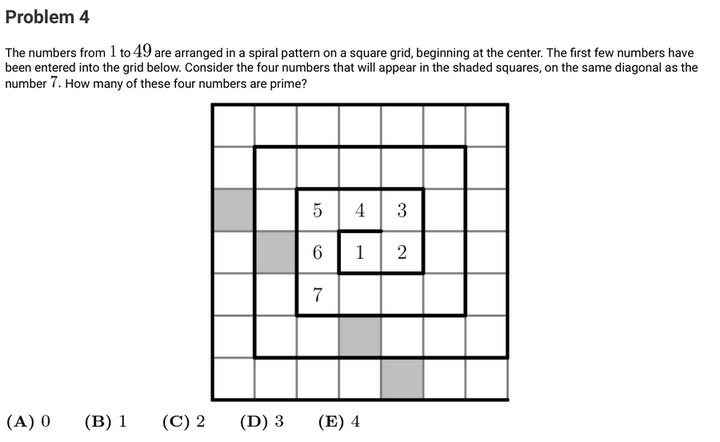
Forget the spiral pattern — what matters is which numbers end up on those four squares.
Still stuck? Show hint 2 →
Hint 2 of 2
Find the four shaded numbers first (they sit on the diagonal through 7), then test each one for being prime.
Show solution
Approach: fill in the diagonal, then test each for primeness
Continuing the spiral outward, the diagonal through 7 (going up-left and down-right) contains the four shaded numbers 19, 23, 39, 47.
Test each: 19 prime, 23 prime, 47 prime; but 39 = 3 × 13 is composite.
So 3 of the four shaded numbers are prime.
Another way — use perfect squares as landmarks (MAA):
Without filling the whole grid: on an n×n spiral the number n2 sits in the upper-left (n even) or lower-right (n odd) corner. So 9 is at lower-right of the 3×3 block, 25 at lower-right of 5×5, 49 at lower-right of 7×7; 16 at upper-left of 4×4, 36 at upper-left of 6×6.
Walking outward from those anchors locates the four shaded squares as 19, 23, 39, 47 — with 39 = 3 × 13 the only composite.
Eleven members of the Middle School Math Club each paid the same integer amount for a guest speaker to talk about problem solving at their math club meeting. In all, they paid their guest speaker $1A2. What is the missing digit A of this 3-digit number?
Show answer
Answer: D — A = 3.
Show hints
Hint 1 of 2
The total is 11 × (integer), so 1A2 must be divisible by 11.
Still stuck? Show hint 2 →
Hint 2 of 2
Divisibility rule for 11: alternating sum of digits must be a multiple of 11.
Show solution
Approach: divisibility test for 11
1A2 divisible by 11 ⇒ alternating sum 1 − A + 2 = 3 − A is a multiple of 11.
Single digit A ∈ {0, …, 9}: only A = 3 works (giving 0).
Danica wants to arrange her model cars in rows with exactly 6 cars in each row. She now has 23 model cars. What is the smallest number of additional cars she must buy in order to be able to arrange all her cars this way?
The year 2002 is a palindrome (a number that reads the same from left to right as it does from right to left). What is the product of the digits of the next year after 2002 that is a palindrome?
Show answer
Answer: B — 4.
Show hints
Hint 1 of 2
Keep the thousands digit at 2, so the next palindrome looks like 2 _ _ 2.
Still stuck? Show hint 2 →
Hint 2 of 2
For that to mirror, the two middle digits must be equal — make them as small as you can while passing 2002.
Show solution
Approach: build the next palindrome from the outside in
Don't change the leading 2, so the year stays of the form 2 _ _ 2 with equal middle digits.
The smallest such year after 2002 is 2112, whose digit product is 2 × 1 × 1 × 2 = 4.
Consider all positive four-digit integers whose digits are all even. What fraction of these integers are divisible by 4?
Show answer
Answer: D — 3/5.
Show hints
Hint 1 of 2
Divisibility by 4 depends only on the last two digits.
Still stuck? Show hint 2 →
Hint 2 of 2
With an even tens digit, the tens part is already a multiple of 4, so only the units digit decides it.
Show solution
Approach: reduce divisibility by 4 to the units digit
A number is divisible by 4 exactly when its last two digits are. With an even tens digit, 10·(tens) is already a multiple of 4, so it comes down to the units digit being 0, 4, or 8.
That's 3 of the 5 even units digits, and it holds for every choice of the other digits, so the fraction is 3/5.
Five distinct integers from 1 to 10 are chosen, and five distinct integers from 11 to 20 are chosen. No two numbers differ by exactly 10. What is the sum of the ten chosen numbers?
Show answer
Answer: C — 105.
Show hints
Hint 1 of 2
Each chosen low number blocks exactly one high number. How many highs are left to choose from?
Still stuck? Show hint 2 →
Hint 2 of 2
Five chosen lows block five highs — leaving exactly five unblocked highs, which are forced to be picked. They're the highs matching the unchosen lows + 10.
Show solution
Approach: the high choices are forced, and pair with the unchosen lows
Each chosen low (say x) blocks the high x + 10. With 5 lows chosen, 5 highs are blocked — so the 5 chosen highs are exactly the 5 unblocked ones: those that are 10 more than the 5 unchosen lows.
Sum of chosen highs = (sum of unchosen lows) + 5 × 10. So (chosen lows) + (chosen highs) = (chosen lows) + (unchosen lows) + 50 = (sum of 1 to 10) + 50.
1 + 2 + … + 10 = 55, so the total is 55 + 50 = 105.
Number Theorycomplementary-countingcareful-counting
Nicolas is planning to send a package to his friend Anton, who is a stamp collector. To pay for the postage, Nicolas would like to cover the package with a large number of stamps. Suppose he has a collection of 5-cent, 10-cent, and 25-cent stamps, with exactly 20 of each type. What is the greatest number of stamps Nicolas can use to make exactly $7.10 in postage?
Show answer
Answer: E — 55 stamps.
Show hints
Hint 1 of 2
Maximizing stamps used = minimizing stamps removed from his whole collection. What does the whole collection total?
Still stuck? Show hint 2 →
Hint 2 of 2
Total of all 60 stamps = $8. He needs to remove $0.90. Minimize the number of stamps that sum to $0.90.
Show solution
Approach: minimize stamps removed, not maximize stamps used
Total value of all 60 stamps: 20·($0.05 + $0.10 + $0.25) = 20 · $0.40 = $8.00.
He needs to make $7.10, so he removes $8.00 − $7.10 = $0.90 worth. Maximizing stamps used ≡ minimizing stamps removed.
Minimum stamps summing to $0.90: three 25¢ (75¢) + one 10¢ + one 5¢ = $0.90 in 5 stamps.
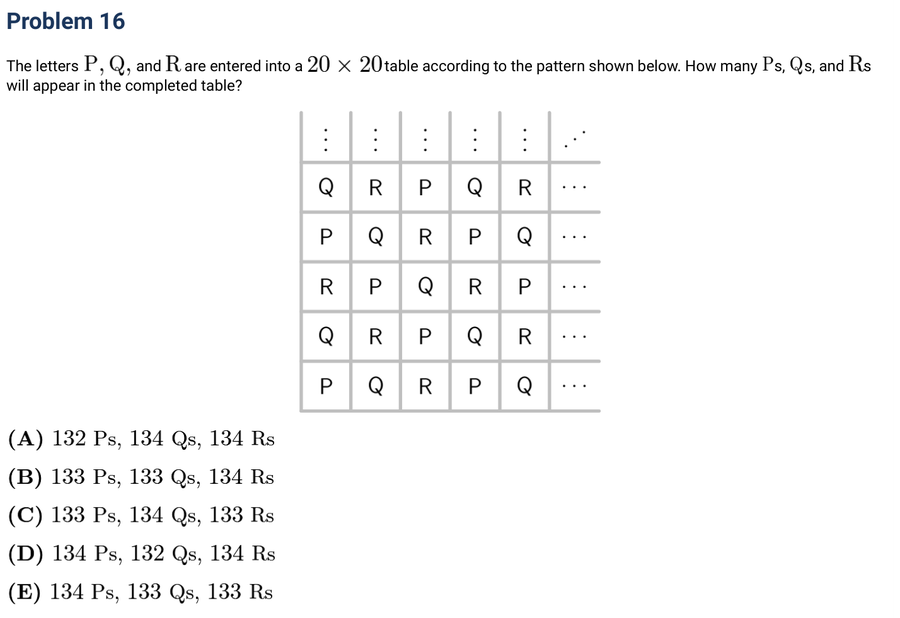
20 × 20 = 400 cells, with the letters cycling P, Q, R. How does 400 split among three letters?
Still stuck? Show hint 2 →
Hint 2 of 2
400 = 3 × 133 + 1, so one letter gets the extra 1. By the table's diagonals, P-count = R-count — so Q takes the extra.
Show solution
Approach: 400 cells split into thirds, with one letter winning the remainder
The board has 20 × 20 = 400 cells, and the P/Q/R pattern repeats every 3 cells diagonally. 400 = 3 × 133 + 1, so the counts are 133, 133, 134 in some order.
Look at the lower-left 2 × 2 corner of the pattern: Q R / P Q — one P, two Qs, one R. By the rest of the board's symmetry (P and R balance), the corner's extra Q is the surplus.
Greta Grasshopper sits on a long line of lily pads in a pond. From any lily pad, Greta can jump 5 pads to the right or 3 pads to the left. What is the fewest number of jumps Greta must make to reach the lily pad located 2023 pads to the right of her starting position?
Show answer
Answer: D — 411 jumps.
Show hints
Hint 1 of 2
Order doesn't matter — only the counts of right and left jumps. Set up an equation in R and L.
Still stuck? Show hint 2 →
Hint 2 of 2
5R − 3L = 2023. Need R ≥ 405 and 5R − 2023 divisible by 3.
Show solution
Approach: count-only equation, then mod constraint
Order doesn't matter. Let R = right jumps, L = left jumps. Then 5R − 3L = 2023, with R, L ≥ 0.
Minimum R: R ≥ 405 (else 5R < 2023, leaving negative L). And 5R − 2023 must be divisible by 3.
Mod 3: 5R ≡ 2R, and 2023 ≡ 1, so 2R ≡ 1 ⇒ R ≡ 2 (mod 3). The smallest R ≥ 405 satisfying this is 407.
Then L = (5·407 − 2023)/3 = 12/3 = 4. Total: 407 + 4 = 411 jumps.
If n is an even positive integer, the double-factorial notation n!! represents the product of all the even integers from 2 to n. For example: 8!! = 2 × 4 × 6 × 8. What is the units digit of the following sum?
2!! + 4!! + 6!! + … + 2022!!
Show answer
Answer: B — Units digit 2.
Show hints
Hint 1 of 2
Once a double-factorial includes 10 as a factor, it ends in 0. Which terms in the sum still affect the ones digit?
Still stuck? Show hint 2 →
Hint 2 of 2
Only 2!!, 4!!, 6!!, 8!! contribute — everything from 10!! onward ends in 0.
Show solution
Approach: drop the 10!!-and-up terms (they end in 0)
n!! for n ≥ 10 contains the factor 10, so its units digit is 0.
Compute only the survivors: 2!! = 2, 4!! = 8, 6!! = 48, 8!! = 384. Their units digits: 2, 8, 8, 4.
Sum of units digits: 2 + 8 + 8 + 4 = 22. Units digit: 2.
For a positive integer n, the factorial notation n! represents the product of the integers from n to 1. For example: 6! = 6 × 5 × 4 × 3 × 2 × 1. What value of N satisfies the following equation?
5! × 9! = 12 × N!
Show answer
Answer: A — N = 10.
Show hints
Hint 1 of 2
Compute 5! — can you factor 12 out of it neatly?
Still stuck? Show hint 2 →
Hint 2 of 2
5! = 120 = 12 × 10. So the equation becomes 12 × 10 × 9! = 12 × N!.
A number is called flippy if its digits alternate between two distinct digits. For example, 2020 and 37373 are flippy, but 3883 and 123123 are not. How many five-digit flippy numbers are divisible by 15?
Show answer
Answer: B — 4 numbers.
Show hints
Hint 1 of 2
Divisible by 15 = divisible by 5 AND by 3. The last digit must be 0 or 5; since the number is 5 digits, the first digit can't be 0.
Still stuck? Show hint 2 →
Hint 2 of 2
Five-digit flippy: pattern ababa. a ≠ 0 and ends in a, so a = 5. Digit sum = 15 + 2b ⇒ b ∈ {0, 3, 6, 9}.
Show solution
Approach: decompose div-by-15 into 5 and 3
5-digit flippy: ababa with a ≠ b and a ≠ 0.
Div by 5 ⇒ last digit (= a) is 0 or 5. Since a ≠ 0, a = 5.
Number is 5b5b5. Div by 3 ⇒ digit sum 15 + 2b div by 3 ⇒ b div by 3, so b ∈ {0, 3, 6, 9} (and all are ≠ 5).
A palindrome is a number that has the same value when read from left to right or from right to left. (For example, 12321 is a palindrome.) Let N be the least three-digit integer which is not a palindrome but which is the sum of three distinct two-digit palindromes. What is the sum of the digits of N?
Show answer
Answer: A — 2.
Show hints
Hint 1 of 2
Two-digit palindromes (11, 22, 33, …) are all multiples of 11 — so any sum of three of them is a multiple of 11.
Still stuck? Show hint 2 →
Hint 2 of 2
Find the smallest 3-digit multiple of 11 that isn't itself a palindrome. Can it be written as a sum of three distinct 2-digit palindromes?
Show solution
Approach: two-digit palindromes are multiples of 11
Two-digit palindromes (11, 22, …, 99) are all multiples of 11; their sum is too. So N is a multiple of 11.
Smallest 3-digit multiple of 11 that's NOT a palindrome: 110 (palindromes are 121, 131, … — 110 isn't one).
Isabella has 6 coupons that can be redeemed for free ice cream cones at Pete's Sweet Treats. In order to make the coupons last, she decides that she will redeem one every 10 days until she has used them all. She knows that Pete's is closed on Sundays, but as she circles the 6 dates on her calendar, she realizes that no circled date falls on a Sunday. On what day of the week does Isabella redeem her first coupon?
Show answer
Answer: C — Wednesday.
Show hints
Hint 1 of 2
10 days ≡ 3 days mod 7. So the 6 redemption days are at day-of-week offsets 0, 3, 6, 2, 5, 1 from the starting day.
Still stuck? Show hint 2 →
Hint 2 of 2
Those 6 offsets cover 6 of 7 days — missing only offset 4. Sunday must be that missing day, so the start = Sunday − 4 days = Wednesday.
Show solution
Approach: compute the 6 days mod 7, find the missing one
10 days advances the day-of-week by 10 mod 7 = 3 days. So the six redemption days have day-of-week offsets {0, 3, 6, 2, 5, 1} mod 7 from the start.
These 6 offsets cover everything except offset 4. Sunday must be that missing offset, so start day is Sunday − 4 days.
Laila took five math tests, each worth a maximum of 100 points. Laila's score on each test was an integer between 0 and 100, inclusive. Laila received the same score on the first four tests, and she received a higher score on the last test. Her average score on the five tests was 82. How many values are possible for Laila's score on the last test?
Show answer
Answer: A — 4 values.
Show hints
Hint 1 of 2
Set 4f + l = 410, with f < l ≤ 100. Get bounds on l first.
Still stuck? Show hint 2 →
Hint 2 of 2
Since 4f is divisible by 4 and 410 ≡ 2 (mod 4), we need l ≡ 2 (mod 4).
Show solution
Approach: modular constraint + range
Average 82 over 5 tests ⇒ total = 410. Let f = first-four score, l = last. Then 4f + l = 410 with f < l ≤ 100.
l > 82 (else 4f + l would need f ≥ l).
Mod 4: 4f ≡ 0, 410 ≡ 2 ⇒ l ≡ 2 (mod 4). In (82, 100]: l ∈ {86, 90, 94, 98}.
The smallest positive integer greater than 1 that leaves a remainder of 1 when divided by 4, 5, and 6 lies between which of the following pairs of numbers?
Show answer
Answer: D — Between 60 and 79.
Show hint
Hint 1
Same remainder mod 4, 5, AND 6 means n − 1 is divisible by all three. So n − 1 = lcm(4, 5, 6).
Show solution
Approach: lcm shift
n − 1 is divisible by 4, 5, and 6, so by lcm(4, 5, 6) = 60.
Smallest n > 1: n = 61, which lies between 60 and 79.
For any positive integer M, the notation M! denotes the product of the integers 1 through M. What is the largest integer n for which 5n is a factor of the sum
98! + 99! + 100! ?
Show answer
Answer: D — 26.
Show hints
Hint 1 of 2
Factor out 98! from all three terms. The leftover is a clean number.
Still stuck? Show hint 2 →
Hint 2 of 2
98! + 99! + 100! = 98!(1 + 99 + 99·100) = 98! · 10,000. Count factors of 5 in each piece.
Determine how many two-digit numbers satisfy the following property: when the number is added to the number obtained by reversing its digits, the sum is 132.
Show answer
Answer: B — 7 numbers.
Show hints
Hint 1 of 2
Two-digit + reversed = (10a + b) + (10b + a) = 11(a + b). So a + b = 12.
Still stuck? Show hint 2 →
Hint 2 of 2
Count digit pairs (a, b) with a + b = 12, a ∈ {1, …, 9}, b ∈ {0, …, 9}.
Show solution
Approach: factor out 11 from the sum
(10a + b) + (10b + a) = 11(a + b) = 132 ⇒ a + b = 12.
Valid pairs with a from 1–9 and b from 0–9: (3,9), (4,8), (5,7), (6,6), (7,5), (8,4), (9,3).
The least common multiple of a and b is 12, and the least common multiple of b and c is 15. What is the least possible value of the least common multiple of a and c?
Show answer
Answer: A — 20.
Show hints
Hint 1 of 2
b divides both lcms — so b divides gcd(12, 15) = 3. Try b = 3.
Still stuck? Show hint 2 →
Hint 2 of 2
Then minimize a and c: smallest a giving lcm(a, 3) = 12 is 4, and smallest c giving lcm(c, 3) = 15 is 5.
Show solution
Approach: constrain b, then minimize a and c
b must divide both 12 and 15, so b | gcd(12, 15) = 3.
Take b = 3. Then smallest a with lcm(a, 3) = 12 is a = 4. Smallest c with lcm(c, 3) = 15 is c = 5.
On June 1, a group of students is standing in rows, with 15 students in each row. On June 2, the same group is standing with all of the students in one long row. On June 3, the same group is standing with just one student in each row. On June 4, the same group is standing with 6 students in each row. This process continues through June 12 with a different number of students per row each day. However, on June 13, they cannot find a new way of organizing the students. What is the smallest possible number of students in the group?
Show answer
Answer: C — 60 students.
Show hints
Hint 1 of 2
Each day's row count is a divisor of n, all different. Twelve days ⇒ n has at least 12 divisors.
Still stuck? Show hint 2 →
Hint 2 of 2
n is divisible by both 15 and 6, so by lcm(6, 15) = 30. Smallest multiple of 30 with exactly 12 divisors?
Show solution
Approach: translate to a divisor-counting problem
Each day's number of students per row is a divisor of n, and all 12 are different ⇒ n has exactly 12 divisors (no 13th option exists).
n is a multiple of 15 and 6, hence of lcm(6, 15) = 30 = 2 · 3 · 5. That has only (1+1)(1+1)(1+1) = 8 divisors.
Double one prime exponent to get 12: 22 · 3 · 5 = 60 has (2+1)(1+1)(1+1) = 12 divisors. The other options (32·2·5 = 90, 2·3·52=150) are larger.
A baseball league consists of two four-team divisions. Each team plays every other team in its division N games. Each team plays every team in the other division M games with N > 2M and M > 4. Each team plays a 76 game schedule. How many games does a team play within its own division?
Show answer
Answer: B — 48 games.
Show hints
Hint 1 of 2
A team faces 3 division rivals (N games each) and 4 outside teams (M games each): 3N + 4M = 76.
Still stuck? Show hint 2 →
Hint 2 of 2
Use the bounds M > 4 and N > 2M; also 4M ≡ 76 (mod 3) forces a residue on M.
Show solution
Approach: diophantine equation with inequalities
3N + 4M = 76.
Mod 3: 4M ≡ 76 ⇒ M ≡ 1 (mod 3). So M ∈ {7, 10, 13, …}.
N > 2M ⇒ 76 = 3N + 4M > 10M ⇒ M < 7.6.
Combining M > 4 and M < 7.6 and M ≡ 1 (mod 3): M = 7. Then N = (76 − 28)/3 = 16.
The positive integers x and y are the two smallest positive integers for which the product of 360 and x is a square and the product of 360 and y is a cube. What is the sum of x and y?
Show answer
Answer: B — 85.
Show hint
Hint 1
Prime-factor 360 = 23 · 32 · 5. Make every exponent even (square) or a multiple of 3 (cube).
Show solution
Approach: fix exponents to the right parity / multiple of 3
360 = 23 · 32 · 51.
Square: bump 2's exponent to 4 and 5's to 2 ⇒ multiply by 2 · 5 = 10. So x = 10.
Cube: bump 2's to 3 (already), 3's to 3 (add one 3), 5's to 3 (add two 5s) ⇒ multiply by 3 · 25 = 75. So y = 75.
Barry wrote 6 different numbers, one on each side of 3 cards, and laid the cards on a table, as shown. The sums of the two numbers on each of the three cards are equal. The three numbers on the hidden sides are prime numbers. What is the average of the hidden prime numbers? (Visible sides: 44, 59, 38.)
Show answer
Answer: B — 14.
Show hints
Hint 1 of 2
Even-visible cards (44, 38) need an odd prime to make an odd sum; the 59 card needs an even prime to make an odd sum. Equal sums ⇒ the 59 card pairs with the only even prime, 2.
Still stuck? Show hint 2 →
Hint 2 of 2
Common sum = 59 + 2 = 61.
Show solution
Approach: parity forces 2 behind 59
Sum behind 59 + 59 = 61 (odd) only if hidden is even ⇒ hidden = 2 (only even prime).
Alice and Bob play a game involving a circle whose circumference is divided by 12 equally-spaced points. The points are numbered clockwise, from 1 to 12. Both start on point 12. Alice moves clockwise and Bob, counterclockwise. In a turn of the game, Alice moves 5 points clockwise and Bob moves 9 points counterclockwise. The game ends when they stop on the same point. How many turns will this take?
Show answer
Answer: A — 6 turns.
Show hint
Hint 1
After k turns, Alice is at +5k and Bob is at −9k (mod 12). They coincide when 5k ≡ −9k (mod 12) ⇒ 14k ≡ 0 (mod 12).
Each of the letters W, X, Y, and Z represents a different integer in the set {1, 2, 3, 4}, but not necessarily in that order. If WX − YZ = 1, then the sum of W and Y is
Show answer
Answer: E — 7.
Show hints
Hint 1 of 2
For the difference to be exactly the whole number 1, each fraction should itself be a whole number.
Still stuck? Show hint 2 →
Hint 2 of 2
Try making one fraction 3/1 and the other 4/2.
Show solution
Approach: make both fractions whole numbers
To get a difference of exactly 1, both fractions should be integers: 3/1 = 3 and 4/2 = 2 work, since 3 − 2 = 1.
A lucky year is one in which at least one date, written as month/day/year, has the property that the month times the day equals the last two digits of the year. For example, 1956 is lucky because 7/8/56 has 7 × 8 = 56. Which of the following is NOT a lucky year?
Show answer
Answer: E — 1994.
Show hints
Hint 1 of 2
For each year, try to write its last two digits as month × day with a valid month (1–12) and day.
Still stuck? Show hint 2 →
Hint 2 of 2
94 has very few factor pairs.
Show solution
Approach: look for a valid month × day factor pair
90 = 9 × 10, 91 = 7 × 13, 92 = 4 × 23, 93 = 3 × 31 — all have a month from 1–12 with a real day.
But 94 = 2 × 47 only (besides 1 × 94), and no month 1–12 pairs with a valid day, so 1994 is not lucky.
When placing each of the digits 2, 4, 5, 6, 9 in exactly one of the boxes of this subtraction problem, what is the smallest difference that is possible?
−
Show answer
Answer: C — 149.
Show hints
Hint 1 of 2
To minimize the difference, make the 3-digit number as small as you can and the 2-digit number as large as you can.
Still stuck? Show hint 2 →
Hint 2 of 2
Pick the smallest hundreds digit first, then build each number from the digits you have left.
Show solution
Approach: smallest 3-digit minus largest 2-digit
Smallest 3-digit using three of {2, 4, 5, 6, 9}: lead with 2, then take the next two smallest ascending → 245.
Largest 2-digit from the remaining {6, 9} is 96. Difference: 245 − 96 = 149.
In a certain year, January had exactly four Tuesdays and four Saturdays. On what day did January 1 fall that year?
Show answer
Answer: C — Wednesday.
Show hints
Hint 1 of 2
31 days = 4 weeks + 3 days. Three weekdays appear 5 times, the other four appear 4 times.
Still stuck? Show hint 2 →
Hint 2 of 2
For Tuesday and Saturday both to land at 4 times, neither can be among the first 3 days of the month.
Show solution
Approach: find which start makes Tue and Sat both rare
The three weekdays starting on Jan 1 each appear 5 times in a 31-day January. For Tue and Sat both to appear only 4 times, neither can be in those first three weekdays.
Only starting on Wednesday (Wed, Thu, Fri) leaves both Tue and Sat out of that group.
Sekou writes down the numbers 15, 16, 17, 18, 19. After he erases one of his numbers, the sum of the remaining four numbers is a multiple of 4. Which number did he erase?
Show answer
Answer: C — 17.
Show hints
Hint 1 of 2
Adding the five up and testing each removal is slow. What does each number have in common with 4?
Still stuck? Show hint 2 →
Hint 2 of 2
Look at each number's remainder when divided by 4. The remainder of the whole sum tells you which one to erase.
Show solution
Approach: look at remainders mod 4
Remainders mod 4: 15→3, 16→0, 17→1, 18→2, 19→3. Their sum is 9, which leaves remainder 1 mod 4.
To make the remaining four sum divisible by 4, erase the one whose remainder is 1 — that's 17.
All of the marbles in Maria's collection are red, green, or blue. Maria has half as many red marbles as green marbles and twice as many blue marbles as green marbles. Which of the following could be the total number of marbles in Maria's collection?
Show answer
Answer: E — 28 marbles.
Show hints
Hint 1 of 2
Pick one color to stand for a variable, then write the others in terms of it. The total reveals a hidden factor.
Still stuck? Show hint 2 →
Hint 2 of 2
Let r = red count. Green = 2r, blue = 4r. Total = 7r — it must be a multiple of 7.
Show solution
Approach: find the hidden multiple
Let r be the number of red marbles. Half as many red as green → green = 2r. Twice as many blue as green → blue = 4r.
Total = r + 2r + 4r = 7r — always a multiple of 7.
Among the choices, only 28 = 7 × 4 is a multiple of 7.
Let Z be a 6-digit positive integer, such as 247247, whose first three digits are the same as its last three digits taken in the same order. Which of the following numbers must also be a factor of Z?
Show answer
Answer: A — 11.
Show hint
Hint 1
Write Z = abcabc as a multiple of abc. The multiplier factors into nice primes.
Show solution
Approach: abcabc = 1001 · abc
Z = abcabc = abc · 1001.
1001 = 7 · 11 · 13. So 11 is always a factor of Z.
Malcolm wants to visit Isabella after school today and knows the street where she lives but doesn't know her house number. She tells him, "My house number has two digits, and exactly three of the following four statements about it are true."
It is prime.
It is even.
It is divisible by 7.
One of its digits is 9.
This information allows Malcolm to determine Isabella's house number. What is its units digit?
Show answer
Answer: D — 8.
Show hints
Hint 1 of 2
Which two statements can't both be true together?
Still stuck? Show hint 2 →
Hint 2 of 2
A 2-digit number can't be both even and prime (the only even prime is 2). So either (1) or (2) is false — and since 3 of 4 are true, the false one must be (1) "prime".
Show solution
Approach: find the contradiction, then narrow
(1) prime and (2) even can't both be true for a 2-digit number (the only even prime is 2). So the false statement is (1), making (2), (3), (4) all true: the number is even, div by 7, and has a 9 as a digit.
Even + divisible by 7 ⇒ divisible by 14. Two-digit multiples of 14: 14, 28, 42, 56, 70, 84, 98. Only 98 has a 9 digit.
All of Marcy's marbles are blue, red, green, or yellow. One third of her marbles are blue, one fourth of them are red, and six of them are green. What is the smallest number of yellow marbles that Marcy could have?
Show answer
Answer: D — 4 yellow marbles.
Show hints
Hint 1 of 2
The total must be divisible by both 3 and 4 — so by 12. Try 12 first; if it fails, try 24.
Still stuck? Show hint 2 →
Hint 2 of 2
12 total: 4 blue + 3 red + 6 green = 13 > 12. Doesn't work. Try 24.
Show solution
Approach: smallest total divisible by lcm(3, 4)
Total must be a multiple of 12 (so that 1/3 and 1/4 are integers).
Try 12: blue = 4, red = 3, green = 6 ⇒ total already 13 > 12. Doesn't fit.
Try 24: blue = 8, red = 6, green = 6 ⇒ yellow = 24 − 8 − 6 − 6 = 4.
Number Theoryplace-value-differencedivisibility-by-9
When Clara totaled her scores, she inadvertently reversed the units digit and the tens digit of one score. By which of the following might her incorrect sum have differed from the correct one?
Show answer
Answer: A — 45.
Show hint
Hint 1
If a score's last two digits are 10a + b, reversing gives 10b + a. The difference is 9(a − b): always a multiple of 9.
Show solution
Approach: swap creates a multiple of 9 difference
(10a + b) − (10b + a) = 9(a − b).
The sum's error must therefore be a multiple of 9.
Jamar bought some pencils costing more than a penny each at the school bookstore and paid $1.43. Sharona bought some of the same pencils and paid $1.87. How many more pencils did Sharona buy than Jamar?
Show answer
Answer: C — 4 more pencils.
Show hint
Hint 1
Working in cents: the price (in cents) divides both 143 and 187. Take their gcd; since price > 1 cent, only one option survives.
The Amaco Middle School bookstore sells pencils costing a whole number of cents. Some seventh graders each bought a pencil, paying a total of $1.43. Some of the 30 sixth graders each bought a pencil, and they paid a total of $1.95. How many more sixth graders than seventh graders bought a pencil?
Show answer
Answer: D — 4 more.
Show hint
Hint 1
Working in cents, the price divides both 143 and 195. Compute gcd(143, 195).
In Theresa's first 8 basketball games, she scored 7, 4, 3, 6, 8, 3, 1 and 5 points. In her ninth game, she scored fewer than 10 points and her points-per-game average for the nine games was an integer. Similarly in her tenth game, she scored fewer than 10 points and her points-per-game average for the 10 games was also an integer. What is the product of the number of points she scored in the ninth and tenth games?
Show answer
Answer: B — 40.
Show hints
Hint 1 of 2
Sum of first 8: 37. After game 9 (score < 10), total is between 37 and 47; must be a multiple of 9 (mean integer).
Still stuck? Show hint 2 →
Hint 2 of 2
Then after game 10 the total is < 56 and a multiple of 10.
Show solution
Approach: fit each total to the divisibility condition
Sum after 8: 37.
After 9: total in [38, 47], divisible by 9 ⇒ 45. Game 9 = 8.
After 10: total in [46, 55], divisible by 10 ⇒ 50. Game 10 = 5.
The product of the two 99-digit numbers 303,030,303,…,030,303 and 505,050,505,…,050,505 has thousands digit A and units digit B. What is the sum of A and B?
Show answer
Answer: D — 8.
Show hint
Hint 1
The last 4 digits of each factor are 0303 and 0505. Multiply those mod 10000.
Show solution
Approach: compute the last four digits
303 · 505 = 153015.
Last 4 digits: 3015 ⇒ thousands digit A = 3, units digit B = 5.
A box contains gold coins. If the coins are equally divided among six people, four coins are left over. If the coins are equally divided among five people, three coins are left over. If the box holds the smallest number of coins that meets these two conditions, how many coins are left when equally divided among seven people?
Show answer
Answer: A — 0.
Show hint
Hint 1
List numbers ≡ 4 (mod 6) and find the first one that's also ≡ 3 (mod 5).
A whole number larger than 2 leaves a remainder of 2 when divided by each of the numbers 3, 4, 5, and 6. The smallest such number lies between which two numbers?
The number 64 has the property that it is divisible by its units digit. How many whole numbers between 10 and 50 have this property?
Show answer
Answer: C — 17.
Show hints
Hint 1 of 2
Group the numbers by their units digit and test divisibility.
Still stuck? Show hint 2 →
Hint 2 of 2
Units digit 1, 2, or 5 always works; 0 never does (no division by 0).
Show solution
Approach: casework on the units digit
Units digit 1, 2, and 5 each give 4 working numbers (12 total). Then 33 (digit 3), 24 and 44 (digit 4), 36 (digit 6), and 48 (digit 8) work; digits 0, 7, 9 give none.
Brent has goldfish that quadruple (become four times as many) every month, and Gretel has goldfish that double every month. If Brent has 4 goldfish at the same time that Gretel has 128 goldfish, in how many months from that time will they have the same number of goldfish?
Show answer
Answer: B — 5 months.
Show hints
Hint 1 of 2
Write both counts as powers of 2 and match the exponents.
Still stuck? Show hint 2 →
Hint 2 of 2
Brent: 4 · 4^m; Gretel: 128 · 2^m.
Show solution
Approach: equate powers of 2
After m months Brent has 4 · 4^m = 2^(2m+2) and Gretel has 128 · 2^m = 2^(m+7).
What is the smallest sum of two 3-digit numbers that can be obtained by placing each of the six digits 4, 5, 6, 7, 8, 9 in one of the six boxes in this addition problem?
+
Show answer
Answer: C — 1047.
Show hints
Hint 1 of 2
The hundreds digits matter most, so put the two smallest there.
Still stuck? Show hint 2 →
Hint 2 of 2
Then the next-smallest in the tens, and the largest in the units.
Show solution
Approach: small digits into the big place values
Put 4 and 5 in the hundreds (900), 6 and 7 in the tens (130), and 8 and 9 in the units (17).
The notation n! is the product of the first n positive integers. Define the superfactorial of n to be the product of the factorials 1! · 2! · 3! · … · n! (so the superfactorial of 3 is 1! · 2! · 3! = 12). How many factors of 7 appear in the prime factorization of the superfactorial of 51?
Show answer
Answer: E — 171.
Show hints
Hint 1 of 2
The 7-count of the superfactorial is the sum of the 7-counts of 1! through 51!.
Still stuck? Show hint 2 →
Hint 2 of 2
Each k! holds ⌊k/7⌋ + ⌊k/49⌋ sevens; group the values of k by that count.
Show solution
Approach: sum Legendre's 7-count over every factorial
The number of 7s is the sum of v₇(k!) for k = 1 to 51, where v₇(k!) = ⌊k/7⌋ + ⌊k/49⌋.
Seven values of k each contribute 1, 2, 3, 4, 5, and 6, totaling 7(1+2+3+4+5+6) = 147; and k = 49, 50, 51 contribute 8 each, adding 24.
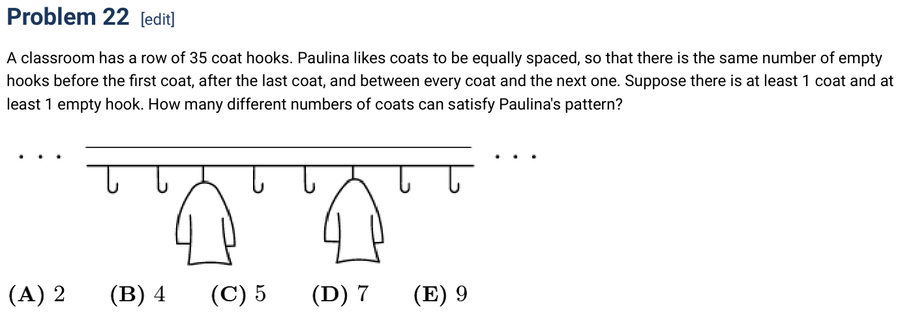
Imagine adding a phantom coat after the last one. Now the row is a clean repeating pattern.
Still stuck? Show hint 2 →
Hint 2 of 2
After the phantom, you have 36 hooks split into d identical blocks of b hooks each, with b ≥ 2 and d ≥ 2. How many (b, d) factorizations of 36 are there?
Show solution
Approach: add a phantom coat, count factor pairs
Add a phantom coat after the last real coat. Now 36 hooks form a perfectly repeating pattern: each block is (some empty hooks) + (one coat), of length b ≥ 2.
If there are d blocks, then bd = 36, and the real coat count = d − 1 (we added one).
Both b ≥ 2 (each block has ≥ 1 empty + 1 coat) and d ≥ 2 (at least 1 original coat + the phantom).
36 = 22 × 32 has (2+1)(2+1) = 9 divisors. Removing the two ordered factorizations with a 1 (1×36 and 36×1) leaves 9 − 2 = 7.
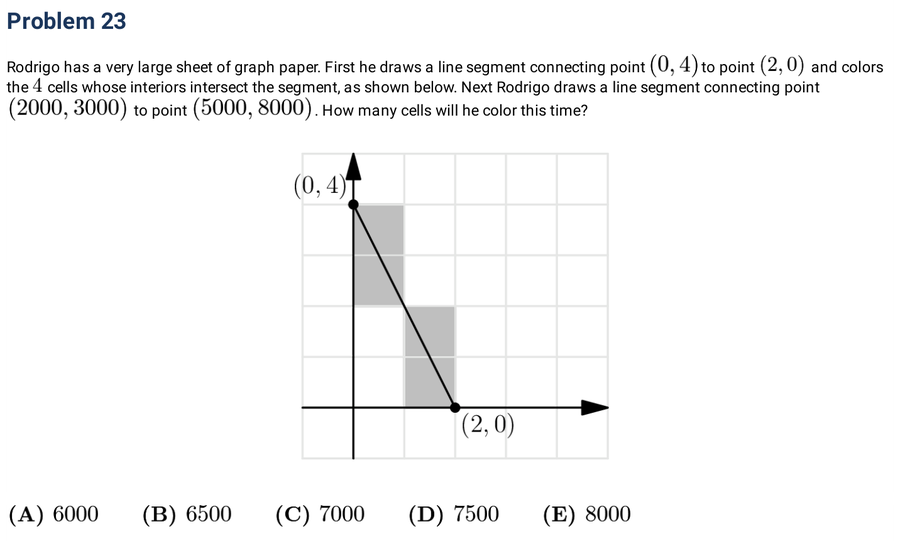
The example (0,4) to (2,0) crosses 4 cells. Notice: 2 + 4 − gcd(2,4) = 4. That's a general formula.
Still stuck? Show hint 2 →
Hint 2 of 2
Apply the formula to (3000, 5000) horizontal/vertical offsets: 3000 + 5000 − gcd(3000, 5000).
Show solution
Approach: use the lattice-line cell-count formula
A line segment whose horizontal offset is a and vertical offset is b crosses a + b − gcd(a, b) grid cells. (You'd cross a + b cells if the line never hit a grid corner; each lattice-point crossing collapses two cell-entries into one, saving 1 per shared factor.)
From (2000, 3000) to (5000, 8000): horizontal offset 3000, vertical offset 5000.
The slope from (2000, 3000) to (5000, 8000) is 5/3. The segment is equivalent to 1000 copies of a primitive (0,0)→(3,5) piece, since gcd(3000, 5000) = 1000.
In a sequence of positive integers, each term after the second is the product of the previous two terms. The sixth term in the sequence is 4000. What is the first term?
Show answer
Answer: D — 5.
Show hints
Hint 1 of 2
Write the first six terms as a, b, and powers of a and b. The 6th term will be a3b5.
Still stuck? Show hint 2 →
Hint 2 of 2
Factor 4000: 4000 = 53 × 25. Match exponents.
Show solution
Approach: track exponents of a and b through the sequence
Let the first two terms be a, b. Then the next four are ab, ab2, a2b3, a3b5. (Each term sums the exponents of the previous two.)
When a positive integer N is fed into a machine, the output is calculated by the rule: if N is even, output N/2; if N is odd, output 3N + 1. Example: 7 → 22 → 11 → 34 → 17 → 52 → 26. When the same 6-step process is applied to a different starting N, the final output is 1. What is the sum of all such integers N?
Show answer
Answer: E — Sum is 83.
Show hints
Hint 1 of 2
Work backward from 1. The predecessors of any k are: 2k (always), and (k − 1)/3 (only if that's an odd integer).
Still stuck? Show hint 2 →
Hint 2 of 2
Build the inverse-tree six levels up from 1. The level-6 leaves are the valid starting values.
Show solution
Approach: invert the machine, walk backward 6 steps from 1
Forward: even → halve, odd → 3n+1. Inverting from a value k: predecessors are 2k (always), and (k−1)/3 (only if that's an odd integer).
How many positive three-digit integers have a remainder of 2 when divided by 6, a remainder of 5 when divided by 9, and a remainder of 7 when divided by 11?
Show answer
Answer: E — 5 integers.
Show hints
Hint 1 of 2
Each remainder is exactly 4 less than the divisor (2 = 6−4, 5 = 9−4, 7 = 11−4). So x ≡ −4 mod each of them.
Still stuck? Show hint 2 →
Hint 2 of 2
x + 4 is divisible by lcm(6, 9, 11) = 198. Count multiples of 198 with x + 4 in [104, 1003].
Each day for four days, Linda traveled for one hour at a speed that resulted in her traveling one mile in an integer number of minutes. Each day after the first, her speed decreased so that the number of minutes to travel one mile increased by 5 minutes over the preceding day. Each of the four days, her distance traveled was also an integer number of miles. What was the total number of miles for the four trips?
Show answer
Answer: C — 25 miles.
Show hints
Hint 1 of 2
Each day's min-per-mile must divide 60 (so that 60 min yields an integer mile count). Find four divisors of 60 in arithmetic progression with common difference 5.
Still stuck? Show hint 2 →
Hint 2 of 2
Divisors of 60: 1, 2, 3, 4, 5, 6, 10, 12, 15, 20, 30, 60. The only arithmetic-progression-5 of length 4 is 5, 10, 15, 20.
Show solution
Approach: min-per-mile must divide 60
60 minutes total per day; for integer miles, the min-per-mile divides 60.
Four divisors of 60 forming an AP with common difference 5: 5, 10, 15, 20.
Miles each day: 60/5 + 60/10 + 60/15 + 60/20 = 12 + 6 + 4 + 3 = 25.
Mrs. Sanders has three grandchildren, who call her regularly. One calls her every three days, one calls her every four days, and one calls her every five days. All three called her on December 31, 2016. On how many days during the next year did she not receive a phone call from any of her grandchildren?
Show answer
Answer: D — 146 days.
Show hints
Hint 1 of 2
The pattern repeats every lcm(3, 4, 5) = 60 days. Count call-days in 60, then scale to 365 (with the leftover 5 days handled).
Still stuck? Show hint 2 →
Hint 2 of 2
Inclusion–exclusion in a 60-day block: 20 + 15 + 12 − 5 − 4 − 3 + 1 = 36 call days. So 60 − 36 = 24 no-call days.
Show solution
Approach: inclusion-exclusion over a 60-day cycle, then handle leftovers
lcm(3, 4, 5) = 60, so the call pattern repeats every 60 days. In one 60-day block:
The digits 1, 2, 3, 4, and 5 are each used once to write a five-digit number PQRST. The three-digit number PQR is divisible by 4, the three-digit number QRS is divisible by 5, and the three-digit number RST is divisible by 3. What is P?
Show answer
Answer: A — P = 1.
Show hints
Hint 1 of 2
QRS div by 5 means S ends in 0 or 5; the only digit available is 5. So S = 5.
Still stuck? Show hint 2 →
Hint 2 of 2
PQR div by 4 means QR is divisible by 4. With S = 5 used, QR is a 2-digit from {1, 2, 3, 4}. Options: 12, 24, 32.
Show solution
Approach: narrow each divisibility constraint in order
S = 5 (the only digit from {1,2,3,4,5} that makes QRS end in 0 or 5).
QR must be a 2-digit number from {1, 2, 3, 4} divisible by 4: {12, 24, 32}.
Test each. QR = 12: leftover {3, 4} for P, T. RST = 25T, digit sum 7 + T; T ∈ {3, 4} gives 10 or 11, neither div by 3.
QR = 24: leftover {1, 3}. RST = 45T, digit sum 9 + T; T = 3 gives 12 (div 3) ✓. So Q = 2, R = 4, T = 3, P = 1. Number: 12435.
QR = 32: leftover {1, 4}. RST = 25T sum 7 + T; T ∈ {1, 4} gives 8 or 11, neither div by 3.
There are 24 four-digit whole numbers that use each of the four digits 2, 4, 5, and 7 exactly once. Only one of these four-digit numbers is a multiple of another one. Which of the following is it?
Show answer
Answer: D — 7425.
Show hints
Hint 1 of 2
The multiple still uses the digits 2, 4, 5, 7, so it stays between 2457 and 7542.
Still stuck? Show hint 2 →
Hint 2 of 2
That keeps the factor tiny: 2457 × 4 is already too big, so test multiplying by 3.
Show solution
Approach: the only feasible factor is 3
Any such multiple uses the same four digits, so it lies between 2457 and 7542; since 2457 × 4 ≈ 9828 overshoots, the factor can only be 2 or 3.
No doubling of a number in the set lands back in the set, but 2475 × 3 = 7425, which uses exactly 2, 4, 5, 7.
A board of 8 columns has squares numbered left to right, top to bottom (row one is 1–8, row two is 9–16, and so on). A student shades square 1, then skips one and shades square 3, skips two and shades square 6, skips three and shades square 10, and continues this way until every column has at least one shaded square. What is the number of the shaded square that first achieves this?
Show answer
Answer: E — 120.
Show hints
Hint 1 of 2
The shaded squares are the triangular numbers 1, 3, 6, 10, 15, … .
Still stuck? Show hint 2 →
Hint 2 of 2
A square's column is set by its value mod 8 — you need all 8 remainders to appear.
Show solution
Approach: triangular numbers mod 8; wait for remainder 0
The shaded squares are triangular numbers, and a square's column depends on its value mod 8.
Every remainder shows up early except 0; the first triangular number divisible by 8 is 120, so the last column fills at square 120.
Some positive integers have both properties: (I) the sum of the squares of their digits is 50, and (II) each digit is larger than the one to its left. The product of the digits of the largest such integer is
Show answer
Answer: C — 36.
Show hints
Hint 1 of 2
The digits strictly increase, so they're distinct; squaring shows there can be at most four of them.
Still stuck? Show hint 2 →
Hint 2 of 2
To make the number large, push the leading digits up while keeping the square-sum at 50.
Show solution
Approach: bound the digit count, then maximize
Five increasing digits would have squares summing to at least 1+4+9+16+25 = 55 > 50, so at most four digits.
The digits 1, 2, 3, 6 give 1 + 4 + 9 + 36 = 50 and form the largest such number, 1236.
The figure below shows a triangular ‘staircase’ array of numbers. The first row has 1 number, the second row has 3, the third row has 5, and so on (the kth row has 2k−1 numbers, in order).
1
2 3 4
5 6 7 8 9
10 11 12 13 14 15 16
…
What number is directly above 142 in this array of numbers?
Show answer
Answer: C — 120.
Show hints
Hint 1 of 2
Row k ends at the perfect square k², and holds 2k − 1 numbers.
Still stuck? Show hint 2 →
Hint 2 of 2
Find which row holds 142, then the number sitting one row up and aligned with it.
Show solution
Approach: use the row structure of the triangle
Rows end at 1, 4, 9, 16, …, k², so 142 is in row 12 (122–144), as its 21st of 23 entries.
Row 11 (101–121) sits centered above, so directly above the 21st entry is the 20th entry of row 11: 101 + 19 = 120.
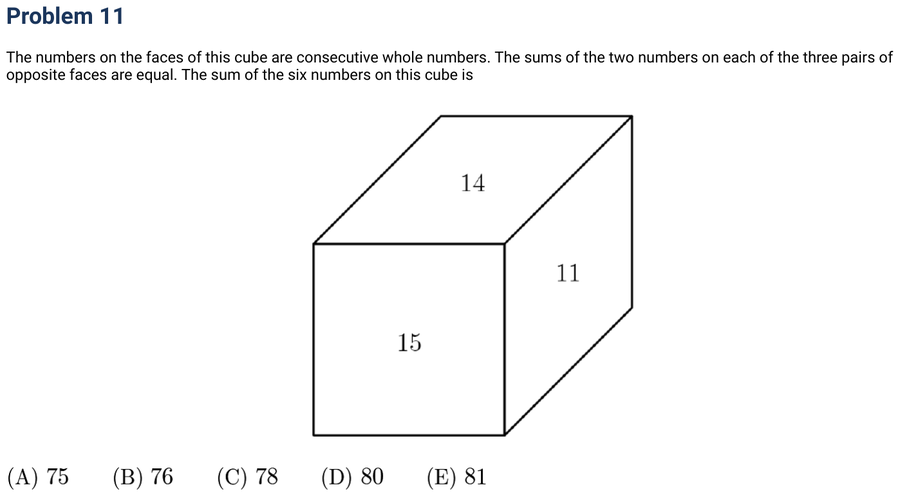
The six faces are six consecutive numbers including the visible 11, 14, 15.
Still stuck? Show hint 2 →
Hint 2 of 2
The visible faces meet at a corner, so they can't be opposite each other — that pins which six numbers.
Show solution
Approach: use the equal-opposite-sums to fix the six numbers
The visible 11, 14, 15 are mutually adjacent, so they aren't opposite pairs. The six consecutive numbers must be 11–16, pairing as 11+16, 12+15, 13+14 (each summing to 27).
Several students are seated at a large circular table. They pass around a bag of 100 pieces of candy. Each person takes one piece and passes the bag to the next person. If Chris takes the first and the last piece of candy, then the number of students at the table could be
Show answer
Answer: B — 11.
Show hints
Hint 1 of 2
Chris takes pieces 1, n+1, 2n+1, … where n is the number of students.
Still stuck? Show hint 2 →
Hint 2 of 2
Taking the 100th piece too means 99 is a multiple of n.
Show solution
Approach: the gap between Chris's pieces must divide 99
Chris takes the 1st and every nth piece after, so for the 100th to be his, n must divide 100 − 1 = 99.
Of the choices, only 11 divides 99, so there could be 11 students.