Topic

Arithmetic & Operations

Order of operations, adding smartly, structure in a calculation.

Practice
Problem 1 · 2026 AMC 8 Easy
Arithmetic & Operations groupingarithmetic-series

What is the value of the following expression?

1 + 2 − 3 + 4 + 5 − 6 + 7 + 8 − 9 + 10 + 11 − 12
Show answer
Answer: A — The answer is 18.
Show hints
Hint 1 of 2
Doing it left-to-right is slow. Look at the sign pattern (+, +, −) and see if it suggests a group size.
Still stuck? Show hint 2 →
Hint 2 of 2
The signs repeat +, +, −. Group the terms in threes and watch the group totals.
Show solution
  1. Group in threes: (1+2−3), (4+5−6), (7+8−9), (10+11−12).
  2. The totals climb by 3 each time: 0, 3, 6, 9.
  3. Sum: 0 + 3 + 6 + 9 = 18.
Mark: · log in to save
Problem 2 · 2026 AMC 8 Easy
Arithmetic & Operations symmetrycareful-counting

In the array shown below, three 3s are surrounded by 2s, which are in turn surrounded by a border of 1s. What is the sum of the numbers in the array?

1111111
1222221
1233321
1222221
1111111
A 5 × 7 array of numbers.
Show answer
Answer: C — The answer is 53.
Show hints
Hint 1 of 2
Several rows of the grid are duplicates. Add one of each kind, then count copies.
Still stuck? Show hint 2 →
Hint 2 of 2
Use the symmetry: the top and bottom rows match, and the 2nd and 4th match — so you only really add three different rows.
Show solution
  1. Top and bottom rows are all 1s: 7 + 7 = 14.
  2. Second and fourth rows: 1 + (2+2+2+2+2) + 1 = 12 each, so 12 + 12 = 24.
  3. Middle row: 1 + 2 + 3 + 3 + 3 + 2 + 1 = 15.
  4. Total: 14 + 24 + 15 = 53.
Mark: · log in to save
Problem 2 · 2025 AMC 8 Easy
Arithmetic & Operations place-valuenumber-systems
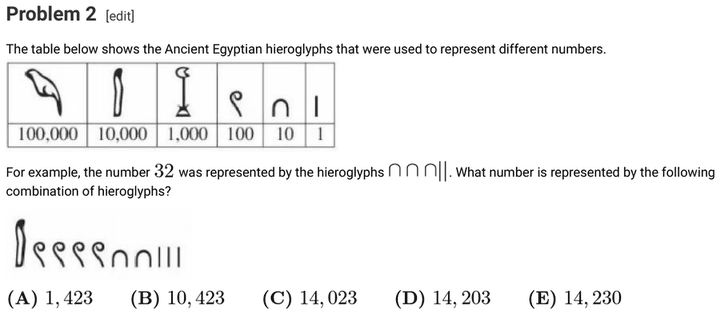
amc8-2025-02
Show answer
Answer: B — 10,423.
Show hint
Hint 1
Each symbol has a fixed value from the table. Add up the values, just like the example (where three ∩ arches and two | strokes made 32).
Show solution
  1. Read the symbols using the table: one 10,000 symbol, four 100 symbols, two 10 symbols, and three 1 symbols.
  2. Add their values: 10,000 + 4×100 + 2×10 + 3×1.
  3. = 10,000 + 400 + 20 + 3 = 10,423.
Mark: · log in to save
Problem 3 · 2025 AMC 8 Medium
Arithmetic & Operations total-then-dividedivision

Buffalo Shuffle-o is a card game in which all the cards are distributed evenly among all players at the start of the game. When Annika and 3 of her friends play Buffalo Shuffle-o, each player is dealt 15 cards. Suppose 2 more friends join the next game. How many cards will be dealt to each player?

Show answer
Answer: C — 10 cards each.
Show hints
Hint 1 of 2
The total number of cards doesn't change. Find that total first.
Still stuck? Show hint 2 →
Hint 2 of 2
First find the total number of cards (it doesn't change), then share it among the new, larger group.
Show solution
  1. Annika + 3 friends = 4 players, each dealt 15, so there are 4 × 15 = 60 cards.
  2. With 2 more friends, there are now 4 + 2 = 6 players.
  3. 60 cards shared among 6 players: 60 ÷ 6 = 10 cards each.
Mark: · log in to save
Problem 1 · 2023 AMC 8 Easy
Arithmetic & Operations order-of-operations

What is the value of (8 × 4 + 2) − (8 + 4 × 2)?

Show answer
Answer: D — The answer is 18.
Show hint
Hint 1
Inside each set of parentheses, do the multiplication before the addition.
Show solution
  1. First parentheses: 8 × 4 + 2 = 32 + 2 = 34.
  2. Second parentheses: 8 + 4 × 2 = 8 + 8 = 16.
  3. Subtract: 34 − 16 = 18.
Mark: · log in to save
Problem 2 · 2020 AMC 8 Easy
Arithmetic & Operations total-then-divide

Four friends do yardwork for their neighbors over the weekend, earning $15, $20, $25, and $40, respectively. They decide to split their earnings equally among themselves. In total how much will the friend who earned $40 give to the others?

Show answer
Answer: C — $15.
Show hints
Hint 1 of 2
Find the fair share first — what does each friend end up with?
Still stuck? Show hint 2 →
Hint 2 of 2
The $40 friend gives away whatever they have above the fair share.
Show solution
Approach: total then divide
  1. Fair share: (15 + 20 + 25 + 40) ÷ 4 = 100 ÷ 4 = $25 each.
  2. The $40 friend keeps $25 and hands over $40 − $25 = $15.
Mark: · log in to save
Problem 3 · 2020 AMC 8 Easy
Arithmetic & Operations unit-rate

Carrie has a rectangular garden that measures 6 feet by 8 feet. She plants the entire garden with strawberry plants. Carrie is able to plant 4 strawberry plants per square foot, and she harvests an average of 10 strawberries per plant. How many strawberries can she expect to harvest?

Show answer
Answer: D — 1920 strawberries.
Show hint
Hint 1
Walk it through in units: square feet → plants → strawberries. Just multiply each step.
Show solution
Approach: chain the per-unit rates
  1. Square feet: 6 × 8 = 48.
  2. Plants: 48 × 4 = 192.
  3. Strawberries: 192 × 10 = 1920.
Mark: · log in to save
Problem 1 · 2019 AMC 8 Easy
Arithmetic & Operations divisionunit-rate

Ike and Mike go into a sandwich shop with a total of $30.00 to spend. Sandwiches cost $4.50 each and soft drinks cost $1.00 each. Ike and Mike plan to buy as many sandwiches as they can and use the remaining money to buy soft drinks. Counting both soft drinks and sandwiches, how many items will they buy?

Show answer
Answer: D — 9 items.
Show hints
Hint 1 of 2
Spend on sandwiches first — what's the most they can buy without going past $30?
Still stuck? Show hint 2 →
Hint 2 of 2
6 sandwiches cost $27, leaving $3 for sodas.
Show solution
Approach: max sandwiches, then sodas with the change
  1. $30 ÷ $4.50 = 6 with $3 left over (a 7th sandwich would cost $31.50, too much).
  2. The $3 buys 3 sodas at $1 each.
  3. Total items: 6 + 3 = 9.
Mark: · log in to save
Problem 5 · 2018 AMC 8 Easy
Arithmetic & Operations groupingarithmetic-series

What is the value of

1 + 3 + 5 + … + 2017 + 2019 − 2 − 4 − 6 − … − 2016 − 2018 ?
Show answer
Answer: E — 1010.
Show hint
Hint 1
Rearrange: 1 + (3−2) + (5−4) + (7−6) + … + (2019−2018). Each parenthesis is just 1.
Show solution
Approach: pair adjacent odd/even terms
  1. Group as 1 + (3 − 2) + (5 − 4) + … + (2019 − 2018). Each parenthesized pair = 1.
  2. Number of pairs: from 3–2 up to 2019–2018 — that's 1009 pairs. Plus the leading 1.
  3. Total: 1 + 1009 = 1010.
Mark: · log in to save
Problem 1 · 2017 AMC 8 Easy
Arithmetic & Operations order-of-operations

Which of the following values is the largest?

Show answer
Answer: A — 10 (option A).
Show hint
Hint 1
PEMDAS: do every multiplication before adding. A zero anywhere in a product kills it.
Show solution
Approach: evaluate each option
  1. (A) 2 + 0 + 1 + 7 = 10. (B) 0 + 1 + 7 = 8. (C) 2 + 0 + 7 = 9. (D) 2 + 0 + 7 = 9. (E) 0.
  2. Largest is (A) = 10.
Mark: · log in to save
Problem 3 · 2017 AMC 8 Medium
Arithmetic & Operations perfect-square

What is the value of the expression √(16 · √(8 · √4)) ?

Show answer
Answer: C — 8.
Show hint
Hint 1
Work from the inside out. The innermost √4 is 2, which collapses the middle radical.
Show solution
Approach: peel from inside
  1. √4 = 2. So middle: √(8 · 2) = √16 = 4.
  2. Outer: √(16 · 4) = √64 = 8.
Mark: · log in to save
Problem 4 · 2017 AMC 8 Easy
Arithmetic & Operations estimate-and-pick

When 0.000315 is multiplied by 7,928,564 the product is closest to which of the following?

Show answer
Answer: D — 2400.
Show hint
Hint 1
Round both to one significant figure: 0.0003 × 8,000,000.
Show solution
Approach: scientific notation, round
  1. 0.000315 ≈ 3 × 10⁻⁴. 7,928,564 ≈ 8 × 10⁶.
  2. Product ≈ 3 · 8 · 102 = 24 · 100 = 2400.
Mark: · log in to save
Problem 5 · 2017 AMC 8 Easy
Arithmetic & Operations factorizationarithmetic-series

What is the value of the expression

1 · 2 · 3 · 4 · 5 · 6 · 7 · 81 + 2 + 3 + 4 + 5 + 6 + 7 + 8 ?
Show answer
Answer: B — 1120.
Show hint
Hint 1
Bottom is 1+2+…+8 = 36. Then cancel 36 = 4 · 9 with the top.
Show solution
Approach: compute the denominator, cancel factors
  1. Denominator: 1 + 2 + … + 8 = 36 = 4 · 9.
  2. Numerator / 36: cancel 4 with the 4 in the product, cancel 9 with 3 · 3 (from the 3 and 6).
  3. Left over: 1 · 2 · (3/3) · (4/4) · 5 · (6/3) · 7 · 8 = 1 · 2 · 5 · 2 · 7 · 8 = 1120.
  4. (Or just: 8!/36 = 40320/36 = 1120.)
Mark: · log in to save
Problem 1 · 2016 AMC 8 Easy
Arithmetic & Operations unit-rate

The longest professional tennis match lasted a total of 11 hours and 5 minutes. How many minutes is that?

Show answer
Answer: C — 665 minutes.
Show hint
Hint 1
11 hours = 11 × 60 = 660 minutes, plus 5 more.
Show solution
Approach: convert hours to minutes
  1. 11 × 60 + 5 = 660 + 5 = 665 minutes.
Mark: · log in to save
Problem 3 · 2016 AMC 8 Easy
Arithmetic & Operations sum-constraint

Four students take an exam. Three of their scores are 70, 80, and 90. If the average of their four scores is 70, then what is the remaining score?

Show answer
Answer: A — 40.
Show hint
Hint 1
Total sum = 4 × 70 = 280. Subtract the three known scores.
Show solution
Approach: total = avg × count
  1. Total = 4 × 70 = 280.
  2. Remaining = 280 − 70 − 80 − 90 = 40.
Mark: · log in to save
Problem 5 · 2015 AMC 8 Easy
Arithmetic & Operations careful-counting

Billy's basketball team scored the following points over the course of the first 11 games of the season: 42, 47, 53, 53, 58, 58, 58, 61, 64, 65, 73. If his team scores 40 in the 12th game, which of the following statistics will show an increase?

Show answer
Answer: A — Range increases.
Show hint
Hint 1
40 is below the previous minimum (42), so it becomes the new low. Which statistic depends on the spread between min and max?
Show solution
Approach: check each statistic when a below-min value is added
  1. Original range: 73 − 42 = 31. New range: 73 − 40 = 33 → increases.
  2. Median (lowering by adding a small value) decreases or stays. Mean drops (40 is below current mean). Mode stays 58. Mid-range = (max+min)/2 decreases (min drops, max unchanged).
  3. Only the range increases.
Mark: · log in to save
Problem 1 · 2014 AMC 8 Easy
Arithmetic & Operations order-of-operations

Harry and Terry are each told to calculate 8 − (2 + 5). Harry gets the correct answer. Terry ignores the parentheses and calculates 8 − 2 + 5. If Harry's answer is H and Terry's answer is T, what is the difference HT?

Show answer
Answer: A — −10.
Show hint
Hint 1
Compute each version separately, then subtract.
Show solution
Approach: evaluate both expressions
  1. H = 8 − (2 + 5) = 8 − 7 = 1.
  2. T = 8 − 2 + 5 = 6 + 5 = 11.
  3. HT = 1 − 11 = −10.
Mark: · log in to save
Problem 2 · 2014 AMC 8 Easy
Arithmetic & Operations extremes-min-max

Paul owes Paula 35 cents and has a pocket full of 5-cent coins, 10-cent coins, and 25-cent coins that he can use to pay her. What is the difference between the largest and the smallest number of coins he can use to pay her?

Show answer
Answer: E — 5 coins difference.
Show hint
Hint 1
Max coins → all 5-cent coins. Min coins → use the biggest coins possible.
Show solution
Approach: compute both extremes
  1. Most coins: 35 / 5 = 7 nickels.
  2. Fewest coins: 25 + 10 = 35 with 2 coins.
  3. Difference: 7 − 2 = 5.
Mark: · log in to save
Problem 3 · 2014 AMC 8 Easy
Arithmetic & Operations average-times-count

Isabella had a week to read a book for a school assignment. She read an average of 36 pages per day for the first three days and an average of 44 pages per day for the next three days. She then finished the book by reading 10 pages on the last day. How many pages were in the book?

Show answer
Answer: B — 250 pages.
Show hint
Hint 1
Average × count gives the total for each three-day block. Then add the last day.
Show solution
Approach: average × count, then sum
  1. First three days: 36 × 3 = 108 pages.
  2. Next three days: 44 × 3 = 132 pages.
  3. Total: 108 + 132 + 10 = 250.
Mark: · log in to save
Problem 6 · 2014 AMC 8 Easy
Arithmetic & Operations factoringsum-of-squares

Six rectangles each with a common base width of 2 have lengths of 1, 4, 9, 16, 25, and 36. What is the sum of the areas of the six rectangles?

Show answer
Answer: D — 182.
Show hint
Hint 1
Each area is 2 × length. Factor out the 2 and sum the lengths once.
Show solution
Approach: factor out the common width
  1. Sum of lengths: 1 + 4 + 9 + 16 + 25 + 36 = 91 (sum of first 6 squares).
  2. Sum of areas: 2 × 91 = 182.
Mark: · log in to save
Problem 10 · 2014 AMC 8 Easy
Arithmetic & Operations year-arithmetic

The first AMC 8 was given in 1985 and it has been given annually since that time. Samantha turned 12 years old the year that she took the seventh AMC 8. In what year was Samantha born?

Show answer
Answer: A — 1979.
Show hint
Hint 1
The n-th AMC 8 was given in 1985 + (n − 1). Subtract her age to get her birth year.
Show solution
Approach: compute year of 7th contest, then subtract age
  1. 7th AMC 8: 1985 + 6 = 1991.
  2. Born 12 years earlier: 1991 − 12 = 1979.
Mark: · log in to save
Problem 3 · 2013 AMC 8 Easy
Arithmetic & Operations pair-grouping

What is the value of 4 · (−1 + 2 − 3 + 4 − 5 + 6 − 7 + … + 1000)?

Show answer
Answer: E — 2000.
Show hint
Hint 1
Group consecutive pairs (−1 + 2), (−3 + 4), …. Each pair = 1.
Show solution
Approach: pair to constants
  1. Each pair (−k + (k+1)) equals 1; there are 500 such pairs (covering 1…1000).
  2. Sum inside: 500. Multiply by 4: 2000.
Mark: · log in to save
Problem 5 · 2013 AMC 8 Easy
Arithmetic & Operations mean-vs-median

Hammie is in the 6th grade and weighs 106 pounds. His quadruplet sisters are tiny babies and weigh 5, 5, 6, and 8 pounds. Which is greater, the average (mean) weight of these five children or the median weight, and by how many pounds?

Show answer
Answer: E — Average, by 20.
Show hint
Hint 1
Order the 5 weights to find the median. Mean = total / 5. The single outlier (106) pulls the mean way up.
Show solution
Approach: compute both
  1. Sorted: 5, 5, 6, 8, 106 ⇒ median = 6.
  2. Mean = (5 + 5 + 6 + 8 + 106)/5 = 130/5 = 26.
  3. Mean exceeds median by 26 − 6 = 20.
Mark: · log in to save
Problem 6 · 2013 AMC 8 Easy
Arithmetic & Operations multiplication-pyramid
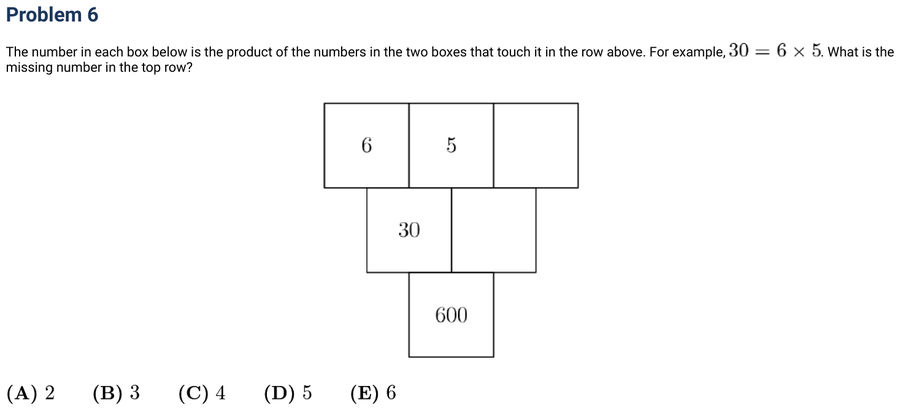
amc8-2013-06
Show answer
Answer: C — 4.
Show hints
Hint 1 of 2
Bottom = left-middle × right-middle. So right-middle = 600 / 30.
Still stuck? Show hint 2 →
Hint 2 of 2
Right-middle = top-middle × top-right = 5 × (top-right).
Show solution
Approach: work down to find right-middle, then back up
  1. Right-middle box = 600 / 30 = 20.
  2. Right-middle = 5 × (top-right), so top-right = 20 / 5 = 4.
Mark: · log in to save
Problem 3 · 2012 AMC 8 Easy
Arithmetic & Operations time-arithmetic

On February 13 The Oshkosh Northwester listed the length of daylight as 10 hours and 24 minutes, the sunrise was 6:57 AM, and the sunset as 8:15 PM. The length of daylight and sunrise were correct, but the sunset was wrong. When did the sun really set?

Show answer
Answer: B — 5:21 PM.
Show hint
Hint 1
Sunset = sunrise + length of daylight.
Show solution
Approach: add the daylight length to sunrise
  1. 6:57 AM + 10 hours = 4:57 PM.
  2. Add the remaining 24 minutes: 4:57 + 0:24 = 5:21 PM.
Mark: · log in to save
Problem 7 · 2012 AMC 8 Easy
Arithmetic & Operations average-budgetmin-with-max-on-other

Isabella must take four 100-point tests in her math class. Her goal is to achieve an average grade of 95 on the tests. Her first two test scores were 97 and 91. After seeing her score on the third test, she realized she can still reach her goal. What is the lowest possible score she could have made on the third test?

Show answer
Answer: B — 92.
Show hints
Hint 1 of 2
Total points needed = 4 × 95 = 380. Subtract the first two scores to find what's left for tests 3 + 4.
Still stuck? Show hint 2 →
Hint 2 of 2
To minimize the 3rd test, maximize the 4th (cap = 100).
Show solution
Approach: budget the remaining two test scores
  1. Needed total: 4 · 95 = 380. Used: 97 + 91 = 188. Remaining: 380 − 188 = 192.
  2. Max possible on the 4th test = 100, so min on the 3rd = 192 − 100 = 92.
Mark: · log in to save
Problem 11 · 2012 AMC 8 Easy
Arithmetic & Operations mean-median-mode

The mean, median, and unique mode of the positive integers 3, 4, 5, 6, 6, 7, and x are all equal. What is the value of x?

Show answer
Answer: D — 11.
Show hints
Hint 1 of 2
"Unique mode" is the only repeated value — that's 6 in this list. So mode = mean = median = 6.
Still stuck? Show hint 2 →
Hint 2 of 2
Force the mean to be 6: solve for x from the 7-term sum.
Show solution
Approach: lock mode = 6, then force mean = 6
  1. Mode must remain 6 (every other value appears once), so x ≠ 3, 4, 5, 7.
  2. Mean = 6 ⇒ sum = 7 · 6 = 42.
  3. 3 + 4 + 5 + 6 + 6 + 7 + x = 31 + x = 42 ⇒ x = 11. (Sorted list: 3, 4, 5, 6, 6, 7, 11 — median 6 ✓.)
Mark: · log in to save
Problem 1 · 2011 AMC 8 Easy
Arithmetic & Operations subtraction

Margie bought 3 apples at a cost of 50 cents per apple. She paid with a 5-dollar bill. How much change did Margie receive?

Show answer
Answer: E — $3.50.
Show hint
Hint 1
Total cost = 3 × $0.50; change = $5 − that.
Show solution
Approach: compute then subtract
  1. Cost: 3 · $0.50 = $1.50.
  2. Change: $5.00 − $1.50 = $3.50.
Mark: · log in to save
Problem 4 · 2011 AMC 8 Easy
Arithmetic & Operations mean-median-mode

Here is a list of the numbers of fish that Tyler caught in nine outings last summer: 2, 0, 1, 3, 0, 3, 3, 1, 2. Which statement about the mean, median, and mode is true?

Show answer
Answer: C — mean < median < mode.
Show hint
Hint 1
Sort the list. Mode = most common value, median = middle (5th of 9), mean = sum/9.
Show solution
Approach: compute each
  1. Sorted: 0, 0, 1, 1, 2, 2, 3, 3, 3.
  2. Mode = 3, median = 2, mean = 15/9 = 5/3 ≈ 1.67.
  3. 5/3 < 2 < 3 ⇒ mean < median < mode.
Mark: · log in to save
Problem 5 · 2011 AMC 8 Easy
Arithmetic & Operations time-conversion

What time was it 2011 minutes after midnight on January 1, 2011?

Show answer
Answer: D — January 2 at 9:31 AM.
Show hint
Hint 1
Divide 2011 by 60 to convert to hours and minutes. Then subtract 24 hours to advance to the next day.
Show solution
Approach: convert minutes to hours, modular over 24
  1. 2011 / 60 = 33 hr 31 min (since 33 · 60 = 1980 and 2011 − 1980 = 31).
  2. 33 hr = 24 hr + 9 hr ⇒ one day later, 9 hr 31 min after midnight = 9:31 AM on January 2.
Mark: · log in to save
Problem 11 · 2011 AMC 8 Easy
Arithmetic & Operations average-of-differences
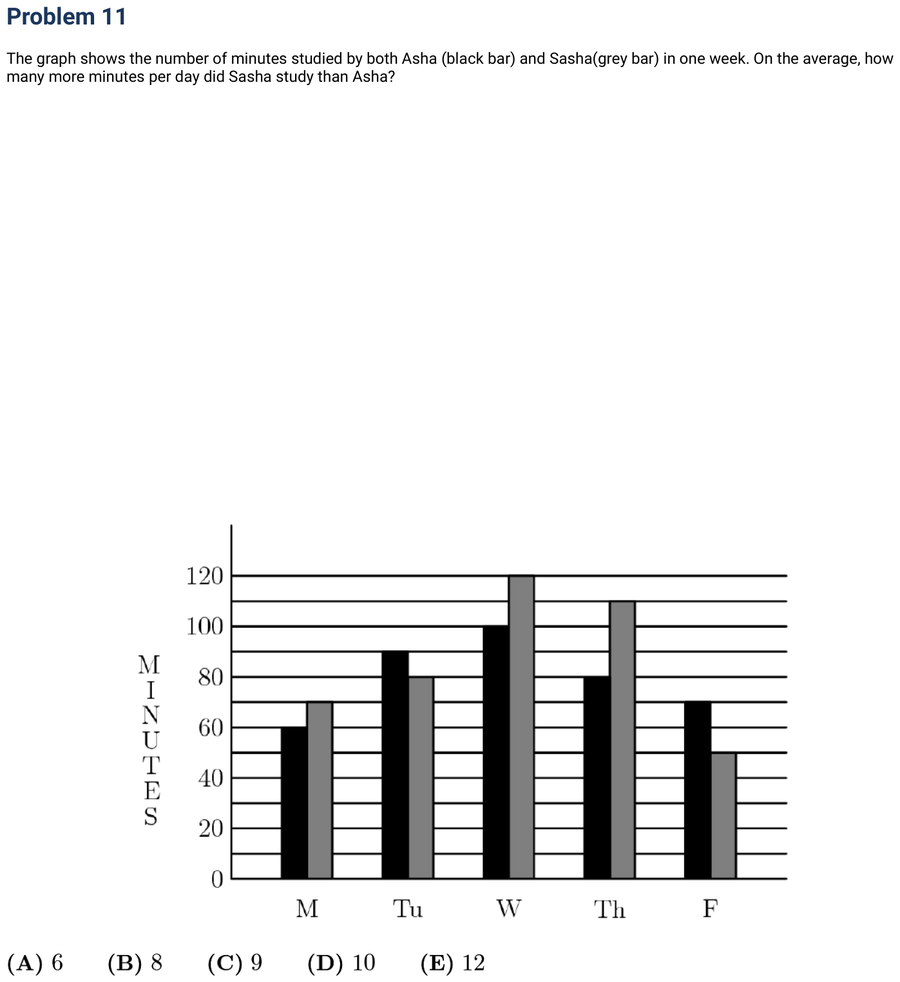
amc8-2011-11
Show answer
Answer: A — 6 minutes.
Show hint
Hint 1
Add the daily differences (Sasha − Asha) and divide by 5.
Show solution
Approach: sum of differences / 5
  1. Daily Sasha − Asha: +10, −10, +20, +30, −20. Sum: 30.
  2. Average over 5 days: 30 / 5 = 6.
Mark: · log in to save
Problem 1 · 2010 AMC 8 Easy
Arithmetic & Operations addition

At Euclid Middle School the mathematics teachers are Miss Germain, Mr. Newton, and Mrs. Young. There are 11 students in Mrs. Germain's class, 8 students in Mr. Newton's class, and 9 students in Mrs. Young's class taking the AMC 8 this year. How many mathematics students at Euclid Middle School are taking the contest?

Show answer
Answer: C — 28.
Show hint
Hint 1
Just add the three class counts.
Show solution
Approach: add
  1. 11 + 8 + 9 = 28.
Mark: · log in to save
Problem 4 · 2010 AMC 8 Easy
Arithmetic & Operations mean-median-mode

What is the sum of the mean, median, and mode of the numbers 2, 3, 0, 3, 1, 4, 0, 3?

Show answer
Answer: C — 7.5.
Show hint
Hint 1
Sort first, then read off mode and median; compute mean from the sum.
Show solution
Approach: compute each of mean/median/mode
  1. Sorted: 0, 0, 1, 2, 3, 3, 3, 4. Sum = 16 ⇒ mean = 16/8 = 2.
  2. Median = avg of 4th and 5th = (2 + 3)/2 = 2.5.
  3. Mode = 3.
  4. Total: 2 + 2.5 + 3 = 7.5.
Mark: · log in to save
Problem 5 · 2010 AMC 8 Easy
Arithmetic & Operations unit-conversion

Alice needs to replace a light bulb located 10 centimeters below the ceiling in her kitchen. The ceiling is 2.4 meters above the floor. Alice is 1.5 meters tall and can reach 46 centimeters above the top of her head. Standing on a stool, she can just reach the light bulb. What is the height of the stool, in centimeters?

Show answer
Answer: B — 34 cm.
Show hint
Hint 1
Convert everything to centimeters. Stool height = light-bulb height − (Alice + reach).
Show solution
Approach: match Alice + stool + reach to the bulb height
  1. Bulb height above floor: 240 − 10 = 230 cm.
  2. Alice's reach (height + arm): 150 + 46 = 196 cm.
  3. Stool: 230 − 196 = 34 cm.
Mark: · log in to save
Problem 1 · 2008 AMC 8 Easy
Arithmetic & Operations word-problem

Susan had 50 dollars to spend at the carnival. She spent 12 dollars on food and twice as much on rides. How many dollars did she have left to spend?

Show answer
Answer: B — $14.
Show hint
Hint 1
Rides: 2 · 12 = 24. Subtract food + rides from 50.
Show solution
Approach: subtract total spending
  1. Total spent: 12 + 2 · 12 = 36.
  2. Left: 50 − 36 = 14.
Mark: · log in to save
Problem 3 · 2008 AMC 8 Easy
Arithmetic & Operations modular-days

If February is a month that contains Friday the 13th, what day of the week is February 1?

Show answer
Answer: A — Sunday.
Show hint
Hint 1
Days of the week repeat every 7. Step back from Friday Feb 13 by 12 days.
Show solution
Approach: step back 12 days mod 7
  1. Feb 13 is Friday. 12 days earlier is Feb 1. 12 mod 7 = 5, so 5 days before Friday.
  2. Going back: Thu, Wed, Tue, Mon, Sun.
Mark: · log in to save
Problem 8 · 2008 AMC 8 Easy
Arithmetic & Operations average
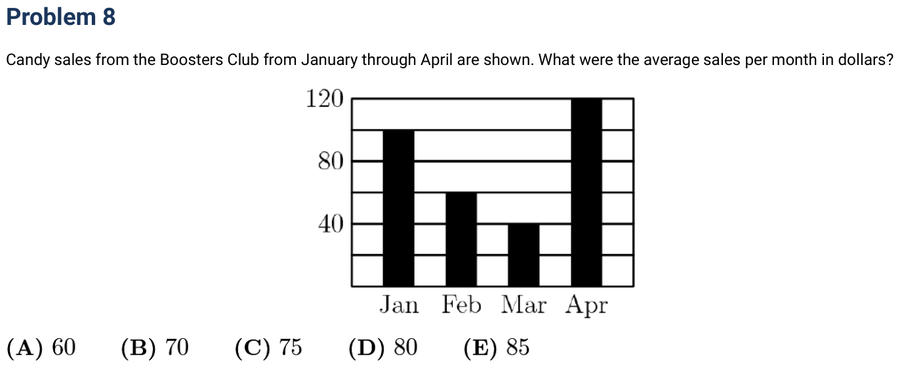
amc8-2008-08
Show answer
Answer: D — $80.
Show hint
Hint 1
Sum the four months, divide by 4.
Show solution
Approach: sum / 4
  1. Sum: 100 + 60 + 40 + 120 = 320.
  2. Average: 320 / 4 = 80.
Mark: · log in to save
Problem 10 · 2008 AMC 8 Easy
Arithmetic & Operations weighted-average

The average age of the 6 people in Room A is 40. The average age of the 4 people in Room B is 25. If the two groups are combined, what is the average age of all the people?

Show answer
Answer: D — 34.
Show hint
Hint 1
Combined average = total ages / total people. Each room's total = avg × count.
Show solution
Approach: total ages / total count
  1. Room A total: 6 · 40 = 240. Room B: 4 · 25 = 100.
  2. Combined: 340 / 10 = 34.
Mark: · log in to save
Problem 1 · 2007 AMC 8 Easy
Arithmetic & Operations average-target

Theresa's parents have agreed to buy her tickets to see her favorite band if she spends an average of 10 hours per week helping around the house for 6 weeks. For the first 5 weeks she helps around the house for 8, 11, 7, 12 and 10 hours. How many hours must she work for the final week to earn the tickets?

Show answer
Answer: D — 12 hours.
Show hint
Hint 1
Target total = 6 · 10 = 60. Subtract what she's already done.
Show solution
Approach: target total minus actual
  1. Done so far: 8 + 11 + 7 + 12 + 10 = 48.
  2. Needed: 60 − 48 = 12.
Mark: · log in to save
Problem 2 · 2007 AMC 8 Easy
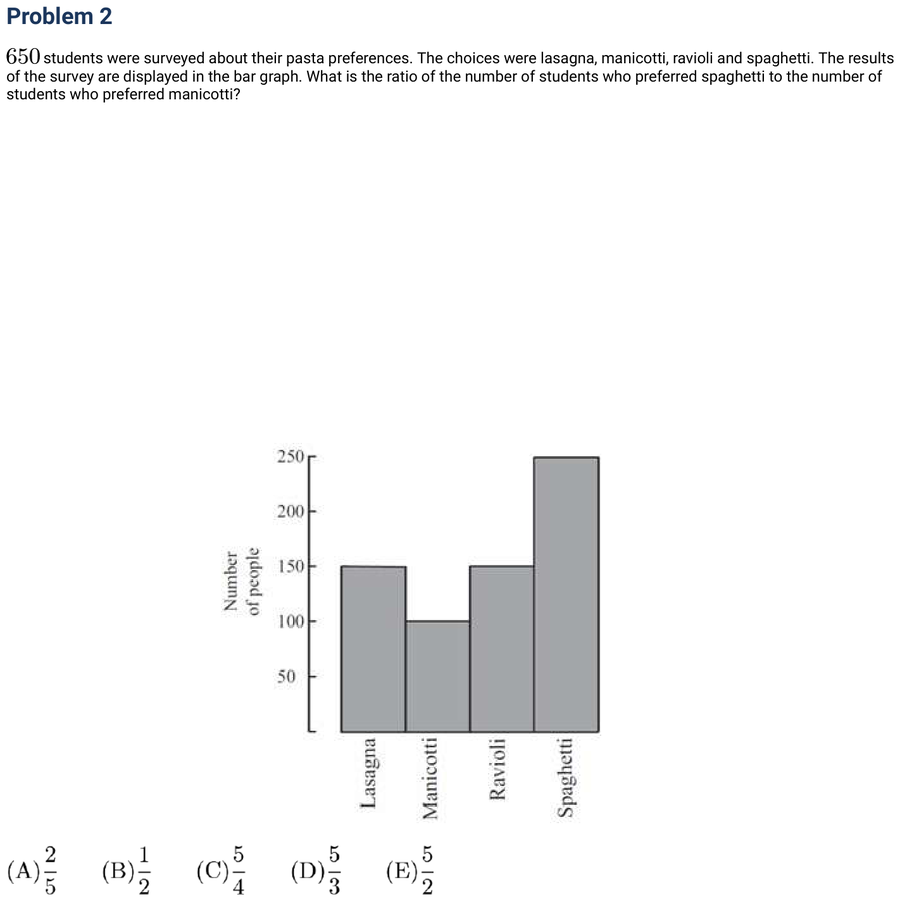
Arithmetic & Operations ratio-from-graph
amc8-2007-02
Show answer
Answer: E — 5/2.
Show hint
Hint 1
Read off counts; simplify the ratio.
Show solution
Approach: read and reduce
  1. Spaghetti / Manicotti = 250 / 100 = 5/2.
Mark: · log in to save
Problem 5 · 2007 AMC 8 Easy
Arithmetic & Operations target-amount

Chandler wants to buy a 500 dollar mountain bike. For his birthday, his grandparents send him 50 dollars, his aunt sends him 35 dollars and his cousin gives him 15 dollars. He earns 16 dollars per week for his paper route. He will use all of his birthday money and all of the money he earns from his paper route. In how many weeks will he be able to buy the mountain bike?

Show answer
Answer: B — 25 weeks.
Show hint
Hint 1
Subtract birthday total from 500, then divide by 16.
Show solution
Approach: remaining / weekly earning
  1. Birthday: 50 + 35 + 15 = 100. Needed from route: 400.
  2. Weeks: 400 / 16 = 25.
Mark: · log in to save
Problem 7 · 2007 AMC 8 Easy
Arithmetic & Operations average-update

The average age of 5 people in a room is 30 years. An 18-year-old person leaves the room. What is the average age of the four remaining people?

Show answer
Answer: D — 33.
Show hint
Hint 1
Total before: 5 · 30 = 150. After: 150 − 18 = 132. Divide by 4.
Show solution
Approach: total × count update
  1. Old total: 150. New total: 132.
  2. Average: 132 / 4 = 33.
Mark: · log in to save
Problem 1 · 2006 AMC 8 Easy
Arithmetic & Operations estimation

Mindy made three purchases for $1.98, $5.04, and $9.89. What was her total, to the nearest dollar?

Show answer
Answer: D — $17.
Show hint
Hint 1
Round each to the nearest dollar before adding (each is already close to a whole).
Show solution
Approach: round and add
  1. $1.98 + $5.04 + $9.89 ≈ 2 + 5 + 10 = 17.
Mark: · log in to save
Problem 2 · 2006 AMC 8 Easy
Arithmetic & Operations scoring-rule

On the AMC 8 contest Billy answers 13 questions correctly, answers 7 questions incorrectly and doesn't answer the last 5. What is his score? (right = +1, wrong or N/A = +0)

Show answer
Answer: C — 13.
Show hint
Hint 1
Only correct answers count.
Show solution
Approach: just count correct
  1. 13 correct · 1 = 13.
Mark: · log in to save
Problem 1 · 2005 AMC 8 Easy
Arithmetic & Operations undo-then-redo

Connie multiplies a number by 2 and gets 60 as her answer. However, she should have divided the number by 2 to get the correct answer. What is the correct answer?

Show answer
Answer: B — 15.
Show hint
Hint 1
First recover the original number, then divide by 2.
Show solution
Approach: undo, then redo
  1. Original = 60 / 2 = 30.
  2. Correct answer: 30 / 2 = 15.
Mark: · log in to save
Problem 5 · 2005 AMC 8 Easy
Arithmetic & Operations greedy-packing

Soda is sold in packs of 6, 12 and 24 cans. What is the minimum number of packs needed to buy exactly 90 cans of soda?

Show answer
Answer: B — 5 packs.
Show hint
Hint 1
Use as many 24-packs as possible, then fill in with 12s and 6s.
Show solution
Approach: greedy from largest pack
  1. 3 · 24 = 72 leaves 18. Then one 12 + one 6 = 18.
  2. Packs used: 3 + 1 + 1 = 5.
Mark: · log in to save
Problem 7 · 2004 AMC 8 Easy
Arithmetic & Operations two-step-calculation

An athlete's target heart rate, in beats per minute, is 80% of the theoretical maximum heart rate. The maximum heart rate is found by subtracting the athlete's age, in years, from 220. To the nearest whole number, what is the target heart rate of an athlete who is 26 years old?

Show answer
Answer: B — 155 bpm.
Show hint
Hint 1
Max: 220 − 26 = 194. Target: 0.80 · 194.
Show solution
Approach: two-step
  1. Max: 220 − 26 = 194.
  2. Target: 0.80 · 194 = 155.2 ≈ 155.
Mark: · log in to save
Problem 9 · 2004 AMC 8 Easy
Arithmetic & Operations average-from-totals

The average of the five numbers in a list is 54. The average of the first two numbers is 48. What is the average of the last three numbers?

Show answer
Answer: D — 58.
Show hint
Hint 1
Sum total − sum of first two = sum of last three; divide by 3.
Show solution
Approach: totals minus totals
  1. Total sum: 5 · 54 = 270. First two: 2 · 48 = 96.
  2. Last three sum: 174. Average: 174 / 3 = 58.
Mark: · log in to save
Problem 10 · 2004 AMC 8 Easy
Arithmetic & Operations time-conversionrate

Handy Aaron helped a neighbor 114 hours on Monday, 50 minutes on Tuesday, from 8:20 to 10:45 on Wednesday morning, and a half-hour on Friday. He is paid $3 per hour. How much did he earn for the week?

Show answer
Answer: E — $15.
Show hint
Hint 1
Convert each day to hours, sum, multiply by $3.
Show solution
Approach: convert and sum
  1. Mon: 1.25 hr. Tue: 50/60 = 5/6 hr. Wed: 2 hr 25 min = 29/12 hr. Fri: 0.5 hr.
  2. Total: 5/4 + 5/6 + 29/12 + 1/2 = 15/12 + 10/12 + 29/12 + 6/12 = 60/12 = 5 hr.
  3. Earnings: 3 · 5 = $15.
Mark: · log in to save
Problem 3 · 2002 AMC 8 Easy
Arithmetic & Operations total-then-divide

What is the smallest possible average of four distinct positive even integers?

Show answer
Answer: C — 5.
Show hint
Hint 1
To make an average as small as possible, use the smallest numbers allowed.
Show solution
Approach: use the four smallest distinct positive even integers
  1. The smallest distinct positive even integers are 2, 4, 6, 8.
  2. Their average is (2 + 4 + 6 + 8) ÷ 4 = 20 ÷ 4 = 5.
Mark: · log in to save
Problem 3 · 2001 AMC 8 Easy
Arithmetic & Operations division

Granny Smith has $63. Elberta has $2 more than Anjou, and Anjou has one-third as much as Granny Smith. How many dollars does Elberta have?

Show answer
Answer: E — $23.
Show hint
Hint 1
Work down the chain: find Anjou's amount first, then Elberta's.
Show solution
Approach: follow the chain of clues
  1. Anjou has one-third of $63, which is $21.
  2. Elberta has $2 more: $21 + $2 = $23.
Mark: · log in to save
Problem 1 · 2000 AMC 8 Easy
Arithmetic & Operations ages

Aunt Anna is 42 years old. Caitlin is 5 years younger than Brianna, and Brianna is half as old as Aunt Anna. How old is Caitlin?

Show answer
Answer: B — 16.
Show hint
Hint 1
Find Brianna's age first, then step down to Caitlin.
Show solution
Approach: follow the chain of ages
  1. Brianna is half of 42, which is 21.
  2. Caitlin is 5 younger: 21 โˆ’ 5 = 16.
Mark: · log in to save
Problem 2 · 2000 AMC 8 Easy
Arithmetic & Operations number-systems

Which of these numbers is less than its reciprocal?

Show answer
Answer: A — โˆ’2.
Show hints
Hint 1 of 2
Rule out the easy ones: 0 has no reciprocal, and ยฑ1 equal their own.
Still stuck? Show hint 2 →
Hint 2 of 2
Check โˆ’2 against its reciprocal, โˆ’ยฝ.
Show solution
Approach: check each candidate against its reciprocal
  1. 0 has no reciprocal; 1 and โˆ’1 are their own reciprocals; and 2 > ยฝ.
  2. Only โˆ’2 is below its reciprocal, since โˆ’2 < โˆ’ยฝ. Answer โˆ’2.
Mark: · log in to save
Problem 3 · 2000 AMC 8 Easy
Arithmetic & Operations careful-countingestimate-and-pick

How many whole numbers lie in the interval between 53 and 2π?

Show answer
Answer: D — 5.
Show hints
Hint 1 of 2
Find the smallest whole number above 5/3 and the largest below 2ฯ€.
Still stuck? Show hint 2 →
Hint 2 of 2
5/3 โ‰ˆ 1.67 and 2ฯ€ โ‰ˆ 6.28.
Show solution
Approach: bound the interval, then count integers inside
  1. 5/3 โ‰ˆ 1.67 and 2ฯ€ โ‰ˆ 6.28, so the whole numbers strictly between them are 2, 3, 4, 5, 6.
  2. That is 5 whole numbers.
Mark: · log in to save
Problem 1 · 1999 AMC 8 Easy
Arithmetic & Operations work-backward

(6 ? 3) + 4 − (2 − 1) = 5. To make this statement true, the question mark between the 6 and the 3 should be replaced by

Show answer
Answer: A — รท (division).
Show hints
Hint 1 of 2
Simplify the part you can: 4 โˆ’ (2 โˆ’ 1) is just 3.
Still stuck? Show hint 2 →
Hint 2 of 2
That leaves 6 ? 3 = 2 โ€” which operation gives 2?
Show solution
Approach: simplify, then solve for the operation
  1. The tail simplifies: 4 โˆ’ (2 โˆ’ 1) = 3.
  2. So 6 ? 3 must equal 5 โˆ’ 3 = 2, and only 6 รท 3 = 2 works.
  3. The missing sign is รท.
Mark: · log in to save
Problem 2 · 1996 AJHSME Easy
Arithmetic & Operations order-of-operations

Jose, Thuy, and Kareem each start with the number 10. Jose subtracts 1 from 10, doubles his answer, and then adds 2. Thuy doubles 10, subtracts 1 from her answer, and then adds 2. Kareem subtracts 1 from 10, adds 2 to his number, and then doubles the result. Who gets the largest final answer?

Show answer
Answer: C — Kareem.
Show hints
Hint 1 of 2
Just follow each person's three steps in order.
Still stuck? Show hint 2 →
Hint 2 of 2
Doubling last makes the biggest difference.
Show solution
Approach: compute each result
  1. Jose: (10 โˆ’ 1)ยท2 + 2 = 20. Thuy: 10ยท2 โˆ’ 1 + 2 = 21. Kareem: (10 โˆ’ 1 + 2)ยท2 = 22.
  2. The largest is Kareem's 22.
Mark: · log in to save
Problem 3 · 1996 AJHSME Easy
Arithmetic & Operations pattern

The 64 whole numbers from 1 through 64 are written, one per square, on a checkerboard (an 8 by 8 array). The first 8 numbers go in order across the first row, the next 8 across the second row, and so on. After all 64 numbers are written, the sum of the numbers in the four corners will be

Show answer
Answer: A — 130.
Show hints
Hint 1 of 2
The top row is 1โ€“8 and the bottom row is 57โ€“64.
Still stuck? Show hint 2 →
Hint 2 of 2
The corners are the first and last entry of those two rows.
Show solution
Approach: identify the four corner values
  1. The corners are 1 and 8 (top row) and 57 and 64 (bottom row).
  2. Their sum is 1 + 8 + 57 + 64 = 130.
Mark: · log in to save
Problem 1 · 1993 AJHSME Easy
Arithmetic & Operations check-choices

Which pair of numbers does NOT have a product equal to 36?

Show answer
Answer: C — {1/2, โˆ’72}.
Show hints
Hint 1 of 2
Multiply each pair and look for the one that isn't 36.
Still stuck? Show hint 2 →
Hint 2 of 2
Watch the signs โ€” two negatives make a positive.
Show solution
Approach: multiply each pair
  1. (โˆ’4)(โˆ’9) = 36, (โˆ’3)(โˆ’12) = 36, (1)(36) = 36, (3/2)(24) = 36 โ€” all equal 36.
  2. But (1/2)(โˆ’72) = โˆ’36, not 36, so the odd pair is {1/2, โˆ’72}.
Mark: · log in to save
Problem 3 · 1992 AJHSME Easy
Arithmetic & Operations max-min

What is the largest difference that can be formed by subtracting two numbers chosen from the set {โˆ’16, โˆ’4, 0, 2, 4, 12}?

Show answer
Answer: D — 28.
Show hints
Hint 1 of 2
A difference is largest when you subtract the smallest number from the largest.
Still stuck? Show hint 2 →
Hint 2 of 2
Subtracting a negative adds.
Show solution
Approach: largest minus smallest
  1. The biggest difference is 12 โˆ’ (โˆ’16).
  2. That equals 12 + 16 = 28.
Mark: · log in to save
Problem 1 · 1991 AJHSME Easy
Arithmetic & Operations subtraction

1,000,000,000,000 − 777,777,777,777 =

Show answer
Answer: B — 222,222,222,223.
Show hints
Hint 1 of 2
Compare with 999,999,999,999 โˆ’ 777,777,777,777, which is all 2's.
Still stuck? Show hint 2 →
Hint 2 of 2
Subtracting from one more than that adds 1.
Show solution
Approach: subtract from the all-9's number, then adjust
  1. 999,999,999,999 โˆ’ 777,777,777,777 = 222,222,222,222.
  2. Our top number is 1 larger, so the answer is 222,222,222,222 + 1 = 222,222,222,223.
Mark: · log in to save
Problem 2 · 1991 AJHSME Easy
Arithmetic & Operations order-of-operations

16 + 84 − 2 =

Show answer
Answer: C — 12.
Show hint
Hint 1
The fraction bar groups the top and the bottom โ€” finish each before dividing.
Show solution
Approach: simplify numerator and denominator
  1. Top: 16 + 8 = 24. Bottom: 4 โˆ’ 2 = 2.
  2. 24 รท 2 = 12.
Mark: · log in to save
Problem 3 · 1991 AJHSME Easy
Arithmetic & Operations powers-of-ten

Two hundred thousand times two hundred thousand equals

Show answer
Answer: E — forty billion.
Show hints
Hint 1 of 2
Multiply 2 ร— 2 and count the zeros.
Still stuck? Show hint 2 →
Hint 2 of 2
200,000 has five zeros.
Show solution
Approach: multiply, then count zeros
  1. (2 ร— 10โต) ร— (2 ร— 10โต) = 4 ร— 10ยนโฐ.
  2. 4 ร— 10ยนโฐ = 40,000,000,000 = forty billion.
Mark: · log in to save
Problem 1 · 1989 AJHSME Easy
Arithmetic & Operations pair-terms

(1 + 11 + 21 + 31 + 41) + (9 + 19 + 29 + 39 + 49) =

Show answer
Answer: E — 250.
Show hints
Hint 1 of 2
Pair the first term of each group with the matching term of the other.
Still stuck? Show hint 2 →
Hint 2 of 2
Each pair like 1 + 9 makes a round 10 (then 30, 50, โ€ฆ).
Show solution
Approach: pair across the two groups
  1. Pairing gives 1+9, 11+19, 21+29, 31+39, 41+49 = 10, 30, 50, 70, 90.
  2. Their sum is 10 + 30 + 50 + 70 + 90 = 250.
Mark: · log in to save
Problem 3 · 1987 AJHSME Easy
Arithmetic & Operations pair-from-ends

2(81 + 83 + 85 + 87 + 89 + 91 + 93 + 95 + 97 + 99) =

Show answer
Answer: E — 1800.
Show hints
Hint 1 of 2
Pair the smallest with the largest, next-smallest with next-largest, etc.
Still stuck? Show hint 2 →
Hint 2 of 2
Each pair sums to the same value.
Show solution
Approach: pair from the ends
  1. 81 + 99 = 83 + 97 = โ‹ฏ = 180. Five such pairs make 5 ร— 180 = 900.
  2. Double it: 2 ร— 900 = 1800.
Mark: · log in to save
Problem 3 · 1986 AJHSME Easy
Arithmetic & Operations pick-smallest

The smallest sum one could get by adding three different numbers from the set {7, 25, โˆ’1, 12, โˆ’3} is

Show answer
Answer: C — 3.
Show hint
Hint 1
Pick the three smallest numbers in the set.
Show solution
Approach: sum the three smallest
  1. The three smallest are โˆ’3, โˆ’1, and 7.
  2. Their sum: โˆ’3 + (โˆ’1) + 7 = 3.
Mark: · log in to save
Problem 4 · 1986 AJHSME Easy
Arithmetic & Operations round-and-multiply

The product (1.8)(40.3 + .07) is closest to

Show answer
Answer: C — 74.
Show hint
Hint 1
The small .07 barely changes the sum; round 40.37 โ‰ˆ 40.
Show solution
Approach: round before multiplying
  1. 1.8 ร— 40.37 โ‰ˆ 1.8 ร— 40 = 72.
  2. Closest of the choices is 74.
Mark: · log in to save
Problem 2 · 1985 AJHSME Easy
Arithmetic & Operations arithmetic-series

90 + 91 + 92 + 93 + 94 + 95 + 96 + 97 + 98 + 99 =

Show answer
Answer: B — 945.
Show hints
Hint 1 of 2
Adding ten numbers one-by-one is slow โ€” for a run that climbs by 1 each time, there's a shortcut.
Still stuck? Show hint 2 →
Hint 2 of 2
Sum of an arithmetic run = (first + last)โ„2 ร— count.
Show solution
Approach: average ร— count
  1. Average = (90 + 99)โ„2 = 94.5; count = 10.
  2. Sum = 94.5 ร— 10 = 945.
Mark: · log in to save
Problem 14 · 2025 AMC 8 Medium
Arithmetic & Operations work-backwardsubstitution

A number N is inserted into the list 2, 6, 7, 7, 28. The mean is now twice as great as the median. What is N?

Show answer
Answer: E — 34.
Show hints
Hint 1 of 2
With 6 numbers, the median is the average of the middle two. Where in the sorted list does N land?
Still stuck? Show hint 2 →
Hint 2 of 2
Every answer choice is at least 7, so the middle two are always 7 and 7 — the median locks in at 7 no matter what.
Show solution
Approach: median pins to 7, then back-solve the mean
  1. All answer choices are ≥ 7, so when N is inserted into the sorted list, the middle two stay 7 and 7. The median is always 7.
  2. Mean = 2 × 7 = 14, so the six numbers must sum to 6 × 14 = 84.
  3. The original five sum to 2 + 6 + 7 + 7 + 28 = 50, so N = 84 − 50 = 34.
Mark: · log in to save
Problem 20 · 2023 AMC 8 Hard
Arithmetic & Operations sum-constraintcasework

Two integers are inserted into the list 3, 3, 8, 11, 28 to double its range. The mode and median remain unchanged. What is the maximum possible sum of two additional numbers?

Show answer
Answer: D — 60.
Show hints
Hint 1 of 2
Original range = 28 − 3 = 25. New range = 50. To maximize the sum, push the new max as high as possible.
Still stuck? Show hint 2 →
Hint 2 of 2
Keep min = 3 ⇒ new max = 3 + 50 = 53. That's one insert. Now find the largest second insert that keeps median = 8 and mode = 3.
Show solution
Approach: push max up, then maximize the other insert under the median/mode constraints
  1. Range doubles from 25 to 50. To maximize the sum, leave the min at 3 and stretch the max: one insert = 3 + 50 = 53.
  2. With 7 numbers, the median is the 4th. Sorted so far: 3, 3, 8, 11, 28, 53 (6 values). The 2nd insert x must keep median = 8.
  3. If x > 8, the 4th value shifts off 8 (and choosing x = 8 ties the mode with two 8's). So x ≤ 7.
  4. Maximum x = 7 (mode stays uniquely 3). Sum = 53 + 7 = 60.
Mark: · log in to save
Problem 11 · 2022 AMC 8 Easy
Arithmetic & Operations off-by-one

Henry the donkey has a very long piece of pasta. He takes a number of bites of pasta, each time eating 3 inches of pasta from the middle of one piece. In the end, he has 10 pieces of pasta whose total length is 17 inches. How long, in inches, was the piece of pasta he started with?

Show answer
Answer: D — 44 inches.
Show hints
Hint 1 of 2
Each bite turns one piece into two. How many bites does it take to end with 10 pieces?
Still stuck? Show hint 2 →
Hint 2 of 2
10 pieces = 9 bites × 3 inches removed = 27 inches gone. Original = remaining + removed.
Show solution
Approach: count bites as gaps between pieces
  1. Each bite from the middle of a piece adds one new piece (one piece → two). Starting from 1 piece, reaching 10 pieces took 9 bites.
  2. 9 bites × 3 inches = 27 inches removed.
  3. Original length = 17 (remaining) + 27 (eaten) = 44 inches.
Mark: · log in to save
Problem 16 · 2022 AMC 8 Medium
Arithmetic & Operations sum-constraint

Four numbers are written in a row. The average of the first two is 21, the average of the middle two is 26, and the average of the last two is 30. What is the average of the first and last of the numbers?

Show answer
Answer: B — 25.
Show hints
Hint 1 of 2
Convert each average into a sum (multiply by 2). You don't need the four numbers individually — just a + d.
Still stuck? Show hint 2 →
Hint 2 of 2
(a + b) + (c + d) = (a+b+c+d), and you can subtract (b+c) to leave a+d.
Show solution
Approach: add the outer two sums, subtract the inner sum
  1. a + b = 42, b + c = 52, c + d = 60.
  2. (a+b) + (c+d) − (b+c) = a + d = 42 + 60 − 52 = 50.
  3. Average = 50/2 = 25.
Mark: · log in to save
Problem 19 · 2022 AMC 8 Medium
Arithmetic & Operations careful-counting
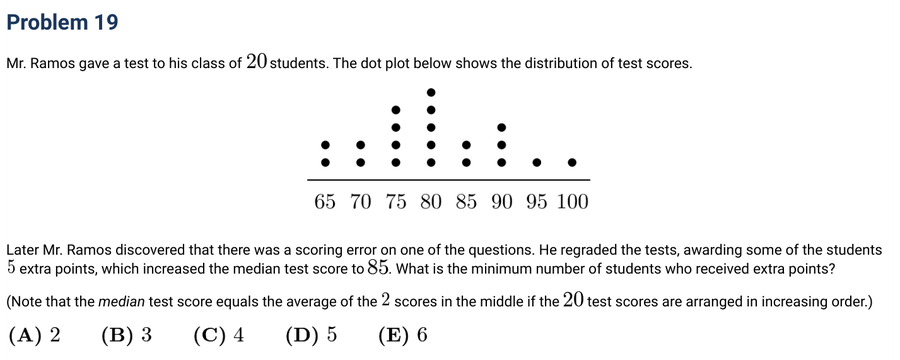
amc8-2022-19
Show answer
Answer: C — 4 students.
Show hints
Hint 1 of 2
With 20 students the median is the average of the 10th and 11th scores. For the median to be 85, both the 10th and 11th need to be (at least) 85.
Still stuck? Show hint 2 →
Hint 2 of 2
Currently 7 students scored ≥ 85. To make the 11th-highest hit 85, you need 4 more at ≥ 85.
Show solution
Approach: make the 11th-highest score reach 85
  1. Median of 20 scores = average of the 10th and 11th when sorted. To pin the median at 85, the 10th and 11th positions must both equal 85.
  2. From the dot plot, 7 students originally scored ≥ 85. Adding 5 to a student scoring 80 raises them to 85.
  3. Need at least 11 students at ≥ 85, so at least 11 − 7 = 4 students must be raised.
Mark: · log in to save
Problem 14 · 2020 AMC 8 Easy
Arithmetic & Operations estimate-and-pick
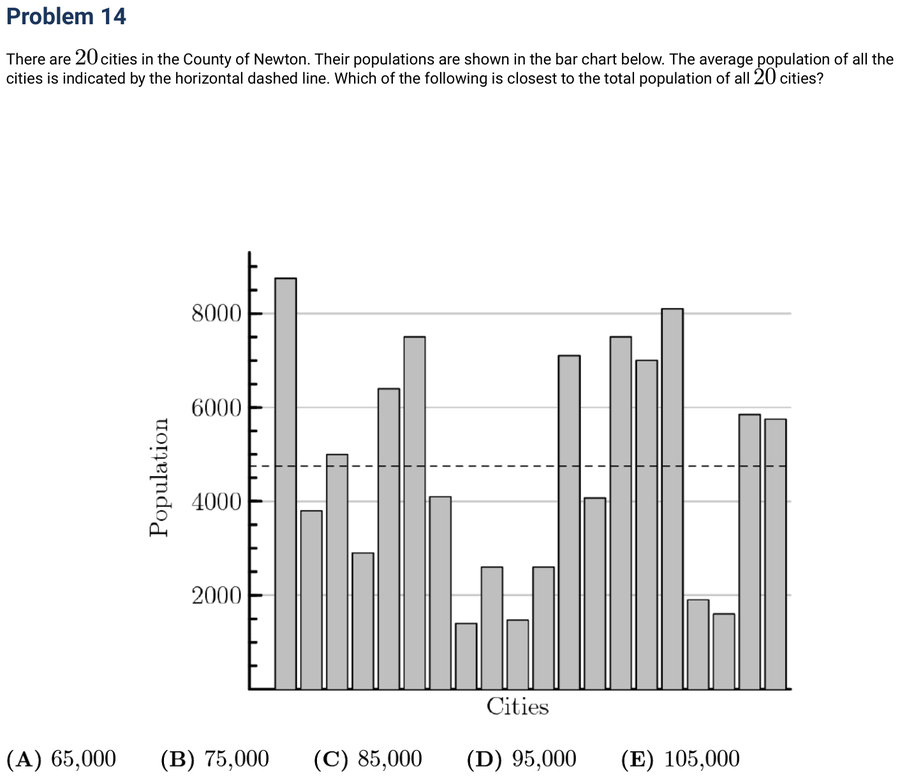
amc8-2020-14
Show answer
Answer: D — Closest to 95,000.
Show hints
Hint 1 of 2
Total = average × number of cities. The dashed line shows the average.
Still stuck? Show hint 2 →
Hint 2 of 2
Average reads ~4750. Multiply by 20.
Show solution
Approach: total = average × count
  1. The dashed line marks the average at about 4,750.
  2. Total population ≈ 4,750 × 20 = 95,000.
Mark: · log in to save
Problem 19 · 2016 AMC 8 Easy
Arithmetic & Operations arithmetic-sequence

The sum of 25 consecutive even integers is 10,000. What is the largest of these 25 consecutive integers?

Show answer
Answer: E — 424.
Show hint
Hint 1
For an odd number of terms in arithmetic progression, the middle term equals the average. Then the largest is 12 steps above.
Show solution
Approach: average = middle term; largest = middle + 12 steps
  1. Average = 10,000 / 25 = 400. With 25 consecutive evens, the middle (13th) term is 400.
  2. The largest is 12 steps of 2 above: 400 + 24 = 424.
Mark: · log in to save
Problem 18 · 2002 AMC 8 Hard
Arithmetic & Operations total-then-divide

Gage skated 1 hr 15 min each day for 5 days and 1 hr 30 min each day for 3 days. How long would he have to skate the ninth day in order to average 85 minutes of skating each day for the entire time?

Show answer
Answer: E — 2 hours.
Show hints
Hint 1 of 2
Compare each day to the 85-minute target instead of adding everything up.
Still stuck? Show hint 2 →
Hint 2 of 2
The first 5 days fall short of 85 and the next 3 go over โ€” track the running shortfall.
Show solution
Approach: measure each day against the 85-minute target
  1. Against an 85-minute target, each of the 5 days at 75 min is 10 short (โˆ’50 total), and each of the 3 days at 90 min is 5 over (+15 total).
  2. That leaves a shortfall of 50 โˆ’ 15 = 35 minutes, so day 9 must be 85 + 35 = 120 minutes = 2 hours.
Another way — totals:
  1. Skated so far: 5ยท75 + 3ยท90 = 645 min. Needed for the average: 9ยท85 = 765 min.
  2. Day 9 = 765 โˆ’ 645 = 120 min = 2 hours.
Mark: · log in to save
Problem 14 · 1997 AJHSME Hard
Arithmetic & Operations mean-median-mode

A set of five positive integers has mean 5, median 5, and 8 as its only mode. What is the difference between the largest and smallest integers in the set?

Show answer
Answer: D — 7.
Show hints
Hint 1 of 2
The five numbers sum to 5 ร— 5 = 25, and the mode 8 means two of them are 8.
Still stuck? Show hint 2 →
Hint 2 of 2
The median 5 is the middle value; the two smallest must be distinct and add to what's left.
Show solution
Approach: use the sum, mode, and median together
  1. The numbers total 25; two 8s (the only mode) account for 16, and the median forces the middle value 5, leaving 4 for the two smallest.
  2. Distinct positive integers adding to 4 are 1 and 3, giving {1, 3, 5, 8, 8} and a difference of 8 โˆ’ 1 = 7.
Mark: · log in to save
Problem 19 · 1995 AJHSME Hard
Arithmetic & Operations medianread-graph
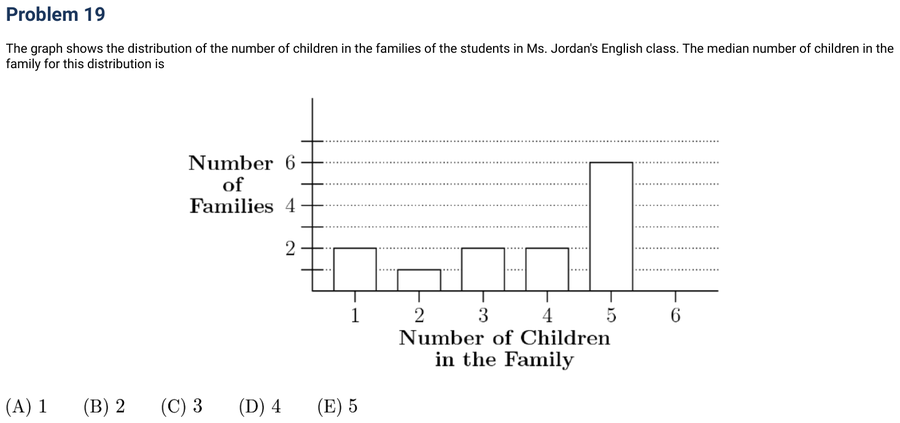
ajhsme-1995-19
Show answer
Answer: D — 4.
Show hints
Hint 1 of 2
Add up the bar heights to get the total number of families.
Still stuck? Show hint 2 →
Hint 2 of 2
The median is the middle value once all families are lined up in order.
Show solution
Approach: find the middle value of the ordered data
  1. The bars give 2, 1, 2, 2, 6 families for 1, 2, 3, 4, 5 children โ€” 13 families total.
  2. The 7th value (the middle of 13) falls in the '4 children' group, so the median is 4.
Mark: · log in to save
Problem 11 · 1993 AJHSME Hard
Arithmetic & Operations mediancumulative-count
ajhsme-1993-11
Show answer
Answer: C — 70.
Show hints
Hint 1 of 2
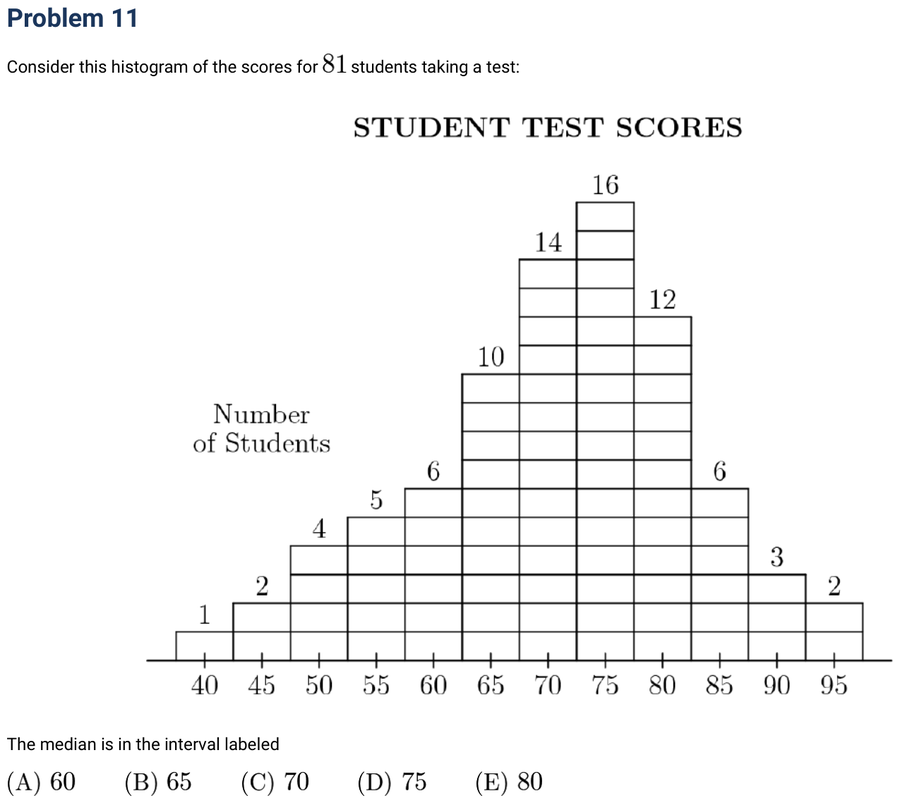
With 81 students, the median is the 41st score from the bottom.
Still stuck? Show hint 2 →
Hint 2 of 2
Add bar heights from the left until you pass 41.
Show solution
Approach: count up to the middle student
  1. The median is the 41st of 81 students. Adding the bars from the low end: 1, 3, 7, 12, 18, 28, 42 โ€” the running total passes 41 at the 70 bar.
  2. So the median lies in the interval labeled 70.
Mark: · log in to save
Problem 12 · 1993 AJHSME Hard
Arithmetic & Operations order-of-operationstrial

If each of the three operation signs +, −, × is used exactly once in one of the blanks in the expression 5 __ 4 __ 6 __ 3, then the value of the result could equal

Show answer
Answer: E — 19.
Show hints
Hint 1 of 2
Remember multiplication happens before addition and subtraction.
Still stuck? Show hint 2 →
Hint 2 of 2
Try placing ร— between 6 and 3.
Show solution
Approach: try placements, respecting order of operations
  1. Take 5 โˆ’ 4 + 6 ร— 3: the multiplication gives 18 first.
  2. Then 5 โˆ’ 4 + 18 = 19, using each sign once.
Mark: · log in to save
Problem 13 · 1992 AJHSME Hard
Arithmetic & Operations mean-median-mode

Five test scores have a mean of 90, a median of 91, and a mode of 94. The sum of the two lowest test scores is

Show answer
Answer: B — 171.
Show hints
Hint 1 of 2
The five scores total 5 ร— 90; the median is the 3rd score.
Still stuck? Show hint 2 →
Hint 2 of 2
The mode 94 must be the two highest scores.
Show solution
Approach: pin the top three, then subtract
  1. The scores total 450. The median is 91 (the 3rd), and the mode 94 (twice) must be the 4th and 5th: so the top three are 91, 94, 94 = 279.
  2. The two lowest sum to 450 โˆ’ 279 = 171.
Mark: · log in to save
Problem 7 · 1991 AJHSME Hard
Arithmetic & Operations estimationfactoring

The value of (487,000)(12,027,300) + (9,621,001)(487,000)(19,367)(.05) is closest to

Show answer
Answer: D — About 10,000,000,000.
Show hints
Hint 1 of 2
The numerator has 487,000 as a common factor โ€” pull it out.
Still stuck? Show hint 2 →
Hint 2 of 2
Then round each piece to a power of ten.
Show solution
Approach: factor, then estimate with powers of ten
  1. The numerator is 487,000 ร— (12,027,300 + 9,621,001) โ‰ˆ (5 ร— 10โต)(2 ร— 10โท) = 10ยนยณ.
  2. The denominator is about (2 ร— 10โด)(0.05) = 10ยณ, so the value โ‰ˆ 10ยนยณ รท 10ยณ = 10ยนโฐ.
Mark: · log in to save
Problem 13 · 1990 AJHSME Hard
Arithmetic & Operations round-uprate

One proposal for new postage rates for a letter was 30 cents for the first ounce and 22 cents for each additional ounce (or fraction of an ounce). The postage for a letter weighing 4.5 ounces was

Show answer
Answer: C — 1.18 dollars.
Show hints
Hint 1 of 2
After the first ounce, 3.5 ounces remain โ€” each fraction counts as a whole charge.
Still stuck? Show hint 2 →
Hint 2 of 2
Round 3.5 up to 4 additional charges.
Show solution
Approach: first ounce plus rounded-up additional ounces
  1. After the first ounce (30ยข), 3.5 ounces remain, charged as 4 additional ounces.
  2. Total = 30 + 4 ร— 22 = 118ยข = $1.18.
Mark: · log in to save
Problem 20 · 1990 AJHSME Hard
Arithmetic & Operations mean-error

The annual incomes of 1,000 families range from 8200 dollars to 98,000 dollars. In error, the largest income was entered on the computer as 980,000 dollars. The difference between the mean of the incorrect data and the mean of the actual data is

Show answer
Answer: A — 882 dollars.
Show hints
Hint 1 of 2
Only one entry changed, so the totals differ by that one error.
Still stuck? Show hint 2 →
Hint 2 of 2
Divide the size of the error by the number of families.
Show solution
Approach: spread the single error over all families
  1. The wrong entry overstates the total by 980,000 โˆ’ 98,000 = 882,000.
  2. Over 1,000 families, the mean is off by 882,000 รท 1000 = $882.
Mark: · log in to save
Problem 9 · 2026 AMC 8 Medium
Arithmetic & Operations simplify-radicals

What is the value of this expression?

16√8181√16
Show answer
Answer: B — 2/3.
Show hints
Hint 1 of 2
Work the inner square roots first: โˆš81 = 9 and โˆš16 = 4.
Still stuck? Show hint 2 →
Hint 2 of 2
Then take the outer square roots of the two products.
Show solution
Approach: simplify inside-out
  1. Inside the radicals, 16โˆš81 = 16 ยท 9 = 144 and 81โˆš16 = 81 ยท 4 = 324.
  2. So the value is โˆš144 / โˆš324 = 12 / 18 = 2/3.
Mark: · log in to save
Problem 9 · 2025 AMC 8 Medium
Arithmetic & Operations arithmetic-series
amc8-2025-09
Show answer
Answer: B — 6.5.
Show hints
Hint 1 of 2
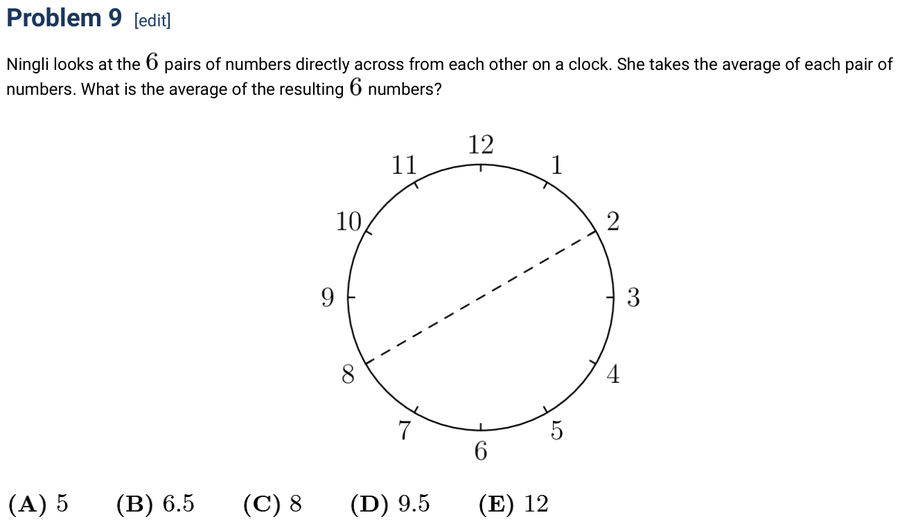
Each of the 12 clock numbers appears in exactly one pair. So the 6 pair-averages together "see" all 12 numbers.
Still stuck? Show hint 2 →
Hint 2 of 2
When every number shows up exactly once across the pairs, the average of the pair-averages equals the average of all 12 numbers.
Show solution
Approach: average of pair-averages = overall average
  1. The six pairs together include every clock number 1–12 exactly once, so the average of the six pair-averages is the same as the average of 1–12.
  2. 1–12 are evenly spaced, so their average is the midpoint: (1 + 12)/2 = 6.5.
Mark: · log in to save
Problem 6 · 2023 AMC 8 Medium
Arithmetic & Operations order-of-operationscasework

The digits 2, 0, 2, and 3 are placed in the expression below, one digit per box. What is the maximum possible value of the expression?

×
Show answer
Answer: C — 9.
Show hints
Hint 1 of 2
Where should the 0 go to not kill the answer? Putting 0 in the base or as a factor makes things bad — what about as an exponent?
Still stuck? Show hint 2 →
Hint 2 of 2
Use 0 as an exponent (anything0 = 1) so that side becomes 1. Then maximize the other side with the digits {2, 2, 3}.
Show solution
Approach: place 0 as an exponent, maximize the rest
  1. If 0 goes in a base or as a stand-alone factor, the product is 0. Use 0 as an exponent — that side becomes 1.
  2. The other side is baseexp using {2, 2, 3}: 23 = 8, 32 = 9, 22 = 4 (one digit unused). The largest is 32 = 9.
  3. Maximum product: 1 × 9 = 9.
Mark: · log in to save
Problem 7 · 2019 AMC 8 Easy
Arithmetic & Operations sum-constraintestimate-and-pick

Shauna takes five tests, each worth a maximum of 100 points. Her scores on the first three tests are 76, 94, and 87. In order to average 81 for all five tests, what is the lowest score she could earn on one of the other two tests?

Show answer
Answer: A — 48.
Show hints
Hint 1 of 2
To minimize one of the two remaining scores, max out the other (= 100). Then the rest is forced.
Still stuck? Show hint 2 →
Hint 2 of 2
Total needed: 5 × 81 = 405. First three sum to 257. Remaining two must sum to 148, so the minimum is 148 − 100.
Show solution
Approach: max the partner, minimize the other
  1. Total required: 5 × 81 = 405. First three tests: 76 + 94 + 87 = 257.
  2. Remaining two tests must total 405 − 257 = 148.
  3. To minimize one, set the other to 100: minimum = 148 − 100 = 48.
Mark: · log in to save
Problem 10 · 2019 AMC 8 Medium
Arithmetic & Operations careful-counting
amc8-2019-10
Show answer
Answer: B — Mean +1, median +1.
Show hints
Hint 1 of 2
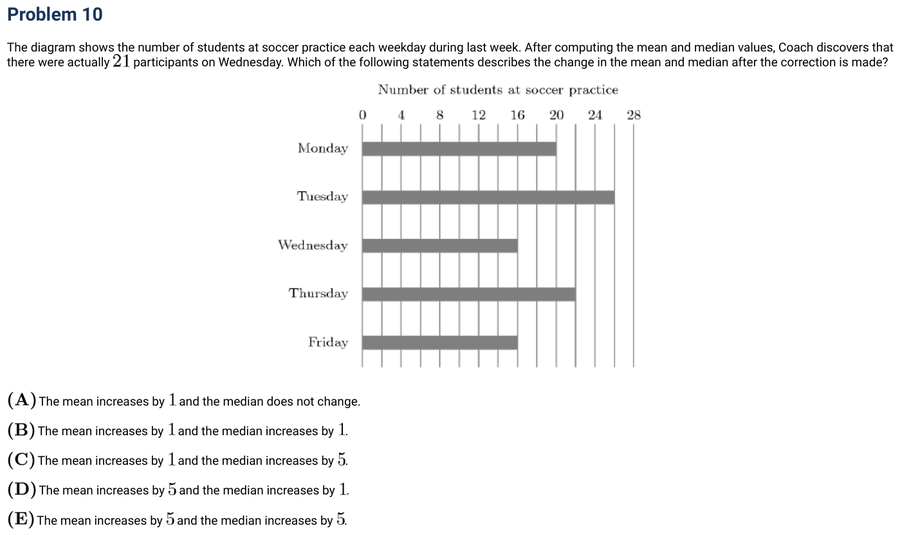
Changing Wednesday from 16 to 21 adds 5 to the total; the mean of 5 days goes up by 5/5 = 1.
Still stuck? Show hint 2 →
Hint 2 of 2
Recompute the sorted order. The middle value of the corrected list slides up by 1.
Show solution
Approach: track the change in total and the new sorted middle
  1. Wednesday changes from 16 to 21, a total increase of 5. With 5 days, the mean rises by 5/5 = 1.
  2. Original sorted days: 16, 18, 20, 22, 26 → median 20. After correction: 18, 20, 21, 22, 26 → median 21. Median rises by 1.
  3. Answer: both increase by 1.
Mark: · log in to save
Problem 8 · 2018 AMC 8 Easy
Arithmetic & Operations careful-counting
amc8-2018-08
Show answer
Answer: C — 4.36.
Show hints
Hint 1 of 2
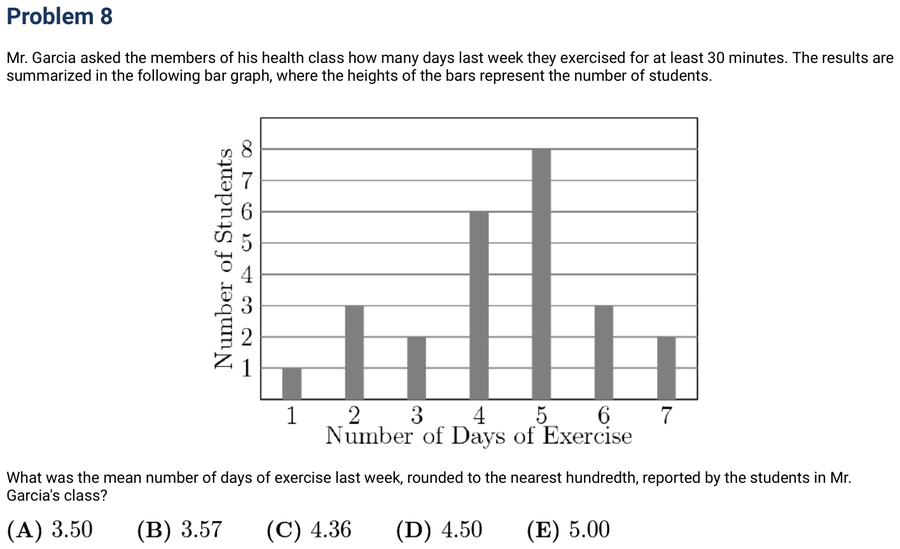
Mean = (total days) ÷ (total students). Read each bar's height to get the count of students for each day-value.
Still stuck? Show hint 2 →
Hint 2 of 2
Total days = 1·1 + 3·2 + 2·3 + 6·4 + 8·5 + 3·6 + 2·7. Total students = sum of heights.
Show solution
Approach: weighted mean from the bar heights
  1. Students per day-count (1 to 7 days): 1, 3, 2, 6, 8, 3, 2. Total students: 1+3+2+6+8+3+2 = 25.
  2. Total days: 1·1 + 3·2 + 2·3 + 6·4 + 8·5 + 3·6 + 2·7 = 1 + 6 + 6 + 24 + 40 + 18 + 14 = 109.
  3. Mean = 109 / 25 = 4.36.
Mark: · log in to save
Problem 6 · 2016 AMC 8 Easy
Arithmetic & Operations careful-counting
amc8-2016-06
Show answer
Answer: B — Median = 4.
Show hint
Hint 1
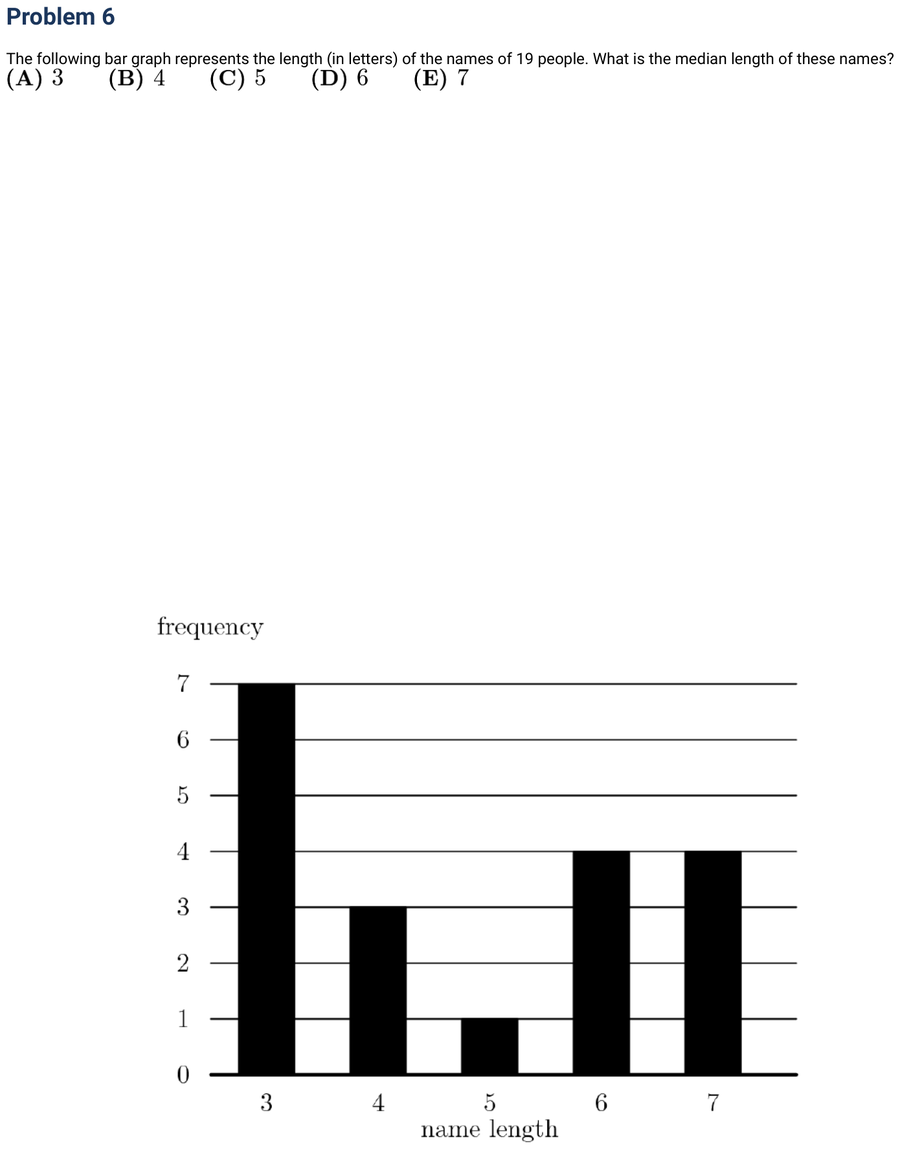
19 names ⇒ median is the 10th. Read the bars left-to-right and count until you hit position 10.
Show solution
Approach: find the 10th value
  1. Counts by length: 7 at length 3, 3 at length 4, 1 at length 5, 4 at length 6, 4 at length 7. (Total 19 ✓.)
  2. Sorted, positions 1–7 are 3s, positions 8–10 are 4s, so the 10th value is 4.
Mark: · log in to save
Problem 8 · 2016 AMC 8 Easy
Arithmetic & Operations groupingarithmetic-series

Find the value of the expression

100 − 98 + 96 − 94 + 92 − 90 + … + 8 − 6 + 4 − 2.
Show answer
Answer: C — 50.
Show hint
Hint 1
Group as (100 − 98) + (96 − 94) + … Each pair equals 2.
Show solution
Approach: pair adjacent terms
  1. (100 − 98) + (96 − 94) + … + (4 − 2) — each pair = 2.
  2. Pairs span 100 down to 2 in steps of 4 (each pair drops by 4): (100 − 4)/4 + 1 = 25 pairs.
  3. Total: 25 × 2 = 50.
Mark: · log in to save
Problem 7 · 2003 AMC 8 Medium
Arithmetic & Operations total-then-divide

Blake and Jenny each took four 100-point tests. Blake averaged 78 on the four tests. Compared with Blake, Jenny scored 10 points higher on the first test, 10 points lower on the second, and 20 points higher on each of the third and fourth. By how much does Jenny's average exceed Blake's on these four tests?

Show answer
Answer: A — 10 points.
Show hint
Hint 1
You never need Blake's actual average — just track how far ahead or behind Jenny is on each test.
Show solution
Approach: average the point differences
  1. Jenny's differences from Blake are +10, −10, +20, +20, which total +40.
  2. Her average is ahead by 40 ÷ 4 = 10 points.
Mark: · log in to save
Problem 10 · 2003 AMC 8 Medium
Arithmetic & Operations divisionproportion

Art, Roger, Paul, and Trisha bake cookies that are all the same thickness, in the shapes shown below (dimensions in inches). Each friend uses the same amount of dough, and Art's batch makes exactly 12 cookies.

How many cookies will be in one batch of Trisha's cookies?

Show answer
Answer: E — 24 cookies.
Show hint
Hint 1
A batch is the dough that makes 12 of Art's cookies. How does Trisha's cookie size compare to Art's?
Show solution
Approach: compare Trisha's cookie to Art's
  1. A batch is the dough for 12 of Art's 12 in² cookies, i.e. 144 in².
  2. Trisha's cookies are ½(3)(4) = 6 in², exactly half of Art's, so she makes twice as many: 24.
Mark: · log in to save
Problem 8 · 2002 AMC 8 Medium
Arithmetic & Operations read-tablecareful-counting

Juan organizes the stamps in his collection by country and by the decade in which they were issued. He paid these prices at the stamp shop: Brazil and France, 6¢ each; Peru, 4¢ each; and Spain, 5¢ each. (Brazil and Peru are South American countries; France and Spain are European.) The table shows how many stamps he has from each country and decade.

How many of his European stamps were issued in the 1980s?

Number of Stamps by Decade
Country'50s'60s'70s'80s
Brazil47128
France841215
Peru64610
Spain39139
Show answer
Answer: D — 24.
Show hints
Hint 1 of 2
France and Spain are the European countries.
Still stuck? Show hint 2 →
Hint 2 of 2
Add their two entries in the 1980s column.
Show solution
Approach: read the European rows in the 1980s column
  1. The European countries are France and Spain.
  2. In the 1980s they have 15 and 9 stamps: 15 + 9 = 24.
Mark: · log in to save
Problem 9 · 2002 AMC 8 Medium
Arithmetic & Operations read-tablecareful-counting

Juan organizes the stamps in his collection by country and by the decade in which they were issued. He paid these prices at the stamp shop: Brazil and France, 6¢ each; Peru, 4¢ each; and Spain, 5¢ each. (Brazil and Peru are South American countries; France and Spain are European.) The table shows how many stamps he has from each country and decade.

His South American stamps issued before the 1970s cost him how much?

Number of Stamps by Decade
Country'50s'60s'70s'80s
Brazil47128
France841215
Peru64610
Spain39139
Show answer
Answer: B — $1.06.
Show hints
Hint 1 of 2
South American means Brazil and Peru; โ€œbefore the 1970sโ€ means the '50s and '60s columns.
Still stuck? Show hint 2 →
Hint 2 of 2
Multiply each country's stamp count by its price, then add.
Show solution
Approach: count the right cells, then multiply by price
  1. Brazil and Peru are South American; before the 1970s covers the '50s and '60s.
  2. Brazil: 4 + 7 = 11 stamps at 6¢ = 66¢. Peru: 6 + 4 = 10 stamps at 4¢ = 40¢.
  3. Total: 66¢ + 40¢ = 106¢ = $1.06.
Mark: · log in to save
Problem 10 · 2002 AMC 8 Medium
Arithmetic & Operations read-tabletotal-then-divideestimate-and-pick

Juan organizes the stamps in his collection by country and by the decade in which they were issued. He paid these prices at the stamp shop: Brazil and France, 6¢ each; Peru, 4¢ each; and Spain, 5¢ each. (Brazil and Peru are South American countries; France and Spain are European.) The table shows how many stamps he has from each country and decade.

The average price of his 1970s stamps is closest to which value?

Number of Stamps by Decade
Country'50s'60s'70s'80s
Brazil47128
France841215
Peru64610
Spain39139
Show answer
Answer: E — About 5.4 cents.
Show hints
Hint 1 of 2
Average price = total cost of the 1970s stamps ÷ how many there are.
Still stuck? Show hint 2 →
Hint 2 of 2
Use the whole 1970s column across all four countries.
Show solution
Approach: weighted average over the 1970s column
  1. 1970s stamps: Brazil 12 and France 12 at 6¢, Peru 6 at 4¢, Spain 13 at 5¢.
  2. Total cost: 12×6 + 12×6 + 6×4 + 13×5 = 72 + 72 + 24 + 65 = 233¢, over 12 + 12 + 6 + 13 = 43 stamps.
  3. 233 ÷ 43 ≈ 5.4, so the average is closest to 5.4 cents.
Mark: · log in to save
Problem 6 · 2001 AMC 8 Medium
Arithmetic & Operations off-by-one

Six trees are equally spaced along one side of a straight road. The distance from the first tree to the fourth is 60 feet. What is the distance in feet between the first and last trees?

Show answer
Answer: B — 100 feet.
Show hints
Hint 1 of 2
Count the gaps between trees, not the trees themselves.
Still stuck? Show hint 2 →
Hint 2 of 2
First-to-fourth spans 3 gaps; first-to-last spans 5.
Show solution
Approach: count gaps, not trees
  1. From the first tree to the fourth there are 3 gaps, so each gap is 60 รท 3 = 20 feet.
  2. From the first to the sixth tree there are 5 gaps: 5 ร— 20 = 100 feet.
Mark: · log in to save
Problem 7 · 2000 AMC 8 Medium
Arithmetic & Operations number-systemscareful-counting

What is the minimum possible product of three different numbers of the set {โˆ’8, โˆ’6, โˆ’4, 0, 3, 5, 7}?

Show answer
Answer: B — โˆ’280.
Show hints
Hint 1 of 2
A product of three numbers is negative when you use one negative or all three negatives.
Still stuck? Show hint 2 →
Hint 2 of 2
Compare the two extreme options against each other.
Show solution
Approach: make the product as negative as possible
  1. For the most negative product, try one negative with the two largest positives, or all three negatives.
  2. (โˆ’8)(5)(7) = โˆ’280 beats (โˆ’8)(โˆ’6)(โˆ’4) = โˆ’192, so the minimum is โˆ’280.
Mark: · log in to save
Problem 8 · 2000 AMC 8 Medium
Arithmetic & Operations complementary-counting
amc8-2000-08
Show answer
Answer: D — 41.
Show hints
Hint 1 of 2
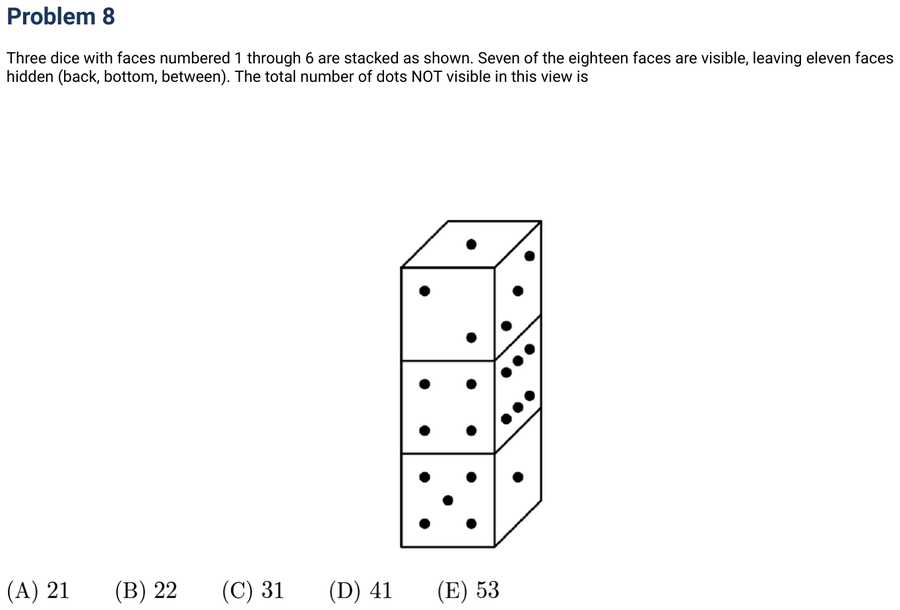
The six faces of one die always total 1+2+3+4+5+6 = 21.
Still stuck? Show hint 2 →
Hint 2 of 2
Subtract the visible dots from the total of all three dice.
Show solution
Approach: total of all faces minus the visible ones
  1. All three dice together have 3 ร— 21 = 63 dots.
  2. The seven visible faces show 1 + 1 + 2 + 3 + 4 + 5 + 6 = 22, so the hidden dots total 63 โˆ’ 22 = 41.
Mark: · log in to save
Problem 12 · 2000 AMC 8 Medium
Arithmetic & Operations careful-counting
amc8-2000-12
Show answer
Answer: D — 353 blocks.
Show hints
Hint 1 of 2
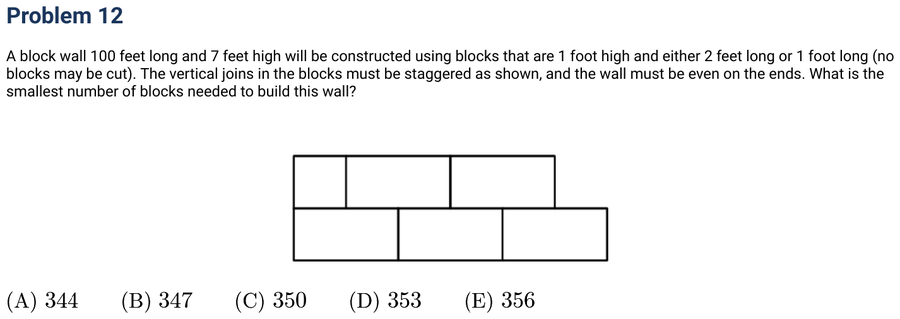
Each row is 100 ft long โ€” find the cheapest way to fill one row.
Still stuck? Show hint 2 →
Hint 2 of 2
Staggering the joints forces the alternate rows to use a 1-ft block at each end.
Show solution
Approach: count blocks row by row
  1. A row of all 2-ft blocks needs 100 รท 2 = 50 blocks. To stagger the joints, the in-between rows use 49 two-ft blocks plus a 1-ft block on each end = 51 blocks.
  2. Four rows of 50 and three rows of 51: 200 + 153 = 353 blocks.
Mark: · log in to save
Problem 13 · 1999 AMC 8 Medium
Arithmetic & Operations averagetotals

The average age of the 40 members of a computer science camp is 17 years. There are 20 girls, 15 boys, and 5 adults. If the average age of the girls is 15 and the average age of the boys is 16, what is the average age of the adults?

Show answer
Answer: C — 28 years.
Show hints
Hint 1 of 2
Work with total ages, not averages: everyone's ages add to 40 ร— 17.
Still stuck? Show hint 2 →
Hint 2 of 2
Subtract the girls' and boys' totals to leave the adults' total.
Show solution
Approach: convert averages to totals
  1. All 40 ages total 40 ร— 17 = 680. Girls total 20 ร— 15 = 300 and boys total 15 ร— 16 = 240.
  2. Adults total 680 โˆ’ 300 โˆ’ 240 = 140, so their average is 140 รท 5 = 28.
Mark: · log in to save
Problem 17 · 1999 AMC 8 Medium
Arithmetic & Operations round-upunit-conversion

Cookies for a Crowd. At a school, 108 students eat an average of 2 cookies apiece. The recipe makes a pan of 15 cookies and uses 2 eggs per pan, and only full recipes are made. Walter buys eggs by the half-dozen. How many half-dozens should he buy to make enough cookies?

Show answer
Answer: C — 5 half-dozens.
Show hints
Hint 1 of 2
First find how many full pans of 15 cookies cover all the cookies needed.
Still stuck? Show hint 2 →
Hint 2 of 2
Then count the eggs and split them into half-dozens (6 each).
Show solution
Approach: cookies โ†’ pans โ†’ eggs โ†’ half-dozens
  1. The students eat 108 ร— 2 = 216 cookies, needing 216 รท 15 = 14.4 โ†’ 15 full pans.
  2. That's 15 ร— 2 = 30 eggs, or 30 รท 6 = 5 half-dozens.
Mark: · log in to save
Problem 19 · 1999 AMC 8 Medium
Arithmetic & Operations round-upunit-conversion

Cookies for a Crowd. The recipe makes a pan of 15 cookies using 3 tablespoons of butter, and only full recipes are made. Walter and Gretel must supply 216 cookies. There are 8 tablespoons in a stick of butter. How many sticks of butter are needed?

Show answer
Answer: B — 6 sticks.
Show hints
Hint 1 of 2
Find the number of full pans for 216 cookies, then the butter they use.
Still stuck? Show hint 2 →
Hint 2 of 2
Convert tablespoons to sticks (8 per stick), rounding up.
Show solution
Approach: pans โ†’ tablespoons โ†’ sticks
  1. 216 cookies need 216 รท 15 = 14.4 โ†’ 15 pans, using 15 ร— 3 = 45 tablespoons of butter.
  2. At 8 tablespoons per stick, that's 45 รท 8 = 5.6 โ†’ 6 sticks.
Mark: · log in to save
Problem 7 · 1998 AJHSME Medium
Arithmetic & Operations regrouping

100 × 19.98 × 1.998 × 1000 =

Show answer
Answer: D — (1998)ยฒ.
Show hints
Hint 1 of 2
Pair the factors so each pair makes the same round number.
Still stuck? Show hint 2 →
Hint 2 of 2
100 ร— 19.98 and 1.998 ร— 1000 are both 1998.
Show solution
Approach: pair factors into 1998 ร— 1998
  1. Group as (100 ร— 19.98) ร— (1.998 ร— 1000) = 1998 ร— 1998.
  2. That is (1998)ยฒ.
Mark: · log in to save
Problem 8 · 1997 AJHSME Medium
Arithmetic & Operations total-minus-parts

Walter catches the school bus at 7:30 a.m., has 6 classes that last 50 minutes each, has 30 minutes for lunch, and has 2 hours of additional time at school. He takes the bus home and arrives at 4:00 p.m. How many minutes has he spent on the bus?

Show answer
Answer: B — 60 minutes.
Show hints
Hint 1 of 2
Find the whole stretch from 7:30 a.m. to 4:00 p.m. in minutes.
Still stuck? Show hint 2 →
Hint 2 of 2
Subtract all the time accounted for at school.
Show solution
Approach: total time minus time spent at school
  1. From 7:30 a.m. to 4:00 p.m. is 8.5 hours = 510 minutes; school uses 6ยท50 + 30 + 2ยท60 = 450 minutes.
  2. The bus rides take the rest: 510 โˆ’ 450 = 60 minutes.
Mark: · log in to save
Problem 5 · 1996 AJHSME Medium
Arithmetic & Operations sign-analysisnumber-line
ajhsme-1996-05
Show answer
Answer: A — P โˆ’ Q.
Show hints
Hint 1 of 2
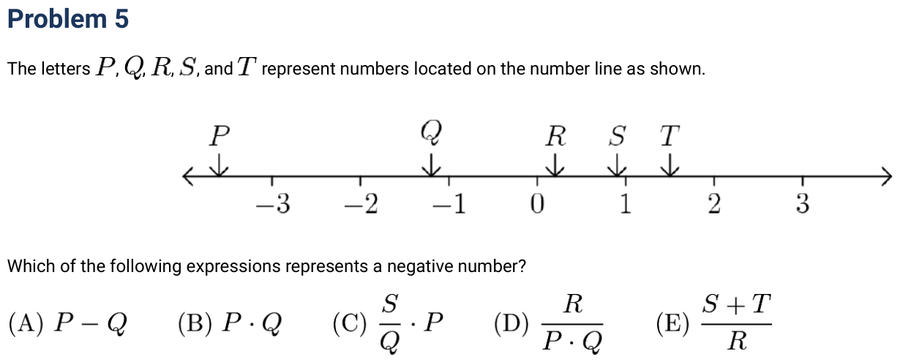
Read each letter's sign and rough size from the number line.
Still stuck? Show hint 2 →
Hint 2 of 2
A difference is negative when you subtract a larger number from a smaller one.
Show solution
Approach: check each expression's sign
  1. From the line, P โ‰ˆ โˆ’2.7 and Q โ‰ˆ โˆ’1, while R, S, T are positive.
  2. P โˆ’ Q โ‰ˆ โˆ’2.7 โˆ’ (โˆ’1) = โˆ’1.7 is negative; the other four expressions all come out positive.
  3. So P โˆ’ Q is the negative one.
Mark: · log in to save
Problem 8 · 1996 AJHSME Medium
Arithmetic & Operations number-lineextremal

Points A and B are 10 units apart. Points B and C are 4 units apart. Points C and D are 3 units apart. If A and D are as close as possible, then the number of units between them is

Show answer
Answer: B — 3 units.
Show hints
Hint 1 of 2
Walk from A: out 10, then come back as much as possible.
Still stuck? Show hint 2 →
Hint 2 of 2
The best you can backtrack is 4 + 3 = 7.
Show solution
Approach: go out 10, backtrack 4 then 3
  1. Place B 10 from A, then step C back 4 and D back another 3: A is at 0, D ends at 10 โˆ’ 4 โˆ’ 3 = 3.
  2. You can't reach 0 (10 โ‰  4 + 3), so the closest is 3 units.
Mark: · log in to save
Problem 12 · 1996 AJHSME Medium
Arithmetic & Operations average-sum

What number should be removed from the list 1, 2, 3, 4, 5, 6, 7, 8, 9, 10, 11 so that the average of the remaining numbers is 6.1?

Show answer
Answer: B — 5.
Show hints
Hint 1 of 2
Find the total of all 11 numbers, then the total the 10 remaining must have.
Still stuck? Show hint 2 →
Hint 2 of 2
The difference is the removed number.
Show solution
Approach: compare the sums before and after
  1. The eleven numbers total 66; the remaining ten must total 6.1 ร— 10 = 61.
  2. So the removed number is 66 โˆ’ 61 = 5.
Mark: · log in to save
Problem 4 · 1995 AJHSME Medium
Arithmetic & Operations two-step-process

A teacher tells the class: "Think of a number, add 1 to it, and double the result. Give the answer to your partner. Partner, subtract 1 from the number you are given and double the result to get your answer." Ben thinks of 6 and gives his answer to Sue. What should Sue's answer be?

Show answer
Answer: C — 26.
Show hints
Hint 1 of 2
Compute Ben's answer first, then feed it into Sue's steps.
Still stuck? Show hint 2 →
Hint 2 of 2
Each person does: (something ยฑ 1) then double.
Show solution
Approach: run the two stages in order
  1. Ben: (6 + 1) ร— 2 = 14, which he gives to Sue.
  2. Sue: (14 โˆ’ 1) ร— 2 = 26.
Mark: · log in to save
Problem 3 · 1994 AJHSME Medium
Arithmetic & Operations time-arithmetic

Each day Maria must work 8 hours. This does not include the 45 minutes she takes for lunch. If she begins working at 7:25 A.M. and takes her lunch break at noon, then her working day will end at

Show answer
Answer: C — 4:10 P.M.
Show hints
Hint 1 of 2
Find how much she works before lunch, then how much is left.
Still stuck? Show hint 2 →
Hint 2 of 2
Don't forget the 45-minute lunch pushes the afternoon back.
Show solution
Approach: split the workday around lunch
  1. From 7:25 to noon she works 4 h 35 min, leaving 8 h โˆ’ 4 h 35 min = 3 h 25 min.
  2. Lunch ends at 12:45, and 3 h 25 min later is 4:10 P.M.
Mark: · log in to save
Problem 4 · 1993 AJHSME Medium
Arithmetic & Operations regrouping

1000 × 1993 × 0.1993 × 10 =

Show answer
Answer: E — (1993)ยฒ.
Show hints
Hint 1 of 2
Group the powers of ten with the decimal.
Still stuck? Show hint 2 →
Hint 2 of 2
1000 ร— 0.1993 ร— 10 collapses neatly.
Show solution
Approach: regroup the factors
  1. 1000 ร— 0.1993 ร— 10 = 1993, leaving 1993 ร— 1993.
  2. So the product is (1993)ยฒ.
Mark: · log in to save
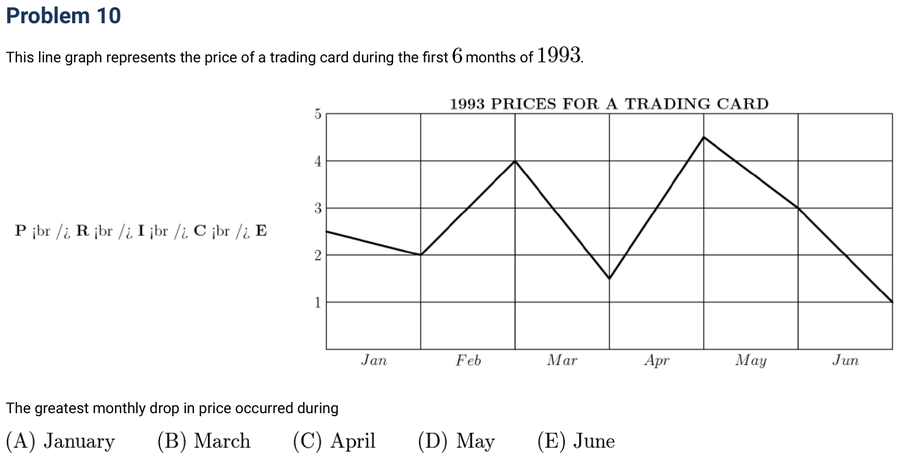
Problem 10 · 1993 AJHSME Medium
Arithmetic & Operations read-graph
ajhsme-1993-10
Show answer
Answer: B — March.
Show hints
Hint 1 of 2
A 'drop' is a downward segment of the line.
Still stuck? Show hint 2 →
Hint 2 of 2
Compare the sizes of the downward steps and pick the steepest one.
Show solution
Approach: compare the downward steps
  1. Look only at the segments where the price falls and measure how far each drops.
  2. The steepest downward step starts at the March price, so the greatest monthly drop occurred during March.
Mark: · log in to save
Problem 15 · 1993 AJHSME Medium
Arithmetic & Operations average-sum

The arithmetic mean (average) of four numbers is 85. If the largest of these numbers is 97, then the mean of the remaining three numbers is

Show answer
Answer: A — 81.0.
Show hints
Hint 1 of 2
Find the total of all four numbers from the mean.
Still stuck? Show hint 2 →
Hint 2 of 2
Remove the largest, then average the other three.
Show solution
Approach: work with the total
  1. The four numbers total 4 ร— 85 = 340; removing 97 leaves 243.
  2. Their mean is 243 รท 3 = 81.0.
Mark: · log in to save
Problem 1 · 1992 AJHSME Medium
Arithmetic & Operations pair-terms
10 − 9 + 8 − 7 + 6 − 5 + 4 − 3 + 2 − 11 − 2 + 3 − 4 + 5 − 6 + 7 − 8 + 9=
Show answer
Answer: B — 1.
Show hints
Hint 1 of 2
Pair consecutive terms in the top, and in the bottom, to add them up quickly.
Still stuck? Show hint 2 →
Hint 2 of 2
Both the numerator and the denominator come out to 5.
Show solution
Approach: pair terms in top and bottom
  1. Top: (10โˆ’9)+(8โˆ’7)+(6โˆ’5)+(4โˆ’3)+(2โˆ’1) = 5. Bottom: (1โˆ’2)+(3โˆ’4)+(5โˆ’6)+(7โˆ’8)+9 = โˆ’4+9 = 5.
  2. So the value is 5/5 = 1.
Mark: · log in to save
Problem 8 · 1991 AJHSME Medium
Arithmetic & Operations max-quotientsigns

What is the largest quotient that can be formed using two numbers chosen from the set {โˆ’24, โˆ’3, โˆ’2, 1, 2, 8}?

Show answer
Answer: D — 12.
Show hints
Hint 1 of 2
For a big positive quotient, divide a large-magnitude number by a small one.
Still stuck? Show hint 2 →
Hint 2 of 2
Two negatives divide to a positive.
Show solution
Approach: divide the largest magnitude by the smallest
  1. Dividing โˆ’24 by โˆ’2 gives a positive quotient of 12, the biggest possible.
  2. So the largest quotient is 12.
Mark: · log in to save
Problem 12 · 1991 AJHSME Medium
Arithmetic & Operations average

If 2 + 3 + 43 = 1990 + 1991 + 1992N, then N =

Show answer
Answer: D — 1991.
Show hints
Hint 1 of 2
The left side is the average of 2, 3, 4, which is 3.
Still stuck? Show hint 2 →
Hint 2 of 2
For the right side to equal 3, N must be the count that makes its average 3 โ€” i.e. the sum divided by 3.
Show solution
Approach: both sides are an average
  1. The left side equals 3. The right side is 5973/N, so 5973/N = 3 gives N = 5973 รท 3.
  2. That is N = 1991 (the middle of 1990, 1991, 1992).
Mark: · log in to save
Problem 7 · 1990 AJHSME Medium
Arithmetic & Operations sign-productmaximize

When three different numbers from the set {โˆ’3, โˆ’2, โˆ’1, 4, 5} are multiplied, the largest possible product is

Show answer
Answer: C — 30.
Show hints
Hint 1 of 2
A positive product needs an even number of negatives โ€” here, two.
Still stuck? Show hint 2 →
Hint 2 of 2
Pair the two most-negative numbers with the largest positive.
Show solution
Approach: two negatives times the biggest positive
  1. Using (โˆ’3)(โˆ’2) = 6 and the largest positive 5 gives a positive product.
  2. 6 ร— 5 = 30, the largest possible.
Mark: · log in to save
Problem 5 · 1989 AJHSME Medium
Arithmetic & Operations order-of-operations

โˆ’15 + 9 ร— (6 รท 3) =

Show answer
Answer: D — 3.
Show hint
Hint 1
Do the parentheses and multiplication before the addition.
Show solution
Approach: follow the order of operations
  1. 6 รท 3 = 2, then 9 ร— 2 = 18.
  2. Finally โˆ’15 + 18 = 3.
Mark: · log in to save
Problem 6 · 1989 AJHSME Medium
Arithmetic & Operations number-linespacing
ajhsme-1989-06
Show answer
Answer: C — 12.
Show hints
Hint 1 of 2
Count how many equal steps lie between 0 and 20 to find each step's size.
Still stuck? Show hint 2 →
Hint 2 of 2
Then count the steps from 0 up to y.
Show solution
Approach: find the step size, then count to y
  1. There are 5 equal steps from 0 to 20, so each step is 4. y sits 3 steps past 0.
  2. So y = 3 ร— 4 = 12.
Mark: · log in to save
Problem 7 · 1988 AJHSME Medium
Arithmetic & Operations round-and-multiply

2.46 ร— 8.163 ร— (5.17 + 4.829) is closest to

Show answer
Answer: B — 200.
Show hints
Hint 1 of 2
Round each factor to a friendly number.
Still stuck? Show hint 2 →
Hint 2 of 2
2.46 โ‰ˆ 2.5, 8.163 โ‰ˆ 8, the sum โ‰ˆ 10.
Show solution
Approach: round to easy numbers
  1. 2.46 ร— 8.163 ร— (5.17 + 4.829) โ‰ˆ 2.5 ร— 8 ร— 10.
  2. = 200.
Mark: · log in to save
Problem 6 · 1987 AJHSME Medium
Arithmetic & Operations sign-rules

The smallest product one could obtain by multiplying two numbers in the set {โˆ’7, โˆ’5, โˆ’1, 1, 3} is

Show answer
Answer: B — โˆ’21.
Show hints
Hint 1 of 2
A negative product needs one negative factor and one positive factor.
Still stuck? Show hint 2 →
Hint 2 of 2
Make the magnitudes as big as possible โ€” pair the biggest positive with the biggest-magnitude negative.
Show solution
Approach: biggest positive times most-negative
  1. For the most-negative product, pick the largest positive (3) and the most-negative number (โˆ’7).
  2. 3 ร— (โˆ’7) = โˆ’21.
Mark: · log in to save
Problem 10 · 1987 AJHSME Medium
Arithmetic & Operations factor-the-common-term

4(299) + 3(299) + 2(299) + 298 =

Show answer
Answer: B — 2989.
Show hints
Hint 1 of 2
Factor 299 from the first three terms.
Still stuck? Show hint 2 →
Hint 2 of 2
(4 + 3 + 2) ร— 299 = 9 ร— 299.
Show solution
Approach: factor and combine
  1. (4 + 3 + 2)(299) + 298 = 9 ร— 299 + 298 = 2691 + 298.
  2. = 2989.
Mark: · log in to save
Problem 8 · 1985 AJHSME Medium
Arithmetic & Operations substitute-and-compare

If a = โˆ’2, the largest number in the set โˆ’3a, 4a, 24โ„a, aยฒ, 1 is

Show answer
Answer: A — โˆ’3a.
Show hint
Hint 1
Substitute a = โˆ’2 in each expression and compare.
Show solution
Approach: substitute and pick the max
  1. โˆ’3(โˆ’2) = 6, 4(โˆ’2) = โˆ’8, 24โ„(โˆ’2) = โˆ’12, (โˆ’2)ยฒ = 4, 1.
  2. The largest is 6 = โˆ’3a.
Mark: · log in to save
Problem 21 · 2001 AMC 8 Stretch
Arithmetic & Operations sum-constraintwork-backward

The mean of a set of five different positive integers is 15. The median is 18. The maximum possible value of the largest of these five integers is

Show answer
Answer: D — 35.
Show hints
Hint 1 of 2
Mean 15 means the five numbers add to 75.
Still stuck? Show hint 2 →
Hint 2 of 2
To push one number as high as possible, make the other four as small as the rules allow.
Show solution
Approach: fix the total, minimize the others
  1. Five numbers averaging 15 sum to 5 ร— 15 = 75.
  2. The median (3rd value) is 18, so the two below it are the smallest distinct positives 1 and 2, and the 4th value is the smallest integer above 18, namely 19.
  3. The largest = 75 โˆ’ 1 โˆ’ 2 โˆ’ 18 โˆ’ 19 = 35.
Mark: · log in to save
Problem 23 · 2000 AMC 8 Stretch
Arithmetic & Operations average

There is a list of seven numbers. The average of the first four numbers is 5, and the average of the last four numbers is 8. If the average of all seven numbers is 647, then the number common to both sets of four numbers is

Show answer
Answer: B — 6.
Show hints
Hint 1 of 2
Add the two group-sums together โ€” every number is counted once, except the shared one, counted twice.
Still stuck? Show hint 2 →
Hint 2 of 2
So (sum of the two fours) minus (sum of all seven) leaves exactly the common number.
Show solution
Approach: the overlap gets counted twice
  1. The first four total 4 ยท 5 = 20 and the last four total 4 ยท 8 = 32. Adding gives 52, which counts every number once except the shared middle one, counted twice.
  2. All seven total 7 ยท 6โดโ„โ‚‡ = 46, counting each number once.
  3. Subtracting strips one copy of everything, leaving the doubled number: 52 โˆ’ 46 = 6.
Mark: · log in to save