Topic

Algebra & Patterns

Formulas, made-up operations, sequences.

Practice
Problem 4 · 2025 AMC 8 Medium
Algebra & Patterns arithmetic-sequenceoff-by-one

Lucius is counting backward by 7s. His first three numbers are 100, 93, and 86. What is his 10th number?

Show answer
Answer: B — 37.
Show hints
Hint 1 of 2
From the 1st number to the 10th, how many steps do you actually take?
Still stuck? Show hint 2 →
Hint 2 of 2
From the 1st number to the 10th you take 9 steps of 7. How much do you subtract in total?
Show solution
  1. Each step subtracts 7, and from the 1st to the 10th number is 9 steps.
  2. Total subtracted: 9 × 7 = 63.
  3. 10th number: 100 − 63 = 37.
Mark: · log in to save
Problem 3 · 2023 AMC 8 Medium
Algebra & Patterns evaluate-formula

Wind chill estimates how cold it feels in wind, using

(wind chill) = (air temperature) − 0.7 × (wind speed),

with temperature in °F and wind speed in mph. If the air temperature is 36°F and the wind speed is 18 mph, which is closest to the wind chill?

Show answer
Answer: B — About 23.
Show hint
Hint 1
Just put the numbers into the formula. Do the multiplication first, then subtract.
Show solution
  1. Multiply: 0.7 × 18 = 12.6.
  2. Subtract from the temperature: 36 − 12.6 = 23.4.
  3. The closest answer choice is 23.
Mark: · log in to save
Problem 2 · 2022 AMC 8 Easy
Algebra & Patterns custom-operationsubstitution

Consider these two operations:

ab = a2b2
ab = (ab)2

What is the value of (5 ◆ 3) ★ 6?

Show answer
Answer: D — 100.
Show hint
Hint 1
Work the inside (the ◆) first, then apply the ★ to that result.
Show solution
  1. Inside first: 5 ◆ 3 = 52 − 32 = 25 − 9 = 16.
  2. Now apply ★: 16 ★ 6 = (16 − 6)2 = 102.
  3. = 100.
Mark: · log in to save
Problem 4 · 2020 AMC 8 Medium
Algebra & Patterns arithmetic-sequencespiral-pattern
amc8-2020-04
Show answer
Answer: B — 37 dots.
Show hints
Hint 1 of 2
Don't count the next picture — count what each new band adds to the one before it.
Still stuck? Show hint 2 →
Hint 2 of 2
Each new band of a hexagon has 6 more dots than the previous band: 6, 12, 18, … Add the next one to the 19 you already have.
Show solution
Approach: differences are an arithmetic sequence
  1. Each new band adds 6 more dots than the last: bands are 6, 12, 18, 24, …
  2. The 3rd hexagon already has 1 + 6 + 12 = 19 dots.
  3. The next hexagon adds the 18-dot band: 19 + 18 = 37.
Mark: · log in to save
Problem 7 · 2014 AMC 8 Easy
Algebra & Patterns sum-and-difference

There are four more girls than boys in Ms. Raub's class of 28 students. What is the ratio of number of girls to the number of boys in her class?

Show answer
Answer: B — 4 : 3.
Show hint
Hint 1
Sum is 28 and difference is 4. The larger group is (sum + diff)/2, the smaller is (sum − diff)/2.
Show solution
Approach: sum-and-difference trick
  1. Girls = (28 + 4)/2 = 16, boys = (28 − 4)/2 = 12.
  2. Ratio = 16 : 12 = 4 : 3.
Mark: · log in to save
Problem 4 · 2013 AMC 8 Easy
Algebra & Patterns find-share-then-total

Eight friends ate at a restaurant and agreed to share the bill equally. Because Judi forgot her money, each of her seven friends paid an extra $2.50 to cover her portion of the total bill. What was the total bill?

Show answer
Answer: C — $140.
Show hint
Hint 1
The 7 friends together covered Judi's share: 7 × $2.50. That's one-eighth of the total.
Show solution
Approach: Judi's share × 8
  1. Judi's share = 7 × $2.50 = $17.50.
  2. Everyone paid the same, so total = 8 × $17.50 = $140.
Mark: · log in to save
Problem 9 · 2013 AMC 8 Easy
Algebra & Patterns powers-of-two

The Incredible Hulk can double the distance it jumps with each succeeding jump. If its first jump is 1 meter, the second jump is 2 meters, the third jump is 4 meters, and so on, then on which jump will it first be able to jump more than 1 kilometer (1,000 meters)?

Show answer
Answer: C — 11th jump.
Show hint
Hint 1
Jump n is 2n−1 meters. Find the smallest n with 2n−1 > 1000.
Show solution
Approach: powers of 2
  1. Jump n = 2n−1 m.
  2. 29 = 512 (10th jump), 210 = 1024 (11th jump).
  3. First > 1000 is the 11th.
Mark: · log in to save
Problem 17 · 2013 AMC 8 Easy
Algebra & Patterns consecutive-integers

The sum of six consecutive positive integers is 2013. What is the largest of these six integers?

Show answer
Answer: B — 338.
Show hint
Hint 1
Sum of 6 consecutive integers starting at x is 6x + 15.
Show solution
Approach: set up and solve
  1. Let smallest = x. Then 6x + 15 = 2013 ⇒ 6x = 1998 ⇒ x = 333.
  2. Largest = 333 + 5 = 338.
Mark: · log in to save
Problem 9 · 2012 AMC 8 Easy
Algebra & Patterns system-of-equationshead-leg-trick

The Fort Worth Zoo has a number of two-legged birds and a number of four-legged mammals. On one visit to the zoo, Margie counted 200 heads and 522 legs. How many of the animals that Margie counted were two-legged birds?

Show answer
Answer: C — 139 birds.
Show hint
Hint 1
If every animal had 4 legs, you'd see 800 legs. The shortage (800 − 522) comes from the 2-leg birds, each missing 2 legs.
Show solution
Approach: leg-shortage shortcut
  1. If all 200 had 4 legs: 200 · 4 = 800 legs.
  2. Actual: 522 ⇒ shortage = 800 − 522 = 278 legs.
  3. Each bird is short 2 legs ⇒ birds = 278 / 2 = 139.
Mark: · log in to save
Problem 19 · 2012 AMC 8 Easy
Algebra & Patterns all-but-trick

In a jar of red, green, and blue marbles, all but 6 are red marbles, all but 8 are green, and all but 4 are blue. How many marbles are in the jar?

Show answer
Answer: C — 9 marbles.
Show hint
Hint 1
"All but 6 are red" means green + blue = 6. Get all three two-color sums and add them up.
Show solution
Approach: add the three 'all but' equations
  1. Green + Blue = 6, Red + Blue = 8, Red + Green = 4.
  2. Add: 2(Red + Green + Blue) = 18 ⇒ Total = 9.
Mark: · log in to save
Problem 2 · 2010 AMC 8 Easy
Algebra & Patterns operator-definition

If a@b = a × ba + b for a, b positive integers, then what is 5@10?

Show answer
Answer: D — 10/3.
Show hint
Hint 1
Just substitute.
Show solution
Approach: substitute and simplify
  1. 5@10 = (5 · 10)/(5 + 10) = 50/15 = 10/3.
Mark: · log in to save
Problem 11 · 2010 AMC 8 Easy
Algebra & Patterns ratio-and-difference

The top of one tree is 16 feet higher than the top of another tree. The heights of the two trees are in the ratio 3 : 4. In feet, how tall is the taller tree?

Show answer
Answer: B — 64 feet.
Show hint
Hint 1
The ratio 3:4 means the difference (1 part) corresponds to 16 feet. So 1 part = 16 ft.
Show solution
Approach: ratio difference = 1 part
  1. 4 − 3 = 1 part = 16 ft.
  2. Taller (4 parts) = 4 · 16 = 64 ft.
Mark: · log in to save
Problem 1 · 2009 AMC 8 Easy
Algebra & Patterns work-backward

Bridget bought a bag of apples at the grocery store. She gave half of the apples to Ann. Then she gave Cassie 3 apples, keeping 4 apples for herself. How many apples did Bridget buy?

Show answer
Answer: E — 14 apples.
Show hint
Hint 1
Work backwards from the 4 she kept.
Show solution
Approach: reverse each step
  1. After giving Cassie 3: she had 4 + 3 = 7.
  2. Before giving Ann half: original = 2 · 7 = 14.
Mark: · log in to save
Problem 5 · 2009 AMC 8 Easy
Algebra & Patterns tribonaccirecurrence

A sequence of numbers starts with 1, 2, and 3. The fourth number of the sequence is the sum of the previous three numbers in the sequence: 1 + 2 + 3 = 6. In the same way, every number after the fourth is the sum of the previous three numbers. What is the eighth number in the sequence?

Show answer
Answer: D — 68.
Show hint
Hint 1
Just iterate the rule: each new term = sum of the previous three.
Show solution
Approach: build the sequence forward
  1. 1, 2, 3, 6, 11, 20, 37, 68.
Mark: · log in to save
Problem 19 · 2007 AMC 8 Easy
Algebra & Patterns difference-of-squares

Pick two consecutive positive integers whose sum is less than 100. Square both of those integers and then find the difference of the squares. Which of the following could be the difference?

Show answer
Answer: C — 79.
Show hint
Hint 1
(x+1)2x2 = 2x + 1 = sum of the two integers. The sum < 100 and is odd.
Show solution
Approach: factor the difference
  1. (x+1)2x2 = 2x + 1 = (x) + (x+1).
  2. Difference equals the sum of the two integers — less than 100, and odd.
  3. Only 79 is odd and less than 100.
Mark: · log in to save
Problem 9 · 2006 AMC 8 Easy
Algebra & Patterns telescoping-product

What is the product of 32 × 43 × 54 × … × 20062005?

Show answer
Answer: C — 1003.
Show hint
Hint 1
Each numerator cancels with the next denominator. Only the first denominator and last numerator survive.
Show solution
Approach: telescope
  1. Product collapses to 2006 / 2 = 1003.
Mark: · log in to save
Problem 10 · 2006 AMC 8 Easy
Algebra & Patterns inverse-proportion
amc8-2006-10
Show answer
Answer: A — Graph A.
Show hint
Hint 1
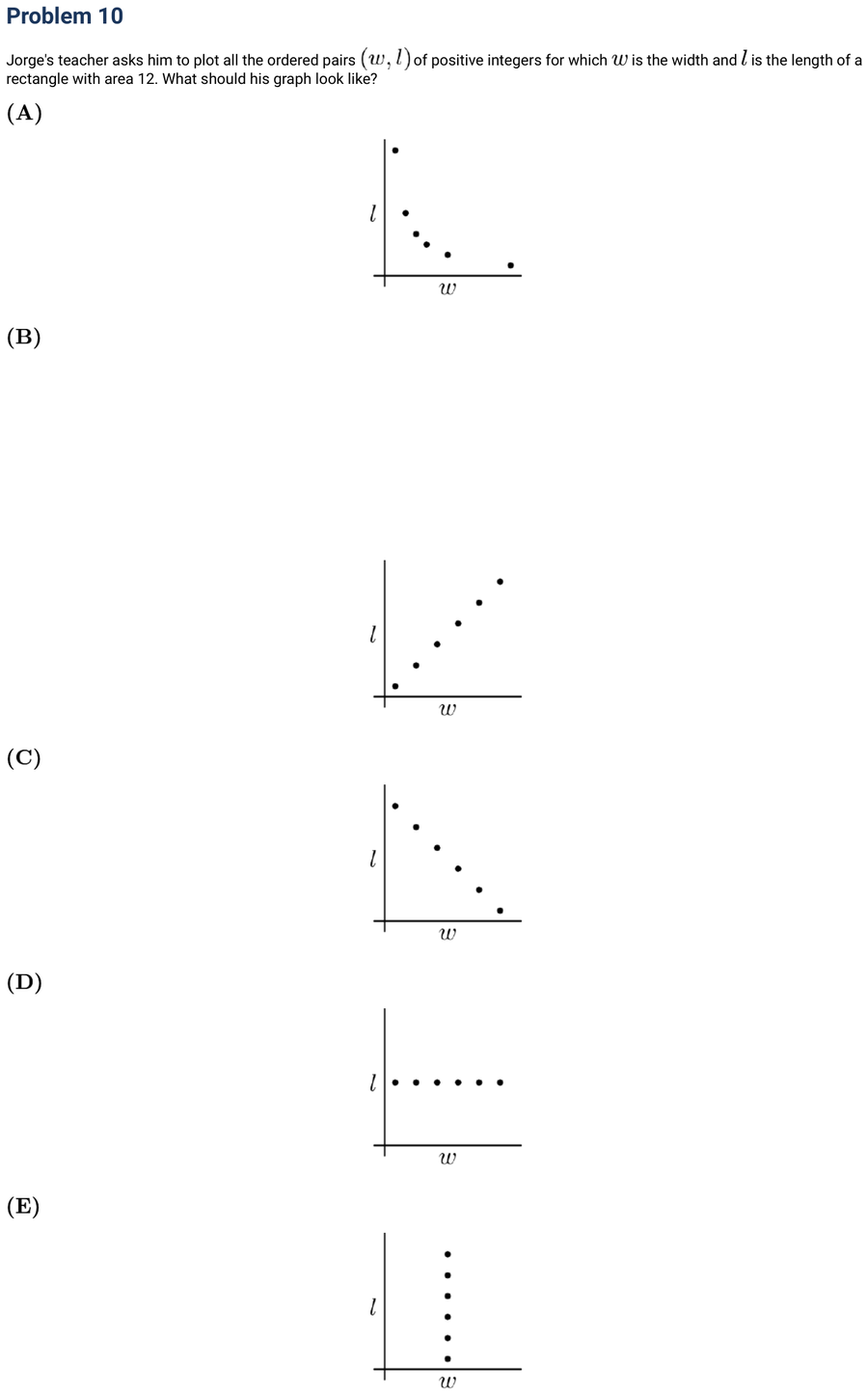
wl = 12 means l = 12/w: as w increases, l decreases hyperbolically.
Show solution
Approach: inverse relationship
  1. l = 12/w: w and l are inversely proportional — plot decreases.
  2. Only graph A shows this shape.
Mark: · log in to save
Problem 12 · 2005 AMC 8 Easy
Algebra & Patterns arithmetic-sequenceaverage

Big Al the ape ate 100 delicious yellow bananas from May 1 through May 5. Each day he ate six more bananas than on the previous day. How many delicious bananas did Big Al eat on May 5?

Show answer
Answer: D — 32.
Show hint
Hint 1
Five-term arithmetic sequence with common difference 6. Middle term = average = 100/5 = 20.
Show solution
Approach: middle term is the mean
  1. Mean = 100 / 5 = 20 = May 3.
  2. May 5 = 20 + 2 · 6 = 32.
Mark: · log in to save
Problem 4 · 2003 AMC 8 Easy
Algebra & Patterns substitution

A group of children riding on bicycles and tricycles rode past Billy Bob's house. Billy Bob counted 7 children and 19 wheels. How many tricycles were there?

Show answer
Answer: C — 5 tricycles.
Show hint
Hint 1
Imagine all 7 children on bicycles first, then see how many extra wheels you still need.
Show solution
Approach: assume all bicycles, then add the extra wheels
  1. If all 7 rode bicycles, that's 7 × 2 = 14 wheels.
  2. There are 19 − 14 = 5 extra wheels, and each tricycle adds exactly one extra wheel, so there are 5 tricycles.
Another way — solve the system:
  1. With b bicycles and t tricycles: b + t = 7 and 2b + 3t = 19.
  2. Subtract twice the first from the second: t = 19 − 14 = 5.
Mark: · log in to save
Problem 2 · 2001 AMC 8 Easy
Algebra & Patterns factor-pairssum-constraint

I'm thinking of two whole numbers. Their product is 24 and their sum is 11. What is the larger number?

Show answer
Answer: D — 8.
Show hint
Hint 1
List the factor pairs of 24 and check which pair adds to 11.
Show solution
Approach: scan the factor pairs of 24
  1. The factor pairs of 24 are 1Ā·24, 2Ā·12, 3Ā·8, 4Ā·6 — only 3 and 8 add up to 11.
  2. The larger of the two is 8.
Mark: · log in to save
Problem 1 · 1998 AJHSME Easy
Algebra & Patterns substitution

For x = 7, which of the following is the smallest?

Show answer
Answer: B — 6/(x+1).
Show hints
Hint 1 of 2
Plug in x = 7 and compare the five values.
Still stuck? Show hint 2 →
Hint 2 of 2
The smallest fraction has the largest bottom and a small top.
Show solution
Approach: substitute x = 7 and compare
  1. With x = 7 the choices are 6/7, 6/8, 6/6, 7/6, 8/6.
  2. The smallest is 6/8 = 0.75, which is 6/(x+1).
Mark: · log in to save
Problem 2 · 1998 AJHSME Easy
Algebra & Patterns custom-operation

If acbd = a·d − b·c, what is the value of 3142 ?

Show answer
Answer: E — 2.
Show hints
Hint 1 of 2
Apply the given rule: top-left Ɨ bottom-right minus top-right Ɨ bottom-left.
Still stuck? Show hint 2 →
Hint 2 of 2
Just plug in 3, 4, 1, 2.
Show solution
Approach: apply the defining rule
  1. The rule gives aĀ·d āˆ’ bĀ·c = 3Ā·2 āˆ’ 4Ā·1.
  2. That is 6 āˆ’ 4 = 2.
Mark: · log in to save
Problem 2 · 1997 AJHSME Easy
Algebra & Patterns optimization

Ahn chooses a two-digit integer, subtracts it from 200, and doubles the result. What is the largest number Ahn can get?

Show answer
Answer: D — 380.
Show hints
Hint 1 of 2
To make the result big, subtract as little as possible from 200.
Still stuck? Show hint 2 →
Hint 2 of 2
The smallest two-digit number is 10.
Show solution
Approach: subtract the smallest two-digit number
  1. Subtracting the smallest two-digit number, 10, leaves the most: 200 āˆ’ 10 = 190.
  2. Doubling gives 2 Ɨ 190 = 380.
Mark: · log in to save
Problem 2 · 1995 AJHSME Easy
Algebra & Patterns work-through-relations

Jose is 4 years younger than Zack. Zack is 3 years older than Inez. Inez is 15 years old. How old is Jose?

Show answer
Answer: C — 14.
Show hints
Hint 1 of 2
Start from Inez and work outward.
Still stuck? Show hint 2 →
Hint 2 of 2
Zack is 3 more than Inez; Jose is 4 less than Zack.
Show solution
Approach: chain the relationships
  1. Zack is 15 + 3 = 18.
  2. Jose is 18 āˆ’ 4 = 14.
Mark: · log in to save
Problem 12 · 2024 AMC 8 Medium
Algebra & Patterns substitutionsum-constraint

Rohan keeps a total of 90 guppies in 4 fish tanks.

  • There is 1 more guppy in the 2nd tank than in the 1st tank.
  • There are 2 more guppies in the 3rd tank than in the 2nd tank.
  • There are 3 more guppies in the 4th tank than in the 3rd tank.

How many guppies are in the 4th tank?

Show answer
Answer: E — 26 guppies.
Show hints
Hint 1 of 2
Stack the increments from tank 1: tank 2 = tank 1 + 1, tank 3 = tank 1 + 3, tank 4 = tank 1 + 6.
Still stuck? Show hint 2 →
Hint 2 of 2
Add all four expressions: 4·(tank 1) + 10 = 90, so tank 1 = 20.
Show solution
Approach: express every tank in terms of tank 1
  1. Let tank 1 = x. Then tank 2 = x + 1, tank 3 = x + 3, tank 4 = x + 6.
  2. Sum: 4x + 10 = 90, so x = 20.
  3. Tank 4 = 20 + 6 = 26.
Mark: · log in to save
Problem 13 · 2022 AMC 8 Medium
Algebra & Patterns substitutionsum-constraint

How many positive integers can fill the blank in the sentence below?

"One positive integer is ___ more than twice another, and the sum of the two numbers is 28."

Show answer
Answer: D — 9 values.
Show hints
Hint 1 of 2
Set up: smaller = a, larger = 2a + c. The blank is c.
Still stuck? Show hint 2 →
Hint 2 of 2
a + (2a + c) = 28 ⇒ c = 28 − 3a. For both to be positive integers, count valid a.
Show solution
Approach: express c in terms of a, count valid a
  1. Let smaller = a, larger = 2a + c (with c ≥ 1 the blank). Sum: 3a + c = 28, so c = 28 − 3a.
  2. a ≥ 1 and c ≥ 1 ⇒ 28 − 3a ≥ 1 ⇒ a ≤ 9.
  3. a ∈ {1, 2, …, 9} ⇒ 9 values for the blank.
Mark: · log in to save
Problem 20 · 2022 AMC 8 Hard
Algebra & Patterns substitutionsum-constraint
amc8-2022-20
Show answer
Answer: D — x = 8.
Show hints
Hint 1 of 2
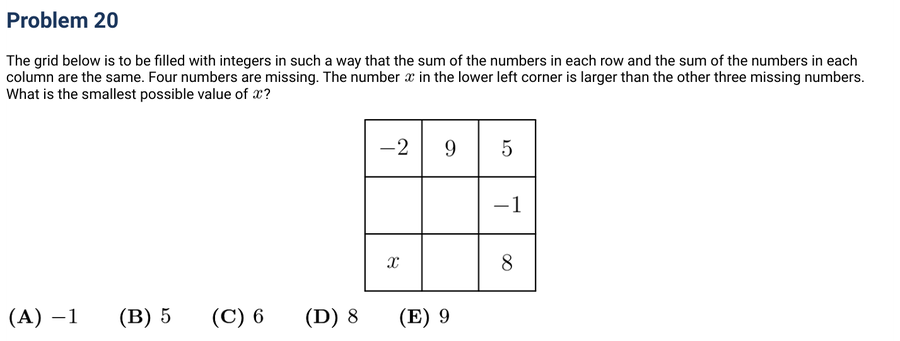
Find the common row/column sum from the known top row, then express each missing cell in terms of x.
Still stuck? Show hint 2 →
Hint 2 of 2
Top row sums to 12 ⇒ magic sum is 12. The other three missing cells are 14−x, 4−x, x−1. x must beat all of them.
Show solution
Approach: set the common sum, express each blank in terms of x
  1. Top row: −2 + 9 + 5 = 12. So every row and column sums to 12.
  2. First column: −2 + (above x) + x = 12 ⇒ cell above x = 14 − x.
  3. Bottom row: x + (middle bottom) + 8 = 12 ⇒ middle bottom = 4 − x.
  4. Middle row: (14−x) + (center) + (−1) = 12 ⇒ center = x − 1.
  5. x must be the largest: x > 14−xx > 7; x > 4−xx > 2; x > x−1 always.
  6. Smallest integer satisfying all: x = 8.
Mark: · log in to save
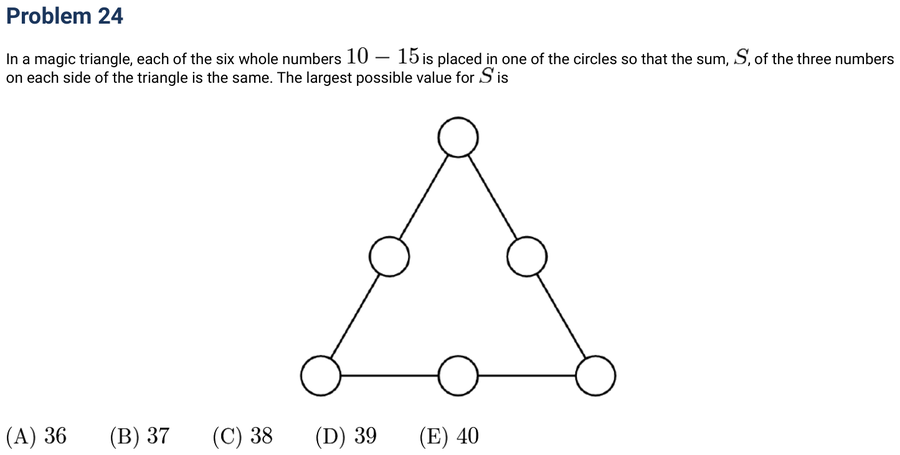
Problem 16 · 2020 AMC 8 Medium
Algebra & Patterns sum-constraintsubstitution
amc8-2020-16
Show answer
Answer: E — B = 5.
Show hints
Hint 1 of 2
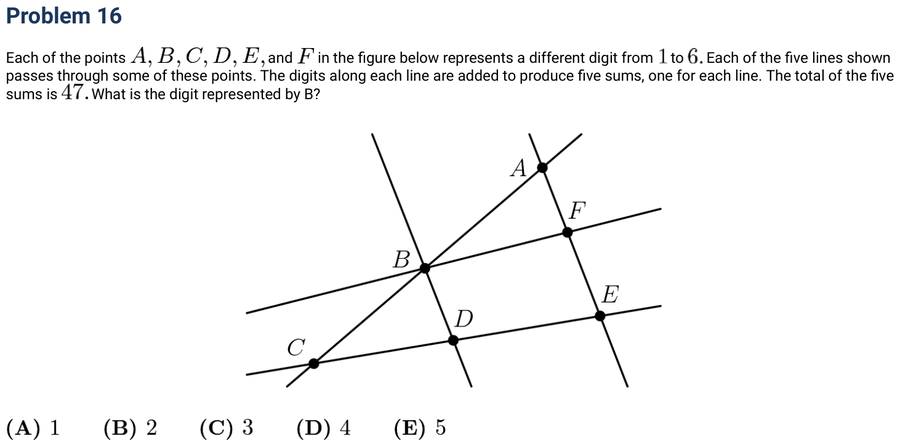
Each digit is added once per line it sits on. Which point appears on more than 2 lines?
Still stuck? Show hint 2 →
Hint 2 of 2
Every point is on 2 lines except B, which is on 3. So the total of all five line-sums is 2(A+B+C+D+E+F) + B = 47.
Show solution
Approach: count how many lines each point sits on
  1. Counting incidences: each of A, C, D, E, F sits on 2 lines; B sits on 3. So the total of five line-sums is 2(A+B+C+D+E+F) + B = 47.
  2. A+B+C+D+E+F = 1+2+3+4+5+6 = 21, so 2(21) + B = 42 + B = 47.
  3. B = 5.
Mark: · log in to save
Problem 20 · 2020 AMC 8 Hard
Algebra & Patterns caseworksubstitution
amc8-2020-20
Show answer
Answer: B — 24.2 meters.
Show hints
Hint 1 of 2
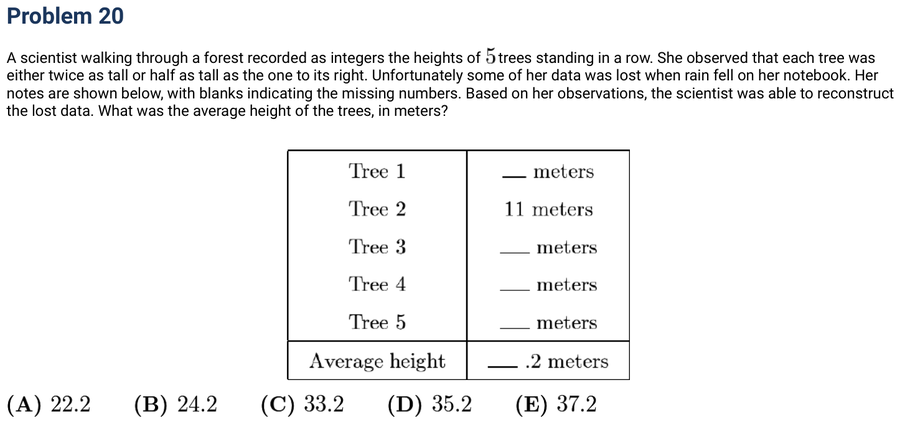
Tree 2 = 11. Tree 1 and Tree 3 must each be either 22 or 5.5 (not integer) — so both are 22.
Still stuck? Show hint 2 →
Hint 2 of 2
Tree 4 = 22 or 44; Tree 5 = double-or-half of Tree 4. Try cases until the average ends in .2.
Show solution
Approach: force integer heights, then test cases for the .2 ending
  1. Tree 2 = 11. Half of 11 is 5.5 (not integer), so Tree 1 and Tree 3 must each be 22. (Tree 1 = 22, Tree 3 = 22.)
  2. Tree 4 is twice or half of Tree 3 (= 22): so Tree 4 = 44 or 11. Then Tree 5 follows from Tree 4.
  3. Cases: (T4, T5) = (44, 88): avg = 187/5 = 37.4. (44, 22): avg = 121/5 = 24.2. (11, 22): avg = 17.6. (11, 5.5) fails (not integer).
  4. Only one ends in .2: average = 24.2 meters.
Mark: · log in to save
Problem 20 · 2019 AMC 8 Medium
Algebra & Patterns square-root-both-sidescasework

How many different real numbers x satisfy the equation

(x2 − 5)2 = 16 ?
Show answer
Answer: D — 4 real numbers.
Show hints
Hint 1 of 2
Take the square root of both sides: x2 − 5 = ±4. Two cases for x2.
Still stuck? Show hint 2 →
Hint 2 of 2
x2 = 9 gives two values; x2 = 1 gives two more.
Show solution
Approach: split on the ± root
  1. (x2 − 5)2 = 16 ⇒ x2 − 5 = ±4.
  2. Case +4: x2 = 9 ⇒ x = ±3.
  3. Case −4: x2 = 1 ⇒ x = ±1.
  4. Total: 4 distinct real solutions.
Mark: · log in to save
Problem 17 · 2017 AMC 8 Easy
Algebra & Patterns substitutionsum-constraint

Starting with some gold coins and some empty treasure chests, I tried to put 9 gold coins in each treasure chest, but that left 2 treasure chests empty. So instead I put 6 gold coins in each treasure chest, but then I had 3 gold coins left over. How many gold coins did I have?

Show answer
Answer: C — 45 coins.
Show hint
Hint 1
Set up two equations for the same gold-coin count: g = 9(n − 2) and g = 6n + 3.
Show solution
Approach: two equations, same g
  1. Let n = chests, g = coins. Nine-per-chest leaves 2 empty: g = 9(n − 2). Six-per-chest with 3 left over: g = 6n + 3.
  2. 9(n − 2) = 6n + 3 ⇒ 3n = 21 ⇒ n = 7.
  3. g = 6(7) + 3 = 45.
Mark: · log in to save
Problem 21 · 2010 AMC 8 Hard
Algebra & Patterns work-backward

Hui is an avid reader. She bought a copy of the best seller Math is Beautiful. On the first day, Hui read 1/5 of the pages plus 12 more, and on the second day she read 1/4 of the remaining pages plus 15 pages. On the third day she read 1/3 of the remaining pages plus 18 pages. She then realized that there were only 62 pages left to read, which she read the next day. How many pages are in this book?

Show answer
Answer: C — 240 pages.
Show hints
Hint 1 of 2
Work backwards from the 62 pages left. Day 3 left her with 62 pages after reading (1/3)R + 18 from R; so 2R/3 − 18 = 62.
Still stuck? Show hint 2 →
Hint 2 of 2
Repeat the inversion for day 2 and day 1.
Show solution
Approach: work backwards day by day
  1. After day 3 there are 62 pages left. If R3 = pages at start of day 3: (2/3)R3 − 18 = 62 ⇒ R3 = 120.
  2. Start of day 2: (3/4)R2 − 15 = 120 ⇒ R2 = 180.
  3. Start of day 1: (4/5)R1 − 12 = 180 ⇒ R1 = 240.
Mark: · log in to save
Problem 24 · 2009 AMC 8 Hard
Algebra & Patterns cryptarithm

The letters A, B, C, and D represent digits. If AB + CA = DA and ABCA = A, what digit does D represent?

Show answer
Answer: E — 9.
Show hints
Hint 1 of 2
From the units column of the addition (B + A ends in A), get B = 0.
Still stuck? Show hint 2 →
Hint 2 of 2
Then AB = 10A. Plug into the subtraction equation to find A and C.
Show solution
Approach: units column then subtract
  1. Units of addition: B + AA (mod 10) ⇒ B = 0 (no carry since A is a digit).
  2. Now AB = 10A and CA = 10C + A. Subtraction: 10A − (10C + A) = A ⇒ 9A − 10C = A ⇒ 8A = 10C ⇒ 4A = 5C.
  3. Digits with 4A = 5C: A = 5, C = 4.
  4. D · 10 + A = AB + CA = 50 + 45 = 95 ⇒ D = 9.
Mark: · log in to save
Problem 17 · 2002 AMC 8 Hard
Algebra & Patterns work-backward

In a mathematics contest with ten problems, a student gains 5 points for a correct answer and loses 2 points for an incorrect answer. If Olivia answered every problem and her score was 29, how many correct answers did she have?

Show answer
Answer: C — 7.
Show hints
Hint 1 of 2
Imagine she got all 10 right first, then see what each wrong answer costs.
Still stuck? Show hint 2 →
Hint 2 of 2
Turning one correct answer into a wrong one drops the score by 5 + 2 = 7.
Show solution
Approach: start from a perfect score and subtract
  1. All 10 correct would score 5 Ɨ 10 = 50.
  2. Each wrong answer (instead of right) costs 5 + 2 = 7 points, and 50 āˆ’ 29 = 21 = 3 Ɨ 7.
  3. So 3 were wrong and 7 were correct.
Another way — set up an equation:
  1. Let x = number correct, so 10 āˆ’ x are wrong: 5x āˆ’ 2(10 āˆ’ x) = 29.
  2. Then 7x āˆ’ 20 = 29, giving x = 7.
Mark: · log in to save
Problem 17 · 2000 AMC 8 Hard
Algebra & Patterns custom-operation

The operation ⊗ is defined for all nonzero numbers by ab = a2 / b. Determine [(1 ⊗ 2) ⊗ 3] − [1 ⊗ (2 ⊗ 3)].

Show answer
Answer: A — āˆ’2/3.
Show hints
Hint 1 of 2
Compute each bracket separately, innermost operation first.
Still stuck? Show hint 2 →
Hint 2 of 2
The operation isn't associative, so the two brackets won't match.
Show solution
Approach: evaluate each bracket inside-out
  1. 1 ★ 2 = 1²/2 = ½, then (½) ★ 3 = (½)²/3 = 1/12.
  2. 2 ★ 3 = 2²/3 = 4/3, then 1 ★ (4/3) = 1²/(4/3) = 3/4.
  3. Difference = 1/12 āˆ’ 3/4 = 1/12 āˆ’ 9/12 = āˆ’2/3.
Mark: · log in to save
Problem 19 · 1997 AJHSME Hard
Algebra & Patterns telescoping

If the product

32 · 43 · 54 · 65 · … · ab= 9,

what is the sum of a and b?

Show answer
Answer: D — 35.
Show hints
Hint 1 of 2
Each numerator cancels the denominator of the next fraction.
Still stuck? Show hint 2 →
Hint 2 of 2
After all the cancellation only a/2 survives, and b is one less than a.
Show solution
Approach: telescoping product
  1. Everything cancels except a/2, so a/2 = 9 gives a = 18, and b = 17.
  2. Their sum is 18 + 17 = 35.
Mark: · log in to save
Problem 16 · 1996 AJHSME Hard
Algebra & Patterns groupingtelescoping

1 − 2 − 3 + 4 + 5 − 6 − 7 + 8 + 9 − 10 − 11 + … + 1992 + 1993 − 1994 − 1995 + 1996 =

Show answer
Answer: C — 0.
Show hints
Hint 1 of 2
The signs repeat in a 4-term pattern: +, āˆ’, āˆ’, +.
Still stuck? Show hint 2 →
Hint 2 of 2
Group the terms in blocks of four and see what each block adds to.
Show solution
Approach: group into blocks of four
  1. Each block of four, like 1 āˆ’ 2 āˆ’ 3 + 4, adds to 0.
  2. Since 1996 is a multiple of 4, the whole sum splits into 499 such blocks, giving 0.
Mark: · log in to save
Problem 20 · 1996 AJHSME Hard
Algebra & Patterns find-the-cycle

A special key on a calculator replaces the displayed number x with 1 Ć· (1 āˆ’ x). (For example, from 2 it gives 1 Ć· (1 āˆ’ 2) = āˆ’1.) If the calculator shows 5 and the key is pressed 100 times in a row, the calculator will display

Show answer
Answer: A — āˆ’0.25.
Show hints
Hint 1 of 2
Press the key a few times and watch for a repeating cycle.
Still stuck? Show hint 2 →
Hint 2 of 2
Once you know the cycle length, reduce 100 by it.
Show solution
Approach: find the repeating cycle
  1. Starting at 5: 5 → āˆ’0.25 → 0.8 → 5, a cycle of length 3.
  2. Since 100 = 3Ā·33 + 1, after 100 presses the display matches one press: āˆ’0.25.
Mark: · log in to save
Problem 23 · 1996 AJHSME Hard
Algebra & Patterns system-equations

The manager of a company planned to give a $50 bonus to each employee from the company fund, but the fund was $5 short of what was needed. Instead the manager gave each employee a $45 bonus and kept the remaining $95 in the fund. How much money was in the company fund before any bonuses were paid?

Show answer
Answer: E — 995 dollars.
Show hints
Hint 1 of 2
Let n be the number of employees and write the fund two ways.
Still stuck? Show hint 2 →
Hint 2 of 2
Fund = 50n āˆ’ 5 (just short of $50 each) and fund = 45n + 95 (after the $45 bonuses).
Show solution
Approach: set two expressions for the fund equal
  1. The fund is 50n āˆ’ 5 (5 short of $50 each) and also 45n + 95 (gave $45 each, kept $95).
  2. Setting them equal: 50n āˆ’ 5 = 45n + 95 gives n = 20, so the fund was 45Ā·20 + 95 = $995.
Mark: · log in to save
Problem 17 · 1994 AJHSME Hard
Algebra & Patterns partial-sums

Pauline can shovel snow at the rate of 20 cubic yards for the first hour, 19 cubic yards for the second, 18 for the third, and so on, always shoveling one cubic yard less per hour than the previous hour. If her driveway is 4 yards wide, 10 yards long, and covered with snow 3 yards deep, then the number of hours it will take her to shovel it clean is closest to

Show answer
Answer: D — 7.
Show hints
Hint 1 of 2
First find the total volume of snow: 4 Ɨ 10 Ɨ 3.
Still stuck? Show hint 2 →
Hint 2 of 2
Add 20 + 19 + 18 + … until you reach that volume.
Show solution
Approach: accumulate the decreasing hourly amounts
  1. The snow is 4 Ɨ 10 Ɨ 3 = 120 cubic yards.
  2. Running totals: 20, 39, 57, 74, 90, 105, 119 — after 7 hours she's at 119, just shy of 120, so the time is closest to 7 hours.
Mark: · log in to save
Problem 18 · 1994 AJHSME Hard
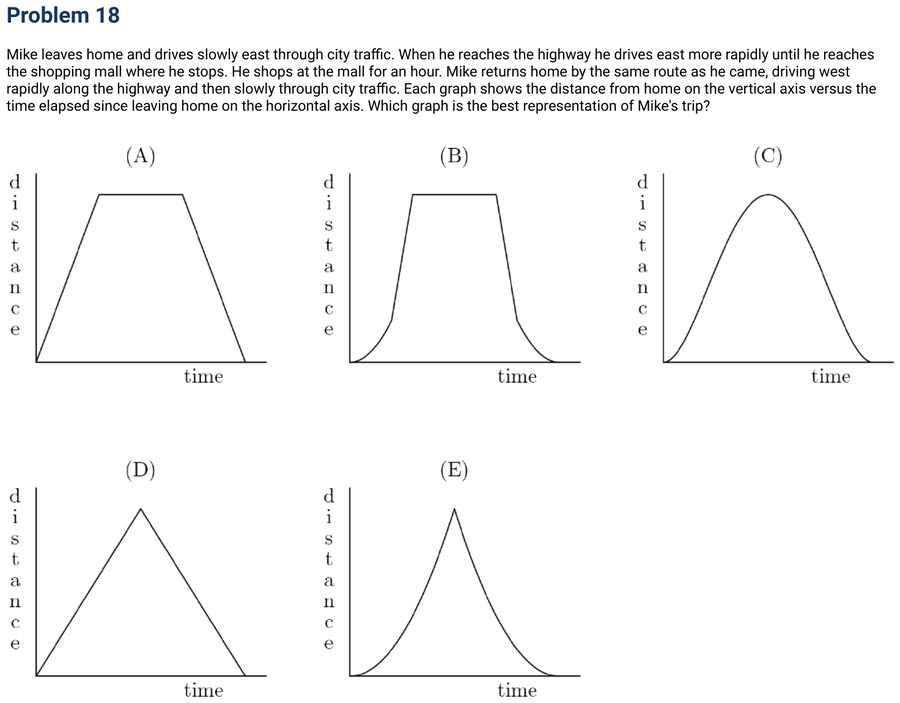
Algebra & Patterns graph-reading
ajhsme-1994-18
Show answer
Answer: B — Graph B.
Show hints
Hint 1 of 2
Distance from home rises while going out, stays flat while shopping, then falls coming back.
Still stuck? Show hint 2 →
Hint 2 of 2
Because the speed changes (gentle in city, steep on highway), each side of the graph bends rather than staying a single straight line.
Show solution
Approach: match each changing-speed leg to the graph's slope
  1. Going out, distance rises gently (city) then steeply (highway), so the climb curves and gets steeper; it stays flat for the hour at the mall; coming home it falls steeply (highway) then gently (city).
  2. Graph B shows these two different slopes on each side — the straight-sided trapezoid (A) would mean a single constant speed each way.
Mark: · log in to save
Problem 9 · 1993 AJHSME Hard
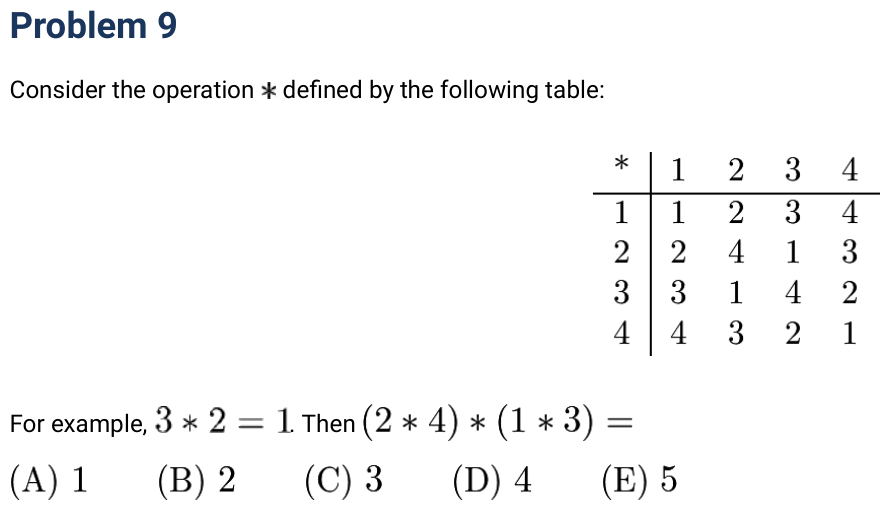
Algebra & Patterns read-table
ajhsme-1993-09
Show answer
Answer: D — 4.
Show hints
Hint 1 of 2
Read each starred product straight off the table.
Still stuck? Show hint 2 →
Hint 2 of 2
Do the two inner operations first, then combine.
Show solution
Approach: look up each operation in the table
  1. From the table, 2 āˆ— 4 = 3 and 1 āˆ— 3 = 3.
  2. Then 3 āˆ— 3 = 4.
Mark: · log in to save
Problem 19 · 1993 AJHSME Hard
Algebra & Patterns pair-terms

(1901 + 1902 + 1903 + … + 1993) − (101 + 102 + 103 + … + 193) =

Show answer
Answer: A — 167,400.
Show hints
Hint 1 of 2
Line up the two sums term by term.
Still stuck? Show hint 2 →
Hint 2 of 2
Each top term is exactly 1800 more than the matching bottom term.
Show solution
Approach: subtract matching terms
  1. Both sums have 93 terms, and each top term beats its partner by 1901 āˆ’ 101 = 1800.
  2. So the difference is 93 Ɨ 1800 = 167,400.
Mark: · log in to save
Problem 19 · 1992 AJHSME Hard
Algebra & Patterns extremal

The distance between the 5th and 26th exits on an interstate highway is 118 miles. If any two exits are at least 5 miles apart, then what is the largest number of miles there can be between two consecutive exits that are between the 5th and 26th exits?

Show answer
Answer: C — 18 miles.
Show hints
Hint 1 of 2
There are 21 gaps between the 5th and 26th exits.
Still stuck? Show hint 2 →
Hint 2 of 2
To stretch one gap as far as possible, make all the others as small as allowed (5 miles).
Show solution
Approach: shrink the other gaps to free up room
  1. There are 26 āˆ’ 5 = 21 gaps. Making 20 of them the minimum 5 miles uses 100 miles.
  2. The last gap can be 118 āˆ’ 100 = 18 miles.
Mark: · log in to save
Problem 19 · 1991 AJHSME Hard
Algebra & Patterns minimize-rest

The average (arithmetic mean) of 10 different positive whole numbers is 10. The largest possible value of any of these numbers is

Show answer
Answer: C — 55.
Show hints
Hint 1 of 2
The ten numbers add to 10 Ɨ 10 = 100.
Still stuck? Show hint 2 →
Hint 2 of 2
To make one as big as possible, make the other nine as small as possible (and different).
Show solution
Approach: shrink the other nine numbers
  1. The numbers total 100. The nine smallest different positive numbers are 1, 2, …, 9, summing to 45.
  2. So the largest can be 100 āˆ’ 45 = 55.
Mark: · log in to save
Problem 10 · 1990 AJHSME Hard
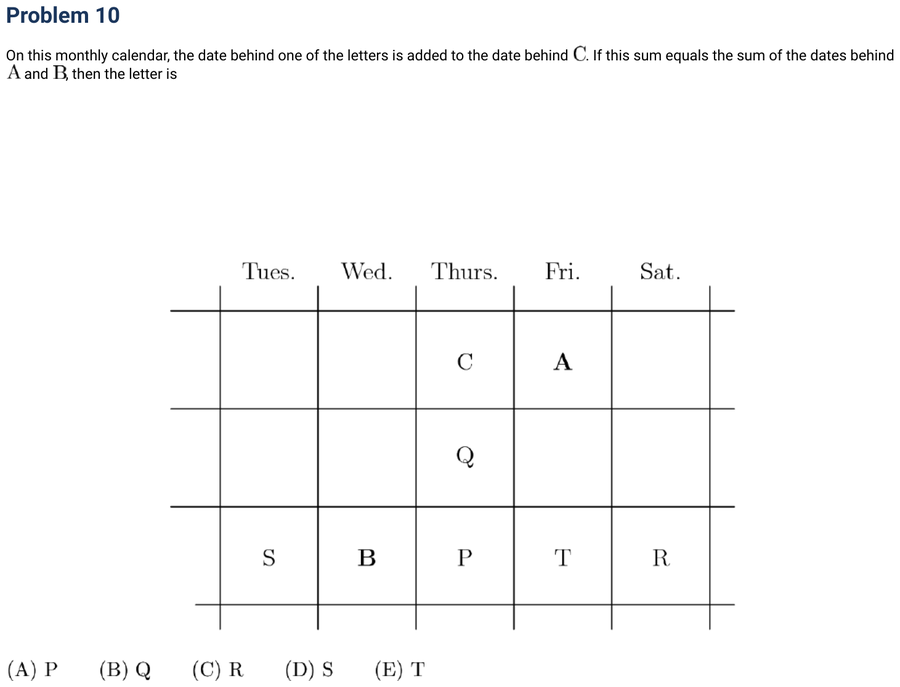
Algebra & Patterns calendar-arithmeticsubstitution
ajhsme-1990-10
Show answer
Answer: A — P.
Show hints
Hint 1 of 2
Dates one row apart on a calendar differ by 7; A is one day after C.
Still stuck? Show hint 2 →
Hint 2 of 2
Set up the equation (date) + C = A + B and solve for the letter.
Show solution
Approach: use the +7 (down a row) and +1 (next day) structure
  1. Let C be its date. Then A = C + 1, B = C + 13, and P = C + 14 (two rows below C).
  2. Since A + B = 2C + 14 and P + C = 2C + 14, the matching letter is P.
Mark: · log in to save
Problem 16 · 1990 AJHSME Hard
Algebra & Patterns pair-terms

1990 − 1980 + 1970 − 1960 + … − 20 + 10 =

Show answer
Answer: D — 1000.
Show hints
Hint 1 of 2
Pair the terms: (1990 āˆ’ 1980), (1970 āˆ’ 1960), … each equals 10.
Still stuck? Show hint 2 →
Hint 2 of 2
Don't forget the leftover +10 at the end.
Show solution
Approach: pair the terms, then add the leftover
  1. Pairs (1990 āˆ’ 1980), (1970 āˆ’ 1960), …, (30 āˆ’ 20) each give 10, and there are 99 such pairs: 990.
  2. Adding the final +10 gives 990 + 10 = 1000.
Mark: · log in to save
Problem 17 · 1989 AJHSME Hard
Algebra & Patterns bound-the-average

The number N is between 9 and 17. The average of 6, 10, and N could be

Show answer
Answer: B — 10.
Show hints
Hint 1 of 2
Plug the extreme values of N into the average formula to see what range the average can land in.
Still stuck? Show hint 2 →
Hint 2 of 2
Then check which choice falls inside that range.
Show solution
Approach: bound the average using the bounds on N
  1. Average = (6 + 10 + N)⁄3 = (16 + N)⁄3. With 9 < N < 17, this ranges from 25⁄3 ā‰ˆ 8.3 to 33⁄3 = 11.
  2. Of the choices, only 10 sits in that range (N = 14 gives average 10).
Mark: · log in to save
Problem 18 · 1989 AJHSME Hard
Algebra & Patterns involution

Many calculators have a reciprocal key 1/x that replaces the current number displayed with its reciprocal. For example, if the display is 00004 and the 1/x key is pressed, then the display becomes 000.25. If 00032 is currently displayed, what is the fewest positive number of times you must depress the 1/x key so the display again reads 00032?

Show answer
Answer: B — 2.
Show hints
Hint 1 of 2
Try the operation once, then again — does anything change after that?
Still stuck? Show hint 2 →
Hint 2 of 2
The reciprocal of the reciprocal is the original number.
Show solution
Approach: apply 1/x twice
  1. Press once: 32 → 1⁄32. Press again: 1⁄32 → 32.
  2. So the display reads 32 again after exactly 2 presses.
Mark: · log in to save
Problem 19 · 1988 AJHSME Hard
Algebra & Patterns arithmetic-sequence-nth-term

What is the 100th number in the arithmetic sequence: 1, 5, 9, 13, 17, 21, 25, …?

Show answer
Answer: A — 397.
Show hints
Hint 1 of 2
The common difference is 4; the 100th term sits 99 steps after the first.
Still stuck? Show hint 2 →
Hint 2 of 2
100th term = 1 + 99 Ɨ 4.
Show solution
Approach: a + (nāˆ’1)d
  1. First term 1, common difference 4. The 100th term = 1 + 99 Ɨ 4 = 1 + 396.
  2. = 397.
Mark: · log in to save
Problem 15 · 1987 AJHSME Hard
Algebra & Patterns solve-linear-equation

The sale ad read: "Buy three tires at the regular price and get the fourth tire for three dollars." Sam paid 240 dollars for a set of four tires at the sale. What was the regular price of one tire?

Show answer
Answer: D — 79 dollars.
Show hint
Hint 1
Subtract the $3 promo tire first, then split what's left across three tires.
Show solution
Approach: isolate the three full-price tires
  1. Three full-price tires cost 240 āˆ’ 3 = 237 dollars.
  2. Regular price = 237 ⁄ 3 = 79 dollars.
Mark: · log in to save
Problem 19 · 1987 AJHSME Hard
Algebra & Patterns repeated-squaringgrowth

A calculator has a squaring key which replaces the current number displayed with its square. For example, if the display is 000003 and the key is depressed, then the display becomes 000009. If the display reads 000002, how many times must you depress the key to produce a displayed number greater than 500?

Show answer
Answer: A — 4.
Show hint
Hint 1
Repeated squaring goes 2 → 4 → 16 → 256 → 65536. Watch which crosses 500.
Show solution
Approach: iterate squaring
  1. 2 → 4 → 16 → 256 → 65536. 256 isn't yet greater than 500, but 65536 is.
  2. So 4 presses are needed.
Mark: · log in to save
Problem 11 · 1986 AJHSME Hard
Algebra & Patterns custom-operation

If A ✶ B means (A + B) ⁄ 2, then (3 ✶ 5) ✶ 8 is

Show answer
Answer: A — 6.
Show hints
Hint 1 of 2
Apply the inner operation first, then the outer.
Still stuck? Show hint 2 →
Hint 2 of 2
3 ✶ 5 is the average of 3 and 5.
Show solution
Approach: apply the operation twice
  1. 3 ✶ 5 = (3 + 5)⁄2 = 4. Then 4 ✶ 8 = (4 + 8)⁄2 = 6.
  2. = 6.
Mark: · log in to save
Problem 18 · 1985 AJHSME Hard
Algebra & Patterns interval-from-inequalities

Nine copies of a certain pamphlet cost less than $10.00 while ten copies of the same pamphlet (at the same price) cost more than $11.00. How much does one copy of this pamphlet cost?

Show answer
Answer: E — $1.11.
Show hints
Hint 1 of 2
9p < 10 and 10p > 11 give a narrow interval for p.
Still stuck? Show hint 2 →
Hint 2 of 2
10⁄9 ā‰ˆ 1.111 and 11⁄10 = 1.10.
Show solution
Approach: bracket p from both inequalities
  1. 9p < 10 → p < 10⁄9 ā‰ˆ 1.111. 10p > 11 → p > 1.10. So 1.10 < p < 1.111.
  2. Only choice in range: $1.11.
Mark: · log in to save
Problem 14 · 2026 AMC 8 Medium
Algebra & Patterns arithmetic-sequence

Jami picked three equally spaced integers on the number line. The sum of the first and second is 40, and the sum of the second and third is 60. What is the sum of all three numbers?

Show answer
Answer: B — 75.
Show hints
Hint 1 of 2
For equally spaced numbers, the middle one is the average of the other two.
Still stuck? Show hint 2 →
Hint 2 of 2
Add the two given sums and see how many times the middle number appears.
Show solution
Approach: the middle number carries everything
  1. Since the numbers are equally spaced, first + third = 2 Ɨ second. Adding the two given sums: 40 + 60 = first + 2Ā·second + third = 4Ā·second, so the middle is 25.
  2. The total is 3 Ɨ 25 = 75.
Mark: · log in to save
Problem 9 · 2023 AMC 8 Medium
Algebra & Patterns evaluate-formula
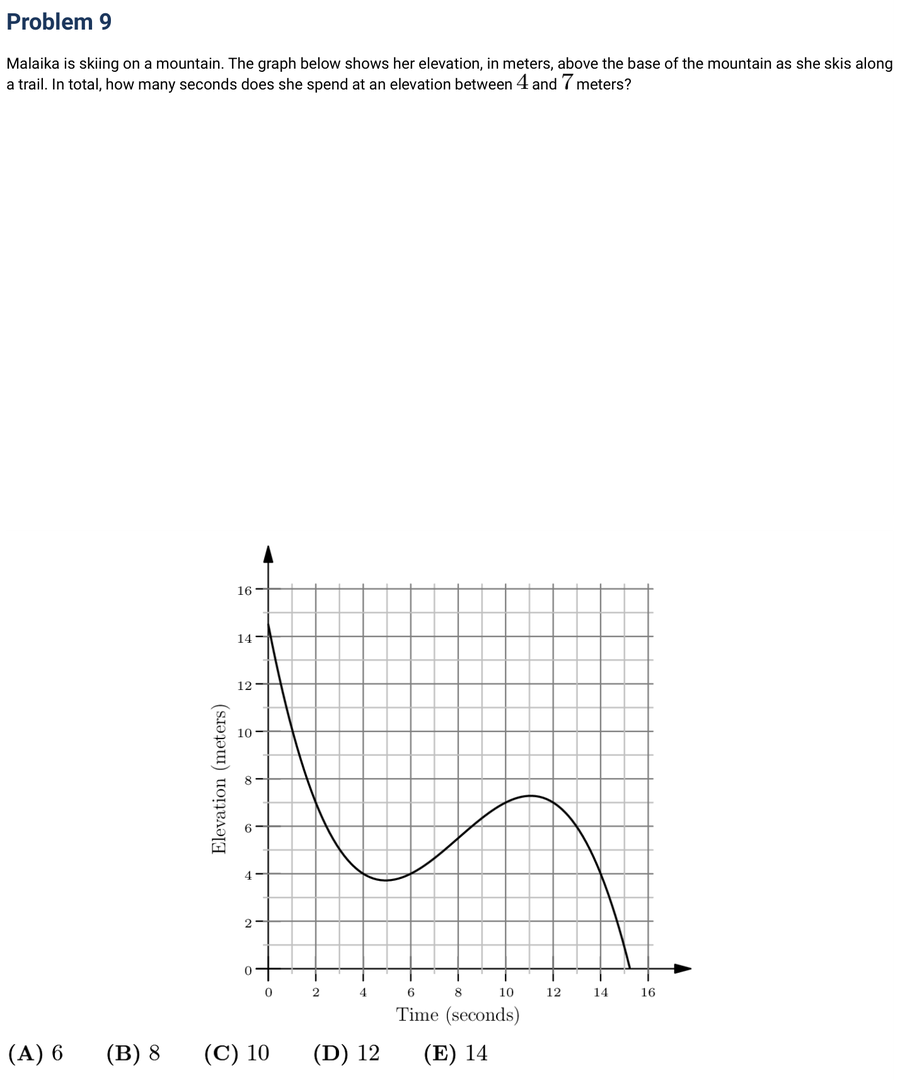
amc8-2023-09
Show answer
Answer: B — 8 seconds.
Show hints
Hint 1 of 2
Draw two horizontal lines on the graph at elevations 4 and 7. Read off the time intervals where the curve sits between them.
Still stuck? Show hint 2 →
Hint 2 of 2
There are three such time intervals; add their durations.
Show solution
Approach: read the graph between two horizontal lines
  1. The curve sits between elevations 4 and 7 over three intervals: roughly t = 2 to 4 (2 sec), t = 6 to 10 (4 sec), and t = 12 to 14 (2 sec).
  2. Total: 2 + 4 + 2 = 8 seconds.
Mark: · log in to save
Problem 6 · 2022 AMC 8 Easy
Algebra & Patterns substitutionarithmetic-sequence

Three positive integers are equally spaced on a number line. The middle number is 15 and the largest number is 4 times the smallest number. What is the smallest of these three numbers?

Show answer
Answer: C — 6.
Show hints
Hint 1 of 2
Equally spaced means the middle equals the average of the outer two.
Still stuck? Show hint 2 →
Hint 2 of 2
Let smallest = x, largest = 4x. Their average = 5x/2 = 15.
Show solution
Approach: middle = average of outers
  1. Let smallest = x, so largest = 4x. Equally spaced ⇒ middle = (x + 4x)/2 = 5x/2.
  2. Set 5x/2 = 15 ⇒ x = 6.
Mark: · log in to save
Problem 8 · 2020 AMC 8 Medium
Algebra & Patterns substitutionsum-constraint

Ricardo has 2020 coins, some of which are pennies (1-cent coins) and the rest of which are nickels (5-cent coins). He has at least one penny and at least one nickel. What is the difference in cents between the greatest possible and least possible amounts of money that Ricardo can have?

Show answer
Answer: C — 8072 cents.
Show hints
Hint 1 of 2
Trade pennies for nickels: each swap adds 4 cents. So the total is a linear function of the nickel count n.
Still stuck? Show hint 2 →
Hint 2 of 2
Total = p + 5n = (p+n) + 4n = 2020 + 4n. With 1 ≤ n ≤ 2019, difference is 4 × (2019 − 1).
Show solution
Approach: rewrite total as 2020 + 4n
  1. Total cents = p + 5n = (p + n) + 4n = 2020 + 4n.
  2. Constraints: p ≥ 1 and n ≥ 1 with p + n = 2020 ⇒ n ∈ [1, 2019].
  3. Maximum vs minimum total: 4(2019) − 4(1) = 4 × 2018 = 8072.
Mark: · log in to save
Problem 10 · 2016 AMC 8 Easy
Algebra & Patterns custom-operationsubstitution

Suppose that ab means 3ab. What is the value of x if

2 ∗ (5 ∗ x) = 1 ?
Show answer
Answer: D — x = 10.
Show hint
Hint 1
Inner first: 5 ∗ x = 15 − x. Then plug into the outer.
Show solution
Approach: inside-out substitution
  1. 5 ∗ x = 15 − x.
  2. 2 ∗ (15 − x) = 6 − (15 − x) = x − 9.
  3. Set = 1: x = 10.
Mark: · log in to save
Problem 9 · 2015 AMC 8 Easy
Algebra & Patterns arithmetic-sequencearithmetic-series

On her first day of work, Janabel sold one widget. On day two, she sold three widgets. On day three, she sold five widgets, and on each succeeding day, she sold two more widgets than she had sold on the previous day. How many widgets in total had Janabel sold after working 20 days?

Show answer
Answer: D — 400 widgets.
Show hint
Hint 1
The first 20 positive odd numbers: 1, 3, 5, …, 39. The sum of the first n odd numbers is n2.
Show solution
Approach: sum of first n odd numbers = n^2
  1. Day k sales: 2k − 1. Days 1 to 20 sum: 1 + 3 + 5 + … + 39.
  2. Sum of the first n odd numbers is n2.
  3. Total: 202 = 400.
Mark: · log in to save
Problem 16 · 2015 AMC 8 Medium
Algebra & Patterns fraction-word-problemsubstitution

In a middle-school mentoring program, a number of the sixth graders are paired with a ninth-grade student as a buddy. No ninth grader is assigned more than one sixth-grade buddy. If 13 of all the ninth graders are paired with 25 of all the sixth graders, what fraction of the total number of sixth and ninth graders have a buddy?

Show answer
Answer: B — 4/11.
Show hints
Hint 1 of 2
Pairs are one-to-one, so the number of paired ninth-graders equals the number of paired sixth-graders. Set that up as one equation and pick a convenient size.
Still stuck? Show hint 2 →
Hint 2 of 2
Let there be 15 ninth-graders. Then 5 of them are paired (one-third). So 5 sixth-graders are paired too, which is two-fifths of all sixth-graders ⇒ 12 sixth-graders total.
Show solution
Approach: pick concrete sizes so the fractions are whole numbers
  1. Pairs are one-to-one, so paired ninth-graders = paired sixth-graders. Pick small numbers that make both fractions whole: ninth = 6, sixth = 5.
  2. Then paired ninth = (1/3)(6) = 2 and paired sixth = (2/5)(5) = 2. ✓
  3. Total students = 6 + 5 = 11. Buddied students = 2 + 2 = 4. Fraction = 4/11.
Another way — algebra:
  1. Let n = ninth-graders, s = sixth-graders. (1/3)n = (2/5)s ⇒ 5n = 6s.
  2. Buddied / total = ((1/3)n + (2/5)s) / (n + s) = (2 · (1/3)n) / (n + s) (since the two numerators are equal).
  3. Using 5n = 6s, ratio simplifies to 4/11.
Mark: · log in to save
Problem 17 · 2015 AMC 8 Medium
Algebra & Patterns distance-speed-time

Jeremy's father drives him to school in rush hour traffic in 20 minutes. One day there is no traffic, so his father can drive him 18 miles per hour faster and gets him to school in 12 minutes. How far in miles is it to school?

Show answer
Answer: D — 9 miles.
Show hints
Hint 1 of 2
Set the two distance expressions equal: rush-hour distance = no-traffic distance. Convert 20 min and 12 min to hours (1/3 and 1/5).
Still stuck? Show hint 2 →
Hint 2 of 2
Solve s · (1/3) = (s + 18) · (1/5) for the rush-hour speed s, then plug back.
Show solution
Approach: equate the two distance expressions
  1. Let rush-hour speed be s mph. Distance: s · (1/3) = (s + 18) · (1/5).
  2. Multiply by 15: 5s = 3(s + 18) ⇒ 2s = 54 ⇒ s = 27.
  3. Distance = 27 · (1/3) = 9 miles.
Mark: · log in to save
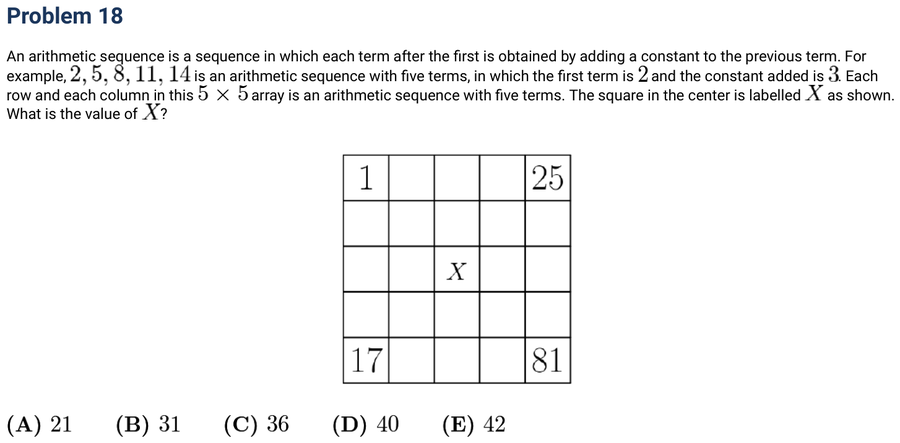
Problem 18 · 2015 AMC 8 Medium
Algebra & Patterns arithmetic-sequencemiddle-is-average
amc8-2015-18
Show answer
Answer: B — X = 31.
Show hints
Hint 1 of 2
In a 5-term arithmetic sequence the middle (3rd) term equals the average of the 1st and 5th terms.
Still stuck? Show hint 2 →
Hint 2 of 2
Find the middle of the top row (avg of 1 and 25), middle of the bottom row (avg of 17 and 81), then average those two.
Show solution
Approach: middle term = average of endpoints (used twice)
  1. Middle of top row = (1 + 25)/2 = 13.
  2. Middle of bottom row = (17 + 81)/2 = 49.
  3. X is the middle of the middle column, which is the average of those two: (13 + 49)/2 = 31.
Mark: · log in to save
Problem 20 · 2015 AMC 8 Medium
Algebra & Patterns system-of-equationsparity-mod

Ralph went to the store and bought 12 pairs of socks for a total of $24. Some of the socks he bought cost $1 a pair, some of the socks he bought cost $3 a pair, and some of the socks he bought cost $4 a pair. If he bought at least one pair of each type, how many pairs of $1 socks did Ralph buy?

Show answer
Answer: D — 7 pairs.
Show hints
Hint 1 of 2
Let a, b, c be the counts of $1, $3, $4 pairs. Write the two equations and subtract.
Still stuck? Show hint 2 →
Hint 2 of 2
After subtracting, you get 2b + 3c = 12 with b, c ≥ 1. Use parity (2b is even) to pin down c.
Show solution
Approach: subtract the two equations
  1. a + b + c = 12 and a + 3b + 4c = 24.
  2. Subtract: 2b + 3c = 12. So 3c is even, meaning c is even; and 0 < c < 4 ⇒ c = 2.
  3. Then 2b = 6 ⇒ b = 3, and a = 12 − 3 − 2 = 7.
Mark: · log in to save
Problem 22 · 2014 AMC 8 Medium
Algebra & Patterns place-value-algebra

A 2-digit number is such that the product of the digits plus the sum of the digits is equal to the number. What is the units digit of the number?

Show answer
Answer: E — Units digit 9.
Show hint
Hint 1
Write the number as 10a + b and translate the condition. Cancel everything you can.
Show solution
Approach: translate to algebra, then cancel
  1. Let the number be 10a + b. Condition: ab + a + b = 10a + b.
  2. Simplify: ab = 9a. Since a ≠ 0 (it's a two-digit number), divide by a: b = 9.
  3. (Any 2-digit number with units digit 9 works: 19, 29, 39, … check: 1·9 + 1 + 9 = 19. ✓)
Mark: · log in to save
Problem 15 · 2013 AMC 8 Medium
Algebra & Patterns powers-by-inspection

If 3p + 34 = 90, 2r + 44 = 76, and 53 + 6s = 1421, what is the product of p, r, and s?

Show answer
Answer: B — 40.
Show hints
Hint 1 of 2
Subtract the known term from each equation, then identify the power.
Still stuck? Show hint 2 →
Hint 2 of 2
9 = 32, 32 = 25, 1296 = 64.
Show solution
Approach: simplify and match powers
  1. 3p = 90 − 81 = 9 = 32p = 2.
  2. 2r = 76 − 44 = 32 = 25r = 5.
  3. 6s = 1421 − 125 = 1296 = 64s = 4.
  4. Product: 2 · 5 · 4 = 40.
Mark: · log in to save
Problem 16 · 2012 AMC 8 Medium
Algebra & Patterns place-value-greedy

Each of the digits 0, 1, 2, 3, 4, 5, 6, 7, 8, and 9 is used only once to make two five-digit numbers so that they have the largest possible sum. Which of the following could be one of the numbers?

Show answer
Answer: C — 87431.
Show hint
Hint 1
Higher place values dominate. To maximize the sum, put the two biggest digits in the ten-thousands place (one each), the next two in the thousands place, etc.
Show solution
Approach: split digits into matched pairs by place value
  1. Pair digits by descending size for each place: {9, 8}, {7, 6}, {5, 4}, {3, 2}, {1, 0}.
  2. Each number gets one from each pair. So the digits of each number (left to right) come from {9, 8}, {7, 6}, {5, 4}, {3, 2}, {1, 0}.
  3. Only 87431 matches: 8∈{9,8}, 7∈{7,6}, 4∈{5,4}, 3∈{3,2}, 1∈{1,0}. ✓
Mark: · log in to save
Problem 13 · 2010 AMC 8 Medium
Algebra & Patterns consecutive-integerspercent-equation

The lengths of the sides of a triangle in inches are three consecutive integers. The length of the shortest side is 30% of the perimeter. What is the length of the longest side?

Show answer
Answer: E — 11 inches.
Show hint
Hint 1
Let the smallest side be s. Then perimeter = 3s + 3. Set s = 0.3 · (3s + 3).
Show solution
Approach: translate the percent condition
  1. Sides: s, s+1, s+2. Perimeter: 3s + 3.
  2. s = 0.3(3s + 3) ⇒ s = 0.9s + 0.9 ⇒ 0.1s = 0.9 ⇒ s = 9.
  3. Longest = s + 2 = 11.
Mark: · log in to save
Problem 22 · 2010 AMC 8 Medium
Algebra & Patterns place-value-difference

The hundreds digit of a three-digit number is 2 more than the units digit. The digits of the three-digit number are reversed, and the result is subtracted from the original three-digit number. What is the units digit of the result?

Show answer
Answer: E — 8.
Show hints
Hint 1 of 2
Let units = u, tens = t, hundreds = u + 2. Original − reversed simplifies to a constant.
Still stuck? Show hint 2 →
Hint 2 of 2
Reversing flips the hundreds and units digits. Difference = 99 · (hundreds − units).
Show solution
Approach: compute (original − reversed)
  1. Original − reversed = 100(u+2) + 10t + u − (100u + 10t + u+2) = 99(u+2) − 99u = 198.
  2. Units digit of 198 = 8.
Mark: · log in to save
Problem 24 · 2010 AMC 8 Medium
Algebra & Patterns match-bases-or-exponents

What is the correct ordering of the three numbers, 108, 512, and 224?

Show answer
Answer: A — 2^24 < 10^8 < 5^12.
Show hints
Hint 1 of 2
Rewrite each as a product of equal-exponent powers. E.g., 108 = 28 · 58, 224 = 28 · 48, 512 = 58 · 54.
Still stuck? Show hint 2 →
Hint 2 of 2
Compare pairwise using shared factors.
Show solution
Approach: factor out a common eighth power
  1. Compare 224 vs 108: 224 = 28 · 48, 108 = 28 · 58. Since 4 < 5: 224 < 108.
  2. Compare 108 vs 512: 108 = 44 · 58, 512 = 54 · 58. Since 44 = 256 < 625 = 54: 108 < 512.
  3. Therefore 224 < 108 < 512.
Mark: · log in to save
Problem 21 · 2009 AMC 8 Medium
Algebra & Patterns invariant-total

Andy and Bethany have a rectangular array of numbers with 40 rows and 75 columns. Andy adds the numbers in each row. The average of his 40 sums is A. Bethany adds the numbers in each column. The average of her 75 sums is B. What is the value of AB?

Show answer
Answer: D — 15/8.
Show hint
Hint 1
Both Andy and Bethany sum the same array total. So 40A = sum of array = 75B.
Show solution
Approach: set both totals equal to the array sum
  1. Sum of all entries = 40 · A = 75 · B.
  2. A/B = 75/40 = 15/8.
Mark: · log in to save
Problem 23 · 2009 AMC 8 Medium
Algebra & Patterns quadratic

On the last day of school, Mrs. Awesome gave jelly beans to her class. She gave each boy as many jelly beans as there were boys in the class. She gave each girl as many jelly beans as there were girls in the class. She brought 400 jelly beans, and when she finished, she had six jelly beans left. There were two more boys than girls in her class. How many students were in her class?

Show answer
Answer: B — 28 students.
Show hint
Hint 1
Each boy gets b beans, so all boys get b2. Similarly girls get g2. b2 + g2 = 394.
Show solution
Approach: set up and solve a quadratic
  1. b = g + 2 and b2 + g2 = 400 − 6 = 394.
  2. (g + 2)2 + g2 = 394 ⇒ 2g2 + 4g + 4 = 394 ⇒ g2 + 2g − 195 = 0.
  3. (g + 15)(g − 13) = 0 ⇒ g = 13, b = 15.
  4. Total: 13 + 15 = 28.
Mark: · log in to save
Problem 12 · 2008 AMC 8 Medium
Algebra & Patterns geometric-sequence

A ball is dropped from a height of 3 meters. On its first bounce it rises to a height of 2 meters. It keeps falling and bouncing to 23 of the height it reached in the previous bounce. On which bounce will it rise to a height less than 0.5 meters?

Show answer
Answer: C — 5th bounce.
Show hint
Hint 1
After the nth bounce, height = 3 · (2/3)n. Test small n until it drops below 1/2.
Show solution
Approach: compute heights
  1. After bounce 4: 3 · (2/3)4 = 16/27 ≈ 0.593 (above 0.5).
  2. After bounce 5: 3 · (2/3)5 = 32/81 ≈ 0.395 (below 0.5).
  3. Answer: 5.
Mark: · log in to save
Problem 13 · 2008 AMC 8 Medium
Algebra & Patterns system-of-equations

Mr. Harman needs to know the combined weight in pounds of three boxes he wants to mail. However, the only available scale is not accurate for weights less than 100 pounds or more than 150 pounds. So the boxes are weighed in pairs in every possible way. The results are 122, 125 and 127 pounds. What is the combined weight in pounds of the three boxes?

Show answer
Answer: C — 187 pounds.
Show hint
Hint 1
Each box is in 2 of the 3 pair-sums. Adding all three pair-sums double-counts each weight.
Show solution
Approach: sum the pair-sums and halve
  1. Sum of pair-sums: 122 + 125 + 127 = 374 = 2(a + b + c).
  2. Total: 374 / 2 = 187.
Mark: · log in to save
Problem 17 · 2008 AMC 8 Medium
Algebra & Patterns fixed-perimeter-areamax-min

Ms. Osborne asks each student in her class to draw a rectangle with integer side lengths and a perimeter of 50 units. All of her students calculate the area of the rectangle they draw. What is the difference between the largest and smallest possible areas of the rectangles?

Show answer
Answer: D — 132.
Show hint
Hint 1
l + w = 25, both positive integers. Area = l(25 − l); max near l = 12 or 13, min at l = 1.
Show solution
Approach: max at center, min at extreme
  1. Largest: l = 12, w = 13 ⇒ area 156.
  2. Smallest: l = 1, w = 24 ⇒ area 24.
  3. Difference: 156 − 24 = 132.
Mark: · log in to save
Problem 20 · 2008 AMC 8 Medium
Algebra & Patterns common-numeratorsmallest-integer-total

The students in Mr. Neatkin's class took a penmanship test. Two-thirds of the boys and 3/4 of the girls passed the test, and an equal number of boys and girls passed the test. What is the minimum possible number of students in the class?

Show answer
Answer: B — 17.
Show hints
Hint 1 of 2
Let p be the common count passing. Boys = (3/2)p, girls = (4/3)p; total = (17/6)p.
Still stuck? Show hint 2 →
Hint 2 of 2
Total must be a positive integer; smallest p making it integer is p = 6.
Show solution
Approach: introduce a common-count variable
  1. Boys = (3/2)p, girls = (4/3)p. Total = (3/2 + 4/3)p = (17/6)p.
  2. Smallest positive integer total requires p = 6 ⇒ total = 17.
Mark: · log in to save
Problem 15 · 2007 AMC 8 Medium
Algebra & Patterns inequality-reasoning

Let a, b and c be numbers with 0 < a < b < c. Which of the following is impossible?

Show answer
Answer: A — a + c < b is impossible.
Show hint
Hint 1
a > 0 and c > b imply a + c > b.
Show solution
Approach: compare to b
  1. Since c > b and a > 0, a + c > b — never less.
  2. All other choices have explicit examples (e.g., a = 1/3, b = 1/2, c = 1 gives ac = 1/3 < 1/2 = b).
  3. Impossible: (A).
Mark: · log in to save
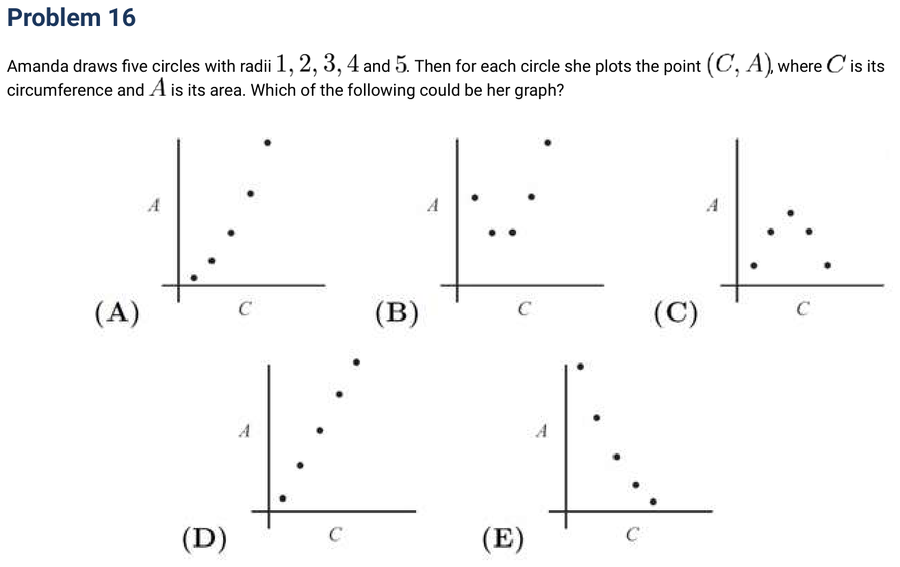
Problem 16 · 2007 AMC 8 Medium
Algebra & Patterns quadratic-vs-linear
amc8-2007-16
Show answer
Answer: A — Graph A.
Show hint
Hint 1
C = 2πr, A = πr2. Eliminating r: A = C2/(4π). Look for a graph that's an increasing concave-up curve.
Show solution
Approach: identify the shape of A vs C
  1. A grows like C2: both increasing, concave-up.
  2. Only graph A shows that pattern.
Mark: · log in to save
Problem 20 · 2007 AMC 8 Medium
Algebra & Patterns percent-equation

Before district play, the Unicorns had won 45% of their basketball games. During district play, they won six more games and lost two, to finish the season having won half their games. How many games did the Unicorns play in all?

Show answer
Answer: A — 48 games.
Show hint
Hint 1
Let pre-district games be x. Pre-district wins: 0.45x. Final wins: 0.45x + 6 = (x + 8)/2.
Show solution
Approach: set up an equation
  1. 0.45x + 6 = (x + 8)/2.
  2. Multiply by 10: 4.5x + 60 = 5x + 40 ⇒ 0.5x = 20 ⇒ x = 40.
  3. Total games: 40 + 8 = 48.
Mark: · log in to save
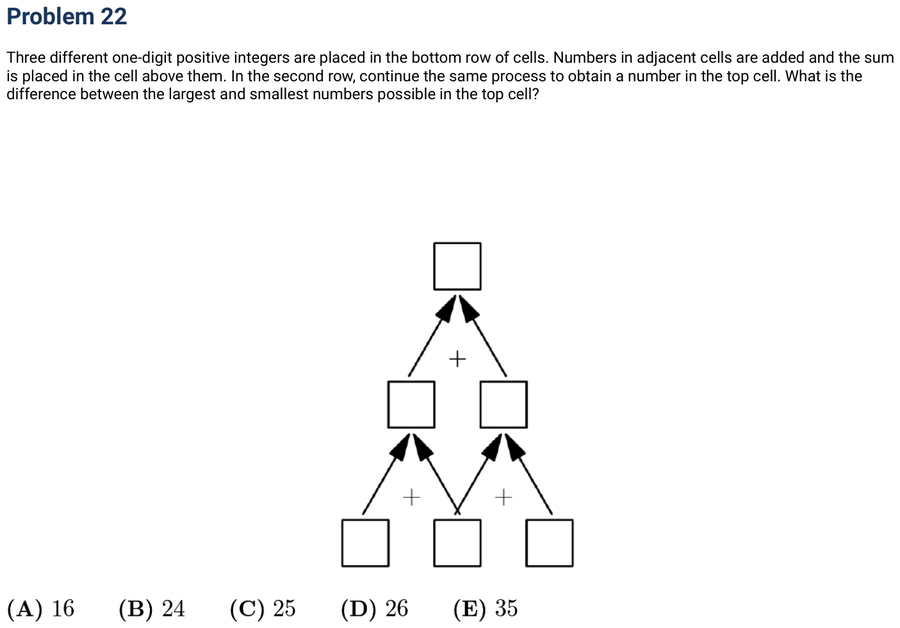
Problem 22 · 2006 AMC 8 Medium
Algebra & Patterns pyramid-formula
amc8-2006-22
Show answer
Answer: D — 26.
Show hints
Hint 1 of 2
Top = a + 2b + c where a, b, c are bottom-left, middle, bottom-right.
Still stuck? Show hint 2 →
Hint 2 of 2
Use 1, 2, 3 (min) and 7, 8, 9 (max), with the largest digit in the middle.
Show solution
Approach: find the formula then optimize
  1. Top = a + 2b + c. Middle has double weight.
  2. Min: a=2, b=1, c=3 ⇒ 2 + 2 + 3 = 7.
  3. Max: a=8, b=9, c=7 ⇒ 8 + 18 + 7 = 33.
  4. Diff: 33 − 7 = 26.
Mark: · log in to save
Problem 11 · 2002 AMC 8 Medium
Algebra & Patterns perfect-squaredifference-of-squares

A sequence of squares is made of identical square tiles. Each square's edge is one tile longer than the edge of the previous square. The first three squares are shown. How many more tiles does the seventh square require than the sixth?

Show answer
Answer: C — 13.
Show hints
Hint 1 of 2
A square that is n tiles on a side uses n Ɨ n tiles.
Still stuck? Show hint 2 →
Hint 2 of 2
Compare 7 Ɨ 7 with 6 Ɨ 6.
Show solution
Approach: the nth square uses n² tiles
  1. A square that is n tiles on a side uses n² tiles.
  2. So the seventh needs 7² = 49 and the sixth needs 6² = 36: the difference is 49 āˆ’ 36 = 13.
Another way — difference of squares (no squaring needed):
  1. 7² āˆ’ 6² = (7 + 6)(7 āˆ’ 6) = 13 Ɨ 1 = 13.
Mark: · log in to save
Problem 12 · 2001 AMC 8 Medium
Algebra & Patterns custom-operation

If ab = a + bab, then (6 ♦ 4) ♦ 3 =

Show answer
Answer: A — 4.
Show hints
Hint 1 of 2
Work inside the parentheses first, just like any operation.
Still stuck? Show hint 2 →
Hint 2 of 2
Order matters: the bottom is a āˆ’ b, not b āˆ’ a.
Show solution
Approach: evaluate the custom operation inside-out
  1. First 6 ♦ 4 = (6 + 4)/(6 āˆ’ 4) = 10/2 = 5.
  2. Then 5 ♦ 3 = (5 + 3)/(5 āˆ’ 3) = 8/2 = 4.
Mark: · log in to save
Problem 12 · 1998 AJHSME Medium
Algebra & Patterns simplify-term

What is the value of 2(1 − 12) + 3(1 − 13) + 4(1 − 14) + … + 10(1 − 110)?

Show answer
Answer: A — 45.
Show hints
Hint 1 of 2
Simplify a single term: k(1 āˆ’ 1/k) is just k āˆ’ 1.
Still stuck? Show hint 2 →
Hint 2 of 2
Then you're adding 1 + 2 + … + 9.
Show solution
Approach: simplify each term to k āˆ’ 1
  1. Each term k(1 āˆ’ 1/k) equals k āˆ’ 1, so the sum is 1 + 2 + 3 + … + 9.
  2. That total is 45.
Mark: · log in to save
Problem 6 · 1996 AJHSME Medium
Algebra & Patterns minimize

What is the smallest result that can be obtained from the following process? Choose three different numbers from the set {3, 5, 7, 11, 13, 17}, add two of them, then multiply their sum by the third number.

Show answer
Answer: C — 36.
Show hints
Hint 1 of 2
To make a product small, multiply by the smallest number.
Still stuck? Show hint 2 →
Hint 2 of 2
Then add the two next-smallest numbers.
Show solution
Approach: multiply by the smallest, add the next two
  1. Use 3 as the multiplier and add the next two smallest, 5 and 7: (5 + 7) Ɨ 3 = 36.
  2. Any other choice (such as (3 + 7) Ɨ 5 = 50) is larger, so the smallest is 36.
Mark: · log in to save
Problem 9 · 1996 AJHSME Medium
Algebra & Patterns reciprocal

If 5 times a number is 2, then 100 times the reciprocal of the number is

Show answer
Answer: D — 250.
Show hints
Hint 1 of 2
First find the number, then flip it.
Still stuck? Show hint 2 →
Hint 2 of 2
5 Ɨ number = 2 means the number is 2/5.
Show solution
Approach: find the number, then its reciprocal
  1. The number is 2/5, so its reciprocal is 5/2.
  2. 100 Ɨ (5/2) = 250.
Mark: · log in to save
Problem 11 · 1996 AJHSME Medium
Algebra & Patterns compare-magnitudes

Let x be the number 0.00…01, where there are 1996 zeros after the decimal point before the 1. Which of the following expressions represents the largest number?

Show answer
Answer: D — 3/x.
Show hints
Hint 1 of 2
x is an extremely tiny positive number.
Still stuck? Show hint 2 →
Hint 2 of 2
Dividing by something tiny makes the result enormous.
Show solution
Approach: compare sizes when x is tiny
  1. Since x is a tiny positive number, 3 + x, 3 āˆ’ x, and 3Ā·x are all near 3 (or near 0), and x/3 is tiny.
  2. But 3/x divides by something tiny, giving a gigantic number, so 3/x is largest.
Mark: · log in to save
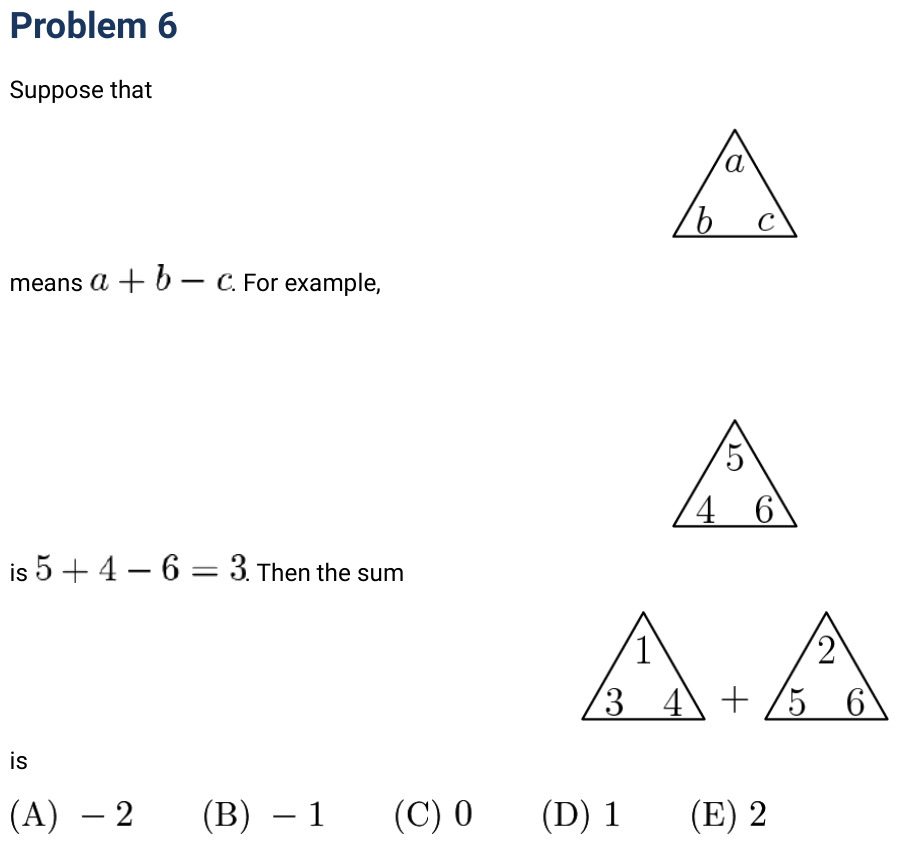
Problem 6 · 1992 AJHSME Medium
Algebra & Patterns custom-operation
ajhsme-1992-06
Show answer
Answer: D — 1.
Show hints
Hint 1 of 2
Each triangle means top + bottom-left āˆ’ bottom-right.
Still stuck? Show hint 2 →
Hint 2 of 2
Evaluate both triangles, then add.
Show solution
Approach: apply the rule to each triangle
  1. First triangle: 1 + 3 āˆ’ 4 = 0. Second triangle: 2 + 5 āˆ’ 6 = 1.
  2. Their sum is 0 + 1 = 1.
Mark: · log in to save
Problem 8 · 1992 AJHSME Medium
Algebra & Patterns cost-revenue-profit

A store owner bought 1500 pencils at $0.10 each. If he sells them for $0.25 each, how many of them must he sell to make a profit of exactly $100.00?

Show answer
Answer: C — 1000.
Show hints
Hint 1 of 2
First find his total cost, then the revenue needed for a $100 profit.
Still stuck? Show hint 2 →
Hint 2 of 2
Divide that revenue by the $0.25 selling price.
Show solution
Approach: needed revenue Ć· price
  1. Cost is 1500 Ɨ $0.10 = $150, so he needs $150 + $100 = $250 in sales.
  2. At $0.25 each, that's $250 Ć· $0.25 = 1000 pencils.
Mark: · log in to save
Problem 4 · 1991 AJHSME Medium
Algebra & Patterns sum-near-round-number

If 991 + 993 + 995 + 997 + 999 = 5000 − N, then N =

Show answer
Answer: E — 25.
Show hints
Hint 1 of 2
Each term is a little under 1000; how much under?
Still stuck? Show hint 2 →
Hint 2 of 2
The five shortfalls add to N.
Show solution
Approach: measure each term below 1000
  1. The five numbers fall short of 1000 by 9, 7, 5, 3, 1, totaling 25, so the sum is 5000 āˆ’ 25.
  2. Thus N = 25.
Mark: · log in to save
Problem 21 · 1991 AJHSME Medium
Algebra & Patterns linear-rate

For every 3° rise in temperature, the volume of a certain gas expands by 4 cubic centimeters. If the volume of the gas is 24 cubic centimeters when the temperature is 32°, what was the volume in cubic centimeters when the temperature was 20°?

Show answer
Answer: A — 8.
Show hints
Hint 1 of 2
From 32° down to 20° is a 12° drop — how many 3° steps is that?
Still stuck? Show hint 2 →
Hint 2 of 2
Each step removes 4 cm³.
Show solution
Approach: count the 3° steps and subtract
  1. A 12° drop is four 3° steps, each shrinking the gas by 4 cm³, for 16 cm³ less.
  2. So the volume was 24 āˆ’ 16 = 8 cm³.
Mark: · log in to save
Problem 7 · 1989 AJHSME Medium
Algebra & Patterns coin-value

If the value of 20 quarters and 10 dimes equals the value of 10 quarters and n dimes, then n =

Show answer
Answer: D — 35.
Show hints
Hint 1 of 2
Trading away 10 quarters loses 250 cents — make it up in dimes.
Still stuck? Show hint 2 →
Hint 2 of 2
Each dime is worth 10 cents.
Show solution
Approach: balance the values in cents
  1. 20 quarters + 10 dimes = 600Ā¢. The other side is 250Ā¢ from 10 quarters, so the dimes must supply 350Ā¢.
  2. 350 Ć· 10 = 35 dimes.
Mark: · log in to save
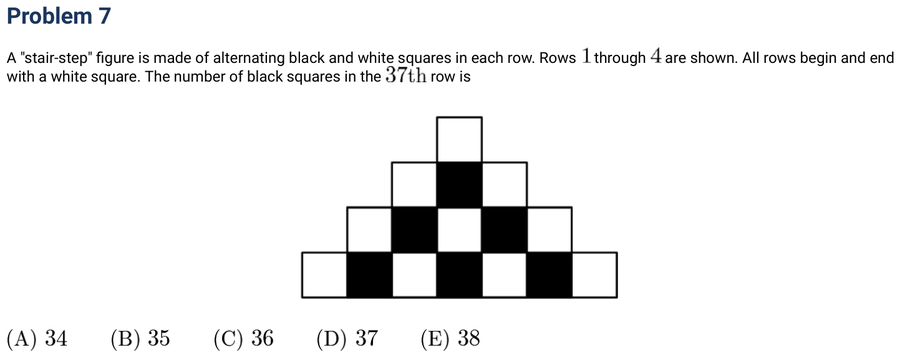
Problem 7 · 1985 AJHSME Medium
Algebra & Patterns pattern-by-row
ajhsme-1985-07
Show answer
Answer: C — 36.
Show hints
Hint 1 of 2
In row n the row has 2n āˆ’ 1 squares; counting whites first, blacks are one fewer.
Still stuck? Show hint 2 →
Hint 2 of 2
Row n: n whites and (n āˆ’ 1) blacks.
Show solution
Approach: find the row-n pattern
  1. Row 1: 1 white, 0 black. Row 2: W B W (2 white, 1 black). Row n: n whites and (n āˆ’ 1) blacks.
  2. Row 37: 37 āˆ’ 1 = 36 black squares.
Mark: · log in to save
Problem 20 · 2025 AMC 8 Hard
Algebra & Patterns arithmetic-seriesfraction-to-decimal

Sarika, Dev, and Rajiv are sharing a large block of cheese. They take turns cutting off half of what remains and eating it: first Sarika eats half of the cheese, then Dev eats half of the remaining half, then Rajiv eats half of what remains, then back to Sarika, and so on. They stop when the cheese is too small to see. About what fraction of the original block of cheese does Sarika eat in total?

Show answer
Answer: A — 4/7.
Show hints
Hint 1 of 2
Sarika eats on turns 1, 4, 7, … — every third turn. What fraction does each Sarika-bite eat?
Still stuck? Show hint 2 →
Hint 2 of 2
Sarika's bites are 1/2, then 1/16, then 1/128, … — a geometric series with ratio 1/8.
Show solution
Approach: sum a geometric series
  1. Each turn eats half of what's left, so the cheese remaining after turn n is 1/2n. Sarika eats at turns 1, 4, 7, …, taking 12, 116, 1128, … of the original block.
  2. Geometric series with first term a = 12 and ratio r = 18.
  3. Sum = a1 − r = 1/27/8 = 4/7.
Mark: · log in to save
Problem 21 · 2024 AMC 8 Hard
Algebra & Patterns ratioproportionsubstitution

A group of frogs (called an army) is living in a tree. A frog turns green when in the shade and turns yellow when in the sun. Initially, the ratio of green to yellow frogs was 3 : 1. Then 3 green frogs moved to the sunny side and 5 yellow frogs moved to the shady side. Now the ratio is 4 : 1. What is the difference between the number of green frogs and yellow frogs now?

Show answer
Answer: E — 24 frogs.
Show hints
Hint 1 of 2
Express both populations in one variable (yellow), then write the new ratio as an equation.
Still stuck? Show hint 2 →
Hint 2 of 2
After moves: green = 3y + 2, yellow = y − 2. Set (3y+2)/(y−2) = 4.
Show solution
Approach: let y = initial yellow, then use both ratios
  1. Let y = initial yellow count, so initial green = 3y.
  2. After the moves: green = 3y + 5 − 3 = 3y + 2 (5 in, 3 out). Yellow = y + 3 − 5 = y − 2.
  3. New ratio: 3y + 2y − 2 = 4 ⇒ 3y + 2 = 4y − 8 ⇒ y = 10. So initial green = 30, yellow = 10.
  4. After: green = 32, yellow = 8. Difference = 32 − 8 = 24.
Mark: · log in to save
Problem 25 · 2023 AMC 8 Hard
Algebra & Patterns arithmetic-sequencedivisibilitycasework

Fifteen integers a1, a2, a3, …, a15 are arranged in order on a number line. The integers are equally spaced and have the property that

1 ≤ a1 ≤ 10,   13 ≤ a2 ≤ 20,   and   241 ≤ a15 ≤ 250.

What is the sum of the digits of a14?

Show answer
Answer: A — 8.
Show hints
Hint 1 of 2
Equally spaced → arithmetic sequence with common difference d. From the bounds, get a tight range for 14d.
Still stuck? Show hint 2 →
Hint 2 of 2
a15a1 = 14d. With 241−10 ≤ 14d ≤ 250−1, the only multiple of 14 in [231, 249] is 238 = 14×17. So d = 17.
Show solution
Approach: nail d from bounds, then a1, then a14
  1. Equal spacing: a15a1 = 14d. Bounds give 231 ≤ 14d ≤ 249, and the only multiple of 14 in there is 238 → d = 17.
  2. Then a2 = a1 + 17 forces a1 ≤ 3, and a15 = a1 + 238 forces a1 ≥ 3. So a1 = 3.
  3. a14 = a15d = (3 + 238) − 17 = 224. Digit sum: 2 + 2 + 4 = 8.
Mark: · log in to save
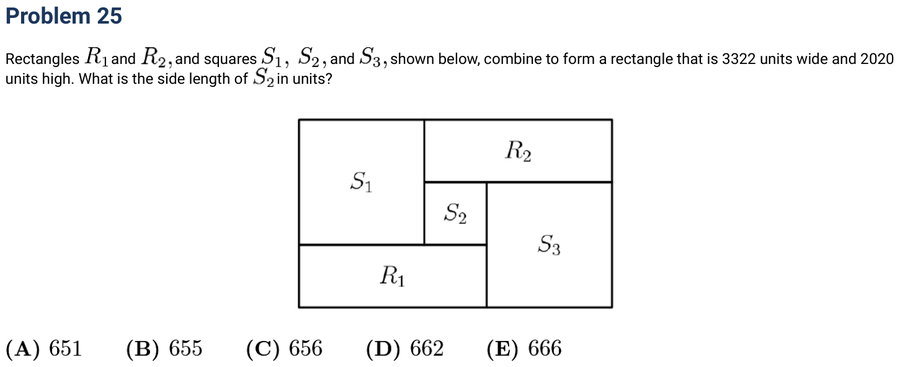
Problem 25 · 2020 AMC 8 Hard
Algebra & Patterns substitutionsum-constraint
amc8-2020-25
Show answer
Answer: A — S2 has side 651.
Show hints
Hint 1 of 2
Set up two equations: width = s1 + s2 + s3 and height has R2's height + s3.
Still stuck? Show hint 2 →
Hint 2 of 2
R2's height = s1s2, so height = s1s2 + s3. Subtract the two equations to isolate s2.
Show solution
Approach: two linear equations, subtract to isolate s_2
  1. Across the top: width = s1 + s2 + s3 = 3322.
  2. Down the side: height = (height of R2) + s3. R2's height = s1s2, so height = s1s2 + s3 = 2020.
  3. Subtract: 2s2 = 3322 − 2020 = 1302 ⇒ s2 = 651.
Mark: · log in to save
Problem 23 · 2019 AMC 8 Hard
Algebra & Patterns divisibilitycasework

After Euclid High School's last basketball game, it was determined that 14 of the team's points were scored by Alexa and 27 were scored by Brittany. Chelsea scored 15 points. None of the other 7 team members scored more than 2 points. What was the total number of points scored by the other 7 team members?

Show answer
Answer: B — 11 points.
Show hints
Hint 1 of 2
Let T = total. Then 1/4 and 2/7 of T are integers ⇒ T is a multiple of lcm(4,7) = 28.
Still stuck? Show hint 2 →
Hint 2 of 2
Others = TT/4 − 2T/7 − 15 = 13T/28 − 15. Constrained by 0 ≤ Others ≤ 7×2 = 14.
Show solution
Approach: T is a multiple of 28; test small values
  1. Let T be the total. Alexa has T/4, Brittany 2T/7 — both integers ⇒ T divisible by 28.
  2. Others' total: TT/4 − 2T/7 − 15 = 13T/28 − 15. Must be in [0, 14] (since 7 players, ≤ 2 each).
  3. T = 28: gives −2 (invalid). T = 56: gives 13·56/28 − 15 = 26 − 15 = 11 (valid).
  4. T = 84 would give 39 − 15 = 24, exceeding 14.
Mark: · log in to save
Problem 21 · 2017 AMC 8 Hard
Algebra & Patterns caseworksubstitution

Suppose a, b, and c are nonzero real numbers, and a + b + c = 0. What are the possible value(s) for

a|a| + b|b| + c|c| + abc|abc| ?
Show answer
Answer: A — 0.
Show hints
Hint 1 of 2
x/|x| = +1 or −1 depending on sign. Since a + b + c = 0, exactly one or two of them are negative.
Still stuck? Show hint 2 →
Hint 2 of 2
Case 2 positive + 1 negative vs 1 positive + 2 negative — check the four signs sum to 0 in both cases.
Show solution
Approach: casework on how many are negative
  1. Since a + b + c = 0 and none are zero, either (i) two are positive and one is negative, or (ii) two are negative and one is positive.
  2. Case (i): signs of a, b, c are +, +, −; product abc is negative. Sum: (+1) + (+1) + (−1) + (−1) = 0.
  3. Case (ii): signs are −, −, +; product is positive. Sum: (−1) + (−1) + (+1) + (+1) = 0.
  4. Either way, the value is 0.
Mark: · log in to save
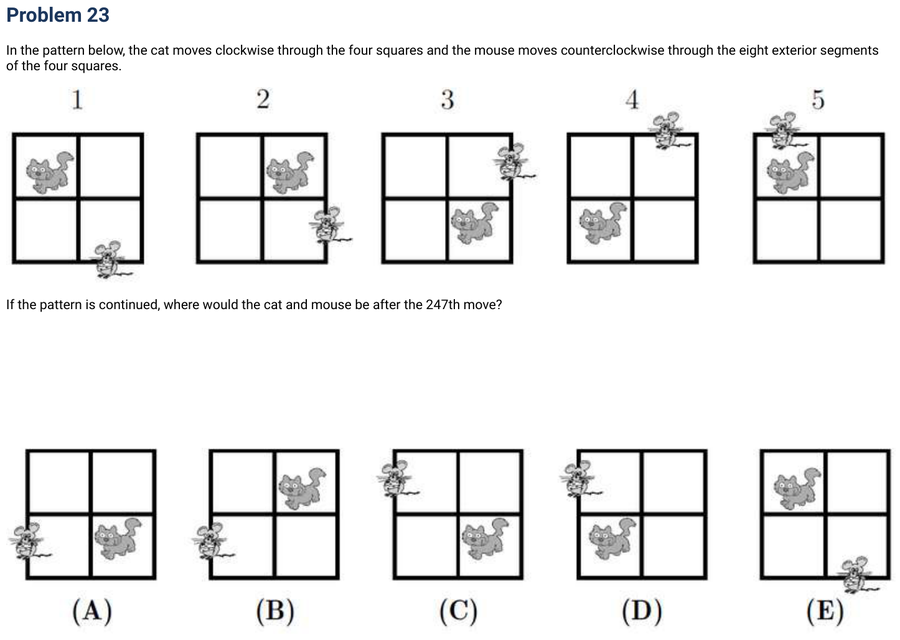
Problem 23 · 2003 AMC 8 Stretch
Algebra & Patterns mod-arithmeticfind-the-cycle
amc8-2003-23
Show answer
Answer: A — the cat in the bottom-right square, the mouse on the bottom-left segment.
Show hints
Hint 1 of 2
The cat and mouse move independently — handle each one's cycle on its own.
Still stuck? Show hint 2 →
Hint 2 of 2
The cat repeats every 4 moves and the mouse every 8; use the remainders of 247.
Show solution
Approach: use the separate cycle lengths
  1. The cat's position repeats every 4 moves and the mouse's every 8, so only the remainder of 247 matters for each.
  2. 247 = 4·61 + 3, so the cat is where it is after 3 moves: the bottom-right square.
  3. 247 = 8·30 + 7, so the mouse is where it is after 7 moves: the bottom-left segment.
  4. The picture matching both is A.
Mark: · log in to save
Problem 25 · 2002 AMC 8 Stretch
Algebra & Patterns substitution

Loki, Moe, Nick, and Ott are good friends. Ott had no money, but the others did. Moe gave Ott one-fifth of his money, Loki gave Ott one-fourth of his money, and Nick gave Ott one-third of his money. Each gave Ott the same amount of money. What fractional part of the group's money does Ott now have?

Show answer
Answer: B — 1/4.
Show hints
Hint 1 of 2
The three gifts are equal — pick a convenient size for that common gift, like $1.
Still stuck? Show hint 2 →
Hint 2 of 2
Then Moe started with $5, Loki $4, Nick $3; passing money around never changes the group total.
Show solution
Approach: set the equal gift to a convenient $1
  1. Let each gift be $1. Since $1 is Moe's fifth, Loki's fourth, and Nick's third, they began with $5, $4, and $3.
  2. Handing money over doesn't change the total: $5 + $4 + $3 = $12, and Ott now holds the three gifts, $3.
  3. Ott's share is 3/12 = 1/4.
Mark: · log in to save
Problem 22 · 1998 AJHSME Stretch
Algebra & Patterns find-the-cycle

Terri builds a sequence of positive integers by these rules: if the integer is less than 10, multiply it by 9; if it is even and greater than 9, divide it by 2; if it is odd and greater than 9, subtract 5. Find the 98th term of the sequence that begins 98, 49, … .

Show answer
Answer: D — 27.
Show hints
Hint 1 of 2
Generate terms until they start repeating.
Still stuck? Show hint 2 →
Hint 2 of 2
Once you spot the repeating block, use its length to jump ahead to the 98th term.
Show solution
Approach: find the repeating cycle, then index into it
  1. The sequence runs 98, 49, 44, 22, 11, 6, 54, 27, 22, 11, … — from the 4th term on it cycles 22, 11, 6, 54, 27 with length 5.
  2. From the 4th term, (98 āˆ’ 4) = 94 steps and 94 Ć· 5 leaves remainder 4, landing on the 5th entry of the cycle: 27.
Mark: · log in to save
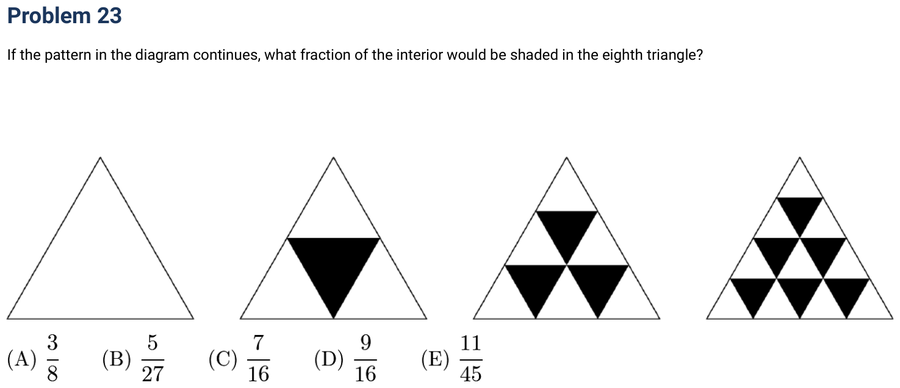
Problem 23 · 1998 AJHSME Stretch
Algebra & Patterns find-the-pattern
ajhsme-1998-23
Show answer
Answer: C — 7/16.
Show hints
Hint 1 of 2
Count shaded vs. total small triangles in the first few figures, then find the rule.
Still stuck? Show hint 2 →
Hint 2 of 2
The ratio simplifies to (n āˆ’ 1)/(2n) for the nth triangle.
Show solution
Approach: find the pattern, then plug in n = 8
  1. The nth triangle splits into n² small triangles, of which (n² āˆ’ n)/2 are shaded — a ratio of (n āˆ’ 1)/(2n).
  2. For the 8th triangle that is 7/16.
Mark: · log in to save
Problem 25 · 1998 AJHSME Stretch
Algebra & Patterns work-backwardinvariant

Three generous friends redistribute their money as follows: Amy gives Jan and Toy enough to double each of their amounts; then Jan gives Amy and Toy enough to double theirs; finally Toy gives Amy and Jan enough to double theirs. Toy had $36 at the beginning and $36 at the end. What is the total amount the three friends have?

Show answer
Answer: D — $252.
Show hints
Hint 1 of 2
The total never changes — you only need to find it at one moment.
Still stuck? Show hint 2 →
Hint 2 of 2
Toy's money doubles in the first two rounds, so track it up to just before his own turn.
Show solution
Approach: track Toy's doubling, then read off the total
  1. Toy's $36 doubles in each of the first two rounds: 36 → 72 → 144 just before his turn.
  2. He ends with $36, so he gave away 144 āˆ’ 36 = 108, which exactly doubled Amy and Jan — meaning they held $108 then.
  3. The total, unchanged throughout, is 144 + 108 = $252.
Mark: · log in to save
Problem 21 · 1990 AJHSME Stretch
Algebra & Patterns work-backward

A list of 8 numbers is formed by beginning with two given numbers. Each new number in the list is the product of the two previous numbers. Find the first number if the last three numbers are 16, 64, 1024.

Show answer
Answer: B — 1/4.
Show hints
Hint 1 of 2
Each term is the product of the two before it, so divide to step backward.
Still stuck? Show hint 2 →
Hint 2 of 2
From 16, 64, 1024 work back: the term before 16 is 64 Ć· 16, and so on.
Show solution
Approach: divide to walk back to the start
  1. Since 1024 = 16 Ā· 64, the term before 16 is 64 Ć· 16 = 4, then 16 Ć· 4 = 4, then 4 Ć· 4 = 1, then 4 Ć· 1 = 4, and finally 1 Ć· 4 = 1/4.
  2. So the first number is 1/4.
Mark: · log in to save
Problem 24 · 1990 AJHSME Stretch
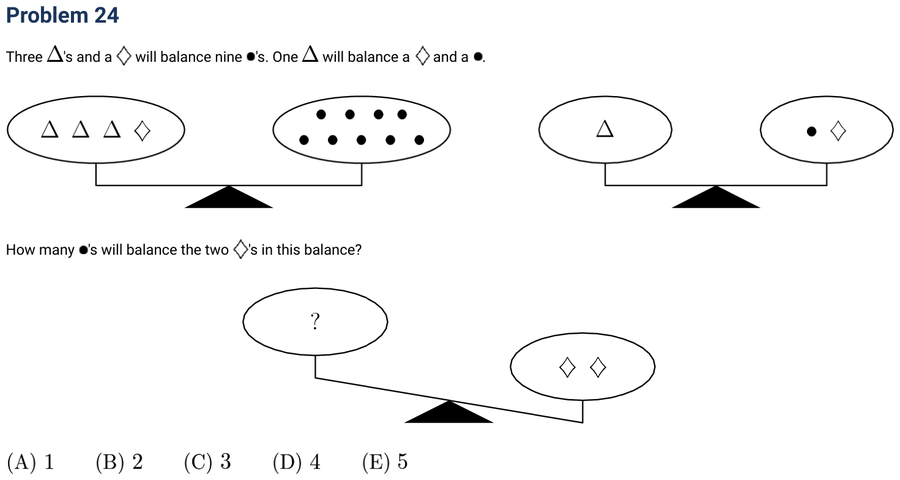
Algebra & Patterns substitutionbalance
ajhsme-1990-24
Show answer
Answer: C — 3.
Show hints
Hint 1 of 2
Write the two balances as equations: 3 triangles + 1 diamond = 9 circles, and 1 triangle = 1 diamond + 1 circle.
Still stuck? Show hint 2 →
Hint 2 of 2
Substitute to eliminate the triangles.
Show solution
Approach: substitute one balance into the other
  1. From 3T + D = 9C and T = D + C: 3(D + C) + D = 9C gives 4D = 6C, so 2D = 3C.
  2. Thus two diamonds balance 3 circles.
Mark: · log in to save
Problem 21 · 1988 AJHSME Stretch
Algebra & Patterns case-on-where-n-falls

A fifth number, n, is added to the set {3, 6, 9, 10} to make the mean of the set of five numbers equal to its median. The number of possible values of n is

Show answer
Answer: C — 3.
Show hints
Hint 1 of 2
The median depends on where n falls in the sorted list; split into three cases.
Still stuck? Show hint 2 →
Hint 2 of 2
In each case, set mean = median and solve for n.
Show solution
Approach: case on where n sits in the sorted list
  1. Mean = (28 + n)⁄5. Case n ≤ 6: median = 6 → n = 2. Case 6 ≤ n ≤ 9: median = n → 28 + n = 5n → n = 7. Case n ≄ 9: median = 9 → n = 17.
  2. Each value of n is consistent with its case, so the answers are 2, 7, 17 — 3 values.
Mark: · log in to save
Problem 24 · 1987 AJHSME Stretch
Algebra & Patterns score-constraintparity

A multiple choice examination consists of 20 questions. The scoring is +5 for each correct answer, āˆ’2 for each incorrect answer, and 0 for each unanswered question. John's score on the examination is 48. What is the maximum number of questions he could have answered correctly?

Show answer
Answer: D — 12.
Show hints
Hint 1 of 2
Let c = correct, w = wrong; 5c āˆ’ 2w = 48 with c + w ≤ 20 and c, w ≄ 0 integers.
Still stuck? Show hint 2 →
Hint 2 of 2
5c must be even, so c must be even — that limits c to even values.
Show solution
Approach: maximize c subject to 5c āˆ’ 2w = 48 and c + w ≤ 20
  1. From 5c āˆ’ 2w = 48, c must be even (so 5c is even); from c + w ≤ 20, c is at most about 12.6.
  2. The biggest even c that fits is c = 12 (w = 6, total 18).
Mark: · log in to save
Problem 24 · 1985 AJHSME Stretch
Algebra & Patterns double-count-vertices
ajhsme-1985-24
Show answer
Answer: D — 39.
Show hints
Hint 1 of 2
Add the three side-sums: each vertex is counted twice, each midpoint once.
Still stuck? Show hint 2 →
Hint 2 of 2
3S = 2Ā·(vertex sum) + (midpoint sum) = (vertex sum) + 75.
Show solution
Approach: double-count vertex contributions
  1. Total of all 6 numbers 10 + 11 + ⋯ + 15 = 75. Adding the three side-sums gives each vertex twice and each midpoint once, so 3S = (vertex sum) + 75. Maximize by putting the three biggest at the vertices: 13 + 14 + 15 = 42.
  2. 3S = 42 + 75 = 117 → S = 39 (with midpoints 12, 10, 11 between the matching vertex pairs).
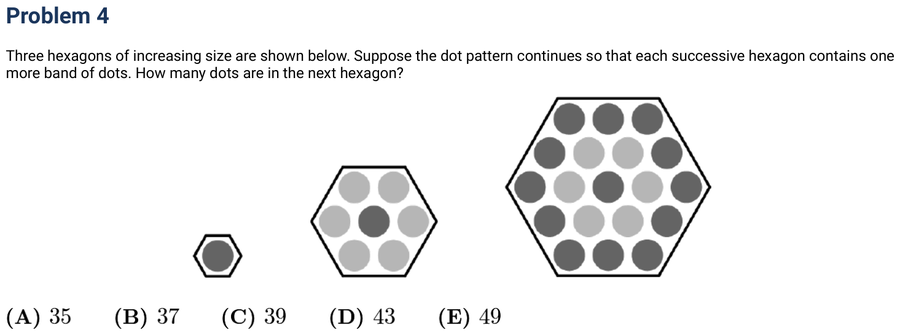
Mark: · log in to save