You don't need to do the whole subtraction. What part of the answer is the question actually asking about?
Still stuck? Show hint 2 →
Hint 2 of 2
Only the ones digits matter — and every number ends in 2. So skip the big subtraction entirely.
Show solution
Only the ones digit matters. The five numbers being subtracted all end in 2, so their ones digits sum to 5 × 2 = 10 — together they take away something ending in 0.
Subtracting a multiple of 10 from 222,222 doesn't touch its ones digit: it stays 2.
Another way — keep the intermediate positive (MAA):
Look only at the last two digits so the running total never goes negative: 22 − 2 − 2 − 2 − 2 − 2.
Four squares of side lengths 4, 7, 9, and 10 units are arranged in increasing size order so that their left edges and bottom edges align. The squares alternate in the color pattern white-gray-white-gray, respectively, as shown in the figure. What is the area of the visible gray region, in square units?
Sides 4, 7, 9, 10 share a bottom-left corner; smaller squares lie on top.
Show answer
Answer: E — 52 square units.
Show hints
Hint 1 of 2
Each gray square is only partly visible. What shape is the gray you can actually see?
Still stuck? Show hint 2 →
Hint 2 of 2
Each smaller square sits on top, so every gray square shows just a frame: its area minus the square covering it. And a2 − b2 = (a+b)(a−b) makes that instant.
Show solution
Smaller squares sit on top, so each gray square shows a frame = (its area) − (the square on top of it).
Gray 10 under white 9: 102 − 92 = (10+9)(10−9) = 19.
Gray 7 under white 4: 72 − 42 = (7+4)(7−4) = 33.
Add the two frames: 19 + 33 = 52.
Another way — alternating add and subtract (MAA):
The visible gray is the 10-square minus the 9-square plus the 7-square minus the 4-square: 100 − 81 + 49 − 16.
When Yunji added all the integers from 1 to 9, she mistakenly left out a number. Her incorrect sum turned out to be a square number. What number did Yunji leave out?
Show answer
Answer: E — She left out 9.
Show hints
Hint 1 of 2
Start from the correct total 1+2+…+9. Taking one number out lands you near a special number — which one?
Still stuck? Show hint 2 →
Hint 2 of 2
Find the correct total of 1 through 9. Leaving out x makes the sum 45 − x. Which x makes that a perfect square?
Show solution
1 + 2 + 3 + … + 9 = 45.
Leaving out x (from 1 to 9) gives 45 − x, which is between 36 and 44.
Aaliyah rolls two standard 6-sided dice. She notices that the product of the two numbers rolled is a multiple of 6. Which of the following integers cannot be the sum of the two numbers?
Show answer
Answer: B — The sum cannot be 6.
Show hints
Hint 1 of 2
The product is a multiple of 6 only when the two dice meet a special condition. Test each answer choice against it.
Still stuck? Show hint 2 →
Hint 2 of 2
A product is a multiple of 6 only if the pair contains a 3 or 6 (factor of 3) and an even number (factor of 2). Just test the answer choices against that.
Show solution
The pair must include a multiple of 3 (a 3 or a 6) and an even number.
Sum 6 comes only from (1,5), (2,4), (3,3) — products 5, 8, 9, none a multiple of 6. So 6 is impossible.
Every other choice has a good pair: 5 = (2,3)→6, 7 = (1,6)→6, 8 = (2,6)→12, 9 = (3,6)→18.
Another way — list every valid pair (MAA):
Pairs whose product is a multiple of 6 (need a multiple of 3 and an even number): (1,6), (2,3), (2,6), (3,6), (4,6), (5,6), (6,6).
Their sums: 7, 5, 8, 9, 10, 11, 12. Among A–E, only 6 is missing.
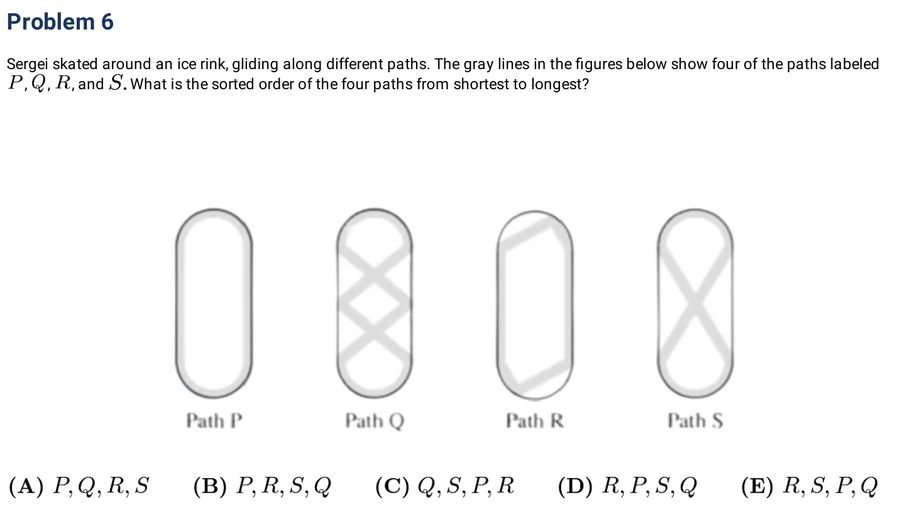
Use the plain oval P as a baseline. Which paths cut corners (shorter) and which add diagonals (longer)?
Still stuck? Show hint 2 →
Hint 2 of 2
R uses straight shortcuts across the rounded ends — shorter than P. S and Q swap edges for diagonals; a diagonal is a hypotenuse, always longer than the legs it replaces.
Show solution
Approach: compare each path to the plain oval boundary
R cuts the rounded ends with straight chords, so R is strictly shorter than P. Shortest.
S adds one diagonal X inside the oval — the diagonal is a hypotenuse, longer than the legs P would take. So S > P.
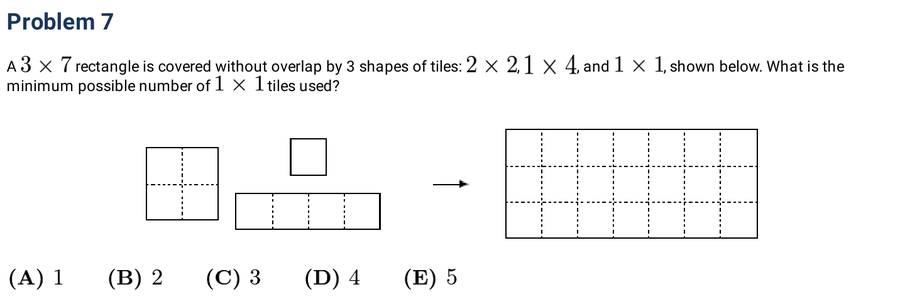
The 2×2 and 1×4 tiles each cover 4 squares. What does that tell you about the number of 1×1 tiles needed?
Still stuck? Show hint 2 →
Hint 2 of 2
21 squares total, and the 2×2 + 1×4 tiles fill a multiple of 4. So the 1×1 count is 1, 5, 9, … Try the smallest that actually fits.
Show solution
Approach: modular constraint, then check the smallest workable count
Each 2×2 and 1×4 tile covers 4 unit squares, so together they fill a multiple of 4. The 1×1 count must equal 21 − (multiple of 4) ≡ 1 (mod 4): possible values 1, 5, 9, …
Can we cover 20 of the 21 squares with 2×2 and 1×4 tiles, leaving just one 1×1? Trying shows it doesn't fit (a 3×7 rectangle with one cell removed can't be partitioned into 2×2's and 1×4's).
5 works: place four 2×2 and 1×4 tiles covering 16 squares, with the 5 remaining cells filled by 1×1's. Minimum = 5.
On Monday Taye has $2. Every day, he either gains $3 or doubles the amount of money he had on the previous day. How many different dollar amounts could Taye have on Thursday, 3 days later?
Show answer
Answer: D — 6 different amounts.
Show hints
Hint 1 of 2
Build a tree: from each daily amount, branch on +$3 or ×2. Some branches collide — just list the unique values.
Still stuck? Show hint 2 →
Hint 2 of 2
Tuesday: {$4, $5}. Wednesday: {$7, $8, $10} (the $8 from two paths). Thursday will land on 6 distinct values.
Show solution
Approach: tree of cases, dedupe at the end
From $2 each day choose +$3 or ×2. Tuesday: 2+3=5 or 2×2=4 → {$4, $5}.
All of the marbles in Maria's collection are red, green, or blue. Maria has half as many red marbles as green marbles and twice as many blue marbles as green marbles. Which of the following could be the total number of marbles in Maria's collection?
Show answer
Answer: E — 28 marbles.
Show hints
Hint 1 of 2
Pick one color to stand for a variable, then write the others in terms of it. The total reveals a hidden factor.
Still stuck? Show hint 2 →
Hint 2 of 2
Let r = red count. Green = 2r, blue = 4r. Total = 7r — it must be a multiple of 7.
Show solution
Approach: find the hidden multiple
Let r be the number of red marbles. Half as many red as green → green = 2r. Twice as many blue as green → blue = 4r.
Total = r + 2r + 4r = 7r — always a multiple of 7.
Among the choices, only 28 = 7 × 4 is a multiple of 7.
In January 1980 the Mauna Loa Observatory recorded carbon dioxide CO2 levels of 338 ppm (parts per million). Over the years the average CO2 reading has increased by about 1.515 ppm each year. What is the expected CO2 level in ppm in January 2030? Round your answer to the nearest integer.
Show answer
Answer: B — 414 ppm.
Show hints
Hint 1 of 2
Constant per-year increase means total increase is linear in the years elapsed.
Still stuck? Show hint 2 →
Hint 2 of 2
Multiply the per-year rate by the number of years (50), then add to the 1980 starting value.
Buzz Bunny is hopping up and down a set of stairs, one step at a time. In how many ways can Buzz start on the ground, make a sequence of 6 hops, and end up back on the ground? (For example, one sequence of hops is up-up-down-down-up-down.)
Show answer
Answer: B — 5 sequences.
Show hints
Hint 1 of 2
Each sequence needs 3 ups and 3 downs. But Buzz can never go below the ground — the running count of downs can never exceed ups.
Still stuck? Show hint 2 →
Hint 2 of 2
Start with U, end with D. Enumerate carefully without breaking the rule.
Show solution
Approach: exhaustively list valid up/down sequences
The sequence has 3 U's and 3 D's, with D's never exceeding U's at any point (otherwise Buzz goes below the ground).
All valid sequences: UUUDDD, UUDUDD, UUDDUD, UDUUDD, UDUDUD.
Minh enters the numbers 1 through 81 into the cells of a 9 × 9 grid in some order. She calculates the product of the numbers in each row and column. What is the least number of rows and columns that could have a product divisible by 3?
Show answer
Answer: D — 11 rows and columns.
Show hints
Hint 1 of 2
Any row or column with even one multiple of 3 has a divisible-by-3 product. So you want the multiples of 3 packed into as few rows and columns as possible.
Still stuck? Show hint 2 →
Hint 2 of 2
Count of multiples of 3 in 1–81: 27. A 5×5 corner block fits 25; the other 2 spill into a 6th column.
Show solution
Approach: pack multiples of 3 into a tight corner block
There are 27 multiples of 3 in 1–81. Any row or column containing a multiple of 3 gets a product divisible by 3, so we want the multiples confined to as few rows and columns as possible.
A 5×5 corner block holds only 25 multiples. The remaining 2 must spill out — place them in the 6th column of rows 1 and 2.
Jordan owns 15 pairs of sneakers. Three fifths of the pairs are red and the rest are white. Two thirds of the pairs are high-top and the rest are low-top. The red high-top sneakers make up a fraction of the collection. What is the least possible value of this fraction?
Show answer
Answer: C — 4/15.
Show hints
Hint 1 of 2
To minimize the overlap of "red AND high-top", let the OTHER kind (white) soak up as many high-tops as it can.
Still stuck? Show hint 2 →
Hint 2 of 2
9 red, 6 white. 10 high-top, 5 low-top. Make all 6 whites high-top; only 4 high-top spots remain — those must be red.
Show solution
Approach: push white pairs into high-top to crowd out red
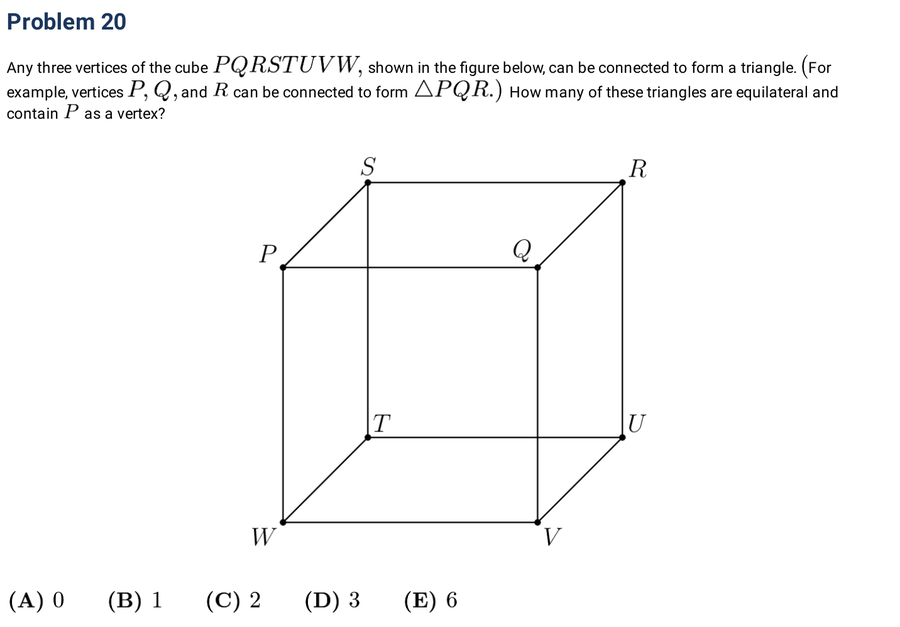
An equilateral triangle in a cube can't use edges or space diagonals as sides — only face diagonals work.
Still stuck? Show hint 2 →
Hint 2 of 2
P has 3 face-diagonal neighbors (one on each of P's three faces). Any 2 of those 3 are also face-diagonal apart, so each pair forms an equilateral triangle with P.
Show solution
Approach: use face-diagonal length as the only valid side
Edges have length 1, face diagonals √2, space diagonals √3. An equilateral triangle must use sides of one length, and only face diagonals can form a closed triangle on a cube.
The vertices at face-diagonal distance from P are R, T, V (one on each of P's three faces).
Every pair of {R, T, V} is also a face diagonal (they lie on the three faces opposite to P), so {P, R, T}, {P, R, V}, {P, T, V} are all equilateral.
A group of frogs (called an army) is living in a tree. A frog turns green when in the shade and turns yellow when in the sun. Initially, the ratio of green to yellow frogs was 3 : 1. Then 3 green frogs moved to the sunny side and 5 yellow frogs moved to the shady side. Now the ratio is 4 : 1. What is the difference between the number of green frogs and yellow frogs now?
Show answer
Answer: E — 24 frogs.
Show hints
Hint 1 of 2
Express both populations in one variable (yellow), then write the new ratio as an equation.
Still stuck? Show hint 2 →
Hint 2 of 2
After moves: green = 3y + 2, yellow = y − 2. Set (3y+2)/(y−2) = 4.
Show solution
Approach: let y = initial yellow, then use both ratios
Let y = initial yellow count, so initial green = 3y.
After the moves: green = 3y + 5 − 3 = 3y + 2 (5 in, 3 out). Yellow = y + 3 − 5 = y − 2.
New ratio: 3y + 2y − 2 = 4 ⇒ 3y + 2 = 4y − 8 ⇒ y = 10. So initial green = 30, yellow = 10.
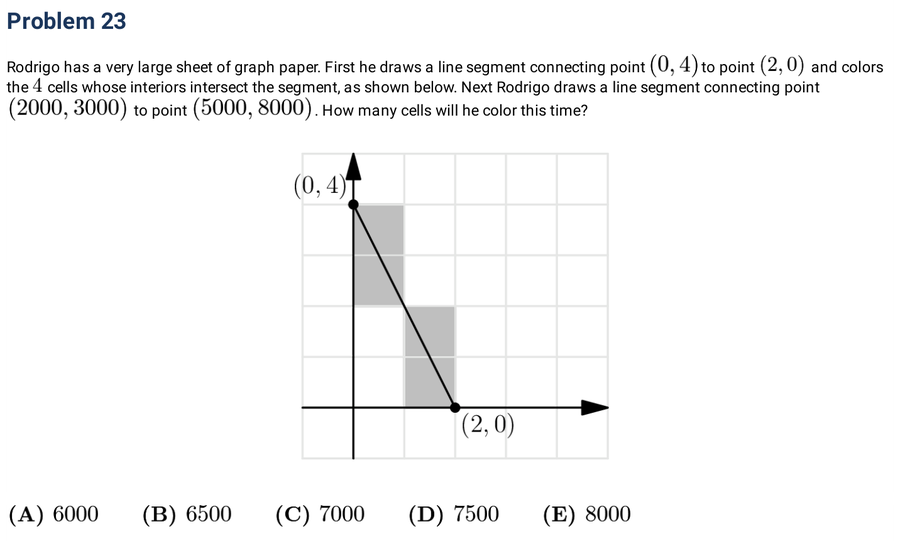
The example (0,4) to (2,0) crosses 4 cells. Notice: 2 + 4 − gcd(2,4) = 4. That's a general formula.
Still stuck? Show hint 2 →
Hint 2 of 2
Apply the formula to (3000, 5000) horizontal/vertical offsets: 3000 + 5000 − gcd(3000, 5000).
Show solution
Approach: use the lattice-line cell-count formula
A line segment whose horizontal offset is a and vertical offset is b crosses a + b − gcd(a, b) grid cells. (You'd cross a + b cells if the line never hit a grid corner; each lattice-point crossing collapses two cell-entries into one, saving 1 per shared factor.)
From (2000, 3000) to (5000, 8000): horizontal offset 3000, vertical offset 5000.
The slope from (2000, 3000) to (5000, 8000) is 5/3. The segment is equivalent to 1000 copies of a primitive (0,0)→(3,5) piece, since gcd(3000, 5000) = 1000.
A small airplane has 4 rows of seats with 3 seats in each row. Eight passengers have boarded the plane and are distributed randomly among the seats. A married couple is next to board. What is the probability there will be 2 adjacent seats in the same row for the couple?
Show answer
Answer: C — 20/33.
Show hints
Hint 1 of 2
Count the complement: when can the couple not sit together? Then subtract from 1.
Still stuck? Show hint 2 →
Hint 2 of 2
Per row of L-M-R, no adjacent pair is open iff M is occupied OR both L and R are occupied. Case-split on how many of the 4 middle seats are occupied.
Show solution
Approach: complementary counting on middle-seat occupancies
Total arrangements: choose 8 of 12 seats for passengers, C(12, 8) = 495.
For NO adjacent pair to be open in a row L–M–R: either M is occupied, or both L and R are occupied. Casework on k = number of rows with M occupied:
k = 0: all four M's empty ⇒ all 8 edge seats filled. 1 way.
k = 1: 4 choices of row, then 2 choices for the extra passenger in that row's edges. 8 ways.
k = 2: C(4,2) = 6 row-choices × C(4,2) = 6 placements of remaining 2 passengers in the 4 unfilled edges. 36 ways.
k = 3: C(4,3) = 4 row-choices × C(6,3) = 20 placements of remaining 3 passengers. 80 ways.
k = 4: all middles filled (4 passengers); C(8,4) = 70 placements of the remaining 4 on edges. 70 ways.
Total "no adjacent": 1 + 8 + 36 + 80 + 70 = 195. So adjacent count = 495 − 195 = 300.