AMC 8 · Test Mode

2022 AMC 8

Test mode — hints and solutions are locked. Pick an answer for each, then submit at the bottom to see your score.

← Exit test mode No hints or solutions until you submit.
Problem 1 · 2022 AMC 8 Easy
Geometry & Measurement area-decompositiongrid-counting
amc8-2022-01
Show answer
Answer: A — 10 square inches.
Show hints
Hint 1 of 2
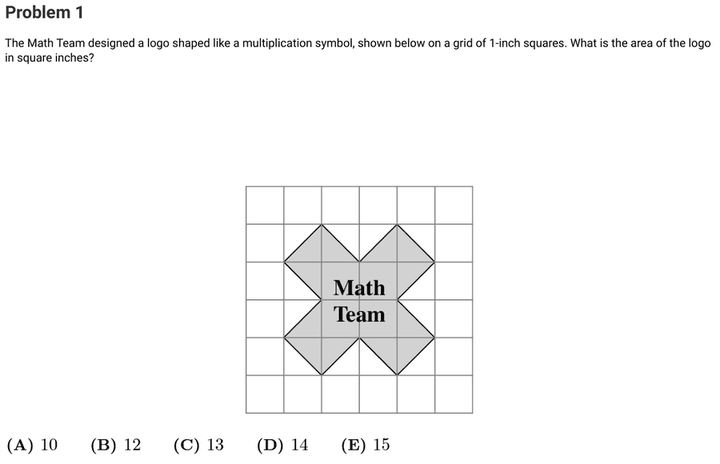
There's a grid behind the logo — let it count for you instead of trying to eyeball the area.
Still stuck? Show hint 2 →
Hint 2 of 2
Lay the logo on the grid and add area piece by piece: count the whole gray squares, then the gray half-squares (triangles).
Show solution
  1. The logo splits into whole unit squares plus triangular half-squares along the grid lines.
  2. There are 4 whole gray squares in the middle, and the surrounding gray triangles add up to 6 more square inches (twelve half-squares).
  3. Total area: 4 + 6 = 10 square inches.
Another way — spot five identical tilted unit-squares (MAA):
  1. The logo is made of five small tilted squares whose sides go diagonally across one grid cell, so each side is √(12 + 12) = √2.
  2. Each such square has area (√2)2 = 2.
  3. Five of them: 5 × 2 = 10 square inches.
Mark: · log in to save
Problem 2 · 2022 AMC 8 Easy
Algebra & Patterns custom-operationsubstitution

Consider these two operations:

ab = a2b2
ab = (ab)2

What is the value of (5 ◆ 3) ★ 6?

Show answer
Answer: D — 100.
Show hint
Hint 1
Work the inside (the ◆) first, then apply the ★ to that result.
Show solution
  1. Inside first: 5 ◆ 3 = 52 − 32 = 25 − 9 = 16.
  2. Now apply ★: 16 ★ 6 = (16 − 6)2 = 102.
  3. = 100.
Mark: · log in to save
Problem 3 · 2022 AMC 8 Medium
Number Theory factorizationfactor-triplescasework

When three positive integers a, b, and c are multiplied together, their product is 100. Suppose a < b < c. In how many ways can the numbers be chosen?

Show answer
Answer: E — 4 ways.
Show hints
Hint 1 of 2
100 has only a handful of factor groupings. Be systematic so you don't miss any or double-count.
Still stuck? Show hint 2 →
Hint 2 of 2
List the ways to write 100 as a product of three different whole numbers, smallest to largest. (100 = 22 × 52.)
Show solution
  1. Try the smallest factor as 1: 1×2×50, 1×4×25, 1×5×20 — all have a < b < c.
  2. Now without a 1: 2×5×10 works (2 < 5 < 10).
  3. Others repeat a factor (like 1×10×10 or 2×2×25), so they don't count.
  4. That gives 4 valid choices.
Another way — bound the smallest factor first (MAA):
  1. Since a < b < c and abc = 100, we get a3 < 100, so a ≤ 4. And a must be a factor of 100, so a ∈ {1, 2, 4}.
  2. For each: a = 1 gives (1,2,50), (1,4,25), (1,5,20); a = 2 gives (2,5,10); a = 4 gives nothing (would need bc = 25 with 4 < b < c).
  3. Total: 4 ways.
Mark: · log in to save
Problem 4 · 2022 AMC 8 Medium
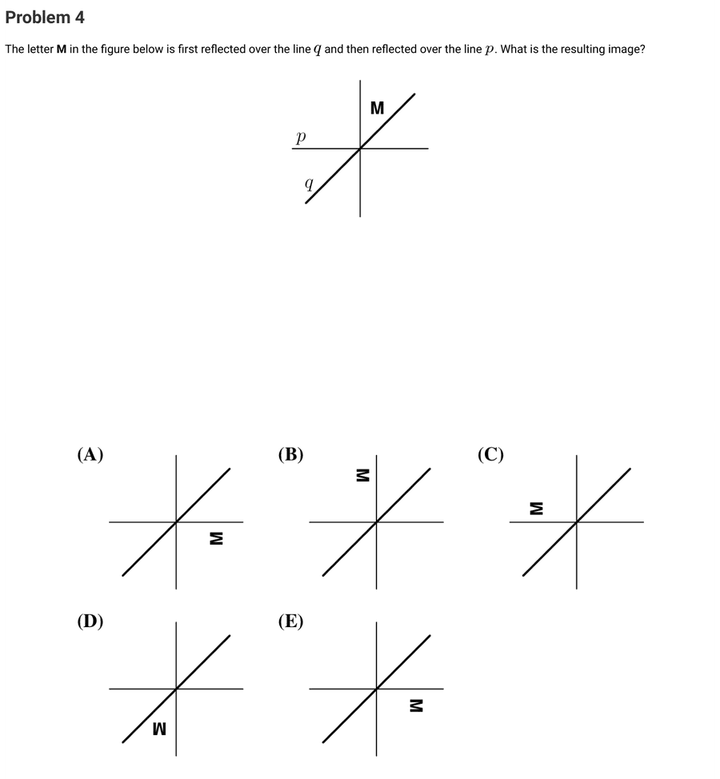
Geometry & Measurement reflectiontransformationscomposition
amc8-2022-04
Show answer
Answer: E — It matches figure (E).
Show hints
Hint 1 of 2
Two flips in a row often equal a single, simpler motion. Try to see the final position, not each step.
Still stuck? Show hint 2 →
Hint 2 of 2
Two reflections in a row, over two lines that cross, equal a single rotation about the crossing point — by twice the angle between the lines.
Show solution
  1. Reflect M over line q, then over line p.
  2. Doing two reflections about lines through one point is the same as rotating M about that point by twice the angle between p and q.
  3. Carrying M through both flips lands it in the position shown in figure (E).
Another way — just do the two reflections in order (MAA):
  1. Reflect M over line q: the M flips across that line, landing in its mirror image position.
  2. Reflect that result over line p: a second flip across the other line.
  3. The final position matches choice (E).
Mark: · log in to save
Problem 5 · 2022 AMC 8 Stretch
Logic & Word Problems ageswork-backwardsum-constraint

Anna and Bella are celebrating their birthdays together. Five years ago, when Bella turned 6 years old, she received a newborn kitten as a birthday present. Today the sum of the ages of the two children and the kitten is 30. How many years older than Bella is Anna?

Show answer
Answer: C — 3 years older.
Show hints
Hint 1 of 2
Don't solve for ages directly — figure out who is how old today first.
Still stuck? Show hint 2 →
Hint 2 of 2
Work out each one's age today first. Bella was 6 five years ago; the kitten was newborn five years ago. The leftover part of 30 is Anna's age.
Show solution
  1. Bella today: 6 + 5 = 11. Kitten today: 0 + 5 = 5.
  2. The three ages sum to 30, so Anna = 30 − 11 − 5 = 14.
  3. Anna − Bella = 14 − 11 = 3 years.
Mark: · log in to save
Problem 6 · 2022 AMC 8 Easy
Algebra & Patterns substitutionarithmetic-sequence

Three positive integers are equally spaced on a number line. The middle number is 15 and the largest number is 4 times the smallest number. What is the smallest of these three numbers?

Show answer
Answer: C — 6.
Show hints
Hint 1 of 2
Equally spaced means the middle equals the average of the outer two.
Still stuck? Show hint 2 →
Hint 2 of 2
Let smallest = x, largest = 4x. Their average = 5x/2 = 15.
Show solution
Approach: middle = average of outers
  1. Let smallest = x, so largest = 4x. Equally spaced ⇒ middle = (x + 4x)/2 = 5x/2.
  2. Set 5x/2 = 15 ⇒ x = 6.
Mark: · log in to save
Problem 7 · 2022 AMC 8 Easy
Ratios, Rates & Proportions distance-speed-timeunit-rate

When the World Wide Web first became popular in the 1990s, download speeds reached a maximum of about 56 kilobits per second. Approximately how many minutes would the download of a 4.2-megabyte song have taken at that speed? (Note that there are 8000 kilobits in a megabyte.)

Show answer
Answer: B — 10 minutes.
Show hints
Hint 1 of 2
Convert the song to kilobits first (units of the speed), then time = size ÷ speed.
Still stuck? Show hint 2 →
Hint 2 of 2
4.2 MB × 8000 kbits/MB = 33,600 kbits. Divide by 56 kbits/sec.
Show solution
Approach: convert to matching units, then divide
  1. Song size: 4.2 × 8000 = 33,600 kilobits.
  2. Time = 33,600 ÷ 56 = 600 seconds = 10 minutes.
Mark: · log in to save
Problem 8 · 2022 AMC 8 Medium
Fractions, Decimals & Percents fraction-to-decimal

What is the value of

13 · 24 · 35 · … · 1820 · 1921 · 2022 ?
Show answer
Answer: B — 1/231.
Show hints
Hint 1 of 2
Every number 3 through 20 appears once as a numerator and once as a denominator. What cancels?
Still stuck? Show hint 2 →
Hint 2 of 2
After cancellation: only 1 · 2 (from numerators) and 21 · 22 (from denominators) survive.
Show solution
Approach: telescoping cancellation
  1. Numerators run 1, 2, 3, …, 20. Denominators run 3, 4, 5, …, 22. Every number from 3 to 20 appears in both lists and cancels.
  2. Left over: 1 · 221 · 22 = 2462 = 1231.
Mark: · log in to save
Problem 9 · 2022 AMC 8 Easy
Fractions, Decimals & Percents percent-multiplier

A cup of boiling water (212°F) is placed to cool in a room whose temperature remains constant at 68°F. Suppose the difference between the water temperature and the room temperature is halved every 5 minutes. What is the water temperature, in degrees Fahrenheit, after 15 minutes?

Show answer
Answer: B — 86°F.
Show hints
Hint 1 of 2
Don't track the temperature directly — track the difference from room temp.
Still stuck? Show hint 2 →
Hint 2 of 2
Initial gap: 212 − 68 = 144. Halved three times in 15 minutes: 144 / 23 = 18. Add to room temp.
Show solution
Approach: track the gap, halve it each interval
  1. Initial gap above room: 212 − 68 = 144°F.
  2. 15 minutes = three 5-minute halvings: 144 → 72 → 36 → 18.
  3. Final temperature = 68 + 18 = 86°F.
Mark: · log in to save
Problem 10 · 2022 AMC 8 Easy
Ratios, Rates & Proportions distance-speed-timegraph-reading
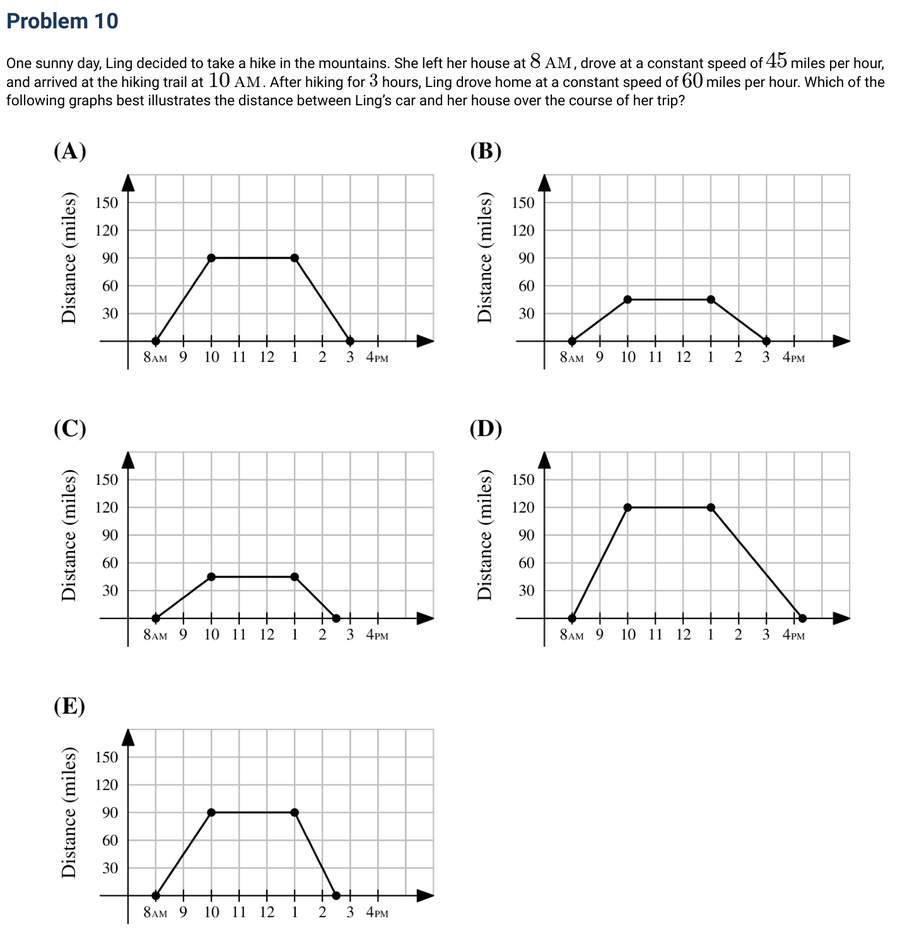
amc8-2022-10
Show answer
Answer: E — Graph (E).
Show hints
Hint 1 of 2
Compute the peak distance (when she reaches the trail) and the timing of the three phases.
Still stuck? Show hint 2 →
Hint 2 of 2
Drive 2 hr at 45 mph = 90 mi. Hike 3 hr at the trail (distance flat). Drive back at 60 mph → 90/60 = 1.5 hr.
Show solution
Approach: compute peak distance and return time
  1. Outbound: 2 hr × 45 mph = 90 miles, reaching the trail at 10am.
  2. Hike 3 hr (distance stays at 90 miles), so she leaves the trail at 1pm.
  3. Return: 90 miles ÷ 60 mph = 1.5 hr, so she's home at 2:30pm.
  4. The graph that peaks at 90 miles between 10am and 1pm and comes back to 0 at 2:30pm is choice E.
Mark: · log in to save
Problem 11 · 2022 AMC 8 Easy
Arithmetic & Operations off-by-one

Henry the donkey has a very long piece of pasta. He takes a number of bites of pasta, each time eating 3 inches of pasta from the middle of one piece. In the end, he has 10 pieces of pasta whose total length is 17 inches. How long, in inches, was the piece of pasta he started with?

Show answer
Answer: D — 44 inches.
Show hints
Hint 1 of 2
Each bite turns one piece into two. How many bites does it take to end with 10 pieces?
Still stuck? Show hint 2 →
Hint 2 of 2
10 pieces = 9 bites × 3 inches removed = 27 inches gone. Original = remaining + removed.
Show solution
Approach: count bites as gaps between pieces
  1. Each bite from the middle of a piece adds one new piece (one piece → two). Starting from 1 piece, reaching 10 pieces took 9 bites.
  2. 9 bites × 3 inches = 27 inches removed.
  3. Original length = 17 (remaining) + 27 (eaten) = 44 inches.
Mark: · log in to save
Problem 12 · 2022 AMC 8 Medium
Counting & Probability careful-countingperfect-square
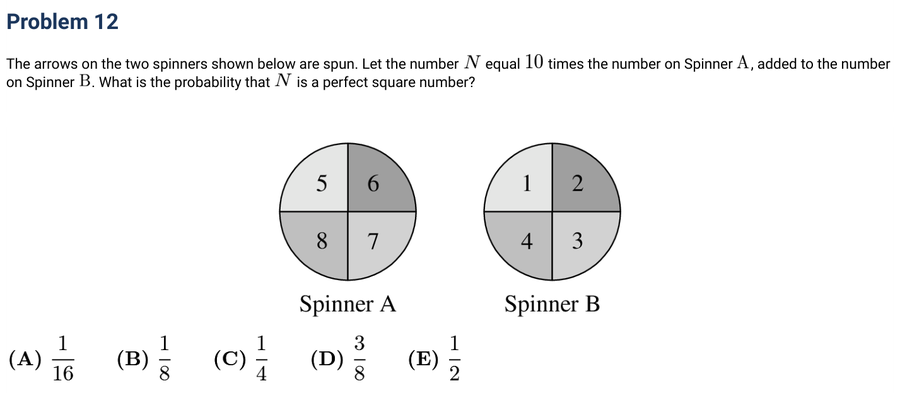
amc8-2022-12
Show answer
Answer: B — 1/8.
Show hints
Hint 1 of 2
N is a 2-digit number with tens digit from Spinner A and ones digit from Spinner B. List the perfect squares in range.
Still stuck? Show hint 2 →
Hint 2 of 2
Spinner A ∈ {5, 6, 7, 8}, so N is in the 50s, 60s, 70s, or 80s. Perfect squares there: 64 and 81.
Show solution
Approach: enumerate perfect squares in the possible range
  1. N = 10A + B with A ∈ {5, 6, 7, 8} and B ∈ {1, 2, 3, 4}: N is between 51 and 84.
  2. Perfect squares in [51, 84]: 64 (= 82) and 81 (= 92). 64 = (A=6, B=4); 81 = (A=8, B=1). Both pairs are reachable.
  3. Probability = 24 × 4 = 18.
Mark: · log in to save
Problem 13 · 2022 AMC 8 Medium
Algebra & Patterns substitutionsum-constraint

How many positive integers can fill the blank in the sentence below?

"One positive integer is ___ more than twice another, and the sum of the two numbers is 28."

Show answer
Answer: D — 9 values.
Show hints
Hint 1 of 2
Set up: smaller = a, larger = 2a + c. The blank is c.
Still stuck? Show hint 2 →
Hint 2 of 2
a + (2a + c) = 28 ⇒ c = 28 − 3a. For both to be positive integers, count valid a.
Show solution
Approach: express c in terms of a, count valid a
  1. Let smaller = a, larger = 2a + c (with c ≥ 1 the blank). Sum: 3a + c = 28, so c = 28 − 3a.
  2. a ≥ 1 and c ≥ 1 ⇒ 28 − 3a ≥ 1 ⇒ a ≤ 9.
  3. a ∈ {1, 2, …, 9} ⇒ 9 values for the blank.
Mark: · log in to save
Problem 14 · 2022 AMC 8 Medium
Counting & Probability careful-counting

In how many ways can the letters in BEEKEEPER be rearranged so that two or more E's do not appear together?

Show answer
Answer: D — 24 ways.
Show hints
Hint 1 of 2
BEEKEEPER has 5 E's and 4 non-E letters (B, K, P, R) in 9 positions. Where can the 5 E's go without two being adjacent?
Still stuck? Show hint 2 →
Hint 2 of 2
5 non-adjacent positions in a row of 9 force the E's into positions 1, 3, 5, 7, 9. Then the 4 non-E letters fill positions 2, 4, 6, 8 in some order.
Show solution
Approach: lock the E positions, permute the rest
  1. BEEKEEPER = 5 E's + {B, K, P, R} in 9 slots. To keep no two E's adjacent, the 5 E's must occupy all 5 odd positions (1, 3, 5, 7, 9) — the only way to fit 5 non-adjacent positions in 9.
  2. The other 4 letters fill positions 2, 4, 6, 8 in any order: 4! = 24 arrangements.
Mark: · log in to save
Problem 15 · 2022 AMC 8 Medium
Fractions, Decimals & Percents unit-rateestimate-and-pick
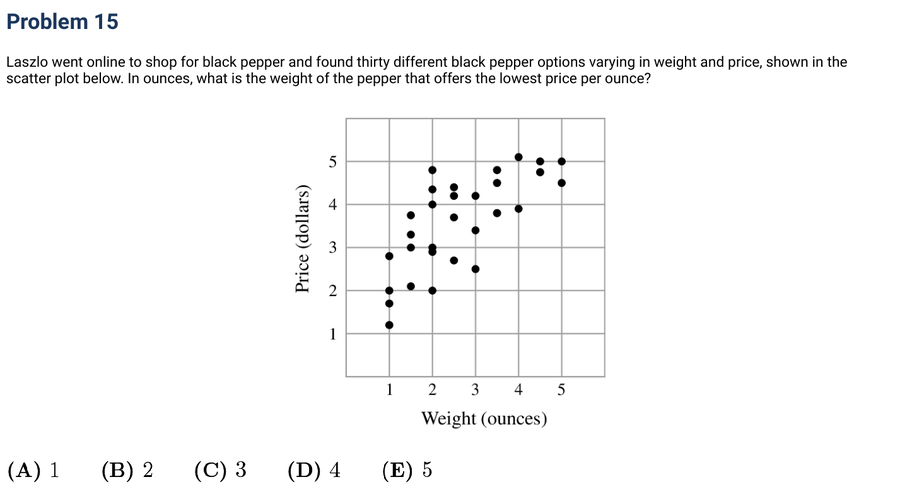
amc8-2022-15
Show answer
Answer: C — 3 ounces.
Show hints
Hint 1 of 2
For each weight, find the lowest price dot in that column. Then compute price ÷ weight.
Still stuck? Show hint 2 →
Hint 2 of 2
Lowest-price-per-ounce will favor a weight where the cheapest available pepper drops well below the dollar-per-ounce line.
Show solution
Approach: lowest dot in each column, then divide
  1. Lowest price at each weight (reading off the scatter): 1 oz ≈ $1.25 (rate ≈ 1.25), 2 oz ≈ $2 (1.00), 3 oz ≈ $2.5 (≈ 0.83), 4 oz ≈ $3.9 (≈ 0.97), 5 oz ≈ $4.5 (≈ 0.90).
  2. The 3-ounce option has the lowest rate (~$0.83/oz). Answer: 3 ounces.
Mark: · log in to save
Problem 16 · 2022 AMC 8 Medium
Arithmetic & Operations sum-constraint

Four numbers are written in a row. The average of the first two is 21, the average of the middle two is 26, and the average of the last two is 30. What is the average of the first and last of the numbers?

Show answer
Answer: B — 25.
Show hints
Hint 1 of 2
Convert each average into a sum (multiply by 2). You don't need the four numbers individually — just a + d.
Still stuck? Show hint 2 →
Hint 2 of 2
(a + b) + (c + d) = (a+b+c+d), and you can subtract (b+c) to leave a+d.
Show solution
Approach: add the outer two sums, subtract the inner sum
  1. a + b = 42, b + c = 52, c + d = 60.
  2. (a+b) + (c+d) − (b+c) = a + d = 42 + 60 − 52 = 50.
  3. Average = 50/2 = 25.
Mark: · log in to save
Problem 17 · 2022 AMC 8 Medium
Number Theory last-digitmod-10

If n is an even positive integer, the double-factorial notation n!! represents the product of all the even integers from 2 to n. For example: 8!! = 2 × 4 × 6 × 8. What is the units digit of the following sum?

2!! + 4!! + 6!! + … + 2022!!
Show answer
Answer: B — Units digit 2.
Show hints
Hint 1 of 2
Once a double-factorial includes 10 as a factor, it ends in 0. Which terms in the sum still affect the ones digit?
Still stuck? Show hint 2 →
Hint 2 of 2
Only 2!!, 4!!, 6!!, 8!! contribute — everything from 10!! onward ends in 0.
Show solution
Approach: drop the 10!!-and-up terms (they end in 0)
  1. n!! for n ≥ 10 contains the factor 10, so its units digit is 0.
  2. Compute only the survivors: 2!! = 2, 4!! = 8, 6!! = 48, 8!! = 384. Their units digits: 2, 8, 8, 4.
  3. Sum of units digits: 2 + 8 + 8 + 4 = 22. Units digit: 2.
Mark: · log in to save
Problem 18 · 2022 AMC 8 Hard
Geometry & Measurement areaarea-decomposition

The midpoints of the four sides of a rectangle are (−3, 0), (2, 0), (5, 4), and (0, 4). What is the area of the rectangle?

Show answer
Answer: C — 40.
Show hints
Hint 1 of 2
The midpoints of any quadrilateral form a parallelogram — with area exactly half the original.
Still stuck? Show hint 2 →
Hint 2 of 2
Compute the midpoint-parallelogram's area, then double.
Show solution
Approach: midpoint parallelogram has half the parent's area
  1. The four midpoints form a parallelogram. Its base ((-3,0) to (2,0)) is length 5; its height (0 to 4) is 4. Area = 5 × 4 = 20.
  2. Theorem: the midpoint quadrilateral has half the area of the original. So the rectangle has area 2 × 20 = 40.
Mark: · log in to save
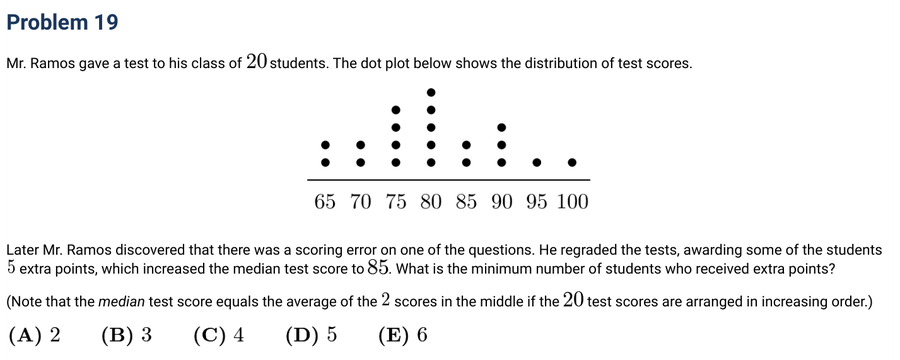
Problem 19 · 2022 AMC 8 Medium
Arithmetic & Operations careful-counting
amc8-2022-19
Show answer
Answer: C — 4 students.
Show hints
Hint 1 of 2
With 20 students the median is the average of the 10th and 11th scores. For the median to be 85, both the 10th and 11th need to be (at least) 85.
Still stuck? Show hint 2 →
Hint 2 of 2
Currently 7 students scored ≥ 85. To make the 11th-highest hit 85, you need 4 more at ≥ 85.
Show solution
Approach: make the 11th-highest score reach 85
  1. Median of 20 scores = average of the 10th and 11th when sorted. To pin the median at 85, the 10th and 11th positions must both equal 85.
  2. From the dot plot, 7 students originally scored ≥ 85. Adding 5 to a student scoring 80 raises them to 85.
  3. Need at least 11 students at ≥ 85, so at least 11 − 7 = 4 students must be raised.
Mark: · log in to save
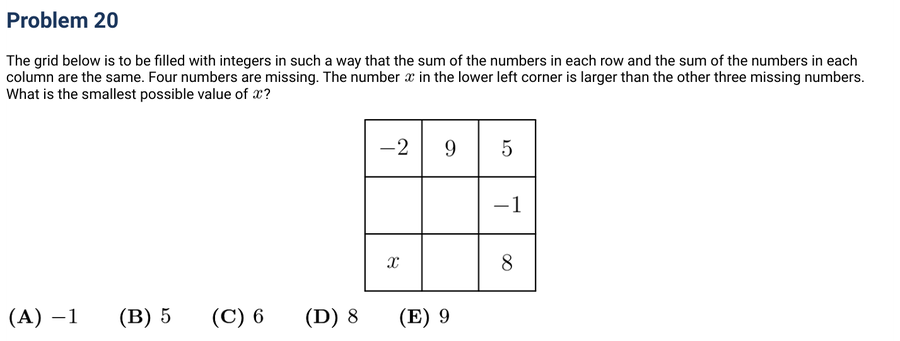
Problem 20 · 2022 AMC 8 Hard
Algebra & Patterns substitutionsum-constraint
amc8-2022-20
Show answer
Answer: D — x = 8.
Show hints
Hint 1 of 2
Find the common row/column sum from the known top row, then express each missing cell in terms of x.
Still stuck? Show hint 2 →
Hint 2 of 2
Top row sums to 12 ⇒ magic sum is 12. The other three missing cells are 14−x, 4−x, x−1. x must beat all of them.
Show solution
Approach: set the common sum, express each blank in terms of x
  1. Top row: −2 + 9 + 5 = 12. So every row and column sums to 12.
  2. First column: −2 + (above x) + x = 12 ⇒ cell above x = 14 − x.
  3. Bottom row: x + (middle bottom) + 8 = 12 ⇒ middle bottom = 4 − x.
  4. Middle row: (14−x) + (center) + (−1) = 12 ⇒ center = x − 1.
  5. x must be the largest: x > 14−xx > 7; x > 4−xx > 2; x > x−1 always.
  6. Smallest integer satisfying all: x = 8.
Mark: · log in to save
Problem 21 · 2022 AMC 8 Hard
Fractions, Decimals & Percents percent-multipliercasework

Steph scored 15 baskets out of 20 attempts in the first half of a game, and 10 baskets out of 10 attempts in the second half. Candace took 12 attempts in the first half and 18 attempts in the second. In each half, Steph scored a higher percentage of baskets than Candace. Surprisingly they ended with the same overall percentage of baskets scored. How many more baskets did Candace score in the second half than in the first?

Show answer
Answer: C — 9 more baskets.
Show hints
Hint 1 of 2
Steph took 20 + 10 = 30 attempts; Candace took 12 + 18 = 30. Same total, same overall % ⇒ same total makes.
Still stuck? Show hint 2 →
Hint 2 of 2
Steph: 15 + 10 = 25 makes. Candace must also make 25. With her per-half percentages strictly below Steph's, only one (f, s) split works.
Show solution
Approach: match totals, then narrow by per-half constraints
  1. Same total attempts (30 each) + same overall percentage ⇒ same total makes. Steph made 15 + 10 = 25, so Candace also made 25.
  2. Let Candace's makes be f (first half, out of 12) and s (second, out of 18). Per-half percentages strictly below Steph: f/12 < 15/20 = 3/4 ⇒ f ≤ 8. And s/18 < 1 ⇒ s ≤ 17.
  3. f + s = 25, f ≤ 8, s ≤ 17 ⇒ only f = 8, s = 17 fits.
  4. sf = 17 − 8 = 9.
Mark: · log in to save
Problem 22 · 2022 AMC 8 Hard
Ratios, Rates & Proportions distance-speed-timecasework

A bus takes 2 minutes to drive from one stop to the next, and waits 1 minute at each stop to let passengers board. Zia takes 5 minutes to walk from one bus stop to the next. As Zia reaches a bus stop, if the bus is at the previous stop or has already left the previous stop, then she will wait for the bus. Otherwise she will start walking toward the next stop. Suppose the bus and Zia start at the same time toward the library, with the bus 3 stops behind. After how many minutes will Zia board the bus?

Show answer
Answer: A — 17 minutes.
Show hints
Hint 1 of 2
Zia only checks at multiples of 5 minutes (when she reaches a stop). At each check, see where the bus is and whether to wait.
Still stuck? Show hint 2 →
Hint 2 of 2
Bus cycle: 2 min driving + 1 min stopped = 3 min per stop. Track stop indexes at t = 0, 5, 10, 15.
Show solution
Approach: simulate at Zia's 5-minute checkpoints
  1. Index stops by the bus's start (stop 0). At t = 0, Zia is at stop 3, bus at stop 0.
  2. t = 5: Zia at stop 4. Bus took 5 min → finished stop 1 (arrived at 2 min, left at 3 min, arrived at stop 2 at 5 min). Bus is at stop 2 — not yet at the previous stop (3), so Zia walks on.
  3. t = 10: Zia at stop 5. Bus: from t = 5 (at stop 2) waits 1 min (leaves at 6), drives 2 min to stop 3 (arrives at 8), waits till 9, drives to stop 4 (arrives at 11). So at t = 10, bus is mid-drive between stops 3 and 4 — not at the previous stop (4), so Zia walks on.
  4. t = 15: Zia at stop 6. Bus: arrives at stop 4 at 11, waits till 12, drives to stop 5 (arrives 14, waits till 15). At t = 15, bus is at stop 5 — the previous stop. Zia waits.
  5. Bus leaves stop 5 at t = 15 and drives 2 min to stop 6: arrives at t = 17.
Mark: · log in to save
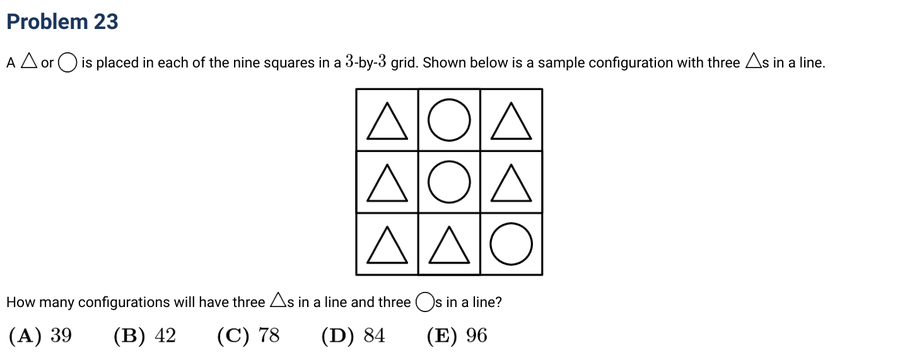
Problem 23 · 2022 AMC 8 Hard
Counting & Probability careful-countingcaseworksymmetry
amc8-2022-23
Show answer
Answer: D — 84 configurations.
Show hints
Hint 1 of 2
If ▵'s form a horizontal line, the ○'s line must also be horizontal (otherwise a cell would need to be both shapes). Same for vertical. So count vertical-line configurations and double.
Still stuck? Show hint 2 →
Hint 2 of 2
Casework on number of vertical lines: 3 (one for each column) or exactly 2.
Show solution
Approach: double the vertical-line count by symmetry, then casework
  1. A ▵ line and a ○ line can't be perpendicular (a cell would be both shapes). So both lines are horizontal, OR both are vertical. Count vertical, then multiply by 2.
  2. Vertical: case 3 lines — each of the 3 columns is monochromatic. 2³ = 8 colorings, minus the 2 all-same colorings (only one shape gets a line) → 6.
  3. Vertical: case 2 lines — one ▵ column, one ○ column, one mixed. 3 ways to pick the ▵ column × 2 remaining for ○ × 6 mixed configurations for the leftover column (2³ minus the two all-same = 6) = 36.
  4. Vertical total: 6 + 36 = 42. By symmetry, horizontal also = 42. Total: 42 + 42 = 84.
Mark: · log in to save
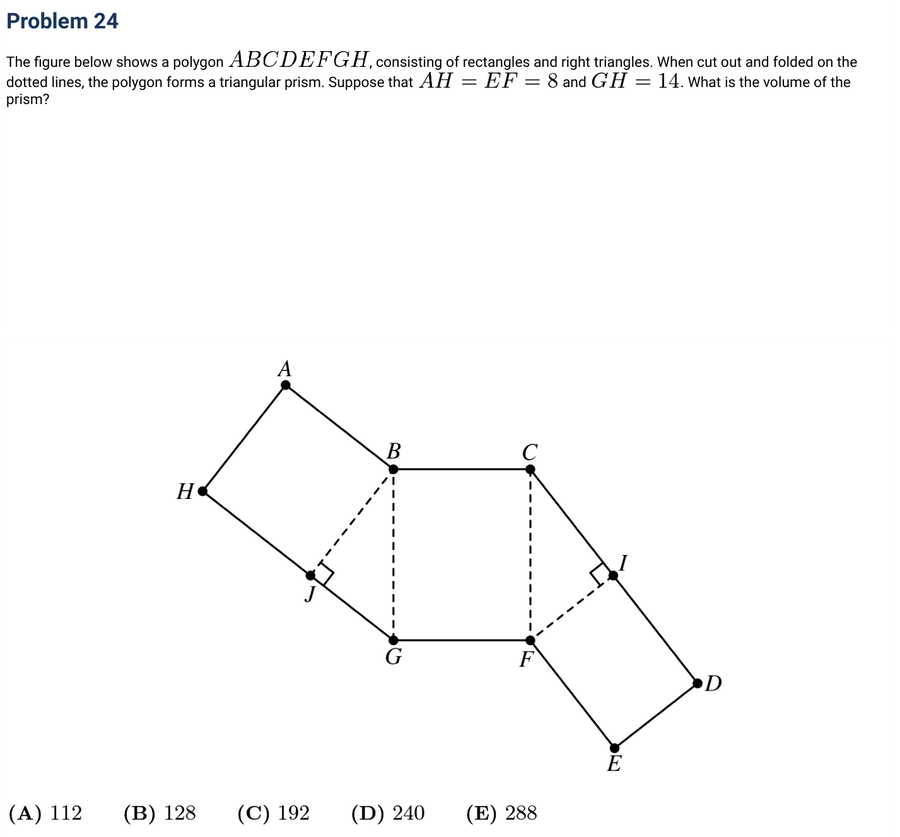
Problem 24 · 2022 AMC 8 Hard
Geometry & Measurement areaspatial-reasoning
amc8-2022-24
Show answer
Answer: C — Volume 192.
Show hints
Hint 1 of 2
Identify the prism: a triangular base of legs 6 and 8 (right triangle), with prism length 8.
Still stuck? Show hint 2 →
Hint 2 of 2
Match edges in the net: AH = EF = 8 forces the rectangle sides; GH = 14 with HJ = 8 gives GJ = 6 — the other leg of the triangular base.
Show solution
Approach: identify the right triangle base and the prism length
  1. Tracing the edges as the net folds: AB = BC = HJ = GF = 8 (the prism length). Also BJ = AH = 8.
  2. GJ = GH − HJ = 14 − 8 = 6.
  3. Triangular base BJG is a right triangle with legs 6 and 8: area = (6 × 8)/2 = 24.
  4. Volume = base × length = 24 × 8 = 192.
Mark: · log in to save
Problem 25 · 2022 AMC 8 Hard
Counting & Probability careful-countingcasework

A cricket randomly hops between 4 leaves, on each turn hopping to one of the other 3 leaves with equal probability. After 4 hops, what is the probability that the cricket has returned to the leaf where it started?

Show answer
Answer: E — 7/27.
Show hints
Hint 1 of 2
Track only one number: pn = probability the cricket is on the starting leaf after n hops.
Still stuck? Show hint 2 →
Hint 2 of 2
From start, the cricket must leave (contributes 0 to pn+1). From any other leaf, prob 1/3 of returning. So pn+1 = (1 − pn)/3.
Show solution
Approach: recursive probability on starting leaf
  1. Let pn = P(on starting leaf after n hops). From the start, the cricket can't stay; from any non-start, it returns with probability 1/3.
  2. pn+1 = (1 − pn) · 13.
  3. Iterate from p0 = 1: p1 = 0, p2 = 1/3, p3 = 2/9, p4 = (1 − 2/9)/3 = (7/9)/3 = 7/27.
Mark: · log in to save