AMC 8 · Test Mode

2018 AMC 8

Test mode — hints and solutions are locked. Pick an answer for each, then submit at the bottom to see your score.

← Exit test mode No hints or solutions until you submit.
Problem 1 · 2018 AMC 8 Easy
Ratios, Rates & Proportions ratioproportion

An amusement park has a collection of scale models, with a ratio of 1 : 20, of buildings and other sights from around the country. The height of the United States Capitol is 289 feet. What is the height in feet of its replica at this park, rounded to the nearest whole number?

Show answer
Answer: A — 14 feet.
Show hint
Hint 1
Scale 1:20 means the replica is 1/20 of the original. Divide.
Show solution
Approach: divide by the scale factor
  1. Replica height = 289 / 20 = 14.45.
  2. Rounded: 14 feet.
Mark: · log in to save
Problem 2 · 2018 AMC 8 Easy
Fractions, Decimals & Percents fraction-to-decimal

What is the value of the product

(1 + 11) · (1 + 12) · (1 + 13) · (1 + 14) · (1 + 15) · (1 + 16) ?
Show answer
Answer: D — 7.
Show hint
Hint 1
Rewrite each factor as n+1n. Then watch consecutive numerators and denominators cancel.
Show solution
Approach: rewrite and telescope
  1. 1 + 1/n = (n+1)/n. So the product is 21 · 32 · 43 · 54 · 65 · 76.
  2. Everything cancels except 7/1 = 7.
Mark: · log in to save
Problem 3 · 2018 AMC 8 Medium
Logic & Word Problems caseworkcareful-counting

Students Arn, Bob, Cyd, Dan, Eve, and Fon are arranged in that order in a circle. They start counting: Arn first, then Bob, and so forth. When the number contains a 7 as a digit (such as 47) or is a multiple of 7 that person leaves the circle and the counting continues. Who is the last one present in the circle?

Show answer
Answer: D — Dan.
Show hints
Hint 1 of 2
List the early 'bad' numbers: 7, 14, 17, 21, 27, 28, 35, … Track who lands on each as the circle shrinks.
Still stuck? Show hint 2 →
Hint 2 of 2
After each elimination, continue counting from the next person in the shrunken circle.
Show solution
Approach: step through the counting, eliminating people
  1. Counts that eliminate: 7, 14, 17, 21, 27, 28, … (7 itself, 14, multiples of 7, or any number with a 7 digit).
  2. Pass 1 (6 people): A=1, B=2, C=3, D=4, E=5, F=6, A=7 ⇒ A out.
  3. Pass 2 (5 people: B, C, D, E, F): B=8, C=9, D=10, E=11, F=12, B=13, C=14 ⇒ C out.
  4. Pass 3 (4: B, D, E, F): D=15, E=16, F=17 ⇒ F out.
  5. Pass 4 (3: B, D, E): B=18, D=19, E=20, B=21 ⇒ B out.
  6. Pass 5 (2: D, E): D=22, E=23, D=24, E=25, D=26, E=27 ⇒ E out.
  7. Last remaining: Dan.
Mark: · log in to save
Problem 4 · 2018 AMC 8 Easy
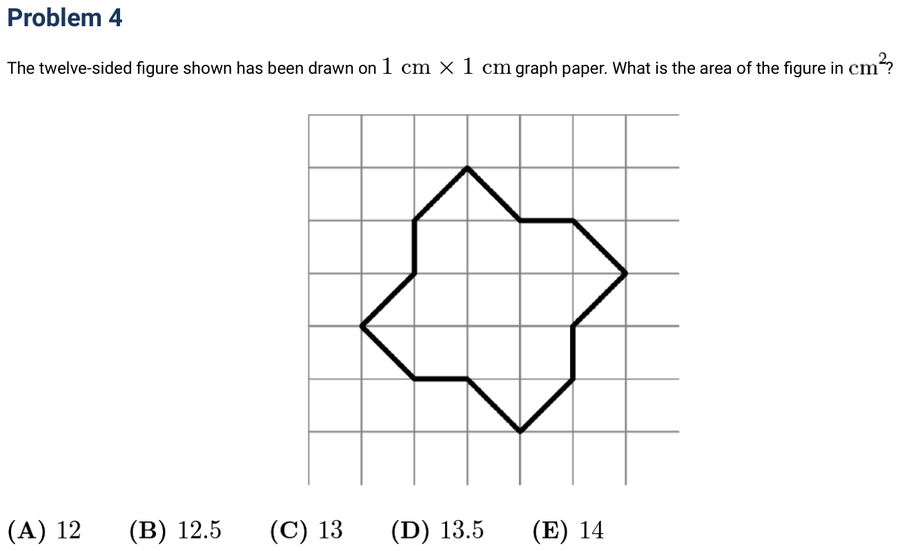
Geometry & Measurement area-decompositionarea
amc8-2018-04
Show answer
Answer: C — 13 sq cm.
Show hints
Hint 1 of 2
Split the shape into a central square plus four triangular bumps. Each bump is a right triangle on the grid.
Still stuck? Show hint 2 →
Hint 2 of 2
Center 3 × 3 = 9. Each bump triangle: base 2, height 1 ⇒ area 1. Four of them = 4.
Show solution
Approach: split into a square + 4 triangles
  1. The figure breaks into a 3 × 3 central square plus 4 identical right triangles on the outside.
  2. Square area: 9. Each triangle: (1/2)(2)(1) = 1; four of them: 4.
  3. Total: 9 + 4 = 13 cm2.
Mark: · log in to save
Problem 5 · 2018 AMC 8 Easy
Arithmetic & Operations groupingarithmetic-series

What is the value of

1 + 3 + 5 + … + 2017 + 2019 − 2 − 4 − 6 − … − 2016 − 2018 ?
Show answer
Answer: E — 1010.
Show hint
Hint 1
Rearrange: 1 + (3−2) + (5−4) + (7−6) + … + (2019−2018). Each parenthesis is just 1.
Show solution
Approach: pair adjacent odd/even terms
  1. Group as 1 + (3 − 2) + (5 − 4) + … + (2019 − 2018). Each parenthesized pair = 1.
  2. Number of pairs: from 3–2 up to 2019–2018 — that's 1009 pairs. Plus the leading 1.
  3. Total: 1 + 1009 = 1010.
Mark: · log in to save
Problem 6 · 2018 AMC 8 Medium
Ratios, Rates & Proportions distance-speed-time

On a trip to the beach, Anh traveled 50 miles on the highway and 10 miles on a coastal access road. He drove three times as fast on the highway as on the coastal road. If Anh spent 30 minutes driving on the coastal road, how many minutes did his entire trip take?

Show answer
Answer: C — 80 minutes.
Show hints
Hint 1 of 2
Coastal speed = 10 mi / 30 min = 1/3 mile/minute. Highway is 3× faster = 1 mile/minute.
Still stuck? Show hint 2 →
Hint 2 of 2
Highway time = 50 miles ÷ 1 mile/min = 50 min. Add the 30 min coastal.
Show solution
Approach: find each leg's time separately
  1. Coastal: 10 miles in 30 min ⇒ 1/3 mile per minute. Highway is 3× that: 1 mile/min.
  2. Highway time: 50 / 1 = 50 min.
  3. Total: 30 + 50 = 80 minutes.
Mark: · log in to save
Problem 7 · 2018 AMC 8 Medium
Number Theory divisibilitydigit-sum

The 5-digit number 2018U is divisible by 9. What is the remainder when this number is divided by 8?

Show answer
Answer: B — Remainder 3.
Show hints
Hint 1 of 2
Div by 9 ⇔ digit sum div by 9. Find U.
Still stuck? Show hint 2 →
Hint 2 of 2
U = 7 (since 2+0+1+8 = 11; 11+U div by 9 ⇒ U = 7). Then 20187 mod 8.
Show solution
Approach: use the divisibility-by-9 rule
  1. Sum of digits 2+0+1+8+U = 11 + U must be a multiple of 9 (with 0 ≤ U ≤ 9). So U = 7.
  2. 20187 ÷ 8 = 2523 remainder 3 (since 2523 × 8 = 20184). Remainder: 3.
Mark: · log in to save
Problem 8 · 2018 AMC 8 Easy
Arithmetic & Operations careful-counting
amc8-2018-08
Show answer
Answer: C — 4.36.
Show hints
Hint 1 of 2
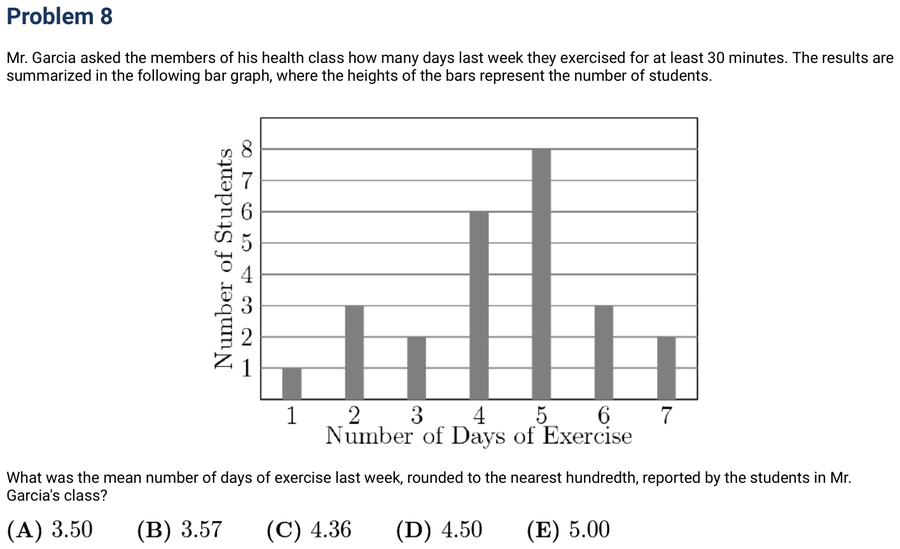
Mean = (total days) ÷ (total students). Read each bar's height to get the count of students for each day-value.
Still stuck? Show hint 2 →
Hint 2 of 2
Total days = 1·1 + 3·2 + 2·3 + 6·4 + 8·5 + 3·6 + 2·7. Total students = sum of heights.
Show solution
Approach: weighted mean from the bar heights
  1. Students per day-count (1 to 7 days): 1, 3, 2, 6, 8, 3, 2. Total students: 1+3+2+6+8+3+2 = 25.
  2. Total days: 1·1 + 3·2 + 2·3 + 6·4 + 8·5 + 3·6 + 2·7 = 1 + 6 + 6 + 24 + 40 + 18 + 14 = 109.
  3. Mean = 109 / 25 = 4.36.
Mark: · log in to save
Problem 9 · 2018 AMC 8 Medium
Geometry & Measurement area-decompositionperimeter

Tyler is tiling the floor of his 12 foot by 16 foot living room. He plans to place one-foot by one-foot square tiles to form a border along the edges of the room and to fill in the rest of the floor with two-foot by two-foot square tiles. How many tiles will he use?

Show answer
Answer: B — 87 tiles.
Show hints
Hint 1 of 2
Border (1×1 tiles): walk around the rectangle — total = 2×(12+16) − 4 for shared corners.
Still stuck? Show hint 2 →
Hint 2 of 2
Inner area is 10 × 14 (one foot off each side), filled with 2×2 tiles.
Show solution
Approach: border + interior
  1. Border: 2(12) + 2(16) − 4 = 52 unit tiles (subtract 4 because each corner is shared by two sides).
  2. Interior: 10 ft × 14 ft = 140 sq ft, filled by 2×2 tiles → 140 / 4 = 35 tiles.
  3. Total: 52 + 35 = 87.
Mark: · log in to save
Problem 10 · 2018 AMC 8 Medium
Fractions, Decimals & Percents fraction-to-decimalevaluate-formula

The harmonic mean of a set of non-zero numbers is the reciprocal of the average of the reciprocals of the numbers. What is the harmonic mean of 1, 2, and 4?

Show answer
Answer: C — 12/7.
Show hints
Hint 1 of 2
Three steps: take reciprocals, average, take reciprocal again.
Still stuck? Show hint 2 →
Hint 2 of 2
Reciprocals: 1, 1/2, 1/4. Sum = 7/4. Average = 7/12. Final reciprocal: 12/7.
Show solution
Approach: follow the definition
  1. Reciprocals: 1, 1/2, 1/4. Sum: 1 + 1/2 + 1/4 = 7/4.
  2. Average of 3 reciprocals: (7/4)/3 = 7/12.
  3. Harmonic mean = reciprocal: 12/7.
Mark: · log in to save
Problem 11 · 2018 AMC 8 Medium
Counting & Probability careful-counting

Abby, Bridget, and four of their classmates will be seated in two rows of three for a group picture. If the seating positions are assigned randomly, what is the probability that Abby and Bridget are adjacent to each other in the same row or the same column?

Show answer
Answer: C — 7/15.
Show hints
Hint 1 of 2
Count unordered Abby-Bridget seat pairs that are adjacent. Total pairs = C(6,2) = 15.
Still stuck? Show hint 2 →
Hint 2 of 2
Adjacencies: 4 horizontal (two pairs per row × 2 rows) + 3 vertical (one pair per column × 3 columns) = 7.
Show solution
Approach: count adjacent seat-pairs out of all seat-pairs
  1. Choose 2 seats for {Abby, Bridget}: C(6,2) = 15 unordered pairs.
  2. Adjacent pairs: horizontally 2 per row × 2 rows = 4; vertically 3 columns × 1 pair each = 3. Total 7.
  3. Probability = 7/15.
Mark: · log in to save
Problem 12 · 2018 AMC 8 Medium
Ratios, Rates & Proportions proportionratio

The clock in Sri's car, which is not accurate, gains time at a constant rate. One day as he begins shopping he notes that his car clock and his watch (which is accurate) both say 12:00 noon. When he is done shopping, his watch says 12:30 and his car clock says 12:35. Later that day, Sri loses his watch. He looks at his car clock and it says 7:00. What is the actual time?

Show answer
Answer: B — 6:00.
Show hints
Hint 1 of 2
30 real minutes correspond to 35 car-clock minutes. Ratio: actual / car = 30/35 = 6/7.
Still stuck? Show hint 2 →
Hint 2 of 2
Car clock shows 7 hours = 420 car-minutes past noon. Actual = 420 × 6/7.
Show solution
Approach: convert car-time to actual via the rate
  1. 30 real minutes = 35 car-clock minutes ⇒ actual = (6/7) × car-clock time.
  2. Car shows 7:00, which is 420 car-minutes past noon. Actual = 420 × 6/7 = 360 minutes = 6 hours.
  3. Actual time: 6:00.
Mark: · log in to save
Problem 13 · 2018 AMC 8 Hard
Number Theory divisibilitycasework

Laila took five math tests, each worth a maximum of 100 points. Laila's score on each test was an integer between 0 and 100, inclusive. Laila received the same score on the first four tests, and she received a higher score on the last test. Her average score on the five tests was 82. How many values are possible for Laila's score on the last test?

Show answer
Answer: A — 4 values.
Show hints
Hint 1 of 2
Set 4f + l = 410, with f < l ≤ 100. Get bounds on l first.
Still stuck? Show hint 2 →
Hint 2 of 2
Since 4f is divisible by 4 and 410 ≡ 2 (mod 4), we need l ≡ 2 (mod 4).
Show solution
Approach: modular constraint + range
  1. Average 82 over 5 tests ⇒ total = 410. Let f = first-four score, l = last. Then 4f + l = 410 with f < l ≤ 100.
  2. l > 82 (else 4f + l would need fl).
  3. Mod 4: 4f ≡ 0, 410 ≡ 2 ⇒ l ≡ 2 (mod 4). In (82, 100]: l ∈ {86, 90, 94, 98}.
  4. 4 values.
Mark: · log in to save
Problem 14 · 2018 AMC 8 Medium
Number Theory factorizationdigit-sum

Let N be the greatest five-digit number whose digits have a product of 120. What is the sum of the digits of N?

Show answer
Answer: D — 18.
Show hints
Hint 1 of 2
Greedy: maximize the leftmost digit first — biggest single digit dividing 120.
Still stuck? Show hint 2 →
Hint 2 of 2
120 = 8 × 15. 15 = 5 × 3. 3 = 3 × 1. Remaining slots: 1, 1. Number: 85311.
Show solution
Approach: greedy left-to-right factorization
  1. Largest digit dividing 120 is 8 (since 9 doesn't divide 120). After taking out 8: leftover product 15.
  2. Largest digit dividing 15 is 5. Leftover: 3. Largest digit dividing 3 is 3. Leftover: 1 → fill remaining digits with 1.
  3. N = 85311. Digit sum: 8 + 5 + 3 + 1 + 1 = 18.
Mark: · log in to save
Problem 15 · 2018 AMC 8 Medium
Geometry & Measurement areaarea-fraction
amc8-2018-15
Show answer
Answer: D — 1 square unit.
Show hints
Hint 1 of 2
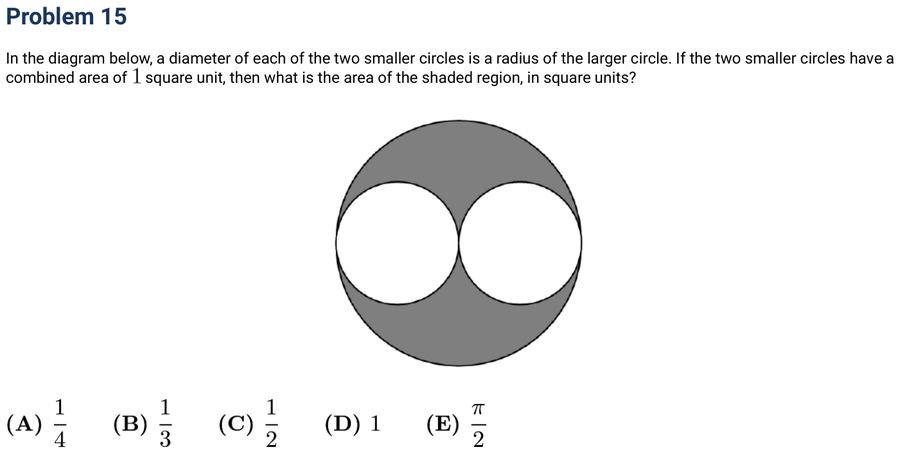
Each small circle has half the big circle's radius — so 1/4 the big's area. Two of them = 1/2 of the big.
Still stuck? Show hint 2 →
Hint 2 of 2
Two smalls = 1 (given), so big = 2. Shaded = big − two smalls = 2 − 1.
Show solution
Approach: areas scale as radius squared
  1. Small radius = (big radius)/2 ⇒ small area = (big area)/4. Two smalls = (big)/2.
  2. Two smalls = 1 ⇒ big = 2.
  3. Shaded = big − two smalls = 2 − 1 = 1.
Mark: · log in to save
Problem 16 · 2018 AMC 8 Medium
Counting & Probability careful-countingcasework

Professor Chang has nine different language books lined up on a bookshelf: two Arabic, three German, and four Spanish. How many ways are there to arrange the nine books on the shelf keeping the Arabic books together and keeping the Spanish books together?

Show answer
Answer: C — 5760 ways.
Show hints
Hint 1 of 2
Glue the Arabic books into one block and the Spanish books into another. Then arrange 5 objects (block-A, 3 German, block-S).
Still stuck? Show hint 2 →
Hint 2 of 2
5! external orderings × 2! internal Arabic × 4! internal Spanish.
Show solution
Approach: block-then-internal
  1. Treat the 2 Arabic books as one block and the 4 Spanish books as one block. Together with the 3 German books, we have 5 objects to order: 5! = 120 ways.
  2. Inside the Arabic block: 2! = 2 orderings. Inside the Spanish block: 4! = 24 orderings.
  3. Total: 120 × 2 × 24 = 5760.
Mark: · log in to save
Problem 17 · 2018 AMC 8 Medium
Ratios, Rates & Proportions ratiodistance-speed-time

Bella begins to walk from her house toward her friend Ella's house. At the same time, Ella begins to ride her bicycle toward Bella's house. They each maintain a constant speed, and Ella rides 5 times as fast as Bella walks. The distance between their houses is 2 miles, which is 10,560 feet, and Bella covers 2½ feet with each step. How many steps will Bella take by the time she meets Ella?

Show answer
Answer: A — 704 steps.
Show hints
Hint 1 of 2
Bella : Ella speed ratio 1 : 5, so Bella covers 1/6 of the total 10,560 feet by the time they meet.
Still stuck? Show hint 2 →
Hint 2 of 2
Bella's distance = 1760 feet. Divide by 2.5 ft/step.
Show solution
Approach: ratio of distances, then divide by step length
  1. Combined speed ratio Bella : Ella = 1 : 5, so Bella covers 1/6 of the 10,560-foot distance.
  2. Bella's distance: 10,560 / 6 = 1,760 feet.
  3. Steps: 1,760 / 2.5 = 704.
Mark: · log in to save
Problem 18 · 2018 AMC 8 Medium
Number Theory factorizationprime-test

How many positive factors does 23,232 have?

Show answer
Answer: E — 42 factors.
Show hints
Hint 1 of 2
Find the prime factorization of 23,232, then multiply (exponent + 1) for each prime.
Still stuck? Show hint 2 →
Hint 2 of 2
23,232 = 26 · 3 · 112.
Show solution
Approach: prime factorize, multiply (exponent + 1) per prime
  1. Factor: 23,232 = 2 · 11,616 = 22 · 5,808 = … = 26 · 363 = 26 · 3 · 121 = 26 · 3 · 112.
  2. Number of factors: (6+1)(1+1)(2+1) = 7 · 2 · 3 = 42.
Mark: · log in to save
Problem 19 · 2018 AMC 8 Hard
Counting & Probability caseworkcareful-counting
amc8-2018-19
Show answer
Answer: C — 8 ways.
Show hints
Hint 1 of 2
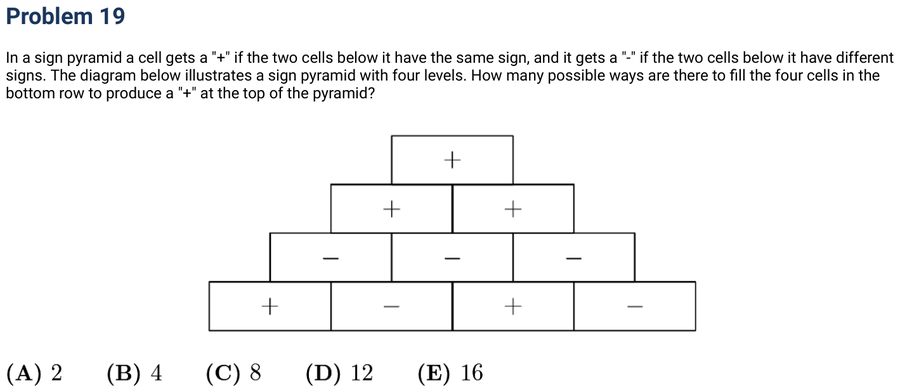
Encode + as 0 and − as 1. The pyramid rule "+ iff same" is exactly the XOR rule (so the cell above two cells = their XOR).
Still stuck? Show hint 2 →
Hint 2 of 2
The top of a 4-row pyramid = bottom XOR with Pascal-mod-2 coefficients (1, 1, 1, 1). So top = 0 iff bottom has an even number of −'s.
Show solution
Approach: XOR interpretation, then count even-parity bottoms
  1. Encode + as 0 and − as 1. The rule ("+ iff same") makes each upper cell the XOR of the two below.
  2. After 3 layers, the top cell = bottom1 ⊕ bottom2 ⊕ bottom3 ⊕ bottom4 (the binomial coefficients 1, 3, 3, 1 are all odd).
  3. Top = + (= 0) ⇔ even number of −'s in the bottom row.
  4. Of the 24 = 16 bottom configurations, exactly half have even parity: 8.
Mark: · log in to save
Problem 20 · 2018 AMC 8 Hard
Geometry & Measurement area-fractionarea-decomposition
amc8-2018-20
Show answer
Answer: A — 4/9.
Show hints
Hint 1 of 2
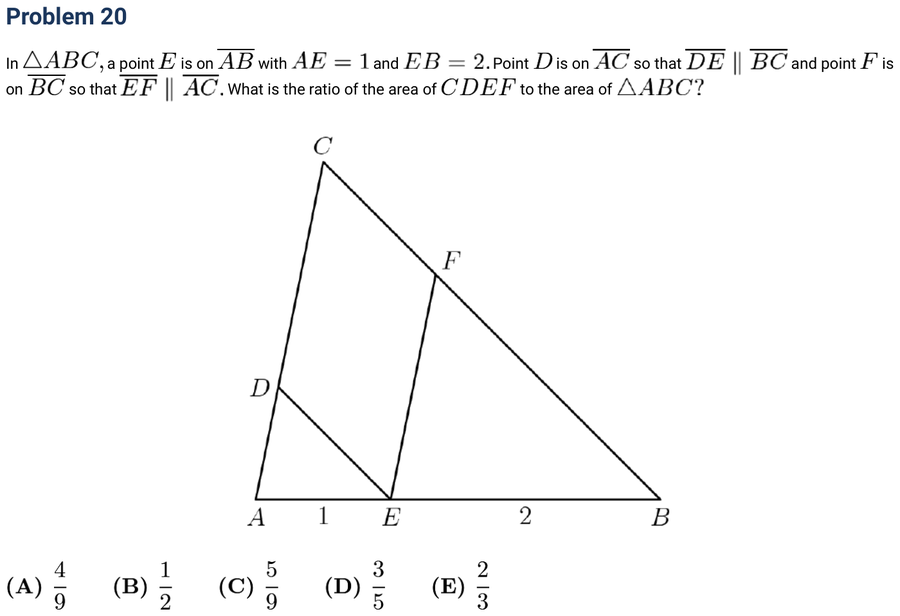
DE ∥ BC means ▵ADE is similar to ▵ABC with ratio AE/AB = 1/3. Similarly ▵EFB ~ ▵ABC with ratio 2/3.
Still stuck? Show hint 2 →
Hint 2 of 2
Area scales as the square of the similarity ratio. The quadrilateral is what's left after removing those two triangles.
Show solution
Approach: carve away two similar triangles
  1. AE/AB = 1/3 ⇒ ▵ADE has area (1/3)2 = 1/9 of ▵ABC.
  2. EB/AB = 2/3 ⇒ ▵EFB has area (2/3)2 = 4/9 of ▵ABC.
  3. Quadrilateral CDEF = ABC − ADE − EFB = 1 − 1/9 − 4/9 = 4/9.
Mark: · log in to save
Problem 21 · 2018 AMC 8 Hard
Number Theory divisibilitycasework

How many positive three-digit integers have a remainder of 2 when divided by 6, a remainder of 5 when divided by 9, and a remainder of 7 when divided by 11?

Show answer
Answer: E — 5 integers.
Show hints
Hint 1 of 2
Each remainder is exactly 4 less than the divisor (2 = 6−4, 5 = 9−4, 7 = 11−4). So x ≡ −4 mod each of them.
Still stuck? Show hint 2 →
Hint 2 of 2
x + 4 is divisible by lcm(6, 9, 11) = 198. Count multiples of 198 with x + 4 in [104, 1003].
Show solution
Approach: spot the common shift, then use lcm
  1. 2 = 6 − 4, 5 = 9 − 4, 7 = 11 − 4 ⇒ x ≡ −4 mod 6, 9, 11 simultaneously.
  2. So x + 4 is a multiple of lcm(6, 9, 11) = 2 · 32 · 11 = 198.
  3. 100 ≤ x ≤ 999 ⇒ 104 ≤ x + 4 ≤ 1003. Multiples of 198 in that range: 198, 396, 594, 792, 990. 5 values.
Mark: · log in to save
Problem 22 · 2018 AMC 8 Hard
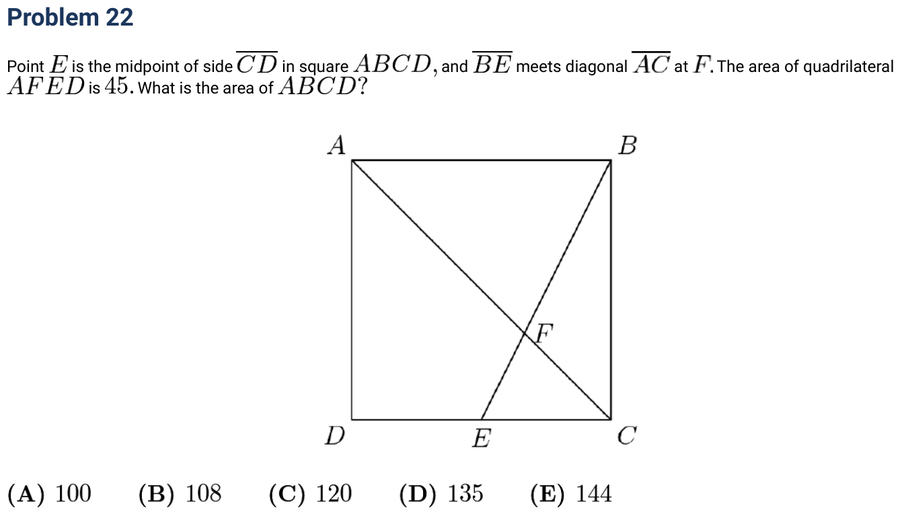
Geometry & Measurement area-fractionarea-decomposition
amc8-2018-22
Show answer
Answer: B — Area 108.
Show hints
Hint 1 of 2
Use similar triangles. F lies on diagonal AC, where BE crosses it. The ratio AF:FC follows from the parallel sides.
Still stuck? Show hint 2 →
Hint 2 of 2
AB ∥ DE? No, but consider triangles ▵BFC and ▵EFA on the diagonal AC — they're similar with ratio AB:EC = 2:1. So AF/AC = 2/3.
Show solution
Approach: use the AF:FC ratio from similar triangles
  1. Let the square have side s. EC = s/2 (E midpoint of CD), and AB = s.
  2. Triangles ▵AFB and ▵CFE share vertex F on diagonal AC, with AB ∥ EC. Similar with ratio AB : EC = 2 : 1, so AF : FC = 2 : 1, meaning F is 2/3 of the way from A to C.
  3. Area of ▵CEF: take ▵BCE (area (s/2)·s/2 = s2/4) and subtract ▵BCF (similar argument). Net ▵CEF area = s2/12.
  4. Area AFED = ▵ACD − ▵CEF = s2/2 − s2/12 = 5s2/12 = 45.
  5. s2 = 108.
Mark: · log in to save
Problem 23 · 2018 AMC 8 Hard
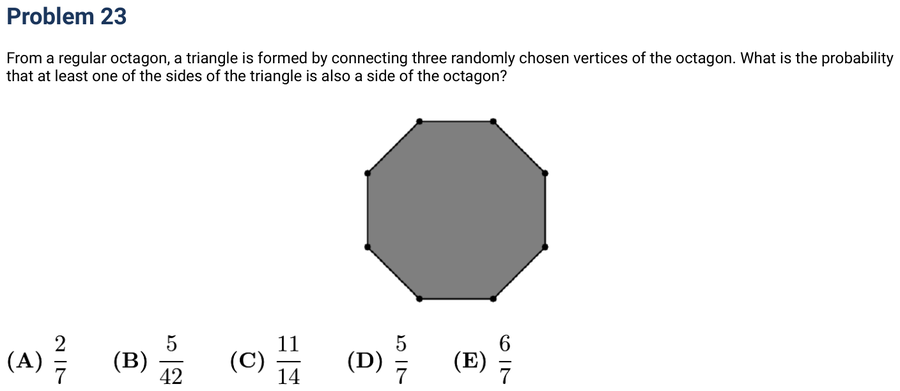
Counting & Probability complementary-countingcareful-counting
amc8-2018-23
Show answer
Answer: D — 5/7.
Show hints
Hint 1 of 2
Complement: count triangles with NO octagon-side. The three chosen vertices then have gaps ≥ 1 around the octagon.
Still stuck? Show hint 2 →
Hint 2 of 2
Stars and bars: with three gaps summing to 5 and each ≥ 1, there are C(4, 2) = 6 ways (with one vertex fixed). Total triangles through that fixed vertex: C(7, 2) = 21.
Show solution
Approach: complementary counting with gap variables
  1. Fix a vertex A. Choose the other two vertices around the octagon, leaving gaps x, y, z between consecutive chosen vertices (each gap = number of skipped octagon vertices), with x + y + z = 5.
  2. Total ways: C(7, 2) = 21 (choose 2 of the remaining 7 vertices).
  3. No-side cases: each gap ≥ 1, i.e. x, y, z ≥ 1 and sum 5. Stars-and-bars: C(4, 2) = 6.
  4. P(no side on octagon) = 6/21 = 2/7. P(at least one side) = 1 − 2/7 = 5/7.
Mark: · log in to save
Problem 24 · 2018 AMC 8 Hard
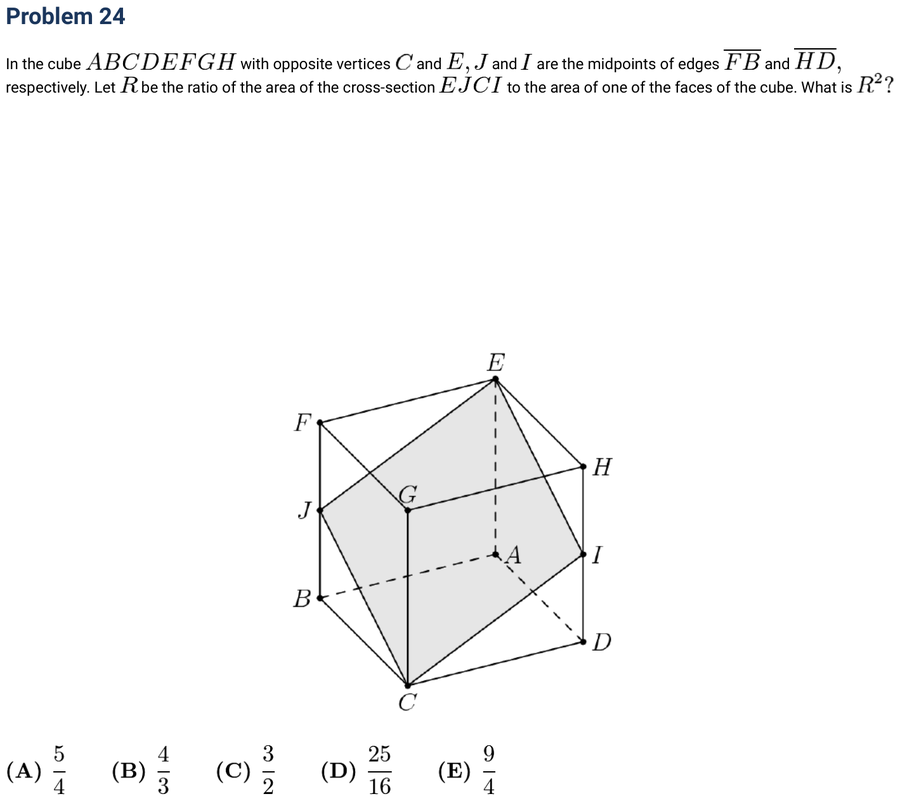
Geometry & Measurement pythagorean-tripleareaspatial-reasoning
amc8-2018-24
Show answer
Answer: C — R² = 3/2.
Show hints
Hint 1 of 2
EJCI is a rhombus (all four sides are equal: each connects a midpoint of one edge to an adjacent corner). Use diagonals.
Still stuck? Show hint 2 →
Hint 2 of 2
Diagonals: IJ = face diagonal = s√2. CE = space diagonal = s√3. Rhombus area = (1/2) · d1 · d2.
Show solution
Approach: compute rhombus area via diagonals
  1. EJCI has all sides equal (each connects a corner of the cube to a midpoint of the opposite face edge), so it's a rhombus. Its diagonals are IJ and CE.
  2. IJ = face diagonal of the cube = s√2. CE = space diagonal = s√3.
  3. Area = (1/2)(s√2)(s√3) = s2√6 / 2.
  4. R = area / face = (s2√6 / 2) / s2 = √6 / 2.
  5. R2 = 6 / 4 = 3/2.
Mark: · log in to save
Problem 25 · 2018 AMC 8 Hard
Number Theory perfect-cubeestimate-and-pick

How many perfect cubes lie between 28 + 1 and 218 + 1, inclusive?

Show answer
Answer: E — 58 cubes.
Show hints
Hint 1 of 2
218 = (26)3 = 643. So cubes ≤ 218 + 1 means base ≤ 64.
Still stuck? Show hint 2 →
Hint 2 of 2
28 = 256, 28 + 1 = 257. The next cube above 257 is 73 = 343 (since 63 = 216).
Show solution
Approach: bracket the cube-root bounds
  1. Upper end: 218 = (26)3 = 643, so 643 ≤ 218 + 1 ✓. Cubes at base ≥ 65 exceed the range.
  2. Lower end: 63 = 216 < 257 = 28 + 1, but 73 = 343 ≥ 257 ✓. Smallest valid base: 7.
  3. Count integers from 7 to 64 inclusive: 64 − 7 + 1 = 58.
Mark: · log in to save