AMC 8 · Test Mode

2017 AMC 8

Test mode — hints and solutions are locked. Pick an answer for each, then submit at the bottom to see your score.

← Exit test mode No hints or solutions until you submit.
Problem 1 · 2017 AMC 8 Easy
Arithmetic & Operations order-of-operations

Which of the following values is the largest?

Show answer
Answer: A — 10 (option A).
Show hint
Hint 1
PEMDAS: do every multiplication before adding. A zero anywhere in a product kills it.
Show solution
Approach: evaluate each option
  1. (A) 2 + 0 + 1 + 7 = 10. (B) 0 + 1 + 7 = 8. (C) 2 + 0 + 7 = 9. (D) 2 + 0 + 7 = 9. (E) 0.
  2. Largest is (A) = 10.
Mark: · log in to save
Problem 2 · 2017 AMC 8 Easy
Fractions, Decimals & Percents percent-multiplierproportion
amc8-2017-02
Show answer
Answer: E — 120 votes.
Show hint
Hint 1
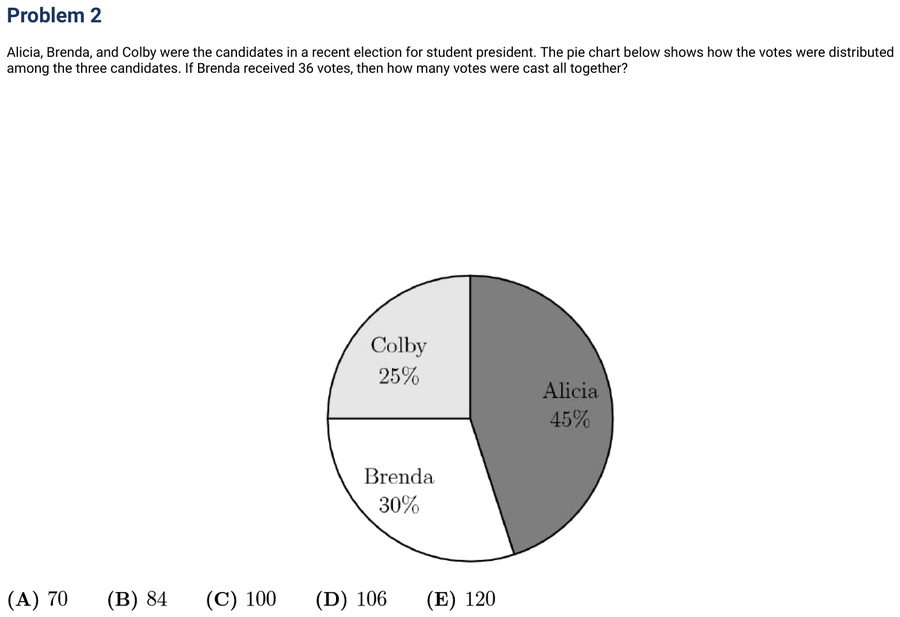
Brenda has 30% of the votes — 36 votes. Find 100%.
Show solution
Approach: scale 30% to 100%
  1. 30% of total = 36 ⇒ total = 36 / 0.30 = 120.
Mark: · log in to save
Problem 3 · 2017 AMC 8 Medium
Arithmetic & Operations perfect-square

What is the value of the expression √(16 · √(8 · √4)) ?

Show answer
Answer: C — 8.
Show hint
Hint 1
Work from the inside out. The innermost √4 is 2, which collapses the middle radical.
Show solution
Approach: peel from inside
  1. √4 = 2. So middle: √(8 · 2) = √16 = 4.
  2. Outer: √(16 · 4) = √64 = 8.
Mark: · log in to save
Problem 4 · 2017 AMC 8 Easy
Arithmetic & Operations estimate-and-pick

When 0.000315 is multiplied by 7,928,564 the product is closest to which of the following?

Show answer
Answer: D — 2400.
Show hint
Hint 1
Round both to one significant figure: 0.0003 × 8,000,000.
Show solution
Approach: scientific notation, round
  1. 0.000315 ≈ 3 × 10⁻⁴. 7,928,564 ≈ 8 × 10⁶.
  2. Product ≈ 3 · 8 · 102 = 24 · 100 = 2400.
Mark: · log in to save
Problem 5 · 2017 AMC 8 Easy
Arithmetic & Operations factorizationarithmetic-series

What is the value of the expression

1 · 2 · 3 · 4 · 5 · 6 · 7 · 81 + 2 + 3 + 4 + 5 + 6 + 7 + 8 ?
Show answer
Answer: B — 1120.
Show hint
Hint 1
Bottom is 1+2+…+8 = 36. Then cancel 36 = 4 · 9 with the top.
Show solution
Approach: compute the denominator, cancel factors
  1. Denominator: 1 + 2 + … + 8 = 36 = 4 · 9.
  2. Numerator / 36: cancel 4 with the 4 in the product, cancel 9 with 3 · 3 (from the 3 and 6).
  3. Left over: 1 · 2 · (3/3) · (4/4) · 5 · (6/3) · 7 · 8 = 1 · 2 · 5 · 2 · 7 · 8 = 1120.
  4. (Or just: 8!/36 = 40320/36 = 1120.)
Mark: · log in to save
Problem 6 · 2017 AMC 8 Easy
Geometry & Measurement ratiosubstitution

If the degree measures of the angles of a triangle are in the ratio 3 : 3 : 4, what is the degree measure of the largest angle of the triangle?

Show answer
Answer: D — 72°.
Show hint
Hint 1
The ratio 3 : 3 : 4 totals 10 parts, which equals 180°. So one part = 18°.
Show solution
Approach: ratio sums to 180
  1. Total parts: 3 + 3 + 4 = 10, so one part = 180/10 = 18°.
  2. Largest angle = 4 × 18 = 72°.
Mark: · log in to save
Problem 7 · 2017 AMC 8 Medium
Number Theory factorizationdivisibility

Let Z be a 6-digit positive integer, such as 247247, whose first three digits are the same as its last three digits taken in the same order. Which of the following numbers must also be a factor of Z?

Show answer
Answer: A — 11.
Show hint
Hint 1
Write Z = abcabc as a multiple of abc. The multiplier factors into nice primes.
Show solution
Approach: abcabc = 1001 · abc
  1. Z = abcabc = abc · 1001.
  2. 1001 = 7 · 11 · 13. So 11 is always a factor of Z.
Mark: · log in to save
Problem 8 · 2017 AMC 8 Medium
Number Theory divisibilitycasework

Malcolm wants to visit Isabella after school today and knows the street where she lives but doesn't know her house number. She tells him, "My house number has two digits, and exactly three of the following four statements about it are true."

  1. It is prime.
  2. It is even.
  3. It is divisible by 7.
  4. One of its digits is 9.

This information allows Malcolm to determine Isabella's house number. What is its units digit?

Show answer
Answer: D — 8.
Show hints
Hint 1 of 2
Which two statements can't both be true together?
Still stuck? Show hint 2 →
Hint 2 of 2
A 2-digit number can't be both even and prime (the only even prime is 2). So either (1) or (2) is false — and since 3 of 4 are true, the false one must be (1) "prime".
Show solution
Approach: find the contradiction, then narrow
  1. (1) prime and (2) even can't both be true for a 2-digit number (the only even prime is 2). So the false statement is (1), making (2), (3), (4) all true: the number is even, div by 7, and has a 9 as a digit.
  2. Even + divisible by 7 ⇒ divisible by 14. Two-digit multiples of 14: 14, 28, 42, 56, 70, 84, 98. Only 98 has a 9 digit.
  3. Units digit: 8.
Mark: · log in to save
Problem 9 · 2017 AMC 8 Medium
Number Theory divisibilitycasework

All of Marcy's marbles are blue, red, green, or yellow. One third of her marbles are blue, one fourth of them are red, and six of them are green. What is the smallest number of yellow marbles that Marcy could have?

Show answer
Answer: D — 4 yellow marbles.
Show hints
Hint 1 of 2
The total must be divisible by both 3 and 4 — so by 12. Try 12 first; if it fails, try 24.
Still stuck? Show hint 2 →
Hint 2 of 2
12 total: 4 blue + 3 red + 6 green = 13 > 12. Doesn't work. Try 24.
Show solution
Approach: smallest total divisible by lcm(3, 4)
  1. Total must be a multiple of 12 (so that 1/3 and 1/4 are integers).
  2. Try 12: blue = 4, red = 3, green = 6 ⇒ total already 13 > 12. Doesn't fit.
  3. Try 24: blue = 8, red = 6, green = 6 ⇒ yellow = 24 − 8 − 6 − 6 = 4.
Mark: · log in to save
Problem 10 · 2017 AMC 8 Medium
Counting & Probability careful-counting

A box contains five cards, numbered 1, 2, 3, 4, and 5. Three cards are selected randomly without replacement from the box. What is the probability that 4 is the largest value selected?

Show answer
Answer: C — 3/10.
Show hint
Hint 1
For 4 to be the largest, the draw must include 4 and the other two come from {1, 2, 3}.
Show solution
Approach: include the max, pick the rest below it
  1. Total ways to choose 3 of 5 cards: C(5, 3) = 10.
  2. Favorable: pick 4, then pick the other 2 from {1, 2, 3}: C(3, 2) = 3 ways.
  3. Probability = 3/10.
Mark: · log in to save
Problem 11 · 2017 AMC 8 Easy
Geometry & Measurement perfect-squarecareful-counting

A square-shaped floor is covered with congruent square tiles. If the total number of tiles that lie on the two diagonals is 37, how many tiles cover the floor?

Show answer
Answer: C — 361 tiles.
Show hint
Hint 1
Both diagonals share the center tile (the floor must be an odd-by-odd square). So diagonal tiles = 2n − 1.
Show solution
Approach: 2n − 1 = 37 gives the side length
  1. If the floor is n × n, the two diagonals share the center tile, so they cover 2n − 1 tiles.
  2. 2n − 1 = 37 ⇒ n = 19.
  3. Total tiles: 192 = 361.
Mark: · log in to save
Problem 12 · 2017 AMC 8 Easy
Number Theory divisibility

The smallest positive integer greater than 1 that leaves a remainder of 1 when divided by 4, 5, and 6 lies between which of the following pairs of numbers?

Show answer
Answer: D — Between 60 and 79.
Show hint
Hint 1
Same remainder mod 4, 5, AND 6 means n − 1 is divisible by all three. So n − 1 = lcm(4, 5, 6).
Show solution
Approach: lcm shift
  1. n − 1 is divisible by 4, 5, and 6, so by lcm(4, 5, 6) = 60.
  2. Smallest n > 1: n = 61, which lies between 60 and 79.
Mark: · log in to save
Problem 13 · 2017 AMC 8 Easy
Logic & Word Problems sum-constraint

Peter, Emma, and Kyler played chess with each other. Peter won 4 games and lost 2 games. Emma won 3 games and lost 3 games. If Kyler lost 3 games, how many games did he win?

Show answer
Answer: B — 1 win.
Show hint
Hint 1
Every game has one winner and one loser, so total wins across all players = total losses.
Show solution
Approach: wins = losses across all three
  1. Total losses: 2 + 3 + 3 = 8.
  2. Total wins: 4 + 3 + K = 8 ⇒ K = 1.
Mark: · log in to save
Problem 14 · 2017 AMC 8 Medium
Fractions, Decimals & Percents percent-multipliersubstitution

Chloe and Zoe are both students in Ms. Demeanor's math class. Last night they each solved half of the problems in their homework assignment alone and then solved the other half together. Chloe had correct answers to only 80% of the problems she solved alone, but overall 88% of her answers were correct. Zoe had correct answers to 90% of the problems she solved alone. What was Zoe's overall percentage of correct answers?

Show answer
Answer: C — 93%.
Show hints
Hint 1 of 2
Pretend there are 100 problems — 50 alone, 50 together. The "together" half is the same for both girls. Find that.
Still stuck? Show hint 2 →
Hint 2 of 2
Chloe: 80% of 50 = 40 alone; 88% total = 88 correct; so together = 48 of 50.
Show solution
Approach: use 100 problems, isolate the joint half
  1. Set 100 problems: 50 alone + 50 together. Chloe alone: 0.8 × 50 = 40 correct. Chloe total: 88. So together: 88 − 40 = 48 correct.
  2. Zoe alone: 0.9 × 50 = 45 correct. Zoe together: same 48 (joint work).
  3. Zoe total: 45 + 48 = 93 out of 100 = 93%.
Mark: · log in to save
Problem 15 · 2017 AMC 8 Medium
Counting & Probability careful-countinggrid

In the arrangement of letters and numerals below, by how many different paths can one spell AMC8? Beginning at the A in the middle, a path allows only moves from one letter to an adjacent (above, below, left, or right, but not diagonal) letter. One example of such a path is traced in the picture.

8C88CMC8CMAM8CMC8C8
Show answer
Answer: D — 24 paths.
Show hint
Hint 1
From the central A, count branches. Then from each M, count branches to C; from each C, count branches to 8. Multiply.
Show solution
Approach: multiply branch counts at each step
  1. From A: 4 adjacent M's (up/down/left/right).
  2. From each M: 3 adjacent C's (one direction goes back to A, doesn't count).
  3. From each C: 2 adjacent 8's.
  4. Total: 4 × 3 × 2 = 24.
Mark: · log in to save
Problem 16 · 2017 AMC 8 Medium
Geometry & Measurement area-fractionpythagorean-triple
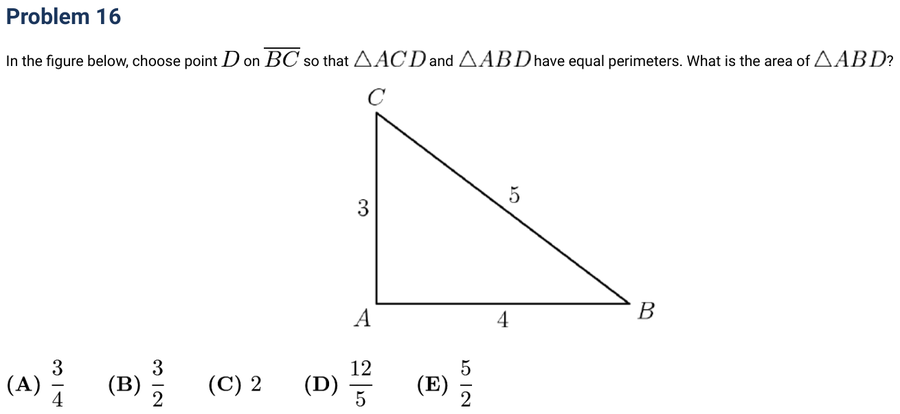
amc8-2017-16
Show answer
Answer: D — 12/5.
Show hints
Hint 1 of 2
Equal perimeters: AC + CD + AD = AB + BD + AD ⇒ AC + CD = AB + BD. Plug in AC=3, AB=4, CD+BD=5.
Still stuck? Show hint 2 →
Hint 2 of 2
BD = 2 and CD = 3. The two triangles share the altitude from A, so their areas scale as BD : BC.
Show solution
Approach: equal perimeters set BD, then area ratio
  1. ▵ABC is a 3-4-5 right triangle (right angle at A). Let BD = x, so CD = 5 − x.
  2. AD is shared, so equal perimeters ⇒ AC + CD = AB + BD ⇒ 3 + (5 − x) = 4 + xx = 2.
  3. ▵ABD and ▵ABC share the altitude from A to line BC, so areas are in ratio BD : BC = 2 : 5.
  4. Area of ▵ABC = (1/2)(3)(4) = 6. Area of ▵ABD = (2/5)(6) = 12/5.
Mark: · log in to save
Problem 17 · 2017 AMC 8 Easy
Algebra & Patterns substitutionsum-constraint

Starting with some gold coins and some empty treasure chests, I tried to put 9 gold coins in each treasure chest, but that left 2 treasure chests empty. So instead I put 6 gold coins in each treasure chest, but then I had 3 gold coins left over. How many gold coins did I have?

Show answer
Answer: C — 45 coins.
Show hint
Hint 1
Set up two equations for the same gold-coin count: g = 9(n − 2) and g = 6n + 3.
Show solution
Approach: two equations, same g
  1. Let n = chests, g = coins. Nine-per-chest leaves 2 empty: g = 9(n − 2). Six-per-chest with 3 left over: g = 6n + 3.
  2. 9(n − 2) = 6n + 3 ⇒ 3n = 21 ⇒ n = 7.
  3. g = 6(7) + 3 = 45.
Mark: · log in to save
Problem 18 · 2017 AMC 8 Medium
Geometry & Measurement pythagorean-triplearea-decomposition
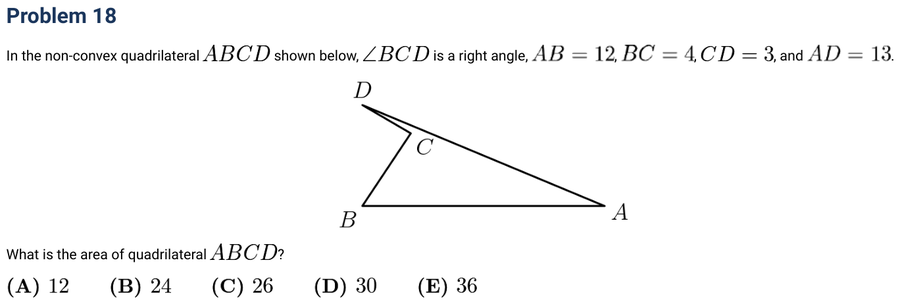
amc8-2017-18
Show answer
Answer: B — Area 24.
Show hints
Hint 1 of 2
Right triangle BCD (legs 4 and 3) makes diagonal BD = 5. Then triangle ABD has sides 5, 12, 13 — another right triangle.
Still stuck? Show hint 2 →
Hint 2 of 2
Non-convex shape ABCD = area ▵ABD − area ▵BCD.
Show solution
Approach: decompose into two right triangles
  1. ▵BCD is right-angled at C with legs 4 and 3 ⇒ BD = 5.
  2. ▵ABD has sides 5, 12, 13 — another right triangle (right angle at B).
  3. Area = ▵ABD − ▵BCD = (1/2)(12)(5) − (1/2)(4)(3) = 30 − 6 = 24.
Mark: · log in to save
Problem 19 · 2017 AMC 8 Hard
Number Theory factorizationdivisibility

For any positive integer M, the notation M! denotes the product of the integers 1 through M. What is the largest integer n for which 5n is a factor of the sum

98! + 99! + 100! ?
Show answer
Answer: D — 26.
Show hints
Hint 1 of 2
Factor out 98! from all three terms. The leftover is a clean number.
Still stuck? Show hint 2 →
Hint 2 of 2
98! + 99! + 100! = 98!(1 + 99 + 99·100) = 98! · 10,000. Count factors of 5 in each piece.
Show solution
Approach: factor out 98!, count 5s
  1. 98! + 99! + 100! = 98!(1 + 99 + 99·100) = 98!(100 + 9900) = 98! · 10,000.
  2. 10,000 = 104 = 24 · 54 → contributes 4 factors of 5.
  3. Factors of 5 in 98!: ⌊98/5⌋ + ⌊98/25⌋ = 19 + 3 = 22.
  4. Total: 22 + 4 = 26.
Mark: · log in to save
Problem 20 · 2017 AMC 8 Hard
Counting & Probability careful-counting

An integer between 1000 and 9999, inclusive, is chosen at random. What is the probability that it is an odd integer whose digits are all distinct?

Show answer
Answer: B — 56/225.
Show hint
Hint 1
Place the units digit first (odd, 5 choices), then thousands (not 0, not the same as units), then hundreds, then tens.
Show solution
Approach: place positions in a constrained order
  1. Total integers in [1000, 9999]: 9000.
  2. Favorable: units digit odd (1, 3, 5, 7, 9) → 5 choices. Thousands digit must not be 0 and not equal units → 8 choices.
  3. Hundreds: not equal to either of the two used → 8 choices (digits 0–9 minus 2). Tens: not equal to any of the three → 7 choices.
  4. Favorable count: 5 × 8 × 8 × 7 = 2240.
  5. Probability: 2240 / 9000 = 56/225.
Mark: · log in to save
Problem 21 · 2017 AMC 8 Hard
Algebra & Patterns caseworksubstitution

Suppose a, b, and c are nonzero real numbers, and a + b + c = 0. What are the possible value(s) for

a|a| + b|b| + c|c| + abc|abc| ?
Show answer
Answer: A — 0.
Show hints
Hint 1 of 2
x/|x| = +1 or −1 depending on sign. Since a + b + c = 0, exactly one or two of them are negative.
Still stuck? Show hint 2 →
Hint 2 of 2
Case 2 positive + 1 negative vs 1 positive + 2 negative — check the four signs sum to 0 in both cases.
Show solution
Approach: casework on how many are negative
  1. Since a + b + c = 0 and none are zero, either (i) two are positive and one is negative, or (ii) two are negative and one is positive.
  2. Case (i): signs of a, b, c are +, +, −; product abc is negative. Sum: (+1) + (+1) + (−1) + (−1) = 0.
  3. Case (ii): signs are −, −, +; product is positive. Sum: (−1) + (−1) + (+1) + (+1) = 0.
  4. Either way, the value is 0.
Mark: · log in to save
Problem 22 · 2017 AMC 8 Hard
Geometry & Measurement pythagorean-triplearea
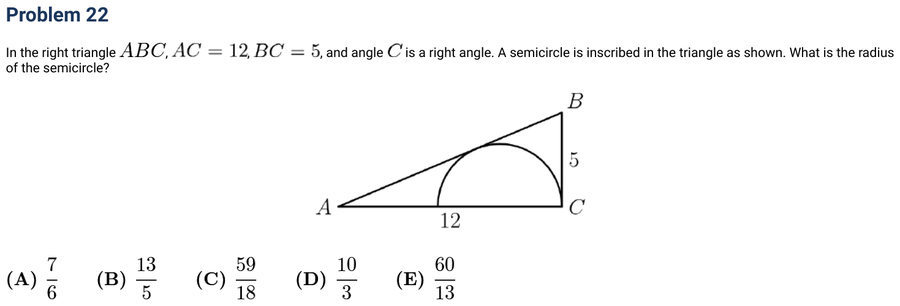
amc8-2017-22
Show answer
Answer: D — r = 10/3.
Show hints
Hint 1 of 2
Two tangents from B to the semicircle have equal length, so BD = BC = 5. That fixes AD = 13 − 5 = 8.
Still stuck? Show hint 2 →
Hint 2 of 2
▵ADO is similar to ▵ACB (both right, share angle A). Use the ratio r/8 = 5/12.
Show solution
Approach: tangent lengths + similar triangles
  1. Hypotenuse AB = √(122 + 52) = 13. Let O be the semicircle's center on AC and D its tangent point on AB.
  2. Tangents from B to the circle: BC = BD = 5. So AD = 13 − 5 = 8.
  3. ▵ADO ~ ▵ACB (right at D and C respectively, share angle A) ⇒ r8 = 512.
  4. r = 40/12 = 10/3.
Mark: · log in to save
Problem 23 · 2017 AMC 8 Hard
Number Theory factorizationarithmetic-sequence

Each day for four days, Linda traveled for one hour at a speed that resulted in her traveling one mile in an integer number of minutes. Each day after the first, her speed decreased so that the number of minutes to travel one mile increased by 5 minutes over the preceding day. Each of the four days, her distance traveled was also an integer number of miles. What was the total number of miles for the four trips?

Show answer
Answer: C — 25 miles.
Show hints
Hint 1 of 2
Each day's min-per-mile must divide 60 (so that 60 min yields an integer mile count). Find four divisors of 60 in arithmetic progression with common difference 5.
Still stuck? Show hint 2 →
Hint 2 of 2
Divisors of 60: 1, 2, 3, 4, 5, 6, 10, 12, 15, 20, 30, 60. The only arithmetic-progression-5 of length 4 is 5, 10, 15, 20.
Show solution
Approach: min-per-mile must divide 60
  1. 60 minutes total per day; for integer miles, the min-per-mile divides 60.
  2. Four divisors of 60 forming an AP with common difference 5: 5, 10, 15, 20.
  3. Miles each day: 60/5 + 60/10 + 60/15 + 60/20 = 12 + 6 + 4 + 3 = 25.
Mark: · log in to save
Problem 24 · 2017 AMC 8 Hard
Number Theory complementary-countingdivisibility

Mrs. Sanders has three grandchildren, who call her regularly. One calls her every three days, one calls her every four days, and one calls her every five days. All three called her on December 31, 2016. On how many days during the next year did she not receive a phone call from any of her grandchildren?

Show answer
Answer: D — 146 days.
Show hints
Hint 1 of 2
The pattern repeats every lcm(3, 4, 5) = 60 days. Count call-days in 60, then scale to 365 (with the leftover 5 days handled).
Still stuck? Show hint 2 →
Hint 2 of 2
Inclusion–exclusion in a 60-day block: 20 + 15 + 12 − 5 − 4 − 3 + 1 = 36 call days. So 60 − 36 = 24 no-call days.
Show solution
Approach: inclusion-exclusion over a 60-day cycle, then handle leftovers
  1. lcm(3, 4, 5) = 60, so the call pattern repeats every 60 days. In one 60-day block:
  2. Calls by inclusion-exclusion: 20 (every 3) + 15 (every 4) + 12 (every 5) − 5 (every 12) − 4 (every 15) − 3 (every 20) + 1 (every 60) = 36 call days. So 60 − 36 = 24 no-call days per block.
  3. 365 days = 6 full 60-day blocks + 5 extra days. No-call days from blocks: 6 × 24 = 144.
  4. In the last 5 days (days 361–365 ≡ days 1–5 of a new cycle): day 1 no call, day 2 no call, day 3 call, day 4 call, day 5 call. So 2 more no-call days.
  5. Total: 144 + 2 = 146.
Mark: · log in to save
Problem 25 · 2017 AMC 8 Hard
Geometry & Measurement areaarea-decomposition
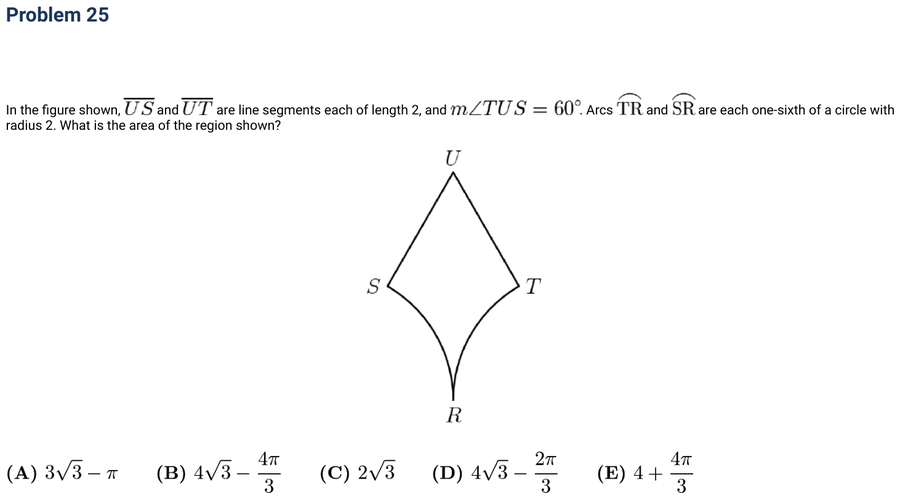
amc8-2017-25
Show answer
Answer: B — 4√3 − 4π/3.
Show hints
Hint 1 of 2
Extend US and UT down so the figure becomes an equilateral triangle. Subtract the two circular sectors that were carved out.
Still stuck? Show hint 2 →
Hint 2 of 2
Equilateral triangle of side 4 minus two 60° sectors of radius 2.
Show solution
Approach: complete to an equilateral triangle, subtract two sectors
  1. Extending US and UT past S and T (using the arcs' radii of 2) completes a 60°-60°-60° equilateral triangle with side 2 + 2 = 4.
  2. Equilateral triangle area: 42√34 = 4√3.
  3. The two arcs are each 1/6 of a circle of radius 2 — sector area πr2/6 = 4π/6 = 2π/3 each. Two sectors: 4π/3.
  4. Region = 4√3 − 4π/3 (choice B).
Mark: · log in to save