AMC 8 · Test Mode

2014 AMC 8

Test mode — hints and solutions are locked. Pick an answer for each, then submit at the bottom to see your score.

← Exit test mode No hints or solutions until you submit.
Problem 1 · 2014 AMC 8 Easy
Arithmetic & Operations order-of-operations

Harry and Terry are each told to calculate 8 − (2 + 5). Harry gets the correct answer. Terry ignores the parentheses and calculates 8 − 2 + 5. If Harry's answer is H and Terry's answer is T, what is the difference HT?

Show answer
Answer: A — −10.
Show hint
Hint 1
Compute each version separately, then subtract.
Show solution
Approach: evaluate both expressions
  1. H = 8 − (2 + 5) = 8 − 7 = 1.
  2. T = 8 − 2 + 5 = 6 + 5 = 11.
  3. HT = 1 − 11 = −10.
Mark: · log in to save
Problem 2 · 2014 AMC 8 Easy
Arithmetic & Operations extremes-min-max

Paul owes Paula 35 cents and has a pocket full of 5-cent coins, 10-cent coins, and 25-cent coins that he can use to pay her. What is the difference between the largest and the smallest number of coins he can use to pay her?

Show answer
Answer: E — 5 coins difference.
Show hint
Hint 1
Max coins → all 5-cent coins. Min coins → use the biggest coins possible.
Show solution
Approach: compute both extremes
  1. Most coins: 35 / 5 = 7 nickels.
  2. Fewest coins: 25 + 10 = 35 with 2 coins.
  3. Difference: 7 − 2 = 5.
Mark: · log in to save
Problem 3 · 2014 AMC 8 Easy
Arithmetic & Operations average-times-count

Isabella had a week to read a book for a school assignment. She read an average of 36 pages per day for the first three days and an average of 44 pages per day for the next three days. She then finished the book by reading 10 pages on the last day. How many pages were in the book?

Show answer
Answer: B — 250 pages.
Show hint
Hint 1
Average × count gives the total for each three-day block. Then add the last day.
Show solution
Approach: average × count, then sum
  1. First three days: 36 × 3 = 108 pages.
  2. Next three days: 44 × 3 = 132 pages.
  3. Total: 108 + 132 + 10 = 250.
Mark: · log in to save
Problem 4 · 2014 AMC 8 Easy
Number Theory parityprimes

The sum of two prime numbers is 85. What is the product of these two prime numbers?

Show answer
Answer: E — 166.
Show hint
Hint 1
Odd sum from two primes ⇒ one of them must be even. The only even prime is 2.
Show solution
Approach: the only even prime is 2
  1. 85 is odd, so one prime is even ⇒ it must be 2.
  2. The other prime: 85 − 2 = 83 (prime).
  3. Product: 2 × 83 = 166.
Mark: · log in to save
Problem 5 · 2014 AMC 8 Easy
Ratios, Rates & Proportions unit-rate

Margie's car can go 32 miles on a gallon of gas, and gas currently costs $4 per gallon. How many miles can Margie drive on $20 worth of gas?

Show answer
Answer: C — 160 miles.
Show hint
Hint 1
$20 buys how many gallons? Then multiply by miles per gallon.
Show solution
Approach: convert dollars to gallons to miles
  1. Gallons: 20 / 4 = 5.
  2. Miles: 5 × 32 = 160.
Mark: · log in to save
Problem 6 · 2014 AMC 8 Easy
Arithmetic & Operations factoringsum-of-squares

Six rectangles each with a common base width of 2 have lengths of 1, 4, 9, 16, 25, and 36. What is the sum of the areas of the six rectangles?

Show answer
Answer: D — 182.
Show hint
Hint 1
Each area is 2 × length. Factor out the 2 and sum the lengths once.
Show solution
Approach: factor out the common width
  1. Sum of lengths: 1 + 4 + 9 + 16 + 25 + 36 = 91 (sum of first 6 squares).
  2. Sum of areas: 2 × 91 = 182.
Mark: · log in to save
Problem 7 · 2014 AMC 8 Easy
Algebra & Patterns sum-and-difference

There are four more girls than boys in Ms. Raub's class of 28 students. What is the ratio of number of girls to the number of boys in her class?

Show answer
Answer: B — 4 : 3.
Show hint
Hint 1
Sum is 28 and difference is 4. The larger group is (sum + diff)/2, the smaller is (sum − diff)/2.
Show solution
Approach: sum-and-difference trick
  1. Girls = (28 + 4)/2 = 16, boys = (28 − 4)/2 = 12.
  2. Ratio = 16 : 12 = 4 : 3.
Mark: · log in to save
Problem 8 · 2014 AMC 8 Easy
Number Theory divisibility-by-11

Eleven members of the Middle School Math Club each paid the same integer amount for a guest speaker to talk about problem solving at their math club meeting. In all, they paid their guest speaker $1A2. What is the missing digit A of this 3-digit number?

Show answer
Answer: D — A = 3.
Show hints
Hint 1 of 2
The total is 11 × (integer), so 1A2 must be divisible by 11.
Still stuck? Show hint 2 →
Hint 2 of 2
Divisibility rule for 11: alternating sum of digits must be a multiple of 11.
Show solution
Approach: divisibility test for 11
  1. 1A2 divisible by 11 ⇒ alternating sum 1 − A + 2 = 3 − A is a multiple of 11.
  2. Single digit A ∈ {0, …, 9}: only A = 3 works (giving 0).
  3. Check: 132 = 11 × 12. ✓
Mark: · log in to save
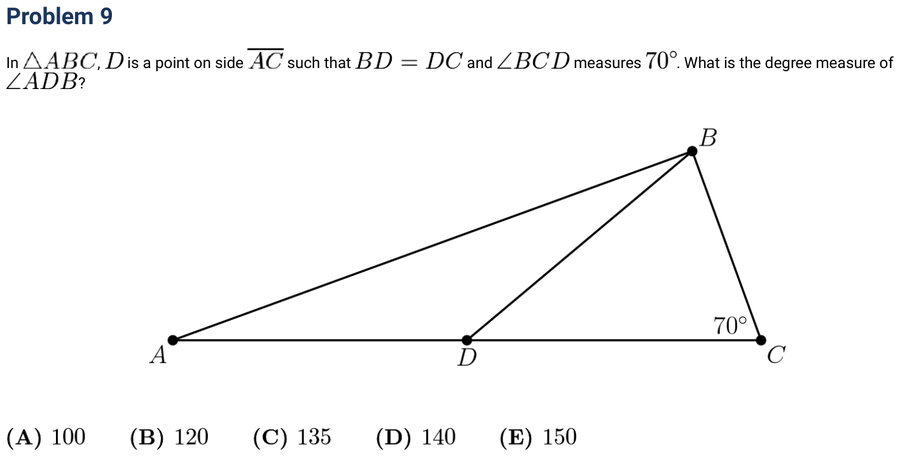
Problem 9 · 2014 AMC 8 Easy
Geometry & Measurement isosceles-trianglelinear-pair
amc8-2014-09
Show answer
Answer: D — 140 degrees.
Show hints
Hint 1 of 2
BDC is isosceles (BD = DC), so its base angles are equal.
Still stuck? Show hint 2 →
Hint 2 of 2
ADB and ∠BDC are supplementary (linear pair along AC).
Show solution
Approach: exterior angle of an isosceles triangle
  1. BDC is isosceles (BD = DC), so the two base angles ∠DBC and ∠DCB both equal 70°.
  2. ADB is the exterior angle of ▵BDC at D, so it equals the sum of the two remote interior angles: 70° + 70° = 140°.
Another way — linear pair after computing the apex angle:
  1. Base angles 70° each give apex ∠BDC = 180° − 140° = 40°. Then ∠ADB = 180° − 40° = 140°.
Mark: · log in to save
Problem 10 · 2014 AMC 8 Easy
Arithmetic & Operations year-arithmetic

The first AMC 8 was given in 1985 and it has been given annually since that time. Samantha turned 12 years old the year that she took the seventh AMC 8. In what year was Samantha born?

Show answer
Answer: A — 1979.
Show hint
Hint 1
The n-th AMC 8 was given in 1985 + (n − 1). Subtract her age to get her birth year.
Show solution
Approach: compute year of 7th contest, then subtract age
  1. 7th AMC 8: 1985 + 6 = 1991.
  2. Born 12 years earlier: 1991 − 12 = 1979.
Mark: · log in to save
Problem 11 · 2014 AMC 8 Medium
Counting & Probability lattice-pathscomplementary-counting

Jack wants to bike from his house to Jill's house, which is located three blocks east and two blocks north of Jack's house. After biking each block, Jack can continue either east or north, but he needs to avoid a dangerous intersection one block east and one block north of his house. In how many ways can he reach Jill's house by biking a total of five blocks?

Show answer
Answer: A — 4 ways.
Show hints
Hint 1 of 2
Total paths from (0,0) to (3,2) with E/N steps: C(5, 2) = 10. Subtract the ones that pass through the bad corner (1,1).
Still stuck? Show hint 2 →
Hint 2 of 2
Paths through (1,1) = (paths to (1,1)) × (paths from (1,1) to (3,2)) = 2 × 3 = 6.
Show solution
Approach: total − paths through (1,1)
  1. Total E/N paths: C(5, 2) = 10.
  2. Paths through (1,1): C(2, 1) × C(3, 1) = 2 × 3 = 6.
  3. Allowed paths: 10 − 6 = 4.
Another way — case split on first two moves:
  1. To avoid (1,1) Jack's first two moves must be either EE or NN.
  2. After EE he is at (2, 0) and needs 1 E + 2 N in some order: C(3,1) = 3 paths. After NN he is at (0, 2) and needs 3 E + 0 N: 1 path.
  3. Total: 3 + 1 = 4.
Mark: · log in to save
Problem 12 · 2014 AMC 8 Easy
Counting & Probability permutationsprobability-basic

A magazine printed photos of three celebrities along with three photos of the celebrities as babies. The baby pictures did not identify the celebrities. Readers were asked to match each celebrity with the correct baby pictures. What is the probability that a reader guessing at random will match all three correctly?

Show answer
Answer: B — 1/6.
Show hint
Hint 1
How many ways can 3 baby photos be ordered? Only one ordering matches the celebrities.
Show solution
Approach: 3! arrangements, one correct
  1. 3 baby photos can be assigned in 3! = 6 ways. Exactly 1 is the correct matching.
  2. Probability = 1/6.
Mark: · log in to save
Problem 13 · 2014 AMC 8 Medium
Number Theory parity

If n and m are integers and n2 + m2 is even, which of the following is impossible?

Show answer
Answer: D — n + m cannot be odd.
Show hint
Hint 1
Squares preserve parity: k2 is even iff k is even. So n2 + m2 even ⇒ n, m have the same parity.
Show solution
Approach: parity of squares matches parity of base
  1. n2 + m2 even ⇒ n2 and m2 have the same parity ⇒ n and m have the same parity.
  2. Same parity ⇒ n + m is always even, never odd.
Mark: · log in to save
Problem 14 · 2014 AMC 8 Medium
Geometry & Measurement area-formulapythagorean-triple
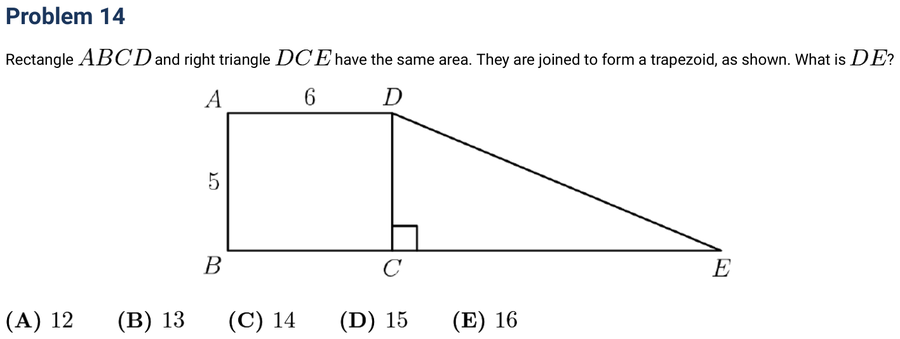
amc8-2014-14
Show answer
Answer: B — DE = 13.
Show hints
Hint 1 of 2
Set the two areas equal to find CE. Then use the Pythagorean theorem on ▵DCE.
Still stuck? Show hint 2 →
Hint 2 of 2
5-12-13 right triangle.
Show solution
Approach: equal areas to find leg, then Pythagoras
  1. Rectangle area = 5 × 6 = 30.
  2. Triangle area = (1/2)(5)(CE) = 30 ⇒ CE = 12.
  3. DE = √(52 + 122) = √169 = 13.
Mark: · log in to save
Problem 15 · 2014 AMC 8 Medium
Geometry & Measurement central-angleisosceles-triangle
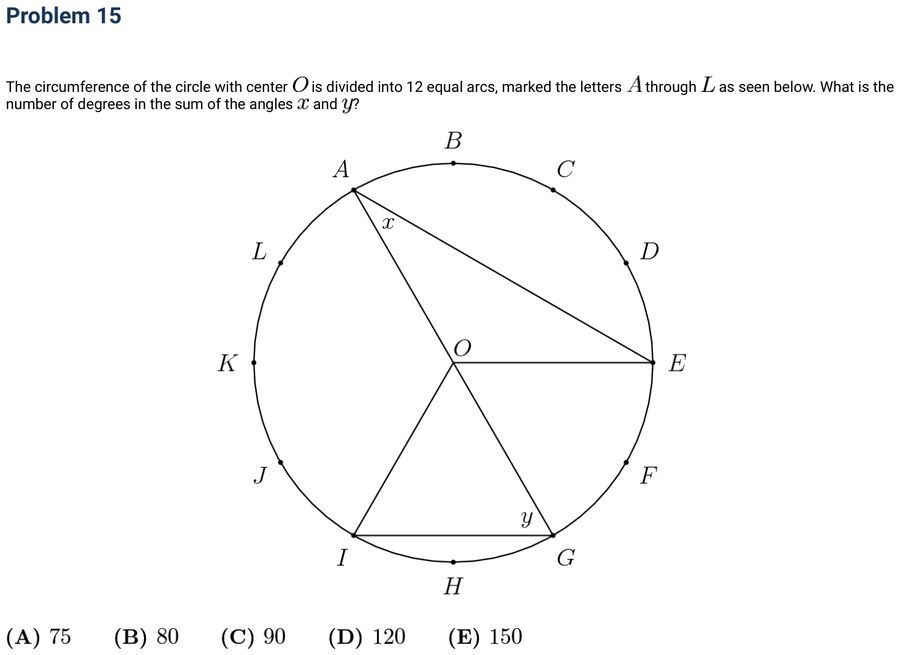
amc8-2014-15
Show answer
Answer: C — 90 degrees.
Show hints
Hint 1 of 2
Each of the 12 arcs spans 360°/12 = 30° at the center.
Still stuck? Show hint 2 →
Hint 2 of 2
Each triangle has two sides that are radii, so it is isosceles. The apex angle is the central angle ⇒ base angles are (180 − central)/2.
Show solution
Approach: central angles + isosceles base angles
  1. Arcs from A to E: 4 arcs ⇒ central angle ∠AOE = 4 × 30° = 120°. Triangle OAE is isosceles, so x = (180 − 120)/2 = 30°.
  2. Arcs from G to I: 2 arcs ⇒ ∠GOI = 60°. Triangle OIG isosceles, so y = (180 − 60)/2 = 60°.
  3. x + y = 30° + 60° = 90°.
Mark: · log in to save
Problem 16 · 2014 AMC 8 Medium
Counting & Probability round-robinavoid-double-counting

The "Middle School Eight" basketball conference has 8 teams. Every season, each team plays every other conference team twice (home and away), and each team also plays 4 games against non-conference opponents. What is the total number of games in a season involving the "Middle School Eight" teams?

Show answer
Answer: B — 88 games.
Show hint
Hint 1
Conference games: pairs of teams, each pair plays twice. Non-conference: each of 8 teams plays 4 extras — those involve only one MSE team, so don't divide by 2.
Show solution
Approach: count conference pairs × 2, plus non-conference
  1. Conference pairs: C(8, 2) = 28. Each pair plays 2 games ⇒ 56 games.
  2. Non-conference: 8 teams × 4 games each = 32 games (the opponent is outside MSE, so no double-counting).
  3. Total: 56 + 32 = 88.
Mark: · log in to save
Problem 17 · 2014 AMC 8 Medium
Ratios, Rates & Proportions distance-speed-time

George walks 1 mile to school. He leaves home at the same time each day, walks at a steady speed of 3 miles per hour, and arrives just as school begins. Today he was distracted by the pleasant weather and walked the first 12 mile at a speed of only 2 miles per hour. At how many miles per hour must George run the last 12 mile in order to arrive just as school begins today?

Show answer
Answer: B — 6 mph.
Show hint
Hint 1
Total time on a normal day = 1/3 hour. How much of that did the slow first half use? Whatever's left must cover the second half-mile.
Show solution
Approach: subtract used time from total time
  1. Normal total time = 1 / 3 hr.
  2. First half-mile at 2 mph took (1/2) / 2 = 1/4 hr.
  3. Time remaining for the second half = 1/3 − 1/4 = 1/12 hr.
  4. Required speed = (1/2) / (1/12) = 6 mph.
Mark: · log in to save
Problem 18 · 2014 AMC 8 Medium
Counting & Probability binomial-counting

Four children were born at City Hospital yesterday. Assume each child is equally likely to be a boy or a girl. Which of the following outcomes is most likely?

Show answer
Answer: D — 3 of one gender and 1 of the other is most likely.
Show hints
Hint 1 of 2
All 16 sequences of BBBB … GGGG are equally likely. Count how many sequences each described outcome covers.
Still stuck? Show hint 2 →
Hint 2 of 2
C(4, k) for k = 0, 1, 2, 3, 4 gives 1, 4, 6, 4, 1. Note "3 of one, 1 of other" covers both k=1 and k=3.
Show solution
Approach: count favorable sequences out of 16
  1. All 4 boys: 1 sequence.
  2. All 4 girls: 1 sequence.
  3. 2-and-2: C(4, 2) = 6 sequences.
  4. 3-and-1 (either way): C(4, 1) + C(4, 3) = 4 + 4 = 8 sequences.
  5. Largest count: 3 of one gender, 1 of the other (8 sequences).
Mark: · log in to save
Problem 19 · 2014 AMC 8 Medium
Geometry & Measurement hide-faces-in-3doptimization

A cube with 3-inch edges is to be constructed from 27 smaller cubes with 1-inch edges. Twenty-one of the cubes are colored red and 6 are colored white. If the 3-inch cube is constructed to have the smallest possible white surface area showing, what fraction of the surface area is white?

Show answer
Answer: A — 5/54.
Show hints
Hint 1 of 2
The 27 unit cubes break into types by how many faces are exposed: 1 interior (0 exposed), 6 face-centers (1 each), 12 edges (2 each), 8 corners (3 each). Hide white cubes in the lowest-exposure positions first.
Still stuck? Show hint 2 →
Hint 2 of 2
Total surface = 6 · 9 = 54. Compute the white area; divide.
Show solution
Approach: place white cubes where the fewest faces show
  1. Hide one white cube in the very center (0 faces showing).
  2. Place the remaining 5 white cubes at the 6 face-centers (1 face showing each) ⇒ 5 white faces visible.
  3. Total surface area = 6 × 32 = 54 unit squares.
  4. White fraction = 5/54.
Mark: · log in to save
Problem 20 · 2014 AMC 8 Medium
Geometry & Measurement quarter-circle-areapi-approximation
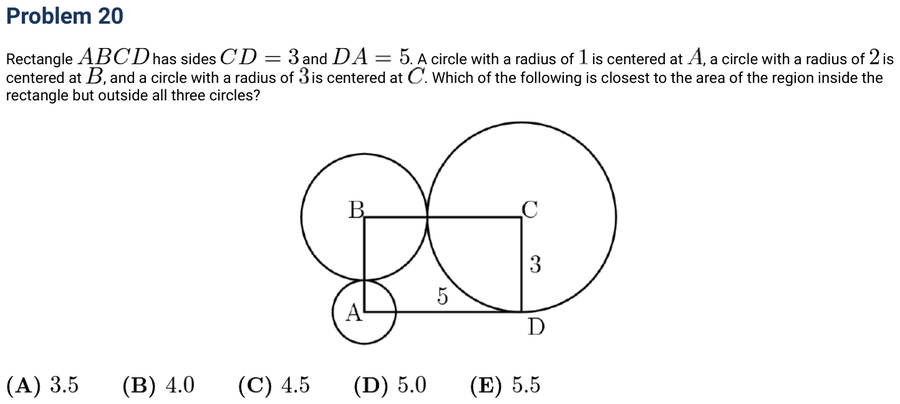
amc8-2014-20
Show answer
Answer: B — 4.0.
Show hints
Hint 1 of 2
Each circle contributes a quarter-circle inside the rectangle (radius fits in the rectangle without overlapping the others). Compute the rectangle's area minus the three quarter-circles.
Still stuck? Show hint 2 →
Hint 2 of 2
Quarter-circle areas: π/4, π, 9π/4 ⇒ total = 14π/4 = 7π/2.
Show solution
Approach: rectangle area − three quarter-circles
  1. Rectangle area = 3 × 5 = 15.
  2. Quarter-circles sum: (1/4)(π + 4π + 9π) = 14π/4 = 7π/2.
  3. Remaining area = 15 − 7π/2 ≈ 15 − 11.0 = 4.0.
Mark: · log in to save
Problem 21 · 2014 AMC 8 Hard
Number Theory divisibility-by-3mod-arithmetic

The 7-digit numbers 74A52B1 and 326AB4C are each multiples of 3. Which of the following could be the value of C?

Show answer
Answer: A — C = 1.
Show hints
Hint 1 of 2
Divisibility by 3: sum of digits divisible by 3. Write the digit-sum condition for each number, then subtract.
Still stuck? Show hint 2 →
Hint 2 of 2
Combine both conditions to find C's residue mod 3.
Show solution
Approach: two mod-3 conditions, subtract
  1. First number: 7+4+5+2+1 = 19, so 19 + A + B ≡ 0 (mod 3) ⇒ A + B ≡ 2 (mod 3).
  2. Second number: 3+2+6+4 = 15, so 15 + A + B + C ≡ 0 (mod 3) ⇒ A + B + C ≡ 0 (mod 3).
  3. Subtract: C ≡ −2 ≡ 1 (mod 3). Choices give C = 1.
Mark: · log in to save
Problem 22 · 2014 AMC 8 Medium
Algebra & Patterns place-value-algebra

A 2-digit number is such that the product of the digits plus the sum of the digits is equal to the number. What is the units digit of the number?

Show answer
Answer: E — Units digit 9.
Show hint
Hint 1
Write the number as 10a + b and translate the condition. Cancel everything you can.
Show solution
Approach: translate to algebra, then cancel
  1. Let the number be 10a + b. Condition: ab + a + b = 10a + b.
  2. Simplify: ab = 9a. Since a ≠ 0 (it's a two-digit number), divide by a: b = 9.
  3. (Any 2-digit number with units digit 9 works: 19, 29, 39, … check: 1·9 + 1 + 9 = 19. ✓)
Mark: · log in to save
Problem 23 · 2014 AMC 8 Hard
Logic & Word Problems logic-puzzleprimes-list

Three members of the Euclid Middle School girls' softball team had the following conversation.
Ashley: I just realized that our uniform numbers are all 2-digit primes.
Bethany: And the sum of your two uniform numbers is the date of my birthday earlier this month.
Caitlin: That's funny. The sum of your two uniform numbers is the date of my birthday later this month.
Ashley: And the sum of your two uniform numbers is today's date.
What number does Caitlin wear?

Show answer
Answer: A — 11.
Show hints
Hint 1 of 3
All three pairwise sums of the uniform numbers are dates (1–31), so the three primes are small two-digit primes. List candidates.
Still stuck? Show hint 2 →
Hint 2 of 3
Pairwise sums ≤ 31 force the primes to be in {11, 13, 17, 19}. Find a triple whose three pairwise sums are all distinct.
Still stuck? Show hint 3 →
Hint 3 of 3
Then Bethany's date is the smallest sum (earlier in the month), Caitlin's is the largest (later), today is between.
Show solution
Approach: list primes, find a workable triple, assign by date order
  1. Each pairwise sum is a date 1–31, so each is ≤ 31. Two-digit primes: 11, 13, 17, 19, 23, 29. Pairs that sum to ≤ 31: only those from {11, 13, 17, 19} (any pair including 23 or 29 exceeds 31 for the larger sums).
  2. Among the triples in {11, 13, 17, 19} we need three distinct pairwise sums. {11, 13, 17}: 24, 28, 30 — distinct. ✓
  3. Bethany's birthday = smallest sum = 24, so Ashley + Caitlin = 24 ⇒ {A, C} = {11, 13}.
  4. Caitlin's birthday = largest sum = 30, so Ashley + Bethany = 30 ⇒ {A, B} = {13, 17}.
  5. Ashley is in both sets, so Ashley = 13. Then Caitlin = 11, Bethany = 17. Today = Bethany + Caitlin = 28 (between 24 and 30 — consistent).
  6. Caitlin wears 11.
Mark: · log in to save
Problem 24 · 2014 AMC 8 Hard
Logic & Word Problems optimizationmedian-of-100

One day the Beverage Barn sold 252 cans of soda to 100 customers, and every customer bought at least one can of soda. What is the maximum possible median number of cans of soda bought per customer on that day?

Show answer
Answer: C — 3.5.
Show hints
Hint 1 of 3
Order the counts smallest to largest. Median = average of 50th and 51st values. To make those big, push the first 49 down to the minimum (which is 1).
Still stuck? Show hint 2 →
Hint 2 of 3
After setting the first 49 to 1, 203 cans remain for 51 customers; each from 51st onward must be ≥ 51st value.
Still stuck? Show hint 3 →
Hint 3 of 3
Let 50th = a, 51st = b, with ab. Make the last 50 all equal to b. Constraint: a + 50b ≤ 203.
Show solution
Approach: minimize the first 49, push the median pair as high as possible
  1. Set customers 1–49 to 1 can each: uses 49 cans, leaves 252 − 49 = 203 for the last 51.
  2. Let the 50th value be a and the 51st value be b (ab). Make customers 51–100 all equal to b: total of last 51 = a + 50b ≤ 203.
  3. Maximize (a + b)/2 over integers with ab. Try b = 4: a + 200 ≤ 203 ⇒ a ≤ 3, so a = 3 (still ≤ b). Median = (3 + 4)/2 = 3.5.
  4. Try b = 5: a + 250 ≤ 203 — impossible. So 3.5 is the max.
Mark: · log in to save
Problem 25 · 2014 AMC 8 Hard
Geometry & Measurement semicircle-lengthscaling-by-pi-over-2
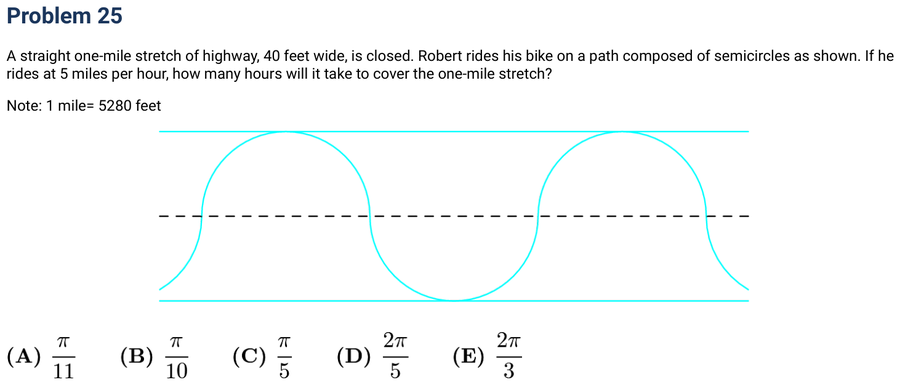
amc8-2014-25
Show answer
Answer: B — π/10 hours.
Show hints
Hint 1 of 2
Each semicircle replaces a straight diameter d with a half-circumference (π/2)d. So the bike path is π/2 times the straight 1-mile distance.
Still stuck? Show hint 2 →
Hint 2 of 2
Then time = distance / speed.
Show solution
Approach: compare the semicircular path length to the straight distance
  1. Each semicircle's diameter lies along the highway and the curve just reaches the edge, so for any diameter d the half-circumference is (π/2)d. Stacking semicircles end-to-end multiplies the total length by π/2.
  2. Bike path length = (π/2) · 1 mile = π/2 miles.
  3. Time = (π/2) / 5 = π/10 hours.
Mark: · log in to save