AMC 8 · Test Mode

2010 AMC 8

Test mode — hints and solutions are locked. Pick an answer for each, then submit at the bottom to see your score.

← Exit test mode No hints or solutions until you submit.
Problem 1 · 2010 AMC 8 Easy
Arithmetic & Operations addition

At Euclid Middle School the mathematics teachers are Miss Germain, Mr. Newton, and Mrs. Young. There are 11 students in Mrs. Germain's class, 8 students in Mr. Newton's class, and 9 students in Mrs. Young's class taking the AMC 8 this year. How many mathematics students at Euclid Middle School are taking the contest?

Show answer
Answer: C — 28.
Show hint
Hint 1
Just add the three class counts.
Show solution
Approach: add
  1. 11 + 8 + 9 = 28.
Mark: · log in to save
Problem 2 · 2010 AMC 8 Easy
Algebra & Patterns operator-definition

If a@b = a × ba + b for a, b positive integers, then what is 5@10?

Show answer
Answer: D — 10/3.
Show hint
Hint 1
Just substitute.
Show solution
Approach: substitute and simplify
  1. 5@10 = (5 · 10)/(5 + 10) = 50/15 = 10/3.
Mark: · log in to save
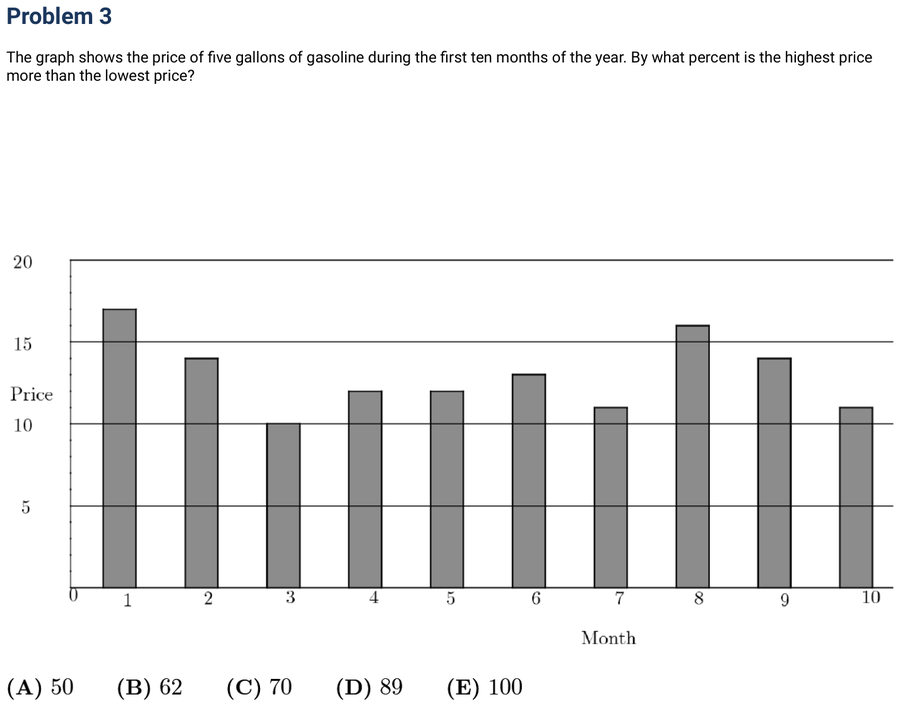
Problem 3 · 2010 AMC 8 Easy
Fractions, Decimals & Percents percent-increase
amc8-2010-03
Show answer
Answer: C — 70%.
Show hint
Hint 1
Percent more = (high − low) / low × 100.
Show solution
Approach: percent above the low
  1. Highest = 17, lowest = 10.
  2. (17 − 10) / 10 = 0.7 = 70%.
Mark: · log in to save
Problem 4 · 2010 AMC 8 Easy
Arithmetic & Operations mean-median-mode

What is the sum of the mean, median, and mode of the numbers 2, 3, 0, 3, 1, 4, 0, 3?

Show answer
Answer: C — 7.5.
Show hint
Hint 1
Sort first, then read off mode and median; compute mean from the sum.
Show solution
Approach: compute each of mean/median/mode
  1. Sorted: 0, 0, 1, 2, 3, 3, 3, 4. Sum = 16 ⇒ mean = 16/8 = 2.
  2. Median = avg of 4th and 5th = (2 + 3)/2 = 2.5.
  3. Mode = 3.
  4. Total: 2 + 2.5 + 3 = 7.5.
Mark: · log in to save
Problem 5 · 2010 AMC 8 Easy
Arithmetic & Operations unit-conversion

Alice needs to replace a light bulb located 10 centimeters below the ceiling in her kitchen. The ceiling is 2.4 meters above the floor. Alice is 1.5 meters tall and can reach 46 centimeters above the top of her head. Standing on a stool, she can just reach the light bulb. What is the height of the stool, in centimeters?

Show answer
Answer: B — 34 cm.
Show hint
Hint 1
Convert everything to centimeters. Stool height = light-bulb height − (Alice + reach).
Show solution
Approach: match Alice + stool + reach to the bulb height
  1. Bulb height above floor: 240 − 10 = 230 cm.
  2. Alice's reach (height + arm): 150 + 46 = 196 cm.
  3. Stool: 230 − 196 = 34 cm.
Mark: · log in to save
Problem 6 · 2010 AMC 8 Easy
Geometry & Measurement lines-of-symmetry

Which of the following figures has the greatest number of lines of symmetry?

Show answer
Answer: E — Square (4 lines).
Show hint
Hint 1
Triangle: 3. Rhombus (non-square): 2. Rectangle (non-square): 2. Isosceles trapezoid: 1. Square: 4.
Show solution
Approach: count for each shape
  1. Equilateral triangle: 3 lines. Non-square rhombus: 2. Non-square rectangle: 2. Isosceles trapezoid: 1. Square: 4 lines (two diagonals + two midpoint lines).
  2. Most lines: square.
Mark: · log in to save
Problem 7 · 2010 AMC 8 Medium
Logic & Word Problems greedy-coin

Using only pennies, nickels, dimes, and quarters, what is the smallest number of coins Freddie would need so he could pay any amount of money less than a dollar?

Show answer
Answer: B — 10 coins.
Show hints
Hint 1 of 2
Greedy: start with pennies (need 4 to cover 1–4 cents), then nickels, dimes, quarters — one of each value up to the next.
Still stuck? Show hint 2 →
Hint 2 of 2
After 4 pennies + 1 nickel, you can pay anything up to 9 cents. Each new coin should extend the reachable range as much as possible.
Show solution
Approach: build up the reachable range coin by coin
  1. 4 pennies (cover 0–4¢). +1 nickel ⇒ reach 9¢. +1 dime ⇒ reach 19¢. +1 nickel ⇒ reach 24¢. +1 quarter ⇒ reach 49¢. +1 quarter ⇒ 74¢. +1 quarter ⇒ 99¢.
  2. Coins used: 4 + 1 + 1 + 1 + 1 + 1 + 1 = 10. (Specifically 4 pennies, 2 nickels, 1 dime, 3 quarters.)
  3. Smallest count: 10.
Mark: · log in to save
Problem 8 · 2010 AMC 8 Medium
Ratios, Rates & Proportions relative-speed

As Emily is riding her bicycle on a long straight road, she spots Emerson skating in the same direction 1/2 mile in front of her. After she passes him, she can see him in her rear mirror until he is 1/2 mile behind her. Emily rides at a constant rate of 12 miles per hour, and Emerson skates at a constant rate of 8 miles per hour. For how many minutes can Emily see Emerson?

Show answer
Answer: D — 15 minutes.
Show hint
Hint 1
Use the gap-closing speed: Emily − Emerson = 4 mph. She sees him while the gap shrinks from 1/2 ahead to 1/2 behind — a total relative shift of 1 mile.
Show solution
Approach: relative-speed reasoning
  1. Relative speed: 12 − 8 = 4 mph.
  2. Emily must cover 1 mile of relative displacement (from 1/2 ahead to 1/2 behind).
  3. Time: 1 / 4 hour = 15 minutes.
Mark: · log in to save
Problem 9 · 2010 AMC 8 Easy
Fractions, Decimals & Percents weighted-average

Ryan got 80% of the problems correct on a 25-problem test, 90% on a 40-problem test, and 70% on a 10-problem test. What percent of all the problems did Ryan answer correctly?

Show answer
Answer: D — 84%.
Show hint
Hint 1
Count correct on each test, then divide by the total number of problems.
Show solution
Approach: total correct / total problems
  1. Correct: 0.8 · 25 + 0.9 · 40 + 0.7 · 10 = 20 + 36 + 7 = 63.
  2. Total: 25 + 40 + 10 = 75.
  3. 63 / 75 = 84%.
Mark: · log in to save
Problem 10 · 2010 AMC 8 Medium
Geometry & Measurement area-ratio-of-circles

Six pepperoni circles will exactly fit across the diameter of a 12-inch pizza when placed. If a total of 24 circles of pepperoni are placed on this pizza without overlap, what fraction of the pizza is covered by pepperoni?

Show answer
Answer: B — 2/3.
Show hint
Hint 1
Each pepperoni has diameter 12/6 = 2, so its area is π, compared to the pizza's 36π. Each pepperoni is 1/36 of the pizza.
Show solution
Approach: ratio of pepperoni area to pizza area
  1. Pepperoni radius: 1. Pizza radius: 6. Area ratio: (1/6)2 = 1/36 per pepperoni.
  2. 24 pepperonis: 24/36 = 2/3.
Mark: · log in to save
Problem 11 · 2010 AMC 8 Easy
Algebra & Patterns ratio-and-difference

The top of one tree is 16 feet higher than the top of another tree. The heights of the two trees are in the ratio 3 : 4. In feet, how tall is the taller tree?

Show answer
Answer: B — 64 feet.
Show hint
Hint 1
The ratio 3:4 means the difference (1 part) corresponds to 16 feet. So 1 part = 16 ft.
Show solution
Approach: ratio difference = 1 part
  1. 4 − 3 = 1 part = 16 ft.
  2. Taller (4 parts) = 4 · 16 = 64 ft.
Mark: · log in to save
Problem 12 · 2010 AMC 8 Medium
Fractions, Decimals & Percents fix-the-invariant

Of the 500 balls in a large bag, 80% are red and the rest are blue. How many of the red balls must be removed from the bag so that 75% of the remaining balls are red?

Show answer
Answer: D — 100 red balls.
Show hint
Hint 1
Blue balls don't change. 75% red ⇒ 25% blue, so the 100 blue balls represent 25% of the new total.
Show solution
Approach: blue stays constant, so use blue to find new total
  1. Initial: 400 red, 100 blue.
  2. After removal, 25% blue means total = 100 / 0.25 = 400 balls.
  3. Removed: 500 − 400 = 100 red balls.
Mark: · log in to save
Problem 13 · 2010 AMC 8 Medium
Algebra & Patterns consecutive-integerspercent-equation

The lengths of the sides of a triangle in inches are three consecutive integers. The length of the shortest side is 30% of the perimeter. What is the length of the longest side?

Show answer
Answer: E — 11 inches.
Show hint
Hint 1
Let the smallest side be s. Then perimeter = 3s + 3. Set s = 0.3 · (3s + 3).
Show solution
Approach: translate the percent condition
  1. Sides: s, s+1, s+2. Perimeter: 3s + 3.
  2. s = 0.3(3s + 3) ⇒ s = 0.9s + 0.9 ⇒ 0.1s = 0.9 ⇒ s = 9.
  3. Longest = s + 2 = 11.
Mark: · log in to save
Problem 14 · 2010 AMC 8 Easy
Number Theory prime-factorization

What is the sum of the prime factors of 2010?

Show answer
Answer: C — 77.
Show hint
Hint 1
Factor out small primes first: 2010 / 2 / 3 / 5 = ?
Show solution
Approach: factor primes step by step
  1. 2010 = 2 · 1005 = 2 · 3 · 335 = 2 · 3 · 5 · 67 (67 is prime).
  2. Sum: 2 + 3 + 5 + 67 = 77.
Mark: · log in to save
Problem 15 · 2010 AMC 8 Medium
Fractions, Decimals & Percents find-total-from-percent

A jar contains five different colors of gumdrops: 30% are blue, 20% are brown, 15% red, 10% yellow, and the other 30 gumdrops are green. If half of the blue gumdrops are replaced with brown gumdrops, how many gumdrops will be brown?

Show answer
Answer: C — 42.
Show hints
Hint 1 of 2
Green = 100% − 30 − 20 − 15 − 10 = 25%, so 30 gumdrops = 25% ⇒ total = 120.
Still stuck? Show hint 2 →
Hint 2 of 2
Brown starts at 20% · 120 = 24. Add half the blue gumdrops (which switch color).
Show solution
Approach: find the total, then update brown
  1. Green % = 25 ⇒ total = 30 / 0.25 = 120.
  2. Blue count: 30% · 120 = 36. Brown count: 20% · 120 = 24.
  3. Half of blue (18) become brown: 24 + 18 = 42.
Mark: · log in to save
Problem 16 · 2010 AMC 8 Easy
Geometry & Measurement area-equation

A square and a circle have the same area. What is the ratio of the side length of the square to the radius of the circle?

Show answer
Answer: B — √π.
Show hint
Hint 1
Set s2 = πr2 and solve for s/r.
Show solution
Approach: equate areas
  1. s2 = πr2 ⇒ (s/r)2 = π.
  2. s/r = √π.
Mark: · log in to save
Problem 17 · 2010 AMC 8 Hard
Geometry & Measurement area-bisectorsimilar-triangles
amc8-2010-17
Show answer
Answer: D — 2/3.
Show hints
Hint 1 of 2
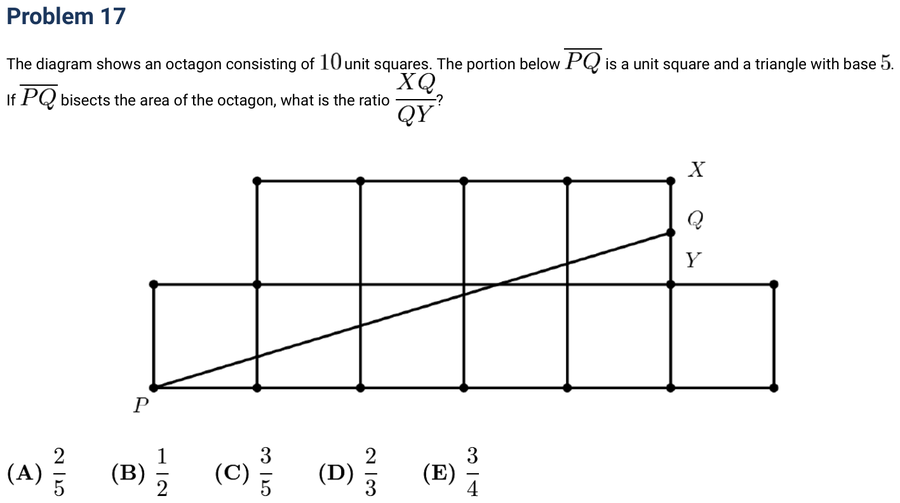
Total area = 10, so each half = 5. Below PQ: a unit square + a triangle of base 5. So the triangle has area 4 and base 5.
Still stuck? Show hint 2 →
Hint 2 of 2
Triangle area = (1/2) · 5 · ZQ = 4 ⇒ ZQ = 1.6. With XY = 2, QY = ZQ − 1 = 0.6 and XQ = 2 − ZQ = 0.4.
Show solution
Approach: use the area below PQ to locate Q
  1. Total area = 10, half = 5. Below PQ = unit square + triangle = 5, so the triangle has area 4 with base 5.
  2. Triangle height = 2 · 4 / 5 = 1.6. That's the height ZQ.
  3. XY spans 2 units. With Q on it at 1.6 above the base: QY = 1.6 − 1 = 0.6 and XQ = 2 − 1.6 = 0.4.
  4. Ratio XQ/QY = 0.4/0.6 = 2/3.
Mark: · log in to save
Problem 18 · 2010 AMC 8 Medium
Geometry & Measurement area-ratio
amc8-2010-18
Show answer
Answer: C — 6 : π.
Show hints
Hint 1 of 2
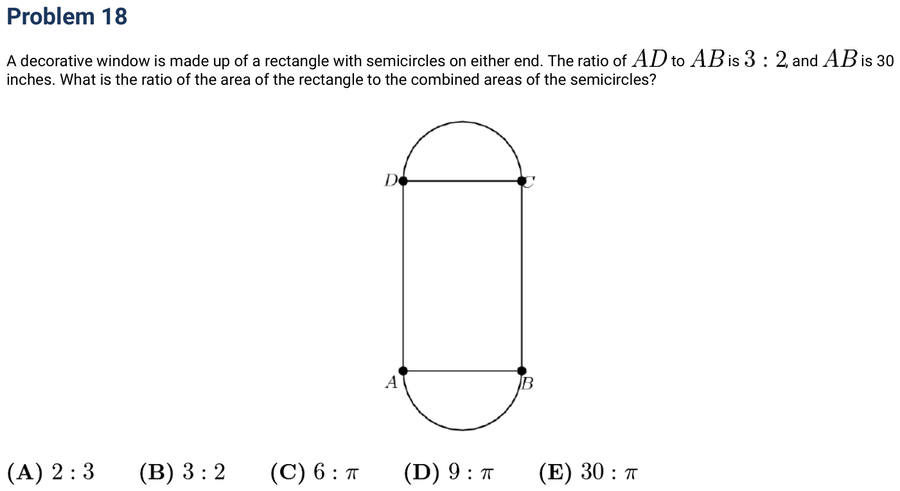
Two semicircles of diameter 30 combine to a single circle of diameter 30 ⇒ area 225π.
Still stuck? Show hint 2 →
Hint 2 of 2
Rectangle: 30 × 45 = 1350. Form the ratio.
Show solution
Approach: combine the semicircles into one circle
  1. AD = (3/2) · 30 = 45. Rectangle area: 30 · 45 = 1350.
  2. Two semicircles of diameter 30 ⇒ one circle of radius 15: area = 225π.
  3. Ratio: 1350 : 225π = 6 : π.
Mark: · log in to save
Problem 19 · 2010 AMC 8 Medium
Geometry & Measurement tangent-radiusannulus-area
amc8-2010-19
Show answer
Answer: C — 64π.
Show hints
Hint 1 of 2
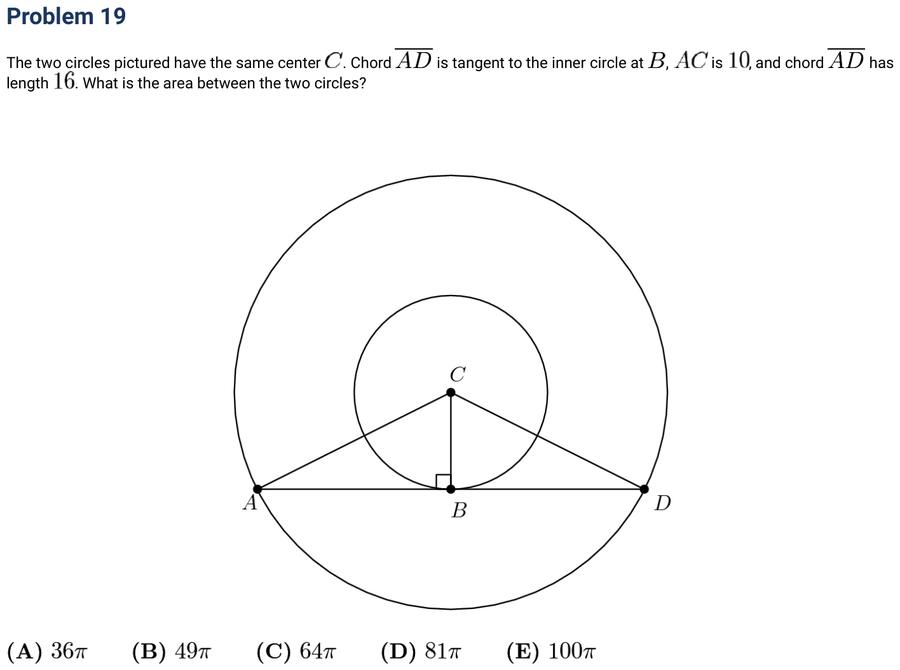
CBAD at the tangent point and B bisects AD, so AB = 8.
Still stuck? Show hint 2 →
Hint 2 of 2
Annulus area = π(AC2CB2) = π · AB2 by Pythagoras.
Show solution
Approach: Pythagoras on right triangle ABC
  1. Tangent ⇒ CBAD at B, so B is the midpoint of AD: AB = 8.
  2. Annulus area: πAC2 − πCB2 = π(AC2CB2) = π · AB2 = 64π.
Mark: · log in to save
Problem 20 · 2010 AMC 8 Hard
Counting & Probability inclusion-exclusiondivisibility

In a room, 2/5 of the people are wearing gloves, and 3/4 of the people are wearing hats. What is the minimum number of people in the room wearing both a hat and a glove?

Show answer
Answer: A — 3.
Show hints
Hint 1 of 2
Total people must be divisible by 5 and 4 ⇒ multiple of 20. Smallest is 20.
Still stuck? Show hint 2 →
Hint 2 of 2
Inclusion-exclusion gives the minimum overlap: gloves + hats − 1 (cap).
Show solution
Approach: smallest valid total, then inclusion-exclusion
  1. Total people: multiple of 20. Take 20 (the smallest).
  2. Gloves: 2/5 · 20 = 8. Hats: 3/4 · 20 = 15.
  3. Min(both) = max(0, gloves + hats − total) = max(0, 8 + 15 − 20) = 3.
Mark: · log in to save
Problem 21 · 2010 AMC 8 Hard
Algebra & Patterns work-backward

Hui is an avid reader. She bought a copy of the best seller Math is Beautiful. On the first day, Hui read 1/5 of the pages plus 12 more, and on the second day she read 1/4 of the remaining pages plus 15 pages. On the third day she read 1/3 of the remaining pages plus 18 pages. She then realized that there were only 62 pages left to read, which she read the next day. How many pages are in this book?

Show answer
Answer: C — 240 pages.
Show hints
Hint 1 of 2
Work backwards from the 62 pages left. Day 3 left her with 62 pages after reading (1/3)R + 18 from R; so 2R/3 − 18 = 62.
Still stuck? Show hint 2 →
Hint 2 of 2
Repeat the inversion for day 2 and day 1.
Show solution
Approach: work backwards day by day
  1. After day 3 there are 62 pages left. If R3 = pages at start of day 3: (2/3)R3 − 18 = 62 ⇒ R3 = 120.
  2. Start of day 2: (3/4)R2 − 15 = 120 ⇒ R2 = 180.
  3. Start of day 1: (4/5)R1 − 12 = 180 ⇒ R1 = 240.
Mark: · log in to save
Problem 22 · 2010 AMC 8 Medium
Algebra & Patterns place-value-difference

The hundreds digit of a three-digit number is 2 more than the units digit. The digits of the three-digit number are reversed, and the result is subtracted from the original three-digit number. What is the units digit of the result?

Show answer
Answer: E — 8.
Show hints
Hint 1 of 2
Let units = u, tens = t, hundreds = u + 2. Original − reversed simplifies to a constant.
Still stuck? Show hint 2 →
Hint 2 of 2
Reversing flips the hundreds and units digits. Difference = 99 · (hundreds − units).
Show solution
Approach: compute (original − reversed)
  1. Original − reversed = 100(u+2) + 10t + u − (100u + 10t + u+2) = 99(u+2) − 99u = 198.
  2. Units digit of 198 = 8.
Mark: · log in to save
Problem 23 · 2010 AMC 8 Hard
Geometry & Measurement circle-radiipythagorean
amc8-2010-23
Show answer
Answer: B — 1/2.
Show hints
Hint 1 of 2
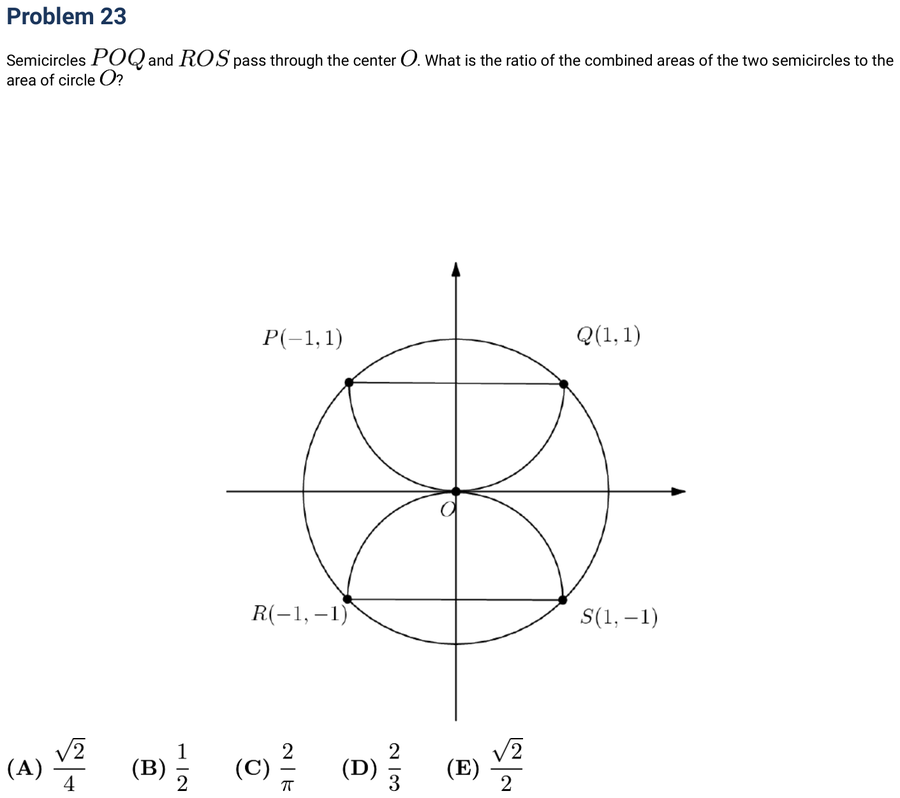
Each small semicircle has diameter PQ (or RS) = 2; radius 1.
Still stuck? Show hint 2 →
Hint 2 of 2
The big circle has radius OQ = √2 (Pythagoras on (1,1)). Compute both areas and divide.
Show solution
Approach: compute each area
  1. Small semicircles: radius 1, each area π/2; combined π.
  2. Big circle: radius √(12+12) = √2, area 2π.
  3. Ratio: π / (2π) = 1/2.
Mark: · log in to save
Problem 24 · 2010 AMC 8 Medium
Algebra & Patterns match-bases-or-exponents

What is the correct ordering of the three numbers, 108, 512, and 224?

Show answer
Answer: A — 2^24 < 10^8 < 5^12.
Show hints
Hint 1 of 2
Rewrite each as a product of equal-exponent powers. E.g., 108 = 28 · 58, 224 = 28 · 48, 512 = 58 · 54.
Still stuck? Show hint 2 →
Hint 2 of 2
Compare pairwise using shared factors.
Show solution
Approach: factor out a common eighth power
  1. Compare 224 vs 108: 224 = 28 · 48, 108 = 28 · 58. Since 4 < 5: 224 < 108.
  2. Compare 108 vs 512: 108 = 44 · 58, 512 = 54 · 58. Since 44 = 256 < 625 = 54: 108 < 512.
  3. Therefore 224 < 108 < 512.
Mark: · log in to save
Problem 25 · 2010 AMC 8 Hard
Counting & Probability recurrencecomposition

Everyday at school, Jo climbs a flight of 6 stairs. Jo can take the stairs 1, 2, or 3 at a time. For example, Jo could climb 3, then 1, then 2. In how many ways can Jo climb the stairs?

Show answer
Answer: E — 24 ways.
Show hints
Hint 1 of 2
Let f(n) be the number of ways to climb n stairs. Each climb ends in a 1, 2, or 3 step: f(n) = f(n−1) + f(n−2) + f(n−3).
Still stuck? Show hint 2 →
Hint 2 of 2
Start with f(1)=1, f(2)=2, f(3)=4.
Show solution
Approach: tribonacci-style recurrence
  1. f(1) = 1, f(2) = 2, f(3) = 4.
  2. f(4) = 1 + 2 + 4 = 7.
  3. f(5) = 2 + 4 + 7 = 13.
  4. f(6) = 4 + 7 + 13 = 24.
Mark: · log in to save