AMC 8

2009 AMC 8

25 problems — read each, give it a real try, then peek at the hints.

Practice: Take as test →
Problem 1 · 2009 AMC 8 Easy
Algebra & Patterns work-backward

Bridget bought a bag of apples at the grocery store. She gave half of the apples to Ann. Then she gave Cassie 3 apples, keeping 4 apples for herself. How many apples did Bridget buy?

Show answer
Answer: E — 14 apples.
Show hint
Hint 1
Work backwards from the 4 she kept.
Show solution
Approach: reverse each step
  1. After giving Cassie 3: she had 4 + 3 = 7.
  2. Before giving Ann half: original = 2 · 7 = 14.
Mark: · log in to save
Problem 2 · 2009 AMC 8 Easy
Ratios, Rates & Proportions proportion

On average, for every 4 sports cars sold at the local dealership, 7 sedans are sold. The dealership predicts that it will sell 28 sports cars next month. How many sedans does it expect to sell?

Show answer
Answer: D — 49 sedans.
Show hint
Hint 1
28 is 7 × 4. So sedans = 7 × 7.
Show solution
Approach: scale the ratio
  1. 28 / 4 = 7 ⇒ ratio scales by 7.
  2. Sedans: 7 × 7 = 49.
Mark: · log in to save
Problem 3 · 2009 AMC 8 Easy
Ratios, Rates & Proportions unit-rate
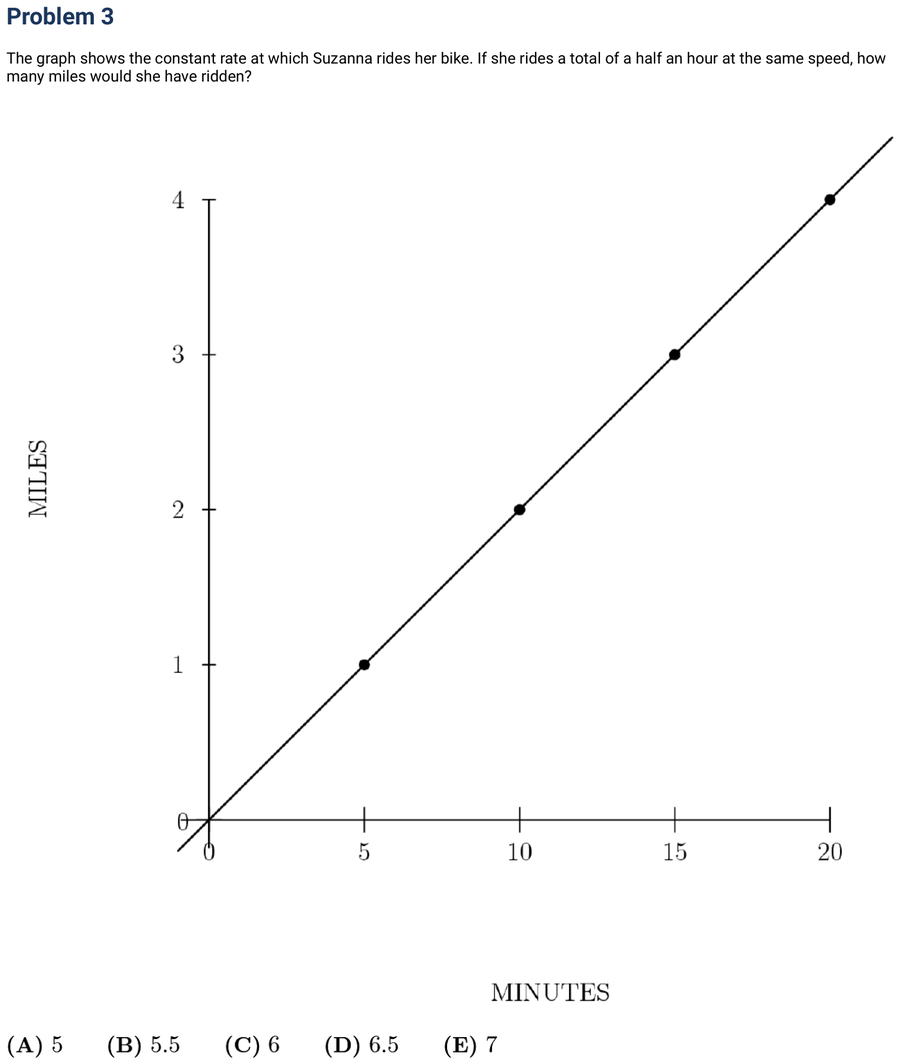
amc8-2009-03
Show answer
Answer: C — 6 miles.
Show hint
Hint 1
Read off the rate from the graph: 1 mile per 5 minutes, so 30 min gives 30/5 miles.
Show solution
Approach: constant rate × time
  1. Rate: 1 mile per 5 minutes = 12 mph.
  2. 30 minutes ⇒ 6 miles.
Mark: · log in to save
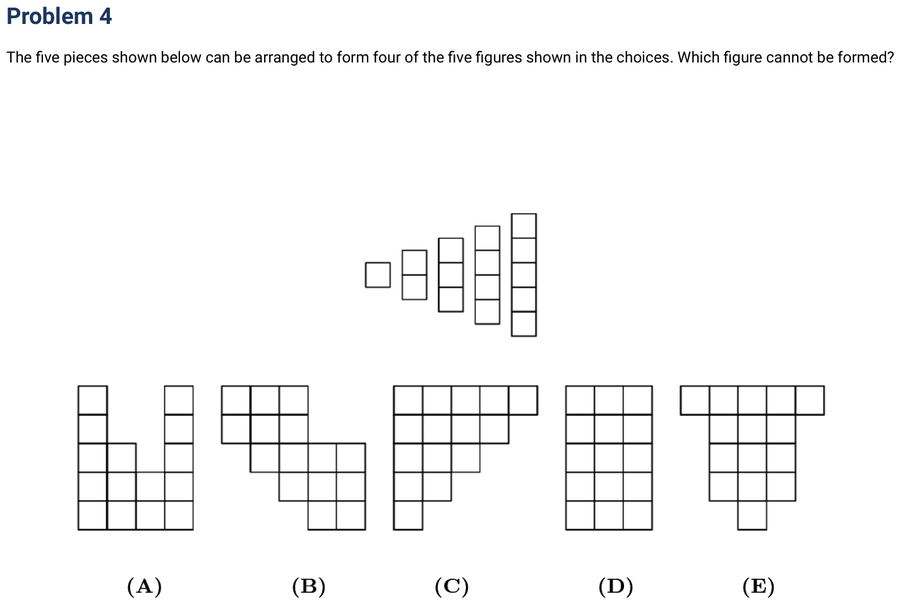
Problem 4 · 2009 AMC 8 Easy
Geometry & Measurement tiling-fit
amc8-2009-04
Show answer
Answer: B — B.
Show hint
Hint 1
One of the pieces is a 5-block straight strip; it must be placed straight in any arrangement. Look for a target shape with no 5-in-a-row segment.
Show solution
Approach: find the figure with no length-5 straight segment
  1. The 1×5 strip must lie either entirely horizontal or vertical in any arrangement.
  2. Figure B has no straight 5-block run, horizontal or vertical, so the 1×5 piece cannot fit. So B is impossible.
Mark: · log in to save
Problem 5 · 2009 AMC 8 Easy
Algebra & Patterns tribonaccirecurrence

A sequence of numbers starts with 1, 2, and 3. The fourth number of the sequence is the sum of the previous three numbers in the sequence: 1 + 2 + 3 = 6. In the same way, every number after the fourth is the sum of the previous three numbers. What is the eighth number in the sequence?

Show answer
Answer: D — 68.
Show hint
Hint 1
Just iterate the rule: each new term = sum of the previous three.
Show solution
Approach: build the sequence forward
  1. 1, 2, 3, 6, 11, 20, 37, 68.
Mark: · log in to save
Problem 6 · 2009 AMC 8 Easy
Ratios, Rates & Proportions combined-rate

Steve's empty swimming pool will hold 24,000 gallons of water when full. It will be filled by 4 hoses, each of which supplies 2.5 gallons of water per minute. How many hours will it take to fill Steve's pool?

Show answer
Answer: A — 40 hours.
Show hint
Hint 1
Combined rate = 4 · 2.5 = 10 gal/min. Convert minutes to hours.
Show solution
Approach: combined rate, total volume, convert
  1. Rate: 10 gal/min ⇒ 600 gal/hour.
  2. Time: 24,000 / 600 = 40 hours.
Mark: · log in to save
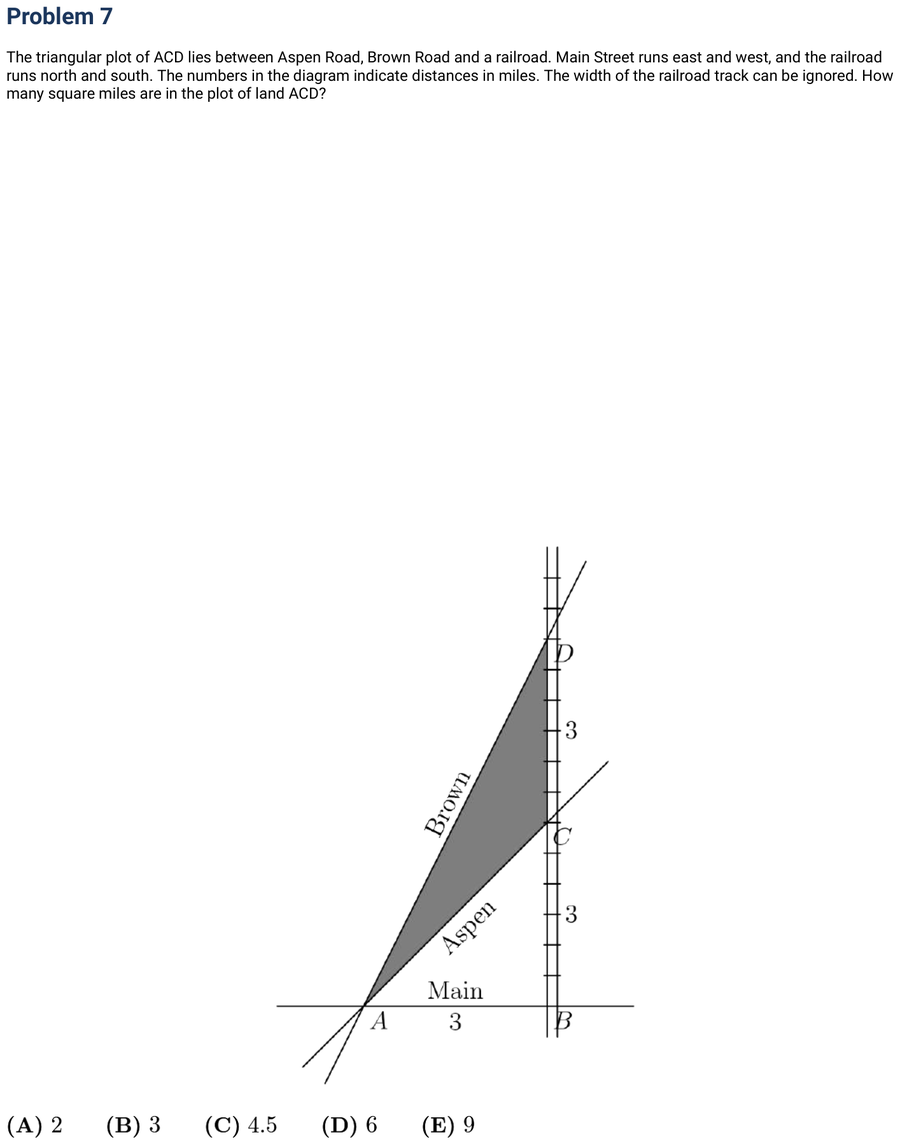
Problem 7 · 2009 AMC 8 Easy
Geometry & Measurement triangle-area
amc8-2009-07
Show answer
Answer: C — 4.5 square miles.
Show hint
Hint 1
Both C and D sit on the railroad; CD = 3. The plot's base is CD with the apex at A.
Show solution
Approach: base × height / 2
  1. Base CD = 3 (along the railroad). Height from A to the railroad = 3 (along Main Street).
  2. Area = (1/2)(3)(3) = 4.5.
Mark: · log in to save
Problem 8 · 2009 AMC 8 Easy
Fractions, Decimals & Percents percent-multiplier

The length of a rectangle is increased by 10% and the width is decreased by 10%. What percent of the old area is the new area?

Show answer
Answer: B — 99%.
Show hint
Hint 1
Multiply the two factors: 1.1 · 0.9 = ?
Show solution
Approach: multiply multipliers
  1. New area / old area = 1.1 · 0.9 = 0.99 = 99%.
Mark: · log in to save
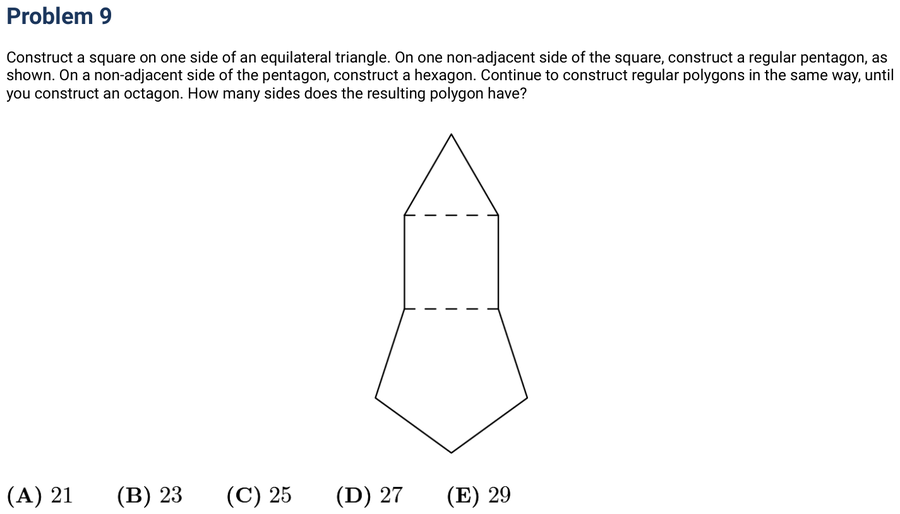
Problem 9 · 2009 AMC 8 Medium
Geometry & Measurement shared-sides-polygon-chain
amc8-2009-09
Show answer
Answer: B — 23 sides.
Show hint
Hint 1
Each interior polygon loses 2 sides to the chain (one to the previous, one to the next). The first and last lose only 1.
Show solution
Approach: subtract shared sides
  1. End polygons (triangle, octagon) contribute all but 1: (3 − 1) + (8 − 1) = 2 + 7 = 9.
  2. Middle polygons (square, pentagon, hexagon, heptagon) contribute all but 2: (4 + 5 + 6 + 7) − 4 · 2 = 22 − 8 = 14.
  3. Total: 9 + 14 = 23.
Mark: · log in to save
Problem 10 · 2009 AMC 8 Easy
Counting & Probability interior-of-board

On a checkerboard composed of 64 unit squares, what is the probability that a randomly chosen unit square does not touch the outer edge of the board?

Show answer
Answer: D — 9/16.
Show hint
Hint 1
Interior = (8 − 2)2 = 36 inside squares.
Show solution
Approach: count interior squares
  1. Interior: 6 × 6 = 36.
  2. Probability: 36 / 64 = 9/16.
Mark: · log in to save
Problem 11 · 2009 AMC 8 Medium
Number Theory gcd

The Amaco Middle School bookstore sells pencils costing a whole number of cents. Some seventh graders each bought a pencil, paying a total of $1.43. Some of the 30 sixth graders each bought a pencil, and they paid a total of $1.95. How many more sixth graders than seventh graders bought a pencil?

Show answer
Answer: D — 4 more.
Show hint
Hint 1
Working in cents, the price divides both 143 and 195. Compute gcd(143, 195).
Show solution
Approach: find the common price via gcd
  1. 143 = 11 · 13; 195 = 3 · 5 · 13. So price | 13 and price > 1 ⇒ price = 13¢.
  2. Seventh graders: 143/13 = 11. Sixth graders: 195/13 = 15.
  3. Difference: 15 − 11 = 4.
Mark: · log in to save
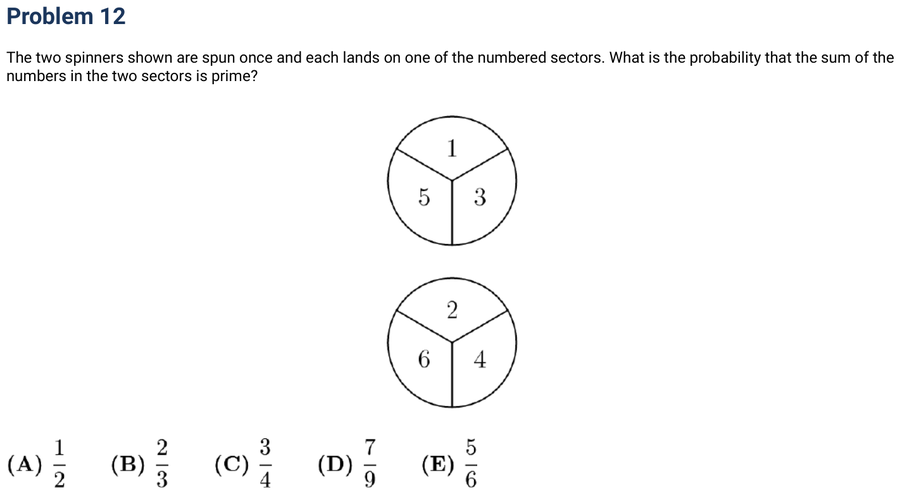
Problem 12 · 2009 AMC 8 Medium
Counting & Probability enumerate-outcomes
amc8-2009-12
Show answer
Answer: D — 7/9.
Show hint
Hint 1
Odd + even = odd, so all 9 sums are odd. Just count which are prime.
Show solution
Approach: list 9 sums, count primes
  1. Sums: 3, 5, 7, 5, 7, 9, 7, 9, 11. Non-prime: the two 9s.
  2. Prime probability: 7/9 = 7/9.
Mark: · log in to save
Problem 13 · 2009 AMC 8 Easy
Counting & Probability last-digit

A three-digit integer contains one of each of the digits 1, 3, and 5. What is the probability that the integer is divisible by 5?

Show answer
Answer: B — 1/3.
Show hint
Hint 1
Divisible by 5 iff units digit is 5. Each of {1, 3, 5} is equally likely in the units position.
Show solution
Approach: P(units = 5)
  1. By symmetry of the 6 arrangements, units digit is 5 with probability 1/3.
Mark: · log in to save
Problem 14 · 2009 AMC 8 Medium
Ratios, Rates & Proportions harmonic-mean

Austin and Temple are 50 miles apart along Interstate 35. Bonnie drove from Austin to her daughter's house in Temple, averaging 60 miles per hour. Leaving the car with her daughter, Bonnie rode a bus back to Austin along the same route and averaged 40 miles per hour on the return trip. What was the average speed for the round trip, in miles per hour?

Show answer
Answer: B — 48 mph.
Show hint
Hint 1
Average speed = total distance / total time. Don't just average the two speeds — equal distances at different speeds gives the harmonic mean.
Show solution
Approach: total distance / total time
  1. Time out: 50/60 = 5/6 hr. Time back: 50/40 = 5/4 hr. Total time: 5/6 + 5/4 = 25/12 hr.
  2. Total distance: 100. Average: 100 / (25/12) = 48 mph.
Mark: · log in to save
Problem 15 · 2009 AMC 8 Medium
Ratios, Rates & Proportions limiting-ingredient

A recipe that makes 5 servings of hot chocolate requires 2 squares of chocolate, 1/4 cup sugar, 1 cup water and 4 cups milk. Jordan has 5 squares of chocolate, 2 cups of sugar, lots of water, and 7 cups of milk. If she maintains the same ratio of ingredients, what is the greatest number of servings of hot chocolate she can make?

Show answer
Answer: D — 8¾ servings.
Show hint
Hint 1
For each ingredient, compute how many recipes worth Jordan has, then multiply by 5 servings. The smallest result limits the answer.
Show solution
Approach: compute per-ingredient capacity, take the min
  1. Chocolate: 5/2 recipes worth.
  2. Sugar: 2 / (1/4) = 8 recipes.
  3. Milk: 7/4 recipes.
  4. Smallest is milk at 7/4. Servings: 5 · 7/4 = 35/4 = .
Mark: · log in to save
Problem 16 · 2009 AMC 8 Medium
Counting & Probability factor-triples

How many 3-digit positive integers have digits whose product equals 24?

Show answer
Answer: D — 21.
Show hint
Hint 1
List unordered digit triples (each digit 1-9) with product 24. Then count arrangements (3! for distinct, 3!/2! for one repeat).
Show solution
Approach: enumerate digit multisets, count permutations
  1. Triples: {1, 3, 8}, {1, 4, 6}, {2, 2, 6}, {2, 3, 4}.
  2. Permutations: 6 + 6 + 3 + 6 = 21.
Mark: · log in to save
Problem 17 · 2009 AMC 8 Hard
Number Theory exponent-parity-mod

The positive integers x and y are the two smallest positive integers for which the product of 360 and x is a square and the product of 360 and y is a cube. What is the sum of x and y?

Show answer
Answer: B — 85.
Show hint
Hint 1
Prime-factor 360 = 23 · 32 · 5. Make every exponent even (square) or a multiple of 3 (cube).
Show solution
Approach: fix exponents to the right parity / multiple of 3
  1. 360 = 23 · 32 · 51.
  2. Square: bump 2's exponent to 4 and 5's to 2 ⇒ multiply by 2 · 5 = 10. So x = 10.
  3. Cube: bump 2's to 3 (already), 3's to 3 (add one 3), 5's to 3 (add two 5s) ⇒ multiply by 3 · 25 = 75. So y = 75.
  4. x + y = 85.
Mark: · log in to save
Problem 18 · 2009 AMC 8 Medium
Counting & Probability pattern-scaling
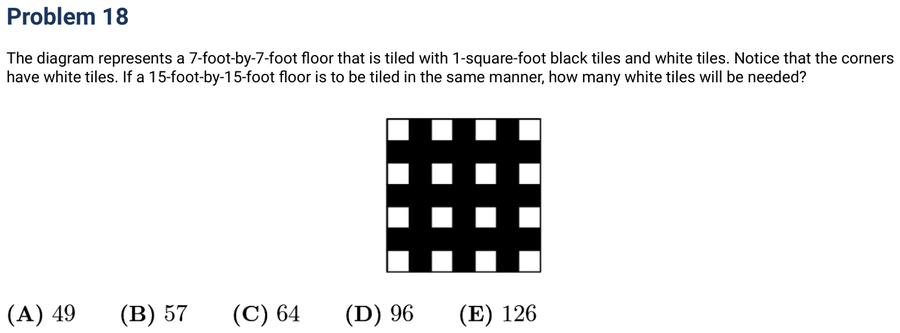
amc8-2009-18
Show answer
Answer: C — 64 dark tiles.
Show hint
Hint 1
Dark tiles sit at (odd row, odd column). In a 7×7: 4 odd rows × 4 odd cols = 16. In a 15×15: 8 × 8.
Show solution
Approach: count odd-row × odd-column positions
  1. 7-foot floor: odd positions 1, 3, 5, 7 ⇒ 4 each direction; 4 × 4 = 16 (consistent with diagram).
  2. 15-foot floor: odd positions 1, 3, 5, 7, 9, 11, 13, 15 ⇒ 8 each direction.
  3. Dark tiles: 8 × 8 = 64.
Mark: · log in to save
Problem 19 · 2009 AMC 8 Medium
Geometry & Measurement caseworkisosceles-triangle

Two angles of an isosceles triangle measure 70° and x°. What is the sum of the three possible values of x?

Show answer
Answer: D — 165.
Show hint
Hint 1
Three cases for which pair of angles are equal: 70° and x°, the two 70°-angles, or two x°-angles.
Show solution
Approach: case-split on the equal pair
  1. Case 1: x = 70 (the matched pair).
  2. Case 2: two 70° angles ⇒ x = 180 − 140 = 40.
  3. Case 3: two x° angles ⇒ 2x + 70 = 180 ⇒ x = 55.
  4. Sum: 70 + 40 + 55 = 165.
Mark: · log in to save
Problem 20 · 2009 AMC 8 Hard
Geometry & Measurement non-congruent-triangles
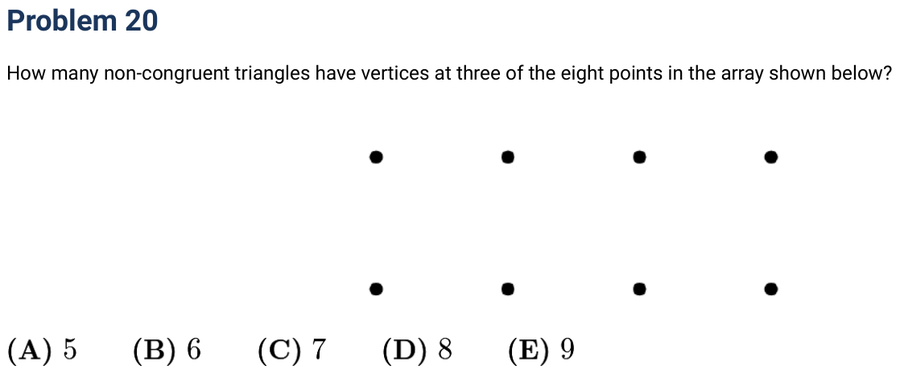
amc8-2009-20
Show answer
Answer: D — 8.
Show hints
Hint 1 of 2
Triangle types break into 1-and-2 (one vertex on one row, two on the other) and degenerate (all three collinear — exclude).
Still stuck? Show hint 2 →
Hint 2 of 2
Catalog by which row and the horizontal spacing between the two same-row vertices.
Show solution
Approach: case on the row-pair separation, count up to reflection
  1. Three collinear points give no triangle, so two vertices sit on one row (separation 1, 2, or 3) and the third on the other row.
  2. Pair separation 1: the lone vertex sits 0, 2, or 3 columns away from the pair's left vertex (left-of-pair and right-of-pair are mirror images, so we cap at 3 cases) — 3 triangles.
  3. Pair separation 2: the lone vertex sits below the pair's left vertex, midpoint, or two columns past — 3 triangles.
  4. Pair separation 3: the pair is at the row's two ends; the lone vertex is one of the two interior columns (the other two positions mirror these) — 2 triangles.
  5. Total: 3 + 3 + 2 = 8 non-congruent triangles.
Mark: · log in to save
Problem 21 · 2009 AMC 8 Medium
Algebra & Patterns invariant-total

Andy and Bethany have a rectangular array of numbers with 40 rows and 75 columns. Andy adds the numbers in each row. The average of his 40 sums is A. Bethany adds the numbers in each column. The average of her 75 sums is B. What is the value of AB?

Show answer
Answer: D — 15/8.
Show hint
Hint 1
Both Andy and Bethany sum the same array total. So 40A = sum of array = 75B.
Show solution
Approach: set both totals equal to the array sum
  1. Sum of all entries = 40 · A = 75 · B.
  2. A/B = 75/40 = 15/8.
Mark: · log in to save
Problem 22 · 2009 AMC 8 Medium
Counting & Probability casework-on-digit-count

How many whole numbers between 1 and 1000 do not contain the digit 1?

Show answer
Answer: D — 728.
Show hint
Hint 1
Split by number of digits. Each non-leading position can be any of 9 digits {0, 2, …, 9}; the leading position avoids 0 and 1, so 8 choices.
Show solution
Approach: casework on digit count
  1. 1 digit (no 1): 8 numbers.
  2. 2 digits: 8 · 9 = 72.
  3. 3 digits: 8 · 9 · 9 = 648.
  4. 1000 contains 1, excluded.
  5. Total: 8 + 72 + 648 = 728.
Mark: · log in to save
Problem 23 · 2009 AMC 8 Medium
Algebra & Patterns quadratic

On the last day of school, Mrs. Awesome gave jelly beans to her class. She gave each boy as many jelly beans as there were boys in the class. She gave each girl as many jelly beans as there were girls in the class. She brought 400 jelly beans, and when she finished, she had six jelly beans left. There were two more boys than girls in her class. How many students were in her class?

Show answer
Answer: B — 28 students.
Show hint
Hint 1
Each boy gets b beans, so all boys get b2. Similarly girls get g2. b2 + g2 = 394.
Show solution
Approach: set up and solve a quadratic
  1. b = g + 2 and b2 + g2 = 400 − 6 = 394.
  2. (g + 2)2 + g2 = 394 ⇒ 2g2 + 4g + 4 = 394 ⇒ g2 + 2g − 195 = 0.
  3. (g + 15)(g − 13) = 0 ⇒ g = 13, b = 15.
  4. Total: 13 + 15 = 28.
Mark: · log in to save
Problem 24 · 2009 AMC 8 Hard
Algebra & Patterns cryptarithm

The letters A, B, C, and D represent digits. If AB + CA = DA and ABCA = A, what digit does D represent?

Show answer
Answer: E — 9.
Show hints
Hint 1 of 2
From the units column of the addition (B + A ends in A), get B = 0.
Still stuck? Show hint 2 →
Hint 2 of 2
Then AB = 10A. Plug into the subtraction equation to find A and C.
Show solution
Approach: units column then subtract
  1. Units of addition: B + AA (mod 10) ⇒ B = 0 (no carry since A is a digit).
  2. Now AB = 10A and CA = 10C + A. Subtraction: 10A − (10C + A) = A ⇒ 9A − 10C = A ⇒ 8A = 10C ⇒ 4A = 5C.
  3. Digits with 4A = 5C: A = 5, C = 4.
  4. D · 10 + A = AB + CA = 50 + 45 = 95 ⇒ D = 9.
Mark: · log in to save
Problem 25 · 2009 AMC 8 Hard
Geometry & Measurement surface-area-viewsstaircase-decomposition
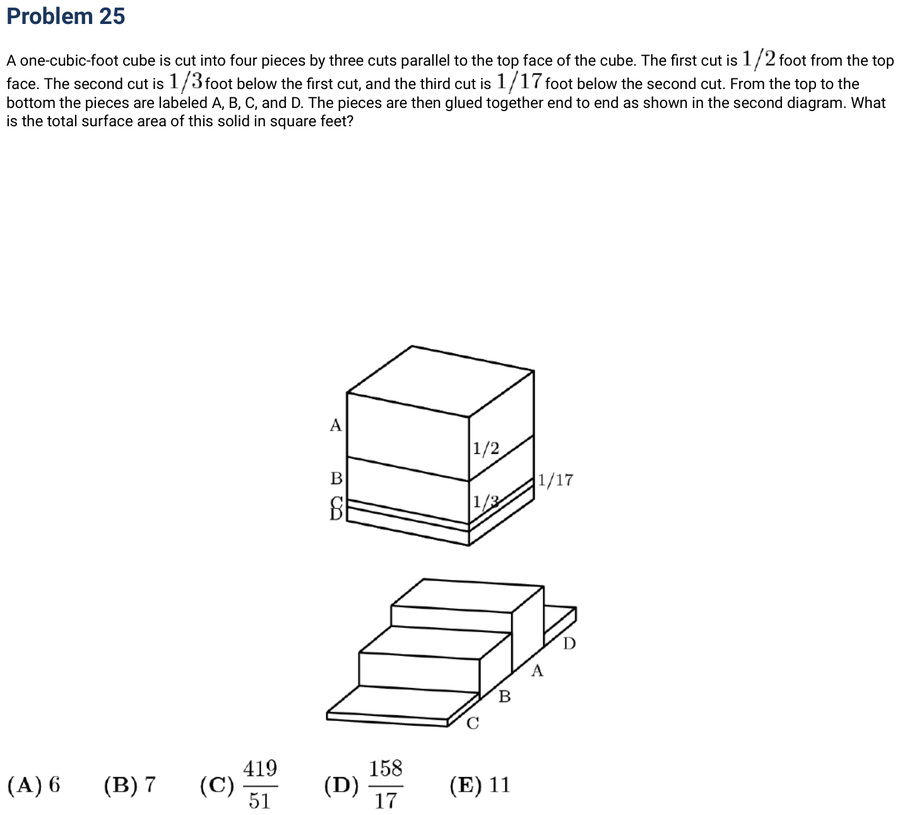
amc8-2009-25
Show answer
Answer: E — 11 square feet.
Show hints
Hint 1 of 3
Look from each of the 6 directions and sum the visible areas.
Still stuck? Show hint 2 →
Hint 2 of 3
Top and bottom views are each four 1×1 squares (the bases of the four pieces) = 4 sq ft each.
Still stuck? Show hint 3 →
Hint 3 of 3
End views show the full height of the tallest piece (1/2 sq ft each); front and back show the staircase silhouette whose total height adds to 1.
Show solution
Approach: sum surface area by 6-view projections
  1. Top view: each piece's 1×1 top is visible ⇒ 4 sq ft. Same for bottom ⇒ 4 sq ft.
  2. Front and back views: silhouette is 4 rectangles of width 1 with heights summing to 1 ⇒ 1 sq ft each, total 2 sq ft.
  3. End views: in the monotone-staircase arrangement, each end view equals the cross section of the tallest piece A: 1 · (1/2) = 1/2. Two ends ⇒ 1 sq ft.
  4. Total: 4 + 4 + 2 + 1 = 11.
Mark: · log in to save