AMC 8 · Test Mode

2005 AMC 8

Test mode — hints and solutions are locked. Pick an answer for each, then submit at the bottom to see your score.

← Exit test mode No hints or solutions until you submit.
Problem 1 · 2005 AMC 8 Easy
Arithmetic & Operations undo-then-redo

Connie multiplies a number by 2 and gets 60 as her answer. However, she should have divided the number by 2 to get the correct answer. What is the correct answer?

Show answer
Answer: B — 15.
Show hint
Hint 1
First recover the original number, then divide by 2.
Show solution
Approach: undo, then redo
  1. Original = 60 / 2 = 30.
  2. Correct answer: 30 / 2 = 15.
Mark: · log in to save
Problem 2 · 2005 AMC 8 Easy
Fractions, Decimals & Percents percent-of-amount

Karl bought five folders from Pay-A-Lot at a cost of $2.50 each. Pay-A-Lot had a 20%-off sale the following day. How much could Karl have saved on the purchase by waiting a day?

Show answer
Answer: C — $2.50.
Show hint
Hint 1
Compute the total then take 20%.
Show solution
Approach: 20% of total
  1. Total: 5 · $2.50 = $12.50.
  2. Savings: 0.20 · $12.50 = $2.50.
Mark: · log in to save
Problem 3 · 2005 AMC 8 Easy
Geometry & Measurement reflection-symmetry
amc8-2005-03
Show answer
Answer: D — 4.
Show hint
Hint 1
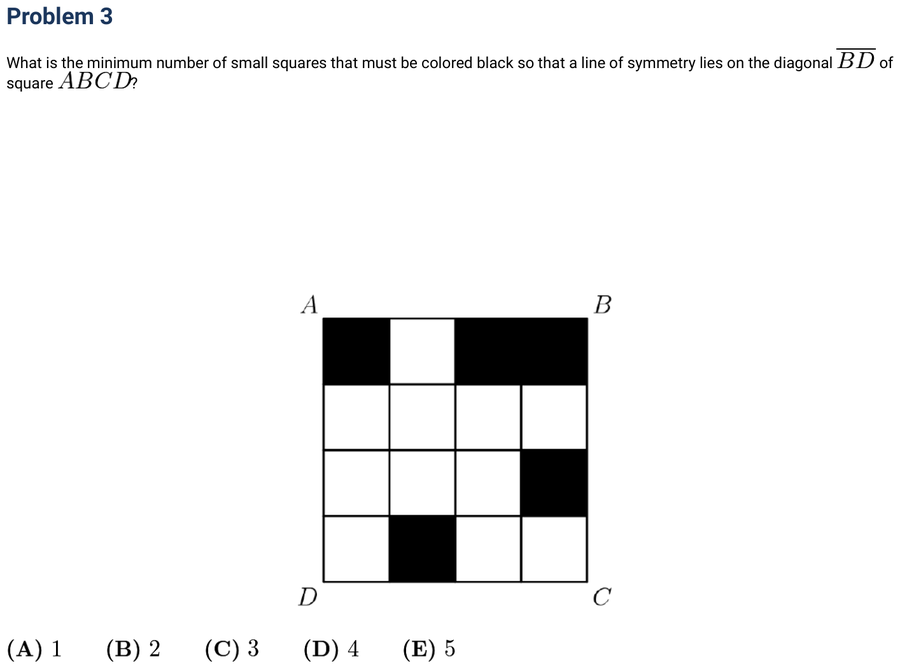
Every black square off the diagonal must have its mirror image (across BD) also black. Count which mirror images are missing.
Show solution
Approach: count missing reflections
  1. Each of the 4 already-black off-diagonal cells has its mirror image (across BD) still white.
  2. We must blacken those 4 mirror cells ⇒ 4 additional squares.
Mark: · log in to save
Problem 4 · 2005 AMC 8 Easy
Geometry & Measurement perimeter-area

A square and a triangle have equal perimeters. The lengths of the three sides of the triangle are 6.1 cm, 8.2 cm and 9.7 cm. What is the area of the square in square centimeters?

Show answer
Answer: C — 36.
Show hint
Hint 1
Triangle perimeter / 4 gives square's side.
Show solution
Approach: perimeter then area
  1. Perimeter: 6.1 + 8.2 + 9.7 = 24. Square side: 24/4 = 6.
  2. Area: 62 = 36.
Mark: · log in to save
Problem 5 · 2005 AMC 8 Easy
Arithmetic & Operations greedy-packing

Soda is sold in packs of 6, 12 and 24 cans. What is the minimum number of packs needed to buy exactly 90 cans of soda?

Show answer
Answer: B — 5 packs.
Show hint
Hint 1
Use as many 24-packs as possible, then fill in with 12s and 6s.
Show solution
Approach: greedy from largest pack
  1. 3 · 24 = 72 leaves 18. Then one 12 + one 6 = 18.
  2. Packs used: 3 + 1 + 1 = 5.
Mark: · log in to save
Problem 6 · 2005 AMC 8 Easy
Fractions, Decimals & Percents place-value-comparison

Suppose d is a digit. For how many values of d is 2.00d5 > 2.005?

Show answer
Answer: C — 5 values.
Show hint
Hint 1
Both numbers share 2.00 prefix. Compare the next two digits: d5 vs 05.
Show solution
Approach: compare digit-by-digit
  1. Pad to four decimal places: 2.0050 vs 2.00d5.
  2. First three decimals are 005 vs 00d; comparing position-by-position, the deciding digit is d vs 5.
  3. If d > 5: bigger. If d = 5: 2.0055 > 2.0050 still bigger. If d < 5: smaller (e.g., d=4 gives 2.0045 < 2.0050).
  4. Valid: d ∈ {5, 6, 7, 8, 9} ⇒ 5 values.
Mark: · log in to save
Problem 7 · 2005 AMC 8 Medium
Geometry & Measurement pythagorean

Bill walks 12 mile south, then 34 mile east, and finally 12 mile south. How many miles is he, in a direct line, from his starting point?

Show answer
Answer: B — 1¼.
Show hint
Hint 1
Total south: 1 mile. East: 3/4. Pythagoras.
Show solution
Approach: pythagorean theorem
  1. Net south: 1, east: 3/4.
  2. Distance: √(12 + (3/4)2) = √(1 + 9/16) = √(25/16) = 5/4 = .
Mark: · log in to save
Problem 8 · 2005 AMC 8 Easy
Number Theory parity-rules

Suppose m and n are positive odd integers. Which of the following must also be an odd integer?

Show answer
Answer: E — 3mn.
Show hint
Hint 1
odd × odd = odd; odd + odd = even; even + odd = odd.
Show solution
Approach: apply parity rules to each
  1. (A) odd + odd = even. (B) odd − odd = even. (C) odd + odd = even. (D) (odd + odd)2 = even2 = even.
  2. (E) odd · odd · odd = odd.
Mark: · log in to save
Problem 9 · 2005 AMC 8 Medium
Geometry & Measurement isosceles-then-equilateral
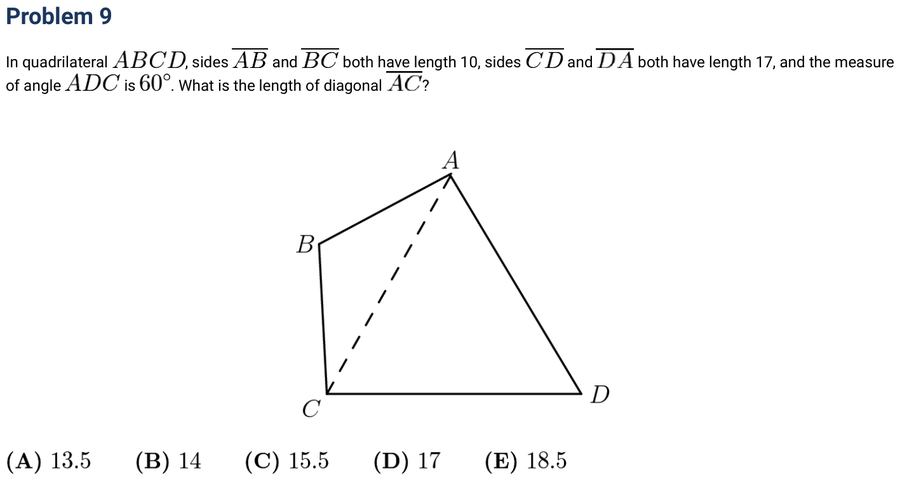
amc8-2005-09
Show answer
Answer: D — 17.
Show hint
Hint 1
ADC is isosceles with DA = DC = 17 and apex angle 60°. The base angles are equal, and they sum to 120° ⇒ each is 60°.
Show solution
Approach: isosceles + 60° apex ⇒ equilateral
  1. ADC: DA = DC = 17, ∠ADC = 60°.
  2. Base angles each = (180 − 60)/2 = 60° ⇒ triangle is equilateral.
  3. AC = 17.
Mark: · log in to save
Problem 10 · 2005 AMC 8 Easy
Ratios, Rates & Proportions speed-time-ratio

Joe had walked half way from home to school when he realized he was late. He ran the rest of the way to school. He ran 3 times as fast as he walked. Joe took 6 minutes to walk half way to school. How many minutes did it take Joe to get from home to school?

Show answer
Answer: D — 8 minutes.
Show hint
Hint 1
Running 3x as fast takes 1/3 the time for the same distance.
Show solution
Approach: scale time by speed
  1. Walking half: 6 min. Running the other half (3x speed): 6/3 = 2 min.
  2. Total: 6 + 2 = 8 min.
Mark: · log in to save
Problem 11 · 2005 AMC 8 Easy
Fractions, Decimals & Percents commutative-multiplication

The sales tax rate in Bergville is 6%. During a sale at the Bergville Coat Closet, the price of a coat is discounted 20% from its $90.00 price. Two clerks, Jack and Jill, calculate the bill independently. Jack rings up $90.00 and adds 6% sales tax, then subtracts 20% from this total. Jill rings up $90.00, subtracts 20% of the price, then adds 6% of the discounted price for sales tax. What is Jack's total minus Jill's total?

Show answer
Answer: C — $0.
Show hint
Hint 1
Multiplication is commutative: order of factors doesn't change the product.
Show solution
Approach: compare multipliers
  1. Jack: 90 · 1.06 · 0.80. Jill: 90 · 0.80 · 1.06.
  2. Same product ⇒ difference = $0.
Mark: · log in to save
Problem 12 · 2005 AMC 8 Easy
Algebra & Patterns arithmetic-sequenceaverage

Big Al the ape ate 100 delicious yellow bananas from May 1 through May 5. Each day he ate six more bananas than on the previous day. How many delicious bananas did Big Al eat on May 5?

Show answer
Answer: D — 32.
Show hint
Hint 1
Five-term arithmetic sequence with common difference 6. Middle term = average = 100/5 = 20.
Show solution
Approach: middle term is the mean
  1. Mean = 100 / 5 = 20 = May 3.
  2. May 5 = 20 + 2 · 6 = 32.
Mark: · log in to save
Problem 13 · 2005 AMC 8 Medium
Geometry & Measurement rectilinear-completion
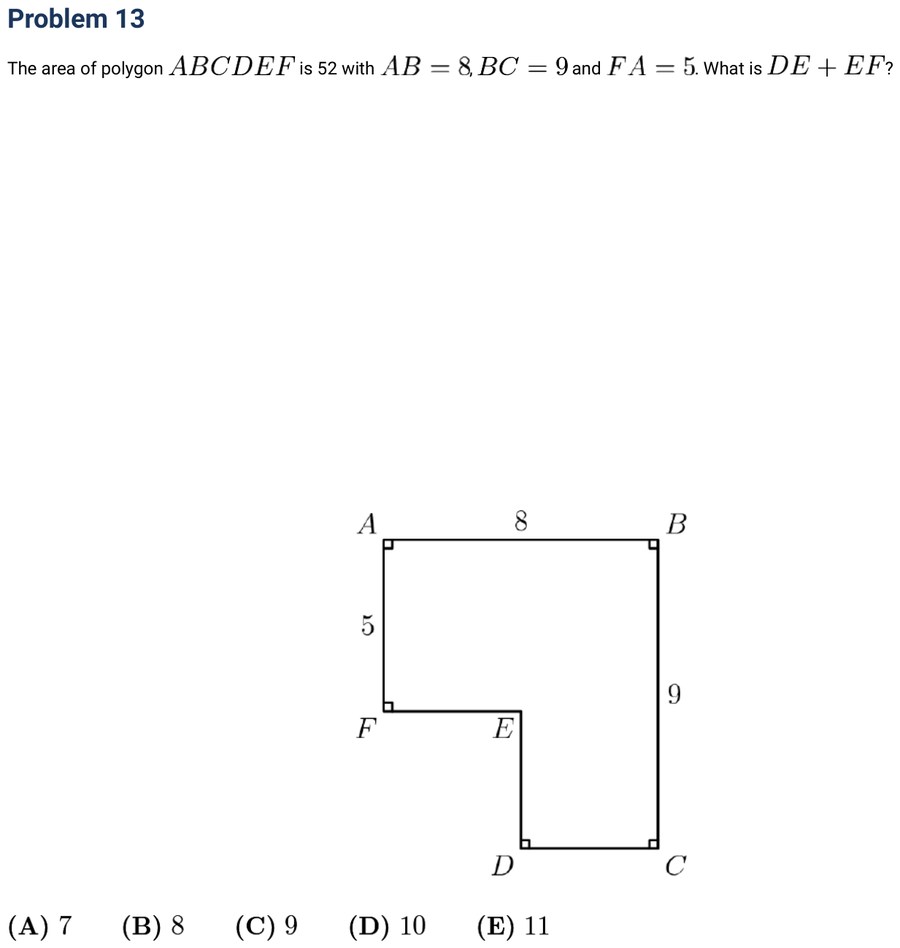
amc8-2005-13
Show answer
Answer: C — 9.
Show hints
Hint 1 of 2
Complete to a rectangle. Bounding rectangle area = 8 · 9 = 72. Missing rectangle FEDP has area 72 − 52 = 20.
Still stuck? Show hint 2 →
Hint 2 of 2
ED = BCFA = 4 (vertical part of cut); divide 20 / 4 to get FE.
Show solution
Approach: complete to bounding rectangle
  1. Bounding rectangle: 8 × 9 = 72. Cut-out rectangle FEDP: 72 − 52 = 20.
  2. ED (vertical leg of the cut) = 9 − 5 = 4. So FE = 20 / 4 = 5.
  3. DE + EF = 4 + 5 = 9.
Mark: · log in to save
Problem 14 · 2005 AMC 8 Medium
Counting & Probability round-robin

The Little Twelve Basketball League has two divisions, with six teams in each division. Each team plays each of the other teams in its own division twice and every team in the other division once. How many games are scheduled?

Show answer
Answer: B — 96.
Show hints
Hint 1 of 2
Intra-division pairs per division: C(6, 2) = 15; each pair plays twice. Two divisions.
Still stuck? Show hint 2 →
Hint 2 of 2
Inter-division: 6 × 6 = 36, no doubling.
Show solution
Approach: count intra-division and inter-division separately
  1. Intra: 2 · C(6, 2) · 2 = 2 · 15 · 2 = 60.
  2. Inter: 6 · 6 = 36.
  3. Total: 60 + 36 = 96.
Mark: · log in to save
Problem 15 · 2005 AMC 8 Medium
Counting & Probability triangle-inequalityisosceles

How many different isosceles triangles have integer side lengths and perimeter 23?

Show answer
Answer: C — 6 triangles.
Show hint
Hint 1
Let legs be y and base x: 2y + x = 23. Triangle inequality: 2y > x.
Show solution
Approach: list valid (y, x)
  1. 2y + x = 23, x > 0, 2y > x.
  2. From 2y > 23 − 2y: y > 5.75 ⇒ y ≥ 6.
  3. Also x ≥ 1 ⇒ 2y ≤ 22 ⇒ y ≤ 11.
  4. Valid y: 6, 7, 8, 9, 10, 11 ⇒ 6 triangles.
Mark: · log in to save
Problem 16 · 2005 AMC 8 Easy
Logic & Word Problems pigeonhole

A five-legged Martian has a drawer full of socks, each of which is red, white or blue, and there are at least five socks of each color. The Martian pulls out one sock at a time without looking. How many socks must the Martian remove from the drawer to be certain there will be 5 socks of the same color?

Show answer
Answer: D — 13.
Show hint
Hint 1
Worst case: 4 of each color (12 socks) without yet getting 5 of one color.
Show solution
Approach: pigeonhole on the worst case
  1. After 12 socks, possible to have 4 red, 4 white, 4 blue (no color has 5).
  2. 13th sock must give some color 5 ⇒ minimum = 13.
Mark: · log in to save
Problem 17 · 2005 AMC 8 Easy
Ratios, Rates & Proportions slope-as-speed
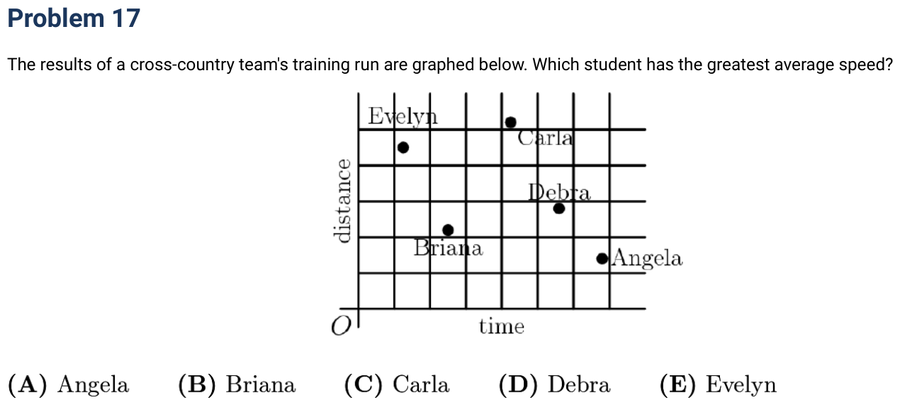
amc8-2005-17
Show answer
Answer: E — Evelyn.
Show hint
Hint 1
Average speed = distance / time = slope of line from the origin to the point.
Show solution
Approach: steepest slope from origin
  1. The student with the steepest line through the origin is fastest.
  2. From the graph, that's Evelyn.
Mark: · log in to save
Problem 18 · 2005 AMC 8 Easy
Number Theory count-multiples

How many three-digit numbers are divisible by 13?

Show answer
Answer: C — 69.
Show hint
Hint 1
Three-digit multiples of 13: smallest is 13 · 8 = 104. Largest is 13 · 76 = 988. Count from 8 to 76.
Show solution
Approach: find smallest and largest multipliers
  1. Smallest 3-digit multiple: 13 · 8 = 104. Largest: 13 · 76 = 988.
  2. Multipliers 8 through 76: 76 − 8 + 1 = 69.
Mark: · log in to save
Problem 19 · 2005 AMC 8 Medium
Geometry & Measurement trapezoid-altitudespythagorean
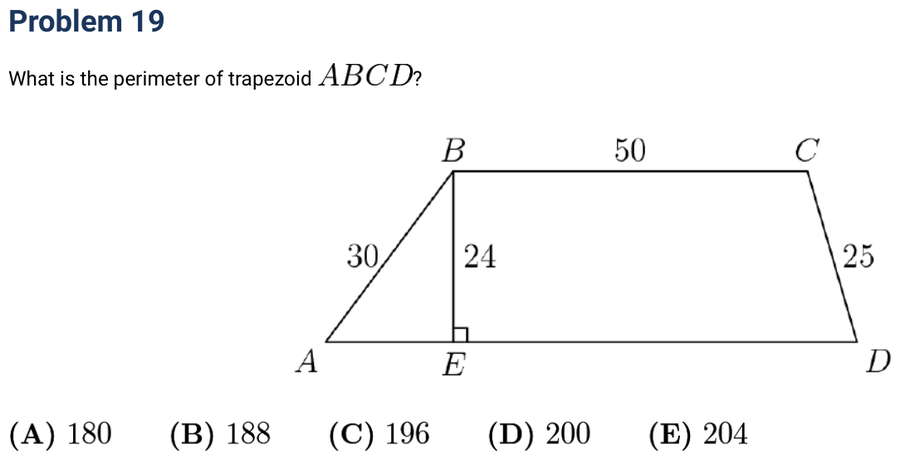
amc8-2005-19
Show answer
Answer: A — 180.
Show hints
Hint 1 of 2
Drop altitudes from B and C onto AD. Use 18-24-30 and 7-24-25 right triangles.
Still stuck? Show hint 2 →
Hint 2 of 2
AD = AE + EF + FD.
Show solution
Approach: drop altitudes, find AD, sum
  1. Right triangle on the left: legs 24, 18 (hypotenuse 30) ⇒ AE = 18.
  2. Right triangle on the right: legs 24, 7 (hypotenuse 25) ⇒ FD = 7.
  3. EF = BC = 50. So AD = 18 + 50 + 7 = 75.
  4. Perimeter: 75 + 30 + 50 + 25 = 180.
Mark: · log in to save
Problem 20 · 2005 AMC 8 Hard
Number Theory modular-meeting

Alice and Bob play a game involving a circle whose circumference is divided by 12 equally-spaced points. The points are numbered clockwise, from 1 to 12. Both start on point 12. Alice moves clockwise and Bob, counterclockwise. In a turn of the game, Alice moves 5 points clockwise and Bob moves 9 points counterclockwise. The game ends when they stop on the same point. How many turns will this take?

Show answer
Answer: A — 6 turns.
Show hint
Hint 1
After k turns, Alice is at +5k and Bob is at −9k (mod 12). They coincide when 5k ≡ −9k (mod 12) ⇒ 14k ≡ 0 (mod 12).
Show solution
Approach: modular equality
  1. 14k ≡ 0 (mod 12) ⇒ 7k ≡ 0 (mod 6) ⇒ k ≡ 0 (mod 6).
  2. Smallest positive: k = 6.
Mark: · log in to save
Problem 21 · 2005 AMC 8 Medium
Counting & Probability collinear-exclusion
amc8-2005-21
Show answer
Answer: C — 18.
Show hint
Hint 1
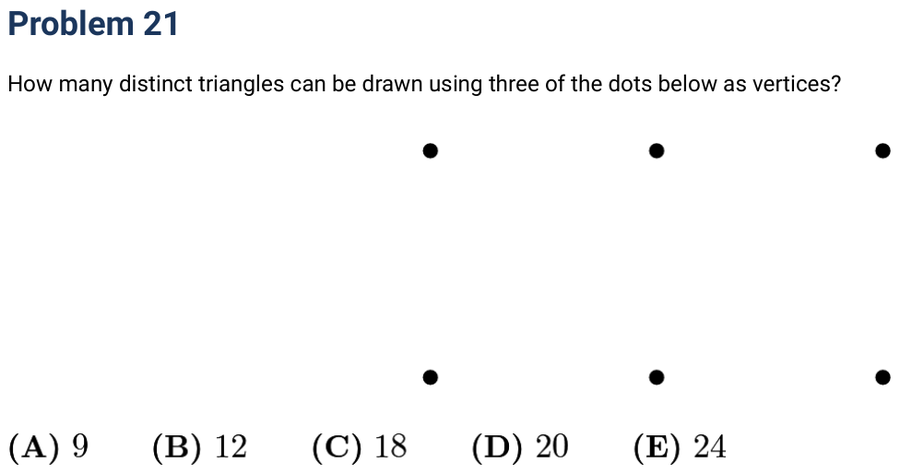
C(6, 3) = 20 total triples; subtract triples that are collinear (the two rows).
Show solution
Approach: subtract collinear triples
  1. C(6, 3) = 20. Collinear sets: top row (1) and bottom row (1) ⇒ 2.
  2. Triangles: 20 − 2 = 18.
Mark: · log in to save
Problem 22 · 2005 AMC 8 Medium
Fractions, Decimals & Percents unit-price-ranking

A company sells detergent in three different sized boxes: small (S), medium (M) and large (L). The medium size costs 50% more than the small size and contains 20% less detergent than the large size. The large size contains twice as much detergent as the small size and costs 30% more than the medium size. Rank the three sizes from best to worst buy.

Show answer
Answer: E — MLS (best M, then L, then S).
Show hint
Hint 1
Set the small price to $1 and the large size to 10 oz. Derive the rest, then compute price per oz.
Show solution
Approach: anchor sizes, compute unit prices
  1. Small: $1, 5 oz (large is twice the small ⇒ small = 5 oz).
  2. Medium: $1.50 (50% more than small), 8 oz (20% less than 10 oz large).
  3. Large: 10 oz, $1.95 (30% more than medium).
  4. $/oz: S = 0.200, M = 0.1875, L = 0.195.
  5. Best (lowest $/oz) to worst: M, L, S.
Mark: · log in to save
Problem 23 · 2005 AMC 8 Medium
Geometry & Measurement tangent-radiusisosceles-right-triangle
amc8-2005-23
Show answer
Answer: B — 8.
Show hint
Hint 1
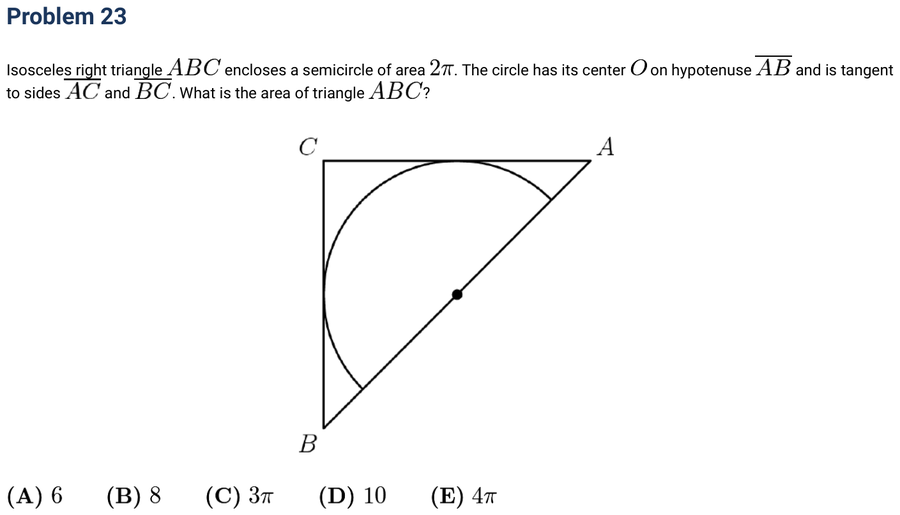
Full circle area: 2 · 2π = 4π ⇒ radius 2. Each leg equals the diameter (twice the radius) by symmetry of the inscribed semicircle in a 45-45-90.
Show solution
Approach: find radius then leg
  1. Full circle area would be 4π ⇒ r = 2.
  2. By tangency in the 45-45-90, each leg = 2r = 4.
  3. Area: (1/2)(4)(4) = 8.
Mark: · log in to save
Problem 24 · 2005 AMC 8 Hard
Logic & Word Problems reverse-from-target

A certain calculator has only two keys [+1] and [×2]. When you press one of the keys, the calculator automatically displays the result. For instance, if the calculator originally displayed "9" and you pressed [+1], it would display "10." If you then pressed [×2], it would display "20." Starting with the display "1," what is the fewest number of keystrokes you would need to reach "200"?

Show answer
Answer: B — 9 keystrokes.
Show hints
Hint 1 of 2
Work backwards. If the current number is even, the last move was likely ×2 (divide by 2). If odd, the last was +1 (subtract 1).
Still stuck? Show hint 2 →
Hint 2 of 2
Each step backwards corresponds to one keystroke forward.
Show solution
Approach: reverse from 200 to 1
  1. 200 → 100 → 50 → 25 (now odd, so subtract 1) → 24 → 12 → 6 → 3 (odd) → 2 → 1.
  2. Steps: 9.
Mark: · log in to save
Problem 25 · 2005 AMC 8 Hard
Geometry & Measurement equal-area-balance
amc8-2005-25
Show answer
Answer: A — 2/√π.
Show hint
Hint 1
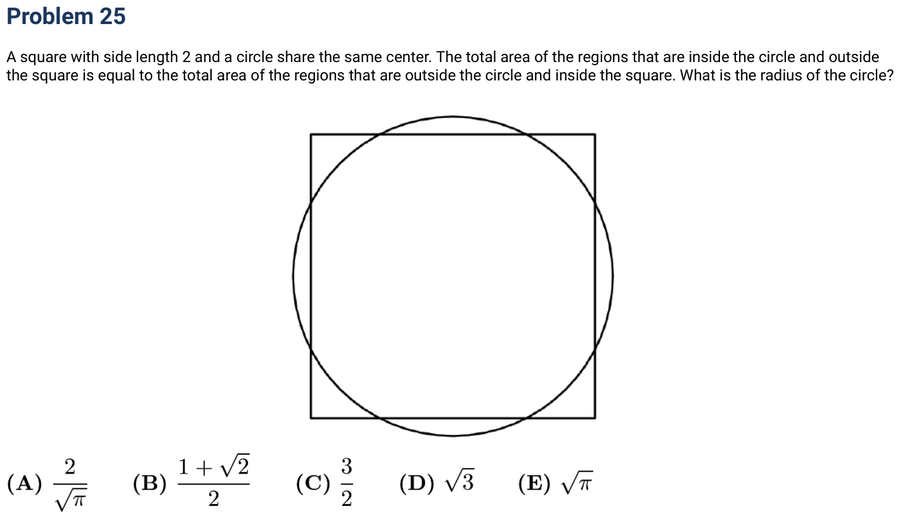
Let I be the overlap area. Inside-circle-outside-square = πr2I. Outside-circle-inside-square = 4 − I. Set equal ⇒ circle area = square area.
Show solution
Approach: equal external areas ⇒ equal total areas
  1. πr2I = 4 − I ⇒ πr2 = 4 ⇒ r2 = 4/π.
  2. r = 2/√π.
Mark: · log in to save