AMC 8 · Test Mode

2004 AMC 8

Test mode — hints and solutions are locked. Pick an answer for each, then submit at the bottom to see your score.

← Exit test mode No hints or solutions until you submit.
Problem 1 · 2004 AMC 8 Easy
Ratios, Rates & Proportions unit-rate

On a map, a 12-centimeter length represents 72 kilometers. How many kilometers does a 17-centimeter length represent?

Show answer
Answer: B — 102 km.
Show hint
Hint 1
1 cm = 72/12 = 6 km. Multiply by 17.
Show solution
Approach: unit rate
  1. Scale: 72/12 = 6 km per cm.
  2. 17 cm: 17 · 6 = 102 km.
Mark: · log in to save
Problem 2 · 2004 AMC 8 Easy
Counting & Probability permutations-with-repeats

How many different four-digit numbers can be formed by rearranging the four digits in 2004?

Show answer
Answer: B — 6.
Show hint
Hint 1
Digits {2, 0, 0, 4}: 4!/2! = 12 arrangements; subtract those starting with 0.
Show solution
Approach: multiset permutations minus leading zero
  1. Total arrangements: 4!/2! = 12 (the 0 repeats).
  2. Leading zero arrangements: arrange {2, 0, 4} in last 3 spots = 3! = 6.
  3. Valid: 12 − 6 = 6.
Mark: · log in to save
Problem 3 · 2004 AMC 8 Easy
Ratios, Rates & Proportions proportion

Twelve friends met for dinner at Oscar's Overstuffed Oyster House, and each ordered one meal. The portions were so large, there was enough food for 18 people. If they shared, how many meals should they have ordered to have just enough food for the 12 of them?

Show answer
Answer: A — 8 meals.
Show hint
Hint 1
12 meals = 18 people ⇒ 1 meal feeds 1.5. Solve m · 1.5 = 12.
Show solution
Approach: person-per-meal rate
  1. Each meal feeds 18/12 = 1.5 people.
  2. Meals for 12: 12 / 1.5 = 8.
Mark: · log in to save
Problem 4 · 2004 AMC 8 Easy
Counting & Probability combinations

Ms. Hamilton's eighth-grade class wants to participate in the annual three-person-team basketball tournament. Lance, Sally, Joy, and Fred are chosen for the team. In how many ways can the three starters be chosen?

Show answer
Answer: B — 4.
Show hint
Hint 1
Choosing 3 starters from 4 = choosing the 1 non-starter.
Show solution
Approach: complement
  1. C(4, 3) = C(4, 1) = 4.
Mark: · log in to save
Problem 5 · 2004 AMC 8 Easy
Logic & Word Problems elimination-bracket

Ms. Hamilton's eighth-grade class wants to participate in the annual three-person-team basketball tournament. The losing team of each game is eliminated from the tournament. If sixteen teams compete, how many games will be played to determine the winner?

Show answer
Answer: D — 15 games.
Show hint
Hint 1
Each game eliminates exactly one team. 15 must be eliminated.
Show solution
Approach: one elimination per game
  1. Need 15 teams eliminated (everyone except the winner).
  2. Games: 15.
Mark: · log in to save
Problem 6 · 2004 AMC 8 Easy
Fractions, Decimals & Percents percent-equation

After Sally takes 20 shots, she has made 55% of her shots. After she takes 5 more shots, she raises her percentage to 56%. How many of the last 5 shots did she make?

Show answer
Answer: C — 3.
Show hint
Hint 1
Made so far: 0.55 · 20 = 11. Target made: 0.56 · 25 = 14. Difference is how many she made in the last 5.
Show solution
Approach: made-shot difference
  1. Made before: 11. Made after: 14.
  2. Made in last 5: 14 − 11 = 3.
Mark: · log in to save
Problem 7 · 2004 AMC 8 Easy
Arithmetic & Operations two-step-calculation

An athlete's target heart rate, in beats per minute, is 80% of the theoretical maximum heart rate. The maximum heart rate is found by subtracting the athlete's age, in years, from 220. To the nearest whole number, what is the target heart rate of an athlete who is 26 years old?

Show answer
Answer: B — 155 bpm.
Show hint
Hint 1
Max: 220 − 26 = 194. Target: 0.80 · 194.
Show solution
Approach: two-step
  1. Max: 220 − 26 = 194.
  2. Target: 0.80 · 194 = 155.2 ≈ 155.
Mark: · log in to save
Problem 8 · 2004 AMC 8 Easy
Counting & Probability constrained-counting

Find the number of two-digit positive integers whose digits total 7.

Show answer
Answer: B — 7.
Show hint
Hint 1
Tens digit a from 1 to 7; units digit = 7 − a (always valid since 0 ≤ 7 − a ≤ 6).
Show solution
Approach: count tens-digit options
  1. a ∈ {1, …, 7}, units = 7 − a.
  2. Numbers: 16, 25, 34, 43, 52, 61, 70 ⇒ 7.
Mark: · log in to save
Problem 9 · 2004 AMC 8 Easy
Arithmetic & Operations average-from-totals

The average of the five numbers in a list is 54. The average of the first two numbers is 48. What is the average of the last three numbers?

Show answer
Answer: D — 58.
Show hint
Hint 1
Sum total − sum of first two = sum of last three; divide by 3.
Show solution
Approach: totals minus totals
  1. Total sum: 5 · 54 = 270. First two: 2 · 48 = 96.
  2. Last three sum: 174. Average: 174 / 3 = 58.
Mark: · log in to save
Problem 10 · 2004 AMC 8 Easy
Arithmetic & Operations time-conversionrate

Handy Aaron helped a neighbor 114 hours on Monday, 50 minutes on Tuesday, from 8:20 to 10:45 on Wednesday morning, and a half-hour on Friday. He is paid $3 per hour. How much did he earn for the week?

Show answer
Answer: E — $15.
Show hint
Hint 1
Convert each day to hours, sum, multiply by $3.
Show solution
Approach: convert and sum
  1. Mon: 1.25 hr. Tue: 50/60 = 5/6 hr. Wed: 2 hr 25 min = 29/12 hr. Fri: 0.5 hr.
  2. Total: 5/4 + 5/6 + 29/12 + 1/2 = 15/12 + 10/12 + 29/12 + 6/12 = 60/12 = 5 hr.
  3. Earnings: 3 · 5 = $15.
Mark: · log in to save
Problem 11 · 2004 AMC 8 Medium
Logic & Word Problems process-of-elimination

The numbers −2, 4, 6, 9 and 12 are rearranged according to these rules: The largest isn't first, but it is in one of the first three places. The smallest isn't last, but it is in one of the last three places. The median isn't first or last. What is the average of the first and last numbers?

Show answer
Answer: C — 6.5.
Show hint
Hint 1
Largest (12) and smallest (−2) and median (6) all cannot be the first or last. That leaves 4 and 9 for the endpoints.
Show solution
Approach: exclude forbidden positions
  1. 12 (largest) not first or last (must be in 2nd or 3rd). −2 (smallest) not last (4th or 3rd). 6 (median) not first or last.
  2. First and last cannot be 12, −2, or 6, so they're 4 and 9.
  3. Average: (4 + 9)/2 = 6.5.
Mark: · log in to save
Problem 12 · 2004 AMC 8 Medium
Fractions, Decimals & Percents battery-fraction-rates

Niki usually leaves her cell phone on. If her cell phone is on but she is not actually using it, the battery will last for 24 hours. If she is using it constantly, the battery will last for only 3 hours. Since the last recharge, her phone has been on 9 hours, and during that time she has used it for 60 minutes. If she doesn't talk any more but leaves the phone on, how many more hours will the battery last?

Show answer
Answer: B — 8 more hours.
Show hint
Hint 1
Idle uses 1/24 per hour; using uses 1/3 per hour. So far: 8 hr idle + 1 hr in use.
Show solution
Approach: battery fraction used so far
  1. Used: 8 · (1/24) + 1 · (1/3) = 1/3 + 1/3 = 2/3.
  2. Remaining: 1/3 of battery. At idle rate 1/24 per hour: time = (1/3) · 24 = 8 hr.
Mark: · log in to save
Problem 13 · 2004 AMC 8 Medium
Logic & Word Problems exactly-one-true

Amy, Bill and Celine are friends with different ages. Exactly one of the following statements is true. I. Bill is the oldest. II. Amy is not the oldest. III. Celine is not the youngest. Rank the friends from the oldest to the youngest.

Show answer
Answer: E — Amy, Celine, Bill.
Show hints
Hint 1 of 2
If I is true, II is also true (Bill oldest ⇒ Amy isn't); that's two trues, forbidden. So I is false.
Still stuck? Show hint 2 →
Hint 2 of 2
Then Bill is not oldest. If II is true (Amy not oldest), Celine must be oldest ⇒ III also true (since the youngest can't be the oldest); forbidden again.
Show solution
Approach: rule out which single statement is true
  1. I true ⇒ II also true. Two trues forbidden ⇒ I false.
  2. II true ⇒ Celine oldest, making III true. Forbidden ⇒ II false.
  3. So III is the only true one and I, II are false. Bill not oldest (I false); Amy is oldest (II false). Then by III, Celine is not youngest, so Bill is youngest.
  4. Order: Amy, Celine, Bill.
Mark: · log in to save
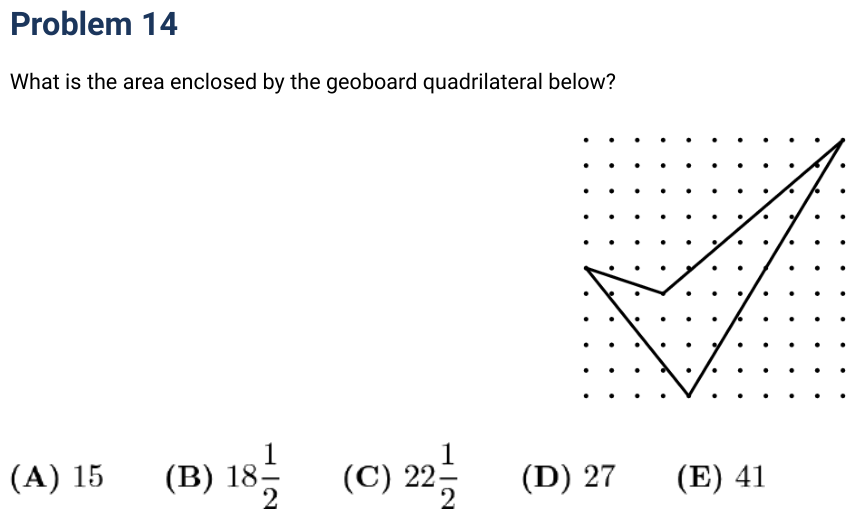
Problem 14 · 2004 AMC 8 Hard
Geometry & Measurement picks-theorem
amc8-2004-14
Show answer
Answer: C — 22½.
Show hint
Hint 1
Pick's theorem: A = I + B/2 − 1, where I is interior lattice points and B is boundary lattice points.
Show solution
Approach: Pick's theorem
  1. B = 5, I = 21.
  2. A = 21 + 5/2 − 1 = 20 + 5/2 = 22½.
Mark: · log in to save
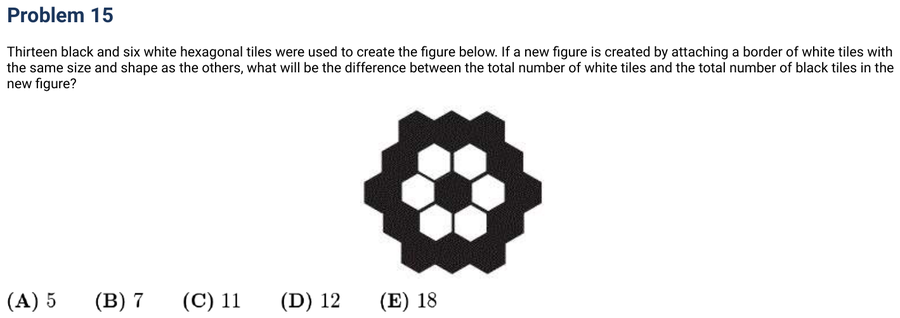
Problem 15 · 2004 AMC 8 Medium
Counting & Probability hex-rings
amc8-2004-15
Show answer
Answer: C — 11.
Show hint
Hint 1
Ring n contains 6n hexagons. The new border (3rd ring) has 18 tiles.
Show solution
Approach: hexagonal ring counts
  1. Black total: 13 (unchanged).
  2. White total: 6 + 18 = 24.
  3. Difference: 24 − 13 = 11.
Mark: · log in to save
Problem 16 · 2004 AMC 8 Easy
Fractions, Decimals & Percents mixture-fraction

Two 600 mL pitchers contain orange juice. One pitcher is 1/3 full and the other pitcher is 2/5 full. Water is added to fill each pitcher completely, then both pitchers are poured into one large container. What fraction of the mixture in the large container is orange juice?

Show answer
Answer: C — 11/30.
Show hint
Hint 1
Total OJ: 600(1/3) + 600(2/5) = 200 + 240 = 440. Total volume: 1200.
Show solution
Approach: OJ / total
  1. OJ: 200 + 240 = 440 mL.
  2. Total: 1200 mL.
  3. Fraction: 440/1200 = 11/30.
Mark: · log in to save
Problem 17 · 2004 AMC 8 Medium
Counting & Probability stars-and-bars

Three friends have a total of 6 identical pencils, and each one has at least one pencil. In how many ways can this happen?

Show answer
Answer: D — 10 ways.
Show hint
Hint 1
Stars-and-bars with each person ≥ 1: C(n − 1, k − 1) = C(5, 2).
Show solution
Approach: stars and bars
  1. Give 1 to each first; distribute remaining 3 freely among 3 friends: C(3 + 2, 2) = C(5, 2) = 10.
Mark: · log in to save
Problem 18 · 2004 AMC 8 Hard
Logic & Word Problems logic-puzzleelimination

Five friends compete in a dart-throwing contest. Each one has two darts to throw at the same circular target, and each individual's score is the sum of the scores in the target regions that are hit. The scores for the target regions are the whole numbers 1 through 10. Each throw hits the target in a region with a different value. The scores are: Alice 16, Ben 4, Cindy 7, Dave 11, Ellen 17. Who hits the region worth 6 points?

Show answer
Answer: A — Alice.
Show hint
Hint 1
Each region is used exactly once. Start with the smallest score (Ben = 4): the only pair from 1–10 is {1, 3}.
Show solution
Approach: uniqueness forces each pair in turn
  1. Ben (4): only 1 + 3.
  2. Cindy (7): from remaining digits {2, 4, 5, 6, 7, 8, 9, 10}, the only pair is 2 + 5.
  3. Dave (11): only 4 + 7.
  4. Remaining for Alice and Ellen: {6, 8, 9, 10}. Alice 16 = 6 + 10. Ellen 17 = 8 + 9.
  5. Alice hits 6.
Mark: · log in to save
Problem 19 · 2004 AMC 8 Medium
Number Theory lcm

A whole number larger than 2 leaves a remainder of 2 when divided by each of the numbers 3, 4, 5, and 6. The smallest such number lies between which two numbers?

Show answer
Answer: B — Between 60 and 79.
Show hint
Hint 1
x − 2 is divisible by lcm(3, 4, 5, 6) = 60.
Show solution
Approach: shift by 2 and use LCM
  1. Smallest x > 2 with x − 2 = 60 ⇒ x = 62.
  2. 62 lies between 60 and 79.
Mark: · log in to save
Problem 20 · 2004 AMC 8 Medium
Fractions, Decimals & Percents fraction-from-empty

Two-thirds of the people in a room are seated in three-fourths of the chairs. The rest of the people are standing. If there are 6 empty chairs, how many people are in the room?

Show answer
Answer: D — 27 people.
Show hint
Hint 1
1/4 of the chairs are empty = 6 ⇒ chairs total. Then 3/4 of chairs gives # seated people.
Show solution
Approach: find chairs, then people
  1. Empty chairs (1/4 of total) = 6 ⇒ chairs = 24.
  2. Seated people = (3/4)(24) = 18, which is 2/3 of all people.
  3. Total people = 18 / (2/3) = 27.
Mark: · log in to save
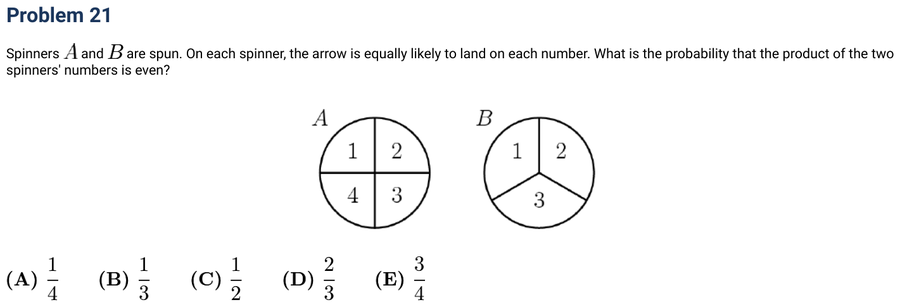
Problem 21 · 2004 AMC 8 Easy
Counting & Probability complementary-counting
amc8-2004-21
Show answer
Answer: D — 2/3.
Show hint
Hint 1
Product odd ⇔ both numbers odd. P(both odd) = (1/2)(2/3) = 1/3.
Show solution
Approach: complement
  1. P(both odd) = (2/4)(2/3) = 1/3.
  2. P(even) = 1 − 1/3 = 2/3.
Mark: · log in to save
Problem 22 · 2004 AMC 8 Medium
Fractions, Decimals & Percents set-up-variables

At a party there are only single women and married men with their wives. The probability that a randomly selected woman is single is 2/5. What fraction of the people in the room are married men?

Show answer
Answer: B — 3/8.
Show hint
Hint 1
Pick 5 women. 2 single, 3 married. Married women bring 3 husbands. Total people: 5 + 3 = 8.
Show solution
Approach: anchor with concrete count
  1. Let women = 5. Single: 2; married: 3.
  2. Married men = 3 (one per married woman). Total people: 5 + 3 = 8.
  3. Fraction: 3/8 = 3/8.
Mark: · log in to save
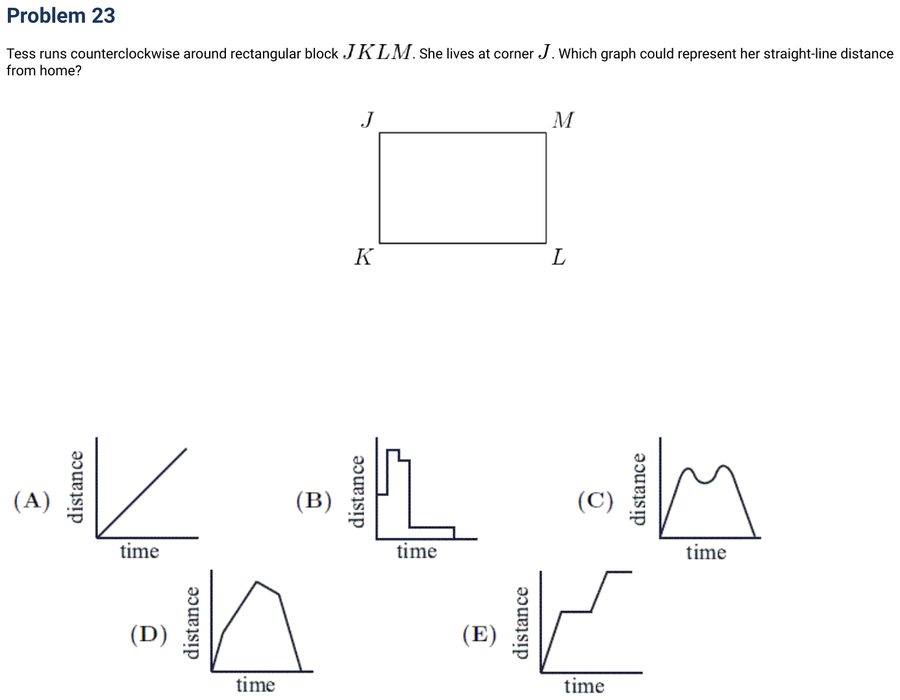
Problem 23 · 2004 AMC 8 Medium
Geometry & Measurement distance-vs-time-graph
amc8-2004-23
Show answer
Answer: D — Graph D.
Show hints
Hint 1 of 2
Distance from J hits a single maximum when she's at L (the diagonally opposite corner), then comes back. Look for a single-peak curve.
Still stuck? Show hint 2 →
Hint 2 of 2
The function is non-linear (Pythagorean as she moves along sides), so not straight lines.
Show solution
Approach: qualitative shape of d(t)
  1. Distance from J increases, peaks at the far corner L, then decreases back to 0.
  2. Curve is non-linear because each side adds √(x2 + const2) shapes.
  3. Single hump, returning to zero — that's D.
Mark: · log in to save
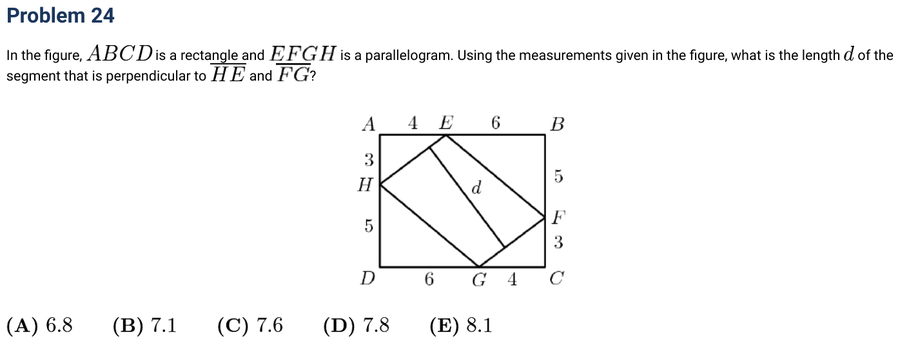
Problem 24 · 2004 AMC 8 Hard
Geometry & Measurement parallelogram-area-as-base-times-height
amc8-2004-24
Show answer
Answer: C — 7.6.
Show hints
Hint 1 of 2
Area of parallelogram EFGH = rectangle area − 4 corner triangles.
Still stuck? Show hint 2 →
Hint 2 of 2
HE is a hypotenuse of the 3-4 right triangle ⇒ HE = 5. Use Area = base · height.
Show solution
Approach: area / base = height
  1. Corner triangles: at A (3, 4): area 6. At C (3, 4): area 6. At B (5, 6): area 15. At D (5, 6): area 15. Total: 42.
  2. Parallelogram area: 10 · 8 − 42 = 38.
  3. Base HE = √(32 + 42) = 5.
  4. d = 38 / 5 = 7.6.
Mark: · log in to save
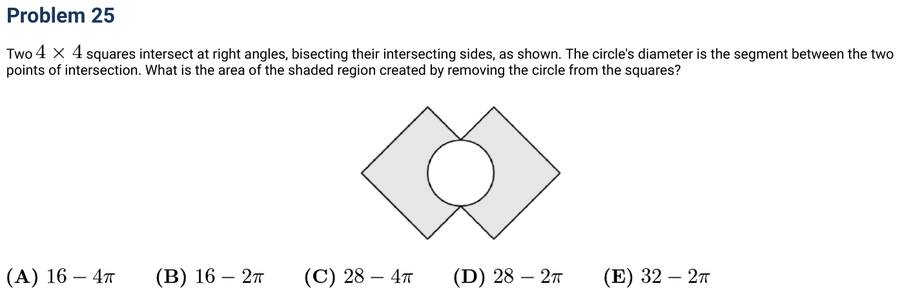
Problem 25 · 2004 AMC 8 Hard
Geometry & Measurement union-and-subtraction
amc8-2004-25
Show answer
Answer: D — 28 − 2π.
Show hints
Hint 1 of 2
Union of the two squares: 16 + 16 − overlap. Overlap is a 2×2 square (area 4).
Still stuck? Show hint 2 →
Hint 2 of 2
Circle's diameter = diagonal of overlap square = 2√2 ⇒ radius √2 ⇒ area 2π.
Show solution
Approach: union minus circle
  1. Each square: 16. Overlap: 2×2 = 4. Union: 16 + 16 − 4 = 28.
  2. Circle radius √2 ⇒ area 2π.
  3. Shaded: 28 − 2π = 28 − 2π.
Mark: · log in to save