AMC 8 · Test Mode

2002 AMC 8

Test mode — hints and solutions are locked. Pick an answer for each, then submit at the bottom to see your score.

← Exit test mode No hints or solutions until you submit.
Problem 1 · 2002 AMC 8 Easy
Geometry & Measurement spatial-reasoningcareful-counting

A circle and two distinct lines are drawn on a sheet of paper. What is the largest possible number of points of intersection of these figures?

Show answer
Answer: D — 5.
Show hints
Hint 1 of 2
Count the crossings one pair of figures at a time.
Still stuck? Show hint 2 →
Hint 2 of 2
A straight line can cut a circle in at most 2 points; two lines cross each other in at most 1.
Show solution
Approach: count intersections pair by pair
  1. Each line can cross the circle in at most 2 points, so the two lines give up to 2 + 2 = 4 points on the circle.
  2. The two lines can meet each other in at most 1 more point.
  3. Total: 4 + 1 = 5.
Mark: · log in to save
Problem 2 · 2002 AMC 8 Easy
Counting & Probability careful-counting

How many different combinations of $5 bills and $2 bills can be used to make a total of $17? Order does not matter.

Show answer
Answer: A — 2.
Show hints
Hint 1 of 2
The $2 bills always add an even amount, but $17 is odd.
Still stuck? Show hint 2 →
Hint 2 of 2
So the number of $5 bills must be odd — just try 1 and 3.
Show solution
Approach: use parity to pin down the number of $5 bills
  1. $2 bills only add even amounts, and $17 is odd, so the number of $5 bills has to be odd.
  2. Three $5 bills make $15, leaving $2 = one $2 bill; one $5 bill leaves $12 = six $2 bills.
  3. Five or more fives overshoot $17, so there are exactly 2 combinations.
Mark: · log in to save
Problem 3 · 2002 AMC 8 Easy
Arithmetic & Operations total-then-divide

What is the smallest possible average of four distinct positive even integers?

Show answer
Answer: C — 5.
Show hint
Hint 1
To make an average as small as possible, use the smallest numbers allowed.
Show solution
Approach: use the four smallest distinct positive even integers
  1. The smallest distinct positive even integers are 2, 4, 6, 8.
  2. Their average is (2 + 4 + 6 + 8) ÷ 4 = 20 ÷ 4 = 5.
Mark: · log in to save
Problem 4 · 2002 AMC 8 Easy
Number Theory place-value

The year 2002 is a palindrome (a number that reads the same from left to right as it does from right to left). What is the product of the digits of the next year after 2002 that is a palindrome?

Show answer
Answer: B — 4.
Show hints
Hint 1 of 2
Keep the thousands digit at 2, so the next palindrome looks like 2 _ _ 2.
Still stuck? Show hint 2 →
Hint 2 of 2
For that to mirror, the two middle digits must be equal — make them as small as you can while passing 2002.
Show solution
Approach: build the next palindrome from the outside in
  1. Don't change the leading 2, so the year stays of the form 2 _ _ 2 with equal middle digits.
  2. The smallest such year after 2002 is 2112, whose digit product is 2 × 1 × 1 × 2 = 4.
Mark: · log in to save
Problem 5 · 2002 AMC 8 Easy
Number Theory divisibility

Carlos Montado was born on Saturday, November 9, 2002. On what day of the week will Carlos be 706 days old?

Show answer
Answer: C — Friday.
Show hints
Hint 1 of 2
The day of the week repeats every 7 days, so only the remainder of 706 when divided by 7 matters.
Still stuck? Show hint 2 →
Hint 2 of 2
706 = 700 + 6, and 700 is a multiple of 7.
Show solution
Approach: strip off the whole weeks (multiples of 7)
  1. Since 700 is a multiple of 7, after 700 days the weekday is again Saturday.
  2. Six more days past Saturday lands on Friday.
Mark: · log in to save
Problem 6 · 2002 AMC 8 Medium
Ratios, Rates & Proportions unit-rategraph-reading
amc8-2002-06
Show answer
Answer: A — Graph A — the volume rises steadily, then stays constant once the bath overflows.
Show hints
Hint 1 of 2
Find the net rate at which water collects before the bath is full.
Still stuck? Show hint 2 →
Hint 2 of 2
Water gains 20 − 18 = 2 mL each minute, then holds steady once it overflows.
Show solution
Approach: net inflow until full, then constant
  1. Before overflowing, water collects at 20 − 18 = 2 mL per minute — a steady gain, so the graph rises in a straight line.
  2. Once the bath fills it overflows, so the volume stops changing and the line goes flat.
  3. Rising steadily, then level: that is graph A.
Mark: · log in to save
Problem 7 · 2002 AMC 8 Medium
Fractions, Decimals & Percents percent-multiplier

The students in Mrs. Sawyer's class each chose one of five kinds of candy in a taste test. The bar graph shows their preferences. What percent of her class chose candy E?

SWEET TOOTH012345678ABCDEKinds of candyNumber of students
Show answer
Answer: E — 20%.
Show hints
Hint 1 of 2
First find how many students there are in all.
Still stuck? Show hint 2 →
Hint 2 of 2
With 25 students total, each one is 4% of the class.
Show solution
Approach: part over whole, then turn into a percent
  1. The class total is 6 + 8 + 4 + 2 + 5 = 25 students.
  2. Candy E was chosen by 5 of them: 5/25 = 1/5 = 20%.
Mark: · log in to save
Problem 8 · 2002 AMC 8 Medium
Arithmetic & Operations read-tablecareful-counting

Juan organizes the stamps in his collection by country and by the decade in which they were issued. He paid these prices at the stamp shop: Brazil and France, 6¢ each; Peru, 4¢ each; and Spain, 5¢ each. (Brazil and Peru are South American countries; France and Spain are European.) The table shows how many stamps he has from each country and decade.

How many of his European stamps were issued in the 1980s?

Number of Stamps by Decade
Country'50s'60s'70s'80s
Brazil47128
France841215
Peru64610
Spain39139
Show answer
Answer: D — 24.
Show hints
Hint 1 of 2
France and Spain are the European countries.
Still stuck? Show hint 2 →
Hint 2 of 2
Add their two entries in the 1980s column.
Show solution
Approach: read the European rows in the 1980s column
  1. The European countries are France and Spain.
  2. In the 1980s they have 15 and 9 stamps: 15 + 9 = 24.
Mark: · log in to save
Problem 9 · 2002 AMC 8 Medium
Arithmetic & Operations read-tablecareful-counting

Juan organizes the stamps in his collection by country and by the decade in which they were issued. He paid these prices at the stamp shop: Brazil and France, 6¢ each; Peru, 4¢ each; and Spain, 5¢ each. (Brazil and Peru are South American countries; France and Spain are European.) The table shows how many stamps he has from each country and decade.

His South American stamps issued before the 1970s cost him how much?

Number of Stamps by Decade
Country'50s'60s'70s'80s
Brazil47128
France841215
Peru64610
Spain39139
Show answer
Answer: B — $1.06.
Show hints
Hint 1 of 2
South American means Brazil and Peru; “before the 1970s” means the '50s and '60s columns.
Still stuck? Show hint 2 →
Hint 2 of 2
Multiply each country's stamp count by its price, then add.
Show solution
Approach: count the right cells, then multiply by price
  1. Brazil and Peru are South American; before the 1970s covers the '50s and '60s.
  2. Brazil: 4 + 7 = 11 stamps at 6¢ = 66¢. Peru: 6 + 4 = 10 stamps at 4¢ = 40¢.
  3. Total: 66¢ + 40¢ = 106¢ = $1.06.
Mark: · log in to save
Problem 10 · 2002 AMC 8 Medium
Arithmetic & Operations read-tabletotal-then-divideestimate-and-pick

Juan organizes the stamps in his collection by country and by the decade in which they were issued. He paid these prices at the stamp shop: Brazil and France, 6¢ each; Peru, 4¢ each; and Spain, 5¢ each. (Brazil and Peru are South American countries; France and Spain are European.) The table shows how many stamps he has from each country and decade.

The average price of his 1970s stamps is closest to which value?

Number of Stamps by Decade
Country'50s'60s'70s'80s
Brazil47128
France841215
Peru64610
Spain39139
Show answer
Answer: E — About 5.4 cents.
Show hints
Hint 1 of 2
Average price = total cost of the 1970s stamps ÷ how many there are.
Still stuck? Show hint 2 →
Hint 2 of 2
Use the whole 1970s column across all four countries.
Show solution
Approach: weighted average over the 1970s column
  1. 1970s stamps: Brazil 12 and France 12 at 6¢, Peru 6 at 4¢, Spain 13 at 5¢.
  2. Total cost: 12×6 + 12×6 + 6×4 + 13×5 = 72 + 72 + 24 + 65 = 233¢, over 12 + 12 + 6 + 13 = 43 stamps.
  3. 233 ÷ 43 ≈ 5.4, so the average is closest to 5.4 cents.
Mark: · log in to save
Problem 11 · 2002 AMC 8 Medium
Algebra & Patterns perfect-squaredifference-of-squares

A sequence of squares is made of identical square tiles. Each square's edge is one tile longer than the edge of the previous square. The first three squares are shown. How many more tiles does the seventh square require than the sixth?

Show answer
Answer: C — 13.
Show hints
Hint 1 of 2
A square that is n tiles on a side uses n × n tiles.
Still stuck? Show hint 2 →
Hint 2 of 2
Compare 7 × 7 with 6 × 6.
Show solution
Approach: the nth square uses n² tiles
  1. A square that is n tiles on a side uses n² tiles.
  2. So the seventh needs 7² = 49 and the sixth needs 6² = 36: the difference is 49 − 36 = 13.
Another way — difference of squares (no squaring needed):
  1. 7² − 6² = (7 + 6)(7 − 6) = 13 × 1 = 13.
Mark: · log in to save
Problem 12 · 2002 AMC 8 Medium
Counting & Probability complementary-counting

A board game spinner is divided into three regions labeled A, B, and C. The probability the arrow stops on region A is 13 and on region B is 12. What is the probability the arrow stops on region C?

Show answer
Answer: B — 1/6.
Show hints
Hint 1 of 2
The three probabilities have to add up to 1.
Still stuck? Show hint 2 →
Hint 2 of 2
So region C gets whatever is left after A and B.
Show solution
Approach: probabilities of all regions sum to 1
  1. Since the arrow must land somewhere, P(C) = 1 − 1312.
  2. Over a denominator of 6: 662636 = 16.
Mark: · log in to save
Problem 13 · 2002 AMC 8 Hard
Geometry & Measurement volume-scalingspatial-reasoning

For his birthday, Bert gets a box that holds 125 jellybeans when filled to capacity. A few weeks later, Carrie gets a larger box full of jellybeans. Her box is twice as high, twice as wide, and twice as long as Bert's. Approximately how many jellybeans did Carrie get?

Show answer
Answer: E — About 1000.
Show hints
Hint 1 of 2
Doubling every dimension does more than double the box — picture stacking copies of the small box inside the big one.
Still stuck? Show hint 2 →
Hint 2 of 2
Twice as long, wide, and high multiplies the volume by 2 × 2 × 2.
Show solution
Approach: scaling all three dimensions cubes the factor
  1. Doubling all three dimensions multiplies the volume by 2 × 2 × 2 = 8.
  2. So Carrie's box holds about 8 × 125 = 1000 jellybeans.
Mark: · log in to save
Problem 14 · 2002 AMC 8 Hard
Fractions, Decimals & Percents percent-multiplier

A merchant offers a large group of items at 30% off. Later, the merchant takes 20% off these sale prices and claims that the final price of these items is 50% off the original price. The total discount is

Show answer
Answer: B — 44%.
Show hints
Hint 1 of 2
Discounts don't simply add — track the fraction of the price you still pay.
Still stuck? Show hint 2 →
Hint 2 of 2
After 30% off you pay 0.7 of the price; the next 20% off pays 0.8 of that.
Show solution
Approach: multiply the fractions of price still paid
  1. After 30% off you pay 0.70 of the original; taking another 20% off pays 0.80 of that.
  2. So you pay 0.70 × 0.80 = 0.56 of the original — a 44% total discount, not 50%.
Mark: · log in to save
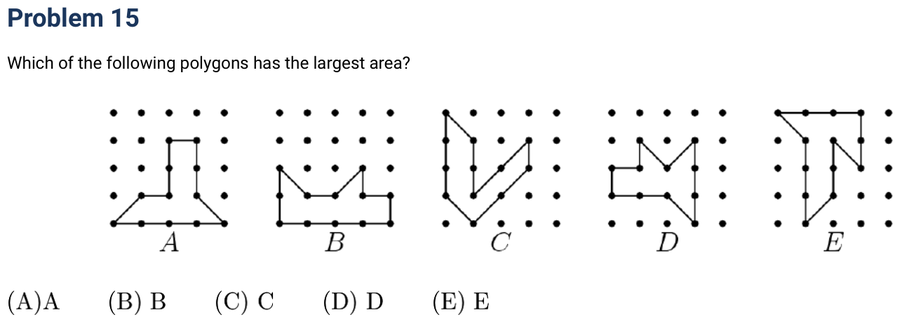
Problem 15 · 2002 AMC 8 Hard
Geometry & Measurement area-decompositiongrid
amc8-2002-15
Show answer
Answer: E — Polygon E, with area 5.5.
Show hints
Hint 1 of 2
Split each polygon into unit squares and half-square triangles, then add up the area.
Still stuck? Show hint 2 →
Hint 2 of 2
A whole grid square counts 1; a triangle that is half a square counts ½.
Show solution
Approach: count whole squares and half-squares
  1. Break each polygon into unit squares (area 1) and half-square triangles (area ½), then add.
  2. The areas come out to 5, 5, 5, 4.5, and 5.5, so polygon E is the largest at 5.5.
Mark: · log in to save
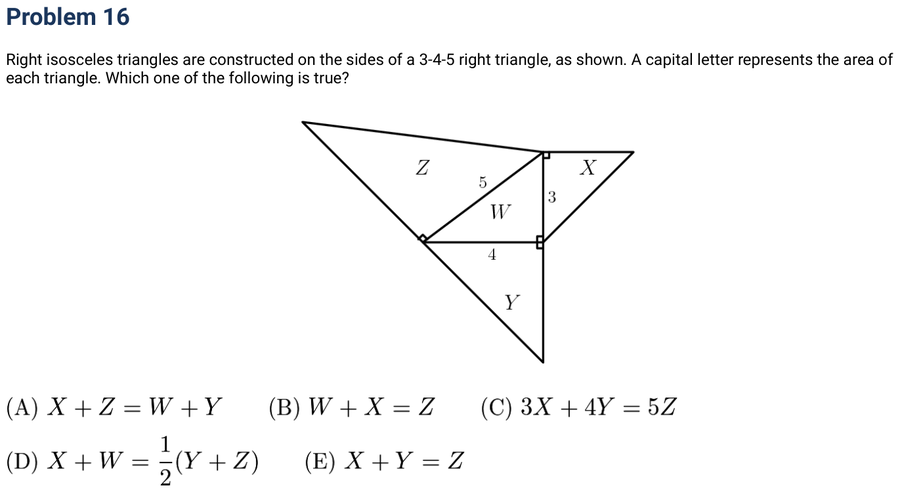
Problem 16 · 2002 AMC 8 Hard
Geometry & Measurement areapythagorean-triplesquare-area
amc8-2002-16
Show answer
Answer: E — X + Y = Z.
Show hints
Hint 1 of 2
Each outer triangle is right isosceles, so its area is half the square built on the side it sits on.
Still stuck? Show hint 2 →
Hint 2 of 2
That ties X, Y, Z to 3², 4², 5² — and 3² + 4² = 5².
Show solution
Approach: each isosceles right triangle's area is half the square on its side
  1. A right isosceles triangle on a side of length s has both legs s, so its area is ½s². Thus X = ½·3² = 4.5, Y = ½·4² = 8, Z = ½·5² = 12.5.
  2. Because 3² + 4² = 5², halving every term gives X + Y = Z (4.5 + 8 = 12.5), so the answer is E.
Mark: · log in to save
Problem 17 · 2002 AMC 8 Hard
Algebra & Patterns work-backward

In a mathematics contest with ten problems, a student gains 5 points for a correct answer and loses 2 points for an incorrect answer. If Olivia answered every problem and her score was 29, how many correct answers did she have?

Show answer
Answer: C — 7.
Show hints
Hint 1 of 2
Imagine she got all 10 right first, then see what each wrong answer costs.
Still stuck? Show hint 2 →
Hint 2 of 2
Turning one correct answer into a wrong one drops the score by 5 + 2 = 7.
Show solution
Approach: start from a perfect score and subtract
  1. All 10 correct would score 5 × 10 = 50.
  2. Each wrong answer (instead of right) costs 5 + 2 = 7 points, and 50 − 29 = 21 = 3 × 7.
  3. So 3 were wrong and 7 were correct.
Another way — set up an equation:
  1. Let x = number correct, so 10 − x are wrong: 5x − 2(10 − x) = 29.
  2. Then 7x − 20 = 29, giving x = 7.
Mark: · log in to save
Problem 18 · 2002 AMC 8 Hard
Arithmetic & Operations total-then-divide

Gage skated 1 hr 15 min each day for 5 days and 1 hr 30 min each day for 3 days. How long would he have to skate the ninth day in order to average 85 minutes of skating each day for the entire time?

Show answer
Answer: E — 2 hours.
Show hints
Hint 1 of 2
Compare each day to the 85-minute target instead of adding everything up.
Still stuck? Show hint 2 →
Hint 2 of 2
The first 5 days fall short of 85 and the next 3 go over — track the running shortfall.
Show solution
Approach: measure each day against the 85-minute target
  1. Against an 85-minute target, each of the 5 days at 75 min is 10 short (−50 total), and each of the 3 days at 90 min is 5 over (+15 total).
  2. That leaves a shortfall of 50 − 15 = 35 minutes, so day 9 must be 85 + 35 = 120 minutes = 2 hours.
Another way — totals:
  1. Skated so far: 5·75 + 3·90 = 645 min. Needed for the average: 9·85 = 765 min.
  2. Day 9 = 765 − 645 = 120 min = 2 hours.
Mark: · log in to save
Problem 19 · 2002 AMC 8 Hard
Counting & Probability careful-countingplace-value

How many whole numbers between 99 and 999 contain exactly one 0?

Show answer
Answer: D — 162.
Show hints
Hint 1 of 2
Every number here is three digits, and a three-digit number never starts with 0.
Still stuck? Show hint 2 →
Hint 2 of 2
So the single 0 must sit in the tens or the units place — count each spot.
Show solution
Approach: place the lone 0, then fill the rest with nonzero digits
  1. These are three-digit numbers with a nonzero hundreds digit, so the one 0 has to be the tens or the units digit: 2 choices for where it goes.
  2. The other two digits must be nonzero (1–9): 9 choices each.
  3. Total: 2 × 9 × 9 = 162.
Mark: · log in to save
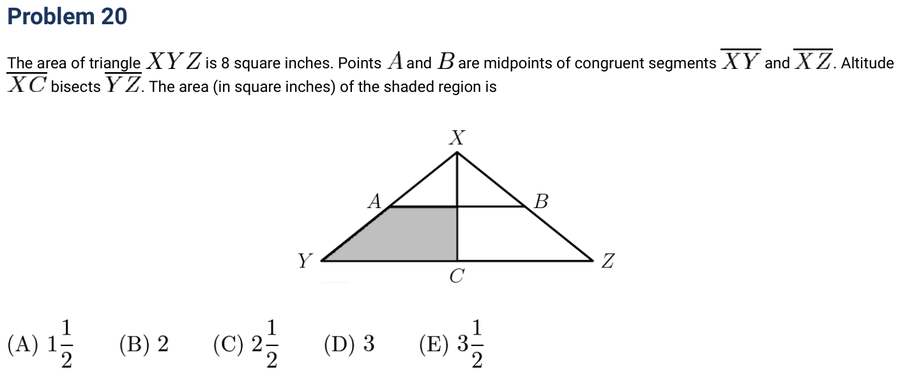
Problem 20 · 2002 AMC 8 Stretch
Geometry & Measurement area-fractionsimilar-triangles
amc8-2002-20
Show answer
Answer: D — 3 square inches.
Show hints
Hint 1 of 2
Altitude XC splits the whole triangle into two equal halves — start from one half's area.
Still stuck? Show hint 2 →
Hint 2 of 2
Within that half, the small triangle cut off by the midpoints has half the side lengths, so a quarter of the area.
Show solution
Approach: halve the triangle, then remove the midpoint triangle
  1. Altitude XC cuts triangle XYZ into two equal halves, so triangle XYC has area 8 ÷ 2 = 4.
  2. The shaded part is that half with the small top triangle removed; that small triangle has half the side lengths, so ¼ of the half = 1.
  3. Shaded area = 4 − 1 = 3 square inches.
Mark: · log in to save
Problem 21 · 2002 AMC 8 Stretch
Counting & Probability symmetrycomplementary-counting

Harold tosses a nickel four times. The probability that he gets at least as many heads as tails is

Show answer
Answer: E — 11/16.
Show hints
Hint 1 of 2
By symmetry, "at least as many heads as tails" is just as likely as "at least as many tails as heads."
Still stuck? Show hint 2 →
Hint 2 of 2
Those two events overlap only on a 2–2 tie, so find the probability of that tie.
Show solution
Approach: use heads–tails symmetry
  1. Heads and tails are symmetric, so P(heads ≥ tails) = P(tails ≥ heads); the two events overlap exactly on a 2–2 tie.
  2. Hence 2·P(heads ≥ tails) = 1 + P(tie). The tie has C(4,2) = 6 ways out of 16, so P(tie) = 6/16 = 3/8.
  3. Then P(heads ≥ tails) = (1 + 3/8) ÷ 2 = 11/16.
Mark: · log in to save
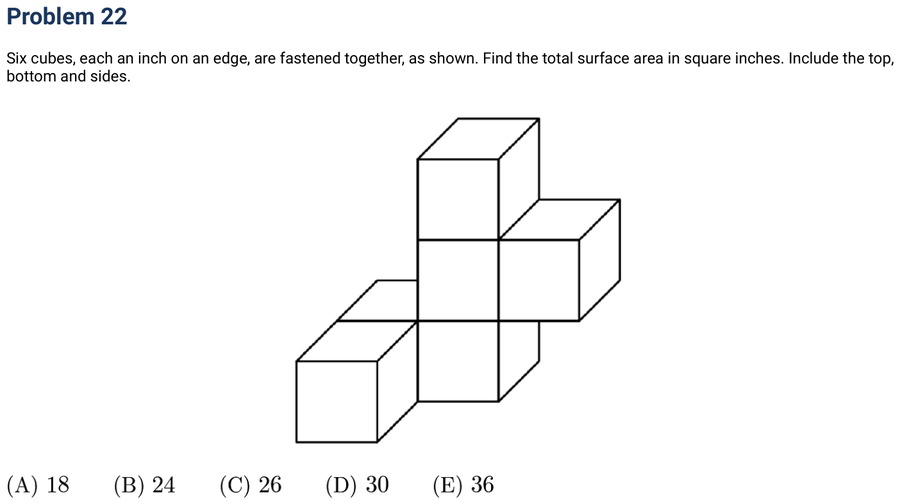
Problem 22 · 2002 AMC 8 Stretch
Geometry & Measurement hide-faces-in-3dspatial-reasoning
amc8-2002-22
Show answer
Answer: C — 26 square inches.
Show hints
Hint 1 of 2
Six separate cubes would show 36 faces — fastening them together hides some.
Still stuck? Show hint 2 →
Hint 2 of 2
Subtract the faces that are pressed against another cube.
Show solution
Approach: total faces minus the hidden (touching) faces
  1. Six separate unit cubes would show 6 × 6 = 36 faces.
  2. In this arrangement the touching faces are hidden: three cubes hide 1 face, two hide 2, and one hides 3 — that's 3 + 4 + 3 = 10.
  3. Exposed surface area = 36 − 10 = 26 square inches.
Mark: · log in to save
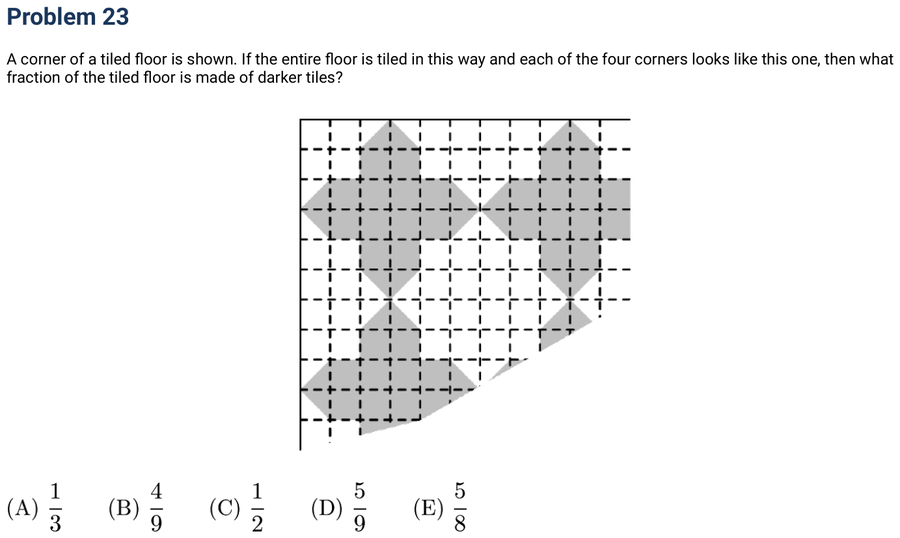
Problem 23 · 2002 AMC 8 Stretch
Geometry & Measurement area-fractionsymmetry
amc8-2002-23
Show answer
Answer: B — 4/9.
Show hints
Hint 1 of 2
Find the smallest block of the pattern that repeats across the whole floor.
Still stuck? Show hint 2 →
Hint 2 of 2
Inside one block, dark tiles cover some whole squares plus triangles that combine into more squares.
Show solution
Approach: find the repeating block, then the dark fraction inside it
  1. The pattern repeats in 3 × 3 blocks of unit squares.
  2. In one block the dark region is 3 whole squares plus two triangles that join into a 4th — 4 dark squares out of 9.
  3. So the fraction of dark tiles is 4/9.
Mark: · log in to save
Problem 24 · 2002 AMC 8 Stretch
Ratios, Rates & Proportions ratioproportion

Miki has a dozen oranges of the same size and a dozen pears of the same size. Miki uses her juicer to extract 8 ounces of pear juice from 3 pears and 8 ounces of orange juice from 2 oranges. She makes a pear-orange juice blend from an equal number of pears and oranges. What percent of the blend is pear juice?

Show answer
Answer: B — 40%.
Show hints
Hint 1 of 2
Work out how much juice one pear gives and how much one orange gives.
Still stuck? Show hint 2 →
Hint 2 of 2
With equal numbers of each fruit, just compare those per-fruit yields.
Show solution
Approach: compare juice per fruit
  1. One pear gives 8/3 oz of juice; one orange gives 8/2 = 4 oz.
  2. Equal numbers of each fruit make the pear-to-orange juice ratio 8/3 : 4 = 2 : 3.
  3. Pear's share of the blend is 2 ÷ (2 + 3) = 2/5 = 40%.
Mark: · log in to save
Problem 25 · 2002 AMC 8 Stretch
Algebra & Patterns substitution

Loki, Moe, Nick, and Ott are good friends. Ott had no money, but the others did. Moe gave Ott one-fifth of his money, Loki gave Ott one-fourth of his money, and Nick gave Ott one-third of his money. Each gave Ott the same amount of money. What fractional part of the group's money does Ott now have?

Show answer
Answer: B — 1/4.
Show hints
Hint 1 of 2
The three gifts are equal — pick a convenient size for that common gift, like $1.
Still stuck? Show hint 2 →
Hint 2 of 2
Then Moe started with $5, Loki $4, Nick $3; passing money around never changes the group total.
Show solution
Approach: set the equal gift to a convenient $1
  1. Let each gift be $1. Since $1 is Moe's fifth, Loki's fourth, and Nick's third, they began with $5, $4, and $3.
  2. Handing money over doesn't change the total: $5 + $4 + $3 = $12, and Ott now holds the three gifts, $3.
  3. Ott's share is 3/12 = 1/4.
Mark: · log in to save