AJHSME · Test Mode

1994 AJHSME

Test mode — hints and solutions are locked. Pick an answer for each, then submit at the bottom to see your score.

← Exit test mode No hints or solutions until you submit.
Problem 1 · 1994 AJHSME Easy
Fractions, Decimals & Percents common-denominator

Which of the following is the largest?

Show answer
Answer: D — 5/12.
Show hints
Hint 1 of 2
Put them all over a common denominator of 24.
Still stuck? Show hint 2 →
Hint 2 of 2
Then just compare numerators.
Show solution
Approach: compare over a common denominator
  1. Over 24: 8/24, 6/24, 9/24, 10/24, 7/24.
  2. The biggest numerator is 10, so 5/12 is largest.
Mark: · log in to save
Problem 2 · 1994 AJHSME Easy
Fractions, Decimals & Percents sum-fractions
110 + 210 + 310 + 410 + 510 + 610 + 710 + 810 + 910 + 5510=
Show answer
Answer: D — 10.
Show hints
Hint 1 of 2
All terms share the denominator 10, so add the numerators first.
Still stuck? Show hint 2 →
Hint 2 of 2
1 + 2 + … + 9 = 45.
Show solution
Approach: add numerators over the common 10
  1. The numerators add to (1 + 2 + … + 9) + 55 = 45 + 55 = 100.
  2. So the sum is 100/10 = 10.
Mark: · log in to save
Problem 3 · 1994 AJHSME Medium
Arithmetic & Operations time-arithmetic

Each day Maria must work 8 hours. This does not include the 45 minutes she takes for lunch. If she begins working at 7:25 A.M. and takes her lunch break at noon, then her working day will end at

Show answer
Answer: C — 4:10 P.M.
Show hints
Hint 1 of 2
Find how much she works before lunch, then how much is left.
Still stuck? Show hint 2 →
Hint 2 of 2
Don't forget the 45-minute lunch pushes the afternoon back.
Show solution
Approach: split the workday around lunch
  1. From 7:25 to noon she works 4 h 35 min, leaving 8 h − 4 h 35 min = 3 h 25 min.
  2. Lunch ends at 12:45, and 3 h 25 min later is 4:10 P.M.
Mark: · log in to save
Problem 4 · 1994 AJHSME Medium
Geometry & Measurement rotation
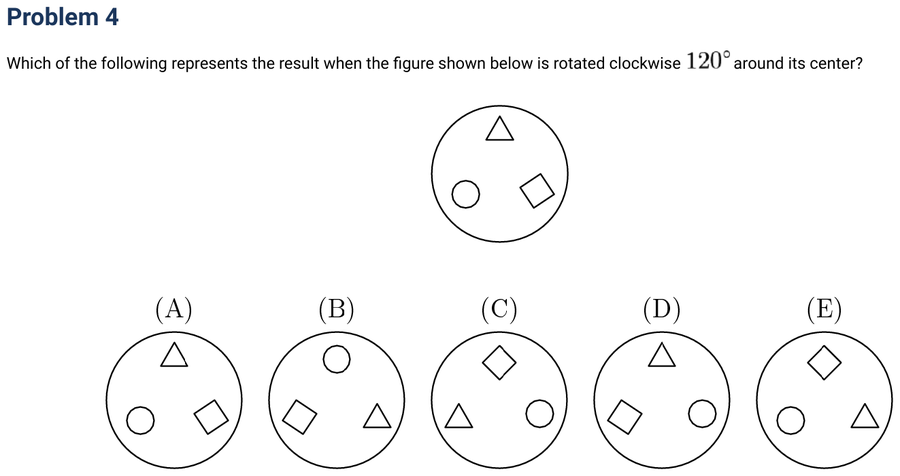
ajhsme-1994-04
Show answer
Answer: B — Choice B.
Show hints
Hint 1 of 2
A 120° clockwise turn moves each shape to the next position clockwise.
Still stuck? Show hint 2 →
Hint 2 of 2
Track where the triangle, circle, and diamond each land.
Show solution
Approach: rotate each shape one position clockwise
  1. Clockwise 120° sends top → lower-right → lower-left → top.
  2. So the circle moves to the top, the diamond to the lower-left, and the triangle to the lower-right — matching choice B.
Mark: · log in to save
Problem 5 · 1994 AJHSME Easy
Ratios, Rates & Proportions unit-conversion

Given that 1 mile = 8 furlongs and 1 furlong = 40 rods, the number of rods in one mile is

Show answer
Answer: B — 320.
Show hints
Hint 1 of 2
Convert miles to furlongs, then furlongs to rods.
Still stuck? Show hint 2 →
Hint 2 of 2
Just multiply the two conversion factors.
Show solution
Approach: chain the conversions
  1. 1 mile = 8 furlongs, and each furlong = 40 rods.
  2. So 1 mile = 8 × 40 = 320 rods.
Mark: · log in to save
Problem 6 · 1994 AJHSME Medium
Number Theory divisibility

The units digit (one's digit) of the product of any six consecutive positive whole numbers is

Show answer
Answer: A — 0.
Show hints
Hint 1 of 2
Among six consecutive numbers, what's guaranteed to appear?
Still stuck? Show hint 2 →
Hint 2 of 2
A multiple of 5 and an even number together make a multiple of 10.
Show solution
Approach: the product is a multiple of 10
  1. Any six consecutive numbers include a multiple of 5 and at least one even number.
  2. Their product is therefore a multiple of 10, so its units digit is 0.
Mark: · log in to save
Problem 7 · 1994 AJHSME Hard
Geometry & Measurement exterior-angleangle-chase
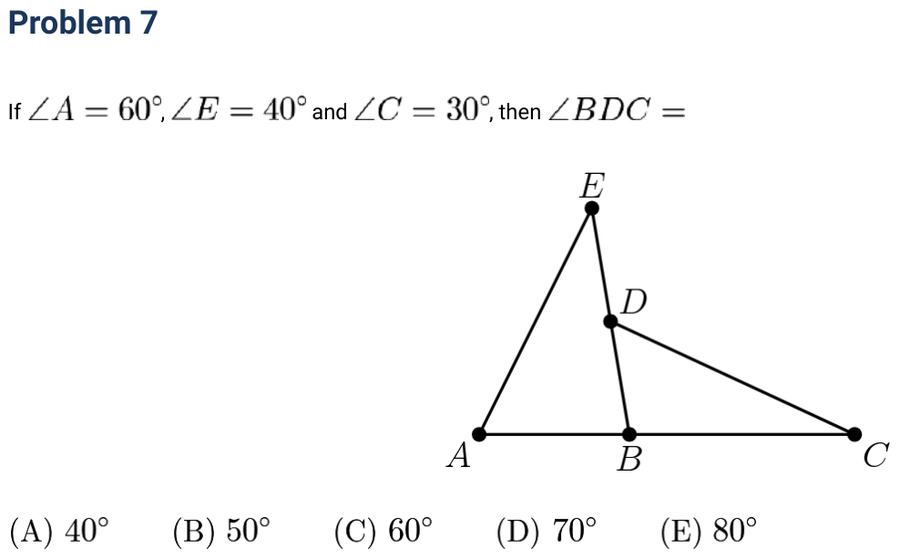
ajhsme-1994-07
Show answer
Answer: B — 50°.
Show hints
Hint 1 of 2
First find ∠ABE in triangle ABE from ∠A and ∠E.
Still stuck? Show hint 2 →
Hint 2 of 2
Since A, B, C are in a line, ∠DBC is the supplement of ∠ABE.
Show solution
Approach: angle sum, then a supplement
  1. In triangle ABE, ∠ABE = 180° − 60° − 40° = 80°.
  2. A, B, C are collinear, so ∠DBC = 180° − 80° = 100°. In triangle BDC, ∠BDC = 180° − 100° − 30° = 50°.
Mark: · log in to save
Problem 8 · 1994 AJHSME Hard
Counting & Probability digit-sumcounting

For how many three-digit whole numbers does the sum of the digits equal 25?

Show answer
Answer: C — 6.
Show hints
Hint 1 of 2
The maximum digit sum is 9 + 9 + 9 = 27, so 25 is just 2 short.
Still stuck? Show hint 2 →
Hint 2 of 2
Spread a shortfall of 2 across the three digits.
Show solution
Approach: count from the maximum 27
  1. Digit triples summing to 25 are two 9s and a 7, or a 9 and two 8s.
  2. Arranging gives (9,9,7), (9,7,9), (7,9,9), (9,8,8), (8,9,8), (8,8,9) — 6 numbers.
Mark: · log in to save
Problem 9 · 1994 AJHSME Hard
Fractions, Decimals & Percents discounttax

A shopper buys a 100-dollar coat on sale for 20% off. An additional 5 dollars are taken off the sale price by using a discount coupon. A sales tax of 8% is paid on the final selling price. The total amount the shopper pays for the coat is

Show answer
Answer: A — 81.00 dollars.
Show hints
Hint 1 of 2
Apply the discounts in order before the tax.
Still stuck? Show hint 2 →
Hint 2 of 2
20% off $100, then −$5, then ×1.08.
Show solution
Approach: discounts first, then tax
  1. 20% off $100 is $80; the coupon makes it $75.
  2. Adding 8% tax: $75 × 1.08 = $81.00.
Mark: · log in to save
Problem 10 · 1994 AJHSME Hard
Number Theory divisors

For how many positive integer values of N is the expression 36N + 2 an integer?

Show answer
Answer: A — 7.
Show hints
Hint 1 of 2
N + 2 must be a divisor of 36.
Still stuck? Show hint 2 →
Hint 2 of 2
Since N ≥ 1, only divisors that are at least 3 count.
Show solution
Approach: count valid divisors of 36
  1. N + 2 must divide 36, and N ≥ 1 means N + 2 ≥ 3.
  2. The divisors of 36 that are ≥ 3 are 3, 4, 6, 9, 12, 18, 36 — 7 of them.
Mark: · log in to save
Problem 11 · 1994 AJHSME Hard
Logic & Word Problems two-way-table

Last summer 100 students attended basketball camp. Of those, 52 were boys and 48 were girls. Also, 40 students were from Jonas Middle School and 60 were from Clay Middle School. Twenty of the girls were from Jonas Middle School. How many of the boys were from Clay Middle School?

Show answer
Answer: B — 32.
Show hints
Hint 1 of 2
Make a boys/girls by Jonas/Clay table and fill it in.
Still stuck? Show hint 2 →
Hint 2 of 2
Find the Clay girls first, then the Clay boys.
Show solution
Approach: fill in a two-way table
  1. Girls from Clay = 48 − 20 = 28.
  2. Clay has 60 students, so boys from Clay = 60 − 28 = 32.
Mark: · log in to save
Problem 12 · 1994 AJHSME Hard
Geometry & Measurement dissectionarea-comparison
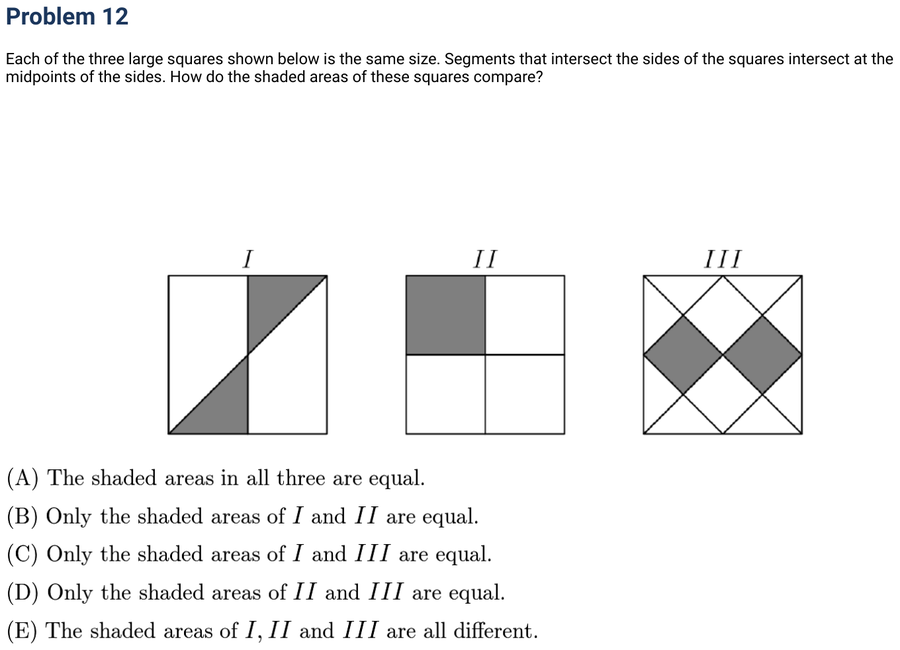
ajhsme-1994-12
Show answer
Answer: A — All three are equal.
Show hints
Hint 1 of 2
Don't compute each area separately — rearrange the shaded pieces.
Still stuck? Show hint 2 →
Hint 2 of 2
In each square the shaded parts cut and reassemble into the same region.
Show solution
Approach: cut and rearrange to compare
  1. In each square the shaded pieces can be slid together to cover the same fraction of the square.
  2. So the three shaded areas are all equal.
Mark: · log in to save
Problem 13 · 1994 AJHSME Medium
Fractions, Decimals & Percents average

The number halfway between 16 and 14 is

Show answer
Answer: C — 5/24.
Show hints
Hint 1 of 2
Halfway between two numbers is their average.
Still stuck? Show hint 2 →
Hint 2 of 2
Add the fractions and divide by 2.
Show solution
Approach: average the two fractions
  1. 1/6 + 1/4 = 2/12 + 3/12 = 5/12.
  2. Half of 5/12 is 5/24.
Mark: · log in to save
Problem 14 · 1994 AJHSME Medium
Ratios, Rates & Proportions total-divided

Two children at a time can play pairball. For 90 minutes, with only two children playing at a time, five children take turns so that each one plays the same amount of time. The number of minutes each child plays is

Show answer
Answer: E — 36.
Show hints
Hint 1 of 2
Two children play at once, so there are 2 × 90 child-minutes of play available.
Still stuck? Show hint 2 →
Hint 2 of 2
Share those equally among the five children.
Show solution
Approach: total child-minutes, shared equally
  1. Two play at a time for 90 minutes: 2 × 90 = 180 child-minutes.
  2. Split among 5 children: 180 ÷ 5 = 36 minutes each.
Mark: · log in to save
Problem 15 · 1994 AJHSME Hard
Number Theory patternmod-arithmetic
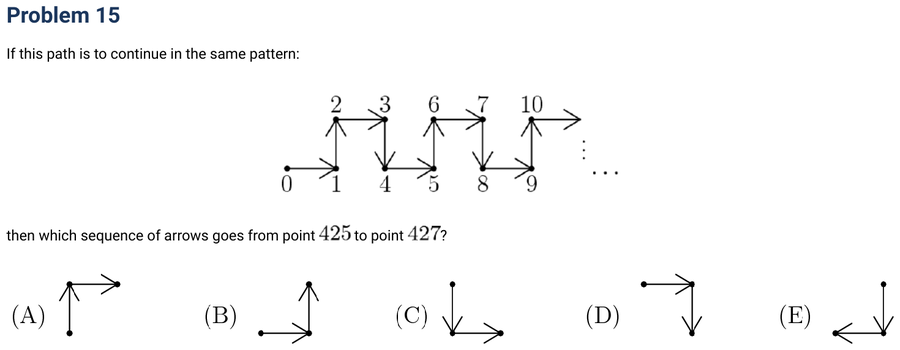
ajhsme-1994-15
Show answer
Answer: A — Up arrow, then right arrow.
Show hints
Hint 1 of 2
The arrow pattern repeats every 4 steps.
Still stuck? Show hint 2 →
Hint 2 of 2
Find 425 and 426 modulo 4 to see which arrows apply.
Show solution
Approach: use the period-4 repetition
  1. The arrows repeat with period 4: from a number ≡ 0 (right), ≡ 1 (up), ≡ 2 (right), ≡ 3 (down).
  2. Since 425 ≡ 1 and 426 ≡ 2 (mod 4), the moves are up then right — choice A.
Mark: · log in to save
Problem 16 · 1994 AJHSME Medium
Geometry & Measurement scaling

The perimeter of one square is 3 times the perimeter of another square. The area of the larger square is how many times the area of the smaller square?

Show answer
Answer: E — 9.
Show hints
Hint 1 of 2
Perimeter scales with the side, so the sides are in the same 3 : 1 ratio.
Still stuck? Show hint 2 →
Hint 2 of 2
Area scales with the side squared.
Show solution
Approach: area scales as the square of the side ratio
  1. The side ratio equals the perimeter ratio, 3.
  2. So the area ratio is 3² = 9.
Mark: · log in to save
Problem 17 · 1994 AJHSME Hard
Algebra & Patterns partial-sums

Pauline can shovel snow at the rate of 20 cubic yards for the first hour, 19 cubic yards for the second, 18 for the third, and so on, always shoveling one cubic yard less per hour than the previous hour. If her driveway is 4 yards wide, 10 yards long, and covered with snow 3 yards deep, then the number of hours it will take her to shovel it clean is closest to

Show answer
Answer: D — 7.
Show hints
Hint 1 of 2
First find the total volume of snow: 4 × 10 × 3.
Still stuck? Show hint 2 →
Hint 2 of 2
Add 20 + 19 + 18 + … until you reach that volume.
Show solution
Approach: accumulate the decreasing hourly amounts
  1. The snow is 4 × 10 × 3 = 120 cubic yards.
  2. Running totals: 20, 39, 57, 74, 90, 105, 119 — after 7 hours she's at 119, just shy of 120, so the time is closest to 7 hours.
Mark: · log in to save
Problem 18 · 1994 AJHSME Hard
Algebra & Patterns graph-reading
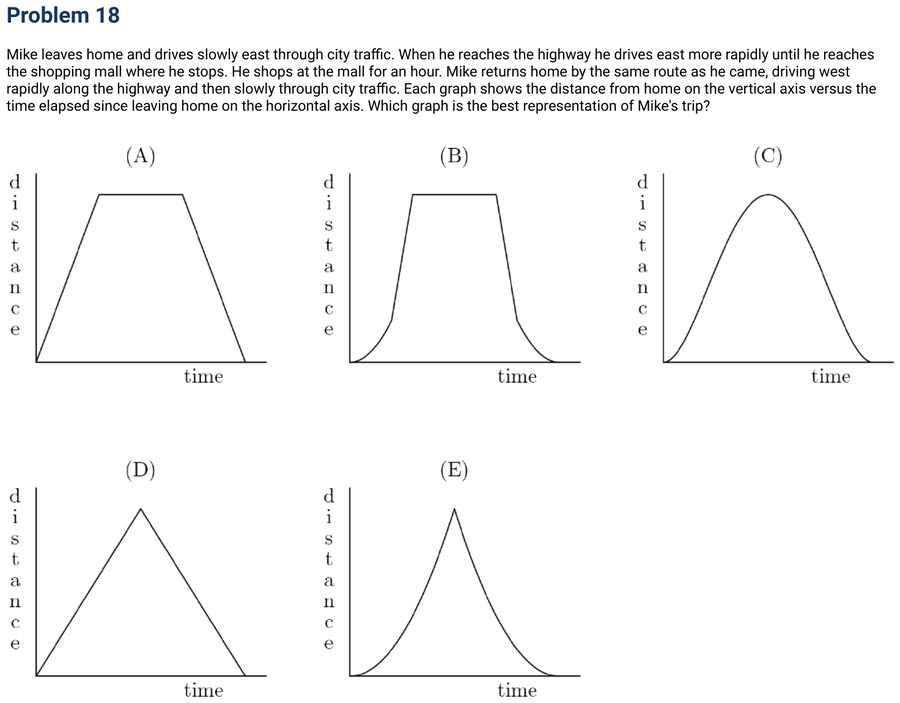
ajhsme-1994-18
Show answer
Answer: B — Graph B.
Show hints
Hint 1 of 2
Distance from home rises while going out, stays flat while shopping, then falls coming back.
Still stuck? Show hint 2 →
Hint 2 of 2
Because the speed changes (gentle in city, steep on highway), each side of the graph bends rather than staying a single straight line.
Show solution
Approach: match each changing-speed leg to the graph's slope
  1. Going out, distance rises gently (city) then steeply (highway), so the climb curves and gets steeper; it stays flat for the hour at the mall; coming home it falls steeply (highway) then gently (city).
  2. Graph B shows these two different slopes on each side — the straight-sided trapezoid (A) would mean a single constant speed each way.
Mark: · log in to save
Problem 19 · 1994 AJHSME Hard
Geometry & Measurement tangentdimensions
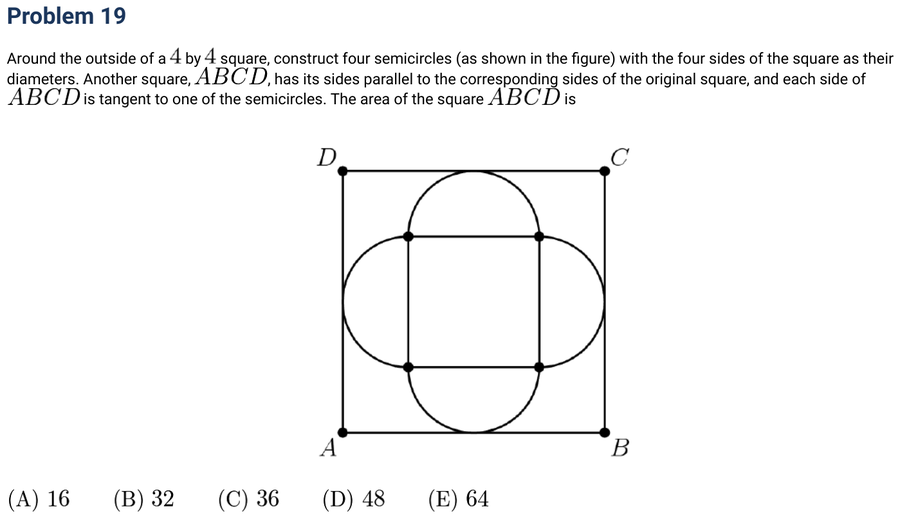
ajhsme-1994-19
Show answer
Answer: E — 64.
Show hints
Hint 1 of 2
Each semicircle has diameter 4, so it bulges out 2 (its radius) past each side.
Still stuck? Show hint 2 →
Hint 2 of 2
The outer square's side is the inner side plus those two bulges.
Show solution
Approach: grow the inner square by the semicircle radii
  1. Each semicircle has radius 2 and sticks out 2 beyond its side, so square ABCD has side 4 + 2 + 2 = 8.
  2. Its area is 8² = 64.
Mark: · log in to save
Problem 20 · 1994 AJHSME Stretch
Fractions, Decimals & Percents minimize-fractions

Let W, X, Y, and Z be four different digits selected from the set {1, 2, 3, 4, 5, 6, 7, 8, 9}.

If the sum WX + YZ is to be as small as possible, then WX + YZ must equal

Show answer
Answer: D — 25/72.
Show hints
Hint 1 of 2
To make two fractions small, use the smallest numerators and the largest denominators.
Still stuck? Show hint 2 →
Hint 2 of 2
Test how to pair 1 and 2 over 8 and 9.
Show solution
Approach: smallest tops over largest bottoms, paired well
  1. Use numerators 1, 2 and denominators 8, 9. Pairing as 1/8 + 2/9 = 9/72 + 16/72 = 25/72 beats 1/9 + 2/8 = 26/72.
  2. So the smallest sum is 25/72.
Mark: · log in to save
Problem 21 · 1994 AJHSME Hard
Counting & Probability pigeonhole

A gumball machine contains 9 red, 7 white, and 8 blue gumballs. The least number of gumballs a person must buy to be sure of getting four gumballs of the same color is

Show answer
Answer: C — 10.
Show hints
Hint 1 of 2
Imagine the worst luck: as many gumballs as possible without four of any color.
Still stuck? Show hint 2 →
Hint 2 of 2
That's three of each color; the next one must make a fourth.
Show solution
Approach: worst case, then one more
  1. You could draw 3 red, 3 white, 3 blue — 9 gumballs — with no color yet reaching four.
  2. The 10th gumball must complete a set of four, so the answer is 10.
Mark: · log in to save
Problem 22 · 1994 AJHSME Stretch
Counting & Probability parityprobability
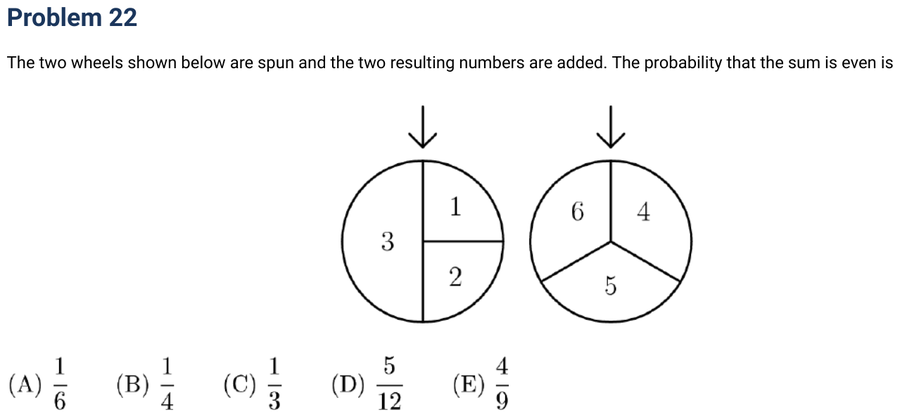
ajhsme-1994-22
Show answer
Answer: D — 5/12.
Show hints
Hint 1 of 2
A sum is even when both numbers are even or both are odd.
Still stuck? Show hint 2 →
Hint 2 of 2
Read each wheel's chance of landing odd vs. even from the region sizes.
Show solution
Approach: combine the even/odd chances of each wheel
  1. Wheel 1 lands even (the 2) with probability 1/4 and odd with 3/4; wheel 2 lands even (6 or 4) with probability 2/3 and odd (5) with 1/3.
  2. Even sum = both even or both odd: (1/4)(2/3) + (3/4)(1/3) = 2/12 + 3/12 = 5/12.
Mark: · log in to save
Problem 23 · 1994 AJHSME Stretch
Number Theory place-valuemaximize
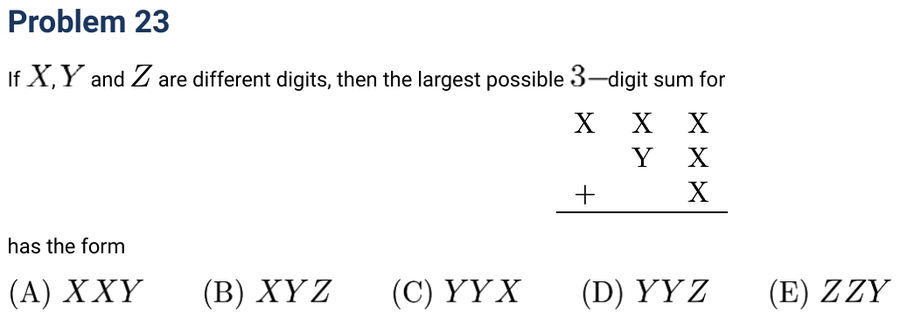
ajhsme-1994-23
Show answer
Answer: D — Form YYZ.
Show hints
Hint 1 of 2
The sum equals 113·X + 10·Y; keep it to three digits while making it large.
Still stuck? Show hint 2 →
Hint 2 of 2
Find the digits of that largest sum and match them to X, Y, Z.
Show solution
Approach: express the sum, then maximize within three digits
  1. Adding XXX + YX + X gives 113·X + 10·Y. To stay three digits, X ≤ 8; taking X = 8, Y = 9 gives 904 + 90 = 994.
  2. 994 reads as 9, 9, 4 = Y, Y, (a new digit Z), so the form is YYZ.
Mark: · log in to save
Problem 24 · 1994 AJHSME Stretch
Counting & Probability caseworkorder-ideal

A 2 by 2 square is divided into four 1 by 1 squares. Each small square is painted green or red. In how many ways can this be done so that no green square shares its top or right side with a red square? (There may be from zero to four green squares.)

Show answer
Answer: B — 6.
Show hints
Hint 1 of 2
The rule means: anything directly above or to the right of a green square must also be green.
Still stuck? Show hint 2 →
Hint 2 of 2
So the green squares must form an 'up-and-right' staircase region.
Show solution
Approach: green region must be closed upward and rightward
  1. If a square is green, the squares above it and to its right can't be red, so they're green too.
  2. The green sets that satisfy this are: none, just the top-right, top-right + top-left, top-right + bottom-right, those three together, and all four — 6 ways.
Mark: · log in to save
Problem 25 · 1994 AJHSME Stretch
Number Theory small-casespattern

Find the sum of the digits in the answer to

9999…9994 nines×4444…4494 fours

where a string of 94 nines is multiplied by a string of 94 fours.

Show answer
Answer: A — 846.
Show hints
Hint 1 of 2
Try small versions: 9 × 4, 99 × 44, 999 × 444, and find the digit-sum pattern.
Still stuck? Show hint 2 →
Hint 2 of 2
The digit sum turns out to be 9 times the number of nines.
Show solution
Approach: spot the pattern from small cases
  1. 9·4 = 36 (digit sum 9), 99·44 = 4356 (18), 999·444 = 443556 (27): the digit sum is 9 × (number of nines).
  2. With 94 nines, the digit sum is 9 × 94 = 846.
Mark: · log in to save