AJHSME · Test Mode

1993 AJHSME

Test mode — hints and solutions are locked. Pick an answer for each, then submit at the bottom to see your score.

← Exit test mode No hints or solutions until you submit.
Problem 1 · 1993 AJHSME Easy
Arithmetic & Operations check-choices

Which pair of numbers does NOT have a product equal to 36?

Show answer
Answer: C — {1/2, −72}.
Show hints
Hint 1 of 2
Multiply each pair and look for the one that isn't 36.
Still stuck? Show hint 2 →
Hint 2 of 2
Watch the signs — two negatives make a positive.
Show solution
Approach: multiply each pair
  1. (−4)(−9) = 36, (−3)(−12) = 36, (1)(36) = 36, (3/2)(24) = 36 — all equal 36.
  2. But (1/2)(−72) = −36, not 36, so the odd pair is {1/2, −72}.
Mark: · log in to save
Problem 2 · 1993 AJHSME Easy
Fractions, Decimals & Percents simplify-fraction

When the fraction 4984 is expressed in simplest form, the sum of the numerator and the denominator will be

Show answer
Answer: C — 19.
Show hints
Hint 1 of 2
Both 49 and 84 share a factor of 7.
Still stuck? Show hint 2 →
Hint 2 of 2
Reduce, then add the two parts.
Show solution
Approach: reduce, then add
  1. 49/84 = 7/12 after dividing top and bottom by 7.
  2. 7 + 12 = 19.
Mark: · log in to save
Problem 3 · 1993 AJHSME Medium
Number Theory prime-factorization

Which of the following numbers has the largest prime factor?

Show answer
Answer: B — 51.
Show hints
Hint 1 of 2
Factor each number into primes.
Still stuck? Show hint 2 →
Hint 2 of 2
Then compare the biggest prime in each.
Show solution
Approach: factor and compare largest primes
  1. 39 = 3·13, 51 = 3·17, 77 = 7·11, 91 = 7·13, 121 = 11².
  2. The largest prime factor among these is 17, from 51.
Mark: · log in to save
Problem 4 · 1993 AJHSME Medium
Arithmetic & Operations regrouping

1000 × 1993 × 0.1993 × 10 =

Show answer
Answer: E — (1993)².
Show hints
Hint 1 of 2
Group the powers of ten with the decimal.
Still stuck? Show hint 2 →
Hint 2 of 2
1000 × 0.1993 × 10 collapses neatly.
Show solution
Approach: regroup the factors
  1. 1000 × 0.1993 × 10 = 1993, leaving 1993 × 1993.
  2. So the product is (1993)².
Mark: · log in to save
Problem 5 · 1993 AJHSME Medium
Fractions, Decimals & Percents read-graphproportion
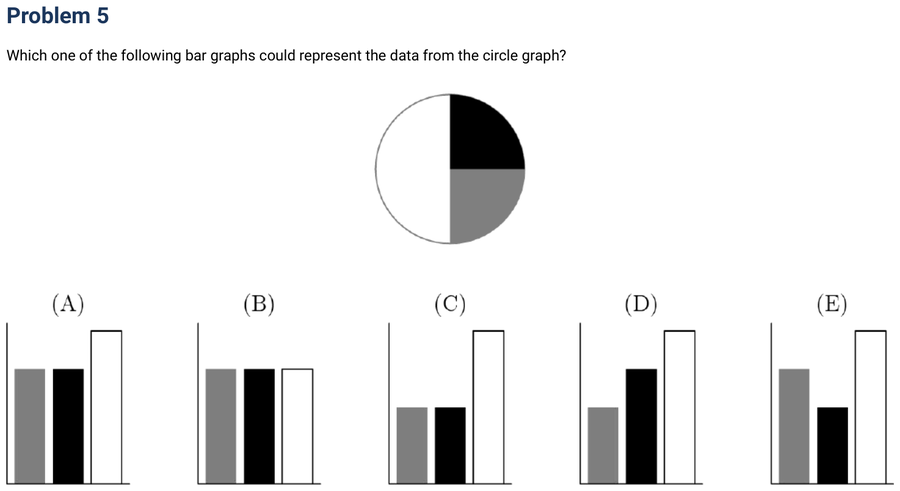
ajhsme-1993-05
Show answer
Answer: C — Bar graph C.
Show hints
Hint 1 of 2
Read the three slice sizes: one is half, the other two are quarters.
Still stuck? Show hint 2 →
Hint 2 of 2
The matching bar graph has one bar twice as tall as the two equal ones.
Show solution
Approach: match slice sizes to bar heights
  1. The circle is half white and two equal quarters (black and gray).
  2. So the bars should show one tall bar (white) twice the height of two equal shorter bars — that's graph C.
Mark: · log in to save
Problem 6 · 1993 AJHSME Medium
Ratios, Rates & Proportions unit-rate

A can of soup can feed 3 adults or 5 children. If there are 5 cans of soup and 15 children are fed, then how many adults would the remaining soup feed?

Show answer
Answer: B — 6 adults.
Show hints
Hint 1 of 2
First find how many cans the 15 children use.
Still stuck? Show hint 2 →
Hint 2 of 2
The leftover cans each feed 3 adults.
Show solution
Approach: use cans for children, then convert the rest
  1. 15 children need 15 ÷ 5 = 3 cans, leaving 5 − 3 = 2 cans.
  2. Those 2 cans feed 2 × 3 = 6 adults.
Mark: · log in to save
Problem 7 · 1993 AJHSME Medium
Number Theory exponent-rules

33 + 33 + 33 =

Show answer
Answer: A — 3⁴.
Show hints
Hint 1 of 2
Three copies of the same thing is 3 times it.
Still stuck? Show hint 2 →
Hint 2 of 2
3 × 3³ = 3¹ × 3³.
Show solution
Approach: factor out the common power
  1. 3³ + 3³ + 3³ = 3 × 3³.
  2. Adding exponents, 3 × 3³ = 3⁴.
Mark: · log in to save
Problem 8 · 1993 AJHSME Medium
Ratios, Rates & Proportions rate

To control her blood pressure, Jill's grandmother takes one half of a pill every other day. If one supply of medicine contains 60 pills, then the supply would last approximately

Show answer
Answer: D — 8 months.
Show hints
Hint 1 of 2
How many doses are in 60 pills if each dose is half a pill?
Still stuck? Show hint 2 →
Hint 2 of 2
Each dose covers two days.
Show solution
Approach: doses, then days
  1. 60 pills ÷ ½ per dose = 120 doses, and each dose lasts 2 days, so 240 days.
  2. 240 days is about 8 months.
Mark: · log in to save
Problem 9 · 1993 AJHSME Hard
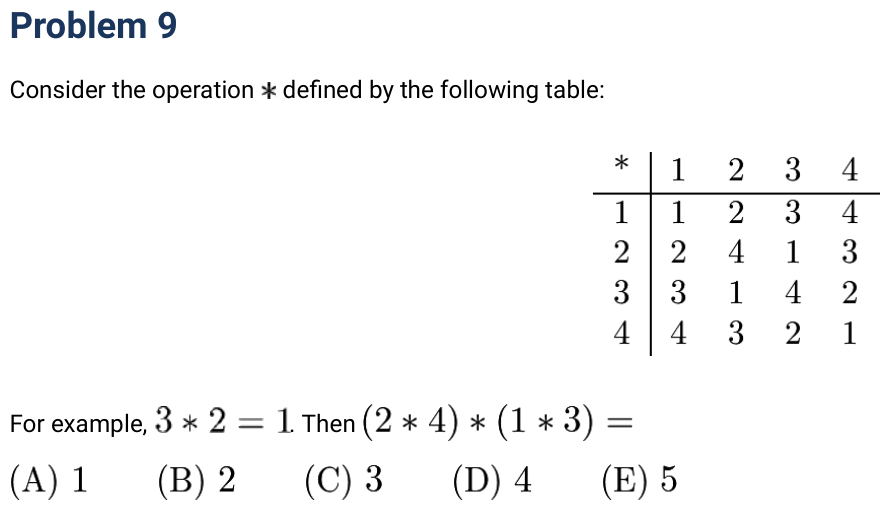
Algebra & Patterns read-table
ajhsme-1993-09
Show answer
Answer: D — 4.
Show hints
Hint 1 of 2
Read each starred product straight off the table.
Still stuck? Show hint 2 →
Hint 2 of 2
Do the two inner operations first, then combine.
Show solution
Approach: look up each operation in the table
  1. From the table, 2 ∗ 4 = 3 and 1 ∗ 3 = 3.
  2. Then 3 ∗ 3 = 4.
Mark: · log in to save
Problem 10 · 1993 AJHSME Medium
Arithmetic & Operations read-graph
ajhsme-1993-10
Show answer
Answer: B — March.
Show hints
Hint 1 of 2
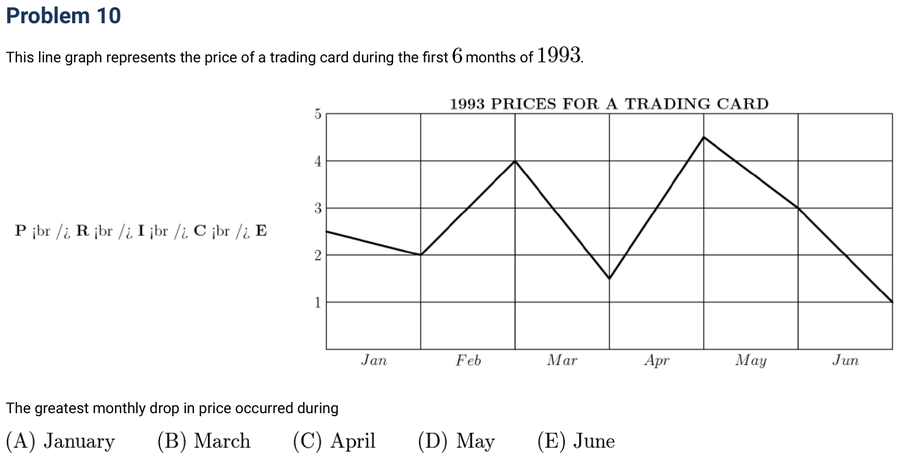
A 'drop' is a downward segment of the line.
Still stuck? Show hint 2 →
Hint 2 of 2
Compare the sizes of the downward steps and pick the steepest one.
Show solution
Approach: compare the downward steps
  1. Look only at the segments where the price falls and measure how far each drops.
  2. The steepest downward step starts at the March price, so the greatest monthly drop occurred during March.
Mark: · log in to save
Problem 11 · 1993 AJHSME Hard
Arithmetic & Operations mediancumulative-count
ajhsme-1993-11
Show answer
Answer: C — 70.
Show hints
Hint 1 of 2
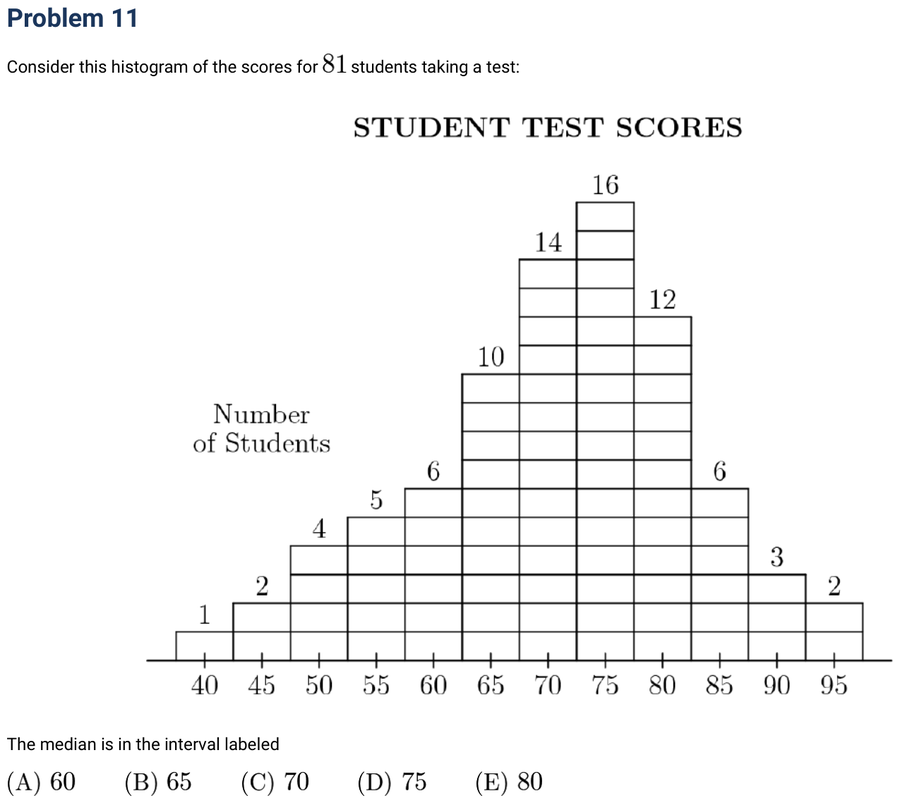
With 81 students, the median is the 41st score from the bottom.
Still stuck? Show hint 2 →
Hint 2 of 2
Add bar heights from the left until you pass 41.
Show solution
Approach: count up to the middle student
  1. The median is the 41st of 81 students. Adding the bars from the low end: 1, 3, 7, 12, 18, 28, 42 — the running total passes 41 at the 70 bar.
  2. So the median lies in the interval labeled 70.
Mark: · log in to save
Problem 12 · 1993 AJHSME Hard
Arithmetic & Operations order-of-operationstrial

If each of the three operation signs +, −, × is used exactly once in one of the blanks in the expression 5 __ 4 __ 6 __ 3, then the value of the result could equal

Show answer
Answer: E — 19.
Show hints
Hint 1 of 2
Remember multiplication happens before addition and subtraction.
Still stuck? Show hint 2 →
Hint 2 of 2
Try placing × between 6 and 3.
Show solution
Approach: try placements, respecting order of operations
  1. Take 5 − 4 + 6 × 3: the multiplication gives 18 first.
  2. Then 5 − 4 + 18 = 19, using each sign once.
Mark: · log in to save
Problem 13 · 1993 AJHSME Hard
Geometry & Measurement area-subtraction
ajhsme-1993-13
Show answer
Answer: D — 36.
Show hints
Hint 1 of 2
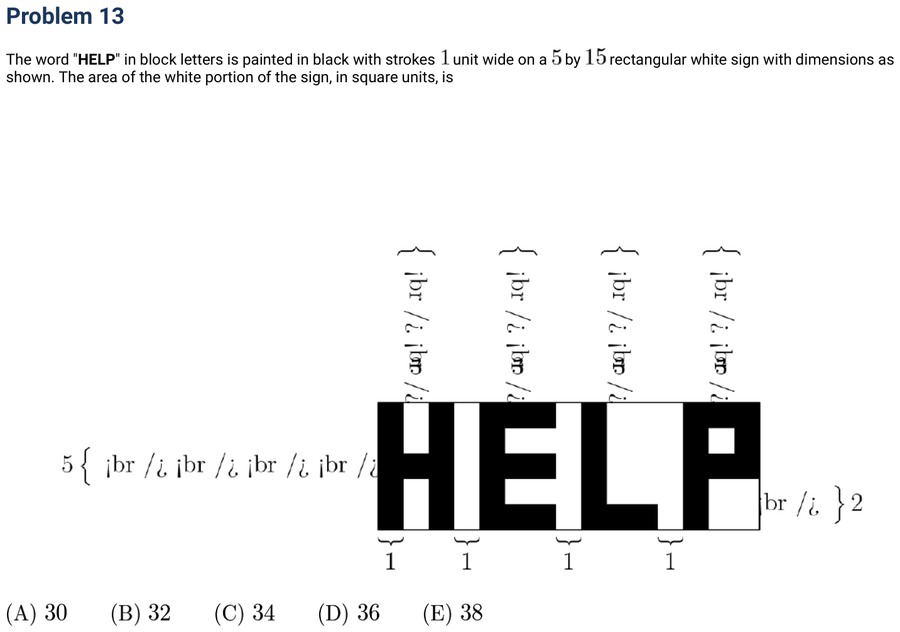
White area = whole sign − black letters.
Still stuck? Show hint 2 →
Hint 2 of 2
Count the unit squares each block letter covers.
Show solution
Approach: subtract the letters' area from the sign
  1. The sign is 5 × 15 = 75 square units, and the four block letters (1-unit strokes) cover 39 squares in total.
  2. So the white area is 75 − 39 = 36.
Mark: · log in to save
Problem 14 · 1993 AJHSME Hard
Logic & Word Problems latin-squarededuction
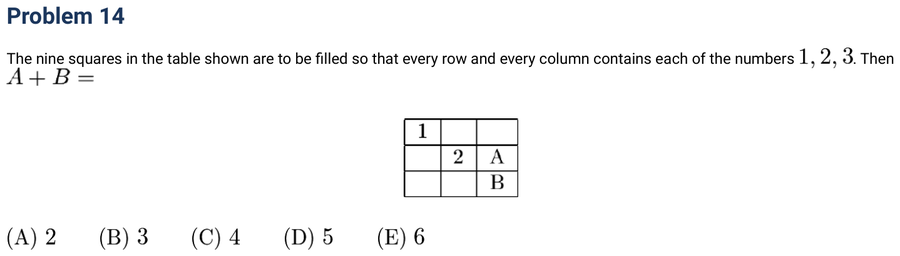
ajhsme-1993-14
Show answer
Answer: C — 4.
Show hints
Hint 1 of 2
Every row and every column must contain 1, 2, 3 exactly once — like a mini Sudoku.
Still stuck? Show hint 2 →
Hint 2 of 2
Fill in forced cells one at a time.
Show solution
Approach: deduce each cell from the row/column rule
  1. The top row already has 1, so its other cells are 2 and 3; the column with 2 and the diagonal force the middle column to read 3, 2, 1.
  2. Working through, A = 1 and B = 3, so A + B = 4.
Mark: · log in to save
Problem 15 · 1993 AJHSME Medium
Arithmetic & Operations average-sum

The arithmetic mean (average) of four numbers is 85. If the largest of these numbers is 97, then the mean of the remaining three numbers is

Show answer
Answer: A — 81.0.
Show hints
Hint 1 of 2
Find the total of all four numbers from the mean.
Still stuck? Show hint 2 →
Hint 2 of 2
Remove the largest, then average the other three.
Show solution
Approach: work with the total
  1. The four numbers total 4 × 85 = 340; removing 97 leaves 243.
  2. Their mean is 243 ÷ 3 = 81.0.
Mark: · log in to save
Problem 16 · 1993 AJHSME Hard
Fractions, Decimals & Percents continued-fraction
11 + 12 + 13=
Show answer
Answer: C — 7/10.
Show hints
Hint 1 of 2
Work from the bottom up.
Still stuck? Show hint 2 →
Hint 2 of 2
Simplify 2 + 1/3 first, then move outward.
Show solution
Approach: simplify from the inside out
  1. 2 + 1/3 = 7/3, so 1 ÷ (7/3) = 3/7, and 1 + 3/7 = 10/7.
  2. Finally 1 ÷ (10/7) = 7/10.
Mark: · log in to save
Problem 17 · 1993 AJHSME Hard
Geometry & Measurement surface-areanet
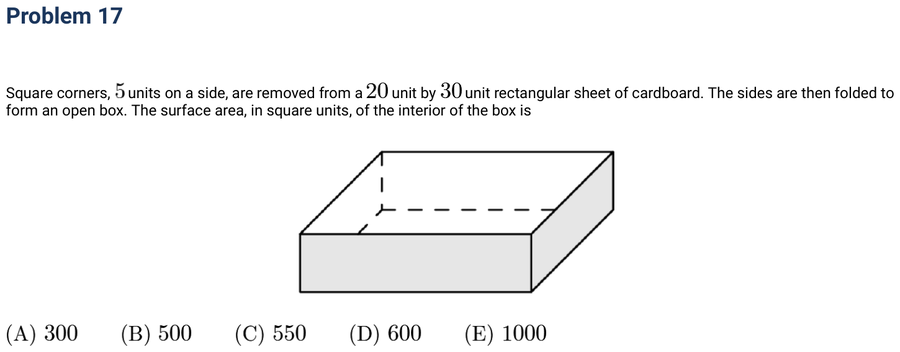
ajhsme-1993-17
Show answer
Answer: B — 500.
Show hints
Hint 1 of 2
After cutting 5×5 corners, the base is (20−10) by (30−10) and the height is 5.
Still stuck? Show hint 2 →
Hint 2 of 2
The open box has a bottom and four inner walls — no top.
Show solution
Approach: bottom plus the four walls
  1. The base is 10 × 20 = 200 and the height is 5, so the four walls add 2(10·5) + 2(20·5) = 300.
  2. The interior surface (no top) is 200 + 300 = 500.
Mark: · log in to save
Problem 18 · 1993 AJHSME Hard
Geometry & Measurement area-decompositionmidpoint
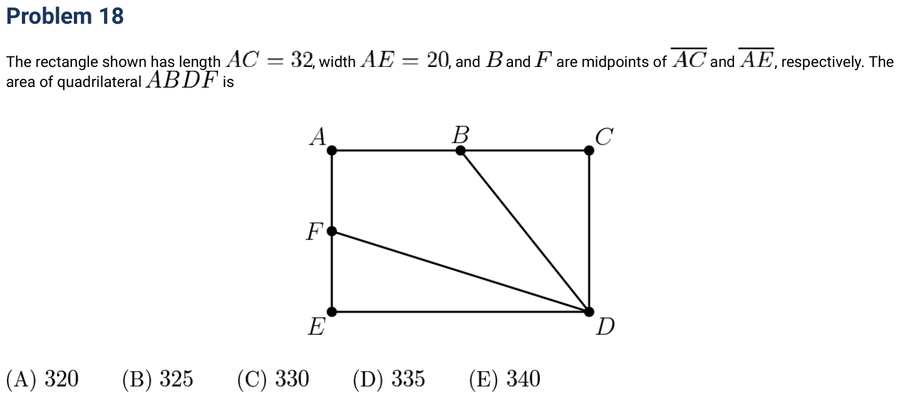
ajhsme-1993-18
Show answer
Answer: A — 320.
Show hints
Hint 1 of 2
Subtract the two right triangles cut off from the rectangle to leave ABDF.
Still stuck? Show hint 2 →
Hint 2 of 2
△BCD and △FED are right triangles with one leg = a midpoint half-length.
Show solution
Approach: rectangle minus two corner right triangles
  1. Rectangle ACDE has area 32 × 20 = 640. The two right triangles cut off to leave ABDF are △BCD (legs BC = 16, CD = 20, area 160) and △FED (legs FE = 10, ED = 32, area 160).
  2. ABDF = 640 − 160 − 160 = 320.
Another way — coordinates + shoelace:
  1. Place A(0,20), B(16,20), D(32,0), F(0,10). Shoelace gives ½|0·(20−10) + 16·(0−20) + 32·(10−20) + 0·(20−0)| = ½(320 + 320) = 320.
Mark: · log in to save
Problem 19 · 1993 AJHSME Hard
Algebra & Patterns pair-terms

(1901 + 1902 + 1903 + … + 1993) − (101 + 102 + 103 + … + 193) =

Show answer
Answer: A — 167,400.
Show hints
Hint 1 of 2
Line up the two sums term by term.
Still stuck? Show hint 2 →
Hint 2 of 2
Each top term is exactly 1800 more than the matching bottom term.
Show solution
Approach: subtract matching terms
  1. Both sums have 93 terms, and each top term beats its partner by 1901 − 101 = 1800.
  2. So the difference is 93 × 1800 = 167,400.
Mark: · log in to save
Problem 20 · 1993 AJHSME Stretch
Number Theory borrowing-patterndigit-sum

When 1093 − 93 is expressed as a single whole number, the sum of the digits is

Show answer
Answer: D — 826.
Show hints
Hint 1 of 2
Try a small case like 10⁴ − 93 = 9907 to see the shape.
Still stuck? Show hint 2 →
Hint 2 of 2
10ⁿ − 93 is a string of nines ending in 07.
Show solution
Approach: find the digit pattern from a small case
  1. 10⁴ − 93 = 9907, 10⁵ − 93 = 99907 — so 10ⁿ − 93 is (n − 2) nines followed by 07.
  2. For n = 93 that's 91 nines and a 0 and 7: 91 × 9 + 7 = 826.
Mark: · log in to save
Problem 21 · 1993 AJHSME Hard
Fractions, Decimals & Percents percent-area

If the length of a rectangle is increased by 20% and its width is increased by 50%, then the area is increased by

Show answer
Answer: D — 80%.
Show hints
Hint 1 of 2
Area multiplies by the two growth factors.
Still stuck? Show hint 2 →
Hint 2 of 2
1.2 × 1.5 — how much more than 1 is that?
Show solution
Approach: multiply the two growth factors
  1. The new area is 1.2 × 1.5 = 1.8 times the old area.
  2. That's an increase of 80%.
Mark: · log in to save
Problem 22 · 1993 AJHSME Stretch
Counting & Probability digit-counting

Pat Peano has plenty of 0's, 1's, 3's, 4's, 5's, 6's, 7's, 8's and 9's, but he has only twenty-two 2's. How far can he number the pages of his scrapbook with these digits?

Show answer
Answer: D — 119.
Show hints
Hint 1 of 2
The only limit is the supply of 2's — count how many 2's the page numbers use.
Still stuck? Show hint 2 →
Hint 2 of 2
Pages 1–99 use 20 twos; then keep going until the 2's run out.
Show solution
Approach: track how the 2's get used up
  1. Pages 1–99 use 20 twos (ten in the units place, ten in the tens place). That leaves 2 twos.
  2. Pages 102 and 112 use one 2 each, exhausting the supply; pages 113–119 need no 2, but 120 would, so he can reach 119.
Mark: · log in to save
Problem 23 · 1993 AJHSME Stretch
Logic & Word Problems orderingconstraints

Five runners, P, Q, R, S, T, have a race. P beats Q, P beats R, Q beats S, and T finishes after P and before Q. Who could NOT have finished third in the race?

Show answer
Answer: C — P and S.
Show hints
Hint 1 of 2
Combine the clues into chains: P is ahead of Q, R, and T, and S is behind Q.
Still stuck? Show hint 2 →
Hint 2 of 2
Count how many runners must be ahead of each person.
Show solution
Approach: see who is forced too high or too low
  1. P beats Q, R, and T, and P < T < Q < S, so P is always first — it can't be third.
  2. S comes after Q, which comes after both P and T, so at least three runners beat S, putting it 4th or later — also never third. So the answer is P and S.
Mark: · log in to save
Problem 24 · 1993 AJHSME Stretch
Number Theory patternrows

The figure below shows a triangular ‘staircase’ array of numbers. The first row has 1 number, the second row has 3, the third row has 5, and so on (the kth row has 2k−1 numbers, in order).

1
2  3  4
5  6  7  8  9
10  11  12  13  14  15  16

What number is directly above 142 in this array of numbers?

Show answer
Answer: C — 120.
Show hints
Hint 1 of 2
Row k ends at the perfect square k², and holds 2k − 1 numbers.
Still stuck? Show hint 2 →
Hint 2 of 2
Find which row holds 142, then the number sitting one row up and aligned with it.
Show solution
Approach: use the row structure of the triangle
  1. Rows end at 1, 4, 9, 16, …, k², so 142 is in row 12 (122–144), as its 21st of 23 entries.
  2. Row 11 (101–121) sits centered above, so directly above the 21st entry is the 20th entry of row 11: 101 + 19 = 120.
Mark: · log in to save
Problem 25 · 1993 AJHSME Stretch
Geometry & Measurement coveringtilting

A checkerboard consists of one-inch squares. A square card, 1.5 inches on a side, is placed on the board so that it covers part or all of the area of each of n squares. The maximum possible value of n is

Show answer
Answer: E — 12 or more.
Show hints
Hint 1 of 2
Don't keep the card lined up with the grid — tilt it.
Still stuck? Show hint 2 →
Hint 2 of 2
A tilted card pokes its corners into many extra squares.
Show solution
Approach: tilt the card to cross more grid lines
  1. Lined up, the 1.5-inch card touches only up to a 3 × 3 block (9 squares).
  2. But tilting it lets its corners reach into still more squares, so it can cover 12 or more.
Mark: · log in to save