What is the smallest sum of two 3-digit numbers that can be obtained by placing each of the six digits 4, 5, 6, 7, 8, 9 in one of the six boxes in this addition problem?
+
Show answer
Answer: C — 1047.
Show hints
Hint 1 of 2
The hundreds digits matter most, so put the two smallest there.
Still stuck? Show hint 2 →
Hint 2 of 2
Then the next-smallest in the tens, and the largest in the units.
Show solution
Approach: small digits into the big place values
Put 4 and 5 in the hundreds (900), 6 and 7 in the tens (130), and 8 and 9 in the units (17).
A dress originally priced at 80 dollars was put on sale for 25% off. If 10% tax was added to the sale price, then the total selling price (in dollars) of the dress was
Show answer
Answer: D — 66 dollars.
Show hints
Hint 1 of 2
Take 25% off first, then add the tax on the reduced price.
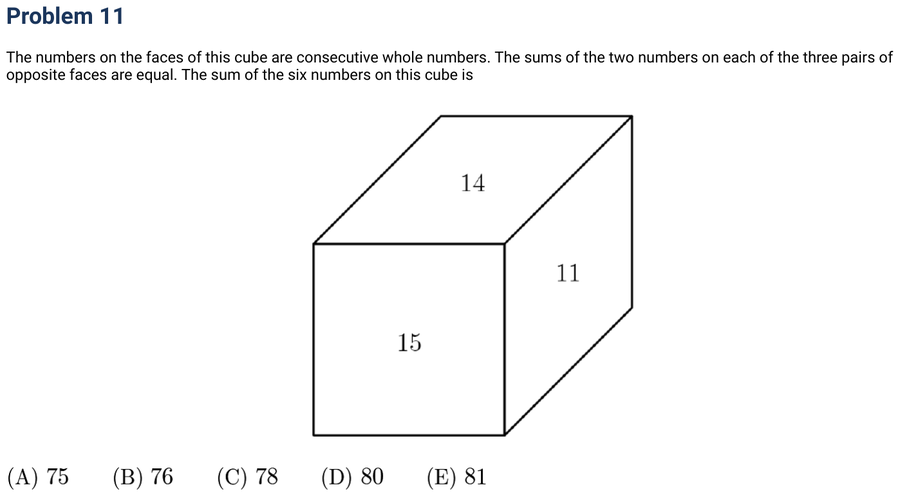
The six faces are six consecutive numbers including the visible 11, 14, 15.
Still stuck? Show hint 2 →
Hint 2 of 2
The visible faces meet at a corner, so they can't be opposite each other — that pins which six numbers.
Show solution
Approach: use the equal-opposite-sums to fix the six numbers
The visible 11, 14, 15 are mutually adjacent, so they aren't opposite pairs. The six consecutive numbers must be 11–16, pairing as 11+16, 12+15, 13+14 (each summing to 27).
There are twenty-four 4-digit numbers that use each of the four digits 2, 4, 5, and 7 exactly once. Listed in numerical order from smallest to largest, the number in the 17th position in the list is
Show answer
Answer: B — 5724.
Show hints
Hint 1 of 2
Each choice of leading digit fixes 3! = 6 numbers.
Still stuck? Show hint 2 →
Hint 2 of 2
Find which leading-digit block holds the 17th, then list within it.
Show solution
Approach: group by leading digit, then order within
Leading 2: positions 1–6, leading 4: 7–12, leading 5: 13–18. So the 17th is the 5th number starting with 5.
Those are 5247, 5274, 5427, 5472, 5724 — the 5th is 5724.
One proposal for new postage rates for a letter was 30 cents for the first ounce and 22 cents for each additional ounce (or fraction of an ounce). The postage for a letter weighing 4.5 ounces was
Show answer
Answer: C — 1.18 dollars.
Show hints
Hint 1 of 2
After the first ounce, 3.5 ounces remain — each fraction counts as a whole charge.
Still stuck? Show hint 2 →
Hint 2 of 2
Round 3.5 up to 4 additional charges.
Show solution
Approach: first ounce plus rounded-up additional ounces
After the first ounce (30¢), 3.5 ounces remain, charged as 4 additional ounces.
A bag contains only blue balls and green balls. There are 6 blue balls. If the probability of drawing a blue ball at random from this bag is 14, then the number of green balls in the bag is
Show answer
Answer: B — 18.
Show hints
Hint 1 of 2
If blue is 1/4 of the balls, the total is 4 times the blue count.
Still stuck? Show hint 2 →
Hint 2 of 2
Subtract the blue balls to get the green ones.
Show solution
Approach: find the total, then subtract blue
Blue = 1/4 of all, so the total is 4 × 6 = 24 balls.
A straight concrete sidewalk is to be 3 feet wide, 60 feet long, and 3 inches thick. How many cubic yards of concrete must a contractor order for the sidewalk if concrete must be ordered in a whole number of cubic yards?
Show answer
Answer: A — 2.
Show hints
Hint 1 of 2
Convert 3 inches to feet (1/4 ft) and find the volume in cubic feet.
Still stuck? Show hint 2 →
Hint 2 of 2
There are 27 cubic feet in a cubic yard; round up.
There are 120 seats in a row. What is the fewest number of seats that must be occupied so the next person to be seated must sit next to someone?
Show answer
Answer: B — 40.
Show hints
Hint 1 of 2
You want every empty seat to touch an occupied one.
Still stuck? Show hint 2 →
Hint 2 of 2
Each occupied seat can 'cover' itself plus its two neighbors — three seats per person.
Show solution
Approach: each occupied seat covers a block of 3
Each occupied seat covers itself and its two neighbors — at most 3 seats. So 120 ÷ 3 = 40 people are necessary, and 39 leaves at least one empty seat with two empty neighbors.
40 is also enough: seat one person in every block of (occupied, empty, empty). Every empty seat touches an occupied one. So the answer is 40.
The annual incomes of 1,000 families range from 8200 dollars to 98,000 dollars. In error, the largest income was entered on the computer as 980,000 dollars. The difference between the mean of the incorrect data and the mean of the actual data is
Show answer
Answer: A — 882 dollars.
Show hints
Hint 1 of 2
Only one entry changed, so the totals differ by that one error.
Still stuck? Show hint 2 →
Hint 2 of 2
Divide the size of the error by the number of families.
Show solution
Approach: spread the single error over all families
The wrong entry overstates the total by 980,000 − 98,000 = 882,000.
Over 1,000 families, the mean is off by 882,000 ÷ 1000 = $882.
A list of 8 numbers is formed by beginning with two given numbers. Each new number in the list is the product of the two previous numbers. Find the first number if the last three numbers are 16, 64, 1024.
Show answer
Answer: B — 1/4.
Show hints
Hint 1 of 2
Each term is the product of the two before it, so divide to step backward.
Still stuck? Show hint 2 →
Hint 2 of 2
From 16, 64, 1024 work back: the term before 16 is 64 ÷ 16, and so on.
Show solution
Approach: divide to walk back to the start
Since 1024 = 16 · 64, the term before 16 is 64 ÷ 16 = 4, then 16 ÷ 4 = 4, then 4 ÷ 4 = 1, then 4 ÷ 1 = 4, and finally 1 ÷ 4 = 1/4.
Several students are seated at a large circular table. They pass around a bag of 100 pieces of candy. Each person takes one piece and passes the bag to the next person. If Chris takes the first and the last piece of candy, then the number of students at the table could be
Show answer
Answer: B — 11.
Show hints
Hint 1 of 2
Chris takes pieces 1, n+1, 2n+1, … where n is the number of students.
Still stuck? Show hint 2 →
Hint 2 of 2
Taking the 100th piece too means 99 is a multiple of n.
Show solution
Approach: the gap between Chris's pieces must divide 99
Chris takes the 1st and every nth piece after, so for the 100th to be his, n must divide 100 − 1 = 99.
Of the choices, only 11 divides 99, so there could be 11 students.
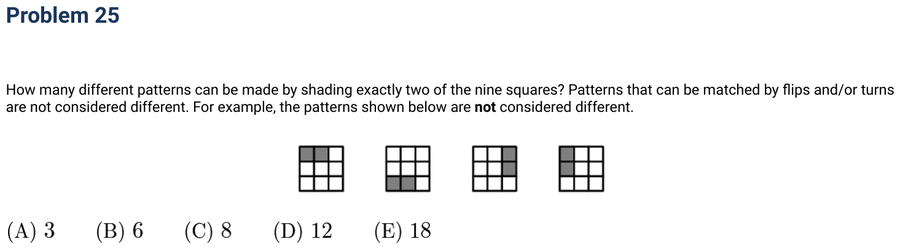
The nine cells come in three kinds: center, edges, and corners.
Still stuck? Show hint 2 →
Hint 2 of 2
Group the chosen pairs by the kinds of the two cells and their relative position.
Show solution
Approach: classify the shaded pairs up to flips and turns
Sort the two-cell choices by type: center+edge, center+corner, two adjacent edges, two opposite edges, two adjacent corners, two diagonal corners, corner+touching edge, corner+far edge.
These give 8 patterns that can't be matched by any flip or turn, so the answer is 8.