AJHSME · Test Mode

1989 AJHSME

Test mode — hints and solutions are locked. Pick an answer for each, then submit at the bottom to see your score.

← Exit test mode No hints or solutions until you submit.
Problem 1 · 1989 AJHSME Easy
Arithmetic & Operations pair-terms

(1 + 11 + 21 + 31 + 41) + (9 + 19 + 29 + 39 + 49) =

Show answer
Answer: E — 250.
Show hints
Hint 1 of 2
Pair the first term of each group with the matching term of the other.
Still stuck? Show hint 2 →
Hint 2 of 2
Each pair like 1 + 9 makes a round 10 (then 30, 50, …).
Show solution
Approach: pair across the two groups
  1. Pairing gives 1+9, 11+19, 21+29, 31+39, 41+49 = 10, 30, 50, 70, 90.
  2. Their sum is 10 + 30 + 50 + 70 + 90 = 250.
Mark: · log in to save
Problem 2 · 1989 AJHSME Easy
Fractions, Decimals & Percents place-value

210 + 4100 + 61000 =

Show answer
Answer: D — .246.
Show hints
Hint 1 of 2
Each fraction is a decimal in its own place: tenths, hundredths, thousandths.
Still stuck? Show hint 2 →
Hint 2 of 2
Just write the digits in order.
Show solution
Approach: place each digit in its decimal slot
  1. 2/10 = 0.2, 4/100 = 0.04, 6/1000 = 0.006.
  2. Adding gives .246.
Mark: · log in to save
Problem 3 · 1989 AJHSME Easy
Fractions, Decimals & Percents compare-decimals

Which of the following numbers is the largest?

Show answer
Answer: A — .99.
Show hints
Hint 1 of 2
Compare the digits right after the decimal point.
Still stuck? Show hint 2 →
Hint 2 of 2
.99 has a 9 in the hundredths place; the others have 0 there.
Show solution
Approach: compare place by place
  1. All start with .9; in the hundredths place .99 has a 9 while the rest have 0.
  2. So .99 is largest.
Mark: · log in to save
Problem 4 · 1989 AJHSME Medium
Fractions, Decimals & Percents estimation

Estimate to determine which of the following numbers is closest to 401.205.

Show answer
Answer: E — 2000.
Show hints
Hint 1 of 2
Round 401 to 400 and .205 to .2.
Still stuck? Show hint 2 →
Hint 2 of 2
Dividing by .2 is the same as multiplying by 5.
Show solution
Approach: round, then divide
  1. 401/.205 ≈ 400/0.2 = 400 × 5 = 2000.
  2. So it is closest to 2000.
Mark: · log in to save
Problem 5 · 1989 AJHSME Medium
Arithmetic & Operations order-of-operations

−15 + 9 × (6 ÷ 3) =

Show answer
Answer: D — 3.
Show hint
Hint 1
Do the parentheses and multiplication before the addition.
Show solution
Approach: follow the order of operations
  1. 6 ÷ 3 = 2, then 9 × 2 = 18.
  2. Finally −15 + 18 = 3.
Mark: · log in to save
Problem 6 · 1989 AJHSME Medium
Arithmetic & Operations number-linespacing
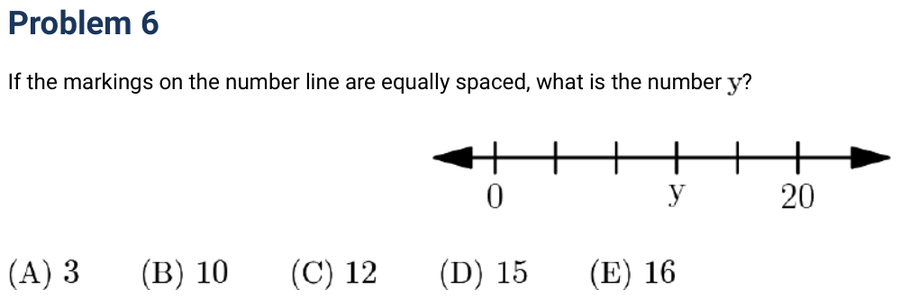
ajhsme-1989-06
Show answer
Answer: C — 12.
Show hints
Hint 1 of 2
Count how many equal steps lie between 0 and 20 to find each step's size.
Still stuck? Show hint 2 →
Hint 2 of 2
Then count the steps from 0 up to y.
Show solution
Approach: find the step size, then count to y
  1. There are 5 equal steps from 0 to 20, so each step is 4. y sits 3 steps past 0.
  2. So y = 3 × 4 = 12.
Mark: · log in to save
Problem 7 · 1989 AJHSME Medium
Algebra & Patterns coin-value

If the value of 20 quarters and 10 dimes equals the value of 10 quarters and n dimes, then n =

Show answer
Answer: D — 35.
Show hints
Hint 1 of 2
Trading away 10 quarters loses 250 cents — make it up in dimes.
Still stuck? Show hint 2 →
Hint 2 of 2
Each dime is worth 10 cents.
Show solution
Approach: balance the values in cents
  1. 20 quarters + 10 dimes = 600¢. The other side is 250¢ from 10 quarters, so the dimes must supply 350¢.
  2. 350 ÷ 10 = 35 dimes.
Mark: · log in to save
Problem 8 · 1989 AJHSME Medium
Fractions, Decimals & Percents distribute

(2 × 3 × 4) (12 + 13 + 14) =

Show answer
Answer: E — 26.
Show hint
Hint 1
Distribute the front product across the three fractions — each one was chosen to make a clean whole number.
Show solution
Approach: distribute the 24 over the fractions
  1. 24 × ½ = 12, 24 × ⅓ = 8, 24 × ¼ = 6.
  2. Adding: 12 + 8 + 6 = 26.
Mark: · log in to save
Problem 9 · 1989 AJHSME Medium
Ratios, Rates & Proportions ratiopercent

There are 2 boys for every 3 girls in Ms. Johnson's math class. If there are 30 students in her class, what percent of them are boys?

Show answer
Answer: C — 40%.
Show hints
Hint 1 of 2
The ratio 2 : 3 makes 5 equal parts in all.
Still stuck? Show hint 2 →
Hint 2 of 2
Find how many students are in each part, then count the boys.
Show solution
Approach: split into ratio parts
  1. 5 parts make 30 students, so each part is 6 and the boys (2 parts) number 12.
  2. 12 of 30 is 40%.
Mark: · log in to save
Problem 10 · 1989 AJHSME Medium
Geometry & Measurement clock-angles

What is the number of degrees in the smaller angle between the hour hand and the minute hand on a clock that reads seven o'clock?

Show answer
Answer: D — 150°.
Show hints
Hint 1 of 2
Each hour mark on a clock face is the same number of degrees from the next.
Still stuck? Show hint 2 →
Hint 2 of 2
How many hour marks separate the hands at 7:00, and what's each mark worth?
Show solution
Approach: count hour marks × 30°
  1. 12 hour marks split 360° evenly, so each gap is 30°.
  2. At 7:00 the hands sit 5 marks apart the short way (12 → 7), giving 5 × 30° = 150°.
Mark: · log in to save
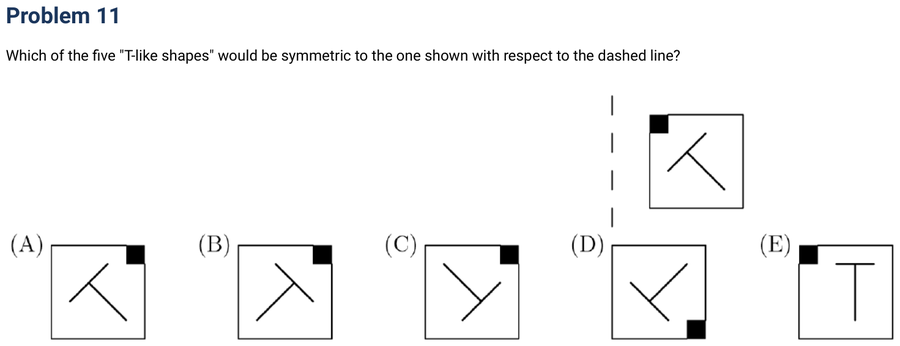
Problem 11 · 1989 AJHSME Hard
Geometry & Measurement reflection-symmetry
ajhsme-1989-11
Show answer
Answer: B — B.
Show hints
Hint 1 of 2
A reflection across a vertical line swaps left and right but leaves up and down alone.
Still stuck? Show hint 2 →
Hint 2 of 2
Hold each choice up to a mirror placed on the dashed line — only one matches the original.
Show solution
Approach: mentally flip left↔right and keep up/down
  1. Reflecting across the vertical dashed line swaps the left and right of every feature: the corner square moves to the opposite side of its box, and the slanted arms flip their lean.
  2. Choice B is the only T-like shape whose corner square and arms are the mirror image of the original.
Mark: · log in to save
Problem 12 · 1989 AJHSME Hard
Fractions, Decimals & Percents simplify-complex-fraction
1 − 131 − 12=
Show answer
Answer: E — 4⁄3.
Show hints
Hint 1 of 2
Compute the numerator and denominator separately before dividing.
Still stuck? Show hint 2 →
Hint 2 of 2
Dividing by a fraction is multiplying by its reciprocal.
Show solution
Approach: evaluate top and bottom, then flip-and-multiply
  1. Top: 1 − 1⁄3 = 2⁄3. Bottom: 1 − 1⁄2 = 1⁄2.
  2. (2⁄3) ÷ (1⁄2) = (2⁄3) × 2 = 4⁄3.
Mark: · log in to save
Problem 13 · 1989 AJHSME Hard
Fractions, Decimals & Percents proportional-scaling
97 × 53=
Show answer
Answer: A — .9 ⁄ (.7 × 53).
Show hints
Hint 1 of 2
Scaling the numerator and one denominator factor by the same amount leaves the fraction unchanged.
Still stuck? Show hint 2 →
Hint 2 of 2
Multiply the top and one factor on the bottom both by 0.1.
Show solution
Approach: match factors of 10 on top and bottom
  1. Choice A turns 9 → .9 (×0.1) and 7 → .7 (×0.1). Same ×0.1 on top and bottom cancels: .9 ⁄ (.7 × 53) = 9 ⁄ (7 × 53).
  2. Every other choice changes a different number of factors by 0.1, so its value differs from the original.
Mark: · log in to save
Problem 14 · 1989 AJHSME Hard
Number Theory minimize-differenceplace-value

When placing each of the digits 2, 4, 5, 6, 9 in exactly one of the boxes of this subtraction problem, what is the smallest difference that is possible?

   
−     
 
Show answer
Answer: C — 149.
Show hints
Hint 1 of 2
To minimize the difference, make the 3-digit number as small as you can and the 2-digit number as large as you can.
Still stuck? Show hint 2 →
Hint 2 of 2
Pick the smallest hundreds digit first, then build each number from the digits you have left.
Show solution
Approach: smallest 3-digit minus largest 2-digit
  1. Smallest 3-digit using three of {2, 4, 5, 6, 9}: lead with 2, then take the next two smallest ascending → 245.
  2. Largest 2-digit from the remaining {6, 9} is 96. Difference: 245 − 96 = 149.
Mark: · log in to save
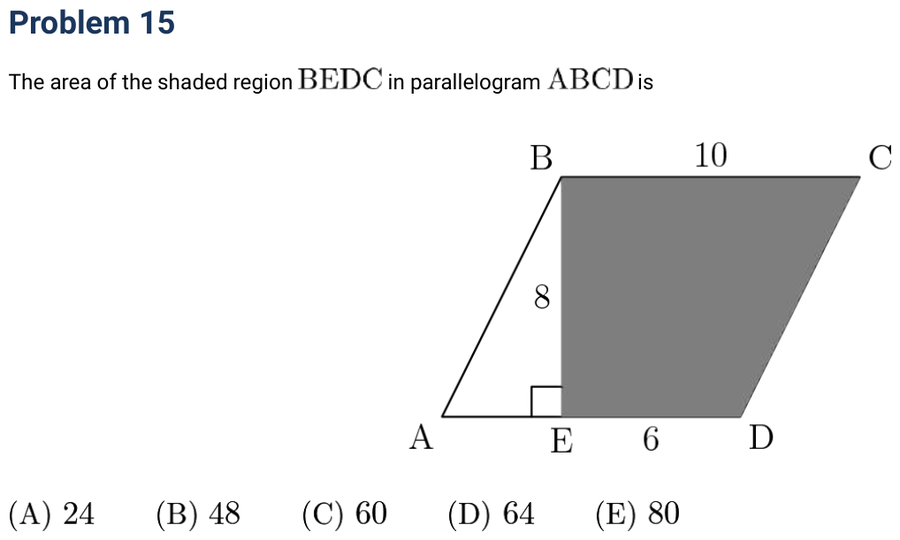
Problem 15 · 1989 AJHSME Hard
Geometry & Measurement trapezoid-areaparallelogram
ajhsme-1989-15
Show answer
Answer: D — 64.
Show hints
Hint 1 of 2
BEDC is a trapezoid: BC and ED are both horizontal, and BE is perpendicular to them.
Still stuck? Show hint 2 →
Hint 2 of 2
Use ½ × (sum of parallel sides) × height.
Show solution
Approach: trapezoid area directly
  1. AD = BC = 10 (opposite sides of the parallelogram). With ED = 6, the trapezoid BEDC has parallel sides BC = 10 and ED = 6, and height BE = 8.
  2. Area = ½(10 + 6)(8) = 64.
Mark: · log in to save
Problem 16 · 1989 AJHSME Hard
Number Theory parityprimes

In how many ways can 47 be written as the sum of two primes?

Show answer
Answer: A — 0.
Show hints
Hint 1 of 2
Odd = odd + even, so one of the two primes must be even.
Still stuck? Show hint 2 →
Hint 2 of 2
The only even prime is 2 — what does the other prime have to be?
Show solution
Approach: force one prime to be 2, then check
  1. 47 is odd, so one prime is even. The only even prime is 2, forcing the other prime to be 47 − 2 = 45.
  2. But 45 = 9 × 5 isn't prime, so there are 0 ways.
Mark: · log in to save
Problem 17 · 1989 AJHSME Hard
Algebra & Patterns bound-the-average

The number N is between 9 and 17. The average of 6, 10, and N could be

Show answer
Answer: B — 10.
Show hints
Hint 1 of 2
Plug the extreme values of N into the average formula to see what range the average can land in.
Still stuck? Show hint 2 →
Hint 2 of 2
Then check which choice falls inside that range.
Show solution
Approach: bound the average using the bounds on N
  1. Average = (6 + 10 + N)⁄3 = (16 + N)⁄3. With 9 < N < 17, this ranges from 25⁄3 ≈ 8.3 to 33⁄3 = 11.
  2. Of the choices, only 10 sits in that range (N = 14 gives average 10).
Mark: · log in to save
Problem 18 · 1989 AJHSME Hard
Algebra & Patterns involution

Many calculators have a reciprocal key 1/x that replaces the current number displayed with its reciprocal. For example, if the display is 00004 and the 1/x key is pressed, then the display becomes 000.25. If 00032 is currently displayed, what is the fewest positive number of times you must depress the 1/x key so the display again reads 00032?

Show answer
Answer: B — 2.
Show hints
Hint 1 of 2
Try the operation once, then again — does anything change after that?
Still stuck? Show hint 2 →
Hint 2 of 2
The reciprocal of the reciprocal is the original number.
Show solution
Approach: apply 1/x twice
  1. Press once: 32 → 1⁄32. Press again: 1⁄32 → 32.
  2. So the display reads 32 again after exactly 2 presses.
Mark: · log in to save
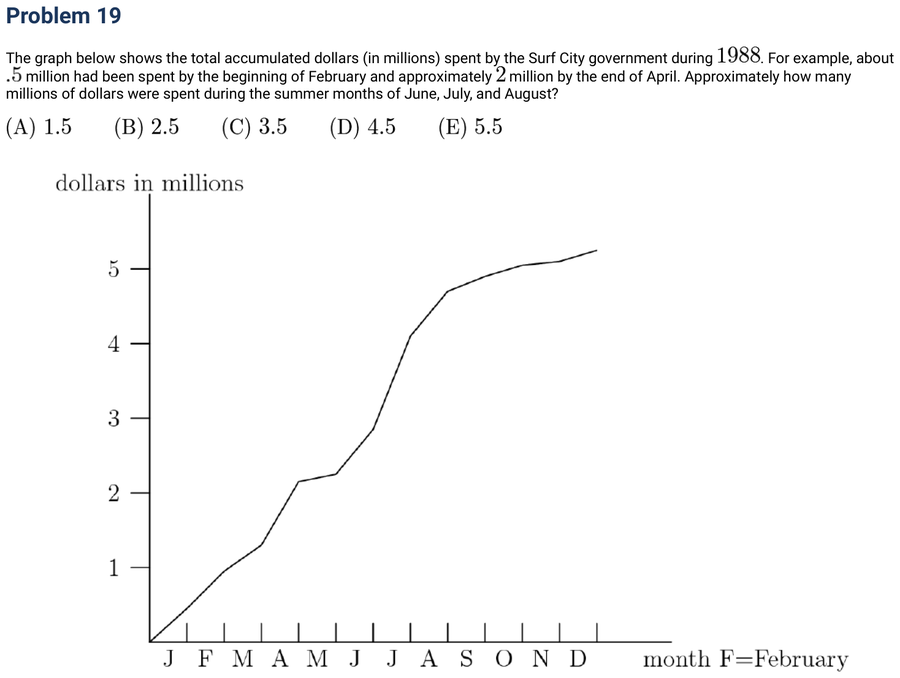
Problem 19 · 1989 AJHSME Hard
Ratios, Rates & Proportions read-cumulative-graphdifferences
ajhsme-1989-19
Show answer
Answer: B — 2.5.
Show hints
Hint 1 of 2
The graph is cumulative, so spending in any time window is the rise of the curve over that window.
Still stuck? Show hint 2 →
Hint 2 of 2
Read the total at the end of August and subtract the total at the end of May.
Show solution
Approach: difference of accumulated totals
  1. Summer covers June, July, and August. Read the curve at end-of-May (≈ 2.2) and end-of-August (≈ 4.7).
  2. Amount spent over the summer ≈ 4.7 − 2.2 = 2.5 million.
Mark: · log in to save
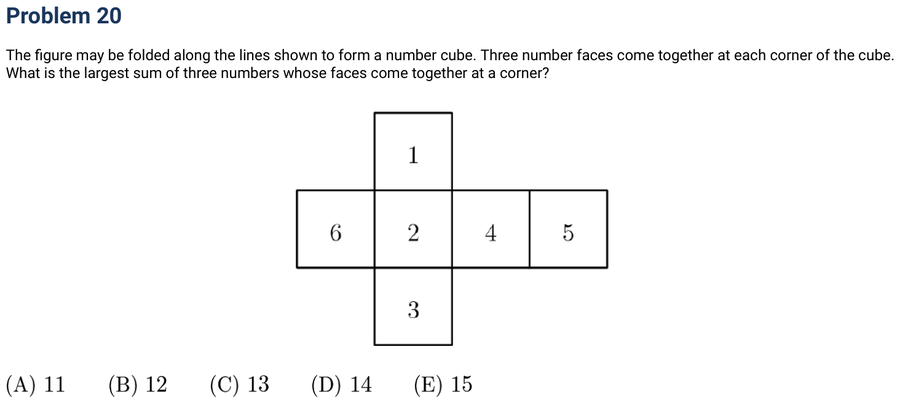
Problem 20 · 1989 AJHSME Hard
Geometry & Measurement cube-netopposite-faces
ajhsme-1989-20
Show answer
Answer: D — 14.
Show hints
Hint 1 of 2
Pair up the faces that end up opposite each other after folding — opposite faces never share a corner.
Still stuck? Show hint 2 →
Hint 2 of 2
At every corner, the three meeting faces are one from each opposite pair, so pick the larger number from each pair.
Show solution
Approach: find opposite-face pairs from the net, then take the max from each pair
  1. Fold the net with 2 as the front: 1 goes on top and 3 on the bottom (1↔3), 6 to the left and 4 to the right (6↔4), and 5 wraps around to the back opposite 2 (2↔5).
  2. Each corner has one face from each pair, so the biggest corner sum is 5 + 3 + 6 = 14.
Mark: · log in to save
Problem 21 · 1989 AJHSME Stretch
Fractions, Decimals & Percents keep-fractionpercent

Jack had a bag of 128 apples. He sold 25% of them to Jill. Next he sold 25% of those remaining to June. Of those apples still in his bag, he gave the shiniest one to his teacher. How many apples did Jack have then?

Show answer
Answer: D — 71.
Show hints
Hint 1 of 2
Selling 25% means keeping 75% = 3⁄4.
Still stuck? Show hint 2 →
Hint 2 of 2
Multiply by 3⁄4 twice, then subtract 1 for the apple given to the teacher.
Show solution
Approach: keep ¾ twice, then subtract 1
  1. After Jill: 128 × 3⁄4 = 96. After June: 96 × 3⁄4 = 72.
  2. Give 1 to the teacher: 72 − 1 = 71.
Mark: · log in to save
Problem 22 · 1989 AJHSME Stretch
Number Theory lcm-of-cycle-lengths

The letters A, J, H, S, M, E and the digits 1, 9, 8, 9 are "cycled" separately as follows and put together in a numbered list:

      AJHSME  1989
  1.  JHSMEA  9891
  2.  HSMEAJ  8919
  3.  SMEAJH  9198
      .........

What is the number of the line on which AJHSME 1989 will appear for the first time?

Show answer
Answer: C — 12.
Show hints
Hint 1 of 2
The letters return to AJHSME every 6 lines; the digits return to 1989 every 4 lines.
Still stuck? Show hint 2 →
Hint 2 of 2
The two parts line up again the first time both cycles finish together.
Show solution
Approach: LCM of the two cycle lengths
  1. The 6 letters come back after 6 cycles; the 4 digits come back after 4 cycles.
  2. Both line up together at the smallest common multiple: LCM(6, 4) = 12.
Mark: · log in to save
Problem 23 · 1989 AJHSME Stretch
Geometry & Measurement surface-areaexposed-faces
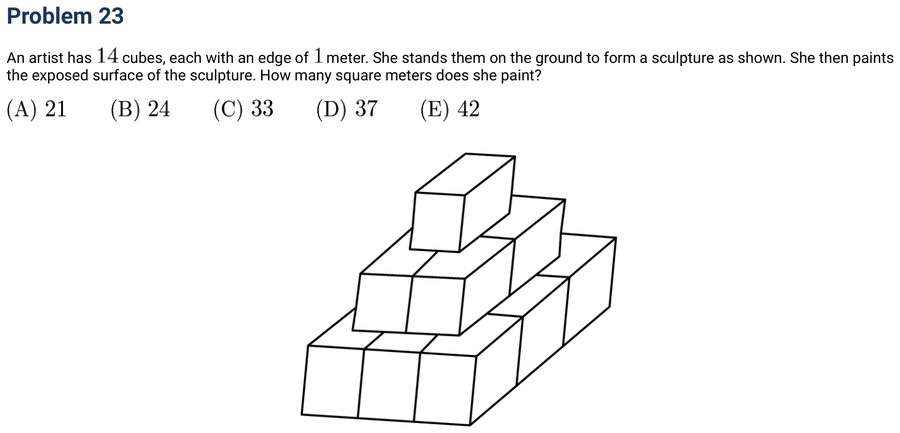
ajhsme-1989-23
Show answer
Answer: C — 33.
Show hints
Hint 1 of 2
Each cube face is 1 m². Count only the faces that are visible — none of those touching the ground or another cube.
Still stuck? Show hint 2 →
Hint 2 of 2
Sum the exposed faces from the top, front, back, left, right; faces hidden by neighbors don't count.
Show solution
Approach: tally exposed faces by direction
  1. Top faces (one per cube whose top isn't covered) total 10. Front-facing exposed faces total 6, back 6, and the two side walls together account for the remaining 11.
  2. Adding gives 10 + 6 + 6 + 11 = 33 square meters of paint.
Mark: · log in to save
Problem 24 · 1989 AJHSME Stretch
Geometry & Measurement fold-and-cutperimeter-ratio
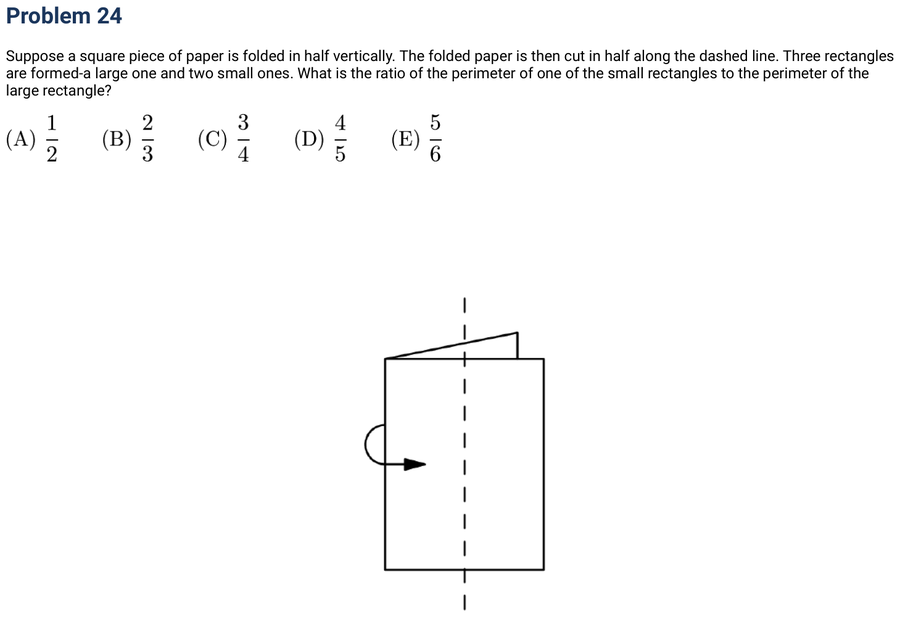
ajhsme-1989-24
Show answer
Answer: E — 5⁄6.
Show hints
Hint 1 of 2
Pick a convenient side length for the square (say 4) so the pieces have whole-number sides.
Still stuck? Show hint 2 →
Hint 2 of 2
The cut parallel to the fold leaves the fold-side as one rectangle; the open side falls apart into two.
Show solution
Approach: pick side 4 and read the three rectangles off
  1. Take the square 4 × 4. Folding halves the width to a 2 × 4 stack; cutting it in half parallel to the fold means the cut sits at 1 from the fold. The fold-side unfolds back into one 2 × 4 large rectangle; the open side becomes two separate 1 × 4 small rectangles.
  2. Small perimeter 2(1 + 4) = 10, large perimeter 2(2 + 4) = 12, ratio 10⁄12 = 5⁄6.
Mark: · log in to save
Problem 25 · 1989 AJHSME Stretch
Counting & Probability parityindependent-events
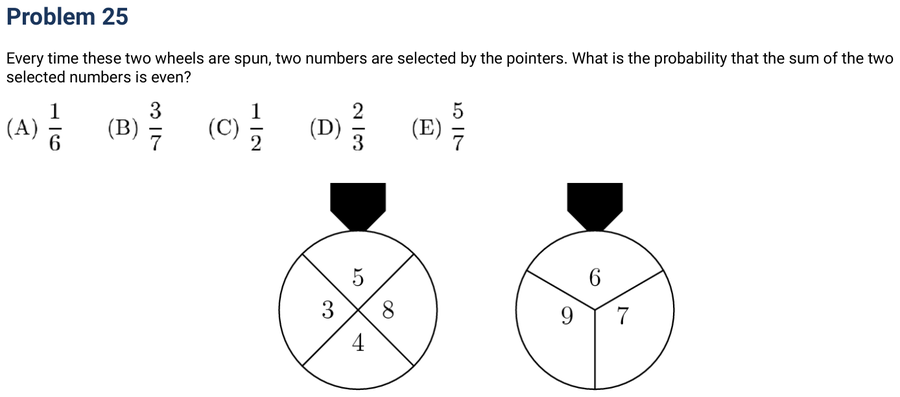
ajhsme-1989-25
Show answer
Answer: C — 1⁄2.
Show hints
Hint 1 of 2
The sum is even exactly when both wheels land on numbers of the same parity (both even or both odd).
Still stuck? Show hint 2 →
Hint 2 of 2
Compute the even/odd probabilities of each wheel separately, then combine.
Show solution
Approach: split on parity and multiply
  1. Wheel 1 has equal sectors {5, 3, 8, 4}: P(even) = 2⁄4 = ½, P(odd) = ½. Wheel 2 has equal sectors {6, 9, 7}: P(even) = 1⁄3, P(odd) = 2⁄3.
  2. P(both even) + P(both odd) = ½·⅓ + ½·⅔ = 1⁄6 + 2⁄6 = 1⁄2.
Mark: · log in to save