Tick one or more bands and topics — problems are pulled from every authored year.
Showing 20 of 205 matching
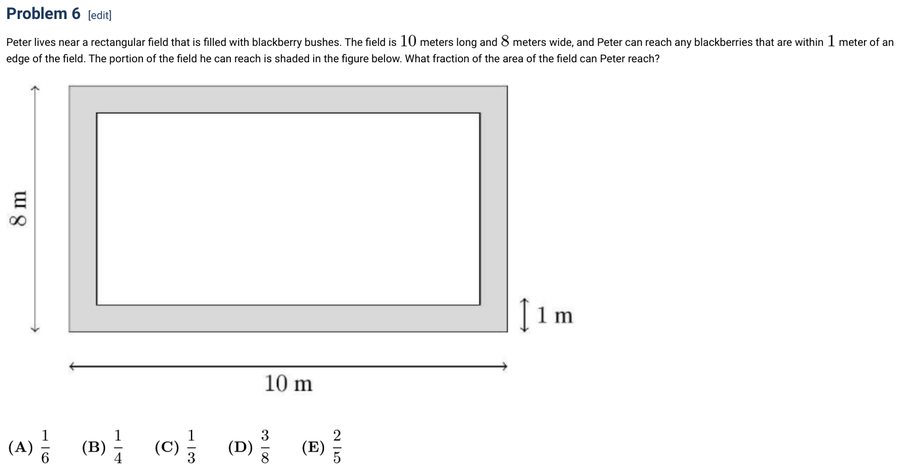
Problem 6 · 2026 AMC 8
Medium
Geometry & Measurementarea-decomposition
Show answer
Answer: E — 2/5.
Show hints
Hint 1 of 2
The reachable border is a frame around the field — an awkward shape. Don't measure it directly; what's the easy shape you'd subtract to leave only the frame?
Still stuck? Show hint 2 →
Hint 2 of 2
Find the unreachable inner rectangle instead (everything more than 1 m from every edge): a 1 m strip on each side shrinks each dimension by 2. Then border = whole − inner.
Show solution
Approach: complementary counting — subtract the easy inner rectangle
The reachable strip is a frame, which is fiddly to measure head-on. Flip it: the unreachable part is the rectangle more than 1 m from every edge — a clean rectangle.
A 1 m margin on each side trims 1 + 1 = 2 from each dimension: the inner rectangle is (10 − 2) × (8 − 2) = 8 × 6 = 48, out of the full 10 × 8 = 80.
So the reachable frame is 80 − 48 = 32, giving the fraction 32/80 = 2/5.
Why this transfers: a border/frame is almost always easiest as (whole rectangle) − (inner rectangle) — and remember a uniform margin shrinks each side by twice the margin, not once.
Mika wants to estimate how far a new electric bike goes on a full charge. She made two trips totaling 40 miles: the first used 12 of the battery and the second used 310 of the battery. How many miles can the bike go on a fully charged battery?
Show answer
Answer: C — 50 miles.
Show hints
Hint 1 of 2
The 40 miles didn't drain a full battery. First combine the two trips: what single fraction of the battery did the 40 miles actually use?
Still stuck? Show hint 2 →
Hint 2 of 2
Once you know 40 miles used some fraction of the charge, the rest is one proportion: scale that fraction up to a whole battery (the full charge is 5/5).
Show solution
Approach: find the fraction the 40 miles used, then scale to a whole battery
Combine the two trips: ½ + 3/10. With a common denominator, 5/10 + 3/10 = 8/10 = 4/5 of the battery powered the 40 miles.
If 4/5 of a charge gives 40 miles, each fifth gives 40 ÷ 4 = 10 miles, so a full 5/5 gives 5 × 10 = 50 miles.
Why this works: ‘a fraction of the whole equals a known amount’ is a proportion — find the value of one unit piece (here, one-fifth = 10 mi), then multiply up to the whole.
Another way — divide by the fraction:
4/5 of the battery = 40 miles, so the full battery is 40 ÷ 45 = 40 × 54 = 50 miles.
A poll asked some people whether they liked solving mathematics problems, and exactly 74% answered "yes." What is the fewest possible number of people who could have been asked?
Show answer
Answer: D — 50 people.
Show hints
Hint 1 of 2
You can't have a fraction of a person, so 74% of the group has to land on a whole number. What does that force about the group size?
Still stuck? Show hint 2 →
Hint 2 of 2
Reduce 74/100 to lowest terms. The denominator of the reduced fraction is the smallest group size that makes the count whole.
Show solution
Approach: the reduced denominator is the smallest workable group
‘74% said yes’ means (yes count) = 74100 × (group), and that has to be a whole number of people.
Reduce: 74100 = 3750. Since 37 and 50 share no factors, the group must be a multiple of 50 for 37/50 of it to be whole — so the fewest is 50 people (with 37 yeses).
Why this transfers: ‘exactly p% must be a whole count’ problems always come down to reducing p/100 — the smallest group is the reduced denominator, because that's the first size that clears the fraction.
Top and bottom are built from the very same numbers, 16 and 81, just with their roles swapped. That symmetry says: simplify each piece the same way and the answer should be a clean ratio — both are perfect squares and perfect fourth powers.
Still stuck? Show hint 2 →
Hint 2 of 2
Work each square root from the inside out: simplify the inner root, multiply, then take the outer root. Or notice 16 = 2⁴ and 81 = 3⁴ and ride the exponents.
Show solution
Approach: simplify each nested root from the inside out
Start with the innermost roots: √81 = 9 and √16 = 4. Now the insides are plain numbers.
Five runners finished a race: Luke, Melina, Nico, Olympia, and Pedro. Nico finished 11 minutes behind Pedro. Olympia finished 2 minutes ahead of Melina but 3 minutes behind Pedro. Olympia finished 6 minutes ahead of Luke. Which runner finished fourth?
Show answer
Answer: A — Luke.
Show hints
Hint 1 of 2
The clues compare runners to each other in a tangle. Pick one person as the zero mark and pin everybody's finish time to that single reference — which runner is mentioned most often?
Still stuck? Show hint 2 →
Hint 2 of 2
Pedro is the natural anchor (he appears in two clues). Put 0 at Pedro and write each other runner as ‘so many minutes behind Pedro,’ then just read the list in order.
Show solution
Approach: anchor everyone to one runner, then read the order
Pin everyone to Pedro at 0 (minutes behind him). Olympia is 3 behind → +3. Melina is 2 behind Olympia → +5. Luke is 6 behind Olympia → +9. Nico is 11 behind Pedro → +11.
Sorted front to back: Pedro (0), Olympia (3), Melina (5), Luke (9), Nico (11). Fourth across the line is Luke.
Why this transfers: for any ‘A is ahead/behind B’ ordering puzzle, convert every relative clue into a position on one number line anchored to a single person — the ranking then just falls out by sorting.
Sekou writes down the numbers 15, 16, 17, 18, 19. After he erases one of his numbers, the sum of the remaining four numbers is a multiple of 4. Which number did he erase?
Show answer
Answer: C — 17.
Show hints
Hint 1 of 2
You don't need the actual sums — only the leftover after dividing by 4 matters. What's each number's leftover?
Still stuck? Show hint 2 →
Hint 2 of 2
Find the leftover (remainder) of the total when divided by 4. The number you erase must carry away exactly that much leftover.
Show solution
Approach: track only the remainders (leftovers) mod 4
The full sum 15+16+17+18+19 = 85, and 85 = 84 + 1 leaves a leftover of 1 after dividing by 4. To make the remaining four a clean multiple of 4, you must erase exactly the leftover of 1.
Which number carries leftover 1? Checking: 16 leaves 0, 17 leaves 1, 18 leaves 2, 19 leaves 3, 15 leaves 3. Only 17 has leftover 1, so erase 17.
Why this transfers: for any divisibility question, work with remainders, not the big sums — a number's remainder is all that affects divisibility. Sanity check: 85 − 17 = 68 = 4 × 17. ✓
How many students earned a score of at least 80% and less than 90%?
Show answer
Answer: D — 37 students.
Show hints
Hint 1 of 2
These groups aren't separate piles — "at least 80%" already contains everyone who scored at least 90%. They're nested, like measuring cups inside each other.
Still stuck? Show hint 2 →
Hint 2 of 2
So to get just the 80–90% band, take the big group and subtract the part of it you don't want. Which two of the four counts do you need? (The 85% and 95% lines are decoys.)
Show solution
Approach: subtract the inner group from the outer (don't add the bands)
The four counts are nested, not separate: the 13 who scored ≥ 90% sit inside the 50 who scored ≥ 80%. So you subtract, you don't add.
Students in [80%, 90%) = (those ≥ 80%) − (those ≥ 90%) = 50 − 13 = 37. The 85% and 95% counts are just there to distract.
Why this transfers: with "at least" cutoffs, the count for a band is the difference of two cumulative counts — spot the nesting and subtract instead of trying to build each band from scratch.
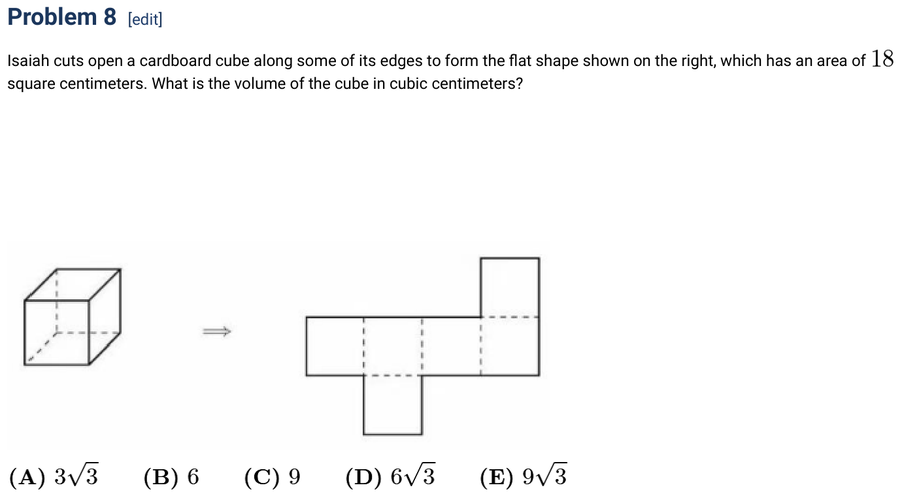
Why this transfers: the chain area → length → volume is one you'll reuse constantly — a square's side is √(area), and a cube's volume is that side cubed. Don't be thrown by the answer being a surd; (√3)3 = 3√3, not a whole number.
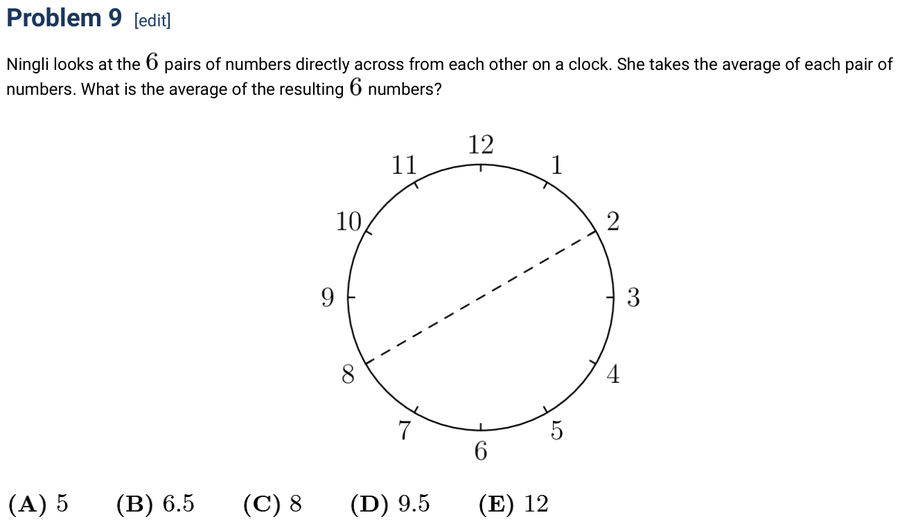
You don't need to know which numbers are paired. The 6 pairs use up all 12 clock numbers, each exactly once — so what are you really averaging?
Still stuck? Show hint 2 →
Hint 2 of 2
Averaging the six pair-averages (each pair the same size) just re-averages all 12 numbers. So the answer is simply the average of 1 through 12.
Show solution
Approach: average of equal-size pair-averages = overall average
Notice the actual pairings (1&2 across from 7&8, etc.) never matter: the six pairs cover all twelve numbers 1–12 exactly once. Averaging six equal-size pair-averages is the same as averaging all twelve numbers at once.
And 1–12 are evenly spaced, so their average is just the midpoint of the ends: (1 + 12)/2 = 6.5.
Why this transfers: averaging the averages of equal-size groups equals the overall average — but only when the groups are the same size. (Unequal groups need a weighted average.) And the mean of any evenly-spaced list is the midpoint of its first and last term.
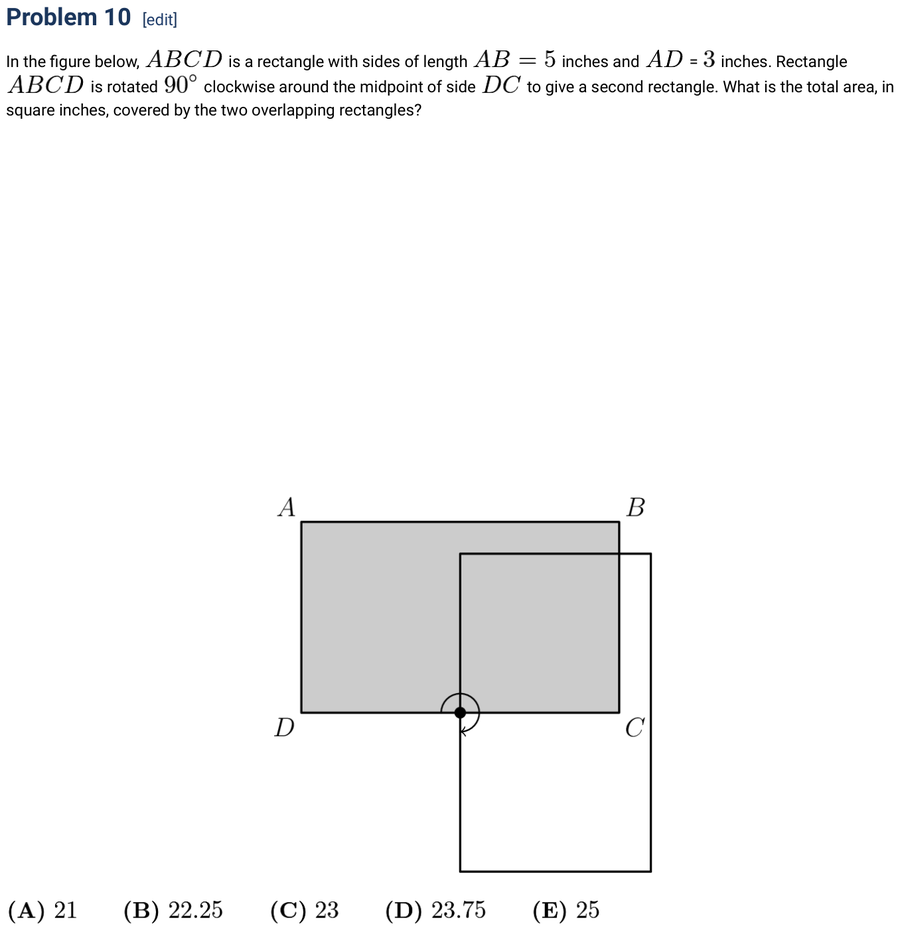
Don't try to find the funny outline directly. If you just add both rectangles' areas, what region gets counted twice?
Still stuck? Show hint 2 →
Hint 2 of 2
Area covered = (one rectangle) + (other rectangle) − (the overlap). So you only need the overlap's area. It's a square — and the pivot at the midpoint of DC fixes its side at 2.5.
Show solution
Approach: inclusion–exclusion (add both, subtract the double-count)
The shape covered is awkward, but its area isn't: add both rectangles and subtract the part you counted twice. Each rectangle is 5 × 3 = 15.
The overlap: the rotation pivots at the midpoint of DC, so along DC the shared strip is half of 5 = 2.5, and a quarter-turn makes the overlap a 2.5 × 2.5 square — area 2.52 = 6.25.
Covered area = 15 + 15 − 6.25 = 23.75.
Why this transfers: whenever two regions overlap, |A or B| = |A| + |B| − |A and B| — the overlap must be subtracted once because adding counts it twice. This inclusion–exclusion idea saves you from ever computing a messy combined outline.
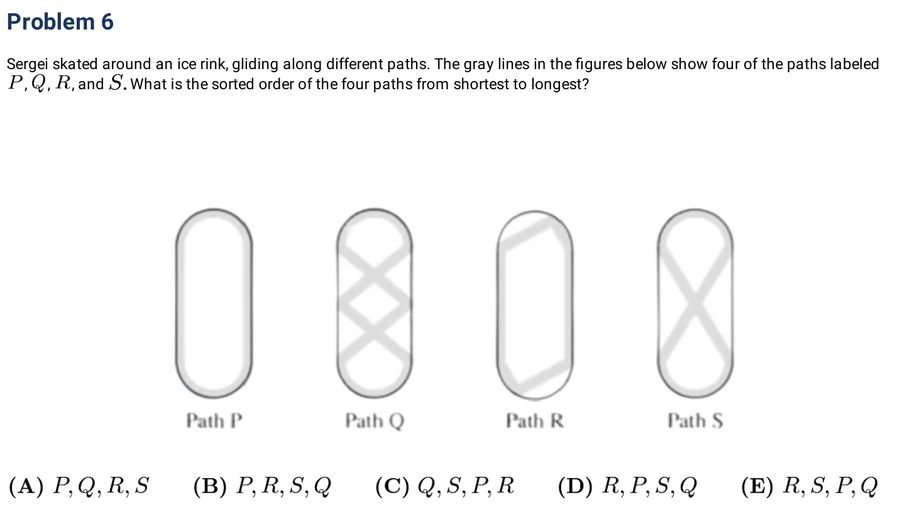
Don't try to measure anything. Use the plain oval P as your ruler, then ask of each other path: does it cut a corner (shorter) or detour across a diagonal (longer)?
Still stuck? Show hint 2 →
Hint 2 of 2
Principle: a straight chord across a curve is shorter than the arc; a diagonal across a rectangle is longer than the two sides it skips (hypotenuse > leg). Count cuts vs. diagonals for each path.
Show solution
Approach: compare each path to the plain oval boundary, no measuring
The whole problem is comparisons, not lengths — so compare every path to the plain oval P. R replaces the two rounded ends with straight chords; a straight chord is shorter than the arc it spans, so R < P. R is the shortest, which already narrows you to choices D and E.
S trades part of the boundary for one diagonal slash across the oval. That diagonal is the hypotenuse of a right triangle, and a hypotenuse is always longer than either leg it replaces — so S > P.
Q does the same trade but with two crossing diagonals, longer still: Q > S.
Order shortest→longest: R, P, S, Q — choice D. This transfers: in any "order the lengths" figure problem, look for arcs-vs-chords and diagonals-vs-sides rather than computing — the inequalities decide it.
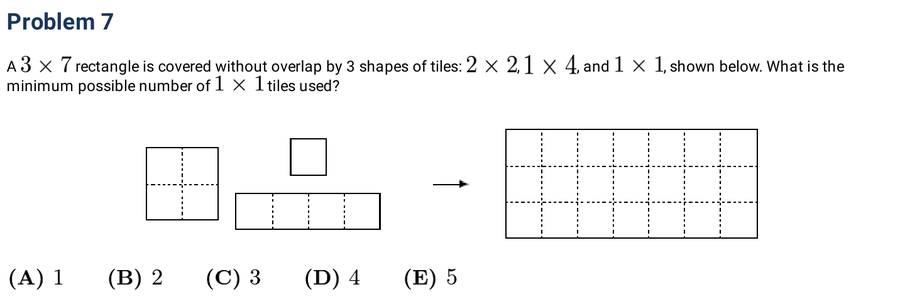
The 2×2 and 1×4 tiles BOTH cover exactly 4 squares. So before placing anything, what does that force about how many cells the tiny 1×1 tiles must mop up?
Still stuck? Show hint 2 →
Hint 2 of 2
Technique — a counting (mod 4) filter: the big tiles fill a multiple of 4, and 21 = 4×5 + 1, so the 1×1 count is 1, 5, 9, … You'd love 1, but check whether it can actually be tiled before believing it.
Show solution
Approach: count mod 4 to bound it, then a coloring argument rules out 1
Start with arithmetic, not pictures. Both big tiles cover 4 squares, so they always fill a multiple of 4. Since 21 = 4×5 + 1, the leftover for 1×1 tiles is 21 − (multiple of 4), which is 1, 5, 9, … The dream answer is 1.
Can just one 1×1 work? Color the 3×7 board in 4 repeating diagonal colors (or check by hand): the 2×2 and 1×4 tiles can't tile a 3×7 board with a single cell removed, no matter where that cell is — it never fits. So 1 is impossible.
Next allowed value is 5, and it's achievable: lay four big tiles (a mix of 2×2 and 1×4) covering 16 cells, then drop 1×1's into the 5 holes. Minimum = 5. This transfers: a covering count gives a quick lower-bound filter, but you still must exhibit one real arrangement — "allowed by counting" isn't the same as "buildable."
On Monday Taye has $2. Every day, he either gains $3 or doubles the amount of money he had on the previous day. How many different dollar amounts could Taye have on Thursday, 3 days later?
Show answer
Answer: D — 6 different amounts.
Show hints
Hint 1 of 2
Each day has 2 choices over 3 days, so 2×2×2 = 8 paths — but the question asks for AMOUNTS, not paths. Why might those two counts differ?
Still stuck? Show hint 2 →
Hint 2 of 2
Technique: track the SET of reachable amounts day by day, not the branching paths. When two paths land on the same dollar amount, the set automatically merges them — so you can't over-count.
Show solution
Approach: track the set of reachable amounts, letting duplicates merge
The trap is counting 2×2×2 = 8 paths; the question wants distinct amounts, and some paths collide. So carry a SET forward each day instead of a list of paths. Start $2. Tuesday: 2+3 = 5 or 2×2 = 4 → {4, 5}.
Wednesday, apply both moves to each: 4+3 = 7, 4×2 = 8, 5+3 = 8, 5×2 = 10. The two 8's merge → {7, 8, 10}.
Thursday from {7, 8, 10}: 7→{10,14}, 8→{11,16}, 10→{13,20}, all distinct → {10, 11, 13, 14, 16, 20}.
6 distinct amounts. This transfers: whenever "how many outcomes" can repeat, count states (the set), not branches — the set throws away duplicates for you. It's the seed of breadth-first thinking.
All of the marbles in Maria's collection are red, green, or blue. Maria has half as many red marbles as green marbles and twice as many blue marbles as green marbles. Which of the following could be the total number of marbles in Maria's collection?
Show answer
Answer: E — 28 marbles.
Show hints
Hint 1 of 2
The three colors lock together in fixed ratios, so the total can't be just any number. Name the smallest pile with a variable and the others follow — what does their sum have to be a multiple of?
Still stuck? Show hint 2 →
Hint 2 of 2
Technique: pick the color that makes the others whole. Red is smallest, so let r = red, green = 2r, blue = 4r. Total 7r must be a multiple of 7.
Show solution
Approach: fix the ratios into one variable, find the hidden multiple
Choose the variable to dodge fractions. "Half as many red as green" makes green double the red, so let r = red (the smallest). Then green = 2r, and blue = twice green = 4r.
Total = r + 2r + 4r = 7r — whatever r is, the total is a multiple of 7.
Only 28 = 7 × 4 among the choices is a multiple of 7. This transfers: when quantities are tied by ratios, the total is always a fixed multiple, so the answer must be divisible by the sum of the ratio parts (here 1 + 2 + 4 = 7) — you can often skip straight to that divisibility test.
In January 1980 the Mauna Loa Observatory recorded carbon dioxide CO2 levels of 338 ppm (parts per million). Over the years the average CO2 reading has increased by about 1.515 ppm each year. What is the expected CO2 level in ppm in January 2030? Round your answer to the nearest integer.
Show answer
Answer: B — 414 ppm.
Show hints
Hint 1 of 2
"Same amount every year" is the signal for one move: total rise = rate × number of years. Don't add year by year.
Still stuck? Show hint 2 →
Hint 2 of 2
Technique — linear growth: increase = (yearly rate) × (years elapsed), then add to the starting level. Count the years from 1980 to 2030 first.
Show solution
Approach: rate × time, then add to start
A constant yearly increase means the rise is just rate × time — no need to step through 50 separate years. Years elapsed: 2030 − 1980 = 50.
Total increase: 50 × 1.515 = 75.75 ≈ 76 ppm.
New level: 338 + 76 = 414. Sanity check: ~1.5 ppm/yr over 50 years is roughly 75, landing just above 338+75 = 413 — only 414 is in range, so estimation alone nails the choice.
The digits 2, 0, 2, and 3 are placed in the expression below, one digit per box. What is the maximum possible value of the expression?
×
Show answer
Answer: C — 9.
Show hints
Hint 1 of 2
The 0 is dangerous — as a base or a factor it wipes the product to 0. Where could you hide it so it does no harm?
Still stuck? Show hint 2 →
Hint 2 of 2
Park the 0 in an exponent (anything0 = 1), making that factor 1. Then make the other factor as big as you can from {2, 2, 3} — check both 23 and 32.
Show solution
Approach: place 0 as an exponent, maximize the rest
The 0 is the problem child. As a base or factor it would crush the whole product to 0 — so the move is to defuse it by parking it in an exponent, where anything0 = 1 (harmless).
That turns one factor into 1, and now you just want the other factor as big as possible using the leftover {2, 2, 3}. Compare 23 = 8 and 32 = 9 — a bigger base with a smaller exponent wins here, giving 32 = 9.
Maximum product: 1 × 9 = 9. Worth keeping: a 0 you can't avoid is least damaging as an exponent; and when balancing base vs. exponent for small numbers, the larger base often beats the larger exponent.
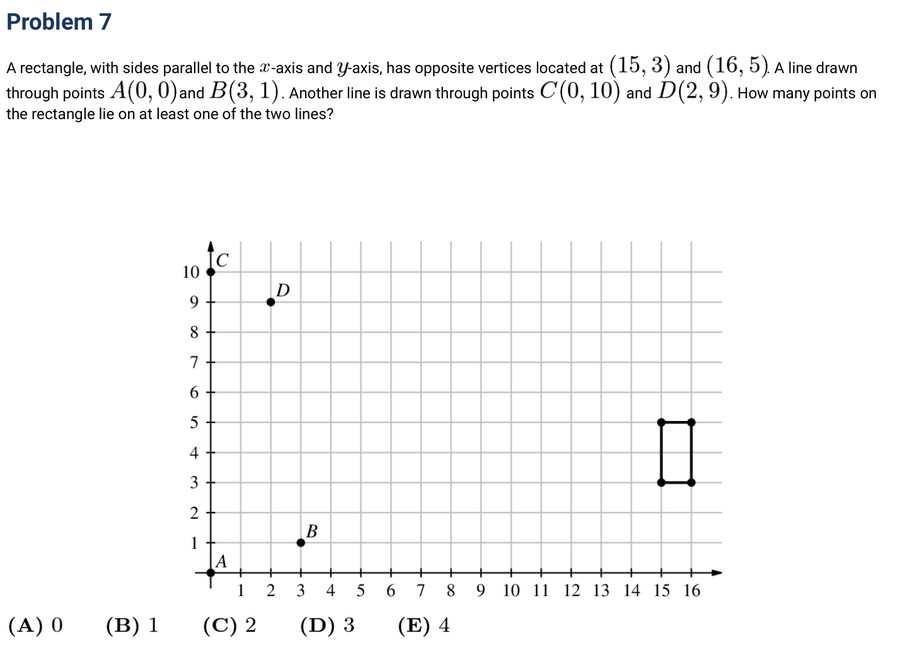
The rectangle is tiny and way off to the right (x only runs 15 to 16). So instead of graphing the whole lines, just ask: when a line reaches that far right, is its height between 3 and 5? You only need to test x = 15 and x = 16.
Still stuck? Show hint 2 →
Hint 2 of 2
Read each line's slope off its two points to get its equation. Line AB rises 1 for every 3 right: y = x/3. Line CD drops 1 for every 2 right: y = 10 − x/2. Plug in x = 15 and 16.
Show solution
Approach: evaluate the two lines at the rectangle's x-range
Notice the rectangle is a thin sliver far to the right: x runs only 15 to 16, y only 3 to 5. So you don't graph the whole lines — you just check whether either line is at the right height when it gets out to x = 15 or 16.
Line AB: slope = 1/3 (from A(0,0) to B(3,1)), so y = x/3. At x = 15: y = 5 — exactly the corner (15, 5) ✓. At x = 16: y ≈ 5.33, just above the box.
Line CD: slope = −1/2, so y = 10 − x/2. At x = 15: y = 2.5; at x = 16: y = 2 — both below the box.
Only (15, 5) lands on the rectangle — 1 point. Why this is faster: when a region is far from the lines, test the region's edges rather than tracing the lines all the way out.
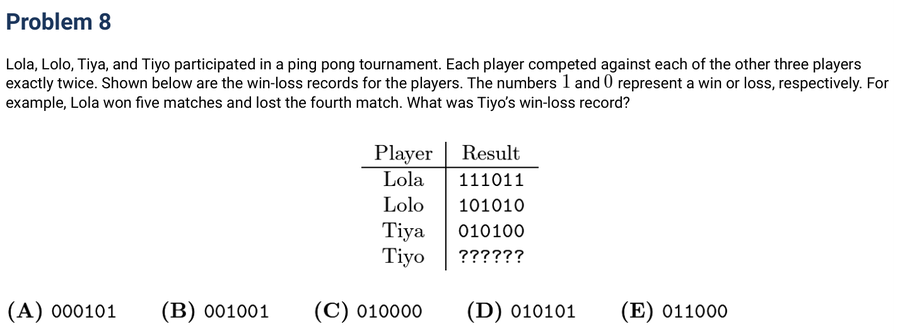
Don't reconstruct who-beat-whom. Each round, the 4 players split into 2 matches — so every round produces exactly 2 wins. That fixed total is your lever.
Still stuck? Show hint 2 →
Hint 2 of 2
Read the table by column instead of by row. Each column (round) must sum to 2 across all four players, so Tiyo's entry is just 2 minus the other three.
Show solution
Approach: each round's wins sum to 2
The shortcut: you don't need the matchups. Every round, four players pair into two games, so exactly 2 wins (and 2 losses) get handed out — meaning every column of the table sums to 2.
So add Lola + Lolo + Tiya down each round: 2, 2, 2, 1, 2, 1.
Tiyo fills the gap to 2 each round: 0, 0, 0, 1, 0, 1 = 000101. This transfers: when each ‘round’ has a fixed total, an unknown row is just total minus the known rows — column thinking beats casework.
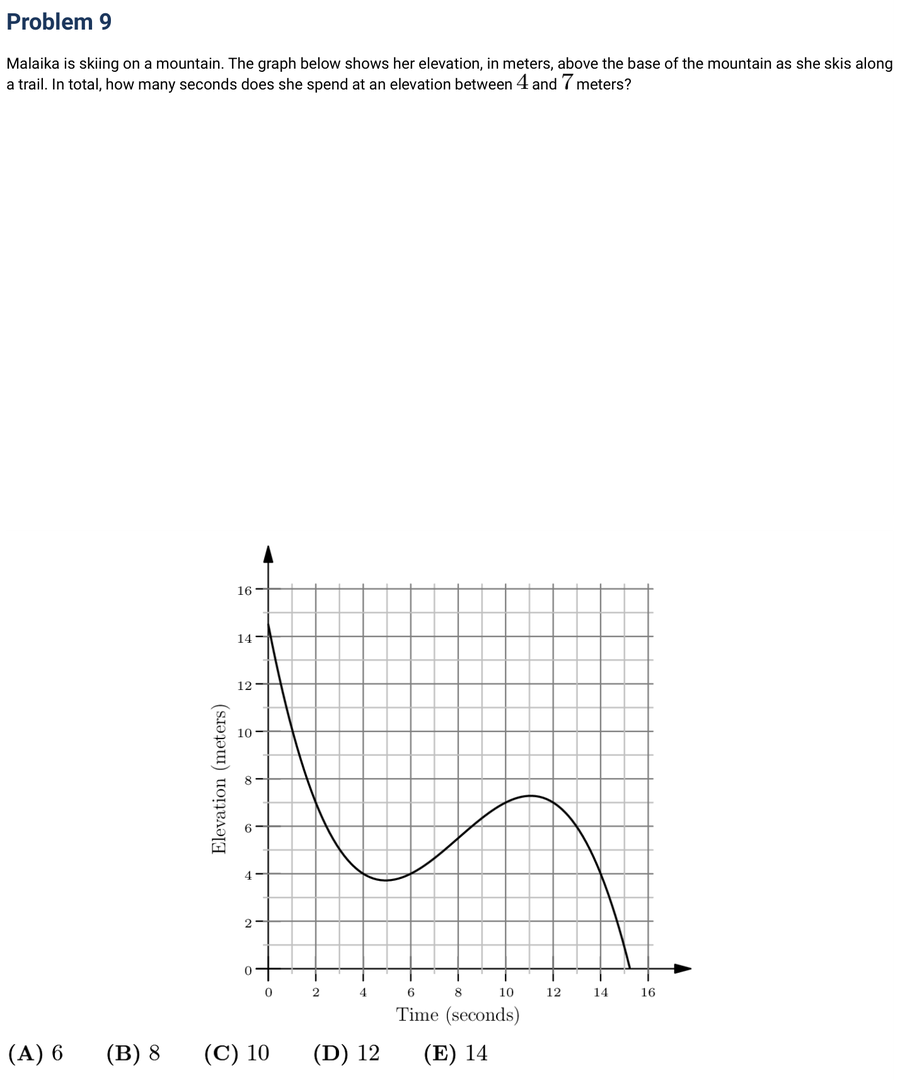
You don't care how high she is — only when she's inside the 4-to-7 band. Think of it as a horizontal stripe on the graph.
Still stuck? Show hint 2 →
Hint 2 of 2
Draw horizontal lines at 4 and 7; the curve enters and leaves that stripe a few times. Add up how long it stays inside each time.
Show solution
Approach: read the graph between two horizontal lines
Re-frame the question as a horizontal stripe: shade the band between elevation 4 and 7. The answer is just how much time (horizontal distance) the curve spends inside that band — her actual height inside it is irrelevant.
The curve dips into and out of the band three times: roughly t = 2 to 4 (2 sec), t = 6 to 10 (4 sec), and t = 12 to 14 (2 sec).
Total: 2 + 4 + 2 = 8 seconds. This transfers: ‘how long is the value between A and B’ on any graph means ‘sum the horizontal widths where the curve lies between two horizontal lines.’
Harold made a plum pie to take on a picnic. He was able to eat only 14 of the pie, and he left the rest for his friends. A moose came by and ate 13 of what Harold left behind. After that, a porcupine ate 13 of what the moose left behind. How much of the original pie still remained after the porcupine left?
Show answer
Answer: D — 1/3.
Show hints
Hint 1 of 2
Don't track what each animal ate — track what each one left behind. Then the leftovers chain together.
Still stuck? Show hint 2 →
Hint 2 of 2
Each ‘a fraction of what's left’ means multiply. Harold leaves 3/4, the moose leaves 2/3 of that, the porcupine leaves 2/3 of that — so multiply 3/4 × 2/3 × 2/3.
Show solution
Approach: multiply the 'leftover' fractions
The trap is to subtract each bite from the whole pie — but the moose eats a third of what's left, not a third of the whole pie. So work with what each animal leaves, and chain those leftovers by multiplying (‘of’ means ×).
Harold leaves 34; the moose leaves 23 of that; the porcupine leaves 23 of that.
34 × 23 × 23 = 1236 = 13. This transfers: repeated ‘a fraction of what remains’ (discounts on discounts, evaporation, decay) always multiplies the survival fractions.
Another way — twelve slices (MAA):
Cut the pie into 12 equal slices. Harold eats 3, leaving 9. Moose eats 13 of 9 = 3, leaving 6. Porcupine eats 13 of 6 = 2, leaving 4.