Tick one or more bands and topics — problems are pulled from every authored year.
Showing 20 of 205 matching
Problem 21 · 2026 AMC 8
Stretch
Counting & Probabilitymarkov-chaincasework
Show answer
Answer: B — 1/4.
Show hints
Hint 1 of 2
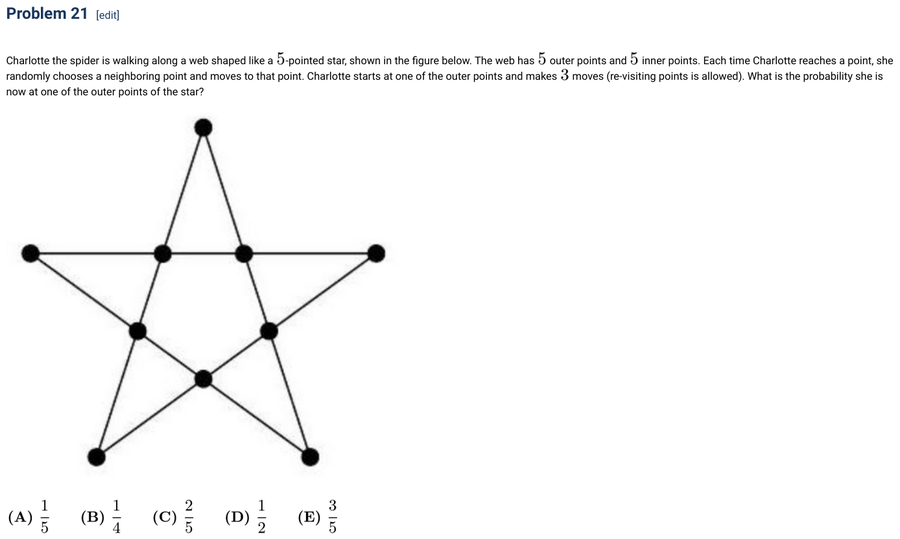
Ten points is too many to track one by one — but notice every point is one of just two types. An outer tip touches only 2 inner points (degree 2); an inner point touches 2 outer tips and 2 inner points (degree 4). So collapse the whole web into ‘outer vs. inner’.
Still stuck? Show hint 2 →
Hint 2 of 2
Now it's a 2-state chain. From outer you always step inner; from inner you step outer with probability 2/4 = ½. Track just ‘chance of being outer’ move by move.
Show solution
Approach: collapse 10 points to two states (outer/inner) and track the probability
The 10 points come in only two kinds, so lump them: an outer tip has both edges going inward (so outer → inner for sure), while an inner point has 4 edges, 2 to outer tips and 2 to inner points (so inner → outer with probability 2/4 = ½). By symmetry it doesn't matter which tip we start at.
Start outer. Move 1: forced inward, so the spider is surely inner.
Move 2: from inner it goes outer with probability ½, inner with probability ½.
Move 3: to finish on an outer tip, the only route is to have stayed inner on move 2 (½), then step outward on move 3 (½). (Being outer after move 2 forces it back inner on move 3 — a dead end.) So the chance is ½ × ½ = 1/4.
Why this transfers: when a random walk lives on a symmetric graph, group the vertices into a few ‘types’ that behave alike — the problem shrinks from many points to a tiny state machine you can track by hand.
The integers 1 through 25 are arbitrarily separated into five groups of 5 numbers each. The median of each group is found, and M is the median of those five medians. What is the least possible value of M?
Show answer
Answer: A — 9.
Show hints
Hint 1 of 2
Unpack what M even is: it's the median of the five medians, i.e. the 3rd-smallest of them. To push M down, you need three groups whose medians are all small at once.
Still stuck? Show hint 2 →
Hint 2 of 2
Here's the bottleneck: a group's median needs two strictly smaller numbers sitting below it. Three small medians plus their six ‘below’ numbers eat up a lot of the tiny values — and tiny values are scarce. Count how many you'd need.
Show solution
Approach: lower-bound by counting scarce small numbers, then build a matching example
First decode M: it is the 3rd-smallest of the five group medians. So making M tiny requires three groups to each have a small median simultaneously.
Now the scarcity argument. Each of those three medians needs two numbers strictly below it inside its group. Suppose M ≤ 8. Then three medians (each ≤ 8) together with their six below-numbers (each smaller still) are 9 distinct values all ≤ 8 — impossible, since only 8 numbers (1–8) are that small. So M ≥ 9.
Then show 9 is actually reachable: {1, 2, 7, 24, 25}, {3, 4, 8, 22, 23}, {5, 6, 9, 20, 21} have medians 7, 8, 9, while the last two groups {10–14} and {15–19} absorb the big numbers (medians 12, 17). The five medians 7, 8, 9, 12, 17 have median 9.
Bound met by an example ⇒ the least value is 9.
Why this transfers: extremal problems are won by pairing a lower bound (a counting/pigeonhole reason it can't be smaller) with a construction (an explicit example hitting that bound). Neither half alone is a proof — you need both jaws of the vise.
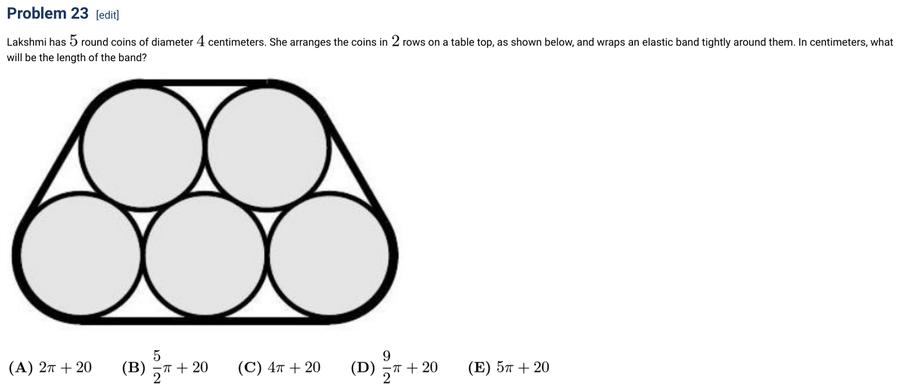
Split the band into two kinds of pieces: the straight stretches (lying along flat tangent lines between coins) and the curved stretches (hugging a coin). Handle the two kinds separately.
Still stuck? Show hint 2 →
Hint 2 of 2
Key fact: going once around any convex bunch, the band turns through exactly 360°, so all its curved pieces together make one full circle. The straight pieces are each tangent, so they're as long as the gaps between the outer coin centers — i.e. the perimeter of the polygon joining those centers.
Show solution
Approach: curves sum to one whole circle; straights trace the outer-center polygon
Diameter 4 means radius 2. Break the band into straight tangent segments and curved arcs that wrap the outer coins.
The arcs: as the band loops all the way around, its direction turns through a full 360°, and each arc bends along a radius-2 coin. All the arcs together sweep one complete turn, so they add up to exactly one full circle: 2π × 2 = 4π.
The straights: each tangent segment runs parallel to the line joining two neighboring outer coin centers and has the same length. So the straight pieces total the perimeter of the trapezoid through the four outer centers. With touching radius-2 coins, the bottom span is 8 and the other three center-to-center sides are each 4: 8 + 4 + 4 + 4 = 20.
Band length = 4π + 20 → 4π + 20 centimeters.
Why this transfers: for a belt/band tight around any bunch of equal circles, the answer is always (one full circle from the radius) + (perimeter of the polygon through the outer centers). The curved parts re-assemble into a single circle because the total turning is one full 360°.
The notation n! is the product of the first n positive integers. Define the superfactorial of n to be the product of the factorials 1! · 2! · 3! · … · n! (so the superfactorial of 3 is 1! · 2! · 3! = 12). How many factors of 7 appear in the prime factorization of the superfactorial of 51?
Show answer
Answer: E — 171.
Show hints
Hint 1 of 2
The superfactorial is a product of factorials, and exponents add across a product. So the total number of 7s is just the sum of the 7-counts of 1!, 2!, …, 51! — turn one big product into a sum.
Still stuck? Show hint 2 →
Hint 2 of 2
Count the 7s in a single k! with Legendre's formula: ⌊k/7⌋ + ⌊k/49⌋ (multiples of 7 give one, multiples of 49 give an extra). Then group the values of k by how many 7s they contribute — the count is constant on each block of 7 consecutive values.
Show solution
Approach: Legendre's 7-count, summed over every factorial in blocks
Across a product, exponents add, so the number of 7s in 1!·2!·…·51! is the sum of v₇(k!) for k = 1 to 51, where Legendre's formula gives v₇(k!) = ⌊k/7⌋ + ⌊k/49⌋.
Track how the count grows as k rises. For k = 1–6 it's 0; then it steps up by 1 each time k passes a new multiple of 7, staying flat in between — so v₇(k!) = 1 for the 7 values 7–13, = 2 for 14–20, …, up to = 6 for 42–48.
That block sums to 7×(1+2+3+4+5+6) = 7×21 = 147. Then at k = 49 the count jumps to 8 (= ⌊49/7⌋ + ⌊49/49⌋ = 7 + 1), and k = 49, 50, 51 each give 8, adding 3×8 = 24.
Total = 147 + 24 = 171.
Why this transfers: to count a prime p in a factorial, use ⌊k/p⌋ + ⌊k/p²⌋ + …; the higher powers (here 49 = 7²) are exactly what create the surprise ‘jump’ that an easy 1+2+3+… guess would miss.
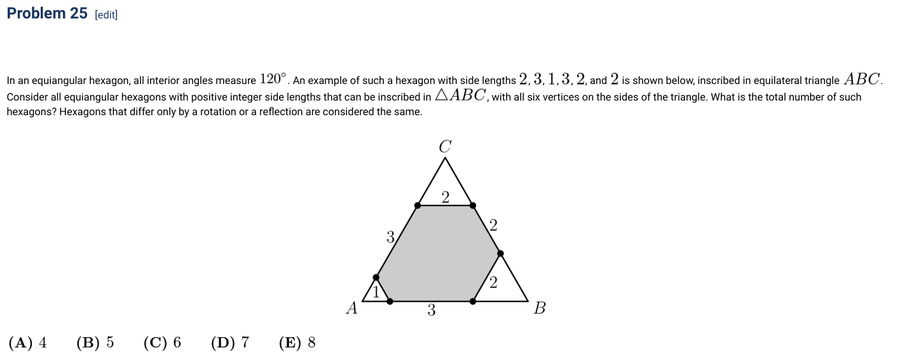
Don't think ‘hexagon’ — think about what's missing. An equiangular hexagon inscribed this way is exactly the equilateral triangle with a small equilateral triangle snipped off each corner. So describe a hexagon by its three corner-cut sizes a, b, c instead of its six sides.
Still stuck? Show hint 2 →
Hint 2 of 2
Each side of the big triangle is split into cut + middle + cut, and the middle piece must be a real side (length ≥ 1). With triangle side 6, that says a + b ≤ 5 for every pair. Then count the triples — remembering rotations/reflections are the same, so order doesn't matter.
Show solution
Approach: describe each hexagon by its three corner cuts, then count valid triples
Reframe the shape: an equiangular hexagon with all six vertices on the triangle is the triangle with a small equilateral triangle cut off each corner. So a hexagon is fully pinned down by the three integer cut sizesa, b, c at the corners — far fewer numbers than six sides.
Find the triangle's side: the example's bottom edge reads 1 + 3 + 2 = 6, so the triangle has side 6. Each edge is cut + middle + cut, e.g. a + (middle) + b = 6, and the middle must be an actual hexagon side, so 6 − a − b ≥ 1, i.e. a + b ≤ 5 for every pair of cuts.
Since rotations and reflections are the same, count unordered triples {a, b, c} of positive integers with all pairwise sums ≤ 5: {1,1,1}, {1,1,2}, {1,1,3}, {1,1,4}, {1,2,2}, {1,2,3}, {2,2,2}, {2,2,3}. That's 8.
Why this transfers: a shape defined by lots of side conditions often has far fewer real degrees of freedom — here three corner cuts — and ‘up to rotation/reflection’ means count unordered/symmetric configurations, not every labeled one.
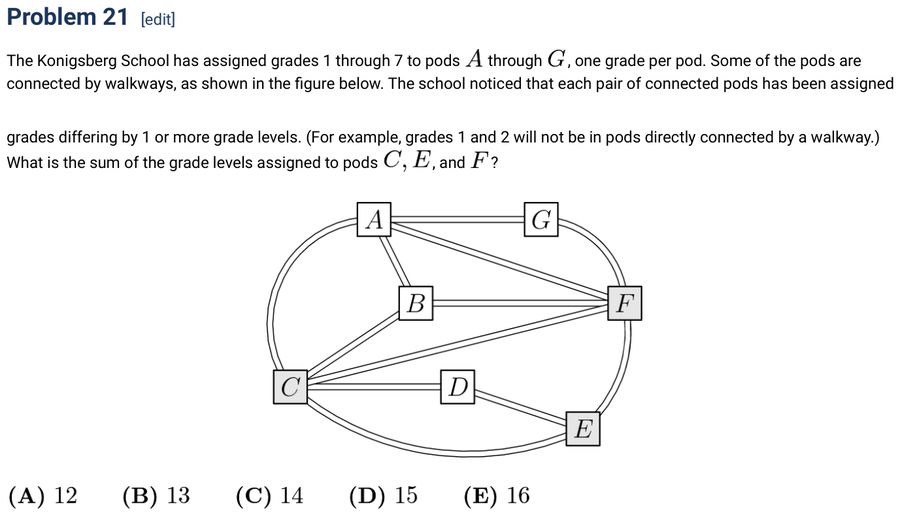
The hardest pressure is where many pods are mutually connected — tackle that knot first. Find the largest group of pods that are all directly linked to each other; their grades are squeezed into a tiny set.
Still stuck? Show hint 2 →
Hint 2 of 2
Pods A, B, C, F are pairwise connected (a 4-clique), so their four grades must be mutually ≥ 2 apart. From {1,…,7}, the only such quadruple is {1, 3, 5, 7} — the most spread-out choice.
Show solution
Approach: find the clique to lock down four grades, then radiate outward
Spot the tightest constraint: A, B, C, F are all mutually connected, so their four grades must each differ by ≥ 2. Packing 4 grades into 1–7 that far apart forces exactly {1, 3, 5, 7} — there's no slack.
G connects to A and F. If G = 2, then A, F ≠ 1 or 3, forcing {A, F} ⊂ {5, 7} and {B, C} = {1, 3}.
D and E only touch C and F. The extreme grades 1 and 7 each have just one neighbor in this clique, so place 1 at C and 7 at F. The remaining {4, 6} go to D, E.
Filling in: D = 6 (avoids 7 enough), E = 4 (avoids 1 and 7), B = 3 (next to C = 1), A = 5. All constraints hold.
C + E + F = 1 + 4 + 7 = 12.
Why this transfers: in any constraint/coloring puzzle on a network, attack the densest cluster (the clique) first — it has the fewest possibilities, so it locks in the most and leaves the loose pods easy to finish.
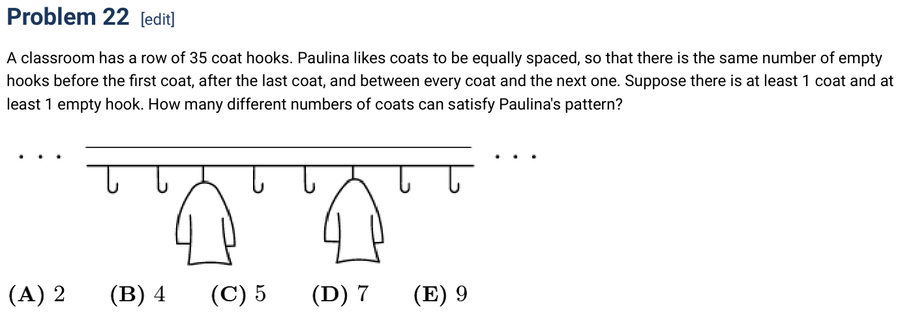
The annoying part is that the gap after the last coat has no coat closing it off, unlike the gaps between coats. Fix that asymmetry: imagine one phantom coat on a 36th hook, and now empty-then-coat repeats perfectly.
Still stuck? Show hint 2 →
Hint 2 of 2
With the phantom, 36 hooks split into d identical blocks of length b (each = some empties + one coat), so bd = 36 with b ≥ 2 and d ≥ 2. Counting the coat-arrangements becomes counting these factorizations.
Show solution
Approach: add a phantom coat to make a clean repeat, then count factor pairs
The setup is fiddly because the trailing gap isn't followed by a coat the way the inner gaps are. Patch it: drop a phantom coat on a 36th hook. Now the whole row is a flawless repeat of (some empty hooks)+(one coat), each block of length b ≥ 2.
If there are d such blocks, bd = 36, and the real coat count is d − 1 (we added one phantom). The constraints are b ≥ 2 (each block has ≥ 1 empty + 1 coat) and d ≥ 2 (≥ 1 real coat plus the phantom).
So just count factorizations 36 = b × d with both factors ≥ 2. Since 36 = 22 × 32 has (2+1)(2+1) = 9 divisors, and we drop the two using a 1 (1×36, 36×1), the answer is 9 − 2 = 7.
Why this transfers: when boundary items spoil a repeating pattern, add (or remove) a phantom to restore the symmetry — the awkward "ends differ from the middle" complication melts into a clean periodic count.
Number Theoryprimesdifference-of-squaresprime-test
How many four-digit numbers have all three of the following properties?
The tens digit and ones digit are both 9.
The number is 1 less than a perfect square.
The number is the product of exactly two prime numbers.
Show answer
Answer: B — Exactly 1.
Show hints
Hint 1 of 2
Translate each clue into a structural fact. Ending in 99 means "add 1" gives a number ending in 00 — and a perfect square ending in 00 forces its square root to be a multiple of 10. That alone cuts the candidates to a handful.
Still stuck? Show hint 2 →
Hint 2 of 2
Now the number is (10k)2 − 1 = (10k − 1)(10k + 1), already factored. "Product of exactly two primes" means both of those factors must themselves be prime — you're hunting twin primes straddling a multiple of 10.
Show solution
Approach: turn the clues into structure: square ends in 00, then seek twin primes
Decode the conditions instead of testing thousands of numbers. "Ends in 99" + 1 = ends in 00, and a square ending in 00 must be (10k)2. So the number is (10k)2 − 1 = (10k − 1)(10k + 1) — a difference of squares, factored for free.
"Product of exactly two primes" now means both 10k − 1 and 10k + 1 are prime. Check: 39×41 (39 = 3×13, no), 49×51 (49 = 72, no), 59×61 (both prime ✓), 69×71 (69 = 3×23, no), 79×81 (81 = 34, no), 89×91 (91 = 7×13, no), 99×101 (99 = 9×11, no).
Only 59 × 61 = 3599 survives, so exactly 1.
Why this transfers: "one less than a perfect square" should instantly trigger the difference-of-squares factoring a2 − 1 = (a−1)(a+1) — turning a vague property into a concrete factorization you can prime-test.
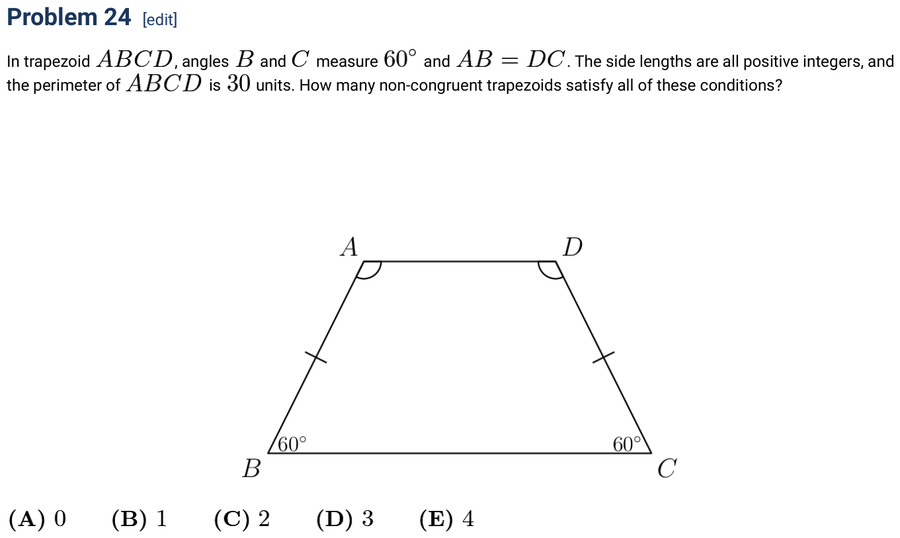
Two 60° base angles are begging for an equilateral triangle. Slice one off: draw a line through A parallel to the slanted side CD — what shape gets cut out, and what's left?
Still stuck? Show hint 2 →
Hint 2 of 2
That cut makes an equilateral triangle ABE (so AB = BE = AE) plus a parallelogram ADCE (so AD = EC). Relabel the equal lengths x and y, and the whole perimeter collapses to 3x + 2y = 30 — now it's just counting integer solutions.
The two 60° angles are the cue. Draw a segment through A parallel to CD, meeting BC at E. Because ∠B = 60° and AB = DC, triangle ABE has all 60° angles — it's equilateral, so AB = BE = AE = x.
What remains, ADCE, is a parallelogram (AE ∥ DC and AD ∥ EC), so the two parallel sides match: AD = EC = y.
Now the perimeter rewrites entirely in x and y: AB + BC + CD + DA = x + (x + y) + x + y = 3x + 2y = 30. The geometry is gone — it's a counting problem.
Need positive integers: y = (30 − 3x)/2 must be positive (so x < 10) and an integer (so 30 − 3x even, i.e. x even). That leaves x ∈ {2, 4, 6, 8} — 4 trapezoids.
Why this transfers: a parallel auxiliary line through a vertex peels a trapezoid into a triangle + parallelogram, and a 60° angle makes that triangle equilateral. The payoff is converting a shape question into a tidy linear equation to count.
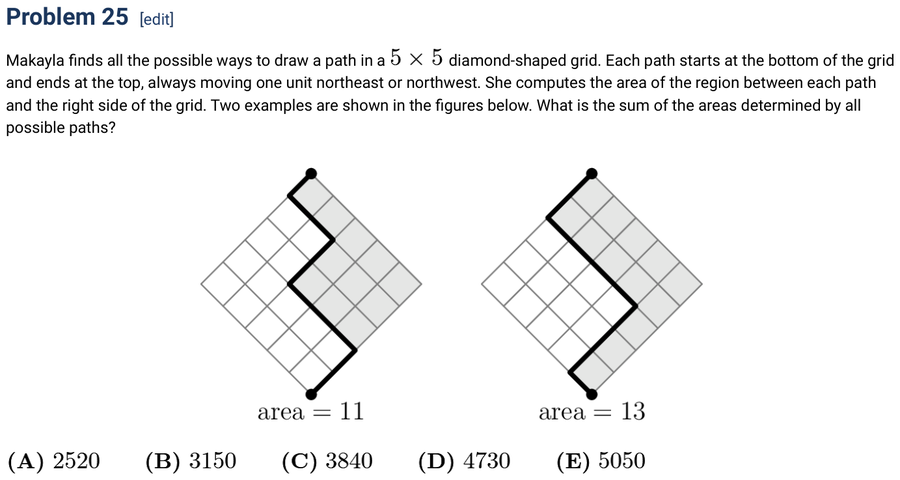
Summing the right-area of all 252 paths one at a time is hopeless. The escape: mirror each path left↔right. The full set of paths is its own mirror image, so the total of all left areas equals the total of all right areas — the answer you want.
Still stuck? Show hint 2 →
Hint 2 of 2
Add the two totals: for a single path, (left area) + (right area) is just the whole diamond, a constant. So 2×(answer) = (that constant) × (number of paths). The path count is the ways to interleave 5 NE and 5 NW moves.
Show solution
Approach: double it via the left↔right mirror, so each path contributes a constant
Let X be the sum of right-side areas. Flipping every path left↔right sends the set of all paths to itself, so the sum of all left-side areas is also X. Add them: 2X = sum over all paths of (left + right).
But for any single path, left area + right area is the entire 5×5 diamond = 25 — a constant, independent of the path. The hard per-path detail vanishes.
Number of paths = interleavings of 5 NE moves and 5 NW moves = 10!5! · 5! = 252.
So 2X = 25 × 252 = 6300, giving X = 3150.
Why this transfers: to sum a quantity you can't compute term-by-term, add it to its mirror image — if the pair sums to a constant, you've turned an impossible sum into (constant) × (count) ÷ 2. This pairing/symmetry trick is the same idea behind summing 1+2+…+n by pairing ends.
A group of frogs (called an army) is living in a tree. A frog turns green when in the shade and turns yellow when in the sun. Initially, the ratio of green to yellow frogs was 3 : 1. Then 3 green frogs moved to the sunny side and 5 yellow frogs moved to the shady side. Now the ratio is 4 : 1. What is the difference between the number of green frogs and yellow frogs now?
Show answer
Answer: E — 24 frogs.
Show hints
Hint 1 of 2
A 3 : 1 ratio means green = 3 × yellow, so the whole army rides on one number. Call yellow y and write everything in terms of it.
Still stuck? Show hint 2 →
Hint 2 of 2
Technique: track the net change per color (frogs move both ways), then set the new ratio equal to 4. After the moves green = 3y + 2, yellow = y − 2 — so (3y+2)/(y−2) = 4.
Show solution
Approach: let y = initial yellow, then use both ratios
The 3 : 1 ratio pins green to yellow, so use one variable: let y = initial yellow, then initial green = 3y.
Net the movements per color. Green: 5 yellow-turned-green arrive, 3 leave for the sun → 3y + 5 − 3 = 3y + 2. Yellow: 3 sun-turned-yellow arrive, 5 leave for shade → y + 3 − 5 = y − 2.
New ratio 4 : 1 means green is 4 times yellow: 3y + 2 = 4(y − 2) = 4y − 8 → y = 10. So now green = 32, yellow = 8.
The question asks the DIFFERENCE now: 32 − 8 = 24. Watch the ask: it wants the current gap, not the original counts — easy to stop a step early.
Another way — the total army never changes:
Every move just recolors a frog (sun↔shade), so the total is fixed. Initially green:yellow = 3:1, so the total is a multiple of 3+1 = 4; finally it's 4:1, a multiple of 4+1 = 5. The total is a multiple of both, so a multiple of 20.
Now the difference. Finally green:yellow = 4:1, so the gap is 4−1 = 3 parts out of 5, i.e. 35 of the total. With the total = 40 (the value consistent with the 3 net-out yellow and 4:1 split), the difference is 35×40 = 24.
Forget the spiral entirely. The tape is the SAME material whether coiled or unrolled, so its cross-section area is conserved. Unrolled, that area is just length × thickness.
Still stuck? Show hint 2 →
Hint 2 of 2
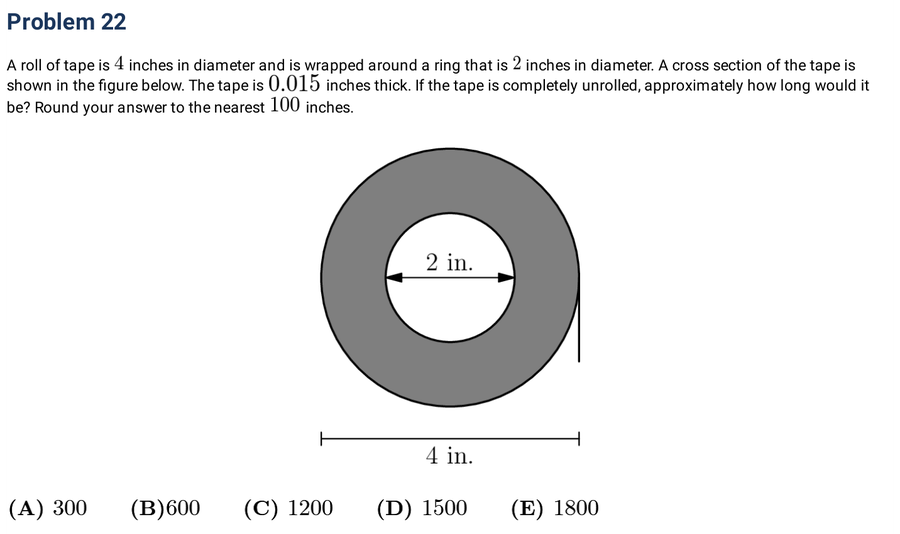
Technique (conserve the cross-section area): the coiled tape fills the ring between the inner and outer circles. Ring area = length × thickness. Ring = π(R2 − r2), with R = 2, r = 1 (radii, half the diameters).
Show solution
Approach: the ring's area equals length × thickness
The slick idea: coiling doesn't change how much tape there is, so the cross-section area is the same coiled or flat. Flat, the tape is a thin strip of length L and thickness 0.015 in — area = 0.015L.
Coiled, that same cross-section is the ring between outer radius 2 (diameter 4) and inner radius 1 (diameter 2): area = π(22 − 12) = 3π.
Set them equal: 0.015L = 3π → L = 3π0.015 = 200π ≈ 628 in, rounding to 600. This transfers: for anything rolled, folded, or melted, the AREA (or volume) is conserved — equate "before" and "after" instead of tracing the shape.
Another way — layers × average circumference (MAA estimate):
The roll's wall is 1 inch thick (radius 2 minus radius 1), and each wrap is 0.015 in, so there are about 1 ÷ 0.015 ≈ 67 layers.
A layer's circumference runs from 2π (inner) to 4π (outer), averaging 3π. Total length ≈ 67 × 3π ≈ 200π ≈ 628 → 600. Same answer, by averaging the loops instead of conserving area.
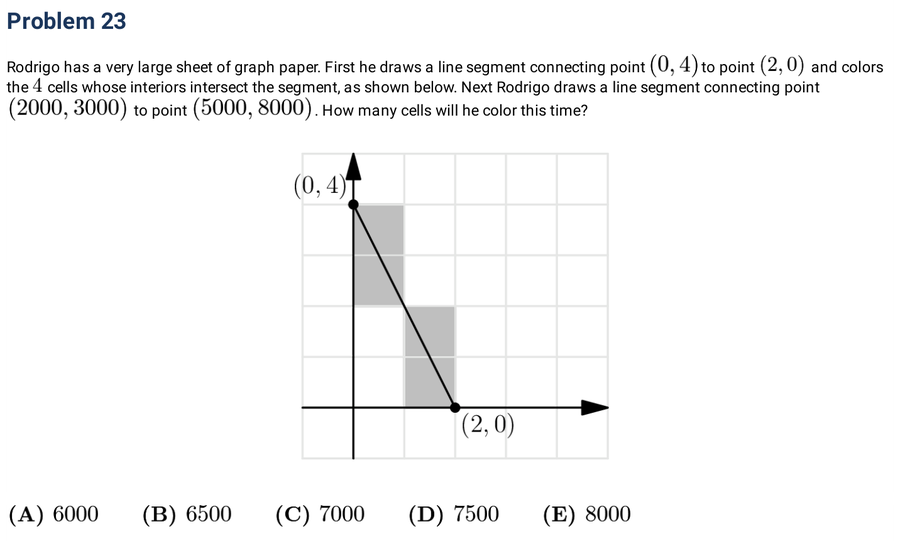
Think about WHEN the segment moves into a new cell: every time it crosses a vertical or horizontal gridline. So count crossings — but watch the special moment when it crosses both at once (through a grid corner) and gets two for the price of one.
Still stuck? Show hint 2 →
Hint 2 of 2
Technique (lattice cell-crossing formula): cells = (horizontal offset) + (vertical offset) − gcd(those offsets). The gcd counts the corner-crossings you'd otherwise double-count. Apply it to offsets 3000 and 5000.
Show solution
Approach: use the lattice-line cell-count formula
A line segment whose horizontal offset is a and vertical offset is b crosses a + b − gcd(a, b) grid cells. (You'd cross a + b cells if the line never hit a grid corner; each lattice-point crossing collapses two cell-entries into one, saving 1 per shared factor.)
From (2000, 3000) to (5000, 8000): horizontal offset 3000, vertical offset 5000.
The slope from (2000, 3000) to (5000, 8000) is 5/3. The segment is equivalent to 1000 copies of a primitive (0,0)→(3,5) piece, since gcd(3000, 5000) = 1000.
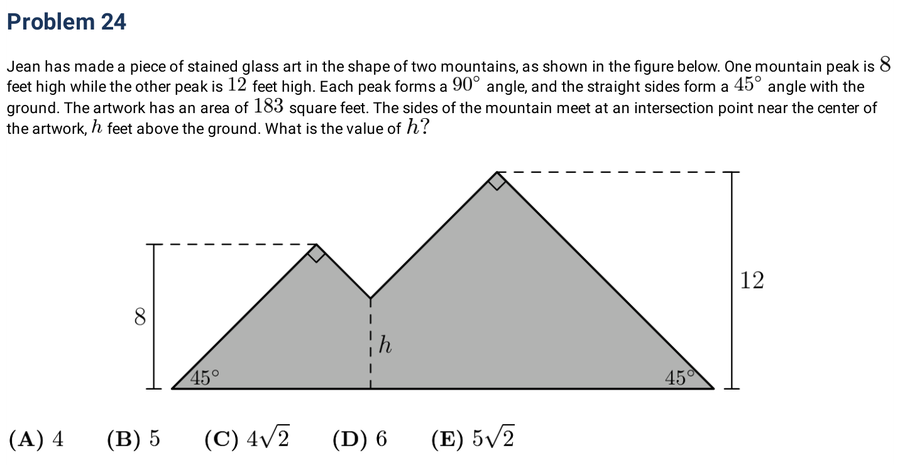
The dip between the peaks is exactly where the two mountains OVERLAP. So if you treat each mountain as a full triangle and add them, you've counted that dip twice — the setup for inclusion–exclusion.
Still stuck? Show hint 2 →
Hint 2 of 2
Handy fact: a 45-45-90 mountain triangle of peak height H has base 2H, so its area is 12(2H)(H) = H2. The dip is a third such triangle of height h.
Show solution
Approach: inclusion–exclusion on three 45-45-90 triangles
First, a clean area shortcut: each mountain is a right-isoceles triangle (90° peak, 45° base angles), so its base is 2×(its height) and its area is 12(2H)(H) = H2. Heights 8 and 12 give areas 64 and 144.
If you just add 64 + 144, you double-count the V-dip where the two mountains overlap — and that dip is itself a 45-45-90 triangle of height h, area h2. So the true artwork area is 64 + 144 − h2.
Set that to the given 183: 208 − h2 = 183 → h2 = 25 → h = 5. This transfers: when two regions overlap, area(A) + area(B) − area(overlap) = total — inclusion–exclusion turns a tricky shape into three simple ones.
A small airplane has 4 rows of seats with 3 seats in each row. Eight passengers have boarded the plane and are distributed randomly among the seats. A married couple is next to board. What is the probability there will be 2 adjacent seats in the same row for the couple?
Show answer
Answer: C — 20/33.
Show hints
Hint 1 of 2
Counting WHERE the couple can sit is messy — there are many ways to leave an open pair. Flip it: count the seatings where the couple CAN'T sit together (no open adjacent pair), which is far more rigid, then subtract.
Still stuck? Show hint 2 →
Hint 2 of 2
The 8 passengers can sit in C(12,8) = 495 ways. Per row L-M-R, an adjacent open pair is blocked exactly when M is taken OR both L and R are taken. Case-split on k = how many of the 4 middle seats are occupied.
Show solution
Approach: complementary counting on middle-seat occupancies
Counting the "couple fits" seatings directly is a tangle, so count the COMPLEMENT — seatings with no open adjacent pair anywhere — and subtract from the total. Total ways to seat 8 passengers in 12 seats (order ignored): C(12, 8) = 495.
For NO adjacent pair to be open in a row L–M–R: either M is occupied, or both L and R are occupied. Casework on k = number of rows with M occupied:
k = 0: all four M's empty ⇒ all 8 edge seats filled. 1 way.
k = 1: 4 choices of row, then 2 choices for the extra passenger in that row's edges. 8 ways.
k = 2: C(4,2) = 6 row-choices × C(4,2) = 6 placements of remaining 2 passengers in the 4 unfilled edges. 36 ways.
k = 3: C(4,3) = 4 row-choices × C(6,3) = 20 placements of remaining 3 passengers. 80 ways.
k = 4: all middles filled (4 passengers); C(8,4) = 70 placements of the remaining 4 on edges. 70 ways.
Total "no open pair": 1 + 8 + 36 + 80 + 70 = 195. So the favorable count = 495 − 195 = 300.
Probability = 300495 = 2033. This transfers: when "at least one good spot exists" has many overlapping ways to happen, count the cleaner complement ("no good spot") instead — here the no-pair condition reduced to a tidy per-row rule and a single case-split.
Alina writes the numbers 1, 2, …, 9 on separate cards, one number per card. She wishes to divide the cards into 3 groups of 3 cards so that the sum of the numbers in each group will be the same. In how many ways can this be done?
Show answer
Answer: C — 2 ways.
Show hints
Hint 1 of 2
Find the target sum first — that single number tells you a lot. In particular, where can the three largest cards possibly sit?
Still stuck? Show hint 2 →
Hint 2 of 2
Each group sums to 15, so 7, 8, 9 can't share a group (7+8 already overshoots room) — they're spread one per group. Same for 1, 2, 3. Now the only freedom left is where 5 lands; case-split on that.
Show solution
Approach: fix the totals, then place the extreme numbers
The total 1+2+…+9 = 45 splits into three equal groups, so each must sum to 15. That target instantly pins the big and small cards.
7, 8, 9 must each land in a different group (any two of them already total 15 or more, leaving no room for a positive third). By the same squeeze, 1, 2, 3 spread out one per group too.
So the only real choice is 5's partner-pair, which must sum to 10: {3,5,7}, {2,5,8}, or {1,5,9}. Test each by finishing the other two groups.
{2,5,8} dies: it would leave 1, 3, 7, 9 to form two groups of 15, but 9 needs a 6 (gone) and 7 needs an 8 (gone) — impossible. The other two succeed: {1,5,9}/{3,4,8}/{2,6,7} and {3,5,7}/{1,6,8}/{2,4,9}.
So there are 2 ways. This transfers: in equal-sum partition problems, first compute the target, then corner the extreme values — the largest elements have the fewest legal homes, so placing them first kills most of the casework.
In a sequence of positive integers, each term after the second is the product of the previous two terms. The sixth term in the sequence is 4000. What is the first term?
Show answer
Answer: D — 5.
Show hints
Hint 1 of 2
Don't guess numbers — track structure. Call the first two terms a and b; every later term is a product, so it's just a and b raised to some powers. Watch how those powers grow.
Still stuck? Show hint 2 →
Hint 2 of 2
The exponents of a (and of b) each follow a Fibonacci-style add: the 6th term is a3b5. Now break 4000 into primes and match.
Show solution
Approach: track exponents of a and b through the sequence
Let the first two terms be a, b. Each new term multiplies the previous two, which adds their exponents — so the exponents climb like Fibonacci: a, b, ab, ab2, a2b3, a3b5.
So the 6th term is a3b5 = 4000. Factor: 4000 = 4 × 1000 = 22 × (2×5)3 = 25 × 53. Matching the cube to a3 and the fifth power to b5 gives a = 5, b = 2.
First term: 5. Sanity check: the sequence reads 5, 2, 10, 20, 200, 4000 — the 6th term hits 4000. Worth keeping: in any ‘multiply the previous two’ sequence, the exponents of the two starting values follow the Fibonacci numbers.
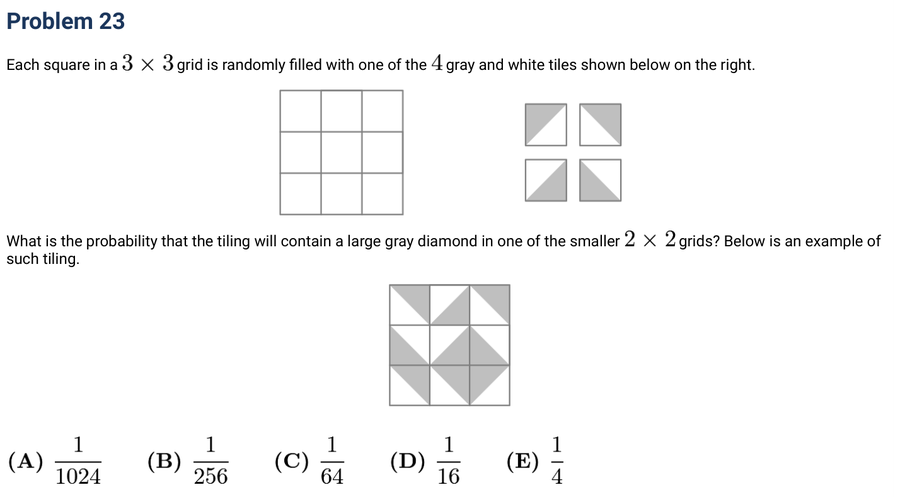
A diamond is built from four tiles meeting at one point — and any 2×2 diamond must use the center cell. So the center tile is already ‘there’; the question is whether its three neighbors line up.
Still stuck? Show hint 2 →
Hint 2 of 2
Once the center tile shows a gray corner, the three tiles touching that corner each need one specific orientation out of 4 to complete the diamond. Three independent 1-in-4 events — multiply.
Show solution
Approach: three neighbor tiles must each orient correctly
Picture how a diamond forms: four gray triangles meet at a single point, and that point is always a corner of the center cell. So the center tile is automatically part of any diamond — whatever gray corner it happens to show is the corner the diamond grows from.
To complete that diamond, the three tiles touching that gray corner must each be turned the right way. Each tile has 4 equally likely orientations, exactly 1 of which works, so each contributes probability 14 — independently.
Multiply: 14 × 14 × 14 = 164. Why this is faster: instead of counting all 49 tilings, condition on the piece that's always involved (the center) and only the constraints that matter survive.
Another way — count favorable tilings (MAA):
Total tilings: each of the 9 cells takes 1 of 4 tiles, so 49 in all.
Favorable: a diamond's center can sit at any of the 4 corners of the middle cell (4 choices). Once chosen, the 4 tiles forming it are forced, but the other 5 cells are free: 45. So favorable = 4 × 45 = 46.
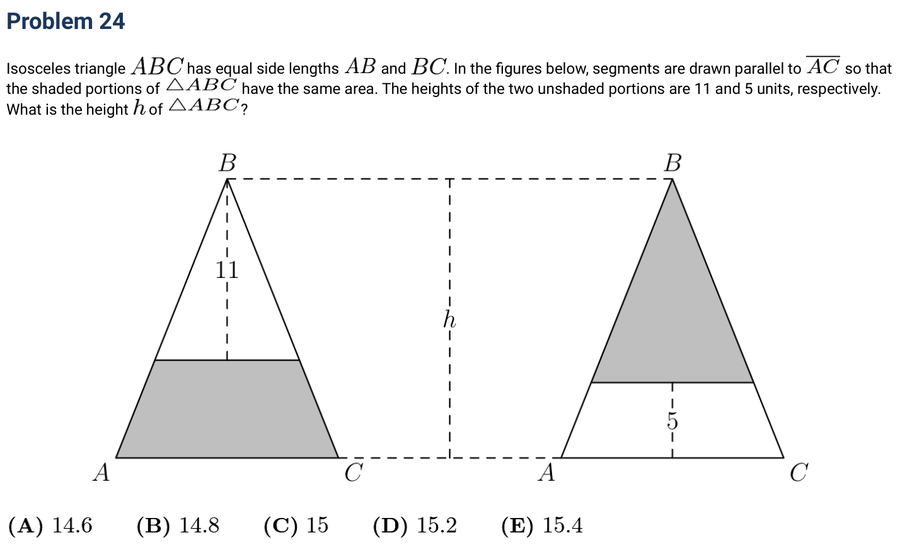
Each cut makes a smaller triangle similar to ABC. The one fact you need: a sub-triangle of height k has area (k/h)2 of ABC — areas scale as the square of height.
Still stuck? Show hint 2 →
Hint 2 of 2
Write both shaded pieces as fractions of ABC and set them equal. Left shaded = whole − top triangle (height 11). Right shaded = the top triangle of height h − 5. The total area T cancels, leaving a clean equation in h.
Show solution
Approach: areas scale as height squared; equate shaded regions
Both cuts create triangles similar to ABC, so the only tool needed is: area shrinks as the square of height. Crucially, the shaded areas being equal means their fractions of ABC are equal — so the actual area T never matters and cancels out.
Left figure: the unshaded top triangle has height 11, so it's (11/h)2 of ABC; the shaded trapezoid is the rest, 1 − (11/h)2.
Right figure: the shaded piece is the top triangle of height h − 5, which is ((h−5)/h)2 of ABC.
Set equal: 1 − 121/h2 = (h−5)2/h2. Multiply by h2: h2 − 121 = h2 − 10h + 25 — the h2 drops out, giving 10h = 146.
h = 14.6. Worth keeping: ‘cut parallel to the base’ always makes a similar triangle whose area is (height ratio)2 — convert to fractions of the whole and the unknown total cancels itself away.
Fifteen integers a1, a2, a3, …, a15 are arranged in order on a number line. The integers are equally spaced and have the property that
1 ≤ a1 ≤ 10, 13 ≤ a2 ≤ 20, and 241 ≤ a15 ≤ 250.
What is the sum of the digits of a14?
Show answer
Answer: A — 8.
Show hints
Hint 1 of 2
‘Equally spaced integers’ means an arithmetic sequence: every step adds the same whole number d. The whole problem turns on pinning down that single d.
Still stuck? Show hint 2 →
Hint 2 of 2
The span a15 − a1 = 14d. Squeeze it: subtract the smallest a1 from the largest a15 for the upper end and vice-versa, getting 231 ≤ 14d ≤ 249. Only one multiple of 14 lives there.
Show solution
Approach: nail d from bounds, then a1, then a14
Equally spaced = arithmetic, so a fixed integer d is added each step. The clever part: although a1 and a15 are each only known within a window, their difference 14d is squeezed into a narrow range — and that range may contain just one multiple of 14.
Widest and narrowest gaps: 241 − 10 ≤ 14d ≤ 250 − 1, i.e. 231 ≤ 14d ≤ 249. The only multiple of 14 in there is 238 = 14 × 17, so d = 17.
Now back-substitute: a2 = a1 + 17 ≤ 20 forces a1 ≤ 3, while a15 = a1 + 238 ≥ 241 forces a1 ≥ 3. The two pincers meet at a1 = 3.
a14 = a15 − d = (3 + 238) − 17 = 224, so the digit sum is 2 + 2 + 4 = 8. This transfers: when loose bounds multiply into a tight one, a divisibility condition (here ‘multiple of 14’) often leaves a single survivor — squeeze, then sieve.