Tick one or more bands and topics — problems are pulled from every authored year.
Showing 20 of 205 matching
Problem 16 · 2026 AMC 8
Hard
Number Theorydivisibility-rule
Consider all positive four-digit integers whose digits are all even. What fraction of these integers are divisible by 4?
Show answer
Answer: D — 3/5.
Show hints
Hint 1 of 2
Don't count the thousands of numbers. Divisibility by 4 cares only about the last two digits — so the first two even digits are free and just cancel out of the fraction.
Still stuck? Show hint 2 →
Hint 2 of 2
Here's the lucky break: the tens digit is even, so 10×(tens) is a multiple of 20, hence already a multiple of 4. That leaves the units digit as the only thing that decides divisibility by 4.
Show solution
Approach: divisibility by 4 collapses onto the units digit alone
Divisibility by 4 depends only on the last two digits, so the thousands and hundreds digits don't matter — whatever fraction works for the last two digits is the answer for the whole pile.
Split the last two digits as 10·(tens) + units. The tens digit is even, so 10·(tens) is a multiple of 20, which is already a multiple of 4. That means the number is divisible by 4 exactly when the units digit alone is — i.e. units ∈ {0, 4, 8}.
Of the 5 allowed even units {0, 2, 4, 6, 8}, three (0, 4, 8) work, and this holds no matter what the other digits are. So the fraction is 3/5 → 3/5.
Why this transfers: a divisibility rule lets you ignore most digits — isolate just the digits the rule depends on, and check whether the ‘free’ part is automatically handled so the count reduces to one digit.
Four students sit in a row and chat with the people next to them. They then rearrange themselves so that no one is seated next to anyone they sat next to before. How many such rearrangements are possible?
Show answer
Answer: A — 2.
Show hints
Hint 1 of 2
Label the original seats 1, 2, 3, 4. The forbidden new-neighbor pairs are exactly the old neighbors: 1-2, 2-3, 3-4. Instead of listing what's banned, flip it — which pairs are allowed to sit together?
Still stuck? Show hint 2 →
Hint 2 of 2
List the allowed pairs (1-3, 1-4, 2-4) and you'll see they chain together in essentially one way. A valid row is just a path that uses every student through allowed links.
Show solution
Approach: build the ‘allowed-neighbor’ chain instead of testing all 24 orders
The banned new-neighbor pairs are the old ones: 1-2, 2-3, 3-4. Flip to the allowed pairs — everything else: 1-3, 1-4, and 2-4. A legal new row is a path that strings all four students together using only allowed links.
Trace the allowed links: 2 connects only to 4, and 3 connects only to 1, so 2 and 3 must be the ends. The only way to join them is 2–4–1–3.
That chain read either direction gives 2–4–1–3 and 3–1–4–2, so there are 2 rearrangements.
Why this transfers: ‘who may sit/stand next to whom’ problems become much easier as a graph — draw the allowed connections and count paths through all the vertices, rather than testing every permutation against a list of bans.
In how many ways can 60 be written as the sum of two or more consecutive odd positive integers, arranged in increasing order?
Show answer
Answer: B — 2.
Show hints
Hint 1 of 2
Before any algebra, use parity: a sum of k odd numbers is even exactly when k is even. Since 60 is even, that already says something about how many terms you can have.
Still stuck? Show hint 2 →
Hint 2 of 2
A run of k consecutive odd numbers starting at a sums to k(a + k − 1) = 60. Test only the evenk that divide 60, keeping those with a positive odd start.
Show solution
Approach: parity narrows k, then the run-sum formula finishes it
First a free filter: adding k odd numbers gives a result with the same parity as k. Our target 60 is even, so the number of terms k must be even — we never even test odd k.
A run of k consecutive odds starting at a is a + (a+2) + … = k(a + k − 1) = 60, so a = 60/k − (k − 1). Check the even k ≥ 2 dividing 60:
k = 2 → a = 29 (29 + 31 = 60); k = 6 → a = 5 (5+7+9+11+13+15 = 60); k = 4, 10, 12… give a ≤ 0 or non-odd. Two runs work.
So there are 2 ways.
Why this transfers: on ‘sum of consecutive’ problems, a parity (or mod) check on the target usually kills most cases for free before you grind the algebra — cheap filters first, formula second.
Miguel and his dog Luna start together at a park entrance. Miguel throws a ball straight ahead to a tree and keeps walking at a steady pace. Luna sprints to the ball and immediately brings it back to Miguel. Luna runs 5 times as fast as Miguel walks. What fraction of the entrance-to-tree distance does Miguel cover by the time Luna brings him the ball?
Show answer
Answer: D — 1/3.
Show hints
Hint 1 of 2
They run for the same amount of time, so forget the clock entirely — in equal time, distance is just proportional to speed. Luna covers 5 times as far as Miguel, whatever that distance turns out to be.
Still stuck? Show hint 2 →
Hint 2 of 2
Picture Luna's actual route: entrance → tree → back to wherever Miguel has walked to. Set that whole length equal to 5 times Miguel's short walk and solve.
Show solution
Approach: same time ⇒ Luna's path length = 5 × Miguel's
Because they move for the same time, the time cancels: Luna's total distance is simply 5 times Miguel's. So set their path lengths in a 5-to-1 ratio — no need for actual speeds or seconds.
Let the entrance-to-tree distance be 1 and Miguel's walk be d. Luna runs to the tree (1) and back to Miguel, who has moved up to d, so the return leg is 1 − d. Luna's path = 1 + (1 − d) = 2 − d.
Equal time means Luna's path = 5d: 5d = 2 − d ⇒ 6d = 2 ⇒ d = 1/3.
Why this transfers: when two movers share the same time window, drop the clock — their distances are in the ratio of their speeds, turning a rate problem into a one-line distance equation.
The land of Catania uses gold coins (1 mm thick) and silver coins (3 mm thick). In how many ways can Taylor make a stack exactly 8 mm tall using any arrangement of gold and silver coins, where order matters?
Show answer
Answer: D — 13.
Show hints
Hint 1 of 2
Listing every 8 mm stack by hand is error-prone. Instead build the answer from smaller stacks: focus on just the top coin — it's either gold (1 mm) or silver (3 mm). What height of stack sits underneath in each case?
Still stuck? Show hint 2 →
Hint 2 of 2
If f(n) counts stacks of height n, a gold top leaves f(n−1) below it and a silver top leaves f(n−3). So f(n) = f(n−1) + f(n−3). Build up from small heights.
Show solution
Approach: recursion by the top coin: f(n) = f(n−1) + f(n−3)
Sort stacks of height n by what the top coin is. If it's gold (1 mm), the rest is any stack of height n−1; if it's silver (3 mm), the rest is any stack of height n−3. Those cases don't overlap and cover everything, so f(n) = f(n−1) + f(n−3).
Seed the small cases: f(0) = 1 (the empty stack), f(1) = 1, f(2) = 1 (only gold fits). Then climb: f(3)=2, f(4)=3, f(5)=4, f(6)=6, f(7)=9, f(8)=13.
So there are 13 stacks.
Why this transfers: ‘order matters’ counting with a few fixed step sizes is almost always a recursion — condition on the last piece, and the count for n becomes a sum of counts for smaller totals (this is the same engine behind staircase / tiling problems).
Five distinct integers from 1 to 10 are chosen, and five distinct integers from 11 to 20 are chosen. No two numbers differ by exactly 10. What is the sum of the ten chosen numbers?
Show answer
Answer: C — 105.
Show hints
Hint 1 of 2
The question asks for one fixed sum, yet you get to choose the numbers freely. That's a hint the sum is the same for every valid choice — so find what's forced. Each low number you pick rules out exactly one high number.
Still stuck? Show hint 2 →
Hint 2 of 2
Picking 5 lows blocks 5 highs, leaving exactly 5 highs you're forced to take. Those forced highs are 10 more than the 5 lows you didn't pick — so chosen-highs and unchosen-lows pair up.
Show solution
Approach: the high picks are forced; chosen highs pair with the unchosen lows
Insight: the answer can't depend on your choices (the problem gives just one sum), so something must be forced. Each chosen low x blocks the high x+10; choosing 5 lows blocks 5 highs, so the 5 highs you must take are precisely the unblocked ones — the highs that are 10 more than the 5 lows you didn't choose.
So every high pairs with an unchosen low: sum of chosen highs = (sum of unchosen lows) + 5×10. Then (chosen lows) + (chosen highs) = (chosen lows) + (unchosen lows) + 50 = (all of 1–10) + 50.
1 + 2 + … + 10 = 55, so the total is 55 + 50 = 105, the same for any legal choice.
Why this transfers: when a problem lets you choose but asks for a single number, look for the invariant — the quantity that's the same across all valid choices. Here a blocking/pairing argument shows the sum never moves.
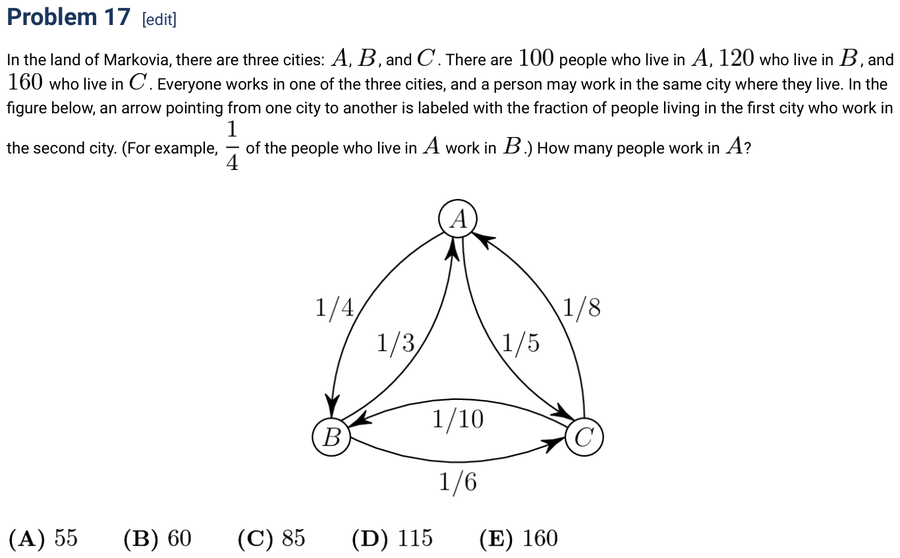
Sort people by where they work, not where they live. Workers in A arrive from three places: stayers in A, commuters from B, commuters from C. Add those three.
Still stuck? Show hint 2 →
Hint 2 of 2
The sneaky one is A→A: there's no arrow for "stays in A," so count it the easy way — everyone in A minus those who leave for B or C. The other two are just fraction × population.
Show solution
Approach: group by workplace; count the stayers by subtraction
Reorganize people by workplace. Workers in A come from three home cities, so add the three streams — and for the A→A stream, there's no "stays" arrow, so use complementary counting: everyone in A minus those who commute out.
Why this transfers: in flow problems, choose to count by the destination, and fill any missing "stay put" category by subtracting the ones who leave from the whole — the leftover-fractions always sum to 1.
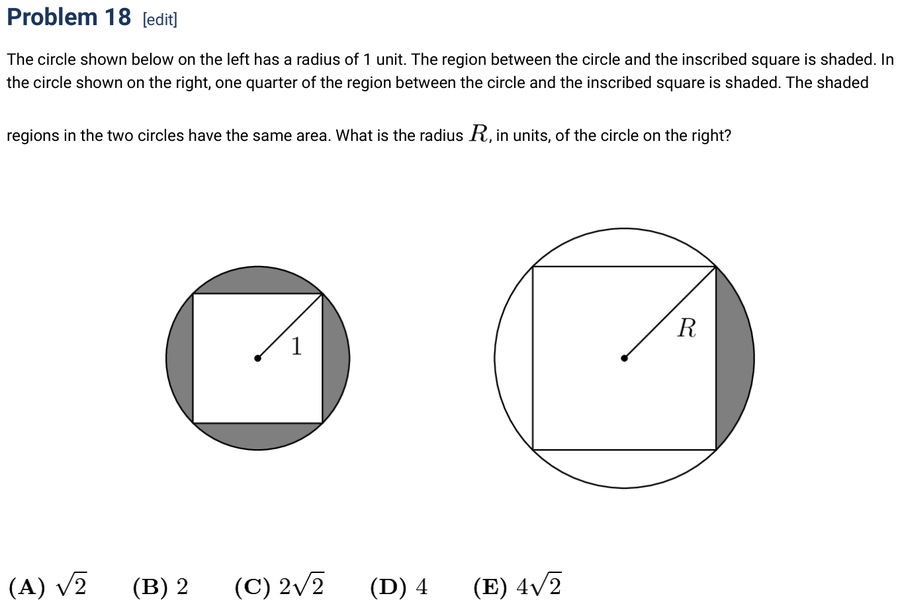
Don't compute either crescent-region's actual area. The two pictures are the same shape scaled up — so ask how area responds when you scale a figure.
Still stuck? Show hint 2 →
Hint 2 of 2
First translate the words into one number: "one quarter of the right region = the whole left region" means the right region is 4× the left. Since area scales as (length)2, the length scale-up is √4.
Show solution
Approach: similar figures: area scales as the square of the length
Both pictures are the identical shape (a square inscribed in a circle), just enlarged — so every area on the right is R2 times the matching area on the left, because radius 1 scales up to R.
The condition says a quarter of the right's between-region equals the left's whole between-region, so the right's whole region is 4 times the left's: R2 = 4.
R = √4 = 2.
Why this transfers: for similar figures, areas scale as length2 (and volumes as length3). Whenever shapes are merely scaled copies, you can skip the messy individual areas and just take a square root of the area ratio to get the length ratio.
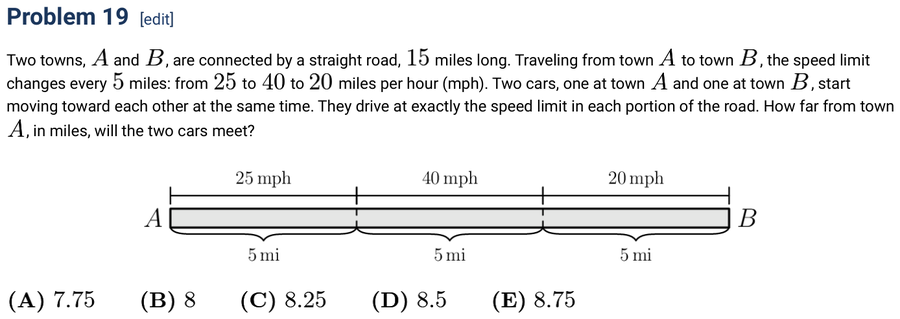
Guess where they meet first: the middle section, where both happen to drive 40 mph. There, equal speeds mean they close the gap evenly — all the trickiness is in how unevenly they reach the middle.
Still stuck? Show hint 2 →
Hint 2 of 2
Time A to the middle: 5/25 = 1/5 hr. Time B to the middle: 5/20 = 1/4 hr. So A enters the middle 1/20 hr early — turn that head start into miles, then split what's left.
Show solution
Approach: find each car's position when both are in the equal-speed middle section
Bet that they meet in the middle 40-mph section (then they go the same speed, so you only need positions). A covers its 5-mile left section in 5/25 = 1/5 hr; B covers its 5-mile right section in 5/20 = 1/4 hr. So A reaches the middle 1/4 − 1/5 = 1/20 hr before B.
In that 1/20-hr head start, A drives 40 × 1/20 = 2 miles into the middle. So when B finally enters, A is at mile 7, B at mile 10 — a 3-mile gap, both now at 40 mph.
Equal speeds split the gap evenly: each drives 1.5 more miles. A's meeting point is 7 + 1.5 = 8.5 miles from A.
Why this transfers: when speeds match over the stretch where they meet, the closing is symmetric — so isolate the asymmetry (the unequal times to arrive), convert it to a distance, then share the remainder equally.
Another way — track total time to the meeting instant:
They meet somewhere in the middle section at the same clock time t. Suppose A has gone a distance d into the middle and B has gone 5 − d into it (their middle distances fill the 5-mile section).
Sarika, Dev, and Rajiv are sharing a large block of cheese. They take turns cutting off half of what remains and eating it: first Sarika eats half of the cheese, then Dev eats half of the remaining half, then Rajiv eats half of what remains, then back to Sarika, and so on. They stop when the cheese is too small to see. About what fraction of the original block of cheese does Sarika eat in total?
Show answer
Answer: A — 4/7.
Show hints
Hint 1 of 2
Sarika eats on turns 1, 4, 7, … — every third turn. Each bite is half of what's left, so list the sizes of her bites and look for a pattern from one of hers to the next.
Still stuck? Show hint 2 →
Hint 2 of 2
Her bites are 12, then 116, then 1128, … — each is 18 of the one before (three halvings between her turns). That's a geometric series.
Show solution
Approach: sum the geometric series of Sarika's bites
Each turn eats half of what remains, so after turn n there's 1/2n left, and turn n ate 1/2n of the original. Sarika takes turns 1, 4, 7, …, so her bites are 12, 116, 1128, … — each 18 of the previous.
So it's a geometric series, first term a = 12, ratio r = 18.
Sum = a1 − r = 1/27/8 = 4/7.
Why this transfers: a never-ending halving (or any |ratio| < 1) sums to a finite total a1 − r — pull out one person's terms, find the constant ratio between consecutive ones, and apply the formula.
Another way — ratio of bite sizes (no infinite sum):
In every round of three turns, Sarika, Dev, and Rajiv eat in the fixed ratio 12 : 14 : 18 = 4 : 2 : 1 of whatever was there at the round's start.
Since that 4 : 2 : 1 split repeats on every leftover chunk, it holds for the whole block too. Sarika's share is 44 + 2 + 1 = 4/7 — and the cheese is essentially all eaten.
Minh enters the numbers 1 through 81 into the cells of a 9 × 9 grid in some order. She calculates the product of the numbers in each row and column. What is the least number of rows and columns that could have a product divisible by 3?
Show answer
Answer: D — 11 rows and columns.
Show hints
Hint 1 of 2
One multiple of 3 anywhere in a row makes that whole row's product divisible by 3 — same for its column. So a single bad number "poisons" a full row AND a full column. How do you poison as few lines as possible?
Still stuck? Show hint 2 →
Hint 2 of 2
Technique: count the multiples of 3 (there are 27 in 1–81) and pack them into an r×c block. That block fits r·c of them while poisoning r + c lines — minimize r + c with r·c ≥ 27.
Show solution
Approach: pack multiples of 3 into the tightest possible block
A row or column's product is divisible by 3 the instant it holds even one multiple of 3. So each multiple-of-3 placement poisons one row and one column — the goal is to confine all of them to the fewest lines. There are 27 multiples of 3 in 1–81 (81÷3).
Squeeze them into an r×c rectangle: it covers r·c cells and poisons exactly r + c lines. We need r·c ≥ 27 while making r + c small. A 5×5 block holds 25 — two short.
Tuck the last 2 multiples into a 6th column (rows 1–2). Now rows poisoned: 5; columns poisoned: 6; total 5 + 6 = 11. (A 6×5 would also reach 30 cells and 11 lines — same minimum.)
This transfers: for a fixed area r·c, the perimeter-like sum r + c is smallest when the rectangle is near-square — the same reason a square fences the most area for a given fence.
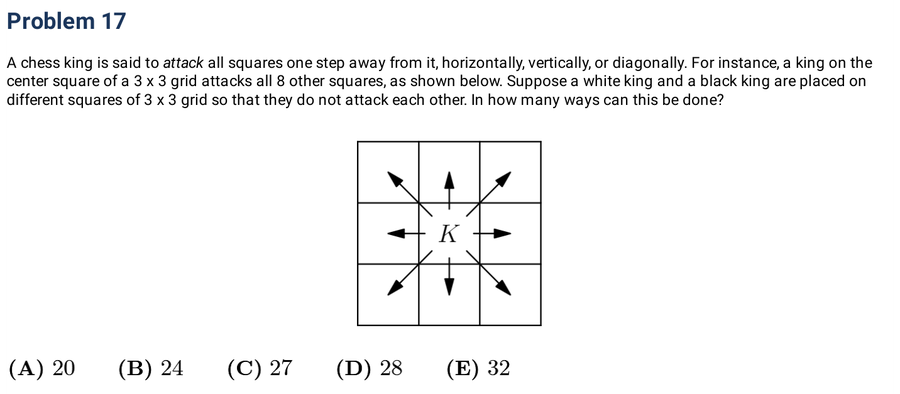
First, kill the impossible square: the CENTER attacks all 8 others, so a king there always attacks — neither king can sit there. That leaves only the 8 border squares.
Still stuck? Show hint 2 →
Hint 2 of 2
Technique — casework by the first king's spot, because corners and edge-middles see different numbers of squares: a corner attacks 3 (5 safe for the other), an edge-middle attacks 5 (3 safe).
Show solution
Approach: casework on the first king's position
Rule out the center first: it attacks all 8 surrounding squares, so a king there can never avoid attacking — both kings live on the 8 border squares. The kings are different colors, so order matters; place white first, then count safe spots for black.
White on a corner (4 corners): a corner attacks only 3 squares, leaving 8 − 3 = 5 safe for black. 4 × 5 = 20.
White on an edge-middle (4 of them): it attacks 5 squares, leaving 3 safe. 4 × 3 = 12.
Total: 20 + 12 = 32. Why split into cases: the count of attacked squares depends on the piece's position, so group positions by that count — the same move pays off whenever a board has corner/edge/center symmetry.
Another way — all pairs minus attacking pairs:
Place white anywhere (9), then black on any other square (8): 9 × 8 = 72 ordered placements ignoring attacks.
Subtract attacking placements. Count adjacencies on the 3×3: there are 12 edge-adjacencies and 8 diagonal-adjacencies, 20 unordered attacking pairs, so 40 ordered ones.
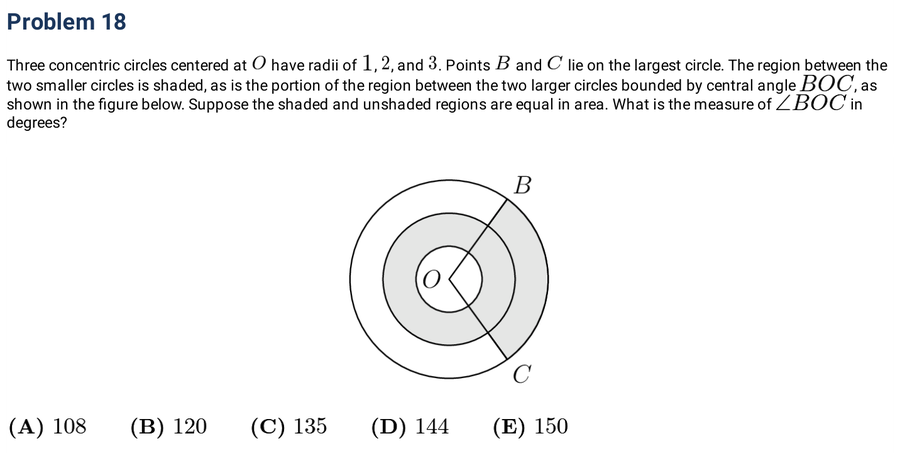
"Shaded = unshaded" is the gift: each must be exactly HALF the whole disk. So you don't compare two messy regions — you just set shaded = half the total.
Still stuck? Show hint 2 →
Hint 2 of 2
Break the disk into three rings (inner disk, ring 1–2, ring 2–3) and find each area from πr2. The only part the angle controls is the θ-sector of the outer ring.
Show solution
Approach: shaded equals half the disk; only the outer sector depends on the angle
The phrase "shaded = unshaded" means each is exactly half the disk — so skip comparing regions and just set shaded = half the total. Total disk area = π·32 = 9π, so shaded must be 4.5π.
Now tally the shaded parts in rings. The fully-shaded inner annulus (radii 1 to 2) has area π(22 − 12) = 3π, no angle involved. The outer annulus (radii 2 to 3) has area π(32 − 22) = 5π, but only the θ-slice of it is shaded: θ360(5π).
Set shaded = half: 3π + θ360(5π) = 4.5π. The 3π already covers most of the half, leaving the sector to supply just 1.5π: θ360(5π) = 1.5π → θ360 = 0.3 → θ = 108°.
This transfers: when a problem says two regions are equal, immediately rewrite it as "each = half the whole" — one equation instead of two, and the constant parts often vanish into the half.
Jordan owns 15 pairs of sneakers. Three fifths of the pairs are red and the rest are white. Two thirds of the pairs are high-top and the rest are low-top. The red high-top sneakers make up a fraction of the collection. What is the least possible value of this fraction?
Show answer
Answer: C — 4/15.
Show hints
Hint 1 of 2
There are a FIXED 10 high-tops. To make as few of them red as possible, give as many high-tops as you can to the white pairs instead — crowd red out.
Still stuck? Show hint 2 →
Hint 2 of 2
Technique (minimize an overlap by pushing to the extreme): 9 red, 6 white; 10 high-top, 5 low-top. Whites can absorb at most 6 high-tops, so red is forced to take whatever high-tops are left.
Show solution
Approach: push white pairs into high-top to crowd out red
First nail the four counts. Red = 35×15 = 9, white = 6; high-top = 23×15 = 10, low-top = 5. The total of 10 high-tops is fixed; we only choose WHO gets them.
To minimize red high-tops, hand high-tops to white first. There are only 6 white pairs, so at most 6 high-tops can be white — do exactly that.
That leaves 10 − 6 = 4 high-top spots with nowhere to go but red. So the smallest red-high-top fraction is 415. This transfers: to minimize the overlap of two groups, shove the limited "other" group as full as it goes — the forced leftover is your minimum (it's the same logic as the Pigeonhole/inclusion bound).
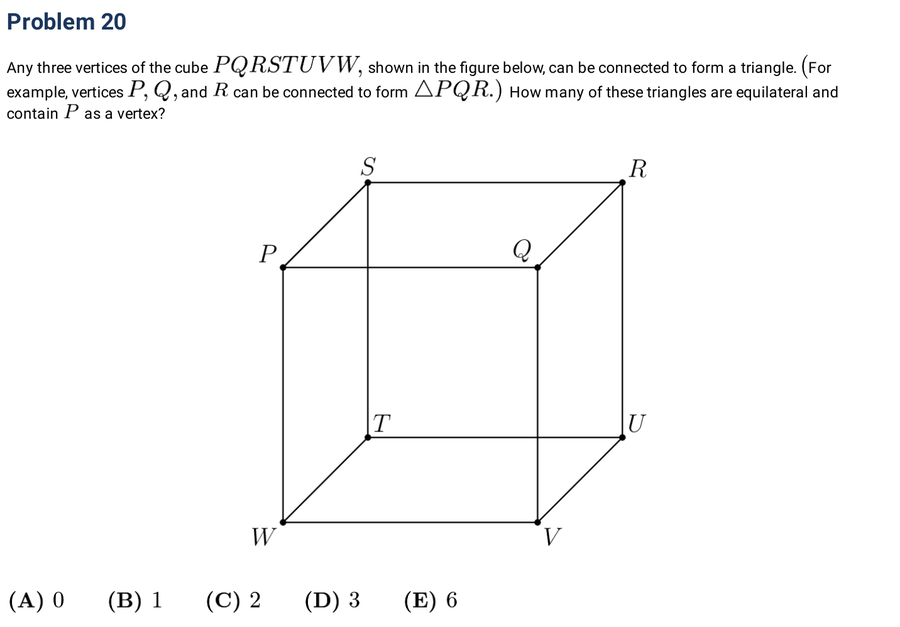
A cube only offers three distances between vertices: edge (1), face diagonal (√2), space diagonal (√3). For all three sides to match, which single distance can do it?
Still stuck? Show hint 2 →
Hint 2 of 2
Only face diagonals (√2) work. So find P's face-diagonal neighbors, then count how many TRIANGLES they form — that's a "choose 2" once you know how many neighbors there are.
Show solution
Approach: use face-diagonal length as the only valid side
List the only three possible vertex-to-vertex distances in a cube: edge = 1, face diagonal = √2, space diagonal = √3. An equilateral triangle needs all three sides equal, and edges or space diagonals can't close up into a triangle — only face diagonals (√2) can.
From P, the vertices a face-diagonal away are the three that sit across each of P's three faces: R, T, V (one per face).
Now check pairs: any two of {R, T, V} are themselves a face-diagonal apart, so each pair plus P is an equilateral triangle. With 3 such neighbors, the number of triangles is "choose 2 of 3" = 3: {P,R,T}, {P,R,V}, {P,T,V}.
3 triangles. This transfers: in 3-D distance problems, first list the few possible lengths, decide which can build the shape, then it becomes a small counting ("choose 2") problem.
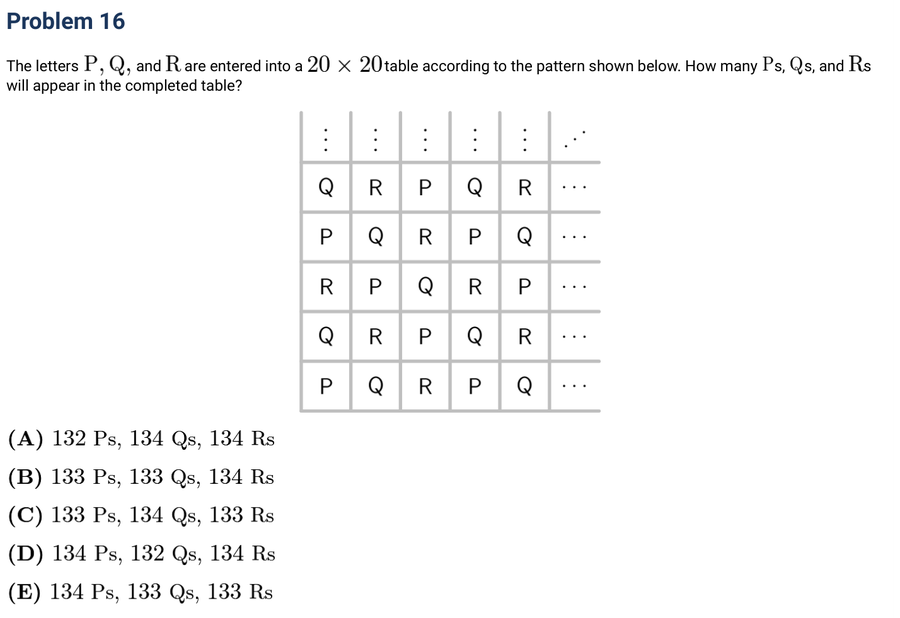
20 isn't a multiple of 3, so the three letters can't come out perfectly equal — 400 = 3 × 133 + 1 means exactly one letter gets one extra. The real work is finding which letter.
Still stuck? Show hint 2 →
Hint 2 of 2
Trick to balance the board: pretend you add a 21st column that's a copy of column 3. Each row of P,Q,R repeating across 21 cells holds exactly 7 of each — perfectly even. Then just subtract back off the column you added.
Show solution
Approach: pad to a clean width, then subtract the extra column
Since 20 isn't divisible by 3, the counts can't be equal: 400 = 3 × 133 + 1, so two letters tie at 133 and one gets 134. The whole question is which letter wins the leftover.
Make the width friendly: imagine appending a 21st column identical to the 3rd column. Now every row spans 21 = 3 × 7 cells, so each row has exactly 7 P, 7 Q, 7 R. Over 20 rows that's 140 of each — perfectly balanced.
Now undo it: the column you added (a copy of column 3, which reads P, R, Q, P, R, … down 20 cells) contains 7 Ps, 6 Qs, 7 Rs. Subtract from 140 each: 140−7 = 133 Ps, 140−6 = 134 Qs, 140−7 = 133 Rs.
So the table has 133 Ps, 134 Qs, 133 Rs. This transfers: when a repeating pattern doesn't fit evenly, pad it to a clean multiple where counting is trivial, then subtract the padding.
Another way — tile with 1×3 triominoes (MAA):
Any 1×3 straight tile laid on the pattern covers exactly one P, one Q, and one R. So wherever the board tiles cleanly, the three letters stay perfectly balanced.
Split the 20×20 board into an 18×18 square, a 2×18 strip, an 18×2 strip (all divisible by 3, so balanced), plus a leftover 2×2 corner.
That corner reads Q R / P Q — one extra Q. So the whole board has one more Q than P or R: 133 Ps, 134 Qs, 133 Rs.
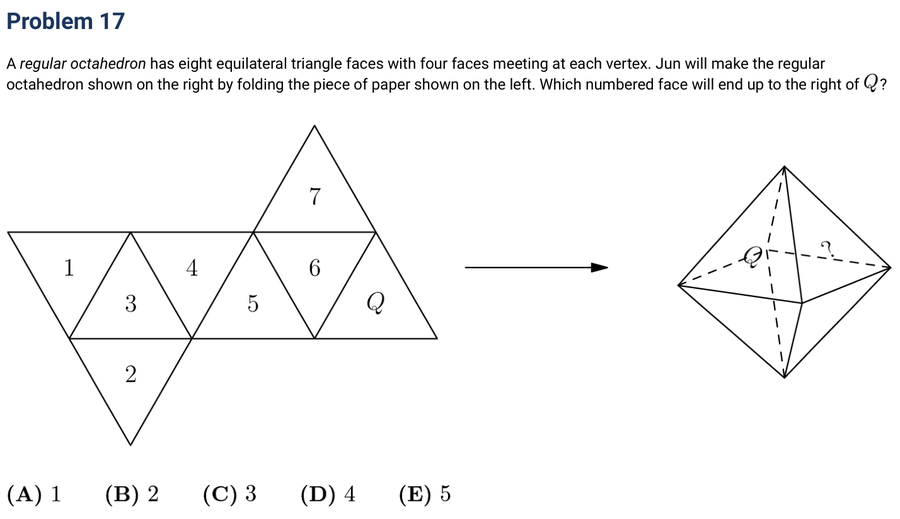
Don't try to fold the whole net in your head. Use the structure: an octahedron is two pyramids glued base-to-base, so its 8 faces split into a top 4 and a bottom 4, and exactly 4 faces meet at each tip.
Still stuck? Show hint 2 →
Hint 2 of 2
Hunt for 4 faces that all share one corner in the net — those become one pyramid (one hemisphere). Faces 2, 3, 4, 5 do that, so the other four {Q, 6, 7, 1} are Q's hemisphere; the answer must be among them.
Show solution
Approach: split the eight faces into two hemispheres of four
Instead of mentally folding, use the octahedron's structure: it's two square pyramids base-to-base, so the 8 faces split into a top set of 4 and a bottom set of 4, and exactly 4 faces ring each apex.
In the net, faces 2, 3, 4, 5 all meet at a single vertex — that vertex becomes one apex, making {2, 3, 4, 5} one hemisphere. Q can't be in that group, so by elimination Q's hemisphere is {Q, 6, 7, 1}.
Within that ring of four around the top apex, the fold seats face 1 immediately to the right of Q. This transfers: for any solid-from-net puzzle, first sort faces into the groups that share a vertex — it slashes the possibilities before you fold anything.
Greta Grasshopper sits on a long line of lily pads in a pond. From any lily pad, Greta can jump 5 pads to the right or 3 pads to the left. What is the fewest number of jumps Greta must make to reach the lily pad located 2023 pads to the right of her starting position?
Show answer
Answer: D — 411 jumps.
Show hints
Hint 1 of 2
Order doesn't matter — jumping right-then-left lands the same place as left-then-right. So all that matters is how many of each.
Still stuck? Show hint 2 →
Hint 2 of 2
She should overshoot 2023 with right jumps (landing on a multiple of 5), then walk back to 2023 in left jumps of 3. Find the first overshoot whose gap is a multiple of 3.
Show solution
Approach: overshoot to a multiple of 5, then step back by 3s
Order doesn't matter, so do all the right jumps first: they land Greta on a multiple of 5 just past 2023. Then left jumps of 3 carry her back to 2023, so the overshoot gap must be a multiple of 3.
Right jumps: 2035 ÷ 5 = 407. Left jumps: 12 ÷ 3 = 4. Total: 407 + 4 = 411 jumps. This transfers: ‘reach a target using two step sizes’ problems collapse once you realize order doesn't matter — only the counts of each step do, so you're really just solving 5R − 3L = 2023 in whole numbers.
Another way — pair each left jump with a right jump (MAA):
Pair every left jump with a right jump: a pair nets 5 − 3 = 2 pads forward, and any leftover right jumps add 5 each. With P pairs and Q spare right jumps, 2P + 5Q = 2023 and the total jumps is 2P + Q.
Spare right jumps move farther per jump, so maximize Q (minimize P). The smallest P making 2023 − 2P a multiple of 5 is P = 4, giving Q = (2023 − 8)/5 = 403.
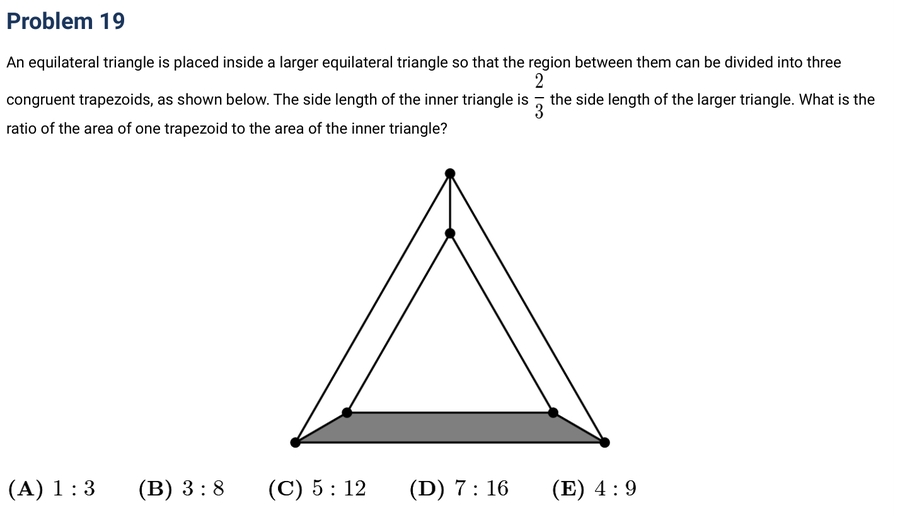
You never need the actual area formula. Lengths scale by 2:3, so areas scale by the square: (2/3)2 = 4/9. That one fact does all the work.
Still stuck? Show hint 2 →
Hint 2 of 2
Pick friendly numbers: let the inner triangle be 4 and the outer be 9 (ratio 4:9). The three trapezoids together fill the gap 9 − 4, then split it evenly into three.
Show solution
Approach: areas scale as side-length squared
Don't reach for ½·base·height — the key is that for similar figures, doubling lengths quadruples area: area scales as the square of the length ratio. Side ratio 2:3 → area ratio 4:9.
So set inner area = 4 and outer area = 9 (any pair in 4:9 works). The ring of three congruent trapezoids fills the leftover 9 − 4 = 5, so each trapezoid is 53.
One trapezoid : inner triangle = 5/34 = 512, i.e. 5 : 12. Worth keeping: whenever you see a ratio of lengths, square it for the ratio of areas (and cube it for volumes) — then you can assign convenient numbers and skip the geometry.
Another way — solve for the trapezoid area (MAA):
Let the inner triangle have area A. The outer triangle is (3/2)2 = 9/4 as large, so its area is 94A.
Inner triangle plus three trapezoids fills the outer triangle: A + 3X = 94A, so 3X = 54A and X = 512A.
Two integers are inserted into the list 3, 3, 8, 11, 28 to double its range. The mode and median remain unchanged. What is the maximum possible sum of two additional numbers?
Show answer
Answer: D — 60.
Show hints
Hint 1 of 2
‘Double the range’ just fixes how far apart the new min and max are (50 apart). To make the sum big, don't lower the min — keep it at 3 and shoot the max as high as allowed.
Still stuck? Show hint 2 →
Hint 2 of 2
Keeping min = 3 forces the new max to 3 + 50 = 53 (one insert, used up). Now the second insert should be as big as possible without breaking median = 8 or mode = 3 — so it has to stay below 8.
Show solution
Approach: push max up, then maximize the other insert under the median/mode constraints
Doubling the range only sets the spread between min and max to 50 — it doesn't say which one moves. Since we want a large sum, keep the small end at 3 and stretch the top: the new max must be 3 + 50 = 53. That's one of the two inserts spent.
Now place the second insert x as high as possible. The list has 7 numbers, so the median is the 4th when sorted: 3, 3, 8, 11, 28, 53 already sit there, and median must stay 8.
If x were 8 or more, the 4th spot would no longer be 8 (and x = 8 would also create a second mode). So x ≤ 7 — and x = 7 keeps 3 the unique mode and 8 the median.
Max sum = 53 + 7 = 60. Worth keeping: to maximize a sum under min/max/median/mode rules, fix the cheap constraints first (anchor the min, blow up the max), then push each remaining value to the edge of what the rules allow.