Tick one or more bands and topics — problems are pulled from every authored year.
Showing 20 of 205 matching
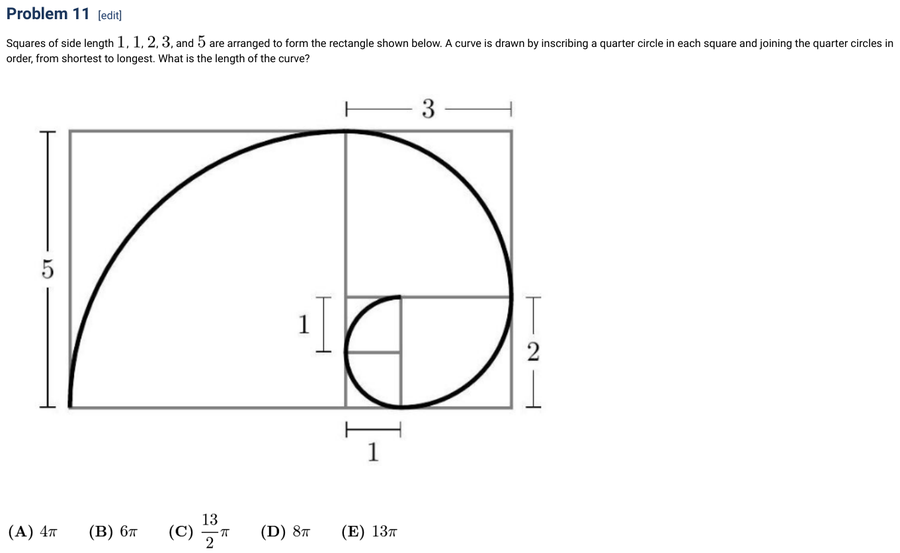
Problem 11 · 2026 AMC 8
Medium
Geometry & Measurementarc-length
Show answer
Answer: B — 6π.
Show hints
Hint 1 of 2
The spiral isn't one weird curve — it's five separate quarter-circles, one per square. In a square of side s, the inscribed quarter-circle has radius s. What is a quarter of that circle's circumference?
Still stuck? Show hint 2 →
Hint 2 of 2
Each arc is ¼ × 2πs = πs/2 — the arc length is just proportional to the side. So factor out π/2 and add the five sides.
Show solution
Approach: each square gives a quarter-circle; arc length scales with the side
Break the spiral into its five pieces: in each square of side s, the inscribed quarter-circle has radius s, so its arc is one-fourth of the full circumference: ¼ × 2πs = πs/2.
Every arc is just (π/2) times its side, so factor that out and total the sides 1, 1, 2, 3, 5: total = (π/2)(1 + 1 + 2 + 3 + 5) = (π/2)(12) = 6π.
Why this transfers: when a curve is built from circular arcs, handle each arc as (its fraction of a turn) × (2π × its radius), then add — you never need to draw the whole curve, just account for each arc's radius and how much of a full turn it sweeps.
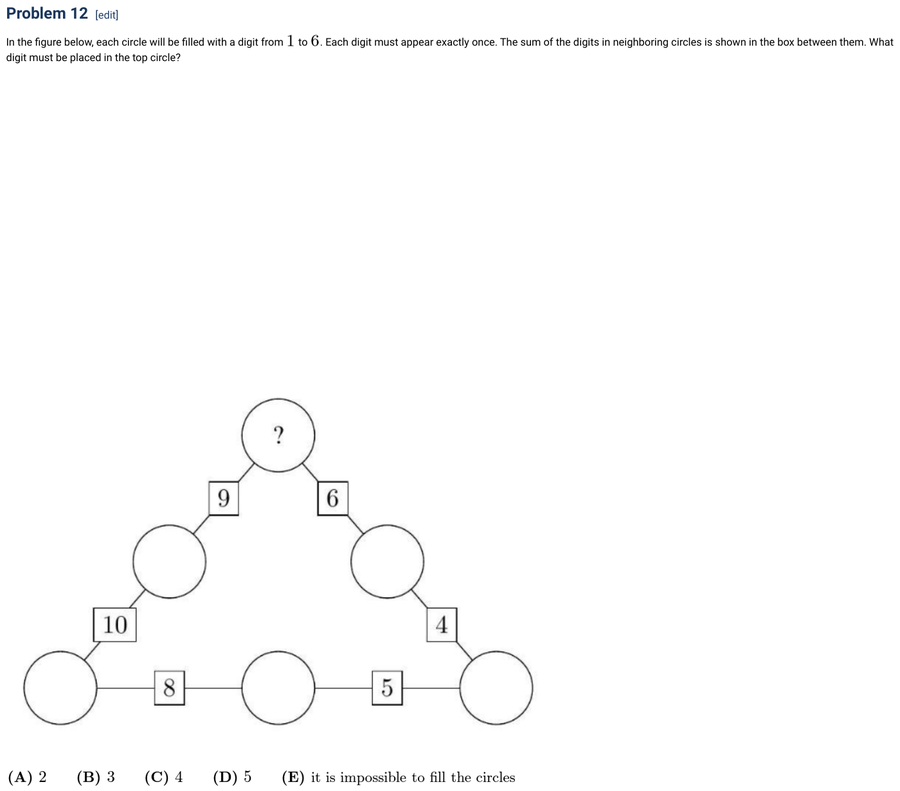
Don't guess the top circle — attack the most constrained edge first. With only the digits 1–6, which edge-sum can be made in only one way?
Still stuck? Show hint 2 →
Hint 2 of 2
The edge labeled 10 is the tightest: among 1–6, the only pair adding to 10 is 4 + 6. Pin those two circles down, then each neighboring sum forces the next digit like dominoes.
Show solution
Approach: start at the most-constrained edge, then let the sums force each digit
Scan for the edge with the fewest options. The sum 10 is the giveaway: out of 1–6, only 4 + 6 reaches 10, so that left edge's two circles are 4 and 6 in some order.
Test which way round: the edge above it sums to 9. If the upper circle is 4, the top is 9 − 4 = 5; the lower one is then 6. (The other way, top = 9 − 6 = 3, collides later.)
Now the dominoes fall: bottom-left 6 with edge 8 → bottom-middle 2; edge 5 → bottom-right 3; right edge 4 → upper-right 1; and the last check 5 + 1 = 6 matches the top-right edge. Digits used: {5,4,6,2,3,1} = 1–6 exactly once. ✓
So the top circle is 5.
Why this transfers: in any fill-the-grid / fill-the-graph puzzle, begin at the cell with the fewest legal choices — one forced value usually triggers a chain that solves the rest with no guessing.
Don't try to measure the slanted side directly. The area of any square is just (side length)² — so you only need side², never the side itself.
Still stuck? Show hint 2 →
Hint 2 of 2
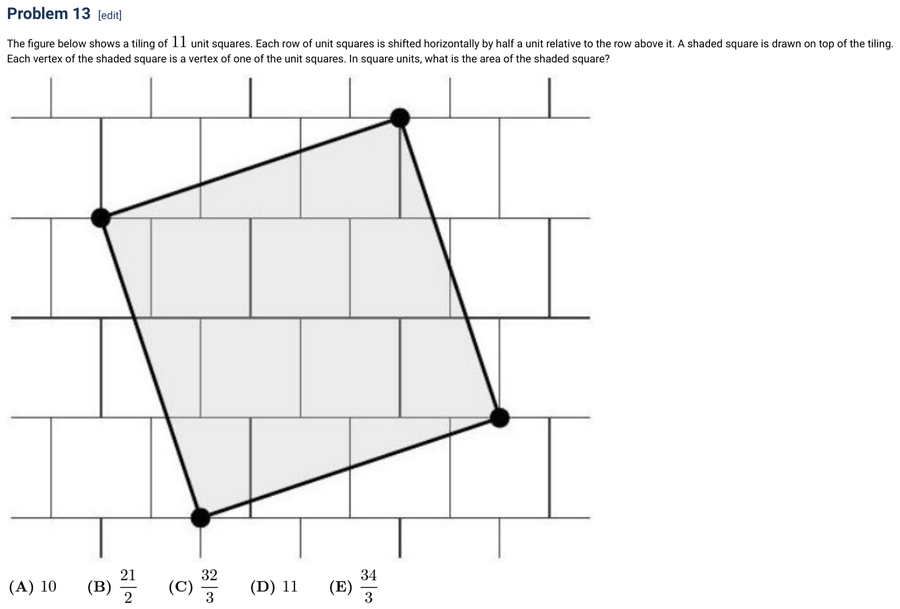
Treat one tilted side as a journey across the grid: so many units right and so many up. By the Pythagorean theorem, side² = (across)² + (up)², and that is the area — no square roots needed.
Show solution
Approach: area = side², and side² = (horizontal step)² + (vertical step)²
Pick one side of the shaded square and trace it from corner to corner across the tiling: it moves 1 unit across and 3 units up (the half-unit row shifts let the vertices land on lattice points).
That side is the hypotenuse of a right triangle with legs 1 and 3, so side² = 1² + 3² = 10. But the area of the square is side², so the area is 10 — you never even compute the side.
Why this transfers: for any tilted square on a grid, the area is just (horizontal step)² + (vertical step)² of one side. This is the ‘tilted-square shortcut’ — it skips both the square root and the messier ‘big square minus 4 corner triangles’ method.
Another way — bounding box minus four corner triangles:
Enclose the tilted square in the smallest upright square. With side-steps of 1 and 3, that box is 4 × 4 = 16.
The four right-triangle corners each have legs 1 and 3, area ½·1·3 = 1.5, so four of them remove 4 × 1.5 = 6.
Tilted-square area = 16 − 6 = 10, matching the shortcut.
Jami picked three equally spaced integers on the number line. The sum of the first and second is 40, and the sum of the second and third is 60. What is the sum of all three numbers?
Show answer
Answer: B — 75.
Show hints
Hint 1 of 2
‘Equally spaced’ is the magic phrase: the middle number is exactly the average of the outer two. So how does the middle number relate to the whole sum of three?
Still stuck? Show hint 2 →
Hint 2 of 2
Add the two given sums (40 + 60). The middle number gets counted twice and the outer two once each — turn that into the value of the middle, then triple it.
Show solution
Approach: the middle number is the average — and the whole sum is just 3 times it
For three equally spaced numbers, the middle one is the average of all three, so the total is simply 3 × middle. Find the middle.
Add the two given sums: (first + second) + (second + third) = 40 + 60 = 100. The middle got counted twice, the outer two once each, so 100 = (first + second + third) + second. Also first + third = 2·second, giving 100 = 4·second, so the middle is 25.
Total = 3 × 25 = 75.
Why this transfers: in any evenly-spaced list, the middle term is the mean, so sum = (count) × (middle). Spotting ‘equally spaced’ lets you skip solving for the individual numbers.
Another way — name the spacing and watch it cancel:
Call the numbers m−d, m, m+d. The first sum is 2m−d = 40 and the second is 2m+d = 60.
Add them: 4m = 100, so m = 25. The total is exactly 3m = 75 — the spacing d never matters.
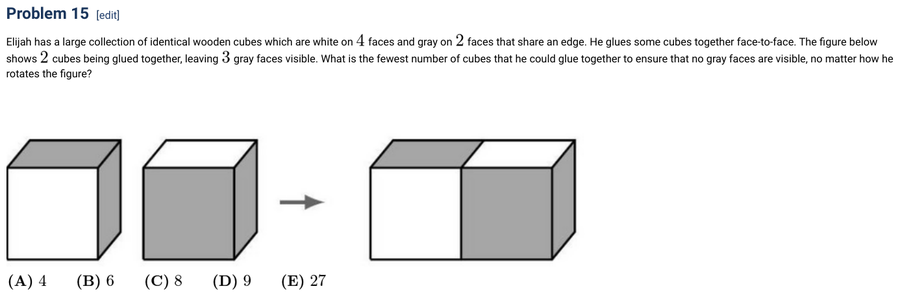
Focus on what one cube needs. Its two gray faces meet at an edge (they're adjacent, not opposite). To bury both, the cube must be glued on two faces that also meet at an edge.
Still stuck? Show hint 2 →
Hint 2 of 2
So a straight line of cubes can't work — the inside cubes are only glued on opposite faces. Every cube needs two glued faces sharing a corner. What's the smallest cluster where every cube gets that?
Show solution
Approach: each cube must be glued on two faces that share an edge
Zoom in on a single cube. Its two gray faces are adjacent (they share an edge), so to hide both, the cube has to touch neighbors on two faces that share an edge — an ‘L’ of contact, not a straight-through pair.
That rules out a straight row: an end cube is glued on only one face, and a middle cube is glued on two opposite faces — either way a gray face is left showing. You need the cubes to turn a corner.
Arrange four cubes in a 2 × 2 square. Every cube then touches two neighbors on faces that meet at an edge, so its gray pair can point into that corner and stay hidden. Three or fewer cubes can't give all of them an L of contacts.
The fewest is 4.
Why this transfers: ‘hide adjacent faces’ problems hinge on which faces get covered, not just how many — opposite-face contact (a straight line) and edge-sharing contact (a corner) are very different, and the gray-face geometry tells you which you need.
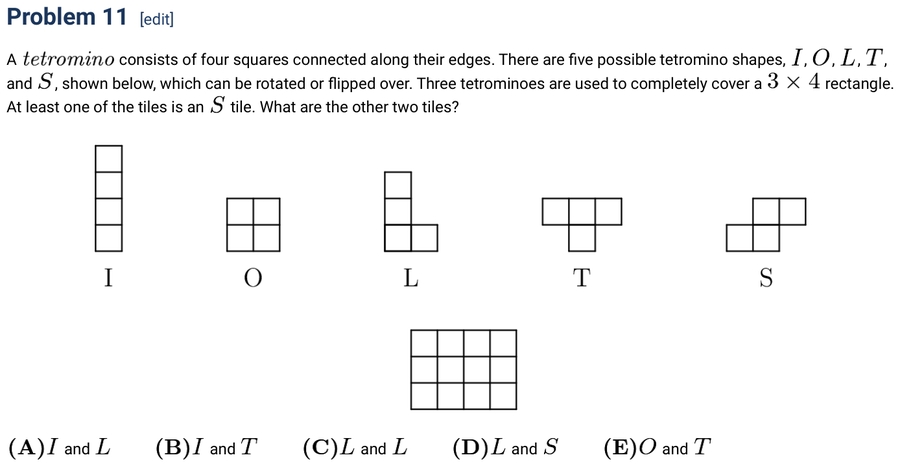
You're told one tile is an S, the trickiest, kinkiest shape. Lock it down first — commit to placing it, then see what hole is left for the other two.
Still stuck? Show hint 2 →
Hint 2 of 2
Slide the S along an edge so it leaves a tidy hole. The remaining 8 squares fall into an L-shape — what two tetrominoes fill that?
Show solution
Approach: place the most constrained piece first, then read off the leftover
The 3 × 4 rectangle is 12 squares = three tetrominoes. Start with the given S piece, because it's the most awkward — pinning the hardest constraint first leaves you the least to juggle.
Tuck the S against an edge so it doesn't fracture the rest. The 8 squares left over form one connected L-shaped region.
That region splits neatly down the middle into two L tetrominoes — so the other two tiles are L and L.
Why this transfers: in any tiling or fitting puzzle, place the piece with the fewest legal positions first. It collapses the casework, instead of building up a mess of options you later have to undo.
Another way — eliminate by what can't reach a corner:
Once the S sits in place, look at the leftover region's corners: each is a square that only an L (or I) can reach into without poking outside.
An O or T can't fill those notched corners, and a single I plus the S won't close the gap — so the pair must be two L's, choice L and L.
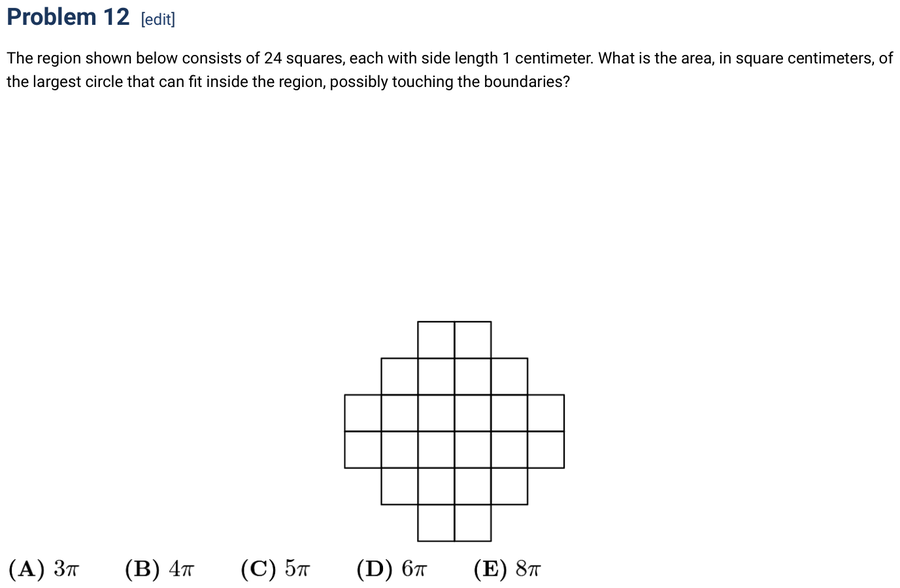
A circle's reach is capped by the closest bit of boundary. On this lumpy plus-shape, that closest bit isn't a flat edge — it's an inward corner where two arms meet.
Still stuck? Show hint 2 →
Hint 2 of 2
Center the circle in the middle (by symmetry). Find one nearest inward corner: it's 1 unit across and 2 units up from the center. The Pythagorean theorem gives the radius — then square it for the area.
Show solution
Approach: radius = distance to the closest point of the boundary
Center the circle at the region's center (forced by symmetry). The biggest it can grow is limited by the nearest boundary point — and on this cross-shape those are the inward corners where the arms notch in, not the outer flat edges.
One such corner sits 1 unit across and 2 units up from the center, so the radius is the hypotenuse: √(12 + 22) = √5.
Area = π × (√5)2 = 5π.
Why this transfers: the largest inscribed circle is always pinned by the closest point of the boundary — so on a non-convex shape, hunt the inward corners first. And notice you never needed √5 itself: squaring it for the area gives a clean 5.
Computing 25 remainders one by one is a trap. Adding 2 each time bumps the remainder by 2 (mod 7) — so the remainders march in a short repeating loop. Find that loop.
Still stuck? Show hint 2 →
Hint 2 of 2
The loop has length 7, and 25 = 3 full loops + 4 leftovers. The full loops hit every remainder equally, so it's only those 4 leftovers — the first remainders in the cycle — that decide which bars stand taller.
Show solution
Approach: find the period-7 cycle; only the leftovers break the tie
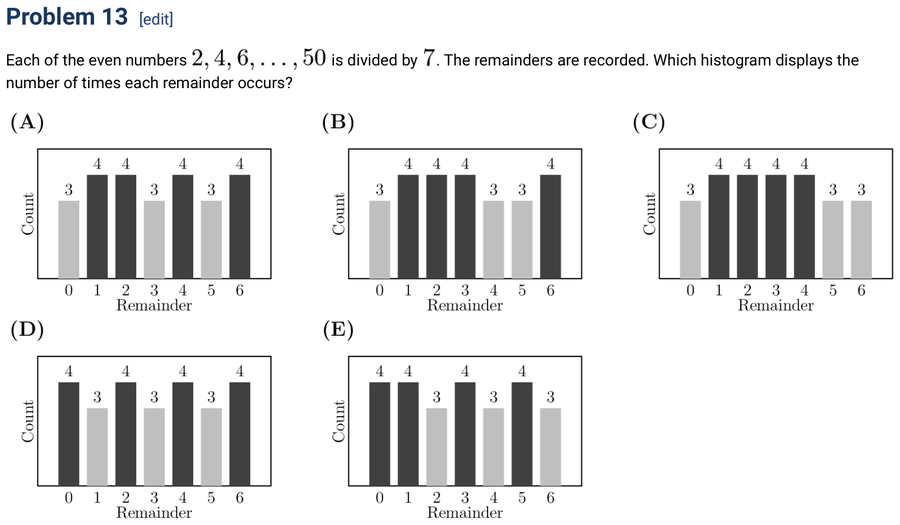
Adding 2 each step bumps the remainder by 2 (mod 7), so 2, 4, 6, 8, 10, 12, 14, … give remainders that loop: 2, 4, 6, 1, 3, 5, 0, repeating every 7.
There are 25 even numbers = 3 complete loops (21 numbers, each remainder appearing 3 times — so all bars start tied) plus 4 extras, which are the first four of the cycle: 2, 4, 6, 1.
Those 4 extras push remainders 1, 2, 4, 6 up to 4 each, while 0, 3, 5 stay at 3 each. The histogram with its taller bars exactly on 1, 2, 4, 6 is choice A.
Why this transfers: for "how often does each remainder occur" questions, find the repeating cycle, peel off the whole cycles (which tie everything), and let the short leftover tail break the tie. That beats brute-forcing every value.
A number N is inserted into the list 2, 6, 7, 7, 28. The mean is now twice as great as the median. What is N?
Show answer
Answer: E — 34.
Show hints
Hint 1 of 2
Peek at the answer choices before doing any algebra: every option is at least 7. The sorted list already has 7, 7 sitting dead center — what does inserting a big number do to the median?
Still stuck? Show hint 2 →
Hint 2 of 2
With 6 numbers the median is the average of the middle two, and those stay 7 and 7. So the median is locked at 7 — turn that into the mean and back-solve the sum.
Show solution
Approach: let the answer choices pin the median, then back-solve the mean
Glance at the choices first: all are ≥ 7. The starting list sorts to 2, 6, 7, 7, 28, and inserting any number that big keeps 7 and 7 as the middle two of the six. So the median is locked at 7 — no algebra needed for it.
"Mean is twice the median" then forces mean = 2 × 7 = 14, so the six numbers sum to 6 × 14 = 84.
The original five sum to 2 + 6 + 7 + 7 + 28 = 50, so N = 84 − 50 = 34.
Why this transfers: reading the answer choices can collapse the hard part of a problem — here they guarantee where N lands, freezing the median so you only have to chase the mean.
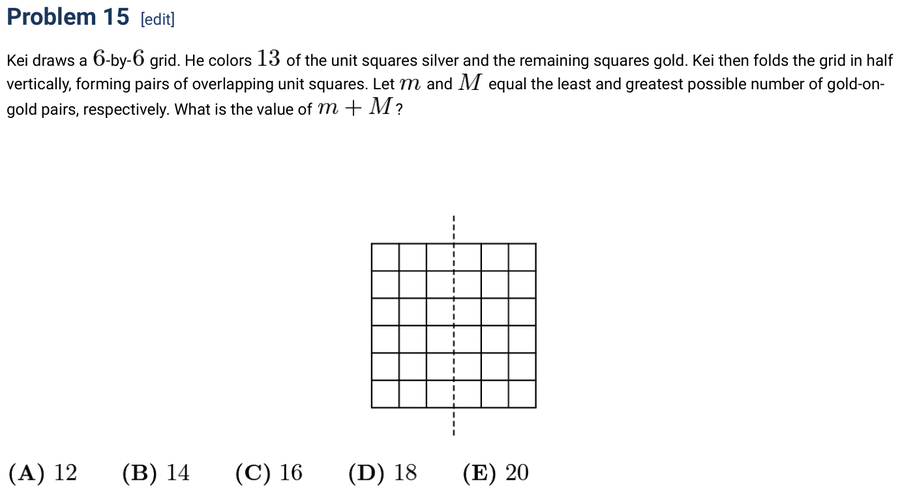
The fold turns 36 squares into 18 overlapping pairs. First, how many gold squares are there — and how does that compare to 18?
Still stuck? Show hint 2 →
Hint 2 of 2
There are more golds (23) than pairs (18), so some doubling-up is unavoidable. To make it rare, spread golds one-per-pair first; to make it common, glue golds together two-at-a-time.
Show solution
Approach: for an extreme, push the arrangement all the way to one side
Count gold: 36 − 13 = 23 golds, and the fold makes 18 pairs. Since 23 > 18, gold-on-gold pairs can't be avoided entirely — that tension is the whole problem.
Fewest (m): spread golds so each of the 18 pairs gets one first; that uses 18, and the remaining 23 − 18 = 5 are forced to land on already-gold squares. So m = 5.
Most (M): instead pile golds two-to-a-pair. 23 = 2 × 11 + 1, so you fill 11 pairs fully with 1 gold left over. So M = 11.
m + M = 5 + 11 = 16.
Why this transfers: to find a min or max of a count, don't search randomly — deliberately arrange things to the extreme (spread out for the minimum, clump together for the maximum). The leftover after even distribution is exactly the pigeonhole surplus, 23 − 18 = 5.
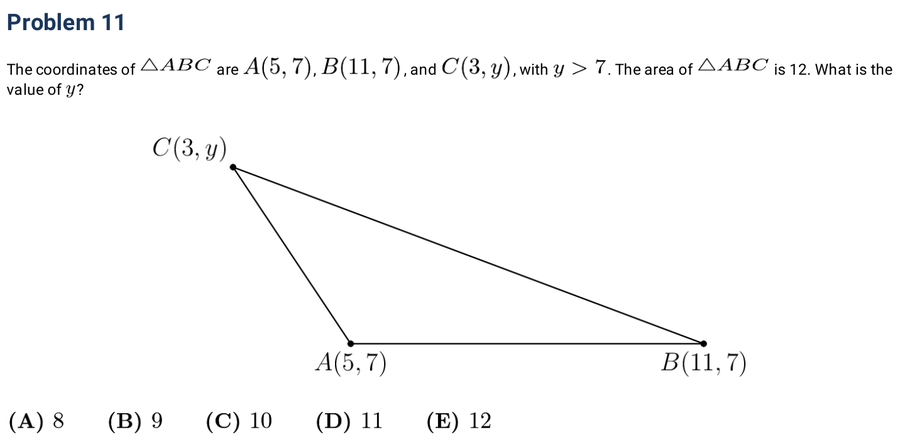
You get to CHOOSE which side is the base. A and B share the same height (y = 7), so AB is horizontal — pick that one and the height becomes trivial.
Still stuck? Show hint 2 →
Hint 2 of 2
Technique: with a horizontal base, the height is just the vertical gap. Base AB = 6 (from x = 5 to 11); height from C is y − 7.
Show solution
Approach: use the horizontal side as the base
A and B both sit at y = 7, so AB is a flat horizontal segment — the easiest possible base. Its length is just the x-gap: 11 − 5 = 6.
Because the base is horizontal, the height is simply how far C rises above the line y = 7, namely y − 7 — no distance formula needed. Area = 12 · 6 · (y − 7) = 12.
So 12 · 6 = 3 times the height equals 12 → height = 4 → y = 7 + 4 = 11. This transfers: on the coordinate plane, always make the base horizontal or vertical — then base and height are just coordinate differences.
Rohan keeps a total of 90 guppies in 4 fish tanks.
There is 1 more guppy in the 2nd tank than in the 1st tank.
There are 2 more guppies in the 3rd tank than in the 2nd tank.
There are 3 more guppies in the 4th tank than in the 3rd tank.
How many guppies are in the 4th tank?
Show answer
Answer: E — 26 guppies.
Show hints
Hint 1 of 2
The clues chain off each other, so anchor everything to ONE tank. From tank 1, each later tank is tank 1 plus a running total: +1, then +1+2 = +3, then +1+2+3 = +6.
Still stuck? Show hint 2 →
Hint 2 of 2
Technique: write all four as tank 1 + (0, 1, 3, 6). Their sum is 4·(tank 1) + 10 = 90 — one equation for one unknown.
Show solution
Approach: express every tank in terms of tank 1
The differences chain, so pin everything to tank 1 = x. Then tank 2 = x + 1, tank 3 = (x+1) + 2 = x + 3, tank 4 = (x+3) + 3 = x + 6.
Adding: 4x + (1 + 3 + 6) = 4x + 10 = 90, so x = 20.
The question wants tank 4, not tank 1 — so finish the job: tank 4 = 20 + 6 = 26. Watch out: solving for x = 20 and stopping is the classic trap; always re-read what's being asked.
Another way — level the tanks against the total:
If all four tanks matched tank 1, the total would be 4·(tank 1). The real total is 10 more (the built-in extras 0+1+3+6), so 4·(tank 1) = 90 − 10 = 80 → tank 1 = 20.
Buzz Bunny is hopping up and down a set of stairs, one step at a time. In how many ways can Buzz start on the ground, make a sequence of 6 hops, and end up back on the ground? (For example, one sequence of hops is up-up-down-down-up-down.)
Show answer
Answer: B — 5 sequences.
Show hints
Hint 1 of 2
Ending back on the ground after 6 hops forces exactly 3 ups and 3 downs. The real constraint: at no moment can downs outnumber ups, or Buzz drops below the ground.
Still stuck? Show hint 2 →
Hint 2 of 2
This is the "balanced parentheses" rule — read U as ( and D as ). List the legal arrangements; always start with U, end with D.
Show solution
Approach: count valid never-go-below sequences (a Catalan count)
Back to the ground in 6 hops means equal ups and downs: 3 U and 3 D. The twist is the ground floor — reading left to right, the count of D's may never exceed the count of U's (else Buzz steps below the ground). So every valid string starts U and ends D.
List them with that rule, keeping ups ahead: UUUDDD, UUDUDD, UUDDUD, UDUUDD, UDUDUD — 5 in all.
This transfers: "up/down steps that never go below start" is exactly the balanced-parentheses problem, and its counts are the Catalan numbers 1, 2, 5, 14, … For 3 ups and 3 downs the count is the 3rd Catalan number, 5 — matching our list, and a fast check for the longer versions of this problem.
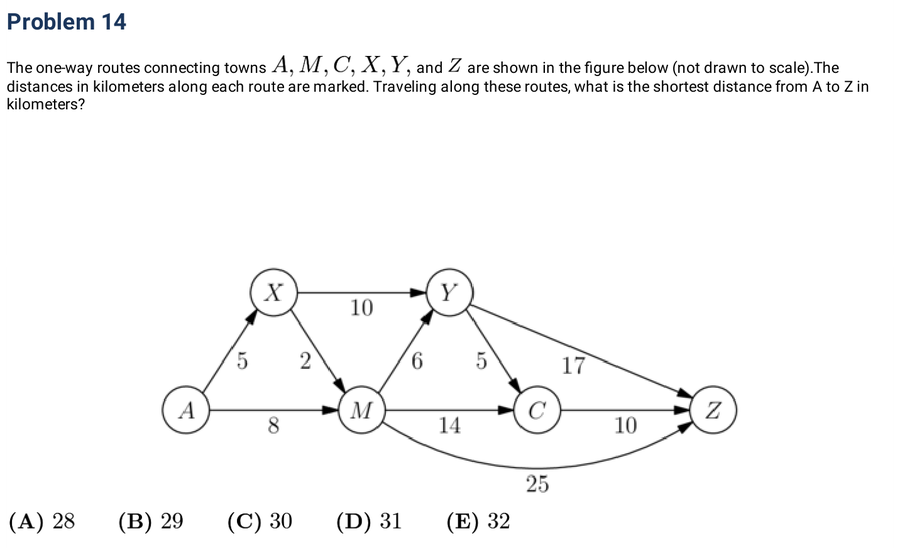
Don't try to trace whole routes — too many. Instead label each town with its OWN shortest distance from A, in the order the towns can be reached.
Still stuck? Show hint 2 →
Hint 2 of 2
Technique (shortest-path relaxation): a town's best distance = the smallest "(best distance to a town that feeds it) + (that edge)". Solve them in flow order A, X, M, Y, C, Z.
Show solution
Approach: shortest-path table, town by town
Rather than list every full route, find the shortest distance to each town from A, building up in the order towns become reachable. Each town's value = the cheapest "(arrived-distance to a feeder) + (its edge to here)." Start: A→X = 5 (only way in).
A→M = min(8 direct, 5 + 2 via X) = 7. Going through X beats the direct road.
A→Y = min(5 + 10 via X, 7 + 6 via M) = 13.
A→C = min(7 + 14 via M, 13 + 5 via Y) = 18.
A→Z = min(7 + 25 via M, 13 + 17 via Y, 18 + 10 via C) = 28 (via C). This transfers: this is Dijkstra's idea — once a town has its final shortest label, every later town can lean on it, so you never re-explore whole paths.
Let the letters F, L, Y, B, U, G represent distinct digits. Suppose FLYFLY is the greatest number that satisfies the equation
8 · FLYFLY = BUGBUG.
What is the value of FLY + BUG?
Show answer
Answer: C — 1107.
Show hints
Hint 1 of 2
A number that repeats a 3-digit block, like ABCABC, isn't random — it's the block times something. What number, when multiplied by 123, gives 123123?
Still stuck? Show hint 2 →
Hint 2 of 2
Key fact: ABCABC = 1001 × ABC. So FLYFLY = 1001·FLY and BUGBUG = 1001·BUG, and the whole equation collapses to 8 · FLY = BUG.
Show solution
Approach: strip the repeat, then maximize digit-by-digit
The repeated block is the doorway: ABCABC = ABC×1000 + ABC = 1001·ABC. So FLYFLY = 1001·FLY, BUGBUG = 1001·BUG, and dividing both sides by 1001 leaves the tiny equation 8 · FLY = BUG.
BUG is still only 3 digits, so 8 · FLY < 1000 → FLY ≤ 124. That forces F = 1, and the tens digit L ≤ 2 (if L = 3, 8·13Y already exceeds 1040).
We want the GREATEST FLY, so push digits up. L = 2 (1 is taken by F). Now test the units Y from high down, needing all six digits F,L,Y,B,U,G distinct: Y = 4 gives 8·124 = 992 (repeated 9, fails); Y = 3 gives 8·123 = 984, digits {1,2,3,9,8,4} all different ✓.
FLY + BUG = 123 + 984 = 1107. You'll see it again: 1001 = 7×11×13 is the workhorse behind every ABCABC pattern — spotting the repeated block lets you divide a 6-digit monster down to 3 digits.
NASA's Perseverance Rover was launched on July 30, 2020. After traveling 292,526,838 miles, it landed on Mars in Jezero Crater about 6.5 months later. Which of the following is closest to the Rover's average interplanetary speed in miles per hour?
Show answer
Answer: C — About 60,000 mph.
Show hints
Hint 1 of 2
The answer choices jump by factors of 10, not by small amounts — that's permission to round wildly. Don't touch 292,526,838; call it 3 × 10⁸.
Still stuck? Show hint 2 →
Hint 2 of 2
Turn 6.5 months into hours through friendly rounding: ≈ 200 days ≈ 5000 hours. Then speed ≈ distance ÷ time.
Show solution
Approach: round to easy numbers, divide
First read the answer choices: they're spaced by powers of 10. That means precision is wasted — the game is to land in the right ballpark, so round everything to one digit.
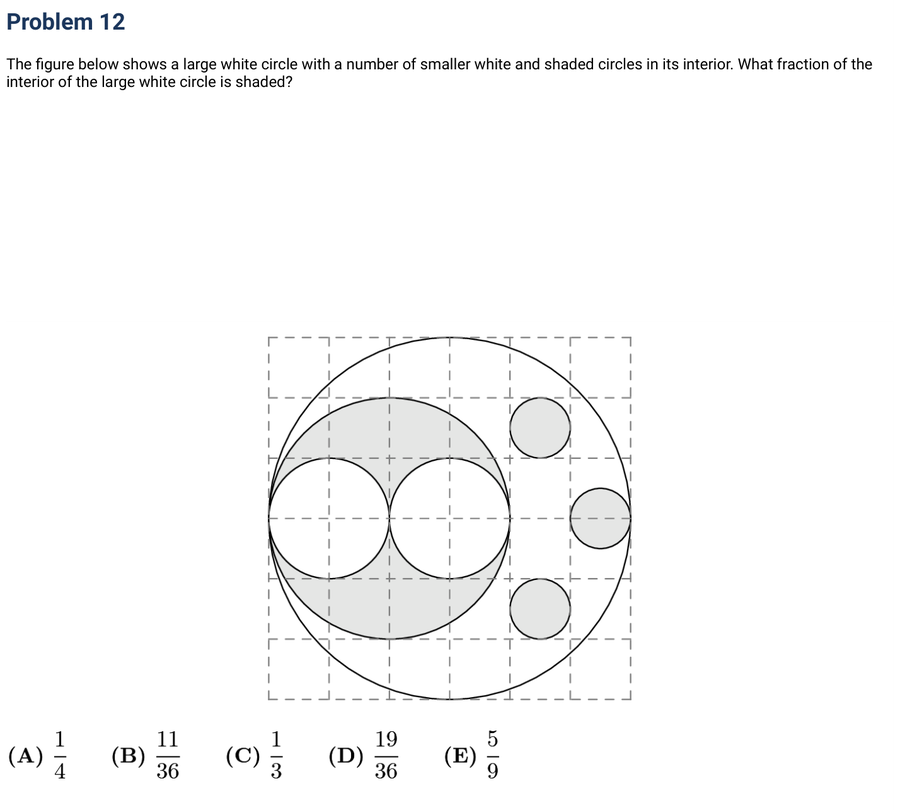
First use the faint grid to read off every radius (3, 2, 1, and 12). Then notice the big shaded disk has two white circles biting into it — so its shaded area is disk minus those bites.
Still stuck? Show hint 2 →
Hint 2 of 2
Because every area carries a factor of π, you can drop the π and just compare radius-squared values: outer = 9, big disk = 4, each inner white = 1, each tiny shaded = 14. The π cancels in the final fraction.
Show solution
Approach: sum shaded, subtract carved-out whites
Read the radii off the grid: outer circle 3, big shaded disk 2, the two white circles inside it 1 each, the three tiny shaded circles 12 each. Since we want a fraction, the π will cancel — so really just work with radius-squared.
Big shaded disk has area 4π, but two white circles (1π each) eat into it: net shaded there = 4π − 2π = 2π.
Three tiny shaded circles add 3 × π4 = 3π4.
Total shaded = 2π + 3π4 = 11π4, over the outer 9π: 11π/49π = 1136. Worth keeping: in any ‘what fraction is shaded’ circle problem the π always cancels — compare radius² values and skip π entirely.
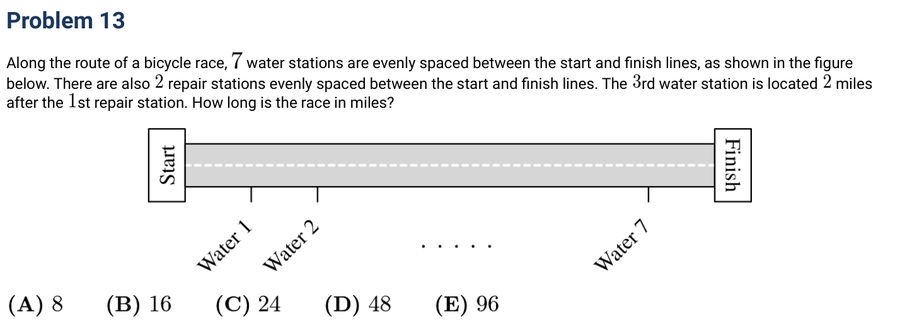
Forget miles for a moment — locate each station as a fraction of the whole route. The watch-out: stations sit between start and finish, so 2 stations make 3 equal gaps (not 2).
Still stuck? Show hint 2 →
Hint 2 of 2
2 repair stations → route split into thirds, so the 1st repair is at 1/3. 7 water stations → eighths, so the 3rd water is at 3/8. The gap between those positions is the given 2 miles.
Show solution
Approach: convert station positions to fractions of the route
Pin each station as a fraction of the route. The key (and the trap): n stations spaced between start and finish cut it into n+1 equal pieces. So 2 repair stations → thirds (1st repair at L/3) and 7 water stations → eighths (3rd water at 3L/8).
The 3rd water is 2 miles past the 1st repair, so 3L/8 − L/3 = 2.
Combine over 24: (9L − 8L)/24 = L/24 = 2, so L = 48 miles. Worth keeping: ‘k things evenly spaced between two ends’ always means k+1 gaps — the classic fencepost catch.
Another way — spacing variables (MAA):
Let w be the gap between water stations and r the gap between repair stations. The whole route is 8w = 3r.
The 3rd water (at 3w) is 2 past the 1st repair (at r): 3w = r + 2. Sub r = 3w − 2 into 8w = 3r: 8w = 9w − 6, so w = 6.
Number Theorycomplementary-countingcareful-counting
Nicolas is planning to send a package to his friend Anton, who is a stamp collector. To pay for the postage, Nicolas would like to cover the package with a large number of stamps. Suppose he has a collection of 5-cent, 10-cent, and 25-cent stamps, with exactly 20 of each type. What is the greatest number of stamps Nicolas can use to make exactly $7.10 in postage?
Show answer
Answer: E — 55 stamps.
Show hints
Hint 1 of 2
‘Use the most stamps’ is hard to chase directly. Flip it: he owns a fixed pile worth a fixed total, so using the most stamps means setting aside the fewest. What's the whole pile worth?
Still stuck? Show hint 2 →
Hint 2 of 2
All 60 stamps total $8.00, and he only needs $7.10 — so he must hold back exactly $0.90. Now the easy question: what's the fewest stamps that make $0.90?
Show solution
Approach: minimize stamps removed, not maximize stamps used
Maximizing what you use is the same as minimizing what you leave out — and since the whole pile is fixed, the leftover is fixed in value too. That flip turns a messy ‘maximize’ into a tidy ‘minimize.’
All 60 stamps total 20 × ($0.05 + $0.10 + $0.25) = 20 × $0.40 = $8.00. To pay $7.10 he must hold back $8.00 − $7.10 = $0.90.
Fewest stamps making $0.90: grab the biggest coins first — three 25¢ (75¢), one 10¢, one 5¢ = $0.90 with just 5 stamps.
Stamps used = 60 − 5 = 55. This transfers: ‘use the most/fewest of a fixed supply’ problems are almost always easier solved by counting the complement — what you don't use.
Another way — build up directly (MAA):
To pile on stamps, lean on the small ones and use as few 25¢ as possible. The 5¢ and 10¢ together max out at $1.00 + $2.00 = $3.00, so you need at least $4.10 more from quarters — at least seventeen 25¢ = $4.25.
That leaves $7.10 − $4.25 = $2.85. Since $2.85 isn't a whole number of dimes, use an odd count of nickels: nineteen 5¢ = $0.95 leaves $1.90 = nineteen 10¢.
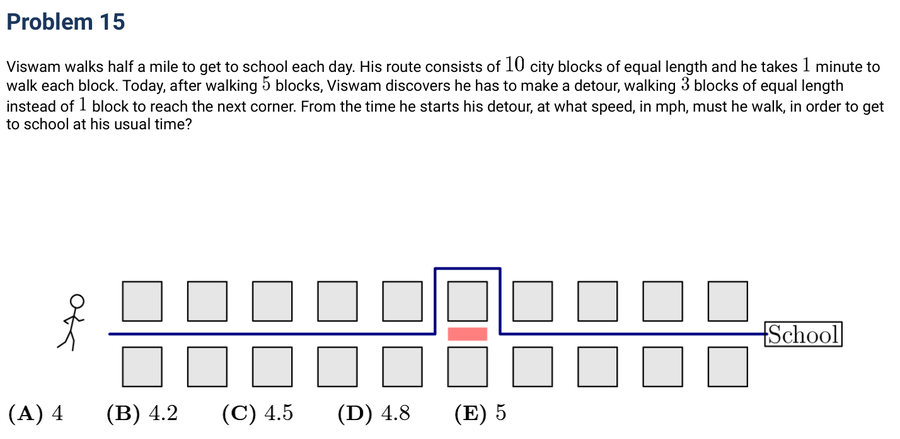
The deadline doesn't move — he still has the same 5 minutes left. What changed is only the distance: the detour swaps 1 block for 3, adding 2 extra blocks.
Still stuck? Show hint 2 →
Hint 2 of 2
So in the leftover 5 minutes he must now cover 7 blocks instead of 5. Turn both into mph-friendly units: each block is 0.05 mile, 5 minutes is 1/12 hour.
Show solution
Approach: convert blocks to miles, time to hours
The anchor is that his arrival time is unchanged — so his time budget for the rest of the walk is fixed, and only his distance grew. That's what forces a faster speed.
Usual walk: 10 blocks = 0.5 mile in 10 min, so each block is 0.05 mile and 5 blocks normally take 5 minutes. After the detour, the detour swaps 1 block for 3, so the remaining trip is 5 + 2 = 7 blocks = 0.35 mile.
He still has only 5 minutes = 1/12 hour. Speed = 0.35 ÷ (1/12) = 0.35 × 12 = 4.2 mph. This transfers: when a deadline is fixed and only the distance changes, hold time constant and let speed = new distance ÷ that fixed time.
Another way — scale up his old speed by the extra distance:
His normal pace covers those last 5 blocks in exactly the 5 minutes he has. The detour makes him cover 7 blocks in that same time — 7/5 as far.
So he must go 7/5 times his usual 3 mph: 3 × 7/5 = 21/5 = 4.2 mph.