Tick one or more bands and topics — problems are pulled from every authored year.
Showing 20 of 205 matching
Problem 1 · 2026 AMC 8
Easy
Arithmetic & Operationsgroupingarithmetic-series
What is the value of the following expression?
1 + 2 − 3 + 4 + 5 − 6 + 7 + 8 − 9 + 10 + 11 − 12
Show answer
Answer: A — The answer is 18.
Show hints
Hint 1 of 2
Don't read it as one long line — notice the signs themselves repeat in a short cycle. What does that cycle tell you about how to chunk the terms?
Still stuck? Show hint 2 →
Hint 2 of 2
The signs run +, +, − over and over. That's the group-by-the-pattern trick: chop into groups of three and add the group totals instead of the 12 separate terms.
Show solution
Approach: let the sign pattern choose the group size
The signs march +, +, − over and over — that's a clue to chop the 12 terms into groups of three, not to slog left to right.
Each group is (small + next − bigger). The first few: 1+2−3 = 0, 4+5−6 = 3, 7+8−9 = 6, 10+11−12 = 9. The group totals just climb by 3.
Add the four group totals: 0 + 3 + 6 + 9 = 18.
Why this transfers: when a long expression has a repeating sign or operation pattern, group by the length of that pattern — the messy string usually collapses into a short, regular list you can add in your head.
Another way — split into a clean +-sum and a -sum:
Add every term as if all were positive: 1+2+…+12 = 12×132 = 78.
The subtracted terms are 3, 6, 9, 12; we had counted them as +, so we must remove them twice: 2 × (3+6+9+12) = 2 × 30 = 60.
In the array shown below, three 3s are surrounded by 2s, which are in turn surrounded by a border of 1s. What is the sum of the numbers in the array?
1
1
1
1
1
1
1
1
2
2
2
2
2
1
1
2
3
3
3
2
1
1
2
2
2
2
2
1
1
1
1
1
1
1
1
A 5 × 7 array of numbers.
Show answer
Answer: C — The answer is 53.
Show hints
Hint 1 of 2
Before adding 35 numbers, look at the rows: some are exact copies of each other. Can you avoid adding the same row twice?
Still stuck? Show hint 2 →
Hint 2 of 2
Lean on the mirror symmetry — top matches bottom, 2nd matches 4th — so you only add three different rows and double two of them. (Or count how many 1s, 2s, and 3s there are.)
Show solution
Approach: use the mirror symmetry — only three rows are really different
The grid is a mirror image top-to-bottom: row 1 = row 5, and row 2 = row 4. So you only have to add up three rows, then double two of them.
Why this transfers: whenever a figure repeats or mirrors, add one copy of each distinct piece and multiply — the symmetry does most of the counting for you.
Another way — count how many of each number, not row by row:
The three 3s sit in the center: 3 × 3 = 9.
The 2s form a ring — five in row 2, five in row 4, two in the middle row = 12 twos: 12 × 2 = 24.
Everything else is a 1. The grid is 5×7 = 35 cells, so the 1s number 35 − 3 − 12 = 20, worth 20.
Haruki has a piece of wire that is 24 centimeters long. He wants to bend it to form each of the following shapes, one at a time.
A regular hexagon with side length 5 cm.
A square of area 36 cm2.
A right triangle whose legs are 6 and 8 cm long.
Which of the shapes can Haruki make?
Show answer
Answer: D — Square and triangle only.
Show hints
Hint 1 of 2
The wire is one fixed length and can't stretch. So what single number must every makeable shape's outline equal?
Still stuck? Show hint 2 →
Hint 2 of 2
A shape works only if its perimeter equals 24 cm. Find each perimeter — and for the triangle, watch for a familiar right-triangle (the 6-8-10) so you don't have to compute a square root.
Show solution
Approach: the wire never stretches — only perimeter = 24 works
A fixed loop of wire can only bend into a shape whose perimeter is exactly 24 cm. So the whole problem becomes: find each perimeter and check it against 24.
Hexagon: 6 sides × 5 = 30 cm. Too long — no. (Notice you don't even need the others to rule this one out.)
Square of area 36: the side is √36 = 6, so perimeter 4 × 6 = 24 cm. ✓
Right triangle, legs 6 and 8: spot the 6-8-10 Pythagorean triple — the hypotenuse is 10, so perimeter 6 + 8 + 10 = 24 cm. ✓
Only the square and the triangle fit, so the answer is Square and triangle only.
You'll see it again: 3-4-5 and its scalings (6-8-10, 9-12-15…) are the most common right triangles on contests — recognizing one saves you the square-root work.
Brynn's savings decreased by 20% in July, then increased by 50% of the new amount in August. Brynn's savings are now what percent of the original amount?
Show answer
Answer: E — 120%.
Show hints
Hint 1 of 2
Careful — the answer isn't simply −20 + 50 = +30%. The 50% rise acts on the already-shrunk amount, so the two changes don't just add.
Still stuck? Show hint 2 →
Hint 2 of 2
Turn each change into a multiplier (×0.8, then ×1.5) and multiply them — that's how percent changes compound, and you never need the starting amount.
Show solution
Approach: turn each percent change into a multiplier
A percent change is really a multiplier: down 20% leaves 80%, so × 0.8; up 50% means × 1.5. And changes chain by multiplying, so you never need a starting amount.
0.8 × 1.5 = 1.2, which is 120% of the original.
Watch the trap: the answer is not −20% + 50% = +30%. Percents stack by multiplying, not adding, because the +50% applies to the shrunken amount, not the original.
Another way — plug in a friendly number:
Pretend Brynn started with $100. July: down 20% leaves $80. August: up 50% of $80 adds $40, giving $120.
$120 out of the original $100 is 120%. Picking 100 makes the percent fall right out.
Casey went on a road trip that covered 100 miles, stopping only for a lunch break along the way. The trip took 3 hours in total and her average speed while driving was 40 miles per hour. In minutes, how long was the lunch break?
Show answer
Answer: B — 30 minutes.
Show hints
Hint 1 of 2
The 40 mph only describes the part where she's actually moving — the 3 hours also hides the lunch stop. Which piece can you compute directly?
Still stuck? Show hint 2 →
Hint 2 of 2
Time = distance ÷ speed gives the driving time only. Subtract that from the 3 total hours and what's left is the break.
Show solution
Approach: the 3 hours is driving + break; only driving obeys distance ÷ speed
The 40 mph is her speed while driving, so distance ÷ speed gives only the driving time, not the whole trip. Find that first: 100 ÷ 40 = 2.5 hours.
Whatever's left of the 3 total hours is the lunch break: 3 − 2.5 = 0.5 hour = 30 minutes.
Sanity check: 30 minutes of lunch is reasonable, and 2.5 h of driving at 40 mph really does cover 100 miles. The reusable idea: always separate ‘moving time’ from total time before using rate = distance ÷ time — the rate only describes the moving part.
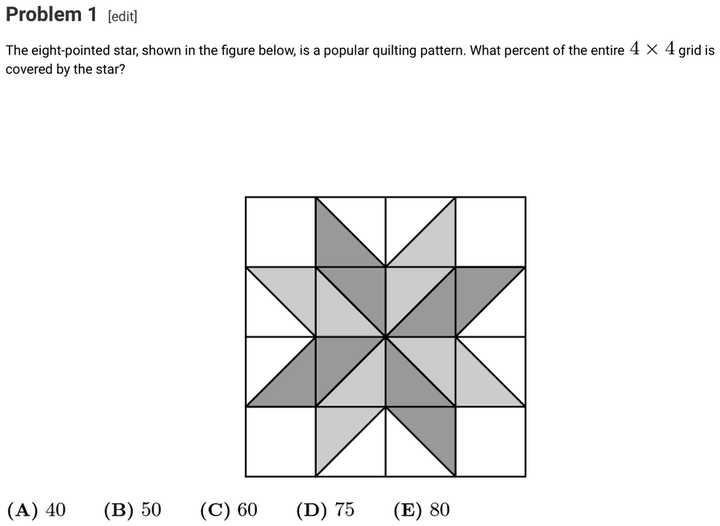
You probably don't need to measure anything. Could the shaded and unshaded parts be hiding the same total area?
Still stuck? Show hint 2 →
Hint 2 of 2
Look for symmetry that swaps shaded with white: pair every shaded triangle with a matching white triangle the same size. If they pair up perfectly, the answer is forced.
Show solution
Approach: pair each shaded triangle with a white twin (symmetry)
Don't measure anything — look for a partner. Each shaded triangle of the star has a congruent white triangle right beside it; shaded and white tile the grid in matched pairs.
Matched pairs means shaded = white exactly, so the star covers half the 4 × 4 grid: 8 of 16 squares = 50%.
Why this transfers: whenever a figure has a symmetry that swaps shaded with unshaded (a flip or a quarter-turn), the shaded fraction is forced to 1/2 — you never have to compute the area.
Another way — shrink to one quarter (MAA):
The four-fold symmetry means the shaded fraction of the whole equals the shaded fraction of just the top-left 2 × 2 quarter.
In that quarter, sliding one little triangle over makes it obvious the shaded part is exactly half — so the whole is 50% too.
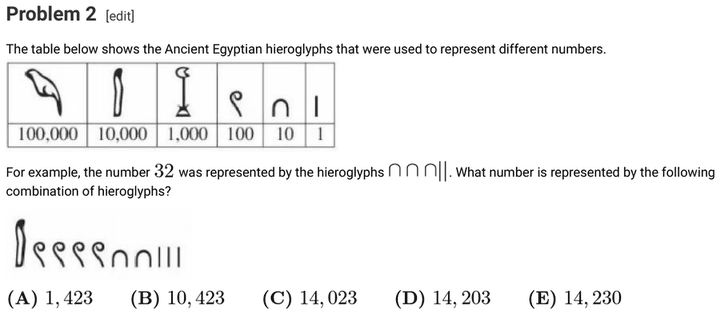
Unlike our digits, here position doesn't matter — a symbol is worth the same wherever it appears. So you only need to count how many of each kind.
Still stuck? Show hint 2 →
Hint 2 of 2
Tally each symbol type and add their table values, just like the example (three ∩ arches and two | strokes made 32). Notice there's no thousands symbol — what does that force the thousands digit to be?
Show solution
Approach: count each symbol type, then add the values
The key idea: in this Egyptian system a symbol's value doesn't depend on where it sits — you just count how many of each kind there are. So tally: one 10,000, four 100s, two 10s, three 1s.
Buffalo Shuffle-o is a card game in which all the cards are distributed evenly among all players at the start of the game. When Annika and 3 of her friends play Buffalo Shuffle-o, each player is dealt 15 cards. Suppose 2 more friends join the next game. How many cards will be dealt to each player?
Show answer
Answer: C — 10 cards each.
Show hints
Hint 1 of 2
More friends show up, but no new cards do. What's the one number here that stays exactly the same?
Still stuck? Show hint 2 →
Hint 2 of 2
The total number of cards is fixed. Find that total from the first game, then share it among the new, larger group.
Show solution
Approach: fixed total of cards, redistribute among players
The deck doesn't grow when friends arrive — the total number of cards is the thing that stays fixed. Find it: 4 players × 15 cards = 60 cards.
Now redeal that same 60 among 4 + 2 = 6 players: 60 ÷ 6 = 10 cards each.
Why this transfers: in any "shared evenly" problem, hunt for the quantity that doesn't change (here, the total). Pin it down once, then it answers every version of the question.
Lucius is counting backward by 7s. His first three numbers are 100, 93, and 86. What is his 10th number?
Show answer
Answer: B — 37.
Show hints
Hint 1 of 2
Careful — the 1st number is free. Getting from the 1st to the 10th, how many subtractions of 7 do you actually perform?
Still stuck? Show hint 2 →
Hint 2 of 2
It's 9 steps, not 10 (like fenceposts: 10 posts, 9 gaps). So how much is subtracted from 100 in total?
Show solution
Approach: count the steps, not the terms (arithmetic sequence)
The trap is multiplying by 10. But the 1st number cost no subtraction — going from the 1st to the 10th is only 9 steps, not 10. (Think fenceposts: 10 posts have 9 gaps between them.)
Each step subtracts 7, so you subtract 9 × 7 = 63 total: 100 − 63 = 37.
Why this transfers: the nth term of a sequence starting at the 1st uses n − 1 steps, not n. This off-by-one (fencepost) idea shows up in any "count from term 1 to term n" question. Sanity check: 37 + 63 = 100. ✓
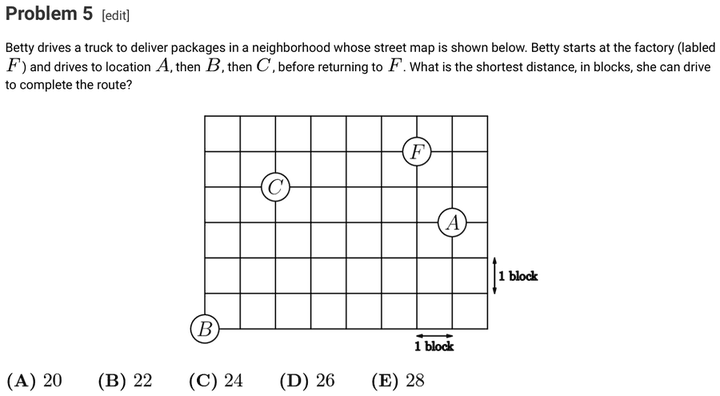
You can't cut diagonally across blocks. So however Betty zigzags within one leg, the distance is the same — what two things does it depend on?
Still stuck? Show hint 2 →
Hint 2 of 2
Each leg's length is just its sideways blocks plus its up-and-down blocks (taxicab distance). Read those off the map for F→A, A→B, B→C, C→F and add.
Show solution
Approach: taxicab / Manhattan distance per leg
Key idea: on a street grid you can't cut diagonally, so the distance for any leg is just (horizontal blocks) + (vertical blocks) — and as long as you never backtrack, the exact path doesn't matter, only where you start and end. (This is the taxicab / Manhattan distance.)
Read the four legs off the map: F→A = 1 + 2 = 3, A→B = 7 + 3 = 10, B→C = 2 + 4 = 6, C→F = 4 + 1 = 5.
Total: 3 + 10 + 6 + 5 = 24 blocks.
Why this transfers: on any grid where you only move along streets, the shortest distance between two points is fixed — just add the sideways and up-down gaps. The wiggly path you choose is irrelevant.
Another way — C is already on the way back (MAA):
Notice C lies on a shortest path from B back to F, so visiting C costs nothing extra. The problem reduces to F → A → B → F.
The question wants only the LAST digit. So why compute all six? What's the smallest piece of each number you actually need?
Still stuck? Show hint 2 →
Hint 2 of 2
Technique: for any "ones digit of…" question, work only in the ones column. Here every number ends in 2 — that's all that matters.
Show solution
Approach: only the ones digit matters
The question asks for ONE digit, so do ONE digit of arithmetic. Every number ends in 2, and there are five being subtracted, so their ones digits remove 5 × 2 = 10 — an amount ending in 0.
Taking away something ending in 0 never disturbs a ones digit: 222,222 keeps its 2. This transfers: for any "last digit of…" question, throw away every higher place and work only in the ones column.
Sanity check: the true value is 222,222 − 24,690 = 197,532 — ones digit 2, as predicted.
Another way — keep the intermediate positive (MAA):
Look only at the last two digits so the running total never goes negative: 22 − 2 − 2 − 2 − 2 − 2.
What is the value of this expression in decimal form?
4411 + 11044 + 441100
Show answer
Answer: C — 6.54.
Show hints
Hint 1 of 2
Before finding a common denominator, glance at each fraction alone — do any of them just collapse to a clean number?
Still stuck? Show hint 2 →
Hint 2 of 2
Each one simplifies on its own (every part hides a factor of 11). Turn each into a decimal, then add.
Show solution
Approach: simplify each fraction, then add
Don't reach for a common denominator — each fraction simplifies to a clean decimal on its own, so just turn them one at a time. 4411 = 4.
11044 = 52 = 2.5 (cancel 22).
441100 = 4100 = 0.04 (cancel 11).
Add: 4 + 2.5 + 0.04 = 6.54. Sanity check: answers near 6.5 should sit just above 6.5 once the tiny 0.04 is added — rules out 6.4 and 6.9.
Another way — pull out the shared 11 first (MAA):
Every numerator and denominator carries a factor of 11. Spotting that turns 44, 110, 1100 into 4×11, 10×11, 100×11 — the 11's cancel before you divide.
You're left with 41 + 104 + 4100 = 4 + 2.5 + 0.04 = 6.54.
Four squares of side lengths 4, 7, 9, and 10 units are arranged in increasing size order so that their left edges and bottom edges align. The squares alternate in the color pattern white-gray-white-gray, respectively, as shown in the figure. What is the area of the visible gray region, in square units?
Sides 4, 7, 9, 10 share a bottom-left corner; smaller squares lie on top.
Show answer
Answer: E — 52 square units.
Show hints
Hint 1 of 2
You never see a whole gray square — a smaller one always sits on its bottom-left corner. So what shape is the gray you actually see, and how would you find its area?
Still stuck? Show hint 2 →
Hint 2 of 2
Technique: each visible gray piece = (its square) − (the square on top). And a2 − b2 = (a+b)(a−b) makes 102−92 = 19 instantly — no squaring.
Show solution
Approach: frame = outer square minus the one on top (difference of squares)
The insight: you never see a whole gray square — a smaller white square always sits on top, leaving only an L-shaped frame. So gray visible = (gray square's area) − (the square covering it).
Gray 10 under white 9: 102 − 92. Instead of 100 − 81, use a2 − b2 = (a+b)(a−b) = 19×1 = 19 — no big subtraction.
Gray 7 under white 4: 72 − 42 = (7+4)(7−4) = 11×3 = 33.
Add the two frames: 19 + 33 = 52. You'll see it again: any time two squares (or any two areas) sit one inside the other, the leftover is their difference — and difference-of-squares makes consecutive sizes like 10 and 9 collapse to just their sum.
Another way — alternating add and subtract (MAA):
The visible gray is the 10-square minus the 9-square plus the 7-square minus the 4-square: 100 − 81 + 49 − 16.
When Yunji added all the integers from 1 to 9, she mistakenly left out a number. Her incorrect sum turned out to be a square number. What number did Yunji leave out?
Show answer
Answer: E — She left out 9.
Show hints
Hint 1 of 2
Don't test all nine cases. Find the FULL total 1+2+…+9 first — the answer is that total minus one small number, so it lands just below it. Which perfect square is nearby?
Still stuck? Show hint 2 →
Hint 2 of 2
Technique: full sum is 45 (pair 1+9, 2+8, …). Removing x gives 45 − x, somewhere in 36–44. Which value lands exactly on a perfect square?
Show solution
Approach: the full sum minus the missing number is a perfect square
The insight: start from the FULL total and only then take one number away. 1 + 2 + … + 9 = 45 (it pairs up: 1+9, 2+8, 3+7, 4+6, and a lonely 5 — four 10s plus 5).
Dropping a number from 1 to 9 leaves a sum between 45−9 = 36 and 45−1 = 44. So we just need a perfect square in the window 36–44.
Only 36 = 62 lives there (the next square, 49, is too big). So the sum became 36.
Removed amount = 45 − 36 = 9. Why this transfers: when something is "almost" a known total, compute the whole thing first, then the small correction — far easier than testing every number.
Aaliyah rolls two standard 6-sided dice. She notices that the product of the two numbers rolled is a multiple of 6. Which of the following integers cannot be the sum of the two numbers?
Show answer
Answer: B — The sum cannot be 6.
Show hints
Hint 1 of 2
What does "multiple of 6" really demand of the two dice? Break 6 into its prime pieces — the product needs both of them.
Still stuck? Show hint 2 →
Hint 2 of 2
Technique: 6 = 2 × 3, so the pair needs a factor of 2 (an even die) AND a factor of 3 (a 3 or 6). Test each answer's possible pairs against that single rule.
Show solution
Approach: test which sum has no multiple-of-6 pair
The insight: "multiple of 6" means "has a factor 2 AND a factor 3." So the pair must contain at least one even number AND at least one 3 or 6. That's the only condition — no need to multiply anything out.
Now test each sum. Sum 6 can only be (1,5), (2,4), or (3,3). Check: (1,5) has no even-and-3, (2,4) has no 3 or 6, (3,3) has a 3 but no even number. None qualify — so a sum of 6 is impossible.
Every other choice does have a qualifying pair: 5 = (2,3), 7 = (1,6), 8 = (2,6), 9 = (3,6). Answer: 6. This transfers: to test divisibility by a composite like 6, 12, or 15, split it into prime factors and check each one separately.
Another way — list every valid pair (MAA):
Pairs whose product is a multiple of 6 (need a multiple of 3 and an even number): (1,6), (2,3), (2,6), (3,6), (4,6), (5,6), (6,6).
Their sums: 7, 5, 8, 9, 10, 11, 12. Among A–E, only 6 is missing.
The two parentheses use the same three numbers — only the multiply sign moved. So the difference is really a contest between ‘8 × 4’ and ‘4 × 2’.
Still stuck? Show hint 2 →
Hint 2 of 2
Inside each parentheses, the rule is multiply before you add (order of operations). Evaluate each group, then subtract.
Show solution
Approach: order of operations: multiply before you add
The two parentheses look almost identical — same numbers 8, 4, 2 — but the × sits in a different spot. That's the whole trick: the answer comes from where the multiplication lands, not from the numbers themselves.
First parentheses: multiply first, so 8 × 4 + 2 = 32 + 2 = 34.
Second parentheses: 8 + 4 × 2 = 8 + 8 = 16.
Subtract: 34 − 16 = 18. Sanity check: the first group is much bigger because the big multiply (8 × 4) happens there, so a positive answer feels right.
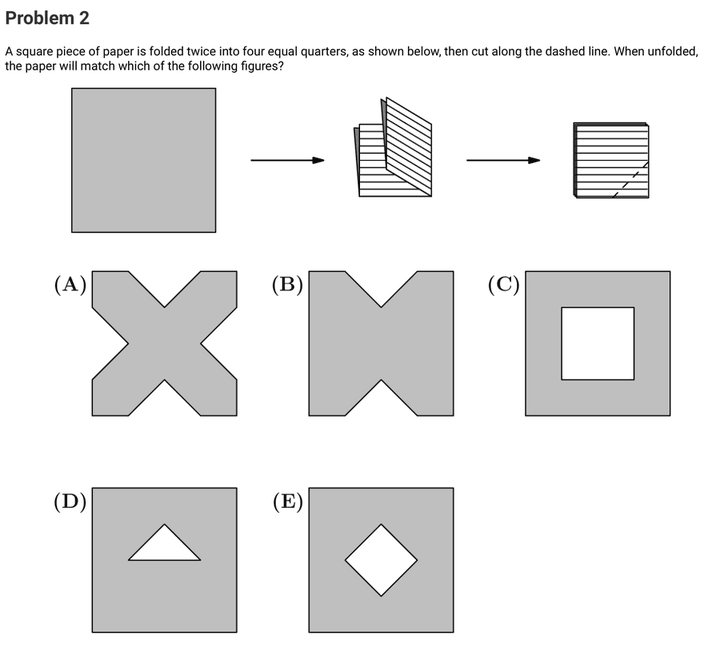
Find the one corner where all the folds meet — that's the spot the cut affects most. Where does it land on the full sheet?
Still stuck? Show hint 2 →
Hint 2 of 2
Folding twice into quarters stacks four layers at one corner, and that corner is the center of the original sheet. So one cut becomes four identical snips arranged symmetrically around the middle.
Show solution
Approach: track where one cut lands once the layers are stacked
The key question for any folding-and-cutting puzzle: where is the corner that all the folds meet at? Folding twice into quarters stacks all four corners onto one spot — and that spot is the center of the original sheet.
So a single cut near that folded corner is really happening through four layers at once — meaning four identical snips appear around the center when you unfold.
A straight diagonal cut takes a triangle off that stacked corner; unfolded, the four triangles join into one diamond-shaped hole in the middle — figure (E). This transfers: whatever you cut at the all-folds-meet corner becomes a symmetric shape centered on the sheet; cuts at an open edge stay at the edge.
Another way — fold real paper (or imagine one layer):
If you can, fold a square twice and cut — the fastest check. If not, just unfold one step at a time: the cut on the folded square mirrors across the first crease, then the result mirrors across the second crease.
Two mirrorings of a corner-triangle produce a four-fold symmetric hole sitting dead-center — matching (E).
with temperature in °F and wind speed in mph. If the air temperature is 36°F and the wind speed is 18 mph, which is closest to the wind chill?
Show answer
Answer: B — About 23.
Show hints
Hint 1 of 2
‘Closest’ tells you not to sweat the decimals — estimate. Wind makes it feel colder, so your answer must come out below 36.
Still stuck? Show hint 2 →
Hint 2 of 2
Put the numbers into the formula: multiply 0.7 × (wind speed) first, then subtract that from the temperature.
Show solution
Approach: substitute into the formula, then pick the closest choice
The word ‘closest’ is a hint that you can estimate. 0.7 × 18 is close to 0.7 × 18 = 12.6, and even rounding to ‘about 13 colder’ already points at choice (B).
Exactly: 0.7 × 18 = 12.6.
Subtract from the temperature: 36 − 12.6 = 23.4.
Closest choice is 23. Sanity check: wind should make it feel colder, so the answer must be below 36 — it is.
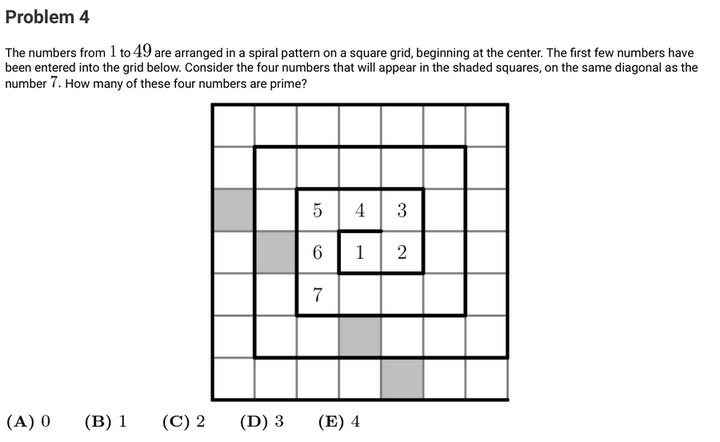
The spiral is just scenery — the real question is simply which four numbers land on those squares. Find them, then the problem becomes ‘how many are prime?’
Still stuck? Show hint 2 →
Hint 2 of 2
To find the numbers without drawing the whole grid, use the perfect squares as landmarks: 9, 25, 49 sit at corners of their layers. Then test each shaded number for primeness (a quick digit-sum check catches multiples of 3).
Show solution
Approach: fill in the diagonal, then test each for primeness
The clever move is to ignore the picture's prettiness and just ask: which four numbers land on those squares? Once you know them, the spiral has done its job and the question is pure prime-testing.
Continuing the spiral outward, the diagonal through 7 carries the four shaded numbers 19, 23, 39, 47.
Now test each for primeness. 39 jumps out: its digits add to 12 (a multiple of 3), so 39 = 3 × 13 is composite. The other three — 19, 23, 47 — are prime.
So 3 of the four shaded numbers are prime. Worth keeping: the digit-sum test (digits add to a multiple of 3 ⇒ divisible by 3) is the fastest way to spot a non-prime here.
Another way — use perfect squares as landmarks (MAA):
Without filling the whole grid: on an n×n spiral the number n2 sits in the upper-left (n even) or lower-right (n odd) corner. So 9 is at lower-right of the 3×3 block, 25 at lower-right of 5×5, 49 at lower-right of 7×7; 16 at upper-left of 4×4, 36 at upper-left of 6×6.
Walking outward from those anchors locates the four shaded squares as 19, 23, 39, 47 — with 39 = 3 × 13 the only composite.
A lake contains 250 trout, along with a variety of other fish. When a marine biologist catches and releases a sample of 180 fish from the lake, 30 are identified as trout. Assume the ratio of trout to the total number of fish is the same in both the sample and the lake. How many fish are there in the lake?
Show answer
Answer: B — 1500 fish.
Show hints
Hint 1 of 2
Think of the net of 180 fish as a shrunk-down copy of the whole lake — same recipe, smaller pot. So the trout fraction matches.
Still stuck? Show hint 2 →
Hint 2 of 2
Find the trout fraction in the sample (30 out of 180), then apply that same fraction to the 250 known trout to recover the whole.
Show solution
Approach: the trout fraction is the same in sample and lake
The sample is a tiny scale model of the lake: the trout fraction in your net should match the trout fraction in the whole lake. So find that one fraction and apply it.
In the sample, 30 of 180 are trout: 30 ÷ 180 = 16. That clean fraction is the heart of the problem — trout are 1 in every 6 fish.
So the 250 real trout are 16 of the whole lake, meaning the lake holds 250 × 6 = 1500 fish. This transfers to every ‘capture sample’ (or poll, or survey): part-of-sample = part-of-whole.
Another way — scale the whole sample up:
The lake has 250 trout but the sample only caught 30 — so the lake is 250 ÷ 30 = 253 times as ‘trout-rich’ as the sample.
Everything scales by that same factor, so total fish = 180 × 253 = 60 × 25 = 1500.