About this topic
Here is the strange thing about spatial problems: the kids who are ‘good at picturing things’ are not the ones who win them. The winners stop picturing the whole thing at once. They grab one piece — one face, one corner, one beam of light — and follow only that.
Try it right now. Hold a closed fist in front of you. That is a cube. Without moving your hand, which face is hidden against your palm side? You answered instantly — not by rotating the cube in your head, but by tracking one face. That is the entire skill, scaled up.
Two habits carry every chapter here. Redraw and label: copy the figure onto scratch paper and mark what you know, so the picture becomes your memory instead of your worry. Track one piece: never ask ‘what does the whole shape do?’ Ask ‘where does this one part go?’ The rest always follows.
The chapters climb a ladder: nets and cube counts first, then mirrors and dice, then tiling, grids, and the counting tricks that crack the hard problems. Start low. The optional For older kids blocks are there when you want them, not before.
Cube nets — which flat shape folds up?
Cut a cereal box along its edges and flatten it. What you get is a net — a flat shape that folds back into the solid. A cube has 6 square faces, so a cube net is always 6 squares joined edge to edge. But here is the catch that traps everyone: not every arrangement of 6 squares folds into a cube.
Fold one in your head and you feel why. As the squares swing up, each one has to land on its own face — floor, ceiling, or one of the four walls. If two squares both try to cover the same wall, the fold jams. Six squares is necessary. It is not enough.
The faster question: which faces end up opposite?
Most net problems do not ask ‘is this a cube?’ They ask ‘after folding, which face sits across from which?’ You could fold every time. There is a rule that saves you.
Look at any straight row of squares in the net. Walk along the row. Faces pair up by skipping one: the 1st with the 3rd, the 2nd with the 4th. Two squares that touch can never be opposite — on a real cube, neighbours share an edge, and opposite faces share nothing.
When four faces sit in a row, they wrap around the cube like a belt, and that belt hands you two opposite pairs at once (1–3 and 2–4). The two squares poking out of the belt are the last pair, top and bottom. All six faces sorted, no folding needed.
A named shortcut: the ‘cross’ net reads itself
The cross trick. The most common cube net is a plus sign: one centre square with four arms, plus one square hanging off the end of one arm. Make the centre the floor. The four arms fold straight up into the four walls — so arms that point opposite ways are opposite faces (left arm vs right arm, top arm vs bottom arm). The lone square on the far end of an arm folds over to become the ceiling, opposite the floor. That sorts all three pairs without folding a single square in your head.
Quick example. A plus net has centre C, arms U (up), D (down), L (left), R (right), and one extra square X stuck beyond the U arm. Centre C is the floor, so its partner X (the ceiling) is opposite C. The opposite arms pair off: U is opposite D, and L is opposite R. Three pairs: C–X, U–D, L–R — read straight off the cross.
THE MOVE: opposite faces are the two with exactly one square between them in a straight line. Skip one to find the partner.
For a ‘does this fold into a cube?’ question, pick any square as the floor and fold the rest up one at a time, ticking off the 6 faces as you cover them: floor, ceiling, and four walls. The instant two squares fight for the same face, that shape is out. For a ‘which one does NOT fold?’ question you only need to catch the single clash.
Counting 6 squares and declaring ‘cube net, done’. A plus-sign of 5 squares with one stuck wrong, an L of 6 in the wrong bend — both have 6 squares and both fail. Always fold-check.
In an L-shaped net, two faces sit at the far ends, pointing away from each other — one at the top of the column, one at the right of the row. They point opposite directions on the flat page, so they must be the opposite faces of the cube.
Why it breaks: ‘points opposite ways on the paper’ is not the same as ‘opposite on the cube’ — once you fold, those two end squares swing up and meet along an edge, so they are actually neighbours. Two faces that share an edge can never be opposite.
The fix: ignore how the flat squares point. Walk a straight run and skip one: that is the only way to read true opposites. If there is no straight run of three through a pair, fold-check by hand.
The diagram shows the net of a cube whose faces are numbered. Sascha adds the numbers that are on opposite faces of the cube. Which three results does he get?
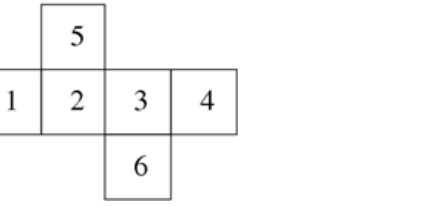
The net’s faces are numbered. Sascha folds it into a cube and adds each pair of opposite faces. Which three sums does he get? Do it without folding — use the skip-one rule.
Step 1 — find the straight band. Faces 1, 2, 3, 4 sit in a row, so they belt the cube. Skipping one along the row: 1 is opposite 3, and 2 is opposite 4.
Step 2 — the leftovers are top and bottom. That belt used four faces. The two remaining squares, 5 and 6, must be the ceiling and floor, so 5 is opposite 6.
Step 3 — add each pair. 1 + 3 = 4, 2 + 4 = 6, 5 + 6 = 11. The three sums are 4, 6, 11 — choice A. You never folded anything; you read the partners straight off the row.
Find the straight band first. Faces 1, 2, 3, 4 sit in a row, so they belt the cube: 1 is opposite 3, and 2 is opposite 4. That uses four faces. The leftover squares 5 and 6 have to be the top and bottom, so 5 is opposite 6. Now add the pairs: 1 + 3 = 4, 2 + 4 = 6, 5 + 6 = 11. The three sums are 4, 6, 11 — choice A. You never folded anything; you read the partners straight off the row.
6 squares is necessary but not enough — always fold-check. There are exactly 11 different cube nets. To find opposite faces, skip one along a straight row.
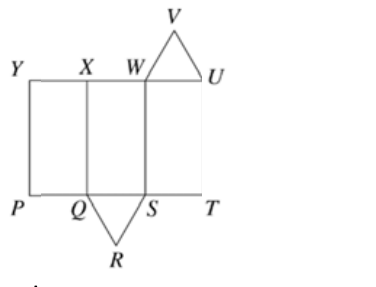
2015 · #7 The diagram shows the net of a three-sided prism. Which line of the diagram forms an edge of the prism together with line UV when the...
The diagram shows the net of a three-sided prism. Which line of the diagram forms an edge of the prism together with line UV when the net is folded up?
Show answer
Show hints
Still stuck? Show hint 2 →
Show solution
- The net of the triangular prism wraps the rectangular faces around the two triangular ends.
- When it is folded up, segment UV is brought together with the segment that shares its endpoints after folding.
- Tracing the fold, that segment is XY.
- So the answer is XY (C).
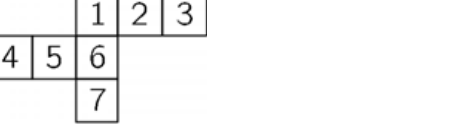
2015 · #21 Nina wants to make a cube from the paper net. You can see there are 7 squares instead of 6. Which square(s) can she remove from the net,...
Nina wants to make a cube from the paper net. You can see there are 7 squares instead of 6. Which square(s) can she remove from the net, so that the other 6 squares remain connected and from the newly formed net a cube can be made?
Show answer
Show hints
Still stuck? Show hint 2 →
Show solution
- Removing a square must keep the other six joined and able to fold into a cube with no doubled-up face.
- Taking out an interior square breaks the net or makes two squares fold onto the same face, so those fail.
- Removing square 3 works, and removing square 7 works, while no other single removal does — so the answer is only 3 or 7.
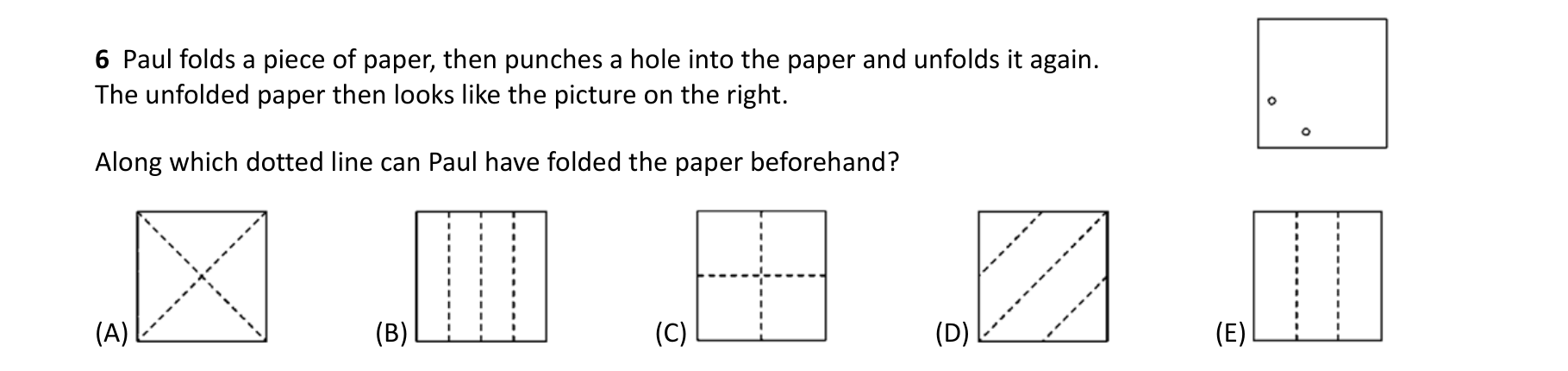
2017 · #6 (figure problem)
Show answer
Show hints
Still stuck? Show hint 2 →
Show solution
- Unfolding mirrors each punched hole across every fold line, so before unfolding the holes must be symmetric about the fold.
- Among the choices, only one dotted line is an axis of symmetry for the two holes shown.
- That fold line is choice D.
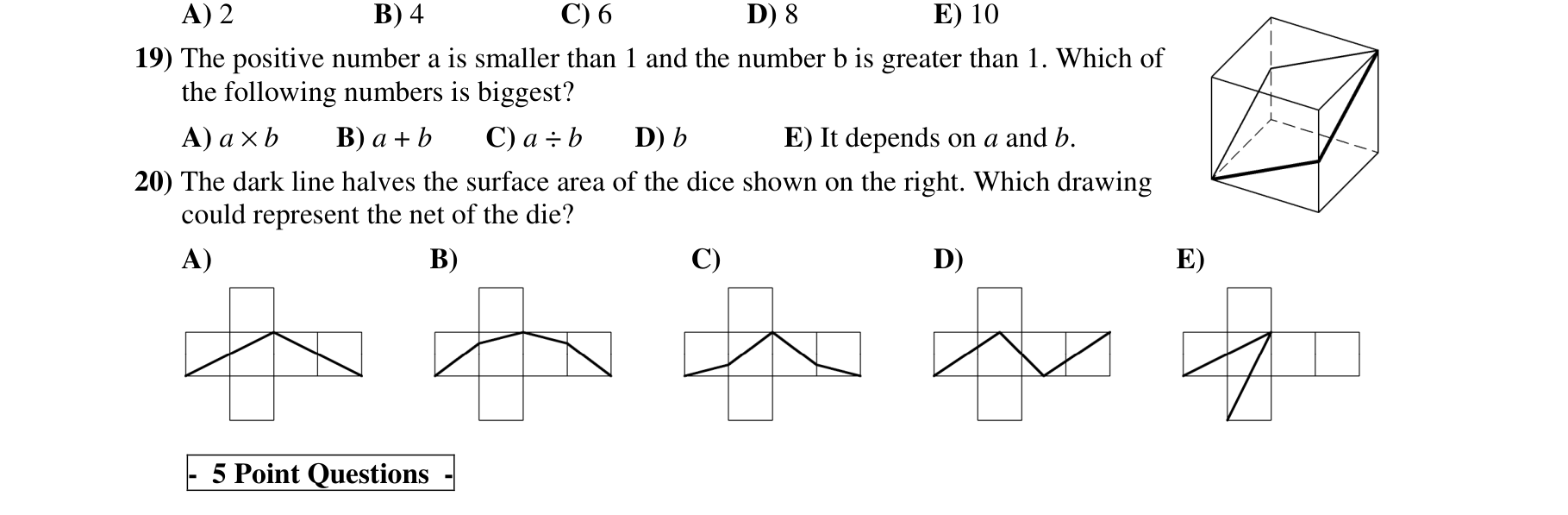
2011 · #20 The dark line halves the surface area of the die shown on the right. Which of the drawings A–E could represent the net of this die?
The dark line halves the surface area of the die shown on the right. Which of the drawings A–E could represent the net of this die?
Show answer
Show hints
Still stuck? Show hint 2 →
Show solution
- The dark line on the die separates its surface into two equal-area parts.
- When a net is folded into the cube, that same line must close up into one continuous halving curve.
- Only net A folds so the marked line cleanly divides the surface into two equal halves.
Reading a 3D shape — count by layers
A drawing of a 3D pile is a liar. It shows you the front and the top and hides everything behind and underneath. Try to count the whole pile at once and you will always miss the cubes in the back. So do not count the pile. Count slices.
Cut the shape into flat layers — floor layer, next layer up, next — and count one easy 2D slice at a time. Write each layer’s number down. A solid n×n×n cube is n identical layers of n×n cubes, which is why it holds n³ small cubes: a 3×3×3 is three layers of 9, so 27.
See why the back cubes hide? On the page you only meet the front edge of each floor — the other eight cubes of every floor sit behind it. Counting floor-by-floor catches all nine each time; eyeballing the drawing never does.
Surface area: count the faces the light can touch
‘How much paint?’ or ‘how much foil?’ is a surface-area question, and it falls to the same layer-style discipline: count exposed unit faces, do not eyeball. One little cube alone shows 6 faces. Every time two cubes are glued face to face, the touching pair vanishes from the outside — you lose 2 faces (one from each cube).
Worked it out. Glue three unit cubes into an L. Apart, they show 3 × 6 = 18 faces. There are 2 glued contacts (the corner cube touches each of the other two), and each contact hides 2 faces: 18 − 2 × 2 = 14 exposed faces. For a solid 2×2×2 block the shortcut is faster still: it is a cube, so its surface is 6 sides × (2×2) = 24 unit faces — no gluing arithmetic needed when the shape is already a neat box.
Front, top & side views
Kangaroo loves showing a stack and asking what it looks like from the front, the top, or the side — or running it backwards: here are the three flat views, how many cubes are there?
One idea unlocks all of them. A view records the tallest stack along each line you look down. From the front you see the highest cube in each column. From the top you see the footprint — which floor squares are covered at all. From the side, the highest cube in each row.
To rebuild a cube count from views, lay the footprint out and raise each column to the tallest height the front and side views allow. If the problem asks for the maximum, push every column as high as it is permitted; for the minimum, raise only as much as the views force.
THE MOVE: slice into layers and count flat. Each view is the tallest cube along your line of sight.
Two clean tactics. (1) Subtract from full: for ‘how many more to finish the big cube?’, take the finished cube’s total minus the cubes already placed. (2) Count by layers: tally each slice and add. Both beat eyeballing every time.
Counting only the cubes you can see and forgetting the hidden ones at the back and bottom. Before you write a number, ask: what is sitting behind this front face that I cannot see?
A drawing shows a stack of small cubes. I count carefully around the picture — every cube whose face I can see — and reach 14, so there are 14 cubes.
Why it breaks: the drawing only ever shows the front, top, and one side; a whole column of cubes can hide directly behind a front cube and never show a single face. Counting visible faces always lands too low.
The fix: count by layers, floor by floor, including the cubes you cannot see, and write each layer’s total down. Or, when the shape is heading toward a full block, take the full total and subtract the gap.
Nathalie wants to build a large cube out of small cubes (the complete cube is shown on the left). How many small cubes are missing from the shape on the right so that it would form the large cube?
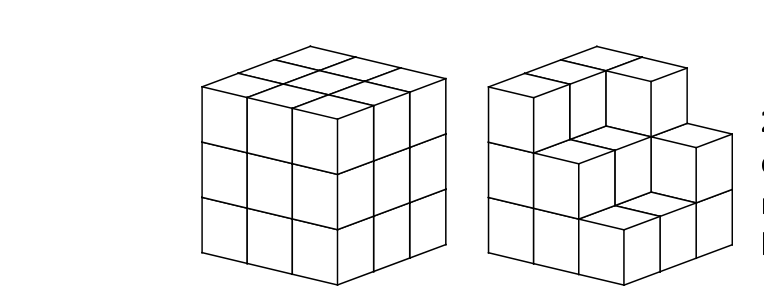
Nathalie wants to build a big cube. The picture shows how far she has gotten. How many small cubes are still missing? Use the subtract-from-full move.
Step 1 — the fixed total. The finished cube is 3 wide, 3 tall, 3 deep, so it needs 3 × 3 × 3 = 27 small cubes.
Step 2 — count what is there, by layers. Go floor by floor (not by eye) so the hidden back cubes are not lost. Layer by layer the built-up shape holds 20 cubes.
Step 3 — subtract. Missing = 27 − 20 = 7, choice C. You never had to picture the gap as a 3D blob.
Step 4 — check it a second way. Count the empty spots directly, layer by layer — they also add to 7. Two roads to the same number is the surest sign a spatial answer is right. Make that your habit on every cube-count.
The finished cube is 3 wide, 3 tall, 3 deep, so it needs 3 × 3 × 3 = 27 small cubes. Now count what is already there — and do it by layers, not by eye, so the hidden back cubes are not lost. Layer by layer the built-up shape holds 20 cubes. Missing = 27 − 20 = 7, choice C. Notice you never had to picture the gap as a 3D blob; you counted a full cube and subtracted a layered count.
Check it a second way. Instead of subtracting, count the gap straight on: go layer by layer and tally only the empty spots in each, and they add to 7 as well. Two different roads to the same number is the surest sign you have it right — a spatial answer you reach two ways is one you can trust. Make that your habit on every cube-count.
Framing inspired by AoPS Prealgebra.
Layers turn a scary 3D count into a few easy 2D counts. Write each layer down so you cannot lose one. For ‘how many more’: full total − placed.
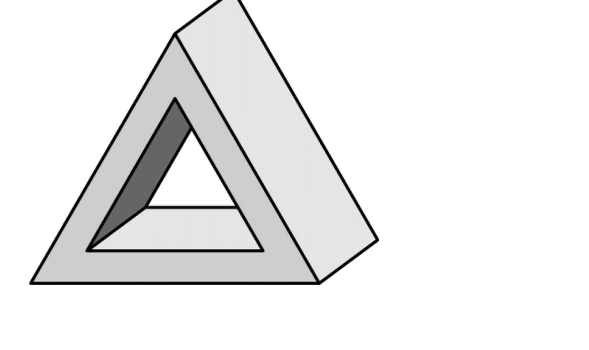
2009 · #6 How many faces does the object shown have? (It is a prism with a hole through it.)
How many faces does the object shown have? (It is a prism with a hole through it.)
Show answer
Show hints
Still stuck? Show hint 2 →
Show solution
- The two triangular ends are now frames, but each is still one face: 2 faces.
- The three outer rectangular sides: 3 faces.
- Drilling the triangular hole creates three inner rectangular walls: 3 more faces.
- Total = 2 + 3 + 3 = 8 faces — answer D.
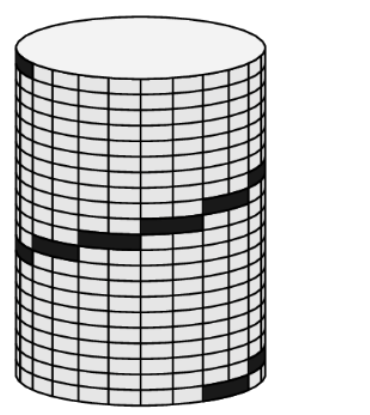
2023 · #4 Nine steps of a staircase winding around a cylinder can be seen, starting at the bottom and leading all the way to the top. All the...
Nine steps of a staircase winding around a cylinder can be seen, starting at the bottom and leading all the way to the top. All the steps are equally high. How many steps cannot be seen?
Show answer
Show hints
Still stuck? Show hint 2 →
Still stuck? Show hint 3 →
Show solution
- The nine steps you can see are the ones facing you as the staircase spirals up the front of the cylinder.
- As the spiral turns, the same number of steps run around the hidden back at each level, and the tower keeps climbing past where the front steps stop.
- Counting the back steps level by level all the way to the top gives twelve steps that are turned away and cannot be seen.
- So the number that cannot be seen is D, 12.
2022 · #21 A building is made of cubes of the same size. The three pictures show it from above (von oben), from the front (von vorne) and from the...
A building is made of cubes of the same size. The three pictures show it from above (von oben), from the front (von vorne) and from the right (von rechts). What is the maximum number of cubes that could be used to make this building?
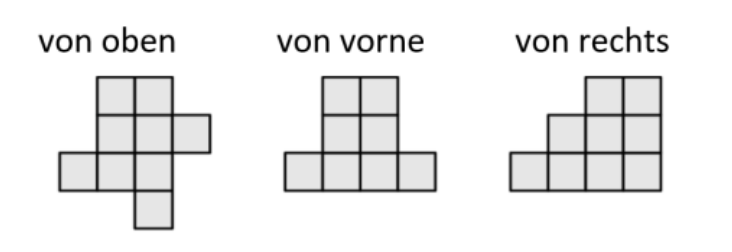
Show answer
Show hints
Still stuck? Show hint 2 →
Show solution
- The top view shows which floor positions are occupied.
- The front and right views give the largest height allowed for each row and column.
- Stacking each column to its maximum allowed height totals 19 cubes.
- So the answer is B.
2020 · #22 John built a structure of equal-sized wooden cubes whose front, right-side and top views are shown, using as many cubes as possible. His...
John built a structure of equal-sized wooden cubes whose front, right-side and top views are shown, using as many cubes as possible. His sister Ana wants to remove as many cubes as she can without changing any of these three views. At most, how many cubes can she remove?
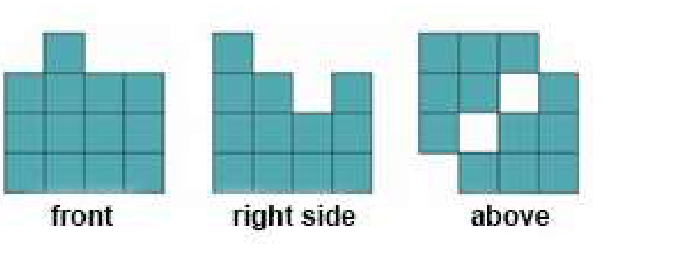
Show answer
Show hints
Still stuck? Show hint 2 →
Show solution
- Build the most cubes giving those three views, then strip out any cube not needed by all three silhouettes.
- Each removed cube must leave the front, side and top outlines unchanged.
- The largest number she can remove while preserving every view is 12.
Fold & count check
One net, one cube count. Fold in your head with the skip-one rule, then count by layers.
2015 · #4 The diagram shows the net of a cube whose faces are numbered. Sascha adds the numbers that are on opposite faces of the cube. Which...
The diagram shows the net of a cube whose faces are numbered. Sascha adds the numbers that are on opposite faces of the cube. Which three results does he get?
Show answer
Show hints
Still stuck? Show hint 2 →
Show solution
- Faces 1, 2, 3, 4 form a band around the cube, so 1 is opposite 3 and 2 is opposite 4.
- The remaining faces 5 and 6 are top and bottom, so 5 is opposite 6.
- The three opposite-face sums are 1+3 = 4, 2+4 = 6, and 5+6 = 11.
- So Sascha gets 4, 6, 11 (A).
2009 · #6 How many faces does the object shown have? (It is a prism with a hole through it.)
How many faces does the object shown have? (It is a prism with a hole through it.)
Show answer
Show hints
Still stuck? Show hint 2 →
Show solution
- The two triangular ends are now frames, but each is still one face: 2 faces.
- The three outer rectangular sides: 3 faces.
- Drilling the triangular hole creates three inner rectangular walls: 3 more faces.
- Total = 2 + 3 + 3 = 8 faces — answer D.
Tiling & tessellation — cover with no gaps
Look at a brick wall, a bathroom floor, a honeycomb. Copies of one shape, fitted edge to edge, with no gaps and no overlaps. That is a tiling, and Kangaroo turns it into two questions: can this shape cover the region, and what is the fewest (or most) pieces that do it.
Reach for area first — it is free. If the region has area A and each tile covers area t, then you need at least A ÷ t tiles, and never more than that with a single tile size. That one division kills half the answer choices before you place a single piece.
Area gives the ceiling. Then you must check the shape actually reaches it, because thin arms, odd corners, or a parity clash can stop you one short. A quick checkerboard colouring is the classic tie-breaker: if every tile must cover an equal number of black and white squares but the region has unequal black and white, a perfect cover is impossible.
THE MOVE: divide areas for the count, then confirm a real arrangement (or a colouring argument) reaches it.
A handy trick: half the size means a quarter of the area
Area does not shrink the way length does. Halve every side of a flat shape and the area drops to a quarter, not a half — because area is two-dimensional, so it scales by the square of the length factor. Scale lengths by \(k\) and area scales by \(k^2\): half-size gives \((\tfrac12)^2=\tfrac14\) the area; double-size gives \(2^2=4\) times. The neatest case to remember is the midpoint triangle: join the midpoints of a triangle’s three sides and the little triangle in the middle is a half-scale copy, so it holds exactly \(\tfrac14\) of the area — and the original splits into four congruent triangles, the middle one plus three around it. So whenever you see ‘midpoints joined up’, reach for the factor \(\tfrac14\) before you compute anything.
Another worked example
A triangular flag has area 48 cm\(^2\). You join the midpoints of its three sides to mark a smaller triangle inside; then you join the midpoints of that triangle’s sides to mark an even smaller one. What is the area of the smallest (innermost) triangle?
Step 1 — one midpoint step is ×\(\tfrac14\). The midpoint triangle is a half-scale copy, so its area is \(\tfrac14\) of the triangle it sits inside. First step: \(48\div4=\textbf{12}\) cm\(^2\).
Step 2 — do it again. The same rule applies to the 12 cm\(^2\) triangle: \(12\div4=\textbf{3}\) cm\(^2\). So the innermost triangle is 3 cm\(^2\). Notice you never needed the base or height — the scaling rule does it all. (Quick check: each midpoint step quarters the area, so two steps multiply by \(\tfrac14\times\tfrac14=\tfrac1{16}\), and \(48\div16=3\). ✓ Same answer two ways.)
Area-scaling framing inspired by Terry Chew, Math Olympiad (teacher resource).
To use the fewest tiles, cover the big open stretches with your biggest tiles first, then mop up the awkward tips and corners with the small ones — those forced small pieces set the real limit. To use the most, do the reverse.
Trusting the area ceiling and stopping. Area says ‘at most this many’; it never promises the pieces fit. A shape can fail the cover even when the areas divide perfectly. Always sketch one real placement.
Julio wants to make the shape shown in the top picture on the right. He has several of each of the five tiles shown in the bottom picture on the right. The tiles must be placed next to each other without overlapping. What is the smallest number of tiles he must use?
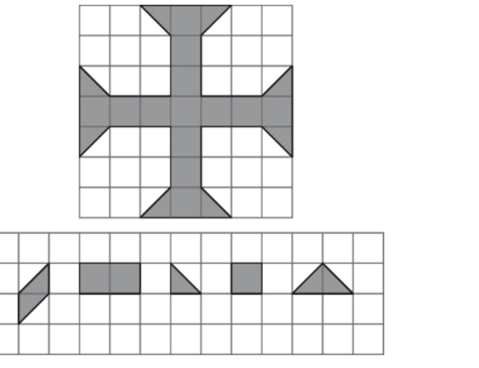
Julio builds a plus-shaped cross out of five tile types and wants the fewest tiles. What is the smallest number he can use? Big tiles for the body, small ones forced at the tips.
Fewest tiles means each tile should swallow as much area as it can, so fill the fat straight body of the cross with the biggest tiles — the long rectangle and the large triangle. Now the four slanted arm-tips are too thin and pointy for any big tile, so each tip has to be finished with the small triangles. Those small tips are unavoidable, and they are what stop the count from dropping further. Pack the body big and the tips small, no overlaps, and the whole cross is covered in 13 tiles — choice C. No arrangement does it in fewer, because the tips force those last small pieces.
Area gives the ceiling; a drawing or a checkerboard colouring confirms whether you reach it. Big tiles on open space, small tiles forced at the tips.
2017 · #3 Anna has four identical building blocks that each look like the one shown (a straight strip of three squares). Which of the shapes in...
Anna has four identical building blocks that each look like the one shown (a straight strip of three squares). Which of the shapes in the options can she not form with them?

Show answer
Show hints
Still stuck? Show hint 2 →
Show solution
- The block is a straight strip of three squares, so four blocks cover 12 squares total.
- Each pictured shape has 12 squares, so the test is whether it splits into four straight 1×3 strips.
- Four of the shapes can be cut into such strips; the remaining one cannot be tiled this way.
- That shape is (E).
2013 · #4 Melanie has a square piece of paper with a 4×4 grid drawn on it. She cuts along the gridlines, cutting out several shapes that each look...
Melanie has a square piece of paper with a 4×4 grid drawn on it. She cuts along the gridlines, cutting out several shapes that each look like the one pictured or its mirror image. How many squares are left over if she cuts out as many shapes as possible?
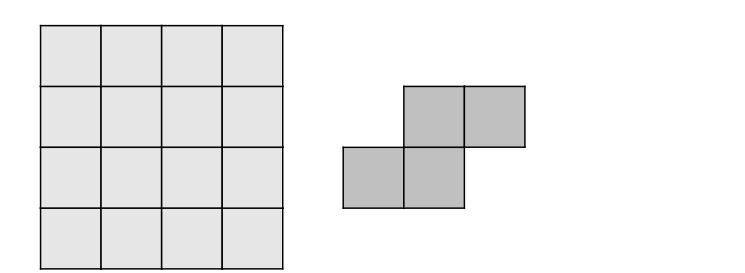
Show answer
Show hints
Still stuck? Show hint 2 →
Show solution
- The 4×4 grid has 16 unit squares; each cut-out piece uses 4 of them.
- These S/Z-shaped pieces cannot fill the 4×4 square completely.
- The best packing fits 3 pieces (12 squares), leaving 4 squares uncovered.
- So 4 squares are left over.
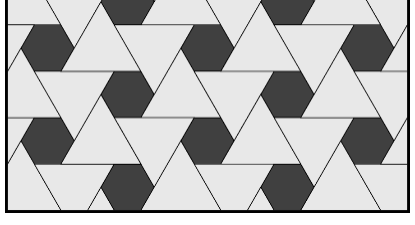
2024 · #24 Tiler Teri wants to cover a square floor with a regular pattern (see diagram) using six-sided and three-sided tiles. She estimates that...
Tiler Teri wants to cover a square floor with a regular pattern (see diagram) using six-sided and three-sided tiles. She estimates that she will need about 3000 six-sided tiles for the whole floor. About how many three-sided tiles will she need?
Show answer
Show hints
Still stuck? Show hint 2 →
Show solution
- In this regular pattern, six triangles ring each hexagon, but every triangle is shared by three hexagons, so each hexagon effectively owns 6 ÷ 3 = 2 triangles.
- That means the tiling always has 2 triangles for every hexagon.
- With about 3000 hexagons, the number of triangles is about 2 × 3000 = 6000.
Mirrors, reflections & rotations
Hold a word up to a bathroom mirror. AMBULANCE comes out backwards — which is why real ambulances print it reversed, so it reads right in a rear mirror. That is a reflection: left and right swap across a line. A rotation is different — the whole figure turns around a point, like a clock hand.
Both go wrong the same way: you try to flip or spin the entire shape in your head and lose your place. Don’t. Track one feature. Pick a single corner, one arrow, one beam, and ask only where it lands. Across a mirror a point hops to the other side, the same distance from the line; the rest of the figure follows.
Two facts handle most of these. The back view of something is its front view flipped left-to-right. And a beam that hits a mirror bounces off at an equal angle — trace it one straight segment at a time.
Why a turn is not a flip
This is the mix-up that costs the most points. A rotation keeps the shape unchanged — same handedness, just pointed a new way, the way your right hand is still a right hand after you wave it around. A reflection flips handedness — your right hand’s mirror image is a left hand, and no turning will ever make them match. One letter proves it:
Turn the b and you get q; mirror it and you get d — different moves, different results. When a problem says turn / rotate, spin it; when it says flip / mirror / back view, reverse it.
For symmetry questions (does this picture have a mirror line?), test the pieces, not the whole. A stacked word is vertically symmetric only if every letter is — one bad letter kills it.
THE MOVE: follow one point, arrow, or beam through the flip or turn — never the whole figure.
Go deeper: reflect to straighten a bent path
Here reflection is a tool, not a question. A frog at A must hop down to touch a straight bank, then up to B. What route is shortest? The bent two-leg path is hard to measure — so get rid of the bend. Mirror B across the bank to a copy B′ on the far side. Every down-then-up route to B is exactly as long as the matching straight route to B′ (the second leg is just flipped over the line). The shortest is the dead-straight line A→B′, and where it crosses the bank is the touch point.
The same idea reads a bouncing beam or a fold: replace the reflected leg with its mirror image and the whole path snaps into one straight line you can measure.
Strategy framing inspired by Posamentier, The Art of Problem Solving (teacher resource).
For a reflection, send your tracked point straight across the mirror line to the same distance on the far side. For a rotation, fix the centre and turn that one feature alone by the given angle. For a bouncing beam, redraw each reflected segment at an equal angle and walk it to the edge.
Confusing a reflection with a rotation. A flipped b becomes a d (mirror); a turned b becomes a q (rotation). They are not the same picture. Read the problem: ‘flip / mirror / back view’ means reflect; ‘turn / rotate’ means rotate.
If the letters of the word MAMA are written one underneath another, the word has a vertical axis of symmetry. For which of these words is that also true?
Write a word with its letters stacked in a column, like MAMA. It has a vertical mirror line. For which of ADAM, BAUM, BOOT, LOGO, TOTO is that also true? Test one letter at a time.
A stacked word has a vertical mirror line only if every letter is symmetric left-to-right on its own. So scan each word for a single bad letter and you can throw it out instantly. ADAM has D — D is not vertically symmetric, out. BAUM and BOOT both start with B — B fails the vertical mirror, out. LOGO has L and G, both lopsided, out. That leaves TOTO: T is symmetric across a vertical line, O is symmetric, T again, O again — every letter passes. So the answer is TOTO, choice E. You never pictured the whole word in a mirror; you checked letters one by one and the first failure ended each candidate.
Reflection = left/right flip across a line; rotation = turn about a point. Back view = front flipped. Track one point or one beam, not the whole figure.
2016 · #1 Which of the following road signs has the most axes of symmetry?
Which of the following road signs has the most axes of symmetry?

Show answer
Show hints
Still stuck? Show hint 2 →
Still stuck? Show hint 3 →
Show solution
- An axis of symmetry is a fold line where one half lands perfectly on the other half.
- The arrow signs match only one fold (or none, once an arrowhead points a direction), and the car shape matches just its up-down fold.
- The no-entry sign (a horizontal bar in a circle) matches a left-right fold AND a top-bottom fold, so it has 2 folds.
- Two is the most of any sign, so the answer is the no-entry sign, choice (C).
2020 · #5 Flipping a card over its top edge, we see the photo of the kangaroo shown. If instead we flip the card over its right edge, what will appear?
Flipping a card over its top edge, we see the photo of the kangaroo shown. If instead we flip the card over its right edge, what will appear?

Show answer
Show hints
Still stuck? Show hint 2 →
Show solution
- Flipping the card over its top edge gives the shown kangaroo, a flip about a horizontal line.
- Flipping instead over the right edge is a flip about a vertical line, the left-to-right mirror of the original.
- Carrying out that vertical flip on the starting picture gives the kangaroo in option D.
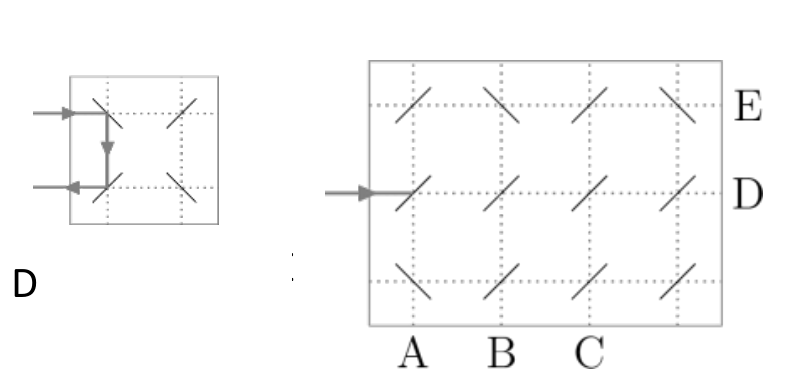
2022 · #3 The two-sided mirrors reflect the laser beam as shown in the small picture on the left. At which letter does the laser beam leave the...
The two-sided mirrors reflect the laser beam as shown in the small picture on the left. At which letter does the laser beam leave the picture on the right?
Show answer
Show hints
Still stuck? Show hint 2 →
Show solution
- Use the small picture to learn how each slanted mirror deflects the beam.
- Starting from the entry arrow on the big grid, advance the beam and turn it a quarter-turn at every mirror it hits.
- Following the bounces, the beam leaves the grid at letter B.
Dice & labelled cubes — use the hidden pairing
Pick up a real die and add the dots on any two opposite faces. You get 7 every time: 1 across from 6, 2 across from 5, 3 across from 4. Three pairs, all summing to 7. Memorise them and a whole family of problems cracks open.
Two facts ride along with it. Faces that share an edge are neighbours, never opposite — so to find a face’s partner, list everything that touches it and the one number left over is the opposite. And all six faces add to 1+2+3+4+5+6 = 21, which is your budget for any ‘total of the visible faces’ problem: start from 21 per die and subtract whatever is hidden or glued away.
Beyond dice: numbered cubes
Some problems put your own numbers on a cube and ask about corner sums (add the three faces meeting at a corner). The quiet gift here: two corners at opposite ends of a space diagonal together touch all six faces once, so their corner sums always add to the same total. That lets you pair a known corner with an unknown one and solve in one line.
THE MOVE: opposite faces sum to 7, all six sum to 21, neighbours are never opposite. For corner sums, pair opposite corners.
For glued-dice or stacked-cube totals, work from 21 per cube and subtract the faces pressed together or hidden. To make the visible total small, hide the big numbers; to make it large, hide the small ones. For a die rolling across a grid, forget the whole cube — track only the bottom face as it tips one square at a time.
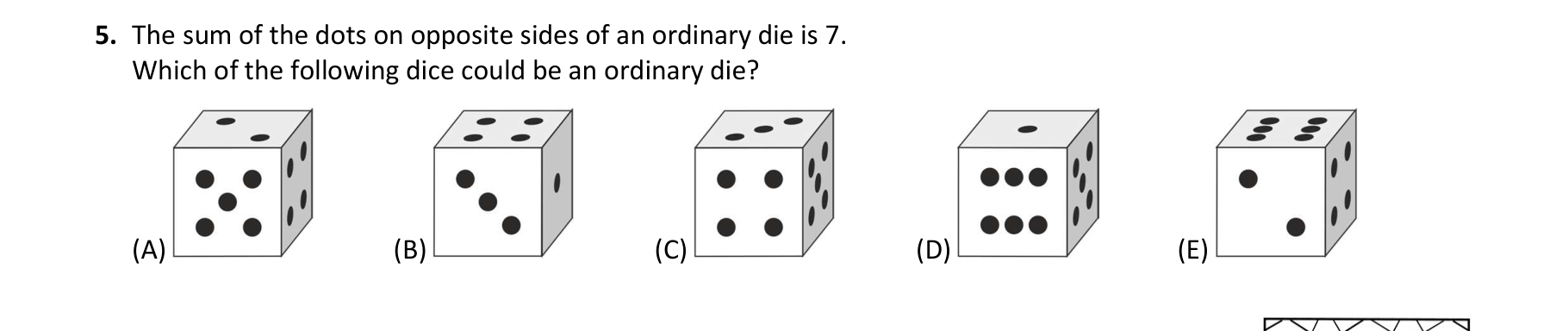
Assuming any cube with dots is a real die. A problem may print an impossible die to bait you. Check it: opposite faces must total 7, and the three faces around a corner must match a genuine die’s arrangement. If not, reject that picture.
Maria writes a number on each face of the cube. Then, for each corner point of the cube, she adds the numbers on the faces which meet at that corner. (For corner B she adds the numbers on faces BCDA, BAEF and BFGC.) In this way she gets a total of 14 for corner C, 16 for corner D, and 24 for corner E. Which total does she get for corner F?
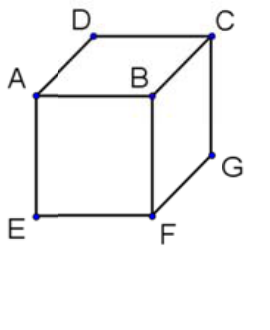
Maria writes a number on each face of a cube, then for each corner adds the three faces meeting there. She gets 14 at corner C, 16 at D, 24 at E. What does corner F get? Pair opposite corners.
Step 1 — the key fact. Do not chase the six face values. Two corners at opposite ends of a space diagonal together cover all six faces exactly once, so any such pair adds to the same total S (the sum of all six faces).
Step 2 — pair the corners. C and E are an opposite pair, and D and F are the other pair, so C + E = D + F.
Step 3 — solve. 14 + 24 = 16 + F, so 38 = 16 + F, giving F = 22, choice C. One pairing, one equation, done.
Do not chase the six face values — you do not need them. A corner’s number is the sum of its three faces. Two corners at opposite ends of a space diagonal together cover all six faces exactly once, so any such pair adds to the same total S (the sum of all six faces). On this cube, C and E are an opposite pair, and D and F are the other, so C + E = D + F. Plug in: 14 + 24 = 16 + F, so 38 = 16 + F, giving F = 22, choice C. One pairing, one equation, done.
Opposite faces sum to 7; all six sum to 21; touching faces are never opposite. To roll a die, follow only the bottom face. For corner sums, opposite corners share the same total.
2019 · #5 (figure problem)
Show answer
Show hints
Still stuck? Show hint 2 →
Still stuck? Show hint 3 →
Show solution
- On an ordinary die opposite faces sum to 7 (1-6, 2-5, 3-4), and the three faces around one corner follow a fixed orientation.
- Reject any picture whose three visible faces could not all sit around one corner of a standard die.
- Only picture E shows three faces consistent with a genuine ordinary die.
2011 · #20 The dark line halves the surface area of the die shown on the right. Which of the drawings A–E could represent the net of this die?
The dark line halves the surface area of the die shown on the right. Which of the drawings A–E could represent the net of this die?
Show answer
Show hints
Still stuck? Show hint 2 →
Show solution
- The dark line on the die separates its surface into two equal-area parts.
- When a net is folded into the cube, that same line must close up into one continuous halving curve.
- Only net A folds so the marked line cleanly divides the surface into two equal halves.
Mirror & dice check
A reflection and a die. Track one feature; use opposite-faces-sum-to-7.
2020 · #5 Flipping a card over its top edge, we see the photo of the kangaroo shown. If instead we flip the card over its right edge, what will appear?
Flipping a card over its top edge, we see the photo of the kangaroo shown. If instead we flip the card over its right edge, what will appear?
Show answer
Show hints
Still stuck? Show hint 2 →
Show solution
- Flipping the card over its top edge gives the shown kangaroo, a flip about a horizontal line.
- Flipping instead over the right edge is a flip about a vertical line, the left-to-right mirror of the original.
- Carrying out that vertical flip on the starting picture gives the kangaroo in option D.
2019 · #5 (figure problem)
Show answer
Show hints
Still stuck? Show hint 2 →
Still stuck? Show hint 3 →
Show solution
- On an ordinary die opposite faces sum to 7 (1-6, 2-5, 3-4), and the three faces around one corner follow a fixed orientation.
- Reject any picture whose three visible faces could not all sit around one corner of a standard die.
- Only picture E shows three faces consistent with a genuine ordinary die.
Building & cutting solids — count what changes
Hand a kid a few odd pieces and ask which ones snap together into a clean shape, and the instinct is to shove pieces around at random until something looks right. Resist it. There is a calmer way in, and it starts with counting before fitting.
Whether you are joining pieces or slicing a solid, ask first: what number must stay fixed, and what changes? If three blocks combine into a cube building, the building must have exactly as many little cubes as the three blocks together — count cubes and cross out every choice with the wrong total before you fit anything. If you cut or drill a solid, count how each cut adds or removes faces, edges, and corners.
When you do fit pieces, match a bump to a notch: a piece’s stick-out has to drop into another piece’s matching dent, no gap and no overlap. Find the bump and the dent it fills, slot them, and trace the outside edge — if it comes out clean, that is your pair.
For face counts, do not forget the surfaces a hole or tunnel creates inside. A block with a tube drilled through it gains the inner walls of that tube as brand-new faces.
A built-in error check: spot Euler’s pattern
After you count the corners, edges, and faces of a solid, you can check your count for free — using a pattern you can rediscover any time. Do not memorise a formula; find it. Count V (corners), E (edges), F (faces) for a few solids and look for what stays the same:
| solid | V (corners) | E (edges) | F (faces) | V − E + F |
|---|---|---|---|---|
| cube | 8 | 12 | 6 | 2 |
| tetrahedron (triangular pyramid) | 4 | 6 | 4 | 2 |
| octahedron (two pyramids glued) | 6 | 12 | 8 | ? |
Fill the last box: 6 − 12 + 8 = 2. Every solid with no holes lands on the same number. That is Euler’s rule:
V − E + F = 2
So if your own count of a solid does not give 2, you miscounted — go back before you trust the answer. (Forgot the rule mid-test? Rebuild it from a cube: 8 − 12 + 6 = 2.)
Use it on the corner-cut cube. Slice all 8 corners of a cube. You get V = 8 × 3 = 24 corners (each cut makes a triangle), F = 6 original + 8 new triangles = 14 faces, and E = 12 original + 8 × 3 = 36 edges. Check: 24 − 36 + 14 = 2. ✓ The count survives Euler, so you can trust the 24 corners.
Go deeper: the five Platonic solids — and why you never memorise Euler
Solids are named by their face count, using the same Greek prefixes as polygons: tetra- 4, hexa- 6 (a cube is a hexahedron), octa- 8, dodeca- 12, icosa- 20. A solid whose faces are all the same regular polygon, meeting the same way at every corner, is a regular (or Platonic) solid — and there are exactly five, no more:
| solid | F (faces) | V (corners) | E (edges) | V − E + F |
|---|---|---|---|---|
| tetrahedron | 4 | 4 | 6 | 2 |
| cube (hexahedron) | 6 | 8 | 12 | 2 |
| octahedron | 8 | 6 | 12 | 2 |
| dodecahedron | 12 | 20 | 30 | 2 |
| icosahedron | 20 | 12 | 30 | 2 |
Every row lands on 2 again — the same pattern, holding across wildly different solids. Notice the cube and octahedron simply swap their face and corner counts (6/8 ↔ 8/6); so do the dodecahedron and icosahedron (12/20 ↔ 20/12). That swap is a real symmetry, not a coincidence.
Here is the part worth keeping: do not memorise V − E + F = 2. Just remember a relationship exists. If you ever blank on it mid-test, rebuild it from the solid you know cold — a cube: 8 corners, 12 edges, 6 faces, so 8 − 12 + 6 = 2. Now you have the formula back, with no memorising. (Even a soccer ball obeys it: 60 corners − 90 edges + 32 faces = 2.)
Platonic-solids table and the ‘rebuild it from a cube’ habit from Batterson, Competition Math for Middle School (teacher resource).
Pattern-first framing inspired by Batterson, Competition Math for Middle School (teacher resource).
THE MOVE: count the fixed quantity first (cubes, area, corners), then fit by matching bump to notch.
One more ‘count what changes’ trap, away from solids: a straight log gets cuts, and each cut adds one more piece — so pieces are always one ahead of cuts. Sketch it and you see why the count is off by one.
Framing inspired by AoPS Prealgebra.
Cube count is your fast filter: total the little cubes in the given pieces and reject any target with a different count. For truncations and drillings, track corners and faces one cut at a time: slicing off a corner removes that single vertex but adds the small new face’s corners in its place.
Forgetting the faces or corners a cut creates. Slicing a corner does not only delete a point — it opens a new little face with new corners of its own. Counting only what you removed gives the wrong total.
A tetrahedron has 4 corners. We slice off all 4 corners. Each cut removes one corner, so 4 corners are gone and the new solid has 4 − 4 = 0 corners.
Why it breaks: it only counts what each cut takes away and never what the cut opens up. Every slice replaces the old point with a small triangular face — and that triangle brings 3 brand-new corners.
The fix: sketch one cut and watch the new triangle appear — three faces met at that vertex, so the flat cut is a triangle with 3 corners. Each of the 4 cuts trades 1 corner for 3, so 4 × 3 = 12 corners. Count the corners and faces a cut creates, not only the ones it deletes.
Julio cuts off all four corners of a regular tetrahedron (see picture). How many corners does the object have now?
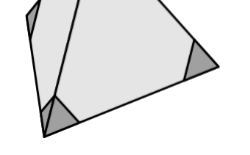
Julio cuts off all four corners of a regular tetrahedron. How many corners does the new solid have? Track what each cut creates.
Start from what is fixed: a regular tetrahedron has 4 corners. Now follow one cut. Slicing off a single corner deletes that one vertex, but the flat cut opens a small triangular face right where the point was — and a triangle has 3 corners. So one corner gone is replaced by 3 new ones. The old vertices all vanish; only the new triangle-corners survive. Four corners cut, each giving 3 new corners: 4 × 3 = 12 corners, choice D. The whole problem is ‘what does each cut create?’ not ‘what does it remove?’.
Count the fixed quantity first (cubes / area / corners). When you cut a solid, count the faces and corners the cut creates, not only what it takes away.
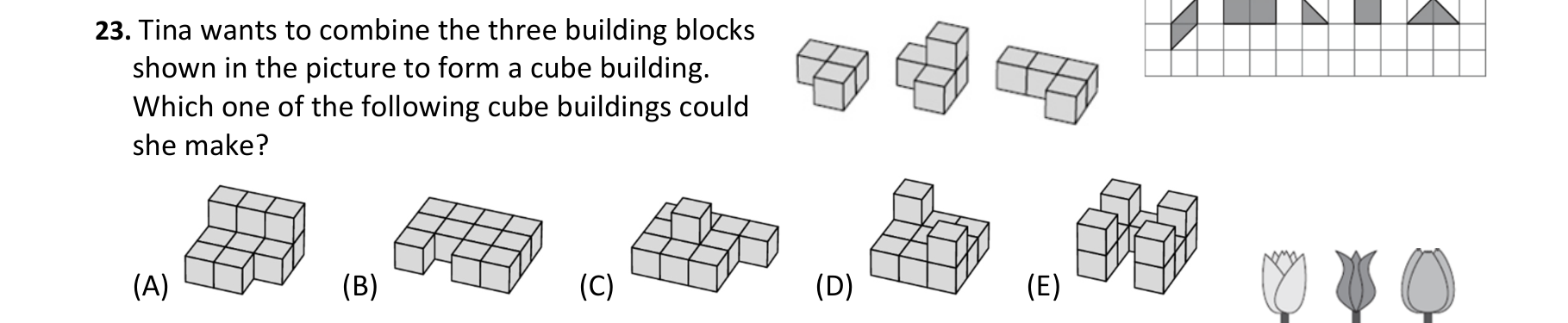
2025 · #23 Tina wants to combine the three building blocks shown in the picture to form a cube building. Which one of the following cube buildings...
Tina wants to combine the three building blocks shown in the picture to form a cube building. Which one of the following cube buildings could she make? (The three blocks and the five choices A–E are pictured with the question.)
Show answer
Show hints
Still stuck? Show hint 2 →
Show solution
- Each of the three building blocks is made of small cubes; counting them gives a fixed total number of cubes that the finished building must contain.
- Count the cubes in each answer building and cross out the ones with the wrong total — the right building must have exactly as many cubes as the three blocks combined.
- Among the buildings with the correct cube count, only (D) can actually be assembled from those three particular blocks fitting together with no gaps, so the answer is (D).
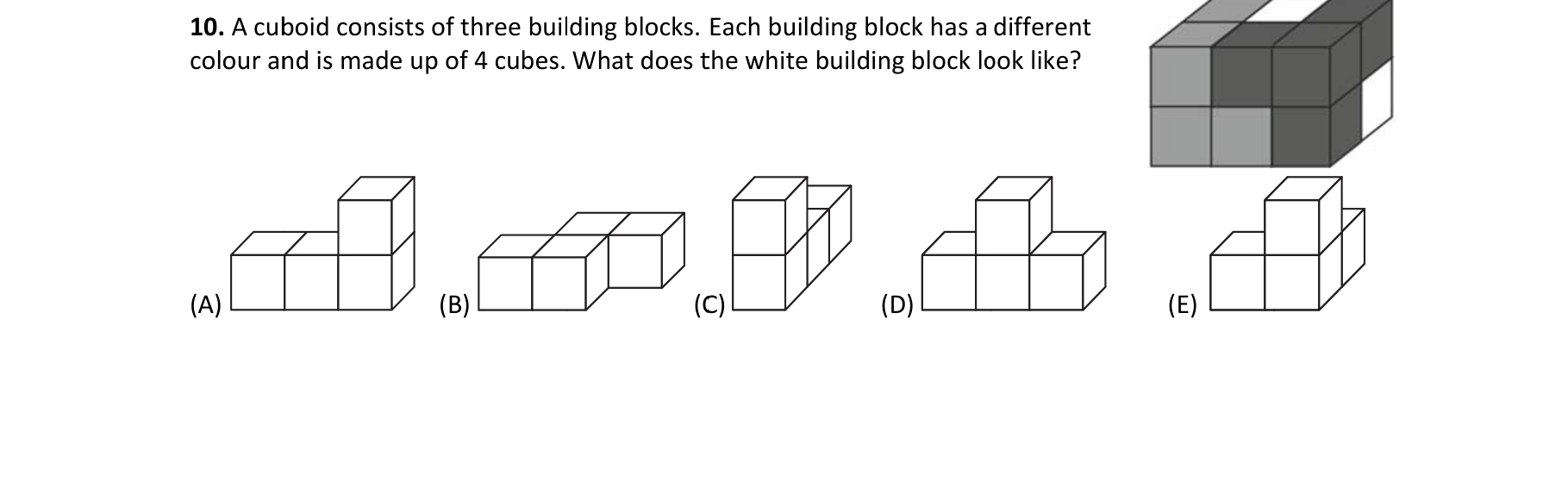
2012 · #10 A cuboid is built from three building blocks. Each building block has a different colour and is made up of 4 cubes. What does the white...
A cuboid is built from three building blocks. Each building block has a different colour and is made up of 4 cubes. What does the white building block look like?
Show answer
Show hints
Still stuck? Show hint 2 →
Still stuck? Show hint 3 →
Show solution
- The full cuboid holds 12 unit cubes shared by three blocks of 4 cubes each, so the grey and dark-grey blocks fill 8 cubes and the white block fills the remaining 4.
- Tracking the white cubes through the picture, three of them lie in a row along the bottom and the fourth sits on top of the middle of that row.
- That T-shaped block matches building block D.
2011 · #5 (figure problem)

Show answer
Show hints
Still stuck? Show hint 2 →
Show solution
- The cuboid is missing a chunk of small cubes in a particular 3-D arrangement.
- Compare the shape of that gap with each offered piece.
- Only piece E has cubes arranged so it fits the gap exactly and completes the cuboid.
2009 · #6 How many faces does the object shown have? (It is a prism with a hole through it.)
How many faces does the object shown have? (It is a prism with a hole through it.)
Show answer
Show hints
Still stuck? Show hint 2 →
Show solution
- The two triangular ends are now frames, but each is still one face: 2 faces.
- The three outer rectangular sides: 3 faces.
- Drilling the triangular hole creates three inner rectangular walls: 3 more faces.
- Total = 2 + 3 + 3 = 8 faces — answer D.
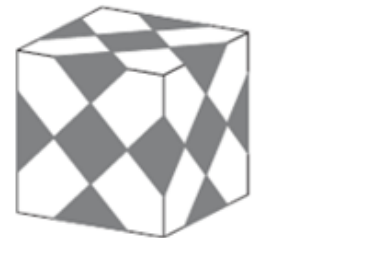
2025 · #4 Grey squares of equal size are glued onto a cube (see picture). All surfaces of the cube then look the same. How many grey squares were...
Grey squares of equal size are glued onto a cube (see picture). All surfaces of the cube then look the same. How many grey squares were used in total?
Show answer
Show hints
Still stuck? Show hint 2 →
Show solution
- Because all six faces look identical, you only need to count the grey squares on a single face and then multiply.
- Each face carries 3 grey squares in its diamond design.
- With 6 matching faces that makes 3 × 6 = 18 grey squares in total, so the answer is (D) 18.
Grids — locate by row and column, not by eye
Grid problems look like easy counting, and that is the trap. Every single time, the danger is the same: you miss a cell or count one twice because you trusted your eye. The cure is to count in an order you cannot lose track of.
If a grid is filled with numbers in a steady march — 1 to 8 across the first row, 9 to 16 across the next, and so on — you never have to read every cell. Pin down one cell you are sure of, then step to the others by the grid’s rhythm: the cell to the right is ‘plus 1’, and the cell directly below is ‘plus one whole row’.
With eight per row, the cell under any number is exactly 8 more. So once you place a single anchor, you know precisely which numbers a puzzle piece would sit on — and you match the piece to those positions, not to a fuzzy picture.
For ‘how many little squares / rectangles’ problems, count by size class: all the 1×1s, then all the 2×2s, and so on, so nothing slips past. For path problems, count by which cell you step through.
THE MOVE: anchor one cell you are sure of, then reach every other by ‘plus a row, plus a column’.
A handy trick: a staircase of squares is a triangular number
Some grid figures are not full rectangles but staircases: 1 square on the top step, 2 on the next, 3 on the next, and so on down to the bottom row. You do not count them square by square — you add the steps. A staircase with \(n\) steps holds \(1+2+3+\cdots+n\) squares, and that running sum has a one-line shortcut: \(1+2+\cdots+n=\dfrac{n(n+1)}{2}\) (pair the first with the last, \(1+n\); the second with the second-last, \(2+(n-1)\); every pair makes \(n+1\), and there are \(n/2\) pairs). These totals 1, 3, 6, 10, 15, … are the triangular numbers. So a 7-step staircase needs \(\dfrac{7\times8}{2}=28\) squares — no drawing, no counting one at a time.
Another worked example
A pattern of identical square tiles is laid as a staircase: the top step is 1 tile wide, the next step 2 tiles, the next 3, and so on, each step one tile wider than the one above. The finished staircase uses exactly 36 tiles. How many steps does it have?
Step 1 — name the total. A staircase of \(n\) steps uses \(\dfrac{n(n+1)}{2}\) tiles, and we are told that equals 36. So \(\dfrac{n(n+1)}{2}=36\), which means \(n(n+1)=72\).
Step 2 — find two neighbours that multiply to 72. We need a number times the next number to give 72. Try around \(\sqrt{72}\approx8.5\): \(8\times9=72\). ✓ That fits with \(n=8\). So the staircase has 8 steps. (Check by adding: \(1+2+3+4+5+6+7+8=36\). ✓)
Staircase-counting framing inspired by Terry Chew, Math Olympiad (teacher resource).
Find a landmark — a corner, a known number, a marked star — and compute every other cell’s position by counting rows and columns from it. Never decide a shape’s position by squinting at the drawing.
Matching a puzzle piece to the picture by its outline alone. Two pieces can look almost identical; only the actual numbers (or coordinates) the cells carry tell them apart. Compute the cells, then match.
Holger writes the numbers up to 40 into the table in the same way as shown. Which of the pieces A to E can he then cut out from the table?

Holger fills a table with 1, 2, 3, …, eight numbers per row. Which puzzle piece can be cut from a real patch of the table? Anchor a number, then step by the row size.
Eight per row is the rhythm. Take the number 12: the first row is 1–8, so the second row is 9, 10, 11, 12 — that puts 12 in row 2, column 4. The cell directly under 12 is one full row down, so add 8: that is 20. Next to it, 21. Go one more row under the 21, add 8 again: 29. So a real patch reads 12 on top, 20 and 21 in the middle, and 29 hanging beneath the 21. Only one piece’s outline holds exactly those four cells in those spots — that is piece C. You computed which numbers sit where; you never trusted the picture.
Count grids in a fixed order; locate cells by ‘plus a row, plus a column’ from one anchor, never by eye. Count squares by size class.
2023 · #1 The diagram shows a grid made of vertical and horizontal lines. Which part was cut from the grid?
The diagram shows a grid made of vertical and horizontal lines. Which part was cut from the grid?

Show answer
Show hints
Still stuck? Show hint 2 →
Show solution
- The missing region has a fixed size and a specific arrangement of internal horizontal and vertical lines.
- Check each option for the same number of crossing lines and the same dimensions as the hole.
- Only piece E reproduces that exact line pattern.
- So the part cut from the grid is E.
2023 · #3 Which of the shapes cannot be split into two triangles using a single straight line?
Which of the shapes cannot be split into two triangles using a single straight line?

Show answer
Show hints
Still stuck? Show hint 2 →
Show solution
- The rectangle, trapezoid and square each have four sides, so a diagonal cut turns them into two triangles.
- The triangle can be split into two triangles by a line from a vertex to the opposite side.
- The hexagon has six sides; one straight cut cannot reduce it to two three-sided pieces.
- So the shape that cannot be split is the hexagon, A.
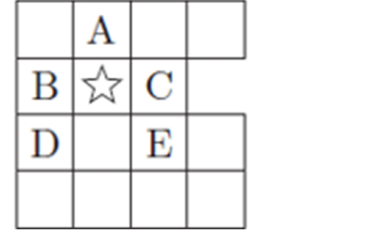
2025 · #20 Joanna divides the figure into five equal-sized, same-shaped parts, each of which consists of three squares. Which of the letters is in...
Joanna divides the figure into five equal-sized, same-shaped parts, each of which consists of three squares. Which of the letters is in the part with the star?
Show answer
Show hints
Still stuck? Show hint 2 →
Show solution
- Since every piece is the same three-square shape, start at a corner of the figure where only one shape can fit; that fixes what the repeating piece looks like.
- Lay that same piece again and again to tile the whole figure with no gaps or overlaps — there is only one way it all fits together.
- The piece that ends up covering the starred square also covers the square labelled E, so the answer is (E).
Overcount, then subtract — the counting fix for hard spatial problems
The hardest spatial problems are not about seeing — they are about counting without missing or doubling. And the most powerful counting move sounds backwards: count too much on purpose, then take back the extra.
Picture marking every little cube that touches a drawn line, face by face. A cube on an edge or corner of the big cube belongs to two faces, so you count it twice. That’s fine — as long as you then subtract those doubles back out. Counting loose and correcting beats juggling overlaps in your head.
Add the two counts, then remove the shared middle once. On cubes that’s cubes on shared edges; on tunnels, cubes where two tunnels cross; on grids, a cell two shapes both claim. The other half of clean counting is casework: split into cases that don’t overlap and don’t leave a gap, keep a written tally, and count each.
THE MOVE: count everything loosely, then subtract exactly the things you counted more than once.
Counting figures hidden inside a figure: sort by size, then by direction
‘How many triangles in this picture?’ is the classic miss-or-double trap. Pointing at random never works. The fix is a two-key sort: group every triangle first by its size, then by which way it points (up or down). Take a triangle split into a 3-row grid of nine small triangles and tally:
| size | pointing up | pointing down |
|---|---|---|
| small (1 cell) | 6 | 3 |
| medium (4 cells) | 3 | 0 |
| large (whole) | 1 | 0 |
Add the entries: 6 + 3 + 3 + 1 = 13 triangles. The down-pointing ones are exactly what beginners forget — sorting by direction forces you to hunt for them. When a figure is symmetric, up-count equals down-count, so tally one side and double.
Go deeper: the same sort counts squares (and the tilted ones people miss)
The same sort counts squares. ‘How many squares in a 3×3 grid of unit squares?’ Sort by size: the 1×1 squares, 9; the 2×2 squares (each fixed by its top-left corner, which sits in a 2×2 block of positions), 4; the 3×3 square, 1. Total 9 + 4 + 1 = 14. Beginners answer 9 because they forget the bigger squares hiding on top.
But that 14 is only the upright squares. On a dot grid, squares can also sit tilted — corners still on grid dots, sides on a slant. These are the same ‘down-pointing’ blind spot, now about orientation.
In that 3×3 grid there are exactly 6 tilted squares: 4 small (side \(\sqrt2\)) and 2 larger (side \(\sqrt5\)). Add them to the 14 upright and the real total is 14 + 6 = 20. To find a tilted square, pick any slanted segment between two dots as one side, then turn that step 90° at each corner — if all four corners land on dots, it’s a square.
For older kids: why squares come in tilt ‘families’
Every square is fixed by one side, drawn as a step ‘right \(a\), up \(b\)’. Turning that step 90° four times closes the square, so its tilt is set by the ratio \(a:b\). Upright squares are the \(b=0\) family; the side-\(\sqrt2\) squares are the \(a=b=1\) family; the side-\(\sqrt5\) ones are the \(a=2,b=1\) (or \(1,2\)) family. Sorting by tilt family is the same disciplined sort, one level up.
Tilted-square trap inspired by Batterson, Competition Math for Middle School (teacher resource).
Strategy framing inspired by Posamentier, The Art of Problem Solving (teacher resource).
Do the easy per-piece count first — per face, per line, per tunnel — as if nothing overlapped. Then hunt for what got counted twice (shared edges, crossings, corners) and subtract precisely those. Always write the tally down.
Either forgetting to subtract the overlaps (too big) or subtracting them more than once (too small). Count the shared items, then remove each one exactly once.
Nine straight tunnels are drilled through a 5×5×5 cube. Each tunnel takes out a row of 5 little cubes, so the number removed is 9 × 5 = 45.
Why it breaks: deep inside the block the tunnels cross, and a cube sitting at a crossing was counted once for every tunnel running through it. The loose total of 45 counts those shared cubes more than once.
The fix: keep the overcount, then subtract each crossing cube back out so it is counted exactly once. After removing the double-counts the true total drops to 39 — the loose count was only the starting point, never the answer.
Mike has 125 small, equally big cubes. He glues some of them together in such a way that one big cube with exactly nine tunnels is created (see diagram). The tunnels go all the way straight through the cube. How many of the 125 cubes is he not using?
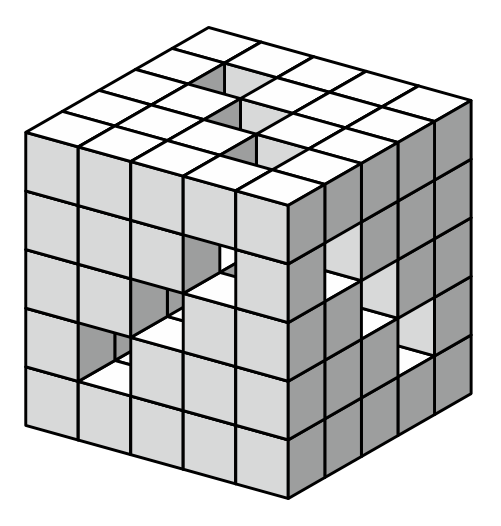
A big cube of 125 little cubes (5×5×5) has nine straight tunnels drilled through it. How many little cubes are removed? Overcount the tunnels, then subtract the crossings.
Step 1 — the loose count. Each tunnel is a straight line punched all the way through, so it removes a row of 5 little cubes. Nine tunnels, counted loosely, would remove 9 × 5 = 45 cubes.
Step 2 — spot the double-count. Deep inside the cube the tunnels cross, and a cube at a crossing got counted once for every tunnel through it — so it was counted more than once.
Step 3 — pay back the overlaps. Subtract those shared crossing cubes so each is counted exactly once. The true number removed comes down to 39, choice D. Count loose (45), then take back the overlaps to land on 39.
Each tunnel is a straight line punched all the way through, so it removes a row of 5 little cubes. Nine tunnels, counted loosely, would remove 9 × 5 = 45 cubes. But that is too many: deep inside the cube the tunnels cross each other, and a cube sitting at a crossing got counted once for each tunnel through it — so it was double-counted. Subtract those shared crossing cubes back out, and the true number removed comes down to 39, choice D. That is the whole chapter in one problem: count loose (45), then take back the overlaps to land on 39.
Overcount on purpose, then subtract the double-counts. Or split into non-overlapping cases. Keep a written tally so nothing is missed.
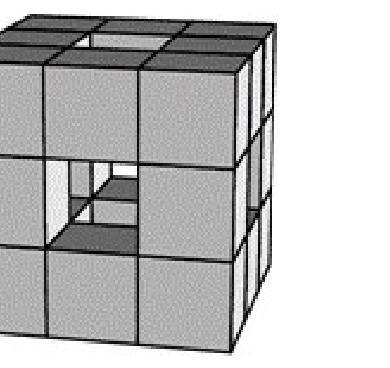
2019 · #3 A 3 × 3 × 3 cube is made up of small 1 × 1 × 1 cubes. Then the middle cubes from front to back, from top to bottom and from right to...
A 3 × 3 × 3 cube is made up of small 1 × 1 × 1 cubes. Then the middle cubes from front to back, from top to bottom and from right to left are removed (see diagram). How many 1 × 1 × 1 cubes remain?
Show answer
Show hints
Still stuck? Show hint 2 →
Show solution
- A 3×3×3 block has 27 unit cubes.
- Each of the three tunnels (front-back, top-bottom, left-right) removes the 3 cubes down its middle line.
- All three lines share the single centre cube, so together they remove the centre plus 6 face-centre cubes = 7 cubes.
- 27 − 7 = 20 cubes remain.
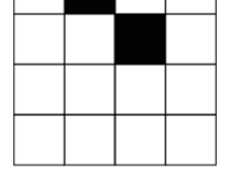
2024 · #22 Tarek wants to colour two more cells of the 4×4-square black so that the pattern of white and black cells has exactly one axis of...
Tarek wants to colour two more cells of the 4×4-square black so that the pattern of white and black cells has exactly one axis of symmetry. In how many ways can he do that?
Show answer
Show hints
Still stuck? Show hint 2 →
Still stuck? Show hint 3 →
Show solution
- Reflecting the two given black cells across the vertical axis forces one extra colouring that is symmetric only about that vertical line.
- The horizontal axis similarly forces one valid colouring.
- The two diagonal axes are more flexible and give the remaining colourings, for a total of four diagonal-symmetric ways.
- Adding them up, 1 vertical + 1 horizontal + 4 diagonal = 6 ways.
2025 · #20 Joanna divides the figure into five equal-sized, same-shaped parts, each of which consists of three squares. Which of the letters is in...
Joanna divides the figure into five equal-sized, same-shaped parts, each of which consists of three squares. Which of the letters is in the part with the star?
Show answer
Show hints
Still stuck? Show hint 2 →
Show solution
- Since every piece is the same three-square shape, start at a corner of the figure where only one shape can fit; that fixes what the repeating piece looks like.
- Lay that same piece again and again to tile the whole figure with no gaps or overlaps — there is only one way it all fits together.
- The piece that ends up covering the starred square also covers the square labelled E, so the answer is (E).
Bigger in 3D — double the side, eight times the size
Back in the tiling chapter you met a flat surprise: halve a shape’s sides and its area drops to a quarter, because area is two-dimensional and scales by the square of the length. In 3D the surprise is bigger still — and it catches almost everyone.
Double every side of a box and it does not hold twice as much. It holds eight times as much. Volume is three-dimensional, so it scales by the cube of the length factor. Watch it on a plain cube before you trust the words.
A unit cube has surface 6 and volume 1. Scale every side by 2 and you get surface 6×2² = 24 (four times as much foil) and volume 2³ = 8 (eight times as much filling). The rule, for any whole or fractional factor \(k\):
length ×\(k\) → surface ×\(k^2\) → volume ×\(k^3\)
Worked it out. A fish tank’s length, width, and height are all tripled. By what factor does the water it holds grow? Lengths ×3, so volume ×3³ = 27. (And the glass it takes grows only ×3² = 9.) You never need the actual measurements — the factor does the whole job.
The story that makes it stick: Minos and the doubled tomb
Legend says King Minos ordered his son’s cube-shaped tomb to be made ‘twice as big.’ The builders doubled every side — and accidentally built a tomb eight times the size, because doubling the side cubes the volume (2³ = 8). To truly double the volume you must scale each side by \(\sqrt[3]{2}\approx1.26\), not by 2. (That ‘doubling the cube’ turned out to be impossible with just a compass and straightedge — but for us it is just a reminder that \(\times2\) on the side is \(\times8\) on the inside.)
THE MOVE: scale a length by \(k\) and surface scales by \(k^2\), volume by \(k^3\). Double the side ⇒ ×4 surface, ×8 volume.
3D-scaling framing inspired by the ‘doubling the cube’ problem in Posamentier, The Art of Problem Solving (teacher resource), with formulas from Batterson, Competition Math for Middle School.
Read the question for the length factor \(k\) (‘all dimensions doubled’ means \(k=2\)). Then: surface answers get \(k^2\), volume/capacity answers get \(k^3\). Never multiply a volume by just \(k\) — that is the trap.
Scaling volume by the length factor instead of its cube. ‘Twice as big’ on every side is 8 times the volume, not 2. Likewise surface is ×4, not ×2. Pin down what kind of quantity is asked — length, area, or volume — then use \(k\), \(k^2\), or \(k^3\).
Length ×\(k\) → surface ×\(k^2\) → volume ×\(k^3\). Doubling every side gives ×4 surface and ×8 volume. To truly double a volume, scale sides by \(\sqrt[3]{2}\approx1.26\).
Counting routes on a grid
‘How many shortest ways can you walk from corner A to corner B along the streets of a grid?’ is one of the commonest grid questions there is. Listing every route by hand is hopeless — you miss some and repeat others. There is a method that counts them all with nothing but addition.
Every shortest route only ever goes right or up (never back), so the very last step into any corner came either from the left or from below. That means:
routes to a corner = routes to the corner on its left + routes to the corner below it
So write 1 along the whole bottom edge and the whole left edge (there is exactly one straight route to each of those), then fill every other corner by adding its left neighbour and its lower neighbour. The number that lands in the far corner is your answer.
For a 3×3 block of streets the corner fills to 20 — there are 20 shortest routes from A to B. (You may know the shortcut: \(\binom{6}{3}=20\), choosing which 3 of the 6 steps go up. The add-up grid gives the same answer and never needs a formula.)
Routes that must pass through a point: multiply the two legs
If a route has to go through a particular corner P, split the trip at P: count the routes A→P, count the routes P→B, and multiply them (every first leg can pair with every second leg). On the 3×3 grid, if P is the dead-centre corner, A→P has \(\binom{4}{2}=6\) routes and P→B has \(\binom{2}{1}=2\), so \(6\times2=\textbf{12}\) routes pass through P.
Routes that must avoid a point: subtract
To count routes that do not touch a blocked corner, take all routes and subtract the ones that pass through it. Here: 20 total − 12 through the centre = 8 routes that avoid the centre. Counting the bad ones and subtracting is far easier than threading around the block by hand.
THE MOVE: write 1s on the bottom and left edges, then each corner = below + left. Through a point: multiply the legs. Avoid a point: subtract.
Lattice-path framing inspired by Terry Chew, Math Olympiad (teacher resource), with the add-up (Pascal) engine from Batterson, Competition Math for Middle School.
Always fill the bottom edge and the left edge with 1s first — those are your starting truths. Then sweep across, each corner just ‘left + below’. For a forced stop, multiply the two legs; for a forbidden corner, subtract the through-count from the total.
Trying to list routes one by one (you will double-count or drop some), or adding the two legs of a through-point trip instead of multiplying them. Each A→P route can be followed by any P→B route, so the pairs multiply.
Shortest routes = the add-up grid: 1s on the bottom and left, then each corner = below + left; the far corner is the count. Through a point: multiply the legs. Avoid a point: total − through.
Spatial stretch test
Five harder spatial problems — folding, cube-views, tiling, counting tricks.
2015 · #21 Nina wants to make a cube from the paper net. You can see there are 7 squares instead of 6. Which square(s) can she remove from the net,...
Nina wants to make a cube from the paper net. You can see there are 7 squares instead of 6. Which square(s) can she remove from the net, so that the other 6 squares remain connected and from the newly formed net a cube can be made?
Show answer
Show hints
Still stuck? Show hint 2 →
Show solution
- Removing a square must keep the other six joined and able to fold into a cube with no doubled-up face.
- Taking out an interior square breaks the net or makes two squares fold onto the same face, so those fail.
- Removing square 3 works, and removing square 7 works, while no other single removal does — so the answer is only 3 or 7.
2022 · #21 A building is made of cubes of the same size. The three pictures show it from above (von oben), from the front (von vorne) and from the...
A building is made of cubes of the same size. The three pictures show it from above (von oben), from the front (von vorne) and from the right (von rechts). What is the maximum number of cubes that could be used to make this building?
Show answer
Show hints
Still stuck? Show hint 2 →
Show solution
- The top view shows which floor positions are occupied.
- The front and right views give the largest height allowed for each row and column.
- Stacking each column to its maximum allowed height totals 19 cubes.
- So the answer is B.
2025 · #22 Julio wants to make the shape shown in the top picture on the right. He has several of each of the five tiles shown in the bottom...
Julio wants to make the shape shown in the top picture on the right. He has several of each of the five tiles shown in the bottom picture on the right. The tiles must be placed next to each other without overlapping. What is the smallest number of tiles he must use?
Show answer
Show hints
Still stuck? Show hint 2 →
Show solution
- Fewer tiles means each tile should cover as much as possible, so fill the wide straight parts of the cross with the largest tiles (the long rectangle and the big triangle).
- The four slanted arm-tips are too thin for the big tiles, so each tip has to be finished with the small triangle pieces — these are unavoidable and set the limit on how low the count can go.
- Packing the big tiles in the body and the small triangles at the tips, with no overlaps, covers the whole cross in 13 tiles, and no arrangement does it in fewer, so the answer is (C) 13.
2015 · #24 Maria writes a number on each face of the cube. Then, for each corner point of the cube, she adds the numbers on the faces which meet at...
Maria writes a number on each face of the cube. Then, for each corner point of the cube, she adds the numbers on the faces which meet at that corner. (For corner B she adds the numbers on faces BCDA, BAEF and BFGC.) In this way she gets a total of 14 for corner C, 16 for corner D, and 24 for corner E. Which total does she get for corner F?
Show answer
Show hints
Still stuck? Show hint 2 →
Show solution
- A corner's number is the sum of its three meeting faces. Two corners on opposite ends of a space diagonal together touch all six faces exactly once, so each such pair has the same sum S (the total of all six faces).
- Corners C and E are opposite, and corners D and F are opposite, so C + E = D + F.
- Thus 14 + 24 = 16 + F, giving F = 38 − 16 = 22.
2017 · #27 Mike has 125 small, equally big cubes. He glues some of them together in such a way that one big cube with exactly nine tunnels is...
Mike has 125 small, equally big cubes. He glues some of them together in such a way that one big cube with exactly nine tunnels is created (see diagram). The tunnels go all the way straight through the cube. How many of the 125 cubes is he not using?
Show answer
Show hints
Still stuck? Show hint 2 →
Show solution
- Each tunnel removes a straight line of 5 cubes; nine tunnels would remove 45, but the tunnels intersect inside the cube.
- Subtracting the cubes shared at the crossings leaves 39 cubes actually removed.
- So Mike does not use 39 cubes.
Quick reference
SPATIAL FACTS
- A cube has 6 faces, 12 edges, 8 vertices; opposite faces never touch.
- A cube net is 6 squares — exactly 11 different ones exist. Six squares alone do not guarantee a net; fold-check. Opposite faces skip one along a straight row (1–3, 2–4); two squares that touch are neighbours, never opposite.
- Count 3D by layers: an n×n×n cube is n³ small cubes; remember the hidden ones. Each flat view is the tallest cube along your line of sight.
- Die: opposite faces sum to 7, all six sum to 21, neighbours are never opposite. Opposite corners of a cube share the same corner-sum.
- Tiles needed ≥ region area ÷ tile area — then check it is achievable (checkerboard colouring).
- Back view = front view flipped left-right. Reflection flips across a line; rotation turns about a point. To shorten a bent touch-the-line path, reflect the far point across the line and draw it straight.
- Cuts on a line: pieces = cuts + 1 (so 3 pieces need 2 cuts). Slicing a corner creates a new face with its own corners — count what a cut adds, not only what it removes.
- Count figures inside a figure by size, then by orientation (up vs down); the down-pointing ones are the ones beginners miss.
- Overcount, then subtract the double-counts (shared edges, tunnel crossings). When a count comes out, redo it a second way — two roads to the same number means you can trust it.
COMMON TRAPS
- Counting only visible cubes and forgetting the hidden ones.
- Assuming any 6-square shape folds into a cube.
- On a net, reading two squares that point opposite ways on the paper as opposite faces — once folded they often share an edge, so they are neighbours.
- Confusing a reflection (mirror flip) with a rotation (turn).
- Trusting the area ceiling without checking the tiles actually fit.
- Forgetting the faces or corners a cut creates, or trusting an impossible die.
- Reading ‘3 pieces’ as 3 cuts — pieces are always one more than cuts.
- Forgetting to subtract overlaps when counting — or subtracting them twice; missing the down-pointing figures in a count-the-triangles problem.
REACHING FOR 20+
- View-reconstruction. Given front, top, and side views, rebuild the cube count by laying the footprint down and raising each column. For the maximum, push every column as high as the views allow; for the minimum, raise only what the views force.
- Corner-sum pairing. On a numbered cube, two corners at opposite ends of a space diagonal touch all six faces once, so opposite-corner sums are equal — pair a known corner with the unknown and solve in one equation.
- Inclusion–exclusion on solids. For tunnels or lines through a cube, overcount per tunnel, then subtract the cubes at crossings exactly once (a triple crossing is shared by three, so handle it carefully).
- Reflect-to-straighten. Turn a bent touch-the-line (or bouncing-beam, or fold) path into one straight segment by reflecting the endpoint; then a right triangle gives the length.
- Symmetry-halving. When a figure is symmetric, up-count equals down-count — tally one and double.