About this topic
A logic problem hands you a wall of sentences and dares you to keep it all in your head. Don't. The trick that wins every one of these is the same: get the words out of your head and onto the page — as a grid, a line, or a short list of rules — then let the page do the thinking.
The shapes repeat. Once you can spot ‘this is a seating puzzle,’ ‘this is a ranking,’ ‘this is a liar puzzle,’ you already know which picture to draw. This lesson walks you up the ladder: read and tabulate, flip an if-then the right way, negate a clue without falling for the trap, rank with a single line, branch into cases, break a false claim with one example, fire an implication chain, crack truth-tellers and liars, and push a quantity to its limit.
Turn the story into a table
Three people, three jobs, a tangle of “isn’t” clues — hold it in your head and your brain slips. A grid kills that instantly: names down the side, attributes across the top, a × in every box a clue forbids. Read off what’s left.
- Alex’s row gets two ×’s from the clues, so Alex is forced to be Lawyer.
- Now nobody else can be Lawyer — × the rest of that column.
- Carl can’t be Lawyer (taken) or Teacher (clue), so Carl = Doctor.
- Beth takes the leftover: Teacher.
THE MOVE
Get it out of your head and into a grid. Names down one side, attributes across the top. A clue becomes a ×. When a row or column has one box left, lock it in — then cascade.
Go deeper: match the puzzle to the right picture, and tracing figures you’re given
Match the puzzle to the picture
Different stories want different pictures. Spot the shape, draw the right one:
| If the puzzle smells like … | Draw this |
|---|---|
| Seating (“A is next to B”) | A row of chairs with name slots |
| People matched to things (jobs, pets, hobbies) | People × attributes grid |
| Truth-tellers / liars | A table of who-is-what, one row per case |
| Ordering (“A is taller than B”) | One vertical line; place each name on it |
| Counts that split two ways (boys/girls × two schools) | A grid with row and column totals |
When the puzzle hands you a picture — trace it, don’t imagine it
Some logic puzzles come with a figure: a maze, a folded die, kangaroos around a table. Your instinct is to picture the whole thing moving at once. Resist it. You’ll lose track by step two.
Instead, follow ONE step at a time on the actual figure, and mark each spot with your pencil before moving on. Treat each square (or seat, or face) as a tiny instruction you obey, then forget. The picture is your scratch paper.
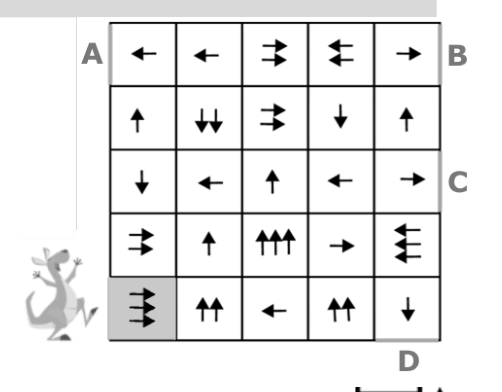
Try it on the maze puzzle below (Joey’s jumps): Joey starts in the bottom-left square, and each square’s arrows say how far to jump. Put your pencil on the start, read its arrows, count the squares out loud, land. Repeat from the new square. Obey, mark, move — until a jump carries Joey off the edge at exit B. One step on the page beats five in your head.
A clue written as ‘NOT X’ goes straight into the grid as a × — no thinking required. Mark every × first; the answer usually appears the moment a row or column is down to one open box.
To complete the grid below, each of the digits 1 through 4 must occur once in each row and once in each column. What number will occupy the lower right-hand square?
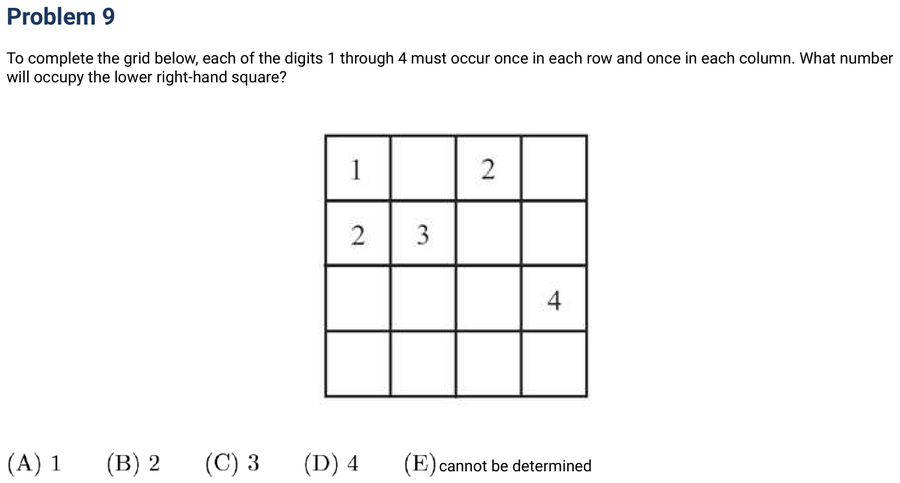
A 4×4 grid holds the digits 1–4, each digit once per row and once per column (a tiny Latin square). What digit goes in the bottom-right box?
This is a tiny Latin square: digits 1–4, each once per row and once per column, and you want the bottom-right box. Do not solve the whole grid. The question asks for one box, so chase only the row and column that pass through it.
Aim at the rightmost column — the one through the corner. It already holds a 4, so no other box in that column can be 4. That’s the lever.
The top row’s two blanks are 3 and 4; the column has banned 4, so the top-right box is 3. The same move on the next row (blanks 1 and 4) forces a 1.
The column now shows 3, 1, 4. Only one digit is left for the bottom-right box: 2. You never touched the left half of the grid.
The whole solve is “three of four are accounted for in a line, so the fourth is forced.” In any grid puzzle, attack the most-filled row or column first — it forces a box, which tightens the next line, which forces another. Chase the eliminations, not the picture.
Draw the table before you reason. Clues become ×’s. Lock in any row or column with one box left, then cascade.
2020 · #9 Juca wrote a whole number greater than zero in each box of the 3×3 board shown, so that the sums of the numbers in each row and in each...
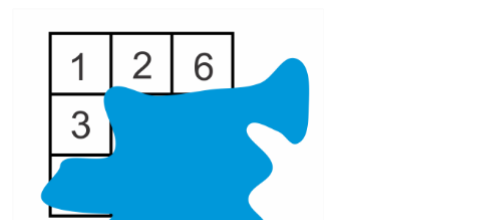
Juca wrote a whole number greater than zero in each box of the 3×3 board shown, so that the sums of the numbers in each row and in each column are equal. The only thing Juca remembers is that no number is used three times. What number is written in the center box?
Show answer
Show hints
Still stuck? Show hint 2 →
Show solution
- Each row and column sums to 1 + 2 + 6 = 9.
- The left column 1 + 3 + ? = 9 forces the bottom-left to be 5.
- Filling in keeps the sums at 9; the center value can be 4 (center 5 would repeat a number three times, which is forbidden).
- So the center is 4, choice C.
2007 · #11 Tiles I, II, III and IV are translated so one tile coincides with each of the rectangles A, B, C and D. In the final arrangement, the...
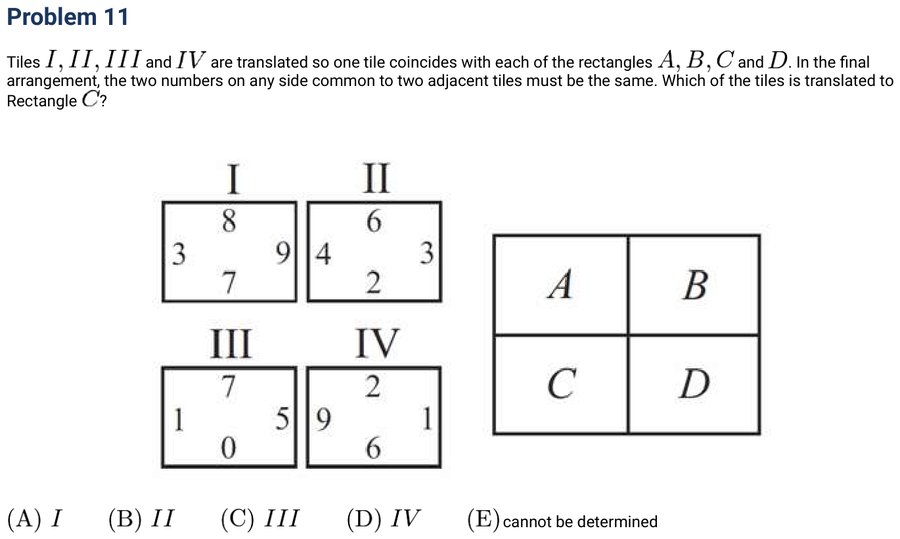
Tiles I, II, III and IV are translated so one tile coincides with each of the rectangles A, B, C and D. In the final arrangement, the two numbers on any side common to two adjacent tiles must be the same. Which of the tiles is translated to Rectangle C?
Show answer
Show hints
Still stuck? Show hint 2 →
Show solution
- Some edge numbers appear on only one tile (no other tile carries that number), so those edges must lie on the outer boundary of the 2 × 2 arrangement. Pinning those tiles into their forced corners removes most of the freedom.
- From the anchored tile, walk to its neighbors by matching the shared edge number. The chain forces tile IV into rectangle C.
2024 · #1 Kangaroo Joey wants to jump through the maze. Joey starts in the square at the bottom left (see picture). The number of arrows in a...
Kangaroo Joey wants to jump through the maze. Joey starts in the square at the bottom left (see picture). The number of arrows in a square tells how long the jump must be: a square with three arrows means Joey jumps over two squares in the direction of the arrows and lands in the third square.
Where will Joey leave the maze?
Show answer
Show hints
Still stuck? Show hint 2 →
Show solution
- Begin on the bottom-left square and read its arrows: move in the arrow's direction by as many squares as there are arrows (three arrows = land in the third square).
- Repeat from each square you land on, always obeying the new square's arrows.
- Following the chain of jumps, Joey is carried to the edge of the grid and exits through the side marked B.
- So Joey leaves the maze at B.
2023 · #10 Evita wants to write the numbers from 1 to 8, with one number in each field. The sum of the numbers in each row should be equal. The sum...
Evita wants to write the numbers from 1 to 8, with one number in each field. The sum of the numbers in each row should be equal. The sum of the numbers in each of the four columns should also be the same. She has already written in the numbers 3, 4 and 8 (see diagram). Which number does she have to write in the dark field?
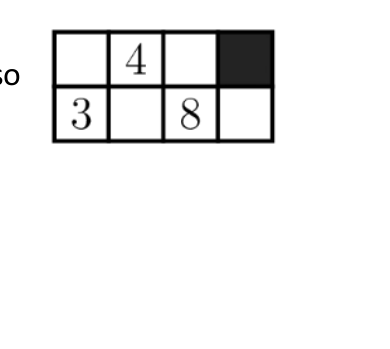
Show answer
Show hints
Still stuck? Show hint 2 →
Show solution
- 1 + 2 + ... + 8 = 36; with two equal rows each row sums to 18, and with four equal columns each column sums to 9.
- Place the remaining numbers so each column totals 9 and each row totals 18, respecting the given 3, 4 and 8.
- The dark field is then forced to be 7.
- So the answer is 7 (E).
Contrapositive — flip the if-then the safe way
“If it’s raining, the ground is wet.” True. Now the ground is dry — what can you say? It can’t be raining. You used the most powerful move in elementary logic without naming it.
CONTRAPOSITIVE
“If A, then B” means the SAME thing as “If not B, then not A.”
Four ways to flip an “if-then” — only TWO mean the same
From any rule “If A, then B,” you can make three other sentences by swapping or negating. Only one is equivalent to the original. The other two are classic contest traps.
| Name | Shape | Example (“rain → wet”) | Same as original? |
|---|---|---|---|
| Original | If A → B | If raining, then wet. | — (it IS the original) |
| Contrapositive | If NOT B → NOT A | If NOT wet, then NOT raining. | YES ✓ |
| Converse | If B → A | If wet, then raining. | NO × (could be a hose) |
| Inverse | If NOT A → NOT B | If NOT raining, then NOT wet. | NO × (could be a hose) |
The wet ground could be from a sprinkler — so “wet → raining” isn’t guaranteed. That’s why the converse fails. The contrapositive escapes the trap because it only flips the same statement around.
THE MOVE
To disprove “if A then B,” hunt for a case with A true and B false. To use the rule, watch for “not B” in the problem — it instantly hands you “not A.”
Named trick — chain the rules, then read the contrapositive
Contest if-thens often come in a string: “If it’s a square it’s a rectangle; if it’s a rectangle it has four right angles.” Stack them into one arrow chain — square → rectangle → four right angles — and the whole chain has a single clean contrapositive: flip it and reverse every arrow. “No four right angles → not a rectangle → not a square.”
Quick check on the move: from “If A → B → C,” suppose you learn not C. Walk the contrapositive chain backward: not C forces not B, which forces not A. So a fact at the END of the chain can hand you a fact at the START — that is the contrapositive doing two steps at once.
When a problem gives “If X then Y” and you want to know whether Y must hold, scan for “not Y.” If “not Y” appears, the contrapositive instantly gives you “not X.” Reading the rule backwards is often easier than reading it forwards.
Five cards are lying on a table as shown.
Each card has a letter on one side and a whole number on the other side. Jane said, “If a vowel is on one side of any card, then an even number is on the other side.” Mary showed Jane was wrong by turning over one card. Which card did Mary turn over?
Five cards lie on a table showing the faces 3, 4, 6, P, Q. Jane’s rule: “If a vowel is on one side of a card, then an even number is on the other.” Mary flips ONE card and proves Jane wrong. Which one?
The rule is one-directional: vowel → even. The ONLY way to break it is a card that is a vowel paired with an odd number. So ask, face by face, “could flipping this expose that forbidden pair?”
P, Q are consonants — the rule never restricts consonants. Flipping them proves nothing. And 4, 6 are even — the rule allows any letter behind an even number, so they’re useless too.
3 is odd — if a vowel is hiding behind it, that’s a vowel with an odd number, a direct contradiction. Only the odd-numbered card can catch the violation. Mary flipped 3.
This is the famous Wason card task in disguise. To break “A → B” you need A true with B false — so you only ever check the A-faces (vowels) and the not-B-faces (odd numbers). Anything already not-A or already B is a wasted flip.
To disprove ‘if A then B’: find a case with A true and B false. The contrapositive ‘not B → not A’ is the original wearing a hat.
2025 · #21 Fabio never tells the truth on Tuesdays, Thursdays and Saturdays, while he always tells the truth on the other days of the week. One day...
Fabio never tells the truth on Tuesdays, Thursdays and Saturdays, while he always tells the truth on the other days of the week. One day Mateo had the following conversation with Fabio:
Mateo: “What day is today?”
Fabio: “Saturday”
Mateo: “What day will tomorrow be?”
Fabio: “Wednesday”
On which day of the week did the conversation take place?
Show answer
Show hints
Still stuck? Show hint 2 →
Show solution
- Fabio lies on Tue/Thu/Sat and tells the truth otherwise; both his answers share that day’s truth status.
- He says ‘today is Saturday’ and ‘tomorrow is Wednesday’.
- Only Thursday works: it is a lying day, and both statements are indeed false (it isn’t Saturday, and tomorrow is Friday not Wednesday).
- So the conversation happened on Thursday.
2001 · #20 Kaleana shows her test score to Quay, Marty, and Shana, but the others keep theirs hidden. Quay thinks, "At least two of us have the...
Kaleana shows her test score to Quay, Marty, and Shana, but the others keep theirs hidden. Quay thinks, "At least two of us have the same score." Marty thinks, "I didn't get the lowest score." Shana thinks, "I didn't get the highest score." List the scores from lowest to highest for Marty (M), Quay (Q), and Shana (S).
Show answer
Show hints
Still stuck? Show hint 2 →
Show solution
- Quay is certain two scores are equal but has seen only Kaleana's — the sole way to be sure is if HIS score matches it. So Q = K.
- Marty knows he's not lowest, and the only score he's seen is Kaleana's, so M > K. Shana knows she's not highest, so S < K. Swap K for Q: S < Q < M.
- Lowest to highest: S, Q, M. The transferable move in "who-knows-what" logic: a person's certainty is built only from what they can actually observe — that constraint is what pins everything down.
Negating clues — when statements are FALSE
Some puzzles tell you a clue is false and make you work out what that leaves open. “NOT next to Carl” doesn’t mean far away — only not adjacent. Negation is where careful kids pull ahead, because every line has a trap baked in. Write the negation as a plain positive fact before you use it; this table is your cheat sheet:
| The clue says … | The negation means … | Trap to dodge |
|---|---|---|
| X is next to Y | X is at least 2 seats from Y | Not “X is far from Y” — only not adjacent. |
| X is between Y and Z | X is outside the Y–Z range | “Not between” means “to one side,” not “the opposite.” |
| A is taller than B | A is shorter than OR equal to B | NOT only “shorter than.” The “or equal” matters. |
| A is greater than 5 | A is ≤ 5 | Not only “less than 5.” |
| All X have property P | At least one X does NOT have P | NOT “no X has P.” |
| Some X has property P | No X has P | — |
| A and B (both happen) | NOT A or NOT B (at least one fails) | De Morgan: “and” flips to “or.” |
| A or B (at least one) | NOT A and NOT B (neither happens) | De Morgan again. |
THE MOVE
Rewrite every “NOT” clue as a plain positive fact before you place anything. “NOT first or last” becomes “somewhere in the middle.” Then the clue is one × in your grid.
Go deeper: cross out what can’t be — a worked elimination
Cross out what can’t be — watch the answer appear
A negation clue is a gift: it’s a ready-made ×. You don’t have to figure out where something IS — you keep marking where it ISN’T, and the grid corners you into the answer.
Here’s a clean one. Three boxes — white, red, green — hold a chocolate bar, an apple, and nothing (one each). Two clues: the chocolate is in the white or the red box, and the apple is in neither the white nor the green box. Rows are the boxes, columns are the contents. Each clue is a handful of ×’s:
The apple column has ×’s in white and green, so the apple is forced into red. Now red is full — × the rest of red’s row. The chocolate (white or red) can’t be red anymore, so it’s in white. Green takes what’s left: empty. You never guessed; every box was forced by an elimination. That’s exactly the Kangaroo box puzzle — chocolate in the white box.
THE MOVE
Mark all the ×’s the clues force. When any row or column has a single open cell, that cell must be a ✓ — lock it, then × the rest of its row AND column. Repeat until the grid is full.
For ‘these clues are all false’ puzzles, negate each clue ON PAPER first, turning it into a positive constraint, then place names one box at a time. Trying to juggle the negation in your head is where the wrong answers come from.
The numbers −2, 4, 6, 9 and 12 are rearranged according to these rules: The largest isn't first, but it is in one of the first three places. The smallest isn't last, but it is in one of the last three places. The median isn't first or last. What is the average of the first and last numbers?
Rearrange −2, 4, 6, 9, 12 under three rules, then average the first and last numbers. Notice the question only asks about the two endpoints — so don’t order all five. Find who is banned from the ends.
Name the three special values: largest = 12, smallest = −2, median = 6. Read each rule as a ban:
- “Largest isn’t first, but is in the first three” ⇒ 12 is not first, and (being in the first three) not last either. 12 is off both ends.
- “Smallest isn’t last, but is in the last three” ⇒ −2 is not last, and not first. −2 is off both ends.
- “Median isn’t first or last” ⇒ 6 is off both ends.
Three numbers are forbidden from both endpoints, so the two survivors — 4 and 9 — must fill the ends. Their average: (4 + 9) ÷ 2 = 6.5.
You never decided whether 4 or 9 sits first — and you never needed to, because their average is the same either way. When a puzzle asks for one feature, translate the clues into bans on that feature and ignore the rest.
Convert FALSE (or ‘not’) clues into precise positive bans before applying them. Mind the ‘or equal’ on inequalities.
2009 · #5 There are three boxes in front of me: one white, one red and one green. One box holds a chocolate bar, another holds an apple, and one...
There are three boxes in front of me: one white, one red and one green. One box holds a chocolate bar, another holds an apple, and one box is empty. The chocolate bar is in either the white box or the red box. The apple is in neither the white box nor the green box. In which box is the chocolate bar?
Show answer
Show hints
Still stuck? Show hint 2 →
Show solution
- The apple is in neither white nor green, so the apple is in the red box.
- The chocolate is in the white or the red box, but red now holds the apple.
- Therefore the chocolate is in the white box — answer A.
2024 · #8 There are five different kinds of fruit in a bowl: apples, grapes, cherries, strawberries and bananas. Anna likes apples, cherries,...
There are five different kinds of fruit in a bowl: apples, grapes, cherries, strawberries and bananas. Anna likes apples, cherries, strawberries and bananas. Berta likes apples. Conny likes grapes, cherries, strawberries and bananas. Doris likes apples, grapes and cherries. Eva likes apples and cherries. The fruits are shared out so that each person gets a different kind of fruit, but everybody gets a kind of fruit that they like. Who gets the cherries?
Show answer
Show hints
Still stuck? Show hint 2 →
Show solution
- Berta likes only apples, so Berta must get the apples.
- Eva likes only apples and cherries; with apples taken, Eva must get the cherries.
- So the cherries go to Eva.
2024 · #28 Captain Flint asks four of his pirates to note down how many gold, silver and bronze coins there were in the treasure chest. Their...
Captain Flint asks four of his pirates to note down how many gold, silver and bronze coins there were in the treasure chest. Their answers are shown in the diagram. Unfortunately, part of the paper was damaged. Only one of the four pirates told the truth; the other three lied on every single one of their answers. The total number of coins was 30. Who told the truth?
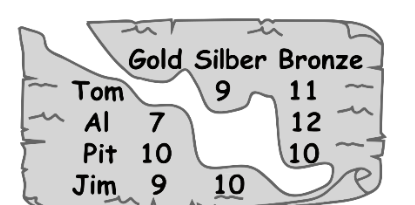
Show answer
Show hints
Still stuck? Show hint 2 →
Still stuck? Show hint 3 →
Show solution
- Suppose Al is honest: then gold = 7 and bronze = 12, so silver = 30 − 7 − 12 = 11.
- Check the liars against (gold, silver, bronze) = (7, 11, 12): Tom's 9 silver and 11 bronze are both wrong, Pit's 10 gold and 10 bronze are both wrong, and Jim's 9 gold and 10 silver are both wrong.
- So every other pirate lied on every answer, exactly as required, and trying any other pirate as honest forces a clash, so this is the only possibility.
- The truthful pirate is Al.
Tables, contrapositive, negation
Three puzzles that fall to a grid, a careful flip, and a precise negation.
2007 · #9 To complete the grid below, each of the digits 1 through 4 must occur once in each row and once in each column. What number will occupy...
To complete the grid below, each of the digits 1 through 4 must occur once in each row and once in each column. What number will occupy the lower right-hand square?
Show answer
Show hints
Still stuck? Show hint 2 →
Show solution
- Aim at column 4, the column through the corner we want. It already holds a 4 (row 3), so no other cell in it can be 4 — that's the lever.
- Row 1's two blanks are 3 and 4, but column 4 has banned 4, so row 1 col 4 = 3. Same move on row 2 (blanks 1 and 4): col 4 = 1.
- Column 4 now shows 3, 1, 4, leaving only one digit for the bottom-right square: 2.
- Transfers everywhere: in any Latin-square / Sudoku cell, when three of four values are accounted for in a line, the fourth is forced — chase eliminations, not the whole grid.
1985 · #25 Five cards are lying on a table as shown. P Q 3 4 6Each card has a letter on one side and a whole number on the other side. Jane said,...
Five cards are lying on a table as shown.
Each card has a letter on one side and a whole number on the other side. Jane said, “If a vowel is on one side of any card, then an even number is on the other side.” Mary showed Jane was wrong by turning over one card. Which card did Mary turn over?
Show answer
Show hints
Still stuck? Show hint 2 →
Still stuck? Show hint 3 →
Show solution
- Breaking 'vowel → even' requires a card that's a vowel paired with an odd number. Check what flipping each face could reveal: P, Q (consonants) — the rule doesn't restrict consonants, useless to flip; 4, 6 (even) — the rule permits any letter behind an even number, also useless; 3 (odd) — if a vowel hides behind it, that's a vowel with an odd number, a direct contradiction.
- Only the odd-numbered card can expose the forbidden vowel-with-odd combination, so Mary turned over 3.
- Why this transfers: to test an 'if A then B' rule, you only ever check the A-cases (is B true?) and the not-B-cases (is A false behind it?). Cases that are already not-A or already B can never disprove it — a sharp filter that saves you from flipping every card.
2004 · #11 The numbers −2, 4, 6, 9 and 12 are rearranged according to these rules: The largest isn't first, but it is in one of the first three...
The numbers −2, 4, 6, 9 and 12 are rearranged according to these rules: The largest isn't first, but it is in one of the first three places. The smallest isn't last, but it is in one of the last three places. The median isn't first or last. What is the average of the first and last numbers?
Show answer
Show hints
Still stuck? Show hint 2 →
Show solution
- Identify the three special values: largest 12, smallest −2, median 6. Now read the rules as bans on the endpoints: the largest 'isn't first' and lives in the first three (so not last either) → 12 is off both ends; the smallest 'isn't last' and lives in the last three (so not first) → −2 is off both ends; the median 'isn't first or last' → 6 is off both ends.
- Three of the five numbers are forbidden from both endpoints, so the two endpoints must be the survivors: 4 and 9.
- Average of the ends: (4 + 9) ÷ 2 = 6.5.
- The transferable lesson: when a puzzle asks for one feature, attack that feature directly. We never determined whether 4 or 9 is first — and we never had to, because their average is the same either way.
Ordering and ranking puzzles
“Alice is taller than Bob; Bob taller than Carla; Diana taller than Alice.” Don’t juggle heights in your head. Draw one vertical line, tall at top, and drop each name onto it — the line does all the bookkeeping.
TRANSITIVITY — the chain-link rule
If A > B and B > C, then automatically A > C. No separate clue needed. Use it to stretch a few thin clues into a full ranking.
Go deeper: the anchor trick (numeric gaps) and a worked one-line ranking
The anchor trick
When clues say “3 minutes ahead,” “5 minutes behind,” pick ONE person as the anchor (the one mentioned most) and measure everyone’s gap from them. Each clue collapses to one addition.
THE MOVE
One line for pure rankings; one anchor when there are numbers. Convert every relative clue into a single position, then sort and read off.
One line, four clues — a quick example
Five kids by height: P is taller than Q, Q is taller than R, S is taller than P, and T is shorter than R. Draw the vertical line and drop each name. Start with the longest chain: S > P > Q > R, and T sits below R. Top to bottom that’s S, P, Q, R, T. So the 3rd-tallest is Q — and notice you never needed a clue directly comparing, say, S and T; transitivity stitched the gaps shut.
Off-by-one — count the GAPS, not the posts
Stand 5 fence posts in a row. How many gaps between them? Not 5 — only 4. The ends have no gap past them. This mismatch (the fencepost trap) wrecks more counting answers than any hard idea.
Decide whether you’re counting things (posts: 1…5) or steps between things (gaps: 4). They differ by one. “Antonia is the 5th” means 4 people sit before her, not 5.
See it in the circle-headcount puzzle below. Girls stand in a circle; Bianca counts off as “one.” Going clockwise, Antonia is the 5th; going anticlockwise, Antonia is the 8th. Each direction is a count that starts at Bianca and ends at Antonia — so both of those two girls get tallied in both directions. Add the counts and you have double-counted exactly two girls: 5 + 8 = 13, then take away the 2 doubles, giving 11. (Falling for 5 + 8 = 13 is the trap.)
Go deeper: another worked example — rank people from their own claims (and ties)
Another worked example — rank them from their claims
Four students forgot their exam ranks (all different, 1st–4th) but each remembered one true statement. Anna: “Beatrice scored higher than me.” Beatrice: “I came second.” Charles: “I scored higher than Beatrice.” David: “I scored higher than Anna.” What was the full ranking, 1st to 4th?
Each claim is just a position-clue — turn them into one line, highest at the top.
- Beatrice fixes herself at 2nd.
- Charles is above Beatrice, and the only spot above 2nd is 1st — so Charles is 1st.
- That leaves 3rd and 4th for Anna and David. David is above Anna, so David is 3rd and Anna is 4th. (This also fits Anna’s clue: Beatrice, at 2nd, is above her.)
Top to bottom: Charles, Beatrice, David, Anna. Notice you never compared Charles with David directly — pinning Beatrice and Charles to exact seats squeezed the other two into the only order left.
What if a clue says ‘same height’?
Clues aren't always strict ‘taller than.’ A clue can say Charlie is the same height as Dana (an =, not a >). Then they share one spot on the line — place them side by side at the same level. The order is now only partial: a few people may be tied. That's fine. Re-read what the question actually asks — ‘who is tallest?’ or ‘who is third?’ is often still forced even though the full ranking has a tie in it. Answer the asked spot; ignore ties that don't touch it.
If the clues only pin down a partial order, check the exact position the question asks about — it’s often forced even when the full ranking isn’t. Answer what’s asked, not the whole puzzle.
Children stand in a circle. A starting child counts off “one.” Counting clockwise from there Sam is 5th; counting anticlockwise from the same child Sam is 9th. So the circle has 5 + 9 = 14 children.
Why it breaks: Each count runs from the starting child to Sam, so BOTH the starting child and Sam land in both directions — the sum tallies two children twice.
The fix: Subtract the two doubles: 5 + 9 − 2 = 12. (Same as counting the children strictly to one side, 5 − 1 = 4, plus the other side, 9 − 1 = 8, plus nobody left over: 4 + 8 = 12.) Whenever you wrap two counts around a loop, take out each shared endpoint once.
Five runners finished a race: Luke, Melina, Nico, Olympia, and Pedro. Nico finished 11 minutes behind Pedro. Olympia finished 2 minutes ahead of Melina but 3 minutes behind Pedro. Olympia finished 6 minutes ahead of Luke. Which runner finished fourth?
Five runners finish a race. Nico is 11 min behind Pedro; Olympia is 2 min ahead of Melina but 3 min behind Pedro; Olympia is 6 min ahead of Luke. Who finished fourth?
Pedro shows up most, so anchor on Pedro at 0 and write everyone as “minutes behind Pedro.”
Pedro: 0 (anchor). Olympia: +3 (3 behind Pedro). Melina: +5 (2 behind Olympia, so 3 + 2). Luke: +9 (6 behind Olympia, so 3 + 6). Nico: +11 (11 behind Pedro).
Sort front to back: Pedro, Olympia, Melina, Luke, Nico. Fourth across the line is Luke.
Picking the most-mentioned runner as the anchor turns every relative clue into one addition. After that the ranking falls out by sorting the numbers — no mental juggling.
Draw the line (or pick an anchor). Place each clue as a position. Use transitivity. Read off the spot the question asks about.
1999 · #6 Bo, Coe, Flo, Jo, and Moe have different amounts of money. Neither Jo nor Bo has as much money as Flo. Both Bo and Coe have more than...
Bo, Coe, Flo, Jo, and Moe have different amounts of money. Neither Jo nor Bo has as much money as Flo. Both Bo and Coe have more than Moe. Jo has more than Moe, but less than Bo. Who has the least amount of money?
Show answer
Show hints
Still stuck? Show hint 2 →
Show solution
- Sweep the clues for who loses each comparison. Moe is beaten by Bo, by Coe, and by Jo directly. And since Flo > Bo > Moe, Flo beats Moe too.
- Every other person sits above Moe, so Moe has the least.
- Why this transfers: for a "who is least/greatest" question you only need the extreme, not the whole ranking — find the name that's on the losing side of every clue and stop. Chaining Flo > Bo > Moe shows you can hop across people you were never directly told to compare.
2025 · #7 Six children were running a race. Ariadne finished third. Bill finished sixth, just behind Ernest. Fatima finished between Ariadne and...
Six children were running a race. Ariadne finished third. Bill finished sixth, just behind Ernest. Fatima finished between Ariadne and Ernest. Diana overtook Charles just before the finish line. Who won the race?
Show answer
Show hints
Still stuck? Show hint 2 →
Show solution
- Ariadne is 3rd. Bill is 6th just behind Ernest, so Ernest is 5th.
- Fatima finishes between Ariadne (3rd) and Ernest (5th), so Fatima is 4th.
- Only places 1 and 2 are left for Diana and Charles, and Diana overtook Charles at the end.
- So Diana is 1st — Diana won.
2021 · #10 Byron is 5 cm taller than Aaron, but 10 cm shorter than Caron. Darren is 10 cm taller than Caron, but 5 cm shorter than Erin. Which of...
Byron is 5 cm taller than Aaron, but 10 cm shorter than Caron. Darren is 10 cm taller than Caron, but 5 cm shorter than Erin. Which of the following statements is true?
Show answer
Show hints
Still stuck? Show hint 2 →
Show solution
- Byron = Aaron + 5; Caron = Byron + 10 = Aaron + 15.
- Darren = Caron + 10 = Aaron + 25; Erin = Darren + 5 = Aaron + 30.
- So Erin is 30 cm taller than Aaron, i.e. Aaron is 30 cm shorter than Erin.
- So the answer is E.
1993 · #23 Five runners, P, Q, R, S, T, have a race. P beats Q, P beats R, Q beats S, and T finishes after P and before Q. Who could NOT have...
Five runners, P, Q, R, S, T, have a race. P beats Q, P beats R, Q beats S, and T finishes after P and before Q. Who could NOT have finished third in the race?
Show answer
Show hints
Still stuck? Show hint 2 →
Show solution
- Chain the clues. 'T after P and before Q' plus 'Q beats S' gives P < T < Q < S, and separately P < R. Read positions as left-to-right finishing order.
- P sits ahead of T, Q, R, and S — all four others — so P is forced into 1st. With 0 people who can be ahead of it, P can never be 3rd.
- S sits behind Q, which is behind both P and T, so at least P, T, Q finish ahead of S: that's 3 runners, pinning S at 4th or 5th. S can never be 3rd either.
- Everyone else (Q, R, T) has enough wiggle room to land 3rd in some valid order, so the runners who could NOT be third are P and S.
- Why this transfers: for ranking-with-clues, you rarely need the full order. Turn the clues into one chain, then count must-be-ahead / must-be-behind. A position is impossible for anyone whose forced-ahead count is too big (can't move up) or too small (forced even higher).
2017 · #10 Some girls are standing in a circle. The teacher makes them do a headcount: Bianca says one, her neighbour says two, and so on. If they...
Some girls are standing in a circle. The teacher makes them do a headcount: Bianca says one, her neighbour says two, and so on. If they count in a clockwise direction, Antonia says five. If they count in an anticlockwise direction, Antonia says eight. How many girls are forming the circle?
Show answer
Show hints
Still stuck? Show hint 2 →
Show solution
- Clockwise, Antonia is the 5th, so 4 girls separate them that way.
- Anticlockwise she is the 8th, so 7 girls separate them the other way.
- Around the whole circle: 4 + 7 = 11 girls.
Casework — when the clues don't decide for you
When the clues run out and you’re stuck between two or three possibilities, don’t freeze — try each possibility on its own and keep the one that survives every clue. That’s casework: a trunk (the choice you can’t resolve) and one branch per case. Walk each branch alone, apply all the clues, × the dead ends.
Case A dies on a later clue. Case B survives. That’s your answer.
THE MOVE — clean casework
- Label the cases: Case A, Case B, …
- In each case, apply EVERY clue — not only the one that set up the case.
- Cross out dead ends with ×.
- Count survivors. For “how many possible” questions, that count is the answer.
Two safety checks: cases must be mutually exclusive (no overlap, or you double-count) and exhaustive (no gaps, or you miss the answer). Ask out loud: “Does every scenario fit into exactly one of my cases?”
Go deeper: it’s OK to guess and back up — wrong turns are part of it
Casework can feel scary because you have to commit to a case before you know it’s right. That’s fine. Picking a case and finding it dies is not a mistake — it’s how casework works. Each dead branch you cross off is real progress: it shrinks what’s left and often points straight at the survivor.
So don’t wait for certainty before you start. Try a case, follow it honestly to the end, and if a clue kills it, calmly back up and try the next one. The best solvers treat a wrong turn as one more × in the grid, not a failure. A few brave guesses, each checked against every clue, will close the puzzle faster than freezing in front of it.
Mindset framing inspired by Posamentier, The Art of Problem Solving (“trial and success”).
Go deeper: seed the list from the tightest clue, and work backwards from the end
Make a list — and split on the tightest clue first
When several clues pile up, don’t test every possibility against all of them at once. Start your list from the clue that allows the fewest options, then strike out members that break the other clues. A short list beats a long one every time.
Say you want a two-digit multiple of 6 whose digits add to 9. “Multiple of 6” is the tight clue — only 15 of them exist. List them, then keep the ones whose digits sum to 9: 18, 36, 54, 72, 90. Five survivors, found in seconds, because you started narrow. Pick the most restrictive clue to seed the list; let the looser clues do the crossing-out.
Framing inspired by AoPS Prealgebra.
Work backwards — start from the end and undo
Some word problems hand you the FINISH and ask for the start: “after all the buying and selling, the price was X — what did it cost first?” Setting up algebra forwards is error-prone. Instead, walk the steps in reverse, undoing each one. Add becomes subtract, double becomes halve, “profit of 6” becomes “minus 6.”
A clean example: Danielle picks a number, multiplies by 3, adds 6, divides by 3, subtracts 6, and ends with 4. Run it backwards from 4 — undo each step bottom to top: 4 → add 6 = 10 → times 3 = 30 → minus 6 = 24 → divide by 3 = 8. She started with 8. Then check by going forwards — working backwards is solving the equation without ever writing it.
THE MOVE
When you know a lot about the END and want the START, reverse the story step by step, replacing each action with its undo. Then verify by running your answer forwards.
Framing inspired by AoPS Prealgebra.
When 3+ unknowns and several constraints tangle, freeze ONE unknown by cases, let the constraints fill in the rest of that case, then check it against every clue. The case that survives is the answer.
Seating puzzle: I try putting Bob in seat 2, work the rest out, and it fits the first two clues. Found a valid arrangement — done!
Why it breaks: “Fits the clues I bothered to check” is not “fits ALL the clues.” A later clue may still kill that case — and a different case might survive instead.
The fix: Run EVERY constraint against the arrangement before you trust it, and finish the other cases too. For a “how many are possible” question, the answer is the count of survivors, so you must test all branches, not stop at the first that looks good.
Aaron, Darren, Karen, Maren, and Sharon rode on a small train that has five cars that seat one person each. Maren sat in the last car. Aaron sat directly behind Sharon. Darren sat in one of the cars in front of Aaron. At least one person sat between Karen and Darren. Who sat in the middle car?
Five friends sit in five one-person cars in a line. Maren is in car 5. Aaron sits directly behind Sharon. Darren sits ahead of Aaron. At least one person sits between Karen and Darren. Who’s in the middle car (car 3)?
The glued Sharon–Aaron pair is the unknown to case on. Let Sharon–Aaron sit in cars k and k+1.
k = 1 (cars 1, 2): Darren must be ahead of car 2 — only car 1, already taken. Dead.
k = 2 (cars 2, 3): Darren takes car 1; Karen takes car 4. Karen (4) and Darren (1) are 3 apart, so “at least one between” holds. Survives. Order: Darren, Sharon, Aaron, Karen, Maren.
k = 3 (cars 3, 4): Darren needs car 1 or 2, Karen gets the other — they’d sit in 1 and 2 with nobody between. Fails the spacing rule.
Only the middle case survives, so car 3 holds Aaron.
The glued pair only fits three ways (cars 1–2, 2–3, or 3–4), so there are only three cases to test. Two die on a later clue; one lives. That’s the whole method — small, finite, certain.
List every case. Apply ALL constraints to each. Count the ones that survive.
2018 · #3 Students Arn, Bob, Cyd, Dan, Eve, and Fon are arranged in that order in a circle. They start counting: Arn first, then Bob, and so...
Students Arn, Bob, Cyd, Dan, Eve, and Fon are arranged in that order in a circle. They start counting: Arn first, then Bob, and so forth. When the number contains a 7 as a digit (such as 47) or is a multiple of 7 that person leaves the circle and the counting continues. Who is the last one present in the circle?
Show answer
Show hints
Still stuck? Show hint 2 →
Show solution
- Step 1 is the setup that makes everything easy: list the eliminating counts in order — 7, 14, 17, 21, 27, … (multiples of 7, or any number containing the digit 7). Now you only have to find who says each of these.
- Pass 1 (6 people): A=1, B=2, C=3, D=4, E=5, F=6, A=7 ⇒ A out.
- Pass 2 (5 people: B, C, D, E, F): B=8, C=9, D=10, E=11, F=12, B=13, C=14 ⇒ C out.
- Pass 3 (4: B, D, E, F): D=15, E=16, F=17 ⇒ F out.
- Pass 4 (3: B, D, E): B=18, D=19, E=20, B=21 ⇒ B out.
- Pass 5 (2: D, E): D=22, E=23, D=24, E=25, D=26, E=27 ⇒ E out.
- Last remaining: Dan.
- You'll see it again: "person leaves the circle, counting continues" problems are simulations — resist hunting for a formula and just bookkeep carefully; the only trap is forgetting the count keeps rising as people drop out.
2023 · #8 (figure problem)
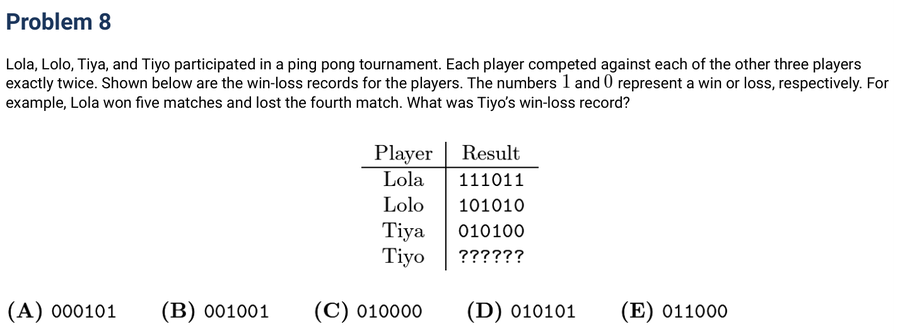
Show answer
Show hints
Still stuck? Show hint 2 →
Show solution
- The shortcut: you don't need the matchups. Every round, four players pair into two games, so exactly 2 wins (and 2 losses) get handed out — meaning every column of the table sums to 2.
- So add Lola + Lolo + Tiya down each round: 2, 2, 2, 1, 2, 1.
- Tiyo fills the gap to 2 each round: 0, 0, 0, 1, 0, 1 = 000101. This transfers: when each ‘round’ has a fixed total, an unknown row is just total minus the known rows — column thinking beats casework.
2024 · #24 There are three identical dice on a table (see picture). What is the sum of the three numbers on the bottoms of the dice, touching the table?
There are three identical dice on a table (see picture). What is the sum of the three numbers on the bottoms of the dice, touching the table?
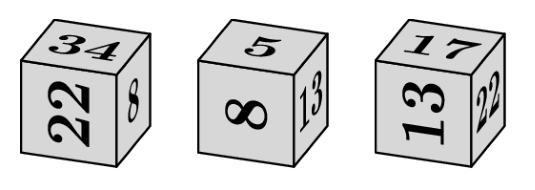
Show answer
Show hints
Still stuck? Show hint 2 →
Still stuck? Show hint 3 →
Show solution
- The dice are identical, so the numbers seen together on the pictures tell you which faces can sit next to each other and which must be opposite.
- Two numbers shown on the same die are not opposite, and matching this up across all three pictures sorts the faces into opposite pairs.
- Each die's table face is opposite its top face, so swap each visible top for its opposite to get the three bottom numbers.
- Adding those three bottom numbers gives 43.
2010 · #23 In the grid, how many grey squares have to be coloured white so that each row and each column contains exactly one grey square?
In the grid, how many grey squares have to be coloured white so that each row and each column contains exactly one grey square?
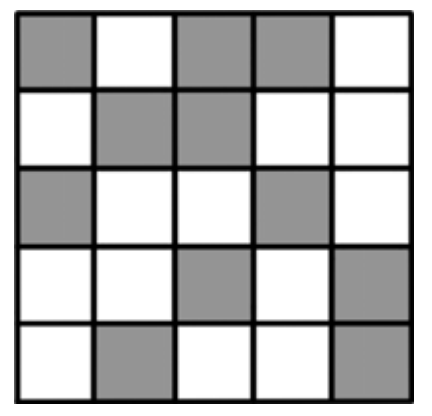
Show answer
Show hints
Still stuck? Show hint 2 →
Show solution
- The finished grid keeps exactly one grey square per row and per column, which is 5 grey squares in all.
- Counting the picture, there are 11 grey squares now, and you can pick 5 of them with one in every row and column.
- So you must colour \(11 - 5 = 6\) grey squares white — the answer is C.
2025 · #8 The picture shows the menu of a burger restaurant. The rain has washed away some of the numbers. The burgers are listed by price in...
The picture shows the menu of a burger restaurant. The rain has washed away some of the numbers. The burgers are listed by price in increasing order, the cheapest being the “veggie” burger. What is the smallest possible price of the “deluxe” burger?
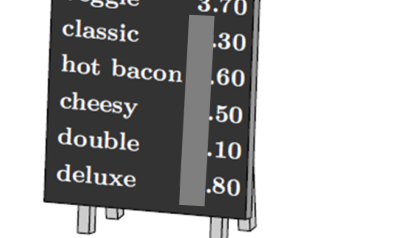
Show answer
Show hints
Still stuck? Show hint 2 →
Show solution
- Prices rise: veggie 3.70 < classic _.30 < hot bacon _.60 < cheesy _.50 < double _.10 < deluxe _.80.
- Smallest classic above 3.70 is 4.30; then hot bacon 4.60; cheesy must beat 4.60 so 5.50; double beats 5.50 so 6.10.
- Deluxe must beat 6.10 and end in .80, so the least it can be is 6.80, which is (B).
2011 · #8 Felix the Tomcat catches 12 fish in 3 days. On the second day he catches more than on the first. On the third day he catches more than...
Felix the Tomcat catches 12 fish in 3 days. On the second day he catches more than on the first. On the third day he catches more than on the second but less than on the first two days together. How many fish does he catch on day three?
Show answer
Show hints
Still stuck? Show hint 2 →
Show solution
- Let the catches be d1 < d2 on days 1 and 2, with total 12.
- Day 3 is more than day 2 but less than d1+d2.
- Testing d1=3, d2=4 gives d3=5: indeed 5>4 and 5<7, and 3+4+5=12.
- So on day three he catches 5 fish.
2022 · #5 Anna and Bella are celebrating their birthdays together. Five years ago, when Bella turned 6 years old, she received a newborn kitten as...
Anna and Bella are celebrating their birthdays together. Five years ago, when Bella turned 6 years old, she received a newborn kitten as a birthday present. Today the sum of the ages of the two children and the kitten is 30. How many years older than Bella is Anna?
Show answer
Show hints
Still stuck? Show hint 2 →
Show solution
- Insight: the kitten is the easy clue, not a distraction — “newborn five years ago” means it's exactly 5 today. And Bella, 6 five years ago, is 11 today. Both ages are now fixed.
- Anna is the only mystery, and the total 30 hands her to us: Anna = 30 − 11 (Bella) − 5 (kitten) = 14.
- Anna − Bella = 14 − 11 = 3 years.
- Sanity check: 14 + 11 + 5 = 30. ✓
Break a claim with one example
Someone claims “ALL swans are white.” You could count a thousand white swans and still not have proved it — the next one might be black. But find a single black swan and the claim is dead on the spot. That lopsidedness is the secret weapon of these problems.
THE ASYMMETRY OF “FOR ALL”
| To … | You need … |
|---|---|
| PROVE “For all X, P(X)” | To check EVERY X (or a general argument) |
| DISPROVE “For all X, P(X)” | ONE counterexample — that’s it |
| PROVE “There exists X with P(X)” | ONE example — that’s it |
| DISPROVE “There exists X with P(X)” | To check EVERY X (or a general argument) |
THE MOVE
To kill a “for all” claim, hunt for the ONE case that breaks it. To answer “which value is impossible / which can’t happen,” try to build each candidate — the one you can never build is the answer.
How to hunt
Contest counterexamples almost always live in the first few small values, or among the answer choices. For each candidate, check the TWO conditions:
- Does it satisfy the “if” part (the hypothesis)?
- If yes, does it FAIL the “then” part (the conclusion)?
Both true means you’ve found one. If a candidate doesn’t even satisfy the “if,” skip it — it can’t disprove anything.
For ‘which value CANNOT happen’ questions, flip it around: try to construct each answer choice. The four you can build are decoys; the one you can never build is the answer. You’re finding the counterexample to ‘all of these are possible.’
Four villages A, B, C and D lie (not necessarily in this order) along a straight road. A and C are 75 km apart, B and D are 45 km apart, and B and C are 20 km apart. Which of these distances cannot be the distance from A to D?
Villages A, B, C, D sit somewhere along a straight road. AC = 75 km, BD = 45 km, BC = 20 km. Which listed distance cannot be AD?
This is a disprove-by-building problem: four of the choices CAN be AD, one can’t. Put C at position 0 on a number line. Then BC = 20 puts B at +20 or −20; AC = 75 puts A at +75 or −75; D sits 45 from B.
- Run through the consistent left/right combinations and compute AD each time.
- The distances that actually appear are 10, 50, 100, and 140 km — each one is buildable.
- 80 km never comes out, no matter how you place the points.
So the distance that cannot be AD is 80 km (choice C).
“Which cannot happen” is a counterexample question in reverse: instead of one example to break a rule, you build an example for each option and watch which one you can never make. Signed positions on one line turn the messy “not necessarily in order” into a short, finite check.
One counterexample kills a ‘for all’; one example proves a ‘there exists.’ For ‘cannot happen,’ try to build each choice — the unbuildable one wins.
2000 · #20 You have nine coins: a collection of pennies, nickels, dimes, and quarters having a total value of $1.02, with at least one coin of each...
You have nine coins: a collection of pennies, nickels, dimes, and quarters having a total value of $1.02, with at least one coin of each type. How many dimes must you have?
Show answer
Show hints
Still stuck? Show hint 2 →
Show solution
- Take one of each coin off the top: 1 + 5 + 10 + 25 = 41¢, using 4 of the 9 coins. Remaining: 102 − 41 = 61¢ in 5 more coins.
- Units digit move: nickels, dimes, quarters all end in 0 or 5, so only pennies can produce the final '1' in 61. With 5 coins, you can't afford 6 pennies — so exactly 1 more penny. Now 60¢ in 4 coins.
- 60¢ in 4 coins needs a quarter (four dimes max out at 40¢). Two quarters = 50¢ leaves 10¢ in 2 coins = two nickels. That fills all four with no dime.
- So beyond the single starter dime, none are added: 1 dime.
- The reusable trick: in coin/total problems, read the *last digit* of the amount — only pennies (the 1¢ pieces) can change it, so the units digit alone often pins the smallest-coin count and collapses the casework.
2026 · #22 The integers 1 through 25 are arbitrarily separated into five groups of 5 numbers each. The median of each group is found, and M is the...
The integers 1 through 25 are arbitrarily separated into five groups of 5 numbers each. The median of each group is found, and M is the median of those five medians. What is the least possible value of M?
Show answer
Show hints
Still stuck? Show hint 2 →
Show solution
- First decode M: it is the 3rd-smallest of the five group medians. So making M tiny requires three groups to each have a small median simultaneously.
- Now the scarcity argument. Each of those three medians needs two numbers strictly below it inside its group. Suppose M ≤ 8. Then three medians (each ≤ 8) together with their six below-numbers (each smaller still) are 9 distinct values all ≤ 8 — impossible, since only 8 numbers (1–8) are that small. So M ≥ 9.
- Then show 9 is actually reachable: {1, 2, 7, 24, 25}, {3, 4, 8, 22, 23}, {5, 6, 9, 20, 21} have medians 7, 8, 9, while the last two groups {10–14} and {15–19} absorb the big numbers (medians 12, 17). The five medians 7, 8, 9, 12, 17 have median 9.
- Bound met by an example ⇒ the least value is 9.
- Why this transfers: extremal problems are won by pairing a lower bound (a counting/pigeonhole reason it can't be smaller) with a construction (an explicit example hitting that bound). Neither half alone is a proof — you need both jaws of the vise.
2025 · #21 (figure problem)
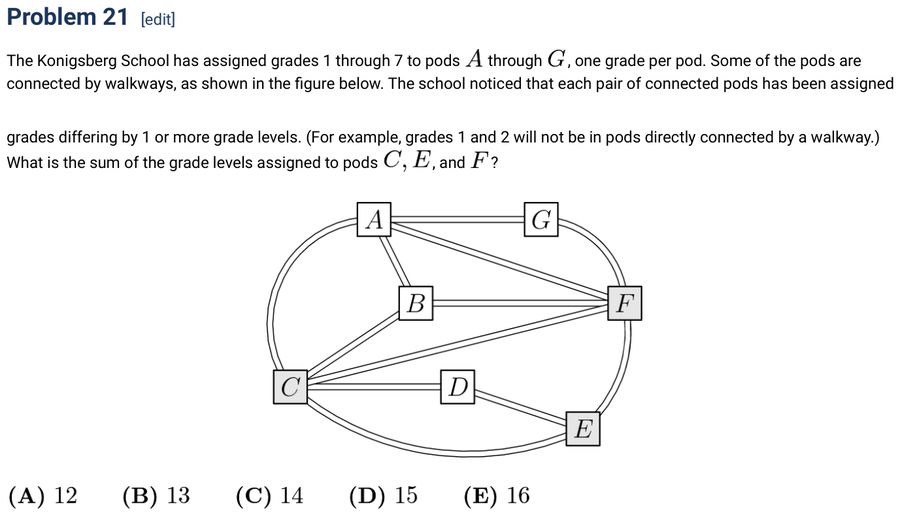
Show answer
Show hints
Still stuck? Show hint 2 →
Show solution
- Spot the tightest constraint: A, B, C, F are all mutually connected, so their four grades must each differ by ≥ 2. Packing 4 grades into 1–7 that far apart forces exactly {1, 3, 5, 7} — there's no slack.
- G connects to A and F. If G = 2, then A, F ≠ 1 or 3, forcing {A, F} ⊂ {5, 7} and {B, C} = {1, 3}.
- D and E only touch C and F. The extreme grades 1 and 7 each have just one neighbor in this clique, so place 1 at C and 7 at F. The remaining {4, 6} go to D, E.
- Filling in: D = 6 (avoids 7 enough), E = 4 (avoids 1 and 7), B = 3 (next to C = 1), A = 5. All constraints hold.
- C + E + F = 1 + 4 + 7 = 12.
- Why this transfers: in any constraint/coloring puzzle on a network, attack the densest cluster (the clique) first — it has the fewest possibilities, so it locks in the most and leaves the loose pods easy to finish.
Ordering, casework, counterexamples
Three puzzles that need a ranking line, branching cases, and a buildable-or-not check.
2025 · #7 Six children were running a race. Ariadne finished third. Bill finished sixth, just behind Ernest. Fatima finished between Ariadne and...
Six children were running a race. Ariadne finished third. Bill finished sixth, just behind Ernest. Fatima finished between Ariadne and Ernest. Diana overtook Charles just before the finish line. Who won the race?
Show answer
Show hints
Still stuck? Show hint 2 →
Show solution
- Ariadne is 3rd. Bill is 6th just behind Ernest, so Ernest is 5th.
- Fatima finishes between Ariadne (3rd) and Ernest (5th), so Fatima is 4th.
- Only places 1 and 2 are left for Diana and Charles, and Diana overtook Charles at the end.
- So Diana is 1st — Diana won.
2020 · #6 Aaron, Darren, Karen, Maren, and Sharon rode on a small train that has five cars that seat one person each. Maren sat in the last car....
Aaron, Darren, Karen, Maren, and Sharon rode on a small train that has five cars that seat one person each. Maren sat in the last car. Aaron sat directly behind Sharon. Darren sat in one of the cars in front of Aaron. At least one person sat between Karen and Darren. Who sat in the middle car?
Show answer
Show hints
Still stuck? Show hint 2 →
Show solution
- Start with the strictest clue: “directly behind” glues Sharon–Aaron into one block (S then A). Maren is fixed in car 5. A glued block of 2 only fits a handful of ways — test each.
- S, A in cars 1, 2: Darren needs a car ahead of car 2, but car 1 is taken. Fail.
- S, A in cars 3, 4: Darren and Karen must fill cars 1 and 2 — adjacent, with nobody between them. Breaks the spacing rule. Fail.
- S, A in cars 2, 3: Darren in car 1, Karen in car 4 — three cars apart, fine. The row is Darren, Sharon, Aaron, Karen, Maren.
- Only that arrangement survives, so Aaron is in the middle car.
- You'll see this again as: in seating/ordering logic, attack the most restrictive clue first (a fixed seat, or two people who must be adjacent). It chops the possibilities fastest, so you test a few cases instead of all 120 orderings.
2022 · #25 Four villages A, B, C and D lie (not necessarily in this order) along a straight road. A and C are 75 km apart, B and D are 45 km apart,...
Four villages A, B, C and D lie (not necessarily in this order) along a straight road. A and C are 75 km apart, B and D are 45 km apart, and B and C are 20 km apart. Which of these distances cannot be the distance from A to D?
Show answer
Show hints
Still stuck? Show hint 2 →
Show solution
- Put C at 0. Then B is at +20 or -20 (since BC = 20), A is at +75 or -75 (since AC = 75), and D sits 45 from B.
- Trying all the consistent combinations, A to D comes out as 10, 50, 100 or 140 km.
- AD = 80 km never appears, so the distance that cannot occur is C.
Implication chains
Line up dominoes: Alan, Beth, Carlos, Diana. The rules say “if Alan gets an A, so does Beth,” “if Beth, so does Carlos,” “if Carlos, so does Diana.” Tip the first domino and the whole row falls. Tip one near the end and only a few fall. That’s an implication chain, and it has one ironclad rule: it only fires forward.
Light up one bulb and the whole string after it lights up. Nothing fires backward.
CHAINS FIRE FORWARD
If A → B → C → D and A is true, then B, C, AND D are all forced true. You can’t stop the chain partway.
| Start the chain at … | Number lit up | OK if K = 2? |
|---|---|---|
| Alan (first link) | 4 (Alan, Beth, Carlos, Diana) | × too many |
| Beth | 3 (Beth, Carlos, Diana) | × too many |
| Carlos | 2 (Carlos, Diana) | ✓ exactly right |
| Diana (last link) | 1 (Diana only) | × too few |
THE MOVE
To leave exactly K lit at the end, start the chain at position (chain length) − K + 1. Push the A’s as far down the chain as the count allows.
For ‘A → B → C → D’ chains with ‘exactly K got an A,’ the only consistent start is position |chain| − K + 1. Everything earlier over-lights; everything later under-lights.
Alan, Beth, Carlos, and Diana were discussing their possible grades in mathematics class this grading period. Alan said, "If I get an A, then Beth will get an A." Beth said, "If I get an A, then Carlos will get an A." Carlos said, "If I get an A, then Diana will get an A." All of these statements were true, but only two of the students received an A. Which two received A's?
Three true statements: Alan→Beth, Beth→Carlos, Carlos→Diana (each “if I get an A, so does the next”). Exactly two students got an A. Which two?
The arrows point one way: Alan → Beth → Carlos → Diana. An A anywhere knocks down everyone after it — never anyone before. Test from the front.
Alan gets an A ⇒ Beth, Carlos, Diana too. That’s 4 — too many. Beth gets an A ⇒ Carlos, Diana too. That’s 3 — too many.
Carlos gets an A ⇒ only Diana follows. That’s exactly 2, and nobody earlier is dragged in. So the two are Carlos and Diana.
Because the arrows fire forward only, the earlier a person is, the more A’s they trigger. To keep the count smallest, the A’s have to sit as far down the chain as possible — here, the last two links.
Implication chains fire forward. To leave N lit at the end, start at position |chain| − N + 1.
2021 · #10 Byron is 5 cm taller than Aaron, but 10 cm shorter than Caron. Darren is 10 cm taller than Caron, but 5 cm shorter than Erin. Which of...
Byron is 5 cm taller than Aaron, but 10 cm shorter than Caron. Darren is 10 cm taller than Caron, but 5 cm shorter than Erin. Which of the following statements is true?
Show answer
Show hints
Still stuck? Show hint 2 →
Show solution
- Byron = Aaron + 5; Caron = Byron + 10 = Aaron + 15.
- Darren = Caron + 10 = Aaron + 25; Erin = Darren + 5 = Aaron + 30.
- So Erin is 30 cm taller than Aaron, i.e. Aaron is 30 cm shorter than Erin.
- So the answer is E.
2001 · #20 Kaleana shows her test score to Quay, Marty, and Shana, but the others keep theirs hidden. Quay thinks, "At least two of us have the...
Kaleana shows her test score to Quay, Marty, and Shana, but the others keep theirs hidden. Quay thinks, "At least two of us have the same score." Marty thinks, "I didn't get the lowest score." Shana thinks, "I didn't get the highest score." List the scores from lowest to highest for Marty (M), Quay (Q), and Shana (S).
Show answer
Show hints
Still stuck? Show hint 2 →
Show solution
- Quay is certain two scores are equal but has seen only Kaleana's — the sole way to be sure is if HIS score matches it. So Q = K.
- Marty knows he's not lowest, and the only score he's seen is Kaleana's, so M > K. Shana knows she's not highest, so S < K. Swap K for Q: S < Q < M.
- Lowest to highest: S, Q, M. The transferable move in "who-knows-what" logic: a person's certainty is built only from what they can actually observe — that constraint is what pins everything down.
2024 · #8 There are five different kinds of fruit in a bowl: apples, grapes, cherries, strawberries and bananas. Anna likes apples, cherries,...
There are five different kinds of fruit in a bowl: apples, grapes, cherries, strawberries and bananas. Anna likes apples, cherries, strawberries and bananas. Berta likes apples. Conny likes grapes, cherries, strawberries and bananas. Doris likes apples, grapes and cherries. Eva likes apples and cherries. The fruits are shared out so that each person gets a different kind of fruit, but everybody gets a kind of fruit that they like. Who gets the cherries?
Show answer
Show hints
Still stuck? Show hint 2 →
Show solution
- Berta likes only apples, so Berta must get the apples.
- Eva likes only apples and cherries; with apples taken, Eva must get the cherries.
- So the cherries go to Eva.
Truth-tellers and liars
“Alex says it’s Tuesday. Bobbi says Alex is lying.” One always tells the truth, the other always lies — who’s who? These feel slippery but are pure machinery: two rules and a small table crack them every time.
THE TWO RULES
- A truth-teller’s statement is TRUE.
- A liar’s statement is FALSE.
THE MOVE
Try each “who is what” assignment as a separate case. In each one, check whether the statements come out the way the rules demand. Cross off any case that contradicts itself. What survives is the answer.
The agreement shortcut
| A says about B … | Same type | Different type |
|---|---|---|
| “B is a truth-teller” | consistent | contradiction |
| “B is lying” | contradiction | consistent |
Memorize this 2×2: vouching for someone only works if you’re the SAME type; calling someone a liar only works if you’re a DIFFERENT type. It halves your casework.
Go deeper: the self-accusation trick, and the ‘day of the week’ variant (worked table)
Named trick — let a speaker accuse the group
A favourite move: someone makes a claim about the very group they belong to. A says, of A and B, “At least one of us is a liar.” Run the two cases on A.
- A is honest: the claim is true, so at least one of {A, B} lies — it can’t be A, so B lies. Consistent.
- A lies: the claim is false, so “at least one lies” is false, meaning nobody lies — but that makes A honest, contradicting “A lies.” Dead.
Only the first case survives: A honest, B a liar. The trick is that a self-referential accusation often collapses to a single survivor — test the speaker’s own type first and the contradiction does the rest.
The “day of the week” variant
A popular twist: a creature lies only on certain days. Now “truth-teller vs liar” depends on which day it is — so case on the day, and remember that all of one speaker’s statements share that day’s truth status.
Take Fabio, who lies on Tue/Thu/Sat. He says “today is Saturday” and “tomorrow is Wednesday.” Don’t reason in your head. Make one row per day you could assume, mark whether it’s a truth day or a lying day, then check both statements against that rule. The row with no × is the answer.
Only Thursday clears both checks: it’s a lying day, and both statements really are false (it isn’t Saturday, and tomorrow is Friday, not Wednesday). So it’s Thursday. Every other day dies on the very first statement — you stop the moment a row earns one ×.
Whenever a speaker makes a statement, there are exactly two cases: ‘speaker honest AND statement true’ or ‘speaker lying AND statement false.’ These two are exhaustive — test both and discard contradictions. For day-of-week versions, case on the day instead.
Four octopuses each claim the group’s total legs. The blue one says “28.” That sounds like a confident, exact number, so blue is the honest one — the answer is blue.
Why it breaks: A liar can state a number every bit as confidently as a truth-teller. Believing a claim because it sounds sure is exactly the trap these puzzles are built on.
The fix: Never take a statement at face value — test it. Honest speakers must AGREE on a shared fact, so different numbers force all-but-one to be liars; then the liars’ fixed leg-counts tell you the real total, and only the matching claim is honest. Here that lands on green, not blue.
Six-legged, seven-legged and eight-legged octopuses serve Neptune, king of the sea. The seven-legged ones always lie, while the six-legged and eight-legged ones always tell the truth. One day four octopuses meet. The blue one says: “Together we have 28 legs.” The green one says: “Together we have 27 legs.” The yellow one says: “Together we have 26 legs.” The red one says: “Together we have 25 legs.” Which colour octopus is telling the truth?
Six- and eight-legged octopuses always tell the truth; seven-legged ones always lie. Four meet and each states the group’s total legs: blue 28, green 27, yellow 26, red 25. Who’s telling the truth?
Start with the agreement shortcut. Every honest octopus knows the real total, so any two honest ones would say the same number. The four numbers are all different, so at most one is honest — the other three are seven-legged liars.
Three liars contribute 3 × 7 = 21 legs. The one honest octopus has 6 or 8 legs, so the true total is 21 + 6 = 27, or 21 + 8 = 29.
27 matches a claim (green); 29 matches nobody. So the real total is 27, said by the green octopus — choice C.
The whole puzzle turns on one observation: honest speakers must agree, so different answers force almost everyone to be a liar. Once you know three are liars, their legs are fixed and the total is two quick sums to test against the claims.
Try each who-is-what assignment; keep only the contradiction-free one. Honest speakers always agree — different answers cap how many can be truthful.
2025 · #21 Fabio never tells the truth on Tuesdays, Thursdays and Saturdays, while he always tells the truth on the other days of the week. One day...
Fabio never tells the truth on Tuesdays, Thursdays and Saturdays, while he always tells the truth on the other days of the week. One day Mateo had the following conversation with Fabio:
Mateo: “What day is today?”
Fabio: “Saturday”
Mateo: “What day will tomorrow be?”
Fabio: “Wednesday”
On which day of the week did the conversation take place?
Show answer
Show hints
Still stuck? Show hint 2 →
Show solution
- Fabio lies on Tue/Thu/Sat and tells the truth otherwise; both his answers share that day’s truth status.
- He says ‘today is Saturday’ and ‘tomorrow is Wednesday’.
- Only Thursday works: it is a lying day, and both statements are indeed false (it isn’t Saturday, and tomorrow is Friday not Wednesday).
- So the conversation happened on Thursday.
2022 · #28 Mowgli asks a bear and a panther what day of the week it is. The bear always lies on Monday, Tuesday and Wednesday; the panther always...
Mowgli asks a bear and a panther what day of the week it is. The bear always lies on Monday, Tuesday and Wednesday; the panther always lies on Thursday, Friday and Saturday. On every other day both tell the truth. The bear says, “Yesterday was one of my lying days.” The panther says, “Yesterday was also one of my lying days.” On which day did this conversation take place?
Show answer
Show hints
Still stuck? Show hint 2 →
Show solution
- The bear lies Mon-Tue-Wed; the panther lies Thu-Fri-Sat; both tell the truth on Sunday.
- On Thursday the bear tells the truth and yesterday (Wed) really was its lying day; the panther lies today, and since yesterday (Wed) was not its lying day, its statement is false as required of a liar.
- Both statements are consistent only on Thursday, so the answer is A.
2010 · #27 In Tautostadt there are only nobles and liars. Every sentence spoken by a noble is true, and every sentence spoken by a liar is false....
In Tautostadt there are only nobles and liars. Every sentence spoken by a noble is true, and every sentence spoken by a liar is false. One day some of them meet in a room, and three of them speak as follows:
The first one says: “There are no more than three in this room. We are all liars.”
The second one says: “There are no more than four in this room. We are not all liars.”
The third one says: “In this room we are five. Three of us are liars.”
How many people are in the room, and how many of them are liars?
Show answer
Show hints
Still stuck? Show hint 2 →
Show solution
- The first speaker's claim includes that everyone is a liar, which a noble could not say, so he is a liar and his whole sentence is false.
- With four people in the room, the second speaker's claim (at most four, not all liars) is true, so he is a noble, while the third speaker's claim of five people is false, so he is a liar.
- That gives a room of four people, two of whom are liars (option C).
2022 · #23 30 people are sitting around a round table. Some of them are wearing a hat. People without a hat must tell the truth; people with a hat...
30 people are sitting around a round table. Some of them are wearing a hat. People without a hat must tell the truth; people with a hat may either tell the truth or lie. Each person claims: “At least one of my two neighbours is wearing a hat.” What is the largest number of people who can be without a hat?
Show answer
Show hints
Still stuck? Show hint 2 →
Show solution
- A hatless person always tells the truth, so their claim 'a neighbour wears a hat' must be true; thus no hatless person sits between two hatless people.
- So at most two hatless people can sit consecutively, in a pattern like (no-hat, no-hat, hat) repeated.
- Around 30 seats that gives 2 out of every 3, i.e. 20 hatless people.
- So the answer is D.
Push it to the limit — optimization
“What’s the biggest? The smallest? The fewest? The most?” These ask you to drive a quantity as far as a rule allows and then stop on the line. The recipe never changes: push toward the extreme until a rule says STOP.
THE MOVE
- List EVERY constraint.
- Find the binding one — the rule that says STOP first as you push.
- Push to that boundary.
- If the answer must be a whole number, round to the nearest legal one.
Push the OTHERS to free up room
When a total is fixed and you want one piece huge, shrink every other piece to its minimum — whatever’s left in the budget pours into your target. Flip it to make one piece tiny.
| Goal | What to do with the OTHERS |
|---|---|
| Maximize one of n numbers (sum fixed) | Push the others to their minimum |
| Minimize one of n numbers (sum fixed) | Push the others to their maximum |
| Maximize the median of n sorted numbers | Push the lower half down; raise the upper half to a common ceiling |
A handy trick: cover the TARGETS, not the objects
Some “fewest” problems flip the usual job: instead of pushing one quantity to a limit, you must hit a whole list of required values using as few markers as possible. The move is to stop counting the markers and start counting the gaps between pairs of them — because every gap you can form is a value you can measure. A few cleverly spaced marks create many different gaps at once, so place them where their differences sweep the whole target list. Aim for marks whose pairwise gaps overlap as little as possible — spread, don’t bunch.
Another worked example — the fewest marks on a 6 cm rod
A plain 6 cm rod has no markings except its two ends (at 0 and 6). You may add marks, and you measure a length by taking the distance between any two marks (ends count as marks). What is the fewest extra marks needed so you can measure every whole length from 1 to 6 cm?
Don’t guess six marks. Count gaps. The two ends already give the gap 6. Try adding just two marks — at 1 cm and at 4 cm — so the marks sit at 0, 1, 4, 6. Now list every pairwise gap:
- 1 − 0 = 1, 6 − 4 = 2, 4 − 1 = 3
- 4 − 0 = 4, 6 − 1 = 5, 6 − 0 = 6
Four marks produce exactly the gaps 1, 2, 3, 4, 5, 6 — the whole target list — so 2 extra marks are enough. (One extra mark gives at most three gaps, far too few, so you truly cannot do it with fewer.) You optimized by chasing the differences, not the marks.
For ‘biggest/smallest one piece, fixed total’ problems: shove every OTHER piece to its limit, and whatever the total has left is your answer. The total is the binding constraint; everything else is how you spend it.
A snail at the bottom of a 10 m well climbs 4 m each day but slips 2 m back each night, so it gains 2 m a day. To climb 10 m it needs 10 ÷ 2 = 5 days.
Why it breaks: The “2 m per day” rate only applies while the snail is still trapped. On the day its climb first reaches the top, it’s OUT — it never takes that night’s slip.
The fix: Push to the boundary, then check the last step by hand. After day 3 the snail sits at 6 m (net 2 m × 3). On day 4 it climbs 6 + 4 = 10 m and escapes — day 4, not day 5. Extremes love to overshoot on the final move; always verify the step that crosses the line.
The integers 1 through 25 are arbitrarily separated into five groups of 5 numbers each. The median of each group is found, and M is the median of those five medians. What is the least possible value of M?
The integers 1–25 are split into five groups of five. Take each group’s median, then take the median of those five medians, M. What’s the smallest M can be?
First decode M: it’s the median of five numbers, so it’s the 3rd-smallest of the five group-medians. To push M down, you need three groups whose medians are all small at the same time.
Now the squeeze. Each small median needs two numbers strictly below it inside its own group. Suppose M ≤ 8. Then three medians (each ≤ 8) plus their six below-numbers are 9 different values all ≤ 8 — but only the numbers 1–8 are that small. Nine values can’t fit in eight slots. So M ≥ 9.
Then show 9 is reachable: {1, 2, 7, 24, 25}, {3, 4, 8, 22, 23}, {5, 6, 9, 20, 21} have medians 7, 8, 9, while {10–14} and {15–19} mop up the big numbers (medians 12, 17). The five medians 7, 8, 9, 12, 17 have median 9.
Lower bound met by an example, so the least M is 9 (choice A).
Extremal problems are won with two jaws of a vise: a lower bound (a counting reason it can’t go smaller) and a construction (an actual example hitting that bound). Neither half alone is enough. The scarce resource here is small numbers — counting how many you’d need is what forces M ≥ 9.
Push to the extreme until a rule stops you. For ‘least possible largest’ style answers, pair a counting lower bound with a built example that hits it.
2017 · #10 Only four players scored goals in a handball game, and each scored a different number of goals. Michael scored the fewest. If the other...
Only four players scored goals in a handball game, and each scored a different number of goals. Michael scored the fewest. If the other three players scored 20 goals in total, what is the greatest number of goals Michael could have scored?
Show answer
Show hints
Still stuck? Show hint 2 →
Show solution
- Michael scored the fewest, so the other three each scored more than him, and all four totals are different.
- To let Michael score a lot, the other three should be just barely bigger: the three smallest different scores above Michael are Michael+1, Michael+2 and Michael+3.
- If Michael scored 4, the others would be at least 5, 6, 7 = 18, which fits inside 20 (for example 5, 6, 9 add to 20).
- If Michael scored 5, the others would be at least 6, 7, 8 = 21, which is already more than 20 — too big.
- So Michael could score at most 4 (C).
Same idea with algebra
If Michael scores \(m\), the smallest the other three can total is \((m+1)+(m+2)+(m+3)=3m+6\). We need \(3m+6\le 20\), so \(m\le 4\).
2005 · #16 A five-legged Martian has a drawer full of socks, each of which is red, white or blue, and there are at least five socks of each color....
A five-legged Martian has a drawer full of socks, each of which is red, white or blue, and there are at least five socks of each color. The Martian pulls out one sock at a time without looking. How many socks must the Martian remove from the drawer to be certain there will be 5 socks of the same color?
Show answer
Show hints
Still stuck? Show hint 2 →
Show solution
- Imagine the meanest possible luck: 4 red, 4 white, 4 blue. That's 12 socks and still no color has reached 5.
- There's nowhere left to hide — the 13th sock must be a 4th color's... no, must be the 5th of some color. So 13 guarantees it.
- Why this transfers: for 'how many to guarantee' problems, find the largest haul that fails the goal (here 3×4 = 12), then add 1. The five legs in the story are pure distraction — only the three colors matter.
2022 · #22 Each animal in the picture stands for a whole number greater than zero, and different animals stand for different numbers. The two...
Each animal in the picture stands for a whole number greater than zero, and different animals stand for different numbers. The two animals in each column add up to the number written beneath that column. What is the largest possible value of the sum of the four numbers in the top row?
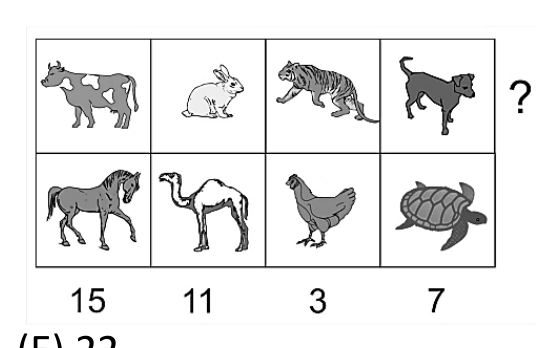
Show answer
Show hints
Still stuck? Show hint 2 →
Still stuck? Show hint 3 →
Show solution
- The four column sums add up to 36, and that 36 splits into the top row plus the bottom row, so a smaller bottom row means a bigger top row.
- Every animal stands for a different number, so the four bottom animals must be four different numbers; the smallest four different positive whole numbers are 1, 2, 3, 4 - but each top animal must beat its own bottom partner and also stay different from all the rest.
- Choosing bottom values 1, 3, 5, 7 (top partners 2, 4, 6, 8) keeps all eight numbers different and gives the smallest workable bottom row of 16.
- Then the top row is 36 − 16 = 20, and no allowed arrangement does better, so the answer is C.
2024 · #20 Every day, penguin Paula catches 12 fish for her two children. Every day she gives one of her children 7 fish and the other 5 fish....
Every day, penguin Paula catches 12 fish for her two children. Every day she gives one of her children 7 fish and the other 5 fish. After several days, one of her children has received 44 fish. How many fish did the other child receive?
Show answer
Show hints
Still stuck? Show hint 2 →
Show solution
- Over d days the children share 12d fish total.
- One child's total 5d + 2·(number of 7-days) = 44 forces d = 8 (with 2 such days).
- Total fish = 12 × 8 = 96, so the other child got 96 − 44 = 52.
Shrink it, then grow it back
This chapter (and the next) handle a problem built around a scary big number: instead of grinding it out, find a pattern. “How many lines connect 26 offices, one per pair?” 26 is too big to draw — so shrink first: solve 2, 3, 4 offices, tabulate, watch the jumps, then grow back. This is reduce and expand, the most reliable move in problem solving.
The jumps 1, 2, 3, … tell the whole story: a new dot must connect to every dot already present, so adding the n-th dot adds n−1 new lines. There’s a clean shortcut, too: each of the n dots connects to the other n−1, giving n×(n−1) line-ends, but each line has two ends, so divide by 2. Lines = n(n−1)/2. For 6 people shaking hands that’s 6×5/2 = 15; grow it to 26 offices and you get 26×25/2 = 325 — without ever drawing the monster.
THE MOVE — reduce and expand
- Shrink the big number to 1, 2, 3, 4, … — cases small enough to count by hand.
- Tabulate the results in a column, and look at the jumps between them.
- Find the rule (often the jumps form a simple pattern), then grow it back to the original number.
Strategy framing inspired by Posamentier, The Art of Problem Solving (teacher resource).
Go deeper: when the jumps aren’t constant (staircase / Fibonacci), and reading a term out loud
Sometimes the jumps aren’t constant — look one step BACK
Not every table grows by a steady amount. Picture a rabbit climbing a staircase, hopping 1 or 2 steps at a time. How many ways to climb a flight? Shrink it: 1 step → 1 way, 2 steps → 2 ways (1+1 or 2), 3 steps → 3 ways, 4 steps → 5 ways. The list is 1, 2, 3, 5, 8, … — not plain counting; each number is the sum of the previous two.
Here’s why, and it’s the same “think about the last move” idea as the phone lines: the rabbit’s final hop onto step n came either from step n−1 (a 1-hop) or step n−2 (a 2-hop). So the ways to reach step n = ways to reach (n−1) + ways to reach (n−2). A student who stops at 1, 2, 3 might guess the 6-step answer is 6 — but expand far enough and the real rule appears.
A handy trick: when there’s no number rule, read the term OUT LOUD
Reduce-and-expand looks for a number jump — but some sequences hide a rule that isn’t arithmetic at all. When the jumps make no sense, try a different lens: describe each term in words and see if the description IS the next term. The classic is the “say what you see” sequence, where a term is literally a spoken summary of the one before it. The fix for a stubborn pattern is often to change what you’re measuring — counts of digits, not the digits themselves.
Another worked example — say what you see
Find the next term: 1, 11, 21, 1211, 111221, …
The differences are nonsense and the lengths jump around, so a number rule won’t come. Read each term aloud as a count of runs of equal digits instead:
- 1 is “one 1” → write 11.
- 11 is “two 1s” → write 21.
- 21 is “one 2, one 1” → write 1211.
- 1211 is “one 1, one 2, two 1s” → write 111221.
Each term really is the spoken description of the one before it — so read 111221 aloud: “three 1s, two 2s, one 1” → 312211. That’s the next term. The rule was invisible until you stopped doing arithmetic and started narrating the digits.
When a problem hands you an intimidating number (26 offices, an 8×8 board, 100 lockers), replace it with 1, 2, 3, 4 and count those by hand. Tabulate, read the jumps, find the rule, and only then put the big number back. The small cases do the thinking for you.
Ms. Hamilton's eighth-grade class wants to participate in the annual three-person-team basketball tournament. The losing team of each game is eliminated from the tournament. If sixteen teams compete, how many games will be played to determine the winner?
Sixteen three-person teams play a single-elimination tournament — lose once and you’re out. How many games are played to crown a champion?
Sixteen is big, so shrink it. Count games for 2 teams, 4 teams, 8 teams:
- 2 teams → 1 game (the winner is champion).
- 4 teams → 2 games in round 1, then 1 final = 3 games.
- 8 teams → 4 + 2 + 1 = 7 games.
The table reads 1, 3, 7, … — each is one less than the number of teams. Now see WHY, and the pattern stops being a guess: every game knocks out exactly one team, and you must knock out everyone except the single champion. With 16 teams, 15 must be eliminated, so there are exactly 15 games.
The reduce-and-expand table pointed at the rule; the “count the losers” reason proved it.
Small cases gave the shape of the answer (teams minus one), and one clean observation — each game eliminates exactly one team — turned that guess into certainty. You never had to draw the 16-team bracket.
Shrink the scary number to tiny cases, tabulate, read the jumps to find the rule, then grow it back. Confirm the rule with a reason (here: each game eliminates one team) so it’s proven, not just eyeballed.
2013 · #24 40 boys and 28 girls hold hands in a big circle. Exactly 18 boys give their right hand to a girl. How many boys give their left hand to a girl?
40 boys and 28 girls hold hands in a big circle. Exactly 18 boys give their right hand to a girl. How many boys give their left hand to a girl?
Show answer
Show hints
Still stuck? Show hint 2 →
Still stuck? Show hint 3 →
Show solution
- Walk around the circle one way. Every place where a boy is followed by a girl is a boy giving that hand to a girl; every place a girl is followed by a boy is a girl giving her hand to a boy.
- Going around a loop, the number of boy→girl spots equals the number of girl→boy spots, because the two kinds must alternate.
- So just as many boys give their left hand to a girl as give their right hand to a girl: 18.
2016 · #6 Maria wants there to be a knife to the right of every plate and a fork to the left of it. To get the right order she always swaps one...
Maria wants there to be a knife to the right of every plate and a fork to the left of it. To get the right order she always swaps one fork with one knife. What is the minimum number of swaps necessary?
Show answer
Show hints
Still stuck? Show hint 2 →
Show solution
- Check each place setting and mark every fork that is wrongly on the right and every knife wrongly on the left.
- There are 2 such wrong utensils, and one swap trades a wrong fork for a wrong knife, fixing both at the same time.
- So the minimum number of swaps is 2, choice (B).
2018 · #3 Students Arn, Bob, Cyd, Dan, Eve, and Fon are arranged in that order in a circle. They start counting: Arn first, then Bob, and so...
Students Arn, Bob, Cyd, Dan, Eve, and Fon are arranged in that order in a circle. They start counting: Arn first, then Bob, and so forth. When the number contains a 7 as a digit (such as 47) or is a multiple of 7 that person leaves the circle and the counting continues. Who is the last one present in the circle?
Show answer
Show hints
Still stuck? Show hint 2 →
Show solution
- Step 1 is the setup that makes everything easy: list the eliminating counts in order — 7, 14, 17, 21, 27, … (multiples of 7, or any number containing the digit 7). Now you only have to find who says each of these.
- Pass 1 (6 people): A=1, B=2, C=3, D=4, E=5, F=6, A=7 ⇒ A out.
- Pass 2 (5 people: B, C, D, E, F): B=8, C=9, D=10, E=11, F=12, B=13, C=14 ⇒ C out.
- Pass 3 (4: B, D, E, F): D=15, E=16, F=17 ⇒ F out.
- Pass 4 (3: B, D, E): B=18, D=19, E=20, B=21 ⇒ B out.
- Pass 5 (2: D, E): D=22, E=23, D=24, E=25, D=26, E=27 ⇒ E out.
- Last remaining: Dan.
- You'll see it again: "person leaves the circle, counting continues" problems are simulations — resist hunting for a formula and just bookkeep carefully; the only trap is forgetting the count keeps rising as people drop out.
Find a pattern — cycles and the remainder
Sometimes the small cases don’t just grow — they loop, and that has its own fast finish. “Units digit of 2 multiplied by itself 30 times?” Strip the powers of 2 to their last digit and you get 2, 4, 8, 6, 2, 4, 8, 6, … — four digits looping forever. Once a list loops, you only need where in the loop term 30 lands, and that’s one division.
THE MOVE — cycle and remainder
- Tabulate a handful of small cases and find the repeating block.
- Find the cycle length L (how many before it loops).
- Divide the position you want by L and keep only the remainder. The quotient is junk — the remainder names the slot.
Go deeper: why the cycle really repeats (don’t trust an eyeballed pattern)
A pattern you SEE isn’t proven — ask WHY it repeats
Spotting four digits that loop once is a guess, not a fact. Before you trust a cycle out to term 30, make sure it really keeps going. Here the reason is clean: the last digit of a product depends only on the last digits of its factors, so each step is “take the current units digit and double it” — 2→4→8→(16, so)6→(12, so)2, and the moment you return to 2 the whole block is forced to repeat. A pattern with a reason behind it is a tool you can lean on; a pattern you only eyeballed can quietly break on the next term.
Framing inspired by AoPS Prealgebra.
OFF-BY-ONE: remainder 0 lands on the LAST slot
Divide the position by the cycle length L. A remainder of 1, 2, …, L−1 picks slot 1, 2, … But a remainder of 0 means the position is an exact multiple of L — you finish a whole block, so you land on the last slot (slot L), not slot 1. Guard against the slip by testing a tiny case you can check by hand.
Calendars are the everyday version: weekdays cycle with length 7. If today is Monday, the day 100 days from now is found by 100 = 7×14 + 2 — remainder 2, so two weekdays past Monday lands on Wednesday. You never counted 100 days; you counted 2.
When a problem asks for a far-out term — the 2010th letter, the units digit of a giant power, the weekday of some date — compute the first few terms, find the repeating block, and reduce the position by the cycle length. The remainder alone names the term; the quotient is thrown away.
The units digit cycle of powers of 2 is 2, 4, 8, 6 (length 4). For the 8th power, 8 ÷ 4 = 2 with remainder 0, and slot 0 doesn’t exist, so I’ll call it slot 1: units digit 2.
Why it breaks: A remainder of 0 does not wrap forward to slot 1 — it means you finished a whole number of complete blocks, so you stop on the last slot of the block.
The fix: Remainder 0 lands on slot L, the end of the cycle. Here that is slot 4, units digit 6. Check by hand: 2 to the 8th is 256, which really does end in 6. Always test the boundary case — a remainder of 0 is exactly where the off-by-one hides.
A big spot of ink covers most of a calendar page for a certain month. On which day of the week does the 25th of that month fall? (In the calendar the weekday columns are labelled Mo, Di, Mi, Do, Fr, Sa, So — Monday through Sunday.)

An ink blot hides most of a calendar; only a few dates peek out at the edges. Which weekday does the 25th fall on?
There is no clever algebra here — the whole engine is the weekly cycle of length 7. Because weekdays repeat every 7 days, any two dates that differ by a multiple of 7 share a weekday.
Step back from the 25th in jumps of 7: the 25th, the 18th, the 11th, and the 4th all fall on the same weekday (each is 7 apart from the next).
So you don’t need a date near the 25th — any readable date in that column, even early in the month, fixes the whole column. Read one off, and the 25th inherits its weekday.
Carrying the chain to a readable anchor and stepping by sevens lands the 25th on Saturday (choice D).
The blot is a scare tactic; the period-7 cycle does all the work. “Dates a week apart share a weekday” lets one readable date settle a date three weeks away — you replace a long count with a single jump along the cycle.
List a few terms, find the repeating block and its length L, then reduce the position mod L. The remainder picks the slot — and remainder 0 means the last slot, not the first.
2011 · #5 My digital clock just showed 20:11. In how many minutes will it again show the digits 0, 1, 1, 2 in any order?
My digital clock just showed 20:11. In how many minutes will it again show the digits 0, 1, 1, 2 in any order?
Show answer
Show hints
Still stuck? Show hint 2 →
Show solution
- The display 20:11 uses the digits 0, 1, 1, 2.
- The next valid time whose digits are 0, 1, 1, 2 in some order is 21:01.
- From 20:11 to 21:01 is 50 minutes.
2019 · #4 A digital clock shows the time in the picture. What time is it when the clock next shows the exactly same digits again for the first...
A digital clock shows the time in the picture. What time is it when the clock next shows the exactly same digits again for the first time after that?

Show answer
Show hints
Still stuck? Show hint 2 →
Still stuck? Show hint 3 →
Show solution
- The display 20:19 uses the digits 2, 0, 1, 9.
- We need the next time made of exactly these four digits, with a valid hour (00–23) and minutes (00–59).
- After 20:19 the first valid arrangement that appears is 21:09.
- So the answer is 21:09 (C).
2018 · #3 Students Arn, Bob, Cyd, Dan, Eve, and Fon are arranged in that order in a circle. They start counting: Arn first, then Bob, and so...
Students Arn, Bob, Cyd, Dan, Eve, and Fon are arranged in that order in a circle. They start counting: Arn first, then Bob, and so forth. When the number contains a 7 as a digit (such as 47) or is a multiple of 7 that person leaves the circle and the counting continues. Who is the last one present in the circle?
Show answer
Show hints
Still stuck? Show hint 2 →
Show solution
- Step 1 is the setup that makes everything easy: list the eliminating counts in order — 7, 14, 17, 21, 27, … (multiples of 7, or any number containing the digit 7). Now you only have to find who says each of these.
- Pass 1 (6 people): A=1, B=2, C=3, D=4, E=5, F=6, A=7 ⇒ A out.
- Pass 2 (5 people: B, C, D, E, F): B=8, C=9, D=10, E=11, F=12, B=13, C=14 ⇒ C out.
- Pass 3 (4: B, D, E, F): D=15, E=16, F=17 ⇒ F out.
- Pass 4 (3: B, D, E): B=18, D=19, E=20, B=21 ⇒ B out.
- Pass 5 (2: D, E): D=22, E=23, D=24, E=25, D=26, E=27 ⇒ E out.
- Last remaining: Dan.
- You'll see it again: "person leaves the circle, counting continues" problems are simulations — resist hunting for a formula and just bookkeep carefully; the only trap is forgetting the count keeps rising as people drop out.
Two groups that overlap — Venn counting
Chapter 1's table sorted people into separate boxes. But some questions let one person sit in two groups at once: a student can have a brother and a sister; a kid can be in band and chorus. When groups overlap, two circles beat a table.
The story. In a class, 19 students have a brother, 15 have a sister, and 6 have no siblings at all. The class has 33 students. How many have both a brother and a sister?
The move: fill from the inside out
Always write the overlap first, then back out the singles — never the other way round.
- Both = 7 (the centre).
- Brother only = 19 − 7 = 12.
- Sister only = 15 − 7 = 8.
- Add every region once: 12 + 7 + 8 + 6 = 33 — matches the class size. ✓
The shortcut: the over-count IS the overlap
You don't even need the picture. Add the group totals and compare to the real total:
19 + 15 + 6 = 40 names, but only 33 students.
So 40 − 33 = 7 students got counted twice — once as a brother-haver, once as a sister-haver. Those 7 are exactly the ones in both groups. This is the same ‘the over-count is the answer’ idea from the circle puzzle in Chapter 4.
Two-set rule: |A| + |B| − |both| = |A or B|. Rearranged: |both| = |A| + |B| − |A or B|.
Three circles? Same rule, start dead centre.
For three overlapping groups, fill the all-three region first, then each two-way overlap, then the singles — always inside-out.
Vet-school example. Everyone has at least one pet: 30 cat, 28 dog, 26 fish; 13 cat&fish, 11 cat&dog, 15 dog&fish, and 4 have all three. How many applied?
- All three = 4 (centre).
- Cat&dog only = 11 − 4 = 7; cat&fish only = 13 − 4 = 9; dog&fish only = 15 − 4 = 11.
- Cat only = 30 − (7 + 9 + 4) = 10; dog only = 28 − (7 + 11 + 4) = 6; fish only = 26 − (9 + 11 + 4) = 2.
- Total = 10 + 6 + 2 + 7 + 9 + 11 + 4 = 49.
Subtract the overlaps before you add, or you'll count the shared kids two or three times.
Write the overlap first, then subtract it out of each group to get the ‘only’ regions. Need just the overlap and nothing else? Use the shortcut: (sum of the groups) − (the true total) = the double-count = the overlap.
Overlapping groups → draw circles, fill from the inside out. The amount you over-counted by adding the groups is exactly the number sitting in the overlap.
2008 · #11 Each of the 39 students in the eighth grade at Lincoln Middle School has one dog or one cat or both a dog and a cat. Twenty students...
Each of the 39 students in the eighth grade at Lincoln Middle School has one dog or one cat or both a dog and a cat. Twenty students have a dog and 26 students have a cat. How many students have both a dog and a cat?
Show answer
Show hints
Still stuck? Show hint 2 →
Show solution
- Counting dog-owners (20) and cat-owners (26) separately gives 20 + 26 = 46 "pet slots," but there are only 39 kids. The extra 46 − 39 = 7 came from kids who got tallied in both groups.
- Those double-counted kids are exactly the ones with both a dog and a cat: 7.
- Why this transfers: this is inclusion–exclusion — |A| + |B| counts the overlap twice, so |both| = |A| + |B| − |either|. You'll reuse it for any "how many in both groups" question.
2019 · #11 The eighth grade class at Lincoln Middle School has 93 students. Each student takes a math class or a foreign language class or both....
The eighth grade class at Lincoln Middle School has 93 students. Each student takes a math class or a foreign language class or both. There are 70 eighth graders taking a math class, and there are 54 eighth graders taking a foreign language class. How many eighth graders take only a math class and not a foreign language class?
Show answer
Show hints
Still stuck? Show hint 2 →
Show solution
- Every student is in at least one class, so the two lists together should cover all 93 people — yet 70 + 54 = 124. The 124 − 93 = 31 surplus is exactly the students counted in both lists, so Both = 31.
- "Math only" peels off the shared part: 70 − 31 = 39.
- Why this transfers: whenever two groups together exceed the whole, the excess is the overlap — that's inclusion-exclusion (|M| + |F| − |both| = total), and a two-circle Venn diagram makes the "only" regions obvious.
2015 · #15 At Euler Middle School, 198 students voted on two issues in a school referendum with the following results: 149 voted in favor of the...
At Euler Middle School, 198 students voted on two issues in a school referendum with the following results: 149 voted in favor of the first issue and 119 voted in favor of the second issue. If there were exactly 29 students who voted against both issues, how many students voted in favor of both issues?
Show answer
Show hints
Still stuck? Show hint 2 →
Show solution
- Against both = 29, so everyone else voted yes to at least one issue: 198 − 29 = 169 = |A ∪ B|.
- Adding 149 + 119 counts the 'both' voters twice, so 149 + 119 − |both| = 169.
- |both| = 149 + 119 − 169 = 99.
- Why this transfers: the moment you add two overlapping groups, you've double-counted their intersection — subtract it once. A quick Venn sketch (two circles in a box of 198) makes the bookkeeping foolproof.
Guarantee it — pigeonhole & worst case
Some questions don't ask ‘how many can happen’ — they ask ‘how many must happen.’ Watch for the words guarantee, must, at least, certain to. These are almost always one idea in disguise.
Pigeonhole: if you put more items than boxes, some box gets at least two. More pigeons than holes ⇒ a hole is shared.
The story. A drawer holds socks in 4 colours, all jumbled in the dark. How many must you grab to be sure of a matching pair?
The recipe: worst case, then + 1
To guarantee something, picture the unluckiest possible run, then take one more step.
- Worst case: you grab one of each colour — 4 socks, still no pair. Unlucky, but possible.
- + 1: the very next sock can't dodge; it must repeat a colour you already hold.
- So 4 + 1 = 5 socks guarantee a matching pair.
The 4 colours are the holes; the socks are the pigeons. Five pigeons into four holes ⇒ a shared hole ⇒ two socks the same colour.
The real skill: choose the holes
The principle is easy; the art is deciding what the boxes are. Same move, different boxes:
| The story says… | Holes (boxes) | Pigeonhole says |
|---|---|---|
| socks in 4 colours | the 4 colours | 5 socks ⇒ two match |
| 13 people in a room | the 12 months | two share a birth month |
| any 3 whole numbers | even / odd (2 boxes) | two have the same parity |
| remainders when ÷ 5 | remainders 0,1,2,3,4 | 6 numbers ⇒ two share a remainder |
Pick the boxes so that ‘same box’ means exactly the thing the question wants — same colour, same month, same remainder.
Worked: guarantee a dozen of one fruit
A basket has lots of apples, lots of oranges, and lots of pears (3 kinds). Reaching in blind, how many pieces must you take to be sure of 12 of a single kind?
Worst case: you get 11 of each kind and still don't have a dozen of any — that's 11 × 3 = 33 pieces. The next piece (the 34th) must push some kind to 12. Answer: 34.
This is ‘worst case + 1’ with bigger holes: to force 12 in a box, the worst case is 11 in every box, so the answer is 11 × (kinds) + 1.
See guarantee / must / at least? Build the worst case — spread items as evenly as possible to dodge the goal as long as you can — then add 1 (or, for ‘at least m of a kind,’ fill every box with m−1 and add 1).
More pigeons than holes ⇒ a hole repeats. First decide what the holes are (colours, months, remainders), then count the worst case and add one.
2005 · #16 A five-legged Martian has a drawer full of socks, each of which is red, white or blue, and there are at least five socks of each color....
A five-legged Martian has a drawer full of socks, each of which is red, white or blue, and there are at least five socks of each color. The Martian pulls out one sock at a time without looking. How many socks must the Martian remove from the drawer to be certain there will be 5 socks of the same color?
Show answer
Show hints
Still stuck? Show hint 2 →
Show solution
- Imagine the meanest possible luck: 4 red, 4 white, 4 blue. That's 12 socks and still no color has reached 5.
- There's nowhere left to hide — the 13th sock must be a 4th color's... no, must be the 5th of some color. So 13 guarantees it.
- Why this transfers: for 'how many to guarantee' problems, find the largest haul that fails the goal (here 3×4 = 12), then add 1. The five legs in the story are pure distraction — only the three colors matter.
2013 · #6 A sack contains marbles in five different colours: 2 red, 3 blue, 10 white, 4 green and 3 black. You take marbles out of the bag without...
A sack contains marbles in five different colours: 2 red, 3 blue, 10 white, 4 green and 3 black. You take marbles out of the bag without looking and without putting any back. What is the smallest number of marbles you must remove to be sure of having two of the same colour?
Show answer
Show hints
Still stuck? Show hint 2 →
Show solution
- There are 5 different colours, and every colour has at least two marbles.
- The worst case is drawing one marble of each colour: 5 marbles, all different.
- The very next marble (the 6th) must repeat a colour.
- So 6 marbles guarantee a matching pair.
2015 · #18 3 green apples, 5 yellow apples, 7 green pears and 2 yellow pears are in a sack. Without looking, Sebastian takes either an apple or a...
3 green apples, 5 yellow apples, 7 green pears and 2 yellow pears are in a sack. Without looking, Sebastian takes either an apple or a pear out of the sack. How many pieces of fruit must he take out of the sack to be sure of having at least one apple and one pear of the same colour?
Show answer
Show hints
Still stuck? Show hint 2 →
Show solution
- He wins when he holds an apple and a pear of the same colour: green-with-green or yellow-with-yellow.
- The biggest collection that still avoids this takes all 7 green pears and all 5 yellow apples — green pears with no green apple, yellow apples with no yellow pear — that's 12 fruit and still no match.
- Any 13th fruit must be a green apple or a yellow pear, which completes a same-colour pair, so he needs to take 13.
Handshakes & triangular numbers
Chapter 10 said: when a number is scary, shrink it, tabulate, find the rule, grow it back. Here is the most famous payoff of that engine — a formula you'll meet again and again.
The question. Twenty-six phone offices each need one direct line to every other office. How many lines?
Shrink it. Draw the tiny cases — offices as dots, lines as connections — and just count.
Tabulate & read the jumps:
| dots (n) | 2 | 3 | 4 | 5 |
|---|---|---|---|---|
| lines | 1 | 3 | 6 | 10 |
| jump | — | +2 | +3 | +4 |
Each new dot connects to all the dots already there, so the jump grows by one each time. That's exactly 1, 3, 6, 10, … — the triangular numbers.
Why it's n(n−1)/2 — the double-count trick
Don't just trust the table; see why. Each of the n offices needs a line to the other n−1 offices, which looks like n × (n−1) lines. But that counts every line twice — the line A–B is the same as B–A. So divide by 2:
connections between n things = n(n − 1) ÷ 2
Check it on the table: n = 4 gives 4 × 3 ÷ 2 = 6. ✓ Now grow it back: 26 offices need 26 × 25 ÷ 2 = 325 lines.
The cousin: 1 + 2 + 3 + … + n
The triangular numbers also count a plain sum: 1 + 2 + 3 + … + n. The gentle way to add them is to average the first and last, then multiply by how many:
1 + 2 + … + 12 = (1 + 12) ÷ 2 × 12 = 6.5 × 12 = 78.
1 + 2 + … + n = n(n + 1) ÷ 2
(The handshake count n(n−1)/2 is just this sum stopped one step early: shaking hands is 1 + 2 + … + (n−1), since the 2nd person makes 1 new handshake, the 3rd makes 2, and so on.)
Spot the two formulas in the wild
- Handshakes / games / phone lines / segments between points — every pair counts once: n(n−1)/2.
- Stack of rows 1, 2, 3, … (bowling pins, a staircase, seats in a wedge) — a running sum: n(n+1)/2.
- Careful: ‘each shakes the others’ is the pair formula; ‘add up the rows’ is the sum formula. They differ by one step.
‘Every pair connects once’ (handshakes, games, lines, segments) is always n(n−1)/2 — count n × (n−1) and halve it because each pair was counted from both ends. A plain run 1 + 2 + … + n is n(n+1)/2 — average the ends and multiply by the count.
Pairwise connections among n things: n(n−1)/2. Sum of 1 to n: n(n+1)/2. When a count grows by 2, 3, 4, …, you're building a triangular number — reach for these.
2019 · #12 Anna, Bella, Claire, Dora, Erika and Frieda meet at a party. Each pair who know each other shake hands exactly once. Anna shakes hands...
Anna, Bella, Claire, Dora, Erika and Frieda meet at a party. Each pair who know each other shake hands exactly once. Anna shakes hands only once, Bella twice, Claire three times, Dora four times and Erika five times. How many people does Frieda shake hands with?
Show answer
Show hints
Still stuck? Show hint 2 →
Show solution
- Erika (5) shook everyone; Anna (1) then only shook Erika.
- Dora (4) shook everyone but Anna: Erika, Bella, Claire, Frieda — giving Bella her 2nd handshake.
- Claire (3) shook Erika, Dora and Frieda, so Frieda's partners are Erika, Dora, Claire: 3 people.
2019 · #14 Anna, Bella, Claire, Dora and Erika meet at a party. Each pair who know each other shake hands exactly once. Anna shakes hands once,...
Anna, Bella, Claire, Dora and Erika meet at a party. Each pair who know each other shake hands exactly once. Anna shakes hands once, Bella twice, Claire three times and Dora four times. How many people does Erika shake hands with?
Show answer
Show hints
Still stuck? Show hint 2 →
Show solution
- Dora shook 4 times, so she shook hands with all of Anna, Bella, Claire and Erika.
- Anna shook only once, so Anna's single handshake was with Dora.
- Claire shook three times: with Dora plus two others, which must be Bella and Erika; Bella's two are Dora and Claire.
- So Erika shook hands with Dora and Claire: 2 people.
2019 · #28 Teams of three take part in a chess tournament. Each player plays against every player from every other team exactly once. For...
Teams of three take part in a chess tournament. Each player plays against every player from every other team exactly once. For organisational reasons no more than 250 games may be played. What is the greatest number of three-player teams that can take part?
Show answer
Show hints
Still stuck? Show hint 2 →
Show solution
- With n teams of 3, each pair of teams plays 3 × 3 = 9 games, so total games = 9 × n(n−1)/2.
- For n = 7 that is 9 × 21 = 189 (allowed); for n = 8 it is 9 × 28 = 252 (too many).
- So at most 7 teams can take part.
Stretch test
Six harder logic problems spanning casework, truth-tellers, sum-constraints, pigeonhole, and optimization.
2000 · #20 You have nine coins: a collection of pennies, nickels, dimes, and quarters having a total value of $1.02, with at least one coin of each...
You have nine coins: a collection of pennies, nickels, dimes, and quarters having a total value of $1.02, with at least one coin of each type. How many dimes must you have?
Show answer
Show hints
Still stuck? Show hint 2 →
Show solution
- Take one of each coin off the top: 1 + 5 + 10 + 25 = 41¢, using 4 of the 9 coins. Remaining: 102 − 41 = 61¢ in 5 more coins.
- Units digit move: nickels, dimes, quarters all end in 0 or 5, so only pennies can produce the final '1' in 61. With 5 coins, you can't afford 6 pennies — so exactly 1 more penny. Now 60¢ in 4 coins.
- 60¢ in 4 coins needs a quarter (four dimes max out at 40¢). Two quarters = 50¢ leaves 10¢ in 2 coins = two nickels. That fills all four with no dime.
- So beyond the single starter dime, none are added: 1 dime.
- The reusable trick: in coin/total problems, read the *last digit* of the amount — only pennies (the 1¢ pieces) can change it, so the units digit alone often pins the smallest-coin count and collapses the casework.
2001 · #24 (figure problem)
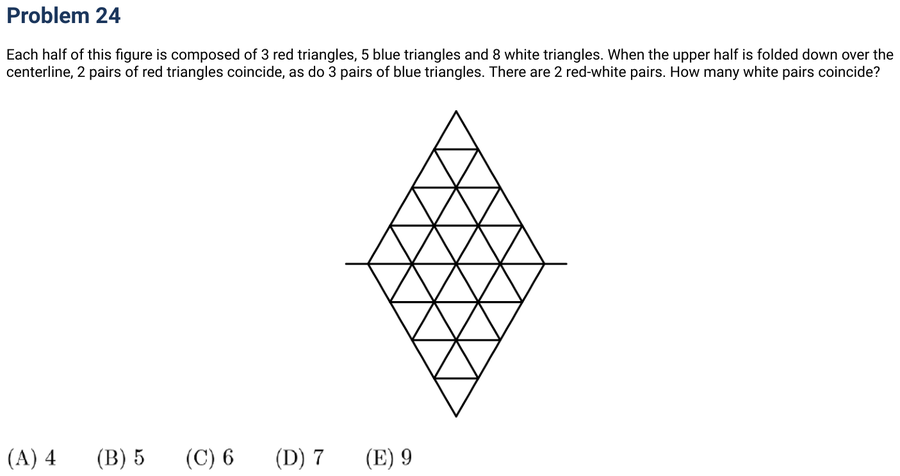
Show answer
Show hints
Still stuck? Show hint 2 →
Show solution
- One half has 3 red, 5 blue, 8 white. The 2 red-red pairs spend 2 reds, leaving 1 red; the 3 blue-blue pairs spend 3 blues, leaving 2 blue.
- Now the leftovers must pair with whites. The 2 red-white pairs spend that last red and 1 white. The 2 leftover blues can't make a 4th blue-blue pair (only 3 are allowed), so each pairs with a white — using 2 more whites.
- Whites spent: 1 (with red) + 2 (with blue) = 3, leaving 8 − 3 = 5 whites per half. Those face each other as 5 white-white pairs.
- The engine here is conservation: a folded figure pairs everything one-to-one, so once you know how each "colored" piece is consumed, the remainder of any one color is forced.
2026 · #22 The integers 1 through 25 are arbitrarily separated into five groups of 5 numbers each. The median of each group is found, and M is the...
The integers 1 through 25 are arbitrarily separated into five groups of 5 numbers each. The median of each group is found, and M is the median of those five medians. What is the least possible value of M?
Show answer
Show hints
Still stuck? Show hint 2 →
Show solution
- First decode M: it is the 3rd-smallest of the five group medians. So making M tiny requires three groups to each have a small median simultaneously.
- Now the scarcity argument. Each of those three medians needs two numbers strictly below it inside its group. Suppose M ≤ 8. Then three medians (each ≤ 8) together with their six below-numbers (each smaller still) are 9 distinct values all ≤ 8 — impossible, since only 8 numbers (1–8) are that small. So M ≥ 9.
- Then show 9 is actually reachable: {1, 2, 7, 24, 25}, {3, 4, 8, 22, 23}, {5, 6, 9, 20, 21} have medians 7, 8, 9, while the last two groups {10–14} and {15–19} absorb the big numbers (medians 12, 17). The five medians 7, 8, 9, 12, 17 have median 9.
- Bound met by an example ⇒ the least value is 9.
- Why this transfers: extremal problems are won by pairing a lower bound (a counting/pigeonhole reason it can't be smaller) with a construction (an explicit example hitting that bound). Neither half alone is a proof — you need both jaws of the vise.
2005 · #16 A five-legged Martian has a drawer full of socks, each of which is red, white or blue, and there are at least five socks of each color....
A five-legged Martian has a drawer full of socks, each of which is red, white or blue, and there are at least five socks of each color. The Martian pulls out one sock at a time without looking. How many socks must the Martian remove from the drawer to be certain there will be 5 socks of the same color?
Show answer
Show hints
Still stuck? Show hint 2 →
Show solution
- Imagine the meanest possible luck: 4 red, 4 white, 4 blue. That's 12 socks and still no color has reached 5.
- There's nowhere left to hide — the 13th sock must be a 4th color's... no, must be the 5th of some color. So 13 guarantees it.
- Why this transfers: for 'how many to guarantee' problems, find the largest haul that fails the goal (here 3×4 = 12), then add 1. The five legs in the story are pure distraction — only the three colors matter.
2010 · #24 Six-legged, seven-legged and eight-legged octopuses serve Neptune, king of the sea. The seven-legged ones always lie, while the...
Six-legged, seven-legged and eight-legged octopuses serve Neptune, king of the sea. The seven-legged ones always lie, while the six-legged and eight-legged ones always tell the truth. One day four octopuses meet. The blue one says: “Together we have 28 legs.” The green one says: “Together we have 27 legs.” The yellow one says: “Together we have 26 legs.” The red one says: “Together we have 25 legs.” Which colour octopus is telling the truth?
Show answer
Show hints
Still stuck? Show hint 2 →
Show solution
- Only one octopus can be honest (the others would otherwise repeat the same total), so the other three are 7-legged liars with \(3 \times 7 = 21\) legs.
- The honest one has 6 or 8 legs; \(21 + 6 = 27\) matches a claim, while \(21 + 8 = 29\) matches nobody, so the real total is 27.
- The octopus that truthfully says 27 is the green one — the answer is C.
2024 · #24 There are three identical dice on a table (see picture). What is the sum of the three numbers on the bottoms of the dice, touching the table?
There are three identical dice on a table (see picture). What is the sum of the three numbers on the bottoms of the dice, touching the table?
Show answer
Show hints
Still stuck? Show hint 2 →
Still stuck? Show hint 3 →
Show solution
- The dice are identical, so the numbers seen together on the pictures tell you which faces can sit next to each other and which must be opposite.
- Two numbers shown on the same die are not opposite, and matching this up across all three pictures sorts the faces into opposite pairs.
- Each die's table face is opposite its top face, so swap each visible top for its opposite to get the three bottom numbers.
- Adding those three bottom numbers gives 43.
Stretch practice — beyond AMC 8
20 bonus problems on Logic & Word Problems. These are typed-answer (no multiple choice) and tilt harder — closer to early AMC 10. Try the ones that look fun.
Stretch · #1 Two players take turns removing \(1\), \(2\), \(3\), or \(4\) counters from a pile that starts with \(27\) counters. The player who...
Show answer
Show hints
Still stuck? Show hint 2 →
Still stuck? Show hint 3 →
Show solution
- To win you want to take the last counter, so after your final move there are \(0\) left. Work backward from there.
- The magic numbers to leave for your opponent are the multiples of \(5\). Leaving \(5\) works: if they take \(k\) (one of \(1, 2, 3, 4\)), you take the remaining \(5 - k\) and grab the last counter.
- So every turn you hand them a multiple of \(5\): \(25, 20, 15, 10, 5, 0\). Whatever they remove, you remove enough to land on the next multiple of \(5\).
- Since \(27 = 25 + 2\), you go FIRST and take \(2\), leaving \(25\). After that always leave a multiple of \(5\); your last move leaves \(0\), so you took the last counter and win.
Stretch · #1 In a fairy tale, a hero must collect golden hairs from a devil's head. The devil's grandmother is blind, so she pulls hairs out at...
Show answer
Show hints
Still stuck? Show hint 2 →
Still stuck? Show hint 3 →
Show solution
- 'Sure' means it must work even with the worst luck: every non-golden hair comes out first. There are \(5-3=2\) non-golden hairs.
- So in the worst case the first 2 pulls are both non-golden; then only golden hairs are left, so the 3rd pull must be golden. She must pull \(2+1=3\) hairs.
- General case: there are \(x-y\) non-golden hairs. In the worst case she pulls all \(x-y\) of them first and gets no gold; after that every remaining hair is golden.
- To collect \(z\) golden hairs she pulls \((x-y)+z\) hairs. Check with \(x=5, y=3, z=1\): \((5-3)+1=3\), which matches. (This is the same idea behind pigeonhole problems.)
Stretch · #2 Same game as before: take \(1\), \(2\), \(3\), or \(4\) counters from a pile of \(27\). But now the player who takes the LAST counter...
Show answer
Show hints
Still stuck? Show hint 2 →
Still stuck? Show hint 3 →
Show solution
- You win by forcing your opponent to take the last counter, so on your final turn you want to leave exactly \(1\).
- Leaving \(1\) is safe (they must take it and lose). Working backward, the safe numbers to leave are one more than a multiple of \(5\): \(1, 6, 11, 16, 21, 26\).
- From any of these, whatever your opponent takes (\(k\)), you take \(5 - k\) to get back to the next safe number.
- Since \(27 = 26 + 1\), you go FIRST and take \(1\), leaving \(26\). Then always leave a number that is \(1\) more than a multiple of \(5\); your last move leaves \(1\), your opponent must take it, and they lose.
Stretch · #2 A hunter leaves camp, walks 10 miles due north in a straight line, and stops for lunch. After lunch he again walks 10 miles due north in...
Show answer
Show hints
Still stuck? Show hint 2 →
Still stuck? Show hint 3 →
Show solution
- 'North' means toward the North Pole. On a flat map that feels like one fixed direction, but on a round Earth it changes with where you stand. The trick is to find the one special spot where this matters.
- Stand exactly at the South Pole. The North Pole is straight up and over the globe in every direction, so from the South Pole every direction you face is 'north.'
- Put the camp at the South Pole. Walking 10 miles 'north' carries the hunter out along a great circle; walking 'north' again continues along that same circle, which loops back toward the pole on the far side and returns him to the South Pole.
- Because all directions from the South Pole are identical (all 'north'), a 'north then north' walk can close on itself. No ordinary spot has that symmetry, so the camp is at the South Pole.
Stretch · #2 How many \(2\)-digit whole numbers are there? Then generalize: how many \(n\)-digit whole numbers are there, where \(n\) is a whole...
Show answer
Show hints
Still stuck? Show hint 2 →
Still stuck? Show hint 3 →
Show solution
- Way 1 (count a range): the whole numbers from \(a\) to \(b\) number \(b-a+1\). The 2-digit numbers go from 10 to 99, so there are \(99-10+1=90\).
- Way 2 (counting principle): the first digit can be \(1,\dots,9\) (9 choices, no leading 0) and the second digit can be \(0,\dots,9\) (10 choices), giving \(9\times10=90\).
- Generalizing to \(n\) digits: 9 choices for the leading digit and 10 for each of the other \(n-1\) digits, so \(9\times10^{\,n-1}\).
- Check: \(n=2\) gives \(9\times10=90\); \(n=3\) gives \(9\times100=900\), matching the three-digit numbers from 100 to 999.
Stretch · #3 You have only a \(5\)-liter bucket and an \(11\)-liter bucket and as much water as you want. How can you end up with exactly \(7\)...
Show answer
Show hints
Still stuck? Show hint 2 →
Still stuck? Show hint 3 →
Show solution
- Work backward: \(7\) liters in the big bucket leaves \(4\) liters of empty space. To pour off exactly \(4\) liters into the \(5\)-liter bucket, the small bucket must already hold \(1\) liter (so it only has room for \(4\) more). And to get exactly \(1\) liter, notice \(11-5-5=1\).
- Now the forward steps. Fill the \(11\)-liter bucket. Pour into the \(5\)-liter bucket and dump it out; do this twice. After pouring out \(5+5=10\), the big bucket holds \(1\) liter.
- Pour that \(1\) liter into the empty \(5\)-liter bucket. Fill the \(11\)-liter bucket again (now it holds \(11\)).
- Pour from the big bucket to fill the small bucket the rest of the way. The small bucket had \(1\), so it takes \(4\) more. The big bucket now has \(11-4 = 7\) liters. Done!
Stretch · #3 A strip of \(15\) unit squares is cut into 'pieces.' Each piece is a run of \(1, 2, 3, 4,\) or \(5\) squares, and we use at most \(5\)...
Show answer
Show hints
Still stuck? Show hint 2 →
Still stuck? Show hint 3 →
Show solution
- The total is 15, each piece is 1 to 5 squares, at most 5 pieces. Since the biggest piece is 5 and \(5\times3=15\), you need at least 3 pieces.
- 3 pieces: the only way is \(5+5+5\) — 1 way.
- 4 pieces (biggest first): \(5+5+4+1,\ 5+5+3+2,\ 5+4+4+2,\ 5+4+3+3,\ 4+4+4+3\) — 5 ways.
- 5 pieces (biggest first): \(5+5+3+1+1,\ 5+5+2+2+1,\ 5+4+4+1+1,\ 5+4+3+2+1,\ 5+4+2+2+2,\ 5+3+3+3+1,\ 5+3+3+2+2,\ 4+4+4+2+1,\ 4+4+3+3+1,\ 4+4+3+2+2,\ 4+3+3+3+2,\ 3+3+3+3+3\) — 12 ways.
- Gauss: in \(1+2+3+4+5\), pair \(1+5=6\), \(2+4=6\), middle 3; each pair adds to \(n+1\). For \(1+2+\cdots+n\), pairing the ends always gives \(n+1\), so \(1+2+\cdots+n=\dfrac{n(n+1)}{2}\). Check: \(1+2+3+4+5=\dfrac{5\times6}{2}=15\), and \(1+2+\cdots+100=\dfrac{100\times101}{2}=5050\).
Stretch · #4 Jim asks a classmate how old she is. She answers, 'I was 14 the day before yesterday, but I'll be 17 next year.' On what day is she...
Show answer
Show hints
Still stuck? Show hint 2 →
Still stuck? Show hint 3 →
Show solution
- This only seems like a paradox if you forget that 'next year' on the calendar can be just a day or two away. Let her birthday be December 31 and the conversation happen on January 1.
- The day before yesterday = December 30: she hadn't yet had her Dec 31 birthday, so she was 14 (matches 'I was 14 the day before yesterday').
- Yesterday = December 31: she turned 15. Today = January 1: she is 15.
- This coming December 31 she turns 16; the December 31 after that she turns 17. Since today is January 1, that birthday lands in the NEXT calendar year (matches 'I'll be 17 next year').
- Everything fits: she is speaking on January 1, and her birthday is December 31.
Stretch · #6 Six patients A, B, C, D, E, F wait at a dentist. Their treatment times are A = 15 min, B = 30 min, C = 10 min, D = 10 min, E = 20 min, F...
Show answer
Show hints
Still stuck? Show hint 2 →
Still stuck? Show hint 3 →
Show solution
- The first patient's time is waited through by all 5 others, the second's by 4, then 3, 2, 1, 0. To make the total small, the biggest counts should multiply the smallest times — so treat the shortest patient first.
- The times in order are 5, 10, 10, 15, 20, 30, which is F, C, D, A, E, B.
- Total waiting time = \(5(5) + 4(10) + 3(10) + 2(15) + 1(20) + 0(30) = 25 + 40 + 30 + 30 + 20 = 145\) minutes.
- So the minimum total is 145 minutes (2 h 25 min). The two 10-minute patients can swap, so the best order is not unique.
Stretch · #7 You win a lottery! There are three piles of bills: a 100-dollar pile, a 50-dollar pile, and a 10-dollar pile. You may take 10 bills from...
Show answer
Show hints
Still stuck? Show hint 2 →
Still stuck? Show hint 3 →
Show solution
- Your winnings are (some count) times each pile's value, added up. To make that largest, give the largest count to the largest bill.
- Take 10 bills from the 100-dollar pile, 5 from the 50-dollar pile, and 1 from the 10-dollar pile.
- \(10 \times 100 + 5 \times 50 + 1 \times 10 = 1000 + 250 + 10 = 1260\) dollars.
- So you win 1260 dollars — the mirror image of the dentist problem, where you matched the big multiplier to the small number instead.
Stretch · #10 Is it possible to draw a single straight line that crosses every one of the \(999\) sides of a \(999\)-sided polygon? Explain why or why not.
Show answer
Show hints
Still stuck? Show hint 2 →
Still stuck? Show hint 3 →
Show solution
- Suppose, for contradiction, that one straight line crosses all 999 sides. The line cuts the plane into two halves.
- Walk around the polygon from vertex to vertex. Crossing a side means stepping over the line, switching half-planes, so a crossed side has its two endpoints on opposite sides.
- If every one of the 999 sides is crossed, the vertices must alternate left, right, left, right around the whole loop and return to the start.
- Returning to the start after alternating only works with an even number of vertices. Since \(999\) is odd, perfect alternation around the loop is impossible — a contradiction. So no such line exists.
Stretch · #19 Someone claims: 'If there are more leaves than trees, then at least 2 trees must have the same number of leaves.' Is this true? Explain.
Show answer
Show hints
Still stuck? Show hint 2 →
Still stuck? Show hint 3 →
Show solution
- The claim is NOT true in general. More leaves than trees only forces some tree to have several leaves; it does not force two trees to have the EXACT SAME count.
- Counterexample: 2 trees and 3 leaves (more leaves than trees). Give one tree 0 leaves and the other 3 leaves — more leaves than trees, yet the two counts differ.
- Why did the 'friends' problems work but this doesn't? There, everyone had at least 1 friend, squeezing the counts into the \(N-1\) values \(1, \dots, N-1\) — one fewer box than people. Here 0 leaves is allowed, so the counts aren't squeezed and the trick fails.
- So the answer is No.
Stretch · #3 Same take-away game (pile of \(27\), take \(1\) to \(4\) each turn). New rule: when all counters are gone, the player who has collected...
Show answer
Show hints
Still stuck? Show hint 2 →
Still stuck? Show hint 3 →
Show solution
- Here you win based on whether YOUR OWN pile is even at the end, so you track two things: the number you leave, and the even/odd state of what you hold.
- When you hold an ODD number, leaving \(5\) wins. Check every reply: take \(1\) then you take \(3\); take \(2\) then you take \(3\); take \(3\) then you take \(1\); take \(4\) then you take \(1\). Each time you add enough so your pile becomes EVEN and you leave a fatal \(0\) or \(1\).
- When you hold an EVEN number, the safe leaves come in pairs. The base pair is \(0, 1\) (you already won) and the next pair is \(6, 7\). Continuing by working backward gives — even pile: leave \(0, 1, 6, 7, 12, 13, 18, 19, 24, 25\); odd pile: leave \(5, 11, 17, 23\).
- From \(27\), the one good first move is to take \(2\): now you hold \(2\) (even) and have left \(25\), which is on the even list. After that, always land on the list matching your current parity.
Stretch · #4 A captured hero must design a new flag with three vertical stripes, each stripe a different color. He can only use colors that already...
Show answer
Show hints
Still stuck? Show hint 2 →
Still stuck? Show hint 3 →
Show solution
- Step 1 — choose the three colors: pick 3 of the 6 with order not mattering yet; there are exactly 20 sets (\(\binom{6}{3}=\dfrac{6\times5\times4}{3\times2\times1}=20\)).
- Step 2 — order each set: three chosen colors A, B, C arrange left-to-right as ABC, ACB, BAC, BCA, CAB, CBA — exactly 6 (\(3!=6\)). Since stripes are ordered, each order is a different flag.
- Step 3 — total flags: \(20\times6=120\). (Directly: 6 choices for the first stripe, 5 for the second, 4 for the third, \(6\times5\times4=120\).)
- Step 4 — new flags: remove the 5 that already exist: \(120-5=115\) brand-new flags.
Stretch · #5 A knight starts on the bottom-left square of a standard \(8 \times 8\) chessboard. Each knight move always goes upward, climbing either...
Show answer
Show hints
Still stuck? Show hint 2 →
Still stuck? Show hint 3 →
Show solution
- (a) Going from row 1 to row 8 is a gain of \(8-1=7\) rows.
- (b) Let \(a\) be long moves (2 rows) and \(b\) short moves (1 row), so \(2a+b=7\). Since \(2a\) is even and 7 is odd, \(b\) is odd. The solutions are \((a,b)=(3,1),(2,3),(1,5),(0,7)\) — 4 combinations.
- (c) Count arrangements for each: \((3,1)\) has 4 moves, the single short in any of 4 spots → 4; \((2,3)\) has 5 moves, choose 2 long → \(\dfrac{5\times4}{2\times1}=10\); \((1,5)\) has 6 moves, single long in any of 6 spots → 6; \((0,7)\) → 1.
- Adding: \(4+10+6+1=21\) different upward move-patterns.
Stretch · #8 It is raining straight down, steadily, with no wind. You need to get from point \(C\) to point \(P\). To stay as dry as possible, should...
Show answer
Show hints
Still stuck? Show hint 2 →
Still stuck? Show hint 3 →
Show solution
- Break the problem into two pieces and think about extremes.
- Top of the head: imagine walking infinitely slowly — you stand in the rain forever and your head gets soaked. Imagine running infinitely fast — you are barely outside, so almost nothing lands on top. So faster means less rain on top.
- Front of the body: as you travel from \(C\) to \(P\), you run into all the raindrops in the space you pass through. That space is the same no matter how fast you cross it, so your front collects the same amount of rain at any speed.
- Putting them together: the front is a tie, and the top favors speed. So running gets you to \(P\) driest overall.
Stretch · #8 A senator must meet five groups, one at a time; while a group is being seen, everyone in later groups waits. Group 1 has 4 members and...
Show answer
Show hints
Still stuck? Show hint 2 →
Still stuck? Show hint 3 →
Show solution
- A group of \(g\) people meeting for \(t\) minutes acts like \(g\) people who each weigh \(t/g\) minutes. So compare time per member, then go smallest-first.
- Time per member: \(G_1 = 20/4 = 5\); \(G_2 = 10/8 = 1.25\); \(G_3 = 30/5 = 6\); \(G_4 = 15/10 = 1.5\); \(G_5 = 25/6 \approx 4.17\).
- Smallest to largest: \(G_2 (1.25), G_4 (1.5), G_5 (4.17), G_1 (5), G_3 (6)\).
- So the best order is G2, G4, G5, G1, G3. (Swapping any neighbor pair shows the earlier group should have the smaller time-per-person, which forces this whole order.)
Stretch · #10 A building project has stages \(P_1, \dots, P_6\) (\(P_1\) start, \(P_6\) finish). An arrow '\(P_2 \to P_5 = 9\)' means \(P_2\) must...
Show answer
Show hints
Still stuck? Show hint 2 →
Still stuck? Show hint 3 →
Show solution
- Steps on different branches run at the same time, so the project finishes only when the longest must-do-in-order chain is complete.
- List the paths from \(P_1\) to \(P_6\): \(P_1\to P_2\to P_3\to P_5\to P_6 = 4+6+7+3 = 20\); \(P_1\to P_2\to P_5\to P_6 = 4+9+3 = 16\); \(P_1\to P_2\to P_4\to P_6 = 4+8+6 = 18\).
- The longest is 20 days, along \(P_1\to P_2\to P_3\to P_5\to P_6\), which is the bottleneck (critical path).
- So the whole project needs 20 days; the other branches finish within that time.
Stretch · #11 Six round disks lie in the plane. No disk contains the center of any other disk. Prove that the six disks cannot all share a single common point.
Show answer
Show hints
Still stuck? Show hint 2 →
Still stuck? Show hint 3 →
Show solution
- Suppose, for contradiction, that all six disks share a common point \(P\). Draw the six segments from \(P\) to the centers \(O_1,\dots,O_6\).
- The angles around \(P\) total \(360^\circ\). If all six were bigger than \(60^\circ\) they'd exceed \(360^\circ\), so by pigeonhole at least one angle is \(\le 60^\circ\). Call its two centers \(O_a\) and \(O_b\), at distances \(a\le b\) from \(P\).
- In triangle \(PO_aO_b\) the angle at \(P\) is \(\le 60^\circ\), so it isn't the largest angle, and the side opposite it, \(O_aO_b\), isn't the longest side; hence \(O_aO_b\le b\).
- Since \(P\) is inside disk \(b\), \(b\) is at most that disk's radius, so \(O_aO_b\le b\le(\text{radius of disk }b)\). That puts center \(O_a\) inside disk \(b\) — one disk contains another's center, contradicting the rule. So the six disks cannot all share a common point.
Stretch · #24 Four glasses sit at the corners of a square table, each right-side-up or upside-down. You are blindfolded. On each turn you may feel any...
Show answer
Show hints
Still stuck? Show hint 2 →
Still stuck? Show hint 3 →
Show solution
- Mix DIAGONAL and ADJACENT grabs so that no matter how the table spins, the glasses are forced toward all-the-same.
- Turn 1 (diagonal): set both right-side-up. Turn 2 (adjacent): set both right-side-up. If no bell, exactly one glass is down.
- Turn 3 (diagonal): flip both. If no bell, the two down glasses are now adjacent. Turn 4 (adjacent): flip both. If no bell, the two down glasses are now diagonal.
- Turn 5 (diagonal): flip both — now all four match and the bell rings. Every branch finishes by turn \(5\), and no faster plan is guaranteed, so the answer is \(5\) turns.
Logic & word problems quick-reference
FACTS TO KNOW
- Contrapositive: ‘If A then B’ = ‘If not B then not A’.
- Converse (not equivalent): ‘If B then A’.
- Inverse (not equivalent): ‘If not A then not B’.
- De Morgan: NOT(A and B) = (NOT A) or (NOT B). NOT(A or B) = (NOT A) and (NOT B).
- Counterexample disproves a ‘for all’. One case with A true and B false kills ‘A → B’.
- One example doesn’t prove a ‘for all’. You’d need a general argument.
- For ‘there exists’: one example proves it; disproving it means checking every case.
- Posts vs gaps: n posts make n−1 gaps. Decide which you’re counting before you add.
- Honest speakers agree: two truth-tellers asked the same fact give the same answer.
- Reduce and expand: shrink a scary number to 1, 2, 3, 4, tabulate, read the jumps to find the rule, then grow it back.
- Lines / handshakes: \(n\) things joined in every pair make \(\dfrac{n(n-1)}{2}\) connections (each of \(n\) joins the other \(n-1\), then halve for the two ends). 6 people shake hands \(\dfrac{6\times5}{2}=15\) times.
- Think about the LAST move: ways to reach step \(n\) often equal ways to reach the earlier steps it could come from — 1-or-2 hops give \(f(n)=f(n-1)+f(n-2)\) (Fibonacci 1, 2, 3, 5, 8, …).
- Single-elimination: each game knocks out one entrant, so \(N\) entrants need \(N-1\) games.
- Cycles & remainder: if a list repeats with cycle length L, the position’s slot is decided by (position mod L). Remainder 0 lands on the LAST slot, not the first.
- Confusing the converse with the original. ‘All cats are mammals’ does NOT mean ‘all mammals are cats’.
- Negating ‘all’ to ‘none’. The negation of ‘all X are Y’ is ‘some X is not Y’, not ‘no X is Y’.
- Dropping the ‘or equal’ when you negate > or <.
- ‘Or’ includes ‘both’ (inclusive).
- Skipping casework when the clues leave more than one possibility.
- The fencepost slip: adding two arc-counts around a circle and double-counting the endpoints.
- Forgetting to recheck ALL constraints on your final answer — not only the ones you used to find it.
- Trusting a confident claim. In liar puzzles, a stated number proves nothing — test it; honest speakers must agree.
- Applying a steady rate past the finish. A net-per-day rate stops the moment you cross the line — the last move can overshoot, so check it by hand.
- Remainder-0 off-by-one in a cycle. A position that is an exact multiple of the cycle length lands on the LAST slot of the block, not the first.
- Trusting an unproven pattern. A loop you only eyeballed can break on the next term — know WHY it repeats before extending it.
- Stopping the small-case table too early. The staircase counts 1, 2, 3 tempt you to guess 6 next, but the real rule adds the two before (5, then 8). Expand a few more cases before you trust the jump.
Drill these:
- Contrapositive of ‘If x is even, then x² is even’ is ‘If x² is odd, then x is odd’.
- ‘Not (A and B)’ = ‘Not A or Not B’ (De Morgan).
- Negation of ‘I will go if it rains’ is ‘It rains but I don’t go’.
- Counterexample to ‘all whole numbers > 1 are prime’: n = 4.
- 10 lampposts in a row have 9 gaps between them.
- Units digit of powers of 2 cycle 2, 4, 8, 6; for the 30th power, 30 = 4×7 + 2 → slot 2 → 4.
- If today is Monday, 100 days later: 100 = 7×14 + 2 → Wednesday.
Want to climb higher? — logic tools for #22–#25 territory
- Extremal answers need TWO halves. For ‘least possible largest’ or ‘greatest possible least’, pair a lower bound (a counting reason it can’t do better) with a construction (an actual example that hits the bound). One half alone never settles it.
- Liar puzzles at scale — count, don’t case. When dozens of people make claims around a table, stop branching and count: honest speakers must all agree on a shared fact, so different answers cap how many can be honest, and the liars’ fixed values often pin the true total.
- Reduce-and-expand to a formula. Push the small cases far enough to name the rule, then prove it: pairwise connections give \(\dfrac{n(n-1)}{2}\); ‘last move’ counting gives recurrences like \(f(n)=f(n-1)+f(n-2)\). A guessed pattern is a #25 trap; a proven one is a tool.
- Cycles beat brute force. Units digits, weekdays, and repeating sequences all reduce a giant position to (position mod L) — and remainder 0 lands on the LAST slot. Verify the cycle length on a tiny case before you trust it.
- Pigeonhole for ‘must’ questions. ‘How many must you take to guarantee …’ is solved by filling the worst case to the brim, then adding one more.