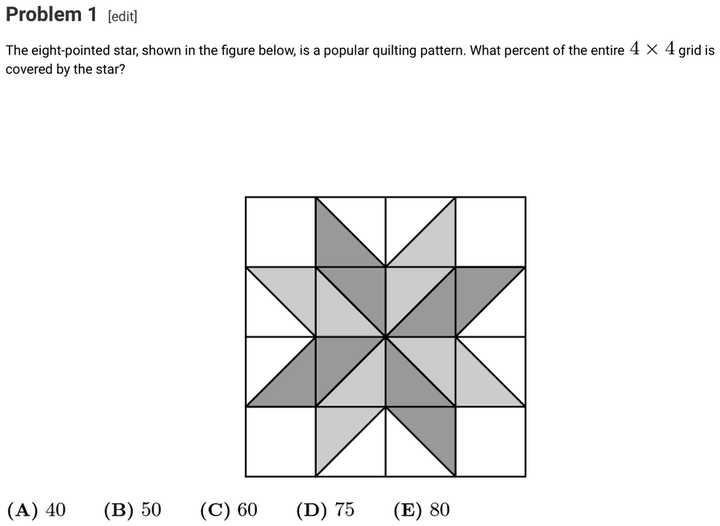
You probably don't need to measure anything. Could the shaded and unshaded parts be hiding the same total area?
Still stuck? Show hint 2 →
Hint 2 of 2
Look for symmetry that swaps shaded with white: pair every shaded triangle with a matching white triangle the same size. If they pair up perfectly, the answer is forced.
Show solution
Approach: pair each shaded triangle with a white twin (symmetry)
Don't measure anything — look for a partner. Each shaded triangle of the star has a congruent white triangle right beside it; shaded and white tile the grid in matched pairs.
Matched pairs means shaded = white exactly, so the star covers half the 4 × 4 grid: 8 of 16 squares = 50%.
Why this transfers: whenever a figure has a symmetry that swaps shaded with unshaded (a flip or a quarter-turn), the shaded fraction is forced to 1/2 — you never have to compute the area.
Another way — shrink to one quarter (MAA):
The four-fold symmetry means the shaded fraction of the whole equals the shaded fraction of just the top-left 2 × 2 quarter.
In that quarter, sliding one little triangle over makes it obvious the shaded part is exactly half — so the whole is 50% too.
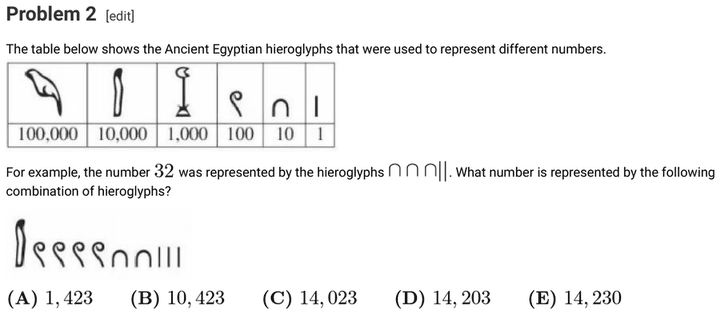
Unlike our digits, here position doesn't matter — a symbol is worth the same wherever it appears. So you only need to count how many of each kind.
Still stuck? Show hint 2 →
Hint 2 of 2
Tally each symbol type and add their table values, just like the example (three ∩ arches and two | strokes made 32). Notice there's no thousands symbol — what does that force the thousands digit to be?
Show solution
Approach: count each symbol type, then add the values
The key idea: in this Egyptian system a symbol's value doesn't depend on where it sits — you just count how many of each kind there are. So tally: one 10,000, four 100s, two 10s, three 1s.
Buffalo Shuffle-o is a card game in which all the cards are distributed evenly among all players at the start of the game. When Annika and 3 of her friends play Buffalo Shuffle-o, each player is dealt 15 cards. Suppose 2 more friends join the next game. How many cards will be dealt to each player?
Show answer
Answer: C — 10 cards each.
Show hints
Hint 1 of 2
More friends show up, but no new cards do. What's the one number here that stays exactly the same?
Still stuck? Show hint 2 →
Hint 2 of 2
The total number of cards is fixed. Find that total from the first game, then share it among the new, larger group.
Show solution
Approach: fixed total of cards, redistribute among players
The deck doesn't grow when friends arrive — the total number of cards is the thing that stays fixed. Find it: 4 players × 15 cards = 60 cards.
Now redeal that same 60 among 4 + 2 = 6 players: 60 ÷ 6 = 10 cards each.
Why this transfers: in any "shared evenly" problem, hunt for the quantity that doesn't change (here, the total). Pin it down once, then it answers every version of the question.
Lucius is counting backward by 7s. His first three numbers are 100, 93, and 86. What is his 10th number?
Show answer
Answer: B — 37.
Show hints
Hint 1 of 2
Careful — the 1st number is free. Getting from the 1st to the 10th, how many subtractions of 7 do you actually perform?
Still stuck? Show hint 2 →
Hint 2 of 2
It's 9 steps, not 10 (like fenceposts: 10 posts, 9 gaps). So how much is subtracted from 100 in total?
Show solution
Approach: count the steps, not the terms (arithmetic sequence)
The trap is multiplying by 10. But the 1st number cost no subtraction — going from the 1st to the 10th is only 9 steps, not 10. (Think fenceposts: 10 posts have 9 gaps between them.)
Each step subtracts 7, so you subtract 9 × 7 = 63 total: 100 − 63 = 37.
Why this transfers: the nth term of a sequence starting at the 1st uses n − 1 steps, not n. This off-by-one (fencepost) idea shows up in any "count from term 1 to term n" question. Sanity check: 37 + 63 = 100. ✓
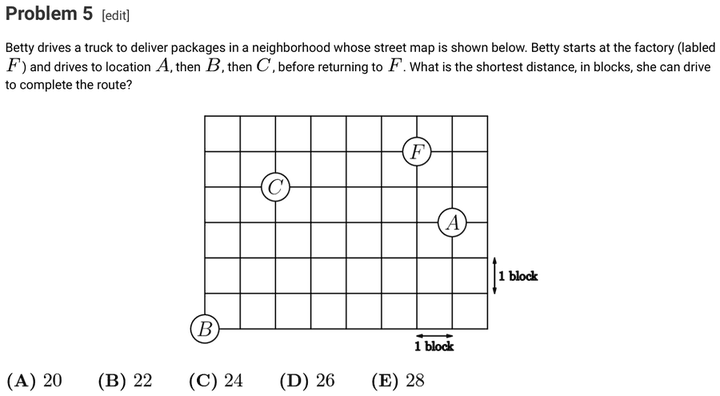
You can't cut diagonally across blocks. So however Betty zigzags within one leg, the distance is the same — what two things does it depend on?
Still stuck? Show hint 2 →
Hint 2 of 2
Each leg's length is just its sideways blocks plus its up-and-down blocks (taxicab distance). Read those off the map for F→A, A→B, B→C, C→F and add.
Show solution
Approach: taxicab / Manhattan distance per leg
Key idea: on a street grid you can't cut diagonally, so the distance for any leg is just (horizontal blocks) + (vertical blocks) — and as long as you never backtrack, the exact path doesn't matter, only where you start and end. (This is the taxicab / Manhattan distance.)
Read the four legs off the map: F→A = 1 + 2 = 3, A→B = 7 + 3 = 10, B→C = 2 + 4 = 6, C→F = 4 + 1 = 5.
Total: 3 + 10 + 6 + 5 = 24 blocks.
Why this transfers: on any grid where you only move along streets, the shortest distance between two points is fixed — just add the sideways and up-down gaps. The wiggly path you choose is irrelevant.
Another way — C is already on the way back (MAA):
Notice C lies on a shortest path from B back to F, so visiting C costs nothing extra. The problem reduces to F → A → B → F.
Sekou writes down the numbers 15, 16, 17, 18, 19. After he erases one of his numbers, the sum of the remaining four numbers is a multiple of 4. Which number did he erase?
Show answer
Answer: C — 17.
Show hints
Hint 1 of 2
You don't need the actual sums — only the leftover after dividing by 4 matters. What's each number's leftover?
Still stuck? Show hint 2 →
Hint 2 of 2
Find the leftover (remainder) of the total when divided by 4. The number you erase must carry away exactly that much leftover.
Show solution
Approach: track only the remainders (leftovers) mod 4
The full sum 15+16+17+18+19 = 85, and 85 = 84 + 1 leaves a leftover of 1 after dividing by 4. To make the remaining four a clean multiple of 4, you must erase exactly the leftover of 1.
Which number carries leftover 1? Checking: 16 leaves 0, 17 leaves 1, 18 leaves 2, 19 leaves 3, 15 leaves 3. Only 17 has leftover 1, so erase 17.
Why this transfers: for any divisibility question, work with remainders, not the big sums — a number's remainder is all that affects divisibility. Sanity check: 85 − 17 = 68 = 4 × 17. ✓
How many students earned a score of at least 80% and less than 90%?
Show answer
Answer: D — 37 students.
Show hints
Hint 1 of 2
These groups aren't separate piles — "at least 80%" already contains everyone who scored at least 90%. They're nested, like measuring cups inside each other.
Still stuck? Show hint 2 →
Hint 2 of 2
So to get just the 80–90% band, take the big group and subtract the part of it you don't want. Which two of the four counts do you need? (The 85% and 95% lines are decoys.)
Show solution
Approach: subtract the inner group from the outer (don't add the bands)
The four counts are nested, not separate: the 13 who scored ≥ 90% sit inside the 50 who scored ≥ 80%. So you subtract, you don't add.
Students in [80%, 90%) = (those ≥ 80%) − (those ≥ 90%) = 50 − 13 = 37. The 85% and 95% counts are just there to distract.
Why this transfers: with "at least" cutoffs, the count for a band is the difference of two cumulative counts — spot the nesting and subtract instead of trying to build each band from scratch.
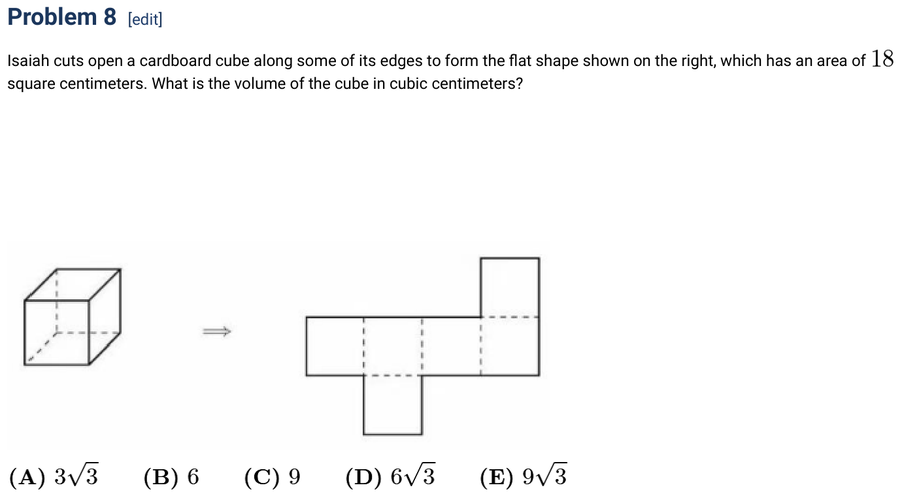
Why this transfers: the chain area → length → volume is one you'll reuse constantly — a square's side is √(area), and a cube's volume is that side cubed. Don't be thrown by the answer being a surd; (√3)3 = 3√3, not a whole number.
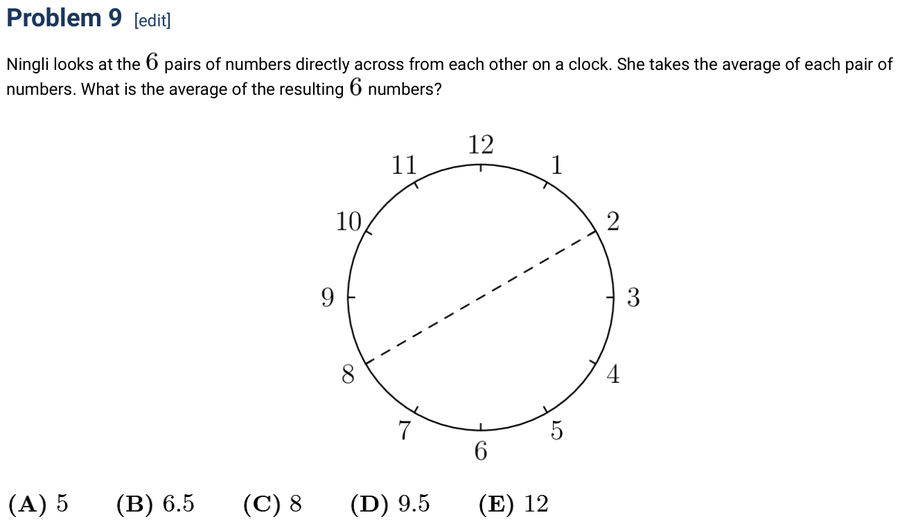
You don't need to know which numbers are paired. The 6 pairs use up all 12 clock numbers, each exactly once — so what are you really averaging?
Still stuck? Show hint 2 →
Hint 2 of 2
Averaging the six pair-averages (each pair the same size) just re-averages all 12 numbers. So the answer is simply the average of 1 through 12.
Show solution
Approach: average of equal-size pair-averages = overall average
Notice the actual pairings (1&2 across from 7&8, etc.) never matter: the six pairs cover all twelve numbers 1–12 exactly once. Averaging six equal-size pair-averages is the same as averaging all twelve numbers at once.
And 1–12 are evenly spaced, so their average is just the midpoint of the ends: (1 + 12)/2 = 6.5.
Why this transfers: averaging the averages of equal-size groups equals the overall average — but only when the groups are the same size. (Unequal groups need a weighted average.) And the mean of any evenly-spaced list is the midpoint of its first and last term.
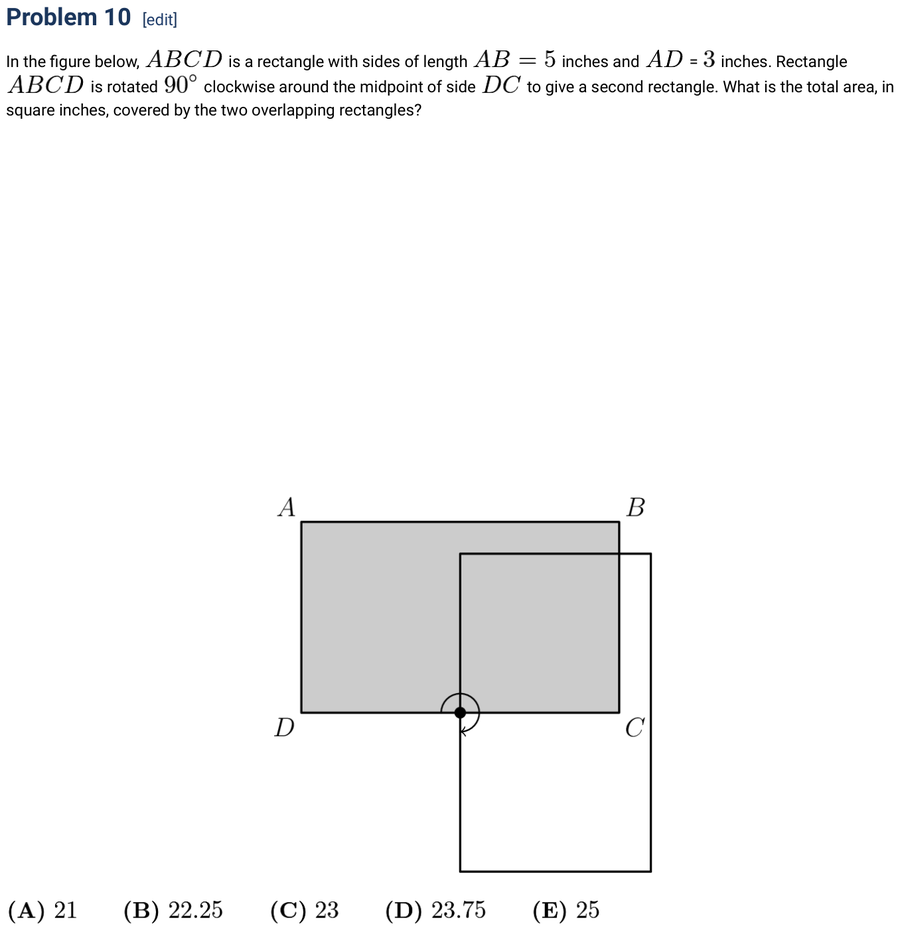
Don't try to find the funny outline directly. If you just add both rectangles' areas, what region gets counted twice?
Still stuck? Show hint 2 →
Hint 2 of 2
Area covered = (one rectangle) + (other rectangle) − (the overlap). So you only need the overlap's area. It's a square — and the pivot at the midpoint of DC fixes its side at 2.5.
Show solution
Approach: inclusion–exclusion (add both, subtract the double-count)
The shape covered is awkward, but its area isn't: add both rectangles and subtract the part you counted twice. Each rectangle is 5 × 3 = 15.
The overlap: the rotation pivots at the midpoint of DC, so along DC the shared strip is half of 5 = 2.5, and a quarter-turn makes the overlap a 2.5 × 2.5 square — area 2.52 = 6.25.
Covered area = 15 + 15 − 6.25 = 23.75.
Why this transfers: whenever two regions overlap, |A or B| = |A| + |B| − |A and B| — the overlap must be subtracted once because adding counts it twice. This inclusion–exclusion idea saves you from ever computing a messy combined outline.
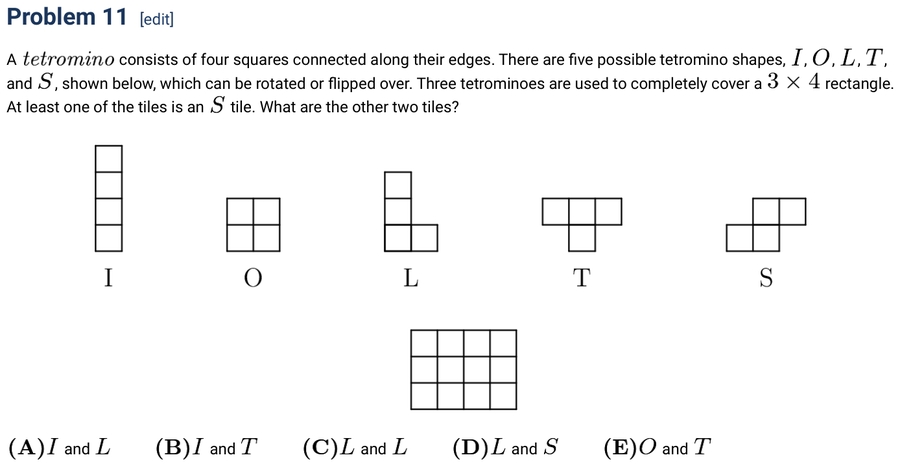
You're told one tile is an S, the trickiest, kinkiest shape. Lock it down first — commit to placing it, then see what hole is left for the other two.
Still stuck? Show hint 2 →
Hint 2 of 2
Slide the S along an edge so it leaves a tidy hole. The remaining 8 squares fall into an L-shape — what two tetrominoes fill that?
Show solution
Approach: place the most constrained piece first, then read off the leftover
The 3 × 4 rectangle is 12 squares = three tetrominoes. Start with the given S piece, because it's the most awkward — pinning the hardest constraint first leaves you the least to juggle.
Tuck the S against an edge so it doesn't fracture the rest. The 8 squares left over form one connected L-shaped region.
That region splits neatly down the middle into two L tetrominoes — so the other two tiles are L and L.
Why this transfers: in any tiling or fitting puzzle, place the piece with the fewest legal positions first. It collapses the casework, instead of building up a mess of options you later have to undo.
Another way — eliminate by what can't reach a corner:
Once the S sits in place, look at the leftover region's corners: each is a square that only an L (or I) can reach into without poking outside.
An O or T can't fill those notched corners, and a single I plus the S won't close the gap — so the pair must be two L's, choice L and L.
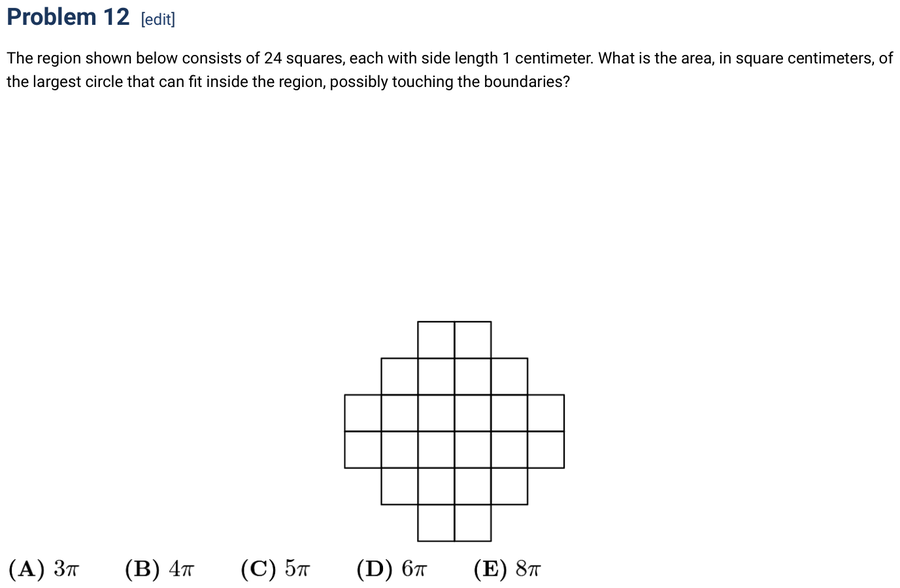
A circle's reach is capped by the closest bit of boundary. On this lumpy plus-shape, that closest bit isn't a flat edge — it's an inward corner where two arms meet.
Still stuck? Show hint 2 →
Hint 2 of 2
Center the circle in the middle (by symmetry). Find one nearest inward corner: it's 1 unit across and 2 units up from the center. The Pythagorean theorem gives the radius — then square it for the area.
Show solution
Approach: radius = distance to the closest point of the boundary
Center the circle at the region's center (forced by symmetry). The biggest it can grow is limited by the nearest boundary point — and on this cross-shape those are the inward corners where the arms notch in, not the outer flat edges.
One such corner sits 1 unit across and 2 units up from the center, so the radius is the hypotenuse: √(12 + 22) = √5.
Area = π × (√5)2 = 5π.
Why this transfers: the largest inscribed circle is always pinned by the closest point of the boundary — so on a non-convex shape, hunt the inward corners first. And notice you never needed √5 itself: squaring it for the area gives a clean 5.
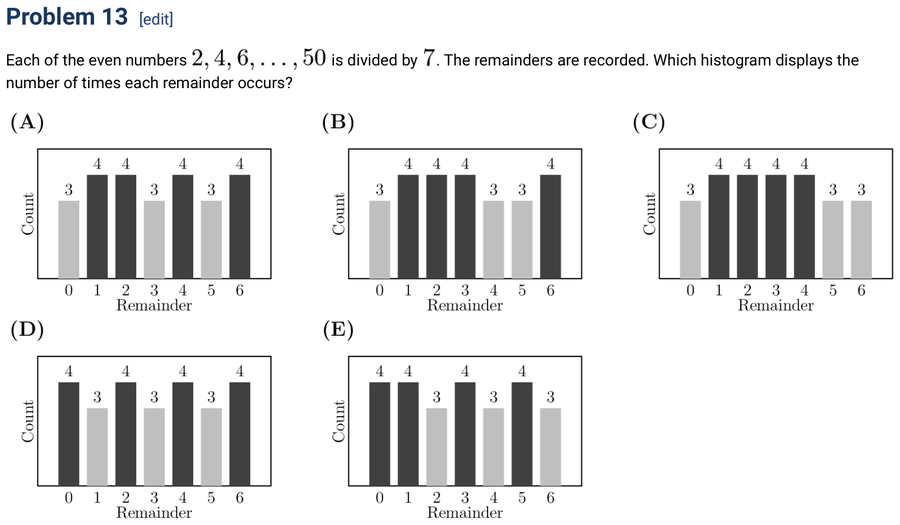
Computing 25 remainders one by one is a trap. Adding 2 each time bumps the remainder by 2 (mod 7) — so the remainders march in a short repeating loop. Find that loop.
Still stuck? Show hint 2 →
Hint 2 of 2
The loop has length 7, and 25 = 3 full loops + 4 leftovers. The full loops hit every remainder equally, so it's only those 4 leftovers — the first remainders in the cycle — that decide which bars stand taller.
Show solution
Approach: find the period-7 cycle; only the leftovers break the tie
Adding 2 each step bumps the remainder by 2 (mod 7), so 2, 4, 6, 8, 10, 12, 14, … give remainders that loop: 2, 4, 6, 1, 3, 5, 0, repeating every 7.
There are 25 even numbers = 3 complete loops (21 numbers, each remainder appearing 3 times — so all bars start tied) plus 4 extras, which are the first four of the cycle: 2, 4, 6, 1.
Those 4 extras push remainders 1, 2, 4, 6 up to 4 each, while 0, 3, 5 stay at 3 each. The histogram with its taller bars exactly on 1, 2, 4, 6 is choice A.
Why this transfers: for "how often does each remainder occur" questions, find the repeating cycle, peel off the whole cycles (which tie everything), and let the short leftover tail break the tie. That beats brute-forcing every value.
A number N is inserted into the list 2, 6, 7, 7, 28. The mean is now twice as great as the median. What is N?
Show answer
Answer: E — 34.
Show hints
Hint 1 of 2
Peek at the answer choices before doing any algebra: every option is at least 7. The sorted list already has 7, 7 sitting dead center — what does inserting a big number do to the median?
Still stuck? Show hint 2 →
Hint 2 of 2
With 6 numbers the median is the average of the middle two, and those stay 7 and 7. So the median is locked at 7 — turn that into the mean and back-solve the sum.
Show solution
Approach: let the answer choices pin the median, then back-solve the mean
Glance at the choices first: all are ≥ 7. The starting list sorts to 2, 6, 7, 7, 28, and inserting any number that big keeps 7 and 7 as the middle two of the six. So the median is locked at 7 — no algebra needed for it.
"Mean is twice the median" then forces mean = 2 × 7 = 14, so the six numbers sum to 6 × 14 = 84.
The original five sum to 2 + 6 + 7 + 7 + 28 = 50, so N = 84 − 50 = 34.
Why this transfers: reading the answer choices can collapse the hard part of a problem — here they guarantee where N lands, freezing the median so you only have to chase the mean.
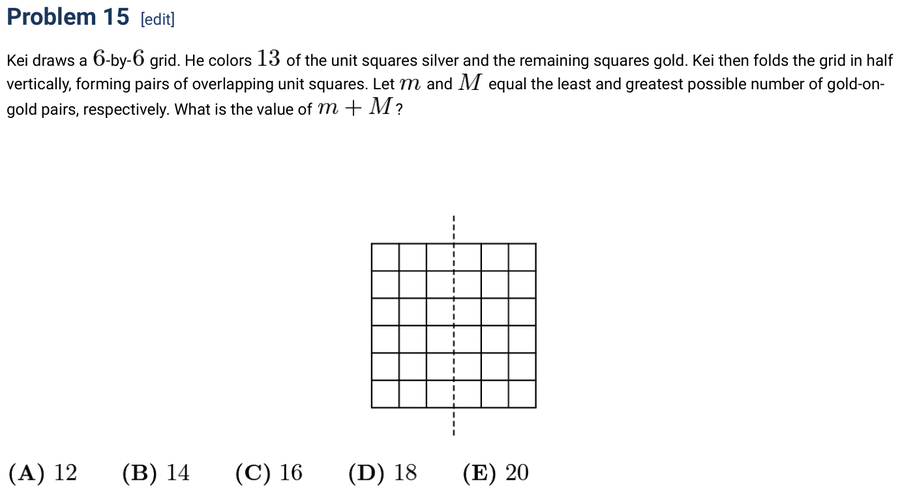
The fold turns 36 squares into 18 overlapping pairs. First, how many gold squares are there — and how does that compare to 18?
Still stuck? Show hint 2 →
Hint 2 of 2
There are more golds (23) than pairs (18), so some doubling-up is unavoidable. To make it rare, spread golds one-per-pair first; to make it common, glue golds together two-at-a-time.
Show solution
Approach: for an extreme, push the arrangement all the way to one side
Count gold: 36 − 13 = 23 golds, and the fold makes 18 pairs. Since 23 > 18, gold-on-gold pairs can't be avoided entirely — that tension is the whole problem.
Fewest (m): spread golds so each of the 18 pairs gets one first; that uses 18, and the remaining 23 − 18 = 5 are forced to land on already-gold squares. So m = 5.
Most (M): instead pile golds two-to-a-pair. 23 = 2 × 11 + 1, so you fill 11 pairs fully with 1 gold left over. So M = 11.
m + M = 5 + 11 = 16.
Why this transfers: to find a min or max of a count, don't search randomly — deliberately arrange things to the extreme (spread out for the minimum, clump together for the maximum). The leftover after even distribution is exactly the pigeonhole surplus, 23 − 18 = 5.
Five distinct integers from 1 to 10 are chosen, and five distinct integers from 11 to 20 are chosen. No two numbers differ by exactly 10. What is the sum of the ten chosen numbers?
Show answer
Answer: C — 105.
Show hints
Hint 1 of 2
The question asks for one fixed sum, yet you get to choose the numbers freely. That's a hint the sum is the same for every valid choice — so find what's forced. Each low number you pick rules out exactly one high number.
Still stuck? Show hint 2 →
Hint 2 of 2
Picking 5 lows blocks 5 highs, leaving exactly 5 highs you're forced to take. Those forced highs are 10 more than the 5 lows you didn't pick — so chosen-highs and unchosen-lows pair up.
Show solution
Approach: the high picks are forced; chosen highs pair with the unchosen lows
Insight: the answer can't depend on your choices (the problem gives just one sum), so something must be forced. Each chosen low x blocks the high x+10; choosing 5 lows blocks 5 highs, so the 5 highs you must take are precisely the unblocked ones — the highs that are 10 more than the 5 lows you didn't choose.
So every high pairs with an unchosen low: sum of chosen highs = (sum of unchosen lows) + 5×10. Then (chosen lows) + (chosen highs) = (chosen lows) + (unchosen lows) + 50 = (all of 1–10) + 50.
1 + 2 + … + 10 = 55, so the total is 55 + 50 = 105, the same for any legal choice.
Why this transfers: when a problem lets you choose but asks for a single number, look for the invariant — the quantity that's the same across all valid choices. Here a blocking/pairing argument shows the sum never moves.
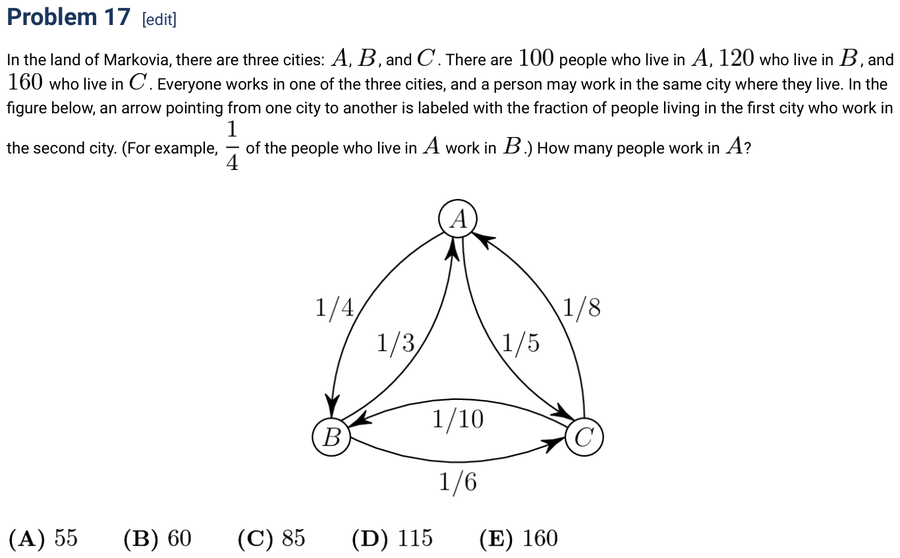
Sort people by where they work, not where they live. Workers in A arrive from three places: stayers in A, commuters from B, commuters from C. Add those three.
Still stuck? Show hint 2 →
Hint 2 of 2
The sneaky one is A→A: there's no arrow for "stays in A," so count it the easy way — everyone in A minus those who leave for B or C. The other two are just fraction × population.
Show solution
Approach: group by workplace; count the stayers by subtraction
Reorganize people by workplace. Workers in A come from three home cities, so add the three streams — and for the A→A stream, there's no "stays" arrow, so use complementary counting: everyone in A minus those who commute out.
Why this transfers: in flow problems, choose to count by the destination, and fill any missing "stay put" category by subtracting the ones who leave from the whole — the leftover-fractions always sum to 1.
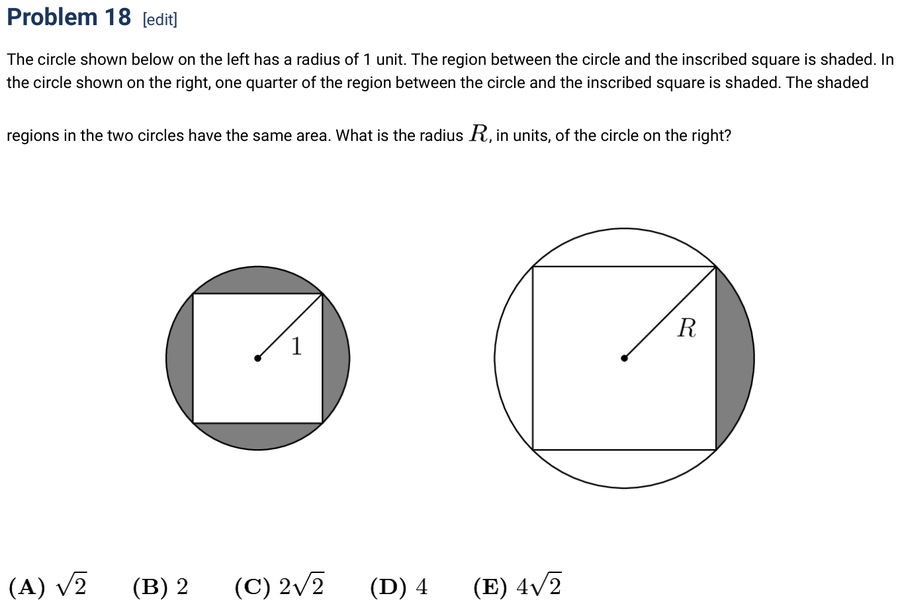
Don't compute either crescent-region's actual area. The two pictures are the same shape scaled up — so ask how area responds when you scale a figure.
Still stuck? Show hint 2 →
Hint 2 of 2
First translate the words into one number: "one quarter of the right region = the whole left region" means the right region is 4× the left. Since area scales as (length)2, the length scale-up is √4.
Show solution
Approach: similar figures: area scales as the square of the length
Both pictures are the identical shape (a square inscribed in a circle), just enlarged — so every area on the right is R2 times the matching area on the left, because radius 1 scales up to R.
The condition says a quarter of the right's between-region equals the left's whole between-region, so the right's whole region is 4 times the left's: R2 = 4.
R = √4 = 2.
Why this transfers: for similar figures, areas scale as length2 (and volumes as length3). Whenever shapes are merely scaled copies, you can skip the messy individual areas and just take a square root of the area ratio to get the length ratio.
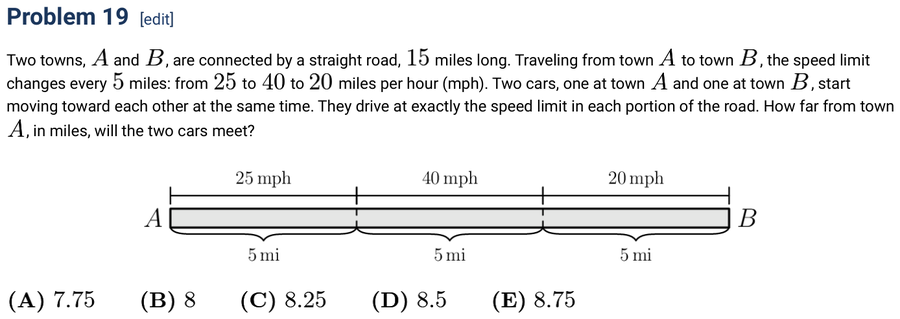
Guess where they meet first: the middle section, where both happen to drive 40 mph. There, equal speeds mean they close the gap evenly — all the trickiness is in how unevenly they reach the middle.
Still stuck? Show hint 2 →
Hint 2 of 2
Time A to the middle: 5/25 = 1/5 hr. Time B to the middle: 5/20 = 1/4 hr. So A enters the middle 1/20 hr early — turn that head start into miles, then split what's left.
Show solution
Approach: find each car's position when both are in the equal-speed middle section
Bet that they meet in the middle 40-mph section (then they go the same speed, so you only need positions). A covers its 5-mile left section in 5/25 = 1/5 hr; B covers its 5-mile right section in 5/20 = 1/4 hr. So A reaches the middle 1/4 − 1/5 = 1/20 hr before B.
In that 1/20-hr head start, A drives 40 × 1/20 = 2 miles into the middle. So when B finally enters, A is at mile 7, B at mile 10 — a 3-mile gap, both now at 40 mph.
Equal speeds split the gap evenly: each drives 1.5 more miles. A's meeting point is 7 + 1.5 = 8.5 miles from A.
Why this transfers: when speeds match over the stretch where they meet, the closing is symmetric — so isolate the asymmetry (the unequal times to arrive), convert it to a distance, then share the remainder equally.
Another way — track total time to the meeting instant:
They meet somewhere in the middle section at the same clock time t. Suppose A has gone a distance d into the middle and B has gone 5 − d into it (their middle distances fill the 5-mile section).
Sarika, Dev, and Rajiv are sharing a large block of cheese. They take turns cutting off half of what remains and eating it: first Sarika eats half of the cheese, then Dev eats half of the remaining half, then Rajiv eats half of what remains, then back to Sarika, and so on. They stop when the cheese is too small to see. About what fraction of the original block of cheese does Sarika eat in total?
Show answer
Answer: A — 4/7.
Show hints
Hint 1 of 2
Sarika eats on turns 1, 4, 7, … — every third turn. Each bite is half of what's left, so list the sizes of her bites and look for a pattern from one of hers to the next.
Still stuck? Show hint 2 →
Hint 2 of 2
Her bites are 12, then 116, then 1128, … — each is 18 of the one before (three halvings between her turns). That's a geometric series.
Show solution
Approach: sum the geometric series of Sarika's bites
Each turn eats half of what remains, so after turn n there's 1/2n left, and turn n ate 1/2n of the original. Sarika takes turns 1, 4, 7, …, so her bites are 12, 116, 1128, … — each 18 of the previous.
So it's a geometric series, first term a = 12, ratio r = 18.
Sum = a1 − r = 1/27/8 = 4/7.
Why this transfers: a never-ending halving (or any |ratio| < 1) sums to a finite total a1 − r — pull out one person's terms, find the constant ratio between consecutive ones, and apply the formula.
Another way — ratio of bite sizes (no infinite sum):
In every round of three turns, Sarika, Dev, and Rajiv eat in the fixed ratio 12 : 14 : 18 = 4 : 2 : 1 of whatever was there at the round's start.
Since that 4 : 2 : 1 split repeats on every leftover chunk, it holds for the whole block too. Sarika's share is 44 + 2 + 1 = 4/7 — and the cheese is essentially all eaten.
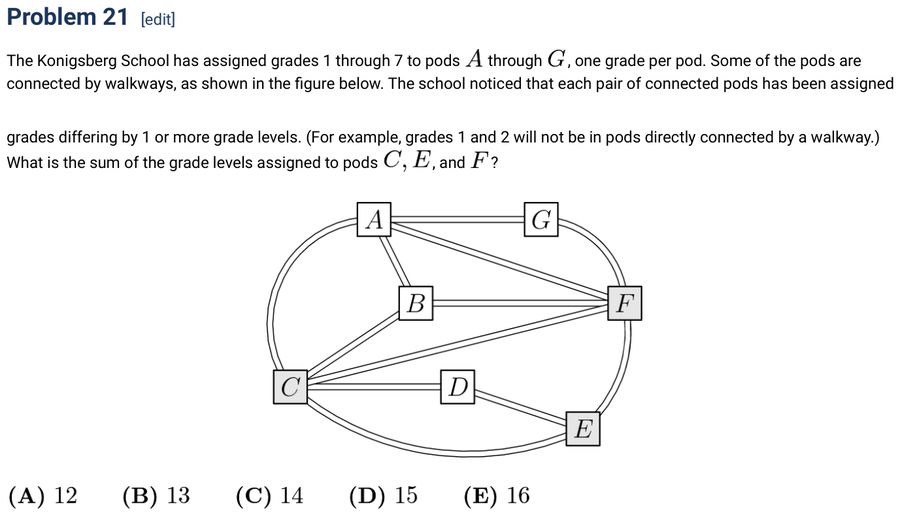
The hardest pressure is where many pods are mutually connected — tackle that knot first. Find the largest group of pods that are all directly linked to each other; their grades are squeezed into a tiny set.
Still stuck? Show hint 2 →
Hint 2 of 2
Pods A, B, C, F are pairwise connected (a 4-clique), so their four grades must be mutually ≥ 2 apart. From {1,…,7}, the only such quadruple is {1, 3, 5, 7} — the most spread-out choice.
Show solution
Approach: find the clique to lock down four grades, then radiate outward
Spot the tightest constraint: A, B, C, F are all mutually connected, so their four grades must each differ by ≥ 2. Packing 4 grades into 1–7 that far apart forces exactly {1, 3, 5, 7} — there's no slack.
G connects to A and F. If G = 2, then A, F ≠ 1 or 3, forcing {A, F} ⊂ {5, 7} and {B, C} = {1, 3}.
D and E only touch C and F. The extreme grades 1 and 7 each have just one neighbor in this clique, so place 1 at C and 7 at F. The remaining {4, 6} go to D, E.
Filling in: D = 6 (avoids 7 enough), E = 4 (avoids 1 and 7), B = 3 (next to C = 1), A = 5. All constraints hold.
C + E + F = 1 + 4 + 7 = 12.
Why this transfers: in any constraint/coloring puzzle on a network, attack the densest cluster (the clique) first — it has the fewest possibilities, so it locks in the most and leaves the loose pods easy to finish.
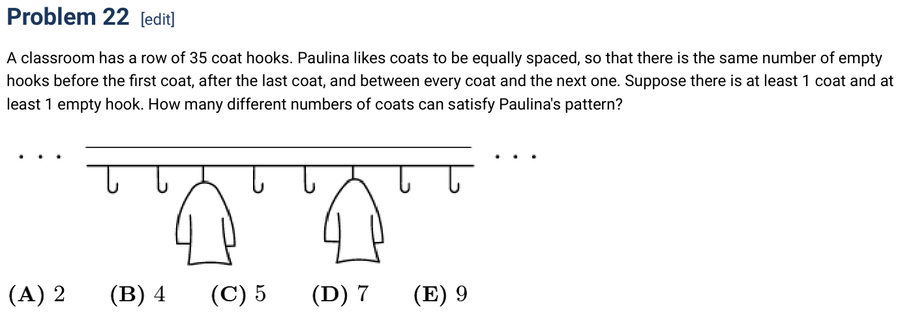
The annoying part is that the gap after the last coat has no coat closing it off, unlike the gaps between coats. Fix that asymmetry: imagine one phantom coat on a 36th hook, and now empty-then-coat repeats perfectly.
Still stuck? Show hint 2 →
Hint 2 of 2
With the phantom, 36 hooks split into d identical blocks of length b (each = some empties + one coat), so bd = 36 with b ≥ 2 and d ≥ 2. Counting the coat-arrangements becomes counting these factorizations.
Show solution
Approach: add a phantom coat to make a clean repeat, then count factor pairs
The setup is fiddly because the trailing gap isn't followed by a coat the way the inner gaps are. Patch it: drop a phantom coat on a 36th hook. Now the whole row is a flawless repeat of (some empty hooks)+(one coat), each block of length b ≥ 2.
If there are d such blocks, bd = 36, and the real coat count is d − 1 (we added one phantom). The constraints are b ≥ 2 (each block has ≥ 1 empty + 1 coat) and d ≥ 2 (≥ 1 real coat plus the phantom).
So just count factorizations 36 = b × d with both factors ≥ 2. Since 36 = 22 × 32 has (2+1)(2+1) = 9 divisors, and we drop the two using a 1 (1×36, 36×1), the answer is 9 − 2 = 7.
Why this transfers: when boundary items spoil a repeating pattern, add (or remove) a phantom to restore the symmetry — the awkward "ends differ from the middle" complication melts into a clean periodic count.
Number Theoryprimesdifference-of-squaresprime-test
How many four-digit numbers have all three of the following properties?
The tens digit and ones digit are both 9.
The number is 1 less than a perfect square.
The number is the product of exactly two prime numbers.
Show answer
Answer: B — Exactly 1.
Show hints
Hint 1 of 2
Translate each clue into a structural fact. Ending in 99 means "add 1" gives a number ending in 00 — and a perfect square ending in 00 forces its square root to be a multiple of 10. That alone cuts the candidates to a handful.
Still stuck? Show hint 2 →
Hint 2 of 2
Now the number is (10k)2 − 1 = (10k − 1)(10k + 1), already factored. "Product of exactly two primes" means both of those factors must themselves be prime — you're hunting twin primes straddling a multiple of 10.
Show solution
Approach: turn the clues into structure: square ends in 00, then seek twin primes
Decode the conditions instead of testing thousands of numbers. "Ends in 99" + 1 = ends in 00, and a square ending in 00 must be (10k)2. So the number is (10k)2 − 1 = (10k − 1)(10k + 1) — a difference of squares, factored for free.
"Product of exactly two primes" now means both 10k − 1 and 10k + 1 are prime. Check: 39×41 (39 = 3×13, no), 49×51 (49 = 72, no), 59×61 (both prime ✓), 69×71 (69 = 3×23, no), 79×81 (81 = 34, no), 89×91 (91 = 7×13, no), 99×101 (99 = 9×11, no).
Only 59 × 61 = 3599 survives, so exactly 1.
Why this transfers: "one less than a perfect square" should instantly trigger the difference-of-squares factoring a2 − 1 = (a−1)(a+1) — turning a vague property into a concrete factorization you can prime-test.
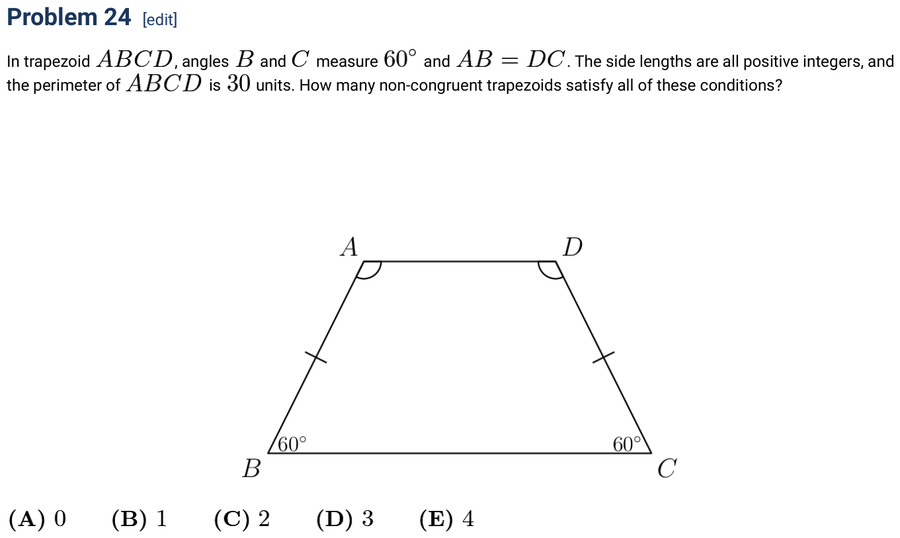
Two 60° base angles are begging for an equilateral triangle. Slice one off: draw a line through A parallel to the slanted side CD — what shape gets cut out, and what's left?
Still stuck? Show hint 2 →
Hint 2 of 2
That cut makes an equilateral triangle ABE (so AB = BE = AE) plus a parallelogram ADCE (so AD = EC). Relabel the equal lengths x and y, and the whole perimeter collapses to 3x + 2y = 30 — now it's just counting integer solutions.
The two 60° angles are the cue. Draw a segment through A parallel to CD, meeting BC at E. Because ∠B = 60° and AB = DC, triangle ABE has all 60° angles — it's equilateral, so AB = BE = AE = x.
What remains, ADCE, is a parallelogram (AE ∥ DC and AD ∥ EC), so the two parallel sides match: AD = EC = y.
Now the perimeter rewrites entirely in x and y: AB + BC + CD + DA = x + (x + y) + x + y = 3x + 2y = 30. The geometry is gone — it's a counting problem.
Need positive integers: y = (30 − 3x)/2 must be positive (so x < 10) and an integer (so 30 − 3x even, i.e. x even). That leaves x ∈ {2, 4, 6, 8} — 4 trapezoids.
Why this transfers: a parallel auxiliary line through a vertex peels a trapezoid into a triangle + parallelogram, and a 60° angle makes that triangle equilateral. The payoff is converting a shape question into a tidy linear equation to count.
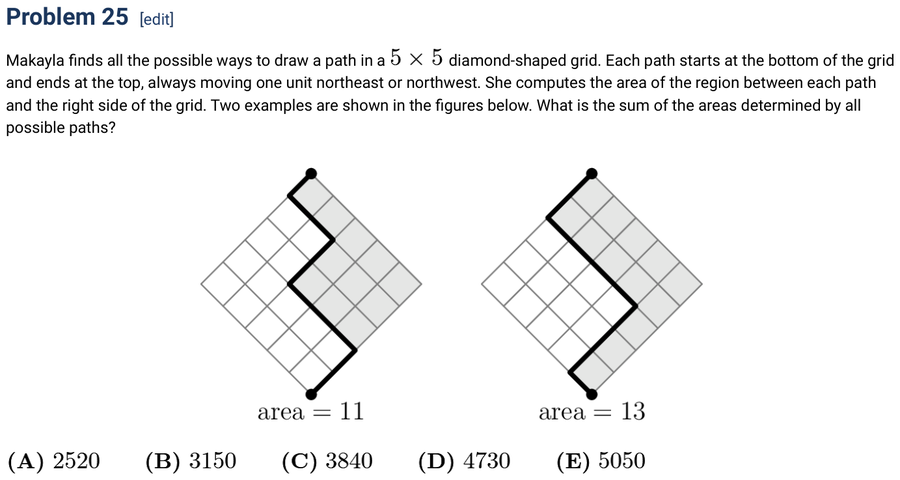
Summing the right-area of all 252 paths one at a time is hopeless. The escape: mirror each path left↔right. The full set of paths is its own mirror image, so the total of all left areas equals the total of all right areas — the answer you want.
Still stuck? Show hint 2 →
Hint 2 of 2
Add the two totals: for a single path, (left area) + (right area) is just the whole diamond, a constant. So 2×(answer) = (that constant) × (number of paths). The path count is the ways to interleave 5 NE and 5 NW moves.
Show solution
Approach: double it via the left↔right mirror, so each path contributes a constant
Let X be the sum of right-side areas. Flipping every path left↔right sends the set of all paths to itself, so the sum of all left-side areas is also X. Add them: 2X = sum over all paths of (left + right).
But for any single path, left area + right area is the entire 5×5 diamond = 25 — a constant, independent of the path. The hard per-path detail vanishes.
Number of paths = interleavings of 5 NE moves and 5 NW moves = 10!5! · 5! = 252.
So 2X = 25 × 252 = 6300, giving X = 3150.
Why this transfers: to sum a quantity you can't compute term-by-term, add it to its mirror image — if the pair sums to a constant, you've turned an impossible sum into (constant) × (count) ÷ 2. This pairing/symmetry trick is the same idea behind summing 1+2+…+n by pairing ends.