The two parentheses use the same three numbers — only the multiply sign moved. So the difference is really a contest between ‘8 × 4’ and ‘4 × 2’.
Still stuck? Show hint 2 →
Hint 2 of 2
Inside each parentheses, the rule is multiply before you add (order of operations). Evaluate each group, then subtract.
Show solution
Approach: order of operations: multiply before you add
The two parentheses look almost identical — same numbers 8, 4, 2 — but the × sits in a different spot. That's the whole trick: the answer comes from where the multiplication lands, not from the numbers themselves.
First parentheses: multiply first, so 8 × 4 + 2 = 32 + 2 = 34.
Second parentheses: 8 + 4 × 2 = 8 + 8 = 16.
Subtract: 34 − 16 = 18. Sanity check: the first group is much bigger because the big multiply (8 × 4) happens there, so a positive answer feels right.
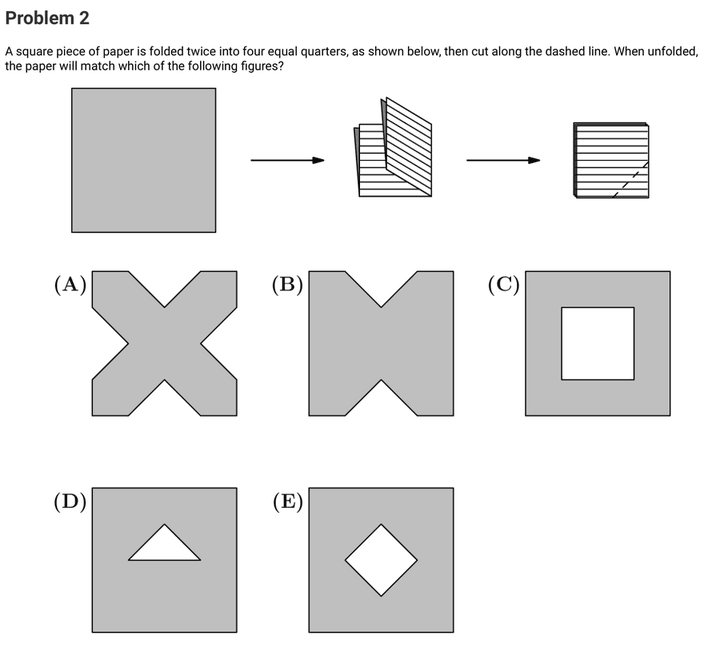
Find the one corner where all the folds meet — that's the spot the cut affects most. Where does it land on the full sheet?
Still stuck? Show hint 2 →
Hint 2 of 2
Folding twice into quarters stacks four layers at one corner, and that corner is the center of the original sheet. So one cut becomes four identical snips arranged symmetrically around the middle.
Show solution
Approach: track where one cut lands once the layers are stacked
The key question for any folding-and-cutting puzzle: where is the corner that all the folds meet at? Folding twice into quarters stacks all four corners onto one spot — and that spot is the center of the original sheet.
So a single cut near that folded corner is really happening through four layers at once — meaning four identical snips appear around the center when you unfold.
A straight diagonal cut takes a triangle off that stacked corner; unfolded, the four triangles join into one diamond-shaped hole in the middle — figure (E). This transfers: whatever you cut at the all-folds-meet corner becomes a symmetric shape centered on the sheet; cuts at an open edge stay at the edge.
Another way — fold real paper (or imagine one layer):
If you can, fold a square twice and cut — the fastest check. If not, just unfold one step at a time: the cut on the folded square mirrors across the first crease, then the result mirrors across the second crease.
Two mirrorings of a corner-triangle produce a four-fold symmetric hole sitting dead-center — matching (E).
with temperature in °F and wind speed in mph. If the air temperature is 36°F and the wind speed is 18 mph, which is closest to the wind chill?
Show answer
Answer: B — About 23.
Show hints
Hint 1 of 2
‘Closest’ tells you not to sweat the decimals — estimate. Wind makes it feel colder, so your answer must come out below 36.
Still stuck? Show hint 2 →
Hint 2 of 2
Put the numbers into the formula: multiply 0.7 × (wind speed) first, then subtract that from the temperature.
Show solution
Approach: substitute into the formula, then pick the closest choice
The word ‘closest’ is a hint that you can estimate. 0.7 × 18 is close to 0.7 × 18 = 12.6, and even rounding to ‘about 13 colder’ already points at choice (B).
Exactly: 0.7 × 18 = 12.6.
Subtract from the temperature: 36 − 12.6 = 23.4.
Closest choice is 23. Sanity check: wind should make it feel colder, so the answer must be below 36 — it is.
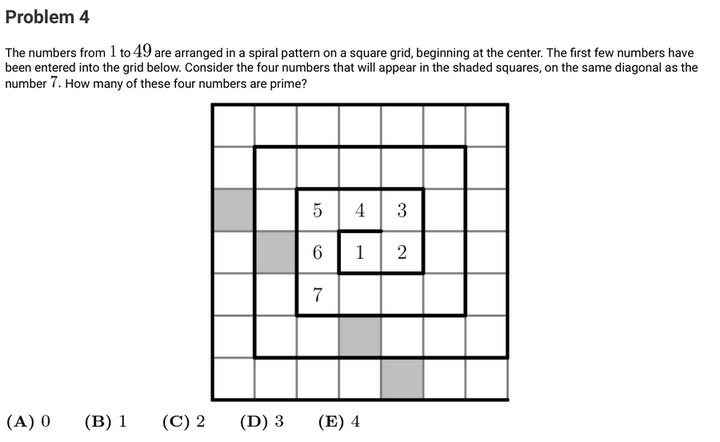
The spiral is just scenery — the real question is simply which four numbers land on those squares. Find them, then the problem becomes ‘how many are prime?’
Still stuck? Show hint 2 →
Hint 2 of 2
To find the numbers without drawing the whole grid, use the perfect squares as landmarks: 9, 25, 49 sit at corners of their layers. Then test each shaded number for primeness (a quick digit-sum check catches multiples of 3).
Show solution
Approach: fill in the diagonal, then test each for primeness
The clever move is to ignore the picture's prettiness and just ask: which four numbers land on those squares? Once you know them, the spiral has done its job and the question is pure prime-testing.
Continuing the spiral outward, the diagonal through 7 carries the four shaded numbers 19, 23, 39, 47.
Now test each for primeness. 39 jumps out: its digits add to 12 (a multiple of 3), so 39 = 3 × 13 is composite. The other three — 19, 23, 47 — are prime.
So 3 of the four shaded numbers are prime. Worth keeping: the digit-sum test (digits add to a multiple of 3 ⇒ divisible by 3) is the fastest way to spot a non-prime here.
Another way — use perfect squares as landmarks (MAA):
Without filling the whole grid: on an n×n spiral the number n2 sits in the upper-left (n even) or lower-right (n odd) corner. So 9 is at lower-right of the 3×3 block, 25 at lower-right of 5×5, 49 at lower-right of 7×7; 16 at upper-left of 4×4, 36 at upper-left of 6×6.
Walking outward from those anchors locates the four shaded squares as 19, 23, 39, 47 — with 39 = 3 × 13 the only composite.
A lake contains 250 trout, along with a variety of other fish. When a marine biologist catches and releases a sample of 180 fish from the lake, 30 are identified as trout. Assume the ratio of trout to the total number of fish is the same in both the sample and the lake. How many fish are there in the lake?
Show answer
Answer: B — 1500 fish.
Show hints
Hint 1 of 2
Think of the net of 180 fish as a shrunk-down copy of the whole lake — same recipe, smaller pot. So the trout fraction matches.
Still stuck? Show hint 2 →
Hint 2 of 2
Find the trout fraction in the sample (30 out of 180), then apply that same fraction to the 250 known trout to recover the whole.
Show solution
Approach: the trout fraction is the same in sample and lake
The sample is a tiny scale model of the lake: the trout fraction in your net should match the trout fraction in the whole lake. So find that one fraction and apply it.
In the sample, 30 of 180 are trout: 30 ÷ 180 = 16. That clean fraction is the heart of the problem — trout are 1 in every 6 fish.
So the 250 real trout are 16 of the whole lake, meaning the lake holds 250 × 6 = 1500 fish. This transfers to every ‘capture sample’ (or poll, or survey): part-of-sample = part-of-whole.
Another way — scale the whole sample up:
The lake has 250 trout but the sample only caught 30 — so the lake is 250 ÷ 30 = 253 times as ‘trout-rich’ as the sample.
Everything scales by that same factor, so total fish = 180 × 253 = 60 × 25 = 1500.
The digits 2, 0, 2, and 3 are placed in the expression below, one digit per box. What is the maximum possible value of the expression?
×
Show answer
Answer: C — 9.
Show hints
Hint 1 of 2
The 0 is dangerous — as a base or a factor it wipes the product to 0. Where could you hide it so it does no harm?
Still stuck? Show hint 2 →
Hint 2 of 2
Park the 0 in an exponent (anything0 = 1), making that factor 1. Then make the other factor as big as you can from {2, 2, 3} — check both 23 and 32.
Show solution
Approach: place 0 as an exponent, maximize the rest
The 0 is the problem child. As a base or factor it would crush the whole product to 0 — so the move is to defuse it by parking it in an exponent, where anything0 = 1 (harmless).
That turns one factor into 1, and now you just want the other factor as big as possible using the leftover {2, 2, 3}. Compare 23 = 8 and 32 = 9 — a bigger base with a smaller exponent wins here, giving 32 = 9.
Maximum product: 1 × 9 = 9. Worth keeping: a 0 you can't avoid is least damaging as an exponent; and when balancing base vs. exponent for small numbers, the larger base often beats the larger exponent.
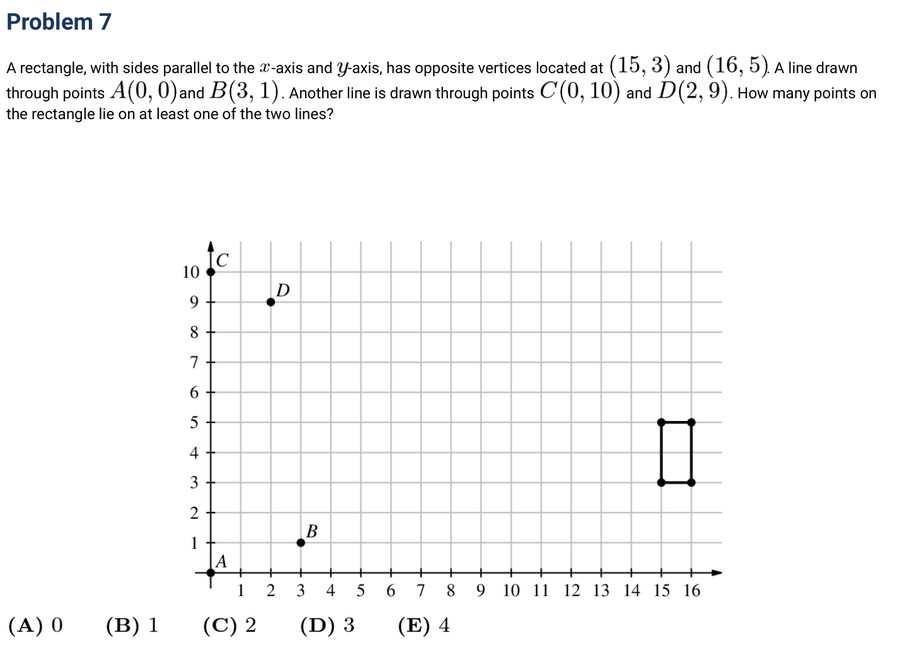
The rectangle is tiny and way off to the right (x only runs 15 to 16). So instead of graphing the whole lines, just ask: when a line reaches that far right, is its height between 3 and 5? You only need to test x = 15 and x = 16.
Still stuck? Show hint 2 →
Hint 2 of 2
Read each line's slope off its two points to get its equation. Line AB rises 1 for every 3 right: y = x/3. Line CD drops 1 for every 2 right: y = 10 − x/2. Plug in x = 15 and 16.
Show solution
Approach: evaluate the two lines at the rectangle's x-range
Notice the rectangle is a thin sliver far to the right: x runs only 15 to 16, y only 3 to 5. So you don't graph the whole lines — you just check whether either line is at the right height when it gets out to x = 15 or 16.
Line AB: slope = 1/3 (from A(0,0) to B(3,1)), so y = x/3. At x = 15: y = 5 — exactly the corner (15, 5) ✓. At x = 16: y ≈ 5.33, just above the box.
Line CD: slope = −1/2, so y = 10 − x/2. At x = 15: y = 2.5; at x = 16: y = 2 — both below the box.
Only (15, 5) lands on the rectangle — 1 point. Why this is faster: when a region is far from the lines, test the region's edges rather than tracing the lines all the way out.
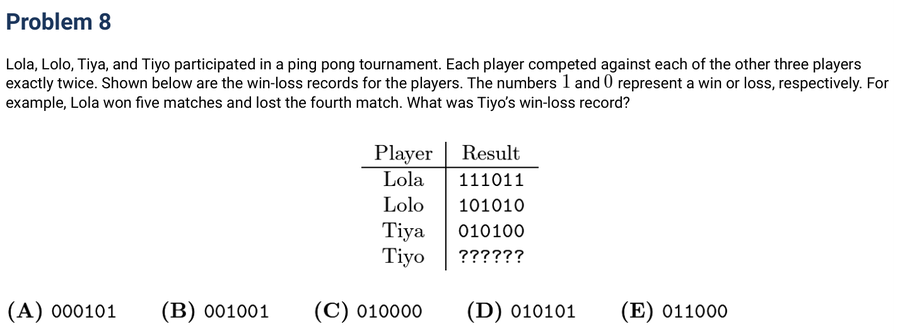
Don't reconstruct who-beat-whom. Each round, the 4 players split into 2 matches — so every round produces exactly 2 wins. That fixed total is your lever.
Still stuck? Show hint 2 →
Hint 2 of 2
Read the table by column instead of by row. Each column (round) must sum to 2 across all four players, so Tiyo's entry is just 2 minus the other three.
Show solution
Approach: each round's wins sum to 2
The shortcut: you don't need the matchups. Every round, four players pair into two games, so exactly 2 wins (and 2 losses) get handed out — meaning every column of the table sums to 2.
So add Lola + Lolo + Tiya down each round: 2, 2, 2, 1, 2, 1.
Tiyo fills the gap to 2 each round: 0, 0, 0, 1, 0, 1 = 000101. This transfers: when each ‘round’ has a fixed total, an unknown row is just total minus the known rows — column thinking beats casework.
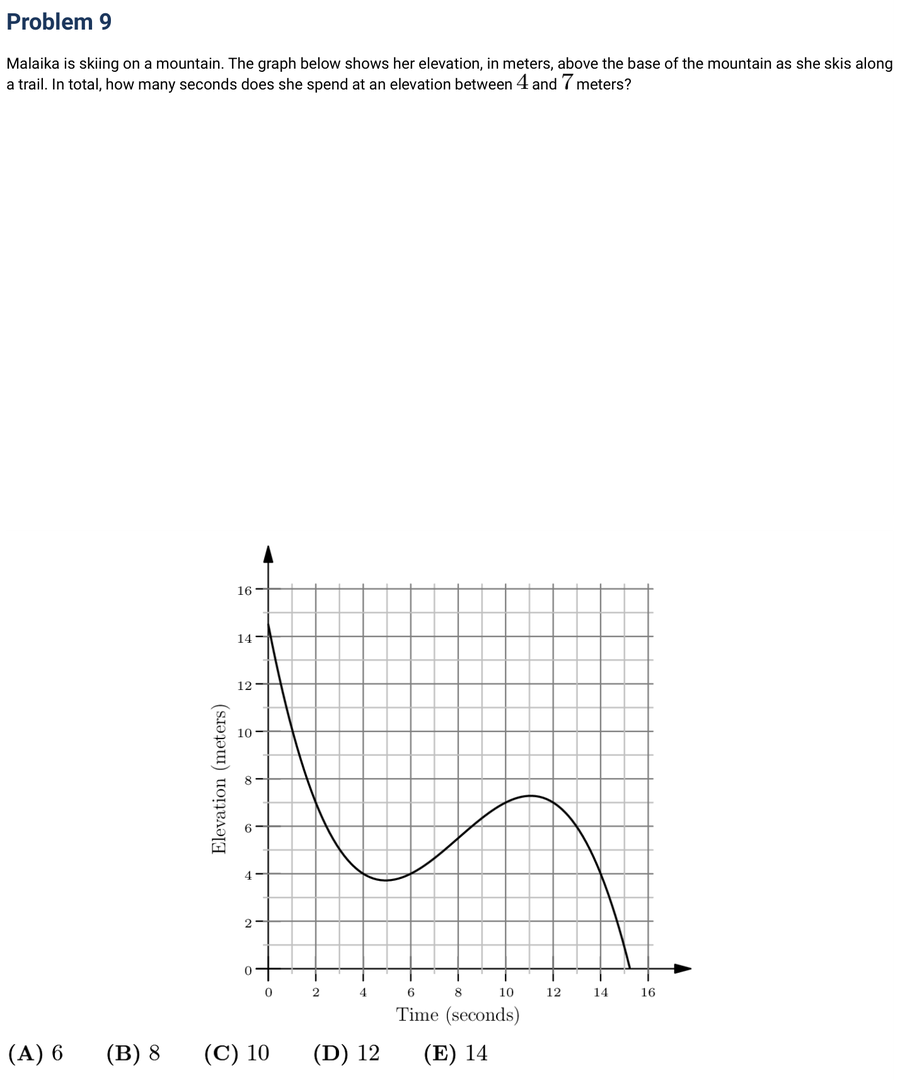
You don't care how high she is — only when she's inside the 4-to-7 band. Think of it as a horizontal stripe on the graph.
Still stuck? Show hint 2 →
Hint 2 of 2
Draw horizontal lines at 4 and 7; the curve enters and leaves that stripe a few times. Add up how long it stays inside each time.
Show solution
Approach: read the graph between two horizontal lines
Re-frame the question as a horizontal stripe: shade the band between elevation 4 and 7. The answer is just how much time (horizontal distance) the curve spends inside that band — her actual height inside it is irrelevant.
The curve dips into and out of the band three times: roughly t = 2 to 4 (2 sec), t = 6 to 10 (4 sec), and t = 12 to 14 (2 sec).
Total: 2 + 4 + 2 = 8 seconds. This transfers: ‘how long is the value between A and B’ on any graph means ‘sum the horizontal widths where the curve lies between two horizontal lines.’
Harold made a plum pie to take on a picnic. He was able to eat only 14 of the pie, and he left the rest for his friends. A moose came by and ate 13 of what Harold left behind. After that, a porcupine ate 13 of what the moose left behind. How much of the original pie still remained after the porcupine left?
Show answer
Answer: D — 1/3.
Show hints
Hint 1 of 2
Don't track what each animal ate — track what each one left behind. Then the leftovers chain together.
Still stuck? Show hint 2 →
Hint 2 of 2
Each ‘a fraction of what's left’ means multiply. Harold leaves 3/4, the moose leaves 2/3 of that, the porcupine leaves 2/3 of that — so multiply 3/4 × 2/3 × 2/3.
Show solution
Approach: multiply the 'leftover' fractions
The trap is to subtract each bite from the whole pie — but the moose eats a third of what's left, not a third of the whole pie. So work with what each animal leaves, and chain those leftovers by multiplying (‘of’ means ×).
Harold leaves 34; the moose leaves 23 of that; the porcupine leaves 23 of that.
34 × 23 × 23 = 1236 = 13. This transfers: repeated ‘a fraction of what remains’ (discounts on discounts, evaporation, decay) always multiplies the survival fractions.
Another way — twelve slices (MAA):
Cut the pie into 12 equal slices. Harold eats 3, leaving 9. Moose eats 13 of 9 = 3, leaving 6. Porcupine eats 13 of 6 = 2, leaving 4.
NASA's Perseverance Rover was launched on July 30, 2020. After traveling 292,526,838 miles, it landed on Mars in Jezero Crater about 6.5 months later. Which of the following is closest to the Rover's average interplanetary speed in miles per hour?
Show answer
Answer: C — About 60,000 mph.
Show hints
Hint 1 of 2
The answer choices jump by factors of 10, not by small amounts — that's permission to round wildly. Don't touch 292,526,838; call it 3 × 10⁸.
Still stuck? Show hint 2 →
Hint 2 of 2
Turn 6.5 months into hours through friendly rounding: ≈ 200 days ≈ 5000 hours. Then speed ≈ distance ÷ time.
Show solution
Approach: round to easy numbers, divide
First read the answer choices: they're spaced by powers of 10. That means precision is wasted — the game is to land in the right ballpark, so round everything to one digit.
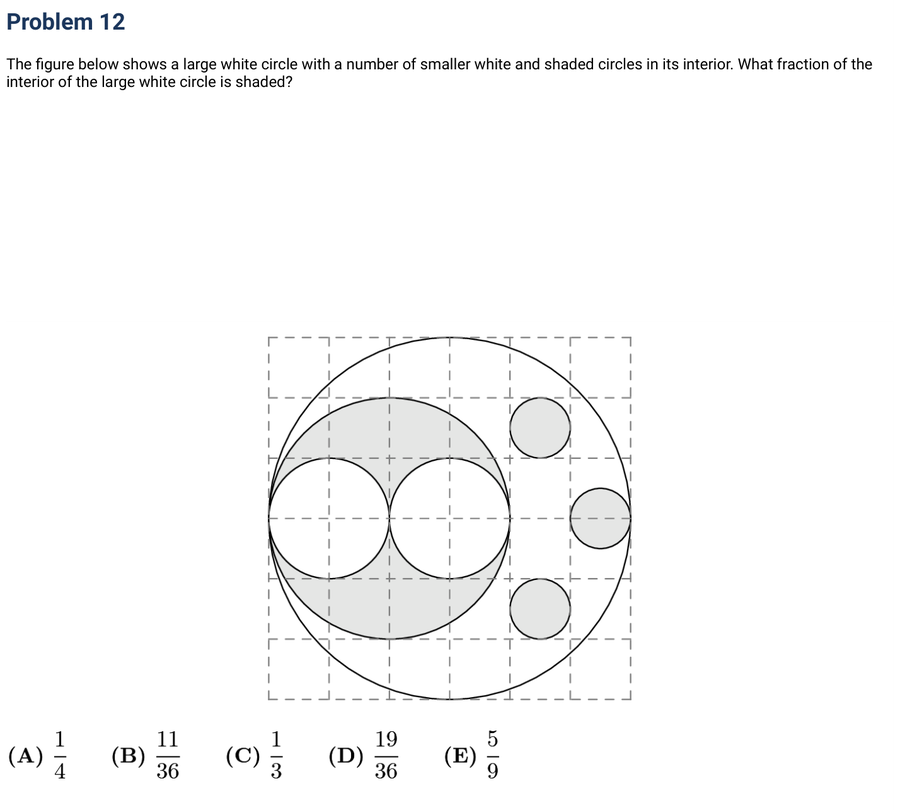
First use the faint grid to read off every radius (3, 2, 1, and 12). Then notice the big shaded disk has two white circles biting into it — so its shaded area is disk minus those bites.
Still stuck? Show hint 2 →
Hint 2 of 2
Because every area carries a factor of π, you can drop the π and just compare radius-squared values: outer = 9, big disk = 4, each inner white = 1, each tiny shaded = 14. The π cancels in the final fraction.
Show solution
Approach: sum shaded, subtract carved-out whites
Read the radii off the grid: outer circle 3, big shaded disk 2, the two white circles inside it 1 each, the three tiny shaded circles 12 each. Since we want a fraction, the π will cancel — so really just work with radius-squared.
Big shaded disk has area 4π, but two white circles (1π each) eat into it: net shaded there = 4π − 2π = 2π.
Three tiny shaded circles add 3 × π4 = 3π4.
Total shaded = 2π + 3π4 = 11π4, over the outer 9π: 11π/49π = 1136. Worth keeping: in any ‘what fraction is shaded’ circle problem the π always cancels — compare radius² values and skip π entirely.
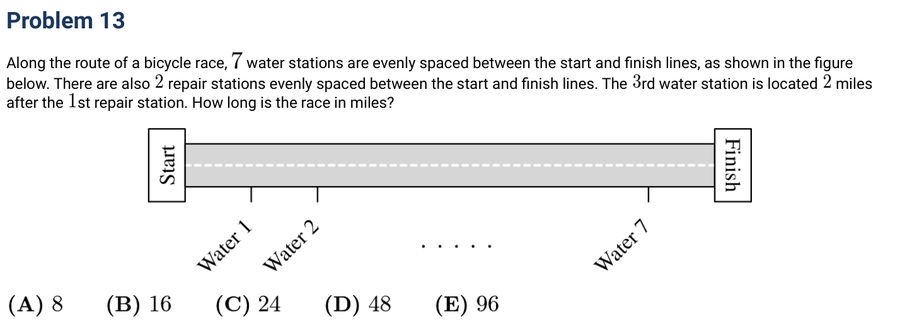
Forget miles for a moment — locate each station as a fraction of the whole route. The watch-out: stations sit between start and finish, so 2 stations make 3 equal gaps (not 2).
Still stuck? Show hint 2 →
Hint 2 of 2
2 repair stations → route split into thirds, so the 1st repair is at 1/3. 7 water stations → eighths, so the 3rd water is at 3/8. The gap between those positions is the given 2 miles.
Show solution
Approach: convert station positions to fractions of the route
Pin each station as a fraction of the route. The key (and the trap): n stations spaced between start and finish cut it into n+1 equal pieces. So 2 repair stations → thirds (1st repair at L/3) and 7 water stations → eighths (3rd water at 3L/8).
The 3rd water is 2 miles past the 1st repair, so 3L/8 − L/3 = 2.
Combine over 24: (9L − 8L)/24 = L/24 = 2, so L = 48 miles. Worth keeping: ‘k things evenly spaced between two ends’ always means k+1 gaps — the classic fencepost catch.
Another way — spacing variables (MAA):
Let w be the gap between water stations and r the gap between repair stations. The whole route is 8w = 3r.
The 3rd water (at 3w) is 2 past the 1st repair (at r): 3w = r + 2. Sub r = 3w − 2 into 8w = 3r: 8w = 9w − 6, so w = 6.
Number Theorycomplementary-countingcareful-counting
Nicolas is planning to send a package to his friend Anton, who is a stamp collector. To pay for the postage, Nicolas would like to cover the package with a large number of stamps. Suppose he has a collection of 5-cent, 10-cent, and 25-cent stamps, with exactly 20 of each type. What is the greatest number of stamps Nicolas can use to make exactly $7.10 in postage?
Show answer
Answer: E — 55 stamps.
Show hints
Hint 1 of 2
‘Use the most stamps’ is hard to chase directly. Flip it: he owns a fixed pile worth a fixed total, so using the most stamps means setting aside the fewest. What's the whole pile worth?
Still stuck? Show hint 2 →
Hint 2 of 2
All 60 stamps total $8.00, and he only needs $7.10 — so he must hold back exactly $0.90. Now the easy question: what's the fewest stamps that make $0.90?
Show solution
Approach: minimize stamps removed, not maximize stamps used
Maximizing what you use is the same as minimizing what you leave out — and since the whole pile is fixed, the leftover is fixed in value too. That flip turns a messy ‘maximize’ into a tidy ‘minimize.’
All 60 stamps total 20 × ($0.05 + $0.10 + $0.25) = 20 × $0.40 = $8.00. To pay $7.10 he must hold back $8.00 − $7.10 = $0.90.
Fewest stamps making $0.90: grab the biggest coins first — three 25¢ (75¢), one 10¢, one 5¢ = $0.90 with just 5 stamps.
Stamps used = 60 − 5 = 55. This transfers: ‘use the most/fewest of a fixed supply’ problems are almost always easier solved by counting the complement — what you don't use.
Another way — build up directly (MAA):
To pile on stamps, lean on the small ones and use as few 25¢ as possible. The 5¢ and 10¢ together max out at $1.00 + $2.00 = $3.00, so you need at least $4.10 more from quarters — at least seventeen 25¢ = $4.25.
That leaves $7.10 − $4.25 = $2.85. Since $2.85 isn't a whole number of dimes, use an odd count of nickels: nineteen 5¢ = $0.95 leaves $1.90 = nineteen 10¢.
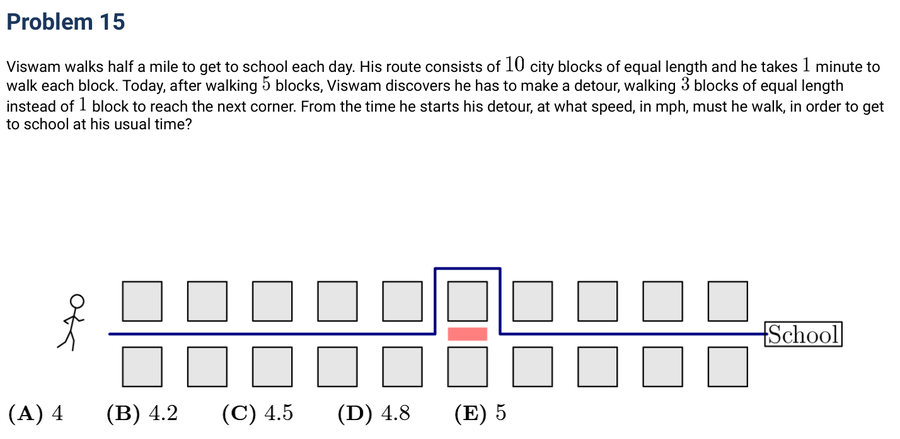
The deadline doesn't move — he still has the same 5 minutes left. What changed is only the distance: the detour swaps 1 block for 3, adding 2 extra blocks.
Still stuck? Show hint 2 →
Hint 2 of 2
So in the leftover 5 minutes he must now cover 7 blocks instead of 5. Turn both into mph-friendly units: each block is 0.05 mile, 5 minutes is 1/12 hour.
Show solution
Approach: convert blocks to miles, time to hours
The anchor is that his arrival time is unchanged — so his time budget for the rest of the walk is fixed, and only his distance grew. That's what forces a faster speed.
Usual walk: 10 blocks = 0.5 mile in 10 min, so each block is 0.05 mile and 5 blocks normally take 5 minutes. After the detour, the detour swaps 1 block for 3, so the remaining trip is 5 + 2 = 7 blocks = 0.35 mile.
He still has only 5 minutes = 1/12 hour. Speed = 0.35 ÷ (1/12) = 0.35 × 12 = 4.2 mph. This transfers: when a deadline is fixed and only the distance changes, hold time constant and let speed = new distance ÷ that fixed time.
Another way — scale up his old speed by the extra distance:
His normal pace covers those last 5 blocks in exactly the 5 minutes he has. The detour makes him cover 7 blocks in that same time — 7/5 as far.
So he must go 7/5 times his usual 3 mph: 3 × 7/5 = 21/5 = 4.2 mph.
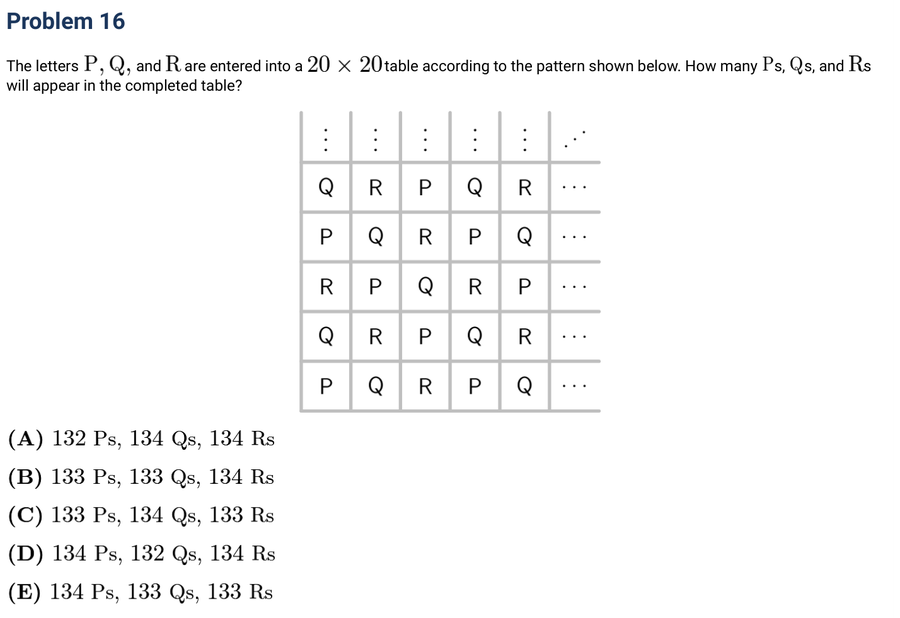
20 isn't a multiple of 3, so the three letters can't come out perfectly equal — 400 = 3 × 133 + 1 means exactly one letter gets one extra. The real work is finding which letter.
Still stuck? Show hint 2 →
Hint 2 of 2
Trick to balance the board: pretend you add a 21st column that's a copy of column 3. Each row of P,Q,R repeating across 21 cells holds exactly 7 of each — perfectly even. Then just subtract back off the column you added.
Show solution
Approach: pad to a clean width, then subtract the extra column
Since 20 isn't divisible by 3, the counts can't be equal: 400 = 3 × 133 + 1, so two letters tie at 133 and one gets 134. The whole question is which letter wins the leftover.
Make the width friendly: imagine appending a 21st column identical to the 3rd column. Now every row spans 21 = 3 × 7 cells, so each row has exactly 7 P, 7 Q, 7 R. Over 20 rows that's 140 of each — perfectly balanced.
Now undo it: the column you added (a copy of column 3, which reads P, R, Q, P, R, … down 20 cells) contains 7 Ps, 6 Qs, 7 Rs. Subtract from 140 each: 140−7 = 133 Ps, 140−6 = 134 Qs, 140−7 = 133 Rs.
So the table has 133 Ps, 134 Qs, 133 Rs. This transfers: when a repeating pattern doesn't fit evenly, pad it to a clean multiple where counting is trivial, then subtract the padding.
Another way — tile with 1×3 triominoes (MAA):
Any 1×3 straight tile laid on the pattern covers exactly one P, one Q, and one R. So wherever the board tiles cleanly, the three letters stay perfectly balanced.
Split the 20×20 board into an 18×18 square, a 2×18 strip, an 18×2 strip (all divisible by 3, so balanced), plus a leftover 2×2 corner.
That corner reads Q R / P Q — one extra Q. So the whole board has one more Q than P or R: 133 Ps, 134 Qs, 133 Rs.
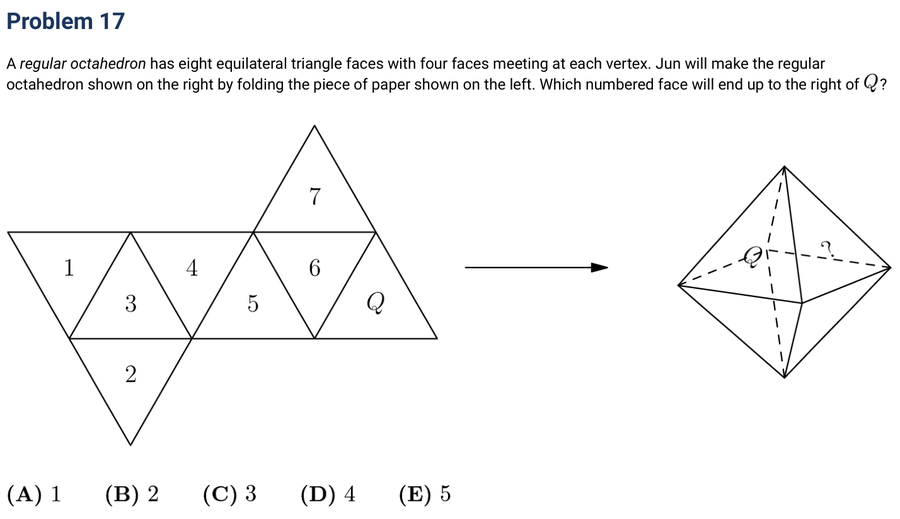
Don't try to fold the whole net in your head. Use the structure: an octahedron is two pyramids glued base-to-base, so its 8 faces split into a top 4 and a bottom 4, and exactly 4 faces meet at each tip.
Still stuck? Show hint 2 →
Hint 2 of 2
Hunt for 4 faces that all share one corner in the net — those become one pyramid (one hemisphere). Faces 2, 3, 4, 5 do that, so the other four {Q, 6, 7, 1} are Q's hemisphere; the answer must be among them.
Show solution
Approach: split the eight faces into two hemispheres of four
Instead of mentally folding, use the octahedron's structure: it's two square pyramids base-to-base, so the 8 faces split into a top set of 4 and a bottom set of 4, and exactly 4 faces ring each apex.
In the net, faces 2, 3, 4, 5 all meet at a single vertex — that vertex becomes one apex, making {2, 3, 4, 5} one hemisphere. Q can't be in that group, so by elimination Q's hemisphere is {Q, 6, 7, 1}.
Within that ring of four around the top apex, the fold seats face 1 immediately to the right of Q. This transfers: for any solid-from-net puzzle, first sort faces into the groups that share a vertex — it slashes the possibilities before you fold anything.
Greta Grasshopper sits on a long line of lily pads in a pond. From any lily pad, Greta can jump 5 pads to the right or 3 pads to the left. What is the fewest number of jumps Greta must make to reach the lily pad located 2023 pads to the right of her starting position?
Show answer
Answer: D — 411 jumps.
Show hints
Hint 1 of 2
Order doesn't matter — jumping right-then-left lands the same place as left-then-right. So all that matters is how many of each.
Still stuck? Show hint 2 →
Hint 2 of 2
She should overshoot 2023 with right jumps (landing on a multiple of 5), then walk back to 2023 in left jumps of 3. Find the first overshoot whose gap is a multiple of 3.
Show solution
Approach: overshoot to a multiple of 5, then step back by 3s
Order doesn't matter, so do all the right jumps first: they land Greta on a multiple of 5 just past 2023. Then left jumps of 3 carry her back to 2023, so the overshoot gap must be a multiple of 3.
Right jumps: 2035 ÷ 5 = 407. Left jumps: 12 ÷ 3 = 4. Total: 407 + 4 = 411 jumps. This transfers: ‘reach a target using two step sizes’ problems collapse once you realize order doesn't matter — only the counts of each step do, so you're really just solving 5R − 3L = 2023 in whole numbers.
Another way — pair each left jump with a right jump (MAA):
Pair every left jump with a right jump: a pair nets 5 − 3 = 2 pads forward, and any leftover right jumps add 5 each. With P pairs and Q spare right jumps, 2P + 5Q = 2023 and the total jumps is 2P + Q.
Spare right jumps move farther per jump, so maximize Q (minimize P). The smallest P making 2023 − 2P a multiple of 5 is P = 4, giving Q = (2023 − 8)/5 = 403.
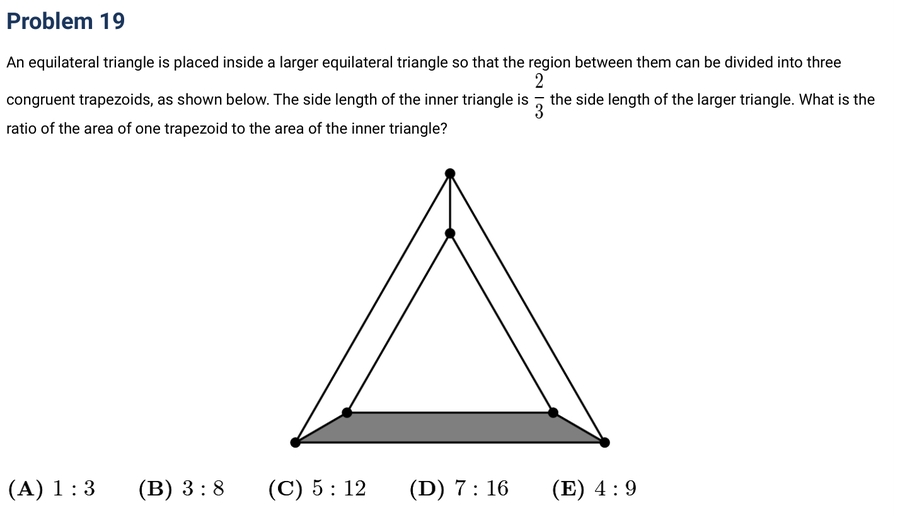
You never need the actual area formula. Lengths scale by 2:3, so areas scale by the square: (2/3)2 = 4/9. That one fact does all the work.
Still stuck? Show hint 2 →
Hint 2 of 2
Pick friendly numbers: let the inner triangle be 4 and the outer be 9 (ratio 4:9). The three trapezoids together fill the gap 9 − 4, then split it evenly into three.
Show solution
Approach: areas scale as side-length squared
Don't reach for ½·base·height — the key is that for similar figures, doubling lengths quadruples area: area scales as the square of the length ratio. Side ratio 2:3 → area ratio 4:9.
So set inner area = 4 and outer area = 9 (any pair in 4:9 works). The ring of three congruent trapezoids fills the leftover 9 − 4 = 5, so each trapezoid is 53.
One trapezoid : inner triangle = 5/34 = 512, i.e. 5 : 12. Worth keeping: whenever you see a ratio of lengths, square it for the ratio of areas (and cube it for volumes) — then you can assign convenient numbers and skip the geometry.
Another way — solve for the trapezoid area (MAA):
Let the inner triangle have area A. The outer triangle is (3/2)2 = 9/4 as large, so its area is 94A.
Inner triangle plus three trapezoids fills the outer triangle: A + 3X = 94A, so 3X = 54A and X = 512A.
Two integers are inserted into the list 3, 3, 8, 11, 28 to double its range. The mode and median remain unchanged. What is the maximum possible sum of two additional numbers?
Show answer
Answer: D — 60.
Show hints
Hint 1 of 2
‘Double the range’ just fixes how far apart the new min and max are (50 apart). To make the sum big, don't lower the min — keep it at 3 and shoot the max as high as allowed.
Still stuck? Show hint 2 →
Hint 2 of 2
Keeping min = 3 forces the new max to 3 + 50 = 53 (one insert, used up). Now the second insert should be as big as possible without breaking median = 8 or mode = 3 — so it has to stay below 8.
Show solution
Approach: push max up, then maximize the other insert under the median/mode constraints
Doubling the range only sets the spread between min and max to 50 — it doesn't say which one moves. Since we want a large sum, keep the small end at 3 and stretch the top: the new max must be 3 + 50 = 53. That's one of the two inserts spent.
Now place the second insert x as high as possible. The list has 7 numbers, so the median is the 4th when sorted: 3, 3, 8, 11, 28, 53 already sit there, and median must stay 8.
If x were 8 or more, the 4th spot would no longer be 8 (and x = 8 would also create a second mode). So x ≤ 7 — and x = 7 keeps 3 the unique mode and 8 the median.
Max sum = 53 + 7 = 60. Worth keeping: to maximize a sum under min/max/median/mode rules, fix the cheap constraints first (anchor the min, blow up the max), then push each remaining value to the edge of what the rules allow.
Alina writes the numbers 1, 2, …, 9 on separate cards, one number per card. She wishes to divide the cards into 3 groups of 3 cards so that the sum of the numbers in each group will be the same. In how many ways can this be done?
Show answer
Answer: C — 2 ways.
Show hints
Hint 1 of 2
Find the target sum first — that single number tells you a lot. In particular, where can the three largest cards possibly sit?
Still stuck? Show hint 2 →
Hint 2 of 2
Each group sums to 15, so 7, 8, 9 can't share a group (7+8 already overshoots room) — they're spread one per group. Same for 1, 2, 3. Now the only freedom left is where 5 lands; case-split on that.
Show solution
Approach: fix the totals, then place the extreme numbers
The total 1+2+…+9 = 45 splits into three equal groups, so each must sum to 15. That target instantly pins the big and small cards.
7, 8, 9 must each land in a different group (any two of them already total 15 or more, leaving no room for a positive third). By the same squeeze, 1, 2, 3 spread out one per group too.
So the only real choice is 5's partner-pair, which must sum to 10: {3,5,7}, {2,5,8}, or {1,5,9}. Test each by finishing the other two groups.
{2,5,8} dies: it would leave 1, 3, 7, 9 to form two groups of 15, but 9 needs a 6 (gone) and 7 needs an 8 (gone) — impossible. The other two succeed: {1,5,9}/{3,4,8}/{2,6,7} and {3,5,7}/{1,6,8}/{2,4,9}.
So there are 2 ways. This transfers: in equal-sum partition problems, first compute the target, then corner the extreme values — the largest elements have the fewest legal homes, so placing them first kills most of the casework.
In a sequence of positive integers, each term after the second is the product of the previous two terms. The sixth term in the sequence is 4000. What is the first term?
Show answer
Answer: D — 5.
Show hints
Hint 1 of 2
Don't guess numbers — track structure. Call the first two terms a and b; every later term is a product, so it's just a and b raised to some powers. Watch how those powers grow.
Still stuck? Show hint 2 →
Hint 2 of 2
The exponents of a (and of b) each follow a Fibonacci-style add: the 6th term is a3b5. Now break 4000 into primes and match.
Show solution
Approach: track exponents of a and b through the sequence
Let the first two terms be a, b. Each new term multiplies the previous two, which adds their exponents — so the exponents climb like Fibonacci: a, b, ab, ab2, a2b3, a3b5.
So the 6th term is a3b5 = 4000. Factor: 4000 = 4 × 1000 = 22 × (2×5)3 = 25 × 53. Matching the cube to a3 and the fifth power to b5 gives a = 5, b = 2.
First term: 5. Sanity check: the sequence reads 5, 2, 10, 20, 200, 4000 — the 6th term hits 4000. Worth keeping: in any ‘multiply the previous two’ sequence, the exponents of the two starting values follow the Fibonacci numbers.
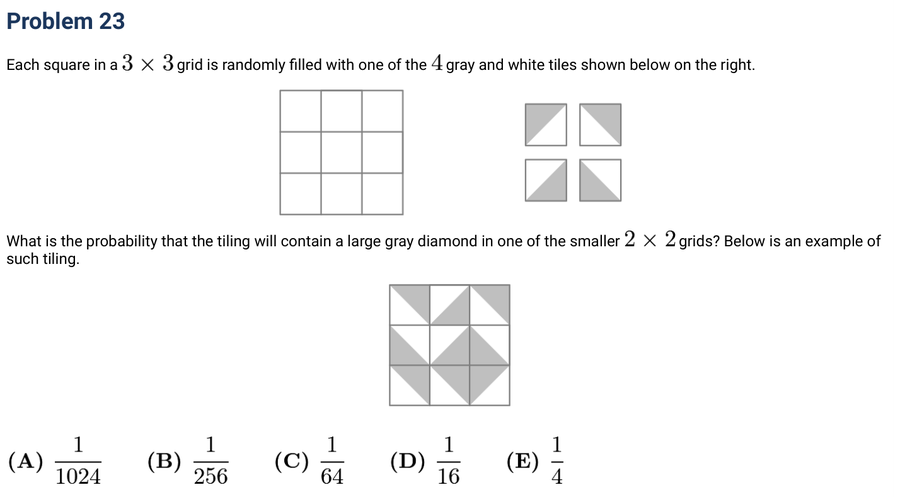
A diamond is built from four tiles meeting at one point — and any 2×2 diamond must use the center cell. So the center tile is already ‘there’; the question is whether its three neighbors line up.
Still stuck? Show hint 2 →
Hint 2 of 2
Once the center tile shows a gray corner, the three tiles touching that corner each need one specific orientation out of 4 to complete the diamond. Three independent 1-in-4 events — multiply.
Show solution
Approach: three neighbor tiles must each orient correctly
Picture how a diamond forms: four gray triangles meet at a single point, and that point is always a corner of the center cell. So the center tile is automatically part of any diamond — whatever gray corner it happens to show is the corner the diamond grows from.
To complete that diamond, the three tiles touching that gray corner must each be turned the right way. Each tile has 4 equally likely orientations, exactly 1 of which works, so each contributes probability 14 — independently.
Multiply: 14 × 14 × 14 = 164. Why this is faster: instead of counting all 49 tilings, condition on the piece that's always involved (the center) and only the constraints that matter survive.
Another way — count favorable tilings (MAA):
Total tilings: each of the 9 cells takes 1 of 4 tiles, so 49 in all.
Favorable: a diamond's center can sit at any of the 4 corners of the middle cell (4 choices). Once chosen, the 4 tiles forming it are forced, but the other 5 cells are free: 45. So favorable = 4 × 45 = 46.
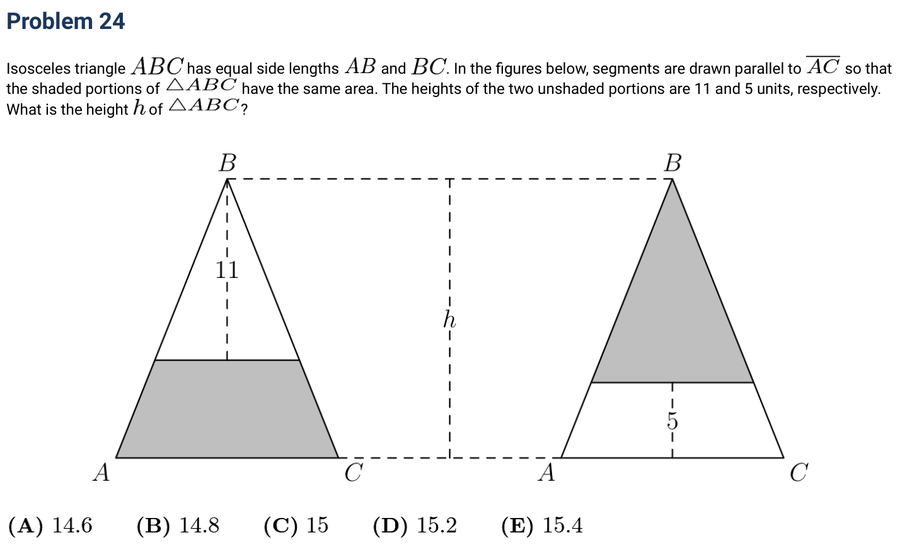
Each cut makes a smaller triangle similar to ABC. The one fact you need: a sub-triangle of height k has area (k/h)2 of ABC — areas scale as the square of height.
Still stuck? Show hint 2 →
Hint 2 of 2
Write both shaded pieces as fractions of ABC and set them equal. Left shaded = whole − top triangle (height 11). Right shaded = the top triangle of height h − 5. The total area T cancels, leaving a clean equation in h.
Show solution
Approach: areas scale as height squared; equate shaded regions
Both cuts create triangles similar to ABC, so the only tool needed is: area shrinks as the square of height. Crucially, the shaded areas being equal means their fractions of ABC are equal — so the actual area T never matters and cancels out.
Left figure: the unshaded top triangle has height 11, so it's (11/h)2 of ABC; the shaded trapezoid is the rest, 1 − (11/h)2.
Right figure: the shaded piece is the top triangle of height h − 5, which is ((h−5)/h)2 of ABC.
Set equal: 1 − 121/h2 = (h−5)2/h2. Multiply by h2: h2 − 121 = h2 − 10h + 25 — the h2 drops out, giving 10h = 146.
h = 14.6. Worth keeping: ‘cut parallel to the base’ always makes a similar triangle whose area is (height ratio)2 — convert to fractions of the whole and the unknown total cancels itself away.
Fifteen integers a1, a2, a3, …, a15 are arranged in order on a number line. The integers are equally spaced and have the property that
1 ≤ a1 ≤ 10, 13 ≤ a2 ≤ 20, and 241 ≤ a15 ≤ 250.
What is the sum of the digits of a14?
Show answer
Answer: A — 8.
Show hints
Hint 1 of 2
‘Equally spaced integers’ means an arithmetic sequence: every step adds the same whole number d. The whole problem turns on pinning down that single d.
Still stuck? Show hint 2 →
Hint 2 of 2
The span a15 − a1 = 14d. Squeeze it: subtract the smallest a1 from the largest a15 for the upper end and vice-versa, getting 231 ≤ 14d ≤ 249. Only one multiple of 14 lives there.
Show solution
Approach: nail d from bounds, then a1, then a14
Equally spaced = arithmetic, so a fixed integer d is added each step. The clever part: although a1 and a15 are each only known within a window, their difference 14d is squeezed into a narrow range — and that range may contain just one multiple of 14.
Widest and narrowest gaps: 241 − 10 ≤ 14d ≤ 250 − 1, i.e. 231 ≤ 14d ≤ 249. The only multiple of 14 in there is 238 = 14 × 17, so d = 17.
Now back-substitute: a2 = a1 + 17 ≤ 20 forces a1 ≤ 3, while a15 = a1 + 238 ≥ 241 forces a1 ≥ 3. The two pincers meet at a1 = 3.
a14 = a15 − d = (3 + 238) − 17 = 224, so the digit sum is 2 + 2 + 4 = 8. This transfers: when loose bounds multiply into a tight one, a divisibility condition (here ‘multiple of 14’) often leaves a single survivor — squeeze, then sieve.